
Self-compacting recycled concrete: basic
mechanical properties, rheology,
robustness and thixotropy
Iris González Taboada
Doctoral Thesis
November 2016
Supervisor: Belén González Fonteboa
Departamento de Tecnoloxía da Construción
Programa de Doutoramento en Enxeñaría Civil
1E.T.S. Enxeñeiros de Camiños, Canais e Portos
1
At this moment, I am going to conclude this “journey” that I began four years ago. In the following lines, I would like to express my deepest appreciation to all those who supported me and gave me the chance to complete this dissertation.
First of all, I would like to express my sincere gratitude to my supervisor Belén for the continuous support and unwavering guidance throughout the course of this work. She gave me the opportunity to participate in this innovative research project and provided the space to develop my own ideas and grow both personally and professionally. In addition, I am deeply indebted to Prof. Fernando Martínez-Abella. Belén and Fernando, I cannot say thank you enough for supporting me throughout my study. I have learned a lot from you. Without your guidance and persistent help, this dissertation would not have been possible.
My sincere thanks also go to Dr. Nicolas Roussel. I am deeply grateful to him for his assistance and the valuable discussions that we had during my research stay at the IFSTTAR.
I got the chance to know many nice people in “Grupo de Construcción – gCons” of University of A Coruña. They were kind to me and provided their help when necessary. I enjoyed the experience of working with them. I will never forget them and I want to tell them “Thank you very much!”. I would like to show special gratitude to María (“a miña IP de laboratorio”) and Sindy. I want to thank them for their assistance during my research work and for their continuous and solid friendship.
I am especially and deeply thankful to Naya, Guille and Iván. Thanks a lot for your enormous patience and continuous encouragement. Without you, I would have never reached this moment. Thank you from the bottom of my heart!
And finally, my most special acknowledgement goes to my parents, for their love, support and encouragement each day of my life. All I have achieved is thanks to them and I would like to dedicate this dissertation to them.
I tried to carefully plan this “journey” from the beginning. However, each day turned out to be an unexpected challenge. Now, I notice that I will only remember the good and positive moments. I know that any work can always be improved. Perfection does not exist. “La dernière chose qu'on
trouve en laissant un ouvrage est de savoir celle qu'il faut mettre la première” (Blaise Pascal). I will
never forget this exciting “journey”. “One’s mind, once stretched by a new idea, never regains its
Self-compacting recycled concrete: basic mechanical properties, rheology,
robustness and thixotropy
This work is focused on the study of hardened and fresh behaviour of self-compacting recycled concrete (SCRC) with different replacement percentages of recycled concrete coarse aggregate (0%, 20%, 50% and 100%).
Regarding hardened behaviour (compressive strength, modulus of elasticity and splitting tensile strength), it has been analysed how the incorporation of recycled coarse aggregate affects self-compacting concrete (SCC). To do so, a database was created with published results regarding vibrated recycled concrete. Different correction coefficients were adjusted to adapt code expressions to this type of concrete. Also, specific prediction expressions for vibrated recycled concretes were adjusted as an alternative to code formulations. Lastly, it has been concluded that both the correction coefficients and the specific expressions can be used with the same accuracy in SCRC as in vibrated recycled concrete.
Regarding fresh behaviour, the relationships between rheological and empirical parameters were analysed concluding that they show the same trend in SCRC as in SCC. In this context, the research has also studied the specificity of SCRC rheology and its influence on the fresh behaviour over time. The achieved conclusions lead to state that this specificity lies in the extra water added to compensate the recycled aggregate absorption and in the intrinsic characteristics of this aggregate. Moreover, the SCRC robustness has been analysed through sensitivity parameters and a statistical approach, defining which factors affect it to a greater extent and which tests provide more sensitivity when this property is studied. Finally, SCRC thixotropy has been evaluated measuring also its influence on interlayer bond strength.
RESUMEN
Hormigón autocompactante reciclado: propiedades mecánicas básicas,
reología, robustez y tixotropía
Este trabajo se centra en el estudio del comportamiento en estado fresco y endurecido del hormigón autocompactante reciclado (HACR) con diferentes porcentajes de sustitución de árido grueso reciclado de hormigón (0%, 20%, 50% y 100%).
del HACR y su influencia en el comportamiento en fresco con el transcurso del tiempo. Las conclusiones alcanzadas permiten exponer que esta particularidad radica en la cantidad de agua extra añadida para compensar la absorción del árido reciclado y en las características intrínsecas de este árido.
Además, se ha analizado la robustez del HACR a través de parámetros de sensibilidad y de una aproximación estadística, definiéndose qué factores afectan en mayor medida y qué ensayos proporcionan más sensibilidad cuando se estudia esta propiedad. Por último, se ha evaluado la tixotropía del HACR midiéndose también su influencia en la adherencia entre capas.
RESUMO
Formigón autocompactante reciclado: propiedades mecánicas básicas,
reoloxía, robustez e tixotropía
Este traballo céntrase no estudo do comportamento en estado fresco e endurecido do formigón autocompactante (FACR) con diferentes porcentaxes de substitución de árido groso reciclado de formigón (0%, 20%, 50% y 100%).
No referente ao comportamento no estado endurecido (resistencia a compresión, módulo de elasticidade e resistencia a tracción), analizouse como afecta ao formigón autocompactante (FAC) a incorporación de árido groso reciclado. Para levar a cabo esta análise, creouse unha base de datos con resultados publicados sobre o formigón vibrado reciclado e axustáronse diferentes coeficientes correctores para adaptar as expresións normativas a este tipo de formigón. Así mesmo, axustáronse expresións preditivas específicas para o formigón vibrado reciclado como unha alternativas ás formulacións das normativas. Finalmente, concluíuse que tanto os coeficientes correctores como as expresión específicas se poden empregar no FACR coa mesma precisión que no formigón vibrado reciclado.
Polo que respecta ao comportamento no estado fresco, analizáronse as relacións entre parámetros reolóxicos e empíricos concluíndose que seguen a mesma tendencia no FACR que no FAC. Neste contexto, a investigación estudou tamén a particularidade da reoloxía do FACR e a súa influencia no comportamento en fresco co transcurso do tempo. As conclusións alcanzadas permiten expoñer que esta particularidade radica na cantidade de auga extra engadida para compensar a absorción do árido reciclado e nas características intrínsecas deste árido.
CHAPTER I INTRODUCTION ... 1
1 INTRODUCTION ... 1
2 RESEARCH OBJECTIVES ... 2
3 OUTLINE OF THIS DISSERTATION ... 3
CHAPTER II LITERATURE REVIEW ……… 5
1 INTRODUCTION ... 5
2 RECYCLED CONCRETE AGGREGATE ... 5
2.1 Introduction and scope of this section ... 5
2.2 Properties of recycled concrete aggregates ... 7
2.2.1 Composition ... 7
2.2.2 Adhered mortar ... 8
2.2.3 Shape and particle size distribution ... 9
2.2.4 Water absorption ...11
2.2.5 Saturated surface dry density ...12
2.2.6 Abrasion resistance ...14
2.3 Influence of recycled concrete aggregate properties on concrete compressive strength ...17
2.4 Final remarks ...19
3 RECYCLED CONCRETE (RC) ...20
3.1 Materials ...20
3.2 Mix proportions ...22
3.3 Mixing procedure...24
3.4 Fresh-state properties...25
3.5 Hardened-state properties ...26
3.6 Durability ...29
4 SELF-COMPACTING CONCRETE (SCC) ...30
4.1 Rheology...32
4.1.4 Thixotropy ... 39
4.1.5 Concrete rheometers ... 41
4.2 Materials ... 43
4.3 Mix proportions ... 44
4.4 Mixing procedure ... 46
4.5 Fresh-state properties ... 47
4.6 Hardened-state properties ... 50
4.7 Durability ... 51
5 SELF-COMPACTING RECYCLED CONCRETE (SCRC) ... 52
5.1 Materials ... 52
5.2 Mix proportions ... 53
5.3 Mixing procedure ... 54
5.4 Fresh-state properties ... 54
5.5 Hardened-state properties ... 56
5.6 Durability ... 57
6 SPECIFIC OBJECTIVES ... 58
CHAPTER III EXPERIMENTAL PROGRAM... 61
1 INTRODUCTION ... 61
2 MATERIALS... 63
2.1 Cement, filler, superplasticiser and water ... 63
2.2 Aggregates ... 64
3 MIX PROPORTIONS... 69
3.1 Mix design parameters from databases ... 70
3.2 Mix design parameters from equivalent mortar analysis ... 71
3.3 Concrete mix design ... 74
4 MIXING PROCEDURE ... 75
4.1 Materials preparation ... 75
4.2 Temperature and humidity ... 78
4.3 Mixing protocol ... 79
5 TESTING PROGRAM ... 81
5.1 Phase 1 and phase 2: Rheology and Robustness... 81
5.1.2 Hardened-state tests ...88
5.1.3 Rheology and Robustness testing protocol ...89
5.2 Phase 3: Thixotropy ...90
5.2.1 Assessment of SCRC thixotropy ...90
5.2.2 Interlayer bond strength of SCRC ...93
5.2.3 Hardened-state tests ...96
5.2.4 Thixotropy testing protocol ...96
CHAPTER IV HARDENED-STATE BEHAVIOUR OF RECYCLED CONCRETE AND SELF-COMPACTING RECYCLED CONCRETE USING DATABASE ANALYSIS ...99
1 INTRODUCTION AND OBJECTIVES ...99
2 RECYCLED CONCRETE (RC) ...100
2.1 Objectives ...101
2.2 Methodology ...102
2.2.1 Genetic programming methodology ...102
2.2.2 Conventional concrete property vs recycled concrete property ...103
2.2.3 Correction of code expressions ...104
2.2.4 Adjustment of specific expressions ...105
2.2.5 Adjustment goodness...106
2.3 Compressive strength (fc) ...107
2.4 Modulus of elasticity (Ec)...109
2.4.1 Conventional concrete property vs recycled concrete property ...111
2.4.2 Correction of code expressions ...112
2.4.3 Adjustment of specific expressions ...116
2.5 Splitting tensile strength (fsp) ...120
2.5.1 Conventional concrete property vs recycled concrete property ...121
2.5.2 Correction of code expressions ...123
2.5.3 Adjustment of specific expressions ...124
3 SELF-COMPACTING RECYCLED CONCRETE (SCRC) ...128
3.1 Objectives ...130
3.2 Hardened properties of SCRC ...131
3.2.1 Density ...131
3.3.2 Modulus of elasticity (Ec) ... 136
3.3.3 Splitting tensile strength (fsp) ... 136
3.4 Suitability of correction coefficients to code expressions ... 136
3.4.1 Modulus of elasticity (Ec) ... 137
3.4.2 Splitting tensile strength (fsp) ... 139
3.5 Suitability of specific expressions ... 141
4 CONCLUSIONS ... 142
CHAPTER V RESULTS OF SELF-COMPACTING RECYCLED CONCRETE FRESH BEHAVIOUR: RHEOLOGY AND ROBUSTNESS ... 145
1 INTRODUCTION ... 145
2 BACKGROUND AND OBJECTIVES ... 146
3 RHEOLOGY ... 147
3.1 Study of rheology with empirical tests ... 147
3.1.1 Empirical parameters. Limits ... 147
3.1.2 Empirical results... 149
3.2 Study of rheology with rheological tests ... 155
3.2.1 Rheological parameters. Rheological models... 155
3.2.2 Rheological results ... 159
4 ROBUSTNESS ... 163
4.1 Study of robustness with empirical tests ... 163
4.2 Study of robustness with rheological tests ... 178
5 CONCLUSIONS ... 181
CHAPTER VI ANALYSIS OF SELF-COMPACTING RECYCLED CONCRETE FRESH BEHAVIOUR: WORKABILITY AND RHEOLOGY ... 183
1 INTRODUCTION AND OBJECTIVES ... 183
2 RELATIONSHIPS BETWEEN EMPIRICAL AND RHEOLOGICAL PARAMETERS IN SCC AND SCRC ... 184
2.1 Relationships between empirical parameters ... 185
2.2 Relationships between empirical and rheological parameters ... 188
2.3 Use of a workability box to define suitable SCRC fresh behaviour ... 189
3 RHEOLOGICAL BEHAVIOUR OF SCRC AT 15 MIN ... 191
3.2 Influence of materials variations ...203
4 RHEOLOGICAL BEHAVIOUR OF SCRC OVER TIME...206
4.1 Introduction...206
4.2 Approach to rheological analysis over time. Thixotropy and workability loss ...207
4.3 Rheological analysis over time ...208
5 CONCLUSIONS ...212
CHAPTER VII ANALYSIS OF SELF-COMPACTING RECYCLED CONCRETE FRESH BEHAVIOUR: ROBUSTNESS ...215
1 INTRODUCTION AND OBJECTIVES ...215
2 SENSITIVITY PARAMETERS APPROACH TO SCRC ROBUSTNESS ...216
3 STATISTICAL APPROACH TO SCRC ROBUSTNESS ...218
3.1 Methodology ...218
3.2 Evaluation of SCRC robustness ...222
3.3 Selection of reliable SCRC properties to evaluate robustness ...229
4 CONCLUSIONS ...233
CHAPTER VIII THIXOTROPY OF SELF-COMPACTING RECYCLED CONCRETE...235
1 INTRODUCTION AND OBJECTIVES ...235
1.1 Introduction...235
1.2 Objectives ...237
2 ASSESSMENT OF SCRC THIXOTROPY ...238
2.1 Structural breakdown curves ...238
2.2 Hysteresis curves ...241
2.3 Yield stress at rest ...242
3 INTERLAYER BOND STRENGTH OF SCRC ...245
4 CONCLUSIONS ...248
CHAPTER IX CONCLUSIONS AND FUTURE RESEARCH ...249
1 CONCLUSIONS ...249
1.1 Hardened-state behaviour of recycled concrete and self-compacting recycled concrete using database analysis ...249
1.2 Workability and rheology of self-compacting recycled concrete ...250
CHAPTER X REFERENCES ... 253
REFERENCES CITED IN THE TEXT OF ALL CHAPTERS ... 253
REFERENCES – RECYCLED CONCRETE AGGREGATE DATABASE ... 271
REFERENCES – RECYCLED CONCRETE DATABASE ... 279
APPENDIX A EXTENDED SUMMARY IN SPANISH ... 285
CHAPTER I INTRODUCTION ... 1
Figure I-1. The key idea in the construction sector ... 1
CHAPTER II LITERATURE REVIEW ……… 5
Figure II-1. Year of publication vs. Number of papers (recycled concrete aggregate database) ... 6
Figure II-2. Recycled concrete aggregates composition [ETXE07a] ... 8
Figure II-3. Recycled aggregate interface [LI12] [SEO14] ... 9
Figure II-4. Recycled concrete aggregate fineness modulus vs. Maximum aggregate size ...10
Figure II-5. Water absorption vs. Maximum aggregate size ...11
Figure II-6. Saturated surface dry density vs. Maximum aggregate size...13
Figure II-7. Water absorption vs. Saturated surface dry density ...14
Figure II-8. Los Angeles coefficient vs. Maximum aggregate size ...15
Figure II-9. Water absorption vs. Los Angeles coefficient ...16
Figure II-10. Saturated surface dry density vs. Los Angeles coefficient ...16
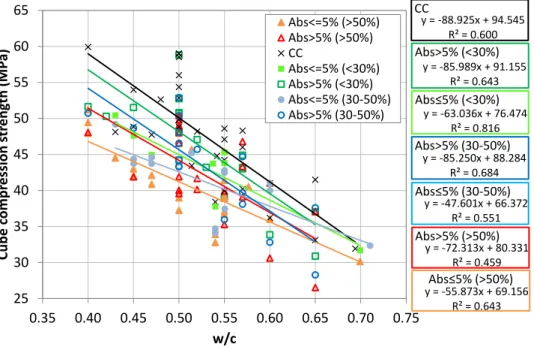
Figure II-11. Cube compression strength vs. water/cement. Effect of recycled aggregate percentage and water absorption...17
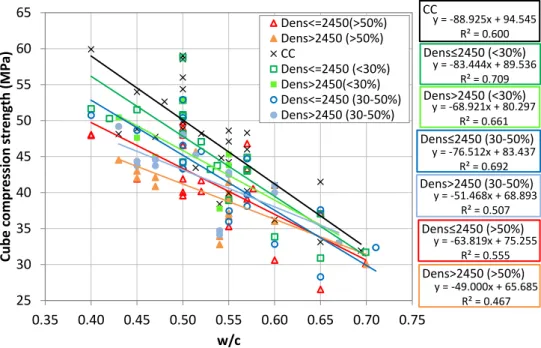
Figure II-12. Cube compression strength vs. water/cement ratio. Effect of recycled aggregate percentage and saturated surface dry density ...18
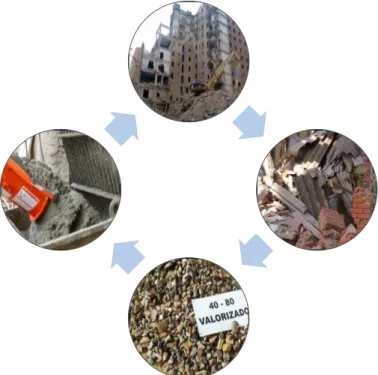
Figure II-13. Life cycle for sustainable development in construction industry ...21
Figure II-14. Recycling procedure [MARI10] ...21
Figure II-15. Possible moisture states of recycled aggregate and mixing procedures ...24
Figure II-16. Self-compacting concrete (SCC) ...30
Figure II-17. Initial necessity of SCC [OKAM03] ...30
Figure II-18. Shear flow [BARN00] ...32
Figure II-19. Flow curves [HU05]...33
Figure II-20. Yield stress and plastic viscosity of fresh concrete [FERR98] ...34
Figure II-21. Representation of aggregate in cement paste [KOEH07] ...35
Figure II-22. Effect of different factors on rheological parameters [BILL12, WALL11] ...36
Figure II-26. A physical explanation of the thixotropic behaviour of cementitious materials
[ROUS06a] ... 40
Figure II-27. Visualization of the thixotropic behaviour of cementitious materials ... 40
Figure II-28. Measurements of thixotropy [KHAY02, KHAY12a]... 41
Figure II-29. Typical rheometer geometry configurations [KOEH09] ... 42
Figure II-30. Concrete rheometers: CEMAGREF-IMG (left) and BTRHEOM (right) ... 43
Figure II-31. Concrete rheometers: Two-Point (left), IBB (centre) and ICAR (right) ... 43
Figure II-32. Typical approaches to achieve self-compactability [OKAM03] ... 45
Figure II-33. Ranges of proportions SCC vs. conventional concrete [OKAM03] ... 46
Figure II-34. Excess paste layer around aggregates [DEEB13]... 47
Figure II-35. Empirical tests: slump flow, L-box, V-funnel, J-Ring ... 48
Figure II-36. Yield stress and plastic viscosity (SCC and conventional concrete) ... 49
Figure II-37. Examples of workability boxes [HWAN06, KOEH09, FERR00] ... 49
Figure II-38. Splitting tensile strength vs. Compressive strength [DOMO07] ... 50
Figure II-39. Modulus of elasticity vs. Compressive strength [DOMO07] ... 51
Figure II-40. The origin of self-compacting recycled concrete ... 52
Figure II-41. Effect of recycled coarse aggregate on sieve segregation test [TANG16] ... 55
Figure II-42. Effect of recycled coarse aggregate on slump flow test [TANG16] ... 55
Figure II-43. Compressive strength of SCRC [GRDI10] ... 56
CHAPTER III EXPERIMENTAL PROGRAM... 61
Figure III-1. Superplasticiser used ... 64
Figure III-2. Natural fine aggregate (left) and natural coarse aggregate (right) ... 65
Figure III-3. RCA composition ... 65
Figure III-4. Constituents of RCA ... 65
Figure III-5. Preparation of aggregate samples for characterization ... 66
Figure III-6. Determination of particle size distribution. Sieving method ... 66
Figure III-7. Determination of particle density and water absorption ... 66
Figure III-8. Determination of flakiness index ... 67
Figure III-9. Aggregates grading ... 67
Figure III-10. Particle size distribution of RCA ... 67
Figure III-11. Shape of coarse aggregates used [QUIR03] ... 68
Figure III-15. RCA water absorption evolution from 0 to 100 min ...70
Figure III-16. Mini-cone (left) and mini-funnel (right) dimensions ...72
Figure III-17. Mini-slump flow test ...72
Figure III-18. Mortar mixer (left). V-funnel (right) ...72
Figure III-19. Mini-slump vs. Mini-funnel of mortar mixes. Equivalent-mortar selection ...74
Figure III-20. Drying process with electrical equipment of gravel (left) and sand (right) ...75
Figure III-21. Air-drying procedure of sand ...76
Figure III-22. Storage of aggregates ...76
Figure III-23. Drying process of recycled aggregate ...77
Figure III-24. Recycled aggregate preparation for M3 method ...77
Figure III-25. Pre-soaking procedure of recycled aggregate ...78
Figure III-26. Materials preparation ...78
Figure III-27. Environmental conditions of laboratory. Temperature and humidity ...79
Figure III-28. Mixer used ...79
Figure III-29. M1 method ...80
Figure III-30. M2 method ...80
Figure III-31. M3 method ...80
Figure III-32. Mixing protocol ...81
Figure III-33. Experimental program flow-chart (phases 1 and 2: Rheology and Robustness) ...82
Figure III-34. Schematic of slump flow apparatus (left, [SCHU05]) and test (right) ...82
Figure III-35. Visual stability index ...83
Figure III-36. Schematic of V-funnel apparatus (left, [SCHU05]) and test (right) ...83
Figure III-37. Schematic of L-box apparatus (left, [DEEB13]) and test (right) ...84
Figure III-38. Schematic of J-Ring apparatus (left) [SCHU05] and test (right) ...85
Figure III-39. Sieve segregation test ...85
Figure III-40. ICAR rheometer [ICAR07]...86
Figure III-41. Speed vs. Time. Stress growth test ...86
Figure III-42. Torque vs. Time. Stress growth test ...86
Figure III-43. Speed vs. Time. Flow curve test ...87
Figure III-44. Torque vs. Time. Flow curve test...87
Figure III-45. Typical flow curve based on Bingham model on the 5 lowest points ...87
Figure III-46. Screen of a stress growth test (left) and of a flow curve test (right) ...88
Figure III-50. Different test devices ... 89
Figure III-51. Experimental program flow-chart (phase 3: Thixotropy) ... 91
Figure III-52. Example of structural breakdown curves ... 91
Figure III-53. Example of structural breakdown area calculation ... 91
Figure III-54. Rheometers used ... 92
Figure III-55. Example of a hysteresis loop flow curve ... 92
Figure III-56. Rotation speed vs. Time on a hysteresis loop flow curve test ... 92
Figure III-57. Typical speed-time profile of yield stress at rest test... 93
Figure III-58. Typical torque-time profile of yield stress at rest test ... 93
Figure III-59. Casting and curing of small beams for bond strength under flexure ... 94
Figure III-60. Schematic of flexural test beams ... 94
Figure III-61. Schematic of flexural test geometry (left) and test (right) ... 95
Figure III-62. Schematic of permeability test prismatic specimens ... 95
Figure III-63. Testing protocol for water penetration under pressure ... 95
Figure III-64. Schematic of three-point bending test geometry (left) and test (right) ... 96
Figure III-65. Compressive strength, modulus of elasticity and splitting tensile strength ... 96
CHAPTER IV HARDENED-STATE BEHAVIOUR OF RECYCLED CONCRETE AND SELF-COMPACTING RECYCLED CONCRETE USING DATABASE ANALYSIS ... 99
Figure IV-1. The recycled concrete interfacial transition zones (ITZ) [OTSU03] ... 100
Figure IV-2. Algorithm example [PERE12] ... 103
Figure IV-3. Methodology used [PERE12] ... 103
Figure IV-4. Methodology of the study ... 106
Figure IV-5. fc,RC vs fc,CC (100%) ... 108
Figure IV-6. fc,RC vs fc,CC (50%) ... 109
Figure IV-7. fc,RC vs fc,CC (20%) ... 109
Figure IV-8. Ec,RC vs Ec,CC (50-100%) ... 112
Figure IV-9. Ec,RC vs Ec,CC (<50%) ... 112
Figure IV-10. Ratio RC vs Ratio CC (AD method) ... 113
Figure IV-11. Ratio RC vs Ratio CC (ADwEW method)... 113
Figure IV-12. Ratio RC vs Ratio CC (PS method) ... 113
... 115
Figure IV-16. Ratio RC corrected with CF vs Ratio CC (AD method) ...115
Figure IV-17. Ratio RC corrected with CF vs Ratio CC (ADwEW method) ...115
Figure IV-18. Ratio RC corrected with CF vs Ratio CC (PS method) ...116
Figure IV-19. Ec,RC predicted value vs Ec,RC experimental value. Training performance (AD method) ... 119
Figure IV-20. Ec,RC predicted value vs Ec,RC experimental value. Testing performance (AD method) ... 119
Figure IV-21. Ec,RC predicted value vs Ec,RC experimental value. Training performance (ADwEW method) ...120
Figure IV-22. Ec,RC predicted value vs Ec,RC experimental value. Testing performance (ADwEW method) ...120
Figure IV-23. Ec,RC predicted value vs Ec,RC experimental value. Training performance (PS method) ... 120
Figure IV-24. Ec,RC predicted value vs Ec,RC experimental value. Testing performance (PS method) 120 Figure IV-25. fsp,RC vs fsp,CC (50-100%) ...122
Figure IV-26. fsp,RC vs fsp,CC (<50%) ...123
Figure IV-27. Ratio RC vs Ratio CC (AD method) ...123
Figure IV-28. Ratio RC vs Ratio CC (ADwEW method) ...123
Figure IV-29. Ratio RC vs Ratio CC (PS method) ...124
Figure IV-30. fsp,RC predicted value vs fsp,RC experimental value. Training performance (AD method) ... 127
Figure IV-31. fsp,RC predicted value vs fsp,RC experimental value. Testing performance (AD method) ... 127
Figure IV-32. fsp,RC predicted value vs fsp,RC experimental value. Training performance (ADwEW method) ...127
Figure IV-33. fsp,RC predicted value vs fsp,RC experimental value. Testing performance (ADwEW method) ...127
Figure IV-34. fsp,RC predicted value vs fsp,RC experimental value. Training performance (PS method) ... 128
Figure IV-35. fsp,RC predicted value vs fsp,RC experimental value. Testing performance (AD method) ... 128
Figure IV-36. Final research proposal ...129
Figure IV-37. Reduction of SCRC fresh-state density vs recycled coarse aggregate percentage ....132
Figure IV-41. fc,RC vs fc,CC ; fc,SCRC vs fc,SCC (100%-ADwEW) ... 135
Figure IV-42. fc,RC vs fc,CC ; fc,SCRC vs fc,SCC (20%-PS) ... 135
Figure IV-43. fc,RC vs fc,CC ; fc,SCRC vs fc,SCC (50%-PS) ... 135
Figure IV-44. fc,RC vs fc,CC ; fc,SCRC vs fc,SCC (100%-PS) ... 135
Figure IV-45. Ec,RC vs Ec,CC ; Ec,SCRC vs Ec,SCC (<50%) ... 136
Figure IV-46. Ec,RC vs Ec,CC ; Ec,SCRC vs Ec,SCC (50-100%) ... 136
Figure IV-47. fsp,RC vs fsp,CC ; fsp,SCRC vs fsp,SCC (<50%) ... 137
Figure IV-48. fsp,RC vs fsp,CC ; fsp,SCRC vs fsp,SCC (50-100%) ... 137
Figure IV-49. Ec,experimental/Ec,calculated-Eurocode in SCRC mixes ... 138
Figure IV-50. Ratio RC vs Ratio CC. Ratio SCRC vs Ratio SCC (Ec) ... 139
Figure IV-51. Ratio RC corrected with CF vs Ratio CC. Ratio SCRC corrected with CF vs Ratio SCC (Ec)
... 139 Figure IV-52. fsp,experimental/fsp,calculated-Eurocode in SCRC mixes ... 140
Figure IV-53. Ratio RC/SCRC vs Ratio CC/SCC (fsp) ... 140
Figure IV-54. Ec,SCRC experimental value vs Ec,SCRC predicted value (RC proposal and codes) ... 141
Figure IV-55. fsp,SCRC predicted value vs fsp,SCRC experimental value (RC proposal and codes) ... 141
CHAPTER V RESULTS OF SELF-COMPACTING RECYCLED CONCRETE FRESH BEHAVIOUR: RHEOLOGY AND ROBUSTNESS ... 145
Figure VI-2. Relationship between SF (slump flow) and PL (L-box) ... 186 Figure VI-3. Relationship between SF (slump flow) and PJ (J-Ring) ... 186 Figure VI-4. Relationship between SF (slump flow) and SFJ (J-Ring) ... 187 Figure VI-5. Relationship between PJ (J-Ring) and PL (L-box) ... 187 Figure VI-6. Relationship between SFJ (J-Ring) and PL (L-box) ... 187 Figure VI-7. Relationship between SFJ (J-Ring) and PJ (J-Ring) ... 187 Figure VI-8. Relationship between t500 (slump flow) and t500J (J-Ring) ... 188 Figure VI-9. Relationship between slump flow (SF) and yield stress (ρ: fresh density (kg/m3) ... 188
Figure VI-10. Relationship between L-box (PL) and yield stress ... 188 Figure VI-11. Relationship between slump flow (t500) and plastic viscosity ... 189 Figure VI-12. Relationship between J-Ring (t500J) and plastic viscosity... 189 Figure VI-13. Workability region 1 (WR1): t500, PL, SFJ ... 190 Figure VI-14. Workability region 2 (WR2): t500J, SF, SFJ ... 190 Figure VI-15. Workability box for SCRC ... 191 Figure VI-16. Static yield stress vs. Plastic viscosity (baseline mixes) ... 192 Figure VI-17. Static yield stress vs. Plastic viscosity (water increase) ... 192 Figure VI-18. Static yield stress vs. Plastic viscosity (water decrease) ... 192 Figure VI-19. Yield stress and plastic viscosity vs. Ø/Ømax ratio ... 197
Figure VI-20. Rheological property vs. Ø/Ømax. Type of aggregate ... 198
Figure VI-21. Natural (left) and recycled (right) coarse aggregates ... 198 Figure VI-22. Yield stress and plastic viscosity vs. (w/c)ef ... 199
Figure VI-23. Yield stress variations vs. w/c ratio (mortars) ... 200 Figure VI-24. Water to cement ratio of SCRCs at 15 min ... 201 Figure VI-25. Yield stress variations vs. (w/c)ef regarding SCRC0W+ ... 201
Figure VI-26. Plastic viscosity variations vs. (w/c)ef regarding SCRC0W+ ... 201
Figure VI-27. Ø/Ømax ratio of SCRCs at 15 min ... 202
Figure VI-36. Yield stress vs. Ø/Ømax. Influence of materials variations ...206
Figure VI-37. Rheograph of baseline mixes ...209 Figure VI-38. Ratios of SF and YS ...209 Figure VI-39. Evolution of (w/c)ef of SCRCs...209
Figure VI-40. Rheological variations vs. Effective w/c ratio over time (SCC vs. SCRC) ...210 Figure VI-41. Rheograph of “S+” mixes ...211 Figure VI-42. Ratios of SF and YS (“S+” mixes) ...211 Figure VI-43. Rheograph of “S-” mixes ...211 Figure VI-44. Ratios of SF and YS (“S-” mixes) ...211 Figure VI-45. Rheograph of “C-” mixes ...211 Figure VI-46. Ratios of SF and YS (“C-” mixes) ...211 Figure VI-47. Rheograph of “C+” mixes ...211 Figure VI-48. Ratios of SF and YS (“C+” mixes) ...211 Figure VI-49. Rheograph of “W+” mixes ...212 Figure VI-50. Ratios of SF and YS (“W+” mixes) ...212 Figure VI-51. Rheograph of “W-” mixes ...212 Figure VI-52. Ratios of SF and YS (“W-” mixes)...212
CHAPTER VII ANALYSIS OF SELF-COMPACTING RECYCLED CONCRETE FRESH BEHAVIOUR: ROBUSTNESS ...215
Figure VII-1. Sensitivity parameters of static yield stress (average 15 and 45 min) ...216 Figure VII-2. Sensitivity parameters of plastic viscosity (average 15 and 45 min) ...216 Figure VII-3. Sensitivity parameters of empirical tests (average 15 and 45 min) ...216 Figure VII-4. Rheological parameter – (w/c)ef (water changes) ...217
Figure VII-5. Rheological parameter – Ø/Ømax (water changes) ...217
Figure VII-6. Flow chart of statistical approach methodology...221
CHAPTER VIII THIXOTROPY OF SELF-COMPACTING RECYCLED CONCRETE...235
Figure VIII-8. Breakdown area of SCRC20 mix ... 240 Figure VIII-9. Breakdown area of SCRC50 mix ... 241 Figure VIII-10. Breakdown area of SCRC100 mix ... 241 Figure VIII-11. “(τi - τe) vs. % RCA” and “Breakdown area vs. % RCA” ... 241
Figure VIII-12. Hysteresis area vs. % RCA ... 242 Figure VIII-13. Hysteresis area vs. Resting time ... 242 Figure VIII-14. Shear stress-time for SCRC0 mix ... 243 Figure VIII-15. Shear stress-time for SCRC20 mix ... 243 Figure VIII-16. Shear stress-time for SCRC50 mix ... 243 Figure VIII-17. Shear stress-time for SCRC100 mix ... 243 Figure VIII-18. τi and τe at each resting time for each SCRC. Yield stress at rest ... 244
Figure VIII-19. τ0 – τe vs. % RCA... 244
Figure VIII-20. τ0 – τe vs. Resting time ... 244
CHAPTER II LITERATURE REVIEW ………..……… 5
Table II-1. Typical pre-soaking methods of recycled aggregates ...25 Table II-2. Effect of recycled concrete aggregate on RC hardened properties (from [SAFI13]) ...26 Table II-3. Factors influencing concrete rheology [KOEH04] ...37 Table II-4. Strength of secondary bonds ...41
CHAPTER III EXPERIMENTAL PROGRAM ...61 Table III-1. Experimental program ...62 Table III-2. Physical properties of cement and limestone filler ...63 Table III-3. Mechanical properties of cement ...63 Table III-4. XRF analysis of cement and limestone filler...63 Table III-5. Basic properties of aggregates ...66 Table III-6. Statistical summary of the mix content of SCC (data from [VILA09]) ...70 Table III-7. Mortar mixes and their rheological properties (mini-slump and mini-funnel) ...73 Table III-8. Mix proportions (1 m³) – “Rheology” and “Robustness” phases ...74 Table III-9. Mix proportions (1 m³) – “Thixotropy” phase ...75 Table III-10. Cement-water contact vs. Delay time between layers ...94
CHAPTER IV HARDENED-STATE BEHAVIOUR OF RECYCLED CONCRETE AND SELF-COMPACTING RECYCLED CONCRETE USING DATABASE ANALYSIS ...99
Table IV-1. Parameters used ...105 Table IV-2. Correction coefficients (X) to estimate fc,RC ...108
Table IV-3. Authors’ equations - Ec,RC ...110
Table IV-4. Correction coefficients (X) to estimate Ec,RC ...111
Table IV-5. Adjustment of the correction coefficient (CF) to calculate the RC modulus ...114 Table IV-6. Parameters a, b and d adjusted using multivariable regression - Ec,RC expression ...116
Table IV-7. Statistical indexes for AD method – Ec expressions ...118
Table IV-8. Statistical indexes for ADwEW method – Ec expressions ...118
Table IV-12. Parameters a, b and d adjusted using multivariable regression– fsp,RC expression ... 124
Table IV-13. Statistical indexes for AD method – fsp expressions ... 126
Table IV-14. Statistical indexes for ADwEW method – fsp expressions ... 126
Table IV-15. Statistical indexes for PS method – fsp expressions ... 126
Table IV-16. Results of SCRC density (“Rheology” phase)... 131 Table IV-17. Results of SCRC density (“Robustness” phase) ... 132 Table IV-18. Results of SCRC mechanical properties (“Rheology” phase) ... 133 Table IV-19. Results of SCRC mechanical properties (“Robustness” phase) ... 133 Table IV-20. Results of SCRC mechanical properties (“Thixotropy” phase) ... 133 Table IV-21. Correction coefficients to estimate fc,SCRC (“Rheology” phase) ... 134
Table IV-22. Correction coefficients to estimate fc,SCRC (“Robustness” phase) ... 134
Table IV-23. Correction coefficients to estimate fc,SCRC, Ec,SCRC, fsp,SCRC (“Thixotropy” phase) ... 134
CHAPTER V RESULTS OF SELF-COMPACTING RECYCLED CONCRETE FRESH BEHAVIOUR: RHEOLOGY AND ROBUSTNESS ... 145
Table V-1. Test methods and parameters measured to evaluate workability characteristics ... 148 Table V-2. Target limits for empirical test parameters ... 148 Table V-3. Rheological tests and parameters measured ... 155 Table V-4. Flow curve test results... 159 Table V-5. Rheological parameters (rheological model and slump flow results) ... 162 Table V-6. Slump flow test requirements ... 164 Table V-7. V-funnel and L-box test requirements ... 165 Table V-8. J-Ring test requirements... 166
CHAPTER VI ANALYSIS OF SELF-COMPACTING RECYCLED CONCRETE FRESH BEHAVIOUR: WORKABILITY AND RHEOLOGY ... 183
Table VI-1. Results used in the analysis of SCRC workability and rheology ... 183 Table VI-2. R² coefficients in relationships between empirical parameters ... 185 Table VI-3. Equivalence between the mix age and the time at rest in stress growth test ... 207
CHAPTER VII ANALYSIS OF SELF-COMPACTING RECYCLED CONCRETE FRESH BEHAVIOUR: ROBUSTNESS ... 215
levels ...226 Table VII-4. SCRC robustness classification ...228 Table VII-5. Evaluation of SCRC robustness (water and superplasticiser variations) ...229 Table VII-6. Evaluation of SCRC robustness (cement variations) ...229 Table VII-7. Kendall’s coefficient and Spearman’s ρs,j (water variations) ...230
Table VII-8. Kendall’s coefficient and Spearman’s ρs,j (superplasticiser variations)...230
Table VII-9. Kendall’s coefficient and Spearman’s ρs,j (cement variations) ...230
Table VII-10. Critical values of Kendall’s coefficient (W*) ...231 Table VII-11. Kendall’s coefficient and Spearman’s ρs,j (6 properties - water variations) ...232
Table VII-12. Kendall’s coefficient and Spearman’s ρs,j (6 properties - superplasticiser variations) 232
Table VII-13. Kendall’s coefficient and Spearman’s ρs,j (6 properties - cement variations) ...232
Table VII-14. Critical values of Kendall’s coefficient (W*) ...233
CHAPTER VIII THIXOTROPY OF SELF-COMPACTING RECYCLED CONCRETE...235
Introduction
1
INTRODUCTION
In recent decades, the economic politics of most governments has led to a production pattern based on the continuous supply of material resources from the natural environment, which eventually ends up as waste. This problem has been notoriously prevalent in the construction sector which has contributed to environmental degradation, producing a high amount of construction and demolition debris (C&D debris) and consuming large volumes of natural resources.
In order to promote sustainable economic growth and ensure sustainable consumption, the United Nations has recently established a new universal set of goals, targets and indicators that member states will be expected to use to outline their political policies over the next 15 years. In accordance, every country will be expected to work towards achieving the 17 main goals established by 2030. These objectives include, but are not limited to, the suitable management of seas, oceans and forests in order to conserve marine and terrestrial resources, combat desertification and reverse land degradation [SDGs15] (Figure I-1).
In this sense, recycled concrete (RC) has been widely recognised as a means to minimize environmental impact and hence, in recent years many researchers have carried out work on its use [EVAN07, CORI09, DAPE11, XIAO13a, GONZ14, CARR15, BRIT16]. Most of them conclude that recycled aggregate from concrete demolition waste provides good enough features for its use in structural concrete. Indeed, with a recycled aggregate content up to 20-30% the degradation of its mechanical properties is unappreciable [XIAO12]. However, the use of high replacement percentages reduces the mechanical strengths of concrete, especially when low quality recycled aggregates are used [BUTL13, ETXE07b, AJDU02].
Many developments were carried out in the field of structural engineering in order to correlate the required properties of concrete to be cast with the structure to be built. This last step has been missing for years in the fresh concrete properties field. Only recently, researchers have started to work on casting prediction tools [KOVL11]. This new research area has appeared at the same time as self-compacting concrete (SCC). “More fluid” is one of the big trends of the last twenty years in the field of modern concretes [ROUS06d]. SCC can flow through and fill the gaps of reinforcements, corners of moulds and voids of rock blocks without any need for vibration and compaction during the placing process, which improves the overall efficiency of concrete construction projects. The use of SCC leads to durable and reliable concrete structures [OKAM03, ZHAN16] and this extremely fluid concrete is expected to be the answer to casting problems. On the other hand, producing a robust, low viscous and low yield value SCC can be really difficult. It is almost an art [WALL06].
As an innovative material, self-compacting recycled concrete (SCRC) links the characteristics of both recycled concrete and self-compacting concrete, satisfying the new construction requirements. Although the use of recycled aggregate is an important indicator of a country’s potential growth, its use in SCC is a relatively new research area and limited studies have been carried out. Also a robust SCRC is almost an art since an only suitable type of SCRC for all applications does not exist, as happens with conventional SCC. Therefore, the study of SCRC in this dissertation will try to obtain significant results both from the aspects of science and practical use.
2
RESEARCH OBJECTIVES
The main goal of this study is to apply the principles of rheology to self-compacting recycled concrete in order to deeply understand its fresh-state behaviour and also to analyse its basic mechanical properties. In this work, recycled aggregate will refer to recycled concrete coarse aggregate. Different SCRC mixes are designed replacing the natural coarse aggregate by the recycled one and also different mixing methods have been used.
According to the literature, self-compacting concrete is expected to present properties in hardened-state similar to those of its equivalent vibrated concrete. Therefore, the first general objective of this work is to prove that it is possible to predict the SCRC properties (compressive strength modulus of elasticity, and splitting tensile strength) using proposed expressions adjusted with vibrated recycled concrete.
On the other hand, in fresh-state, SCRC is expected to show a greater influence of RC and SCC singularities (the particular properties of recycled aggregate and a particular fresh behaviour, respectively). Therefore, this work also aims to investigate how SCRC can be produced with the right workability characteristics (filling ability, passing ability and segregation resistance), rheology and robustness, and to study its thixotropic behaviour.
workability characteristics over time), on the evaluation of its robustness and on the analysis of its thixotropy (evaluating, moreover, its influence on the interlayer bond strength).
This research has been funded by two projects entitled: (a) “Industrial Investigation about Concrete for a Sustainable Market (InHorMeS)” funded by the Innovation Galician Agency; (b) “Robust self-compacting recycled concretes: rheology in fresh state and mechanical properties (Ref: BIA2014-58063-R)” funded by MINECO. Moreover, this work was also possible by the financial support of a pre-doctoral grant of Xunta de Galicia (Spain), also including the INDITEX-UDC 2015 grant for international pre-doctoral stays.
3
OUTLINE OF THIS DISSERTATION
This dissertation is organised into nine chapters, followed by the bibliographical references. Each of them is further divided into sections and sub-sections to clearly present all results and discussion obtained with this work.
A brief overview of the contents of each chapter is presented in the following items.
Chapter I deals with the introduction, the research objectives and the outline of the dissertation. Chapter II reviews the main findings from the literature about recycled concrete aggregate, recycled concrete, self-compacting concrete and self-compacting recycled concrete. The former is studied using database analysis, and various aspects of RC, SCC and SCRC technologies are presented. Firstly, there is an emphasis on general requirements in terms of materials, mix proportions and mixing procedure. Next, the fresh and basic hardened properties of the three types of concrete are explained.
Chapter III deeply describes the experimental program carried out in this work. Firstly, it is described how the SCRC mixes were designed along with their constituent materials and mix proportions. Secondly, the mixing procedures are detailed and lastly, the testing methods and protocols adopted to evaluate the hardened properties and quantify the rheology, robustness and thixotropy of self-compacting recycled concrete are explained.
Chapter IV analyses the hardened-state behaviour of recycled concrete (i.e. vibrated recycled concrete) and self-compacting recycled concrete. Different prediction expressions for compressive strength, modulus of elasticity and splitting tensile strength are adjusted using a database created with published results regarding vibrated recycled concrete. The analysis is focused on determining if the incorporation of recycled concrete coarse aggregate affects SCC to a similar extent as it affects vibrated concrete and if the obtained expressions can be used with the same accuracy in vibrated recycled concrete as in SCRC.
Chapter V shows the results of fresh-state behaviour of all studied SCRCs. Results obtained with rheometer and with empirical tests are presented and also their evolution over time.
In this context, chapter VI is focused on the analysis of fresh-state behaviour regarding workability and rheology of SCRC. It discusses the relationships between empirical parameters and between empirical and rheological ones analysing if they show the same tendency in conventional and recycled self-compacting concretes. On the other hand, it analyses the specificity of SCRC rheology and finally, it studies how the rheology of SCRC evolves over time.
parameters and then a statistical approach is carried out to determine which tests provide more sensitivity when SCRC robustness is evaluated.
Chapter VIII analyses the thixotropy of SCRC using three testing methods: structural breakdown curves at various rotational speeds, hysteresis loop flow curves and yield stress at rest. Finally, the influence of thixotropy on the interlayer bond strength is studied using flexural tests and water permeability tests.
Chapter IX presents the conclusions and some areas are also recommended for future research. Chapter X reports, firstly, a sequence of alphabetical order for the references cited in the text of all chapters. Then, the references used to create the database of recycled concrete aggregate (presented in Chapter II) are listed. Finally, the references used to create the database of recycled concrete (developed in Chapter IV) are shown.
Some of the works described in this dissertation have contributed to the publication of some research papers and others are in the process of publication:
González-Taboada, Iris, González-Fonteboa, Belén, Roussel, Nicolas, Martínez-Abella, Fernando. Rheology and robustness of self-compacting recycled concrete. Cement and
Concrete Composites, under review.
González-Taboada, Iris, González-Fonteboa, Belén, Pérez-Ordóñez, Juan Luis, Eiras-López, Javier. Prediction of self-compacting recycled concrete mechanical properties using vibrated recycled concrete experience. Construction and Building Materials, under review.
González-Taboada, Iris, González-Fonteboa, Belén, Martínez-Abella, Fernando, Pérez-Ordóñez, Juan Luis. Prediction of the mechanical properties of structural recycled concrete using multivariable regression and genetic programming. Construction and Building
Materials, vol. 106, pp. 480-499, 2016.
González-Taboada, Iris, González-Fonteboa, Belén, Martínez-Abella, Fernando, Carro-López, Diego. Study of recycled concrete aggregate quality and its relationship with recycled concrete compressive strength using database analysis. Materiales de Construcción, vol. 66 (323), 2016.
Seara-Paz, Sindy, Fonteboa, Belén, Martínez-Abella, Fernando, González-Taboada, Iris. Time-dependent behaviour of structural concrete made with recycled coarse aggregates. Creep and shrinkage. Construction and Building Materials, vol. 122, pp. 95-109, 2016.
Literature review
1
INTRODUCTION
In this chapter, firstly, recycled concrete aggregate is reviewed with a special emphasis on its properties and its influence on compressive strength of recycled concrete. In the next sections, this chapter shows a general overview of the properties of recycled concrete (RC), self-compacting concrete (SCC) and self-compacting recycled concrete (SCRC), highlighting the influence of materials used on their characteristics in fresh and hardened states. In the last section, the specific objectives of this dissertation are summarized.
2
RECYCLED CONCRETE AGGREGATE
This section studies the physical and mechanical properties of recycled concrete aggregate (recycled aggregate from concrete waste) and their influence on structural recycled concrete compressive strength. It is a study of recycled concrete aggregate quality and its relationship with recycled concrete compressive strength using database analysis.
2.1
Introduction and scope of this section
Figure II-1. Year of publication vs. Number of papers (recycled concrete aggregate database)
The objective of this database analysis is to achieve a full understanding of recycled concrete aggregates and propose a design methodology for structural recycled concrete, based on the physical-mechanical properties of recycled concrete coarse aggregates studied using the database. The quality of recycled aggregate concrete depends on the properties of the recycled aggregates. This section deals with the study of aggregates recycled from concrete waste, which are the most suitable aggregates for creating structural recycled concrete. Apart from the natural aggregate, the other main component of this recycled aggregate is the adhered cement mortar. This material is the cause of the main differences between natural aggregates and recycled concrete aggregates [AKBA13, PAIN10a].
Undoubtedly, there is significant variation in the quality of this kind of aggregate. Firstly, it is related to the original concretes and their differences. Low grade original concrete leads to low grade adhered mortar and consequently, low grade recycled aggregates. Secondly, the recycling process is also important because it influences the amount (quantity) of attached mortar, which decreases as the stages in the crushing process increase [NAGA04]. Finally, it should be noted that there is a significant difference between the properties of recycled coarse aggregates and recycled fine aggregates which always contain a much higher proportion of adhered mortar.
Therefore, the original concrete, the recycling process and the size fraction are the three most important issues that should be controlled when producing recycled concrete aggregates.
From a practical point of view, it would be very interesting to establish patterns or relationships between the different physical-mechanical properties of recycled aggregate and also, between these properties and recycled concrete compressive strength.
To achieve this objective, a database has been developed [references 1-152, Chapter X, section “References – Recycled concrete aggregate database”]. This database has been built using 152 works that deal with recycled concrete aggregates, after studying over 250 international works related to recycled aggregates. The inclusion criterion was the fact that the characterization of the aggregates used should be shown, both for natural and recycled aggregates, and this characterization should include at least the following values: size fraction, water absorption, saturated surface dry density and, whenever possible, composition, Los Angeles coefficient, shape coefficient, fineness modulus and other types of density.
Recently, a wide range of reviews have been published by authors proposing a performance-based classification for the use of recycled aggregates in concrete construction [SILV14] and a model to predict the strength loss based on the quality and content of recycled aggregates [SILV15a]. Others have modelled the compressive strength of recycled concrete using artificial neural networks [DUAN13a], while others have presented a range for recycled concrete components using sensitivity analysis with neural networks [KIM13], although no expressions have been presented. However, the objective of this work is not to propose a prediction methodology for recycled concrete compressive strength. There are many variables that influence recycled concrete compressive strength (grading curves, maximum size fraction, natural aggregate source, cement class, possible admixtures, etc.) which have not been taken into account. In fact, it is really difficult to take all these variables into account. Furthermore, compressive strength is usually experimentally measured and adjusted after different mixing tests. Consequently, the objective of this section is to analyse how the recycled concrete aggregate (both percentage and quality) and the mixing procedure (pre-soaking or adding extra water) influence the recycled concrete strength of different categories (high or low water to cement ratios), in order to establish suitable production or manufacturing recommendations to promote further use of recycled concrete.
2.2
Properties of recycled concrete aggregates
2.2.1
Composition
Recycled aggregates are defined as aggregates obtained from the treatment of inorganic material which has been previously used in construction [ACHE06]. The raw material is the waste material generated during the construction and demolition processes. Regarding the particular case of recycled concrete aggregate, this is obtained from the recycling process of concrete waste material.
Therefore, the recycled concrete aggregates are mainly made of natural aggregate and adhered cement mortar. However, it may incorporate impurities and contaminants, which have a negative influence on the properties of the final recycled concrete [YILD15]. These impurities can be very diverse, such as plastic, wood, gypsum, bricks, ceramics, organic material, asphalt, aluminium, etc. The composition of the recycled aggregates depends on the type of original waste, the recycling plant production process and the size fraction obtained through the crushing process, and can differ depending on these three factors.
Aggregate from concrete demolition and debris generally presents a low quantity of impurities, however, the results for the compositions of recycled concrete aggregates obtained from literature are not significant enough to encounter any kind of relationship. Figure II-2 shows an example of the composition of these aggregates measured according to the European Standard EN 933-11 “Classification test for the constituents of coarse recycled aggregate” [EN933-11]. It can be seen that materials from concrete (mortar, aggregates and aggregates with mortar) make up over 90% of the total.
material at 1%, of asphalt at 1% and finally, the sum of other materials like glass, plastic, metals, etc. must be under 1%.
Figure II-2. Recycled concrete aggregates composition [ETXE07a]
In general, with a suitable crushing process, the recycled coarse aggregates from waste concrete can deal with these limits.
2.2.2
Adhered mortar
The main differences between recycled concrete aggregate and natural aggregate are due to the presence of adhered cement mortar [PEDR14a]. This new material makes the aggregate density lower and the water absorption and Los Angeles coefficient higher, which means lower fragmentation resistance. Consequently, the quality and quantity of adhered mortar is one of the key factors controlling the quality of recycled concrete aggregates and, indeed, the performance of recycled concrete.
It is well known that the quality and quantity of adhered mortar is influenced by the quality of the original or parent concrete, production treatment designed in production plants and size fraction of the aggregates.
The influence of the original concrete is not clear. Some researchers explain that, during the crushing process of low strength original concrete, most of the mortar gets separated from the original aggregate because the bond between mortar and aggregate is weak. As this mortar gets crushed into fine particles, it is then removed during the sieving process. Therefore, the recycled coarse aggregate obtained from this low strength original concrete presents a lower quantity of mortar. However, others explain that the quality of attached mortar in recycled aggregates is lower when obtained from low strength original concretes than when obtained from high strength ones, as the water to cement ratio of the low strength concretes is high and hence, the mortar obtained with them is more porous.
Finally, it is also clear that the crushing process reduces the size of waste material and, as the weakest phase of this material is the adhered mortar, it will be more affected by the crushing process than the original aggregates. In this regard, the fine fractions will be mainly composed of adhered mortar. Therefore, the greater the quantity of adhered mortar the finer the size fraction of aggregate.
The presence of adhered mortar implies that, while conventional concrete is a three-phase composite material (on a microscopic scale) with a mortar matrix, aggregates and one interfacial transition zone between these two zones (paste-aggregate interface), recycled concrete has two interfaces, the interface between adhered mortar and the original aggregate and the new interfacial transition zone between the new mortar and the recycled aggregate. The adhered mortar makes bonding between the recycled aggregate and the new mortar (new interface, Figure II-3) weaker, which leads to worse recycled concrete performance, affecting properties related to deformation (modulus of elasticity, drying shrinkage and creep), durability (water absorption and permeability) and, of course, mechanical behaviour (strength) [GONZ05, HANS83]. Moreover, the adhered mortar also controls the concrete’s workability. As the adhered mortar increases, the water absorption also increases and the fresh mixture’s workability decreases.
Figure II-3. Recycled aggregate interface [LI12] [SEO14]
Regarding the mortar content, the literature shows some randomness. Hansen and Narud [HANS83] reported that the mortar content varied from 30, 39 and 60 percent for 16-30 mm, 8-16 mm and 4-8 mm fractions respectively and assessed that original concrete quality hardly influences this quantity. However, according to Li [LI08], the percentage of old mortar (around 20-30%), mainly depends on the properties of the original concrete and the production process. Ravindrarajah and Tam [RAVI85] stated that, in general, recycled coarse aggregates contain an average of about 50% adhered mortar. On the other hand, Sánchez and Alaejos [JUAN09] found ranges of 23-44% for 8-16 mm fraction and of 33-55% for 4-8 mm fraction. This heterogeneity of results is probably due to the difficulty in measuring the adhered mortar quantity, the different original concretes used and, of course, the different treatments designed to manage construction and demolition waste.
2.2.3
Shape and particle size distribution
Recycled aggregate grading is directly linked to the crushing process applied to the original concrete waste [JUAN04]. Furthermore, this process is restricted by the grading curves set out by countries in their regulations [ACHE06].
maximum aggregate size, depending mainly on the crushing process used and the original concrete quality [LOPE08].
However, the recycled fine aggregate grading generally shows thicker size fractions than conventional fine aggregate. Debieb et al. [DEBI10] even points out that recycled sand consists mainly of gravel and a small quantity of medium-sized sand.
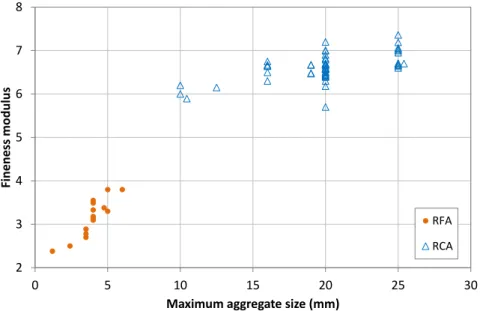
Seventy-one different datasets were considered in the database. The fineness modulus obtained from different authors vary in the range of 5.70 to 7.36 for maximum aggregate sizes between 10 and 25 mm, as shown on Figure II-4, with an average value of 6.55.
Figure II-4. Recycled concrete aggregate fineness modulus vs. Maximum aggregate size
Note: RCA (recycled coarse aggregate); RFA (recycled fine aggregate)
Due to the presence of attached mortar, the surface texture of the recycled coarse aggregates is found to be more porous and rough [BAIR93, JUAN04, YOUN13] than that of the natural aggregate.
Furthermore, it should be taken into account that recycled aggregate generates fines during its manipulation due to the production of small mortar particles. The presence of these fine particles in the recycled coarse aggregate may decrease the bond between the recycled aggregate and the new cement paste and increase the mixing water necessary to achieve fixed workability when the concrete is made [SEAR14]. The Spanish standard limits the fines content to 1% [EHE08]. The Belgian, British and German codes, the Rilem recommendation and the Hong Kong specifications establish a higher limit, which is between 2% and 5% [ACHE06, BSI02, DIN02, RILEM94, WBTC02]. In general, the particle shape of recycled aggregates is determined by the crushing equipment. Impact mills used in recycling plants produce cube-shaped aggregates because concrete tends to break into small blocks without generating slabs [MART11]. In this way, the shape index of recycled and natural coarse aggregate is similar. According to the studies checked [BARB13, JUAN04, OLIV96, ETXE07b, FONS11, GOME02, GONZ05, LOPE14, VIEI11, GONZ08, GONZ02], this index presents a range of values from 0.14 to 0.47 when recycled aggregate is analysed and from 0.19 to 0.58 for natural aggregate. In general, the limit established in the Spanish specification [EHE08] can be fulfilled without any problem.
2 3 4 5 6 7 8
0 5 10 15 20 25 30
Fin
enes
s
mod
ulu
s
Maximum aggregate size (mm)
RFA
2.2.4
Water absorption
The database has verified the usual statement that the water absorption of recycled aggregates is much higher than that of natural aggregates [references 1-152, Chapter X, section “References – Recycled concrete aggregate database”]. The main reason for this difference is the presence of cement mortar that remains attached to the recycled aggregate particles. This cement mortar has higher porosity than the aggregates and therefore, recycled aggregates absorb more water than the conventional kind.
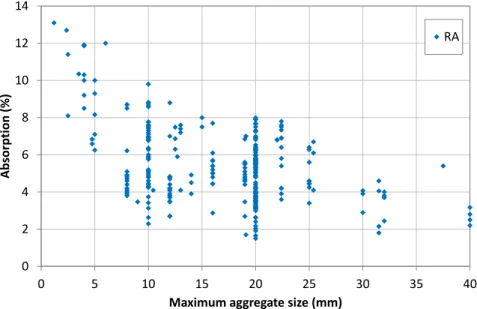
The natural aggregate water absorption usually ranges between 0% and 4%. However, drawing an analysis from the database (two hundred and ninety-nine datasets), the water absorption values obtained for recycled aggregates ranges from 1.65% to 13.1%, with an average value of 5.32%. Furthermore, because of the fact that the percentage of adhered mortar is higher in the sand fraction than in the coarse fraction [ZAHA03], water absorption increases as the size fraction decreases. As already noted, since the weakest phase of waste material is the adhered mortar, it will be more affected by the crushing process than the original aggregates. In this regard, the fine fractions will mainly consist of adhered mortar.
This trend is shown on Figure II-5, highlighting the important influence of the size of recycled aggregate on its water absorption capacity. In this regard, the water absorption of recycled coarse aggregate varies from 1.12 to 8.82%, with an average value of 5.06%, whereas the water absorption of recycled fine aggregate varies from 6.84% to 13.1%, with an average value of 9.89%. However, for the same maximum aggregate size some scatter can be observed, due to the fact that this property is also influenced by the original waste and the crushing processes.
Figure II-5. Water absorption vs. Maximum aggregate size
Note: RA (recycled aggregate)
With regards to original waste, a high quantity of impurities (especially ceramic material) will increase water absorption. However, once again, the influence of the original concrete is not clear, with some researchers indicating that high grade original concrete can make water absorption lower [HANS83, NAGA04] while others [CHAK11, PADM09] state that the water absorption of recycled aggregates increases as the original concrete strength increases. This depends on whether the main effect is the quantity of adhered mortar (low strength original concrete presents
0 2 4 6 8 10 12 14
0 5 10 15 20 25 30 35 40
Absorption
(%
)
Maximum aggregate size (mm)
lower quantity of mortar) or its quality (low strength concrete presents more porous adhered mortar).
Finally, concerning the crushing process, it is clear that a high number of crushing processes leads to lower water absorption values [ETXE07b, LOPE08], due to the fact that these crushing processes reduce the size of the cement adhered mortar which is finally eliminated during the sieving process.
Most international standards set out limits for the water absorption of recycled aggregate. The Rilem recommendations establish a maximum value of 10% for aggregate type II, an aggregate mostly from concrete rubble (ceramic content under 10%) [RILEM94]. This value is also accepted in the recommendations of Hong Kong and Norway [GONÇ10, WBTC02]. In the German standards, maximum water absorption after 10 minutes is established at 10% [ACHE06]. The Belgian specifications are very similar to the Rilem, establishing maximum water absorption at 9% for the recycled aggregate known as GBSB-II, which is the equivalent of the aforementioned aggregate type II. The Australian guide only admits a water absorption capacity of 6%. In Japan, different requirements are demanded depending on the application of the aggregates [JIS05, JIS06, JIS07]; when the highest grade of recycled aggregate (type H) is analysed, the water absorption capacity must be under 3%. The Brazilian and Portuguese specifications allow a maximum water absorption value of 7% [LNEC06, NBR05]. The Spanish standard [EHE08] establishes the limit at 7%, when only 20% of recycled coarse aggregate is going to be used and the natural coarse aggregate shows a water absorption capacity lower than 4.5%. When more than 20% of recycled coarse aggregate is going to be used, the mix of natural and recycled coarse aggregate should maintain an absorption capacity no greater than 5%.
Actually, water absorption develops over time, with the European Standard EN 1097-6 [EN1097-6] establishing that it should be measured after soaking aggregates in water for at least 24 hours. However, many authors agree with the fact that in the first 10 minutes the recycled coarse aggregates can achieve 80-90% of their water absorption capacity [AGRE11, AKBA11, RÜHL92]. For this reason water absorption at 10 minutes is a very useful value when designing, as it can be used to calculate the extra water needed to maintain workability or define the pre-soaking aggregate time.
Belin et al. [BELI14] concluded that water absorption at 24 h can be seen as the simple sum of the capillary absorption of both residual cement paste and initial natural aggregates. They propose a tentative framework for the classification of recycled concrete aggregate based on the water absorption rate and the water absorption capacity at 24 h.
On the other hand, Djerbi [DJER12] has obtained a long saturation time for recycled aggregates (>24 h). He concludes that the standard method of 24 h stipulated in European standards is not suitable for water absorption measurements of recycled aggregates. The water absorption coefficient of recycled aggregates for 24 h of soaking produces about 60% and 70% of the total water absorption obtained after 85 h and 110 h of soaking for the 12.5–20 mm fraction and 5–12.5 mm fraction respectively. He presents a hydrostatic weighing approach and concludes that this new approach allows engineers to determine the test time and that it improves the precision of water absorption measurements for aggregates.
2.2.5
Saturated surface dry density
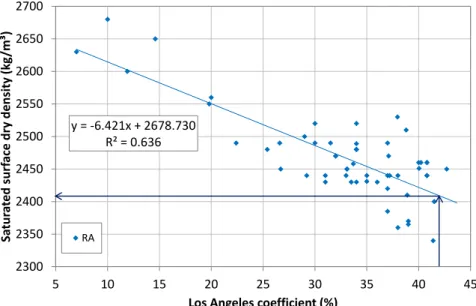
As a general rule, it is verified that the higher the content of attached mortar and impurities, the lower the recycled coarse aggregate density [MART11]. In this regard, again, this property is influenced by the original waste, processing level and size fraction.
Adhered mortar is a porous material with a density of around 1.0–1.6 Kg/m3, which is lower than that of natural aggregate particles [TAM08]. Furthermore, the adhered mortar porosity depends on the water/cement ratio of the parent concrete. Higher strength original concrete provides denser and higher quality adhered mortar, than that obtained from lower strength concrete. However, again, the quantity of cement mortar will be higher in recycled coarse aggregate obtained from high strength concrete. Finally, the type and density of virgin aggregate also plays an important role. Some researchers indicate that it affects recycled aggregate properties more than the water to cement ratio of the original concrete [ZEGA10].
Once again, as the weakest phase of the virgin waste material is the adhered mortar, this will be affected to a greater extent by the crushing process than the original aggregate. In this regard, the adhered mortar will mainly be present in the fine fractions.
Regarding the multiple crushing of source concretes, this reduces the number of particles with cracks, microdefects or voids in the coarse fractions of aggregate. Furthermore, again, the crushing process reduces the size of the adhered cement mortar (weak and easily crushed) which is finally eliminated during the sieving process (powder) or used as recycled fine aggregate. Consequently, the recycled concrete coarse aggregate obtained at each stage of the recycling process improves in density value. Some countries have tried to develop a closed-loop recycling system to improve the coarse aggregate properties and, at the same time, handle the large amount of crushed concrete fines and powder generated during the recycling process for producing recycled cement.
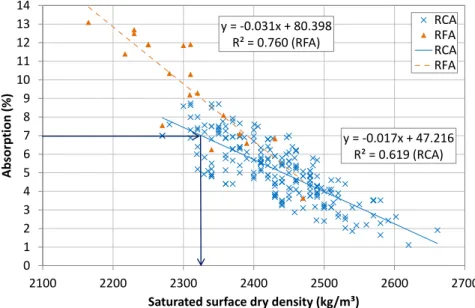
Figure II-6 shows the relationship between maximum aggregate size and density values. As the aggregate size increases, the density value also increases (due to the fact that the adhered mortar content has decreased with the aggregate size). For the same size fraction, some scatter in the data from the literature (two hundred and seventy-four datasets) (Figure II-6) is observed. This is due to the different qualities of the original waste (this property is influenced by original aggregate density) and, also the number of crushing processes undergone by the concrete debris.
Figure II-6. Saturated surface dry density vs. Maximum aggregate size

![Table II-2. Effect of recycled concrete aggregate on RC hardened properties (from [SAFI13])](https://thumb-us.123doks.com/thumbv2/123dok_es/3972488.673570/56.892.175.689.778.1049/table-effect-recycled-concrete-aggregate-hardened-properties-safi.webp)
![Figure II-24. Slump flow and V-funnel tests for variations in moisture content of aggregates [BONE07]](https://thumb-us.123doks.com/thumbv2/123dok_es/3972488.673570/68.892.133.733.869.1093/figure-slump-funnel-tests-variations-moisture-content-aggregates.webp)
