
TítuloModelling the absorption of styrene and acetone on activated carbon and perlite beds
7
0
0
Texto completo
(2) 126. A. M. GERRARD, S. MOLLENCAMP, K. MAKINDE, J. PACA AND O. MISIACZEK. 2 EXPERIMENTAL The beds were fed with a steady, incoming flow-rate of gases at a constant inlet concentration of solute. The inlet and outlet concentrations were measured. As time progressed, the bed became progressively saturated with the VOC, thus, the exit concentration steadily rose in a sigmoidal fashion. In total, fourteen experiments were carried out, (by varying the solute and the bed material, the inlet concentration level and the condition of the mixture at the inlet, (i.e. wet or dry).. 3 THEORY Where there was enough consistent data, the Freundlich isotherm: (1) was used to represent the equilibrium data, where qe= the (equilibrium) loading of solute on the bed divided by the bed mass, Cin=gas inlet concentration, and m and N are constants). For the kinetic investigation, two models were used, the Lagergren and the Vermuelen. Lagergren proposed to relate the total amount of solute adsorbed by the packing with time. He suggested the rate of change of adsorbed solids in the bed was proportional to the unsaturated state of the bed, raised to a power, thus: (2). Here, qe is the maximum (equilibrium) amount adsorbed per mass of bed, t is the time. k is the adsorption rate constant (k1 for pseudo first order and k2 for the pseudo second order approach) and n is the model’s order. This equation is easily solved for n = 1 and n = 2. For the pseudo first order model (n = 1) the equation gives: (3) For the pseudo second order model (n = 2) the equation gives: (4).
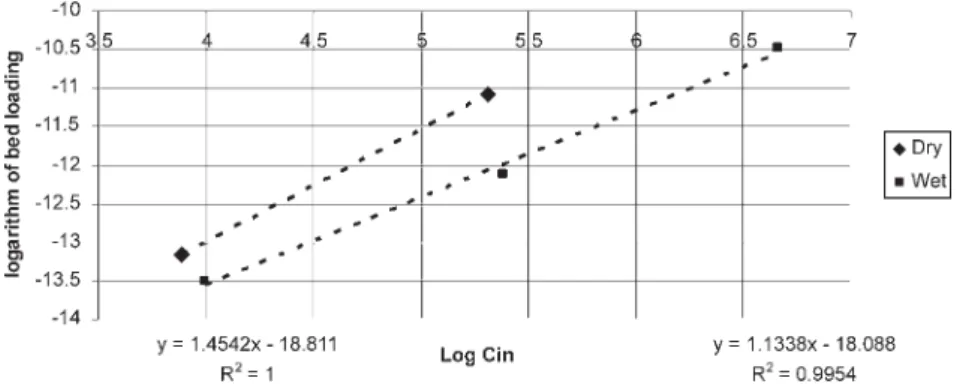
(3) MODELLING THE ADSORPTION OF STYRENE AND ACETONE ON ACTIVATED CARBON. 127. Clearly, both equations are easily linearised. Vermuelen (1953) proposed an equation to describe the fraction of adsorbed solute compared to equilibrium as a function of time, (F(t)=q/qe). He formulates his equation thus:. (5). where D= effective particle diffusivity and = is the particle size. We can define.. Then substitution and rearrangement lead to a straight line formula: (6). This can be plotted so that the slope gives A directly.. 4 RESULTS For the equilibrium data, the styrene-perlite experiments were the most consistent and gave the following logged graph, see Figure 1, for the five experimental runs. For the dry system, the Freundlich equation has an index of around 1.4 and for the wet conditions, it was closer to unity.. Figure 1. Freundlich diagram for styrene on perlite..
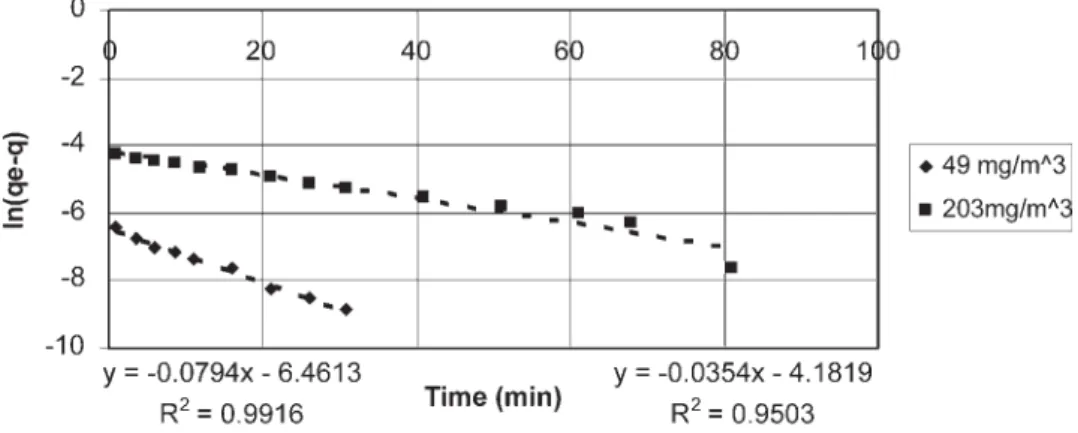
(4) 128. A. M. GERRARD, S. MOLLENCAMP, K. MAKINDE, J. PACA AND O. MISIACZEK. Moving to the modelling of the kinetic data, Figures 2 and 3 show log- linear plots showing the above styrene on perlite data fitted to a pseudo first order Lagergren model:. Figure 2. First order Lagergren model for styrene on dry perlite.. Figure 3. First order Lagergren model on wet perlite.. All the coefficients of determination are well above 90%, indicating a reasonable fit..
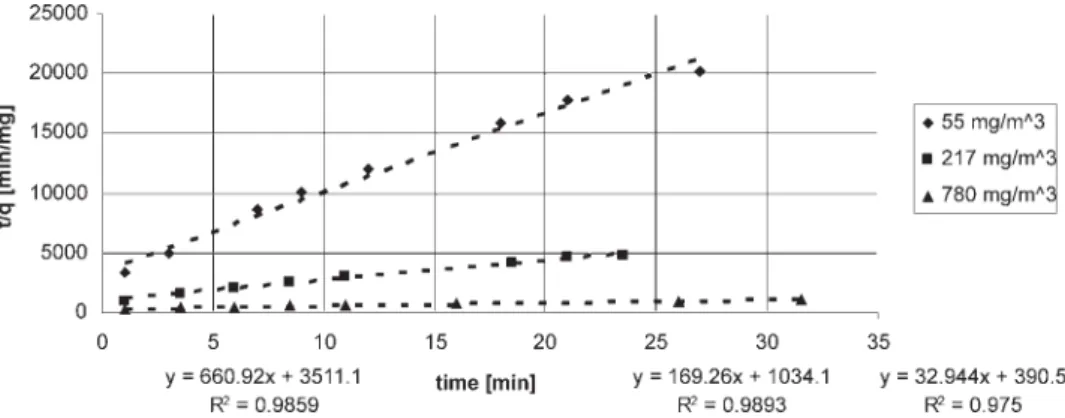
(5) MODELLING THE ADSORPTION OF STYRENE AND ACETONE ON ACTIVATED CARBON. 129. Figure 4. Second order Lagergren model for styrene on wet perlite.. Figure 5. Vermeulen model for styrene on dry perlite.. Figures 4 and 5 show another pair of graphs where some of the styrene on perlite data is fitted to the other two models. Again, the goodness of fit values are pleasing. The Table 1 below summarises all 14 experimental runs and lists the kinetic parameters (k1, k2 and A) and the coefficient of determination, R2, for the three models tested. For example, the third, fourth and fifth rows of numerical data, show the effect of changing inlet concentration for the wet styrene on perlite system. As noted above, all three approaches give reasonable fits to the data, with the average R2 value being 93% for the first order Lagergren model, 88% for the Vermeulen and 86% for the second order Lagergren model. In addition, the range of values of the constants is somewhat smaller for the first order model, which is a further reason to (slightly) prefer it to the alternatives..
(6) 130. A. M. GERRARD, S. MOLLENCAMP, K. MAKINDE, J. PACA AND O. MISIACZEK. In more detail: we note for the styrene on perlite results that the inlet concentration does not have a large effect on the value of k1, especially for the wet system. The results for wet acetone on perlite also give almost constant values for this parameter. Table 1. Summary of the constants found in the three models. Inlet Concentration. k1. R2. k2. R2. A. R2. Lagergren. First order. Lagergren. 2nd order. Vermeulen. model. 0.079 0.035. 0.992 0.950. 83.5 3.24. 0.997 0.986. 0.064 0.028. 0.994 0.905. 0.11 0.079 0.12. 0.929 0.994 0.947. 151. 31.9 3.22. 0.986 0.989 0.975. 0.089 0.06 0.10. 0.900 0.989 0.900. 0.049 0.0069. 0.964 0.741. 0.016 0.000041. 0.967 0.572. 0.043 0.0052. 0.933 0.653. 0.0039. 0.985. 0.00019. 0.916. 0.0041. 0.845. 0.085 0.29. 0.865 0.979. 0.261 6.56. 0.452 0.792. 0.072 0.23. 0.816 0.960. 0.044 0.047. 0.987 0.963. 0.0266 0.015. 0.966 0.968. 0.039 0.041. 0.964 0.932. 0.0069. 0.741. 0.00004. 0.5724. 0.0052. 0.653. 0.0041. 0.983. 0.00021. 0.936. 0.0042. 0.861. Dry styrene on perlite 49 203 Wet styrene on perlite 55 217 780 Dry styrene on carbon 2498 928 Wet styrene on carbon 693 Dry acetone on perlite 645 1677 Wet acetone on perlite 920 2517 Dry acetone on carbon 929 Wet acetone on carbon 681.
(7) MODELLING THE ADSORPTION OF STYRENE AND ACETONE ON ACTIVATED CARBON. 131. 5 CONCLUSIONS It was found that the pseudo first order Lagergren model gave a good fit to most of the data. Typically, the values for k1 ranged from around 0.0039 to 0.29 min-1 and the coefficients of determination were usually over 90%.. 6 NOMENCLATURE A C D F k m n N q ro R2 t. constant concentration diffusivity fractional saturation of bed rate constant equilibrium constant order of model power in Freundlich equation solute adsorbed on bed radius of pore coefficient of determination time. subscripts e equilibrium in inlet condition. REFERENCES Gerrard, A.M., Misiaczek, O., Hajkova, D., Halecky, M. and Paca, J. (2005) Steady state models for the biofiltration of styrene/air mixtures. Chemical and Biochemical Engineering Quarterly. 19 (2): 185-190. Vermuelen, T. (1953) Theory for Irreversible and Constant- Pattern Solid Diffusion. Industrial and Engineering Chemistry. 45: 1664-1665..
(8)
Figure
Documento similar