
Examining the effects of proficiency, gender, and task type on the use of communication strategies
15
0
0
Texto completo
(2) PORTA LINGUARUM. Nº 17, enero 2012. a review of the history of CSs, Dörnyei and Scott (1997) noted that the early interest in CSs stemmed from the recognition that «the mismatch between L2 speakers’ linguistic resources and communicative intentions leads to a number of systematic language phenomena whose main function is to handle difficulties or breakdowns in communication»(p. 174, italics added). If CSs have such a crucial place in enabling learners to manage communicative language use and to overcome their communication problems, why hesitate to include them in language teaching curricula. However, much controversy has been raised around strategy training. While a number of scholars (Lam & Wong, 2000; Dornyei, 1995; Lam, 2006; Nakatani, 2005; Brooks, 1992; Willems, 1987) have argued in favor of including CSs in language teaching courses, others (e.g. Bongaerts & Poulisse, 1989; Paribakht, 1985; Canale & Swain, 1980) have opposed the verdict. Bongaerts and Poulisse (1989), for example, argued that many CS taxonomies have been preoccupied with the surface features of language use rather then the underlying processes prevailing in communication. They noted that these superficial differences disguise the underlying similarities in language use. To provide supporting evidence, Bongaerts and Poulisse asked a group of Dutch learners of English to describe a set of abstract shapes in Dutch and English. Although, due to their low proficiency, the participants had difficulties in finding appropriate English words to describe the shapes, they resorted to the same strategies in both tasks. The implication is that if the CSs are universal among languages, then learners can readily transfer these strategies from L1 to L2 and there is no need for teaching. Paribakht (1985) had adopted a similar view to that of Bongaerts and Poulisse (1989) in proposing that CSs are «freely transferable to L2 learning situations» (p. 142). She argued that strategic competence is different from other areas of language ability in that its transfer into the L2 communicative situations does not cause any interference. A further difference between strategic competence and other competencies pertains to the availability of mechanisms for performing the strategies. That is, the successful use of strategies depends upon the availability of other knowledge areas such as contextual, world, and paralinguistic knowledge. Furthermore, Canale and Swain (1980) pointed out including strategy training in language curricula to improve the knowledge and use of CSs in L2 learners is not essential. They added that CSs «are most likely to be acquired through experience in reallife communication situations» (p. 31). On the other hand, there have been various attempts to show that CSs can be successfully integrated into language teaching programs. Willems (1987) argued that the shift from traditional teaching approaches to the communicative approach has brought about new challenges to learners. They have to be prepared for real-life communicative contexts and yet, in many places, they do not have the required resources. Hence, it is highly important to teach them a set of strategies to overcome communication breakdowns. This strategy training should be twofold: teaching about CSs to raise learners’ awareness as to the variety of CSs at their disposal and the practice of CSs to make their knowledge of CSs more automatic. Lam and Wong (2000) investigated the effectiveness of CS instruction. They examined the impact of CS training on the development of discussion skills of a group of sixth graders learning English as a second language in Hong Kong. Although cases were. 80.
(3) SHIVA KAIVANPANAH, POONEH YAMOUTY et al.. Examining the effects of proficiency, gender.... observed where the effective use of CSs was impeded by participants’ low language proficiency level, the researchers concluded that «training resulted in a greater use of interaction strategies and more genuine interaction in group discussion» (p. 251). They noted that peer assistance and cooperation may be of much value in mitigating against the ineffective use of strategies due to low language ability problems. Similarly, Dornyei (1995) investigated the teachability of three types of CSs: topic avoidance and replacement, circumlocution, and using fillers and hesitation devices. The participants were 109 students learning English in Hungarian secondary schools. The experimental groups received treatment over the course of 6 weeks. This included strategy training in three 20-40 minute lessons. The materials were based on Dörnyei and Thurrell (1991) but were supplemented with awareness-raising discussions. There were two control groups. One group received only teaching materials and the training envisaged in their normal curriculum. The other control group was given conversational training in addition to their normal training which did not include any training in strategies. The results indicated that the quality of circumlocution and the quantity of fillers improved in the oral post-test of topic description, cartoon description, and definition formulation. Hence, Dornyei concluded that the results are indicative of the effect of the teachability of CSs. In an indepth analysis of the performance of a group of English students enrolled in Spanish conversation courses at college level, Brooks (1992) observed that language learners repeatedly resort to their first language to ask for the Spanish terms they needed. Hence, it was concluded that simply engaging students in communicative acts in the classroom is not sufficient to enable them to successfully participate in negotiation of meaning in communicative contexts. Rather, students need to be explicitly taught a number of strategies they can employ whenever their knowledge of the L2 is not enough for successful communication. In another experiment, Lam (2006) examined the impact of CS instruction in Hong Kong. Control and experimental groups received oral lessons. However, in addition to normal instruction, the experimental group received explicit training instrategies of resourcing, paraphrasing, repetition, fillers, self-correction, asking for clarification, and asking for confirmation. The results indicated that the experimental group outperformed the control group on the group discussion tasks. It was found that treatment had a positive impact on raising the awareness of the learners with respect to the range of communication strategies. Lam’s (2006) study confirms the results of a study by Nakatani (2005) on the value of awareness raising on strategy use in oral communication. Nakatani provided some evidence that CS training can improve learners’ performance on proficiency tests. In the study, the control group took a course in oral communication. Besides the course, the experimental group received metacognitive training focused on CSs. The analysis of the scores on the oral proficiency test at the end of the course showed that the experimental group had significantly improved their performance. No significant improvement was observed for the control group. Nakatani concluded that «The lack of a significant improvement in the control group indicates that simply offering students communication practice was not sufficient to develop their speaking ability» (p. 83).. 81.
(4) PORTA LINGUARUM. Nº 17, enero 2012. If research on the teachability of CSs has offered no firm conclusions, further research is needed to shed light on the effectiveness of teaching CSs. The mixed findings of the previous research may be partly due to the fact that there are many confounding factors affecting strategy use and that not all of these factors can be controlled in any single study. From among the various factors involved, language proficiency and gender have received special attention from researchers. Canale and Swain (1980) argued that knowledge of CSs is not of equal importance to L2 learners of different proficiency levels. They stated that «knowledge of how to use such strategies may be particularly helpful at the beginning stages of second language learning, and it is to be expected that the need for certain strategies may change as a function of age and second language proficiency» (p. 31). Paribakht’s (1985) study showed that learners with low proficiency levels more heavily draw upon their knowledge of L1 and resort to such strategies as idiomatic transfer. The more proficient they become, the more they rely on L2-based strategies. Compared to the low-proficient students, highly proficient students face fewer communication problems but whenever they do, they exploit essentially the same CSs. Paribakht concluded that highly proficient L2 learners are in a mid-position between beginners and native speakers with respect to both the types and the relative frequency of strategy use. «This suggests a directionality of transition in the learners’ use of CS toward that of the native speakers, which in turn reflects the transitional nature of their interlanguages» (p. 141), she concluded. In a similar vein, Chen (1990) examined the impact of language proficiency on strategy use. Participants were 12 Chinese (6 highly proficient 6 low proficient) students of English. They took a concept identification task. Each participant had to communicate two concrete and two abstract concepts to a native speaker in an interview. The native speakers were to identify the concept which was explained by the participants and then rate the effectiveness of the strategies used to communicate each concept on a five-point scale ranging from not effective to effective. It was found that the frequency of the CSs employed by the participants and the relative frequency with which they selected different types of CSs varied with their proficiency levels. A positive relationship was reported between language proficiency and communicative effectiveness. In addition, it was found that language proficiency influenced the participants’ choice of CSs. On the other hand, Dornyei’s (1995) findings rejected any firm relationship between language proficiency and CS use. No significant relationship was found between the students’ language proficiency and the extent of strategy use. Therefore, it was suggested that strategy training can be integrated even at a pre-intermediate level. The results of the study by Bialystok (1983) suggested that «language proficiency biases the learner to select differentially between L1 and L2 based strategies but does not predict the selection of specific strategy» (p. 110). The advanced students used significantly more L2-based strategies such as semantic contiguity while the regular students mostly drew upon L1-based strategies such as language switch. However, no relationship was reported between the level of language proficiency and the frequency of the CSs. Therefore, further studies are needed before any firm conclusions are made regarding the impact of language proficiency on the use of CSs. The same is true about the impact of gender on the use of CSs which equally needs further investigation. Only. 82.
(5) SHIVA KAIVANPANAH, POONEH YAMOUTY et al.. Examining the effects of proficiency, gender.... a few studies have examined the impact of gender on the frequency and choice of CSs. As Oxford and Nyikos (1988) note, out of 80 papers, studies, and chapters in books, only four studies have focused on sex differences in strategy use. In almost all these studies females significantly used more language learning strategies than men. Sociolinguistic evidence available with respect to gender difference in communication may partially account for differences in the use of CS by males and females. Fishman (1983) examined the conversational strategies males and females exploited to maintain power relationships. The data included 52 hours of talk between three couples whose interactions were recorded when they were at their apartments. Fishman’s analysis of the data showed that the choice of strategies by males and females were quite different. Men were more likely than women to take control of the conversations. Interestingly, women used almost three times as many questions as men did. He noted that questions are «interactionally powerful utterances». They are usually followed by a response and this is enough to sustain communication for a while. Furthermore, even when males and females employed the same strategies, they exploited them for different purposes. For example, a man would use «minimal responses» such as «yeah», «umm», and «huh» to show lack of interest while a woman would utilize minimal responses to provide «support work», to show that «she is constantly attending to what is said, that she is demonstrating her participation, her interest in the interaction and the speaker» (p. 402). Kocoglu (1997) examined the frequency and type of CSs by male and female Turkish EFL learners when communicating with male and female Native and Non-Native speakers and found that the gender of the NS interlocutor had a significant impact on the use of CSs. The EFL learners used more CSs when interacting with female native speakers because they were more cooperative and encouraging in conversation. The personality of the EFL learner also played a significant role on their use of CSs; extrovert and talkative students were more successful in the conversation than introvert and shy learners. In a recent study by Lai (2010), gender effect on CS use among 36 Chinese EFL learners was examined while they were performing oral and written communicative tasks. The participants were requested to communicate two abstract and two concrete concepts to a native speaker. They were not allowed to use the target words and were asked to interact with the native speaker till the native speaker could identify the target concept or the participant admit that they are unable to communicate. The analysis of the recorded interviews pointed to no differences between males and females in the use of CSs which was attributed to the learning environment. It was found that females were more efficient than males in their use of CSs because of the differences in their execution phase of the production. What makes conclusions difficult is the design of these studies and the type of tasks used; previous studies have not examined the effect of specific task type on CS use. This is echoed by Rossiter (2003) who observed that although CS training has a significant effect on students’ performance, the students use more CSs in the object description tasks than in the narrative tasks. Therefore, he suggested that different tasks elicit different CSs and multiple task types should be used in communicative classes. Similarly in another study on CS use in a task-based computer-meditated context, Smith (2003) concluded that task type influences compensatory strategy use. Since the participants. 83.
(6) PORTA LINGUARUM. Nº 17, enero 2012. employed more compensatory strategies in decision-making tasks, it was suggested that decision-making tasks may elicit more compensatory strategies than jigsaw tasks. This was shown in an early study by Poulisse and Schils (1989) who investigated the impact of language proficiency and task on the use of compensatory strategies. Participants were Dutch learners of English at the advanced, intermediate, and beginner levels. Compensatory strategies were elicited by employing picture description, story retell, and oral interview with English native speakers. The analysis of the frequency of the compensatory strategies indicated that task has significant effects on the use of the strategies. Learners used more analytic strategies such as circumlocution in picture description task and more holistic (e.g., approximation) and transfer strategies in story retell and oral interview. The impact of language proficiency on the use of compensatory strategies was not significant. Since little research has been conducted on the impact of gender and task on the use of CSs, further research is recommended; therefore, in the present study the frequency and choice of CSs between males and females and the impact of task on CS use will be examined. More specifically, the following research questions are addressed in the present study: 1. Does the level of language proficiency influence the use of CSs? 2. Is there any difference in the use of CSs by males and females? 3. Is the frequency of the CSs influenced by the task type? 4. Do male and female language learners at the same proficiency level use the same CSs?. 2. METHOD 2.1. Participants Initially, 227 students (male=89, female=138) aged 12 to 37 studying English at different Language Institutes in Tehran participated in the study. They had studied English for at least one year. Since the purpose of the study was to examine the impact of language proficiency on the frequency of the CSs, students from different English proficiency groups were selected. The distribution of participants appears in Table 2.1. Table 2.1. Participant distribution based on the level of Language Proficiency.. Elementary 67. Pre- intermediate 66. Intermediate 94. 2.2. Instrument Out of different methods of data collection (i.e, observation, think aloud, role paly, questionnaire), we decided to use a questionnaire because 1) it allows the researchers to obtain more information in a short period of time 2) it takes relatively little time to be completed 3) it allows the researchers to objectively compare the results across proficiency level.. 84.
(7) SHIVA KAIVANPANAH, POONEH YAMOUTY et al.. Examining the effects of proficiency, gender.... The CS questionnaire developed in the respondents’ L1 was piloted with 127 students who were similar to the participants in the main study. On the basis of their responses, some of the malfunctioning items were deleted or modified. The reliability coefficient of the questionnaire as estimated by Cronbach’s Alpha was 0.83. 2.3. Procedures A five-point Likert scale questionnaire ranging from 1 (never) to 5 (always) in the students’ L1 was developed on the basis of Dornyei and Scott’s (1997) Inventory of Strategic Language Devices. Students were asked to fill in the questionnaire in 20 minutes in the classroom. Second, to examine the impact of task type on CS use, first, four CSs (circumlocution, appeal for help, time-stalling devices, and message abandonment) were taught to 27 female EFL students at the elementary level. After the instruction, the students participated in three types of tasks, namely picture description, telling a story, and telling a joke.. 3. RESULTS. AND DISCUSSION. 3.1. The impact of language proficiency on the use of CSs Table 3.1 presents the descriptive statistics for CS use by the students. Learners used CSs of asking for clarification or repetition, self-repair, and message reduction more than mumbling, use of similar sounding words, and foreignizing without instruction. This might be due to the participants’ past experience which may have influenced the choice of strategies; as Bialystok (1990) noted, language learners employ some CSs in their L1 communication and transfer those strategies that they regard effective to the L2 situations. Similarly, Leki (1995) argued that sometimes in L2 classrooms students use strategies which they regard effective in L1 situations; this transfer of strategies, however, is not always effective in L2 contexts; therefore, learners should be taught how to use more effective strategies. Marefat and Barbari (2009) also support this argument by noting that although all language learners seem to be «active strategy-users», they are often unable to use strategies effectively. Cultural factors might also partially account for this pattern of strategy use. As Mattison (2010) notes, culture may affect the way the learners use a language. One aspect of culture that influences CS use is mutual knowledge that enables the speakers to reduce their references to figures they had referred to before (Wongsawang, 2001). The second culture issue relates to the learning context; in EFL contexts, due to infrequency of the contact with native speakers, language learners do not feel the need to foreignize words in communication. However, further research is needed before any conclusions are made.. 85.
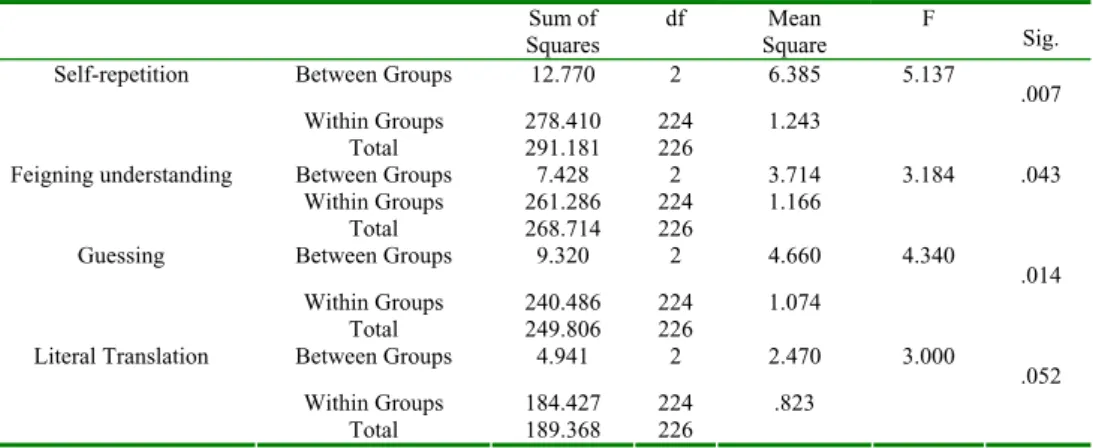
(8) PORTA LINGUARUM. Nº 17, enero 2012. Table 3.1. Descriptive Statistics of CS use (N = 227). Asking for repetition Self-repair Message Reduction Message replacement Asking For Clarification Response confirm Over explicitness Other-repair Expressing Non-Understanding Direct Appeal for Help Guessing Interpretive summary Circumlocution Approximation Use of fillers Indirect Appeal for Help Use of All-purpose words Comprehension check Self-rephrasing Verbal strategy markers Retrieval Word Coinage Self-repetition indirect appeal for help Other-repetition Literal Translation Response reject indirect appeal for help Message Abandonment Feigning understanding Mime Omission Mumbling Use of similar sounding words Foreignizing Valid N (listwise). Minimum 1 1 1 1 1 1 1 1 1 1 1 1 1 1 1 1 1 1 1 1 1 1 1 1 1 1 1 1 1 1 1 1 1 1 1. Maximum 5 5 5 5 5 5 5 5 5 5 5 5 5 5 5 5 5 5 5 5 5 5 5 5 5 5 5 5 5 5 5 5 5 5 5. Mean 3.99 3.94 3.83 3.72 3.71 3.64 3.59 3.45 3.38 3.36 3.35 3.29 3.25 3.07 2.97 2.96 2.90 2.87 2.82 2.82 2.75 2.75 2.74 2.68 2.64 2.60 2.59 2.59 2.43 2.41 2.31 2.20 1.81 1.76 1.37. Std. Deviation .957 .915 .878 .872 .623 .982 .957 1.090 .691 .872 1.051 1.087 .897 1.137 1.125 .756 1.221 1.185 1.021 1.047 1.081 1.161 1.135 1.103 1.164 .915 1.111 1.131 .700 1.090 .918 1.053 1.005 .972 .750. The first research question examined the effect of language proficiency on CS use. We expected that the frequency of CS use might vary as a function of language proficiency; we had two hypotheses: a) more proficient students use more CSs; b) more proficient students use less CSs because due to their command of language, they communicate easily and do not resort to CSs. To check these hypotheses, we relied on the institute’s criterion to differentiate between participants and selected intact classes from different levels (participants who studied New Interchange One, Two, and Three were regarded as elementary(n=67), pre-intermediate(n=66), and intermediate learners(n=94) respectively. To examine the differences in CSs use across the proficiency levels, the one-way ANOVA analysis was performed. No significant differences were found in CS use between the three levels, except in Literal Translation (f (2, 224), p= 0.052), Self-repetition (f (2, 224), p= 0.007), Feigning Understanding (f (2, 224), p= 0.043) and Guessing (f (2, 224), p=0.014).. 86.
(9) SHIVA KAIVANPANAH, POONEH YAMOUTY et al.. Examining the effects of proficiency, gender.... Table 3.2. ANOVA for CSs use of the EFL students across proficiency levels df. Between Groups. Sum of Squares 12.770. Guessing. Within Groups Total Between Groups Within Groups Total Between Groups. 278.410 291.181 7.428 261.286 268.714 9.320. 224 226 2 224 226 2. 240.486 249.806 4.941. 224 226 2. 1.074. Literal Translation. Within Groups Total Between Groups Within Groups Total. 184.427 189.368. 224 226. .823. Self-repetition. Feigning understanding. 2. Mean Square 6.385. F 5.137. Sig. .007. 1.243 3.714 1.166. 3.184. 4.660. 4.340. 2.470. 3.000. .043. .014. .052. Therefore, based on the results, it can be safely concluded that language proficiency does not affect CS use. This is not in keeping with the results of the studies by Paribakht (1985) and Bialystok (1983); in Bialystok’s (1983) study it was found that advanced students use more L2-based strategies of approximation, circumlocution and word coinage than the regular students who employed more L1-based strategies of borrowing, language switch and literal translation. In a similar vein, Paribakht’s (1985) study showed that both the type and the relative frequency of communication strategy use varies with proficiency level. She concluded that the more proficient the L2 learners become, the more they rely on L2 based strategies. She noted that as the learners move towards advanced levels, they abandon some strategies in favor of others. 3.2. The effect of task type on CSs use To elicit CSs, different tasks such as picture description (Varadi,1980; Littlemore, 2001), speaking tasks (Haasstrup & Philipson, 1980; Lam & Wong, 2000; Maleky, 2007), topic description, cartoon description, and definition formulation (Dornyei, 1995), jigsaw and decision making (Smith, 2003), and object description and narrative task (Rossiter, 2003) have been used in previous studies. These studies suggest that type of task might influence the frequency of CSs. For instance, the number of circumlocution has been shown to be low in speaking tasks. On the other hand, the quantity of circumlocution has been shown to be high in object description tasks (Rossiter, 2003). In addition, Lee (2004) suggested that task type could influence L2 output quality and interlanguage development. Consequently, it is important to examine the impact of task type on the frequency of CSs and select appropriate task types to elicit desirable CSs. Hence, after teaching the selected communication strategies, the frequency of each strategy in a picture description, telling a joke, and telling a story tasks was calculated. Table 3.3 presents the frequency of instructed strategies employed by the students in three types of tasks. As Table 3.3 shows the frequency of appealing for help (AFH), circumlocution (C), time-stalling devices (TSD), and message abandonment (MA) in. 87.
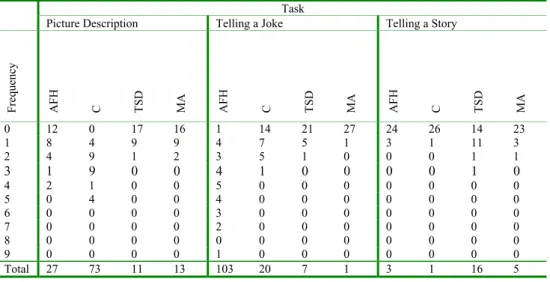
(10) PORTA LINGUARUM. Nº 17, enero 2012. picture description are 27, 73, 11, and 13 respectively. To compare with telling a story (AFH= 3, C=1, TSD=16, MA=5), and telling a joke (AFH=103, C=20, TSD=7, MA=1), picture description could elicit circumlocution and message abandonment more than telling a story or telling a joke tasks. This is in line with the findings of Dornyei (1995), Poulisse and Schils (1989), and Rossiter (2003) who concluded that circumlocution is used more in object description tasks; therefore, it is suggested that to elicit circumlocution and message abandonment prospective researchers employ picture description tasks. On the other hand, telling a joke could be the best task for eliciting appeal for help strategy (AFH=103 times). Since the students are eager to understand a joke, they would ask more questions for clarification, meaning, or repetition. However, since the participants read a joke from a written text, they would not need to use time-stalling devices to gain more time for thinking or message abandonment strategies to relinquish a conversation. Finally, it was concluded that circumlocution, appeal for help, and message abandonment are used rarely in telling a story because of the low frequency of these strategies (C=1, AFH=3, MA=5). Nevertheless, telling a story might be a good task for eliciting timestalling devices (TSD=16); As seen in Table 3.3, time-stalling devices have the highest frequency in telling a story compared to telling a joke and picture description; since students need time to remember the story or the order of the events, they would employ more time-stalling devices to gain time without disrupting the stream of the story. Table 3.3. The frequency of appeal for help (AFH), circumlocution (C), time-stalling devices(TSD), and message abandonment (MA), in picture description, telling a joke, and telling a story tasks. Task Telling a Joke. AFH. C. TSD. MA. AFH. C. TSD. MA. AFH. C. TSD. MA. Telling a Story. Frequency. Picture Description. 0 1 2. 12 8 4. 0 4 9. 17 9 1. 16 9 2. 1 4 3. 14 7 5. 21 5 1. 27 1 0. 24 3 0. 26 1 0. 14 11 1. 23 3 1. 3. 1. 9. 0. 0. 4. 1. 0. 0. 0. 0. 1. 0. 4 5 6 7 8 9 Total. 2 0 0 0 0 0 27. 1 4 0 0 0 0 73. 0 0 0 0 0 0 11. 0 0 0 0 0 0 13. 5 4 3 2 0 1 103. 0 0 0 0 0 0 20. 0 0 0 0 0 0 7. 0 0 0 0 0 0 1. 0 0 0 0 0 0 3. 0 0 0 0 0 0 1. 0 0 0 0 0 0 16. 0 0 0 0 0 0 5. To see whether the type of task influences the elicitation of CSs and the frequency of these strategies, the learners’ performance in three types of tasks were compared using Chi-square analysis. The results presented in Table 3.4 reveal that task type has a. 88.
(11) SHIVA KAIVANPANAH, POONEH YAMOUTY et al.. Examining the effects of proficiency, gender.... significant effect on the use of circumlocution (X2=63.21, p<0.00), appeal for help (X2=58.60, p<0.00), and message abandonment (X2=12.43, p<0.01). Hence, the findings of the present study are in line with the findings of Poulisse and Schils (1989), Bou-Franch (1994), Dornyei (1995), Smith (2003), and Rossiter (2003) who suggested that task type affects the use of CSs. As Poulisse and Schils noted, tasks are different in nature; therefore, these differences (task demands, lack of context, time constraints, and the presence of the interlocutor) influence the use of CSs. Accordingly, it is suggested that picture description requires participants to solve lexical problems posed by the pictures which are not contextualized; therefore, the students have to convey the information by employing circumlocution strategy. Whereas, telling a story and telling a joke tasks can be completed without solving problems; the students could rely on the context, and hence, use less analytic strategies (e.g., circumlocution). Another task difference proposed by Poulisse and Schlis (1989) that could affect the use of CSs is time constraints. Telling a story poses more time constraints than picture description and telling a joke. Long pauses are embarrassing and normally lead to losing the turn; therefore, students rely on time-stalling strategies to avoid long pauses. Finally, in telling a joke, the students may benefit the presence of the interlocutor, and, therefore, more asking for help strategies are usually employed. Table 3.4. Chi-square Analysis on the frequency of CSs employed by learners (N=27) in Telling a Story, Telling a Joke, and Picture Description Task. Strategy Circumlocution Appeal for Help Time-stalling Devices Message Abandonment. X2 63.21 58.60 5.66 12.43. Tasks Df 10 16 6 4. Sig .00 .00 .46 .01. 3.3. Gender and CSs To examine gender differences in the CSs use an independent-sample t-test was run. The findings indicated that there was no significant gender effect in the use of CSs except for Circumlocution (t=.008), asking for Clarification (t=.021), Omission(t=.001), Comprehension Check (t=010), Use of Fillers (t=045), Over-Explicitness (t=.003). We speculate that since these strategies were social in nature, this might be a reflection of the fact that «females generally display greater social orientation than males» (Oxford and Nyikos, 1988, 322). This is echoed by Ehrnman and Oxford (1989) who in a study of 79 language learners reported significant sex differences in strategies for communicating meaning. This difference in strategy use can also be explained by females’ greater interest in social activities. The more frequent use of CSs by females in the present study is also in keeping with the results of Politzer (1983) who examined the language learning behavior and social behavior of women and found that compared to men, women use more social strategies. The greater use of CSs by females in L2 is expected because it has been shown that women are socially oriented. As Benenson et al. (2009) notes, «Researchers investigating. 89.
(12) PORTA LINGUARUM. Nº 17, enero 2012. sex differences in social behavior between genetically unrelated individuals typically conclude that females are more socially oriented than males are» (p. 188). In the present study, the pairwise comparison of the means indicated that females use these strategies more than males. This finding may also be attributable to the fact that men and women perform different social roles and experience different social pressures; This is echoed by Kramarae (cited in Oxford and Nyikos, 1988) who argued that because of division of labor and power in the society, men and women use different strategies. Women tend to be more aware of the appropriate speech and communications strategies. More support for the differences between men and women in the use of strategies can be found in the research on personality variables; research has shown that females are less tolerant of ambiguity than their male peers (Erten and Topkaya , 2009).Consequently, , females attempt to leave no room for uncertainty; as such they are more likely to use comprehension check, asking for clarification, and over explicitness that are used to resolve ambiguity; Vandergrift (1997) summarizes these differences as follows: Studies on gender differences indicate that females typically excel at verbal fluency; they have a stronger social orientation than males (Maccoby and Jacklin 1974); they rely heavily on verbal problem solving strategies (Otten 1985); and they rely heavily on verbally and socially mediated approaches in their interactions (Halpern 1992). This, in addition to the tendency of males to be less self-disclosing and of females to be conversation smoothers (Kramarae 1985), may explain why females report more strategies. Strategy use by gender definitely merits further study to examine the possible differences between reported use and actual use of learning strategies on a wide variety of language tasks. (p. 401).. We were also interested in the difference in the use of CSs by males and females at the same proficiency level. Since there were several CSs (dependent variables) and two independent variables (gender and proficiency) MANOVA was run. We used MANOVA because we wanted to find out whether changes in the independent variables have significant effects on the dependent variable and whether interactions among the variables are significant. The results of the MANOVA are reported in Table 3.5. It can be seen that there are few differences when CS use for male and female language learners are compared. Female students reported using more omission, circumlocution, comprehension check, use of fillers, over explicitness, guessing, and asking for clarification, than males. The use of word coinage, omission, self-repetition, feigning understanding and guessing was influenced by the proficiency level. The interaction between gender and Proficiency level was only significant for Foreignizing. This suggests that the use of foreignizing is different for men and women at the same level of proficiency. Therefore, with respect to the fourth question that examined CS use differences between males and females at the same proficiency level, it was found that males and females differ in the use of several CSs at the same level. Since no previous study has addressed the effect of gender on CS use, it is difficult to compare the results of the present study with the previous ones.. 90.
(13) SHIVA KAIVANPANAH, POONEH YAMOUTY et al.. Examining the effects of proficiency, gender.... Table 3.5. Multivariate tests for examining the differences in the use of CSs at the same proficiency levels by male and female LL. Source. Gender. proficiency. gender * proficiency. Dependent Variable Omission Comprehension check Other-repair Use of fillers Over explicitness Guessing Circumlocution Asking For Clarification Word Coinage Omission Self-repetition Feigning understanding Guessing Foreignizing. 4. CONCLUSIONS, IMPLICATIONS,. Type III Sum of Squares 12.802 11.511 .853 5.652 7.910 4.035 4.298 2.116 8.834 6.308 12.390 9.095 10.202 7.855. AND. df 1 1 1 1 1 1 1 1 2 2 2 2 2 2. SUGGESTIONS. Mean Square 12.802 11.511 .853 5.652 7.910 4.035 4.298 2.116 4.417 3.154 6.195 4.548 5.101 3.927. FOR. F 12.227 8.488 .707 4.554 8.875 3.776 5.371 5.545 3.327 3.013 4.940 3.897 4.774 7.483. Sig. .001 .004 .401 .034 .003 .053 .021 .019 .038 .051 .008 .022 .009 .001. FURTHER RESEARCH. The present study examined the frequency of CSs across proficiency levels, the effect of task type on the use of CSs, and the differential use of CSs among males and females. The findings indicated that the most frequently employed CSs by Iranian EFL students were asking for clarification and repetition and self-repair; and the least frequently used strategies were mumbling, use of similar sounding words, and foreignizing. It was found that while the frequency of the CSs used by the Iranian EFL students was independent of language proficiency, gender influences the use of some of CSs. The Oneway ANOVA analysis for the frequency of CS use across three levels of language proficiency revealed that the students employ different types of CSs almost equally regardless of their level of language proficiency. This implies that CS training can be used in elementary, pre-intermediate, and intermediate courses. In addition, since the finding of this study shows that different tasks elicit different CSs, it is suggested that a variety of tasks should be used in CSs training courses. With respect to gender it was found that there was no significant gender effect in the use of CSs except for strategies that were social in nature. This was supported by Ehrnman and Oxford (1989) who noted that females have greater interest in social activities. The complex nature of CSs could not be captured in just one study. Further research is needed before generalizations are made. There were a number of limitations in the present study that should be taken into account in future studies. First, the effect of three tasks has been examined in only elementary proficiency level. Future studies can investigate the effect of task type on intermediate and advanced proficiency levels. Second, this study did not investigate the frequency of strategy use by proficiency level; future studies can examine the possibility that some strategies are used more frequently at certain levels of proficiency; third, this study mainly relied on self report of perceived. 91.
(14) PORTA LINGUARUM. Nº 17, enero 2012. CS use by EFL learners; since one of the shortcomings of the questionnaire as data collection procedures is that it may reflect students’ perception of their use of strategies not their actual use of these strategies, future studies may use other techniques such as observation to find out what type of CSs are used more frequently and whether there is a difference between male and females with respect to the use of these strategies in real life situations.. 5. REFERENCES Benenson, J.F., Markovits, H, Fitzgerald, C., Geoffroy, D. Flemming, J. Kahlenberg, S. M. and Wrangham, R, W. (2009). Males’ Greater Tolerance of Same-Sex Peers, Psychological Science, 20(2), 184-190 Bialystok, E. (1983). «Some factors in the selection and implementation of communication strategies», in Faerch, C. and Kasper, G. (eds.), Strategies in interlanguage communication. London: Longman, 20-60. Bialystok, E. (1990). Communication Strategies: A psychological analysis of second language use. Oxford: Blackwell. Brooks, F. B. (1992). Can we talk? Foreign Language Annals, 25, 59-71. Bongaerts, T. and Poulisse, N. (1989). «Communication strategies in L1 and L2: Same or different?, Applied Linguistic, 10: 253-267. Bou-Franch, P. (1994). «Communication strategies and topic sequences in the conversational discourse of Spanish learners of English», in Stylistica: Revista International de Estudios Estiliscosy Culturales, 2, 3:153-162. Canale, M., & Swain, M. (1980). Theoretical bases of communicative approaches to second language teaching and testing. Applied Linguistics, 1, 1-47. Chen, S. Q. (1990). A study of communication strategies in interlanguage production by Chinese EFL learners. Language Learning, 40, 155–187. (on teachability) Dornyei, Z. (1995). «On the teachability of communication strategies», in TESOL Quarterly, 29, 1: 55-85. Dornyei, Z. and Scott, M.L. (1997). Review article. Communication strategies in second language: Definitions and taxonomies, Language Learning, 47,173-210. Dornyei, Z. and Thurrell, S. (1991). «Strategic competence and how to teach it», in ELT Journal, 45, 1: 16-23. Ehrman, M, & Oxford, R. (1989). Effects of Sex Differences, Career Choice, and Psychological Type on Adult Language Learning Strategies, The Modern Language Journal, 73( 1), 113. Erten, I. H. & Topkaya, E. Z. (2009). Understanding tolerance of ambiguity of EFL learners in reading classes at Tertiary level, Novitas-ROYAL, 2009, Vol.: 3(1), 29-44. Færch, C. & Kasper, G. (1984). Two ways of defining communication strategies. Language Learning, 34, 45-63. Fishman, P. (1983) ‘Interaction: the work women do’, in Barrie Thorne et al. (eds) Language, Gender and Society. Rowley, Mass.: Newbury House, pp. 89-101. First published 1978 in Social Problems 25: 397-406 Green, J. and R. Oxford (1995). A Closer Look at Learning Strategies, L2 Proficiency, and Gender. TESOL Quarterly, 29(2), 261-97.. 92.
(15) SHIVA KAIVANPANAH, POONEH YAMOUTY et al.. Examining the effects of proficiency, gender.... Haastrup, K. and Phillipson, R. (1980). «Achievement strategies in learner/native interaction», in Faerch, C. and Kasper, C. (eds.), Strategies in interlanguage communication. London: Longman, 140-158. Kocoglu, Z. (1997). The role of gender on communication strategy use. Paper presented at the annual meeting of teachers of English to Speakers of other Languages, 31 Orlando, March 11-15 Lam, W.Y.K. (2006). Gauging the effects of ESL oral communication strategy teaching: A multimethod approach, Electronic Journal of Foreign Language Teaching, 3, 142-157. Lam, W. and Wong, J. (2000). «The affects of strategy training on developing discussion skills in an ESL classroom», in ELT Journal, 54, 3: 245-255. Lai, H. (2010), Gender Effect on the Use of CSs, English Language Teaching, 3(4), 28-32. Lee, C. (2004). Language output, communication strategies and communicative tasks in the Chinese context. Maryland: University Press of America. Leki, I. (1995). «Coping strategies of ESL students in writing tasks across the Curriculum», TESOL Quarterly, 29, 2: 235-260. Marefat, F. and Barbari, F. (2009). The relationship between out-of-class language learning strategy use and reading comprehension ability, Porta Linguarum, 12, 91-106. Mattison, J. (2010). «Teaching international students in English. A matter of Culture», in Porta Linguarum, 13, 165-178. Nakatani, Y. (2005) The effects of awareness-raising training on oral communication strategy use. The Modern Language Journal, 89, 76-91. Oxford, R. L., & Nyikos, M. (1989). Variables affecting choice of language learning strategies by university students. Modern Language Journal, 73, 291-300. Paribakht, T. (1985). On the pedagogical relevance of strategic competence.TESL Canada Journal, 3, 53-66. Politzer, R. (1983). An exploratory study of self-reported language learning behaviors and their relation to achievement. Studies in Second Language Acquisition, 6, 54-68. Poulisse, N, & Schils, E. (1989). The Influence of Task- and Proficiency-Related Factors on the Use of Compensatory Strategies: A Quantitative Analysis. Language Learning, 39( 1), 1548 Rossiter, M. J. (2003). It’s like chicken but bigger: Effects of communication strategy in the ESL classroom, Canadian Modern Language Review, 60, 105-121. Sheorey, R., & Mokhtari, K. (2001). Differences in the metacognitive awareness of reading strategies among native and nonnative readers. System, 29, 431-449. Smith, B. (2003). The use of communication strategies in computer-mediated Communication», System, 31, 29-53. Tarone, E. (1980). Communication strategies, foreigner talk and repair in interlanguage. Language Learning, 30, 417-431. Tarone, E. (2005). Speaking in a second language. In E. Hinkel (Ed.) Handbook of research in second language teaching and learning. Hillsdale, NJ: Lawrence Erlbaum. Vandergrifi, L. (1997) The Comprehension Strategies of Second Language French Listeners: A Descriptive Study. Foreign Language Annals, 30 (3), 387-409. Varadi, T. (1980). Strategies of target language learner communication: Message adjustment. In C. Faerch, & G. Kasper (Eds.), Strategies in interlanguage communication (pp. 4-14). London: Longman. Willems, G. M. (1987) Communication strategies and their significance in Foreign Language Teaching. System, 15, 351-364. Wongsawang, P. (2001). Culture-specific notions in L2 communication strategies. Second Language studies, 19(2). 111-135. 93.
(16)
Figure


+2

Documento similar