
Diachronic change in the semantic configuration of six verb preposition combinations
16
0
0
Texto completo
(2) topological, dynamic, or functional nature of the relationship.3 This schematic arrangement provides structure for the diverse meanings of each preposition in a network with ‘primary’ and ‘derived’ senses. The primary sense of a preposition is understood as a proto-concept combining the three conceptual dimensions (topological, functional, and dynamic). This proto-concept is at the centre of a radial network that structures all the senses of the preposition as a family resemblance set.4 The various senses (stemming directly from the central node or indirectly from the more peripheral ones) extend through the network by means of particular shifts of the proto-concept in question, by means of special emphasis given to one or more conceptual dimensions, and by way of metaphorical and metonymic mappings in cases of figurative or idiomatic use (Navarro i Ferrando, 1998a, 2000, 2002, 2006). It is the linguistic context where the preposition occurs that determines the nature of the shift or the kind of focus upon more topological, dynamic, or functional regions of the network. In the proto-concept of SUPPORT an entity stands for the supporting point for another entity, as in He preferred sleeping in bed with his head on a pillow (C10:17).5 In this example, as an instance of the Support proto-concept, topological, functional, and dynamic relations between Tr and Lm receive a balanced focus. Tr and Lm bear a topological relationship of contact between the resting side of the Tr and the outer surface of the Lm. The dynamic patterns expressed by On include directions, forces, and interaction axes of both participants. Dynamics is understood prototypically in terms of a ‘downwards vertical axis’ where the Tr bears a perpendicular position with respect to the Lm, which is canonically in horizontal position. Finally, the functional dimension of On is defined by the control of the Tr over the Lm.6 The Tr’s motion and (self-)control are made possible through its contact with the Lm. Indeed, the functional dimension of control implies the Tr’s self-control, attained through its use of the Lm as support. This proto-concept may suffer various kinds of shifts depending on different perceptual perspectives. It may be the case in certain situations that the supporting Lm does not bear a horizontal position, as in: The picture on the wall, where the wall constitutes a vertical Lm. In other shifts, the supporting Lm is not a differentiated entity from the Tr – as it is the case in: Then he got on his knees and rolled Robert’s body toward the edge (L06:117), where the actual supporting surface (the ground) is not focused on in the conceptualisation; in fact, the Lm is the part of the Tr (knees) that is in contact with the ground. One of the three dimensions may be perceptually more salient than the other two, according to the particular construal at work in the speaker’s mind. Thus, we find instances where topological contact is brought to the fore, whereas dynamics and function remain in the background, as in: …with his coffee, warming his hands on the cup… (K12:68). In other uses the dynamics of the relationship is highlighted, as in: Dean leaned from the saddle and gave him a mighty whack on the back. (N03:117). Likewise, the functional relationship present in the Tr’s control over the Lm may be perceptually more prevalent as in: …executive director of the Committee on Juvenile Delinquency and Youth Crime (A04: 71). Furthermore, it may occur that two conceptual dimensions receive extra emphasis in the meaning conveyed by an expression, the third one remaining in the background, which gives way to further extensions of meaning. In this regard, it is necessary to remark here that, although one or two dimensions may be put into the background in certain senses of On, they are never totally bleached out. In these cases, the highlighted dimension plays an obviously more important role in the conveyance of a specific sense,. 167.
(3) but those dimensions in the background still participate in the creation of such meaning. In fact, the simultaneous highlighting of different conceptual dimensions is a common phenomenon in the verb-preposition combinations, as it is illustrated in our analysis below. The proto-concept of ENCLOSURE constitutes the departing schema for extended meanings of In, as instantiated in: The ice cubes tinkling in a glass (P05:28). According to that proto-concept, Trs are finite, bounded entities (like the ice cubes). Lms are entities that demarcate the limits and capacity of a region –more concretely, an interior space– which needs not be a fully closed space, but may also constitute a partial closure (like a glass). In the relationships expressed by In, the topological configuration called ‘inclusion’ entails a Tr located in the interior space defined by the boundaries of a Lm, which may have potential or actual exit from that interior region. The functional configuration shows the Lm’s control over the Tr in terms of ‘reclusion’, as the Tr’s motion is constrained by the Lm. Thus, the functional relationship between Tr and Lm highlighted in example (P05:28) above is a relation of reclusion, because the movements of the ice cube (the Tr) are restricted to the area within the limits imposed by the boundaries of the glass (the Lm). In addition, the functional configuration expressed by In may alternatively imply the control of the Lm over the Tr in terms of ‘protection’, given that it prevents both the contact of the Tr with other entities from outside, and the access of those entities to its interior region. Finally, the dynamic configuration allows for movement of the Tr within the boundaries of the Lm (e.g. the ice cubes tinkling inside the glass), or else, from the exterior to the interior of the Lm. Peripheral meanings are derived from the ENCLOSURE proto-concept through different kinds of imaginative procedures, like shifts in the arrangement of the canonical configuration, the profiling of topological, functional, and dynamic conceptual dimensions, or metaphorical and metonymic extensions of the proto-concept, of extended shifts, or of one profiled dimension. A semantic shift of the proto-concept shows the interior region as Lm. In that shift, it is the ‘interior space’ within the boundaries of the Lm, rather than the boundaries, what is highlighted, as in: …maneuvering the car around in a very narrow space (L04:165). Here, the ‘space’ (rather than its imaginary boundaries) is conceptualised as Lm, wherein the Tr moves. The functional relationship of reclusion is portrayed in: Philip Spencer, in handcuffs and ankle irons… (P07:117). The functional relationship of protection is shown in: A man with a baby in his arms (D07:61), where the Lm (the man’s arms) clearly control and protect the Tr (the baby). Finally, a typical example of an emphasised dynamic configuration of In is seen in: Manuel whispered in the ears of the Sioux that the Cheyennes were comin’ to raid ‘em for their horses. (N04:29). Here, Manuel’s whispers are metaphorically understood as objects that can move through space. Additionally, the ears of the Sioux are also conceptualised metaphorically as containers where the movement described by the Tr ends. It is of special interest the contrast of the specific semantic patterns profiled by each of these two prepositions as they occur in verb-particle constructions. The semantic load that these prepositions may contribute to the meaning of such constructions has not been analysed yet in full detail. In this paper, we illustrate some of the semantic configurations7 revealed by the usage of prepositions In and On in some verb-preposition constructions of the structure ‘V + prep. + n/pron’. The description of such contexts will also bring out some contrasts of meaning between the use of In and On, as derived from. 168.
(4) their respective semantic configurations. We hold that the particular use of In and On with a single verb stem –and thus the contrastive effects that influence the speakers’ choice of either preposition– may be determined not only by the semantics of the verb, but also by a specific semantic configuration of the preposition retrieved from the speakers’ mind, and reinforced by the linguistic context in hand. Usage tendencies may also play an important role in the speakers’ choice of In or On, and it will also be taken into account. A further aim of our analysis is to check whether the semantic configurations providing for the different senses of In and On in each of these verb-preposition combinations are maintained through two different periods of the English language, or else whether they are modified somehow over time. For that purpose, we analyse a sample of expressions extracted from two different corpora belonging to present Contemporary English and Early Modern English (EModE) respectively. Significant differences in the semantic configurations selected by the senses of each verb-preposition combination are examined and considered as possible signs of diachronic semantic change. 2. VERB-PREPOSITION COMBINATIONS: SAMPLE SELECTION AND HYPOTHESES In English, the construction type considered in our analysis, namely, “V + prep. + n/pron.” produces prepositional verbs and combinations that, although not considered prepositional verbs (Quirk et al., 1985; Biber et al., 2002), show a certain degree of conventionalisation. Grammars like Quirk et al. (1985) and Biber et al. (2002) consider prepositional verbs as a subcategory of the group of “multi-word verbs” on account of a considerable degree of semantic and syntactic integration of verb and preposition. Furthermore, in their descriptions of prepositional verbs, these grammars include other constructions labelled ‘free combinations’ (Quirk et al., 1985) or ‘free combinations of verb plus adverbial prepositional phrase’ (Biber et al., 2002), where the components bear a weaker bondage. These constructions are not considered prepositional verbs. However, both grammars acknowledge the existence of a continuum between multi-word verbs and free combinations. The boundaries between both categories in the continuum are not clear-cut. In actual fact, some constructions may, under certain circumstances, be regarded as prepositional verbs as much as ‘free combinations’. There seems to exist, thus, a vast array of verb-preposition combinations with different degrees of bondage between their elements. Within this range of possibilities, we analyse combinations where verb and preposition are semantically complementary, that is, where the verb requires a prepositional object introduced by a specific preposition in order to convey a particular meaning. The selection of that preposition is constrained by the language and by the conventionalisation of particular uses in the linguistic community. In this regard, we may find He is engaged in a conspiracy or The boss is engaged on a project, but not He is engaged *over a project. We may find instances like I arrived at the station, or She arrived in London, but very rarely He arrived *into the station. Therefore, our analysis includes prepositional verbs, but also free combinations of the kind described above, because they seem to be closer to prepositional verbs than to totally free combinations within the continuum. We do so in compliance with our intention to provide a wider picture of the semantic role of In and On in verb-preposition constructions. The three verb stems. 169.
(5) selected for this study are centre, dwell, and engage. These, in turn, combined with In and On, yield the six verb-particle combinations analysed below. Hence, we take into consideration combinations of ‘Verb + In/On’, from samples extracted from two corpora: the Brown Corpus of American English (BC) (Francis & Kucera, 1961), and the Helsinki Corpus of English Texts (HC) (Rissanen & Ihalainen, 1991). The BC contains more than one million words in texts belonging to 15 different categories. The HC is a compilation of extracts of texts ranging from c. 750 (Old English period) to c. 1700 EModE period). The EModE part is divided into three subparts (I 1500-1570; II 1570-1640; III 1640-1710). Since the whole period (the three subparts) encompasses two centuries, it is possible that some diachronic changes may have occurred within this stretch of time. Therefore, only the last of its subparts was chosen for our analysis, as it contains 171.040 words produced within a range of fifty years, consistent enough to be compared with the kind of data extracted from the BC. This is a considerably reduced period where major diachronic changes are less likely to appear. The HC texts that compose the 1640-1710 (III) subpart of the EModE compilation are also distributed in 16 different categories, which provides an assorted collection of text extracts reflecting the language used in different thematic fields. The semantic configurations resulting from sense analysis of each combination in the BC were contrasted with those extracted from the HC in order to ascertain whether the ‘EModE combinations had a more restricted range of semantic configurations. Should this be the case, our proposed hypothesis might hint that, in the time span between 1640-1710 and 1961, the analysed verb-preposition combinations might have broadened the range of semantic configurations that produce different senses, and thus, might have acquired further senses or uses. We depart, then, from two main research questions: 1- Does the semantic configuration (Tr-Lm relationships in terms of topological, functional, and dynamic dimensions) of each analysed verb-preposition combination remain unaffected over time or is it somehow modified? 2- In that case, which are the main changes? Which are their implications? In this regard, we hypothesise that the range of semantic configurations selected by the senses of each combination may be more restricted in the EModE period. The range of semantic configurations might have expanded over time as these combinations are used in a wider variety of contexts. 3. ANALYSIS AND DISCUSSION The senses of each combination found in the BC and the HC are semantically explained in terms of topological, dynamic, functional dimensions, and the ENCLOSURE and SUPPORT proto-concepts. Different senses are unveiled for a single verb-preposition combination depending on the semantic dimension profiled in each situation. Usage differences between In and On, as combined with the same verb are explained in terms of the different configurations underlying each preposition. That is, the use of In or On with a verb (e.g. ‘engage’) depends on the suitability of the semantic structure of each. 170.
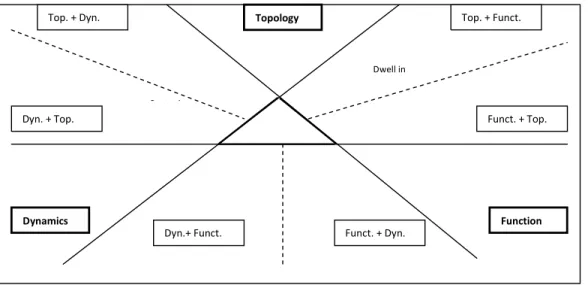
(6) preposition to fit the situational construal at work in the speaker’s mind. According to the data extracted from our corpora, the verb-preposition combinations under analysis yield senses produced by at least one of the following configurations:8 • Topology9 o Topology + Dynamics10 o Topology + Function • Dynamics + Topology11 • Function o Function + Dynamics o Function + Topology Top. + Dyn.. Top. + Funct.. Topology Centre in. Dwell in. Centre on. Dwell on. Dyn. + Top.. Centre in. Funct. + Top.. Centre on Engage in. Dynamics. Function Dyn.+ Funct.. Funct. + Dyn.. Figure 1. Classification of senses in different semantic dimensions. (Brown Corpus). Top. + Dyn.. Top. + Funct.. Topology. Dwell in. Centre in. Dyn. + Top.. Funct. + Top.. Dynamics. Function Dyn.+ Funct.. Funct. + Dyn.. Figure 2. Classification of senses in different semantic regions. (Helsinki Corpus). 171.
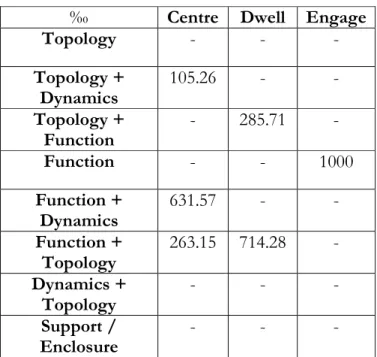
(7) We also present two tables (one for each period) displaying the configurations highlighted by each verb-preposition combination, and the frequency of senses (in a perthousand ratio) that select each of these configurations in the two periods. These tables provide additional data on further differences in terms of usage tendencies between the two historical periods. This comparison of usage tendencies turns out to be especially helpful in the cases of verb-preposition combinations whose senses maintain the same semantic configurations in both periods. ‰ Topology. Centre -. Dwell -. Engage -. Topology + Dynamics Topology + Function Function. 105.26. -. -. -. 285.71. -. -. -. 1000. Function + Dynamics Function + Topology Dynamics + Topology Support / Enclosure. 631.57. -. -. 263.15. 714.28. -. -. -. -. -. -. -. Table 1. Spatial configurations emphasised in verb-preposition combinations: Brown Corpus (1961). ‰ Topology. Centre Dwell Engage -. Topology + Dynamics Topology + Function Function. 1000. -. -. -. 833.33. -. -. -. 1000. Function + Dynamics Function + Topology Dynamics + Topology Support / Enclosure. -. -. -. -. 166.66. -. -. -. -. -. -. -. Table 2. Spatial configurations emphasised in verb-preposition combinations: Helsinki Corpus (1640-1710).. 172.
(8) Centre In/On Semantic configurations highlighted by the senses of ‘centre in’ and ‘centre on’ Helsinki Corpus: ‘Topology + Dynamics Centre in: Brown Corpus: ‘Topology + Dynamics’ plus ‘Function + Topology’ Centre on: Helsinki Corpus: Ø Brown Corpus: ‘Topology + Dynamics’ plus ‘Function + Dynamics’.. Centre in: ‘Topology + Dynamics’ In cases where ‘Topology and Dynamics’ appears as the most salient configuration, the Tr or group of Trs tend to move (actually or fictively) towards the interior region of the Lm, which is perceived as a container and as the central goal of the Tr’s movement. In: …it would seem that the trouble centers in the breaking (J33:10) there is an imaginary movement of the Tr (‘trouble’) towards the Lm. Hence, ‘trouble’ and ‘breaking’ are metaphorically understood as an ‘object’ and a ‘container’ respectively. In the following example: Hence it is that Goodness, justly looked upon, is the Cause, the Sum, the Hinge from which all our Desires arise, in which they centre, and upon which they turn. (<E3 XX PHILO BOETHPR 139:Heading>)12 ‘desires’ (the Tr) are conceived metaphorically as ‘objects’ moving towards the interior of a metaphorical container, that is, ‘Goodness’ (the Lm). ‘Function + Topology’ In some examples of the BC, however, ‘centre in’ seems to highlight functional and topological patterns. Thus, in: Each subject center library was chosen because of its demonstrated strength in a particular area […] History, biography, and education are centered in Hempstead. (A44:43) Hempstead (Lm) is conceived as a topological ‘container’ where the Tr (history, biography, and education) exists. Function is the most important factor in this example. In fact, the choice for In as opposed to On stresses the control of the Lm over the activities or disciplines stored within its library (metaphorical boundaries), the functional relationship expressed by In implies control of the Lm (the container) over the Tr (the entity within it).. Centre on: ‘Topology + Dynamics’ In the BC examples of ‘centre on’, the Tr is conceptualised either as a group of definite entities or as a single entity (or a group of non-definite entities or processes perceived metaphorically as ‘mass’ or ‘fluid’). In both cases, the Tr or Trs totally or partially surround the Lm and are in contact or tend to reach contact with it. Topological patterns are thus highlighted in all these relationships. Furthermore, whenever contact between Tr and Lm is to be attained, dynamic configurations are brought forth, and the (self-) controlled movement of the Tr may be perceived in actuality or fictively. Even though Trs may be understood metaphorically, in this kind of examples they tend to be more or less concrete entities, as in:. 173.
(9) …a region such as the coastal lowlands centering on Charleston had closer ties with England and the West Indies than with the North even after independence. (G01:50)13 ‘Function + Dynamics’ Other examples of ‘centre on’, however, profile functional and dynamic dimensions where the Lm is a central element surrounded by the Trs, which tend to be abstract entities or processes metaphorically conceptualised as fluids or masses. In: Some families place undue emphasis on food: conversations center on it, and rich delicacies are offered as rewards, withheld as punishment. (C17:51) the Lm (food) is conceptualised in a central position to which the Trs (conversations) tend to agglutinate in an imaginary ‘self-controlled’ movement. In relation to the issue of diachronic change in the semantic configurations of ‘centre in’ and ‘centre on’, we may draw two types of inferences in the light of the information reflected in Figure 1 and Figure 2. On the one hand, only combinations of ‘centre in’ were elicited from the HC. This may indicate that, in EModE, ‘centre’ had a tendency to be used only with In. On the other hand, since ‘centre on’ combinations were only elicited in the BC (Contemporary English) it could be inferred that the use of ‘centre on’ appeared at a given time between both periods. The range of ‘centre in/on’ combinations, therefore, seems to have broadened up since the EModE period; this broadening, in turn, implies the birth of a new semantic distinction between the uses of each preposition with this verb, which was not yet active in EModE. According to the data provided by our corpora, it seems that a different set of semantic resources is available for speakers in present Contemporary English and EModE. Present Contemporary English allows for the expression of a wider variety of subtleties of meaning, as evidenced by the semantic differences arising from the speakers’ use of In or On in examples A44:43 and C17:51 above. As regards the specific case of ‘centre in’, time has brought about an expansion of the number of configurations emphasised by this verb: it seems that, in EModE, the senses produced worked exclusively according to the ‘Topology + Dynamic’ configuration (cf. example <E3 XX PHILO BOETHPR 139:Heading>). As reflected in Figure 1, the present usage of ‘centre in’ continues to select ‘topological + dynamic’ patterns, and incorporates a new configuration (‘Function + Topology’). Finally, it is also worth noting that the 1,000‰ figure concerning this combination in Table 2 masks the actual number of occurrences of ‘centre in’. No occurrence of ‘centre on’ and only one occurrence of ‘centre in’ appear in the HC. The scarcity of data regarding these combinations seems to suggest that their use may have been somewhat infrequent or sporadic during EModE. Dwell In/On Semantic configurations highlighted by the senses of ‘dwell in’ and ‘dwell on’ HC: ‘Topology + Function’ Dwell in: BC: ‘Topology + Function’ plus ‘Function + Topology’ Dwell on: HC: ‘Function + Topology’ BC: ‘Function + Topology’ plus ‘Topology + Function’. 174.
(10) There do not seem to be major variations between the semantic configurations highlighted in both periods. In configurations of the kind ‘Function + Topology’, ‘dwell in’ provides a sense of protection or restricted control of the Tr within a threedimensional Lm, but in ‘dwell on’ the Tr is the entity that controls the contact relationship.. Dwell in: Examples of ‘dwell in’ in the BC and in the HC emphasise different degrees of topological and functional predominance. While examples in the BC express ‘Topology + Function’ and ‘Function + Topology’ configurations, the examples in the HC seem to favour the ‘Topology + Function’ configuration. ‘Function + Topology’ Topological patterns are manifest in the BC examples of ‘dwell in’ that reflect senses arising from this configuration, as the Lms are metaphorically conceived as containers enclosing or surrounding the Trs. Functional patterns, nonetheless, seem to play an even more important role in such examples. The Tr-Lm relationship is often construed metaphorically in terms of Trs protected or barred within the boundaries of a three-dimensional Lm. In this regard, functional patterns are made apparent in the ‘protection’ provided by the Lm or by some kind of ‘movement restriction’ imposed by the Lm on the Trs inside it. In the examples below: They dwell, in short, in the doltish twilight in which peasants and serfs of the past are commonly reported to have lived. (C13: 48), Lawrence Lipton, in ‘The Holy Barbarians’, stresses that for the beat generation sex is more than a source of pleasure; it is a mystique, and their private language is rich in the multivalent ambiguities of sexual reference so that they dwell in a sexualized universe of discourse. (G13:13) the Trs (‘they’) stand within the boundaries of metaphorical containers that seem to exert some control over them. The Trs seem to be immerse in the Lms (‘the doltish twilight…’ / ‘a sexualized universe of discourse’), and do not hold any control over them (the Trs are immerse in a situation and do not seem to be able to easily get out of it). ‘Topology + Function’ Another kind of examples seem to place special emphasis on topological patterns, and relegate functional ones to a secondary stage. This semantic configuration was selected only by one example of ‘dwell in’ in the BC : To have Christ dwelling through faith in your hearts. (D16:83) and by all examples of ‘dwell in’ in the HC. In all these examples, the topological sense of inclusion is primarily emphasised. The Trs dwell –are typically located– within the limits of the Lm. Functional patterns, however, are secondarily emphasised, and they are not as apparent as topological ones in all examples. Nonetheless, they can be easily perceived in the sense of protection provided by the Lms in the following examples: …but she forsook her love, and then he married the Church of the Gentiles, and by her as by a second venter had a more numerous Issue, (\atque una domus est omnium filiorum ejus\), all the Children dwell in the same house, and are Heirs of the same promises, intituled to the same Inheritance. (<E3 IR SERM JETAYLOR 8:Heading>) (^Corvinus^) dwells in a Farm and receives all its profits, and reaps and sows as he please, and eats of the Corn and drinks of the Wine; (<E3 IR SERM JETAYLOR 17:Heading>). 175.
(11) Dwell on: ‘Dwell on’ expresses ‘Topology + Function’ and ‘Function + Topology’ configurations in the BC. However, in the HC it appears only expressing senses of ‘Function + Topology’ configurations. ‘Function + Topology’ The Tr expressed by ‘dwell on’ remains on the Lm during a discrete stretch of time. The Lm, in turn, may be conceived literally as a supporting ‘base’ for the Tr, but it may also be conceived metaphorically as a topic or feeling. Additionally, the Tr may be performing some kind of mental activity (thinking, writing, etc.) while ‘on’ the Lm. This is the case in: It is worth dwelling in some detail on the crisis of this story, because it brings together a number of characteristic elements […] significant for Mann’s work. (G15:1) I know I do not have to dwell here on the absurdity of that contention. (F23:24) Since he came to have so great a name, and that I knew him for many years, and in a very particular manner, I will dwell a little longer on his character; for it was of a very extraordinary composition. He began to make a considerable figure very early… Before he was twenty, he came into the house… <E3 NN HIST BURNETCHA 1,I,172:Heading> where the Tr has self-control of its movements and of the topological relationship of contact with the Lm (in these senses, the Tr is often a human entity that controls how long she/he may ‘dwell on’ –i.e. keep metaphorical contact with– a given topic). ‘Topology + Function’ ‘Dwell on’ examples of this semantic configuration are exclusively found in the BC. In the following example: Know ye, fair folk who dwell on earth or shall hereafter come to birth…(G05:78) the Lm (‘earth’) is conceived as a supporting base for the Trs, who have self-control of their movements on account of this contact (the ‘fair folk’ would not be able to ‘dwell’, ‘live’, or perform any kind of controlled activity without the Lm). With respect to diachronic change in the semantic configurations of ‘dwell in’ and ‘dwell on’, ‘Topology + Function’ and ‘Function + Topology’ are the only configurations selected by the senses of these verbs in both corpora. According to our data, the same semantic configurations are maintained over time, as the senses of each combination arise from the same source configurations in EModE and in present Contemporary English. Nevertheless, within the period of time comprehended between EModE and Contemporary English, the range of configurations selected by the senses of ‘dwell in’ and ‘dwell on’ has increased in both cases: on the one hand, while the senses of ‘dwell in’ in the HC select only ‘Topology + Function’ configurations (cf. Figure 2), examples of the same ‘Verb-in’ combination in the BC express ‘Topology + Function’ and ‘Function + Topology’ configurations (cf. Figure 1). On the other hand, HC senses of ‘dwell on’ select exclusively ‘Function + Topology’ configurations, whereas BC examples manifest both ‘Function + Topology’ and ‘Topology + Function’ configurations. It could be argued, then, that the increase of the semantic configurations of both ‘dwell in’ and ‘dwell on’ implies, in turn, an expansion of usage contexts.. 176.
(12) A change between both periods has also taken place regarding the ratio of instances expressing each configuration. As reflected in Table 1 and Table 2, most occurrences in the HC (833.33‰) select ‘Topological + Functional’ patterns, whereas the majority of occurrences in the BC depend on the ‘Function + Topology’ configuration. By and large, the number of examples whose senses select the ‘Topology + Function’ configuration has decreased significantly from the EModE to the Contemporary English period, whereas the number of examples selecting ‘Function + Topology’ has increased substantially. If we bear in mind that most senses emphasising ‘Topology + Function’ are literal, and that those emphasising ‘Function + Topology’ are metaphorical, we may speak of a shift from more literal to more metaphorical uses of this combination. This change in ‘dwell in/on’ may also be related to a possible change in the use and semantic connotations of the verb ‘dwell’. As in the case of ‘dwell in/on’ combinations, there also seems to be an evolution of the senses of dwell from more physical reference towards more metaphorical uses. This evolution is made especially apparent in the uses of ‘dwell in’ in EModE (HC) and in Contemporary English (BC): as illustrated in the examples above, ‘dwell in’ is used in the HC with the sense of ‘live in’ or ‘inhabit’. According to our data, in current English the term ‘dwell’ seems to have lost certain usage loci with this sense (even though ‘dwell’ is still used with the sense of ‘inhabit’ or ‘live in’, the form ‘live’ seems to be more common in present-day English).14 In this connection, it could be argued that ‘dwell’ has become more ‘specialised’ in current English, as its use is restricted to other contexts, which in the BC are metaphorical, as shown in C13: 48 and G13:13 above.15 In conclusion, we may infer that there has been a development of the semantic configurations and scope of use of both ‘dwell in’ and ‘dwell on’ from a single configuration towards two configurations in Contemporary English. This expansion of the configurations seems to be accompanied by an evolution from more physical or literal towards more metaphorical uses of ‘dwell’ and ‘dwell in’ –‘dwell on’, in contrast, is metaphorically used in both corpora. Engage In/On Semantic configurations highlighted by the senses of ‘engage in’ and ‘engage on’ Engage in: HC: ‘Function’ BC: ‘Function’ Engage on: HC: Ø BC: ‘Function’ Both prepositions give primary emphasis to functional relationships when combined with ‘engage’. Therefore, the semantic contrast hinges on the different roles of the participants in the functional relationship: the Lm is the controller of the Tr-Lm relationship in ‘engage in’, whereas the Tr controls the situation expressed by ‘engage on’.. Engage in: ‘Function’ In examples of ‘engage in’ the Tr tends to take part or be concerned with some kind of activity or process (the Lm) which is metaphorically conceptualised as a container.. 177.
(13) The Tr is only a part of that activity or process, and as such bears little control in the TrLm relationship. The Lm controls the relationship. In: “In the same five year period that the United States says they {the detectives} were engaged in this conspiracy”, Sokol continued, “these three young men received…(A20:61) ‘the detectives‘ are conceptualised as Trs immersed in ‘a conspiracy’ (Lm). ‘The conspiracy’ is a complex situation composed by a diversity of factors of which the detectives are a single part or mere factor. The Tr’s action or behaviour is conceptualised as constrained by the global situation that the Lm represents. Examples of ‘engage in’ of this kind appear (with relatively high frequency) in both corpora.. Engage on ‘Function’ The opposite relationship is expressed by ‘engage on’, where the Tr is seen as an entity performing (and controlling) an activity or process, namely, the Lm. The Tr bears control over the activity or process, as instantiated in She was told by the manservant who opened the door that his lordship was engaged on work from which he had left strict orders he was not to be disturbed.(K20:5) where the agent (his lordship) is the controller of the Lm (work). With regard to diachronic change in the semantic configurations of ‘engage in’ and ‘engage on’, all the examples in our corpus emphasise functional patterns. The combination of ‘engage’ plus In or On has not experimented a broadening of the range of semantic configurations providing for different senses in the period of time between 1710 and 1961. There have been other expansions, however, in the use of ‘engage on’ over time. Whereas both corpora abound in examples of ‘engage in’, ‘engage on’ only appears in the BC (cf. figures 1 and 2). The data extracted from the BC and the HC suggest, thus, that the use of ‘engage on’ began after EModE, giving rise to the subtle nuances of meaning explained above. Nevertheless, it is worth noting that, although ‘engage in’ seems to be a rather frequent construction in both periods, only one occurrence of ‘engage on’ was found in the BC. This may give us a clue about the degree of entrenchment of ‘engage on’ in the linguistic community in Contemporary English: the scarcity of examples may imply that this construction is not used frequently in everyday language, and consequently that there is process of pragmatic strengthening at its early stages. Further research with corpora compiled at any point of time between 1710 and 1961, and later on, should be necessary in order to ascertain this hypothesis. As a final consideration, we also hypothesise that the higher frequency of use of ‘engage in’ may indicate a tendency for speakers to conceptualise ‘activities in progress’ such as, say, ‘work’, as entities that exert some control over human beings or as global situations that constrain human action or behaviour. This would explain famous metaphors of the kind ‘my job is a jail’. Indeed, it seems that we do not tend to use ‘engage on’ unless we are aware of our control over a process or a series of activities (as the person in charge, supervisors, or managers).. 178.
(14) 4. CONCLUSION In this paper we have described several semantic configurations that prepositions In and On contribute to a set of verb-preposition combinations, in terms of the emphasis given to topological, functional, and dynamic dimensions of their respective protoconcepts. Furthermore, departing form a cognitive semantic perspective, we have also tried to ascertain whether the senses and uses of these verb-preposition combinations have evolved from EModE up to contemporary English. Our cognitive-semantic analysis departed from two main research questions, and from our hypothesis about the implications of possible diachronic change in the semantic configurations of the senses expressed by a set of verb-particle constructions (centre, dwell, and engage + in/on). Our results reveal that some changes in the usage patterns and the semantic configurations selected by the senses of the verb-preposition combinations have taken place within the period of time between 1710 and 1961. Verb-preposition combinations tend to broaden the range of semantic configurations that produce different senses, and tend also to appear in a new variety of usage contexts. While combinations like ‘centre in/on’, ‘dwell in/on’, experimented a considerable expansion in the number of configurations emphasised, minor variations were found in ‘engage in/on’. Nevertheless, subtler differences of meaning were also found between the two periods as regards the ratio and the classes of senses (see ‘dwell in/on’). With reference to our second research question and the hypothesis developed in it, our data suggest that, as a rule, the range of semantic configurations selected by the senses of each combination tends to be slightly more restricted in EModE than in present Contemporary English. Hence, our analysis lets us speak of an overall expansion of the number of configurations highlighted by the six verb-preposition combinations, which evidences a general tendency towards the development of semantic connotations, contrasts and usage contexts over time. Finally, we deem it necessary to recall some of the limitations of this study: The data produced and analysed here are based exclusively on the results of the analysis of the six verb-preposition combinations in the BC and in the HC. It is important to note that all our hypotheses, contentions, and generalisations about possible semantic changes are grounded on the data extracted from these corpora, and might therefore differ to some degree from other kinds of data.. NOTES 1. Research for this paper was sustained by a MECD grant (ref. AP2003–3771). According to Langacker (1987), prepositions are relational spatial predicates involving two participants: the trajector and the landmark. The Tr is the most salient entity in the relationship. The Lm, remains in a background position and serves as a reference point for the trajector. These labels correspond to the terms ‘figure’ and ‘ground’ in cognitive psychology. 3 These complex schematic arrangements have a gestaltic nature where Tr and Lm work as ‘figure’ and ‘ground’ respectively. As in any gestaltic structure, every part (the three spatial dimensions of meaning) is necessary for the existence of the whole, but it is usage that determines whether certain parts receive extra focus or remain in the background. 2. 179.
(15) 4. Radial networks of senses for On and In are proposed by Navarro i Ferrando (1998a: 219, 266). The central sense in each network corresponds to the proto-concept of ENCLOSURE (In) and SUPPORT (On). Further senses stem from the central sense along the different regions, which are artificially divided (for representational purposes) by means of dotted lines that stand for fuzzy boundaries within a continuum. These boundary lines do not exist as such in the mental network, since this is conceived as a continuum of dimensions. 5 The code reproduces the Brown Corpus coding system (Francis & Kucera, 1961). 6 The notion of function applied to entities in the world (Vandeloise, 1994; Navarro i Ferrando, 1998b, 2001, 2006) must be understood merely as a cognitive resource grounded on human experience. It serves our perceptual and cognitive purposes, but does not exist intrinsically in the perceived entities: as human beings, we perceive functional patterns of effects and consequences in our everyday interaction with the world. It is only because of perceptual and cognitive economy that we apply these functional patterns of (human) interaction in our conceptualisation of other non-human entities and relationships. 7 Here, the notion of ‘semantic configuration’ must be understood as a particular arrangement of three conceptual dimensions that stand for topological, functional, and dynamic patterns in the relationship between Tr and Lm, where more or less emphasis is given to one or more of these dimensions. Each sense analysed in this study is liable to take a particular configuration. 8 Semantic configurations in this paper are referred to in accordance with the emphasis given to each semantic dimension (primarily emphasised dimensions are placed first). Thus, a formula with only one dimension indicates that this dimension is the most salient one, to the detriment of the other two. These remain obviated since there are no contextual clues that allow for their actualisation; however, though they remain in the background, they still play a lesser role in the semantic configuration. In contrast, when two dimensions receive special emphasis in a given semantic configuration, they are referred to by means of the following formula: ‘primarily emphasised semantic dimension’ + ‘secondarily emphasised semantic dimension. This formula indicates that one dimension is strongly emphasised in the TrLm relationship and it interacts with another dimension, which also has a bearing on the conveyance of a specific sense. Finally, it is important to note that, in spite of the fact that only two dimensions are used in these formulae, the three dimensions are at work in all senses (in ‘Topology + Function’, for example, the third dimension – ‘Dynamics’– is still at work). The dimension remaining in the background is omitted in the formulae due to economy purposes. 9 Only topological meaning is primarily emphasised. 10 Combination of topology (primary emphasis) plus dynamics (secondary emphasis). Certain verb-preposition constructions show particular nuances of meaning arising from a secondary emphasis. 11 No instances of ‘primary dynamic’ nor ‘dynamics + function’ were found in either corpus. 12 The code reproduces the HC coding system (Rissanen & Ihalainen, 1991). 13 We take it that the ‘region’ of the coastal lowlands is a ‘concrete’ or ‘definite’ entity. Even if we consider the Lm as the ‘coastal lowlands’, these are still definite entities –not mass–, as evidenced by their plural form. Additionally, they may be conceived as ‘concrete’ entities in that they are primarily visually perceptible ‘regions of space’ whose limits are established in the speakers’ mind due to perceptual economy principles; moreover, these limits established by humans also serve other socio-political and geographical purposes. 14 The Shorter Oxford English Dictionary (SOED) (2002) presents ‘dwell’ with the sense of ‘inhabit’ as an obsolete form. 15 The (SOED) presents the ‘literal’ and ‘metaphorical’ senses in different entries. Their birth seems to be coetaneous and thus it is difficult to ascertain whether ‘physical’ uses were actually the source for ‘metaphorical’ ones. We adhere, however, the hypothesis that such literal-to-metaphorical evolution may be possible over time, according to the data extracted from the BC and the HC.. REFERENCES Bennett, D.C. 1975. Spatial and Temporal Uses of English Prepositions: An Essay in Stratificational Semantics. London: Longman. Biber, D., Conrad, S., Leech, G. 2002 Longman Student Grammar of Spoken and Written English. Harlow: Pearson Education. Downing, A. & Locke, P. 1995 A University Course in English Grammar. New York: Prentice Hall. 180.
(16) Hawkins, B.W. 1984 The Semantics of English Spatial Prepositions. Ph. Dissertation. University of California, San Diego. Johnson, M. 1987 The Body in the Mind. Chicago: University of Chicago Press (Sp. Transl. (1991). El Cuerpo en la Mente. Madrid: Debate.) Lakoff, G. 1987 Women, Fire, and Dangerous Things: What Categories Reveal About the Mind. Chicago: University of Chicago Press. Langacker, R. 1987 Foundations of Cognitive Grammar. Volume I: Theoretical Prerequisites. Stanford: Stanford University Press. Leech, G. 1969 Towards a Semantic Description of English. London: Longman. Lindkvist, K. G. 1950 Studies on the Local Sense of the Prepositions IN, AT, ON, and TO in Modern English. Lund: Berlingska Boktryckeriet. Navarro i Ferrando, I. 1998a. ‘A Multimodal System for the Description of Spatial Semantics: The Preposition ON’,l in Cifuentes, J. L. (ed.): Estudios de Lingüística Cognitiva. Alicante, 767-787. ─. 1998b. A Cognitive Semantics Analysis of the Lexical Units AT, ON, and IN in English. Ph.D. dis. Castelló: UJI. [CeSCa (2003) http://www.tdx.cesca.es/TDX-0804103-133233 (29.04.2007)] ─. 1999. ‘The metaphorical use of ON’. Journal of English Studies 1: 145-164. ─. 2000 ‘A Cognitive-Semantic Analysis of the English Lexical Unit IN’, in Cuadernos de Investigación Filológica XXVI, 189-220. Logroño: Universidad de La Rioja. ─. 2001 ‘Is Function Part of the Literal Meaning of English Prepositions?’, in Ljiljana Šarić – Donald F. Reindl (eds.). On Prepositions, Studia Slavica Oldenburgensia 8, 39-62. Oldenburg: Bibliotheks und Informationssystem der Universität Oldenburg. ─. 2002 ‘Towards a description of the meaning of AT’, in Perspectives on Prepositions, Ed. By Hubert Cuyckens Günter Radden, Tubingen: Günter Narr. 139162 ─. 2006 ‘Functional Contrasts in Spatial Meaning’, in Studia Philologia Universitatis “Petru Maior” 5, 133-144 Quirk, R., Greenbaum, S., Leech, G., & Svartvik, J. 1985 A Comprehensive Grammar of the English Language. London: Longman. Ruiz de Mendoza Ibáñez, F.J. & Otal Campo, J. L. 2002 Metonymy, Grammar and Communication. Granada: Comares. Vandeloise, C. 1994 ‘Methodology and Analyses of the Preposition in’, Cognitive Linguistics 5 (2): 157-184.. 181.
(17)
Figure
Documento similar
If the concept of the first digital divide was particularly linked to access to Internet, and the second digital divide to the operational capacity of the ICT‟s, the
In the “big picture” perspective of the recent years that we have described in Brazil, Spain, Portugal and Puerto Rico there are some similarities and important differences,
It is generally believed the recitation of the seven or the ten reciters of the first, second and third century of Islam are valid and the Muslims are allowed to adopt either of
In the preparation of this report, the Venice Commission has relied on the comments of its rapporteurs; its recently adopted Report on Respect for Democracy, Human Rights and the Rule
1. S., III, 52, 1-3: Examinadas estas cosas por nosotros, sería apropiado a los lugares antes citados tratar lo contado en la historia sobre las Amazonas que había antiguamente
In the previous sections we have shown how astronomical alignments and solar hierophanies – with a common interest in the solstices − were substantiated in the
Díaz Soto has raised the point about banning religious garb in the ―public space.‖ He states, ―for example, in most Spanish public Universities, there is a Catholic chapel
teriza por dos factores, que vienen a determinar la especial responsabilidad que incumbe al Tribunal de Justicia en esta materia: de un lado, la inexistencia, en el
