UNIVERSIDAD ANDRÉS BELLO
FACULTAD DE EDUCACIÓN Y CIENCIAS SOCIALES PEDAGOGÍA EN INGLÉS
UNDERLYING CORRELATION BETWEEN THE SOCIAL REPRESENTATION OF THE EFL SUBJECT AND ASSESSMENT
RESULTS
Tesis para optar al título de Profesor de Inglés para la Enseñanza Básica y Media con grado académico de Licenciado en Educación.
Autores:
Camila Emily Jadue Bahna Yame Ámbar Muñoz Sánchez Gabriela Alejandra Vargas Léniz
Belén Alexandra Vejar Guerra
Profesor Guía:
Eduardo Adrián González Acevedo
DEDICATION
I want to dedicate this research to my family and to everyone who has supported me during this difficult journey, specially to my parents for believing in me and giving me the tools to make my dreams come true. I also want to dedicate this research to my little angel Dakia, who I know is always taking care of me and to my little baby Luna for always cheering me up when I needed it.
Camila Emily Jadue Bahna.
I’d like to dedicate this thesis to God as He is the center of everything. To my father for setting a big example of hard work, and to my mother for always being there for me. To my sister who demonstrates to be the best role model I can follow, someone who never gives up on life, and to my brother for giving me the most gorgeous, cute and adorable nephew of the entire world. Family, this is for you.
Yame Ámbar Muñoz Sánchez.
This goes to my family. To my parents’ infinite patience. To my older brother who demonstrates to be my biggest support and to my younger brother who made me laugh while undergoing this tough process. I will always be in debt to you. Also, I would like to thank my teammates that worked by my side and taught me the real meaning of tolerance.
Gabriela Alejandra Vargas Léniz
I dedicate this research to the people who have believed in me, helped me and most importantly, raised me. I want to thank my 4 grandparents, who never left me alone and made sure I always had what I needed. Thank you for loving my sister and I as if we were your own children. I'll love you for a lifetime. Thank you to my sister, mom and dad for helping me through this process. I want to thank my friends and family for supporting me and cheering me up when I was down. And I want to congratulate myself, even though it has been a very rough journey... I made it! I'm looking forward to what the future holds me. Just remember "if it's good, it’s a memory, if it's bad, it's an experience…"
ACKNOWLEDGMENTS
ABSTRACT
There is a negative predisposition of some primary and secondary students towards the English as a Foreign Language (EFL) subject. In this research, we intend to discover if there is any direct underlying correlation between Chilean EFL students’ social representation of the EFL subject, and their assessment results of named subject throughout the first term. The participants chosen for this study were 115 from 4 different private and subsidized schools. A questionnaire and a focus group were applied, which were later analyzed qualitatively under speech analysis, considering the connotations of the expressed statements to identify the participants’ social representation of the EFL subject which were then correlated with the participants’ assessment results of the EFL subject throughout the first term of the year. In addition, the focus group results were utilized to identify the participant’s social representation’s central core regarding the EFL subject. Finally, the results from the questionnaire showed an indirect correlation between the participants’ social representation of the EFL subject and their assessment results. Nonetheless, the identification of participants’ central core revealed four different areas that merge when referring to the EFL subject: Purpose of learning English, Teacher’s Influence, Communicative Competence and Motivation.
RESUMEN
En esta investigación, se tiene la intención de descubrir si hay alguna correlación subyacente directa entre la representación social de los estudiantes chilenos hacia la asignatura de Idioma Extranjero Inglés y sus resultados académicos del primer semestre en tal asignatura, la razón de esta es la negativa predisposición de algunos alumnos de enseñanza básica y media hacia dicha asignatura. Los participantes elegidos para este estudio fueron un total de 115 estudiantes de 4 diferentes colegios -privados y subvencionados-. Un cuestionario y un grupo focal fueron llevados a cabo, los cuales fueron analizados cualitativamente bajo análisis de discurso, tomando en cuenta la connotación de las declaraciones para identificar la representación social de los participantes acerca de la asignatura de Idioma Extranjero Inglés. Estas fueron luego correlacionadas con el promedio de notas de la asignatura obtenido en el primer semestre del año. Finalmente, los resultados obtenidos del cuestionario mostraron una correlación indirecta entre la representación social de los participantes de la asignatura de Idioma Extranjero Inglés y sus resultados académicos. Por otro lado, la identificación del núcleo central de los participantes reveló cuatro áreas diferentes que se conjugan al referirse a la asignatura de Inglés: El propósito de aprender Ingles, Influencia del profesor, Competencia Comunicativa y Motivación.
TABLE OF CONTENT
DEDICATION III
ACKNOWLEDGMENTS III
ABSTRACT IV
RESUMEN
CHAPTER 1
V
INTRODUCTION OF THE RESEARCH 1
1.1 Introduction. 2
1.1.1 Research Question 4
1.1.2 General Objective 4
1.1.3 Specific Objectives and Tasks 4
CHAPTER 2
THEORETICAL FRAMEWORK 5
2.1 Theoretical Analysis 6
2.1.1 Concepts of Social Representation 6
2.1.2 Analysis of the Central Core Theory 7
2.1.3 Semiotics: Connotation and Denotation 9
2.1.4 Chilean Evaluation System 10
2.1.5 Communicative Competence 11
CHAPTER 3
METHODOLOGICAL FRAMEWORK 15
3.1 Type of Research and Design 16
3.2 Population 17
3.2.1 Sample 18
3.3 Instruments 19
3.4 Data Collection 20
3.5 Analysis of Data Collection 22
3.5.1 Analysis of Questionnaire 22
3.5.1.1 Analysis of Participants’ Social Representation 24
3.5.1.2 Analysis of EFL Subject Participants' Assessments Results 25
3.5.1.3 Analysis of the Underlying Correlation between the Participants’ SRs
and their ARs. 26
3.5.2 Analysis of Focus groups 29
3.5.2.1 Analysis of the Underlying Correlation between the Participants’ SRs and
their ARs. 30
3.5.2.2 Analysis of the Focus Group under the Central Core Theory 30
3.6. Results 33
LIMITATIONS 35
CONCLUSIONS 37
REFERENCES 43
ANNEXES 48
Annex I: Validation Instrument 1 49
Annex II: Validation Instrument 2 50
Annex III: Instrument 1 51
Annex IV: Instrument 2 53
Annex V: Participants’ Assessment Results Chart 54
Annex VI: Chart Questionnaire Group 1 55
Annex VII: Chart Questionnaire Group 2 56
Annex VIII: Chart Questionnaire Group 3 58
Annex IX: Chart Questionnaire Group 4 60
Annex X: Interview Transcription Focus Group 1 63
Annex XI: Interview Transcription Focus Group 2 76
Annex XII: Interview Transcription Focus Group 3 92
Annex XIII: Interview Transcription Focus Group 4 106
Annex XIV: Chart Focus Group 1 120
Annex XV: Chart Focus Group 2 125
Annex XVI: Chart Focus Group 3 130
Annex XVII: Chart Focus Group 4 135
INDEX OF FIGURES AND TABLES
Figure 1. Central Core Theory 9
Table 1. Decreto 1480 Artículo 10 10
Table 2. Decreto 1480 Artículo 10 Free translation 10
Table 3. Correlation of Variables 17
Figure 2. Total of Participants’ SRs of the EFL Subject 24
Table 4. Grades Charts Categorization and Coding 25
Table 5. Total of Participants ARs 26
Table 6. Correlation between SRs and ARs 26
Figure 3. Underlying Correlation between Positive SRs and ARs 27
Figure 4. Underlying Correlation between Neutral SRs and ARs 28
Figure 5. Underlying Correlation between Negative SRs and ARs 29
Table 7. Quantification of opinions according to the Focus Group 30
CHAPTER 1
INTRODUCTION OF THE RESEARCH
1.1 Introduction
Throughout these years, the English language has become one of the most important tools in the contemporary world. Thanks to this, the EFL subject in Chilean schools has been the primary channel for the integration of the language into Chilean society as the officially taught foreign language. Nonetheless, the way in which it might have been approached or introduced might have not been the most appropriate, causing some Chilean EFL students to have experiences from where they became disinterested and reluctant towards the EFL subject. Because of this, this study aims to research whether the students’ assessment results at school have been affected or influenced by their experiences in the EFL subject and the different variables that come with it. To understand this, the theory of Social Representations proposed by Serge Moscovici in 1961 will help us to elucidate the present inquiry, since this cognitive theoretical approach attempts to identify how human experiences, perceptions and opinions trigger behavior and attitudes to any social aspect or object, which in this occasion is the EFL subject.
For a contextualization of the EFL subject in the Chilean reality. In the year 1998, after an educational reform marking the start of the use of the English language as a tool for the future of a globalized world, the EFL subject started being compulsory in Chilean public schools. At that time, it was stated to be taught from seventh grade of elementary education to the four years of high school. These days, under other governmental policies modifications, the EFL subject is compulsory starting from fifth grade at elementary level to senior year at public high school level.
another meaning is given to the student’s assessment results the final average grade of each of the 4 years are counted for the entry to university, which makes evaluations even more important and the aim of success for students.
Therefore, this research will be mainly enclosed in the areas of Education, Sociology and Psychology. Education, as its main focus is on EFL students’ social representations (SRs) of the EFL subject and the evaluation system since their assessments results (ARs) will be consider to look for a possible correlation; Sociology, as this research intends to explore into students’ previous and current experiences regarding the EFL subject; and Psychology, because it will deal with the students’ beliefs, mental predispositions and emotions towards the EFL subject.
1.1.1 Research Question
Is there any direct underlying correlation between Chilean EFL students’ SR of the EFL subject and their ARs throughout the term?
1.1.2 General Objective
To discover if there is any direct underlying correlation between Chilean EFL students’ SR of the EFL subject, and their ARs of the EFL subject throughout the first term.
1.1.3 Specific Objectives and Tasks
1. To explain definitions of the concept of social representation. 2. To analyze theories of social representation in education.
3. To identify the participants’ social representation towards the EFL subject. 4. To describe and classify the students’ social representation according to
their assessment results in the EFL subject.
CHAPTER 2
2.1 Theoretical Analysis
2.1.1. Concepts of Social Representation
The theory of SRs have played a crucial role on being a mean of interpretation and understanding of the attitudes an individual or group has towards the social environment, in other words, they help to understand a person’s view towards a certain topic or object. Whilst many authors have collaborated to propose a definite meaning of SRs, the concept was first introduced by Moscovici (1961), who explained the theory as a system of individual or collective values, ideas and practices which can be divided into two stages: firstly, in elements that orient us in what we already know about the social and material world in order to master it, and secondly, it allows us to classify experiences and to be able to communicate them. Later, in 2001, he presented the terms anchoring, objectification and naturalization, being these three what he describes as the stages of the psychological process someone goes through to create a SR.
- Anchoring is the process of giving the new unfamiliar knowledge a meaning or concept within what is already known.
- Objectification is when the abstract meaning or concept becomes something concrete, which can be objects, ideas, values, practices, etc.
- Naturalization is making the SR a natural part of an individual’s daily life.
Through time, the theory has been adapted using Moscovici’s theory, but the one who recently linked it to education was Jodelet (2011), in her study she stated that SRs are common knowledge, which can be classified as part of common sense and that they are constructed by what we socially share. This is based on the experiences of people and can be used in everyday life.
elements (opinions, knowledge, beliefs) relating to a social object”, making a connection between what one processes internally with what one experiences on a daily basis. Additionally, they explained that “opinions are mostly concerned with the field of position taking, knowledge with the field of learning, and experience and beliefs with that of conviction”. Consequently, these elements produce a predisposition and attitude towards our vision of the world.
2.1.2 Analysis of the Central Core Theory
As it has been previously clarified in this chapter, SRs not only affect people’s behavior, but also their predisposition towards a certain object or condition, and the way people decide to face it, even if it is unconsciously. In accordance to Moliner et al. (2002), some opinions, reactions and attitudes emerge naturally from within when we face everyday-life situations, and that is because in our minds we develop an answer as a result of a complex psychological process and categorization which can be related to the “Central Core Theory”.
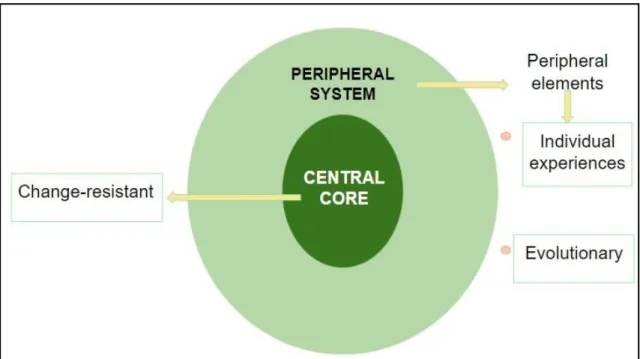
Abric’s central core theory (p.20-22), ensures two main functions: which are the generation of a SR and its organization, first there is a creation of an idea which makes sense and is assessed by the individual, and then this idea is organized according to its constitutive elements so that it becomes stable and unified. These constitutive elements are the ones that give meaning to the representation, comply with rules, stereotypes and attitudes that are in the core of the representation.
Apart from this central core, there are the peripheral elements which are the organized elements that are surrounding the core and have a direct relation with it. The value, presence and function of those elements are determined by the core, they are the most accessible side of a SR. (p. 23-25)
From what it is expressed above, it may be inferred that the mental construction of a certain SR follows a configuration of two categories: significance and order, in which the core will hold the most important or relevant elements that were associated to the object. And, the rest of less valuable information will be placed surrounding that core. Therefore, this organization will dictate the attitude and behavior that a person will show regarding that mentioned object. As stated by Abric, the transformation of the central core produces a change in the representation, therefore, if a SR wants to be changed, the peripheral elements need to be intervened in order to change the core.
Fig. 1. Central Core Theory
2.1.3 Semiotics: Connotation and Denotation
The analysis of speech, regarding its contextual and factual significance was introduced by Ferdinand de Saussure in 1916, who opened what was called as Semiotics or Semiology in the field of Linguistics. He proposed language as an arbitrary sign system, which, basically, can be studied contrasting its regular meaning to its regular use. Though, the terms of denotation and connotation were later proposed by Louis Barthes in 1954, these provided the precise concepts to differentiate the communicative intention from the literal meaning. (Seiler, 2000)
Sonesson (2012), offers a logical explanation to this differentiation:
“…denotation means the same thing as extension, i.e. the object or class of objects subsumed by a concept,
and connotation is another term for what is also termed intension or comprehension, i.e. the list of all
properties characterising the concept, or only those properties conceived to be the necessary and sufficient
criteria for ascribing some object to the concept; and/or the properties permitting us to pick out the objects falling under the concept.”
context, and it leads the understanding for every type of communication, so the sender emits a certain message and the receiver can recognize and somehow decode the emotion and some of the mental constructs behind it.
2.1.4 Chilean Evaluation System
According to the Chilean law, “Decreto 1480, artículo 9” which determines the Chilean evaluation system and specifies that evaluations consider the acquisition of knowledge and information, apart from the application of a wide range of vocabulary and concepts, considering the students’ acquired knowledge, attitudes and interests. The Ministry of Education created a rating scale to evaluate and classify the students’ ARs which are expressed, according to “Decreto 1480,
artículo 10” in the following rating scale, considering 1 as the lowest grade and 7
the highest. (See table 1 and 2)
Table. 1. Decreto 1480, artículo 10. Table 2. Decreto 1480. artículo 10
1 Muy malo
(Free translation by the authors)
2.1.5 Communicative Competence
According to the Chilean National Curriculum Guidelines (Bases Curriculares) from the year 2012 and 2013, the activities that should be done for developing the EFL communicative competence of students must be linked with a daily based situation, which can provide tools and strategies to be able to diminish the anxiety to talk in L2. Students must be given tasks where they can use English in significative, contextualized, and close to students’ real situations. These types of tasks will prompt students’ acquisition of the second language. The use of the language must be contextualized, and the structures and formulas must be considered as elements which support the communication and the real use of the L2. These structures and formulas must not be seen as a separate topic to comprehension and oral production, they must be seen as a complement to achieve a proper communication in the second language. “Bases Curriculares” also states that the inductive discovery of grammatical structures through communicative tasks put in a context will make it easier for students to learn the language properly.
2.2 State of the Art.
The topic of SRs in education has been studied in Chile and Latin America during the last decade. In fact, there are some studies that have already been able to identify student’s SRs towards the EFL subject in the South American context. In Chile, the first study regarding this topic was carried out by González & Ponce (2009). These researchers’ objective was to recognize Chilean university students’ perceptions and opinions about the English language subject during their first semester at university. Within this study, it was estimated that the subjects’ SRs were constructed, most probably, during their school years. In relation to that matter, the authors stated:
tendency towards one theme. … their SRs towards the English subject could have created a sort of permanent and settled idea in their subconscious.”
As it can be understood, this was a similar idea on what Abric states in his Central Core Theory that some ideas can be settled in people’s mind.
The analysis of the previously named Chilean research was placed on what was going on in those students’ minds, what environmental or social influences and/or personal views affected the students at the moment of learning English as a foreign language. The SRs theory in this study helped to extract those mental constructs concerning English learning from that determined group of subjects, which concluded that the perceptions, ideas and opinions of the participants coincided in four general aspects such as the difficulty to learn the language, the students’ appraisal of the teaching methodology applied while they were taught English, the feelings of fear and rejection students felt when facing an EFL class and, finally, the agreement of the students on the usefulness of English as a tool for the future, especially when finding jobs.
EFL to Education, approaching to the understanding of how SRs are involved in the motivation that underlies the act of learning English for High School students of different social backgrounds (middle-lower class/public education and upper class/ private education). Ubillo centered - as the previously named researchers- on identifying or characterizing and comparing the students’ SRs about why learning English, her analysis revealed that the two groups of high schoolers share the ideas of English being a tool to fulfill their aspirational desires of travelling abroad, better job options for one group, and ratifying their social status and high proficiency of the English language for the ones belonging to upper class families. Nevertheless, the notorious difference appears when public education students refer to English as being a mandatory part of their curriculum, and the difficulties that emerge for staying motivated while learning it. However, the other group of students from private education has a different appraisal of English which does not relate to the concepts of obligation. Thus, both groups learning processes of the language were perceived differently.
Intending to go deeper on how SRs might affect the learning and teaching of English, some authors seem to agree on that identifying students’ SRs towards the English language complies with a mere part of the whole analysis. On this matter, Colombian researchers Camacho.E, Ordóñez.E, Fernández.M, García.H, Dorado (2014) express that “Now, the question addresses inside the classrooms, in relation to how students' social representations towards the English learning should be built in direct interaction with them, from their cultural and social context in the framework of their educational process.” . In a certain Argentinian case, also in relation to EFL, Vartalitis & Portesio (2016) state that “...regarding ELT classes in high school as a particular social practice, we believe that awareness of students’ SR of ESS may improve teachers’ understanding of classroom dynamics”.
how English learners’ perceptions and social interaction need to be handled in order not to just distinguish students’ SRs, but to also identify the repercussions these SRs may have in the students’ learning process; from examining the applied methodologies to analyzing the obtained assessment results as an outcome from the applied teaching strategies, curriculum and governmental policies involving the learning process of the English language as a foreign language.
CHAPTER 3
3.1 Type of Research and Design
According to Hernández-Sampieri (2016) the approach of this kind of study is a correlational type research, in which the students’ SR towards the EFL subject and their ARs are the variables involved in it. Since the aim does not seek to produce any change or intervene the participants’ SR nor their ARs, this study also falls into the classification of a non-experimental sort of research. Thus, the purpose of the present research is to attempt to explore the plausible correlation between the two variables. Consequently, the target is to identify if the dependent variable (AR) is influenced by the independent variable (SR). To clarify what was previously expressed: the independent variable corresponds to the participants’ social representations (SRs) of the EFL subject, and the dependent one refers to the participants’ assessment results (ARs) in the named subject.
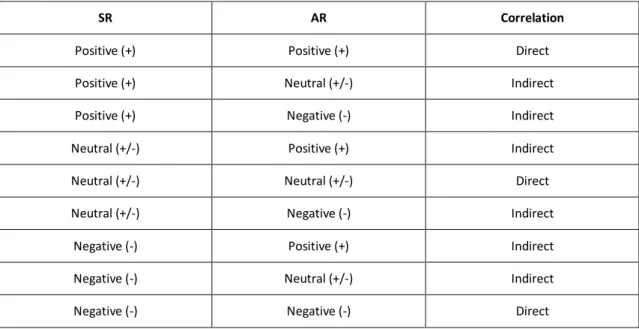
Both variables are divided into three categories: positive, neutral and negative. Which means that participants’ SR might be: positive (+) SR, neutral (+/-) SR or negative (-) SR. Subsequently, the obtained ARs’ categorization and coding might also be: positive (+) AR, neutral (+/-) AR or negative (-) AR. (See table 3)
Therefore, from the results we might two types of correlations:
• Direct correlation, meaning that the values of the two variables coincide: (+) SR and (+) AR, (-) SR and (-) AR or (+/-) SR and (+/-) AR
• Indirect correlation, meaning that the values of the two variables does not coincide:
(+) SR and (+/-) AR, (+) SR and (-) AR,
(+/-) SR and (+) AR, (+/-) SR and (-) AR
Table 3. Correlation of variables.
SR AR Correlation
Positive (+) Positive (+) Direct
Positive (+) Neutral (+/-) Indirect
Positive (+) Negative (-) Indirect
Neutral (+/-) Positive (+) Indirect
Neutral (+/-) Neutral (+/-) Direct
Neutral (+/-) Negative (-) Indirect
Negative (-) Positive (+) Indirect
Negative (-) Neutral (+/-) Indirect
Negative (-) Negative (-) Direct
On accordance to Hernández Sampieri (2016), the used method is qualitative since it involves a qualitative analysis of the participants’ opinions and experiences regarding the EFL subject, which are then interpreted as SRs and correlated with their EFL subject’s ARs. There may be certain factors appearing at this stage, which might be interpreted as influencing current opinions and perceptions of participants, however these findings would be included only for further discussion in this study.
3.2 Population
This research was carried out with participants who were actively involved in the education system, exactly from four schools in the fifth region of Valparaiso:
Colegio Marista Quillota - Instituto Rafael Ariztía (IRA), located in Quillota; Colegio
Marista Villa Alemana – Champagnat, located in Villa Alemana; Colegio Luterano
Concordia Valparaíso; and Colegio Padre Antonio Zanandrea, both located in
metropolitan Valparaiso.
were previously mentioned above.
The criteria to choose this population is based on, firstly, the experience of the student having compulsory English at school, which should at least be 2 years. According to the Chilean Ministry of Education policies, it is established that the minimum compulsory school level to start taking the subject of English as a foreign Language is from 5th grade at elementary level on. Considering that, this study was directed to those students that have had at least two years of compulsory English at school. However, there are students who have been exempted from the subject, which we did not take into consideration for the study because they did not comply with the experience of having compulsory English. The second criterion is based on the schools and classes that were assigned to us in our professional internship. Finally, students with special educational needs were also not considered for this research as they demand different methods in order to be assessed and a case study approach would be more optimal to study their SRs.
3.2.1 Sample
The type of sample used for this research project is based upon quota, and availability sampling which according to Hernández-Sampieri (2014) fall into the category of non-probability or directed samples; because the subjects chosen for this research project stem from a population matrix in which they all have in common the same criteria explained above.
the same amount of EFL curricular hours weekly. However, this study did not focus on the students’ English level.
3.3 Instruments
Following the aim of our research, two validated instruments were carried out: a questionnaire and a focus group with open questions, which were implemented to the participants with the objective of identifying their SRs about the EFL subject. Both instruments were conducted in Spanish with each of the different groups.
The questionnaire consisted of 15 concepts, which were previously chosen by a professional of the psychology field, those words were meant to be said out loud by an interviewer, after listening to the interviewer saying each word, the participants wrote on a sheet of paper the first thing that came to their minds, and their stated written opinion would be considered to reflect the SR of the concepts they heard. This was a free association sort of questionnaire in which the participants listened to the word and wrote down the first thing that came to their minds.
The concepts mentioned were the following:
(See Annex III)
The concepts above were carefully chosen among common words which the participants could relate to the EFL subject was the only important concept of the
research, the rest were used as distractors from the main focus which was the EFL subject.
Referring to the second instrument, the focus group consisted of an interviewer asking 7 questions, which were carefully formulated and validated by a professional psychologist. Those questions allowed us to go deeper into the participants SRs of the EFL subject in particular. The participants were a sub- sample of 12 students from each class, 48 participants in total, who sat on chairs arranged in a semicircle, where they were asked about their school daily life, the EFL subject and their ARs of it. A voice recorder was on during the focus group.
The questions asked were:
1. What is your favorite subject? Why?
2. Which are the most important subjects for you? Why?
3. What do you think the History subject will be useful for, when you finish high school?
4. What is your opinion of the EFL subject?
5. From 1 to 7, Which grade would you give to the EFL subject?
6. How did the first grade of the year in the EFL subject affect you?
7. How would you describe your performance in the EFL subject in relation to your grades? Why?
3.4 Data Collection
differed in 1 month between the first school and the last school where the instruments were applied.
The day of application, two members of the research team, who were not related to the school, went to apply the questionnaire and focus group to the participants. The interviewers had never met the participants and did not give any personal information in order to obtain unbiased opinions from the participants regarding the EFL subject.
As for the first instrument, a whole class from the school was intervened while they were in classes. A white sheet of paper was given to every participant, in where they had to write their 2 last names on the right top corner of it. Then, one of the interviewers gave the instructions to be followed when answering the questionnaire properly. One of the interviewers was in charge of saying the concepts out loud while the other was controlling the time the participants had to answer every concept.
Both instruments were applied on the same day, one followed by the other, with only 10 minutes in between. The application of the questionnaire lasted 15 minutes approximately, while most focus groups lasted between 40 to 45 minutes approximately. Once the focus group was finished, the participants were sent back to their classrooms. It is important to state that both instruments were applied only once in each school.
As stated above, all the answer sheets from the questionnaire were collected by the interviewers to be analyzed. The focus groups’ recordings were later transcribed and classified.
3.5 Analysis of Data Collection
As it was expressed in section 3.1. To analyze the collected data, the terms “positive”, “neutral” and “negative” were adapted as basis of categorization, considering that the main theory in the research is Social Representations, in which the participants’ perceptions and opinions were aspects that belonged the independent variable, these were classified into the named categories.
Apart from the application of both instruments, the participants’ ARs obtained during the first term – that were regarded as dependent variable- were also gathered then coded and later categorized – using the same three terms as explained above- in order to discover the correlation between participants’ SRs and their ARs.
3.5.1 Analysis of Questionnaire
concept which was then classified into 3 categories; negative, neutral and positive.
The following examples are based on the participants answers. The analysis was made taking into account the connotations of the sentences stated through speech analysis (See section 2.1.3). The words and sentences that expressed a positive connotation were: “entretenido” (entertaining), “me gusta” (I like it), “me
gustaría dominarlo” (I would like to master it), and “interesante” (interesting),
which led us to a positive SR of the EFL subject.
Nevertheless, the words and sentences that expressed a neutral connotation were not precise enough to be classified. Most of the times, they were definitions of the concept rather than a statement with a clear connotation. In addition, lots of the neutral statements had a positive tendency and a negative one at the same time, so they were considered neutral because the connotation was not clear enough to determine a classification. On the other hand, the words and expressions that expressed a negative connotation were: “odio” (hate), “aburrida” (boring), “no gusta” (I don’t like it) and “no entretenida” (not entertaining), which led us to a negative SR of the EFL subject. (See Annex VI - IX)
For example:
Positive Statements:
• Entertaining, culture, language of other people.
• I like it because it is a global language.
• Language I would like to master.
• Specially interesting.
Neutral Statements:
• Understand new words.
• I think of the Big Ben.
• Useless, but useful at universal level.
Negative Statements:
• A bit boring.
• I hate English.
• I don’t like it at all.
• It is not very interesting. (Free translation by the authors)
3.5.1.1 Analysis of Participants’ Social Representation
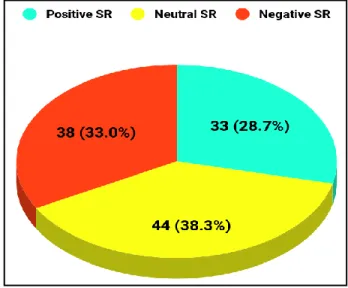
Considering what was stated above, it was possible to identify the participants’ SRs of the EFL subject, then they were divided into the 3 different categories: positive, negative and neutral. From 115 participants, 28.7% had a positive social representation of the EFL subject, 33% had a negative social representation of de EFL subject and 38.3% had a neutral social representation of the EFL subject. (Fig. 2)
3.5.1.2 Analysis of EFL Participants’ Assessment Results
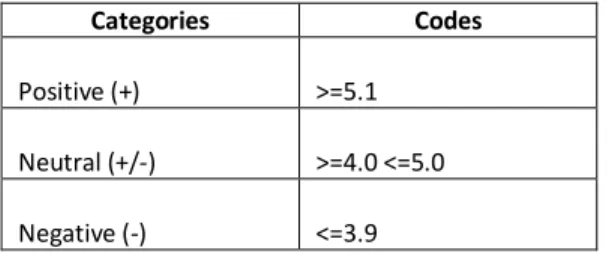
The participants’ ARs from the first term of the year, were gathered and put into a table to be analyzed. Participants were enumerated from 1 to 115 in order not to reveal their identity. The ARs were analyzed according to “Decreto 1480” which classifies them according to a rating scale that goes from 1.0 to 7.0 with different categories: very bad, bad, deficient, average, above average, good, very good. The participants’ AR’s were then itemized in three different categories: negative, neutral and positive. Every category had codes (See Table 4)
• Negative: As the Ministry of Education (MINEDUC) considers grade 4.0 as the minimum passing grade, in consequence, every grade less than or equal to 3.9 was considered to be negative.
• Neutral: As the grades were between sufficient minimum passing grade and regular passing grades, these were considered to be neutral as they were above 4.0, but less than or equal to 5.0.
• Positive: Grades from equal or greater than 5.1 were considered to be positive, according to the Minister of Education (MINEDUC).
Table 4. Grades Chart Categorization and Coding. (See Annex V)
Categories Codes
Positive (+) >=5.1
Neutral (+/-) >=4.0 <=5.0
Negative (-) <=3.9
Table 5. Total of Participants ARs of the EFL Subject
3.5.1.3 Analysis of the Underlying Correlation between the Participants’ SRs
and their ARs.
To correlate the participants’ SRs and their ARs, each of the 3 categories of SRs were subdivided into 3: Positive ARs, neutral ARs and negative ARs, to see the underlying correlation between the variables. (See Table 6)
Table 6. Correlation between the SRs and the ARs of the participants
Social Representations Assessment Results Correlation
Positive (33) 17 (positive) Direct
10 (neutral) Indirect
6 (negative) Indirect
Neutral (44) 28 (positive) Indirect
14 (neutral) Direct
2 (negative) Indirect
Negative (38) 20 (positive) Indirect
12 (neutral) Indirect
6 (negative) Direct
Total: 115 Total: 115
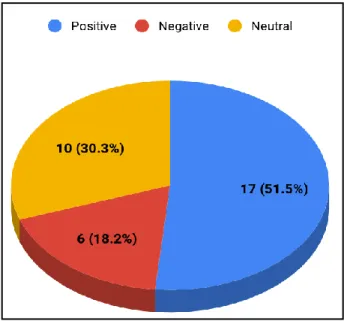
Of a total of 115 participants, 33 presented a positive SR of the EFL subject. 17 of those 33 had a positive (+) SR and a positive (+) AR, therefore they presented a direct correlation between the variables. On the other hand, 10 out of 33 participants had a positive (+) SR and a neutral (+/-) AR, in consequence, they presented an indirect correlation between the variables. Lastly, 6 out of 33 participants had a positive (+) SR and a negative (-) AR, consequently, they also
Positive Neutral Negative
The expressed above was pictured on a pie chart in order to represent the analyzed data. (Fig. 3)
Fig. 3. Underlying Correlation between Positive SRs and ARs.
Out of 115 participants, 44 presented a neutral SR of the EFL subject. 14 of those 44 had a neutral (+/-) SR and a neutral (+/-) AR, therefore they presented a direct correlation between the variables. On the contrary, 28 out of 44 participants had a neutral (+/-) SR and a positive (+) AR, in consequence, they presented an indirect correlation between the variables. Finally, 2 out of 33 participants had a neutral (+/-) SR and a negative (-) AR, thus, they also presented an indirect correlation between the variables.
Fig. 4. Underlying Correlation between Neutral SRs and the ARs.
Regarding the participants’ negative SRs and their ARs. Out of 115 participants, 38 presented a negative (-) SR and a negative (-) AR, for this reason, there was a direct correlation between the variables. Opposite to this, 12 out of 38 participants had a negative (-) SR and a neutral (+/-) AR, hence, there was an indirect correlation between the variables. Lastly, 20 out of 38 participants had a negative (-) SR and a positive (+) AR, for that reason, they also presented an indirect correlation between the variables.
The expressed above was pictured on a pie chart to represent the analyzed data (see Fig. 5)
Fig. 5. Underlying Correlation between Negative SRs and ARs.
3.5.2 Analysis of Focus groups
The focus group had 7 questions. All questions were relevant to the study, except for question number 3 which acted as a distractor. Later, the information gathered from the six questions was used for the qualitative analysis of the participants’ spoken speech, proposed by Barthes in Seiler (2000). Each participant provided a spoken statement in relation to every question.
3.5.2.1 Analysis of the Underlying Correlation between the Participants’ SRs
and their ARs.
It is important to point out that the participants’ SRs explained in section 3.5.1.1, were gathered from written statements the participants gave in instrument 1. In this section, oral statements were given by only 48 selected participants whose opinions were used to extract their SR of the EFL subject in a numerical appraisal.
The assessment results that the participants from the focus groups gave to the EFL subject when answering question 5 was an average of a 4.3 - based on the Chilean scale from 1.0 to 7.0 - which would be the SR of those participants expressed in numerical appraisal. On the contrary, the same participants’ average on their AR was a 5.4, therefore, there is an indirect correlation between both variables, as the SR is neutral and the AR is positive.
3.5.2.2 Analysis of the Focus Group under the Central Core Theory
The focus groups responses were analyzed under speech analysis, beneath the ‘Central Core Theory’, considering the most recurrent participants’ opinions given on questions 1,2,4 and 5 in relation to the EFL subject. As the focus group responses were audio recorded, transcriptions were made and then analyzed.
The numbers expressed below (See table 7) are the quantification of times an opinion was repeated among the participants.
Table 7. Quantification of opinions according to the Focus Group.
Communicative
competence
Teacher’s influence Purpose of learning
English
Motivation
Classification of the Central Core:
The following examples were taken from the focus group and were free translated by the researchers, taking into account the most repeated opinions among the participants.
• Purpose of learning English
Related expressions:
1. “English is present in almost everything I want to major in”.
2. “English taught at school will be useless later”
3. “It will allow me to travel”
4. “You can get by with the English you learn at school”
• Teacher’s influence
Related expressions:
1. “The teacher did not take advantage of the years we had to learn
English”
2. “We don’t learn much in classes. There is no motivation from the
teacher’s part”
3. “They give you the formula as in mathematics”
4. “Everything goes in the teacher’s drive, because if the teacher
• Communicative competence
Related expressions
1. “I like to speak English”
2. “They teach us only the basics. We won’t be able to communicate
properly”
3. “We only learn to write but not to communicate”
4. “I like when we have oral presentations because it is not only
writing but you also speak”
• Motivation
Related expressions:
1. “I used to like English, but now I don’t”
2. “I don’t like English either”
3. “It is a very important subject for me”
4. “There are more important things than English”
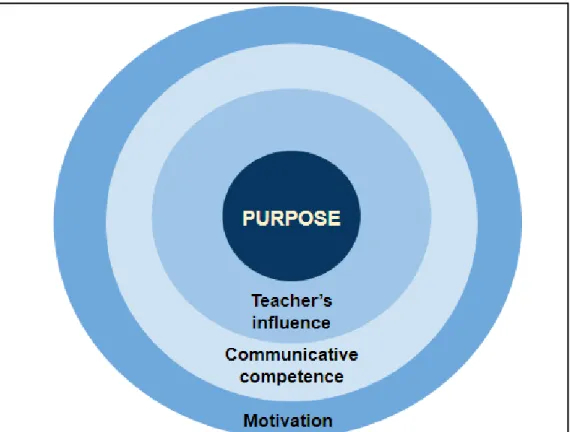
whole, the purpose of learning English is the key factor that determines the appraisal the participants have towards the EFL subject.
Fig. 6. EFL subject Central Core
3.6. Results
Regarding the data obtained from the focus groups in question 5, the results obtained were that the participants SR of the EFL subject expressed as a numerical appraisal was a 4.3; whereas, the participants average ARs was a 5.4. It can be stated that there is an indirect correlation between the participants’ SRs expressed as a numerical appraisal and their ARs.
The results obtained from the questionnaire allowed us to answer the research question, which was, “Is there any direct underlying correlation between Chilean EFL students’ SR of the EFL subject and their ARs throughout the term?”, concluding that there is an indirect underlying correlation between the participants’ SR of the EFL subject and their ARs, because the two variables did not always coincide.
Moreover, even if the participants’ SRs of the EFL subject were neutral, their ARs tended to be positive, meaning that the participants’ SRs do not have any influence on the participants’ ARs of the EFL subject. Regarding the oral numerical appraisal given by the participants in the focus group, it can also be concluded that there is an indirect underlying correlation between the participants’ SR of the EFL subject and their ARs.
Regarding the results obtained from both instruments, it was possible to recognize the EFL subject Central Core (fig. 6) where it could be noticed that the participants’ statements tended to gravitate towards similar topics, such as: motivation, communicative competence and teacher’s influence. From these elements we were able to realize that one of the most important things that influenced the participants’ social representation of the EFL subject is the teacher that dictates the EFL classes. Most of the participants’ bad perception of their EFL teacher expressed that the classes were boring because the teacher did not motivate them to learn English properly and that the activities done by he or she were lacking in purpose, meaning that the vocabulary and grammar learned in these activities were not useful for participants to be used in their everyday life. This showed that the teachers were not considering the participants social context when planning the EFL classes, instead teachers have been mainly teaching vocabulary that the participants are not going to be able to use in a normal daily basis. For instance, in the participants’ words, they gave examples of the EFL Subject resembling Mathematics and how both subjects use formulas. In consequence, the main priority is not learning vocabulary but grammar instead, based on what was collected through their opinions.
before is Meaningful Learning Theory developed by Ausubel & Novak (Ausubel & Novak, in Ballester, 2014): “In teaching it is important to know how learners learn. If we teach in a connected and related way, most of them will learn properly. Otherwise learning difficulties may arise”.
The influence of the named theory in how to teach was also reflected in some of the opinions given by the participants, which make us believe that Meaningful Learning might be one of the factors linked to their SRs of the EFL subject; how experiences previously lived have been acquired and at the same time, beliefs, new knowledge and ideas are the based from someone to begin building up knowledge, in this case, a foreign language. Even though the Meaningful Learning theory is included within the demands and the approaches that the national curriculum and the MINEDUC request or recommend to English teachers, many of the teachers in the Chilean context have opted to teach the language through traditional and structured classes, without taking into account how these may affect their students, creating the threat of producing a negative change that can impair the perception and vision of the subject, as well as, the appreciation they have of the EFL teacher, at a short or long term in the students’ lives. Many of these situations might be due to the fact that institutions, teachers and professionals in the area are not aware of the concept and implications of SRs. When we mentioned the communicative competence imposed by the MINEDUC, it sounded promising that students were going to be able to use the language and develop a communicative competence, but the reality tended to differ as no one supervises that schools and teachers are actually teaching to achieve the requested standard.
objective proposed by the government, as only 18% of students reached the level between an A2 AND B1, according to the CEFR. Additionally, these results reflected how the social gap deeply affects the proficiency they are able to reach in the language, as it was stated by Ubillo, 2017 (See section 2.2)
Therefore, as it was previously explained the English SIMCE can provide us an overview of teachers’ performance and what students are learning at schools. Nonetheless, there are not enough instances where the government supervises that the English subject complies with the purpose and expectations set by the national curriculum.
Returning to the Abric’s Central Core Theory, there is an opportunity to change what students have deeply internalized in their SR core, which in the case of this research is the purpose of learning English, meaning that someone can change or modify the students’ SR core by intervening the peripheral components of it. And, what is more important is that teachers realize the importance they have in the students’ learning process, on account of being the closest element to the central core.
Abric, J.-C. (1976). Jeux, conflits et représentations sociales. Aix-en-Provence, Thèse d'Etat de l'Université de Provence.
Abric, J. (1994). Prácticas sociales y representaciones. (p. 20-25). Coyoacán, México, D.F. (Free translation)
Ballester, A. (2014). Meaningful Learning in Practice. American Research
Institute for Policy Development. Retrieved from:
http://jehdnet.com/journals/jehd/Vol_3_No_4_December_2014/18.pdf
Bello. S, Villaseca. P (2017, p.11). Social Representations from English RP and GA Linguistic Ideologies in Chilean Cultural Settings: a Contrast between Monolingual Spanish Chilean Speakers from Three different Age
Sets. Santiago, Chile. Retreived from
http://repositorio.uchile.cl/bitstream/handle/2250/143384/Social-representations- from-english-rp-and-ga-linguistic-ideologies-in-chilean-cultural- settings.pdf?sequence=1
Camacho.E, Ordóñez.E, Fernández.M, García.H, Dorado.V (2014). Representaciones sociales, frente al aprendizaje del Inglés. Maestría en Educación de la Diversidad (p.6). Colombia. Retrieved from http://ridum.umanizales.edu.co:8080/xmlui/bitstream/handle/6789/1862/AR TICU
LO_Representaciones_Sociales_frente_al_aprendizaje_del_Inglés..pdf?se quen ce=1 (Free translation)
Cuzco & Zhagui (2010). The use of concept maps for developing children’s reading and writing skills in a foreign - language classroom. Cuenca,
Ecuador. Retrieved from
http://dspace.ucuenca.edu.ec/handle/123456789/2058
García, Y. (2003). Representaciones Sociales: Aspectos básicos e Implicaciones para la Psicología. Revista Psicogente, Vol. 6 Núm. 11, 10.
Retrieved from
http://revistas.unisimon.edu.co/index.php/psicogente/article/view/1528/148 9http:
//revistas.unisimon.edu.co/index.php/psicogente/article/view/1528/1489
González. E, Ponce T. (2009) Representaciones Sociales de Estudiantes Universitarios respecto de la Asignatura De Inglés (p.8). Chile (Free translation)
Hernández-Sampieri, R. (2010) Metodología de la Investigación 5ta Edición.
Retrieved from
https://www.esup.edu.pe/descargas/dep_investigacion/Metodologia%20de %20l a%20investigaci%C3%B3n%205ta%20Edici%C3%B3n.pdf
Hernández-Sampieri, R. (2014) Metodología de la Investigación 6ta Edición.
Retrieved from
https://www.esup.edu.pe/descargas/dep_investigacion/Metodologia%20de %20l a%20investigaci%C3%B3n%205ta%20Edici%C3%B3n.pdf
Krashen, S. (1982). Principles and Practice in Second Language Acquisition. University of Southern California. Retrieved from http://www.sdkrashen.com/content/books/principles_and_practice.pdf
Maury. C (2007) Social Representations: a tool box. Knowledge & Policy in
education and health sectors. Europe. Retrieved from
http://www.knowandpol.eu/.
MINEDUC. Biblioteca Digital. Retrieved from
http://archivos.agenciaeducacion.cl/biblioteca_digital_historica/orientacion/ 2010/ orien3m_2010.pdf (Free translation)
MINEDUC. Biblioteca Digital. Retrieved from
http://archivos.agenciaeducacion.cl/biblioteca_digital_historica/resultados/2 012/r esult_2012.pdf. (Free translation)
Moscovici, S. (1973). Foreword. In C. Herzlich, Health and illness: a social psychological analysis. London: Academic Press. Retrieved from http://changingminds.org/explanations/theories/social_representation.htm Pública, M. D. (3 de Noviembre de 2018). Biblioteca Del Congreso Nacional.
Retrieved from Biblioteca Del Congreso Nacional:
https://www.leychile.cl/Navegar?idNorma=1044541&r=1 (Free translation)
R. S. (2014). Metodología de la Investigación (6th ed.). Mexico City: McGRAW- HILL / INTERAMERICANA EDITORES, DE C.V.
https://people.ucalgary.ca/~rseiler/semiolog.htm
Ubillo.V (2017) Social Representations underlying Motivation to learn English in students of public vocational technical and private schools (p.7).
Santiago. Chile. Retrieved from
http://repositorio.uchile.cl/bitstream/handle/2250/143263/Social-
representations-underlying-the-motivation-to-learn-english-in-students-of-public-
vocational-technical%20and-private-schools.pdf?sequence=1&isAllowed=y
Vartalitis. A, Portesio.P. (2016). Social Representation of English as a School Subject: How do High School Students Conceive English as a School
Subject? (p. 2). Argentina. Retrieved from
Annex III: Instrument 1
QUESTIONNAIRE
Colegio: Curso:
Tiempo: 10 min aprox. Cantidad de participantes por grupo: 12
Objetivo de actividad: Identificar la representación social de los
participantes en torno a la asignatura de Inglés para encontrar la conexión
entre concepto y la asociación libre de cada participante.
Descripción actividad: Se dirán en voz alta 15 palabras, de las cuales los
participantes deberán escribir en una hoja la representación social que tienen al escuchar cada una de ellas.
Indicaciones:
- Enumerar del 1 al 15 en una hoja.
- Siguiendo el orden, los participantes deberán escribir solo lo primero que se les venga a la mente respecto de la palabra dicha.
- Se les repetirá 2 veces cada palabra si es necesario. Si el
participante no entiende el significado de la palabra, deberá dejarla en blanco, considerándola nula.
Palabras a mencionar:
16. Chocolate
17. Bad Bunny
18. WiFi
19. Profesor
20. Fútbol
21. Frutas
22. Mall
23. Asignatura de Inglés
24. Deporte
25. Computador
26. Colegio
27. Reggaeton
28. Perro
29. Instagram
Annex IV: Instrument 2
ENTREVISTA: FOCUS GROUP
Colegio: Curso:
Tiempo: 40 min aprox. Cantidad de participantes por grupo: 12
Objetivo de actividad: Identificar la representación social de los
participantes sobre sobre el ramo de Inglés a través de un focus
group.
Descripción de la actividad: Se sentará a los participantes en un semicírculo
y se les preguntará sobre su vida cotidiana y el ramo de Inglés.
Indicaciones:
- Se pondrá una grabadora durante toda la entrevista.
- Se harán 7 preguntas a los participantes, donde deberán justificar sus respuestas.
PREGUNTAS DE FOCUS GROUP
1. ¿Cuál es su ramo favorito? ¿Por qué?
2. ¿Cuáles son los ramos más importantes para ustedes? ¿Por qué? 3. ¿Para qué creen que les va a servir el ramo de X cuando salgan del
colegio?
4. ¿Cuál es su opinión sobre el ramo de inglés?
5. Del 1 al 7 ¿Qué nota le das al Inglés como asignatura?
Annex V: Participants’ Assessment Results Chart
Participant 1 5.1 Participant 36 7.0 Participant 66 6.4 Participant 101 6.3
Participant 2 4.4 Participant 37 6.2 Participant 67 6.6 Participant 102 4.2
Participant 3 6.5 Participant 38 6.5 Participant 68 5.2 Participant 103 3.9
Participant 4 4.3 Participant 39 6.2 Participant 69 5.6 Participant 104 3.7
Participant 5 4.0 Participant 40 5.6 Participant 70 4.4 Participant 105 4.6
Participant 6 6.0 Participant 41 5.4 Participant 71 5.0 Participant 106 4.6
Participant 7 4.9 Participant 42 6.8 Participant 72 4.1 Participant 107 6.2
Participant 8 5.0 Participant 43 5.3 Participant 73 5.2 Participant 108 5.4
Participant 9 5.9 Participant 44 6.2 Participant 74 5.3 Participant 109 2.6
Participant 10 4.6 Participant 45 6.6 Participant 75 6.5 Participant 110 4.0
Participant 11 3.8 Participant 46 5.8 Participant 76 3.9 Participant 111 2.8
Participant 12 5.6 Participant 47 6.3 Participant 77 6.5 Participant 112 4.2
Participant 13 5.2 Participant 48 6.8 Participant 78 5.1 Participant 113 5.0
Participant 14 4.9 Participant 49 6.5 Participant 79 5.9 Participant 114 3.9
Participant 15 3.8 Participant 50 6.9 Participant 80 4.7 Participant 115 4.4
Participant 16 3.3 Participant 51 6.3 Participant 81 4.5
Participant 17 3.4 Participant 52 6.4 Participant 82 6.3
Participant 18 5.5 Participant 53 6.6 Participant 83 5.7
Participant 19 4.8 Participant 54 5.0 Participant 84 5.3
Participant 20 5.9 Participant 55 5.8 Participant 85 4.2
Participant 21 4.9 Participant 56 3.5 Participant 86 6.7
Participant 22 5.3 Participant 52 6.4 Participant 87 4.9
Participant 23 4.1 Participant 53 6.6 Participant 88 6.3
Participant 24 4.3 Participant 54 5.0 Participant 89 6.8
Participant 25 3.7 Participant 55 5.8 Participant 90 4.8
Participant 26 5.2 Participant 56 3.5 Participant 91 4.8
Participant 27 4.7 Participant 57 6.8 Participant 92 4.1
Participant 28 4.4 Participant 58 5.9 Participant 93 7.0
Participant 29 4.2 Participant 59 5.2 Participant 94 6.9
Participant 30 4.5 Participant 60 6.3 Participant 95 5.4
Participant 31 6.7 Participant 61 6.5 Participant 96 6.8
Participant 32 3.8 Participant 62 5.2 Participant 97 4.4
Participant 33 4.8 Participant 63 5.0 Participant 98 6.9
Participant 34 5.5 Participant 64 5.7 Participant 99 6.6
Annex VI: Chart Questionnaire Group 1
Positivo Neutro Negativo
Aprender más. Pienso en el Big Ben. Antes era buena en esa
asignatura.
Algo útil. Es bueno el Inglés, pero en clases
me aburro.
No entiendo nada.
Idioma que me gustaría dominar Hello, bye. Me va mal.
Estados Unidos, algo que quiero
aprender.
Me va más o menos. No me gusta para nada.
Mi amiga me enseña la asignatura
de Inglés.
Asignatura que la mayoría de
los alumnos no sabe sacarle
provecho.
Trabajos. Aprendo más Inglés por mi
cuenta que por la asignatura.
Color morado. No entiendo nada, me aburro.
Palabras nuevas, idioma nuevo . Pesadilla, infierno.
No sé cómo hablar Inglés.
Annex VII: Chart Questionnaire Group 2
Positive Neutral Negative
Me gusta aprender otro idioma. Un ramo más. Porro de mierda.
Especialmente interesante. Inservible, pero a nivel universal
servible.
No es muy entretenido.
Quiero ser bilingüe. Es un idioma que es global en
todo el mundo.
Me cargan los practicantes.
Latero pero interesante. Antigua entretención.
Open English. Aburrido.
Passive voice. Materia difícil.
Aprender un idioma distinto. Materia odiada.
Me llama mucho la atención pero
Pruebas complejas.
Annex VIII: Chart Questionnaire Group 3
Positive Neutral Negative
Asignatura que me ayuda en el
futuro.
Los quantifiers de la miss X. Un poco aburrida.
Es fácil aprender el idioma. Me recuerda al X nuestro
compañero extranjero.
Algo que es fácil. Profesora hablando Inglés.
Me gustan las disertaciones. Clase que me cuesta harto, pero
me gusta mucho.
Entretenido, cultura y lenguaje
de otros.
En la asignatura de Inglés mi
promedio está en la media.
Un enredo de palabras muy interesantes como “cake”.
Asignatura que nos ayuda a
conocer otro idioma.
Me ha servido mucho, se
extraña a Miss X.
Me va muy mal en Inglés, pero me
gustaría aprender.
Amo a la miss, me gusta esta
profe.
Hablaré inglés fluido a futuro.
Juegos, risa, buena profesora. Entender palabras nuevas.
Mundo, el idioma desbloquea
barreras.
X y X siempre participan mucho
en la clase de Inglés.
Aprender un idioma que sirve
mucho para la vida.
Aprendizaje de otro idioma global.
Algo muy útil para el futuro.
La asignatura de Inglés es mi
favorita, aunque no me vaya tan
bien.
Me llevo bien con la asignatura
de inglés, ya que me gusta el
idioma.
Una clase importante para
abrirte paso internacionalmente.
Clase entretenida.
Miss X y X que me gusta.
Annex IX: Chart Questionnaire Group 4
Positive Neutral Negative
Asignatura esencial. Aprender el idioma. Malas notas.
Me gusta porque es un idioma
universal.
Es una asignatura donde uno
aprende Inglés qué es una lengua
extranjera.
Pienso en dormir y no hacer
nada con la X.
Me va re bien, I speak English. La relaciono con Estados Unidos
por la NBA.
Las notas que bajan mi
promedio.
Muy fácil en este colegio y muy
importante.
Pasaje a otras culturas mediante
el idioma.
Odio Inglés.
Pasándola bien con mis amigos. Artistas favoritos como: Ariana
Grande, Shawn Mendes.
Bajo nivel de colegio. Dos horas de Inglés donde no
entiendo.
Me encantaría aprender otros
idiomas extranjeros.
No me gusta, pero es necesario. Materia que menos me gusta.
Me gusta el idioma Inglés. Me gustaría que fuera más
interactivo.
Me disgusta, pero a la vez quiero
aprender.
Debería ser mejor.
Me saqué un 48 :(, pero me gusta
el Inglés.
En inglés bajé mucho mis
notas.
El nivel Inglés en nuestro país
está muy bajo.
Mejor latín.
Malas notas continuamente.
Annex X: Interview Transcription Focus Group 1
1. Interviewer: ¿Cuál es su ramo favorito? ¿Por qué?
Participant 1: No sé… Música, porque aprendo más de música.
Participant 2: Música, porque tocamos instrumentos y disfruto la música.
Participant 3: Música, porque me gusta cantar.
Participant 4: Educación Física. Porque me gusta hacer deporte.
Participant 5: Tecnología, porque me atrae.
Participant 6: Definitivamente, Lenguaje. ¿Por qué? Yo diría fácilmente, porque me siento más identificado con esas clases de gusto artístico, hasta yo mismo me digo “yo tan artista”. Tan actuales en cuanto a edad… Yo me inclino más por el valor artístico del cine y de todo el medio del entretenimiento. Por eso es que me gusta tanto lenguaje, porque tiene temas que me interesan y yo…
Participant 7: Biología, porque se relaciona con lo que quiero estudiar: Medicina.
Participant 8: Lenguaje, porque me va mejor en esas cosas, como en Matemáticas y eso.
Participant 9: Lenguaje. Me gusta porque me va bien y se me hace fácil. El otro ramo es Educación Física, porque me gusta mucho el deporte.
Participant 10: Ni uno… Religión. Por la tía. Me cae bien.
Participant 11: Iba a decir Religión también por la tía. Me cae bien.
Participant 12: Lenguaje, porque soy más como de ese lado que como de… Matemáticas y todo.
2. Interviewer: ¿Cuáles son los ramos más importantes para ustedes? ¿Por qué?
Participant 11: Lenguaje Matemáticas e Historia. Porque también igual, sirve para la vida.
Participant 10: Lenguaje y Matemáticas. Porque sirven para la vida.
Participant 9: Matemáticas. Lenguaje. Inglés. Inglés por es que si hay que viajar al extranjero o a otro lugar es como necesario saber el idioma. Los otros, es porque son necesarios…. Matemáticas, no sé cómo explicarlo, pero es necesario y Lenguaje también.
Participant 8: Lenguaje y Matemáticas, porque son como necesarios… para la vida.
Interviewer: ¿Qué ven o entienden uds por vida? Ir a comprar el pan o después para…
Participant 9: Para un futuro bueno, necesitas saber bien esas cosas.
Participant 1: Al menos lo básico.
Participant 7: Yo creo que Historia y Matemáticas. Porque por ejemplo Historia. Como que siempre están preguntando por cosas que pasaron antes. Cosas que hasta las noticias hablan de historia. Y Matemáticas porque eso es lo que más se aplica en la vida diaria.
Participant 6: Yo creo que Lenguaje Y Matemáticas. Como dije la vez anterior, me interesa el Lenguaje, quiero aprender Lenguaje. Y voy a aprender Lenguaje. …. Matemáticas, la típica respuesta; es necesaria las Matemáticas en toda la vida. Pensé un poco en agregar Inglés ya que sé tanto en este punto, pero a mí, ya en este punto es innecesaria la clase de inglés.
Interviewer: ¿Ya sabes inglés?
Participant 6: Ya sé hacer acento británico.