Boletín del Instituto de Fisiografía y Geología
TITHONIAN (INTERNISPINOSUM ZONE) AMMONITES
FROM CORDÓN DE CUCHILLO CURA,
NEUQUÉN BASIN, ARGENTINA
Horacio PARENT, Alberto C. GARRIDO, Armin SCHERZINGER & Günter SCHWEIGERT
Parent H., Garrido A.C., Scherzinger A. & Schweigert G., 2018. Tithonian (Internispinosum Zone) ammonites from Cordón de Cuchillo Cura, Neuquén Basin, Argentina. Boletín del Instituto de Fisiografía y Geología 88: 25-32. Rosario, 26-10-2018. ISSN 1666-115X.
Abstract. A small collection of ammonites from the outcrops of the Los Catutos Member (Vaca Muerta Formation) in Cuchillo Curá indicates a stratigraphic position in the upper Internispinosum Zone. This ammonite assemblage is composed of Cieneguiticeras aff. falculatum (Steuer), Lingulaticeras sp. A, Haploceratoidea indet. (Lamellaptychus), Choicensisphinctes sp. A, Zapalia triplex (Zeiss & Leanza), Catutosphinctes cf. inflatus (Leanza), Catutosphinctes sp. A, Parodontoceras cf. calistoides (Behrendsen), Aspidoceras euomphalum (Steuer), Toulisphinctes cf. rafaeli (Oppel), and Windhauseniceras internispinsoum (Krantz).
The record of C. aff. falculatum in the studied outcrop extends the stratigraphic range of the genus, which thus spans from the lowermost Tithonian Picunleufuense Zone up to the upper Internispinosum Zone. P. cf. calistoides is the oldest known record for the genus Parodontoceras.
Keywords: Ammonoidea ▪ Argentina ▪ Neuquén Basin ▪ Vaca Muerta Formation ▪ Los Catutos Member ▪ Internispinosum Zone.
Resumen. Amonites tithonianos (Zona Internispinosum) del Cordón de Cuchillo Cura, Cuenca Neuquina, Argentina. En la localidad Cuchillo Curá se obtuvo una pequeña colección de amonites del Miembro Los Catutos (Formación Vaca Muerta) la cual indica una edad correspondiente a la parte alta de la Zona Internispinosum. Este conjunto de amonites está compuesto por las siguiente especies: Cieneguiticeras aff. falculatum (Steuer), Lingulaticeras sp. A, Haploceratoidea indet. (Lamellaptychus), Choicensisphinctes sp. A, Zapalia triplex (Zeiss & Leanza), Catutosphinctes cf. inflatus (Leanza), Catutosphinctes sp. A, Parodontoceras cf. calistoides (Behrendsen), Aspidoceras euomphalum (Steuer), Toulisphinctes cf. rafaeli (Oppel), and Windhauseniceras internispinsoum (Krantz).
El registro de C. aff. falculatum en el afloramiento estudiado amplía el rango estratigráfico del género, el cual se extendería desde la Zona Picunleufuense (Tithoniano inferior basal) hasta la parte alta de la Zona Internispinosum. P. cf. calistoides es el registro mas antiguo del género Parodontoceras en la Cuenca Neuquina.
Palabras clave: Ammonoidea ▪ Argentina ▪ Cuenca Neuquina ▪ Formación Vaca Muerta ▪ Miembro Los Catutos ▪ Zona Internispinosum.
Horacio Parent [[email protected]]: Laboratorio de Paleontología, IFG, FCEIA, Universidad Nacional de Rosario, Pellegrini 250, 2000 Rosario, Argentina.
Alberto C. Garrido [[email protected]]: Museo Provincial de Ciencias Naturales “Prof. Dr. Juan A. Olsacher”, Dirección Provincial de Minería, 8340 Zapala, Neuquén, Argentina &Departamento Geología y Petróleo, Facultad de Ingeniería, Universidad Nacional del Comahue, Buenos Aires 1400, 8300 Neuquén, Argentina. Armin Scherzinger [[email protected]]: Maurenstraße 26, 78194 Immendingen-Hattingen, Germany. Günter Schweigert [[email protected]]: Staatliches Museum für Naturkunde, Rosenstein 1, 70191 Stuttgart, Germany.
Received 21/06/2018 Accepted 10/10/2018 Available online 26/10/2018
Editors A. Greco E.P. Peralta
Bol. Inst. Fis. Geol. 88 (2018): 25-32. Rosario - Argentina.
INTRODUCTION
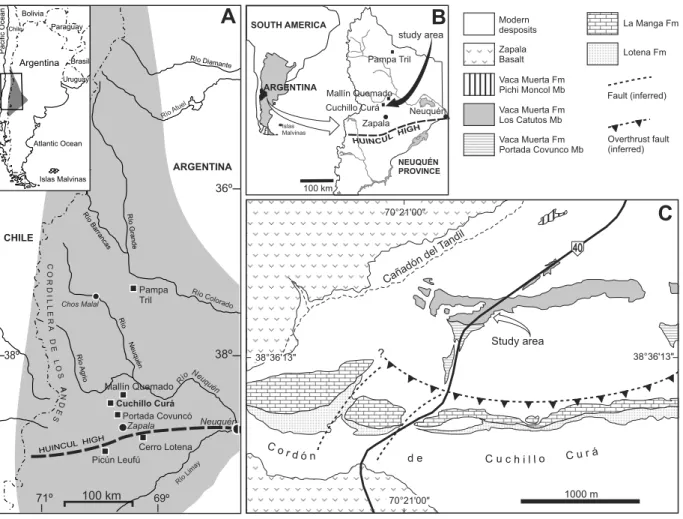
South of 38°S of the eastern sector of the Neuquén Basin (Fig. 1A) the Vaca Muerta Formation shows three well-differentiated sections, which have been formally named, from below, as Portada Covunco, Los Catutos and Pichi Moncol members (Parent et al. 2013). The Los Catutos Mb consists mainly of hard whitish marls (see details in Leanza & Zeiss 1990 and Parent et al. 2013: 6) which make it usually impossible to extract ammonites in a productive way. This condition is typical all throughout the outcrops of the member, from the southern locality Cerro Lotena up to north of Mallín Quemado. Under these circumstances any occasion to gather ammonites from the weathered surfaces in different localities becomes of great value. Of course collections from isolated stratigraphic horizons need to be positioned stratigraphically considering other more complete successions studied under close stratigraphic control.
A small section of about 5-6 m in thickness of whitish marls of the Tithonian Los Catutos Mb is exposed crossing the route 40, 46 km northwest from Zapala City, between Mallín Quemado and Portada Covunco, in the W-E oriented high named Cordón de Cuchillo Curá (Fig. 1B-C). In this
area the deposits of the Lotena and La Manga formations (Callovian-Oxfordian) are superimposed tectonically on the Vaca Muerta Fm which is poorly exposed, covered by modern sediments. Outcrop levels of the Los Catutos Mb represent some part of the Internispinosum Zone which is isolated since the under- and overlying beds are not exposed. From this locally isolated stratigraphic biohorizon a small sample of ammonites was collected which includes some interesting forms.
The purpose of this note is to describe these ammonites and to discuss their position within the Internispinosum Zone. All collected ammonites are stored at the Museo Provincial de Ciencias Naturales "Prof. Dr. Juan A. Olsacher" (MOZ-PI), Zapala, Neuquén Province, Argentina.
Figure 1. A: Neuquén Basin (gray area) with indication of the studied locality and others mentioned in the text. B: Neuquén Province with indication of the study area, north of the Huincul high. C: Geologic map of the study area. The asterisk marks the sampling point in the outcrop of the Los Catutos Member of the Vaca Muerta Formation.
Genus Cieneguiticeras Parent, Myczinski, Scherzinger & Schweigert, 2010
Type species: Haplocerasfalculatum Steuer, 1897; by original designation.
Cieneguiticeras aff. falculatum (Steuer, 1897)
Fig. 2A
Description. Adult macroconch with incomplete bodychamber, maximum diameter 45 mm. Involute from the inner whorls, high-whorled, last whorl of phragmocone smooth. The bodychamber begins at about 31 mm in diameter. It is ornamented with wide lunuloid primary ribs on the upper part of the flank, and in the uppermost flank there are well-formed short intercalar ribs between the primaries.
Remarks. This species is very similar to C.falculatum but differs by its more involute conch, the occurrence of short intercalary ribs on the uppermost flank, and by a younger stratigraphic position. The present species could be related with a small specimen from the upper Proximus Zone of Arroyo Cieneguita (Parent et al. 2010: fig. 5F) which has a sculpture consisting of short and wide primary ribs on the upper flank; however this latter specimen is smaller, showing an earlier ontogenetic stage, so for any closer comparison more material is necessary. In the uppermost Proximus Zone or lowermost Internispinosum Zone of Cerro Lotena an adult macroconch of C. falculatum was collected which is indistinguishable from the morphotype of the Zitteli to Proximus zones (Parent et al. 2010, 2015), with only well-developed lunuloid ribs on the flank. The i n c o m p l e t e m a c r o c o n c h f r o m t h e b a s e o f t h e Internispinosum Zone of Pampa Tril described as Cieneguiticeras n. sp. A in Parent et al. (2015: fig. 85K) differs by showing a densely ribbed outermost whorl with falcoid primary ribs separated by several finer intercalaries at comparable diameter. These differences suggest that the sculpture of the specimens studied herein appears not earlier than in the lower Internispinosum Zone.
Genus Lingulaticeras Ziegler, 1958
Type species: Ammonites nudatus Oppel, 1863; by original designation
Remarks. This genus is a receptacle of microconchs whose macroconchs are currently assigned to Taramelliceras Del Campana, 1905, Neochetoceras Spath, 1925, and Metahaploceras Spath, 1925 (see Schweigert 1998).
Lingulaticeras sp. A
Fig. 2B
Description. A single poorly preserved microconch specimen with remains of the test on part of the bodychamber. The maximum diameter is 53 mm. It is an involute, compressed oxyconic conch with narrow umbilicus and slightly convex flanks. The bodychamber begins at about 35 mm with progressive uncoiling; it is half-whorl long up to the peristome. The sculpture consists of weak irregular falculate ribs with short, stronger prosocline ribs on the uppermost part of the flank. There is a mid-ventral groove developed from at least the last half-whorl of
the phragmocone. The peristome, although poorly preserved shows an acute rostrum and lappets.
Remarks. The falculate ribbing with strong crests on the uppermost flank differentiates the present specimen from the microconchs of Cieneguiticeras and Pasottia Parent, Schweigert, Scherzinger & Enay, 2008 (type species: Pasottia andina) which show a distinctive mid-ventral groove with lingulate structures on otherwise practically smooth flanks. There is nothing described from the Neuquén Basin which can be closely compared with this form. Metahaploceras aff. acallopistum (Fontannes, 1879) in Parent et al. (2015: fig. 84A-B) as represented in the Zitteli [incl. Mendozanus] Zone of Pampa Tril is somewhat similar for the upper flank sculpture. However, these specimens are macroconchs with stonger ribbing covering the flanks and they are stratigraphically older; its corresponding microconch is not yet known.
Superfamily Perisphinctoidea Steinmann, 1890 Family Ataxioceratidae Buckman, 1921
Subfamily Zapaliinae Parent, Schweigert, Scherzinger & Garrido, 2017a
Genus Zapalia Leanza & Zeiss, 1990
Type species: Zapaliafascipartita Leanza & Zeiss, 1990; by original designation
A
10 mmB
1B
2*
*
Zapalia triplex Zeiss & Leanza, 2010
Fig. 3A
Description. Adult macroconchs; evolute with primary ribs rather well-spaced, divided from the mid-flank into two or three secondaries (first half of bodychamber). Some primaries are bifurcated shortly above the umbilical shoulder. The bodychamber begins at 140 to 160 mm in diameter in different specimens, and the maximum size observed is 195 mm (not at peristome).
Remarks. Z. fascipartita differs from Z. triplex by being
more involute and with stronger primary ribs, which divide into several secondaries. Intraspecific variation in a range from evolute serpenticonic conchs with bifurcated ribs towards involute suboxyconic ones with short primary ribs divided in many secondaries is a common pattern in the Ataxioceratidae and well-developed in Zapaliinae (Parent et al. 2017a). This implies that the several co-ocurring morphospecies of Zapalia described by Zeiss & Leanza (2010) from a single outcrop could likely be just macroconchiate variants of a single species. The microconch would consist of the morphospecies grouped in the genus Parazapalia Zeiss & Leanza, 2010, whose
Figure 3. A: Zapalia triplex Zeiss & Leanza, 2010, adult macroconch (field photograph) with incomplete bodychamber. B: Parodontoceras cf. calistoides (Behrendsen, 1891), apparently adult specimen (MOZ-PI-11859). – All from Cuchillo Curá, Los Catutos Mb, Vaca Muerta Fm, Internispinosum Zone. All natural size. Asterisk indicates the last septum.
10 mm
phragmocones are identical to the inner whorls of Zapalia.
Subfamily Torquatisphinctinae Tavera, 1985
Genus Catutosphinctes Leanza & Zeiss, 1992
Type species: Catutosphinctesrafaeli Leanza & Zeiss, 1992; by original designation
Catutosphinctes cf. inflatus (Leanza, 1945)
Fig. 4B
Description and remarks. The sole specimen seems to be a microconch. This serpenticonic ammonite is assigned to Catutosphinctes due to its simple ribbing style with acute primaries widely splayed into two secondaries with some simple intercalatory ribs. It could be assigned to C. inflatus as matching the specimens from the Alternans Zone of Arroyo Cieneguita (Parent et al. 2011: fig. 21). However, the present specimen is poorly preserved and occurs in a deeper stratigraphic position, by which it could be an extreme morphotype of the Internispinosum Zone already resembling typical specimens of C. inflatus. In this sense it
is also somewhat similar to the Internispinosum Zone m i c r o c o n c h i a t e C a t u t o s p h i n c t e s c o l u b r i n o i d e s (Burckhardt, 1903) recently revised in Parent et al. (2011) and the lectotype of which was refigured and further discussed in Garrido et al. (2018).
Catutosphinctes sp. A
Fig. 4C
Description and remarks. A small adult microconch (maximum diameter about 37 mm) with the bodychamber beginning at a diameter of about 22 mm; preserved with lappets. It is rather involute for the genus, finely ribbed with bifurcating ribs. Lappets are short, preceeded by a well-marked rib (Fig. 4C ).2
The well-preserved lappets of this small microconch are typical of the genus. However, the species of the Catutosphinctes lineage are broadly variable in rib-density, even from the inner and/or middle whorls by which our scarce material available cannot be safely compared with any of the known species. C. rafaeli tends to be somewhat more coarsely ribbed in the inner whorls in respect of the present material.
B
A
C
1C
2Figure 4. A: Windhauseniceras internispinosum (Krantz, 1926), complete adult macroconch (field photograph). B: Catutosphinctes cf. inflatus (Leanza, 1945), microconch? (field photograph). C: Catutosphinctes sp. A, complete adult microconch (MOZ-PI-11858); C2: enlarged view (x2) of the lappet. – All from Cuchillo Curá, Los Catutos Mb, Vaca Muerta Fm, Internispinosum Zone. All natural size except C (x2). Asterisk 2
Family Neocomitidae Salfeld, 1921 Subfamily Berriasellinae Spath, 1922
Genus Parodontoceras Spath, 1923
Type species: Hoplitescalistoides Behrendsen, 1891; by original designation
Parodontoceras cf. calistoides (Behrendsen, 1891)
Fig. 3B
Description. Innermost whorls serpenticonic up to some 5 mm in diameter, weakly ribbed. Outer whorls, up to a preserved maximum diameter of 24 mm, platyconic, involute, and narrow umbilicate with high section. Ribbing dense, flexuous; primaries borning on the umbilical wall and bifurcating into two secondaries narrowly splayed from mid-flank; some primaries remain undivided. The last whorl shows a well-defined uncoiling.
Remarks. The uncoiling of the last whorl indicates this specimen is adult; however, there are no indications of its sexual dimorphic status. The venter is not preserved. The inner whorls of P. calistoides are almost identical but finer ribbed (Parent et al. 2015). Many morphospecies of Berriasella are similar to the present specimen, but all of them show a higher bifurcation point, are more evolute, and do not occur earlier than in the latest Tithonian.
T h i s o c c u r r e n c e o f P a ro d o n t o c e r a s i n t h e Internispinosum Zone is very interesting since this genus has been hitherto recorded only from the Alternans Zone, ranging up to the Koeneni Zone (Leanza 1945, Parent et al. 2011, 2015, Garrido et al. 2018: 19).
Family Himalayitidae Spath, 1925
Genus Windhauseniceras Leanza, 1945
Type species: Perisphinctesinternispinosus Krantz, 1926; by monotypy
Windhausenicerasinternispinosum (Krantz, 1926)
Fig. 4A
Remarks. Typical macroconchs close to the lectotype (Krantz 1926: pl. 14: 1-2; Parent 2003: fig. 1) occur in relative abundance. Crushed specimens of this species are hardly distinguishable from similarly preserved specimens of Zapalia, as in the present case. They can be differentiated mainly by the swellings of the points of furcation of the primary ribs in the phragmocone of W. internispinosum which can be observed close to the umbilical seam. In contrast Zapalia exhibits the division of the ribs close to the umbilicus, especially on the outer whorls.
THE AMMONITE FAUNA AND THE AGE OF THE OUTCROP
The full list of ammonites and ancillary elements recorded from the studied outcrop is as follows:
- Cieneguiticeras aff. falculatum: two macroconchs - Lingulaticeras sp. A: one microconch
- Haploceratoidea indet. (Lamellaptychus)
- Choicensisphinctes sp.: abundant small specimens (mainly phragmocones), finely ribbed from the inner whorls; observed in the field
- Zapaliatriplex: abundant as medium-sized macroconchs observed in the field
- Catutosphinctes sp. A: two microconchs - Catutosphinctes cf. inflatus: a single microconch - Parodontoceras cf. calistoides: a single specimen
- Aspidoceraseuomphalum: several specimens observed in the field
- Toulisphinctes cf. rafaeli: two large fragmentary specimens observed in the field
- Wi n d h a u s e n i c e r a s i n t e r n i s p i n o s u m: a b u n d a n t macroconchs observed in the field
- Gastropods: Tornatellaeamendozana Gründel et al., 2007, few specimens observed in the field
- Lucinid bivalves, abundant, observed in the field
The present fauna includes only ammonoid taxa well-known from the Internispinosum Zone. The oppeliids were not previously known, but they do not have much time-correlation potential. Z. triplex has been described exclusively from the upper Internispinosum Zone (Leanza & Zeiss 1990, 1992, Zeiss & Leanza 2010). W. internispinosum is known to be rather confined to its eponymous zone (Leanza 1981, Parent et al. 2007); the present specimens are well distinguishable from the stratigraphically earliest representatives of this species (Parent et al. 2015, 2017b: figs. 9B-C, 10, 12); they closely resemble those of the upper part of the Internispinosum Zone above the internispinosum alpha and "quinchoai" biohorizons (Parent et al. 2015, Garrido et al. 2018). The specimens (microconchs?) of C. cf. inflatus match well with the morphotype figured by Parent et al. (2013: fig. 13C-D) as C. cf. rafaeli from the upper part of the Internispinosum Zone in Portada Covunco section, which is close to the studied locality (see Fig. 1A). The specimen of Catutosphinctes sp. A is not very informative since it is a small microconch. The microconchs of the successive transients of Catutosphinctes show morphotypes which are hardly distinguishable, especially when the material is scarce.
It may be concluded that the studied fauna belongs to a
T
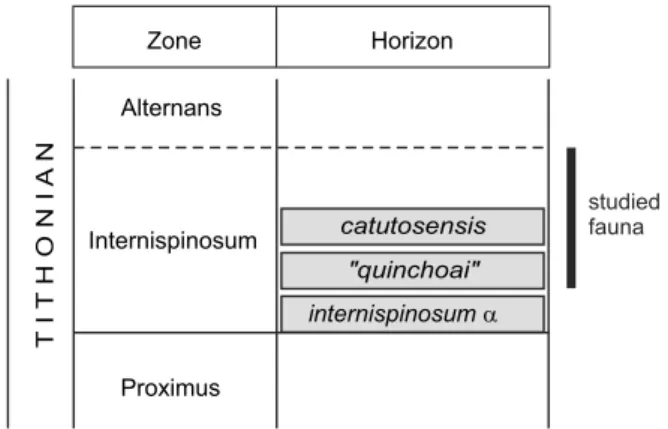
level of the upper part of the Internispinosum Zone that is positioned above the internispinosumalpha Hz. (Fig. 5), correlatable with the (upper?) Ponti Zone (see Parent et al. 2015). The possibility that the studied horizon could belong to the Alternans Zone due to the occurrence of P. cf. calistoides is not considered here, because the remaining ammonites of the assemblage are more numerous and all of them are well-known to occur in the Internispinosum Zone. It is therefore much more probable that the present specimen of P. cf. calistoides represents an early occurrence of this genus in the Internispinosum Zone, hence expanding its stratigraphic range.
CONCLUSIONS
The outcrop of the Los Catutos Mb (Vaca Muerta Fm) in Cordón Cuchillo Curá is Internispinosum Zone in age as indicated by its ammonite fauna.
The record of C. aff. falculatum from Cordón Cuchillo Curá is the youngest one known for the genus Cienguiticeras, whose range then extends from the lowermost Tithonian Picunleufuense Zone up to the upper Internispinosum Zone.
The record of P. cf. calistoides is the oldest one known for the genus Parodontoceras, thus its range would be from the upper Internispinosum Zone up to Koeneni Zone.
Acknowledgements. Dania Pascua and Sergio Cocca (Servicio Geológico del Neuquén, Zapala, Argentina) and Matthias Alberti (Universität Kiel, Kiel, Germany) for taking part of the second field-work. This paper was benefitted from the helpful suggestions of the reviewers of the journal Federico Olóriz (Universidad de Granada, Granada, Spain) and a further anonymous.
REFERENCES
Behrendsen O., 1891-1892. Zur Geologie des Ostabhangs der argentinischen Cordillere. – Zeitschrift der Deutschen Geologischen Gesellschaft43 (1891): 369-420; 44 (1892): 1-42.
Buckman S.S., 1919-1921. Yorkshire Type Ammonites. Vol 3: 5-64. Wesley & Son edit., London.
Del Campana D., 1905. Fossili del Giura superiore di sette Comuni in Provincia di Vicenza. – Publicazione delle Reale Instituti di Studi superiore sezione Scienza Fisico e Naturale23: 1-137.
Douvillé H., 1890. Sur la classification des Cératites de la Craie. – Bulletin de la Société géologique de France (série 3)18: 275-292.
Fischer P.H., 1882. Manuel de conchyliologie et de paléontologie conchyliologique. Librairie F. Savy. Paris. 1369 p.
Fontannes F., 1879. Description des ammonites des calcaires du Château de Crussol, Ardèche (zones à Oppelia tenuilobata et Waageniabeckeri). Georg edit., p. 11 + 123. Lyon.
Garrido A.C., Parent H. & Brambilla L., 2018. Tithonian stratigraphy and ammonite fauna of the Vaca Muerta Formation in Mallín Quemado (Neuquén Basin, A r g e n t i n a ) , w i t h r e m a r k s o n t h e A n d e a n chronostratigraphy. – Volumina Jurassica, in print.
Gründel J., Parent H., Cocca S.E. & Cocca R., 2007. Marine Jurassic gastropods of Argentina. IV. A new species from the Middle Tithonian (Internispinosum Biozone) of Barda Negra, southern Neuquén-Mendoza Basin. – Neues Jahrbuch für Geologie und Paläontologie, Abhandlungen 245(2): 143-146.
Krantz F., 1926. Die Ammoniten des Mittel- und Obertithons. In: E. Jaworski, F. Krantz & H. Gerth (eds.): Beiträge zur Geologie und Stratigraphie des Lias, Doggers, Tithons und der Unterkreide im Süden der Provinz Mendoza (Argentinien). – Geologische Rundschau17a: 427-462.
Leanza A.F., 1945. Ammonites del Jurásico superior y del Cretáceo inferior de la Sierra Azul, en la parte meridional de la provincia de Mendoza. – Anales del Museo de La Plata, nueva serie, Paleontología1: 1-99. Leanza H.A., 1981. The Jurassic-Cretaceous boundary beds
in West Central Argentina and their ammonite zones. – Neues Jahrbuch für Geologie und Paläontologie, Abhandlungen161: 62-92.
Leanza H.A. & Zeiss A., 1990. Upper Jurassic Lithographic Limestone from Argentina (Neuquén Basin): Stratigraphy and Fossils. – Facies22: 169-186.
Leanza H.A. & Zeiss A., 1992. On the ammonite fauna of the Lithographic Limestones from the Zapala region (Neuquén province, Argentina), with the description of a new genus. – Zentralblatt für Geologie und Paläontologie, Teil I (H. 6)1991: 1841-1850.
Oppel A., 1862-1863. III. Ueber jurassische Cephalopoden. Palaeontologische Mittheilungen aus dem Museum des koeniglich Bayerischen Staates 1: 127-262.
Parent H., 2003. Taxonomic and biostratigrapic re-evaluation of Perisphinctes internispinosus Krantz (Upper Jurassic, Ammonoidea). – Paläontologische Zeitschrift77: 353-360.
Parent H., Scherzinger A., Schweigert G. & Capello O.D., 2 0 0 7 . A m m o n i t e s o f t h e M i d d l e Ti t h o n i a n Internispinosum Zone from Barda Negra, southern Neuquén–Mendoza Basin, Argentina. – Boletín del Instituto de Fisiografia y Geología77: 11-24.
Parent H., Myczinski R., Scherzinger A. & Schweigert G., 2010. Cieneguiticeras, a new Tithonian oppeliid genus. – Geobios43: 453-463.
Parent H. Scherzinger A. & Schweigert G., 2011. The Tithonian-Berriasian ammonite fauna and stratigraphy of Arroyo Cieneguita, Mendoza, Argentina. – Boletín del Instituto de Fisiografía y Geología79-81: 21-94. Parent H., Garrido A.C., Schweigert G. & Scherzinger A.,
2013. The Tithonian stratigraphy and ammonite fauna of the transect Portada Covunco-Cerrito Caracoles, Neuquén Basin, Argentina. – Neues Jahrbuch für Geologie und Paläontologie, Abhandlungen269: 1-50. Parent H., Garrido A.C., Scherzinger A., Schweigert G. &
Főzy I., 2015. The Tithonian-Lower Valanginian stratigraphy and ammonite fauna of the Vaca Muerta Formation in Pampa Tril, Neuquén Basin, Argentina. – Boletín del Instituto de Fisiografía y Geología86: 1-96.
Parent H., Schweigert G., Scherzinger A. & Garrido A.C., 2017a. Zapaliinae, a new subfamily of Tithonian-B e r r i a s i a n a t a x i o c e r a t i d a m m o n i t e s . – Paläontologische Zeitschrift91: 507-517.
2017b. Additional Tithonian and Berriasian ammonites from the Vaca Muerta Formation in Pampa Tril, Neuquén Basin, Argentina. – Volumina Jurassica15: 139-154.
Salfeld H., 1921. Kiel- und Furchenbildung auf der Schalenaussenseite der Ammonoideen in ihrer Bedeutung für die Systematik und Festlegung von Biozonen. – Zentralblatt für Mineralogie, Geologie und Paläontologie1921: 343–347.
Schweigert G., 1998. Die Ammonitenfauna des Nusplinger Plattenkalks (Ober-Kimmeridgium, Beckeri-Zone, U l m e n s e - S u b z o n e , B a d e n - W ü r t t e m b e rg ) . – Stuttgarter Beiträge zur Naturkunde B267: 1-54. Spath L.F., 1922. On Cretaceous Ammonoidea from
Angola, collected by J.W. Gregory. – Transactions of the Royal Society of Edinburgh53: 91-160.
Spath L.F., 1923. On ammonites from New Zealand. – Quarterly Journal of the Geological Society 79: 286-312.
Spath L.F., 1925. The Collection of fossils and rocks from Somaliland made by B.N.K. Wyllie and W.R. Smellie. Part 7: Ammonites and aptychi. – Monographs of the
Geological Department of the Hunterian Museum1: 111-164.
Steinmann G., 1890. Cephalopoda. In: G. Steinmann & L. Döderlein (eds.): Elemente der Paläontologie: 344-475, Leipzig (Engelmann).
Steuer A., 1897. Argentinische Jura-Ablagerungen. Ein Beitrag zur Kenntnis der Geologie und Paläontologie der argentinischen Anden. – Palaeontologische Abhandlungen (N.F. 3)7: 129-222.
Tavera J.M., 1985. Los ammonites del Tithónico superior-Berriasense de la Zona Subbética (Cordilleras Béticas). – Tésis doctoral Universidad de Granada587: 1-381. Zeiss A. & Leanza H.A., 2010. Upper Jurassic (Tithonian)
ammonites from the lithographic limestones of the Zapala region, Neuquén Basin, Argentina. – Beringeria 41: 25-75.
Ziegler B., 1958. Monographie der Ammonitengattung Glochiceras im epikontinentalen Jura Mitteleuropas. – PalaeontographicaA110: 93-164.