
Page 1 of 24 The use of oral presentations in Higher Education: CLIL vs. English as a foreign language El uso de las presentaciones orales en Educación Superior: AICLE vs. Inglés como lengua
extranjera
Francisco Gallardo del Puerto María Martínez Adrián Universidad de Cantabria Universidad del País Vasco [email protected] [email protected]
Abstract: The aim of the present study is to gain insight into the use of oral presentations in English in Higher Education. Thirty-five students, divided into two groups – Content-and-language-integrated-learning (CLIL) vs. English-as-a-foreign-language (EFL), were asked about their experience with oral presentations, received theoretical and practical training in how to make good oral presentations, were engaged in tasks in which they had to perform an oral presentation in English, evaluate their peers’ and own presentations, and eventually assessed the whole educational experience. An onset and an offset questionnaire were administered at the beginning and at the end of the innovation experience. The offset questionnaire results indicated that in comparison with the significant gains reported by EFL students, CLIL students did not perceive that their English language skills had improved after the oral presentation training, which suggests that CLIL lessons, in contrast to EFL settings, may be focused on content to the detriment of the language component. Consequently, we make a call for a better integration of content and language and for the use of focus-on-form techniques in CLIL contexts at university.
Keywords: oral presentation; CLIL; English as a foreign language; higher education
Resumen: El objeto del presente trabajo es recabar información sobre el uso de las presentaciones orales en inglés en Educación Superior. Treinta y cinco estudiantes divididos en dos grupos –Aprendizaje-integrado-de-contenido-y-lengua-extranjera (AICLE) e Inglés-como-lengua-extranjera (ILE) fueron encuestados sobre su experiencia con esta herramienta de aprendizaje, recibieron formación teórica y práctica sobre cómo hacer una buena presentación oral en inglés, realizaron tareas en las que tenían que llevar a cabo una presentación oral en inglés, que era juzgada tanto por ellos mismos como por el resto de compañeros, y por último evaluaron la experiencia educativa. Se administraron dos cuestionarios, uno al inicio de la experiencia de innovación educativa y otro al final. El análisis de las respuestas obtenidas a través del cuestionario final demostró que, en comparación con las ganancias significativas percibidas por los estudiantes ILE, el alumnado AICLE no percibía que sus habilidades en lengua inglesa hubieran mejorado después del tratamiento con presentaciones orales, lo que sugiere que quizá las clases AICLE, en contraste con las de ILE, se centran principalmente en el contenido y se olvidan considerablemente del componente lingüístico. En consecuencia, hacemos una llamada a una mejor integración del contenido y la lengua y al uso de técnicas de atención a la forma en los contextos AICLE en la universidad.
Palabras clave: presentación oral, AICLE, inglés como lengua extranjera, educación superior
1. Introduction
Over the past decade the use of ‘other’ (foreign, second) languages as a medium of instruction has become a widespread phenomenon in various educational contexts and settings worldwide (Saarinen & Nikula, 2013). Among the wide variety of language educational approaches available, content-based instruction emphasizes the use of subject matter as a driver of learning. Within this broader category, the content and language integrated learning (CLIL) approach developed in the 1990s has generated considerable interest. As defined by Dalton-Puffer (2011,
Page 2 of 24 183), ‘CLIL can be described as an educational approach where curricular content is taught through the medium of a foreign language, typically to students participating in some form of mainstream education at the primary, secondary, or tertiary level’. Under this umbrella term we can find different CLIL programmes with different contextual factors influencing both their aims and outcomes (Nikula, Dalton-Puffer, & Llinares, 2013), which adds difficulty to pinning down the exact limits of the reality that this term encompasses (Alejo & Piquer, 2010; Cenoz, Genesee, & Gorter, forthcoming).
While most European systems provide CLIL in a variety of (inter)national and minority languages (Eurydice, 2008, 117-118), outside the Anglophone countries, CLIL practices seem to favour the use of English over other languages. Where English is the focus, Content and English Integrated Learning (CEIL) (Dalton-Puffer, Nikula, & Smit, 2010) or English-medium Instruction (EMI) (popular term in Tertiary Education) are practiced (see also Smit & Dafouz, 2012 for terminological considerations). However, in this paper, CLIL will be used, as it is the most widely used term regardless of educational level (see also Aguilar & Muñoz, 2014; Fortanet, 2013; Ruiz Garrido & Campoy Cubillo, 2013 for a similar use of the term in Tertiary Education contexts).
The use of the oral presentation tool in Higher Education has gained in importance in the last decade in programs that embrace the Constructivist view of learning. While the use of oral presentations as a learning tool in English-as-a-Foreign-Language (EFL) has been studied, little is known about their effectiveness in CLIL contexts. In addition, empirical research on CLIL in Higher Education is still in its infancy. This paper will try to shed more light on this topic by reporting on the results of two surveys administered to both CLIL and EFL learners engaged in an initiative called the Education Innovation Project carried out in two universities in northern Spain which was designed to improve students’ oral presentation skills in English. On the basis of students’ answers, we claim that systematic, structured and guided teaching practice is needed as a means for students to effectively improve their oral skills in the foreign language. Additionally, we recommend that teachers, particularly those involved in CLIL programmes emphasize the formal aspects of oral discourse by means of an increase of form-focused input and corrective feedback intended to induce language learners to pay attention to linguistic form in their lessons. This paper is structured as follows. This introduction is followed by an overview of CLIL including relevant research findings. The following section is devoted to the use of oral presentation as a learning tool at university. The methodology of the study is described next. Then the results obtained by means of an onset and an offset questionnaire are presented and discussed. The paper finishes with the main conclusions drawn from our analysis of this approach to enhance university students’ skills to express themselves orally in academic contexts. A particular emphasis will be placed on students’ reported deficiencies when delivering oral presentations.
2. Content and Language Integrated Learning
As CLIL shares many characteristics with other approaches to bilingual education, such as content-based instruction and immersion education, a look at learning outcomes in those contexts deserves attention so as to compare the effectiveness of these programmes with respect to language learning. Studies conducted on immersion programmes in Canada have concluded that intensive use of the second language (L2) as the language of instruction is very effective for the development of communicative competence (Johnson & Swain, 1997; Lightbown & Spada, 1997), as well as for the development of learners’ reading comprehension (McDonald, 1997). In contrast, the benefits of this type of instruction do not seem to work so effectively for productive skills (Cummins & Swain, 1986; Swain, 1985). Immersion students develop (a) almost nativelike comprehension skills as measured by tests of listening and reading comprehension; and (b) high levels of fluency and confidence in using the second language, with production skills considered non-nativelike in terms of grammatical accuracy, lexical variety, and sociolinguistic appropriateness (Harley, Allen, Cummins, & Swain, 1990). What emerges from these studies is that positive evidence is lacking concerning the acquisition of certain first language (L1)-L2 contrasts or non-existent structures in the L1 (Lightbown, 1998;
Page 3 of 24 Long, 1996). In this respect, L2 learners may benefit from some type of explicit instruction or consciousness raising (Sharwood Smith, 1981). Occasional use of form-focused instruction in the form of grammatical explanations or corrective feedback has been found to be beneficial to immersion students (Sanz & Morgan-Short, 2004; Wong & Barreda-Marlys, 2012).
There has also been some research conducted on the effectiveness of CLIL in Europe and more specifically in Spain. Several studies carried out in primary and secondary school contexts confirm the benefits of CLIL when learners are tested on general proficiency though gains on different language areas are not so conclusive (Ruiz de Zarobe, 2011).
Several researchers have called for more focus-on-form in CLIL classrooms in order to promote a better development of particular areas of language (García Mayo, 2009; Ruiz de Zarobe & Lasagabaster, 2010). A more intentional and systematic instructional approach in the form of more explicit instruction (Lyster, 2007) as well as more overt and explicit corrective feedback (Lyster, Saito, & Sato, 2013; Russell, 2009) is needed in meaning-oriented programmes.
In addition, even though CLIL learners also have an EFL class, the former class seems to have minimal effects on the development of less salient features. One perspective drawn from past research is that learners who are exposed to language instruction separately from meaningful language use are more likely to learn to treat language instruction as separated from language use (Lightbown, 1998), and consequently, they seem to have difficulty transferring what they learn from language instruction to language use. Thus, a closer collaborative link between CLIL and EFL classes is required (Lyster, 2013; Martínez Adrián & Gutiérrez Mangado, 2015). Content-based and form-focused instructional options need to be counterbalanced so as to provide L2 learners with a range of opportunities to process and negotiate language across the curriculum (Lyster, 2007).
In the case of Higher Education, little is known on the effect of CLIL instruction on students’ overall proficiency and specific areas of language (e.g., Aguilar & Muñoz, 2014; Hewitt & Stephenson, 2012). The vast majority of studies conducted focus on teacher discourse (e.g., Dafouz, Núñez, Sancho, & Foran, 2007), students’ perceived gains (Muñoz, 2001) or teachers’ and students’ opinions on the implementation of CLIL programmes (e.g., Doiz, Lasagabaster, & Sierra, 2011). Though research on CLIL learners’ language competence at the university level is limited, two studies suggest that the linguistic aspects of the approach tend to be neglected in practice (Dafouz et al, 2007; Pedrosa, 2011), which may be due to the lecturer’s lack of training in language teaching (Cots, 2013), a problem that could be solved by means of team teaching (Doiz et al., 2013c). Given the scarcity of studies on the effect of CLIL on linguistic outcomes and specific skills in Tertiary Education, this study will try to shed more light by analysing the responses provided to two questionnaires administered to a group of EFL and a group of CLIL learners that participated in an innovation teaching experienced aimed at the improvement of oral presentation skills in English.
3. Oral presentation as a learning tool
Swain (1985) emphasized the importance of language production and proposed the Output Hypothesis, which states that L2 production is essential for its acquisition, as it forces learners to test hypotheses, notice new forms, and it also triggers certain cognitive processes, which are essential for learning to take place (Izumi, 2003).
Despite the importance attached to output in modern society, oral skills are, in many cases, relegated to a secondary position in the English language curricula of most technical universities and colleges (Gil Salom & Westall, 1999). Jordan’s (1997) study of course components revealed that only 14% of English for Academic Purposes classroom time was usually spent on academic speech (i.e., oral presentation and seminar strategies).
The implementation of the European Higher Education Area (EHEA) has shifted teacher focus from teaching traditional contents (in terms of concepts and objectives) towards helping students acquire different competencies (Montanero, Mateos, Gómez, & Alejo, 2006) and thus, the importance of oral communication on the part of the student is widely stressed. The European context and the Bologna Declaration on one side and the Constructivist view of
Page 4 of 24 learning on the other constitute the two most important drivers behind recent reforms in Higher Education in Europe (Ramos, Álvarez, & Luque, 2010). The teacher is no longer an actor but a designer of the scenario and the student shifts his/her role from a spectator to an actor. The teacher becomes a guide that helps students acquire different competencies with the final aim of becoming autonomous. As Ramos, Álvarez and Luque (2010) claim, every single professional, either a prospective doctor or a teacher or an engineer, should acquire a series of general competencies (see the Dublin Descriptors, the TUNING Project and the Libros Blancos). Learning to communicate is one of these general competencies and oral presentations are among the activities that can help the student acquire this skill. The use of oral presentations in the classroom has gained in importance. Not only does it promote the development of oral competence in the L1 as well as in the L2, but it also favours both individual and cooperative work. Presentations offer a number of advantages for learning (Ramos et al., 2010):
(i) They help develop important general competencies connected to investigating and solving problems, learning autonomously, investigating, and learning to communicate and cooperate.
(ii) The notions, topics or contents presented and organized by learners themselves are remembered and recalled better than those introduced by others.
(iii) The students take part in the teaching process and are expected to adopt a higher level of responsibility.
(iv) Presenting practical or theoretical information in front of a public audience is a professional competence most learners will need to use in their future careers. (e.g., health, teaching, business and management….).
The shift in the teaching methodologies in the EHEA is one of the adjustments that has been required in order to meet the demands of the European Convergence. Similarly, European universities have promoted educational research and teaching innovation projects in agreement with the tenets of the EHEA. To the present date, a few studies have been conducted on the use of the oral presentation tool (see Otoshi & Heffersen, 2008; De Grez, Valcke, & Roozen, 2009; Ramos et al., 2010). Innovation projects aimed at a guided practice of the use of the oral presentation tool may promote the student’s awareness of the goals to be achieved and it could also encourage their self-reflection (De Grez et al., 2009). As Gil Salom and Westall (1999, 164) argue ‘only through structured task-based practice can students truly learn to express ideas effectively and efficiently’.
In CLIL tertiary education settings, Tatzl (2011) reports that students highlight the significance of spoken interaction not only during their university education but also in their future professional. This author also claims that English language instruction for students should focus on both spoken interaction and academic writing, yet in the form of integrated-skills courses instead of specialised courses targeting isolated skills.
4. The project
The study reported here was part of a larger Education Innovation Project which was carried out in two universities in northern Spain. The project was focused on improving students’ abilities to express themselves orally in academic contexts. It aimed to boost learners’ awareness regarding the different components (linguistic and nonlinguistic) of a good oral presentation. In total, 35 university students were engaged in this one-semester study aimed at learning how to make good oral presentations in English. At the beginning of the project, we administered a questionnaire designed to explore participants’ knowledge about and experience with oral presentations. We also assessed their oral English competence. Subsequently, students received theoretical and practical training (master lessons, seminars and tutorials) in how to make good oral presentations. The instructors made use of educational power-point presentations and videos to show the students the structural and performance-based characteristics of good presentations including essential steps they would need to follow while preparing their talksi.Typical mistakes dealing with the structure of presentations and the performance of
Page 5 of 24 presenters were revealed to the students. Following this instruction, the students were provided with written tips for giving a good presentation. They also received evaluation forms for self- and peer-review of the oral presentations which they were asked to use for their own presentations and for those of their peers, respectively.
After the preparatory instruction period was complete, the students chose the topic of their presentation and prepared an initial draft of their oral presentation. They then practiced them in front of some other students to receive feedback before actually performing their presentations in class. They also evaluated both their peers’ presentations and their own presentations, which had been video-recorded. Additionally, teachers gave them feedback on their oral presentations. Eventually, they assessed the efficiency of the oral presentation learning tool at the very offset of the project.
Participants belonged to two groups receiving instruction by two different teachersii. One group of students (n=16) were taking part in a CLIL course on English literature at the University of the Basque Country. These students were receiving 70% of their instruction in English and some other subjects in their native language/s (Basque and/or Spanish). They also had an ‘English Language’ subject. The other group of students was being taught EFL at the Public University of Navarre for 4 hours a week (20% of their instruction was in English), the rest of their instruction being held in Basque and/or Spanish. As far as their English proficiency, and as reported by their teachers on the basis of students’ performance in a placement test at the beginning of the course, the CLIL group of students were on average at a B2 level whereas the EFL group were at a B1 level, according to the Common European Framework of Reference for Languages (http://www.coe.int/t/dg4/linguistic/Source/Framework_EN.pdf). Table 1 shows the characteristics of both participant groups.
Table 1. Participant characteristics.
Age Gender Year Degree Subject Proficiency
level CLIL
(n=16)
18-21 4 male 12 female
1st/2nd English Studies English Literature B2 EFL (n=19) 18-20 1 male 18 female
1st Primary Education Foreign Language I:
English
B1
The nature of the oral presentations performed by each of the two groups differed according to the requirements of the discipline that the two types of participants were studying – English Literature vs. English Language. The CLIL students performed 60/75-minute long group (4-5 people, 15 minutes per person) presentations in which topics had been assigned by the teacher whilst EFL learners gave 20-minute long individual presentations whose topics were chosen by students themselves.
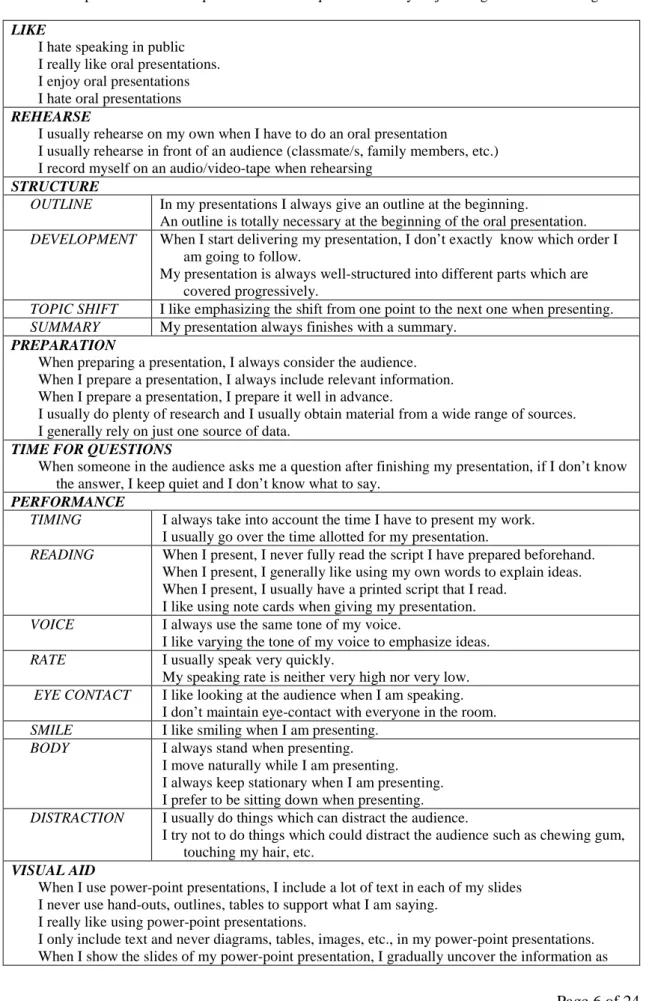
Our intervention in these two classes was limited to an onset and offset questionnaire administered prior to the instructional phase (onset) and after the evaluations of the presentations were completed (offset). Both questionnaires were designed by a team of 3 teachers who were the members of the Education Innovation Project. These teachers had been teaching their subjects for a minimum of 5 years with regular use of the oral presentation tool in their lessons. The instruments were entitled Questionnaire on your knowledge about oral presentations and Questionnaire on your assessment of oral presentation efficiency, respectively. The onset questionnaire (Appendix 1) contained three questions about learner’s prior experience with oral presentations as well as forty-eight 5-point Likert scale items in which students had to show their degree of agreement with a series of statements corresponding to aspects including ‘like’, ‘rehearse’, ‘structure’, ‘preparation’, ‘time for questions’, ‘performance’, and ‘visual aid’ (Table 2). The aim of these statements, which considered an array of relevant aspects in good oral presentations (see Gil Salom & Westall, 1999; González Ortiz, 2004; Hendrix, 2000; Mayer, 2005; Otoshi & Heffernen, 2009; Rupnow, King, &
Page 6 of 24 Johnson, 2001; Yamashiro & Johnson, 1997), was to analyse students’ knowledge about the oral presentation tool.
Table 2. Composition of the oral presentation onset questionnaire by major categories and subcategories. LIKE
I hate speaking in public I really like oral presentations. I enjoy oral presentations I hate oral presentations REHEARSE
I usually rehearse on my own when I have to do an oral presentation I usually rehearse in front of an audience (classmate/s, family members, etc.) I record myself on an audio/video-tape when rehearsing
STRUCTURE
OUTLINE In my presentations I always give an outline at the beginning.
An outline is totally necessary at the beginning of the oral presentation. DEVELOPMENT When I start delivering my presentation, I don’t exactly know which order I
am going to follow.
My presentation is always well-structured into different parts which are covered progressively.
TOPIC SHIFT I like emphasizing the shift from one point to the next one when presenting. SUMMARY My presentation always finishes with a summary.
PREPARATION
When preparing a presentation, I always consider the audience. When I prepare a presentation, I always include relevant information. When I prepare a presentation, I prepare it well in advance.
I usually do plenty of research and I usually obtain material from a wide range of sources. I generally rely on just one source of data.
TIME FOR QUESTIONS
When someone in the audience asks me a question after finishing my presentation, if I don’t know the answer, I keep quiet and I don’t know what to say.
PERFORMANCE
TIMING I always take into account the time I have to present my work. I usually go over the time allotted for my presentation.
READING When I present, I never fully read the script I have prepared beforehand. When I present, I generally like using my own words to explain ideas. When I present, I usually have a printed script that I read.
I like using note cards when giving my presentation. VOICE I always use the same tone of my voice.
I like varying the tone of my voice to emphasize ideas. RATE I usually speak very quickly.
My speaking rate is neither very high nor very low. EYE CONTACT I like looking at the audience when I am speaking.
I don’t maintain eye-contact with everyone in the room. SMILE I like smiling when I am presenting.
BODY I always stand when presenting. I move naturally while I am presenting. I always keep stationary when I am presenting. I prefer to be sitting down when presenting. DISTRACTION I usually do things which can distract the audience.
I try not to do things which could distract the audience such as chewing gum, touching my hair, etc.
VISUAL AID
When I use power-point presentations, I include a lot of text in each of my slides I never use hand-outs, outlines, tables to support what I am saying.
I really like using power-point presentations.
I only include text and never diagrams, tables, images, etc., in my power-point presentations. When I show the slides of my power-point presentation, I gradually uncover the information as
Page 7 of 24 talk progresses.
I never check font size when I use text in a slide.
Before giving my presentation, I usually give plenty of notice if a projector or any other device is required.
When I use power-point presentations, I like adding animation and sound clips.
I usually use visual-aids (overhead projector, power-point, internet resources, drawing, maps…) to support what I am speaking about.
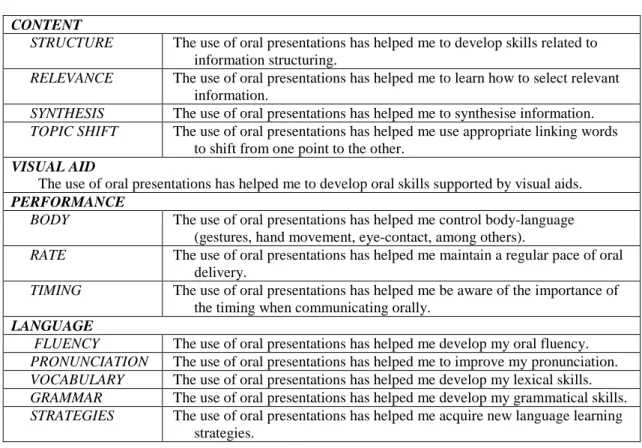
Similarly, the offset questionnaire (see Appendix 2) was made up of thirteen 5-point Likert scale items which measured participants’ assessment of their use of the oral presentation tool in the project by considering such issues as ‘content’, ‘visual aid’, ‘performance’, and ‘language’ (Table 3).
Page 8 of 24 Table 3. Composition of the oral presentation offset questionnaire by major categories and subcategories.
CONTENT
STRUCTURE The use of oral presentations has helped me to develop skills related to information structuring.
RELEVANCE The use of oral presentations has helped me to learn how to select relevant information.
SYNTHESIS The use of oral presentations has helped me to synthesise information. TOPIC SHIFT The use of oral presentations has helped me use appropriate linking words
to shift from one point to the other. VISUAL AID
The use of oral presentations has helped me to develop oral skills supported by visual aids. PERFORMANCE
BODY The use of oral presentations has helped me control body-language (gestures, hand movement, eye-contact, among others).
RATE The use of oral presentations has helped me maintain a regular pace of oral delivery.
TIMING The use of oral presentations has helped me be aware of the importance of the timing when communicating orally.
LANGUAGE
FLUENCY The use of oral presentations has helped me develop my oral fluency. PRONUNCIATION The use of oral presentations has helped me to improve my pronunciation. VOCABULARY The use of oral presentations has helped me develop my lexical skills. GRAMMAR The use of oral presentations has helped me develop my grammatical skills. STRATEGIES The use of oral presentations has helped me acquire new language learning
strategies.
The analysis of the data from both questionnaires was organized for analysis into the categories and subcategories provided in Tables 2 and 3. Mean scores and standard deviations were calculated for both participant groups. Additionally, T-tests were carried out to verify whether differences found between the two learner groups were statistically significant. Even though our main goal in this paper is to make comparisons between the CLIL and the EFL setting, which will be the focus of the discussion section, the data provided by the two questionnaires will allow us to make appropriate comparisons among various categories within each questionnaire. Those comparisons will also be included as part of the results presented in this section. Besides, the conclusion section tackles those issues that are worth considering on the basis of our data as regards the general aim of the Education Innovation Project, that is, the enhancement of university students’ skills to express themselves orally in academic contexts. Hence, a particular emphasis will be placed on students’ reported deficiencies when delivering oral presentations. Additionally, relevant inter-survey connections will be made in the conclusion section.
4.1. The onset questionnaire
Results regarding respondents’ experience in the realisation of oral presentations prior to the intervention are displayed in Table 4; results related to participants’ knowledge about oral presentations are presented in Table 5.
Table 4. Oral presentation experience prior to the intervention based on the onset pre-questionnaire. CLIL
(n=16)
EFL (n=19) EVER DONE? Yes: 16
No: 0 unanswered: 0
Yes: 15 No: 1 unanswered: 3
Page 9 of 24 LENGTH 1-10 min.: 3 11-20 min.: 5 21-30 min.: 8 30 + min.: 0 unanswered: 0 1-10 min.: 6 11-20 min.: 5 21-30 min.: 1 30 + min.: 2 unanswered: 5 FREQUENT IN PRIMARY? Yes: 5
No: 9 unanswered: 2
Yes: 0 No: 14 unanswered: 5 FREQUENT IN SECONDARY? Yes: 9
No: 7 unanswered: 0
Yes: 5 No: 10 unanswered: 4 FREQUENT IN TERTIARY? Yes: 9
No: 4 unanswered: 3
Yes: 13 No: 2 unanswered: 4
All but one of the students in both the CLIL and the EFL group affirmed that they had done oral presentations in class before they filled in the onset questionnaire (Table 4). With regard to the length of oral presentations, Table 4 shows that overall CLIL students have performed longer presentations than EFL learners. Most CLIL students selected either the 11-20 min. or the 21-30 min. option whereas the majority of EFL students opted for the 1-10 min. or the 10-20 min. categories. What is more, while the most fashionable answer was 21-30 min for CLIL learners, 1-10 min. was the favourite one for EFL participants. Table 4 also reveals that students’ reported their experience with oral presentations came from either Secondary or Higher Education levels rather than from Primary level. This is particularly true in the case of the EFL group, where no students reported having given a presentation in primary school. It is also worth noting that EFL students’ oral presentations had occurred mainly at university rather than at secondary school, whereas CLIL students’ distribution of answers between secondary and tertiary level is more balanced.
All in all, CLIL respondents reported having more experience with oral presentations than EFL respondents, as overall they had performed longer presentations and had been in contact with this learning tool more frequently and from an earlier point in their academic preparation. Table 5. Oral presentation knowledge reported by CLIL (n=16) and EFL (n=19) students in the onset questionnaire [mean (M), standard deviations (SD), t-test (t), and probability (p)].
Important Oral Presentation Aspects CLIL M (SD) EFL M (SD) t p LIKE 2.69 (.70) 2.27 (.96) -1.418 .168 REHEARSE 3.02 (.98) 2.71 (.64) -1.063 .298 STRUCTURE 3.59 (.34) 3.64 (.37) -.417 .680 OUTLINE 3.69 (.83) 3.59 (.95) -.296 .769 DEVELOPMENT 3.75 (.58) 3.81 (.70) -.275 .786 TOPIC SHIFT 3.53 (.64) 3.25 (.93) -.993 .330 SUMMARY 3.19 (.75) 3.19 (.91) .000 1.000 PREPARATION 3.57 (.36) 3.76 (.39) 1.396 .173
TIME FOR QUESTIONS 3.62 (.72) 3.37 (.62) -1.054 .300
PERFORMANCE 3.26 (.35) 3.22 (.41) -.996 .327 TIMING 3.59 (.49) 3.81 (.60) 1.127 .269 READING 3.22 (.39) 3.09 (.54) -.754 .457 VOICE 3.28 (.91) 3.31 (.91) .097 .923 RATE 3.31 (.73) 3.00 (.58) -1.346 .189 EYE CONTACT 3.28 (.99) 3.03 (.86) -.756 .455 SMILE 3.09 (.78) 2.90 (.73) -.700 .489 BODY 3.36 (.51) 3.11 (.58) -1.292 .207 DISTRACTION 3.87 (.43) 3.84 (.60) -.170 .866 VISUAL AID 3.45 (.42) 3.56 (.31) .828 .415
Page 10 of 24 Table 5 provides an inter-group comparison of CLIL vs. EFL students’ knowledge about key aspects of oral presentation prior to study. Both groups rated ‘like’, ‘rehearse’ and ‘performance’ categories, in that order, lower than the rest of dimensions analysed, ‘like’ obtaining by far the lowest scores. ‘Structure’, ‘preparation’, ‘time for questions’ and ‘visual aid’ ranked higher on the scale. However, in this second set of categories, CLIL students marked higher scores for ‘time for questions’ whereas this is the category which scored the lowest in the case of EFL learners.
The fact that both CLIL and EFL students rated ‘like’ the lowest, of all the key presentation aspects implies that students do not particularly enjoy conducting oral presentations in class. This is particularly true of EFL learners who assessed this aspect more negatively (CLIL 2.69, EFL 2.27).
‘Rehearse’ is another dimension not very positively assessed by both student groups, the mean score by the EFL group being below the scale median and considerably lower than that of CLIL participants (CLIL 3.02, EFL 2.71), which means that these students do not make effective use of practicing or rehearsing on their own prior to the public performance of their oral presentations.
The last category within the set of dimensions which were evaluated more negatively by respondents is ‘performance’. In this case, scores ranked slightly over 3 points, both student groups yielding extremely similar means (CLIL 3.26, EFL 3.22). Nonetheless, it is worth noting that not all the subcategories making up ‘performance’ ranked the same. In fact, it is worth noting that the highest mean scores obtained in the whole questionnaire come from one of the aspects analysed in the ‘performance’ category, namely ‘distraction’ (CLIL 3.87, EFL 3.84). Both types of learners unanimously reported not doing things that can distract the audience when presenting. ‘Timing’ is another aspect that learners say they consider when presenting orally, as they asserted that they try to fit in the time allotted for their presentations. EFL learners seem to be particularly careful with this aspect as attested by their higher means (CLIL 3.59, EFL 3.85).
However, the remaining ‘performance’ elements examined did not yield such positive results. Neither CLIL nor EFL students seem to pay attention to the subcategory labelled ‘smile’, which obtained the lowest scores (CLIL 3.09, EFL 2.90) and encapsulates presenters’ contagious positive attitude and emotional state when performing an oral presentation. ‘Reading’, ‘rate’, ‘eye contact’ and ‘body’ are not very well placed either. As happened to ‘smile’, it is EFL learners who rated these components more negatively, which means that they do not use their own words but rely on a script to explain their ideas to a larger extent (CLIL 3.22, EFL 3.09), have a worse command of their speaking rate (CLIL 3.31, EFL 3.00), maintain less eye-contact with their audience (CLIL 3.28, EFL 3.03), and control body movement less successfully (CLIL 3.36, EFL 3.11) when presenting. With regard to the ‘voice’ category, which refers to the proper use of varied tones resulting in a more effective oral communication, both learner groups assessed very much alike (CLIL 3.28, EFL 3.31), though.
Let us now turn to the categories which were evaluated more positively by respondents – ‘structure’, ‘preparation’, ‘time for questions’ and ‘visual aid’. As far as the first of these categories, we observe that both student groups behaved similarly (CLIL 3.59, EFL 3.64), which also applies to the various subcategories that make up ‘structure’. ‘Development’ (CLIL 3.75, EFL 3.81) and ‘outline’ (CLIL 3.69, EFL 3.59) are given the highest ratings by the two participant samples, that is, all respondents acknowledge the need to include an outline at the beginning of a presentation as well as progressively presenting contents in an organised way. Yet, ‘topic shift (CLIL 3.53, EFL 3.25), above all in the case of EFL learners, and more particularly ‘summary’ (CLIL 3.19, EFL 3.19) scored considerably more poorly on the scale, which indicates that the use of both linking words/phrases to connect ideas and a final summary of main points is not optimal enough.
‘Preparation’ is the category which was given the best score by EFL learners (CLIL 3.57, EFL 3.76), who seem to be particularly sensitive to the fact that a good presentation requires much previous work by taking its addresses into account and seeking information from different sources which must be analysed and selected in view of its relevance. Unlikely, ‘time for questions’ scored the highest for CLIL learners (CLIL 3.62, EFL 3.37) indicating that these
Page 11 of 24 students seem to have better resources that enable them to answer questions raised by the audience.
Finally, the average rates registered in the ‘visual aid’ category (CLIL 3.45, EFL 3.56) lead us to think that students make sufficiently effective use of visual resources helping them to present content.
4.2. The offset questionnaire
The results of the offset questionnaire are reported in Table 6.
Table 6. Off-set questionnaire results for CLIL (n=16) and EFL (n=19) students [mean (M), standard deviations (SD), T-test (t), and probability (p)].
Important Oral Presentation Aspects CLIL M (SD) EFL M (SD) t p CONTENT 3.89 (.39) 3.87 (.42) -.110 .913 STRUCTURE 4.06 (.44) 3.94 (.57) -.690 .496 RELEVANCE 3.94 (.44) 3.88 (.50) -.374 .711 SYNTHESIS 3.88 (.81) 4.00 (.52) .522 .606 TOPIC SHIFT 3.69 (.79) 3.69 (.70) .000 1.000 VISUAL AID 4.19 (.75) 3.94 (.57) -.1.059 .299 PERFORMANCE 3.79 (.40) 3.94 (.60) .809 .426 BODY 3.94 (.57) 4.00 (.73) .269 .790 RATE 3.50 (.52) 3.69 (.87) .739 .467 TIMING 3.94 (.68) 4.13 (.72) .758 .454 LANGUAGE 3.49 (.75) 3.85 (.58) 1.534 .136 FLUENCY 3.63 (.96) 3.88 (.61) .877 .389 PRONUNCIATION 3.44 (.96) 3.88 (.88) 1.337 .191 VOCABULARY 3.50 (.73) 3.88 (.72) 1.464 .154 GRAMMAR 3.13 (.88) 3.81 (.91) .2166 .038* STRATEGIES 3.75 (.86) 3.81 (.75) .220 .828
Note that statistically significant differences are indicated with (*).
Results showed that average rates were quite high for all the categories examined in both student groups, except in the case of the ‘language’ category for CLIL learners, which yielded a more moderate mean score. Highest figures, by contrast, are given to the ‘visual aid’ category (CLIL 4.19, EFL 3.94), indicating that participants seem to be happy with their use of visual aids (e.g.: overhead projector, powerpoint, etc.) to support their oral presentations.
As for ‘content’, analysed subcategories revealed that groups behaved very similarly as learners reckoned that their engagement in the oral presentation project had helped them to develop skills related to content structuring (CLIL 4.06, EFL 3.94), select relevant information (CLIL 3.94, EFL 3,88), and synthesize main ideas (CLIL 3.88, EFL 4.00). However, they claimed the experience had helped them to use appropriate linking words to shift from one point to another to a lesser extent. In fact, this is the component of ‘content’ which is more tightly linked to linguistic aspects, that is, where formal aspects of language are more directly involved.
As far as ‘performance’ is concerned, we observe that EFL learners consistently achieved slightly higher ratings than CLIL learners (CLIL 3.79, EFL 3.94). EFL learners reported having learned to slightly better control body language (CLIL 3.94, EFL 4.00) and being a bit more aware of the importance of timing when communicating orally (CLIL 3.94, EFL 4.13). On the other hand, the weakest aspect of students’ assessment of performance turned out to be their mastery of a regular pace of oral delivery.
Lastly, the ‘language’ category is the one which both unfolded the lowest rates and distinguished CLIL and EFL learners the most (CLIL 3.49, EFL 3.85). These differences can be read as CLIL learners admitting to having learnt less with regard to language aspects as a consequence of their participation in the oral presentation project. This is something that applies
Page 12 of 24 to all the linguistic components explored (oral fluency, pronunciation, vocabulary, grammar, strategies), differences even reaching statistical significance in the case of grammar learning. 5. Discussion
With regard to the survey administered before students got engaged in the oral presentation project, our results suggest that the group of students in the CLIL course provided a more positive picture regarding their experience in and knowledge about oral presentations. They reported having larger, longer and more frequent experience with oral presentations than EFL participants. CLIL learners also provided more positive answers about the time devoted to questions from the audience at the end of oral presentations. It is clear that these learners feel much more comfortable when interacting in the foreign language, probably because of their instructional context, which favours the use of the language in meaningful contexts for communicative purposes (García Mayo, 2009; Lyster, 2007). While both groups indicated they did not enjoy giving oral presentations, CLIL were less inclined to dislike the practice. This may be due to their greater experience in using this learning tool and their better knowledge of it. This could also be linked to the fact that CLIL learners indicated they practice their oral presentations at home more frequently than EFL learners. Further practice clearly results in better performance, as attested by their higher means in many of the aspects of performance examined in the questionnaire. CLIL learners were found to read less from a script, use a better rate of delivery, maintain more eye-contact with their audience, and make a more effective use of body language. It is clear that they were more aware that a good presentation requires prior practice. This practice can result in a better performance, which would ultimately contribute to their lower degree of dissatisfaction with oral presentation as a learning tool.
CLIL learners did not self-assess as better in all oral presentation key aspects, however. EFL learners reported higher scores for two of the aspects inquired in the onset survey: ‘timing’ and ‘preparation’. EFL learners seem to show a better control of timing, that is, they are better at fitting their presentations in the time given to them. This is probably so because their presentations were shorter in time than those of the CLIL group. As for their longer time dedicated to preparing the content of their presentations, we suggest that their lack of previous experience with the tool may make them feel less secure and they eventually need more preparation time. Besides, considering that the oral presentation project they were engaged in involves English subjects, it may well be the case that, when they filled in the questionnaire, they were thinking of their previous presentations delivered in English, and thus the competence level in English may be a conditioning factor which could explain these results. In other words, a lower competence level in the foreign language would make them need more preparation time. Regarding the results from the survey administered at the end of the oral presentation project, we discovered that CLIL participants reported having improved their visual aid skills more than EFL learners. It is important to keep in mind that the EFL participants in this study belong to a university degree in Primary school Teacher Training, and they work upon creativity aspects and technological means in other disciplines such as all those involving didactics where they learn that children extensively rely on visual elements for learning. This Education Innovation Project may have been useful for CLIL learners to catch up with EFL learners in this regard. On the other hand, EFL participants reported having improved more in performance. It would be convenient to recall the fact the EFL students reported having less experience with performing oral presentations and their performance skills were most probably underdeveloped at the beginning of the project. We suggest that they took further advantage of their experience in this project regarding performance. Nonetheless, EFL learners’ greatest advantage, which also emerges as the biggest difference between the two student groups at the offset of the project, is the language component. English fluency, vocabulary, pronunciation and, more strikingly, grammar are reported to be enhanced by the experience especially in the EFL group. Again, we wish to focus the reader’s attention on two important facts. First, the EFL learners’ competence in English was lower than that of CLIL students at the onset of the study. Second, EFL instruction is focused on linguistic aspects rather than on contents. Consequently, one might justifiably assume that EFL participants took greater advantage of the project experience
Page 13 of 24 in terms of language learning, which may be explained by the findings of past research that suggests that in CLIL environments the language component is disregarded (Dafouz et al. 2007; Pedrosa, 2011). We are also informed from acquisition studies that learners in content-oriented programmes do not show advantages regarding specific aspects of foreign language competence (see Harley et al., 1990 for investigations conducted in Canadian immersion programmes; see Ruiz de Zarobe, 2011 for studies in CLIL settings). Yet, some authors have suggested some measurements to solve this problem, namely more ‘focus on form’ (García Mayo, 2009; Ruiz de Zarobe & Lasagabaster, 2010; Costa, 2012), more solid connections between CLIL and EFL classes (Lyster, 2013) and more ‘content teacher training in language teaching’ (Doiz et al., 2013c), for instance, by means of team teaching (Cots, 2013). As Dafouz (2011) points out, CLIL instructors tend to separate language and content, and many give the former very scarce attention. As a result, the shift from teaching content through the L1 to CLIL is reduced to a change in the vehicle of communication and does not take into account that it usually requires an adaptation of the teaching methodology. A pilot experienced developed at the University of Lleida attempted to confront these problems (Cots & Clemente, 2011) by means of tandem teaching between two instructors, defined as Content Expert and Language Teaching Expert. This collaboration took place both at the level of the design of the teaching programme as well as in its implementation.
Additionally, in line with Gil, Salom and Westall’s (1999) arguments, we suggest that only by means of structured task-based practice, such as the one carried out within our project, will students be able to improve their oral competence in the foreign language, an aspect which is not sufficiently covered and appropriately developed at university (Jordan, 1997).
6. Conclusion
This paper reports findings from a study conducted within an Education Innovation Project, designed to identify best practices for improving oral presentation skills among university students seeking to master a foreign language. This study was specifically focused on English-Medium-Instruction and English-as-a-Foreign-Language. During a semester, participants received both theoretical and practical training in how to make good oral presentations. More specifically, this paper reports on the results of the surveys administered to both types of student at the very beginning and the very end of the didactic experience. These surveys looked into participants’ experience with and knowledge about oral presentations and their subsequent assessment of the didactic experience they had gone through, respectively. The comparison between both learner groups (CLIL vs. EFL) yielded some interesting findings, as reported in the discussion section. However, it is worth remembering that most of the inter-group differences were not statistically significant and thus cannot be easily generalized to other contexts. Even when differences turned out to be supported by inferential statistics, it is important to emphasize that the methodology of the study was limited in as much as it is based on students’ perceptions and not on actual measurements of their learning and/or behavior. Hence, the claims suggested in the light of the data remain tentative.
The CLIL vs. EFL differences identified in this study provided insights to support the, objective of the larger Innovation Education Project designed to improve university students’ abilities to express themselves orally in academic contexts. One aspect of this was to boost learners’ awareness regarding the different components (linguistic and nonlinguistic) of a good oral presentation. Overall, the results of the two surveys examined in this paper seem to indicate that a systematic approach to the preparation and development of oral presentations leads to a better exploitation of the oral presentation as a learning tool (Gil Salom & Westall, 1999; Otoshi & Heffernen, 2009; White, 2009; Yamashiro & Johnson, 1997).
Nevertheless, some deficiencies have been detected which require further intervention on the part of teachers, particularly in light of the onset survey finding that students do not particularly enjoy oral presentations. This calls for instructors’ systematic intervention in the classroom by means, for example, of structured task-based experiences (Gil Salom & Westall, 1999; White, 2009, Yamashiro & Johnson, 1997) aimed at improving students’ abilities when expressing
Page 14 of 24 ideas orally in academic contexts so that they are able to further enjoy this type of activity as part of their learning process.
Regarding performance, the rate of delivery seems to be one of the most difficult aspects for presenters to master, even after having gone through training such as what was provided here (as the low score in the offset survey indicated). Teachers should emphasize this particular aspect when students perform oral tasks. Further visualizations of their own performance by means of video recordings may promote students’ awareness of their deficiencies as regards the aspects most negatively assessed by them. In fact, video technology has been claimed to enhance learning skills in the language classroom (Chuang & Rosenbusch, 2005, and Wagener, 2006) and the use of recordings in our project can make up one of the optimal uses of this technology (see Barry, 2012 for an oral presentation video recording viewing protocol).
An aspect of content which deserves special attention is ‘topic shift’. Linking devices enable a presenter to change from one idea to another in the development of oral discourse. These strategies were not positively evaluated by participants in either survey. Mastering a discourse which lacks abrupt beginnings and awkward pauses by means of the use of appropriate linking words (e.g., to sum up, on the other hand) will provide the oral presentation with far greater fluency of speech (Rupnow et al., 2001). This content aspect is very much related to the language component, the category which overall was one of the most negatively valued at the offset of the project, more particularly by CLIL learners.
These findings have to be taken cautiously as they are based on learners’ self-assessment, and the validity of self-assessment in foreign language learning has been reported to depend on variables as different as teachers’ training (Oscarsson,1984), learners’ experience with self-assessment (Alisha & Dolmaci, 2013), with the foreign language (Heilenman, 1990) or with the language skill self-assessed (Ross, 1998), and learners’ use of Krashen’s (1982) Monitor (Blanche and Merino, 1989).
On the basis of our results, it may be conceded that teachers in general, but content teachers in particular, must pay attention to formal aspects of language and should provide corrective feedback on the language dimension of their students’ oral presentations. It is true that students may learn from the mere fact of having to create and manipulate their own speech in the second language when presenting orally, which is in agreement with the Output Hypothesis (Swain, 1985), but we should not disregard the fact that studies on form-focused instruction inform that attention to form leads to second language improvement. More explicit instruction as well as more explicit corrective feedback could improve the accuracy of specific aspects of the language. Additionally, content instructors are not typically trained in language teaching (Cots., 2013) and very typically disregard linguistic aspects in their lessons (Dafouz et al. 2007; Pedrosa, 2011), and thus cooperation with language experts is highly recommended (Cots & Clemente, 2011; Costa, 2012; Doiz et al., 2013c) .
We believe that the teaching of oral presentation skills must be tackled in tertiary education courses in an integrated fashion because, as Tatzl (2001) demonstrated, university students emphasize the relevance of spoken English interaction in the university context and in their future professional life. Globalization and internationalization of universities cannot be separated from the use of English, as stated by Philipson (2009), and a proper development of foreign language communication skills is mandatory at the tertiary level if this aim is to be achieved. The use of the oral presentation as a learning tool should not be relegated to the realm of communication skills in the first language, as we are immersed in an internationalization process fostered by the implementation of multilingualism programs whose aim is to enhance the use of a foreign language as a medium of instruction (Doiz et al., 2013b). This tool should be part of courses in which English is the medium of instruction as well.
All in all, as most of the studies have focused on attitudes towards CLIL and not actual academic or language outcomes (Saarinen & Nikula, 2013), more empirical research is needed in tertiary education whose findings will help to improve the teaching practice and the training of prospective CLIL lecturers.
Page 15 of 24 This work was supported by the University of the Basque Country under Grant PIE 2008/10. We certify that there is no conflict of interest with this financial organization regarding the material discussed in the manuscript.
References
Aguilar, M., & Muñoz, C. (2014). The Effect of Proficiency on CLIL Benefits in Engineering Students in Spain. International Journal of Applied Linguistics, 24(1), 1-18.
Alejo, R., & Piquer, A. (2010). CLIL Teacher Training in Extremadura: A Needs Analysis Perspective. In Lasagabaster D., & Ruiz de Zarobe, Y. (Eds.), CLIL in Spain. Implementation, Results and Teacher Training (pp. 219-242). Newcastle upon Tyne, UK: Cambridge Scholars Publishing.
Alisha, A. R., & Dolmaci, M. (2013). The Interface between efficacy concerning the Self-assessment on Students Studying English as a Foreign Language. Procedia: Social and Behavioral Sciences, 70, 873-881.
Barry, S. (2012). A Video Recording and Viewing Protocol for Student Group Presentations: Assisting Self-assessment through a Wiki environment. Computers and Education, 59, 855-860.
Blanche, P., & Merino, B. J. (1989). Self-Assessment of Foreign-Language Skills: Implications for Teachers and Researchers. Language Learning, 39(3), 313-338
Cenoz, J., Genesee, F., & Gorter, D. (2013). Critical Analysis of CLIL: Taking Stock and Looking Forward. Applied Linguistics. doi: 10.1093/applin/amt011
Chuang, H., & Rosenbusch, M. (2005). Use of Digital Video Technology in an Elementary Foreign Language Methods Course. British Journal of Educational Technology, 36(5), 868-880.
Costa, F. (2012). Focus on Form in ICLHE lectures in Italy: Evidence from English-medium Science Lectures by Native Speakers of Italian. AILA Review, 25, 30-47.
Cots, J. M. (2013). Introducing English-medium Instruction at the University of Lleida, Spain: Intervention, Beliefs and Practices. In Doiz, A., Lasagabaster D., & Sierra, J. (Eds.), English-medium Instruction at Universities: Global Challenges (pp. 106-128). Bristol, UK: Multilingual Matters.
Cots, J. M., & Clemente, M. (2011). Tandem Teaching in CLIL for Tertiary Education. In Escobar C., and Nussbaum, L. (Eds.), Aprendre en una Altra Llengua (pp. 165-184). Bellaterra, Spain: Servei de Publicacions de la Universitat Autònoma de Barcelona. Cummins, J., & Swain, M. (1986). Bilingualism in Education: Aspects of Theory, Research and
Practice. London, UK: Longman.
Dafouz, E. (2011). English as the Medium of Instruction in Spanish Contexts. In Ruiz de Zarobe, Y., Sierra, J. M., and Gallardo del Puerto, F. (Eds.), Content and Language Integrated Learning. Contributions to Multilingualism in European Contexts (pp. 189-209). Berlin, Germany: Peter Lang.
Dafouz, E., Núñez, B., Sancho, C., & Foran, D. (2007). Integrating CLIL at the Tertiary Level: Teachers’ and Students’ Reactions. In Wolff, D., & Marsh, D. (Eds.), Diverse Contexts Converging Goals. Content and Language Integrated Learning in Europe (pp. 91-102). Frankfurt, Germany: Peter Lang.
Dalton-Puffer, C. (2011). Content and Language Integrated Learning: from Practice to Principle. Annual Review of Applied Linguistics, 31, 182-204.
Dalton-Puffer, C., Nikula, T., & Smit, U. (2010). Language Use and Language Learning in CLIL. Current Findings and Contentious Issues. In Dalton-Puffer, C., Nikula, T., & Smit, U. (Eds.), Language Use and Language Learning in CLIL Classrooms (pp. 279–292). Amsterdam, The Netherlands: John Benjamins.
De Grez, L., Valcke, M., & Roozen, I. (2009). The Impact of Goal Orientation, Self-reflection and Personal Characteristics on the Acquisition of Oral Presentation Skills. European Journal of Psychology of Education, 24(3), 293-306.
Doiz, A., Lasagabaster, D., & Sierra, J. (2011). Internationalisation, Multilingualism and English-medium Instruction: The Teachers’ Perspective. World Englishes, 30, 345-389.
Page 16 of 24 Doiz, A., Lasagabaster, D., & Sierra, J. (2013a) English as L3 at a Bilingual University in the Basque Country. In Doiz, A., Lasagabaster, D., & Sierra, J. (Eds.), English-medium Instruction at Universities: Global Challenges (pp. 84-105). Bristol, UK: Multilingual Matters.
Doiz, A., Lasagabaster, D., & Sierra, J. (2013b). Future Challenges for English-medium Instruction at the Tertiary Level. In Doiz, A., Lasagabaster, D., & Sierra, J. (Eds.), English-medium Instruction at Universities: Global Challenges (pp. 213-221). Bristol, UK: Multilingual Matters.
Fortanet, I. (2013). CLIL in Higher Education. Bristol: Multilingual Matters.
García Mayo, M. P. (2009). El Uso de Tareas y la Atención a la Forma del Lenguaje en el Aula AICLE. In Pavón Vázquez, V., & Ávila López, J. (Eds.), Aplicaciones Didácticas para la Enseñanza Integrada de Lengua y Contenidos (AICLE/CLIL/Émile) (pp. 55-73). Córdoba, Spain: Consejería de Educación de la Junta de Andalucía.
Gil Salom, L., & Westall, D. (2000). Effective Oral Presentations and the ESAP Student. In F. Luttikhuizen (Ed.), Actas del III Congrés Internacional sobre Llengües per a Finalitats Especifiques (pp. 161-164). Barcelona, Spain: Publicacions i Edicions de la Universitat de Barcelona.
González Ortiz, L. (2004). La Comprensión y Producción Oral como Técnica Didáctica. Zona Próxima: Revista del Instituto de Estudios Superiores en Educación, 5, 86-111.
Harley, B., Allen, P., Cummins, J., & Swain, M. (1990). The Development of Second Language Proficiency. Cambridge, UK: Cambridge University Press.
Heilenman, K. (1990). Self-assessment of Second Language Ability: the Role of Response
Effects. Language Testing, 7, 174-201.
Hendrix, K. G. (2000). Assessment and Skill Development for ESL Students in Mainstream Communication Classes Requiring Oral Presentations. Journal of the Association for Communication Administration, 29, 196-212.
Hewitt, E., & Stephenson, J. (2012). Resultados de la Investigación Empírica de Alumnos CLIL Bilingües Estudiando Medicina en una Universidad Española. Dedica. Revista De Educação E Humanidades, 2, 307-322.
Izumi, S. (2003). Comprehension and Production Processes in Second Language Learning: In Search of the Psycholinguistic Rationale of the Output Hypothesis. Applied Linguistics, 24, 168-196.
Johnson, R. K., & Swain, M. (1997). Immersion Education: International Perspectives. Cambridge, UK: Cambridge University Press.
Jordan, R. R. (1997). English for Academic Purposes: A Guide and Resource Book for Teachers. Cambridge, UK: Cambridge University Press.
Krashen, S. (1982). Principles and Practice in Second Language Acquisition. Oxford: Pergamon.
Lightbown, P. (1998). The Importance of Iiming in Focus on Form. In Doughty, C., &
Williams, J. (Eds.), Focus on Form in Classroom Second Language Acquisition (pp.
177-196). Cambridge, UK: Cambridge University Press.
Lightbown, P. M., & Spada, N. (1997). How Languages are Learned. Oxford, UK: Oxford University Press.
Long, M. (1996). The Role of the Linguistic Environment in Second Language Acquisition. In Ritchie, W., & Bhatia, T. (Eds.), Handbook of Research on Second Language Acquisition (pp. 413-468). New York, NY: Academic Press.
Lyster, R. (2007). Learning and Teaching Languages through Content: A Counterbalanced Approach. Amsterdam: John Benjamins.
Lyster, R. (2013). Research Perspectives on Integrating Language and Content through Counterbalanced Instruction. Paper presented at the ALP-CLIL conference, Madrid, June 5-8.
Lyster, R., Saito, K., & Sato, M. (2013). Oral Corrective Feedback in Second Language Classrooms. Language Teaching, 46(1), 1-40.
Page 17 of 24 Martínez Adrián, M., & Gutiérrez Mangado J. (2015). Is CLIL Instruction Beneficial in terms of General Proficiency and Specific Areas of Grammar? Journal of Immersion and Content-Based Language Education, 3(1), 51-76.
Mayer, K. (2005). Fundamentals of Surgical Research Course: Research Presentations. Journal of Surgical Research, 128, 174-171.
McDonald, B. (1997). The Impact of Content-based Instruction: Three Studies. Focus on Basics. Connecting Research and Practice, 1 (D). Retrieved December 15, 2014, from http://www.ncsall.net/?id=429/
Montanero, M., Mateos, V. L., Gómez, V., & Alejo, R. (2006). Orientaciones para la Elaboración del Plan Docente de una Asignatura. Guía Extensa 2006. Badajoz, Spain: Servicio de Publicaciones de la Universidad de Extremadura.
Muñoz, C. (2001). The Use of the Target Language as the Medium of Instruction: University Students’ Perceptions. Anuari de Filologia, 23(1), 71-82.
Nikula, T., Dalton-Puffer, C., & Llinares A. (2013). CLIL Classroom Discourse: Research from Europe. Journal of Immersion and Content-Based Language Education, 1(1), 70-100. Oscarsson, M. (1984). Self-Assessment of Foreign Language Skills: A Survey of Research and
Development Work. Strasbourg: Council of Europe.
Otoshi, J., & Heffernen, N. (2008). Factors Predicting Effective Oral Presentations in EFL Classrooms. Asian EFL Journal, 10(1), 65-78. Retrieved December 15, 2014, from http://www.asian-efl-journal.com/March_08_jo.php
Pedrosa, B. (2011). Discurso Pedagógico y Estrategias Docentes en dos Aulas AICLE. PhD diss., University of the Basque Country.
Philipson, R. (2009). English in Higher Education. Panacea or Pandemic? Angles on the English-Speaking World, 9, 29-57.
Ramos Álvarez, M., & Luque, G. (2010). A Competence-based Constructivist Tool for Evaluation. Cultura y Educación, 22(3), 329-344.
Ross, S. (1998). Self-assessment in Second Language Testing: A Meta-analysis and Experiment with Experiential Factors. Language Testing, 15(1), 1-20.
Ruiz de Zarobe, Y., & Lasagabaster, D. (2010). CLIL in a Bilingual Community: The Basque Autonomous Region. In Lasagabaster, D., & Ruiz de Zarobe, Y. (Eds.), CLIL in Spain: Implementation, Results and Teacher Training (pp. 12-29). Newcastle upon Tyne, UK: Cambridge Scholars Publishing.
Ruiz de Zarobe, Y. (2011). Which Language Competencies Benefit from CLIL? An Insight into Applied Linguistics Research. In Ruiz de Zarobe, Y., Sierra J., & Gallardo del Puerto, F. (Eds.), Content and Foreign Language Integrated Learning: Contributions to Multilingualism in European Contexts (pp. 129-153). Bern, Germany: Peter Lang.
Ruiz Garrido, M. F., & Campoy Cubillo, M. C. (2013). CLIL at University: Research and Developments. Language Value, 5, 1-4.
Rupnow, J. H., King, J., & Johnson, L. K. (2001). Thinking Verbally: Communication Tips for Technical Presentations. Food Technology, 55(1), 46-48.
Russell, V. (2009). Corrective Feedback over a Decade of Research since Lyster and Ranta (1997): Where Do We Stand Today? Electronic Journal of Foreign Language Teaching, 6(1), 21-31.
Saarinen, T., & Nikula, T. (2013). Implicit Policy, Invisible Language: Policies and Practices of International Degree Programmes in Finnish Higher Education. In Doiz, A., Lasagabaster, D., & Sierra, J. (Eds.), English-medium Instruction at Universities: Global Challenges (pp. 131-150). Bristol: Multilingual Matters.
Sanz, C., & Morgan-Short, K. (2004). Positive Evidence vs. Explicit Rule Presentation and Explicit Negative Feedback: A Computer-assisted Study. Language Learning, 54, 35-78. Sharwood-Smith, M. (1981). Consciousness-raising and the Second Language Learner. Applied
Linguistics, 2, 159-168.
Sierra, J., Gallardo del Puerto, F., & Ruiz de Zarobe, Y. (2011). Good Practices and Future Actions in CLIL: Learning and Pedagogy. In Ruiz de Zarobe, Y., Sierra J., & Gallardo del Puerto, F. (Eds.), Content and Foreign Language Integrated Learning: Contributions to Multilingualism in European Contexts (pp. 317-338). Bern, Germany: Peter Lang.
Page 18 of 24 Smit, U., & Dafouz, E. (2012). Integrating Content and Language in Higher Education: An
Introduction to English-medium Policies, Conceptual Issues and Research Practices across Europe. AILA Review, 25, 1-12.
Swain, M. (1985). Communicative Competence: Some Roles of Comprehensible Input and Comprehensible Output in its Development. In Gass, S., and Madden, C. (Eds.), Input in Second Language Acquisition, (pp. 235-253). Rowley, MA: Newbury House.
Tatzl, D. (2011). English-medium Masters’ Programmes at an Austrian University of Applied Sciences: Attitudes, Experiences and Challenges. Journal of English for Academic Purposes, 10(4), 252-270.
Wagener, D. (2006). Promoting Independent Learning Skills Using Video on Digital Language Laboratories. Computer Assisted Language Learning, 19(4), 279-286.
White, E. (2009). Student Perspectives of Peer Assessment for Learning in a Public Speaking Course. Asian EFL Journal-Professional Teaching Articles, 33, 1-55.
Wong, C. Y., & Barreda-Marlys, M. (2012). The Role of Grammar in Communicative Language Teaching: An Exploration of Second Language Teachers' Perceptions and Classroom Practices. Electronic Journal of Foreign Language Teaching, 9(1), 61-75. Yamashiro, A. D., & Johnson, J. (1997). Public Speaking in EFL: Elements for Course Design.
Page 19 of 24 Appendix 1
QUESTIONNAIRE ON YOUR KNOWLEDGE ABOUT ORAL PRESENTATIONS An OP is an oral presentation, either individually or in group, of a previously prepared topic examining
several sources.
1. Have you ever done an oral presentation before? Yes or No. If yes, how long did it take as an average?
1-10 minutes 11-20 minutes 21-30 minutes more than 30 minutes 2. Have you ever done an OP on a regular basis? In:
Primary: Yes / No Secondary: Yes / No University: Yes / No 3. I have done oral presentations quite frequently
Primary:
I totally agree I agree I neither agree nor disagree I disagree I totally disagree Secondary:
I totally agree I agree I neither agree nor disagree I disagree I totally disagree University:
I totally agree I agree I neither agree nor disagree I disagree I totally disagree 4. When I start delivering my presentation, I don’t exactly know which order I am going to
follow
I totally agree I agree I neither agree nor disagree I disagree I totally disagree 5. When I present, I never fully read the script I have prepared beforehand.
I totally agree I agree I neither agree nor disagree I disagree I totally disagree 6. I like looking at the audience when I am speaking.
I totally agree I agree I neither agree nor disagree I disagree I totally disagree 7. When I use power-point presentations, I include a lot of text in each of my slides.
I totally agree I agree I neither agree nor disagree I disagree I totally disagree 8. I hate speaking in public
I totally agree I agree I neither agree nor disagree I disagree I totally disagree 9. In my presentations I always give an outline at the beginning.
I totally agree I agree I neither agree nor disagree I disagree I totally disagree 10. I like smiling when I am presenting.
I totally agree I agree I neither agree nor disagree I disagree I totally disagree 11. I never use handouts, outlines, tables to support what I am saying.
I totally agree I agree I neither agree nor disagree I disagree I totally disagree 12. I usually rehearse on my own when I have to do an oral presentation
I totally agree I agree I neither agree nor disagree I disagree I totally disagree 13. My presentation is always well-structured into different parts which are covered
progressively.
Page 20 of 24 14. When I present, I generally like using my own words to explain ideas.
I totally agree I agree I neither agree nor disagree I disagree I totally disagree 15. I am always very serious when I am presenting.
I totally agree I agree I neither agree nor disagree I disagree I totally disagree 16. I really like using power-point presentations.
I totally agree I agree I neither agree nor disagree I disagree I totally disagree 17. I usually rehearse in front of an audience (classmate/s, family members, etc.)
I totally agree I agree I neither agree nor disagree I disagree I totally disagree 18. When preparing a presentation, I always consider the audience.
I totally agree I agree I neither agree nor disagree I disagree I totally disagree 19. When I present, I usually have a printed script that I read.
I totally agree I agree I neither agree nor disagree I disagree I totally disagree 20. I always stand when presenting.
I totally agree I agree I neither agree nor disagree I disagree I totally disagree 21. I only include text and never diagrams, tables, images, etc., in my power-point
presentations.
I totally agree I agree I neither agree nor disagree I disagree I totally disagree 22. I record myself on an audio/video-tape when rehearsing
I totally agree I agree I neither agree nor disagree I disagree I totally disagree 23. When I prepare a presentation, I always include relevant information.
I totally agree I agree I neither agree nor disagree I disagree I totally disagree 24. I always use the same tone of my voice.
I totally agree I agree I neither agree nor disagree I disagree I totally disagree 25. I move naturally while I am presenting.
I totally agree I agree I neither agree nor disagree I disagree I totally disagree 26. When I show the slides of my power-point presentation, I gradually uncover the
information as talk progresses.
I totally agree I agree I neither agree nor disagree I disagree I totally disagree 27. An outline is totally necessary at the beginning of the OP.
I totally agree I agree I neither agree nor disagree I disagree I totally disagree 28. When I prepare a presentation, I prepare it well in advance.
I totally agree I agree I neither agree nor disagree I disagree I totally disagree 29. I like varying the tone of my voice to emphasize ideas.
I totally agree I agree I neither agree nor disagree I disagree I totally disagree 30. I always keep stationary when I am presenting.
I totally agree I agree I neither agree nor disagree I disagree I totally disagree 31. I never check font size when I use text in a slide.
I totally agree I agree I neither agree nor disagree I disagree I totally disagree 32. I really like oral presentations.

![Table 6. Off-set questionnaire results for CLIL (n=16) and EFL (n=19) students [mean (M), standard deviations (SD), T-test (t), and probability (p)]](https://thumb-us.123doks.com/thumbv2/123dok_es/6869665.287116/11.892.125.768.344.688/table-questionnaire-results-clil-students-standard-deviations-probability.webp)
