FACULTAD de FILOSOFÍA Y LETRAS
DEPARTAMENTO de FILOLOGÍA INGLESA
Grado en Estudios Ingleses
TRABAJO DE FIN DE GRADO
THE ACQUISITION OF VOWEL LENGTHENING IN EFL SPANISH SPEAKERS OF ADVANCED ENGLISH
Guadalupe Cubo Martín
Tutor: Enrique Cámara Arenas
Dedicatoria
Dedicado a Eva y Alicia por haber hecho posible estos cuatro años con mucho esfuerzo y sacrificio; y al IES Jaime Gil de Biedma por no haber dejado de creer en
Abstract
This work deals with the assimilation of vowel lengthening in EFL Spanish speakers at an advanced level, and tries to determine if the explicit teaching of phonetics contributes to the acquisition of this trait. Finally, it aims to analyze the students' own perception of their level of oral competence, and to observe if both realities correspond one each other.
Este trabajo trata de descubrir si los estudiantes hispano-hablantes de inglés en un nivel avanzado han asimilado la duración de las vocales inglesas, y de determinar si un aprendizaje específico en fonética contribuye a la adquisición de este rasgo. Por último, pretende acercarse a la propia percepción de los estudiantes sobre su nivel de competencia oral, y observar si ambas realidades se corresponden o no.
Key words: pronunciation, phonetics, vowel lengthening, EFL, explicit teaching.
List of contents
Section 1. Introduction ……….… 1
Section 2. Theoretical framework ……….…... 3
Introduction ………..….. 3
Acquisition of English vowels and their duration ……….. 3
Learning variables and L2 performances ……….…..… 4
Foreign languages aptitude ……….………….. 5
Foreign languages anxiety ……….…………... 6
Language learning strategies ……….…………... 6
Phonetic training and its impact in vowel pronunciation ……….……….. 6
EFL student’s view on the teaching of pronunciation ………….…………..…. 8
Section 3. Methodology ……….……….…… 10
Approaching to English vowel sounds ……….……… 10
General overview ……….…………... 10
Vowel length ……….……….. 11
Broad vs. narrow transcription ……….……… 14
Section 4. Experiment ……….………... 15
Participants ………... 15
Material ……….………... 16
Procedure ………. 17
Results ……….. 19
Section 5. Discussion and conclusion ………..…………... 25
Section 6.Works cited ………...………….. 27
Section 7. Appendix ………..……….…….... 30
Model of the tasks developed during the investigation ………. 30
Personal data ………... 30
Production task ………... 31
Discrimination task ………. 32
Questionnaire ……….. 33
Classification of words in the production task ………..……… 34
List of tables
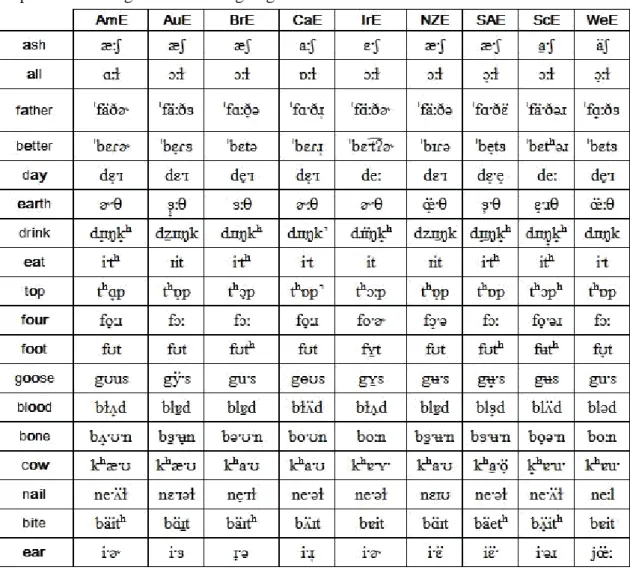
Table 1. Vowel variations in English accents ……….… 12
Table 2. Duration of vowels in different phonetic contexts ………..….. 13
Table 3. Mean age of participants ………..……. 16
Table 4. Minimal pairs used in the discrimination task ……….………. 17
Table 5. Words used in the production task ………..……….. 17
Table 6. Duration of vowels in the tasks ………..………... 20
Table 7. Duration of short vowels in the production task ………..…………. 21
Table 8. Duration of lengthened short vowels in the production task ……….………... 22
Table 9. Classification of words in the production task ………..………… 34
Table 10. Words classified by type of consonant in the production task ………..…….. 34
Table 11. Classification of words in the discrimination task by type of vowel …..…… 34
Table 12. Classification of words in the discrimination task by type of consonant …... 35
List of graphs Graph 1. Duration of vowels during the production task ………..…….. 20
Graph 2. Differences in length among consonantal pairs ………..……. 21
Graph 3. Differences in length between short and lengthened short vowels ………..… 22
Graph 4. Amount of words well-discriminated ………..……. 23
Graph 5. Percentage of accurateness in the discrimination of words ………..… 24
Section 1. Introduction
Behind the need to communicate, it is the need to share. Behind the need to share,
it is the need to be understood. Leo Rosten This study deals with vowel length in English. Our aim is to analyze, through production and discrimination tasks, whether this phenomena is properly assimilated by Spanish advanced EFL students. It concerns with the different contextual processes that can involve a change in the duration of vowels.
In English, differences in vowel length are important because they usually play a role in the discrimination of minimal pairs like bet-bed. English has a complex vowel system, with around twenty vocalic realizations, in contrast with the five Spanish vocalic sounds. This fact is responsible (among others) for the Spanish-speaking English students difficulty in correctly pronouncing the English language.
English vowels can also be affected by many processes depending on their position at the syllable, the word stress or the vocalic environment. There are phenomena as neutralization, L-coloring, devoicing, etc. However, the two relevant processes that we are going to analyze in this study are lengthening and shortening processes which are related with the surrounding consonants.
This complexity in the English vowel system generates many problems for Spanish students, since it is far removed from its own vowel system. With this study, we will try to clarify whether Spanish-speakers EFL learners truly had acquired during their formal learning process the capacity of producing and detecting vowel length variation.
With all this theoretical support, we will design and execute a practical analysis consisting in two main tasks and a questionnaire in order to take into account information regarding motivation. The first one will be a production task in which participants will have to pronounce different single words which are expected to be shortened or lengthened according to their consonant environment and in comparison with the rest of words. In the second one, a discrimination task, students will hear two pairs of words with similar characteristics in which the duration of the vowel will be the key to differentiate them.
We will also include a questionnaire with a double objective: to know (1) how the formal learning stage in phonetics and phonology has been in the participants, and (2) how is their own perception of their oral competence in English.
Section 2. Theoretical Framework
Introduction
Before presenting the study and its results, I would like to address the different factors than can intervene in the linguistic performance of the students: (1) different studies about the acquisition of English vowels and their duration regarding EFL Spanish speakers, (2) the sociolinguistic variables that can influence the process of acquiring a foreign language and (3) the importance of a good pronunciation teaching method, focusing on the problems of Spanish speakers when it comes to addressing the different phonetic realizations of the English vowels.
Acquisition of English vowels and their duration.
The acquisition of English vowels and their qualitative and quantitative features are a problem for L2 learners because of the differences among the vocal systems. In the case of Spanish speakers, who are the focus on this study, Iverson and Evans (2009) proposed an explanation for which the acquisition of English vowels supposes a great problem. In the experiment that they developed, Spanish and German speakers were subjected to several sessions of auditory training for English vowels. The election of these two groups of participants was due to their vowel inventories: five Spanish vowels in contrast to the eighteen German ones. They found that the larger the vowel inventory, the easiest the learning.
In a study carried out by House (1961), he tried to demonstrate that English vowel lengthening is, firstly, “a part of the phonology of the language and is learned by speakers” when we deal with [± tense] or [±voiced] features. Secondly, he wanted to
Following this idea, Cruttenden (1962) stated that long vowels are fully long when they are closed by a voiced consonant, but shortened when the next one is voiceless, always in accented syllables. Furthermore, Lehiste (1976) demonstrated what House (1961) predicted: not only the [± voiced] feature indicates length, but also the kind of consonant influences: vowels are shortened before voiceless stops and lengthened before voiceless fricatives and nasals, and voiced stops and affricates.
Flege and Munro (1995) studied how English and EFL Spanish speakers perceive English vowels. For both groups, the distinction had to do with vowel height. However, in native English speakers this was correlated with duration. While this group also made the distinction between front and back vowel sounds, the Spanish was not able to interpret such feature so easily.
Studies like the one developed by Kondaurova et al (2008) have tried to demonstrate that the distinction among English vowels relies on vowel duration instead of on vowel quality when dealing with non-native speakers. To confirm or reject this hypothesis, they worked with Russian, Spanish and American native listeners. While the American participants showed few reliance on duration, the non-native participants were entirely influenced by such aspect. In a second experiment, Spanish speakers were the ones who depended the most in duration “as a cue to postvocalic consonant voicing”
(Kondaurova et al., 2008).
All these previous researches give us the basis for our study: (1) first of all, the acquisition of the English vowels supposes a trouble for Spanish L2 English speakers due to the small Spanish vowel system, (2) secondly, the postvocalic consonant varies vowel length, (3) and finally, we have to take into account not only the [± voiced] feature, but also the type of consonant and vowel we have according to the place of articulation.
Learning Variables on L2 Performance
variables will be analyzed through the different questions addressed in the questionnaire that participants will have to answer at the end of the task.
Since Carroll and Sapon began their studies on aptitude in 1959, many variables have been proposed to explain individual differences in each person's learning ability. We are going to outline three large groups of variables that influence notably the ability to speak a second language correctly, and some of the tools that have been designed to measure their influence.
Foreign Language Aptitude.
Also known as "language learning ability", it has been the most widely studied variable. Carroll and Sapon (1959) designed a cognitive test named MLAT (Modern Language Aptitude Test) which allowed the measurement of the ability that learners had to learn a language. This is interesting for our research since it was based on four abilities -the phonetic coding ability, the grammatical sensitivity, the rote learning ability, and the inductive language learning ability- and participants can be more successful in ones than in others.
Nowadays, most foreign language aptitude researchers place more emphasis on other variables that derive from the importance given to the communicative approach in language teaching.
Foreign Language Anxiety.
In the sixties, Gadner and Lambert (1963), established that variables as motivation, attitude, self-confidence or anxiety did have an important impact in language acquisition. This idea was then developed by Stephen Krashen in his Monitor Theory through his Affective Filter Hypothesis. Following this theory, Cope, J., Horwitz, E. K., & Horwitz, M. B. (1986) designed the Foreign Language Anxiety Scale (FLCAS), which over time has served to demonstrate in several studies that a high level of anxiety during the learning stage has negative effects on the acquisition of a second language.236132
Language learning strategies.
This category encompasses all those strategies used by the teacher to facilitate the learning process of the student. Their two main objectives are: to make the student better understand all aspects related to the target language and to equip those students with more difficulties with tools to reach the desired level of knowledge.
More specifically, in the last years, several inventories of general language learning strategies have been developed, such as the Oxford's Strategy Inventory for Language Learning (1990) and other L2 performance scores. The research community agrees that the use of well-chosen learning strategies, adapted to the students individual factors such as proficiency, age, nationality, course level or gender, help to significantly improve the L2 performance.
All these variables will influence the ability of students to internalize the characteristics of the foreign language, which the teacher should have into account when addressing their learning process.
Phonetic training and its impact in vowel pronunciation
article The role of phonetic training in L2 speech training, states that Scientific literature has shown that, although English is taught at earlier ages and that many people spend years of their lives perfecting a second language, the results in terms of pronunciation are not satisfactory.
Aliaga-García (2013) pointed to factors like L1 background, amount of L1 and L2 use, length of residence in a L2-speaking environment, gender, language learning aptitude and motivation as determinants for the correct pronunciation of a foreign language.
In her article, Aliaga-García (2013) develops a study on the role of phonetic training in the English class, and the results of its practical application for six weeks with English learners whose first language was Spanish (along with Catalan).
One of the variables addressed in the study was the difficulty of Spanish students in differentiating and pronouncing the different vowels in English since each of them has multiple phonic realizations depending on factors like stress, word position or following consonants. In such cases, the vowel length varies. This fact has an important impact on the learning process for the student, since, if not acquired, it will limit both his ability to understand the foreign language and his ability to make himself understood. Aliaga-García (2013)´s study was designed to measure the impact of speech training on the student's ability to correctly understand and pronounce vowels in English.
The results offered a very significant reality: although the ability of students to perceive variations in the qualities of each vowel, their ability to produce such variations did not improve.
According to Rigol (2005), what her students declare to expect in the foreign language class was to improve their oral skills. However, although students want to improve their oral skills, they generally achieve better results in written language.
She also points out that one of the reasons may be the lack of manuals and adequate teaching materials. Her thesis is that the manuals continue to support the introduction of L2 sounds through written materials, instead of using oral exercises. Thus, "general manuals introduce the sounds of the new language through the alphabet presented in the first lesson and of auditory exercises so that the student learns the letter-sound correspondence" (Rigol, 2005, p.8). This way of approaching the pronunciation training is contradictory, since if what you want to achieve is to improve the oral competence of your students, you cannot base your teaching solely on written content.
Rigol (2005) proposes the immersion of the pupil in the target language, giving them a chance to listen to the language correctly used and to create for them a relaxed environment in which listening and speaking the foreign language are keys to acquire its domain, which, of course, always demands a correct pronunciation .
EFL Student´s view on the Teaching of Pronunciation
After analyzing the researchers' perspectives on the state of phonetic training in our educational system in the previous section, it can be very instructive to know what students think about it.
Benzies (2013) carried out a study based on the opinions of the students of the Degree of English Studies about the teaching of pronunciation during their studies.
“the main materials used are textbooks. Social media, blogs or forums are not employed”. Finally, “teachers receive limited training in pronunciation”.
With this information, Benzies (2013) wanted to know the opinion of her own students. In her study, more than 222 students underwent a survey in which they valued parameters like the amount and type of exposure to English outside the classroom, the student´s attitude to teaching/learning pronunciation, the current role of pronunciation in their EFL cases, their preferences and main difficulties in learning pronunciation, and the role of pronunciation in their materials.
The main conclusion of the study is that the students perceive that the role of pronunciation in specialized English studies is still insufficient and had a general negative opinion on this matter, citing as reasons that (1) “perceptive skills are emphasized more than productive ones”, and although students are constantly exposed to listening to English, they have not enough opportunities to produce the oral language; (2) there is not enough time devoted to “the teaching and learning of pronunciation in their EFL classes”; (3) the range of pronunciation activities offered is monotonous; (4) the students are barely tested for their pronunciation skills; (5) the method used to correct their mistakes is also monotonous; (6) “EFL textbooks contains insufficient pronunciation tasks”, and the ones that appear are repetitive and not very helpful. (Benzies, 2013).
After reviewing these results, we can obtain two very clues for our study: first, that the time devoted to teaching pronunciation is considered insufficient by both teachers and students themselves, a reality that is likely to have an important impact on their pronunciation; and second, that the materials used for phonetic training seem obsolete, leaving aside more modern and effective options such as blogs, podcasts, the use of songs or phonetic transcriptions.
Section 3. Methodology
In this section of the work we will review some factors affecting vowel length. Before explaining the practical experiment, we will focus on analyzing the extent to which Spanish-speakers of advanced English level have acquired or not a correct pronunciation of the English vowel system.
Approaching to English Vowel Sounds
General Overview.
Yoshida (2014) describes vowels as “the rounds in which the air stream moves up from the lungs and through the vocal tract very smoothly; there’s nothing blocking or constricting it. In general, every word has a vowel sound. Vowels are the ‘heart´of syllables” (p.1)
She also states that, even among some varieties of English such as Australian, British or American, vowels diverge much more than consonants as we can see in table 1. The same occurs within these varieties with their different dialects. That is why, in order to master the English language, students must pay close attention to specific features of vowels.
People with no phonetic instruction, assume that English only has five vowel sounds: <a>, <e>, <i>, <o> and <u>. That is the case, for example, of Spanish. However, these are vowel letters, and not vowel sounds. In English, each vowel letter has different allophonic variations, which in many cases, will mean the difference among two words such as but /bʌt/ and bat /bæt/. Either way, each vowel sound may be written with different letters. The sound /ɒ/ may be written as <o> in pond or in long, but also as <a>
focusing in this study, for Spanish speakers when they are learning a language as it has been mentioned previously.
According to Yoshida (2014), “describing vowels is trickier than describing consonants. The tongue is floating freely around the mouth, not touching other parts of the vocal tract. This makes it harder to describe exactly what´s happening in the mouth.” (p.2). She also explains that traditionally, when describing vowels, we should
take into account physical aspects like the tongue position, the lip rounding, the muscular tenseness that vowels involve and if they are simple, glided or diphthongs. However, in the experiment, we will focus only in vowel processes of shortening and lengthening.
Vowel length.
When we hear about “long vowels” and “short vowels”, we may assume that,
for example, two vowels with the same quality <a> as, for example, /a:/ in bard and /æ/ in bat only differ in their duration. However, the difference between those vowels refers to tongue position, tenseness or laxness, etc. Students must pronounce both sounds with their respective qualities, and not only vary the length of the vowel. However, for our practical study, we will only focus on those factors that affect the length of English vowels.
Factors affecting vowel duration.
The duration of each vowel can vary noticeably: all vowels can be lengthened or shortened according to their environment. We will point out two important factors that will determine the length of vowels: the following sound and the stress.
The following sound.
The same changes appear in words like spent and spend, even if there is another sound between the vowel and the final consonant –in this case the letter <n> (Yoshida, 2014). It is important for students to be able to hear and produce this variation in the duration of the vowel, since, other way, it could be hard to differentiate final voiced and voiceless sounds.
The distinction of a minimal pair of the bet-bed type can be complicated for non-native speakers, while the contrast between /t/ and /d/ can be extremely subtle when acting allophonic variations such as devoicing of the d, or the realization of bed with a non-audible release. In such cases, the difference between the two words rests essentially on the fact that the bed vowel is substantially longer than the bet vowel, since it undergoes an extension process to be a short vowel closed by a sound consonant.
Relative to the duration of vowels, Wiik (1965) showed that this varies according to the following consonant by measuring in csec in accented monosyllables the length of the vowel. He demonstrated that both, short and long vowels, are longer when they precede a voiced consonant than when they precede a voiceless one.
Table 2. Duration of vowels in different phonetic contexts (Wiik, 1965)
+ voiced consonant + voiceless consonant
Short vowel 17.2 10.3
Long vowel 31.9 16.5
Stress.
Broad vs Narrow transcriptions.
As we have pointed out in the previous section, the variation in vowel duration may be the only key to distinguish two words. However, that variation in duration is sometimes so slight that it is difficult to perceive or produce for non-native speakers. Therefore, the use of phonetic transcriptions is very useful to teach students to distinguish these phenomena.
Henry Sweet (1877) proposed a transcription system that “accurately indicates the endless shades of difference between every speech sound that can be found in the languages of the world.” (Cited on Dresher, 2015, p.6). He was also the first one to
categorize phonetic transcription into two types.
‘Narrow’ (now more commonly called phonetic) transcription is universal and aims to record sounds in as much detail as possible; ‘Broad’ (now called phonemic) transcription records only the differences insound that are distinctive in the language being represented (Dresher, 2016, p.8).
Section 4. Experiment
Participants.
In order to carry out the research, there were a total amount of 24 participants (see table 4) divided into four different groups, each of them composed of the same number of men and women.
On the one hand, we have groups 1 and 2 which are students of English Studies degree in the University of Valladolid where the enrollment in a subject regarding advanced practical aspects of Phonetics and Phonology is not compulsory. Group 1 is formed by undergraduates enrolled in this subject dealing with advanced training in Phonetics and Phonology. Group 2 is also formed by undergraduates, but who have received little advanced training in Phonetics and Phonology years ago. Their experience in this field was limited to a subject during the first quarter of freshman year.
On the other hand, Group 3 is formed by students with an advanced level of English but whose college career is not part of the academic branch of languages. They all have passed English level tests such as PET, KET, FCE, CAE or CPE. Group 4 consists of high school English teachers. According to their testimony, they did not receive advanced training in Phonetics and Phonology during their degree. They only received the basic notions which were mainly based on practical sessions.
Table 3. Mean age of participants.
Male Female Mean age
Group 1. Mean age 23.3 22 22.26
Group 2. Mean age 26 22 24
Group 3. Mean age 25 31.3 28.2
Group 4. Mean age 37.3 25 36.15
Materials
To carry out the study, three different tasks have been developed: a questionnaire, a discrimination task and a production one, designed to measure how participants perceive and produce vowel sounds in English.
Discrimination task.
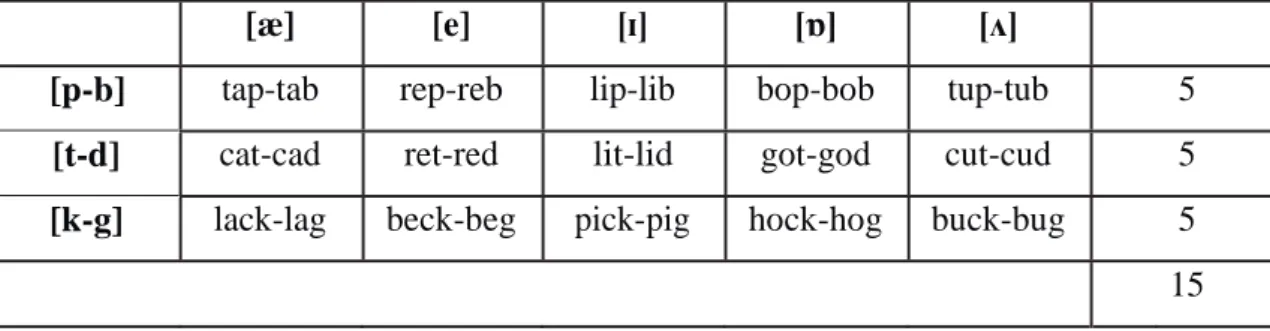
Table 4. Minimal pairs used in the discrimination task.
[æ] [e] [ɪ] [ɒ] [ʌ]
[p-b] tap-tab rep-reb lip-lib bop-bob tup-tub 5
[t-d] cat-cad ret-red lit-lid got-god cut-cud 5
[k-g] lack-lag beck-beg pick-pig hock-hog buck-bug 5 15
Production task.
The production task is composed of a list of 15 words whose vowels are influenced by their consonant environment, as in the discrimination task. What is expected is that the students pronounce them correctly in terms of duration (see table 5). Table 5. Words used in the production task
[æ] [e] [ɪ] [ɒ] [ʌ]
[p-b] gab debt tip cop tub 5
[t-d] cad pet bid pod gut 5
[k-g] pack beg kick dog buck 5
15
Questionnaire
In addition to these two practical tasks, the participants will answer a series of qualitative questions (see questionnaire in section 7.1 in Appendix). What we want to analyze with this test is, on the one hand, how has been the training in Phonology and Phonetics of the participants, and on the other hand, to analyze to what extent they are aware of the impact that knowledge has in their pronunciation.
Procedure
decided on this particular order, doing the production first to avoid that the discrimination put the participants on the track of what was sought. It prevents the exercise of discrimination from becoming a training for the production.
The production task was carried out individually in a relaxed environment. Before we started, we checked the audio and recording quality and that each participant had completed the personal data requested at the beginning of the first page. To each of the questionnaires given to every participant, we assigned a number that also served to name their corresponding audio track. At the beginning of each track, the person in charge of the recording added, before the participants' answers, their identification, using the following formula: "Participant number x, group x, sex: male / female, Word number 1", and after that formula, participants had to pronounce every word on the list. For production, they had three attempts, in case they perceived that they had not pronounced it correctly.
Once the test has been realized, the analysis consisted on measuring the length of vowels in every word by using spectrograms in audacity. We enlarged the word’s spectrogram to a size in which the division among different sounds was visible. Then, we separated the vocalic sound to obtain the duration. The words were divided into expected long vowels and expected short vowels.
The discrimination task was carried out in groups. Before we started, we made sure that the participants listened to the audio perfectly. With the list of minimal pairs in front, participants could listen to the audios up to 3 times as follows: the first word corresponding to the first minimal pair was heard up to three times, so that they chose the one they thought they were perceiving, and then we add a beep to announce the audio of the next pair of the list.
Results
In relation to the personal information, we have obtained that a 54,2% of participants began their phonetic instruction at the age of 18 and all of them started before they were 23 years old. That means that there are not great differences in such aspect. According to the duration of the training, all participants have studied English Phonetics and Phonology around one year. Although the majority liked this kind of subject, 53% of participants said that it is not an easy content. 72% declares their desire to improve their pronunciation, whether to sound like a native (48%) or to pass a level exam (52%).
It is remarkable to say that the 100% thinks that Phonetics and Phonology is important and necessary at all levels of L2 instruction (from the very beginning of learning) and that it is not sufficiently taught neither done in the most efficient and comprehensible ways in elementary and high schools.
Apart from that, only 8,3% of participants do not watch TV series, films, etc. in English. Out of the 91,7% that does it, a 58,3% uses subtitles (41,7% of participants uses English subtitles. That is, the majority needs L1 subtitles).
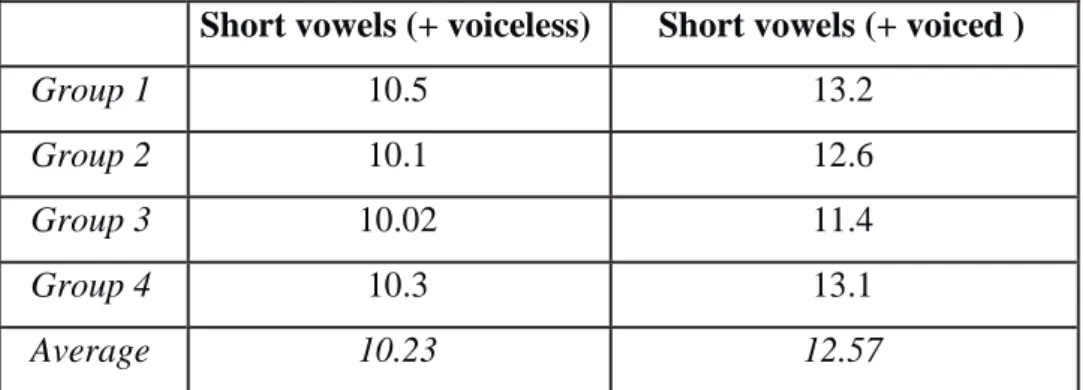
Regarding the production task (see table 6), after measuring vowels with
Audacity, we have observed that all groups produce a very similar duration in short vowels. Only group 4 obtains the exact duration proposed by Wiik (1965) (10.3), although this is just a guideline, since Wiik (1965) analyzed vowel duration in use, that is, analyzing people having conversations. The rest of the groups makes short vowels shorter, except for group 1, which lengthens them in comparison to Wiik´s values (1965). According to lengthened short vowels, group 1 and 4 are the ones that lengthen vowels the most. However, they are much shorter than expected. All these differences in length with the values proposed by Wiik may be because in his research words were used in conversation, in contrast to this research in which they appeared in isolation. Anyway, lengthened was present in every group.
comparison to Wiik (1965), we observe that advanced speakers of English produce a lengthening of the vowel, but not the necessary one. Concerning this aspect, group 1 and group 4 have been the ones that were nearer to the length proposed by Wiik (1965) (see graph 1), the supposed native duration.
Table 6. Duration of vowels in the task.
Short vowels (+ voiceless) Short vowels (+ voiced )
Group 1 10.5 13.2
Group 2 10.1 12.6
Group 3 10.02 11.4
Group 4 10.3 13.1
Average 10.23 12.57
Graph 1. Duration of vowels during the production task.
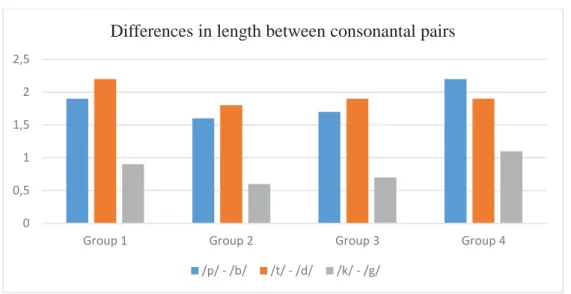
Graph 2 shows that the length difference in the pair /t/ - /d/ is the most acquired by participants, except for group 4, who produced more often the differences in length in /p/ - /b/. The pair with the lowest rate of correct length production in all groups was the /k/ - /g/ minimal pair.
0 2 4 6 8 10 12 14
Group 1 Group 2 Group 3 Group 4 Duration of vowels in the production task
Graph 2. Differences in length between consonantal pairs.
Taking a look to vowels in table 7, we observe that the shortest vowel is [ɒ] and the longest is [æ]. However, the one that has a more similar length to Wiik’s is [e], which is also the vowel that has a pronunciation nearer to the Spanish <e>. Group 4 has achieved the expected duration and Group 1 has exceeded it.
Table 7. Duration of short vowels in the production task
[æ] [e] [ɪ] [ɒ] [ʌ]
Mean average
Group 1 11.45 10.68 10.83 9.61 9.93 10.5
Group 2 11.2 10 11.13 9.2 9.01 10.10
Group 3 11.13 9.98 10.82 9.13 9.04 10.02
Group 4 11.3 10.5 10.68 9.25 9.8 10.30
Mean average 11.27 10.29 10.86 9.29 9.44
In the next table, we have the different durations of lengthened vowels and their average. None of them achieve Wiik (1965)’s length in vowels followed by a voiced consonant. Although, as it is mentioned above, Wiik (1965)´s measures are just guidelines in conjunction with the previous results of short vowels. The longest vowel is
0 0,5 1 1,5 2 2,5
Group 1 Group 2 Group 3 Group 4 Differences in length between consonantal pairs
[æ·] and the shortest is [ɒ·]. Concerning group’s results, we can mention that the groups that have better acquired vowel lengthening are group 1 and 4.
Table 8. Duration of lengthened vowels in the production task.
[æ·] [e·] [ɪ·] [ɒ·] [ʌ·] Mean average
Group 1 14.17 13.08 13.93 11.97 12.88 13.2
Group 2 14.21 13.02 12.89 11.94 10.95 12.6
Group 3 12.95 12.32 12.63 9.21 10 11.4
Group 4 14.38 13.29 14.23 11.67 11.98 13.1
Mean average 13.92 12.92 13.42 11.19 11.45
Finally, in the following table, we can see the differences between short and long vowels. The vowels that are produced with a more clear difference in length are /æ/ and /e/. Participants produce differences in these two vowels more often than the rest. The ones in which they have not made almost differences in length are /ɒ/ and /ʌ/.
The results of the discrimination task are as follows: in group 1, the ratio of correct answers is 78%, and 69% in group 2. Group 4 also approached them, with 65% of well-identified words, and group 3 remained at 42%.
0 0,5 1 1,5 2 2,5 3
/æ/ /e/ /ɪ/ /ɒ/ /ʌ/ Differences in length between short and
lengthened short vowels
Differences in length between short and lengthened short vowels
As it occurred in the production task, participants were less accurate in those pairs ending in /k/ and /g/ consonants (see graph 5) and more accurate in the /t/ - /d/ pairs. The more precise groups according to consonants are group 1 and group 4 as in the production task. In relation to vowels (see graph 6), participants had also more trouble with /ʌ/ and /ɒ/ and discriminated more easily /æ/ and /e/.
0 10 20 30 40 50 60 70 80 90
Group 1 Group 2 Group 3 Group 4 Words well-discriminated
0% 20% 40% 60% 80% 100%
Group 1 Group 2 Group 3 Group 4 Percentage of accurateness in the discrimination of words
/p/ - /b/ /t/ - /d/ /k/ - /g/
0% 10% 20% 30% 40% 50% 60% 70% 80% 90%
Group 1 Group 2 Group 3 Group 4 Percentage of discrimination accurateness in vowels
/æ/ /e/ /ɪ/ /ɒ/ /ʌ/
Graph 5. Percentage of accurateness in the discrimination of words
Section 5. Discussion and conclusion
We can draw several conclusions from the results obtained in the experiment which can give us ideas for further research and future teaching methods. Firstly, it is remarkable that after analyzing individually vowels and consonants, in both cases and in all groups, the easiest sounds are pronounced in the front part of the mouth in the case of vowels ([æ] and [e]) or in a bilabial position in consonants ([p], [b]). In this line, the most complicated ones are those pronounced at the back or in a velar position: [ʌ], [ɒ], [k], and [g]. The fact that the degree of complexity to pronounce or discriminate sounds goes from a front position to a back one might suggest that the trouble that EFL Spanish speakers have with pronunciation involves aspects regarding physiology like the place of articulation and tongue position, the vocal fold adjustments, etc.
Because of the results collected in which we have seen what vowels are more difficult for the different types of learners, we can propose a teaching method based on the primary instruction of the front sounds, which, in addition, are more similar to the Spanish ones. Considering the qualitative questions that participants answered, teachers may spend more time in teaching phonetics and phonology. Since Phonetics and Phonology is seen as a difficult, but important and necessary task, further research could be developed regarding the teaching method that deals with such skill.
Taking into account the age at which participants began the phonetic instruction and that the results cannot be considered strictly negative, we may take a stance against the several studies and researches that are in favor of the known critical period.
the differences in length that the participants have produced in the diverse consonantal pairs, we have observed, as House (1961) and Flege & Munro (1995), that not only the [േ voiced] aspect is relevant, but also the tongue position, the place of articulation, and the rest of physiological features.
Although it is true that English pronunciation can be complicated for a speaker of Spanish, especially its vocal system and the processes of lengthening and shortening of vowels, phenomena that do not exist in our language, it is hopeful than EFL students get to be conscious about it.
With respect to the discrimination task, the results are notably better, especially in groups 1 and 4, with a high success rate. This may indicate that EFL students have a better ability to identify sounds in English than producing them. The reason for this difference can be drawn from the answers to the questionnaires: while the participants complain that they have few opportunities to practice the language outside the classroom, they declare that the vast majority usually listen to music in English and watch original films. Therefore, their ear is better trained than their speech organs.
Section 6. Works cited
Alcántara, J. B. (1994). Rethinking English Vowel Alternation. Working papers of the Cornell Phonetics Laboratory vol. 9, pp. 1-26.
Aliaga-García, C. (2007). The Role of Phonetic Training in L2 Speech Learning.
Proceedings of the Phonetics Teaching & Learning Conference.
Arenas, E. C. (2012). Curso de pronunciación de la lengua inglesa para hispano-hablantes: A Native Cardinalty Method. Valladolid: Secretariado de Publicaciones e Intercambio Editorial de la Universidad de Valladolid.
Benzies, Y. J. C. (2013) Spanish EFL University Students Views on the Teaching of Pronunciation: A Survey-Based Study. LANGUAGE 5, 41-49.
Carroll, J. B & Sapon, S. M. (1959) Modern Language Aptitude Test. Psychological Corporation Modern Language Aptitude Test, 27.
Cope, J., Horwitz, E. K., & Horwitz, M. B. (1986) Foreign Language Classroom Anxiety.
The Modern Language Journal 70 (2), 125-132.
Cruttenden, A. (1962). Gimson’s Pronunciation of English. London: Routledge.
Dörnyei, Z. (2014). The Psychology of the Language Learner: Individual Differences in Second Language Acquisition. New York, USA: Routledge.
Dresher, B. (2016). Contrast in Phonology, 1867–1967: History and Development. Annual Review of Linguistics, 2 (1), 53-73.
Ehrman, M., Grigorenko, E., & Sternberg, R. (2000). A Theory Based Approach to the Measurement of Foreign Language Learning Ability: The Canal F Theory and Test.
Fox, R. A., Flege, J. E. & Munro, M. J. (1995). The perception of English and Spanish vowels by native English and Spanish listeners: A multidimensional scaling analysis.
The Journal of the Acoustical Society of America, 97 (4), 2540-2551.
Henderson, A. (2013). The English Pronunciation Teaching in Europe Survey: Initial Results and Useful Insights for Collaborative Work. Teaching and Researching English Accents in Native and Non-Native Speakers. 123-136.
Henderson, A. et al. (2012) The English Pronunciation Teaching in Europe Survey: Selected Results. Research in Language10 (1), 5-27.
House, A. S. (1961). On Vowel Duration in English. The Journal of the Acoustical Society of America, 33 (9), 1174-1178.
Iverson, P. & Evans, B. G. (2009). Learning English Vowels with Different First-language Vowel Systems II: Auditory Training for Native Spanish and German Speakers. The Journal of the Acoustical Society of America, 126 (2), 866-877.
Kondaurova, M. V. & Francis, A. L. (2008). The Relationship between Native Allophonic Experience with Vowel Duration and Perception of the English Tense/lax Vowel Contrast by Spanish and Russian Listeners. The Journal of the Acoustical Society of America, 124 (6), 3959-3971.
Krashen, S. D. (1981). Second Language Acquisition and Second Language Learning. Oxford, UK: Pergamon Press.
Lambert, W. E., et al. (1963). Attitudinal and Cognitive Aspects of Intensive Study of a Second Language. The Journal of Abnormal and Social Psychology, 66 (4),358. Mompean, J. (2015). Phonetic Notation in Foreign Language Teaching and Learning:
Potential Advantages and Learners’ Views. Research in Language, 13 (3).
Rigol, M. B. (2005). La pronunciación en la clase de lenguas extranjeras. Phonica 1.
Sternberg, R. J. (1999). The Theory of Successful Intelligence. Review of General Psychology 3 (4),292.
Sweet, H. (1877). A Handbook of Phonetics (Vol 2). University of Harvard: Clarendon Press.
Wang, W. S. Y., Lehiste, I., Chuang, C. K., & Darnovsky, N. (1976). Perception of vowel duration. The Journal of the Acoustical Society of America, 60 (S1), S92-S92.
Wiik, K (1965). Finnish and English Vowels: A Comparison with Special Reference to the Learning Problems Met by Native Speakers of Finnish Learning English. Annales Universitatis Turkensis 94.
Section 7. Appendix
Model of the tasks developed during the research
Personal data
Group: 1. Undergraduate (instructed in Phonetics and Phonology).
2. Undergraduate (not instructed in Phonetics and Phonology).
3. High proficiency L2 English speaker.
4. High School teacher.
Sex: male female Age: ______
Production task
PRODUCTION TASK: Pronounce the following words.
Discrimination task
DISCRIMINATION TASK. In every pair, circle the word that you hear.
Questionnaire
QUESTIONNAIRE. Answer the following questions with YES or NO.
1. Do you like Phonetics and Phonology? ______ 2. Do you find English pronunciation easy? ______
3. Have you studied or practiced English pronunciation by yourself (outside the academic context)? ______
4. Do you consider Phonetics and Phonology important and necessary at all levels of L2 instruction (from the very beginning of learning)? ______
5. Is Phonetics and Phonology sufficiently taught in elementary and high schools? ______
6. Is Phonetics and Phonology taught in the most efficient and comprehensive way in elementary and high schools? ______
7. Do you watch TV series, films, documentaries, etc. in English? ______ 8. If yes, how often? _________________ How long? _______________ 9. Do you use subtitles? ______ If yes, are they in English? ______ Answer the following questions about yourself with true (T) or false (F)
1. I study English to pass a level exam.
2. I like or would like to pass for a native among L1 English speakers.
3. I do not care about pronunciation. I know L1 English speakers can understand me.
4. I study English just because it is important in professional arrangements. 5. I like my own accent. I do not need to sound like a native.
6. Native speakers of English comment that my foreign accent is “cute”. I don’t have any motivation to change that.
7. I need more contact with native speakers to achieve a native-like pronunciation. 8. I would have liked to receive more training in pronunciation to have passed the
job interview.
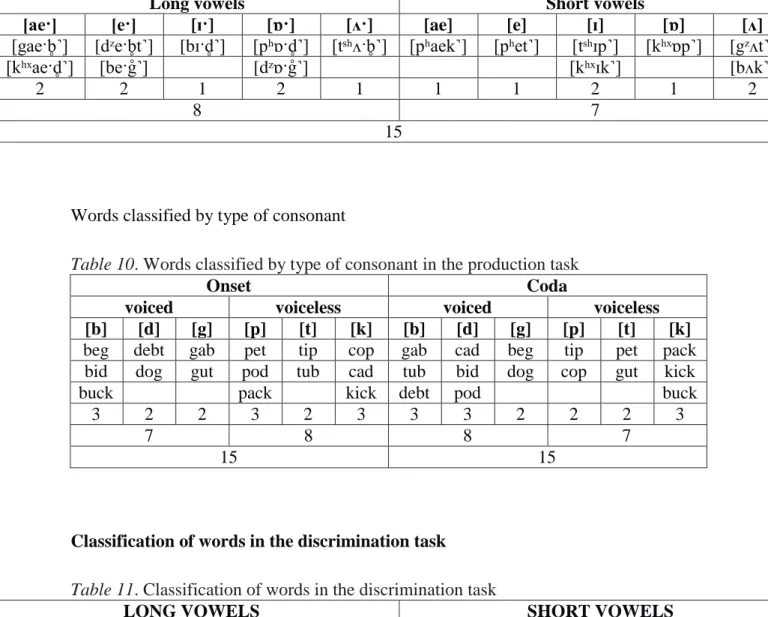
Classification of words in the production task
Table 9. Classification of words in the production task
Long vowels Short vowels
[ae·] [e·] [ɪ·] [ɒ·] [ʌ·] [ae] [e] [ɪ] [ɒ] [ʌ]
[gae·b̥˺] [dᶻe·b̥t˺] [bɪ·d̥˺] [pʰɒ·d̥˺] [tˢʰʌ·b̥˺] [pʰaek˺] [pʰet˺] [tˢʰɪp˺] [kʰˣɒp˺] [gᶻʌt˺]
[kʰˣae·d̥˺] [be·g̊˺] [dᶻɒ·g̊˺] [kʰˣɪk˺] [bʌk˺]
2 2 1 2 1 1 1 2 1 2
8 7
15
Words classified by type of consonant
Table 10. Words classified by type of consonant in the production task
Onset Coda
voiced voiceless voiced voiceless
[b] [d] [g] [p] [t] [k] [b] [d] [g] [p] [t] [k]
beg debt gab pet tip cop gab cad beg tip pet pack bid dog gut pod tub cad tub bid dog cop gut kick
buck pack kick debt pod buck
3 2 2 3 2 3 3 3 2 2 2 3
7 8 8 7
15 15
Classification of words in the discrimination task
Table 11. Classification of words in the discrimination task
LONG VOWELS SHORT VOWELS
[ae·] [e·] [ɪ·] [ɒ·] [ʌ] [ae] [e] [ɪ] [ɒ] [ʌ]
[lae·g̊˺] [re·d̥˺] [hɪd̥˺] [bɒ·b̥˺] [tˢʰʌ·b̥˺] [tˢʰaep˺] [rep˺] [pˢʰɪk˺] [gɒt˺] [kˣʰʌt˺]
[kˣʰae·d̥˺] [be·g̊˺] [hɒ·g̊˺] [lɪp˺] [bʌk˺]
2 2 1 2 1 1 1 2 1 2
8 7
Classification of words by type of consonant
Table 12. Classification of words by type of consonant in the discrimination task
ONSET CODA
VOICED VOICELESS VOICED VOICELESS
lag red beg bob rep lip got buck cad hog hid tub tap pick cut lag cad red beg hid bob hog tub tap rep pick lip got cut buck
8 7 8 7