Substituting a copper atom modifies the melting of aluminum clusters
Baopeng Cao,1Anne K. Starace,1Colleen M. Neal,1Martin F. Jarrold,1,a兲Sara Núñez,2 José M. López,2and Andrés Aguado2,b兲
1
Chemistry Department, Indiana University, 800 E. Kirkwood Ave., Bloomington, Indiana 47405, USA 2
Departamento de Física Teórica, Universidad de Valladolid, Valladolid 47011, Spain
共Received 1 July 2008; accepted 12 August 2008; published online 25 September 2008兲
Heat capacities have been measured for Aln−1Cu−clusters共n= 49– 62兲and compared with results for
pure Aln+ clusters. Aln−1Cu− and Aln+ have the same number of atoms and the same number of valence electrons 共excluding the copper d electrons兲. Both clusters show peaks in their heat capacities that can be attributed to melting transitions; however, substitution of an aluminum atom by a copper atom causes significant changes in the melting behavior. The sharp drop in the melting temperature that occurs betweenn= 55 and 56 for pure aluminum clusters does not occur for the Aln−1Cu− analogs. First-principles density-functional theory has been used to locate the global
minimum energy structures of the doped clusters. The results show that the copper atom substitutes for an interior aluminum atom, preferably one with a local face-centered-cubic environment. Substitution does not substantially change the electronic or geometric structures of the host cluster unless there are several Aln
+
isomers close to the ground state. The main structural effect is a contraction of the bond lengths around the copper impurity, which induces both a contraction of the whole cluster and a stress redistribution between the Al–Al bonds. The size dependence of the substitution energy is correlated with the change in the latent heat of melting on substitution. ©2008 American Institute of Physics.关DOI:10.1063/1.2977874兴
INTRODUCTION
The melting of nanoclusters has received considerable attention in the last few years.1–22 Nanoclusters behave dif-ferently from larger particles. For example, the well-known melting point depression that occurs with decreasing particle size23 breaks down for clusters with less than several hun-dred atoms.24–29Alloy clusters can have structures and prop-erties that are different from their pure counterparts and there has been a lot of interest in their melting behavior as well.30–43However, almost all previous work on the melting of alloy clusters has been computational. There have been many interesting predictions. For example, Mottet et al.
found that substituting a single nickel or copper impurity into icosahedral silver clusters causes a substantial increase in the melting temperature which can be attributed to the strain relaxation induced by sequestering the small impurity atom in the center of the icosahedron.33Chenget al.found a simi-lar result for the substitution of a single copper atom in icosahedral Au55.30 They also found that the copper
segre-gates away from the surface in the liquidlike forms of Au54Cu and Au43Cu12.
The only previous experimental study of alloy cluster melting was reported by Nealet al.who compared the melt-ing behavior of Gan−1Al+ clusters with that of pure Gan+ clusters.44 In this case, however, the melting temperatures and latent heats are not significantly influenced by the sub-stitution. This result was rationalized by noting that gallium
and aluminum are in the same group in the periodic table, and the atoms have similar sizes 共when one considers the densities of the liquids兲.
Here, we report studies of aluminum clusters where we substitute a copper atom for an aluminum atom. To retain the same number of valence electrons in the cluster and hence avoid possible electronic effects, we compare Aln−1Cu−
an-ions and Aln+cations. The copper atom is around 10% smaller than an aluminum atom and so it is possible that the copper atom in Al54Cu−could be sequestered in the center and
sta-bilize an icosahedron. To complement the experimental stud-ies, calculations were performed at the Kohn–Sham density-functional-theory level to search for the global minimum energy structures for Aln−1Cu− clusters with n= 49– 62.
These results are compared to recent calculations for the aluminum cluster cations.45
EXPERIMENTAL METHODS
The heat capacities for Aln−1Cu−clusters were measured
using multicollision-induced dissociation. The method and apparatus have been described in detail elsewhere.29,44,47 Cluster anions are generated by laser vaporization source of a liquid alloy target.48 The aluminum/copper alloy was pre-pared by heating an aluminum rod and copper shot to above the melting point of the alloy in a 0.625 cm diameter ceramic tube in a diffusion pumped vacuum line for more than 24 h. After cooling, the samples were removed from the ceramic tube and a short length was cut off with a hack saw and installed into the source sample holder. The alloy used for a兲Electronic mail: [email protected].
b兲Electronic mail: [email protected].
共 兲
the work reported here has a Cu/Al ratio of around 4 at. %. With this composition, aluminum clusters with one copper atom are the most abundant alloy clusters.
After formation, the alloy cluster ions are carried through the source by the helium buffer gas flow and into the temperature variable extension where their temperature is set for the heat capacity measurements. Cluster ions that exit the extension are focused into a quadrupole mass spectrometer where a particular cluster size is selected. The size-selected clusters are then focused into a high pressure collision cell where collisions with the helium cause the clusters to disso-ciate, if their initial translational energy is large enough. Fragment ions and intact cluster ions are swept across the collision cell by a weak electric field and those that exit are analyzed in a second quadrupole mass spectrometer. The Aln−1Cu−clusters dissociate by sequential loss of aluminum
atoms—the cluster fragment retains the copper atom,
Aln−1Cu−→Aln−2Cu−+ Al,
Aln−2Cu−→Aln−3Cu−+ Al,
etc.
The negative charge remains on the cluster fragment because it has a larger electron affinity than the isolated atom.
The fraction of the cluster ions that dissociate is deter-mined from the mass spectrum. The fraction is measured as a function of the cluster ion’s translational energy at the en-trance of the collisions cell. The translational energy required for 50% of the cluster ions to dissociate共TE50%D兲is then obtained from a linear regression.
TE50%D is measured as a function of the cluster’s initial temperature共as set in the temperature variable extension兲. As the temperature is raised, it decreases due to the increase in the cluster’s initial internal energy. A sharp decrease in TE50%D occurs at the melting temperature due to the latent heat. The derivative of TE50%D with respect to temperature is proportional to the heat capacity. The proportionality con-stant is related to the fraction of the ion’s translational energy that is converted into internal energy in collisions with the helium collision gas, which is estimated from a modified impulsive collision model.49–51
EXPERIMENTAL RESULTS
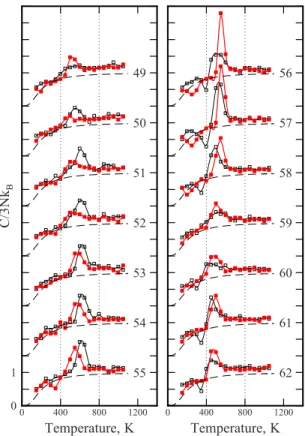
Figure1shows plots of the heat capacities measured for Aln−1Cu−clusters as a function of temperature. The heat
ca-pacities are plotted relative to the classical value 3NkB, where 3N= 3n− 6 + 3/2,nis the total number of atoms in the cluster and kB is the Boltzmann constant. The filled red squares show the measured values for Aln−1Cu− clusters
while the solid red lines show spline fits. For comparison, the open black squares in the figure show heat capacities re-corded for Aln+clusters.
46,52
The thin solid black lines show spline fits. The plots are labeled with the total number of atoms in the cluster共n兲. The dashed lines in Fig.1show heat capacities derived from a modified Debye model that takes into account the finite size of the cluster.53
Peaks in the heat capacities indicate melting transitions. The size and width of the peaks for Aln−1Cu− clusters vary
over a wide range. The peaks forn= 56 and 57 are large and narrow, while those for n= 51 and 52 are small and broad. The center of the peak in the heat capacity is usually taken to be the melting temperature. The area under the peak is the latent heat. For clusters withn= 50– 55 the peak in the heat capacities for Aln−1Cu− clusters occurs at a lower
tempera-ture than for Aln+while forn= 56– 62共exceptn= 59兲the situ-ation is reversed and the peak for Aln−1Cu−clusters occurs at
a higher temperature than for Aln+. There are also significant differences in the size and width of the peaks. For example, the peak in the heat capacity for Al56+ is much broader and smaller than for Al55Cu−.
In addition to the main peak, there is a small peak in the heat capacity plot for Al53Cu− 共n= 54兲 which precedes the
main melting transition. This feature is reproducible. There is a dip in the heat capacities for some clusters at temperatures below the peak in the heat capacity. For Aln−1Cu−clusters, a
dip occurs forn= 55, 56, 57, and 58. The dip also occurs for some Aln+ clusters 共n= 56, 57, 58, 60, 61, and 62兲. For n = 56, 57, and 58 the dips for Aln−1Cu−occur at a significantly
lower temperature than for Aln+. The dips for the Aln+clusters have been attributed to freezing into a high energy geometry
0 400 800 1200
Temperature, K
0 400 800 1200
Temperature, K
C
/3N
kB
49
50
51
52
53
54
55
56
57
58
59
60
61
62
0 1
on rapid cooling and then annealing into a lower energy ge-ometry during the longer timescale for transit through the temperature variable extension.52
As in our previous studies of the melting of Aln+clusters we fit the peaks in the heat capacities with simple two and three-state models.54 Our approach follows that of Poland.19 For clusters in the size regime examined here, melting and freezing are thought to occur in the dynamic coexistence regime where the transitions are between fully liquidlike and fully solidlike clusters. This behavior has been observed in computer simulations.55–58 In this limit, the liquid and solid are in equilibrium characterized by an equilibrium constant given by
K共T兲= exp
冋
−⌬HMELTR
冉
1
T−
1
TMELT
冊
册
, 共1兲
where⌬HMELTis the latent heat, TMELTis the melting
tem-perature, and R is the gas constant. The contribution of the latent heats to the heat capacity is
C共T兲=dEint
dT =
⌬共−fS共T兲⌬HMELT兲
⌬T , 共2兲
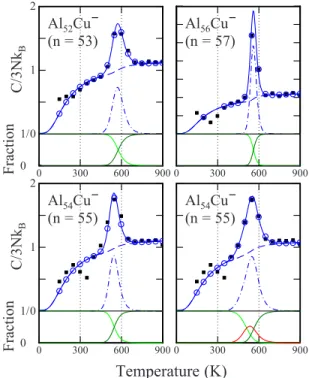
wherefS共T兲is the fraction of solid present at temperatureT. Equation共2兲describes the peak in the heat capacity that re-sults from the melting transition. This peak is fit to the mea-sured peak using a least squares procedure. Some examples are shown in Fig.2.
We start by considering the bottom of each plot where the solid lines show the fractions of the solid 共light green兲 and liquid 共dark green兲 that result from the fit. The blue dashed-dotted line shows the contribution to the heat capac-ity from the latent heat. In order to fit this peak to the ex-perimental results it is necessary to have values for the com-ponent of the heat capacity that results from the internal energy of the solid and liquid. For the solid we use the in-ternal energy derived from the modified Debye model mul-tiplied by a scale factor 共SS兲, and for the liquid we use the solid value multiplied by an additional scale factor共SL兲 共see Ref.54for a full description兲. Thus, there are four adjustable parameters that are optimized in the least squares fit of the two-state model to the experimental results:⌬HMELT,TMELT, SS, and SL.
Consider the results for Al52Cu− 共n= 53兲 in the top left
panel of Fig.2. The filled black squares are the experimental values. The open blue circles show the least squares fit cal-culated with a value for ⌬T in Eq. 共2兲 of 50 K 共the same value as used in the experiments兲. The solid blue line shows the simulation with a value for⌬Tin Eq.共2兲of 5 K. The fact that the calculations with ⌬T= 5 and 50 K are similar indi-cates that the value of⌬Tused in the measurements is small enough that the shape of the peak is faithfully reproduced. It is evident that the two-state model provides a good fit to the experimental results for Al52Cu−.
The top right panel in Fig.2 shows results for Al56Cu−
共n= 57兲. The peak in the heat capacity for this cluster is large and narrow but it is still well fit by the two-state model. In this case the simulation with ⌬T= 5 K appears sharper than obtained using ⌬T= 50 K. Both Al52Cu− and Al56Cu− have
similar melting temperatures. The difference between the two clusters is the size of⌬HMELT: 1.05 eV for Al52Cu−and
1.94 eV for Al56Cu−. As the latent heat becomes larger, the
peak in the heat capacity becomes narrower.
The peaks for the other Aln−1Cu− 共n= 49– 62兲 clusters
studied here can all be fit with the two-state model. For some clusters, the calculated peak is slightly narrower than the measured one. The worst fit is obtained for Al54Cu− 共n
= 55兲 shown in the lower left panel in Fig. 2. A plausible explanation for this behavior is that melting occurs through a partially melted intermediate 共I兲: SIL. A three-state model can be fit to the experimental results in a manner similar to the two-state model 共see Ref.54for details兲. The fit obtained with a three-state model for Al54Cu− 共n= 55兲is
shown in the lower right panel in Fig. 2. The solid lines at the bottom of this plot show the fractions of the solid共light green兲, intermediate共red兲and liquid共dark green兲that result from the fit. Clearly, the small discrepancy in the width of the peak in the heat capacity, that occurred for Al54Cu− 共n
= 55兲with the two-state model, has been fixed with the three-state model. With the three-three-state model there is a melting temperature and latent heat associated with both steps共SI and IL兲. For Al54Cu− 共n= 55兲, the melting temperatures
are 541.6 and 559.4 K compared to 547.4 K obtained with
0 300 600 900 0 300 600 900
0 300 600 900 0 300 600 900
Al52Cu
(n = 53) Al(n = 57)56Cu
Al54Cu
(n = 55) Al(n = 55)54Cu
Temperature (K)
0 1 2
0 1/
0 1 2
0 1/
Fr
ac
tion
C/3Nk
B
Fr
ac
tion
C/3Nk
B
the two-state fit; and the latent heats are 0.66 and 0.73 eV compared with 1.11 eV obtained with the two-state fit. For the other Aln−1Cu−clusters共n= 49– 62兲studied here the
dis-crepancy between the measured peak and the two-state fit is smaller than for Al54Cu−共n= 55兲. In these cases, the
three-state model provides a slightly better fit, but the difference is small and probably not significant.
Substituting the copper atom changes the shape of the heat capacity peaks for some clusters. For example, the heat capacity peaks for Al51+ and Al52+ have a low temperature shoulder which has been interpreted as evidence for a pre-melting transition.46The peaks for Al50Cu−and Al51Cu−are
smaller and broader, and both can be well fit by the two-state model. The peak for Al56+ is broad and is not well fit by the two-state model. In contrast, the peak for Al55Cu− is much
sharper and is well fit by the two-state model.
The top panel in Fig.3 shows melting temperatures de-termined from the fits with the two-state model. The filled red circles show melting temperatures obtained for Aln−1Cu−
clusters. The open black circles show values for Aln+clusters. The sharp drop in the melting temperature for Aln+ clusters that occurs on going from n= 55 to 56 is absent for the Aln−1Cu−clusters.
The middle panel in Fig.3shows latent heats determined for Aln−1Cu− clusters 共filled red circles兲 and Aln+ clusters
共open black circles兲. The latent heats come primarily from the fits of the two-state model, but corrected for clusters where the fit is not ideal. The latent heats for the Aln−1Cu−
clusters range from under 0.5 eV to almost 2 eV. For
clus-ters withn= 50– 55 the latent heats for Aln+are larger than for Aln−1Cu−, while for clusters with n⬎55 the Aln−1Cu−
clus-ters have the larger latent heats.
The entropy changes on melting, shown in the bottom panel of Fig.3, are obtained from⌬SMELT=⌬HMELT/TMELT.
The filled red circles are for Aln−1Cu−clusters and the open
black circles are for Aln+ clusters. The latent heats and the entropies of melting are closely correlated. This explains why the latent heats can vary by more than a factor of four while the melting temperatures for Aln−1Cu−clusters vary by
much less and all lie between 450 and 600 K.
PRELIMINARY DISCUSSION OF EXPERIMENTAL RESULTS
The Aln−1Cu− clusters dissociate by sequential loss of
neutral aluminum atoms. In the case of Al48Cu−, for
ex-ample, we observed the loss of 16 consecutive aluminum atoms as the initial translational energy is raised, and no evidence for the loss of the copper atom.59 One might inter-pret this result as indicating that the copper atom is seques-tered away from the surface of the liquid cluster共dissociation occurs from the liquidlike state兲. However, dissociation here is statistical and hence favors the lowest energy products. Thus, the absence of the copper loss process may simply result because the Aln−2Cu−+ Al product is lower in energy
than Aln−−1+ Cu. However, we do not rule out the idea that the
Cu atom segregates away from the surface in the liquid clus-ter. In simulations of Au54Cu and Au43Cu12, Chenget al.30
found that the copper segregated away from the surface of the liquid clusters. It is well known that concentrations at the surfaces of multicomponent liquids often differ from the con-centrations in the bulk. Usually the component with the lower surface tension segregates to the surface.60,61 In the present case, liquid copper has a higher surface tension than liquid aluminum,62,63and so the copper might be expected to segregate away from the liquid surface.
Bulk aluminum melts at 933 K and so the melting tem-peratures of the Aln
+
clusters shown in Fig.3 共top panel兲are all substantially below the bulk melting point, as expected.23 For the Aln−1Cu−clusters studied here, the atomic
composi-tion is 98.0%–98.4% aluminum. For bulk Al–Cu alloys with these compositions, melting starts at the eutectic point at 821 K and finishes below the melting point of the host alu-minum metal.64For the Aln−1Cu−clusters, substituting a
cop-per atom does not always lower the melting temcop-perature共as it does in the bulk兲. Aln−1Cu− clusters with n= 56– 62 have
melting temperatures that are larger than the corresponding pure aluminum cluster.
Perhaps the most striking difference between the melting behavior of the Aln+and Aln−1Cu−clusters is the absence, for
the Aln−1Cu−clusters, of the sharp drop in the melting
tem-perature that occurs for Aln+ clusters with 56 atoms. This difference propagates to the latent heats: The slight drop for Aln+clusters with 56 atoms is substituted by a large increase for the doped clusters. The significant increase in melting temperature and latent heat observed between Al49+ to Al51+ is also absent for the copper-alloy counterparts. The drop in the melting temperature for Aln+clusters with 56 atoms was ini-tially attributed to a geometry change65but more recent
the-50 55 60
Cluster Size (Atoms)
0 100 200 300
400 50 55 60
0.0 0.5 1.0 1.5 2.0
Latent
Heat
(eV)
50 55 60
400 450 500 550 600 650
Melting
Temperature
(K
)
oretical results45 suggest the structures of Al55+ and Al56+ at 0 K are similar. According to the more recent calculations, Al55+ shows an enhanced stability because it is an electron shell closing, so the drop in melting temperature for Al56+ might also be induced by the opening of a new electron shell. The electron shell closing for Al55+ has been confirmed by photoionization experiments66but, considering the computa-tional difficulties of locating the global minimum energy structures via first-principles calculations, we think theory cannot yet reliably reject the possibility of a structural change.
If the sharp drop in the melting temperatures at Al56+ is due to a structural change, then the absence of this drop in the results for the Aln−1Cu− clusters suggests that the
struc-tural change no longer occurs. On the other hand, the latent heats of the substituted and unsubstituted clusters show simi-lar trends for clusters with more than 56 atoms, which sug-gests structural similarities. Which structure do the Aln−1Cu−
clusters have? In order to shed some light on this complex problem, we have employed first-principles calculations as detailed in the next section.
COMPUTATIONAL METHODS
Calculations were performed at the Kohn–Sham density-functional-theory67 level to search for the global minimum structures of Aln−1Cu−anions withn= 49– 62. We
employ theSIESTAcode,68with exchange and correlation ef-fects treated within the spin-polarized generalized gradient approximation共GGA兲,69 and norm-conserving pseudopoten-tials to describe the core electrons.70,71The Al and Cu atoms contribute 3 and 11 electrons, respectively, to the valence electron density. The copper pseudopotential further includes non-linear core corrections accounting for the core-valence overlap. The basis set employed to expand the cluster wave function contains five basis functions per atom共a double zeta plus polarization or DZP basis in standard notation68兲. The spatial extension of the basis functions is determined by an energy shift68 of 20 meV. The fast-Fourier-transform mesh employed to evaluate some terms in the Hamiltonian is de-termined by a mesh cutoff68 of 100 Ry. The quality of the chosen basis set and pseudopotential was tested by perform-ing calculations for the Al2 and AlCu diatomic molecules as well as for bulk aluminum and copper, with results in good agreement with experiment and previous calculations at the same level of theory.
In a recent work,45 we obtained the global minimum energy structures of Aln+cations withn= 34– 84 by using the same theoretical framework. For each cluster size, more than 100 isomers, including icosahedral, decahedral, face-centered-cubic 共fcc兲, and other disordered or mixed struc-tures, were optimized. With this large structural database available, we first tested how the relative stabilities of pure aluminum clusters are modified by a substitutional copper impurity. Specifically, we have considered all the different structural isomers of Al49+ to generate initial structures for Al48Cu−. Each isomer of the pure aluminum clusters leads to
several different homotops72for the doped cluster, according to the number of geometrically different substitutional sites.
The set of homotops of a given geometric structure spans an energy interval of width of 0.4– 0.5 eV. The energy isomer spectrum of the doped cluster is therefore much denser than the pure aluminum reference spectrum. If we now consider only the lowest energy homotop for each structural isomer, the results show that the relative energies of the different isomers are essentially the same in doped and pure clusters. Only when the total energy difference between two Al49+ iso-mers is small共on the order of 0.2 eV兲can substituting cop-per exchange their energetic ordering.
As noted in the Introduction, calculations suggest that silver and gold icosahedra are stabilized by sequestering a smaller atom at the center. In our previous work,45we found that the Al55+ icosahedron lies approximately 3 eV above the ground state structure. We checked the corresponding Al54Cu− icosahedron 共with the copper impurity sequestered
at the center兲, and it lies 2.9 eV above the ground state struc-ture. The icosahedron is thus only marginally stabilized by the copper impurity.
In summary, doping with a single copper impurity is not found to drastically change the structures of aluminum clus-ters. An important outcome of this observation is that the search for the global minimum energy structures of the doped clusters is simplified. For all other sizes 共n= 50– 62兲, we have just considered 10–20 low-energy Aln+ isomers as candidates to house the copper impurity. We can also reliably conclude that, if the correct structure for Aln−1Cu− is not
found, this is only because the corresponding Aln+ global minimum was not located in our previous study. That is, any mistake in the structures of the pure clusters will necessarily transfer to the doped clusters.
THEORETICAL RESULTS
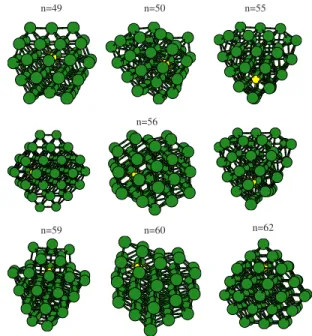
A representative selection of cluster structures is shown in Fig. 4, and the atomic coordinates for the putative global minima will be made available through the internet.73Within the size range of interest here共n= 49– 62兲, the Aln
+
reference structures are either distorted decahedral fragments 共for n
= 50– 59兲or close-packed structures built by stacking planes of atoms according to a fcc sequence 共for n= 49, 60– 62兲. Within this second structural family, the staking sequence can be locally changed to hcp at the cluster surface, which creates stacking faults in the cluster structure共see Ref.45for details兲. The minimum energy isomer of Aln−1Cu− has the
same structure as the corresponding Aln+global energy mini-mum with few exceptions: forn= 54 the doped structure per-tains to the same distorted decahedral family as the parent pure cluster, but differs slightly from it by the reallocation of a few surface atoms; forn= 56– 59, distorted decahedra and close-packed structures are degenerate in energy 共the small energy differences between these isomers, smaller than 1 meV/atom, are clearly beyond the numerical accuracy ex-pected from DFT calculations兲. Therefore, the critical size for the transition from distorted decahedral to close-packed structures, which occurs atn= 60 in the pure clusters, is low-ered to n= 56 in the doped clusters within our numerical accuracy.
clusters doped with copper74–78 do not fully agree on the preferred substitution site for the copper atom. Our results show that copper prefers to occupy interior positions in host aluminum clusters with 49–62 atoms, although the energetic cost for surface segregation of copper is not very large: The most stable homotop with copper at the cluster surface is roughly 0.2 eV above the correct ground state. There are some exceptions to this rule: forn= 61, for example, there is one homotop with the copper atom at the surface which is essentially degenerate with the ground state. For clusters with n= 50– 55, the copper impurity does not occupy the most internal positions, but intermediate ones. These are sites which may be considered as internal in terms of the coordi-nation number of copper but which lack a capping aluminum atom, so that the impurity is partially exposed to the cluster surface共this is most clearly seen for n= 55 in Fig.4兲.
From all the possible interior sites available for substitu-tion, the copper impurity further shows a strong preference for those providing 12 Al–Cu bonds in a local fcc atomic environment. All the host aluminum clusters considered here possess at least one such substitution site, but in many cases
共especially within the distorted decahedral family兲the local fcc atomic environment is considerably distorted, and the 12 Al–Al bond lengths around the substituted aluminum show a large dispersion. Host clusters withn= 49, 56共the left isomer in Fig.4兲and 62, however, offer an almost perfect local fcc environment around the substitution site. As we will see be-low, these undistorted sites are able to accommodate the re-laxation around the smaller Cu impurity much more effi-ciently than the distorted fcc environments. For n= 54 and
n= 55, the local fcc environment is so distorted that the cop-per impurity prefers a different substitution site closer to the cluster surface 共see Fig.4兲, where it is coordinated to only
10 aluminum atoms instead of 12. Clusters with n= 54 and 55 can thus be considered as exceptional cases with respect to the average structural trend.
According to the identified structural trend, pure alumi-num clusters with a close-packed structure are expected to provide a more optimal atomic environment for the copper impurity, as compared to the distorted decahedral clusters. In fact, we observe the energy difference between distorted decahedral and close-packed structures to decrease by about 0.2 eV upon substituting with a copper atom. For n
= 50– 55 atoms, the distorted decahedral structures are sig-nificantly more stable than the close-packed structures, so the doped clusters still adopt the distorted decahedral structure, even if the local atomic environment for copper is not opti-mal. For n= 56– 59, both structural families are sufficiently close in energy for the pure clusters, so that substituting with copper can induce a structural change, as seen in Fig.4.
As we are mainly interested in a comparison between pure and substituted aluminum clusters, we show in Fig. 5
the energy released in the exothermic substitution reaction Aln++ Cu−→Aln−1Cu−+ Al+. This “substitution energy” shows
marked maxima for sizesn= 49, 56, and 62, precisely those offering an undistorted fcc-like atomic environment to the copper impurity. A comparison with Fig.3reveals that those three sizes have the largest latent heat increase upon doping. In particular, the cluster with n= 56 atoms is stabilized by doping with a copper atom much more than the cluster with
n= 55 atoms, which also correlates with the qualitative change in the size evolution of the latent heats on passing from 55 to 56 atoms. For those clusters with more than 56 atoms,n= 61 has the smallest latent heat increase upon dop-ing with copper 共see Fig. 3兲, which correlates with a local minimum in the substitution energy. Finally, the energy gained in the doping process is on average larger forn= 49 and n艌56 than for the n= 50– 55 size range, which also qualitatively correlates with the doping-induced changes in the latent heats. On the quantitative level, however, the varia-tions of the substitution energy with cluster size are signifi-cantly smaller than the corresponding latent heat changes.
DISCUSSION
Introduction of a substitutional impurity is expected to modify the free energies of both solidlike and liquidlike
n=49 n=50 n=55
n=56
n=62
n=59 n=60
FIG. 4. 共Color online兲A representative selection of the structures adopted by Aln−1Cu− cluster anions. The yellow共light兲 sphere represents the Cu impurity. The total number of atoms共n兲is given above each structure. For n= 56 we show three nearly degenerate isomers. All the clusters with n = 50– 55 share the same structural motif, so we show only two structures explicitly. The same happens within the size ranges n= 57– 59 and n = 60– 61.
50 52 54 56 58 60 62
Number of Atoms n 2.1
2.2 2.3 2.4
Su
b
st
itut
ion
Energy
(eV)
phases. If the free energy difference between liquid and solid phases decreases upon doping, the doped cluster will show a depressed melting point and latent heat. In the opposite case, the solid phase of the doped cluster will have enhanced ther-mal stability and therefore a higher melting point than the pure cluster. Let us make the reasonable assumption that the copper-induced free energy change evolves smoothly with size for the liquid clusters. Then, when the doped cluster has, for example, a larger latent heat than the pure cluster, it must be because the solid substitution energy evaluated in the pre-vious section is especially large. This provides a rationale for the good qualitative correlation observed between the theo-retical solid substitution energies and the measured latent heat changes.
There are several different melting scenarios possible in bimetallic nanoalloys. When the two metals segregate in the solid phase but mix in the liquid phase, melting points are systematically depressed. This is observed, for example, in the melting transition of alkali nanoalloys of several compositions.32 The main reason is the mixing entropy, which strongly favors the liquid phase in this case. This is also the reason why the melting points of bulk alloys in the dilute limit are systematically depressed, so it is a well-known effect. When the two metals mix both in solid and liquid phases, the behavior is in general unpredictable: The melting points may be either depressed or enhanced, depend-ing on the specific system. This is also true both for nanoal-loys and bulk alnanoal-loys. Finally, when the two elements are immiscible both in solid and liquid phases, the bulk melting point of the majority phase is not modified at all by the presence of a small concentration of the minority phase共the two systems behave just independently兲. In small clusters, however, immiscible impurities are expected to systemati-cally depress the melting temperatures of the host cluster.79 The reason is the energetic cost of the interface separating the two components, which can be neglected in the bulk limit but not at the nanoscale. For sufficiently large impurities of general shape, the liquid phase is expected to better accom-modate the interfacial region共due to its larger structural free-dom兲, while the more rigid solid phase has to sustain a large interfacial tension. The stress stored in the solid phase is efficiently released upon melting, which promotes the liquid phase and depresses the melting point.79
The single atomic impurity considered here represents a special case because it has a perfectly spherical shape共i.e., it is not a molecular impurity兲. In contrast to bulk systems, pure metallic clusters may on their own sustain a significant degree of bond strain. A single atomic substitutional impurity may put the host lattice under additional stress, but it also may help to ameliorate the existing strain in the host metallic cluster. A specific example of this last situation, which tends to enhance the melting points of the doped clusters, has been shown by Mottet et al.:33 Introducing a copper impurity at the center position of an Ag55 icosahedron significantly
re-laxes the strain of the host cluster because a copper atom is smaller than a silver atom. Note that in this special example the relaxation of the host lattice around the impurity is
ho-mogeneous, that is, involves the coherent contraction of the outer silver atomic shells without unevenly redistributing the remaining bond strain.
We find a similar physical interpretation for the observed melting peculiarities in Aln−1Cu− cluster anions. When the
host cluster contains an interior site with a perfect fcc-like local environment, the local contraction of the host cluster around the smaller impurity is coherent: All the Al–Cu bonds are contracted by similar amounts and the optimal distribu-tion of strain in the host lattice is respected. When the sub-stitution site has a significantly distorted fcc-like atomic en-vironment, structural optimization of the doped cluster tends to make the twelve Al–Cu distances as similar as possible and thus significantly perturbs the optimal distribution of strain in the host lattice. For clusters with n= 54 and 55 at-oms, this is so unfavorable for the solid cluster that the cop-per impurity prefers a different substitution site with only ten Al–Cu bonds.
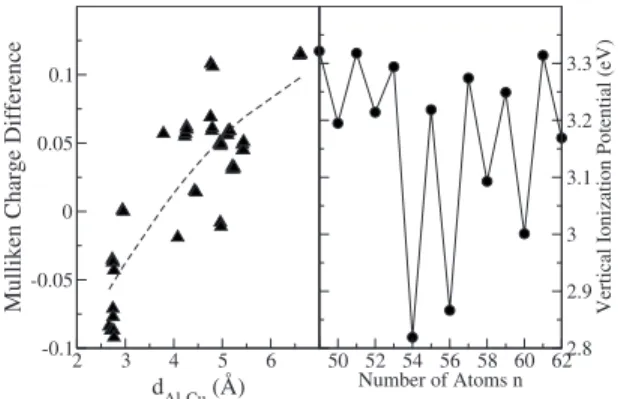
Our interpretation for the changes in melting behavior induced by a substitutional copper impurity is therefore purely structural. However, as Cu and Al have different va-lence states and also different electronegativities, one might expect some contribution to the observed changes coming from electronic effects. So just to complete our view of the doping process, we have analyzed the electronic changes in-duced by doping. A Mulliken population analysis reveals a negligible charge transfer between Cu and Al atoms. This agrees with the results of Zope and Baruah,74 who also ob-served a negligible amount of charge transfer when the cop-per impurity substitutes an interior aluminum atom. Now, if Aln+ and Aln−1Cu− clusters have the same total number of
electrons and the copper impurity is in its monovalent state, the doped clusters must have an excess of electron charge
共integrating to two electrons兲 distributed in the cluster re-gions far from the impurity. This is shown in Fig. 6 共left panel兲, where we plot the difference between the aluminum Mulliken charges of the doped and pure 49-atom clusters, as a function of the distance from the copper impurity. The first coordination shell of aluminum atoms around the copper im-purity shows a deficit of electron charge, while the more
2 3 4 5 6
d
Al-Cu(Å)
-0.1 -0.05 0 0.05 0.1
Mulliken
Charge
Difference
50 52 54 56 58 60 62 Number of Atoms n
2.8 2.9 3 3.1 3.2 3.3
Vertical
Ionization
Potential
(eV)
distant atoms show an accumulation of electron charge. As the impurity occupies an internal position, the electron ex-cess is mostly accommodated at the cluster surface. This is certainly a small difference between the doped and pure clus-ters, but one which is systematic as it is essentially the same for all sizes. Apart from this, the copper impurity does not significantly perturb the electronic structure of the host clus-ter: The vertical ionization potential共VIP兲of the doped clus-ter anions 共the energy difference between the cluster anion and the neutral cluster in the optimum geometry of the an-ion兲 shown in the right panel of Fig.6, identifies electronic shell closings forn= 53 and 55 atoms, in perfect coincidence with the electron shell closings observed for the pure alumi-num cations.45,66The different melting behavior of pure and doped clusters is thus not due to different electron shell structures.
The agreement between theory and experiment is en-couraging, and possibly as good as might be expected from purely static calculations. As discussed above, theory finds an explanation for the qualitative trends observed in the melting experiments. In the future, explicit molecular dy-namics simulations of the melting process might offer a more definitive and complete explanation of the experimental ob-servations, possibly also at the quantitative level.
CONCLUSIONS
Heat capacities measured for Aln−1Cu− clusters show
peaks that can be attributed to melting transitions. The melt-ing temperatures and latent heats for the Aln−1Cu− clusters
show significant differences from those for isoelectronic Aln +
clusters, confirming theoretical predictions that the melting behavior of metal clusters can be significantly modified by substituting a single metal atom. The sharp drop in the melt-ing temperature that occurs between n= 55 and 56 for pure aluminum clusters does not occur for the Aln−1Cu−analogs.
First-principles density-functional calculations reveal that the structures of Aln
+
clusters are not significantly modi-fied upon doping. The electron shell structure is also the same in Aln+ and Aln−1Cu− clusters, which contain the same
total number of electrons. The copper impurity substitutes an internal aluminum atom, preferably one with a local face-centered-cubic atomic environment. Despite the similarities between pure and doped clusters, the detailed atomic relax-ation of the host aluminum cluster around the impurity is size dependent, which makes the substitution reaction sig-nificantly more exothermic for specific cluster sizes. The main physical factors controlling the strong size dependence of the substitution energy have been identified and discussed. The size dependence of the substitution energy is in qualita-tive agreement with the modifications in the latent heats of melting induced by the copper impurity. However, several other experimental observations about the melting transition can not be interpreted with purely static共zero Kelvin兲 calcu-lations.
ACKNOWLEDGMENTS
We gratefully acknowledge the support of the National Science Foundation, the Spanish MEC, and the European
Regional Development Fund共Project Nos. MAT2005-03415 and VA068A06兲.
1R. Li, J. H. G. Owen, S. Kusano, and K. Miki,Appl. Phys. Lett. 89,
073116共2006兲.
2Y. J. Lee, E.-K. Lee, S. Kim, and R. M. Nieminen,Phys. Rev. Lett. 86,
999共2001兲.
3G. A. Breaux, D. A. Hillman, C. M. Neal, R. C. Benirschke, and M. F.
Jarrold,J. Am. Chem. Soc. 126, 8628共2004兲.
4A. Aguado and J. M. López,Phys. Rev. Lett. 94, 233401共2005兲. 5H. Haberland, T. Hippler, J. Donges, O. Kostko, M. Schmidt, and B. von
Issendorff,Phys. Rev. Lett. 94, 035701共2005兲.
6K. Koga, T. Ikeshoji, and K. Sugawara,Phys. Rev. Lett. 92, 115507
共2004兲.
7F. Ding, A. Rosén, and K. Bolton,Phys. Rev. B 70, 075416共2004兲. 8F. Chuang, C. Z. Wang, S. Öğüt, J. R. Chelikowsky, and K. M. Ho,Phys.
Rev. B 69, 165408共2004兲.
9D. Schebarchov and S. C. Hendy,Phys. Rev. Lett. 95, 116101共2005兲. 10A. Aguado and J. M. López,Phys. Rev. B 74, 115403共2006兲. 11D. M. Tomecka, B. Partoens, and F. M. Peeters,Phys. Rev. E71, 062401
共2005兲.
12E. G. Noya, J. P. K. Doye, D. J. Wales, and A. Aguado,Eur. Phys. J. D
43, 57共2007兲.
13M. Lee, S. Gowtham, H. He, K.-C. Lau, L. Pan, and D. G. Kanhere,
Phys. Rev. B 74, 245412共2006兲.
14M. Lee and D. G. Kanhere,Phys. Rev. B 75, 125427共2007兲.
15A. N. Andriotis, Z. G. Fthenakis, and M. Menon, Phys. Rev. B 75,
073413共2007兲.
16A. V. Zhukov, A. S. Kraynyukova, and J. Cao,Phys. Lett. A 364, 329
共2007兲.
17M. Eryrüek and M. H. Güven,Physica A 377, 514共2007兲.
18S. Luo, L. Zheng, A. Strachan, and D. C. Swift,J. Chem. Phys. 126,
034505共2007兲.
19D. Poland,J. Chem. Phys. 126, 054507共2007兲.
20Y. Teng, X. Zeng, H. Zhang, and D. Shun,J. Phys. Chem. B 111, 2309
共2007兲.
21P. C. R. Rodrigues and F. M. S. Silva Fernandes,Eur. Phys. J. D41, 113
共2007兲.
22H. Duan, F. Ding, A. Rosén, A. R. Harutyunyan, S. Curtarolo, and K.
Bolton,Chem. Phys. 333, 57共2007兲.
23P. Pawlow, Z. Phys. Chem.共Leipzig兲 65, 1共1909兲.
24L. S. Lai, J. Y. Guo, V. Petrova, G. Ramanath, and L. H. Allen,Phys.
Rev. Lett. 77, 99共1996兲.
25M. Schmidt, R. Kusche, T. Hippler, J. Donges, W. Kronmüller, B. von
Issendorff, and H. Haberland,Phys. Rev. Lett. 86, 1191共2001兲. 26M. Schmidt, T. Hippler, J. Donges, W. Kronmüller, B. von Issendorff,
and H. Haberland,Phys. Rev. Lett. 87, 203402共2001兲.
27M. Schmidt, J. Donges, T. Hippler, and H. Haberland,Phys. Rev. Lett.
90, 103401共2003兲.
28A. A. Shvartsburg and M. F. Jarrold,Phys. Rev. Lett. 85, 2530共2000兲. 29G. A. Breaux, R. C. Benirschke, T. Sugai, B. S. Kinnear, and M. F.
Jarrold,Phys. Rev. Lett. 91, 215508共2003兲.
30D. Cheng, S. Huang, and W. Wang,Phys. Rev. B 74, 064117共2006兲.
31F. Chen, B. C. Curley, G. Rossi, and R. L. Johnston,J. Phys. Chem. C
111, 9157共2007兲.
32A. Aguado, L. E. González, and J. M. López,J. Phys. Chem. B 108,
11722 共2004兲; A. Aguado and J. M. López,Phys. Rev. B 71, 075415 共2005兲; J. Chem. Theory Comput. 1, 299 共2005兲; Phys. Rev. B 72, 205420共2005兲; A. Aguado, J. M. López, and S. Núñez,Comput. Mater. Sci. 35, 174共2006兲.
33C. Mottet, G. Rossi, F. Baletto, and R. Ferrando,Phys. Rev. Lett. 95,
035501共2005兲.
34K. Michaelian and I. L. Garzón,Eur. Phys. J. D 34, 183共2005兲. 35T. T. Järvi, A. Kuronen, K. Meinander, K. Nordlund, and K. Albe,Phys.
Rev. B 75, 115422共2007兲.
36M. S. Lee, S. Gowtham, H. He, K.-C. Lau, L. Pan, and D. G. Kanhere,
Phys. Rev. B 74, 245412共2006兲.
37I. Kaban, I. Kaban, W. Hoyer, A. Il’inskii, A. Shpak, and P. Jóvári,J.
Non-Cryst. Solids 353, 1808共2007兲.
38J. T. Okada, M. Inui, D. Ishikawa, A. Q. R. Baron, K. Matsuda, S.
Tsutsui, Y. Watanabe, S. Nanao, and T. Ishikawa, J. Phys.: Condens. Matter 18, L613共2006兲.
39X. Lv, X. Bian, T. Mao, Z. Li, J. Guo, and Y. Zhao,Physica B 392, 34
40T. Yen, S. K. Lai, N. Jakse, and J. L. Bretonnet,Phys. Rev. B 75, 165420
共2007兲.
41K. Manninen, A. Rytkönen, and M. Manninen,Eur. Phys. J. D 29, 39
共2004兲.
42R. Ferrando, J. Jellinek, and R. L. Johnston,Chem. Rev.共Washington,
D.C.兲 108, 845共2008兲.
43J. Jellinek,Faraday Discuss. 138, 11共2008兲.
44C. M. Neal, A. K. Starace, and M. F. Jarrold,J. Phys. Chem. A 111, 8056
共2007兲.
45A. K. Starace, C. M. Neal, B. Cao, M. F. Jarrold, A. Aguado, and J. M.
López, “Correlation between the latent heats and cohesive energies of metal clusters and change,” J. Chem. Phys.共in press兲.
46G. A. Breaux, C. M. Neal, B. Cao, and M. F. Jarrold,Phys. Rev. Lett.94,
173401共2005兲.
47C. M. Neal, A. K. Starace, and M. F. Jarrold,J. Am. Soc. Mass Spectrom.
18, 74共2007兲.
48C. M. Neal, G. A. Breaux, B. Cao, A. K. Starace, and M. F. Jarrold,Rev.
Sci. Instrum. 78, 075108共2007兲.
49M. F. Jarrold and E. C. Honea,J. Am. Chem. Soc. 114, 459共1992兲. 50M. F. Jarrold,J. Phys. Chem. 99, 11共1995兲.
51In the model used to estimate the fraction of the ions translational energy
that is converted into internal energy, the energy transfer depends on the mass of the atoms in the cluster. According to the model, the energy transferred by a collision with a copper atom is around 54% less than the energy transferred in a collision with an aluminum atom. We assume that the probability of collision with a copper atom is proportional to the fraction of copper atoms in the cluster. Thus an error would result if the copper atom is not distributed statistically共i.e., if the copper atom segre-gated away from the surface layer or into the surface layer兲. However, because the number of impurity atoms is small compared to the number of host atoms in the clusters studied here, the potential error is small 共around 1%兲.
52M. F. Jarrold, B. Cao, A. K. Starace, C. M. Neal, and O. H. Judd,J.
Chem. Phys. 129, 014503共2008兲.
53J. Bohr,Int. J. Quantum Chem. 84, 249共2001兲.
54C. M. Neal, A. K. Starace, and M. F. Jarrold,Phys. Rev. B 76, 054113
共2007兲.
55R. S. Berry, J. Jellinek, and G. Natanson,Phys. Rev. A 30, 919共1984兲.
56T. L. Beck, J. Jellinek, and R. S. Berry,J. Chem. Phys. 87, 545共1987兲. 57J. P. Rose and R. S. Berry,J. Chem. Phys. 98, 3246共1993兲.
58B. Vekhter and R. S. Berry,J. Chem. Phys. 106, 6456共1997兲.
59If loss of the copper atom occurred with the same probability as loss of an
aluminum atom, around 40% of the starting Al48Cu−clusters should have lost the copper atom after losing 16 atoms sequentially.
60G. Raina, C. U. Kulkarni, and C. R. Rao,J. Phys. Chem. A 105, 10204
共2001兲.
61E. Dimasi, H. Tostman, O. Shpyrkp, P. Huber, B. Ocko, P. Pershan, M.
Deutsch, and L. Berman,Phys. Rev. Lett. 86, 1538共2001兲.
62V. Sarou-Kanian, F. Millot, and J. C. Rifflet,Int. J. Thermophys. 24, 277
共2003兲.
63T. Matsumoto, H. Fujii, T. Ueda, M. Kamai, and K. Nogi,Meas. Sci.
Technol. 16, 432共2005兲.
64R. A. Flinn and P. K. Trojan,Engineering Materials and Their
Applica-tions, 4th ed.共Houghton Mifflin, Boston, 1990兲.
65A. Aguado and J. M. López,J. Phys. Chem. B 110, 14020共2006兲.
66K. E. Schriver, J. L. Persson, E. C. Honea, and R. L. Whetten,Phys. Rev.
Lett. 64, 2539共1990兲.
67W. Kohn and L. J. Sham,Phys. Rev. 140, 1133共1965兲.
68J. M. Soler, E. Artacho, J. D. Gale, A. García, J. Junquera, P. Ordejón,
and D. Sánchez-Portal,J. Phys.: Condens. Matter 14, 2745共2002兲. 69J. P. Perdew, K. Burke, and M. Ernzerhof,Phys. Rev. Lett. 77, 3865
共1996兲; 78, 1396共1997兲.
70D. R. Hamann, M. Schlüter, and C. Chiang,Phys. Rev. Lett. 43, 1494
共1979兲.
71L. Kleinman and D. M. Bylander,Phys. Rev. Lett. 48, 1425共1982兲. 72An isomer with the the same geometric structure but with the impurity
atom occupying a different site. See, E. B. Krissinel and J. Jellinek,Int. J. Quantum Chem. 62, 185共1997兲.
73Web page of the “Nanometric Properties of Matter” Research Group:
http://metodos.fam.cie.uva.es/~GIR
74R. R. Zope and T. Baruah,Phys. Rev. A 64, 053202共2001兲.
75S. N. Khanna, C. Ashman, B. K. Rao, and P. Jena,J. Chem. Phys. 114,
9792共2001兲.
76P. Yang, J.-H. Ge, and Z.-Y. Jiang,J. Mol. Struct.: THEOCHEM 755, 75
共2005兲.
77C. Lacaze-Dufaure, C. Blanc, G. Mankowski, and C. Mijoule,Surf. Sci.
601, 1544共2007兲.
78R. Pal, L. Cui, S. Bulusu, H. Zhai, L. Wang, and X. C. Zeng,J. Chem.
Phys. 128, 024305共2008兲.
79C. Hock, S. Strassburg, H. Haberland, B. V. Issendorff, A. Aguado, and