Factors Associated with Influenza
Vaccination of Hospitalized Elderly Patients
in Spain
Àngela Domínguez1,2*, Núria Soldevila2, Diana Toledo1, Pere Godoy2,3,4, Jesús Castilla2,5, Lluís Force6, María Morales2,7, José María Mayoral8, Mikel Egurrola9, Sonia Tamames10, Vicente Martín11, Jenaro Astray12, Working Group of the Project PI12/02079
1Departament de Salut Pública, Universitat de Barcelona, Barcelona, Spain,2CIBER Epidemiología y Salud Pública (CIBERESP), Madrid, Spain,3Agència de Salut Pública de Catalunya, Barcelona, Spain, 4Institut de Recerca Biomèdica de Lleida, Universitat de Lleida, Lleida, Spain,5Instituto de Salud Pública, Instituto de Investigación Sanitaria de Navarra, Pamplona, Spain,6Hospital de Mataró, Mataró, Spain, 7Universitat de Valencia, Valencia, Spain,8Servicio de Vigilancia de Andalucía, Sevilla, Spain,9Hospital de Galdakao, Usansolo, Spain,10 Dirección General de Salud Pública, Investigación, Desarrollo e Innovación, Junta de Castilla y León, León, Spain,11Universidad de León, León, Spain,12 Consejería de Sanidad, Madrid, Spain
¶ Membership of the Working Group of the Project PI12/02079 is provided in the Acknowledgments. *[email protected]
Abstract
Vaccination of the elderly is an important factor in limiting the impact of influenza in the com-munity. The aim of this study was to investigate the factors associated with influenza vacci-nation coverage in hospitalized patients aged65 years hospitalized due to causes unrelated to influenza in Spain. We carried out a cross-sectional study. Bivariate analysis was performed comparing vaccinated and unvaccinated patients, taking in to account sociodemographic variables and medical risk conditions. Multivariate analysis was per-formed using multilevel regression models. We included 1038 patients: 602 (58%) had received the influenza vaccine in the 2013–14 season. Three or more general practitioner visits (OR = 1.61; 95% CI 1.19–2.18); influenza vaccination in any of the 3 previous seasons (OR = 13.57; 95% CI 9.45–19.48); and 23-valent pneumococcal polysaccharide vaccination (OR = 1.97; 95% CI 1.38–2.80) were associated with receiving the influenza vaccine. Vacci-nation coverage of hospitalized elderly people is low in Spain and some predisposing char-acteristics influence vaccination coverage. Healthcare workers should take these
characteristics into account and be encouraged to proactively propose influenza vaccina-tion to all patients aged65 years.
Introduction
During seasonal epidemics, large numbers of influenza infections may occur in all age groups. In most persons, influenza is a self-limiting illness, but serious secondary complications develop in some infected persons. Influenza affects global health and economies and the a11111
OPEN ACCESS
Citation:Domínguez À, Soldevila N, Toledo D, Godoy P, Castilla J, Force L, et al. (2016) Factors Associated with Influenza Vaccination of Hospitalized Elderly Patients in Spain. PLoS ONE 11(1): e0147931. doi:10.1371/journal.pone.0147931
Editor:Valquiria Bueno, UNIFESP Federal University of São Paulo, BRAZIL
Received:July 31, 2015
Accepted:January 11, 2016
Published:January 29, 2016
Copyright:© 2016 Domínguez et al. This is an open access article distributed under the terms of the
Creative Commons Attribution License, which permits unrestricted use, distribution, and reproduction in any medium, provided the original author and source are credited.
Data Availability Statement:All relevant data are within the paper and its Supporting Information files.
resulting illnesses often require hospitalization, overwhelming hospital and other health care
systems and resulting in excess influenza-related deaths [1].
In elderly people, influenza causes complications of other underlying diseases. Increases in the annual estimated number of deaths resulting from influenza since the 1970s have been
attributed to the disproportionate growth of the population aged65 years, who account for
90% of deaths caused by influenza [2].
The capacity of influenza A and B viruses to undergo gradual antigenic change in their sur-face antigens is taken into account in seasonal influenza vaccination. The annual administra-tion of seasonal influenza vaccine, especially in persons known to be at high risk of serious complications as a result of influenza infection, is the focus of current efforts to reduce the dis-ease impact [1,2].
Observational studies in different communities have shown that annual influenza
vaccina-tion reduces hospitalizavaccina-tions and all-cause deaths in the elderly [3–6]. The World Health
Orga-nization strategy and action plan for healthy ageing in Europe, 2012–2020 considered the
vaccination of older people in order to reduce the health risks (morbidity and mortality) as a
priority intervention [7].
A systematic review of studies on the social determinants of seasonal influenza vaccination
in adults aged65 years suggests that the probability of receiving the vaccine is influenced by
structural and healthcare-related social determinants [8].
In Spain, 17.6% of the population was aged65 years in 2013 [9] and this is forecast to
increase to 30.8% in 2050 [10]. The proportion of institutionalized persons in this age group is
3.6% [11].
The aim of this study was to investigate the factors associated with influenza vaccination
coverage in people aged65 years hospitalized due to causes unrelated to influenza in Spain.
Materials and Methods
Study design
We carried out a cross-sectional study in hospitalized patients aged65 years from 19
hospi-tals located in the main cities of seven Spanish regions (Andalusia, Basque Country, Catalonia, Castile and Leon, Madrid, Navarra and Valencia Community) with unplanned hospital admis-sion (patients not admitted for scheduled surgery or other treatments) due to causes other than acute respiratory disease, pneumonia or influenza-like illness were recruited between Novem-ber 2013 and May 2014.
Selection of patients
Patients included in the study were sought from patients admitted to the internal medicine ser-vice through the emergency department, and from patients admitted to the general surgery, otorhinolaryngology, ophthalmology, dermatology and traumatology services. Patients who did not give written consent were excluded, as were residents of nursing homes. In Spain, influ-enza vaccination is offered on site to all residents of nursing homes, in whom vaccine coverages are close to 100%, while suboptimal coverages are concentrated in non-institutionalized sub-jects who must attend to a health care centre to be vaccinated.
Dependent and independent variables
The dependent variable was influenza vaccination in the 2013–2014 season. Patients were
con-sidered vaccinated with the seasonal influenza vaccine if they had received a dose of the vaccine
during the 2013–2014 season. Information on the vaccination status was obtained from vacci-nation registers, hospital medical records, vaccivacci-nation cards or primary healthcare records.
Specifically-trained health professionals used a structured questionnaire to collect informa-tion on independent variables by patient interview and review of medical records. Independent variables were grouped in three categories according to the socio-behavioural model proposed
by other authors [12–14], predisposing characteristics, enabling resources and risk medical
conditions. The following predisposing characteristics were recorded: age, sex, educational level, smoking, alcohol intake, vaccination status against pneumococcal disease and influenza vaccination history in the three previous influenza seasons. Variables related to social support were collected to measure enabling resources: marital status, number of general practitioner (GP) visits during the last year, number of hospital visits during the last year, whether the patient lived alone or at home with cohabitants, and the Barthel index, which has a total score ranging from 0 (complete dependence) to 100 (complete independence), as a measurement of limitations in activity in the patients included in the study. Risk medical conditions included
were those frequently associated with recommendations on influenza vaccination [1,2]:
chronic obstructive pulmonary disease, chronic respiratory failure, history of pneumonia dur-ing the last two years, neoplasia, transplantation, immunosuppressive treatment, asplenia, dia-betes, renal failure, nephrotic syndrome, autoimmune disease, AIDS, asymptomatic HIV infection, congestive heart disease, disabling neurological disease, obesity, chronic liver disease, hemoglobinopathy or anaemia, cognitive dysfunction, convulsions and neuromuscular disease.
Statistical analysis
A bivariate analysis was made to compare vaccinated and unvaccinated patients taking into account the sociodemographic variables and risk medical conditions. As each Spanish region may introduce specific vaccination programs for specific population groups and because regions have some degree of autonomy in organizing health services, persons living in the same region tend to have similar access to health care. Therefore, to estimate the crude and adjusted odds ratio (OR), we used multilevel regression models that consider the outcome variable among people from the same region, in order to obtain accurate statistical estimates of
vaccina-tion predictors [15]. Covariates were introduced into the model using a backward stepwise
pro-cedure, with a cut-off point of p<0.2.
Model 1 included only variables related to enabling resources; model 2 also included predis-posing variables and model 3 included enabling resources, predispredis-posing variables and risk medical conditions.
The analysis was performed using the SPSS v.18 statistical package and the R v3.1.2
statisti-cal software (http://cran.r-project.org).
Ethical considerations
All data collected were treated as confidential, in strict observance of legislation on observa-tional studies. The study was approved by the Ethics Committees of the hospitals involved (Comité Ético de Investigación Clínica del Hospital Clínic de Barcelona; Comité Ético de Investigación Clínica del Hospital Universitari Mutua de Terrassa; Comité Ético de Investiga-ción Clínica de la Corporació Sanitaria Parc Taulí de Sabadell; Comité Ético de InvestigaInvestiga-ción
Clínica del Hospital de Mataró, Consorci Sanitari del Maresme; Comité Ètic d’Investigació
Clínica de la Fundació Unio Catalana Hospitals; Comité Ético de Investigación Clínica Área de Euskadi; Comité Ético de Investigación Clínica Área de Salud de Burgos y Soria; Comité Ético de Investigación Clínica Área de Salud de León; Comité Ético de Investigación Clínica Área de
Andalucía; Comité Ético de Investigación Clínica del Hospital Ramón y Cajal, Madrid and Comité Ético de Investigación Clínica del Consorcio Hospital General Universitario de Valen-cia). Written informed consent was obtained from all patients included in the study.
Results
Of the 1038 patients included in the study, 602 (58%) had received the influenza vaccine in the
2013–2014 season.
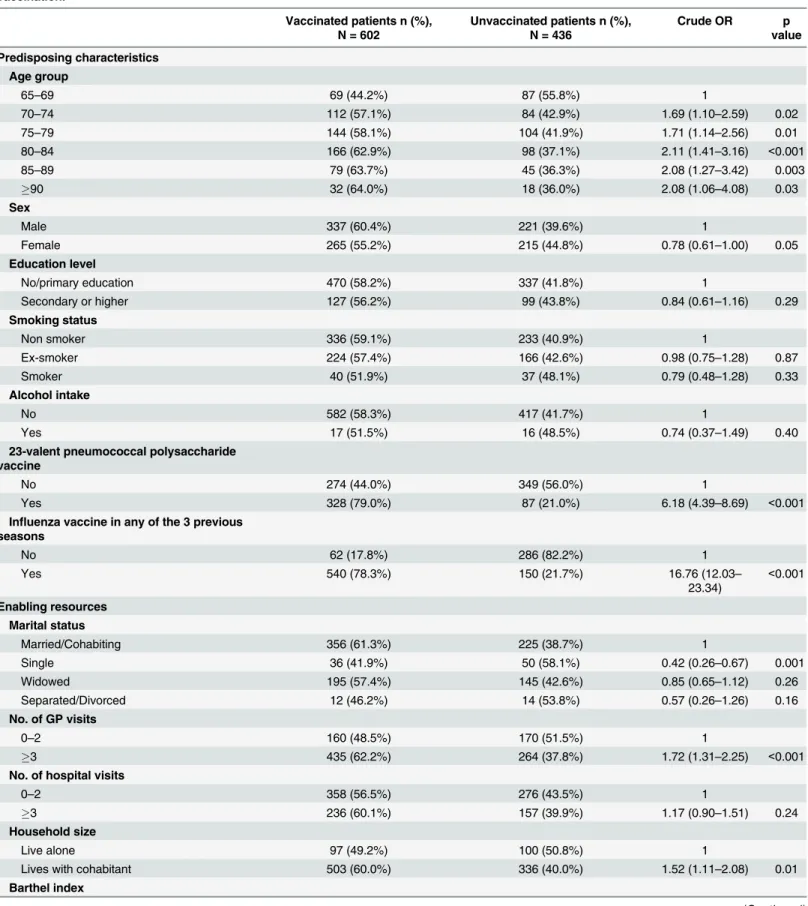
The distribution of the study variables (predisposing characteristics, enabling resources and
medical risk conditions) in vaccinated and unvaccinated patients is shown inTable 1.
Accord-ing to age, patients aged90 years had the highest vaccination coverage (64%), followed by the
85–89 years age group (63.7%), and the lowest coverage was observed in the 65–69 years age
group (44.2%). A history of influenza vaccination in any of the three previous seasons was
found in 78.3% of persons vaccinated during the 2013–14 season compared with only 21.7% in
unvaccinated patients. Single patients had lower vaccination rates than patients with partners
(41.9% and 61.3%, respectively). Patients who made3 GP visits in the previous year had
higher vaccination rates than those who did not (62.2% and 37.8%, respectively). Patients living at home in cohabitation had higher rates (60.0%) than those living alone (49.2%).
No differences were observed in vaccinated and unvaccinated patients with respect to
edu-cational level, sex, level of dependency or the presence of risk medical conditions.S1 Table
shows the distribution of risk medical conditions in vaccinated and unvaccinated patients.
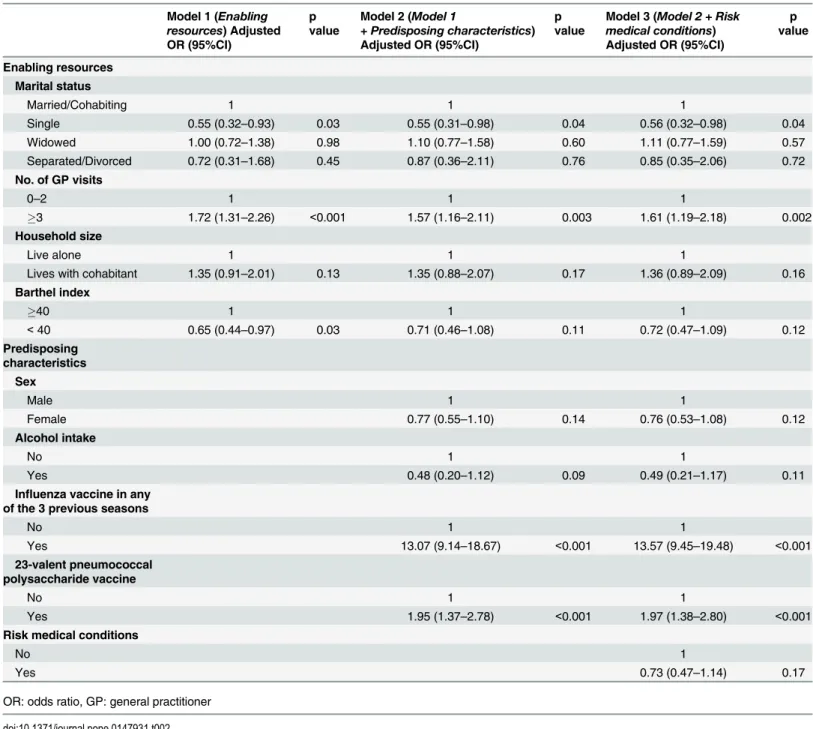
The results of the multilevel regression model are shown inTable 2. Variables related to
enabling resources (Model 1) significantly associated with vaccine uptake were being single
(OR = 0.55; 95% CI 0.32–0.93),3 GP visits in the previous year (OR = 1.72; 95% CI 1.31–
2.26) and a Barthel index<40 (OR = 0.65; 95% CI 0.44–0.97).
Predisposing characteristics (Model 2) associated with influenza vaccination in the 2013–14
season were influenza vaccination in any of the 3 previous seasons (OR = 13.07; 95% CI 9.14–
18.67) and 23-valent pneumococcal polysaccharide vaccination (OR = 1.95; 95% CI 1.37–2.78).
Single status and3 GP visits were also associated with influenza vaccination.
After the inclusion of risk medical conditions (Model 3), the variables associated were the
same as in model 2, with only very-slight increases in the values of the OR for3 GP visits
(OR = 1.61; 95% CI 1.19–2.18); for influenza vaccination in any of the 3 previous seasons
(OR = 13.57; 95% CI 9.45–19.48); and for previous vaccination with the 23-valent
pneumococ-cal polysaccharide vaccine (OR = 1.97; 95% CI 1.38–2.80).
Discussion
The results of this study show that influenza vaccination coverage in elderly hospitalized patients in Spain (58.0%) is clearly lower than the 75% target proposed by the World Health
Assembly for people aged65 years [16]. A Council’s recommendation of the Commission of
the European Community states that concerted action at the community level should be taken to contain seasonal influenza by encouraging vaccination among at-risk groups, with the pur-pose of reaching the target of 75% vaccination coverage of the older age groups recommended
by the WHO, as far as possible by 2015 [17]. This target was not reached, with the median
being 44.7% and only two member states achieving the target in the 2012–13 season: the
Neth-erlands and the United Kingdom [18].
The coverage obtained in this study is very close to that of other Spanish and international studies. In women in the same age group in Galicia, vaccination coverage between 2000 and
2004 was 56.8% [19]. In a more recent study in Navarra [20], the coverage in
Table 1. Distribution of vaccinated and non-vaccinated patients according to sociodemographic characteristics, clinical conditions and history of vaccination.
Vaccinated patients n (%), N = 602
Unvaccinated patients n (%), N = 436
Crude OR p
value
Predisposing characteristics
Age group
65–69 69 (44.2%) 87 (55.8%) 1
70–74 112 (57.1%) 84 (42.9%) 1.69 (1.10–2.59) 0.02
75–79 144 (58.1%) 104 (41.9%) 1.71 (1.14–2.56) 0.01
80–84 166 (62.9%) 98 (37.1%) 2.11 (1.41–3.16) <0.001
85–89 79 (63.7%) 45 (36.3%) 2.08 (1.27–3.42) 0.003
90 32 (64.0%) 18 (36.0%) 2.08 (1.06–4.08) 0.03
Sex
Male 337 (60.4%) 221 (39.6%) 1
Female 265 (55.2%) 215 (44.8%) 0.78 (0.61–1.00) 0.05
Education level
No/primary education 470 (58.2%) 337 (41.8%) 1
Secondary or higher 127 (56.2%) 99 (43.8%) 0.84 (0.61–1.16) 0.29
Smoking status
Non smoker 336 (59.1%) 233 (40.9%) 1
Ex-smoker 224 (57.4%) 166 (42.6%) 0.98 (0.75–1.28) 0.87
Smoker 40 (51.9%) 37 (48.1%) 0.79 (0.48–1.28) 0.33
Alcohol intake
No 582 (58.3%) 417 (41.7%) 1
Yes 17 (51.5%) 16 (48.5%) 0.74 (0.37–1.49) 0.40
23-valent pneumococcal polysaccharide vaccine
No 274 (44.0%) 349 (56.0%) 1
Yes 328 (79.0%) 87 (21.0%) 6.18 (4.39–8.69) <0.001
Influenza vaccine in any of the 3 previous seasons
No 62 (17.8%) 286 (82.2%) 1
Yes 540 (78.3%) 150 (21.7%) 16.76 (12.03–
23.34)
<0.001
Enabling resources
Marital status
Married/Cohabiting 356 (61.3%) 225 (38.7%) 1
Single 36 (41.9%) 50 (58.1%) 0.42 (0.26–0.67) 0.001
Widowed 195 (57.4%) 145 (42.6%) 0.85 (0.65–1.12) 0.26
Separated/Divorced 12 (46.2%) 14 (53.8%) 0.57 (0.26–1.26) 0.16
No. of GP visits
0–2 160 (48.5%) 170 (51.5%) 1
3 435 (62.2%) 264 (37.8%) 1.72 (1.31–2.25) <0.001
No. of hospital visits
0–2 358 (56.5%) 276 (43.5%) 1
3 236 (60.1%) 157 (39.9%) 1.17 (0.90–1.51) 0.24
Household size
Live alone 97 (49.2%) 100 (50.8%) 1
Lives with cohabitant 503 (60.0%) 336 (40.0%) 1.52 (1.11–2.08) 0.01
Barthel index
present study, the highest coverage was in the 85–89 years age group. In Israel [21], the
cover-age in persons cover-aged65 years in 2008–09 was 59.2%, and an increase was also observed in
older age groups.
Other authors have found higher coverages. In the United States in the 2013–14 influenza
season, the coverage was 64.7% in persons aged65 years [22]. The coverage was 73% in
2010–11 in patients aged>65 years seen by general practitioners included in the computerized
disease-surveillance system in France [23]. In many European countries, the vaccine coverage
in people aged>65 years is even lower than was found in our study [18,24].
In all the models in the present study, single marital status was associated with a lower
cov-erage and3 GP visits in the previous year with a higher coverage. Single marital status was
also associated with a lower coverage in an Italian study [14]. In an Irish study [25] widowed
persons had a lower coverage than married ones, but the Spanish study [19] found that older
married women had a significantly-higher probability of being vaccinated.
The association between vaccination coverage and the number of GP visits is in agreement
with other studies in Spain and other countries. [19,20,25–30]
Like most studies [14,22,25,27,30,31], no association was found between sex and influenza
vaccination coverage. However, studies in Spain and Israel have found higher coverages in
males [20,21,26]. We found no association between vaccination coverage and educational level,
in agreement with other authors [19,21,25,27,32].
An association between a higher Barthel index and vaccination coverage was found in model 1, but was not exhibited in models 2 and 3. There is contradictory evidence on the rela-tionship between influenza vaccination and the level of dependence. A Hong Kong study by
Lau et al [31] found that participants with a higher Barthel index were more likely to be
vacci-nated, but in the final multivariable logistic model no association was found. In contrast, a
study in Navarra found that a high level of dependence was associated with vaccination [20].
In models 2 and 3, we found a very close association between influenza vaccination in any of
the three previous seasons and influenza vaccination in 2013–14, in agreement with other studies
in Europe [20,23,27], Canada [29] and China [31]. Likewise, a history of pneumococcal
vaccina-tion was associated with influenza vaccinavaccina-tion. A US study [33] found that 95% of persons
vacci-nated against influenza had received the pneumococcal vaccine. In our study, the figure was 54.5%, but in models 2 and 3 this variable was associated with influenza vaccination. Two studies
in Canada [29,30] found that participants reporting having received influenza vaccination at
least once were significantly more likely to report having received the pneumococcal vaccine. We found no association between risk medical conditions and vaccination coverage, similar
to the results of a Brazilian study [32]. Lau et al [31] found that patients with more risk medical
conditions were less likely to be vaccinated, but other authors have found contrary results [14,20,23].
Table 1. (Continued)
Vaccinated patients n (%), N = 602
Unvaccinated patients n (%), N = 436
Crude OR p
value
40 537 (58.9%) 374 (41.1%) 1
<40 63 (50.4%) 62 (49.6%) 0.73 (0.50–1.07) 0.11
Risk medical conditions
No 69 (59.5%) 47 (40.5%) 1
Yes 533 (57.8%) 389 (42.2%) 0.95 (0.64–1.41) 0.80
OR: odds ratio, GP: general practitioner
The role of primary care physicians in promoting vaccination in the elderly has been
widely recognized [23,34,35]. In a recent Spanish study [36], influenza vaccination of patients
aged65 years was associated with their physicians having favourable opinions about
vacci-nation. Therefore, the promotion of vaccination of primary care physicians by improving their opinions and attitudes about influenza vaccination and taking into account scientific
evidence may have a beneficial effect on coverages in their patients. Some authors [37,38]
have pointed out that healthier persons are more likely to receive the vaccine than less-healthy subjects (health vaccine bias) and if observational studies do not control adequately Table 2. Results of multilevel regression for estimated of factors associated with influenza vaccine.
Model 1 (Enabling resources) Adjusted OR (95%CI)
p value
Model 2 (Model 1
+ Predisposing characteristics) Adjusted OR (95%CI)
p value
Model 3 (Model 2 + Risk medical conditions) Adjusted OR (95%CI)
p value
Enabling resources
Marital status
Married/Cohabiting 1 1 1
Single 0.55 (0.32–0.93) 0.03 0.55 (0.31–0.98) 0.04 0.56 (0.32–0.98) 0.04
Widowed 1.00 (0.72–1.38) 0.98 1.10 (0.77–1.58) 0.60 1.11 (0.77–1.59) 0.57
Separated/Divorced 0.72 (0.31–1.68) 0.45 0.87 (0.36–2.11) 0.76 0.85 (0.35–2.06) 0.72 No. of GP visits
0–2 1 1 1
3 1.72 (1.31–2.26) <0.001 1.57 (1.16–2.11) 0.003 1.61 (1.19–2.18) 0.002
Household size
Live alone 1 1 1
Lives with cohabitant 1.35 (0.91–2.01) 0.13 1.35 (0.88–2.07) 0.17 1.36 (0.89–2.09) 0.16 Barthel index
40 1 1 1
<40 0.65 (0.44–0.97) 0.03 0.71 (0.46–1.08) 0.11 0.72 (0.47–1.09) 0.12
Predisposing characteristics
Sex
Male 1 1
Female 0.77 (0.55–1.10) 0.14 0.76 (0.53–1.08) 0.12
Alcohol intake
No 1 1
Yes 0.48 (0.20–1.12) 0.09 0.49 (0.21–1.17) 0.11
Influenza vaccine in any of the 3 previous seasons
No 1 1
Yes 13.07 (9.14–18.67) <0.001 13.57 (9.45–19.48) <0.001
23-valent pneumococcal polysaccharide vaccine
No 1 1
Yes 1.95 (1.37–2.78) <0.001 1.97 (1.38–2.80) <0.001
Risk medical conditions
No 1
Yes 0.73 (0.47–1.14) 0.17
OR: odds ratio, GP: general practitioner
for those differences, the benefits of influenza vaccination might be exaggerated. One way to
avoid this kind of bias, could be the design of appropriately-powered RCTs [30,39]. However,
RCT are unacceptable among groups already advised to receive the vaccine annually [2] and
observational studies using bias-reducing methods likely represent the only possible option
to assess the effectiveness of the influenza vaccine in the elderly [40]. In a study carried out
during 10 seasons with no evidence of a healthy-vaccine bias, the effectiveness of the vaccine
against hospitalization was demonstrated [4]. A review of 75 studies in the elderly (only one
RCT, with the rest being cohort and case-control studies) concluded that the public health safety profile of the vaccine appears to be acceptable, but the low quality of the available evi-dence precluded clear conclusions being reached on the effects of the vaccine in the elderly
[41]. Osterholm et al. stated that evidence of protection for the present generation of
influ-enza vaccines in adults aged65 years is lacking and that new vaccines based on novel
anti-gens are needed; however the authors agreed that, in the meantime, public support for present vaccines are the best intervention available for seasonal influenza and should be
maintained [42].
The World Health Organization (WHO), after considering that the available evidence
sug-gests that influenza vaccines are less effective in people aged65 years than in young adults,
states that vaccination is still the most efficacious public health tool for the protection of elderly individuals against influenza and encourages its use in elderly persons because they have the
highest risk of mortality from the complications of influenza [43].
Advertising, provider and patient mailing, registry-based telephone calls and patient
educa-tion could also increase vaccinaeduca-tion rates [44].
This study, like all observational studies has strengths and limitations. The main strength is that the vaccination status was obtained from written documents (hospital medical records, vaccination cards or primary healthcare registers) and, therefore, it is unlikely that this
infor-mation was biased. With the exception of two studies [20,30], in all the other studies cited
information on vaccination was obtained directly from the patient or physician. Another strength is that only patients with unplanned hospital admission were included. These patients enter for a variety of reasons and tend to be more representative of the general popu-lation. A possible limitation might be that we excluded patients admitted to hospital for respi-ratory disease, pneumonia or influenza-like illness. Patients hospitalized due to these diseases had probably received the influenza vaccine less frequently than the overall population of elderly people.
Another limitation is that other, unaccounted-for factors might explain some of the rela-tionships observed. In the multilevel regression analysis we took into account several variables that were not included in the final models. Therefore, the associations that were found in these final models might be considered in future strategies to improve influenza vaccination cover-ages in the elderly. Another possible limitation is that no standard definitions of predisposing characteristics or enabling resources are available. We followed criteria similar to those used by
other authors [12–14] and, therefore the comparison may be considered valid. Finally, because
this is a cross-sectional study, no causal relationship can be established. However, the study identified some variables that are associated with vaccination coverage in hospitalized patients and could help improve vaccination strategies in the elderly.
In conclusion, the results of this study show that influenza vaccination coverages in elderly hospitalized patients are low in Spain and should be increased. Some predisposing characteris-tics were associated with a higher influenza vaccination coverage. Healthcare workers should take these characteristics into account and be encouraged to proactively propose influenza
Supporting Information
S1 Table. Distribution of vaccinated and non-vaccinated patients according to risk medical conditions.
(DOCX)
Acknowledgments
The other members of the Project PI12/02079 Working Group are:J. Díaz-Borrego (Servicio Andaluz de Salud), A. Morillo (Hospital Universitario Virgen del Rocío), M.J. Pérez-Lozano (Hospital Universitario Virgen de Valme), J. Gutiérrez (Hospital Universitario Puerta del Mar), M. Pérez-Ruiz, M.A. Fernández-Sierra (Hospital Universitario San Cecilio y Virgen de las Nieves), S. Rojo-Rello, R. Ortiz de Lejarazu (Hospital Clínico Universitario de Valladolid), M.I. Fernández-Natal (Complejo Asistencial Universitario de León), T. Fernández-Villa (GII-GAS-Grupo de Investigación en Interacción Gen-Ambiente y Salud, Universidad de León), A. Pueyo (Hospital Universitario de Burgos), A. Vilella (Hospital Clínic), A. Antón (Hospital
Uni-versitari Vall d’Hebron; Universitat Autónoma de Barcelona), G. Navarro (Corporació
Sani-tària i Universitaria Parc Taulí), M. Riera (Hospital Universitari Mútua Terrassa), E. Espejo (Hospital de Terrassa), M.D. Mas, R. Pérez (ALTHAIA, Xarxa Hospitalaria de Manresa), J.A. Cayla, C. Rius (Agència de Salut Pública de Barcelona; CIBERESP), N. Torner (Agència de Salut Pública de Catalunya; Universitat de Barcelona; CIBERESP), I. Crespo (CIBERESP, Uni-versitat de Barcelona), C. Izquierdo, R. Torra (Agència de Salut Pública de Catalunya), M.F. Domínguez-Berjon, M.A. Gutiérrez, S. Jiménez, E. Gil, F. Martín, R. Génova-Maleras (Conse-jería de Sanidad), M.C. Prados, F. Ezzine de Blas (Hospital Universitario la Paz), J.C. Galan, E. Navas, L. Rodríguez (Hospital Ramon y Cajal), C.J. Álvarez, E. Banderas (Hospital Universi-tario 12 de Octubre), J. Chamorro (Complejo Hospitalario de Navarra), I. Casado, J. Díaz (Instituto de Salud Pública de Navarra), M.J. López de Goicoechea (Hospital de Galdakao), F. Sanz (Consorci Hospital General Universitari de Valencia).
Author Contributions
Conceived and designed the experiments: AD NS DT PG JC LF MM JMM ME ST VM JA. Per-formed the experiments: JMM ME ST VM MM JA. Analyzed the data: AD NS DT. Wrote the paper: AD PG JC LF. Contributed to patient recruitment, data collection and interpretation of the results and editing the manuscript: Other members of the Working Group of the Project PI12/02079.
References
1. Treanor JJ. Influenza (including avian influenza and swine influenza). In: Bennet JE, Dolin R, Blaser MJ, editors. Principles and Practice of Infectious Diseases. 8th ed. Philadelphia: Elsevier; 2015. pp 2000–2029.
2. Fiore AE, Bridges CB, Katz JM, Cox NJ. Inactivated influenza vaccines. In: Plotkin SA, Orenstein WA, Offit PA, editors. Vaccines, 6th ed. Philadelphia: Elsevier; 2013. pp 257–293.
3. Nordin J, Mullooly J, Poblete S, Strikas R, Petrucci R, Wei F, et al. Influenza vaccine effectiveness in preventing hospitalizations and deaths in persons 65 years or older in Minnesota, New York, and Ore-gon: data from 3 health plans. J Infect Dis.2001; 184: 665–670. PMID:11517426
4. Nichol KL, Nordin JD, Nelson DB, Mullooly JP, Hak E. Effectiveness of influenza vaccine in the commu-nity-dwelling elderly. N Engl J Med.2007; 357: 1373–1381. PMID:17914038
6. Cruzeta APS, Schneider IJC, Traebert J. Impact of seasonality and annual immunization of elderly peo-ple upon influenza-related hospitalization rates. Int J Infect Dis.2013; 17:e1194–7. doi:10.1016/j.ijid. 2013.07.013PMID:24084246
7. World Health Organization. Strategy and action plan for healthy ageing in Europe, 2012–2020. World Health Organization Regional Office for Europe, 2012.
8. Nagata JM, Hernández-Ramos I, Kurup AS, Albrecht D, Vivas-Torrealba C, Franco-Paredes C. Social determinants of health and seasonal influenza vaccination in adults65 years: a systematic review of qualitative and quantitative data. BMC Public Health. 2013; 13:388. doi:10.1186/1471-2458-13-388 PMID:23617788
9. INE. Revision of the Municipal Register 2013. Available:http://www.ine.es/jaxi/menu.do?type = pcaxis&file = pcaxis&path=%2Ft20%2Fe245%2Fp04%2F%2Fa2013&L=1. Accessed 17 April 2015. 10. Gil de Miguel A, López de Andrés A, Carrasco Garrido P, Jiménez García R. La salud de las personas
mayores. In: Sierra A, Sáenz MC, Fernández-Crehuet J, et al, editors. Medicina Preventiva y Salud Pública, 11th ed. Barcelona: Elsevier; 2008. pp 992–1003.
11. INE. Population and housing Census 2011. Population resident in group establishments. Available: http://www.ine.es/jaxi/menu.do?type = pcaxis&path=/t20/e244/colectivos/p02/&file = pcaxis&L=1. Accessed 13 May 2015.
12. Andersen RM. Revisiting the behavioral model and access to medical care: does it matter? J Health Soc Behav. 1995; 36: 1–10. PMID:7738325
13. Andersen R, Newman JF. Societal and Individual Determinants of Medical Care Utilization in the United States. The Milbank Quarterly. 2005; 83(4):doi:10.1111/j.1468-0009.2005.00428.x
14. Chiatti C, Barbadoro P, Lamura G, Pennacchietti L, Di Stanislao F, D'Errico MM, et al. Influenza vaccine uptake among community-dwelling Italian elderly: results from a large cross-sectional study. BMC Pub-lic Health. 2011; 11: 207. doi:10.1186/1471-2458-11-207PMID:21457562
15. Katz MH. Multivariable analysis. 3rd ed. Cambridge: Cambridge University Press; 2011. pp 197–201. 16. Fifty-sixth World Health Assembly. Prevention and control of influenza pandemics and annual epidem-ics. WHO, 2003. Available:http://apps.who.int/gb/archive/pdf_files/WHA56/ea56r19.pdf. Accessed 8 May 2015.
17. The Council of the European Union. Council recommendation on seasonal influenza vaccination. Avail-able:http://ec.europa.eu/health/ph_threats/com/Influenza/docs/seasonflu_rec2009_en.pdf. Accessed 8 May 2015.
18. European Centre for Disease Prevention and Control. Seasonal influenza vaccination in Europe. Over-view of vaccination recommendations and coverage rates in the EU Member States for the 2012–13 influenza season. Stockholm: ECDC, 2015.
19. Peña-Rey I, Pérez-Farinós N, Sarría-Santamera A. Factors associated with influenza vaccination among elderly Spanish women. Public Health. 2004; 118: 582–587. PMID:15530939
20. Aguilar I, Reyes M, Martinez- Baz I, Guevara M, Albeniz E, Belza M, et al. Use of the vaccination regis-ter to evaluate influenza vaccine coverage in seniors in the 2010/11 influenza season, Navarre, Spain. Euro Surveill. 2012; 17: 20154. PMID:22551499
21. Schwartz AW, Clarfield AM, Doucete JT, Valinsky L, Karpati T, Landrigan PJ, et al. Disparities in pneu-mococcal and influenza immunization among older adults in Israel: a cross-sectional analysis of socio-demographic barriers to vaccination. Prev Med. 2013; 56: 337–340. doi:10.1016/j.ypmed.2013.01.019 PMID:23402962
22. Reed C, Kim IK, Singleton JA, Chaves SS, Flannery B, Finelli L, et al. Estimated influenza illnesses and hospitalizations averted by vaccination—United States, 2013–14 influenza season. MMWR. 2014; 63: 1151–1154. PMID:25503917
23. Privileggio L, Falchi A, Grisoni ML, Souty C, Turbelin C, Fonteneau L, et al. Rates of immunization against pandemic and seasonal influenza in persons at high risk of severe influenza illness: a cross-sectional study among patients of the French Sentinelles general practitioners. BMC Public Health. 2013; 13: 246. doi:10.1186/1471-2458-13-246PMID:23514534
24. Blank PR, Freiburghaus AU, Schwenkglenks MM, Szucs TD, Kunze U. Influenza vaccination coverage rates in Austria in 2006/07—a representative cross-sectional telephone survey. Wien Med
Wochenschr. 2008; 158: 583–588. doi:10.1007/s10354-008-0582-3PMID:18998078
25. Crawford VLS, O’Hanlon A, McGee H. The effect of patient characteristics upon uptake of the influenza vaccination: a study comparing community-based older adults in two healthcare systems. Age Ageing. 2011; 40: 35–41. doi:10.1093/ageing/afq152PMID:21148323
27. Böhmer MM, Walter D, Müters S, Krause G, Wichmann O. Seasonal influenza vaccine uptake in Ger-many 2007/2008 and 2008/2009: results from a national health update survey. Vaccine. 2011; 29: 4492–4498. doi:10.1016/j.vaccine.2011.04.039PMID:21545822
28. Endrich MM, Blank PR, Szucs TD. Influenza vaccination uptake and socioeconomic determinants in 11 European countries. Vaccine. 2009; 27: 4018–4024. doi:10.1016/j.vaccine.2009.04.029PMID: 19389442
29. Al-Sukhni W, Avarino P, McArthur MA, McGeer A. Impact of public vaccination programs on adult vac-cination rates: two examples from Ontario, Canada. Vaccine. 2008; 26: 1432–1437. doi:10.1016/j. vaccine.2008.01.001PMID:18272261
30. Hottes TS, Skowronski DM, Hiebert B, Janjua NZ, Roos LL, Van Caeseele P, et al. Influenza vaccine effectiveness in the elderly based on administrative databases: change in immunization habit as a marker for bias. Plos One. 2011; 6:e22618. doi:10.1371/journal.pone.0022618PMID:21818350
31. Lau L, Lau Y, Lau YH. Prevalence and correlates of influenza vaccination among non-institutionalized elderly people: an exploratory cross-sectional survey. Int J Nurs Stud. 2009; 46: 768–777. doi:10.1016/ j.ijnurstu.2008.12.006PMID:19162264
32. Campos EC, Sudan LCP, de Mattos ED, Fidelis R. Factors associated with influenza vaccination among the elderly: a cross-sectional study in Cambé, Paraná State, Brazil. Cad Saude Publica. 2012; 28: 878–888. PMID:22641511
33. Jackson ML, Nelson JC, Weiss NS, Neuzil KM, Barlow W, Jackson LA. Influenza vaccination and risk of community-acquired pneumonia in immunocompetent elderly people: a population-based, nested case-control study. Lancet. 2008; 372: 398–405. doi:10.1016/S0140-6736(08)61160-5PMID: 18675690
34. Blank PR, Schwenkglenks M, Szucs TD. Disparities in influenza vaccination coverage rates by target group in five European countries: trends over seven consecutive seasons. Infection. 2009; 37: 390– 400. doi:10.1007/s15010-009-8467-yPMID:19768382
35. Kroneman M, van Essen GA, Paget WJ. Influenza vaccination coverage and reasons to refrain among high-risk persons in four European countries. Vaccine. 2006; 24: 622–628. PMID:16169638
36. Godoy P, Castilla J, Mayoral JM, Martín V, Astray J, Torner N, et al. Influenza vaccination of primary healthcare physicians may be associated with vaccination of their patients: a vaccination coverage study. BMC Fam Pract. 2015; 16: 44. doi:10.1186/s12875-015-0259-0PMID:25880501
37. Simonsen L, Taylor RJ, Viboud C, Miller MA, Jackson LA. Mortality benefits of influenza vaccination in elderly people: an ongoing controversy. Lancet Infect Dis. 2007; 7: 658–666. PMID:17897608
38. Baxter R, Lee J, Fireman B. Evidence of bias in studies of influenza vaccine effectiveness in elderly patients. J Infect Dis. 2010; 201: 186–189. doi:10.1086/649568PMID:19995265
39. Thomas RE. Are influenza-associated morbidity and mortality estimates for those65 in statistical databases accurate, and an appropriate test of influenza vaccine effectiveness? Vaccine. 2014; 32: 6884–6901. doi:10.1016/j.vaccine.2014.08.090PMID:25454864
40. Ridenhour BJ, Campitelli MA, Kwong JC, Rosella LC, Armstrong BG, Mangtani P, et al. Effectiveness of inactivated influenza vaccines in preventing influenza-associated deaths and hospitalizations among Ontario residents aged65 years: estimates with generalized linear models accounting for healthy vaccinee effects. PLoS One. 2013; 8: e76318. doi:10.1371/journal.pone.0076318PMID:24146855
41. Jefferson T, Di Pietrantonj C, Al-Ansary LA, Ferroni E, Thorning S, Thomas RE. Vaccines for preventing influenza in the elderly (Review). Cochrane Databases Syst Rev. 2010; 17: CD004876.
42. Osterholm MT, Kelley NS, Sommer A, Belongia EA. Efficacy and effectiveness of influenza vaccines: a systematic review and meta-analysis. Lancet Infect Dis. 2012; 12: 36–44. doi:10.1016/S1473-3099 (11)70295-XPMID:22032844
43. WHO. Vaccines against influenza WHO position paper- November 2012. Wkly Epidemiol Rec. 2012; 87: 461–476. PMID:23210147