Clinical presentation and time-course of postoperative venous
thromboembolism: Results from the RIETE Registry
Juan Ignacio Arcelus1, Manuel Monreal2, Joseph A. Caprini3, Javier Gutiérrez Guisado4, Mª José Soto5, Manuel Jesús Núñez6, Juan Carlos Alvárez7, and the RIETE investigators
1Departamento de Cirugía de la Universidad de Granada y Hospital Virgen de las Nieves, Granada, Spain;2Servicio de Medicina Interna,
Hospital Universitari Germans Trias i Pujol, Badalona, Spain;3Department of Surgery, Evanston Northwestern Healthcare, Evanston, Illinois,
USA;4Servicio de Medicina Interna, Hospital Asepeyo Coslada, Madrid, Spain;5Servicio de Medicina Interna, Hospital Universitario Puerta del
Mar, Cádiz, Spain;6Servicio de Medicina Interna, Hospital Comarcal de Salnés, Pontevedra, Spain;7Servicio de Medicina Interna, Hospital
Virgen de Macarena, Sevilla, Spain; and the RIETE Investigators*
Summary
There is little literature about the clinical presentation and time-course of postoperative venous thromboembolism (VTE) in dif-ferent surgical procedures.RIETE is an ongoing,prospective reg-istry of consecutive patients with objectively confirmed, symp-tomatic acuteVTE.In this analysis,we analysed the baseline char-acteristics, thromboprophylaxis and therapeutic patterns, time-course,and three-month outcome of all patients with postoper-ative VTE. As of January 2006, there were 1,602 patients with postoperativeVTE in RIETE:393 (25%) after major orthopaedic surgery (145 elective hip arthroplasty, 126 knee arthroplasty, 122 hip fracture); 207 (13%) after cancer surgery; 1,002 (63%) after other procedures.The percentage of patients presenting with clinically overt pulmonary embolism (PE) (48%, 48%, and 50% respectively),the average time elapsed from surgery toVTE (22 ± 16,24 ± 16,and 21 ± 15 days,respectively),and the
three-Keywords
Venous thromboembolism, surgery
month incidence of fatal PE (1.3%, 1.4%, and 0.8%, respectively), fatal bleeding (0.8%, 1.0%, and 0.2%, respectively), or major bleeding (2.3%, 2.9%, and 2.8%, respectively) were similar in the three groups. However, the percentage of patients who had re-ceived thromboprophylaxis (96%, 76% and 52%, respectively), the duration of prophylaxis (17 ± 9.6,13 ± 8.9,and 12 ± 11 days, respectively) and the mean daily doses of low-molecular-weight heparin (4,252 ± 1,016, 3,260 ± 1,141, and 3,769 ± 1,650 IU, re-spectively), were significantly lower in those undergoing cancer surgery or other procedures. In conclusion, the clinical presen-tation,time-course,and three-month outcome ofVTE was simi-lar among the different subgroups of patients,but the use of phylaxis in patients undergoing cancer surgery or other pro-cedures was suboptimal.
Thromb Haemost 2008; 99: 546–551
Blood Coagulation, Fibrinolysis and Cellular Haemostasis
Correspondence to:
Manuel Monreal, MD, PhD, Prof. of Medicine Servicio de Medicina Interna
Hospital Universitari Germans Trias i Pujol 08916 Badalona (Barcelona), Spain
Tel.: +34 934651200 (ext 3322) Fax: +34 934978843 E-mail: [email protected]
*A full list of RIETE investigators is given in the Appendix. Received October 15, 2007 Accepted after major revision December 16, 2007
Prepublished online February 14, 2008 doi:10.1160/TH07-10-0611
Introduction
Venous thromboembolism (VTE) is a common complication in patients undergoing surgery (1). However, there is little informa-tion on the clinical presentainforma-tion, time-course and outcome of symptomatic postoperativeVTE. Most of what we know is based either on studies performed more than 20 years ago (2–4), on studies limited to patients undergoing major joint surgery (5–12), or on the findings of intervention prospective clinical trials on thromboprophylaxis that used objective diagnostic tests
to detectVTE before clinical signs had developed.There have no been comprehensive studies that have compared the clinical presentation and time-course of symptomatic VTE over a spec-trum of different surgical procedures.
patterns, time-course, VTE characteristics and three-month out-come of all patients who developed symptomatic postoperative deep vein thrombosis (DVT) or pulmonary embolism (PE).
Patients and methods
Patient entry criteria
Participating hospitals in the RIETE registry prospectively en-rolled consecutive patients with symptomatic, acute DVT or PE confirmed by objective tests (i.e. compression ultrasonography, contrast venography, or computed tomography [CT] scan, for suspected DVT; helical CT scan, lung scintigraphy or pulmonary angiography, for suspected PE). All patients provided oral con-sent to their participation in the registry, according to the require-ments of the ethics committee within each hospital.
Clinical definitions
Surgical patients were defined as those who had undergone an operation in the two months prior to VTE diagnosis. Proximal DVT was considered when occurring at the popliteal vein or above. In patients with acute respiratory symptoms suggesting PE the diagnosis was confirmed if they also had a positive heli-cal CT scan, a high-probability ventilation-perfusion lung scinti-graphy, a positive pulmonary angioscinti-graphy, visualization of thrombus on echocardiogram, or indeterminate-probability lung scan plus evidence of DVT in the lower limbs (by either compres-sion ultrasonograpy or contrast venography). Fatal PE, in the ab-sence of autopsy, was defined as death shortly after PE diag-nosis, in the absence of any alternative cause of death. Fatal bleeding was defined as any death occurring shortly after a major bleeding episode. Bleeding complications were classified as Major orthopaedic
surgery Cancer surgery Other surgicalprocedures OR (95% CI)orthopedic vs. cancer OR (95% CI)orthopedic vs. other
Patients (n) 393 207 1002
VTE during the first 7 days 010 (2.5%) 004 (1.9%) 0020 (2.0%) 1.3 (0.4–4.9) 1.3 (0.6–2.7) VTE during the first 15 days 184 (47%) 085 (41%) 0453 (45%) 1.3 (0.9–1.8) 1.1 (0.8–1.3) VTE during the first month 279 (71%) 137 (66%) 0759 (76%) 1.2 (0.9–1.8) 0.8 (0.6–1.0)*
VTE characteristics
Symptomatic PE 187 (48%) 102 (49%) 0498 (50%) 0.9 (0.7–1.3) 0.9 (0.7–1.2)
For patients with PE
Heart rate <100 bpm 043 (24%) 033 (33%) 0144 (30%) 0.6 (0.4–1.1) 0.7 (0.5–1.1) SBP <100 mm Hg 014 (7.5%) 009 (8.8%) 0038 (7.6%) 0.8 (0.3–2.0) 1.0 (0.5–1.9) PO2<60 mm Hg(N=609) 066 (45%) 034 (43%) 0130 (34%) 1.1 (0.6–1.9) 1.6 (1.1–2.4)*
Sat O2<90% (N=613) 041 (28%) 024 (29%) 0090 (23%) 1.0 (0.5–1.7) 1.3 (0.8–2.0)
For patients with DVT
Bilateral DVT 006 (2.9%) 008 (7.7%) 0020 (4.0%) 0.4 (0.1–1.1) 0.7 (0.3–1.8)
Proximal DVT 145 (71%) 066 (84%) 0351 (76%) 0.5 (0.2–0.9)* 0.8 (0.5–1.1)
Comparisons between groups: *p <0.05 ;†p <0.01;‡p <0.001.Abbreviations:VTE, venous thromboembolism; PE, pulmonary embolism; DVT, deep vein thrombosis; SD, standard deviation; bpm, beats per minute; SBP, systolic blood pressure; OR, odds ratio; CI, confidence intervals; N/A, not applicable. Major orthopaedic surgery: hip fracture repair, hip arthroplasty, knee arthroplasty.
Clinical characteristics
Gender (males) 109 (28%) 118 (57%) 0500 (50%) 0.3 (0.2–0.4)‡ 0.4 (0.3–0.5)‡
Age >65 years 329 (84%) 126 (61%) 0453 (45%) 3.3 (2.2–4.9)‡ 6.2 (4.6–8.4)‡
Body weight <70 kg 157 (40%) 089 (43%) 0350 (35%) 0.8 (0.6–1.2) 1.2 (0.97–1.6)
Underlying diseases
Creatinine levels >1.2 mg/dl 032 (8.1%) 020 (9.7%) 0072 (7.2%) 0.8 (0.5–1.5) 1.1 (0.7–1.8)
Risk factors for VTE
Cancer 021 (5.3%) 207 (100%) 0162 (16%) N/A 0.3 (0.2–0.5)‡
PriorVTE 029 (7.4%) 021 (10%) 0098 (9.8%) 0.7 (0.4–1.3) 0.7 (0.5–1.1)
Time-course
Time toVTE (days ± SD) 022 ± 16 024 ± 16 0021 ± 15 p=NS p=NS
Chronic lung disease 033 (8.4%) 012 (5.8%) 0072 (7.2%) 1.5 (0.8–3.0) 1.2 (0.8–1.8) Chronic heart failure 025 (6.4%) 004 (1.9%) 0033 (3.3%) 3.4 (1.2–10)* 2.0 (1.2–3.4)†
‘major’if they were overt and required a transfusion of two units of blood or more, or were retroperitoneal, spinal or intracranial.
Variables
The parameters recorded by the registry include details of each patient's baseline characteristics; type and date of surgery; clini-cal status including any coexisting or underlying conditions such as chronic heart or lung disease; creatinine levels; thrombopro-phylaxis received prior to VTE diagnosis and its duration; and the clinical characteristics of the VTE event. Patients received prophylaxis according to the clinical practice of each participat-ing hospital and were not subject to any predetermined interven-tion. Data regarding prior VTE prophylaxis were obtained from medical records.
Follow-up
All patients were followed for at least three months after hospital discharge. During each visit, any signs or symptoms suggesting
recurrences of DVT or PE, or bleeding complications were noted. Each episode of clinically suspected recurrent DVT or PE was documented by repeat compression ultrasonography, ve-nography, lung scanning, helical CT scan, or pulmonary angi-ography. Only objectively confirmed recurrent events are ac-cepted. The causes of death were determined by the attending physicians.
Data collection
Data are recorded on to a computer-based case report form by a registry coordinator at each participating hospital and submitted to a centralized coordinating center through a secure website. The coordinators also ensure that eligible patients are consecu-tively enrolled. Patient identities remain confidential because they are identified by a unique number assigned by the study co-ordinating center, which is responsible for all data management. Study endpoints are adjudicated by the attending physicians, but in case of doubt they address the case report to the Adjudication Figure 1: Cumulative number of patients withVTE after surgery, according to their clinical presentation.VTE, venous thromboembol-ism; DVT, deep vein thrombosis; PE, pulmonary embolism.
Committee of the RIETE Registry. Data quality is monitored and documented electronically to detect inconsistencies or errors, which are resolved by the local coordinators. Data quality is also monitored by periodic visits to participating hospitals, by contract research organizations, who compare the medical rec-ords with the data in the web, as in the case of most clinical trials. In the event of substantial or unjustifiable inconsistencies, pa-tients enrolled from that center are not included in the database.
Statistical analysis
A commercial software package (SPSS version 12.0) was used to calculate odds ratios (ORs) and corresponding 95% confidence intervals (CIs), and a p-value <0.05 was considered to be statis-tically significant. Cox proportional hazards analysis was used to estimate the time-course of VTE after surgery.
Results
As of January 2006, 13,599 consecutive patients with sympto-matic, acute VTE were enrolled at 124 participating centers. Of these, 1,602 (12%) were postoperative. The most common types of surgery were: hip fracture repair in 122 patients; hip
arth-roplasty 145; knee artharth-roplasty 126; other orthopaedic 191; cancer surgery 207; abdominopelvic for conditions other than cancer 397; neurosurgery 123; vascular 99; other 192.
Clinical presentation
Patients with VTE after major orthopaedic surgery (i.e. hip frac-ture or total hip or knee arthroplasty) were more commonly fe-male, significantly older, and had more often chronic heart fail-ure but less frequently cancer than those undergoing cancer sur-gery or other surgical procedures (Table 1).There were no differ-ences between groups in the mean time elapsed from surgery to VTE (22 ± 16, 24 ± 16, and 21 ± 15 days, respectively), or the percentage of patients who developed VTE during the first 15 days after surgery (47%, 41% and 45%, respectively) was also similar. As for the clinical presentation of VTE, there were no differences in the percentage of patients with clinically overt PE (48%, 48%, and 50% respectively), or in the severity of the PE (expressed in terms of tachycardia, hypotension or hypoxemia). Among those with only DVT signs, patients undergoing cancer surgery had more often proximal DVT. However, clinically overt PE appeared significantly earlier (20 ± 15 vs. 24 ± 16 days; p<0.001) than proximal DVT, as shown in Figure 1.
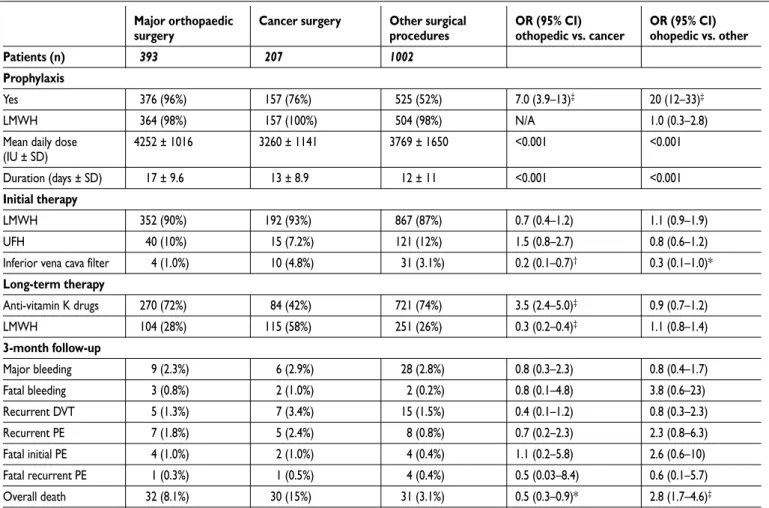
Table 2: Prophylaxis data, treatment options and three-month outcome in the 1,602 postoperative patients withVTE, according to the type of surgery.
Major orthopaedic
surgery Cancer surgery Other surgicalprocedures OR (95% CI)othopedic vs. cancer OR (95% CI)ohopedic vs. other
Patients (n) 0393 0207 1002
Recurrent DVT 0005 (1.3%) 0007 (3.4%) 0015 (1.5%) 0.4 (0.1–1.2) 0.8 (0.3–2.3) Recurrent PE 0007 (1.8%) 0005 (2.4%) 0008 (0.8%) 0.7 (0.2–2.3) 2.3 (0.8–6.3) Fatal initial PE 0004 (1.0%) 0002 (1.0%) 0004 (0.4%) 1.1 (0.2–5.8) 2.6 (0.6–10) Fatal recurrent PE 0001 (0.3%) 0001 (0.5%) 0004 (0.4%) 0.5 (0.03–8.4) 0.6 (0.1–5.7) Overall death 0032 (8.1%) 0030 (15%) 0031 (3.1%) 0.5 (0.3–0.9)* 2.8 (1.7–4.6)‡
Comparisons between groups: *p <0.05 ;†p <0.01;‡p <0.001.Abbreviations:VTE, venous thromboembolism; PE, pulmonary embolism; DVT, deep vein thrombosis; SD, standard deviation; LMWH, low-molecular-weight heparin; UFH, unfractionated heparin; OR, odds ratio; CI, confidence intervals. Major orthopaedic surgery: hip fracture repair, hip arthroplasty, knee arthroplasty.
Prophylaxis
Yes 0376 (96%) 0157 (76%) 0525 (52%) 7.0 (3.9–13)‡ 20 (12–33)‡
LMWH 0364 (98%) 0157 (100%) 0504 (98%) N/A 1.0 (0.3–2.8)
Mean daily dose
(IU ± SD) 4252 ± 1016 3260 ± 1141 3769 ± 1650 <0.001 <0.001
Duration (days ± SD) 0017 ± 9.6 0013 ± 8.9 0012 ± 11 <0.001 <0.001 Initial therapy
LMWH 0352 (90%) 0192 (93%) 0867 (87%) 0.7 (0.4–1.2) 1.1 (0.9–1.9)
UFH 0040 (10%) 0015 (7.2%) 0121 (12%) 1.5 (0.8–2.7) 0.8 (0.6–1.2)
Inferior vena cava filter 0004 (1.0%) 0010 (4.8%) 0031 (3.1%) 0.2 (0.1–0.7)† 0.3 (0.1–1.0)*
Long-term therapy
Anti-vitamin K drugs 0270 (72%) 0084 (42%) 0721 (74%) 3.5 (2.4–5.0)‡ 0.9 (0.7–1.2)
LMWH 0104 (28%) 0115 (58%) 0251 (26%) 0.3 (0.2–0.4)‡ 1.1 (0.8–1.4)
3-month follow-up
Prophylaxis and therapy
Thromboprophylaxis was used in 1,058 (66%) patients, with a significantly higher use in those undergoing major orthopaedic surgery (96%) than in those undergoing cancer surgery (76%), or other procedures (52%), as shown in Table 2. The vast majority (97%) of patients with prophylaxis received low-molecular-weight heparin (LMWH). In 1,014 of the 1,058 patients (96%) who received prophylaxis there was information on its duration: those undergoing major orthopaedic surgery had received higher daily doses of LMWH and for longer than those in the other two groups. Overall, 478 (47%) patients had their VTE event diag-nosed during prophylaxis, 536 (53%) after withdrawal. We have no data on mechanical prophylaxis. As for the use of anticoagu-lant therapy, most patients received LMWH as initial therapy, and then switched to long-term therapy with anti-vitamin K drugs, with the exception of cancer patients (who mostly receiv-ed LMWH as long-term therapy).
Three-month outcome
There were no significant differences between groups in the inci-dence of recurrent VTE, major bleeding, fatal PE or fatal bleed-ing, the only exception being overall mortality (which was higher in cancer patients and those with major orthopedic surgery), as shown in Table 2.
Discussion
Our findings, obtained from a large prospective series of con-secutive patients in the RIETE registry, reveal that two in every three (63%) postoperative VTE events occur after non-ortho-paedic or cancer surgery, and that these patients were less likely to have received prophylaxis following surgery.This observation is of crucial importance because, while much attention has been paid to thromboprophylaxis post orthopaedic or cancer surgery, VTE after other surgical procedures constitutes a large propor-tion of the total burden of VTE in the community.
We also found that the clinical presentation of VTE, the se-verity of PE, the time course, and the three-month outcome were very similar among the three subgroups of patients, irrespective of the type of surgery. The proportion of patients presenting with clinically overt PE in our study was around 50% in all subgroups. Similar findings have been observed in patients undergoing major joint surgery (11), but after cancer surgery Agnelli et al. found most VTE patients (80%) to have PE (16). These differ-ences may be attributed to the need for objective confirmation of PE diagnosis in both the RIETE registry and the study by Bjorna-ra et al. (11). Interestingly, the Bjorna-rate of VTE recurrences or major bleeding complications during the three-month study period was also similar in the three surgical groups. This was rather unex-pected, since orthopaedic patients were significantly older and more frequently had chronic heart failure.
Finally, our findings confirm that the use of thromboprophy-laxis was suboptimal in many patients undergoing cancer sur-gery or other procedures. Interestingly, most cases (55%) of symptomatic postoperative VTE occurred beyond the first 15
days after surgery (again with no differences according to the type of surgery), and 53% of patients receiving prophylaxis had their VTE event diagnosed after withdrawal. These data, as well as those from others (11, 16–18), suggest the need for studies of extended VTE prophylaxis post surgery.
This study has a number of limitations. First, as an observa-tional study, RIETE is not designed to answer questions regard-ing the relative efficacy and safety of different modalities of pro-phylaxis or therapy. Second, the use of propro-phylaxis following surgery was slightly higher than expected given findings from other community based studies, thus suggesting that it may be a result of some bias introduced by inclusion of hospitals with par-ticular interest in VTE. Third, we do not know if the proportions of each type of surgery performed in RIETE hospitals mirror that of a typical community (for example if hospitals performing or-thopaedic or cancer surgeries were under-represented in the RIETE registry). Finally, the study does not provide information concerning the number of procedures performed in the individu-al centres. This data would provide information concerning the incidence of VTE for each of the procedures and would have en-hanced the relevance of the study. However, we included a large series of consecutive patients with symptomatic, objectively confirmed, acute VTE, after a spectrum of different urgent or elective surgical procedures. Our data are hypothesis-generating and provide feedback from real-world clinical situations.
In summary, the clinical presentation, time-course, and three-month outcome of VTE was similar among the different subgroups of patients, irrespectively of the type of surgery. How-ever, the use of thromboprophylaxis in patients undergoing cancer surgery or other procedures was suboptimal. Our data suggest that the use of adequate thromboprophylaxis should be strongly encouraged for all postoperative patients.
Acknowledgements
We express our gratitude to Sanofi-Aventis Spain for supporting this Reg-istry with an unrestricted educational grant and the RegReg-istry Coordinating Center, S & H Medical Science Service, for their logistic and administrative support. The project has been partially supported by Red Respira from the Instituto Carlos III (RedRespira-ISCiii-RTIC-03/11). We would like to thank Prof. Salvador Ortíz, from the Universidad Autónoma de Madrid and Statistical Advisor for S & H Medical Science Service for the statistical analysis of the data presented in this paper.
Appendix
References
1. Geerts WH, Pineo GF, Heit JA, et al. Prevention of venous thromboembolism: the seventh ACCP Confer-ence on antithrombotic and thrombolytic therapy. Chest 2004; 126: 338s-400s.
2. Scurr JH. How long after surgery does the risk of thromboembolism persist ?Acta Chir Scand 1990; 556: 22–24.
3. Huber O, Bounameaux H, Borst F, et al. Postoper-ative pulmonary embolism after hospital discharge. An underestimated risk. Arch Surg 1992; 127: 310–313.
4. Dahl OE, Aspelin T, Arnesen H, et al. Increased ac-tivation of coagulation and formation of late deep ve-nous thrombosis following discontinuation of throm-boprophylaxis after hip replacement surgery. Thromb Res 1995; 80: 299–306.
5. Planes A, Vochelle N, Darmon JY, et al. Risk of deep venous thrombosis after hospital discharge in pa-tients having undergone total hip replacement: double-blind randomised comparison of enoxaparin versus placebo. Lancet 1996; 348: 224–228.
6. White RH, Romano PS, Zhou H, et al. Incidence and time course of thromboembolic outcomes follow-ing total hip or knee arthroplasty. Arch Intern Med 1998; 158: 1525–1531.
7. Phillips CB, Barrett JA, Losina E, et al. Incidence rates of dislocation, pulmonary embolism, and deep in-fection during the first six months after elective total hip replacement. J Bone Joint Surg 2003; 85-A: 20–26.
8. Dahl OE, GudmundsenTE, Bjornara BT, et al. Risk of clinical pulmonary embolism after joint surgery in patients receiving low-molecular-weight heparin pro-phylaxis in hospital. A 10-year prospective register of 3,954 patients.Acta Orthop Scand 2003; 74: 299–304.
9. Howie C, Hughes H, Watts AC. Venous throm-boembolism associated with hip and knee replacement over a ten-year period. A population-based study. J Bone Joint Surg (Br) 2005; 87-B: 1675–1680.
10.SooHoo NF, Zingmond DS, Lieberman JR, et al. Optimal timeframe for reporting short-term compli-cation rates after total knee arthroplasty. J Arthroplasty 2006; 21: 705–711.
11.Bjornara BT, Gudmundsen TE, Dahl OE. Frequen-cy and timing of clinical venous thromboembolism after major joint surgery. J Bone Joint Surg (Br) 2006; 88-B: 386–391.
12.Anand S, Buch K. Post-discharge symptomatic thromboembolic events in hip fracture patients. Ann R Coll Surg Engl 2007; 89: 517–520.
13.Arcelus JI, Monreal M, Caprini JA, et al. The man-agement and outcome of acute venous thromboembol-ism: a prospective registry including 4011 patients. J Vasc Surg 2003; 38: 916–922.
14.Blanco-Molina A, Trujillo-Santos J, Criado J, et al. and the RIETE Investigators. Venous thrombo-embol-ism during pregnancy or postpartum: Findings from the RIETE Registry.Thromb Haemost 2007; 97: 186–190.
15.Falgà C, Capdevila JA, Soler S, et al. for the RIETE In-vestigators. Clinical outcome of patients with venous thromboembolism and renal insufficiency. Findings from theRIETERegistry.ThrombHaemost2007;98:771–776.
16.Agnelli G, Bolis G, Capussotti L, et al. A clinical outcome-based prospective study on venous throm-boembolism after cancer surgery. The @RISTOS pro-ject. Ann Surg 2006; 243: 89–95.
17.White RH, Zhou H, Romano PS. Incidence of symptomatic venous thromboembolism after different elective or urgent surgical procedures. Thromb Hae-most 2003; 90: 367–368.