Open Access
Research
Validity and reliability of the Spanish version of the DN4 (
Douleur
Neuropathique 4 questions
) questionnaire for differential diagnosis of
pain syndromes associated to a neuropathic or somatic component
Concepcion Perez*
1, Rafael Galvez
2, Silvia Huelbes
3, Joaquin Insausti
4,
Didier Bouhassira
5,6, Silvia Diaz
7and Javier Rejas
8Address: 1Unit of Pain, Hospital de la Princesa, Madrid, Spain, 2Unit of Pain and Palliative Care, Hospital Universitario Virgen de las Nieves,
Granada, Spain, 3Neurological Research Unit, Hospital Nacional de Parapléjicos, Toledo, Spain, 4Unit of Pain, Hospital Severo Ochoa, Leganés,
Spain, 5INSERM U-792, Hôpital Ambroise Paré, Boulogne-Billancourt, F-92100 France, 6Université Versailles-Saint-Quentin, Versailles F-78035,
France, 7Department of Health Outcomes Research, Artac Bioestudios, Madrid, Spain and 8Department of Health Outcomes Research, Medical
Unit, Pfizer Spain, Alcobendas, Spain
Email: Concepcion Perez* - [email protected]; Rafael Galvez - [email protected]; Silvia Huelbes - [email protected]; Joaquin Insausti - [email protected]; Didier Bouhassira - [email protected]; Silvia Diaz - [email protected]; Javier Rejas - [email protected]
* Corresponding author
Abstract
Background: This study assesses the validity and reliability of the Spanish version of DN4 questionnaire as a tool for differential diagnosis of pain syndromes associated to a neuropathic (NP) or somatic component (non-neuropathic pain, NNP).
Methods: A study was conducted consisting of two phases: cultural adaptation into the Spanish language by means of conceptual equivalence, including forward and backward translations in duplicate and cognitive debriefing, and testing of psychometric properties in patients with NP (peripheral, central and mixed) and NNP. The analysis of psychometric properties included reliability (internal consistency, inter-rater agreement and test-retest reliability) and validity (ROC curve analysis, agreement with the reference diagnosis and determination of sensitivity, specificity, and positive and negative predictive values in different subsamples according to type of NP).
Results: A sample of 164 subjects (99 women, 60.4%; age: 60.4 ± 16.0 years), 94 (57.3%) with NP (36 with peripheral, 32 with central, and 26 with mixed pain) and 70 with NNP was enrolled. The questionnaire was reliable [Cronbach's alpha coefficient: 0.71, inter-rater agreement coefficient: 0.80 (0.71–0.89), and test-retest intra-class correlation coefficient: 0.95 (0.92–0.97)] and valid for a cut-off value ≥ 4 points, which was the best value to discriminate between NP and NNP subjects.
Discussion: This study, representing the first validation of the DN4 questionnaire into another language different than the original, not only supported its high discriminatory value for identification of neuropathic pain, but also provided supplemental psychometric validation (i.e. test-retest reliability, influence of educational level and pain intensity) and showed its validity in mixed pain syndromes.
Published: 4 December 2007
Health and Quality of Life Outcomes 2007, 5:66 doi:10.1186/1477-7525-5-66
Received: 17 September 2007 Accepted: 4 December 2007
This article is available from: http://www.hqlo.com/content/5/1/66
© 2007 Perez et al; licensee BioMed Central Ltd.
Background
Appropriate therapeutic management of pain requires an accurate diagnosis, distinguishing its cause and origin. According to the International Association for the Study of Pain (IASP), neuropathic pain (NP) is defined as a pain initiated or caused by a primary lesion (or dysfunction) of the nervous system, and comprises a very large group of neurological conditions including diabetic and other sen-sory polyneuropathies, trigeminal neuralgia, post-her-petic neuralgia, stroke, spinal cord injury, and multiple sclerosis, as well as common conditions such as lumbar or cervical radiculopathies, traumatic or postsurgical nerve injuries, etc [1-4]. Virtually any condition damaging the nervous tissues or causing neuronal dysfunction may cause NP [5], suggesting that NP prevalence is high in the general population. Recent data suggest that NP might affect up to 5%–8% of the general population [6-10].
Due to the lack of validated or consensual diagnostic cri-teria, diagnosis of NP has traditionally been based on identification of the neurological lesion through the med-ical history, neurologmed-ical examination, and appropriate electrophysiological or imaging investigations [11,12]. A series of recent studies [13-18] confirmed that chronic pain associated to a nerve lesion has specific clinical char-acteristics and showed that the combinations of selected symptoms and signs have a very high discriminant value for identification of this category of pain. This was the basis for the development and validation of screening tools in the form of simple questionnaires that could be helpful both in daily practice and clinical research. Inter-estingly, although they were developed in parallel in dif-ferent countries and languages (English, German, French), most items (i.e. pain descriptors) included in these clinical tools are similar [19]. Thus, despite the spe-cificities associated to the description of chronic pain in different cultures, the symptom-based approach for diag-nosis of neuropathic pain appears to have transcultural validity.
In order to test this hypothesis, this study analyzed the psychometric properties of the DN4 questionnaire trans-lated into Spanish. The DN4 questionnaire was originally developed and validated in French [15]. It is a clinician-administered questionnaire consisting of 10 items. Seven items related to pain quality (i.e. sensory and pain descriptors) are based on an interview with the patient, and 3 items based on the clinical examination are related to the presence or absence of touch or pinprick hypoesthe-sia and tactile allodynia. The DN4 questionnaire has very good sensitivity (83%) and specificity (90%) for identifi-cation of chronic pain associated to a lesion in the nerv-ous system (either peripheral or central).
Thus, the aim of this study was not only the translation and cultural adaptation of the DN4 questionnaire into Spanish, but to provide also a supplemental psychometric validation of the questionnaire. In particular, in addition to the general diagnostic properties of our translated ques-tionnaire (i.e. sensitivity and specificity), its test-retest reli-ability was verified, and the influence of various factors, such as pain intensity and educational level, on the DN4 results was analyzed. The DN4 was also administered to a group of patients with a combination of neuropathic and non-neuropathic pain to support its validity in mixed pain syndromes.
Methods
The DN4 questionnaire [15] consists of a total of 10 items grouped in 4 sections [Additional file 1]. The first seven items are related to the quality of pain (burning, painful cold, electric shocks) and its association to abnormal sen-sations (tingling, pins and needles, numbness, itching). The other 3 items are related to neurological examination in the painful area (touch hypoesthesia, pinprick hypoesthesia, tactile allodynia). A score of 1 is given to each positive item and a score of 0 to each negative item. The total score is calculated as the sum of all 10 items, and the cut-off value for the diagnosis of neuropathic pain is a total score of 4/10. All questions are related to pain which is the claim for current medical consultation.
Translation of the questionnaire
back-translated into French by two other professional translators (different from the first two translators, and French natives) and submitted to the original author (Dr. D Bouhassira), who proposed a change in the translation of one of the descriptors in the pain scale to certify agree-ment with the original instruagree-ment.
Patients
Patients of both sexes with chronic pain for more than 3 months aged 18 years or over, with an adequate cultural level to understand health questionnaires administered in Spanish were included in this study. Chronic pain could be of a neuropathic, non-neuropathic, or mixed (i.e. both neuropathic and non-neuropathic components) origin. Pain was classified based on the medical history, physical examination, and any procedures (laboratory tests, elec-trophysiology, imaging, etc.) considered appropriate by the clinicians to establish the diagnosis of the type of pain. All patients gave their written informed consent before entering the study. Tables 1 and 2 show the main sociode-mographic data and clinical conditions responsible for pain in the study sample.
Study design
In addition to the DN4 questionnaire, average daily pain intensity was measured using a 100 mm visual analogue scale (VAS), and the short-form McGill Pain Question-naire (SF-MPQ) [26] was used to assess the sensory and affective components of pain. The SF-MPQ includes 15 items related to the presence and severity (assessed with a
4-point Likert scale) of pain descriptors associated to the affective (4 items) or sensory (11 items) dimensions of chronic pain.
All investigators were pain experts. At each participating center, the main investigator collected the sociodemo-graphic and clinical data required for patient characteriza-tion and was required to classify patients into two broad diagnostic categories corresponding to NP and NNP, and to further subcategorize NP into peripheral, central or mixed pain. The diagnosis of the principal investigator was considered as the reference (gold standard) diagnosis. Patients were then separately seen within 2 days by two other investigators (raters A and B) blinded to the diagno-sis proposed by the principal investigator, who adminis-tered the DN4 and SF-McGill questionnaires.
This study was conducted according with usual standard of care in each participant centre, and it did not involve any drug or therapeutic management. Nevertheless, the study design was approved by the IRB of the Universidad Autónoma de Madrid and was conducted in compliance with the Helsinki Declaration for research in humans.
Psychometric measurements and statistical analysis
Reliability
The internal consistency of the Spanish version of the DN4 questionnaire was separately established for raters A and B by calculating Cronbach's α coefficient that assesses the contribution of each item to the precision of
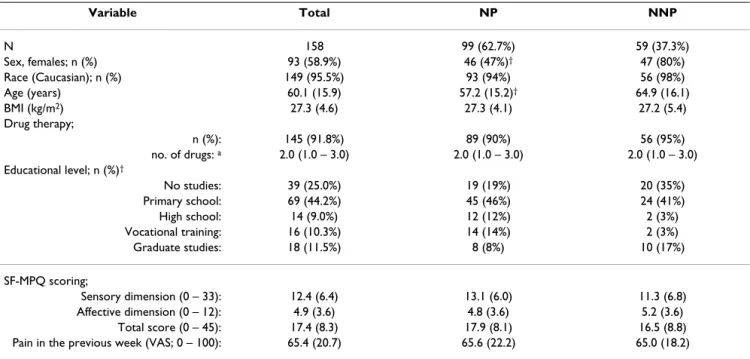
measure-Table 1: Demographic characteristics of study patients, overall and by the main subgroups with (NP) and without (NNP) associated neuropathic component.
Variable Total NP NNP
N 158 99 (62.7%) 59 (37.3%)
Sex, females; n (%) 93 (58.9%) 46 (47%)† 47 (80%)
Race (Caucasian); n (%) 149 (95.5%) 93 (94%) 56 (98%)
Age (years) 60.1 (15.9) 57.2 (15.2)† 64.9 (16.1)
BMI (kg/m2) 27.3 (4.6) 27.3 (4.1) 27.2 (5.4)
Drug therapy;
n (%): 145 (91.8%) 89 (90%) 56 (95%)
no. of drugs: a 2.0 (1.0 – 3.0) 2.0 (1.0 – 3.0) 2.0 (1.0 – 3.0)
Educational level; n (%)†
No studies: 39 (25.0%) 19 (19%) 20 (35%)
Primary school: 69 (44.2%) 45 (46%) 24 (41%)
High school: 14 (9.0%) 12 (12%) 2 (3%)
Vocational training: 16 (10.3%) 14 (14%) 2 (3%)
Graduate studies: 18 (11.5%) 8 (8%) 10 (17%)
SF-MPQ scoring;
Sensory dimension (0 – 33): 12.4 (6.4) 13.1 (6.0) 11.3 (6.8)
Affective dimension (0 – 12): 4.9 (3.6) 4.8 (3.6) 5.2 (3.6)
Total score (0 – 45): 17.4 (8.3) 17.9 (8.1) 16.5 (8.8)
Pain in the previous week (VAS; 0 – 100): 65.4 (20.7) 65.6 (22.2) 65.0 (18.2)
Values are given as mean (standard deviation) or frequency (%) based on the number of valuable cases (information available). BMI = Body Mass
ments by the instrument. Cronbach's α coefficient was assessed in the complete questionnaire and after remov-ing each item from it to assess the independent contribu-tion of each item to the measurement error in the instrument.
Inter-rater reliability was assessed by the agreement of the results obtained by raters A and B for each item and the total score of the DN4 questionnaire. Agreement was determined by calculating the Cohen's kappa coefficient. Inter-rater agreement was also determined by calculating the intra-class correlation coefficient of the total scores assigned by each pair of raters to the same subject, and the answers to each individual item, using a two-factor model and mixed effects.
In a subject sub-sample (n = 68), the test-retest reliability of the questionnaire was assessed by a third administra-tion, after at least 48 hours, of the DN4 scale by rater B. Stability of the questionnaire was analyzed by measuring the intra-class correlation coefficient between the scores of clinicians completing test and retest and using Cohen's kappa coefficient of agreement for the total retest sample and in subgroups by type of pain.
Validity
A ROC (receiver operating characteristic) curve analysis was performed to determine the cut-off value of the ques-tionnaire score providing the best values of sensitivity and specificity for NP diagnosis and determination of Youden's index for the total patient sample included in the study. This was repeated in two sub-samples excluding either patients with mixed pain only or patients with mixed and subjects with central NP (just to test the instru-ment in patients with peripheral NP only). For each cut-off value of the scale score, in addition to sensitivity and specificity and Youden's index, the positive (PPV) and negative predictive value (NPV), the kappa coefficient of agreement with the diagnosis according to the standard criterion or reference diagnosis, and the area under the curve (AUC) calculated by the trapezoid method and its
significance level were estimated. The 95% confidence intervals (95% CI) of the estimators of the cut-off point selected as optimum were calculated. Validity indicators (sensitivity, specificity, PPV, and NPV) were recalculated individually for the presence of each descriptor symptom of the DN4 questionnaire. The Youden's index was calcu-lated by the equation: sensitivity + specificity - 1 [27].
Descriptive statistics were prepared for the variables tested in this study to assess central positition, dispersion, and distribution of variables tested by the Kolmogorov- Smir-nov test. A Student's t test for independent groups or a Mann-Whitney's U test was used in the case of a non-nor-mal distribution to compare continuous or ordinal varia-bles respectively between patients with NP and NNP. All statistical tests were two-tailed, and an α error of < 0.05 was accepted as statistically significant. Data were ana-lyzed using SPSS version 12.0 statistical software.
Results
Sample description
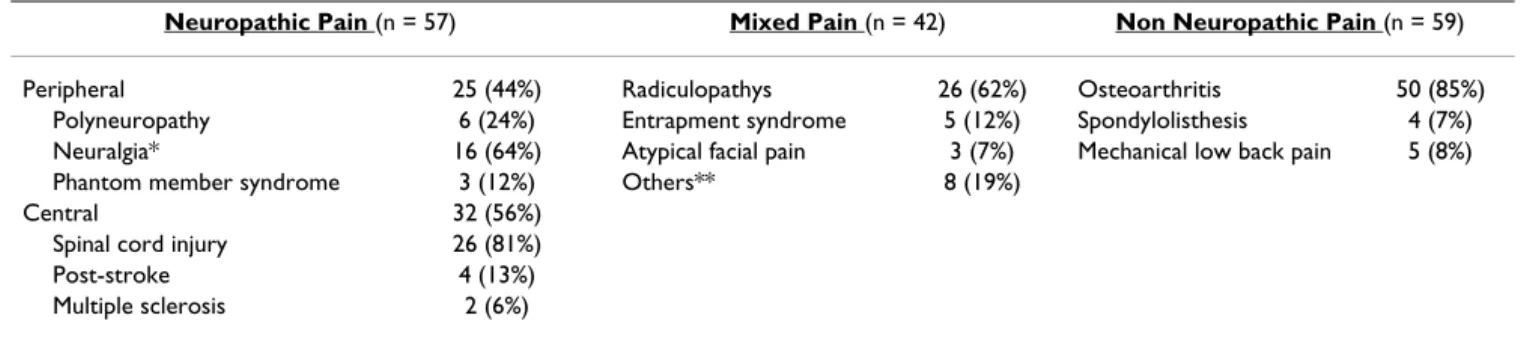
The study was conducted from June to November 2005. Table 1 summarizes the clinical and sociodemographic characteristics of the 158 patients, 99 with NP and 59 with NNP, included in the study, and Table 2 details pain eti-ology. NP was peripheral in 25 (25%) patients, central in 32 (32%), and mixed in 42 patients (42%). The propor-tion of women and the mean age were significantly higher in the NNP group, but the two groups were homogenous in terms of educational level, pain intensity and analgesic treatment (Table 1). The SF-MPQ total score and sub-scores by dimension were not statistically significant between patients with or without NP (Table 1).
Analysis of psychometric properties of the Spanish version of the DN4 questionnaire
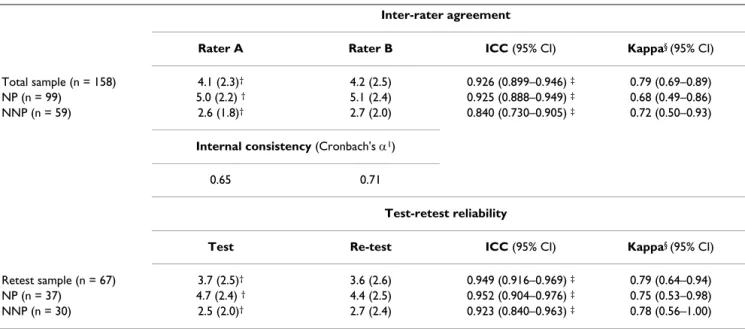
Internal consistency, inter-rater agreement and test-retest reliability Table 3 summarizes the values of the indicators related to reliability of the Spanish version of the DN4 question-naire. Our data support the reliability of the instrument
both in terms of internal consistency (Cronbach's α of
Table 2: Distribution of the most common etiological causes of neuropathic pain (peripheral and central), mixed pain and non-neuropathic pain in the study patients.
Neuropathic Pain (n = 57) Mixed Pain (n = 42) Non Neuropathic Pain (n = 59)
Peripheral 25 (44%) Radiculopathys 26 (62%) Osteoarthritis 50 (85%)
Polyneuropathy 6 (24%) Entrapment syndrome 5 (12%) Spondylolisthesis 4 (7%)
Neuralgia* 16 (64%) Atypical facial pain 3 (7%) Mechanical low back pain 5 (8%)
Phantom member syndrome 3 (12%) Others** 8 (19%)
Central 32 (56%)
Spinal cord injury 26 (81%)
Post-stroke 4 (13%)
Multiple sclerosis 2 (6%)
approximately 0.7 in both observers) and inter-rater relia-bility (Cohen's kappa coefficients ranging from 0.68 and 0.79) or questionnaire stability (intra-class correlation
coefficients ranging from 0.92 and 0.95). Cronbach's α
coefficients did not improve when each scale item was successively removed (values ranging from 0.60 and 0.71), which justifies the contribution of each item to measure the concept measured by the questionnaire (Table 3).
Inter-rater reliability, which is essential for an instrument that contains a semi-structured interview subject to inter-viewer interpretation, was good to very good. The total scores in each diagnostic group did not show statistically significant differences, and the intra-class correlation coef-ficient values ranged from 0.84 and 0.93 (Table 3). Calcu-lation of the kappa coefficients supported the inter-rater agreement regarding diagnostic classification. In addition, retest results confirmed that the DN4 questionnaire has good test-retest stability, with intra-class correlation coef-ficients ranging from 0.92 and 0.95.
Validity
Table 4 gives the results of scale validity as a diagnostic method for NP, comparing its properties first in the total sample of NP patients, and then after successively remov-ing patients with mixed pain and with central NP. In all cases, ROC curve analysis identified a score of 4 as the best cut-off value discriminating between NP and NNP (values of the area under the curve ranging from 0.85 to 0.87, p < 0.001 in all cases, and the highest values of the Youden's
index). This cut-off point showed, in all cases compared, values of 70% or higher (except for PPV in the case of peripheral NP) in indicators of sensitivity, specificity, pos-itive predictive value (PPV), and negative predictive value (NPP), which anticipates a low percentage of both false positive and false negative results when the questionnaire is used.
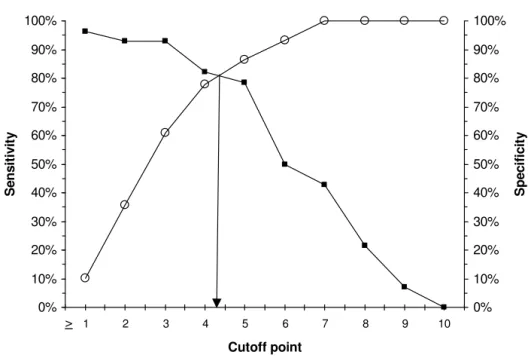
The graphs plotting the cut-off point optimizing the sen-sitivity and specificity values consistently show a cut-off point ≥ 4 points as the most appropriate value for discrim-inating between NP and NNP in both the total sample and after removing patients with mixed pain and central NP (Figures 1, 2 and 3 respectively).
The indicators of the validity of the DN4 questionnaire to differentiate NP from NNP were good in all cases, regard-less of whether the analysis included all patients with NP and NNP or patients with mixed pain or central NP were removed. The improvement seen in sensitivity values when patients who could introduce classification errors were removed was moderate, though both positive and negative predictive values showed more marked changes, improving as expected as patients who could potentially add errors (case of negative predictive value) were removed, and worsening when such patients were included (case of the positive predictive value, Table 4).
Validity in subgroups according to pain severity and educational level Table 5 shows the validity properties of the DN4 question-naire in patient subgroups depending on mean pain
Table 3: Internal consistency, inter-rater agreement, and test-retest reliability of the Spanish version of the DN4 questionnaire.
Inter-rater agreement
Rater A Rater B ICC (95% CI) Kappa§ (95% CI)
Total sample (n = 158) 4.1 (2.3)† 4.2 (2.5) 0.926 (0.899–0.946) ‡ 0.79 (0.69–0.89)
NP (n = 99) 5.0 (2.2) † 5.1 (2.4) 0.925 (0.888–0.949) ‡ 0.68 (0.49–0.86)
NNP (n = 59) 2.6 (1.8)† 2.7 (2.0) 0.840 (0.730–0.905) ‡ 0.72 (0.50–0.93)
Internal consistency (Cronbach's α1)
0.65 0.71
Test-retest reliability
Test Re-test ICC (95% CI) Kappa§ (95% CI)
Retest sample (n = 67) 3.7 (2.5)† 3.6 (2.6) 0.949 (0.916–0.969) ‡ 0.79 (0.64–0.94)
NP (n = 37) 4.7 (2.4) † 4.4 (2.5) 0.952 (0.904–0.976) ‡ 0.75 (0.53–0.98)
NNP (n = 30) 2.5 (2.0)† 2.7 (2.4) 0.923 (0.840–0.963) ‡ 0.78 (0.56–1.00)
NP = Neuropathic Pain, NNP = Non-Neuropathic Pain (somatic), ICC = Intra-class Correlation Coefficient, 95% CI = 95% confidence interval,
1Coefficients for the entire questionnaire (10 items) †p > 0.05 between raters (Friedman's paired test), ‡ p < 0.001 (p value for intra-class
severity in the week prior to questionnaire administration and depending on the educational level of patients. Ques-tionnaire performance was not significantly influenced by the educational level, but was significantly decreased in patients with mild pain.
Discussion
This study represents the first validation of the DN4 ques-tionnaire, originally validated into French, into another language. Overall, the high discriminant value of the Spanish version of the DN4 questionnaire for identifica-tion of neuropathic pain was confirmed. In addiidentifica-tion, our
Cut-off point in the DN4 questionnaire optimizing the sensitivity and specificity values for discriminating between neuropathic pain and non-neuropathic pain in the overall sample
Figure 1
Cut-off point in the DN4 questionnaire optimizing the sensitivity and specificity values for discriminating between neuropathic pain and non-neuropathic pain in the overall sample.
A score > 4 points in the sum of the 10 items of the DN4 questionnaire resulted in the best discriminant cut-off point for the overall sample.
0% 10% 20% 30% 40% 50% 60% 70% 80% 90% 100%
1 2 3 4 5 6 7 8 9 10
Cutoff point
Se
n
s
itiv
it
y
0% 10% 20% 30% 40% 50% 60% 70% 80% 90% 100%
S
p
eci
fi
ci
ty
>
Table 4: Comparison of the psychometric properties of validity for differential diagnosis of neuropathic pain vs non-neuropathic pain for a cut-off value ≥ 4 points in the Spanish version of the DN4 questionnaire, in the overall sample and in patients with pure neuropathic pain (excluding those with mixed pain) and with peripheral neuropathic pain (excluding patients with mixed and central pain).
All patients (n = 158) Mixed pain excluded (n = 116) Mixed and central pain
excluded (n = 84)
Youden index 0.58 0.60 0.60
Sensitivity (%) 79.8% (71%–87%) 81.7% (70%–91%) 82.1% (63%–94%)
Specificity (%) 78.0% (65%–88%) 78.0% (65%–88%) 78.0% (65%–88%)
PPV (%) 85.9% (77%–92%) 79.0% (67%–88%) 63.9% (46%–79%)
NPV (%) 69.7% (57%–80%) 80.7% (68%–90%) 90.2% (79%–97%)
AUC 0.85 (0.79–0.91) † 0.87 (0.80–0.93) † 0.87 (0.78–0.96) †
% of agreement 79.1% (72%–85%) § 79.8% (72%–87%) § 79.3% (69%–87%) §
Kappa's Agreement 0.56 (0.43–0.70) ‡ 0.60 (0.45–0.75) ‡ 0.56 (0.39–0.74) ‡
Youden index = Sensitivity + Specificity – 1, 95% confidence interval in brackets, PPV = Positive Predictive Value, NPV = Negative Predictive Value,
AUC = Area under the curve (ROC curve analysis). †p < 0.001 (p value in ROC curve analysis), §p > 0.05 between reference diagnosis and DN4
classification for a cut off value ≥ 4 pts (McNemar's test), ‡ p < 0.001 (p value for Cohen's kappa of agreement between reference diagnosis and
study provided new information about the test-retest reli-ability of the questionnaire, the influence of educational level and pain intensity on its performance, and its valid-ity in mixed pain syndromes.
Identification of neuropathic components is crucial for characterization of chronic pain patients and to adapt the therapeutic approach, given the differential response of neuropathic pain to analgesic treatment [7,28,29]. There-fore, a better identification of neuropathic pain should improve the therapeutic outcome. Several diagnostic and screening tools have been developed and validated over the past few years for this purpose [19]. All these screen-ing/diagnostic tools make use of similar descriptors to dis-criminate neuropathic patients from other chronic pain patients with up to 80%–90% sensitivity and specificity. The DN4, initially developed and validated in 160 French-speaking patients, has very high diagnostic properties [15] and is one of the easiest tools to use. In particular, its scor-ing is very simple because, unlike in other tools, the items are not "weighted". In the original study, only patients with "pure" neuropathic pain (i.e. not "mixed pain" syn-dromes) of at least moderate intensity (i.e. ≥ 4 out of 10) were included, and the test-retest reliability was not
inves-tigated. Thus, in addition to the linguistic validation of the DN4 questionnaire into Spanish, it appeared of interest to provide additional psychometric validation of this ques-tionnaire.
The reliability and validity of the Spanish version of the DN4 questionnaire were confirmed; in particular, our analyses showed that, similarly to the French version, the best cut-off value corresponds to a total score of 4 out of 10. The overall performance of the Spanish DN4 ques-tionnaire was very good, although specificity and sensitiv-ity appeared to be slightly lower as compared to the original version. These differences might reflect linguistic specificities and cultural differences, but they may also result from methodological disparities (e.g. differences in the clinical characteristics of patients) between both stud-ies. In particular, our analysis of the properties of the questionnaire according to pain intensity revealed signifi-cantly lower sensitivity and specificity in patients with mild pain intensity. The influence of pain intensity on the psychometric properties of neuropathic pain screening tools had not been previously tested with the DN4 or with other questionnaires. The data reported here suggest that these tools might be much less discriminant and should
Cut-off point in the DN4 questionnaire optimizing the sensitivity and specificity values for discriminating between pure neuro-pathic pain (excluding patients with mixed pain) and non-neuroneuro-pathic pain
Figure 2
Cut-off point in the DN4 questionnaire optimizing the sensitivity and specificity values for discriminating between pure neuro-pathic pain (excluding patients with mixed pain) and non-neuroneuro-pathic pain.
A score > 4 points in the sum of the 10 items of the DN4 questionnaire resulted in the best discriminant cut-off point for the sample after excluding patients with mixed pain.
0% 10% 20% 30% 40% 50% 60% 70% 80% 90% 100%
1 2 3 4 5 6 7 8 9 10
Cutoff point
Se
n
s
itiv
it
y
0% 10% 20% 30% 40% 50% 60% 70% 80% 90% 100%
S
p
eci
fi
ci
ty
therefore be used with caution in patients with reduced pain intensity. However, this would have to be confirmed in further studies with the DN4 or other diagnostic ques-tionnaires, because the subgroup of patients with mild pain intensity was relatively small in this study. By
con-trast, our results suggest that the discriminant value of the DN4 questionnaire did not depend on the educational level, confirming that these simple symptom-based ques-tionnaires are easily understood and that their administra-tion should not be restricted to highly educated patients.
Table 5: Properties of validity for diagnosis of pain with neuropathic involvement in different subgroups by pain severity and educational level in the overall sample.
Cut-off value ≥ 4 points Sensitivity (%) Specificity (%) PPV (%) NPV (%) Kappa
Pain severity (VAS)
Mild; < 40 mm (n = 12) 55.6 66.7 83.3 33.3 0.17‡
Moderate; ≥ 40 and < 70 mm (n = 65) 85.0 84.0 89.5 77.8 0.68†††
Severe; ≥ 70 mm (n = 81) 80.0 74.2 83.3 69.7 0.54†††
Educational level
No studies (n = 39) 81.3 73.9 68.4 85.0 0.54††
Primary school (n = 69) 77.1 81.0 90.2 60.7 0.53†††
High school (n = 14) 83.3 100 100 50.0 0.59†
Vocational training (n = 16) 78.6 100.0 100 40 0.48†
Graduate studies (n = 18) 87.5 70.0 70.0 87.5 0.56†
VAS = Visual Analogue Scale for pain (0 – 100 mm) of McGill short pain questionnaire, PPV = Positive Predictive Value, NPV = Negative Predictive
Value. ‡ p > 0.05; †p < 0.05; ††p < 0.01; †††p < 0.001. Two patients did not report their educational level.
Cut-off point in the DN4 questionnaire optimizing the sensitivity and specificity values for discriminating between peripheral neuropathic pain (excluding patients with mixed pain and central neuropathic pain) and non-neuropathic pain
Figure 3
Cut-off point in the DN4 questionnaire optimizing the sensitivity and specificity values for discriminating between peripheral neuropathic pain (excluding patients with mixed pain and central neuropathic pain) and non-neuropathic pain.
A score > 4 points in the sum of the 10 items of the DN4 questionnaire resulted in the best discriminant cut-off point for the sample after excluding patients with mixed pain and central neuropathic pain.
0% 10% 20% 30% 40% 50% 60% 70% 80% 90% 100%
1 2 3 4 5 6 7 8 9 10
Cutoff point
Se
n
s
itiv
it
y
0% 10% 20% 30% 40% 50% 60% 70% 80% 90% 100%
S
p
eci
fi
ci
ty
A supplemental validation investigated in this study con-cerned the stability over time (i.e. test-retest reliability) of the DN4 questionnaire, which was excellent in our patients with or without NP.
The results of the DN4 were similar in patients with "pure" neuropathic pain or mixed pain syndromes, (i.e. the combination of neuropathic and non neuropathic pain in the same patient). Thus, the present data suggest that the neuropathic component of the "mixed pain" syn-drome has clinical characteristics similar to those of "pure" neuropathic pain. Interestingly, this is consistent with the results recently reported by Freynhagen et al [17], showing that radiculopathies associated with mixed pain syndromes have clinical characteristics similar to those of definite neuropathic pain syndromes. In addition, the sta-tistical estimators of validity of the test remained mostly unchanged after removing both the subgroups of patients with mixed pain and with central pain, leaving pure peripheral neuropathic pain only. This suggests that the error level of the questionnaire will remain largely unchanged. More generally, our data tend to support the interest of NP screening tools in the clinical setting. These tools should be of particular interest for both Primary Care Physicians (PCPs) and other non pain specialists to identify NP, diagnose its cause, and adapt the analgesic treatment. Thus, screening tools like DN4 should help PCPs to take a more pro-active role in appropriate treat-ment selection, thus avoiding early therapeutic failure and patient suffering.
Conclusion
The results of this study support the transcultural validity of the DN4 questionnaire. More generally, our data tend to confirm the interest of symptom-based diagnostic tools for identification of the neuropathic pain component. These simple clinical tools may be used not only in daily practice, but also in the clinical research setting (e.g. epi-demiological studies). Future studies directly comparing the performance of the different available tools are war-ranted.
Abbreviations
DN4: Douleur Neuropathique 4 questions;
NP: Neuropathic pain;
NNP: Non Neuropathic pain;
IASP: International Association for Study of Pain;
VAS: Visual Analogue Scale;
SF-MPQ: Short-form McGill Pain Questionnaire;
ROC: Receiver Operating Characteristic;
PPV: Positive Predictive Value;
NPV: Negative Predictive Value;
AUC: Area under the curve;
PCP: Primary Care Physicians.
Competing interests
Javier Rejas is employed at Pfizer Spain. The author(s) declare that they have no competing interests.
Authors' contributions
CP and JR designed the study and were responsible for the idea of the study. CP, RG, SH and JI participated in patient enrrollment and manuscript elaboration. DB wrotte the manuscript in part and was responsible for consultation and scientific support of the project. SD was responsible for monitoring, logistic and evaluation of data. All authors read and approved the final manuscript.
Additional material
Acknowledgements
This study was supported by an unrestricted grant from Pfizer Spain. The authors wish to thank Francisco González (Hospital de la Princesa, Madrid, Spain), María Madariaga (Hospital de la Princesa, Madrid, Spain) and Carmen Martínez-Valero (Hospital Universitario, Virgen de las Nieves, Granada, Spain) for their collaboration in the study.
Preliminary results have been presented as a poster at 5th Congress of the European Federation of IASP Chapters (EFIC), Istanbul, 2006.
References
1. IASP Task Force in Taxonomy: Pain Terms: A Current List with Definitions and Notes on Usage. In Classification of chronic pain syndromes and definitions of pain terms Second edition. Edited by: Merk-sey H, Bogduk N. Seattle, Washington: IASP Press; 1994:206-213. 2. Jensen TS, Gottrup H, Sindrup SH, Bach FW: The clinical picture
of neuropathic pain. Eur J Pharmacol 2001, 429:1-11.
3. Backonja MM: Defining neuropathic pain. Anesth Analg 2003, 97:785-90.
4. Bennett GJ: Neuropathic pain: a crisis of definition? Anesth Analg
2003, 97:619-20.
5. Karlsten R, Gordth T: How do drugs relieve neurogenic pain?
Drugs Aging 1997, 11(5):398-412.
6. Browner WS, Newman TB, Cummings SR: Diseño de un nuevo estudio: III. Pruebas diagnósticas. In Diseño de la Investigación Clínica: Un enfoque epidemiológico Edited by: Hulley SB, Cummings SR. . Barcelona: Doyma; 1993:97-108.
Additional file 1
Cuestionario DN4. This appendix includes the Spanish version of DN4 questionnaire.
Click here for file
Publish with BioMed Central and every scientist can read your work free of charge "BioMed Central will be the most significant development for disseminating the results of biomedical researc h in our lifetime."
Sir Paul Nurse, Cancer Research UK
Your research papers will be:
available free of charge to the entire biomedical community
peer reviewed and published immediately upon acceptance
cited in PubMed and archived on PubMed Central
yours — you keep the copyright
Submit your manuscript here:
http://www.biomedcentral.com/info/publishing_adv.asp
BioMedcentral
7. Gálvez R: Concepto, generalidades, etiología e incidencia del Dolor Neuropático. In Abordaje Actual del Dolor Neuropático. Pri-mera Edición Edited by: Rafael Gálvez, Mateos y cols. Master Line & Prodigio SL. Madrid; 2003:12-22.
8. Gálvez R, Rejas J, Pérez M, Gómez M: Prevalencia del dolor neu-ropático en España: implicaciones clínicas, laborales y asist-enciales. Med Clin (Barc) 2005, 125(6):221-9.
9. Torrance N, Smith BH, Bennett MI, Lee AJ: The epidemiology of chronic pain of predominantly neuropathic origin. Results from a general population survey. J Pain 2006, 7(4):281-9. 10. Bouhassira D, Lanteri-Minet M, Attal N, Laurent B, Touboul C:
Prev-alence of chronic pain with or without neuropathic charac-teristics in the general population. 2007 in press.
11. Hansson P: Difficulties in stratifying neuropathic pain by mechanisms. Eur J Pain 2003, 7:353-7.
12. Cruccu G, Anand P, Attal N, García-Larrea L, Haanpää M, Jørum E, Serra J, Jensen TS: EFNS guidelines on Neuropathic pain assess-ment. Eur J Neurol 2004, 11:153-162.
13. Bennett M: The LANSS Pain Scale: the Leeds assessment of neuropathic symptoms and signs. Pain 2001, 92:147-157. 14. Krause SJ, Backonja M: Development of a neuropathic pain
questionnaire. Clin J Pain 2003, 19:306-14.
15. Bouhassira D, Attal N, Alchaar H, Boureau F, Brochet B, Bruxelle J, Cunin G, Fermanian J, Ginies P, Grun-Overdyking A, Jafari-Schluep H, Lantéri-Minet L, Laurent B, Mick G, Serrie A, Valade D, Vicaut E: Comparison of pain syndromes associated with nervous or somatic lesions and development of a new Neuropathic pain diagnostic questionnaire (DN4). Pain 2005, 114:29-36. 16. Portenoy R: Development and testing of a neuropathic pain
screening questionnaire: ID Pain. Curr Med Res Opin 2006, 22(8):1555-65.
17. Freynhagen R, Tolle T, Stemmler E, Gockel U, Stevens M, Maier C: Screening of neuropathic pain components in patients with chronic back pain associated with nerve root compression: a prospective observational pilot study (MIPORT). Curr Med Res Opin 2006, 22(3):529-37.
18. Pérez C, Gálvez R, Insausti J, Bennett M, Ruiz M, Rejas J, y el grupo para el estudio de la validación al español de la escala LANSS: Adap-tación lingüística y validación al español de la escala LANSS (Leeds Assessment of Neuropathic Symptoms and Signs) para el diagnóstico diferencial del dolor neuropático. Med Clin (Barc) 2006, 127(13):485-91.
19. Bennett MI, Attal N, Backonja MM, Baron R, Bouhassira D, Freynha-gen R, Scholz J, Tolle TR, Wittchen HU, Jensen TS: Using screening tools to identify neuropathic pain. Pain 2007, 127(3):199-203. 20. Guillemin F, Bombardier C, Beaton D: Cross-cultural adaptation
of health-related quality of life measures: literature review and proposed guidelines. J Clin Epidemiol 1993, 46:1417-32. 21. Nunnally JC, Bernstein IJ: Teoría Psicométrica. 3rd edition.
Méxi-co: McGraw-Hill; 1995.
22. Fayers PM, Machin D: Quality of Life: Assessment, analysis and interpretation. West Sussex, UK: John Wiley & Sons Ltd; 2000. 23. Casas J, Repullo JR, Pereira J: Medidas de calidad de vida
rela-cionada con la salud. Conceptos básicos, construcción y adaptación cultural. Med Clin (Barc) 2001, 116:798-796. 24. Chassany O, Sagnier P, Marquis P, Fullerton S, Aaronson N, for the
European Regulatory Issues on Quality of Life Assessment Group: Patient-reported outcomes: the example of health-related quality of life – A European guidance document for the improved integration of health-related quality of life assess-ment in the drug regulatory process. Drug Information Journal
2002, 36:209-238.
25. Streiner DL, Norman GR: Health measurement scales. In A prac-tical guide to their development and use Oxford: Oxford University Press; 1989.
26. Melzack R: The short-form McGill Pain Questionnaire SF-MPQ. Pain 1987, 30:191-7.
27. Taube A: Sensitivity, specificity and predictive values: a graph-ical approach. Stat Med 1986, 5:585-91.
28. Wall PD: Neuropathic pain and injured nerve: central mecha-nisms. Br Med Bull 1991, 47:631-643.
29. Bouhassira D, Attal N: Novel strategies for Neuropathic pain. In The pain system in normal and pathological states: a primer for clinicians