A large displacement structural analysis of a pipeline
subjected to gravity and buoyancy forces
Juan Carlos Mosquera∗, Jaime Garc´ıa-Palaciosaand Avelino Samart´ınb
∗Assistant Professor. Dept. of Structural Mechanics ETSICCYP. UPM. Ciudad Universitaria s/n. 28040 Madrid
aAssistant Professor. of Civil Engineering: Hydraulic and Energetic, UPM. Madrid bFull Professor. Dept. of Structural Mechanics, UPM. Madrid
Abstract
A nonlinear analysis of an elastic tube subjected to gravity forces and buoyancy pressure is carried out. An update lagrangian formulation is used. The structural analysis efficiency in terms of computer time and accuracy, has been improved when load stiffness matrices have been introduced. In this way the follower forces characteristics such as their intensity and direction changes can be well represented. A sensitivity study of different involved variables on the final deformed pipeline shape is carried out.
Keywords:Geometrically nonlinear structures, large displacements, follower forces, hydro-static actions
1. Introduction
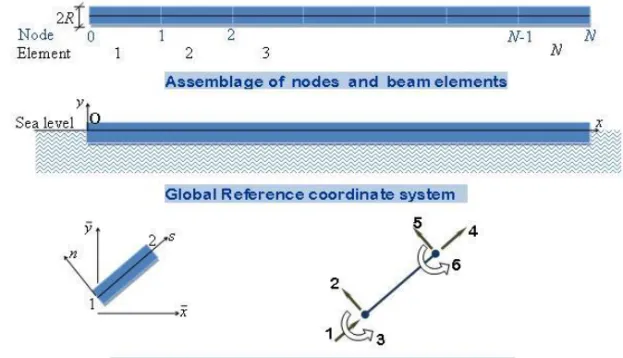
It is considered a pipeline of total lengthLT = N L. For analysis purpose the pipeline is
divided intoN segments of equal lengthL. Each elementiwithi= 1,2, . . . , N is limited by two nodes, 1 and 2, using local numbering andn−1enin global numbering in whichn
varies from 0 toN. The two extreme nodes 0 andN correspond to two lids of weightPLα,
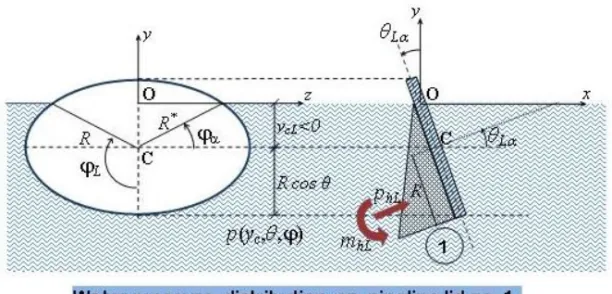
withα= 0andα= 1as it is shown in figure1a.
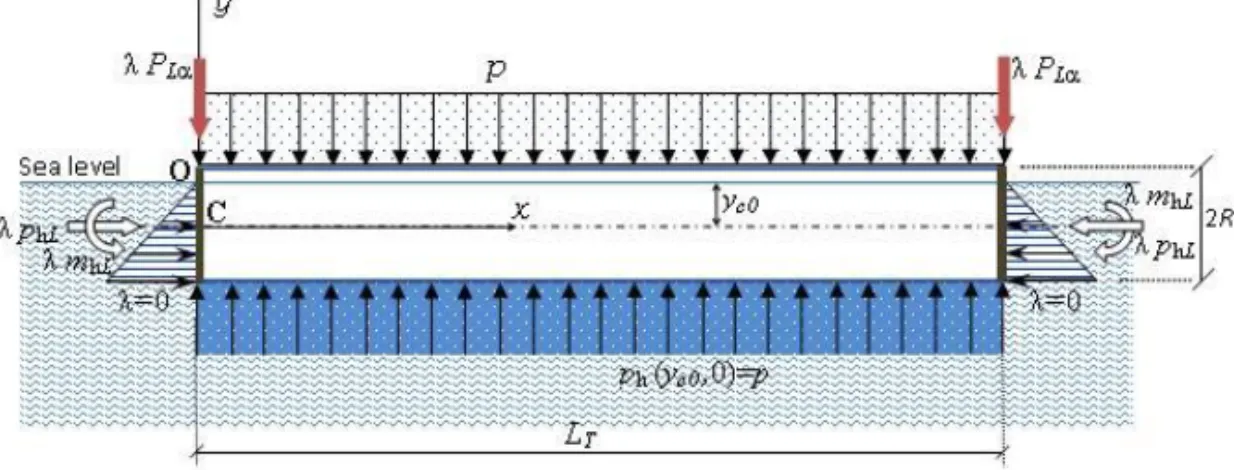
The circular constant section of the pipeline has an external radiusR. The weight of the tube is represented by a uniform distributed load of intensitypper unit of length. In addition, the tube is floating on the sea and therefore it is subjected to an upward hydrostatic pressure. The sea density isγw. Waves and current forces does not exist. Therefore, it is
Figure 1: Pipeline discretizaci´on
modulusE, flexural inertiaIzand areaΩ. All loads are modeled in a first approximation as
concentrated at extreme nodes of each pipeline segment.
The objective of this paper is to find the final equilibrated deformed position of the pipeline subjected to the former loads.
The following system of coordinate axes is adopted: General axes Oxyfor load definition, in which the origin O s the intersection of the vertical at initial pipeline section and the horizontal corresponding to the still water level (SWL). The axis Oxis horizontal and the axis Oyis upwards vertical (figure1b). Ii is assumed that inertial forces due to the waves and sea current does not exist. Finally, a local coordinate systems, nis introduced to define the stress-resultants for each pipeline element 12. The origin of these local axes is at node 1 and the axissis the straight line joining the node 1 and 2. The axisnis normal to the axiss. The axess, nrotated in such a way that their directions became parallel to horizontal and vertical, i.e. to the general axes Oxyare designated byx,¯ y¯.
therefore only the distributed loading is acting, i.e. the pipeline weight and the Archimedes uplift pressure. In figure2the horizontal position of equilibrium of the pipeline is shown. The tube is subjected in this position to its weight balanced by the Archimedes uplift. The remaining loads, the lids weight and the hydrostatic pressure on them, are multiplied by a factorλ = 0 i.e. they are not acting on the pipeline yet. From this initial position of equilibrium the loading on the extreme sections of the pipeline are increasing continuously by varying the factorλfrom its initial valueλ = 0to the final oneλ= 1. An incremental analysis technique is used starting at current configuration of equilibriumC1of the deformed tube, that it corresponds to a value0< λ <1. From this position the lids forces are increasing by the factorλ+dλand it is attempting to find the new target configuration of equilibriumC2 corresponding to these incremental loads. It should be noted that the weight of the pipeline remains constant, both in intensity as in direction, along the length of the tube. Moreover, the Archimedes pressure along the pipeline is not affected by this factor incrementdλ, but due to its follower characteristic attached to the structure, according the classification given in [2], its intensity and direction vary because they are dependent of the deformed geometry of the pipeline. These follower loads not only change its direction due to the incremental rotations occurring at the tube sections along the pipeline, but also its intensity caused by the incremental displacements produced along the pipeline.
Figure 2: Initial configuraci´onC0of the tube in equilibrium
This paper is structured as follows. First, it is studied the hydrostatic pressure on a pipeline slice and its incremental changes when the slice undergoes a differential rotation
iteratively until a final equilibrium position at the end of step loadλ+dλis reached. In these equations the appearance of load stiffness matrices due to the follower loads. By an incre-mental procedure or a step by step technique the final equilibrium position of the pipeline, i.e. the pipeline position corresponding to the final value of the load factorλ= 1can be found. It was found that the inclusion in the analysis of these load matrices allows greater computa-tional efficiency and a better accuracy in the results. Several application examples are shown and in some of them a sensitivity analysis of some key variables illustrate the computational techniques developed. Finally the paper is closed with some general conclusions.
2. Distribution and resultant of the pressure loading on a
tube slice
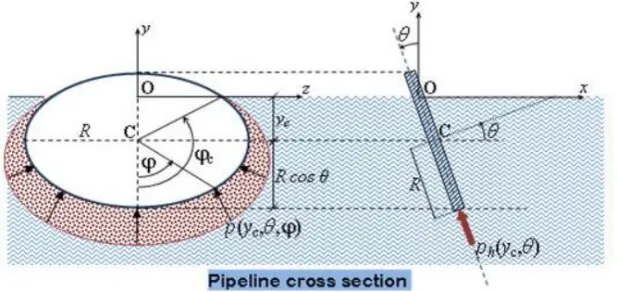
It is assumed a pipeline slice inclined respect to horizontal an angleθ. In figure3the hydro-static pressure distribution on a semi-submerged cross-section of the pipeline is shown. This pressurep(yc, θ, ϕ)is function of following variables: the ordinateycof the center of the
cir-cle, the slopeθof the section respect to the vertical plane and the position of the application point of the pressure defined by the angleϕ. The resultant force,ph(yc, θ)ds, of this pressure
distribution on a pipeline slice of thicknessdsis contained in its middle plane.
Figure 3: Pressure distribution on a circular section
In the following the expressions of the pressure distributionp(yc, θ, ϕ)and its resultant
ph(yc, θ)dsas function of the position of the tube center measured by the ordinate yc are
• Slice in the airyc≥Rcosθ
p(yc, θ, ϕ) = 0 (1)
ph(yc, θ) = 0 (2)
• Semi-submerged sliceRcosθ≥yc≥ −Rcosθ
p(yc, θ, ϕ) =γw[Rcosθcosϕ−yc] (3)
with ϕc≥ϕ≥ −ϕc and ϕc= arctan
³ y
c
Rcosθ
´
ph(yc, θ) = 2 Z ϕc
0
p(yc, θ, ϕ) cosϕRdϕ=
γwR2 "
arccos³ yc
Rcosθ
´
− yc
Rcosθ
r
1−³ yc
Rcosθ
´2#
(4)
• Submerged slice−Rcosθ≥yc
p(yc, θ, ϕ) =γw(Rcosθcosϕ−yc) with −π≥ϕ≥π (5)
ph(yc, θ) = 2 Z π
0
p(yc, θ, ϕ) cosϕRdϕ=γwπR2cos2θ (6)
The variation of the pressure resultant caused by a modification of the position of the grav-ity center of the slice defined by an infinitesimal vertical displacementv0and an infinitesimal rotationθ0are found by the expression:
dpt(yc, θ) = ∂ph(yc, θ)
∂yc
v0+∂ph(yc, θ)
∂θ θ0
in which ∂ph(yc,θ)
∂yc and
∂ph(yc,θ)
fol-lows:
Slice in the airyc ≥Rcosθ
∂ph(yc, θ)
∂yc = 0 (7)
∂ph(yc, θ)
∂θ = 0 (8)
Semi-submerged sliceRcosθ≥yc≥ −Rcosθ
∂ph(yc, θ)
∂yc =−2γwRcosθ r
1−³ yc
Rcosθ
´2
(9)
∂ph(yc, θ)
∂θ =−2γwR
2cosθsinθarccos³ yc
Rcosθ
´
(10)
Submerged slice−Rcosθ≥yc
∂ph(yc, θ)
∂yc = 0 (11)
∂ph(yc, θ)
∂θ =−2γwπR
2cosθsinθ (12)
3. Equivalent loads at element nodes
3..1. Analysis procedure
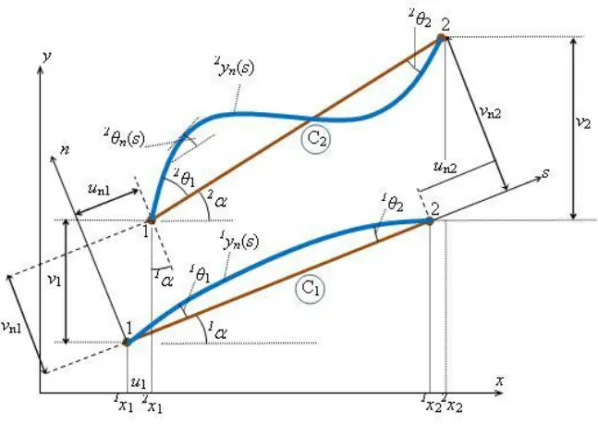
The analysis of the pipeline structure is carried out according to an incremental procedure, eventually iterative within load steps. That means, the final position of the pipeline is reached by successive finite increments of the loaddλ, starting at the value λ = 0and increasing until the final load valueλ= 1. The analysis is described according to an updated lagrangian formulation (UL), in which in each load step the equilibrate configurationC1is known and the adopted local coordinate axis for referencesandnare attached to the known configuration
C1as it is shown in figure4. The axissjoints nodes 1 and 2 of element and the normal axis
ncorresponds to an anticlockwise rotation ofπ
2 of the axiss.
3..2. Displacement independent loads
The load of this type acting on the pipeline is the weight and it is assumed this constant load is applied to a beam element of lengthL inclined an angle α respect to horizontal. The equivalent nodal forces to the weight loading arep = (px1, py1, mz1, px2, py2, mz2)T
at nodes 1 and 2 and they can be approximately expressed in axesx,¯ y¯by means of this formulae:
pxi=pticosα−pnisinα= 0 i= 1,2 (13)
pyi=ptisinα+pnicosα=pL
2 i= 1,2 (14)
in which
pti= Z L
0
N1
ipds, i= 1,2 (16)
pn1= Z L
0
N3
1pds, mn1= Z L
0
N3
2pds (17)
pn2= Z L
0
N33pds, mn2= Z L
0
N43pds (18)
In the former expressions the interpolation linear functions have been designed byN1
i =
N1
i(s)withi= 1,2andNi3=Ni3(s)withi= 1,2,3,4are the cubic interpolation functions
of Hermite. They are defined by the expressions:
N11= 1−ξ, N21=ξ (19)
N3
1 = 1−3ξ2+ 2ξ3, N33= 3ξ2−2ξ3 (20)
N3
2 =1Lξ(1−ξ)2, N43=1L(ξ3−ξ2) (21)
withξ= 1s
L.
The formulae (16)-(18) are valid only in a linear analysis, however their use in a nonlinear analysis can be acceptable if the beam element lengthLis small in comparison to the total pipeline length. In the contrary case, the distributed loading on the beam element should be taken into account in the expression of the nonlinear stiffness matrix of the element. Then the expression (72) of this matrix, given later, should be modified and to include terms related to the the distributed forcep.
3..3. Follower forces
In the case of follower forces the deformed structure should be taken into account in the analysis. This fact leads to the concept of load stiffness matrix. To this end it is assumed, according to an updated lagrangian formulation, that the equilibrated configuration is known
C1. From this known configuration it is arrived to configurationC2when unknown displace-mentsu(s),v(s)andθ(s)are produced due to a load increment. These displacements are expressed in the local coordinates of the elementsandn.
The geometry of the deformed tube element in the configurationC1referred to the local exes can be written if the rotations1θ
1and1θ2at nodes 1 and 2 are known, as follows: 1y
n(ξ) =N23(ξ)1θ1+N43(ξ)1θ2 with ξ= 1s
L (22)
where1L=p(1x
2−1x1)2+ (1y2−1y1)2.
The rotation variation along the deformed beam element is
1θ
n(ξ) =
d1y
n(ξ)
ds = dN3
2(ξ)
ds
1θ 1+
dN3 4(ξ)
ds
1θ
Figure 4: Large displacements in a beam element
If(1x
i,1yi), withi= 1,2, are the general coordinates of the element nodes then the deformed
elementC1in referred to the general axes is:
1y(ξ) =1y
1+1Lξsin1α+1yn(ξ) cos1α, 1θ(ξ) =1θn(ξ) +1α (24)
with1α= arctan(1y
2−1y1)(1x2−1x1)−1. The resultant pressure 1p
h(ξ) on the slice ξ, noting yc(ξ) = y(ξ), can be expressed according to section2.:
1p
h(ξ) =1ph[1yc(ξ),1θ(ξ)] =1ph[1y(ξ),1θ(ξ)] (25)
and the local components of this pressure referred to axessandnare
1p
hs(ξ) =−1ph(ξ) sin1θ and 1phn(ξ) =1ph(ξ) cos1θ (26)
The displacementsun(ξ),vn(ξ)andθn(ξ)of the former slice leads this slice from the
are:
un(ξ) = X
i=1,2
uniNi1(ξ) (27)
vn(ξ) = X
i=1,3
vniNi3(ξ) + X
i=2,4
θniNi3(ξ) (28)
θn(ξ) = X
i=1,3
vnidN
3
i(ξ)
ds +
X
i=2,4
θnidN
3
i(ξ)
ds (29)
whereuni,vniandθniare the unknown displacements of nodeireferred to the element local
axes in configurationC1.
The equations of the deformed tube element in the configurationC2expressed in local coordinates,sandn, are:
2x
n(ξ) =un(ξ), 2yn(ξ) =1yn+vn(ξ), and 2θn(ξ) =1θn(ξ) +θn(ξ) (30)
which referred to the general axes became:
2x(ξ) =1x(ξ) +u
n(ξ) cos1α−1vn(ξ) sin1α=1x(ξ) +u(ξ) (31)
2y(ξ) =1y(ξ) +u
n(ξ) sin1α+1vn(ξ) cos1α=1y(ξ) +v(ξ) (32)
2θ(ξ) =1θ(ξ) +θ
n(ξ) (33)
The hydrostatic pressure resultant2p
h(ξ)on the sliceξin the configurationC2is now modi-fied to the following value:
2p
h(ξ) =1ph[2x(ξ),2y(ξ),2θ(ξ)] =1ph[2x(ξ)] (34)
withx(ξ) = [2x(ξ),2y(ξ),2θ(ξ)]. These pressure components2p
hs(ξ)and2phn(ξ)referred
to local axessandnare respectively:
2p
hs(ξ) =−1ph[2x(ξ),2y(ξ),2θ(ξ)] sin2θn(ξ)
=−1p
h[2x(ξ)] sin[1θn(ξ) +θn(ξ)] (35)
2p
hn(ξ) =1ph[2x(ξ),2y(ξ),2θ(ξ)] cos2θn(ξ)
=−1ph[2x(ξ)] cos[1θn(ξ) +θn(ξ)] (36)
In order to find the resultant pressure,ph(ξ), variation in the sliceξproduced when the slice
changes from configurationC1toC2is necessary to compute the difference2ph(ξ)−1ph(ξ).
This difference can be expressed in a Taylor expansion in the neighborhood1p
h(ξ). Taking
into account (31), (32) and (33) the following expression is obtained:
2p
h[2x(ξ)] =1ph[1x(ξ)] +A(ξ)
∂1p
h
∂yc
+B(ξ)∂1ph
where
A(ξ) = sin1αX
i=1,2
uniNi1(ξ) + cos1α
X
i=1,2
vniN23i−1(ξ) + X
i=1,2
θniN23i(ξ)
B(ξ) = X
i=1,2
vni
dN3 2i−1(ξ)
dξ +
X
i=1,2
θnidN
3 2i(ξ)
dξ
and therefore resultant pressure components in local exes are:
2p
hs(ξ) =−1ph[2x(ξ)] sin(1θn+θn) =−1ph[2x(ξ)] sin1θn−1ph[2x(ξ)]θncos1θn
=1p
hs[1x(ξ)]−sin1θn ·
A(ξ)∂1ph
∂yc
+B(ξ)∂1ph
∂θ
¸ −1p
hn[1x(ξ)]B(ξ)
2p
hn(ξ) =1ph[2x(ξ)] cos(1θn+θn) =1ph[2x(ξ)] cos1θn−1ph[2x(ξ)]θnsin1θn
=1p
hn[1x(ξ)] + cos1θn ·
A(ξ)∂ 1p
h
∂yc +B(ξ)
∂1p
h
∂θ
¸ +1p
hs[1x(ξ)]B(ξ)
The load increments2p
h(ξ)−1ph(ξ)caused by the element displacement from
configura-tionC1toC2are substituted by the following equivalent nodal forcesp= (phsi, phni, phmi)
at element nodesi= 1,2, according to the following expressions in local axes:
phsi=1L Z 1
0
N1
i £2
phs−1phs ¤
dξ with i= 1,2 (38)
phn1=1L Z 1
0
N3 1
£2
phn−1phn ¤
dξ, phm1=1L Z 1
0
N3 2
£2
phn−1phn ¤
dξ (39)
phn2=1L Z 1
0
N33 £2
phn−1phn ¤
dξ, phm2=1L Z 1
0
N43 £2
phn−1phn ¤
dξ (40)
3..4. Load stiffness matrices
The follower forces produce equivalent nodal forces that can be represented as stiffness ma-trices. In the following the variation of the follower forces from configurationC1 toC2is expressed in this more convenient way. With this purpose the functionsA(ξ)andB(ξ)are written in matrix form
A(ξ) =a(ξ)dn, B(ξ) =b(ξ)dn (41) wheredn= (dn1,dn2)T is a vector of dimension6×1partitioned in the submatricesdni= (uni, vni, θni)T of dimension3×1with(i= 1,2)and
a(ξ) = [a1(ξ),a2(ξ)], ai(ξ) = [sin1αNi1,cos1αN23i−1,cos1αN23i]
b(ξ) = [b1(ξ),b2(ξ)], bi(ξ) = [0,dN
3 2i−1
dξ , dN3
2i
The components of the unbalanced resultant total pressure∆ph(ξ) =2ph(ξ)−1ph(ξ)at
sectionξcan be written as follows
2p
hs−1phs=−sin1θn ·
a(ξ)∂ 1p
h
∂yc +b(ξ)
∂1p
h
∂θ
¸
dn−1p
hcos1θnb(ξ)dn (42)
2p
hn−1phn= cos1θn ·
a(ξ)∂ 1p
h
∂yc +b(ξ)
∂1p
h
∂θ
¸
dn−1phsin1θnb(ξ)dn (43)
These components unbalanced forces ∆phs(ξ) = 2phs(ξ)−1phs(ξ)and∆phn(ξ) =
2p
hn(ξ)−1phn(ξ)are replaced by the equivalent nodal forcesphsi,phniandphmiat nodes
i,(i = 1,2)of the pipeline element, that are referred to the local axes and their values are computed according to the expressions (39), (38) and (40). The final results are then1
phsi=1L Z 1
0
N1
i∆phs(ξ)dξ=kL1jdn+kL2jdn with i= 1,2 (44) wherej= 1 if i= 1; j= 4 if i= 2
phni=1L Z 1
0
N3
i∆phn(ξ)dξ =kL1jdn+kL2jdn with i= 1,3 (45)
wherej= 2 if i= 1; j= 5 if i= 3
phmi=1L Z 1
0
N3
i∆phn(ξ)dξ=kL1jdn+kL2jdn with i= 2,4 (46)
wherej= 3 if i= 2; j= 6 if i= 4
(47)
The first row vectorskL1jare coming from the integration of terms of the following type
kL1j=±1L Z 1
0
Ni(1,3)
µ sin1θ
n
cos1θ
n ¶ ·
a(ξ)∂ 1p
h
∂yc +b(ξ)
∂1p
h
∂θ
¸
dξ (48)
and they correspond to the variation of the intensity of the follower forces. The second row vectorskL2jare obtained as a consequences of the integration terms
kL2j=±1L Z 1
0
Ni(1,3)1p
h µ
sin1θ
n
cos1θ
n 
b(ξ)dξ (49)
and in this case they correspond to the variation of the direction of the follower force. The load stiffness matrices kL1 andkL2 relate the force vectors at nodes to the corre-sponding displacements and they can written
pn=kL1dn+kL2dn=kLdn (50)
1It is usual to distinguish between the load matrices of de dimension6×6the matriceskL
1generated by an increment of differential vertical displacementycand the matriceskL2produced by un angle changeθof the section of application of the load pressure. The former load matriceskL1andkL2are partitioned in row matricesj,kL1j
where
pn = ·
pn1
pn2 ¸
,dn = ·
dn1
dn2 ¸
,kLj = kLj1 kLj2 kLj3 kLj4 kLj5 kLj6
(j= 1,2)
where la matrizkLis partitioned as follows ·
pn1 pn2
¸ =
·
kL11 kL12
kL21 kL22 ¸ ·
dn1
dn2 ¸
Finally, the expressions of these matrices in general axes are modified by means of suit-able axes transformations. In this way the following final expressions are found
P=KLD, i.e. · P1 P2 ¸ = ·
KL11 KL12
KL21 KL22 ¸ · D1 D2 ¸ (51) where
Pi= (pxi, pyi, mzi)T, Di= (dxi, dyi, θzi)T
These vectors are related to the former vectors expressed in local axes by the transformation formulae
Pi=Tpni, Di=TTdni KLαβ=TkLαβTT
where
T=
cos
1α −sin1α 0 sin1α cos1α 0
0 0 1
¿From a computational point of view it is convenient to use the matrices as functions of the typekL =kL(yc1, yc2,1α)andp=p(yc1, yc2,1α).
4. Pressure resultante on the pipeline lids
Similarly to the section2.the loads on the two extreme sections or lids of the pipeline are studied. En particular the force and moment resultants of the pressure distribution on each of these extreme sections are obtained.
The force resultant,pα
hLand the momentmαhL of the pressure distribution acting at
Figure 5: Pressure distribution on the end section of the pipeline
angleθLαof the tube, are carried out. This inclination angle respect to the horizontal or slope
at each tube end section is in general different to each end pipeline sectionα. The following results for the forcepα
hLand the momentmαhL pressure resultants on the
pipeline end sectionα:
Section in the air ycLα≥RextcosθLα (52)
pαhL= 0
mα hL= 0
Semi-submerged section RextcosθLα≥ycLα≥ −RextcosθLα (53)
pα
hL=ε2γwR2ext "
ycLα
2 Ã
ϕα+ sinϕαcosϕα+
π
2 !
−Rextcos
3ϕ
α
3 #
mαhL=ε2γwR3ext "
−ycLαcos
3ϕ
α
3 +
Rext
16 (2ϕα−sin 2ϕαcos 2ϕα+π) #
Submerged section ycLα≤ −RextcosθLα (54)
pα
hL=εγwπR2extycLα
mα hL=ε
1 3γwπR
4
ext
where
sinϕα=−
ycLα
RextcosθLα
and ε= (−1)α (55)
The occurrence of small variations,v0andθ0, of the depthycLαand rotationθLα
respec-tively, of sectionα, the increment of the resultant pressure forcepα
are given by the formulae
∆pαhL=
∂pα hL
∂ycLαv0+
∂pα hL
∂θαθ0 and ∆m
α hL=
∂mα hL
∂ycLαv0+
∂mα hL
∂θα θ0 (56)
The expressions of the derivatives ∂pαhL
∂ycLα,
∂mα hL
∂ycLα dep
α
hL andmαhL respect toycLα are
obtained as follows:
Section in the air ycLα≥RextcosθLα (57)
∂pα hL
∂ycLα
= 0
∂mα hL
∂ycLα = 0
Semi-submerged section RextcosθLα≥ycLα≥ −RextcosθLα (58)
∂pα hL
∂ycLα =ε2γwR
2
ext "
1 2 ³
ϕα+ sinϕαcosϕα+π
2 ´
+
(yhLαcos2ϕα+Rextcos2ϕαsinϕα)
∂ϕα
∂ycLα #
∂mα hL
∂ycLα =ε2γwR
3
ext "
−cos
3ϕ
α
3 + (ycLαcos 2ϕ
αsinϕα+Rextsin2ϕαcos2ϕα)
∂ϕα
∂ycLα #
Submerged section ycLα≤ −RextcosθLα (59)
∂pα hL
∂ycLα =εγwπR
2
ext
∂mα hL
∂ycLα
= 0
where
∂ϕα
∂ycLα=−
1
RextcosθLα
1 p
1−sin2ϕ
α
The derivatives∂pαhL
∂θLα,
∂mα hL
∂θLα de∂p
α
hLand∂mαhLrespect toθLαare respectively:
Section in the air ycLα≥RextcosθLα (61)
∂pα hL ∂θLα = 0 ∂mα hL ∂θLα = 0
Semi-submerged section RextcosθLα≥ycLα≥ −RextcosθLα (62)
∂pα hL
∂θLα =ε2γwR
2
ext "
(ycLαcos2ϕα+Rextcos2ϕαsinϕα)
∂ϕα
∂θLα #
∂mα hL
∂θLα =ε2γwR
3
ext "
(ycLαcos2ϕαsinϕα+Rextsin2ϕαcos2ϕα)
∂ϕα
∂θLα #
Submerged section ycLα≤ −RextcosθLα (63)
∂pα hL
∂θLα = 0
∂mα hL
∂θLα = 0
where
∂ϕα
∂θLα
=− ycLα
Rextcos2θLα
sinθLα (64)
The two groups of former expressions of the derivatives of the pressure follower forces on the lids of the pipeline represent two elastic springs attached to the pipeline extreme sections
α. One of them elastically restrained the end section displacement and the another the end section rotation. From the computational point of view it is convenient to express the analysis in general coordinates by means the following transformation formulae:
∆pαhLx= ∆pαhLcosθLα= µ
∂pα hL
∂ycLαv0+
∂pα hL
∂θLαθ0 
cosθLα (65)
∆pα
hLy = ∆pαhLsinθLα= µ
∂pα hL
∂ycLα
v0+
∂pα hL
∂θLα
θ0 
sinθLα (66)
∆mα
hLz= ∆mαhL=
∂mα hL
∂ycLαv0+
∂mα hL
∂θα θ0 (67)
These equations can be written in the compact form
∆pαhL=kαhLdαhL with kαhL= 0 ∂p α hL ∂ycLα
cosθLα
∂pα hL
∂θLα
cosθLα
0 ∂p
α hL
∂ycLα
sinθLα
∂pα hL
∂θLα
sinθLα
and where the force and displacement vector at pipeline end sectionsα= 0,1are defined as follows:
∆pα
hL= [∆pαhLx,∆pαhLy,∆mαLz]T and dαhL= [dαx, dαy, θα]T
Similarly the load vector acting at pipeline end sectionαis defined as
pα
hL= [pαhLx, pαhLy, mαLx]T
5. Stiffness matrix of an element
In addition to the the load stiffness matrices obtained in the previous section the nonlinear stiffness matrix of each beam element of pipeline should be computed. With this objective the incremental equilibrium equations between configurationsC1andC2are formulated and they are discretized by means of the FE method. The obtained results assuming all loads,
Fi = (Fxi, Fyi, Mzi)T, (i = 1,2), are applied at end nodes i, i = 1,2, can be written
according to [3], [1], en forma matricial como sigue: £1
kl+1kg¤d=2f−1f (69)
withklandkg the linear and the geometric stiffness matrix of a 2-D beam element respec-tively. The displacement increments produced by the change of configuration fromC1toC2 caused by the the increasing of the external loads,2f−1f, are collected in the vector
d= ·
d1
d2 ¸
and the forces are kf= · k
f1
kf
2 ¸
(70)
withdi = (dxi, dyi, θi)the displacement increments of node i (i = 1,2). The applied
external loads arekfi= (kF
xi,kFyi,kMzi)T withk= 1,2andi= 1,2
The expression of the linear stiffness matrix is:
kl=
EΩ
L 0 0 −ELΩ 0 0
0 12EIz
L3 6EIL2z 0 −12EIL3z 6EIL2z
0 6EIz
L2 4EILz 0 −6EIL2z 2EILz −EΩ
L 0 0 ELΩ 0 0
0 −12EIz
L3 −6EIL2z 0 12EIL3z −6EIL2z
0 6EIz
L2 2EILz 0 −6EIL2z 4EILz
(71)
withΩthe area of the resistant cross-section of the beam andIzis the moment of inertial of
the cross-section about the axisz. The geometric stiffness matrix is
kg= ·
kg11 kg12
kg21 kg22 ¸
where
kg11=
Fx2
L 0 −MLz1
0 6
5
Fx2(ΩL2+10Iz)
ΩL3 101
Fx2(ΩL2+60Iz)
ΩL2 −Mz1
L 101
Fx2(ΩL2+60Iz)
ΩL2 152
Fx2(ΩL2+30Iz)
ΩL
(73)
kg12=
−Fx2
L 0 −MLz2
0 −6
5
Fx2(ΩL2+10Iz)
ΩL3 101
Fx2(ΩL2+60Iz)
ΩL2 Mz1
L −101
Fx2(ΩL2+60Iz)
ΩL2 301
Fx2(−ΩL2+60Iz)
ΩL
=kTg21 (74)
kg22=
Fx2
L 0
Mz2 L
0 65Fx2(ΩL2+10Iz)
ΩL3 −101
Fx2(ΩL2+60Iz)
ΩL2 Mz2
L −101
Fx2(ΩL2+60Iz)
ΩL2 152
Fx2(ΩL2+30Iz)
ΩL
(75)
It is noticed that the former stiffness matrices,klandkg, are symmetric as correspond to a conservative (adjoint) problem.
In the former results is was assumed that the only loads applied on the element are the ones acting at its end nodes, i.e.Fi= (Fxi, Fyi, Mzi)T,(i= 1,2). Then the stress-resultants
at sectionξof the element produced by the loads acting directly on the element span (weight and hydrostatic pressure) must be added the stress-resultants corresponding to the loadsFi:
Fx=Fx1=−Fx2, Fy=−Mz1+Mz2
L , Mz=−Mz1(1−ξ) +Mz2ξ (76)
The equations (76) represent the stress-resultants at sectionξas function of the reactions of the beam element at its end nodes. They have been obtained using the static equilibrium of the beam element.
6. Incremental equilibrium equations of the pipeline
The initial configurationC0 of the pipeline without initial stresses corresponds to the tube subjected only to the uniforme distributed loads of weightpand uplift hydrostatic pressure
ph(yc, θ). The equilibrium position corresponds to the pipeline floating horizontally,θ= 0,
at depthyc defined as the solution of the equationph(yc, θ = 0) = p. The loads due to
the horizontal pressure on lidsphLand to the weightPLof the pipeline extreme section, i.e. to the lids, are monotonically introduced from this equilibrium position by means a factorλ
varying from 0 up to 1.
are known
Loading: p, 1p
hi(ξ) (i= 1,2, . . . , N), λPLα(α= 0,1), λ1pαhL (77)
Equivalent nodal forces: 1Fj
i,(i= 1,2) (j= 1,2, . . . , N) (78)
deflections and rotations: 1xj
i,1yij,1θji, (i= 1,2) (j= 1,2, . . . , N) (79)
Stres-resultants: 1Fxj(ξ),1Fyj(ξ),1Mzj(ξ),(j= 1,2, . . . , N) (80)
If the following load increments,dλPLαanddλ1pαhL, are introduced on the end sections of
the pipeline,α= 0,1, then the pipeline experiments the displacementsdji at nodesi= 1,2 of all elementsj. The matrix equation of equilibrium can be written
KD=P (81)
where
K=X
α
[kα
l +kαg −kαL1−kαL2]D+λ X
α=0,1
kα
hLdαhL=dλ X
α=0,1
[phL+PLα]
andPLα=PLα[0,−1,0]T is the vector of gravitational loads concentrated at sectionα. The
summations correspond to boolean sums or assembly of all element matrices and vectors of the structural elements. In this way the whole global structure matrices and vector can be built.
The solution of the system of simultaneous linear equations represented by the matrix equation (81) can be carried our by a direct numerical solution method and the displacement vectorDexpressed in global exes is obtained. It is possible to increase the solution accuracy by iterative procedure within the current load step.
Once the displacements are know in the load step it is possible to define all the variables of interest for the configurationC2. These variables should be changed by transforming them to the new coordinate system defined by the achieved configurationC2, i.e. a coordinate transformation should be performed in order to change the already known configurationC2 into the new configurationC1for the new load step.
7. Examples
7..1. Symmetric pipeline
In order to illustrate the described analysis a simple example will be presented. The following data of a symmetric pipeline, i.e. with equal lids will be considered: Length: 18 m,Inner radius: 0,945 m, External radius: 1 m
Young modulus: 2×10⁵kN/m2,Specific weight: 77 kN/m3,Water specific weight: 10,29 kN/m3
The two pipeline lids are equal with thickness 6 cm and weight 14,516 kN each. The total tube weight, lids no included, is: 465,85 kN
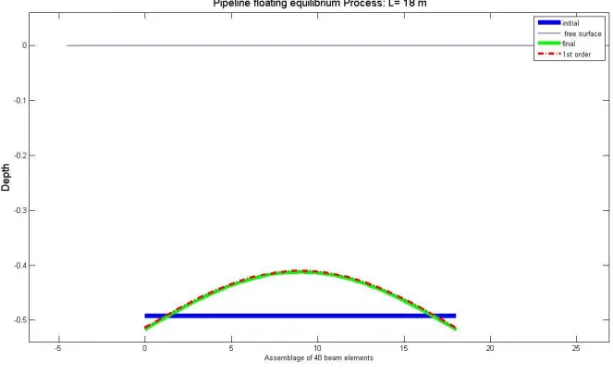
Figure 6: Symmetric pipeline
In figure6 the deformed pipeline obtained by a linear analysis is shown. Also the de-formed pipeline found according to a more elaborated analysis, namely, a nonlinear analysis using an incremental and iterative procedure is presented in the figure. It can be observed that the first order analysis produces larger displacements than the nonlinear analysis.
The initial equilibrated position of the tube (tube weight without lids and uplift Archimedes pressure) is reached for a axis pipeline position of -0,4929 meters.
7..2. Nonsymmetric pipeline
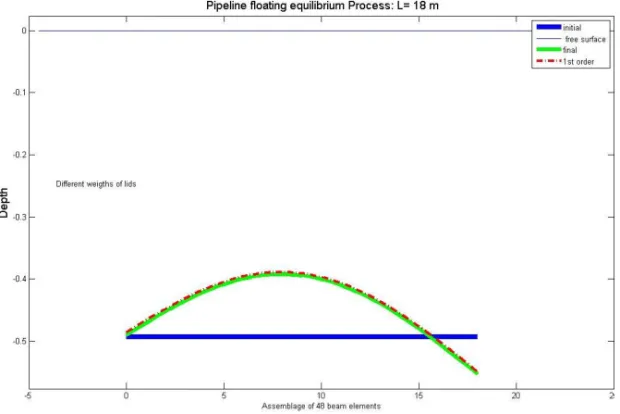
The tube used in this example corresponds to the previous tube but with different lid thick-nesses. One lid has 6 cm of thickness and the other 9 cm. The results are shown in figure 7
8. Conclusions
Figure 7: Nonsymmetric pipeline
9. Acknowledgments
The financial support for this work provided by theDirecci´on General de Investigaci´onof the Spanish Ministry of Education and Science under the research contract DPI2005-09203-02 is grateful recognized by the authors.
References
[1] Garc´ıa-Palacios, J. and Samart´ın, A. and Negro, V. A nonlinear analysis of laying a floating pipeline on the seabed.Engineering Structures, 31(5):1120–1131, 2009.
[2] Schweizerhof, K. and Ramm, E. Displacement dependent pressure loads in nonlinear finite element analisys.Computer and Structures, 18(1):1099–1114, 1984.