Establishing a Theoretical Basis for the Design of an Introductory Hands-on Course in Language Teaching
Clauder Hernando Rojas Caro Universidad Nacional Abierta y a Distancia
Colombia
The Program of B.A. in Teaching English as a Foreign Language School of Education
In Partial Fulfillment
of the Requirements for the Degree of Licenciado en Inglés como Lengua Extranjera
Adviser: Diana Cruz Galeano
June 2018
BASIS FOR DESIGN OF COURSE IN LANGUAGE TEACHING 2
Abstract
The current project aims at establishing the theoretical basis for the design of an introductory hands-on course in language teaching for people who are inexperienced in the teaching
profession. The parameters established for the design of the course at the end of this project will keep in mind the context and students at a language institution in Bogotá, Colombia and will be mainly based on the principles followed by the textbook Face to Face by Cambridge University Press. An actual lesson of the course with its materials will be developed. By restricting the teaching materials to the use of a single commercial textbook I created some good conditions to introduce my trainees to the language teaching practice without the need of contemplating the entirety of the field. Also, the results of this stage (once analyzed) and the research carried out about the basic aspects of language teaching related to my project will give me the necessary information to create the subsequent lessons in order to complete a more through course.
ACKNOWLEDGMENTS
TABLE OF CONTENTS
ABSTRACT ...2
ACKNOWLEDGMENTS ...3
LIST OF TABLES ...6
LIST OF FIGURES ...7
ESTABLISHING A THEORETICAL BASIS FOR THE DESIGN OF AN INTRODUCTORY HANDS-ON COURSE IN LANGUAGE TEACHING ...8
Significance of the Study ... 9
Statement of the Problem ... 11
Objectives ... 12
General Objective ... 12
Specific Objectives ... 12
LITERATURE REVIEW ...13
Communicative language teaching ... 13
Language skills ... 17
Reading and Listening ... 17
Speaking and writing ... 19
Grammar: the fifth skill ... 21
The teaching of language skills... 23
Lesson planning and classroom management ... 25
Teacher training and class observation ... 28
METHODOLOGY ...31
Description of the type of course to be designed ... 32
Type of approach the course will be based on ... 33
Design/adaptation of materials ... 35
The Process of Materials Creation ... 37
Specification of course objectives ... 40
Description of the target students’ profile and their learning needs ... 41
Proposed working schedule ... 43
RESULTS ...44
Course contents, selection and organization ... 44
Estimated timetable ... 47
Course materials... 54
Course assessment ... 61
DISCUSSION ...64
CONCLUSIONS...66
REFERENCES ...70
LIST OF TABLES
Table 1. Subsidiary aims of the course. ...41
Table 2. Students Profile. ...42
Table 3. Estimated working schedule for the project. ...43
Table 4. Table of contents of the course. ...45
Table 5. Estimated timetable for every session in the course. ...47
LIST OF FIGURES
Figure 1. The process of Materials Adaptation. McDonough and Shaw 1993:96 ...37
Figure 2. The process of materials creation. Jolly, D. & Bolitho, R. in Tomlinson 1997: 97 ...38
Figure 3. The process of materials' writing. Jolly and Bolitho (1998). ...39
Figure 4. Lesson 1, exercise A (Sample fragment) ...56
Figure 5. Proposed observation form, exercise 1 ...58
Figure 6. Observation form, exercise 2 sample item. ...59
Figure 7. Sample fragment of the trainer's manual. ...59
Figure 8. Written test, sample question...60
Figure 9. Class observation (Sample questions) ...62
Figure 10. Sample items for the course assessment questions. ...62
CHAPTER 1
Establishing a Theoretical Basis for the Design of an Introductory Hands-on Course in Language Teaching
The current project aims at establishing the theoretical basis for the design of a basic hands-on course in language teaching for people who are inexperienced in the teaching
profession. The course will keep, as a point of reference, a specific profile of language students (which I will describe later in this work) located in Bogotá, Colombia and it will be mainly based on the principles followed by the textbook Face to Face by Cambridge University Press. An actual lesson of the course with its materials will be developed as part of the development of this monography.
Significance of the Study
Although there is a wide variety of introductory courses to the teaching profession in the market, this project will contribute in the way that it will delineate a simplified version of such courses, which can be used to train students who are not familiar with the field. I attempt to select a suitable set of procedures from the ones currently used the teaching of a second/foreign language which can be immediately applied to actual teaching practice by students who are inexperienced in the field.
The hands-on aspect of the course will differentiate it from many other courses which are grounded in theory and in explaining what the former aspects mentioned are. This will be done by demonstrating those aspects to study through videos, for instance, instead of actual teaching practice. This is done because we expect that our trainees will include the application of the techniques studied in actual classroom conditions.
At the end of this project I expect to have a concrete scheme of work I can put into practice to train students with the proposed profile. I also expect to have an initial stage of a bigger project which I could later turn into a legally accepted program in my city. This way, I could give my learners a diploma as technicians in the field of teaching English as a second language.
I would also like to mention my personal interest in the project I expect to develop. Besides the general interest I have in the wide range of subjects that the teaching profession encompasses, this project will allow me to put most of what I have learnt during my studies at UNAD into actual practice. This will be done because I will have to condense such knowledge, simplify it and translate it in such way that it will be more understandable, in order to turn it into a short hands-on training course for future teachers.
Statement of the Problem
Although having a good command of English is currently recognized as an asset for students and professionals in almost any field (Graddol, 2006), this does not mean that our students recognize such importance by just hearing everyone around them state such fact. On the other hand, if we understand that our students’ motivation can be affected precisely by not envisaging what the real purpose of learning the language is, we should also understand that it is one of our duties as teachers to give them such an objective since part of our jobs is to motivate them (Brooks, 1964). Learning how to teach can be such objective.
I consider that this goal would help them focus their attention while they are studying the language, positively affecting their motivation. Placing a very clear and more immediately achievable goal right in front of them would mean that instead of having to repeat to themselves that their current studies might bring something important to them in the future, our students can make more sense of their English learning (Ellis & Sinclair, 1989).
Besides all I have mentioned before, the addition of an introductory course in language teaching to a regular program of English studies might open students’ minds to a new alternative, to a more concrete goal to achieve with the language they are learning and it might even give them a chance to start working in the teaching field in the near future.
Objectives
General Objective
To establish the theoretical basis for the design of an introductory hands-on course in language teaching based on a specific commercial book, aimed at people who are inexperienced in the teaching profession.
Specific Objectives
● To establish the theoretical basis for the design of the lessons which will give our trainees the background information they need to understand the overall structure of the lessons in the chosen textbook
● To specify the theoretical background for trainees to understand the objective (s) of a certain exercise within a lesson and how such exercise relates to the other exercises in that lesson
● To select a repertoire of strategies and techniques that enable the trainees to use the exercises in the textbook in real teaching practice
CHAPTER 2 Literature review
In this chapter I talk about the state of the art in the essential aspects that our trainees need to become familiar with in order to use the textbook we have proposed. This means that the aspects of language teaching/learning studied will be studied as long as they are useful in the actual practical application which will be carried out by our trainees while teaching with the book Face to Face by Cambridge University Press. Since such book claims to work under the communicative approach (CLT), we will start with its review, to then, talk about the teaching of language skills. After that, we will study language analysis for teaching, to then review some strategies and techniques for presenting exercises in a textbook. We will continue with the analysis of group management skills to finally, cover two central aspects of our training course: teacher training and class observation.
Communicative language teaching
language and, at the same time, to its structural features. This all seems to point out at the prioritization given to communication in the teaching/learning process of a language within the communicative approach (Brown, 2000).
Richards & Rodgers (1986) summarize these main characteristics in a set of premises that reflects this perspective. They start by emphasizing the interactional and communicative function of language as well as the importance of its grammar, not as a passive set of rules to be learnt but as something which is applicable to communication.
The communicative approach has been deeply influenced by theoretical advances in other related fields such as pure linguistics. For instance, Noam Chomsky (1965) has been very
influential in the field since he developed his theory of linguistic competence. Hymes (1972), on the other hand, proposed his communicative competence theory and finally Swain (1985) who structured his comprehensible output hypothesis. All of the former have delineated some characteristics of language itself in all its dimensions as well as of the speakers of a language. Even more important to the present work, these characteristics they have described and
characterized within their theories directly influence language- teaching practice by pointing at the key aspects any teacher should aim at and observe along a teaching/learning process.
conditions for students to learn it, since the pressure of having to communicate helps them focus on what is needed to master the target language.
Another very important aspect of the communicative approach is precisely related to its communicative nature and it is of the upmost importance in the design of my course since the textbook in which it is based uses this approach as an integral part of its syllabus. We refer to the notional/functional syllabus (Wilkins, 1972). The term “notional” refer to the language used to express concepts such as location, frequency, time, sequence etc. and functions referring to (requests, threats, complaints, offers etc.). This view of language differs from the ones, which preceded it, such as structuralism or behaviorism (Nunan, 1988 ) and it is paramount, since it exemplifies the importance of making the contents studied as useful as possible to the learner (Wilkins, 1972). What we really need to take into account is that, unlike the proposal made by Wilkins, the lessons of the book which center around functions or notions do not take strongly into account the structural aspects as other lessons in the book.
The next aspect to study within the communicative approach, is that of the subskills of communicative competence. This development in the theory of CLT came from Swain (1985) who identified the “sub competences” that a speaker of a language should have. These are: the accurate use of grammar and vocabulary which every language student should master. This sub-competence is referred to by the author as grammatical sub-competence.
The last aspect I need to talk about within the study of CLT is what the influence of all the theoretical developments previously mentioned; have on the language teaching practice. In order to do this, I am going to look at the contribution made by Widdowson (1979) who listed the aspects of language that should be emphasized in the teaching/learning process within CLT. This also refers to the perspective, which teachers should adopt towards language and
communication.
First, he mentions appropriacy, explaining that it is the effectiveness of an utterance in communicating a message whether the grammatical accuracy in such utterance is high or not. Then, he mentions “use” which describes how a speaker is able to put into practice in real communication the linguistic abstract rules he/she has learned. The next aspect he mentions is the mastery of the pragmatic rules of a language, which helps speakers differentiate between the connotation that words and expression might have within a certain context. He has called this the value proposition, which is the next term in the list and it refers to the function of an utterance whether it is grammatically correct or not. This characteristic helps speakers differentiate aspects such as the intention behind an utterance. Finally, we find coherence which helps speakers and listeners identify whether a whole message makes sense or not.
Widdowson’s categorization of a CLT perspective on language and language use helps us identify which aspects of such language should be emphasized in the teaching practice, and thus, they are essential to any language teacher who attempts to adopt the CLT approach. It is
Austin, 1962, for instance) as it is precisely the case of the textbook object of this study, which still reflects a strong focus on the explicit teaching of grammar.
Language skills
Now that I have studied the main theory underlying CLT and its essential elements for any language teacher, I need to take a look at the actual application such concepts have in the teaching practice. I am going to start by analyzing the teaching of language skills within CLT from the perspective of Spratt, Pulverness and Williams (2005), whose book, The TKT course, summarizes the characteristics of the skills from a very appropriate perspective for the purpose of this dissertation, teacher training. The first skills I am going to look at are the so called “receptive skills”, reading and listening.
Reading and Listening
know about the real world. From here, they should be able to see if such connection actually makes sense (coherence).
A main skill is composed of other subskills (Spratt, Pulverness and Williams, 2005), which in the case of reading are: reading for specific information (scanning), reading for gist (skimming), and reading for detail. An important kind of reading is that of intensive reading which is a learning activity used by teachers to guide students through the formal analysis of a text (or parts of it). Although it is not a subskill it is important to mention it here since my trainees would have to become familiar with it. I am now going to study the second receptive skill, listening.
Listening, as it is described in the TKT course (Spratt, Pulverness and Williams, 2005), involves making sense of the sounds of language and just as reading it is not a passive process. Listeners actively use their knowledge of the world and their knowledge of the skill in their own language (L1) in order to understand the message being received. They predict, hypothesize, among other strategies. Although there are similarities between listening and reading there are fundamental differences due to the very nature of the former. For instance, unlike reading, the message being received disappears right after being uttered. This means that listeners should be able to store the information as long as the communicative exchange requires it. They should also be able to process such information at a very rapid speed.
sometimes carries communicative meaning in itself. Spoken discourse is not well organized and its organization is affected by hesitation, paraphrasing, interruptions, etc. and it also uses more general vocabulary and simpler grammar than that found in reading (Batstone, 1994). Teachers who are training their students to listen in a foreign language should be aware of all of these characteristics in order to guide their students better (Holec, 1980). Listening has subskills which resemble those of reading: listening for gist, listening for specific info, and listening for detail but it adds another one: listening for attitude. This must be observed carefully since the attitude of the speaker might completely change the message being received. It is important to take into account that a learner perceives the speed at which a language is spoken and the accent of the speaker might affect the way the message. Teachers should plan for this and attempt to minimize the resultant negative effects on their students’ learning process (Fanselow, 1987).
Speaking and writing
These two skills have been classified as “productive” (Spratt, Pulverness & Williams, 2005) since they obviously require the individual to produce language in one way or the other. Speaking involves the use of the sounds of a language to convey meaning to the listener. It involves the knowledge of the sound system of such language as well as of the rules that govern it like connected speech, stress, intonation, etc. Other rules have to do with the linguistic system but also with the metalinguistic characteristics of the language being spoken. The latter involve from the use of interaction strategies such as taking turns or asking for clarification to the use of body language. A good speaker of a language should be aware of all of these characteristics and so we should instruct our trainees about them.
has been provided by Spratt, Pulverness & Williams (2005). This list can be used as a departing point of aspects to be taken into account while teaching speaking. Such aspects are the grammar and vocabulary (correct use of tenses for instance), functions (asking for clarification, greeting people, etc.), connected speech (word pronunciation and intonation in the context of a sentence, for instance), appropriacy (responding appropriately to a person with a higher rank, for instance), body language (smiling), interaction (correcting oneself, taking turns in a conversation). The other productive skill which needs to be analyzed for the purpose of this study is writing.
According to the authors, writing is the second productive skill and although it bears some resemblance to its partner, speaking, there are, of course, some specific characteristics which differentiate them. Writing starts with the need to communicate a message and it implies that there is someone to whom a message is directed. Although technically speaking, from its very basis writing requires a minimum level of skill at marking paper with the symbols of the language being used for communicating the message, I am not going to deal with this issue since the students I intend to train in my course already master these basic skills. However, some other essential skills and subskills required in order to produce written language will have to be
analyzed.
necessary in order to be able to communicate effectively through writing. Besides, it is essential to take into account that, unlike speaking, written production gives us the chance to plan what we want to say. This implies that my students should be instructed in such process. Planning a written text could be done in many ways but, for the purpose of this dissertation, we are going to adopt Spratt, Pulverness & Williams’ (2005) proposal.
The authors propose a series of steps which I am going to analyze now. The first step in this process should be brainstorming, which involves thinking about a certain topic without any restrictions and taking notes of our ideas. Then, there is the planning, which involves selecting the ideas that are useful for our purpose, discarding the ones that are not and then organizing them coherently. Next, we start with the writing of a first text which is read and improved over and over until we reach a final version. The final objective is that students produce a written text which is as communicative as possible and which follows a minimum amount of the writing rules studied by students. Although there is much more to be said about language skills, it is out of the scope of this dissertation to discuss the subject in depth. Nevertheless, there is still one more language skill which I am going to discuss due to its relevance to language teaching and the strong focus that the textbook object of my study gives to it, that skill is grammar.
Grammar: the fifth skill
analysis in which they have to answer questions about the structure and function that a certain grammatical structure has in the context in which it is presented. The content of the listening or reading point is in itself disposable as it is only used as a means of presenting the grammar point (Richards & Rodgers, 1986), hence, it is not taken into account for the assessment of the
students. It is the grammar which is assessed through discrete point items in the tests provided by the authors of the textbook.
Grammar is the study of the ways we make meaning by combining, organizing and transforming the components of a language, be it words, phrases, clauses, etc. (Spratt, Pulverness & Williams, 2005) It is naturally used by the speakers of any language and by us, teachers, in order to help our students understand how language works. We do this by describing language to them and this description is usually made in grammatical terms. Grammar is closely linked to language functions which I have previously described as the reason why we communicate. It is composed of parts of speech (verbs, adjectives, adverbs, determiners, prepositions, pronouns, conjunctions, and exclamations), grammatical structures (parts of speech put together to convey a certain meaning) and words with all their variations caused by the use of prefixes and suffixes.
According to White (1988) the teaching of the grammatical aspects of language is basically approached from two opposite sides of a spectrum. It is either inductive or deductive, analytic or experiential or it attempts to either create a habit or help students acquire language in a more naturalistic way. From this perspective, I can classify the main approaches adopted in the teaching of grammar.
through the analysis of such grammar. The guidance is given through questions about the structural and functional aspects of the topic studied. At this point it is easy to see that the approach to the study of grammar that the authors of the book have adopted is inductive and analytical (Stern, 1983). Although it is true that there is an experiential approach in the presentation of the topics, it is important to keep in mind that this stage is only carried out in order to contextualize the specific grammar point to study and, at the same time, make it easier for students to assimilate it.
The teaching of language skills
I am now going to explore the practical application that all the concepts I have studied so far have in language teaching. This section specifically focuses on the techniques and procedures used by teachers to guide the learning process within the methodological framework chosen, namely CLT. I have chosen those techniques, which are applicable to the teaching of any of the skills studied and those which, in my opinion, can be easily understood by our trainees in a short training course such as the one we intend to create. It is important here to bear in mind that once the course has been put into practice, the experience accumulated and the feedback from my trainees will help me decide which techniques I should keep and which I should not keep for the subsequent developments of my course.
(2007) and some others. It is necessary that the reader keep in mind that although these proposals are very valuable to any language teacher, I am only going to discuss those, which match the ones proposed in Face to Face and those which are applicable to teaching practice with this textbook. This analysis is intended to give my trainees the necessary background in the teaching of the language skills so they are able to identify the elements studied in the procedures proposed with the textbook they are going to be using.
It is essential to keep in mind that I am going to adopt a procedure proposed by Harmer (2007) for the whole lesson. This procedure is Engage-Study-Activate in which engaging means stimulating student’s interest in the topic to be studied, studying refers to the formal analysis of the item(s) being presented to students, and finally, activating refers to allowing students to use the language they have learnt. For the individual exercises that compose a lesson, mainly those which focus on the receptive skills, I am going to use the well-known overall sequence of activities starting with a “pre” stage a “while” stage and a “post” stage (Peachey, 2016). As we have already said, these stages are applicable to any skill but for this example I am going to mention listening only.
students’ attention on specific information, usually through the use of a set of questions which students must read and understand before performing the task. Finally the post-listening activities, which for the case of the textbook I am using, usually focus on a detailed analysis of the structures, vocabulary items or functions being used in the passage. This analysis is done inductively and it is guided by questions that focus students’ attention on all the relevant aspects to be understood.
Although in the section devoted to writing as a language skill I have already mentioned the sequence that a typical writing procedure follows, it is important here to review it briefly in order to establish a standard procedure within my training course. This procedure will be applied to the other productive skill, speaking. I am going to analyze now the proposal in this respect made by Thornbury and Watkins (2007) which goes like this: firstly, students explore ideas, which may come from partners, books or other sources such as brainstorming students’ own ideas on a certain topic. Secondly, students organize their ideas in order to select the best ones and to put them in a coherent sequence. Thirdly, a first draft is written, read and edited as many times as necessary to finally produce the final text.
Our analysis continues with lesson planning which is an essential skill for any language teacher to master.
Lesson planning and classroom management
Watkins (2007) to the specific context of the course I attempt to create and so I have left out whatever I considered unnecessary.
First of all, they emphasize the importance of lesson planning. The materials (copies, markers, pens, dictionaries, etc.), video or sound equipment must be set and tested beforehand. According to the authors a teacher should also attempt to predict and prepare for any problems that might arise during the lesson. These problems might be related to logistics as well as to the content of the lesson itself. The latter may have to do with vocabulary, grammar, etc. and so, a teacher must be prepared for this. A good way to predict problems of this nature is to read and re-read the lesson while trying to “get in our students’ boots” in order to think the way they would. Another good way to prepare for such events could be to rehearse what one is going to say and predict what might happen afterwards.
The authors state that a teacher must be aware of the objectives of a lesson in order to guide the lesson towards those objectives. Teachers must be reflective and able to analyze the whole process of the class as it is occurring from the beginning to the end and even afterwards. A good way to do the latter is to set some personal objectives for the class beforehand, then reflect on how the class went once it has finished, to finally compare these conclusions to the objectives. This can be done through the use of a written form specially designed with questions on points that the teacher might want to observe about his/her own performance.
Lesson planning also involves thinking about classroom management, which has to do with the way the teacher behaves or assumes a role in the classroom and how he/she
knowledge about many different aspects of teaching.
These roles are, for instance, planner, which requires knowledge about preparing a lesson. The role of informer requires teachers to be able to give information about language or about how an activity works. The administrative role implies that the teachers should able to organize the classroom and the students for a certain activity by giving clear rules to control students’ behavior. The role of monitor implies that the teacher knows how to supervise what is going on in the classroom and how to guide the learning process as it evolves. The teacher acting within this role should also be able to supervise pair or group work. The role of involver requires the teacher to be able to motivate all students to participate actively and at all times in the
learning process. The parent/friend roles involve dealing with student’s mood whenever it interferes with the development of the class. Being a diagnostician means recognizing particular difficulties students may have to then find the way to help them. Finally the teacher playing the role of a resource should be able to help students and to give advice when it is required.
From the previous information I have found out that any teacher should be able to know when to adopt every one of these roles and to act accordingly in order to make the learning process more efficient. These roles might change according to the group of students or the language teaching/learning setting. All of them require knowledge of the subject matter being taught as well as of the humanistic aspect of teaching (Holliday, 1994).
come in many forms such as teacher-group, teacher-student, student-student or group of students-group of students. According to Spratt, Pulverness & Williams (2005), the decision of organizing students in a certain interaction pattern must be taken according to the students’ learning styles, needs, relationships with others and level of ability. My trainees should be aware of these aspects in order to be able to group students wisely and to solve any problems arising from this particular aspect of classroom management.
Teacher training and class observation
The final aspects of teaching to study in my theoretical background chapter are teacher training and class observation. As to the first one, in order to adapt my course better to the specific context to be intervened, I have chosen to structure it around two concepts: teacher training and mentoring.
As it is seen by Richards and Farell (2005) teacher training is a very specific aspect in teacher education which has to do with short-term immediate goals. A trainee must show
mastery of specific theoretical concepts and strategies, which he/she should later be able to apply in actual classroom practice. Training usually involves direct supervision of a trainee’s
performance and further feedback from the trainer. Some of the goals of regular training courses mentioned by Richards and Farell (ibid: 5) perfectly match the objectives of the course we attempt to design: “Adapting the textbook to match the class, learning how to use group activities in a lesson, and acquiring techniques for giving learners feedback on performance”.
that modelling, as a core characteristic of the mentoring process, requires feedback sessions in which mentor and mentee analyze whatever happened in a certain lesson. Through this analysis they summarize the positive and negative results of such lesson. After this, they should come to a conclusion as to what aspects should be improved or worked upon.
Mentors should have some specific characteristics in order to make the training process as effective as possible and as smooth as possible. Among others, they should always be patient, understanding, kind, diplomatic, optimistic, and willing to share their knowledge (Inostroza, Aguila, & Zúñiga, 2007). It has also been pointed out by Rowley (1999) that mentors should be committed, accepting of their trainee and able to provide instruction appropriately.
According to Inostroza, Aguila, & Zúñiga, (2007), the mentoring process involves mutual class observation, after which the trainee will attempt to imitate his/her mentors’ methodological approach, strategies as well as any other positive traits they may have.
The main approach to guide the learning process of the trainee in my training program will be mostly a prescriptivist approach as it has been described by Randall & Thornton (2001). Such approach implies that the mentors will follow a very straightforward scheme of work to guide their trainees. First, the mentor gives specific instructions to the trainee as to what to do. This is called a directive intervention. Second, the trainer demonstrates what he/she wants his/her trainee to do. Finally, the trainee applies what he/she has learnt to actual teaching practice. The trainee should be given permanent feedback and any other kind of support required for him/her to be able to perform well.
It now seems obvious that within this training scheme of work, class observation will play a very important role since, as I have said above, the first step in my training process
trainees will have to be guided through this process in order for them to notice the aspects of the class being observed.
Wajnryb (1992) and Malderez (1999) offer a good methodological framework to better understand this important subject. Classroom observation can be carried out for multiple reasons; however, the kind of classroom observation I am going to be focusing on will be that of
observation for training (Malderez, 1999). The author proposes that in this type of observation, in order to understand what is expected from him/her, the trainee can observe several aspects of the class: the trainer’s behavior, the interaction patterns between the trainer and the students, and the dynamics of the group, among others. According to Wajnryb (1992) the specific aspects to observe should be guided by an observation task which should be specifically designed by the trainer to focus the trainee’s attention in the key points before the actual session starts. Wajnryb also states that observation tasks given to trainees help them focus their attention on one or several aspects of the lesson and not others. They also free trainees from any bias or from
forming opinions, which might deviate them from the central objective of the observation. These tasks can be guided by any type of questionnaire of form which can be filled up by the trainee while observing the class.
CHAPTER 3
Methodology
In this section, I am going to talk about the main aspects related to the methodology, which I will follow in order to design the training course. First, I have chosen to talk about the overall procedure I will follow for the design of the course. Then, I am going to describe the kind of course I am going to design. Next, I will define the type of approach the course will be based on and the specific objectives I hope to achieve. Finally, I describe the profile of the students I am going to keep in mind as the target population of the course.
Description of the process for course design
The process of course design will start with the decisions related to the main aspects of curriculum that White (1988) has proposed. This means that I will first decide on the objectives, contents, method of instruction and evaluation system of the program. The syllabus of the course will derive from the first two of these aspects I just mentioned. I am going to use Dubin and Olshtain’s (1986) perspective on this issue, which means that syllabus will refer to the steps that I am going to take in order to achieve the most specific objectives at every level.
language adopted. The term “procedures” refers to the teaching practices and techniques used by teachers in actual teaching practice. These depend on the theory of language learning adopted. Once I have finished defining all these aspects, it will be possible to define the timetable, which will be followed for the course.
After all these aspects of course design have been covered, there will have to be a stage for the creation of the materials that are going to be used during the course. There will have to be a trainer’s book, a students’ book, class observation forms and the written tests. Although not an essential element of the course, it would be important to create templates for the certificate and diploma, which could be given to students once they have finished and satisfactorily achieved the aims of the course.
From the perspective of course design, a final stage has to be added. This stage will be devoted to the assessment of the course itself. This stage will use all the experience gathered along the process. The information collected will be used in order to produce a second, improved version of the course. This implies that forms to guide the feedback of the process will have to be created. It is important to take into account that feedback about the course can come from the trainer himself as well as from the trainees whose insight could give us wider perspective on all aspects of the course.
Description of the type of course to be designed
The course will have a theoretical aspect and a practical one. The theoretical aspect will help students become familiar with the basic terminology and concepts behind the language teaching profession, but just those concepts, which students will need for the rest of the stages of the course. This component will have to be covered in classroom sessions with the trainer (or mentor) and the group of trainees. The practical aspect will be divided into two parts: the class observation of the trainer by the trainees and the actual practice carried out by the latter in a real classroom session with real students.
Students will observe, either the trainer in actual teaching practice or a video of an experienced teacher in which the concepts learnt in the theoretical stage are exemplified. Then, they will have to replicate what they have learnt in actual teaching practice with real students. The class observation sessions will be guided by forms, which students will have to fill out as they observe the classes. Trainees will receive permanent feedback on their observation, class preparation and teaching practice.
The assessment of students will be carried out by the trainer in two ways: theoretical assessment and practical assessment. The theoretical aspects of the training will be assessed through written tests and the practical aspects will be assessed by the trainer, while he/she observes the trainees applying what they have learnt in an actual classroom. This class
observation will be guided by forms, which specify which aspects will have to be assessed. This means that the creation of such forms will have to be included in the design stage.
Type of approach the course will be based on
our course will be based on a paradigm centered on knowledge. The type of course I am going to create requires students to be able to replicate the theoretical concepts, techniques and strategies almost exactly as they received them. The teaching style will be mostly centered on transmission and students will have to replicate the actions of the trainer as closely as they can. The contents and objectives will be pre-specified and students are expected to learn them exactly as they will be presented to them. The role of the trainer will be mostly interventionist, which means that he will prescribe what trainees will have to replicate as I explained before.
The product to be measured, as it is the objective of this type of syllabus, will be the written assessment of the students who will have to learn the concepts studied by heart and the performance of the students as it will be observed by the trainer. Such performance will have to comply with the specification previously studied in the training sessions.
According to the type of course I decided to adopt, a mix between training and
mentoring, I have chosen the principles to follow from Gagné’s method (Moreno, 2014). This means that the course will focus on making students able to execute the techniques modeled by the teacher as identically as possible. The steps to follow will be first, task definition, which will center on the conceptual aspects behind the task. The second step will be the analysis of the task. This will be done by dividing the task into several subtasks in an attempt to make the concepts easier to assimilate by the students, and then these tasks will be studied and organized in a coherent sequence. The third step will be the reinforcement and feedback stage which will be done just as this method prescribes it, immediately after they have been executed by the trainee.
simulated environment, the last stage, transference will be performed in a real situation. The trainees will receive permanent feedback at every stage and they will be encouraged to analyze their own performance just as this method proposes.
Design/adaptation of materials
Since a course such as the one I present in this paper requires some materials to support the class sessions, I need to talk about the topic of materials creation and adaptation. In this study, I found that some theorists in the field of language teaching argue that those materials which are created/adapted by the teachers themselves having a specific context and goal in mind are the most appropriate ones (Jolly & Bolitho, 1998) (Tomlinson, 2011). While this might or might not be totally true, I am going to talk about these two issues (materials creation and adaptation) in order not to leave out any of the considerations I need to make to create a solid proposal of materials for my course.
Some of these aspects have been listed by McDonough and Shaw (1993) who found out the reasons why teachers decide to create/adapt materials. I have given some explanations to illustrate the reasons why I considered certain conditions should be met in my own materials according to the specific context I am going to work in:
According to McDonough and Shaw (1993), the characterization of these aspects is as follows:
- Grammar coverage/practice is not enough.
- Grammar is presented unsystematically according to the communicative focus of a lesson.
- Reading passages contain too much unknown vocabulary.
- Some questions are too easy or obvious since the answers do not require real understanding of the text.
- Inauthenticity of listening passages. They are sometimes based on written material which is read out.
- There is not enough guidance on pronunciation.
- Inappropriate subject-matter for the learners’ age or intellectual development. - Culturally inacceptable photographs and other illustrative material.
- Too much/too little material to cover in the time given for the lessons.
- Teachers are not given enough guidance on how to handle group work and role play activities.
- The dialogues are too formal or they do not represent native speakers’ authentic speaking.
- Audio materials difficult to use because of problems related to room size and technical equipment.
- The variety in the activities is not appropriate.
- Materials to do not contain key to the activities or vocabulary definitions required. - Need for tests/quizzes. (p. 83)
individualization (adaptation to students’ learning styles) and localization (adjusting to particular sociocultural issues).
The following figure shows the framework for the process of adaptation of materials designed by McDonough and Shaw’s (1993) where they attempt to describe the elements of their proposal:
Figure 1. The process of Materials Adaptation. McDonough and Shaw 1993:96
The Process of Materials Creation
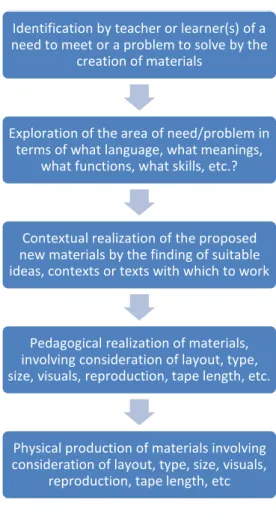
considerations out. I have taken Jolly and Bolitho’s proposal as a guide in this respect. The following diagram, which I transcribe here, illustrates such process:
Figure 2. The process of materials creation. Jolly, D. & Bolitho, R. in Tomlinson 1997: 97
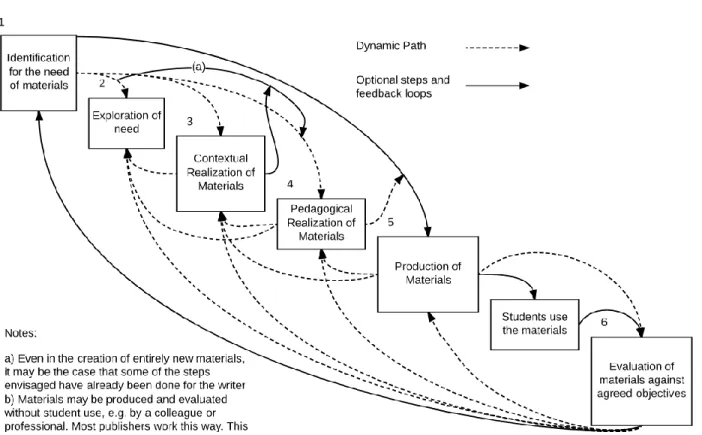
The authors point out that an evaluation stage should be added to their proposal. Such stage, according to them, is crucial for a complete cycle of production of materials. They state that including an actual application in real teaching practice in a classroom and a further adjustment according to the feedback obtained during such process would complete the whole process (Jolly and Bolitho, 1998).
Identification by teacher or learner(s) of a need to meet or a problem to solve by the
creation of materials
Exploration of the area of need/problem in terms of what language, what meanings,
what functions, what skills, etc.?
Contextual realization of the proposed new materials by the finding of suitable ideas, contexts or texts with which to work
Pedagogical realization of materials, involving consideration of layout, type, size, visuals, reproduction, tape length, etc.
Physical production of materials involving consideration of layout, type, size, visuals,
Considering this fact, they expanded their proposal further and concluding that the production of any materials is not a linear process. They pointed at the fact that such process is a series of steps which must be reviewed, adapted, and tailored in many ways while going back and forth from one step to the other. Such conclusions, along with the whole process proposed, are illustrated in the following diagram:
Figure 3. The process of materials' writing. Jolly and Bolitho (1998).
teaching/learning process, which is a perspective I think should be taken into account in the writing of my proposal.
I need to mention here that Jolly and Bolitho (1998) consider that all teachers need some knowledge in materials creation, since such knowledge helps them develop their own criteria when they themselves evaluate those materials produced by others. This also helps in teachers’ professional development as it raises almost every issue related to the teaching profession. Analyzing materials requires knowledge on issues such as methods, techniques, strategies in their relation to teaching practices themselves. This analysis poses a great challenge which contributes to the professional growth of those who embark in it.
Specification of course objectives
Main aim:
Students will be able to teach an English class with the aid of the book Face to Face by Cambridge University Press applying some procedures to achieve the aims of the lessons proposed in the book
Subsidiary aims:
By the end of the course, students will:
be able to identify the overall structure of the lessons in the textbook
be able to present the exercises in a lesson of the book, monitor and give feedback to their
students
be familiar with basic teaching terminology and concepts
Table 1. Subsidiary aims of the course.
Description of the target students’ profile and their learning needs
I am now going to describe the overall profile of the target students for the course which are basically the desired characteristics of our target students. It is important to mention here that in the development of this description, I realized there will have to be a stage in which I have to gather the specific information concerning the profile of my trainees. This means that I will have to create a survey form which will give the information required to customize the course as well as possible to my target group.
In order to structure this description and not to leave out any important information in this respect, I have adopted the list of characteristics provided by McDonough and Shaw, (1993). Although I will have to take into account some of the characteristics mentioned by the authors before and during the actual implementation of the courses, I have left some of them out since without actually knowing who they are it is difficult to predict them. These items are: Attitudes to learning, preferred learning styles, interests, and personality. However, these characteristics will have to be observed by the trainer and he/she will have to adapt any aspects of the course necessary. Here are the characteristics:
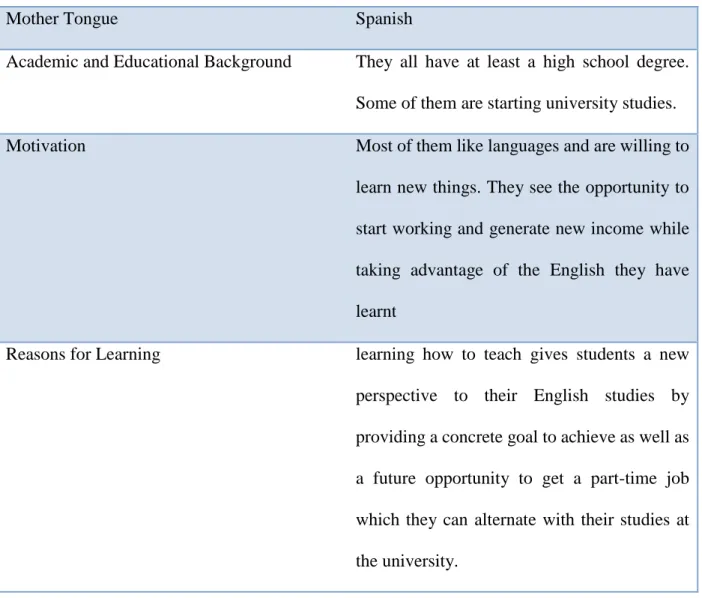
Characteristics of Students
Age Between 16 and 20 years old.
Mother Tongue Spanish
Academic and Educational Background They all have at least a high school degree. Some of them are starting university studies.
Motivation Most of them like languages and are willing to
learn new things. They see the opportunity to start working and generate new income while taking advantage of the English they have learnt
Reasons for Learning learning how to teach gives students a new perspective to their English studies by providing a concrete goal to achieve as well as a future opportunity to get a part-time job which they can alternate with their studies at the university.
Table 2. Students Profile.
Once I have described my trainees’ characteristics, I need to talk about their needs, which according to the aspects mentioned by Spratt, Pulverness and Williams (2005) are divided into personal needs and future professional needs. As to the first one, our students needs come from their age, interests, educational background, cultural background and motivation.
thanks to the analysis I have made for this section I realized that a further development of this project could focus on finding out the specific aspects that motivate students to take the course. I will discuss this further in the discussion section of this monographic paper.
My target group of trainees are also motivated because they see languages as a way to travel abroad, get to visit many places in the world and get to know people from other cultures. As to future professional development, most of them would like to study professions for which languages are an important component. Teaching is one of them and so, a short training course in language teaching which implies actual teaching practice seems very attractive. Such course can give them an idea of what teaching is like and it can even help them make the final decision whether to continue with it as a career or not. They also see this short teaching course as a quick way to start making some money.
Proposed working schedule
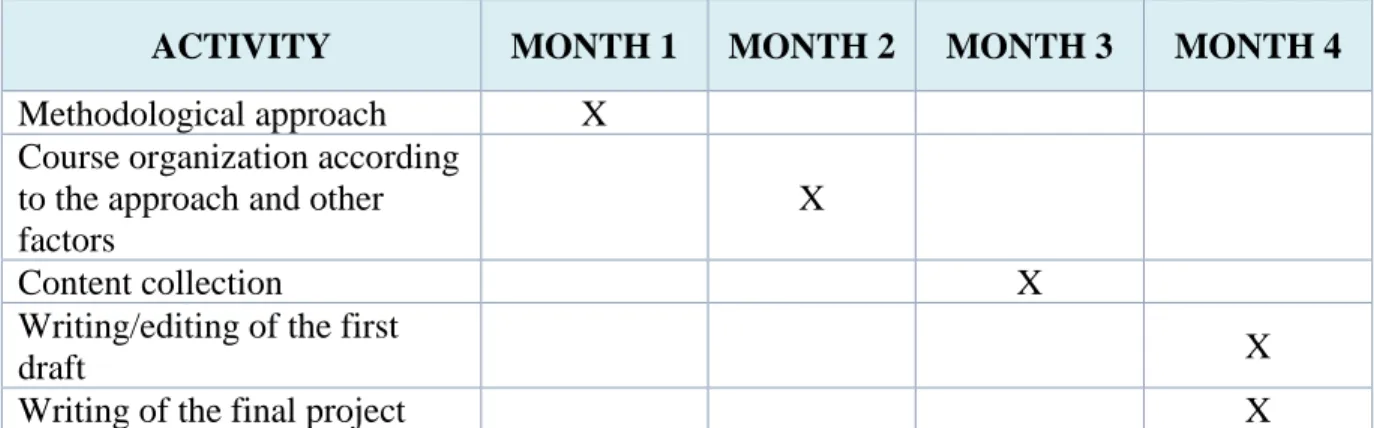
Finally, I am going to propose a working schedule, which I think contemplates all or most of the activities to carry out for this project within a chronogram, which is coherent with the expected workload and the objectives previously established.
ACTIVITY MONTH 1 MONTH 2 MONTH 3 MONTH 4
Methodological approach X
Course organization according to the approach and other factors
X
Content collection X
Writing/editing of the first
draft X
Writing of the final project X
CHAPTER 4
Results
In this section I present the key results of the study I have carried out which has helped me define the main aspects of the course I am going to create. First, I present the contents of the course which I have identified as essential after my study. Second, the results related to the way in which those contents were selected and organized will be presented. Thanks to this
information, I was able to estimate a timetable which will be followed for the course and which I present in the second section of this chapter. Next, the first version of the materials to be used in the actual training course is introduced and analyzed in order to illustrate our findings as to its design and some methodological aspects. This lesson is the product of the knowledge and experience acquired along the development of this dissertation. Finally, I present the findings related to the assessment stage of the course.
Course contents, selection and organization
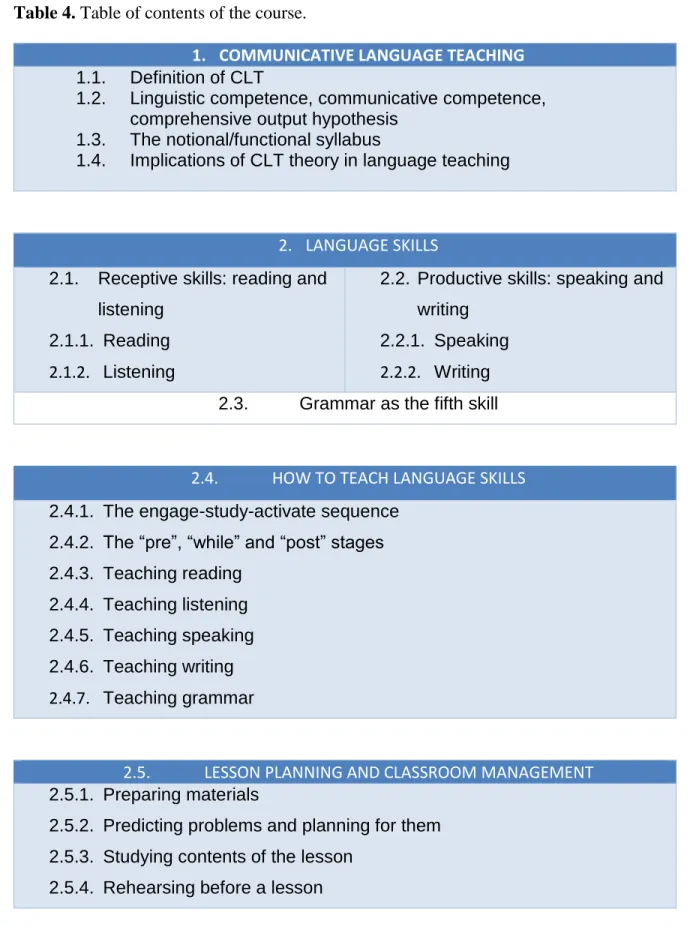
Table 4. Table of contents of the course.
1. COMMUNICATIVE LANGUAGE TEACHING 1.1. Definition of CLT
1.2. Linguistic competence, communicative competence, comprehensive output hypothesis
1.3. The notional/functional syllabus
1.4. Implications of CLT theory in language teaching
2. LANGUAGE SKILLS
2.1. Receptive skills: reading and listening
2.1.1. Reading 2.1.2. Listening
2.2. Productive skills: speaking and writing
2.2.1. Speaking 2.2.2. Writing
2.3. Grammar as the fifth skill
2.4. HOW TO TEACH LANGUAGE SKILLS
2.4.1. The engage-study-activate sequence 2.4.2. The “pre”, “while” and “post” stages 2.4.3. Teaching reading
2.4.4. Teaching listening 2.4.5. Teaching speaking 2.4.6. Teaching writing 2.4.7. Teaching grammar
2.5. LESSON PLANNING AND CLASSROOM MANAGEMENT
2.5.1. Preparing materials
2.5.2. Predicting problems and planning for them 2.5.3. Studying contents of the lesson
2.5.5. Setting the objectives of a lesson
2.5.5.1. Lesson objectives and personal objectives 2.5.5.2. Reflecting on a lesson after you have taught it? 2.5.6. The roles of the language teacher
2.5.6.1. Planner 2.5.6.2. Informer
2.5.6.3. Administrative role 2.5.6.4. The role of monitor 2.5.6.5. The role of involver 2.5.6.6. Parent/friend roles 2.5.6.7. The diagnostician 2.5.6.8. The resource role 2.5.7. Grouping students
As you can observe in the table of contents, they have been organized in two sections: the broader theoretical aspects related to language teaching/learning (such as the approach (CLT) and the theory behind language skills) and the more specific aspects of language teaching. These sections are related to the teaching practice itself (“How to teach language skills” and “Lesson planning and classroom management”).
This method of organization has been adopted in order to give students some theoretical background in language teaching before they start with the actual implementation of such theory in language teaching practice. It is important to keep in mind that despite this section being fairly theoretical, my trainees are going to observe how these concepts are applied by an experienced teacher, which means that not only will they have the theory behind the procedures and
It is expected that they are able to imitate what they have observed, and so, the initial anxiety generated when they have to teach their own classes will have been minimized. This is another important finding of my research and of the design of the course I have adopted.
Estimated timetable
Once I determined the contents of the course, I was able to estimate the amount of time, which should be enough to cover such contents. I have, of course, taken into account the class structure, which we have already presented in section 5.2., the number of students per group, the class observation stage (in the two forms proposed in this project) and the assessment of the teaching practice. The first version of this timetable is as follows:
to some theoretical concepts, such as defining grammar or CLT, do not necessarily require students to observe any practical application.
Since I do not need my trainees to have a complete overview of the whole evolution and streams in the field of language teaching I do not need them to understand every single one of them. By merely defining the particular stream in which they are going to work, I expect them to grasp its main components and tenets without studying it in depth.
I deduced then, that depending on the objective and contents of a particular lesson, there might be no need to have a practical session or students might not be able to put into practice any of the concepts studied due to their lack of knowledge of the topic, as it was the case in the first four sessions.
It was also thanks to this finding that I was able to predict how many observation forms I need to create and the specific aspects they should cover. For instance, for the class session 1 found that the observation task should focus on those elements of a lesson which illustrate the focus on linguistic competence, communicative competence and comprehensive output
hypothesis of a lesson but, at the same time, I found that trainees could observe those elements reflected in the materials they are going to use to teach a lesson i.e. a lesson from the textbook Face to Face. This is going to be particularly useful in case there is no chance for students to observe a teacher in real life.
timetable gave me another important aspect to keep in mind, which I had not foreseen, the time which should be allowed for both, the written assessment and the feedback session after it.
As a final conclusion, I could make at this stage is the need to include an additional lesson (Class session 12) where my trainees will have the chance to put into practice everything they have learnt during the course. This session will be useful for the trainer who will be able to observe the overall performance of his/her trainees in actual teaching practice.
Course materials
Once I was able to define the theoretical aspects around a course such as the one I attempt to create, an important result of my research is that I could now create the sample materials for a lesson as I had already announced I would do.
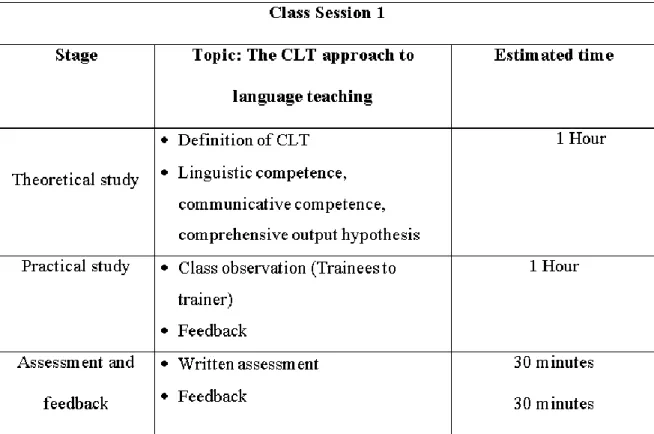
The class session I chose to create was class session 1. In order to make it easier for the reader to follow my presentation of the materials, I am going to transcribe the timetable chart of the lesson taken from the Proposed Course contents section in this Chapter. This chart shows both, the theoretical and the practical contents to be covered as well as the assessment section of the lesson, all of them with their estimated time of completion. Here is the chart:
It is important to mention that, thanks to this chart, one of the first findings of this stage of the process has to do with the timing of the lessons. I found that although I might be able to estimate the time that the lesson should take, the amount of contents in the materials, the exercises, and other aspects of the lessons such as unexpected difficulties that students might have with the concepts, they are all too difficult to estimate. This means that the timing of the lesson should be carefully observed during the first implementation of the materials in order to make any necessary adjustments.
The reader needs to keep in mind that here, I present the sample materials by sections in order to explain how and why they were structured the way they are, but a complete version has been included in ¡Error! No se encuentra el origen de la referencia..
of the lesson pretends to arouse the interest in the topic by involving my trainees in a discussion in which they need to be creative in order to brainstorm any ideas that come to mind. This exercise will help them focus on that information they need in order to understand the main concepts behind CLT which are given to them in the next step, the reading exercise. The exercise is as follows:
Once students have discussed the questions, they are asked to read the text and answer
the questions with the information given in it.
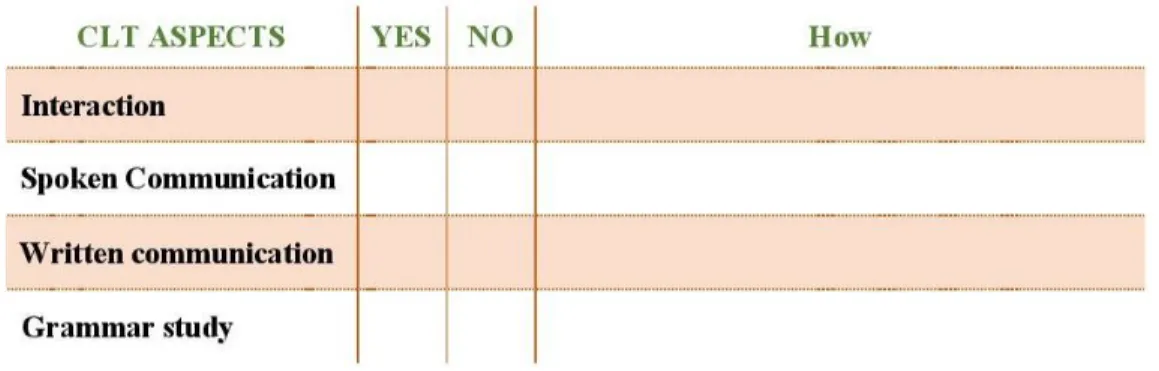
The following step is the class observation which employs the class observation form that I have created to help my trainees focus on the specific concepts I want them to observe in actual teaching practice. This is the first exercise in the form:
Figure 5. Proposed observation form, exercise 1
As we can see, the trainees are asked to identify the main aspects of CLT that they can observe in the lesson but, the key aspect here is that they are also asked to elaborate on their observation. This way they should be able to relate the concepts studied in theory and how they are reflected in actual teaching practice besides being able to reproduce the concepts they have studied in their own words. For instance, if they observe certain interaction patterns they have to explain how they are seen in the lesson. In order to do so, they would need to use the specific terms for interaction patterns and the concepts behind them as they studied them in the theory.
practice. In question 2, for instance, they need to remember what the principles of
communicative competence are in order to be able to identify them in the lesson but they also need to remember the theory behind it in order to answer the question. Here is the actual exercise:
Figure 6. Observation form, exercise 2 sample item.
Another important finding during the creation process of the materials has to do with the trainer’s manual. I realized that the objectives of every lesson should be clearly stated. This is an essential element of the materials, which will help the trainer focus on what he/she should actually achieve and what might not be as relevant for the course. I also found that I was able to determine these objectives by analyzing the contents of the lesson and the overall objectives of the course. This will help me in the elaboration of the materials for further lessons. Here is a sample piece of the trainer’s manual:
The creation of the tests for the lesson did not show any new information but it did help me confirm that it might be viable to ask the trainees to reproduce the theory they studied in a fairly simple written test. What I might need to be very careful with is in giving students the specific information they need for a later test, in which I emphasize the fact that they are going to be asked to reproduce it as closely as possible as they find it in the materials. This assertion will have to be confirmed once I have implemented the lesson and administered the test. Here is a sample question of the test:
Figure 8. Written test, sample question.
Course assessment
Thanks to the elaboration of the table of contents and the timetable of the course, I have found that there are three kinds of assessment, which I need to prepare for, contents assessment, teaching practice assessment and course assessment. The first one refers to the assessment of the specific theoretical concepts that my students are expected to learn, that is the contents and their organization. The second one refers to the class observation of the trainees by the teacher. The third one refers to the course itself. This last one requires the design of specific assessment tools which cover the perspective of all participants in it. This means that there should be a form for the trainees and a different form for the trainer. The analysis of the results of these two
evaluations will give the designer a deeper insight into the aspects which should be improved in further versions of the course. It is also important to take into account that this assessment should only be implemented once the course has finished.
1. What is linguistic competence?
2. Why should a speaker of a language understand the rules of the sociocultural context in which it is spoken?
3. Why is it important to produce language in order to learn it?
All these questions require the trainees to know the exact definitions and concepts behind every one of the topics studied from a theoretical point of view.
From the practical perspective, students should be evaluated with a specific form which helps them focus and understand how the concepts studied in the theory of CLT are reflected in the class they will observe. Some examples of the items in a class observation form could be:
Figure 9. Class observation (Sample questions)
Sample questions related to CLT class observation
1. What section of the class focused on linguistic competence? How?
2. Was the comprehensible output hypothesis applied at any stage of the lesson?
When and how?
As to the course assessment, the questions should attempt to inform the course designer about the effectiveness of the course organization and the strategies employed to help them grasp the concepts behind the theory. These items should be different for the trainer and for the trainee. Some sample items for the trainee could be:
Figure 10. Sample items for the course assessment questions.
Sample items for the course assessment questions (Trainees’ questions)
1. Were you able to see the relation between the theory of language teaching and its
practice? Give examples.
2. Did the class observation forms help you observe the relation between the theory
Figure 11. Other sample items for the trainer.
Sample items for the course assessment questions (Trainer’s questions)
1. Did you find the structure of the class sessions clear and easy to follow? Why?
2. Were the course materials helpful? How?
An important result of my study is that it tells us the aspects of the course, which should be assessed. Of course, this is only a starting point since the items to evaluate every one of these aspects will have to be created but we now have a well-specified set of such aspects to focus on. These correspond to most of the topics studied in order to create the course, which have been specified in chapters 5 and 6. They are the objectives of the course, the contents and their organization, the materials, the assessment techniques and tools, the approach adopted, the timetable, and the lesson structure.
CHAPTER 5
Discussion
Having gone through this whole process in order to design the course I attempt to, there some things to say in light of my new understanding of the matter. First, I have to admit that fitting all of the aspects of language teaching that I wanted to in my course is definitely a little too ambitious. This was one of the biggest limitations of the project. Even after having narrowed the methodological aspects to include in the course, it was almost impossible to fit in all I wanted to achieve my objectives within the length and scope I expected for the project. By taking only CLT as the approach to teaching, I did reduce my scope greatly, but I did not count on the amount of strategies and techniques which, still within the same approach, would have to be analyzed and understood by our trainees in order to perform well in a current language classroom.
Another important insight I gained within the same issue, and which I have to
acknowledge, is related to the fact that despite the wide use of the term “CLT”, there is still some debate as what exactly it actually is. This meant that it was very complicated to give my trainees a simple and direct definition of the approach which might help them grasp the idea of what is expected from them in their teaching practice. This made me think that, in spite of what one may intuitively think, it might be better to focus my trainees’ attention on the strategies and
Although I still think that it is possible to achieve the goals I proposed for this first version of the course, I am also sure that once the lessons are implemented there will have to be many changes in every aspect of the course. It might be necessary to expand on some topics and to reduce the amount of time and effort devoted to others or even eliminate some topics