ICOVACS 2010 – International Conference on Value Chain Sustainability
499
PRODUCT RECOVERY THROUGH RECYCLING
REUSE OR RECYCLE? RECOVERY OPTIONS FOR END-OF-USE
MOBILE PHONES IN SPAIN
Eva Ponce-Cueto
1, José Ángel González-Manteca
2, and Ruth Carrasco-Gallego
3Abstract
The main objective of this paper is to analyze the most important recovery options for end-of-use mobile phones in Spain. We start with a description of the reverse logistics system for mobile phones in Spain. The two main alternatives for this end-of-use e-waste are: reuse and recycling. The study includes the characterization of the different actors involved in the reverse logistics system (collectors, third-party take-back enterprises, sorting facilities, recyclers...) and a description of the most common logistics practices in the sector. We will also analyze the implications of different recovery options for end-of-use mobile phones. Currently the percentage of mobile phones reused is rather larger than those recycled. Special attention has to be paid to the resale channel on secondary markets. We conclude that we need to regulate this second-hand mobile phone market. Finally, we propose an alternative logistic model for improving this closed-loop supply chain: an integrated model for recovering mobile phones (which includes both options) that allows achieving economies of scale.
Keywords: Reverse Logistics Network Design, Product Recovery through Recycling
1. Introduction
Generation of electronic waste is currently an important problem in modern society. The European Union (EU) JRC/IPTS report of Savage et al. (2006:6) states that electro-scrap is the fastest growing waste stream, growing at 3-5% per year, which is three times faster than average waste source. Each EU citizen produces 17-20 kilograms of technological waste per year (Savage et al. 2006:18). PCs and mobile phones make up the bulk of office and communication waste (Zoeteman et al. 2010:429).
The study of recovery options of mobile phones take also special interest because of they also contain many toxic substances which pose a threat to human health and the environment. A detail explanation of substances contained in mobile phones can be found in the Guideline on Material Recovery and Recycling of End-of-Life Mobile Phones elaborated by the MPPI (MPPI, 2009a:9). However, most of the components of a mobile phone are recyclable. The general composition is similar among all mobile phones (weight and volume): approx 40% plastic; 15% Glass and ceramics; 15% Cupper and compounds; 7% Non-ferrous; 3% Ferrous; 3% other. Batteries are the most contaminating substance of the telephone’s components – for example, the battery may be nickel-metal hydride or lithium-ion. Arsenic (in chips made of gallium arsenide), antimony, beryllium, cadmium, lead (used in tin-lead solder), nickel, palladium, silver, gold, tantalum, zinc, bromine compounds and mercury are found in one way or another in the components that compose a mobile phone (less than 1% of weight). The toxic materials of interest under European Union’s Restriction of Hazardous Substances (RoHS) Directive are lead, mercury, cadmium, hexavalent chromium, polybrominated biphyenyls (PBB), and polybrominated diphenyl ethers (PBDE). Of these hazardous constituents, the only ones routinely found in mobile phones today are lead (0.638 g/phone) and hexavalent chromium (0.820 g/phone) (Lindholm, 2003).
As a legal response to this problem, all EU Member States producers have been required to organize collection and environmentally sound management of all electronic equipment put on the market since 2005 (Directive 2002) and for batteries since 2008 (Directive 2006). The directive of the European
1 Universidad Politécnica de Madrid, ETSII, Spain, +34 913363143, [email protected]
2 Universidad Politécnica de Madrid, ETSII, Spain, +34 913363142, [email protected]
Parliament and of the Council on Electrical and Electronic Equipment Waste (WEEE Directive 2002), dated 13th of February, 2003, seeks the prevention of generation of waste electrical and electronic equipment (WEEE), and in addition, the reuse, recycling and other forms of recovery of such wastes in order to reduce waste disposal. Collection rates of at least 4 Kg WEEE per inhabitant and year, as well as recycling and recovery targets for 10 different categories of WEEE, have to be fulfilled. More specifically, mobile phones are included in category 3 (IT and telecommunications equipment). For this category, producers were to fulfill the following target by the 31st of December, 2006: the rate of recovery should have been increased to a minimum of 75% by an average weight per appliance, while the rate of reuse and recycling of components, materials and substances should have been increased to a minimum of 65%.
2. Literature review
Research on cell phones in particular emerged around 13 years ago, when they were targeted by European policy makers (Clift, 1997). The European Trade Organization for the Telecommunication and Professional Electronics Industry (ECTEL) trials, through their so-called Cellular Phones Take-back Working Group conducted a series of publications which include some recommendation of end-of-life mobile phones management (Clift & Wright, 2000) or a life-cycle energy model for take-back and recycling mobile phones (McLaren et al. 1999). Mobile Phone Partnership Initiative (MPPI) created in 2002 developed guidelines through volunteer working groups within the framework of the Basel Convention, with special focus on environmentally management of end-of-life mobile phones (MPPI, 2008). In 2004, and more focus on life cycle assessment of mobile phones, Huisman applied his own environmental assessment methodology of e-waste to mobile phones (Huisman, 2004). Guide and Van Wassenhove (2001) published their article for managing product returns for remanufacturing, and in 2005 Guide et al. published the Recellular Inc. Case (2005), which includes the so called USA remanufacture case of mobile phones. More recently Geyer and Doctori Blass (2010) try to quantify the economic performance of reuse and recycle operations for end-of-use mobile phones based on a research study conducted in U.K in 2003 and in USA in 2006.
The management of this waste is a relatively new problem as it is shown by the literature reviewed. We have revisited international scientific literature that analyzes the impact of the implementation of the WEEE Directive in different countries, such as: Walther and Spengler (2005) for Germany case, Hischier et al. (2005) in Switzerland, Festzy et al. (2003) in Scotland; or in another countries like: Hicks et al. (2005) in China, Yoon and Jang (2006) in Corea or Streicher-Porter et al. (2005) in India. In the Spanish context, the relevant legislation on the subject is Royal Decree 208/2005. Spain has a population of close to 47 million inhabitants (Instituto Nacional de Estadística (INE: national institute of statistics)), 2008) distributed in several autonomous communities, each of which has environmental responsibilities whereby they comply with environmental legislation by means of specific Waste Processing Programs. As there are 17 autonomous communities in Spain, the problem of disposing of this waste is, at best, complicated.
2. Objectives and methodology
The main goal of this paper is to analyze the two main alternatives for end-of-use mobile phones in Spain: reuse and recycling. The study includes the characterization of the different actors involved in the reverse logistics system for both channels (collectors, third-party take-back enterprises, sorting facilities, recyclers...) and the description of the most common logistics practices in the sector. We will also analyze the implications of different recovery options for end-of-use mobile phones, identifying the causes for the inefficiencies in the recovery system. Finally, we propose an alternative model for improving this closed-loop supply chain: an integrated model for recovering mobile phones (which integrates sorting activities in the storage facilities) that allows achieving economies of scale (consolidating load and classifying the handsets in the first step of the model). Once the handsets are classified, then they are sent to appropriate plants (refurbishment plants, recycling plants, second-hand market directly…).
ICOVACS 2010 – International Conference on Value Chain Sustainability
501
TIC congress). The experience acquired in the field study has enabled us to characterize the reverse logistics practices of used and end-of-life mobile phones in the Spanish sector1.The remainder of the paper is organized as follows. In section 3, we include a description of the retirement and collection of mobile phones. Next, in section 4 the recycle channel for mobile phones in Spain are described: the collection system, treatment plants and finally the challenges of this channel are analyzed. In the same way, in section 5 we present the characterization of the current logistics system for reuse mobile phones in Spain, including a detailed description of the main actors operating in the Spanish system. After that, in section 6 we discuss the main problem of this complex reverse logistic system, we propose an alternative model for managing this waste and finally, we present our conclusions and future research proposals.
3. Retirement and collection of mobile phones
In accordance with existing regulations in all EU member states, users of electrical and electronic equipment should be able to return this waste at the least free of charge. Thus, the management and financing of the recycling of these devices is the responsibility of the producers (producer has been defined by OECD as being manufacturer, importer or distributor of a product as part of Extended Producer Responsibility – EPR- principle), from reception at the different collection points, storage, transport and treatment to the correct elimination of all waste.
The points at which mobile phones potentially generate waste are: end users (who discard the product), distributors (i.e.: returned products) and producers (obsolete batches, defective products, etc.). They are represented in Figure 1.
One collection method is to drop-off bins. Regarding selective collection points for mobile phones in Spain, the basic collection points are:
• Recycling centres (in Spain called “puntos limpios”) and other municipal waste collection centres, where users can deposit their WEEE in general and mobile phone waste in particular.
• Sales outlets of mobile phones.
• Shopping centres that have containers for selective collection of used mobile phones.
• Large distributors (Carrefour, Eroski, etc.) that have containers for selective collection of used mobile phones.
• Public institutions (schools, universities, town halls, etc.) that have containers for selective collection of used mobile phones.
Other collection methods are prepaid envelopes or boxes that are collected by mail companies (more used by charitable organizations or companies that pay something for the used mobile phones. There are more details in section 5.1). The rest of mobile phones, that is those that do not end up in one of the currently existing selective collection points, wind up in landfills as uncontrolled waste (with the consequent environmental damage that this waste can cause), or in a drawer in the houses of the users that have stopped using them (it is estimated that scarcely 1 in 5 mobiles is recycled, Nokia 2008). So, a long hibernation period of retired handsets exists. According to Geyer and Doctori Blass (2010:516), owners of electronic products typically keep them beyond the end of the use phase for a variety of reasons, such as perceived residual value and lack of knowledge regarding proper WEEE disposal.
1 This paper stems from the participation of the authors in a research project funded by Plan Nacional de
End Users
Keep in House
Selective collection
points
Landfill
Distributors
Producers
Own channel
Collection systems
Treatment Plants / Sorting
Facilities
Storage Facilities
Storage Facilities:
WLCC
Figure 1. Waste generation points and collection systems of mobile phones. Source: own development
The collection systems in Spain (which are described in detail in section 4.1 and 5.1) are responsible for transporting the mobile phones collected to appropriate storage facilities. These can be:
• Storage facilities of the distribution companies.
• Waste Load Consolidation Centers (WLCC) that receives the WEEE from the municipal waste collection centers and from the different selective collection points, in order to consolidate waste loads before transporting them to the corresponding treatment plants. There is usually at least one or various per province. The object is to lower the cost of transport to the treatment plant.
Once the terminals are collected and storage, there are two main options for them: reuse channel for used mobile phones (with refurbishment or little repair for resale in secondary markets - an explanation of this option is provided in section 5) and recycling option (which includes material recovery and recycling – explained in section 4).
4. Recycle option
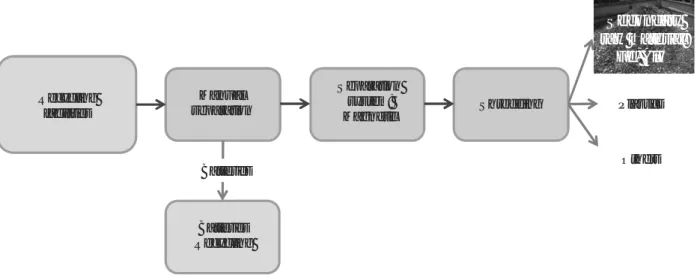
For recycling option, used or end-of-life mobile phones are transported from storage facilities to recycling facilities locating in Spain. At these plants the products are decontaminated, potentially hazardous components of the WEEE are removed from the handset by manual separation (batteries, integrated circuits and crystal liquid displays), accessories and packaging are also sorted and separated manually from the mobile phone handset and the different recyclable components of the handset are separated manually (e.g. case) or using magnetic separation (ferric and non-ferric metals, plastics, etc.). Once separated they are recycled at the plant (if it is prepared to do so) or they are sent to authorize recycling facilities. These are divided into: hazardous waste recycler facilities, such as authorized batteries recycler and non-hazardous waste recycler facilities such as steelworks, smelting plants, plastic recyclers, etc. Figure 2 presents a schematic version of this model.
Recycling facilities
Manual
separation Shredding Separation
system: Magnetic
Secondary raw material:
Fe, Al…
Batteries Recycling
Plastics
Others Batteries
ICOVACS 2010 – International Conference on Value Chain Sustainability
503
4.1 Collection systems in Spain (organized by manufacturers)
The “Fundación Tragamóvil” was set up by Asimelec in 2003 as a non-profit organization to manage waste from telephone and communications equipment and their accessories. Tragamóvil is an initiative promoted by mobile phone manufacturers and telephone providers, such as Telefónica, Vodafone, Nokia,
Motorola, etc. Its objectives are primarily environmental since it works to prevent pollution by selective recycling of mobile phones, encouraging recycling and making millions of users aware of the need to deposit this type of device in the appropriate place.
The “Fundación Tragamóvil” locates its own containers for the collection of end-of-use mobile phones at Collection Points. The 851 points published in its website are located all around Spain and are basically situated in: Telephone Sales Outlets; Technical Service Providers; Recycling Centers; Town Halls; Universities and; Shopping Centers.
Once the containers are filled with end-of-use mobile phones, they are transported to the so-called Waste Load Consolidation Centers (WLCC). These centers have the aim of consolidating loads so as to apply transport economies of scale. There may be one or more WLCC per province, depending on load volume. Finally, mobiles are sent to authorized recycler for treatment and recycling processes (see Figure 1). In 2008, the “Fundación Tragamóvil” treated 1150 tons of telephone and communications waste, including fixed telephone waste (based on primary data collected).
4.2 Treatment plants
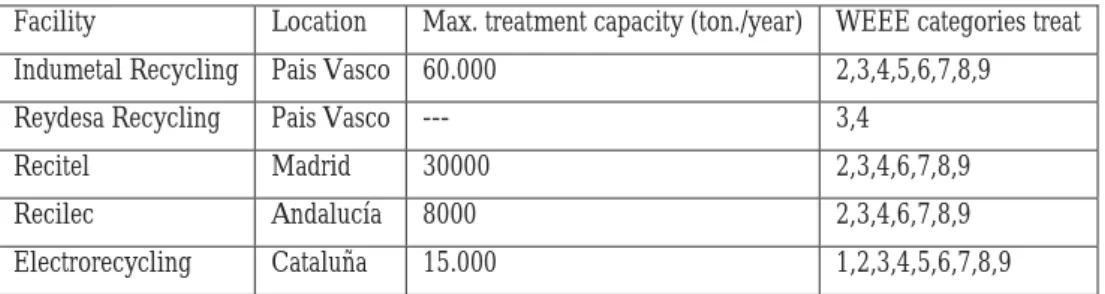
There must be a minimum volume of WEEE for treatment plants to be profitable. Until now, the plants in Spain have dealt with all or a great part of the types of waste generated from EEE. The majority of these plants work with various collection systems that guarantee them a sufficient volume for the investment made to be viable. An evaluation of sites for the location of WEEE recycling plants in Spain is made in the Queiruga et al. (2006) study. There are currently more than 12 plants in Spain for recycling WEEE (including all categories) and only five plants in Spain that recycle waste generated from EEE including in category 3. Of these five plants (shown in Table 2) only two of them recycle mobile phones in Spain.
Table 1. Main WEEE treatment plants (for category 3) located in Spain.
Facility Location Max. treatment capacity (ton./year) WEEE categories treat
Indumetal Recycling Pais Vasco 60.000 2,3,4,5,6,7,8,9
Reydesa Recycling Pais Vasco --- 3,4
Recitel Madrid 30000 2,3,4,6,7,8,9
Recilec Andalucía 8000 2,3,4,6,7,8,9
Electrorecycling Cataluña 15.000 1,2,3,4,5,6,7,8,9
The following is a more detailed description of the two plants that recycle mobile phones.
4.2.1 Indumetal Recycling
The company Indumetal Recycling, S.A. was founded in 1984 from the company Indumetal, traditionally dedicated to the mining and metallurgical industry. Among its objectives are recycling EEE as well as planning, logistics, dismantling and integral treatment of WEEE. Indumetal Recycling, S.A. is currently a reference plant for WEEE recycling services in Spain given the volume of waste they treat yearly. Furthermore, they are holders of the certificates ISO 14001 of environmental control and ISO 9001 which certifies quality control in the processes and products and Indumetal is recognized and authorized by the Environmental Ministry of the Basque Government as: Authorized recycler of hazardous waste; Authorized recycler of non-hazardous waste; Centre for Consolidation and Classification of WEEE.
They have two treatment plants. The larger of the two is in Asúa (Vizcaya) and the other in San Agustín de Guadalix (Madrid). Of the two, only the one situated in Vizcaya recycles mobile phones.
to treat electronic waste, so loss of precious metals will be minimized. The logistics manager of this plant confirms us that the volume of mobile phones recycle is very little (less than 3%).
4.2.2 Recilec
Reciclado de Componentes Electrónicos, S.A. (RECILEC), is a corporation founded in 2005 by the following shareholders: environmental management company (Environmental Ministry of Andalusia),
Fomento Construcciones y Contratas and Indumetal Recycling. The company strives to provide integral services to all agents implicated in generating WEEE who need to manage this waste within the current legal framework.
The WEEE final treatment plant is located in Aznalcollar (Sevilla, Andalusia). They also have a new centre in Loja (Granada, Andalusia). The location of these facilities means that the provinces of eastern Andalusia will have service closer by.
The logistics department of the company RECILEC processes the requests for collection from integrated management system, municipal recycling points and private companies. Their website even provides information about the location of all the municipal recycling points in Andalusia.
The Aznalcóllar plant is designed to treat 40,000 tons of electronic waste annually, which is equivalent to the waste generated by the populations of Andalusia, the Canaries and Extremadura (considering that the quantity generated is four or five kilos per person per year).
4.3 Challenges of this model
The research undertaken has allowed us to identify a series of inefficiencies in the system. In the following sub-sections the main problems identified will be described and the causes of this problems analyzed.
4.3.1 Less volume collected
One of the problems identified in the current reverse logistics system for end-of-use mobile phones is the low recovery rate of this waste through “official” channels. In Spain, Tragamóvil recycled 1,154,084 kilos of mobile phone and communications waste in 2008 (this figure includes mobiles and also switchboards and other types of communications terminals. Primary data collected), which are equivalent to more than nine million mobiles if the figures only included recovery of this kind of terminal. Even with this, the figure is insignificant if we take into account that 21 million of these devices were sold in Spain in 2008, some 3,500,000 kilos (data provided by the Foundation Tragamóvil).
Several main causes for this situation have been identified. The first of these is that a scarce 1 in 5 mobile phones is recycled (Nokia, 2008). A study conducted by Nokia has shown that only 3% of consumers are concerned about depositing the mobile phones they no longer use in a selective collection point. According to Singhal et al. (2005:4), one of the main reasons for this low percentage of mobile phones that are recycled world-wide is the consumer reluctance to dispose of the phone and according to Geyer and Doctori Blass (2010:516), the perceived residual value and the lack of knowledge regarding proper WEEE disposal are other reasons for justifying it. Real recovery rate data from the main Spanish managers in charge of carrying out recovery are not available. Even with this lack of data and with estimations that the current recycling rate does not reach 3%, it is evident that this is one of the principle problems encountered in this logistics system.
Another important cause of this less volume collected is the fact that this is waste that maintains a certain value (it is estimated that current replacement times are between 1 and 2 years, while manufacturers believe that the technical lifetime is in the order of 10 years, Nokia, 2005) and that is easily portable (due to their small size and weight). This fact has caused the emergence of a large secondary market of mobiles discarded by their owners. In fact, a high percentage of this waste is being diverted toward these other channels. Other waste is easier to manage in the first stages due to the fact that they have no value except when recycled (for example, batteries). In the case of EEE waste like home appliances (washing machines, refrigerators, etc.), this problem has not arisen. This is at least in part because they are disposed of when they no longer work, while a great percentage of mobiles is replaced for a new model when they still have good working condition. Even though these large home appliances could be valuable if they worked properly when discarded, their volume and weight make it more difficult for these other “spontaneous” channels to appear. This causes the recovery rate of mobile phones through recycle channel to be very low (scarcely 3%) in comparison with other waste generated in the sector (for example, if we compare the case of batteries with a rate of 21%).
4.3.2 Need for High Volume of Mobiles in Recycling Plants
ICOVACS 2010 – International Conference on Value Chain Sustainability
505
dealt with are lightweight (some weigh less than 100 grams and 10 terminals are needed to make up each kilogram of mobile phones), and are composed of 58% plastic, 25% metals like iron, copper, silver, gold and 17% glass. The metals, which are concentrated mainly in the components of the printed circuit board, are the materials which potentially have the highest index of toxicity. Once the old telephone enters the treatment plant, the first stage is to decontaminate it (the battery and liquid crystal displays are removed). Next the plastics and metals are separated. In order to recover the metals, a refining process is used for precious metals and the copper is smelted, while the plastic and other materials which are stuck to them can be used as fuel for metal recovery. Because of the very design of mobiles many of the plastics that they contain cannot be reutilized as raw material since the contamination by metals impedes this. The most valuable components, such as the semi-precious metals (like gold and silver), or the strategic ones like coltan, only exist in very small quantities (for a single unit the precious metal content is in the order of milligrams: 250mg Ag, 24 mg Au and 9 mg Pd) (UNEP, 2009). A very high volume of this waste is necessary for their recycling to be profitable. There is currently no working plant in Spain which recycles these devices exclusively. Generally, they are treatment plants for other types of EEE, and include among these, mobile phones. The field study carried out as part of this research has enabled us to confirm that the volume of mobiles treated by one of the main EEE waste recycling plants at a national level is very low, almost trivial (less than 3%). A possible solution to this problem would be to improve recovery systems in such a way as to attain a high volume of this waste and thus make dedicating a plant or a certain capacity of a plant to this treatment profitable.5. Reuse option
The reuse option for used or end-of-use mobile phones (which include repair and refurbishing) is analyzed in this section. The model presented has been drawn up based on the field study done as part of this research and is therefore representative of the Spanish context.
For the reuse option we have two main alternatives. On the one hand is the resale market, whose aim would be to obtain income for the sale and in which the user would receive some remuneration for depositing his or her mobile phone in this channel. On the other hand, there is the donation model whose objective is to bring new technologies to Third World users. In this case, the user, moved by solidarity with disadvantaged countries, would opt for turning it in (donating) to this cause.
5.1 Collection systems in Spain for reuse option
Currently, there are three options for recovering used mobile phones in Spain (it is important to point out that there is a notably dynamic component among the entities interested in collecting end-of-use mobile phones, motivated to a large extent by the value that mobiles have and the possibility of sale on the second-hand market):
• Via charitable organizations (the campaign is called in Spain as “dona tu movil”-donate your mobile)
• Via an enterprise that pay for the used mobile phone (if the users want to do, they can donate the quantity received)
• Via a company, organization, institutions, which gives big quantities of mobile phones (more than 20), and are collected by a messenger.
“Dona tu móvil” is a campaign began in 2004 by the Spanish Red Cross, the Fundación Entreculturas and Alboan, and has the collaboration of the British company CMR (Corporate Mobile Recycling). The Red Cross is an international humanitarian institution, the Fundación Entreculturas is linked to the Jesuit religious order and works in the education sector while Alboan, also linked to the same religious order in the Basque Country and Navarre, works in development aid. Therefore, it is an initiative on the part of non-governmental organisations (NGO) who are seeking funding for their humanitarian and social projects through the donation of mobiles.
Specifically, this campaign has two primary objectives:
• Social Action: the income generated through the reuse of the donated mobile phones is utilised in humanitarian, social and education projects;
• Environmental Care: by promoting the reuse and recycling of end-of-use mobile phones.
A number of companies are collaborating with this campaign by providing space and safekeeping for the containers. These include companies like ADIF, Sabeco, Iberia, BBVA, Correos, El Corte Inglés and DIA. Their website states that there are more than 1900 companies and institutions that have been collaborating with them since the beginning of the campaign and there are more than 5000 collection points. Even without being a collaborating company, by making a simple phone call indicating that you have a minimum of 30 mobile phones to donate, a messenger will be sent out to pick them up.
personal interview with the Spanish manager of the company). The average value of mobile phones collected and given to NGO organizations is 1.8 €/phone (primary data).
Another initiative for collecting mobile phones is movilbank.es. In this scheme, the company buys only certain models of mobile phones (for reselling on secondary markets). If a customer is interested in selling a phone a courier will pick it up. After the inspection and testing that everything is according to specifications, the company pays the corresponding amount. Movilbank offers the option to donate all or a part of this amount to a charitable organization (they collaborate with “dona tu movil”). A very similar model is the one employed by Zonzoo, a consumer electronic recycling company that operates in different countries, including Spain.
There are other initiatives for collecting unusable, damaged or obsolete mobile phones in Spain, like the company Biotel (Sistemas de Telefonía SL). Biotel is primarily directed at mobile telephone sales outlets and companies, both of which can accumulate a certain quantity of mobile phones. Additionally, the company has also shown interest in spare parts or complete telephones from mobile telephone technical service companies. In any case, Biotel buys the material according to its own rates. For interested companies, Biotel proposes installing the so-called eco-packaging so that employees can deposit mobile phones in disuse. A very similar initiative is offered by the fonebank company, one of the largest mobile phone recyclers in the UK, for selling a company or organization’s mobile phones.
5.2 Sorting and treatment facilities
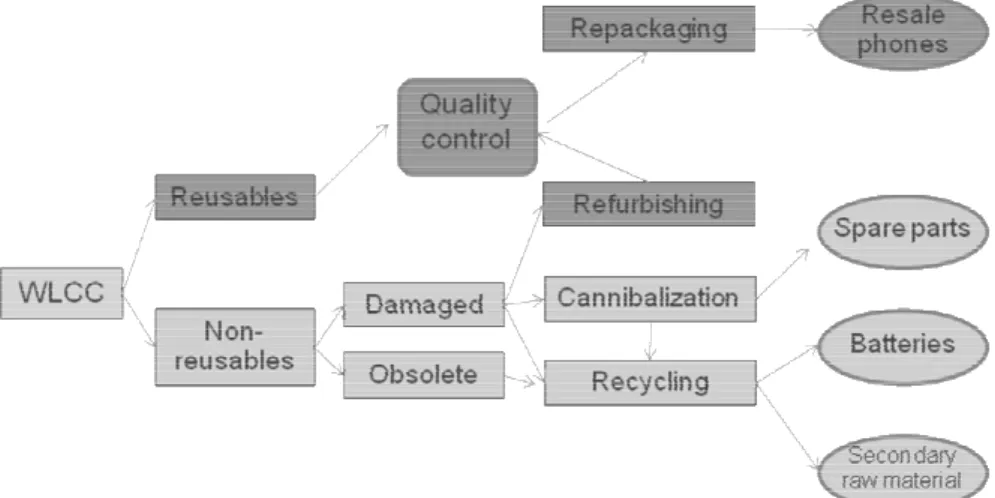
Once the mobile phones have been collected, they are classified into three categories: reusable handsets, damaged and obsolete. After testing and sorting, the reusable handsets undergo a quality control process. Damaged handsets undergo a possible refurbishing and repair process. Finally, a repackaging process takes place before the handset is distributed in the second-hand market (China, South Africa, India…). Obsolete or damaged handsets (that cannot be refurbished) are sent to a recycling facility locates in United Kingdom for recycling and spare parts for cannibalization are sending to China. A brief description of this logistic process is included in Figure 3.
Figure 3. Reuse channel for mobile phones. Source: own development
5.3 Challenges of this model
From an environmental point of view, this option, which would lead us to the reutilization of the product (directly or with little reconditioning), would give mobiles a second use and thus prolong their useful life, which a priori could be more beneficial than opting directly for recycling as the first option. Furthermore, this is the first option of reverse logistics contemplated in the Royal Decree (208/2005). The problem would appear if this resale or donation of the product was carried out in a country in which the disposal, which would be necessary after some time, is not regulated and this waste winds up in uncontrolled landfills. In this second case, if the environmental damage that this option could cause globally is analyzed, it would clearly be more prejudicial.
5.3.1 Legislate second-hand markets
ICOVACS 2010 – International Conference on Value Chain Sustainability
507
extension of producer responsibility (ERP) (Lifset & Lindhqvist, 2008) to the end-of-use-phase of their products. More specifically, it is based on the philosophy of “the one who pollutes pays”, attributing the responsibility for the waste to the manufacturer who puts the product on the market. The moment in which these secondary markets arise and the manufacturer loses control over these markets, we find ourselves facing a legal vacuum. Along these lines, we should mention the Basel Convention (MPPI, 2009b) which attempts to regulate the trans-boundary movement of hazardous waste between countries, especially from “developed countries” to “developing countries”. This agreement includes these objectives: 1) to ensure that the trans-boundary movement of hazardous wastes (printed circuit boards are considered to be part of this category) and other waste is reduced to the minimum consistent with the environmentally sound and efficient management of such waste, and is conducted in a manner which will protect human health and the environment against the adverse effects which may result from such movement; 2) to assure control of trans-boundary movement of hazardous waste and prevent illegal traffic. The agreement focuses on waste, with the idea that waste is substances or objects whose elimination must be carried out (Basel Convention, 1989). By the year 2002, 149 countries, including all of those of the European Union, had ratified this agreement. Accordingly, it is illegal for any European country to export electrical and electronic waste. Nevertheless, devices and electronic components that are reused without the need for any kind of process are not considered waste. This would be the case of mobile phones that are discarded by users, but which still work perfectly well and are donated or sold to developing countries where there is no existing legislation that guarantees the proper treatment of these end-of-life phones. It is precisely in these cases that a legal vacuum exists.5.3.2 Quality management tools and techniques
Quality management tools are required for guarantee the life that the mobile phones resales are in good working condition. The field study conducted shows that companies make a visual inspection of the handsets and a test run. It is interesting to develop specific quality management tools and techniques for improving the reuse closed-loop supply chain processes (especially for assuring the quality of reused mobile phones)
6. Discussion and Conclusions
In this research we analyze the two main reverse logistics channels for recovering mobile phones in Spain, which are: reuse and recycle. A description of the current model for recycled and reused mobile phones in Spain is presented, including the main actors and the most important logistics practices currently used for collecting end-of-use mobile phones in the Spanish context. The model presented for the recycle channel includes the description of: points where waste is generated, collection points, organized management systems for recovery, transfer centers, treatment plants and recycling waste final facilities (both for hazardous and non-hazardous waste). In the case of the reuse channel: collection points, take-back systems, sorting and treatment facilities are also analyzed.
We conclude that one of the main disadvantages of the recycle channel analyzed in this paper is that all mobile phones collected by this channel end up in the recycling plant (for recovering materials), regardless of whether the mobile phone discarded works correctly or not. It should be noted here that mobile phones usability is another vital point for this electronic waste. From an environmental and economic point of view, and also following the guidelines of the EU Directives, it seems reasonable to propose a design of a reverse supply chain that allows the sorting of handsets as a first step, and after that, redirecting them to the appropriate channel. Following this proposal we could redirect the handsets that work properly to the reuse channel and thus, extend their life. We propose the following design for this reverse logistics system in Figure 4:
End Users
Selective collection points
Collection systems
Storage and SORTING
Facilities
Resale channel
Repair and
Refurbishment
facilities
Recycling facilities
Figure 4. A management model proposed for recovering mobile phones. Source: own development
scale. The mobile phones collected would be taken to the sorting facility where they would be classified into the ones for the reuse channel (direct resale or resale with slight repair), the ones for cannibalization (spare parts level) and the ones for recycling (for recovering materials).
We should not forget that the legal framework in force in Spain holds producers responsible for the recovery and appropriate treatment of mobile phones placed on the market, applying the principle “the one who pollutes pays”. Therefore, the logistics model proposed must ensure compliance with this requirement. Thus, and especially in the case of waste generated by mobile phones, special attention should be paid to the secondary markets appearing around this waste and the regulation of these alternative channels, in order to ensure compliance with the requirements imposed by Royal Decree (208/2005) and that the proper delegation of responsibilities is carried out. In this study we advocate a management system that contemplates reuse as the first option, but doing this while utilizing channels that guarantee adequate treatment of this waste at the end of its useful life. Likewise, we recommend an integral management model that takes care of the terminal as well as the battery and the rest of accessories that accompany this waste.
Another important problem identified in this study is the low volume of end-of-use mobile phones recovered for recycling. Regarding the proposal of solutions to increase the volume of recovered mobile phones, the following should be mentioned: citizen awareness policies (to inform them of the advantages of depositing end-of-use terminals in the appropriate channel for proper treatment); incentives to users to participate in a used mobile phone collection system (to encourage users to dispose of their end-of-use phones in the appropriate points by either paying them a certain amount or giving them a discount when buying new products, for instance the “re-mobile plan” proposed by The Phone House in Spain which offers a €5 discount on the purchase of new phones per each used mobile phone -including the corresponding charger- discarded in the shop); improve accessibility to the collection points for final users (which facilitates collection of the devices), location of collection points in such a way that economies of scale can be taken advantage of (to reduce transport costs), collection point control (new unauthorized actors are appearing who remove the telephones from the collection points established by the authorized IMS), location of the WLCC to take advantage of scale economies in transport.
As a future development of this research, we propose conducting a study to analyze the appropriate location in Spain of the integrated storage and sorting facilities proposed in Figure 4.
7. References
Clift R. 1997. The ECTEL trials. Journal of Industrial Ecology, 1(2): 3-5.
Clift, R., & Wright, L. 2000. Relationship between environmental impacts added value along the supply chain. Technology Forecast Soc Shange, 65: 281-295.
Directive 2002/96/EC of the European Parliament and of the Council of 27 January 2003 on waste electrical and electronic equipment (WEEE). OJ L37 13/02/2003, pp. 24-39
Directive 2006/66/EC of the European Parliament and of the Council of 6 September 2006 on batteries and accumulators and waste batteries and accumulators and repealing Directive 91/157/EEC. L 266 26/09/2006, p. 1-14.
Eisenhardt, KM. 1989. Building theories from case study research, Academy Management Review, 14(4): 532–550.
Ellram, LM. 1996. The use of the case study method in logistics research, Journal of Business Logistics, 17(2): 93-138.
Geyer, R. & Doctori Blass, V. 2010. The economics of cell phone reuse and recycling, International. Journal of Advanced Manufacturing Technology, 47( 5-8): 515–525.
Guide, VDR., Neeraj, K., Newman, C. & Van Wassenhove, LN. 2005. Cellular telephone reuse: the ReCellular Inc. case. Chapter in: Managing Closed-Loop Supply Chains. Flapper SD, Van Nunnen JO, Van Wassenhove LN (editors). ISBN 3-540-40698-0. Springer Berlin.
Guide, VDR. & Van Wassenhove, LN. 2001. Managing product returns for remanufacturing. Production and Operations Management, vol. 10: 142–155
Huisman, J. 2003. The QWERTY/EE concept, quantifying recyclability and eco-efficiency for end-of-use treatment of consumer electronic products, Ph.D. thesis, Technical University Delft.
ICOVACS 2010 – International Conference on Value Chain Sustainability
509
Lifset, R. & Lindhqvist, T. 2008. Producer responsibility at a turning point? Journal of Industrial Ecology, 12(2): 144-147.
Lindholm, ME. 2003. Toward Environmentally Conscious Product Design- a Comprehensive DfE Implementation in New Generation Cellular Phones. IEEE International Symposium on Electronics and the Environment, 19-22 May 2003, Boston, USA.
McLaren, J., Wright, L. Parkinson, S. & Jackson, T. 1999. A dynamic life-cycle energy model of mobile phone take-back and recycling, Journal of Industrial Ecology, 2(1): 77-91.
MPPI. 2008. Guidance document on the environmentally sound management of used and end-of-life mobile phones. Mobile Phone Partner Initiative. Basel Convention, UNEP.
MPPI. 2009a. Guideline on material recovery and recycling of end-of-life mobile phones. Mobile Phone Partner Initiative. Basel Convention, UNEP.
MPPI. 2009b. Guideline for the transboundary movement of collected mobile phones. Mobile Phone Partner Initiative. Basel Convention, UNEP.
Nokia (2000). Environmental Report of Nokia Corporation. Study conducted by: Nokia and the Fraunhofer Institute for Reliability and Micorintegration.
Nokia (2005). Integrated product policy pilot project stage 2 final report: options for improving life-cycle environmental performance of mobile phones. Nokia, Espoo, Finland, September 2005.
Nokia. 2008. Global consumer survey reveals that majority of old mobile phones are lying in drawers at home and not being recycled. Press release July 2008.
Queiruga, D., Walther, G., González-Benito, J. & Spengler, T. 2008. Evaluation of sites for the location of WEEE recycling plants in Spain, Waste Management, 28: 181–190.
Royal Decree 208/2005, de 25 de febrero, sobre aparatos eléctricos y electrónicos y la gestión de sus residuos. BOE Núm. 49, pp. 7112-7121.
UNEP 2009. Recycling-From e-waste to resources. Sustainable Innovation and Technology Transfer Industrial Sector Studies. United Nations Environment Programme.
Savage, M., Ogilvie, S. & Slezak K. 2006. Implementation of waste electric and electronic equipment directive in EU 25, IPTS, European Commission Joint Research Centre, Technical Report Series EUR 22231 EN, ISBN 92-79-01926-0.
Singhal, P., Ahonen, S., Rice G., Stutz M., Terho M., & van der Wel H. 2005. Key Environmental Performance Indicators (KEPIs): A New Approach to Environmental Assessment.
http://www.lcainfo.ch/df/DF27/Stutz2KEPIPaper2004.pdf, accessed: may 2010.
Walter G., Steinborn J., Spengler T., Luger T., Herrmann C. 2009. Implementation of the WEEE-directive- economic effects and improvement potentials for reuse and recycling in Germany. International Journal of Advanced Manufacturing Technology, 47(5-8): 461–474.