
Basic limnology of Lago Bonilla, a Tropical lowland lake
9
0
0
Texto completo
(2) REYISTA DE BIOLOGIA TROPICAL. 1430. TABLE 1 Morphometric parameters of Lago Bonilla.. Area(A) Yolume(Y) Max. Depth (zl1l) Mean Depth (Z) Shore Line(L) Shore Line Development(DL) Yolume Development(Dy) Relative Depth(zr) Length (1) Mean Breadth(b) Max. Breadth(bm). 29.5 H m2 3.0H m3 30.0 m 1O.2 m 2239.5 m 1.16 1.02 4.90 908.2 m 324.8 m 406.6 m. ered sediment cores from Lago Bonilla and adjacent Lago Bonillita for paleoecological analyses. They were unable to determine the ages of sediment cores from Bonilla, owing to problems with radiocarbon dating, but their 9.7 m sediment core from Lago Bonillita was shown to span approximately 2500 years. In cores from both lakes they found pollen grains and charcoal fragments indicative of prehistoric agriculture and forest disturbance in the area. The present paper presents the results of four visits to the lake over the period of a year (Aug. 1990 to Jun. 1991), with the aim to study its mixing pattern and planktonic assemblages.. MATERIALS AND METHODS The lake was visited four times in one year to cover both the rainy and dry seasons. Sampling was done in Aug. and Nov. 1990, and Feb. and Jun. 1991 at the deepest part of the lake. Depth profiles of dissolved oxygen, temper ature (YSI meter model 57) and conductivity (YSI meter model 33M S-C-T) were deter mined as well as the Secchi depth. Subsurface replicated water samples for pH, chlorophyll, nutrients and phytoplankton were collected using a Niskin water sampler. Samples of 100 mI for phytoplankton were also taken and pre served with Lugol' s acetic solution. Chlorophyll a determinations were corrected for phaeopigments with the dilute hydrochloric acid method. A volume of 500 mI was filtered and chlorophyll was extracted with 90% ace tone (Strickland & Parsons 1968).. Water for nutrient determinations was fil tered through glass-fibre filters (Whatman GF/C equivalent) and stored in refrigeration (4°C) for no more than three days before analy siso Samples were analyzed at the CIMAR lab oratories. Soluble reactive phosphate (SRP) was measured with the molybdate blue method (Golterman & Clymo 1969). Nitrite was deter mined by the sulfanilamide-NED method (ibid.). For nitrate the cadmium reduction col umn method was used. Ammonia was mea sured with the phenate method (APHA 1980). Phytoplankton samples were settled in graduated cylinders in the laboratory for a min imum of 48 hours, The excess of water was siphoned out with an "U" -shaped siphon. The remnant volume was centrifuged to further concentrate the sample down to 1 mI before counting. Aliquots of 0.1 mI were used for the counts. Aliquotes were placed in a Palmer Malloney cell and counted under 40x objective (total power of 400x). Two diametral transects of 25 optical fields each were scanned. Results were expressed as units per volume, with units being either filaments, colonies, coenobía or individual cells, aceording to the speeies morphology. Species were separated by morphotypes to which a numerical eode was assigned. Eaeh morphotype was identified to the lowest taxonomíe level possible (West & West 1904, 1905, 1908, 1912, 1923, Preseott 1962, Huber-Pestalozii 1968 , Whitford & Schumacher 1973, Komárek 1985). No more than 100 units per speeies were counted (modi fied from Lewis 1978). Rare speeies were counted untíl the limit of optical fields was reaehed. Zooplankton was sampled with vertical (from 20 m deep) and surface horizontal tows, using a 64 mm mesh neto Samples were pre served with 4% formalin. Zooplankton species identifications were made by C. Collado, who has previously published on zooplanton of this and many other lakes in Costa Rica (Collado 1983, Collado et al. 1984, Haberyan et al. 1995).. RESULTS Lago Bonilla is a warm water lake, with temperatures from 26.5 to 29°C at the surfaee, and from 25.1 to 26.5°C at the bottom, with a.
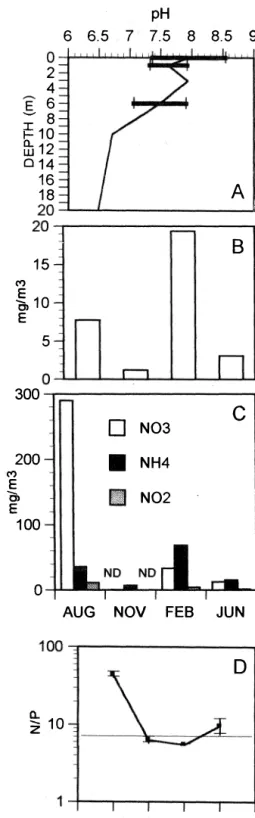
(3) UMAÑA V, G.: Basic limnology ofLago Bonilla heat content that fluctuated between 322 cal 2 2 cm- and 347 cal cm- (mean Q= 336 cal cm2). The water column was found stratified dur ing three visits (Fig. la). In Feb. 1991 the sur face temperature decreased by 2.5°C, and the stratification was less pronounced, yielding a lower value of the Birgean (1916) work of the wind (TabIe 2). The dissolved oxygen shows a sharp decrease below 4m of depth, even in Feb .. In Aug. 199 0 a peak in oxygen was observed at the surface, with an oversaturation (126-170% saturatíon) (Fig. lb). Conductivity showed an increase with depth, specially below 8m (Fig. le). In Feb. 1991 the ehemocline was lowered down to the deepest waters of the lake and conduetivíty was relatively homogeneous down to 15 m. The pH values varied between 6.48 and 8.80, deereasing with depth (Aug. 1990, Fig 2). Nutrient levels varied considerably in the study period (Fig. 3 a,b,e). In general N03- was the most abundant form of N, with levels up to 285 mg N-N03/l in Aug. 1990, but deereasing to not detectable levels in Nov. 1990. NH4+ was always present in moderate levels (between 7.3 to 68.3 mg N-NH4/l). Soluble reactive phos phate (SRP) was present in small amounts,. 1431. most of the time below the detection point (max. 7.7 mg P-P041 in Aug 1990). The con centration of Si02 measured in Jun.1991 was high (5628.9 rng rn-3 Si02)' AH inorganic N fractions were added (DIN) and their proportion reIative to SRP (DIN/SRP) was calculated, to get an indieation of possibIe lirnitation by either of the two nutrients. The ratio DIN/SRP varied among the sampling dates, giving sorne preliminary indication of a shift in the limiting factor (Fig. 2e), values indicated that P lirnitation might be stronger when it occurs than N. These results are now being tested with in situ bíoassays. A total of 58 species of algae were observed in the phytoplankton in all samples colleeted. Of these, 27 belonged to the Chlorophyta. The groups that followed were Pyrrhophyta with 9 species and Cyanophyta with 8. Other groups were less diverse (Tabie 3). With the exception of Aug. 1990, Cyanophyta was the most abun dant group, with a abundance greater than 50% . Chlorophyta was the other dominant group, which attained a maximurn of 90.8% in Aug. 1990. Dinoflagellates and diatoms were the remaining components of the phytopIankton (TabIe 3).. TABLE 2 Values ofthe Work ofthe Wind according to Birge (1916).. Date WT Ws Wb Aug. 1990 652.1 206.9. 445.2 Nov. 1990 426.8 220.3 206.5 Feb. 1991 95.1 67.5 27.6 Jun. 1991 476.4 281.4 195.0 These values are a measure of the resistance of the water column stratification against mixing by the wind and provide a way of comparing the relative stability of diferent temperature profiles from a lake. Ws gives an estimate of the amount of work necessary to break the stratification andWb gives the amount of work necessary to distribute homogeneously the heat content of the water.WT is the sum of both and gives the total amount of work. Units are in Nmlm.. TABLE 3 Number of species per taxonomic group by date. Diversity Values are H': Shannon Diversity Index. J: Equitability based on Shannon'sformula (J=H'/Hmax).. Date. Chlor. Pyrrh. Bacil. Cyano. Other. H'. 13/8/90. 11 12 11 9 13 7 10 7. 2 3 5 4 3 4 4 3. 1 2 3 3 1 1 O O. 6 6 4 5 6 5 4 4. O. 1.44 1.59 1.79 1.69 1.61 1.58 1.88 1.51. 23/1lI90 2'])'])91 13/6/91. 3. 3 3 2 3 2 3. 0.48 0.49 0.55 0.53 0.50 0.53 0.63 0.53.
(4) 1432. REVISTA DE BIOLOGIA TROPICAL. pH 22. TEMPERATUREOC 24. 26. 28. 6. 6.5. 7. 7.5. 8. 8.5. 9. 0������"�4 2 4. 30 E. 6 8. ¡!:10 fu 12 014. '-"'. 16 18. A. 20 20 .-------�=_---. ��------�. O. DISS. OXYGEN (mg/L) 2 4 6 8 10 12. 14. B. 15 ('t). � 10 E. 5. 20 ��----� CONDUCTIVITY (uSí/cm) 300 200 100 o. 300. O������ -y------,. o N03 200. e. • NH4. ('t). E. m N02. o, E. 100. -B-. Aug90. -e-. Nov90. A-. Feb91. ... �. ... o. AUG NOV. FES. JUN. 100 ,-------� o. ----&- Jun91 Fig 1. Depth profiles of A. Temperature B. Dissolved Oxygen and C. Conductivity in Lake Bonilla for the four sampling dates (Aug. 1990, Nov. 1990, Feb. 1991 and Jun. 1991).. The number of taxa per sample varied between 16 and 32, being higher for the deep mixing period (Nov. and Feb.). Shannon' s index values ranged between 1.29 and 1.88, and equitabilíty values between 0.42 and 0.63 (Table 3). The most important species were: cf. Cylindrospermum minimum,. � z. 10. AUG NOV FES JUN Fig. 2. Summary of pH and nutrients in Lake Bonilla. A. Depth Profile of pH. Variation with time of: B. Orthophosphate. �. Inorganic N (N-N03, N-N02 and N NH4)' D. N/P ratios..
(5) --. UMAÑA V, G.: Basic Iimnology oC Lago Bonilla Dactylococcopsis sp., Tet.raedron regulare, Tetraedron minimum, CoelaStrum reticulatum, Anacystis montana and Peridinium inconspicu um. This later species presented low densities. but was always present in the counts. Total density varÍed between 1589 and 7791 individuals per mI. Density was higher during Nov. 1990 and Feb. 1991 (Fig. 3a). Chlorophyll a concentration showed lower val100 ...... 80� 60-. �. O. O. 8. O. blue - green species dominated throughout the study period, with two species sharing domi mlmmu m and Tetra edron nance: Cylindrospermum minimum. Green algae were dominant in Aug. and Nov.. 1990 (Fig. 4a), while 80 60. 80. O �---�I--�I--� 25 -r----�. B. ....... 20-. -1. ...... 40. � 20. w. U Z «. �. 80. 10-. �. 60. ::;). 5-. O O O. O. O. O O. Cyanobacteria. Bacillariophyceae. 40. O �--�I----r-I--�I--� 0.2 ...: ,.......0.4 ..,: SO.6 ..,: - 0.8 .t5. 1 j:: U 1.2 "" w·1.4 ...; en 1.6 � 1.8 ..,: 2. o. O. O �---'-----r---'r--r. � 15-. -. O. 8. O. 60. w 20o. « ..J J: U. 8. O �--'---�--�--r--'. O. z. Chlorophyta. 20. o. Ci5 40-. O O. 40. A. O. 1433. 1. J. I. L. I. 20. O �--�---T--��� 80. ... :.. Dinophyceae. 60 '--. ...... ...... 40 -. e. AUG NOV FES JUN DATES Fig. 3. Values of: A. Total density oC phytoplankton; B. ChlorophyIl a froro subsurface samples and; C. Secchi transparencies; at the four sampling dates in Lake Bonilla.. ues in those months (Fig 3b), with peaks in Aug. 1990 and Jun. 1991. Secchi depth was low, between 1.5 and 1.9m; the greatest values were measured in Nov. 1990 and Feb. 1991 (Fig. 3c). The temporal variation in phytoplank:ton species composition did not show major shifts in the dominant groups. Basically, a few green and. 20. o. ª. AUG NOV. O FEB. DATES. JUN. Fig. 4. Temporal variation oC total abundance o C Chlorophyta, Cyanobacteria, Bacillariophyceae a n d Dinophyceae i n the surface waters o C Lago Bonilla from Aug. 1990 to Jun. 1991 (the sqUare root transCormation was used in the graphs).. Cyanobacteria dominated in Feb. and Jun. 1991 (Fig. 4b); Diatoms showed a maximum also in Feb., but they didn' t become dominant at any tiIile (Fig. 4c), nor did the dinofIagelates, which showed the lower values in Feb. (Fig 4d)..
(6) REVISTA DE BIOLOGIA TROPICAL. 1434. Seven species of zooplankton were identi-. fied: 2 Cladocera (Bosmina hagmanii and Ceriodaphnia cornuta (fonn without horns», 2 Copepoda (Microcyclops sp, Mesocyclops ther mocyclopoides) and also nauplii larvae and cyc1opoid juveniles, and 3 rotifera (Keratella sp., Polyarthra vulgaris and Hexarthra inter media). The composition in vertical and hori zontal surface samples was different. Both Cladocera and the Microcyclops sp. appeared only in the vertical tows, indicating a deeper location of these species within the lake.. DISCUSSION Lago Bonilla is an oligomictic lake, mixing priefIy sometime during the coldest and windi est months from Nov. to Feb. (dry season). The lake stratifies again in early March. A sampling perfonned in March 1989 showed that the lake was stratified. This result agrees well with the report of Mora (1989), who found the lake mix ing in mid Feb. and developing an incipient stratificaton by late Feb.. The low topography of its surroundings and the scarce vegetation allow the wind to blow over the lake. Winds blow in the direction of the main axis of the lake, mixing it completely during the circula tion event. Based on several characteristics of the lake it is possible to c1assify it as a míldly eutrophic lake. One of these characteristics is the persis tent clinograde oxygen profile. Even in the deep mixing period the bottom waters quickly become anoxic again, as a result of large amounts of organic matter being decomposed in the deep portion of the lake. The low Secchi values are also typical of an eutrophic lake, however, it seems to be more related with sedi ments washed into the lake during the rainy period since transparency was lower in the rainest months sampled. The lower total algal density at these times may also indicate sorne degree of light limitation by silt. The abun dance of filamentous Cyanobacteria, which was observed accumulating just beneath the surface on several occasions is another indica tion of eutrophic conditions, (but see bellow). Shifting in the limitÍng nutrient during the year has been observed in many lakes (Sommer 1989), incluiding tropical lakes (Setaro & Melack 1984). P seemed to become more limit-. ing to algae growth in Aug. than was N at other times of the year. The lack of P relative to N may be a result of catde raising and agriculture in the catchment area. N in the fonn of nitrate is known to reach the watercourses more easily via runoff and seepage than phosphate since the latter is easily complexed with aluminum and iron oxides (Parker 1994). Agriculture fertiliz ers and cattle manure are an important source of inorganic N for rivers and lakes, specially in deforested areas (Payne 1986, Parker 1994). Low DIN/SRP have been documented for sorne lowland streams in the Atlantic slope of Costa Rica (Triska et al. 1993) associated with active volcanic geothermal systems that con tribute soluble reactive phosphate. Values of DIN/SRP as low as 3 indicate a high P avail ability , so that N is more likely to become lim iting, in agreement with sorne !iterature reports of N limitation in tropical lakes (e.g. Henry & Tundisi 1983). However, there is no evidence so far to indicate that a similar situation occurs in the Lake Bonilla basin. A plausible explanation for the observed shift might be as follows. The input of N to the lake may decrease during the dry season due to lower runoff from the catchment area. During the deep mixing event, occurring in the first half of the dry season, P becomes more avail able since it is brought up from sediments by the mixing of deeper layers (Margalef 1983). The vertical mixing introduces P to the euphot ic zone and causes a further lowering of the DIN/SRP ratio. The data support this view, since N was less available than P during drier and deep mixing period (Nov. and Feb.). However, it is possible that N may limit the phytoplankton growth even more strongly dur ing the driest months (March through May), just after the wind driven mixing event. Phytoplankton species composition in Lago Bonilla agrees well with the reported composi tion of tropical assemblages. The richness of Chlorophyta, and high abundance of Cyanobacteria, as well as the scarcíty of groups such as Chrysophyta and the paucity of diatoms, are well known features of tropical freshwater phytoplankton (Umaña & Collado 1990, Umaña 1985, Payne 1986). In a survey of several lakes in Costa Rica, in July-August 1991, the phytoplankton of lake Bonilla also showed a codominance by chlorophytes and cyanobacteria (Haberyan et al. 1995)..
(7) UMAÑA V, G.: Basic limnology ofLago Bonilla Dominance was not high, rather it was shared among a few abundant species. At no time between Aug. 1990 and Jun. 1991 did a sin gle species attain a percentage greater than 50% in epilimnetic waters. Due to this situa tion seasonal changes in dominance were not evident, and there were no major shifts in species compositio n during the sampling. However, a tendency was noted for green algae to decrease from Aug. '90 to Feb. '91 and to slightly increase by Jun. '91. On the contrary Cyanobacteria showed an increase from Aug.' 90 to Feb.' 91, just at the time when DIN/SRP ratios were lower, suggesting a low N availability. T h i s s hared dominance b e t w e e n Cyanobacteria and smalI sized green algae differs from typical eutrophic conditions as reported in the literature (cf. Margalef 1983, Sommer et al. 1986). Alt h o u g h Cylindro s p er m u m minimum could f i x N ( Round 1973) it was not highly dominant even at times 'óf pos sible N scarcity. The cod ominance of Cyanobacteria and small greens such as Tetraedron minimum, and T. r egulare is unusual. One possible explanation is that eutrophication in this lake does not come from an unbalanced h igh input of P, since the lake is far from (he influence of any city or town. It ,rather comes from the input of cattle manure and runoff from a partialIy deforested watershed used mainly for cattle. This means that inputs of nutrients are tela tively richer in N forms such as nitrate than in P. As noted aboye, P becomes more limit ing than does N. Diversity indices of phytoplankton were low compared to other Costa Rican lakes (Umaña unplubished data), with few species dominating t h e community. It h as be e n claimed that phytoplankton i n tropical lakes is less diverse than in lakes at higher latitudes (Lewis 1978, Payne 1986) as a result 01 the h i gher seasonality of temp erate r e g i o n s which drives a predictable succession i n phy toplankton composition well described in the literature (e.g. Reynolds 1984, Sommer 1989). No such succession is apparent in this lowland tropical lake, which seems io be always under summer conditions (c.f. Kilham & Kilham 1990). The observed low diversity may also be the consequence of its eutrophic condition (Margalef 1983).. 1435. The zooplankton showed a poor species diversity, with only seven species, all of which have small body size. The lack of big zooplank ters has been described as typical of many tropi cal lakes (Fernando 1980). One possible reason for this faet is a strong predation pressure all year round, exerted mainly by vertebrate predators. Fishes are mainly visual predators (Sommer 1989) preying preferrably upon the large bodied Cladocerans and Copepods. This may be the case in Lake Bonilla, where a rich ichthyofauna seems to be present including small characids and poe cilids that were observed close to the shore. High temperatures have also been proposed as a rea son for small bodied zooplankters in tropical lakes (Fernando 1980). There seems to be a typi cal vertical migration of the zooplankton since vertical and surface horizontal tows yielded dif ferent catch compositions. Ceriod aphnia comuta, Bosmina hogmanl'1i, and Microcyclops sp. were the species which showed a deeper dis tribution during the day. Haberyan et al. (1995) alsó report the presence of Tropocyclops prasi nus in lake Bonilla The absence of large, efficient filter-feeding zooplankton coincides well with the dorninance of small sized algae as noted before. The small zooplankters feed on bacteria rather than phyto plankton (Ceriodaphnia, sorne rotifers) hunt selectively for special items (Bosmina) (cf. DeMott & Kerfoot 1982, Lair 1991, Fulton 1988), or are raptoríal feeders, feeding mainly on larger cells or as predators (C;yclopoids) (cf. Gliwicz & Umaña 1994, DeMott & Watson 1991). These factors can also enhance the abun dance of small celled algae, which are also expected to have high growth rates, outcOlhpet ing the large species. ACKNOWLEDMENTS This work was made possible through grant No. 808-89-063 from the Vicerrectoría de Investigación ofthe Universidad de Costa Rica. I thank Jorge Rossi, who facilitated the access to the lake and previous literature on it, Gregorio Dauphin and Josefina Araya for their invaluable help with collection and analyses of water samples, Herman Soarez, Richard Petersen and a external reviewer for' their help with the manuscript. This work is CIMAR' s contribution No. 250..
(8) REVISTA DE BIOLOGIA TROPICAL. 1436. RESUMEN El lago Bonílla se localiza a 370 m sobre el nivel del mar, en la vertiente oriental del Volean Turrialba, Costa Rica. El lago fue visitado cuatro veces en un año, durante las cuales se colectó la información Iimnológica básica. El lago es monomíctico tibio, circulando durante los meses más fríos y ventosos del año, de Noviembre a Febrero. Se clasificó eutrófico en base a su baja trans parencia de Secchi, la dominancia de Cyanobacterias y la condición anóxica casi permanente en las partes pro fundas del lago. Se observó un cambio en la proporción de N a P, lo que indica que hay una variación en el factor limitan te principal a lo largo del año. El N llega a ser Iimitante durante la época seca, cuando la entrada de este elemento probablemente disminuye debido a la reduc ción del volumen de agua de escorrentía superficial, aña dido a una mayor entrada de P desde los sedimentos en el periodo de mexcla profunda. El P ejerció una Ii � . ilación más severa de acuerdo al valor de la proporcIOn N/P. El fitoplancton compuesto por 58 especies de algas, estuvo dominado por Cyanobacteria y Chlorophyta. Sólo algunas pocas especies dominaron la comunidad, lo que redundó en bajos valores de diversidad. El zooplancton también mostró una pobreza de especies, con sólo siete especies encontradas en el lago. Hubo indicaciones de que el zooplankton realiza migraciones verticales en el lago.. REFERENCES APHA. 1980 Standard Methods for the examination of water and wastewater. American Public Health Association, New York. p 360-361. Beadle, L.e. 1981. The inland waters of tropical Afríca: An introduction to tropical limnology. Longman, London. 475 p. Birge, E. A. 1916. The work of the wind in warming a lake. Trans. Wis. Acad. Sci. Arts. Lett. 18: 341-391. Bumby, M. J. 1973. Chemieal water analysi and aquatic plants of Laggons Bonilla and Bonillita and compa rations of them with six other standing water env) ronmnets of Costa Rica. Associated ColIeges of the Midwest, San José, Costa Rica. 38 p. Bumby, M. J. 1982. Survey of aquatic maerophytes and eh emical qualities of nineteen locations in Costa Rica. Brenesia 19/20: 487- 536. Collado, e. 1983. Costa Rican freshwater zooplankton and zooplankton distríbution in Central America and t h e Caribbean. M . S c . Thesis. U n i v e r s i t y o f Waterloo, Ontario. Collado, C., D. Dafeye, B.H. Dussart & C.H.Fernando. 1984. The freshwater copepoda (Crustacea) of Costa Rica with notes on sorne species. Hydrobiologia 119:89-99.. DeMott, W.R. & W . C. Kerfoot. 1982. Competition among c1adocerans: nature of the interaction between Bosmina and Daphnia. Ecology. 63: 1949-1966. DeMott, W.R. & M.D. Watson. 1991. Remote detection of algae by copepods to algal size, odors and motility. J. Plankton Res. 13: 1203-1222. Fernando, C.H. 1980. The Freshwater zooplankton of Sri Lanka with a discussion of tropical freshwater zooplank ton composition. Int. Rev. ges. Hydrobiol. 65:85-25. Fulton, R.S. III. 1988. Grazing on fJJamentous algae by her bivorous zooplankton. Freshwat. Biol. 20:263-271. Gliwiez, Z. M. & G. Umaña. 1994. Cladoceran body size and vulnerability to copepod predation. Limnol. Oceanogr. 39: 419-424 Golterman, H.L. & R.S. Clymo (eds.) 1969. Methods for chemical analysis of freshwaters.. Blackwells, Oxford. Henry, R. & G. Tundisi. 1983. Responses ofthe phytoplank ton cornmunity of a tropical reservoir (Sao Paulo, BTaZlI) to the enrichment with nitrate, phosphate and EDTA. Int. Rev. ges. Hydrobiol. 68: 853-862. Herrera, W. 1986. Clima de Costa Rica. In L.D. Górnez (ed.) Vegetación y clima de Costa Rica. Vol. lI. EUNED, San José. Haberyan, KA, G. Umaña V. e. Collado & S.P. Horn. 1995. Observations on the plankton of sorne Costa Rican lakes. Hydrobiologia 312: 75-85. Horn, S.P. & K.A. Haberyan. 1993. Physical and chemical properties of Costa Rican lakes. Nat. Geog. Res. Explor. 9: 86-103. Huber-Pestalozii, G. 1968. Das Phytoplankton des SüBwassers. Systematik und Biologie. 3. Teil: Cryptophyceae, Chloromonadophyceae, Dinophyceae. Schweizerbart' sche, Stuttgart. 322 p. Hutchinson, G.E. & H. Li:iffler. 1956. The thermal cJassifica tion of lakes. Proc. Nat. Acad. Sci. 42:84-86. Kilham, P. & S. Kilham. 1990. Endless summer: internal loading processes dominate nutrient cycling in tropical lakes. Freshwat. Biol. 23:379-389. Komárek, 1. 1983. Contribution to the Chlorococcal Algae of Cuba. Nova Hedwigia 37:65-180. Lair, N. 1991. Comparative grazing activities of the rotifer and crnstacean cornmunities in a eutrophic lake. Verh. Interna!. Verein. Limnol. 24:924-927. Lewis, W. M. 1978. A cornpositional, phytogeographical and elernentary structural analysis of the phytoplankton in a tropical lake: Lake Lanao, Phillipines. J. Ecol. 66:213226. Margalef, R. 1983. Lirnnología. Omega, Barcelona..
(9) 1437. UMAÑA V,G.: Basic limnology ofLago BonHla Mora Jamen, M. 1989. Estudio morfométrico y limnológi eo de l a Laguna Bonilla. U n i v ersidad Na ci o n a l Autónoma, Heredia, Costa Rica.. Northrop, LA & S. Hom. 1996. Precolumbian. agriculture. and forest disturbance in Costa Rica: palaeoecological. evidence {rom two lowland rainforest lakes. Holocene 6: 289-299.. Parker, G.G. 1994: Soil fertility, nutrien! acquisition, and. nutrien! cycling,p. 54-63. In L.A, McDade, K.S. Bawa, HA Hespenheide & G.S . Hartshorn (eds.) La Selva: .. ecology and naturalhistory of a neotropical rain forest. University of Chicago, Chicago. Payne, A.l. 1986. The eeology of tropical lakes and rivers. Wiley, New Yorlc. Prescot!, G.W. 1962. Algae ofthe Westem Great Lakes Area. WM. C. Brown, Dubuque, lowa. 977 p. Reynolds, C.S. 1984. The ecology of freshwater phyto plankton. Cambridge Universitys, Cambridge. 38 p.. Round, F.E. 1973. The biology of a1gae. Amold., London. 278 p.. F.V. & J.M. Me1ack. 1984. Responses of phyto plankton to experimental enri c hIIlenti n an Ama�on. Setaro,. floodplain lake. Limnol. Oceanogr. 29: 972-984. Sornmer, U.. (ed.).. 1989. Plankton ecology: successionin. plankton communities. Springerg, Berlin. 369 p. Sommer, U ., Z.M. Gliwic�, W. Lampert & A. Dunean. 1986. The PEG*-model of seasonal succession of planktonic events in fresh waters. Arch. HydrobioL. 106: 433-471.. Strickland, J.D.H. & T.R.Parson. 1972. A practical hand book of seawater analysis.· Bull. Fish. Res. Bd. Can. 167: 310 p. Umaña V., G. & C. Collado. 1990. Planktonic association in the Arenal reservoir, CostaRica. Rev. Biol. Trop.. 38: 311-321.. West, W. & G.S. West. 1971. A monograph of the British desmidiaceae. 1904: VoL l. 1905: Vol H. 1908: Vol III. 1912: Vol IV. 1923: Vol. V. The �aySocíety, London (reprínted by Johnson Reprint Corporation, London). Whitford, L.A. & G.J. Schumacher, 1973. a manual of fresh-water a1gae. Sparks, Raleigh, North Carólina.323. �. ..
(10)
Figure

Documento similar
Finally, other types of treatment that have shown good results in addressing the symptoms and severity of IA and IGD in at least two different reviews or meta-analyses were:
The Dwellers in the Garden of Allah 109... The Dwellers in the Garden of Allah
The aim of the present work is to clarify whether the Pacific SST interannual variability has really changed due to the Atlantic Ocean forcing in the last decades of the
Other objectives of the work are the comparison of the CSI LRR network with other known network models relevant in Network Biology to determine its fit into a
• To study the diversity, distribution and temporal dynamics of mesophilic planktonic archaeal communities in different temperate stratified freshwater lakes characterised
In this sense, the literature has shown that, while people are usually quite accurate at forecasting the valence of future emotional experiences (i.e., negative or positive) or
In some of the dammed lakes (Trampal 3, Barco and Duque), the general pattern in dissolved oxy- gen concentration during the summer is different than the rest of the lakes,
Here we summarize the currently published records on the invasion of two Nostocales genera, Cylindrospermopsis and Aphanizomenon, to lakes and water reservoirs in subtropical
