1
Liquid liquid equilibrium for ethanolysis systems of
fish oil.
S. L. Bucio, A. G. Solaesa, M. T. Sanz∗, S. Beltrán, R. Melgosa
Department of Chemical Engineering, University of Burgos, 09001 Burgos. Spain
Abstract
Enzymatic alcoholysis of fish oil can produce monoacylglycerols (MAG) rich in polyunsaturated fatty acids at atmospheric pressure and low temperature. Biocatalysis in organic solvents helps to create a homogeneous reaction system for the reactants, ethanol and fish oil. This work presents liquid-liquid equilibrium at two different temperatures (303.2 and 323.2 K) and at atmospheric pressure for two solvent-systems in the ethanolysis of fish oil: Ethanol + oil + tert-pentanol and ethanol + oil + hexane. Experimental solubility (binodal) curves were obtained by the cloud point method and tie-line composition was obtained by density and high temperature gas chromatography (HT-GC). The consistency of experimental tie line data was checked by using the Othmer-Tobias equation. The experimental liquid-liquid data were correlated satisfactorily by the nonrandom two liquid (NRTL) model for activity coefficient calculation.
Keywords: Liquid-liquid equilibria; fish oil; ethanolysis; organic solvents.
2
1. Introduction
Fish oil is one of the main sources of n-3 polyunsaturated fatty acids (PUFAs), such as eicosapentaenoic acid (20:5 n-3, EPA) and docosahexaenoic acid (22:6 n-3, DHA). These compounds have been reported to have beneficial effects in human health (Ustun, 1997). 1 They are also widely used as ingredients in functional foods, mostly as their ethylester derivatives. However, their acylglyceride derivatives are preferred to achieve a better assimilation by the human body. From the different acylglycerides, MAGs are non-ionic surfactants and emulsifiers used in the food industry. Enzymatic alcoholysis of fish oil by using 1,3-specific lipases is a simple method to obtain 2-MAGs significantly enriched in EPA and DHA,2,3 providing a practical alternative to the conventional chemical methods in the production of MAGs. Many factors affect the lipase-catalyzed synthesis of MAG, including reaction conditions, type of enzyme 4,5 and reaction media. To obtain the highest yield, all these factors should be optimized.6,7. By using organic solvents as reaction media, the mutual solubility of reactants, ethanol and fish oil could be achieved. Therefore, knowledge of the phase behavior for ethanolysis systems of fish oil in organic solvent as reaction media is necessary to optimize the amount of solvent and guarantee the full miscibility of the reaction mixture. As pointed out by Lanza et al. 8,9 this type of studies are important for a correct design of the process since this can influence the reaction pathway as well as the further purification steps.
3 Binodal curves were obtained by the cloud-point method. Compositions of tie-lines have been directly determined by using a high temperature gas chromatograph (HT-GC) and evaporation of the solvents. The results were compared with indirect measurements of tie lines composition through density measurement of the two phases. The consistency of the experimentally measured tie line data was verified by using the Othmer-Tobias equation. The experimental data were correlated by the nonrandom two-liquid (NRTL) activity coefficient equation, using the Simplex Nelder Mead minimization method with a weight composition-based objective function.
2. Experimental section
2.1. Materials
Ethanol was purchased from Merck KGaA with a purity of 99.9 % and a water content of 0.05 %. Tert-pentanol was obtained from Merck with a purity of ≥ 99% and a water content of 0.065 %, Hexane was purchased from Lab–Scan Analytical Sciences with a purity of ≥ 99% and a water content of 0.01%. Refined fish oil was kindly provided by AFAMSA and it is a mixture of tuna and sardine oil. Products were stored over activated 3Å molecular sieves to keep them dried. Densities measurements were carried out by using an Anton Paar DMA 5000. Results for reactants and solvents are presented in Table 1 with some values found in the literature. 11,12,13.
2.2. Apparatus and procedure Binodal curves determination
4 reactions are carried out under mild conditions. Different binary mixtures of fish oil + hexane (or tert-pentanol) and ethanol + hexane (or tert-pentanol) were prepared by using an analytical balance (Sartorius Basic, accurate ± 0.0001 g). These binary mixtures were titrated with the third component (ethanol or fish oil) by using a syringe needle until a change from transparent to turbid was observed by using a turbidimeter (Eutech Instruments TN-100). The temperature was controlled by a thermostatic bath with a precision of ± 0.5 K. To determine the mass added of the third component, the mixture was weighed again. The amount of the third component was also determined from the mass change of the syringe before and after the titration. The same results were obtained by these two measurements. The cloud point was considered to be a binodal curve point. Samples were collected for density analysis. This way, an expression for density as a function of weight fraction for the three components could be obtained. Each experimental point was replicated at least twice.
Tie lines determination
5 2.3. Analytical methods
Fatty acid profile of fish oil used in this work has been determined by gas chromatography by following the AOAC method.14 The fatty acid methyl esters were firstly prepared and then analyzed by gas chromatography (GC) in a Hewlett Packard gas chromatograph (6890N Network GC System) equipped with an auto-sampler (7683B series) and a flame ionization detector (FID). A fused silica capillary column (OmegawaxTM-320, 30m×0.32mm i.d.) was used. Most of the fatty acid methyl esters were identified by comparison of their retention times with those of chromatographic standards (Sigma Chemical Co.). Further details of the gas chromatograph method can be found elsewhere. 15 Table 2 shows the fatty acid composition of the fish oil used in this work.
The free fatty acid (FFA) content of the fish oil has been determined according to AOCS Official Method Ca 5a-40using an automatic titrator Methrom (Titrando 605). 16 The FFA content was found to be 0.23 ± 0.015 % expressed as percentage of oleic acid. Due to the low free fatty acid content, FFA were not taken into account in the studied systems.
6 For the ethanolysis system of fish oil in tert-pentanol, all components could be satisfactorily quantified by HT-GC. In the literature, it has been reported that HT-GC could thermally degrade species that contain PUFAs such as fish oils. 17 To check the reliability of HT-GC to quantify the fish oil used in this work, composition of the tie line was also determined by density measurements. A density calibration curve was obtained from the previous cloud point determination as a function of composition of the three components of the mixture. 18 This way, for tie line measurements, density and just one composition (tert-pentanol) must be known to determine the composition of the other two components since the third component can be written in terms of the other two to satisfy the material balance. For the ethanolysis system of fish oil in hexane, the HT column was not able to separate ethanol and hexane and only fish oil composition could be determined by HT-GC. For this system, fish oil composition was also measured by evaporation at 323 K. The time necessary to remove completely the other two components was determined by weighing samples every hour until constant mass was reached. The oil composition was obtained by difference. Similar procedure was followed by Lanza et al. 8 in the LLE study of systems of interest in biodiesel production. The composition of the other two components could be determined by density measurements, as it has been described for the ethanolysis system in tert-pentanol.
3. Results and discussion
3.1 Experimental data
7 fit of the density data, similar to the approach used in the correlation of the boiling points of ternary mixtures without using binary data suggested by Tamir, 19 has been used in this work:
(
)
(
)
The coefficients of the empirical Eq. 1 were determined by using the Marquardt algorithm and are listed in Table 5.
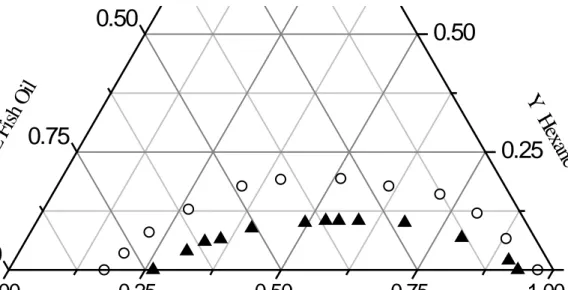
Figures 1 and 2 show the binodal curves for the systems determined in this work. The information provided by the binodal curve is important to optimize the amount of solvent used to create a homogeneous system between reactants. From Figures 1 and 2 can be observed that the two-phase region is slightly bigger when using tert-pentanol as solvent than when using hexane. As expected, an increase in temperature, in the range covered in this work, decreases the biphasic region for both solvents.
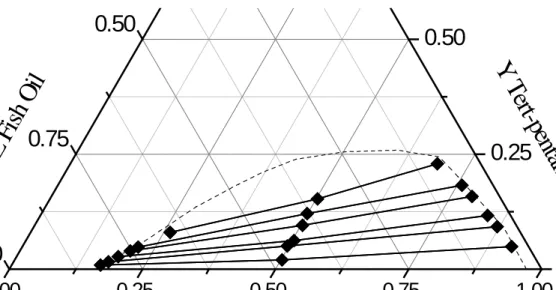
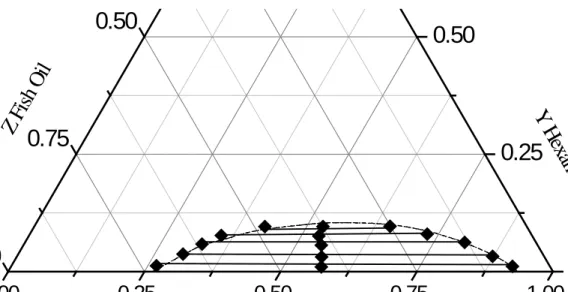
8 Tie lines show that, for the system with tert-pentanol, the ethanol phase is richer in tert-pentanol than the oil phase, however for the ethanol + fish oil + hexane system, the content of hexane is very similar in both phases.
The reliability of the tie-line data were tested by the Othmer–Tobias equation: 20
ethanol in the ethanol-rich phase. The Othmer-Tobias plot for the studied systems is shown in Figure 7. The linearity of the plot indicates a good degree of consistency of the experimental data. The correlations are given in Table 8 at 303.2 K and 323.2 K.
3.2 Data correlation
9 NRTL model has been used to correlate the experimental tie line data. In this work, mass fraction was used as composition unit instead of mole fraction due to the large difference in molar mass of the components of the system. This fact has been suggested in the literature dealing with liquid-liquid equilibrium systems including different kinds of vegetable oils.8 The isoactivity criterion of phase equilibrium can be expressed as a function of mass fraction units as follows:
(
) (
)
OPThe mass fraction-scale activity coefficient γiw must be related to the NRTL activity coefficient γi by the following equation: 8, 21.
∑
fraction of component j respectively.
Rodriguez et al. 21 present an expression for the activity coefficient, γi, for the NRTL model using
mass fractions as unity of concentration:
10 Aij, Bij and αij are parameters of the NRTL model, w is the mass fraction, M is the molecular
weight and T is the equilibrium temperature. Aij and Bij represent the interaction energy between
compounds i and j and αij is a nonrandomness parameter that derives from the local composition
assumption. The parameter estimation was based on the minimization of the following objective function by using the Simplex Nelder Mead method:
(
) (
)
where D is the number of data sets (number of studied temperatures for each system), M is the number of tie-lines in each data set, N is the number of components, the superscripts EP and OP refer to ethanol rich phase and oil rich phase respectively, and the superscripts exp and calc refer to the experimental and calculated values of the liquid-phase concentration. A similar procedure as proposed by Reyes-Labarta et al. 22 has been followed in the minimization procedure to calculate the equilibrium concentrations. The concentrations that satisfy the isoactivity criterion and the mass balances in each phase are calculated by the Newton-Raphson method by fixing pressure, temperature and composition of one of the components in one phase. In the fitting procedure, the non-randomness parameter of the NRTL model has been fixed to different values ranging from 0.1 to 0.5. The best results were obtained for αij = 0.4 in the system ethanol + fish oil + tert-pentanol
and αij = 0.2 in the system ethanol + fish oil + hexane. Table 9 shows the NRTL binary interaction
parameters (Aij, Bij) for these results.
11
From Figures 3-6 can be observed that the NRTL model was able to describe the phase behavior for the ethanol + fish oil system with the two organic solvents, tert-pentanol and hexane, with an average deviation of 0.73 % and 0.51 %, respectively.
4. Conclusions
Experimental liquid-liquid equilibrium data, binodal curve and tie lines, for systems containing fish oil (mixture of tuna and sardine oil), ethanol and tert-pentanol or hexane have been determined. Equilibrium data have been obtained at two different temperatures 303.2 and 323.2 K. As expected, by increasing temperature the biphasic region decreases in the temperature range covered in this work (303.2 to 323.2 K). The miscibility region is slightly larger when using hexane as solvent in the ethanolysis system.
The reliability of the tie-lines was checked by applying the Othmer-Tobias correlation. NRTL activity coefficient model was able to describe the liquid-liquid equilibrium for the two studied systems showing a root mean square deviation lower than 1 %.
Acknowledgment
12
References
(1) Üstun, G.; Goner, S.; Arer, G.; Torkay, S.; Erciyes, A.T. Enzymatic Hydrolysis of Anchovy Oil: Production of Glycerides Enriched in Polyunsaturated Fatty Acids. Appl. Biochem. Biotechnol. 1997, 171 (68), 171-186.
(2) Zuyi, L.; Ward, O. P. Lipase-Catalyzed Alcoholysis to Concentrate the n-3 Polyunsaturated Fatty Acid of Cod Liver Oil. Enzyme Microb. Techno. 1993, 15, 601-606.
(3) Zaks, A. Production of Monoglycerides by Enzymatic Transesterification; Opta Food Ingredients; Inc., Bedford, Mass. 1992, Patent number 5,316,927.
(4) Shen, Z.; Wijesundera, C. Evaluation of Ethanolysis with Immobilized Candida Antarctica Lipase for Regiospecific Analysis of Triacylglycerols. J. Am. Oil Chem. Soc., 2006, 83,923-927. (5) Shaw, J. F.; Chang, R. C.; Wang, F. F.; Wang, Y. J. Lipolytic Activities of a Lipase Immobilized on Six Selected Supporting Materials. Biotechnol. Bioeng. 1990, 35,132–137.
(6) Guan-Chiun, L.; Dong-Lin, W.; Yi-Fang, H.; Jei-Fu, S. Lipase-Catalyzed Alcoholysis of Triglycerides for Short-Chain Monoglyceride Production. J. Am. Oil Chem. Soc. 2004, 81(6) 533-536.
(7) Zaks, A.; Klibanov, A. M. Enzyme-Catalyzed Processes in Organic Solvents; Proc. Natl. Acad. Sci.1985, 82, 3192-3196.
13 (10) Solaesa, A. G.; Bucio, S. L.; Sanz, M. T.; Beltrán, S.; Rebolleda, S. Liquid–liquid equilibria for systems glycerol + sardine oil + tert-alcohols. Fluid Phase Equilibr. 2013, 356, 284-290.
(11) Riddick, J. A.; Bunger, W. B.; Sakano, T. K. Organic Solvents, Physical Properties and Methods of Purification; Fourth Edition ed, ed. T.o. Quemistry,1986.
(12) Deenadayalu, N.; Bahadur, I.; Hofman, T. Ternary excess molar volumes of {methyltrioctylammonium bis(trifluoromethylsulfonyl imide + ethanol + methyl acetate, or ethyl acetate} systemas at T = (298.15, 303.15, and 313.15) K. J. Chem. Thermodyn. 2010, 42, 726-733. (13) Goncalves, F. A. M. M.; Trindade, A. R,; Costa, C. S. M. F.; Bernardo, J. C. S.; Johnson, I.; Fonseca, I. M. A.; Ferreira, A. G. M. PVT, viscosity, and surface tension of ethanol: New measurements and literature data evaluation. J. Chem. Thermodyn. 2010, 42, 1039-1049.
(14) AOCS, Official Methods and Recommended Practices of the American Oil Chemists’ Society. American Oil Chemists’ Society, Champaign, IL 1995.
(15) Rebolleda, S.; Rubio, N.; Beltrán, S.; Sanz, M. T.; González-SanJosé, M. L. Supercritical Fluid Extraction of Corn Germ Oil: Study of the Influence of Process Parameters on the Extraction Yield and Oil Quality. J. Supercritial Fluids. 2012, 72, 270-277.
(16) AOAC, Official Methods and Recommended Practices of the American Oil Chemists’ Society. American Oil Chemists’ Society, Champaign, IL 1990.
(17) Lee, T. W.; Hastilow, C. I. Quantitiative Determination of Triacylglycerol Profile of Structured Lipid by Capillary Supercritical Fluid Chromatography and High-Temperature Gas Chromatrography. J. Am. Oil Chem Soc. 1999, 76 (12), 1405-1413.
14 (19) Tamir, A. Correlation of Vapor-Liquid Equilibria in Systems Showing Homozeotropy or Heteroazeotropy Using Expressions for the Total Pressure and Temperature as Direct Functions of Vapor Composition. Chem. Eng. Sci. 1981, 36 (9), 1467-1473.
(20) Othmer, D. F.; Tobias, P. E. The line correlation. Ind. Eng. Chem. 1942, 34 (6), 693-696. (21) Rodriguez, C. E. C.; Filho, P. A. P.; Meirelles, A. J. A. Phase Equilibrium for the System Rice Bran Oil + Fatty Acids + Etanol + Wáter + γ-Oryzanol + Tocols. Fluid Phase Equilib.
2004, 216, 271-283.
(22) Reyes-Labarta, J. A.; Olaya, M. M.; Velasco, R.; Serrano, M. D.; Marcilla, A. Correlation of the Liquid–Liquid Equilibrium Data for Specific Ternary Systems With One or Two Partially Miscible Binary Subsystems. Fluid Phase Equilib. 2009,278, 9-14.
15
Table 1. Density of the pure components.a
ρexp./kg·m-3 ρliterature/kg·m-3
Component 303.2 K 323.2 K 298.15 K 303.15 K 323.15 K
Ethanol 782.52 765.73 785.06 11 781.812 765.2013
Hexane 651.10 632.10 654.8011 650.18 11 _ _
Tert-pentanol 801.33 783.30 805.00 11 _ _ _ _
Fish oil 917.50 906.53 _ _ _ _ _ _
a
16
Table 2. Fatty acid composition of the fish oil used in this work and of the two phases (oil and ethanol rich phases) of a tie line at 303.2 K for the system ethanol (1) + fish oil (2) + hexane (3).a
Tie line
Fatty acid fish oil, % OP, % EP, %
Myristic C14:0 3.3 3.4 3.8
Palmitic C16:0 19.5 20.2 20.4
Palmitoleic C16:1n-7 5.4 5.5 5.9
Stearic C18:0 6.0 6.2 5.8
Oleic C18:1n-9 18.0 18.5 18.3
Vaccenic C18:1n-7 3.0 2.9 2.9
Linoleic cis (LA) C18:2n-6 2.4 2.4 2.5
α-Linolenic (ALA) C18:3n-3 0.7 0.7 nd
Steriadonic C18:4n-3 0.9 0.9 nd
Eicosenoic C20:1n-9 2.1 2.1 2.0
Eicosatrienoic C20:3n-3 2.1 2.1 2.2
Eicosapentaenoic (EPA) C20:5n-3 7.6 7.4 8.0
Docosapentaenoic (DPA) C22:5n-3 2.0 1.9 1.9
Docosahexaenoic (DHA) C22:6n-3 27.0 25.8 26.3
EP: ethanol phase; OP: oil phase
a
17
Table 3. Binodal curves for ethanol (1) + fish oil (2) + tert-pentanol (3) at 303.2 K and 323.2 K. a
w1 w2 w3 ρ, kg·m-3
303.2 K
0.9711 0.0289 0.0000 784.55
0.8850 0.0260 0.0890 791.74
0.7410 0.0570 0.2020 797.29
0.6860 0.0700 0.2440 798.12
0.5990 0.1420 0.2590 805.20
0.5040 0.2410 0.2550 820.17
0.4190 0.3420 0.2390 827.52
0.3700 0.4200 0.2100 838.72
0.3380 0.4770 0.1850 847.90
0.2830 0.5820 0.1350 860.14
0.2410 0.6760 0.0830 873.72
0.2200 0.7230 0.0570 880.51
0.1765 0.8080 0.0155 891.17
0.1753 0.8247 0.0000 895.48
323.2 K
0.9350 0.0650 0.0000 774.08
0.8390 0.0870 0.0740 776.61
0.7600 0.1100 0.1300 780.78
0.6900 0.1550 0.1550 787.70
0.6420 0.2026 0.1554 794.05
0.6100 0.2353 0.1547 798.65
0.5600 0.2890 0.1510 804.31
0.5150 0.3380 0.1470 810.68
0.4700 0.3948 0.1352 815.05
0.4000 0.4900 0.1100 827.92
0.3650 0.5402 0.0948 832.27
0.3320 0.5930 0.0750 843.07
0.3100 0.6340 0.0560 849.13
0.2650 0.7350 0.0000 886.49
a
18
Table 4. Binodal curves for ethanol (1) + fish oil (2) + hexane (3) at 303.2 K and 323.2 K. a
w1 w2 w3 ρ, kg·m-3
303.2 K
0.9711 0.0289 0.0000 784.55
0.8800 0.0536 0.0664 778.50
0.8000 0.0800 0.1200 774.23
0.7116 0.1280 0.1604 774.56
0.6090 0.2132 0.1778 780.00
0.5130 0.2934 0.1936 787.70
0.4037 0.4043 0.1920 800.05
0.3395 0.4829 0.1776 815.43
0.2660 0.6057 0.1283 839.40
0.2181 0.7019 0.0800 864.38
0.1940 0.7705 0.0355 878.10
0.1753 0.8247 0.0000 895.48
323.2 K
0.9350 0.0650 0.0000 774.08
0.9080 0.0720 0.0200 774.45
0.7978 0.1342 0.0680 769.32
0.6770 0.2230 0.1000 767.17
0.5905 0.3052 0.1043 773.91
0.5540 0.3420 0.1040 775.18
0.5300 0.3660 0.1040 778.23
0.4943 0.4057 0.1000 787.76
0.4020 0.5100 0.0880 816.03
0.3564 0.5782 0.0654 837.32
0.3300 0.6100 0.0600 847.51
0.3072 0.6531 0.0397 864.38
0.2650 0.7350 0.0000 886.49
a
19
Table 5. Parameters of Equation 1.
T /K Parameters r2
Ethanol (1) + Fish oil (2) + Tert-pentanol (3)
A12 = -10.8661 B12= -28.9237
303.2 A13 = -28.407 B13= 108.895 0.9991
A23 = -3.9883 B23= -54.5387
A12= 50.9625 B12= -76.6458
323.2 A13= -31.5295 B13= 4.7147 0.9994
A23= -27.8921 B23= -897.127
Ethanol (1) + Fish oil (2) + Hexane (3)
A12= -28.0217 B12= -49.4943
303.2 A13= 44.3121 B13= -28.2368 0.9993
A23= -133.633 B23= 93.2504
A12= 54.052 B12= -72.4196
323.2 A13= 52.4717 B13= 108.657 0.9990
20
Table 6. Ternary LLE Data for the system ethanol (1) + fish oil (2) + tert-pentanol (3) at 303.2 K and 323.2 K.a
Overall composition Ethanol-rich phase Oil-rich phase
21
Table 7. Ternary LLE Data for system ethanol (1) + fish oil (2) + hexane (3) at 303.2 K and 323.2 K. a
Overall composition Ethanol-rich phase Oil-rich phase
w1 w2 w3 w1 w2 w3 w1 w2 w3
303.2 K
0.5510 0.4176 0.0314 0.9061 0.0540 0.0399 0.2178 0.7400 0.0422 0.5379 0.4095 0.0526 0.8710 0.0714 0.0576 0.2171 0.7190 0.0639 0.5296 0.4005 0.0699 0.8460 0.0850 0.0690 0.2219 0.6925 0.0856 0.5195 0.3905 0.0900 0.8171 0.0914 0.0915 0.2561 0.6390 0.1049 0.4988 0.3711 0.1301 0.7830 0.0895 0.1275 0.2924 0.5695 0.1381
323.2 K
0.5700 0.4200 0.0100 0.9201 0.0684 0.0115 0.2660 0.7217 0.0123 0.5596 0.4090 0.0314 0.8732 0.0943 0.0325 0.3025 0.6604 0.0371 0.5470 0.3970 0.0560 0.8067 0.1310 0.0623 0.3263 0.6150 0.0587 0.5326 0.3916 0.0758 0.7291 0.1910 0.0799 0.3528 0.5700 0.0772 0.5299 0.3741 0.0960 0.6526 0.2510 0.0964 0.4230 0.4820 0.0950
a
22
Table 8. Correlation constants for the Tobias-Othmer correlation of the ternary system at 303.2 K and 323.2 K
System T/K A B r2
Ethanol (1) + Fish oil (2) + Tert-pentanol (3)
303.2 -0.3519 0.5313 0.9291 323.2 0.5101 0.7470 0.9816
Ethanol (1) + Fish oil (2) + Hexane (3)
23
Table 9. NRTL parameters for the ethanol (1) + fish oil (2) + tert-pentanol (3) and for the ethanol (1) + fish oil (2) + hexane (3)
Pair Aij/K Aji/K Bij Bji αij RMS
System: Ethanol (1) + fish oil (2) + tert-pentanol (3)
12 -271.5 3314.3 8.3 -7.5 0.4
0.73
13 7041.2 1930.3 -7.8 -4.4 0.4
23 1594.6 149.7 2.1 -5.7 0.4
System: Ethanol (1) + fish oil (2) + hexane (3)
12 134.8 1605.6 9.0 -8.5 0.2
13 5537.7 20525.8 -16.0 832.7 0.2 0.51
24
List of Figure of Captions
Figure 1. Phase diagram of ethanol (1) + fish oil (2) + tert-pentanol (3) (○ 303.2 K; ▲ 323.2 K)
Figure 2. Phase diagram of ethanol (1) + fish oil (2) + hexane (3) (○ 303.2 K; ▲ 323.2 K)
Figure 3. Liquid-liquid equilibrium for the system ethanol (1) + fish oil (2) + tert-pentanol (3) at 303.2 K: --- binodal curve; ♦ tie lines; NRTL.
Figure 4. Liquid-liquid equilibrium for the system ethanol (1)+ fish oil (2) + tert-pentanol (3) at 323.2 K: --- binodal curve; ♦ tie lines; NRTL.
Figure 5. Liquid-liquid equilibrium for the system ethanol (1) + fish oil (2) + hexane (3) at 303.2 K: --- binodal curve; ♦ tie lines; NRTL.
Figure 6. Liquid-liquid equilibrium for the system ethanol (1) + fish oil (2) + hexane (3) at 323.2 K: --- binodal curve; ♦ tie lines; NRTL.
25
0.00
0.25
0.50
0.75
1.00
0.50
0.75
1.00
0.00
0.25
0.50
Y
T
ert
-pe
nt
anol
Z
F
is
h O
il
X Ethanol
26
0.00
0.25
0.50
0.75
1.00
0.50
0.75
1.00
0.00
0.25
0.50
Y He
xa
ne
Z
F
is
h O
il
X Ethanol
27
0.00
0.25
0.50
0.75
1.00
0.50
0.75
1.00
0.00
0.25
0.50
Y
T
ert
-pe
nt
anol
Z
F
is
h O
il
X Ethanol
28
0.00
0.25
0.50
0.75
1.00
0.50
0.75
1.00
0.00
0.25
0.50
Y
T
ert
-pe
nt
anol
Z
F
is
h O
il
X Ethanol
29
0.00
0.25
0.50
0.75
1.00
0.50
0.75
1.00
0.00
0.25
0.50
Y He
xa
ne
Z
F
is
h O
il
X Ethanol
30
0.00
0.25
0.50
0.75
1.00
0.50
0.75
1.00
0.00
0.25
0.50
Y He
xa
ne
Z
F
is
h O
il
X Ethanol
31