Facultad de Filosofía, Letras y Ciencias de la Educación
Maestría en Lingüística Aplicada a la Enseñanza de Inglés como Lengua
Extranjera
Can the use of English songs improve A1 EFL college students’ listening
comprehension?
Trabajo de titulación previo a la
obtención del título de Magíster en
Lingüística
Aplicada
a
la
Enseñanza de Inglés como Lengua
extranjera
Autor:
BQF. Antonio José González Arteaga
CI: 0104219019
Directora:
Mgst. Juanita Catalina Argudo Serrano
CI: 0102810249
Resumen:
Aunque se han hecho muchas investigaciones en el área de usar canciones para aprender inglés como lengua extranjera, no hay estudios abundantes en el contexto específico de los estudiantes universitarios del Ecuador, especialmente en lo relativo al efecto de las canciones en la comprensión auditiva. El objetivo de este estudio fue determinar cuál es el efecto de las actividades basadas en canciones sobre las destrezas de comprensión auditiva de estudiantes de la Universidad Politécnica Salesiana en Cuenca, Ecuador, con un nivel de competencia en inglés de A1 de acuerdo al Marco Común Europeo de Referencia.
Con este propósito, una intervención con actividades con canciones se aplicó a un grupo experimental en la universidad. Un examen previo y uno posterior a la
intervención fueron aplicados para medir la comprensión auditiva. Los exámenes fueron también aplicados a un grupo control que no recibió la intervención.
Adicionalmente, se condujeron entrevistas con el grupo experimental antes y después de la intervención para obtener sus percepciones y criterios en relación al uso de canciones para el aprendizaje de inglés y el desarrollo de la destreza auditiva, y también sobre la intervención.
El análisis de resultados mostró una ligera mejora tanto en el grupo control como en el experimental. La mejora del grupo experimental sobrepasó a la del grupo control, pero no lo suficiente para ser estadísticamente significativa. Sin embargo, las
percepciones de los estudiantes con relación al método fueron en general positivas.
Abstract:
Although extensive research has been conducted around the world in the area of using songs for learning English as a foreign language, studies done in the specific context of college students in Ecuador are not abundant, especially regarding the effect of songs on listening comprehension. The aim of this study was to determine what is the effect of song-based activities on the listening comprehension skills of college students at the Salesian Polytechnical University in Cuenca, Ecuador, with an English proficiency level of A1 according to the Common European Framework of Reference.
For this purpose, an intervention with song activities was applied to a treatment group in the university. A pretest and a posttest to measure listening comprehension were respectively administered before and after the intervention. The tests were also applied to a control group which did not receive the intervention. Additionally, interviews were conducted with the treatment group before and after the intervention to gather their perceptions and criteria towards the use of songs for learning English and developing the listening skill, and also about the intervention.
Analysis of results showed a slight improvement in both the control and the treatment group. The treatment group’s improvement surpassed that of the control group, but not enough to be statistically significant. However, students’ perceptions
towards the method were generally positive.
Índice del Trabajo
TABLE OF CONTENTS
INTRODUCTION ... 6
STATEMENT OF THE PROBLEM ... 7
RESEARCH QUESTION ... 8
OBJECTIVES ... 9
General Objective ... 9
Specific objectives ... 9
CONTEXT ... 9
THEORETICAL FRAMEWORK ... 11
Language and music at brain level ... 11
Music in the learning of a second language. ... 15
LITERATURE REVIEW ... 21
The Neglected Skill: Listening-Comprehension ... 21
METHODOLOGY ... 31
Research Context ... 31
Universe and Sample ... 31
Research Design ... 33
RESULTS ... 36
DISCUSSION ... 53
CONCLUSIONS ... 56
INTRODUCTION
Music has been widely used as a means for teaching English as a second language (ESL) and English as a foreign language (EFL) all over the world. The specific purposes for its use are varied and range from the generation of motivation to the enhancement of specific skills, such as vocabulary acquisition and oral production.
There are studies from around the globe that report on the positive impact of using songs in the EFL class with students of all ages and proficiency levels: Beasley and Chuang (2008) conducted a correlation and regression analysis with 196 Taiwanese students; their results suggest song likeability and understandability positively influence learners’ perceptions and learning outcomes. In 1999, Schunk conducted a study aimed at assessing the effects of singing paired with signing on vocabulary acquisition on elementary EFL students with a control group, in which pretests and posttests showed the children who received the treatment obtained better results regarding vocabulary gains. Xiangming and Brand (2009) studied the effects of using songs on vocabulary acquisition and language usage in an EFL classroom with adult, college level students from China. They administrated pretests, posttests and delayed posttests to three groups, the first of which only received the music treatment, the second received the music treatment during half the time of each class, and the third would only receive instruction without music. The first group obtained significantly better results.
Similarly, a study conducted in Riobamba, also in a high-school, showed improvements in listening comprehension and oral expression (Allauca, Chafla, and Felicia, 2016).
From a theoretical perspective, Krashen’s affective filter hypothesis (1981) states that motivation, low anxiety and self-confidence are key factors in effective learning, so it is
fundamental to diminish this affective filter which basically consists of negative preconceptions and feelings learners present towards the contents and skills to be learned, and the process of learning itself. According to Krashen, certain types of activities that are generally regarded as pleasant, such as watching videos and listening to songs are effective at diminishing this filter. Maess and Koelsh (2001) propose that, according to neurological studies, language syntax and music syntax are processed in the same brain area, that is, Broca’s area, and the process occurs in a similar manner.
STATEMENT OF THE PROBLEM
Although extensive research has been done in the area of using English songs for different purposes in EFL and ESL learning, studies done in the specific context of college EFL students in Ecuador are not abundant. Some research exists on the use of music for vocabulary acquisition (Cajamarca, Vásquez, 2012) and, in some instances, for listening comprehension (Benalcázar, 2013), but these studies have been applied in primary school classrooms, and not with adult students.
students at the Universidad Politécnica Salesiana (Salesian Polytechnical University) is of relevance.
Listening comprehension is challenging for many EFL adult students of practically all levels. Even learners who are relatively proficient in other areas of the language, such as writing and speaking, oftentimes find it difficult to understand the contents of recorded materials included in English courses that are commonly used in high-schools and universities for EFL teaching, or in true materials, namely, movies and television series (Hamouda, 2013).
Also, EFL learners are usually accustomed to the sound of individual words, but a native or proficient speaker will speak with a certain flow in which recognizing words turns out to be more challenging (Chen, 2009). This is a phenomenon that has been observed in English classes at the Salesian Polytechnical University. Even when the listening tasks are applied according to the timing and guidelines recommended by the methods’ authors –and beyond– a considerable amount of class members still struggle with these activities, and this is reflected in their grades when listening is evaluated.
Field (2009) considers the traditional comprehension approach for listening, in which there is big emphasis in the answers the students provide and not in the learning process itself, has focused on evaluating listening but not in improving it. He also refers to listening as a
‘neglected’ skill, while Rost (2001) considers it is the most important skill in a language, because it is the one that in real contexts is most commonly used.
RESEARCH QUESTION
OBJECTIVES
General Objective
To assess whether the use of English songs, specifically the lyrics, can improve the listening comprehension of Spanish speaking Ecuadorian college students with an A1 level of English proficiency.
Specific objectives
To determine if students show improvement in their listening comprehension after the intervention has been applied.
To analyze the perceptions of the students towards the use of English songs for listening comprehension improvement.
CONTEXT
The intervention was conducted in the year 2017, between the months of April and July, with students belonging to the second course of the English program whose level of proficiency corresponds to A1 in accordance to the Common European Framework of Reference. Two classes were part of the study; one of them functioning as the treatment group and the other as the control group. The treatment group was composed of 42 students and the control group had 41 students, all of which had four hours of English classes per week.
The treatment consisted of exercises based on songs, with the application of a pretest and a posttest to assess changes in the listening comprehension capacity of the students, so the
independent variable is the use of English songs, exercises and activities based on them, and the dependent variable is listening comprehension.
Further data regarding the demographics of the students are presented later in the
THEORETICAL FRAMEWORK
Language and music at brain level
Neuroscientist and psychologist Stefan Koelsh and physicist Burkhard Maess, after magnetoencephalography application and thorough analysis of several subjects submitted to musical stimuli, came to the conclusion that the area of the brain that is responsible for language syntax (Broca’s area) is also the one that processes music syntax which, in turn, leads to the conclusion that these processes are so deeply related that it would seem logical for music to be a powerful tool for language teaching/learning. (Maess, Koelsh, 2001).
Among the special abilities of the human brain is language, and its neurological foundations are of interest in basic and applied neuroscience (Broun & Hgoort, 1999 qtd. In Patel, 2003). On the other hand, recently, interest has been developed in the cerebral bases of music (Peretz & Zatore, 2003 qtd in Patel, 2003).
Language is a syntactic system with hierarchically organized sequences (sentences), and those sequences are combinations of structural elements (words). There is a definite relationship between the structure of sentences and their meaning (Patel, 2012). Music also has structural elements which combine to form organized sequences in hierarchical order (Lerdahl &
Jackendoff, 1983 qtd. In Patel, 2012). In spite of that fact, there are several differences among syntactic musical and linguistic sequences, for instance, an incoming element requires a
Patel (2003), proposes a specific point of view in relation to convergence of the syntax process between language and music, which overlap at brain level, a criterion based in recent neuroimaging studies (Patel, Gibson, Ratner, Bensson & Holcomb, 1998 qtd in Patel, 2003; Koelsch, 2002 qtd. In Patel, 2003) which is also found in Brocca’s aphasia problems, which are not only related to language, but to musical perception.
Furthermore, Gordon (1993) states there are many similarities between music and language, which include rhythm, tone, semantic, and phonetic components, structure, as well as social components, such as the fact that they are both perceived via hearing and, in the case of singing, transmitted orally.
The combinatory principles among language and music take place at diverse stages, for instance, in the formation of words, phrases, and sentences in language, while in music they are musical chords, chords progression and keys (Sloboda, 1995 qtd. in Patel, 2003).
Figure 3. Neural evidence for syntactic overlap in language and music (Patel, 2003, p. 676) Researching in neuroimaging supports the overlapping idea, showing that the syntactic musical process activates language areas in the brain (Maes, Koelsch, Gunter & Friderici; 2001 qtd. in Patel, 2003).
The sharing resource, when referring to the cognitive process, suggests there could be deep connections among certain musical and language aspects which can be quite different in reference to structural organization (Patel, 2012).
Neuropsychology has discovered there are music cognition deficits in normal subjects who present focal damage in the brain, which implies there are independent networks for music and language in the brain, which do not overlap (Peretz& Colheart, 2003 qtd. in Patel, 2012).
posterior-superior temporal lobe (Poepel, 2001 qtd. in Patel, 2012).
Given this apparent contradiction between neuroimaging and neuropsychology, Patel (2003) concluded that the evidence has shown, through a large amount of research, that language and music are much more related than previously believed, and that a possible convergence between modern cognitive theories of the syntactic process in language and music hypothesizes that linguistic and musical syntax share the syntactic process that is applied on different syntactic representations of different domains in posterior regions of the brain. The comparative analysis between music and language provides a clearer and deeper idea of the mind, than the one obtained though the single study of each domain by itself.
communication. In both the internal and external environment of the cells, these currents originate electrical potentials that can be measured by voltage differences between two electrodes in the scalp (Kutas & Federmeier, 2012).
Sammler et al., (2009, qtd. in Koelsch, 2012) observed by electro cortical recording that in language there is greater activation of the temporal lobe than of the frontal lobe, while in the musical domain, the activation was identical in both lobes. It could be inferred that the musical and linguistic information recruit resources at least partially equal within the perisylvian region. Modern methods of functional magnetic resonance imaging (fMRI) include techniques that allow measuring temporal correlations between the influence of activity in one region over another (Patel, 2012). Grahn (2012, qtd. in Patel, 2012) says these methods could be used to compare interactions among temporal superior lobe and the Brocca area regions during syntactic processes of music and language.
Music in the learning of a second language.
“Music has always been a vasta part in people’s lives: it is ubiquitous, it surrounds us everywhere, and it is broadley accepted all around the world” (Kusnierik, 2016, p.22).
Lowe (1998, qtd. in Toffoli & Sockett, 2014) presents several well-documented sources that indicate the following: Both music and language are acquired thanks to the aural sense. The use of music in second language teaching is a good strategy that has been suggested by several education researchers in second language teaching.
According to Toffoli and Socket (2014), in relation to this topic, Lowe records in his work multiple citations, which are so numerous that are not reproduced by Toffoli & Socket, but these same researchers say that these quotes highlight the importance of listening in the second
Online Informal Learning of English (OILE). It is also admitted that despite the differences between songs and spoken language, their common characteristics are sufficient indicators to use music in language teaching. The clear relationship between music and language has been
recognized for some time. The songs occupy an intermediate position between the disciplines of linguistics and musicology. It is practically impossible to establish the point of separation between the completion of a "speech" and the beginning of the categorization of a song. Both have the communication aspects of the language and the entertainment of music, both have rhythm and melody and at the same time represent a form of communication in a linguistic sense (Jolly, 1975).
The beneficial role of music is now definitely recognized. In the social environment, it is recognized that it is motivating, affects the character, decreases anxiety, and has positive effects on mental health. Songs influence learning and memory, including verbal learning. Cognitive psychological research has shown that native speakers often show greater retention of songs than spoken texts (Levitín, 2008 & Wallace 1994, qtd. In Tegge, 2018).
On that note, the affective filter hypothesis proposed by renowned linguist and educator Stephen Krashen (1981) states that students often times present a barrier of negativity towards learning, which is the result of their own preconceptions towards the subject, which might be the result of negative past experiences and also of an ambience of distress and low-selfsteem.
which gives rise to a period of sustained intellectual and/or physical effort in order to attain a previously set goal (or goals).” Music is an art form that has proven its massive appeal on practically every culture over time, its potential as a “filter diminishing” instrument is considerable, as well as its capacity to generate motivation in learners. Due to globalization processes, music in English is highly popular around the world, especially among young people (Shen, 2009).
Songs and second language teaching.
Humanity has used songs in its experience since immemorial times. Nowadays, the prevailing use of the Internet, both in people’s lives and in classrooms, has made the songs and their
accompanying poems accessible at all levels and are very effective as teaching-learning tools. There are two processes involved in the use of songs in English as a Second Language or English as a Foreign Language (ESL / EFL): 1. Bottom up processing, in which the listener builds words and sentences with meaning based on sounds. 2. Top down processing, where the meaning of the message is understood thanks to the background knowledge of the listener.
Adding to this, Purcell (1992, p. 192), who conducted research on the direct application of music in the classroom for learning foreign languages, states the following: “Using songs as a supplement to the typical curriculum is an effective means to enliven the daily lesson plan. Songs provide entertainment as well as insight into language skills...”. He goes on to say that:
Adam J. Simpson, a remarkable ESL blogger for the British Council, emphasizes the importance of producing creative classes to teach English, either to young learners or adults, in order to maintain them motivated. He explains one of the principal methods he uses is to teach songs in English, due to “the great tool music is because of its universal appeal, connecting all cultures and languages” (Simpson, 2015).
The Affective Filter hypothesis states that the teacher must organize an adequate environment for learning the language, the songs favor a low affective filter and thus the students show positive attitude for learning the language. Saricoban and Meltin (2000) found that the songs facilitate the development of the four skills: reading, writing, listening and speaking. According to Shoepp (2001), in addition to the aforementioned authors, there are several others who maintain that songs promote language development because they offer entertainment, and Eken (1996, qtd. In Shoepp, 2001) states that the songs used in the classroom incentive extensive and intense listening practice. Since the nature of the songs is repetitive and consistent, their use leads to automate language learning. There are also linguistic reasons to use songs in the
classroom; some employ the informal conversation language that is what students would listen to in a daily basis outside the classroom (Shoepp, 2001).
Tegge (2018) says that in order to facilitate the acquisition of second language, many
Music, Lyrics and Literature.
According to Ramírez, in the development of oral communication, the importance of
pronunciation should be considered, teaching it requires more than simply imitating the teacher, and since the sound system is an integral part of the language, it is convenient to describe it in terms of the following categories:
Phonemes: the individual sounds of the language (consonants and vowels) that are systematically distinguished for each other (e.g. tin vs. sin)
Syllabus structure: the way in which consonants and vowels may be combined into syllables in a particular language.
Syllable stress: the relative prominence given to one syllable (présent / presént)
Juncture: the manner in which sounds are connected to each other (e.g. nitrate vs. night rate) Intonation: the rise and fell in pitch of the voice during speech production as in this sentence:
Figure 4. Relative Pitch Level (Ramírez, 1995, p.130)
ESL teachers find that using music is effective when dealing with word accentuation,
practice that is not a mechanical drill, so it is recommended as a natural activity of language (Maley, 1987 qtd in Ramirez, 1995).
Lazar (1993, qtd. In Griffiths, 2012) says that in recent years, literature has not been used in language classes. However, there are those who think the interest in teaching language through literature is re-emerging.
Literature develops reading and comprehension skills, listening and speaking, enriches vocabulary, provides a correct grammar model, important content to process and interpret new language, for all this literature has great value in the language class, becoming a motivating element that induces the interaction between students, and educates people.
Songs are only poems set in music. Rhythm, rhyme, and other poetic resources develop language skills and awareness. Ideas have been suggested for using songs with a view to
LITERATURE REVIEW
The methods of teaching a language have had a long history, in which some have acquired prestige and others have fallen into disuse. While in the twentieth century the primary interest was to find more effective methods in the teaching of the language, in the twenty-first century, the so-called "era of post-communication methods", there is concern about a more complex vision that approaches a multi-faceted comprehension of the teaching-learning process, and the individual contributions of each teacher to the pedagogy of language teaching (Richards and Renendya, 2002).
The Neglected Skill: Listening-Comprehension
“Listening comprehension has been neglected in research and practice up to quite recent times” (Osada, 2004, p. 56).
Nunan (2002) calls listening the ‘Cinderella skill’ in learning a second language, since it has been overlooked for speaking, ‘her older sister.’ For many people, acquiring second language knowledge means being able to speak. Listening for a long time was considered by the researchers a skill that develops without assistance. Only around 1970, this skill began to be explored and its investigation has extended during the past thirty years (Osada, 2004).
Researchers and language teachers paid more attention to reading and grammar, while listening was not regarded as important in language teaching (Richards and Rogers, 2001 qtd. in Yildirim and Yildirim, 2016).
experiencing it, that is to say that the simple exposition of the students to the spoken language should constitute adequate instruction in listening comprehension (Mendelson, 1984, Oxford, 1983 and Call, 1985 qtd. in Osada, 2004). It was quite a widespread criterion that reading and writing in a second language meant knowledge of the language; however, for those who are not able to understand, communication is not possible. Listening is this way a basic skill in language learning, thus, 50% of the time that the student spends to learning an L2 should be dedicated to listening (Nunan, 1998 qtd in Yildirm and yildirim, 2016).
First listen, then talk.
It was in the 1990s that interest in listening as part of instruction in language learning increased, and with the advent of Communicative Language Teaching, it was widely accepted that listening comprehension is an important phase of language learning (Osada, 2004). Listening is not only to hear, it is a receptive skill through which the listener converts the sound into words and understands its meaning, which allows it to take part in the communication process
(Sandiku, 2015).
According to Flowerdew and Miller (2005), all children are born with the ability to hear. Children first listen and then start to speak. They speak before they read and finally, writting comes after reading. Among all the other language skills, listening is the first one to appear (Lundsteen, 1979 qtd in Yildirim and Yildirim, 2016, p.2096).
Summing up the recent and not so recent findings of research in the acquisition of second language and the pedagogical theory in this regard, it has been established that there is sufficient evidence to sustain that providing students with initial levels a period of silent learning or ‘Pre-speaking’ is beneficial and oral practice should be postponed. In natural circumstances, both children and adults, beginners in a foreign language, typically maintain an initial period of silence. Learners who have experienced this period of silence showed a tendency to better performance in learning than those who did not. On the other hand, those who were pressured to speak in a very early state suffered a phenomenon known as 'task overload', which probably inhibits the acquisition of language, creates anxiety, and interferes with the learning of the native language.
The authors Gari and Grant emphasize the cognitive, affective, and utilitarian advantages of increasing practice in listening and postponing oral exercises for second language learning. Listening comprehension is important not only in the initial levels of second language acquisition, but also for students of advanced levels (Dunkel, 1996)
Rivers (1996, qtd in Osada, 2004) says that speaking for oneself is not communication, it needs to be understood by another person.
Listening in Second Language Teaching
Berne (1998, qtd. in Osada, 2004) says about L2 listening comprehension, relying on
of passages should be encouraged as soon as they arise, the use of authentic passage leads to a good performance in L2 listening comprehension, and the use of listening strategies should be taught to the students.
Studies in listening reveal that this skill is one of the most difficult for foreign language students Goh, Guo and Wills (2006, qtd. in Yildirim and Yildirim, 2016) and Mendelson (1994, qtd. in Yildirim and Yildirim, 2016) establish the reasons for which listening was not taught correctly: 1) it was not taught as an independent skill for a long period, 2) insecurity of teachers to teach it, and 3) inappropriate traditional materials for teaching listening.
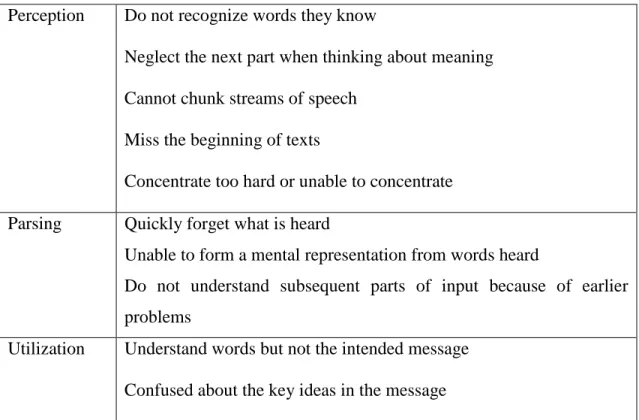
Among the multiple studies conducted on the problems of second language in listening-comprehension, the one conducted by Goh (2000), focuses it from a cognitive perspective and identifies three phases in the listening process and ten problems experienced by the students:
Perception Do not recognize words they know
Neglect the next part when thinking about meaning Cannot chunk streams of speech
Miss the beginning of texts
Concentrate too hard or unable to concentrate Parsing Quickly forget what is heard
Unable to form a mental representation from words heard
Do not understand subsequent parts of input because of earlier problems
Utilization Understand words but not the intended message Confused about the key ideas in the message
Sandiku (2015) argues that a broad vocabulary allows for better listening and understanding, and Staehr (2009) conducted a study that demonstrates the fact that vocabulary knowledge is an important factor in being successful at listening-comprehension in English as a foreign language. Chung (1994) in his doctoral thesis says that although visual and audio media have been used in second language classes, there is very little information about their effectiveness. His work demonstrates with sufficient evidence some of his findings:
The use of images almost always improves listening-comprehension of dialogues. Moving images give excellent results. Images that represent a scene can have a great influence on the ability to predict content, but multiple images in some circumstances produce distraction and deconcentration.
Yilderim & Yilderim (2016) present the following adapted format from Field (2008) for a usual listening lesson:
General questions on context and attitude of speakers
Intensive Listening
Learners infer the meaning of unknown words from the sentences Final play; learners look at transcript
In a study conducted by Tegge in Wellington, New Zeland, 374 informants from various countries responded to a survey related to what musical activities, in short, were used to achieve the following objectives:
1. To create a positive and motivating learning situation; 2. To accommodate individual learner´s needs;
3. To provide authentic language and culture;
4. To teach clearly defined language skills and linguistic knowledge.
90% reported using songs to motivate students with an enjoyable activity. 74% suggested they used songs to create a relaxing atmosphere (Tegge, 2018, p.6).
In conclusion, many teachers have a positive attitude towards the use of songs in teaching and make use of them in class in a creative way and with defined purposes. They are based on
reasoning that often reflects findings in psychological cognitive research. However, the use of songs is limited due to the lack of songs that are in accordance with the curriculum and official prefabricated materials (Tegge, 2018).
Research on the use of songs in Second Language teaching
Kahraman (2008) in his study entitled "The use of songs in improving
listening-comprehension in English," mostly exercised with soft-rock and old pop songs, said that the advantage of rock songs is that they have more meaningful content and more words due to the lack of repeated parts. The results of this study revealed that the best understood songs were those of acoustic soft rock and soft rock genres. The findings suggest that clarity of
Several researchers have demonstrated the importance of songs in the learning of second language. Some aspects of its have been tested experimentally, finding in several cases sufficient evidence to ensure positive results.
Milevanov (2010, qtd. In Toffoli & Socket, 2014) found young adults with great musical aptitude present better pronunciation of English. The researcher based the results on a
comparative test of pronunciation, a phonetical listening discrimination task and a test of musical aptitude.
Li and Broud (2009, qtd. In Toffoli & Socket, 2014) carried out a study in three groups of ESL university students in Hong Kong. A group exposed exclusively to learning English through music, another group did not listen to music in their classes, and a third group that half of the time listened to music in their classes and the other half of the time did not. The results showed that, depending on the degree of use of songs in class, there was differential English language achievement in posttests and delayed posttests.
Faliyant (2017) performed a comparative research to assess the effects of songs in vocabulary acquisition in two groups, an experimental one, and another control group with students of Muhammadiyah University of Metro in the second semester of the 2015/2016 academic year. The experimental group received treatment with songs by the researcher, the control group received their classes in the usual way, without the intervention of the researcher.
The researcher also suggests that to increase student motivation, the use of songs is a measure that should be used in class.
“Beasely & Chuang (2008) studied the effects of listening repetition, song likeability and song understandability on students' perceptions of progress in English and of vocabulary test” (Toffoli & Socket, 2014, p. 196). They did not find a significant correlation, but they attribute that the repetitions were generally limited to a single session (although numerous in that session) and not during a period of several weeks. Informal listeners plan their practice times themselves, but it seems that the design of tasks in the Beasely & Chuang experiment was limiting for progress in language acquisition (Toffoli & Socket, 2014).
On a study conducted in Colombia by Escobar and Gómez (2011), with the aim of developing an instructional unit based on pop music for eighth grade English students, an English workshop was developed and applied, and data was gathered with surveys that were given to the students and to the teachers of a public school in Cali. According to these surveys, the activities were motivating and the students improved their listening and oral production skills.
Kusnierek (2016) carried out an investigation whose goal was to teach vocabulary with the use of songs. Part of the premise was that listening to music in English is highly motivating for students, and the songs are easily accessible. The study was tested with two groups of 14
the questionnaire used was not reliable and had disadvantages. Some teenagers could have ignored questions and left some unanswered, others could have played jokes with the
questionnaires and put the same answer in each of the questions. In addition, students were able to cheat while writing the posttests. The study was conducted by a young teacher, not
experienced, so that their ideas in the lessons could not be considered a perfect example of the lesson type.
In any case, the aforementioned researchers agree that the use of songs in the classroom has a positive influence on the teaching of the language. Kusnierek (2016) suggests that teachers should remember that the selection of songs plays an important role, and Simpson (2015) says that this selection is a really difficult issue, for this we must first consider what we want the students to learn, the level of the language of their class, both for the selection of the song, and to plan the activities. Plus, students should be allowed to choose the songs. He also adds that
considering music sources that do not require internet connection, such as mp3 files or an old-fashioned CD, can also be useful.
METHODOLOGY
Research ContextAs explained in the introductory chapter, this research took place at the Language Institute of the Salesian Politechnic University in Cuenca in the year 2017, between the months of April and July.
Students had four hours of English classes per week, divided into two two-hour weekly lessons. A portion of 20 minutes was destined in each lesson to the intervention for this study. Before conducting this research, students (adults) were asked to agree on their participation in it, and they were provided with fundamental information regarding the key aspects of research and their involvement. Approval from the director of the institute was also obtained in order to proceed with the research.
Universe and Sample
The universe to which this study pertains consists of all UPS students that must take the second level of the mandatory English courses as a requirement for their graduation. A class of 42 students served as the sample for the treatment group. Another class with very similar characteristics regarding demographics, schedules and majors, which was composed of 41 students, served as the control group. I worked as a teacher of both groups.
cities and towns, most of which are located in the same province as Cuenca (Azuay) or in neighboring provinces. In the control group, 36 students are from Cuenca, two from the city of Cañar, one from Sígsig, one from Azogues, and one from Machala. In the treatment group, 34 students are from Cuenca, two from Gualaceo, two from Azogues, one from Biblián, one from Cañar, one from Paute and one from Machala. All the aforementioned demographic data was gathered by asking the students directly.
Men Women
Treatment 24 (57.143%) 18 (42,857%)
Control 22 (53.658%) 19 (46.341%)
Table 1. Number and percentages of men and women in each group
Ages (in years) 19 20 21 22 23 24 25 26
Table 2. Number of participants of each age.
Business Administration 1 2 0 3
Table 3. Number of participants from each major
Research Design
An embedded mixed methods methodology was applied (qualitative embedded in
quantitative). In essence, the main focus of the study was the assessment of the effect of listening to songs and doing related activities through quantitative research and analysis by administering a test before and after the intervention. In order to conduct a deeper analysis of the process and obtain information that would go beyond the results of the tests, qualitative data was gathered as well, also before and after the intervention, since this would provide valuable insights on the students’ thoughts and feelings regarding several aspects of the use of songs, which in turn could be correlated to the test results, allowing for greater comprehension of the whole phenomenon.
The qualitative part was approached phenomenologically and done via interviews which were administered to the treatment group, one before the intervention (appendix 1) and one after the intervention (appendix 2). The first one sought to gather students’ perceptions and ideas towards songs in English, their use as a learning tool, their preferences in music and whether or not they like songs in English. This also played a role in deciding what songs were to be used during the intervention. The second one was oriented towards their thoughts on the intervention, its effects and utility (if any). Since the participants of this study were beginner English learners, interviews were conducted in Spanish, their native language. Several of the participants’ answers are quoted later on in the “results” section. Both the questions and the answers were translated to English to be portrayed in this document.
In order to preserve their anonymity, participants were given simple numeric codes; for example, “participant 6”.
by the time the posttest had to be applied, some of the students in both groups had either quit the English course or retired from their studies at the university, so, in the end, 39 students from the control group and 38 from the treatment group took both the pre and the post tests, making analysis possible. The results from the tests were analyzed applying Analysis of Variance (ANOVA).
Intervention (treatment)
The intervention consisted of using English songs during class and also as weekly home assignments. Each song related task encompassed the following activities: 1) Listening to the song one time, paying close attention and trying to understand as much as possible. 2) Listening to the song again while reading the lyrics which were printed out for the students, with some missing words that had to be completed (The missing words had been studied by the students during the previous course as well as in the current one). 3) Review of new vocabulary. 4) Students worked on answering questions on the literal and intended meaning of the song. 5) New structures, expressions, etc. were reviewed. 6) The songs were listened to twice without reading the printed lyrics. 7) In many occasions, students were also asked to sing along. During each class (which lasted for 2 hours), 20 minutes were dedicated to listening to the songs and performing the activities.
For the song selection, the study by Kahraman (2008), where he points out the benefits of using soft rock songs, as well as the participants’ answers to the questions in the pre-treatment
RESULTS
Pre-treatment interview:
In regards to the first question, “Do you enjoy listening to music?,” out of 42 participants, 38 (90.5%) replied affirmatively, three said “no” (7.1%), and one said “only sometimes” (2.4%).
Figure 5
For the second question, which stemmed from the first and stated “If so, what kinds/genres of music do you enjoy?” there were many answers as expected. Notice that the question was
formulated openly and participants were allowed to include more than one genre, so in many instances the same genre was mentioned by several or at least more than one participant which provided an overview on the musical preferences of the group, as seen in Table 4:
90.5% 7.1% 2.4%
1.- Do you enjoy listening to music?
yes no only sometimes
Number of entries
Music genres Men Women Total Percentage
Figure 6.
Participants answers to the question: What kinds/genres of music do you enjoy?
As it can be seen above, ballads/romantic music, rock music, and electronic ranked in the highest places of participants’ musical preferences, which allowed for many possibilities
rock
2.-If so, what kinds/genres of music do you enjoy?
regarding the use of English songs in the classroom, since there are abundant English songs that belong to those genres.
The third question had two parts: “Is there music in English you enjoy? If so, what are some of the bands/singers/artist you like?”. To the first part, 39 students (92.86%) said “yes” and three (7.14%) said “no”.
Figure 7
Similar to what happened on question 2, students provided many answers to the second part of question 3, that is: “If so, what are some of the bands/singers/artists you like?”, and, as expected, there was some repetition (different participants mentioned some of the same bands, singers, etc.). These answers are included in Table 5. If the musicians were mentioned more than once, the number is specified to the right.
Bruno Mars 4 Audioslave Journey The Outfield Maroon 5 4 Avicil kaigo
The Rolling Stones
92.86% 7.14%
3.- Is threre music in English you enjoy?
AC/DC 3 Blind Guardian Kings of Leon
Three Doors Down Linking Park 3 Christina Perri Lana del Rey Zakk Wylde Metallica 3 Coldplay
Late Night Alumni Michael
Jackson 3 Deftones Martin Garrix The Eagles 3 Die Antwoord Marylin Manson Pink Floyd 3 Dimitri Vegas Megadeth
Alan Walker 2 Drake Bell Men at Work Ariana Grande 2 Flock of Seagulls Nickleback Ed Sheeran 2 Fool's Garden Nightwish Justin Bieber 2 Foreigner Nirvana
REM 2 Green Day Passenger
Selena Gómez 2 Guns N' Roses Pink Ace of Base Hazier Police
Adelle Iggy Azalea Queen
Aerosmith Imany Sam Smith
AJR Iron Maiden Scorpions
Aleso John 5 Snow Patrol
Arctic Monkeys John Waller The Beatles
Table 5. Bands/singers/musicians with English songs that the participants like.
To the fourth and final question of the pre-treatment interview, “What is your opinion about using songs as a method for learning English?”, 39 participants (92.86%) provided answers that regard the use of songs as positive for English learning, such as participant 24 (2017), who says: “The method is interesting because in that manner we can interpret the music, and the lyrics from the chorus of a song might even get stuck in our heads. It has happened to me!”, and participant 12 (2017), who asserts: “In my opinion, it is an adequate method since it allows greater
concentration and interaction for the student.”
because when you listen to English songs you can pronounce and learn words. It is a different and fun method”, while participant 14 (2017) manifests:
According to my point of view, using music helps us a lot when it comes to learning English, since music is universal and we can learn new vocabulary, and we also listen to the correct pronunciation. We can also check the correct writing when we check the lyrics of songs.
Seven considered the use of songs beneficial for improving listening comprehension; “It helps the auditory part and, when taking quizzes, one does not have complications when listening to English pronunciation” (participant 23, 2017). Seven more said it is more fun to learn English with songs than in “traditional” ways; “I think it is a very effective method since I will be able to practice English for my own entertainment (participant 13, 2017) and two said it is more
relaxing, such as participant 30 (2017) in whose opinion “Learning with music helps me feel more relaxed and understand more.” Four simply expressed the use of songs can be or is good for learning English.
On the other hand, two participants (4.76%) had negative opinions about the use of songs for learning English. Participant 32 (2017) says: “I don’t think the method is beneficial”, and participant 1 (2017) considers: “it can be confusing to use songs because they are hard to understand”. Finally, participant 28 (2017) manifested not having an opinion on the topic.
Post treatment interview
By the time the treatment had already been completed, four students had quit the course (participants 7, 9, 15, and 21), so the post treatment interview was conducted with 38 students.
To the question “What's your opinion on the activities based on songs that were done throughout the English course?”, out of the 38 participants, 36 provided positive feedback (Figure 5). 30 students gave comments stating that the activities were “very good” or “excellent” for their learning, such as participant 17 (2017), who says: “They were excellent activities,
92.86% 4.76% 2.38%
Participants perceptions towards the use of
songs in response to the fourth question in
the pre-treatment survery:
What is your opinion about using songs as a
method for learning English?
positive opinions towards the use of songs
negative opinions towards the use of songs
especially for practicing the listening skill and reviewing things we have learnt throughout the course”, and participant 13 (2017) manifests: “The activities were very good for our learning”. 13 students said these activities were pleasant and entertaining. Participant 22 (2017) says: “In my opinion, these activities were entertaining and fun, and I liked them more than reading or other exercises.”, while participant 34 (2017) points out that “(…) listening to songs is much more fun for learning than regular class activities.” Three students found these activities relaxing, for instance, participant 11 (2017) who says: “I was able to feel more relaxed during classes while doing the song activities.” Nine said the activities constitute good listening practice: “The activities were interesting because they increased our auditory capacity for learning English in a better way and also learned how to pronounce the words correctly”
(participant 36, 2017). Participant 3 (2017) says “Working with songs is a very good practice for improving our listening skills.” Eight manifested the activities were helpful in learning new vocabulary: “These activities helped us learned many new words that we didn’t know” (Participant 26, 2017). Participant 2 (2017) manifested he did not like the activities and considered them a waste of time. Finally, participant 18 (2017) student said he did not like the activities because songs are too hard to understand.
To the question “Do you think it would be convenient to continue with song-based activities during the next English courses?”, out of the 38 participants, 36 responded affirmatively, such as participant 36 (2017), who states: “The method is useful, so I think it should be used during the next course, since it helps us learn the English language faster (…)”, and participant 24 (2017), whose opinion is that: “Every teacher should use these materials for the next course for a better learning.” Participant 12 (2017) points out that:
Using activities such as the ones we have practiced during the course is of great help for learning English or any other language. Listening to songs in class has been entertaining and educational, so I think it would be great if they are used on the next courses and, in that manner, we can continue improving our English.
Participant 1 (2017) says it would be convenient to continue if activities were modified, though he/she did not mention in what manner, and participant 16 (2017) states that the song-based activities are “a waste of time and classes. The teacher should stick to chronogram.”
94,74% 5,26%
What's your opinion on the activities based on songs that
were done throughout the English course?
participants who had positive opinions regarding the song activities of this thesis' intervention
Figure 10
Finally, to the question “What are your suggestions for improving this method and making it more effective?”, out of the 38 participants, 17 stated the method was fine as it was, such as participant 12 (2017), in whose opinion “(…) nothing about the method should be changed”, and participant 8 (2017) who says: “The activities work fine as they are”. Six suggested dedicating more time to these activities and using more songs. For instance, participant 37 (2017) considers: “The method was very good but it would be great to have more of these activities during each class.”, and participant 19 (2017) thinks: “It would be good to dedicate more time to the practice with songs in the next course, using more songs and listening more time to them.” Three
suggested using trendier songs: “I’d like to practice with songs that are more famous now” (participant 8, 2017). Three suggested using easier songs at the beginning: “Easy to understand songs should be used in the beginning, and then, little by little, more complex songs should be used.” (participant 14, 2017). “It would be essential to start with easy, slow songs. (participant
94,74% 2,63% 2,63%
Do you think it would be convenient to continue with song
based activities during the next English courses?
24, 2017). Two participants suggested using more varied songs: “More types of songs should be used, such as hip hop” (participant 3, 2017). Two suggested having the full lyrics in English and in Spanish from the beginning: “I think it would be good to have the complete lyrics for the songs from the start because the sound is different from the writing” (participant 38, 2017). Participant 8 (2017) suggested having quizzes on the vocabulary of the songs, even if students would not like it. Participant 19 (2017) suggested watching movies as well as listening to songs, participant 22 (2017) suggested using more "classic" songs, participant 32 (2017) suggested using more modern songs and, finally, participant 16 (2017) suggested not using songs and sticking to the chronogram of the subject.
Figure 11
What are your suggestions for improving this method and
making it more effective?
said the method is fine as it is.
suggested dedicating more time to these activities and using more songs. suggested using more popular songs
suggested using easier songs at the beginning. suggested using more varied songs
suggested having the full lyrics in English and in Spanish from the beginning. suggested having quizzes on the vocabulary of the songs, even if they don't like it. suggested watching movies as well as listening to songs.
Pre and posttest results and analysis:
The following are the results of the quantitative portion of this study, which correspond to the data gathered from the pre and posttests of the experimental and the control groups, as well as the corresponding statistical analysis of this data. Table 7 shows every grade over 56 points the participants from the control group got in both in the pretest and the posttest, and the difference between the two (posttest minus pretest). Table 8 portrays the same data but for the treatment group.
Pretest
/56
Posttest
/56
37 40 44 4
38 28 31 3
39 33 39 6
SUM 1429 1466 37
Table 7. Control Group: Results of Pretest and Posttest, and Difference Between the Two
Figure 12
Pretest /56
Posttest /56
# 17/4/2017 19/7/2017 Difference
(posttest-Pretest and Posttest scores over 56 points
Control group results
30 39 42 3
Table 8. Treatment Group: Scores of Pretest and Postest, and Difference Between the Two
Figure 13
As it can be seen in the tables above, in the majority of cases participants from both the 0
Pretest and Posttest scores over 56 points
Treatment group results
mean value for the scores of pretest and posttest for the control group are 36.64 and 37.59 respectively, with corresponding standard derivations of 8.45 and 8.93. Similarly, the mean values for the treatment groups are 33.58 for pretest and 34.89 for posttest, with respective standard derivations of 7.15 and 7.30 (see Table 3).
Control Group Treatment Group
Table 9. Mean Values and Standard Derivation for the pre and posttests of both the Control and the Treatment Groups.
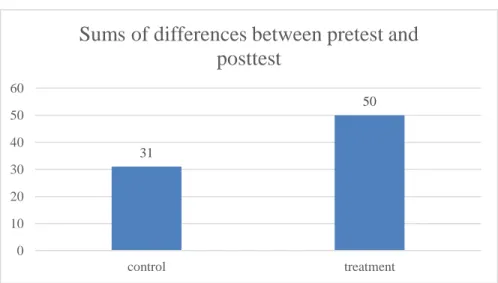
The differences between posttest scores and pretests scores add up to 37 for the control group and 50 for the experimental group. Note that the control group had 1 more participant (Figure 14).
The following table shows an Analysis of Variance of the scores obtained by the control and the treatment groups in the pre and posttests.
Anova: Single Factor
groups 2,59333649 1 2,59333649 0,12661886 0,722962745 3,968470992 Within
groups 1536,10796 75 20,4814395
Total 1538,7013 76
DISCUSSION
Upon looking at the results of the pre and posttest, it can be noticed that in both the control and the treatment group, most participants did slightly better on the posttest. It is to be noted that the control group did not receive the intervention, but they did have listening exercises according to the program of the subject, so that may account for the slightly improved results of that group. When comparing one group to the other, taking into account the differences of the mean values of pre and posttest, or more visibly when looking at the sums of differences between the pretest and the posttest, it is apparent that the treatment group demonstrated higher improvement than the control group after the time of the intervention, but only to a moderate degree. The results of ANOVA show that the difference between the scores of both groups are not statistically significant.
However, the results of the interviews evidence that participants manifested positive opinions towards their experience with the intervention. Nevertheless, these opinions and
share similarities, the use of music did not have a drastic effect in the listening capacity of the participants of this study in particular.
While there are abundant studies that conclude using songs in the English classroom can be quite beneficial for vocabulary acquisition, such as those by Kusnierek (2016), and Faliyant (2017), research on songs used for improving listening comprehension are more elusive. Some researchers report on the positive effects of songs on the listening skill, such as Kahrman (2008), and Escobar & Gómez (2011). However, they did not perform a pre-test and post-test study, nor did they use a control group. Kahrman’s study focuses on the perceptions of the participants towards different genres of music, and Escoabar and Gómez conducted surveys to gather opinions about using pop songs for learning.
There are certain elements that should be taken into account and might constitute certain weaknesses in this research. Since the participants were students who had to complete a course with several contents besides those pertaining directly to this study, and attention had to be dispensed to all language skills, with only four hour of instruction per week, time for the proposed listening activities was relatively limited, amounting only for 20 minutes per class session. Considering the participants in the treatment group did show an improvement that was slightly higher than that of the participants in the control group, albeit not statistically significant, it is possible that with more time to apply the song activities, students would perhaps experience more considerable improvements in their listening comprehension.
CONCLUSIONS
On average, the participants from both the control and the treatment groups showed slight improvement comparing their pre and post listening tests.
Overall, participants from the treatment group performed slightly better on the posttest in relation to the pretest than those of the control group.
Statistically, there was no significant difference between the results of the control group and the treatment group.
Quantitative studies that conclude there is a positive influence from using song-based activities on vocabulary acquisition are abundant around the globe, but the same cannot be said about their effect on listening comprehension. Studies that manifest a favorable influence on that regard, are usually based on the opinions and perceptions of participants, but studies with a pretest and posttest models on the precise relation between song usage and listening comprehension are relatively scarce.
In spite of the limited improvement on the treatment group, as revealed by the applied tests, qualitative results showed that most students had positive thoughts and feelings about the usage of songs during the English class. Several of them considered the activities “very good” or “excellent”.
However, it is also to be noted that it might be possible that “power relationship” existing between teacher and students had an influence on students’ responses to the interviews. Nevertheless, reduction of the affective filter, as proposed by Krashen (1981), might not be a strong enough factor to achieve significant improvements in listening comprehension in the context at hand.
REFERENCES
Allauca, C., Inés, M., Chafla, C., & Felicia, F. (2016). The use of games and songs as
methodological strategies to develop the skills of English language in the students of tercero de bachillerato at Unidad Educativa “San Gerardo” in San Gerardo parish in the academic year 2015-2016 (Bachelor's thesis, Riobamba, UNACH 2016).
Benalcázar Bermeo, J. V. (2013). Bachelorthesis. Retrieved from
http://dspace.ucuenca.edu.ec/handle/123456789/4367
Beasley, R. E., & Chuang, Y. (2008, September). Web-Based Music Study: The Effects of Listening Repetition, Song Likeability, and Song Understandability on EFL Learning Perceptions and Outcomes. ERIC. Retrieved from http://eric.ed.gov/?id=EJ898153
Cajamarca Quintuña, J. R., & Vásquez Loja, V. E. (2012). Bachelor thesis. Retrieved from
http://dspace.ucuenca.edu.ec/handle/123456789/2040
Celce-Murcia, M., & McIntosh, L. (1991). Teaching English as a second or foreign language Chung, U. K. (1994). The effect of audio, a single picture, multiple pictures, or video on second-language listening comprehension (Doctoral dissertation, University of Illinois at Urbana-Champaign).
Creswell, J. W. (2009). Mapping the field of mixed methods research.
Dunkel, P. (1991). Listening in the native and second/foreign language: Toward an integration of research and practice. TESOL quarterly, 25(3), 431-457.
Escobar, E. Y., del Socorro Gómez, M., & Arboleda, A. (2011). La música pop en el desarrollo de las habilidades de escucha y producción oral en inglés. Lenguaje, 33.
Faliyanti, E. (2017). THE INFLUENCE OF ENGLISH SONG TOWARD
STUDENTS’VOCABULARY MASTERY AND STUDENTS’MOTIVATION. Premise: Journal of English Education, 6(1), 77-84.
Faltis, C. J., & Arias, M. B. (Eds.). (2013). Academic language in second language learning. Field, J. (2008). Listening in the Language Classroom. Cambridge University Press.
Flowerdew, J., Long, M. H., & Richards, J. C. (Eds.). (1994). Academic listening: Research perspectives. Cambridge University Press.
Griffiths, C. (2013). Using songs in the language classroom. Procedia-Social and Behavioral Sciences, 70, 1136-1143.
Goh, C. C. (2000). A cognitive perspective on language learners' listening comprehension problems. System, 28(1), 55-75
González, M.C.(2013) An Investigation of Strategies to Teach English as a Foreign Language to Adult Students from Cañar who speak Kichwa as their mother tongue.(Tesis de
Maestría).Universidad de Cuenca, Cuenca Ecuador.
Hamouda, A. (2013, April). An investigation of listening comprehension problems encountered by saudi students in the EL listening classroom. International Journal of Academic Research in Progressive Education and Development,2(2).
Jolly, Y. S. (1975). The use of songs in teaching foreign languages. The Modern Language Journal, 59(1‐ 2), 11-14.
Kahraman, V. (2008). The use of songs in improving listening comprehension in English. Dil Dergisi, 140, 43-51.
Krashen, S. D. (1981). The “Fundamental pedagogical principle” in second language teaching. Studia Linguistica,35(1-2), 50-70. Retrieved from
http://onlinelibrary.wiley.com/doi/10.1111/j.1467-9582.1981.tb00701.x/abstract. Kuśnierek, A. (2016). The role of music and songs in teaching English vocabulary to students. World Scientific News, 1(43), 1-55.
Larsen-Freeman, D. & Long, M. H. (2000). An Introduction to Second Language Acquisition Research.Shanghai: Shanghai Foreign Language Education Press.
Mackey, A., & Gass, S. M. (2005). Second language research: Methodology and design. Mahwah, NJ: Lawrence Erlbaum.
Maess, B., & Koelsh, S. (2001). Musical syntax is processed in Broca's area: An MEG study. Nature Neuroscience,4, 540-545. Retrieved from
http://www.nature.com/neuro/journal/v4/n5/abs/nn0501_540.html
Newton, J. M., Ferris, D. R., Goh, C. C., Grabe, W., Stoller, F. L., & Vandergrift, L. (2018). Teaching English to Second Language Learners in Academic Contexts: Reading, Writing, Listening, and Speaking. Routledge
Osada, N. (2004). Listening comprehension research: A brief review of the past thirty years. Dialogue, 3(1), 53-66.
Powers, D. E. (2010). The case for a comprehensive, four-skills assessment of English-language proficiency. R & D Connections, 14, 1-12.
Rahbar, S., & Khodabakhsh, S. (2013). English Songs as an Effective Asset to Improve Listening Comprehension ability; Evidence from Iranian EFL Learners.IJALEL International Journal of Applied Linguistics & English Literature,2(6), 63-66.
doi:10.7575/aiac.ijalel.v.2n.6p.63
Ramìrez, A.G. ( 1995). Creating Contexts for Second Language Acquisition.Longman Publishers.USA.
Reina, E. A. (2010, January). The use of songs as a tool to work on listening and culture in EFL classes. Cuadernos De Lingüística Hispánica, (15), 121-138.
Richards, J. C., & Renandya, W. A. (Eds.). (2002). Methodology in language teaching: An anthology of current practice. Cambridge university press.Libro
Richards, J. C. (2006). Communicative Language Teaching Today.
Richards, J. C., Hull, J., Proctor, S., & Bohlke, D. (2013). Interchange: Student's book. Cambridge, UK: Cambridge University Press
Richards, J. C., & Rodgers, T. S. (2014). Approaches and methods in language teaching. Cambridge university press.
Rubin, J. (1994). A Review of Second Language Listening Comprehension Research. Modern Language Journal, 78(2), 199-221.
Sadiku, P. C. L. M. (2015). The Importance of Four Skills Reading, Speaking, Writing, Listening in a Lesson Hour. Language and Literature, 1(1).
Sevy-Biloon, J. (2016). Different reasons to play games in an English language class. Journal of Education and Training Studies, 5(1), 84-93.
Savignon, S. J. (1983). Communicative Competence: Theory and Classroom Practice. Texts and Contexts in Second Language Learning. The Addison-Wesley Second Language Professional Library Series.
Shen, C. (2009). Using English Songs: An Enjoyable and Effective Approach to ELTUsing English Songs: An Enjoyable and Effective Approach to ELT. English Language Teaching ELT, 2(1). doi:10.5539/elt.v2n1p88
Schoepp, K. (2001). Reasons for using songs in the ESL/EFL classroom. The internet TESL journal, 7(2), 1-4.
Schunk, H. A. (1999). The Effect of Singing Paired with Signing on Receptive Vocabulary Skills of Elementary ESL Students. Journal of Music Therapy,36(2), 110-124.
doi:10.1093/jmt/36.2.110
Simpson, A. J. (2015). How to use songs in the English language classroom. British Council For You/AJ Simpson [Electronic resource].—The mode of access: https://www. britishcouncil. org/voices-magazine/how-use-songs-english-languageclassroom.
Stæhr, L. S. (2009). Vocabulary knowledge and advanced listening comprehension in English as a foreign language. Studies in second language acquisition, 31(4), 577-607.
APPENDIX 1
PRE-TREATMENT INTERVIEW QUESTIONS
Only the questions in Spanish were presented to the students. Their English translations are included below each question in italics for better understanding of this proposal.
1.- ¿Le gusta escuchar música? Do you enjoy listening to music?
2.- De ser así, ¿qué tipo de música disfruta, cuáles son sus géneros favoritos? If you do, what kind of music do you like, what are your favorite genres?
3.- ¿Hay música en inglés que usted disfrute? De ser así, cuáles son algunas de las bandas/artistas/cantantes que a usted le gustan?
Is there music in English that you enjoy? If so, what are some of the bands/artists/singers you like?
APPENDIX 2
POST-TREATMENT INTERVIEW
Only the questions in Spanish were presented to the students. Their English translation are included below each question in italics for better understanding.
1.- ¿Cuál es su opinión acerca de las actividades basadas en canciones realizadas durante el curso de inglés?
What is your opinion regarding the song-based activities that took place during the English course?
2.- ¿Cree usted que sería conveniente continuar con los próximos ciclos con actividades basadas en canciones para incrementar la comprensión auditiva del idioma inglés?
Do you think it would be convenient to continue using song-based activities in order to increase listening comprehension of the English language in the following courses?
APPENDIX 3