
Enhancing listening skills on second graders trough TPR implementation
87
0
0
Texto completo
(2) NOTE OF ACCEPTANCE. _________________________________________ _________________________________________ _________________________________________ _________________________________________ _________________________________________ _________________________________________ _________________________________________ _________________________________________. _____________________________ Signature. _____________________________ Signature. _____________________________ Signature. Page. 3. Bogotá D.C November 2017.
(3) RAE Resumen Analítico de Educación FORMATO RESUMEN ANALÍTICO EN EDUCACIÓN - RAE Código: FOR020GIB. Versión: 01. Fecha de Aprobación: 10-10-2012. Página 4 de 87. Tipo de documento. 1. Información General Trabajo de grado. Acceso al documento. Universidad Pedagógica Nacional. Biblioteca Central. Autor(es). Enhancing Listening Skills On Second Graders Through TPR Implementation (Mejoramiento de las habilidades de escucha en niños de segundo a través de la implementación del TPR.) Cruz Celis, Diana Katherine. Director. Ronald Andrés Rojas. Publicación. Bogotá. Universidad Pedagógica Nacional. 2017. 87p.. Unidad Patrocinante. Universidad Pedagógica Nacional. Palabras Claves. ESCUCHA EFECTIVA, TPR, HISTORIAS CON ACCIONES.. Título del documento. CANCIONES. CON. ACCIONES,. 2. Descripción Trabajo de grado que describe la investigación realizada con el grupo 202 de la jornada tarde del Colegio Domingo Faustino Sarmiento durante el primer semestre. El objetivo general de la investigación fue determinar la influencia de dos estrategias de TPR en el mejoramiento de la escucha efectiva de la población, para lograrlo se realizó una intervención pedagógica que incluía las canciones con acciones y las historias con acciones como estrategias principales.. Page. 4. El desarrollo teórico y el análisis de datos fueron principalmente sobre el concepto de la escucha efectiva y sus respectivas etapas (recepción, comprensión, respuesta y memorización) y los filtros internos que afectan a la misma (conocimientos previos, actitudes del receptor). Así mismo, a lo largo de la investigación se reflexiona sobre las ventajas y desventajas de la implementación de la Respuesta Física Total (TPR por sus siglas en inglés) en la enseñanza del inglés como segunda lengua en niños de segundo grado..
(4) 3. Fuentes Ahamdi, S. M. (2016). The importance of listening comprehension in language learning. Retrieved from https://ijreeonline.com/article-1-22-en.pdf on August 20,2017 Asher, J. (1982). Learning Another Language Through actions: the complete teacher's guidebook. Los Gatos, California : Sky Oaks Productions, Inc. . Baleghizadeh, Sasan & Arabtabar, Fatemeh. (2010, Agosto). Enhancing Listening Comprehension through a Group Work Guessing Game. 133-143. Retrieved from http://www.redalyc.org/pdf/4994/499450716008.pdf Barbosa, C. P., & Caucha Mendez, J. C. (2011). Implementation of nursery rhymes to develop listening and speaking skills in the second grade students. Bogotá: Universidad Pedagogica Nacional. Burns, A. (2010). "Classroom action research and teacher professional development". New York . Burns, A. (2010). Doing action research in english language teaching a guide for practitioner. Cárdenas Beltrán, M. L. (2009). Helping students develop listening comprehension. https://revistas.unal.edu.co/index.php/profile/article/view/11405. Casperz, Donella & Stasinska Ania. (2015). Can we teach effective listening? An exploratory. Retrieved from Journal of University Teaching & Learning Practice: http://ro.uow.edu.au/cgi/viewcontent.cgi?article=1574&context=jutlp Clark, S. (n.d.). British Council: Kids and songs. Retrieved from https://www.teachingenglish.org.uk/article/kids-songs Cohen, Louis, Manion, Lawrence & Morrison, Keith . (2007 ). Research Method in Education . New York : Routledge. Er, S. (2013, October 21). Using Total Physical Response Method in Early Childhood Foreign Language Teaching Environments. Retrieved from http://www.sciencedirect.com/science/article/pii/S1877042813035581 Frank, C. (1999). Ethnographic eyes. A teacher´s guide to classroom observation. Portsmouth: Heinenmann. Garcia, R. (1985, 1988). Instructor's notebook: How to apply TPR for best results. Los Gatos, California: Sky Oaks Productions, Inc. Gerngross, Gunter; Puchta, Herbert . (1996). Do and understand: 50 action stories for young learners . Malasya : Longman .. Page. 5. Jones, A. (2012, February 02). Action Stories with Children. Retrieved August 2017, from Cambridge School : http://www.ihes.com/bcn/tt/eltconf/12/action_stories_with_children.pdf Kline, J. A. (1996). Listening Effectively. Alabama: Air University Press. Retrieved from Listening Effectively. Koshy, V. (2005). Action Research for Improving Practice: A practical guide. London: Paul Chapman.
(5) Publishing . Krashen, S. (1982). Principles and Practice in second language acquisition . California: Pergamon Press Inc. Lumen - boundless learning. (n.d). Boundless Communications: Learning to Listen and Helping Others Do the Same. Retrieved from https://courses.lumenlearning.com/boundlesscommunications/chapter/stages-of-listening/ Medina, Y. (2015). Developing speaking skills on second grader . Bogotá: Universidad Pedagogica Nacional. Ministerio de Educación Nacional . (2006). Estandares básicos de competencias en Lenguas Extranjeras. Bogotá: Imprenda Nacional. Mohd Zuri Ghani & Norr Huziza Hanim Mohd Ghous. (2013 - 2014, Agosto). THE EFFECTIVENESS OF TOTAL PHYSICAL RESPONSE (TPR) APPROACH IN HELPING SLOW YOUNG LEARNERS WITH LOW ACHIEVEMENT ACQUIRE ENGLISH AS A SECOND LANGUAGE. Retrieved from http://ijsk.org/uploads/3/1/1/7/3117743/1_total_physical_response_tpr_approach.pdf Morales, Adriana & Beltran, Ana Milena. (2006). Developing Listening through the Use of Authentic Material. Retrieved from http://www.redalyc.org/articulo.oa?id=499450712007 Morley, J. (2001). Listening Comprehension instructional models: Matching theory and practice. Retrieved from https://howjournalcolombia.org/index.php/how/article/view/197/246 Parra Luna, M., & Vargas Luna, P. (2006). Visual Auditive based activities in communicative performance: how students learn by watching, listening to. Bogotá: Universidad Pedagogica Nacional . Richard, C. J., & Rodgers, T. S. (1986). Approaches and Methods in Language Teaching: A description and Analysis. Cambridge: Cambridge University Press. Rost, M. (2002). Listening Tasks and Language Acquisition. Retrieved from http://jaltpublications.org/archive/proceedings/2002/018.pdf Taylor-Powell, E., & Rener, M. (2003). Analysing Qualitative data. UW Extention , 1-10. Wrench, J. S. (2012). Stand Up, Speak Out: The Practice and Ethics of Public Speaking. Retrieved from https://saylordotorg.github.io/text_stand-up-speak-out-the-practice-and-ethics-of-publicspeaking/index.html. Page. 6. 4. Contenidos Este trabajo de grado, está organizado por medio de capítulos que dan cuenta del proceso de investigación. El primer capítulo, Contextualización describe la población con la que se trabajó de acuerdo con las observaciones y diagnostico realizados en el aula determinando que la mayor.
(6) falencia en el aprendizaje de la lengua tenía que ver con los procesos de escucha efectiva. El capítulo presenta después los objetivos que determinaron la ruta de trabajo de la investigación. El segundo capítulo Marco Teórico presenta los antecedentes del proyecto y el desarrollo de las categorías de análisis de la escucha efectiva que incluyen las etapas del proceso de escucha efectiva así como los filtros que afectan dicho proceso, de igual modo presenta los referentes teóricos correspondientes a la metodología del TPR. El capítulo tres Metodología de investigación presenta la información fundamental sobre la Investigación Acción y el Análisis de contenidos que es el método elegido para esta investigación en términos de análisis de resultados. El capítulo también presenta una tabla con las categorías e indicadores elegidos para el estudio El capítulo 4 Propuesta Pedagógica desarrolla el enfoque pedagógico de la intervención teniendo en cuenta elementos como la perspectiva de aprendizaje y los roles de los estudiantes y del docente dentro de la intervención. Además describe el programa académico desarrollado y el modelo de planeación de clase. El capítulo 5 Análisis e interpretación de datos describe los resultados arrojados por el proceso de análisis de contenido llevado a cabo. En él se contrastan los instrumentos de recolección de datos con la teoría y cada uno de los indicadores para determinar los alcances y limitaciones del proyecto. Los capítulos Seis y Siete muestran las conclusiones y recomendaciones relacionadas con el proceso investigativo.. 5. Metodología Este proyecto tomó como metodología la investigación acción, teniendo en cuenta sus cuatro fases: planeación, observación, acción, reflexión, que fueron desarrolladas en diferentes partes de la ejecución del mismo y que fueron constantemente revisadas a medida que se hacia la intervención pedagógica.. 6. Conclusiones Las conclusiones del proyecto indican que los estudiantes mostraron una mejora en los procesos de escucha efectiva en las primeras tres etapas del proceso, sin embargo, la mejora evidenciada no alcanzó los resultados esperados del proyecto. Las conclusiones también muestran que los filtros internos analizados afectan significativamente la habilidad estudiada y que estos deben ser tenidos en cuenta en futuras investigaciones. Las conclusiones además presentan los aprendizajes de la. Page. 7. investigadora en varios niveles.. Elaborado por:. Diana Cruz.
(7) Revisado por:. Fecha de Resumen:. Ronald Andrés Rojas. elaboración. del. 11. 10. 2017. ABSTRACT:. The project “Enhancing Listening Skills on Second Graders Trough TPR Implementation” by Diana Cruz Celis describes a research, advanced in the school Domingo Faustino Sarmiento, with second graders; it aimed to determine the influence of TPR strategies on effective listening enhancement. in the target population and to define the advantages and disadvantages of TPR implementation. The participants of the project were 28 second graders: 14 boys and 14 girls, between the ages of six and eight and it was carried out during the first semester of 2017.. Key words: Effective Listening, TPR, Action Songs, Action Stories. RESUMÉN. El proyecto “Mejoramiento de las habilidades de escucha en inglés en niños de segundo a través de la implementación del TPR” por Diana Cruz Celis describe una investigación adelantada en el Colegio Domingo Faustino Sarmiento con el grado segundo. Tenía el objetivo de determinar la influencia de. Page. 8. las estrategias del TPR en el mejoramiento de la escucha efectiva en la población objetivo y definir las ventajas y las desventajas de la implementación del TPR. Los participantes del proyecto fueron 28.
(8) niños de segundo grado: 14 niños y 14 niñas, entre las edades de seis y ocho años y fue llevado a cabo durante el primer semestre del 2017.. Page. 9. Palabras Clave: Escucha efectiva, TPR, Canciones con acciones, historias con acciones..
(9) TABLE OF CONTENTS. CHAPTER 1: CHARACTERIZATION ............................................................................................... 12 1.1 Characterization .......................................................................................................................... 12 1.1.1 Population ............................................................................................................................ 14 1.2. Diagnosis............................................................................................................................... 16. 1.3. Description of the problem ................................................................................................... 21. 1.4. Research question and objectives ......................................................................................... 22. CHAPTER 2: THEORETICAL FRAMEWORK ................................................................................. 23 2.1 LITERATURE REVIEW ........................................................................................................... 23 2.2 THEORETICAL FRAMEWORK .................................................................................................. 28 2.2.1 LISTENING ............................................................................................................................. 29 2.2.1.1 Effective Listening ............................................................................................................ 30 2.2.1.1.1. The receiving stage.................................................................................................. 31. 2.2.1.1.2. The understanding stage ........................................................................................ 32. 2.2.1.1.3. The responding and remembering stages ............................................................ 33. 2.2.1.1.4. Other considerations on effective listening ........................................................... 35. 2.2.3 Total Physical Response .......................................................................................................... 37 2.2.3.1 Action Stories.................................................................................................................... 39 2.2.3.2 Action Songs ..................................................................................................................... 40 CHAPTER 3: RESEARCH METHODOLOGY .................................................................................. 42 3.1 Research Approach ..................................................................................................................... 42 3.2 Content Analysis ......................................................................................................................... 44 3.2.1 Data collection ..................................................................................................................... 46 3.2.2 Setting .................................................................................................................................. 47 3.2.3 Study variables ..................................................................................................................... 47 CHAPTER 4: PEDAGOGICAL PROPOSAL ..................................................................................... 48 4.1 Pedagogical Framework.............................................................................................................. 48 4.2 Stages .......................................................................................................................................... 50 4.3 Planning Model ........................................................................................................................... 51. Page. 10. 4.4. Academic Program..................................................................................................................... 53 CHAPTER 5: INTERPRETATION AND DATA ANALYSIS .......................................................... 54 5.1 Data Management ....................................................................................................................... 54 5.2 Data Analysis .............................................................................................................................. 56.
(10) 5.2.1 Receiving Stage: .................................................................................................................. 56 5.2.2 Understanding Stage: ........................................................................................................... 60 5.2.3 Internal Filters ...................................................................................................................... 63 5.3 Results Summary ........................................................................................................................ 66 CHAPTER 6: CONCLUSIONS ........................................................................................................... 69 CHAPTER 7: GENERAL RECOMMENDATIONS ........................................................................... 72 REFERENCES ..................................................................................................................................... 73. APPENDIX AND FIGURES INDEX Figure 1: Stages of listening according to Kline (1996) ....................................................................... 30 Figure 2: Action Research Phases......................................................................................................... 43 APPENDIX 1: Field notes sample ........................................................................................................ 75 APPENDIX 2: Diagnosis sample ......................................................................................................... 78 APPENDIX 3: Action stories used in class .......................................................................................... 79 APPENDIX 4: Action songs ................................................................................................................. 80 APPENDIX 5: Academic Program ....................................................................................................... 81 APPENDIX 6: Data collection instruments and dates according to categories .................................... 84 APPENDIX 7: Artifact 1 sample ......................................................................................................... 85 APPENDIX 8: Artifact 2 example ........................................................................................................ 86. Page. 11. APPENDIX 9: Informed consent.......................................................................................................... 87.
(11) CHAPTER 1: CHARACTERIZATION. Introduction This chapter describes the context of the Colegio Técnico Domingo Faustino Sarmiento, Branch D in Bogotá, Colombia, regarding the local community in which the school is situated. Afterwards, the researcher will describe in general terms the institution having as a reference point its Proyecto Educativo Institucional (P.E.I) and its rulebook. Then, this chapter will make reference to the population of the group where the researcher focused the research which was a first grade in the stage of observation, that later became second grade for the pedagogical intervention. The intervention was carried out in the afternoon shift. In the present chapter the description on the cognitive, social-affective, cultural and linguistic characteristics of the population will be described.. 1.1 Characterization. The Colegio Técnico Domingo Faustino Sarmiento, branch D is a co-ed public school located in a neighborhood called Rionegro which is part of the district of Barrios Unidos in Bogotá, Colombia. According to a document written by the Secretaría de. Page. 12. Planeación, the majority of the population is characterized having a medium to low socioeconomic strata. Many of the students do not live in close proximity to the school.
(12) and they must use school provided transportation.. Regarding the institutional context, Branch D of is the facility for first cycle (first and second grade) The title of the P.E.I of the school is “Leadership and entrepreneurship managers of a life project and the focus of their vision is to form within their students a quality of strong character and professional skills”. As pedagogical approach, the institution adheres to the Constructivist model and there is an implementation of the cultural historical approach and meaningful learning that seeks to respond to the diverse population. The school aims to establish English as a foreign language in all levels.. In terms of the English class, the school has an immersion program along with the Secretaría de Educación, which objective for the first cycle is to understand short stories in simple language and to understand basic language about immediate context (MEN, 2006). First graders used to have one hour of English class in the immersion room and two hours in their regular classroom. The purpose of the immersion program is to promote spaces of immersion attempting to improve the English skills of the students by providing basic ICTs tools. Upon beginning field work, the immersion program was not available for the first graders since the researcher arrived to the school and the English class was assigned to her. The school incorporates visual aids around the. Page. 13. campus to emphasize additional English learning such as posters, calendars, and encouraging quotes..
(13) 1.1.1 Population The information gathered is based on collected field notes, information retrieved from the “observador del alumno”, and informal interviews with the lead teacher during the second semester of 2016.. This project was applied during the last semester of first grade in 2016 (102) and the first semester of second grade in 2017 (202). There are 29 children in the group: 14 boys and 15 girls, between the ages of six and eight. Half of the children live within the vicinity of the school, mainly in the neighborhood Rionegro and other zones of Suba. In general, the parents of the focus group work in labor field such as surveillance, transportation and commerce companies.. According to the lead teacher, some of the parents are not very engaged with the learning process of their children and about only half of them attend parent-teacher meetings to receive progress reports. Due to difficult situations such as family displacement, domestic violence, and parental neglect, these family models are reflected in the behaviors in the classroom and students often express them as a cause of their misbehavior in class which included aggressiveness towards classmates- verbally and physically- lack of listening, disregard of instructions, short attention span, sleepiness,. Page. 14. and bullying.. In contrast to this behavior, it is a goal of the lead teacher to cultivate an atmosphere of a healthy learning environment by including lessons on values and creating a space.
(14) for guided student self-reflection, in activities that involve introspective dialogue after each class day. In this work, she attempts to function under the vision of the school looks for a comprehensive education. According to her, it is important to establish this type of learning environment because of political and social climate Colombia is facing due to the peace process.. The school has an inclusion program and there are five of the students in the focus group who have learning difficulties, but since these children have different cognitive levels they will not be taken into account in the data analysis. According to the lead teacher a portion of the students had not received any formal education prior to their start in the grade. At least, a third of the students did not know how to read or write in Spanish, some others are in a standard level Spanish reading and writing, or still had not fulfilled the goals in language expected by the end of first grade. A portion of students managed to reach fluency in writing and reading in the native language at that time. The presence of a gap in learning levels in the classroom creates difficulties to deliver lessons as students work at different paces in all subjects.. In many occasions, commands such as stand up, sit down, sleep, cross your arms were very effective to get the students’ attention. These types of commands were done in. Page. 15. English and Spanish where the students responded by performing the actions that they heard. The students liked this type of engagement because they understood the activity as a game and competed with one another. A recurring difficulty in this situation was.
(15) that the students only responded to the aforementioned commands that involved physical movements and once these commands ended, the students disengaged from the lessons in every subject because they got distracted when the teacher started delivering the lesson, students would start running and playing around the classroom or talking to each other showing a difficulty to listen actively to others.. 1.2 Diagnosis The researcher used two instruments proposed by Carolyn Frank (1999) that are field notes and a diagnosis test designed by the researcher taking into account the Estándares básicos de Competencias en lenguas extranjeras: Inglés (MEN, 2006) for the first cycle. The researcher developed a participative observation of the classroom dynamics and used a grid similar to the one proposed by Frank (See Appendix 1) to separate descriptive aspects from reflective aspects of the observation, in order to have a more focused analysis. The analysis of the results, obtained by using these two instruments, help to define the research problem. The diagnosis test (See Appendix 2) was applied during a session of two hours and 24 students out of 29 took the test. It was designed, thinking about the specific standards proposed by the MEN in the aspects of listening and reading. In listening the. Page. 16. diagnosis evaluated the following indicators “I know when people talk to me in English and I react verbally or non-verbally” and “I understand short descriptions about familiar places.”(MEN, 2006). Regarding the reading skills the evaluated aspects were “I.
(16) identify words that relate to topics that are familiar to me” and “I match illustrations to simple sentences” (MEN, 2006). The writing skill was not evaluated since as it has been mentioned above, at least a third part of the children did not have the ability to write in Spanish. As for the conversation skill, children fulfill some of the indicators given by the standards like “I answer to greetings and farewells, I participate actively in word games and nursery rhymes and I reinforce with gestures what I say in order to be understood” (MEN, 2006) For example, the children responded when the teacher said “Good afternoon students” by saying good afternoon teacher. However, when they were asked “How are you?” they answered “how are you?” and they sang a song that says “Hello teacher, hello teacher, how are you?...” Regarding the other indicators, children had not enough vocabulary to fulfill them. In the first activity, students had to color the objects according to what they listened (orange book, blue eraser, red pencil and green ruler) . The teacher said aloud the color and pointed to the drawing for them to color. The biggest confusion was on green because they related it to gray. It was difficult to complete the activity for some children, due to their lack of colors, however, the majority of students completed successfully the activity.. Page. 17. In the second activity the children had to match the numbers with the name of the numbers. Not all the children worked at the same pace, for some it was difficult to.
(17) listen to the instruction because they were still working in the previous exercise, some students opted for leaving the activity empty, or matching everything haphazardly. Some of the students tried to associate the color of the numbers and the letters and tried to match the ones that were very similar, demonstrating again the lack of attention in the moment of listening to the explanation. Twenty-two children matched correctly number 1 with the word “One” and the rest of the numbers were only right for about half of the children. The third activity consisted on coloring a number of objects according to the instruction, at this point of the activity, children were already tired and started to lose concentration. Some of them decided not to do this activity and some others were still doing the first and second. One of the issues in this grade is that they all go in different paces and stages of knowledge which is evident in the field notes. One example is: "In the moment when most of the children have finished coloring, about 6 of them have not started yet” with its analysis: “The difference of age and of learning process within the classroom represents a problem in this grade because children are not always doing the same activity and on the contrary, in one moment there are many children performing different activities because some children finish before others, this means that some children do not complete their assignments and do not follow the rhythm of classes.”. Page. 18. The fourth activity consisted on matching some verbs with the place they were done at, the researcher read aloud the direction, since the students did not know how to.
(18) read. Only 4 of the students achieved the goal of this activity successfully. In general students did not know these verbs in English. The only commands they understood were the simple ones and their vocabulary was very limited contrasted to the indicators of the standards. The last activity was designed for listening and following the directions, first, the researcher introduced the necessary vocabulary: hands, nails, left and right, and then the children were asked to pay attention to the directions to color according to them. The children had previous knowledge of the given colors. In this activity, it was necessary to repeat several times each direction because the children did not pay attention to it, in general terms, the first two instructions were followed, but not the las two. They had trouble at recognizing the learnt vocabulary when pronounced. The diagnosis results show that there is a lack of some basic vocabulary but in general terms, the biggest difficulty for the kids was to pay attention to the directions and to focus on the activity for the many reasons explained before. The difficulty to pay attention lead kids to have trouble in the overall listening skill affecting therefore the English listening skill because the children very often do not even hear the message that is being said to them in order to complete the listening process. From the systematic observation evidenced in the field notes, the researcher has. Page. 19. defined five categories which summarize the characteristics of the group, they are: short attention span, commands, ineffective listening, coexistence and need of affirmation..
(19) Attention span in this group is short because children only concentrate on activities that involve movement and for very little time in comparison to the time they have at school every day. It is for this reason that the teacher has to change activities very often so that they do not get bored, but even when changing activities they lose interest very easily and get distracted with minimal situations external to the class. In fact, the way to get their attention in class is normally by using commands in both English and Spanish as it has been described before. Therefore, commands are a very useful tool for the teacher in order to get children’s attention but they become at some point boring and repetitive for the kids. This situation generates ineffective listening because children sometimes do not hear what has been said and this creates problems in the academic development but also Coexistence problems since the classroom environment becomes very difficult to manage due to the lack of listening and limiting learning of the language because children do not receive the necessary input in order to advance in their English skills. Due to the difficult classroom environment the main teacher at the end of every class day generates a moment with students in which they as a group reflect on their achievements for the day and also on the aspects to improve for the next day (in the academic and the behavioral area). In this and many other moments of the day, the. Page. 20. teacher affirms students in their strengths expecting that children will perform better in classes responding to their need of affirmation..
(20) 1.3 Description of the problem Ahmadi says that “Many studies in language learning have indicated that listening comprehension plays an important role in the learning process. In spite of its importance, listening has been ignored in second language learning, research, and teaching.” (Ahmadi, 2016, p. 7) During the observation held on first grade and through the analysis of the field notes, it has been found that one of the biggest problems concerning English learning is that children are not good at listening effectively to each other. Whenever the teacher or a classmate is talking to them, they are talking among each other until it becomes impossible to listen over the noise, and they only listen when the teacher starts using commands. Listening effectively has not been developed as a habit yet by students, this problem affects all subjects, it prevents students from learning what they are supposed to learn and it also makes the classroom environment hard to manage. It is evident throughout all the observations that regarding English children only respond to commands because they have memorized them but this knowledge is not enough to communicate, however they respond well when the teacher asks them to perform actions with their body. They mainly perform simple actions like “stand up, sit down, turn around, sleep and cross your arms.” They recognize and do the actions in different order because they hear this commands all the time. Most of them do it consciously while others just follow the majority. Some ideas related to the nature of the problem are the lack of good habits in. Page. 21. terms of effective listening and the low English level (lack of vocabulary) which prevents children from understanding what they are listening to which at the same time stop them from learning the other English skills..
(21) 1.4 Research question and objectives The previous description allows the researcher to have a specific idea of the main difficulty in English class which is to be solved during the application of the present research and it will answer to the following question: How does the implementation of two TPR strategies enhances the effective listening in second graders from Colegio Técnico Domingo Faustino Sarmiento? According to the question previously presented the researcher has established the following general objective: To determine the influence of TPR strategies on effective listening enhancement in second graders from Colegio Técnico Domingo Faustino Sarmiento School. In order to achieve the general objective, the researcher has established the following specific objectives: •. To determine the effectiveness of action stories and action songs from TPR in the enhancing of effective listening skills in second graders.. •. To define the advantages and disadvantages of TPR in the effective listening. Page. 22. process in EFL on second graders..
(22) CHAPTER 2: THEORETICAL FRAMEWORK 2.1 LITERATURE REVIEW. Several studies agree that there is not a wide research regarding listening comprehension or effective listening, but they also consider that this skill is one of the most important ones in order to learn English as a foreign language. Something similar happens with TPR, even though it is an approach designed to teach a foreign language in all ages, there is not so much research in similar context to the one of this research project. Hence, it is opportune to review the theoretical context and some studies that have been carried out previously with its results. In the Table 1 there is a summary of the reviewed literature which takes into account research at national and international levels. The studies are described in the order that are listed in Table 1. Table 1.. Page. 23. LITERATURE REVIEW TITLE AUTHOR(S) YEAR Developing speaking skills on Medina Olaya 2015 Second graders from san José Yubeth de Castilla school trough TPR implementation. Implementation of nursery Claudia Patricia 2011 rhymes to develop listening Barbosa and speaking skills in the Paternina second grade students Jurany Cristina Caucha Méndez Visual auditive based activities in communicative performance: how students learn by watching, listening to. Developing Listening through the Use of Authentic Material. INSTITUTION Universidad Pedagógica Nacional. Universidad Pedagógica Nacional. Marcela Parra Luna Paola Vargas Luna. 2005. Universidad Pedagógica Nacional. Ana Milena Beltrán & Adriana. 2006. UNITEC.
(23) Helping students develop listening comprehension Enhancing Listening Comprehension through a Group Work Guessing Game Using Total Physical Response Method in Early Childhood Foreign Language Teaching Environments Listening comprehension instructional models: matching theory and practice. Can we teach effective listening? An exploratory study The effectiveness of total physical response (tpr) approach in helping slow young learners with low achievement acquire english as a second language. Morales Melba Libia Cárdenas B. Sasan Baleghizadeh Fatemeh Arabtabar Sühendan Er. 2000 2010. 2013. Universidad Nacional de Colombia Bogotá, Colombia Magazine How 17. University Faculty of Education, Department of Early Childhood Education, Ankara,Turkey University of Michigan. Joan Morley. 2001. Donella Caspersz Ania Stasinska Mohd Zuri GhaniNorr Huziza Hanim Mohd Ghous. 2015. The University of Western Australia. 20132014. School of Educational Studies, Universiti Sains Malaysia. The first research is related to the use of TPR to develop speaking skills on second graders from San José de Castilla School, in the research project the use of TPR is used as a tool to make students active participants on their speaking process (Medina, 2015) the strategies used, aimed to teach speaking as a natural process and they helped students to interact by reducing the anxiety levels. In the project relevance is given to the TPR methodology and the materials used to teach, giving as a result the improving of the English speaking skill. Even though Medina works with speaking, the use of TPR sets a precedent for present study since the characteristics of the population are very. Page. 24. similar given that the setting is also in Bogotá and with same ages. The second research project is a methodology proposal by Barbosa and Caucha (2011) that aims to foster processes of acquisition of simple structures through the use.
(24) of the nursery rhymes in second graders of the school Liceo Femenino Mercedes Nariño. Nursery rhymes are described as a tool that allows to develop in children the development of listening and speaking. In this study it was proven that the use of nursery rhymes, by providing constant opportunities to listen to authentic language, allows students to identify particular sounds of the foreign language and in later stages allows them to produce them. Since one of the methodological elements in this research is action songs, this project is important as it shows the advantages of using them to teach English to second graders in the context of a public school in Colombia. The next research is called VISUAL-AUDITIVE BASED ACTIVITIES: How students learn by watching, listening to and creating?” (Luna & Luna, 2006). It is a case study which aims to answer to the question: what is the role of the visual-additive based activities in pre-school students' communicative performance? This project is relevant because it shows an alternative of English teaching for kids who do not know yet how to read or write fluently. The conclusions of the study show that even though this is an unconventional methodology the visual-auditive activities are a link between the children and their world perception, they serve as an aid to foster language skills and they allow children to express themselves in the classroom. The importance of visual auditive based activities in language teaching to young learners sets a possibility to be used with TPR since it also considers this type of resources like realia. The fourth study by Beltran and Morales (2006) is about the listening teaching through the use of authentic materials. It addressed the causes of the low listening. Page. 25. comprehension in the population where it was done and what are the criteria to choose the listening materials. It analyzed some categories related to the students' difficulties, weaknesses in the development of the listening skill with different materials and the.
(25) attitudes towards English language and class. The study considered theory on listening comprehension principles and listening teaching techniques which will be helpful in this research to establish the concept of listening that will be developed in the pedagogical intervention. The article Helping students to develop listening comprehension (Cardenas, 2000) emphasizes the importance of the listening process and elements like memory, understanding tasks, interpreting and responding as core elements in the communication process and warns the reader about the possibility of students learning only mechanical processes, it highlights the role of teacher in the listening process, that is why she presents examples on how to plan lessons and what elements to take into account in order to enhance active and effective listening. In this article the researcher proposes a group work guessing game as a technique that is process oriented rather than product-oriented. the research also attempts to generate activities in which students learn how to listen giving the metacognitive process and the necessity for the students to have tools for independent learning a high relevance, because "The ultimate goal of this technique is for students to gradually reach a level of autonomy and avoid depending on their teachers by employing useful strategies which facilitate listening comprehension" (Baleghizadeh, Sasan & Arabtabar, Fatemeh, 2010, p. 139) The next article, focuses on TPR for young learners and lists the positive aspects of using this method in such age. Some of the aspects named are: it is text independent,. Page. 26. it appeals to a number of learning styles, it is enjoyable, fun and interesting and it is bilateral. The article also presents some suggested activities and it is very important since it takes into account learners who do not have reading and writing proficiency in.
(26) their mother language as follows: "Young learners do not know reading and writing yet so they learn through activities, songs, stories and games" (Er, 2013, pág. 3) this article is of vital importance for the present study since it summarizes the importance of TPR in short ages. Moreover, there is a research that says that in the last century has been acknowledged that speaking and listening has become more important. Because of this; the study proposes four listening comprehension instruction models that are described taking into account learning goals, instructional materials, procedures, values and general comments, the four models are pattern matching (listening and repeating), processing discrete-point information (listening and answering comprehension questions), task listening and processing information (language use and analysis) and interactive communicative listening (critical listening and thinking), this is important because it gives the researcher a wide perspective on already existing instruction models which could feed the pedagogical praxis To continue, there is a paper that describes a research aimed to find out if effective listening can be taught and according to the results the researchers argue that effective listening can foster transformative learning. Even though the research was carried out in a university level, the introduction of the concept of effective listening is important for this study since it has a comprehensive understanding of listening that goes beyond hearing. The study also mentions that it is important to notice the filters or factors that that inhibit effective listening by students which could be a limitation in the. Page. 27. process. In the last study the researcher has two main objectives "to study the effectiveness of TPR approach to help slow young learners with low achievement and to.
(27) study the difference between two groups of pupils’ score, the experiment group and the control group" (Mohd Zuri Ghani & Norr Huziza Hanim Mohd Ghous, 2013 - 2014, pág. 1) The study mentions in the results that TPR is able to stimulate the interest in learning of the pupils and that motivation and confidence are important factors when it comes to acquiring language, especially in young ages which could determine decisions on whether keep studying the second language or giving it up. The aforementioned projects present important theoretical background on the fields of several types of listening such as effective and active listening, and how to develop this skill in English as foreign language by acknowledging the importance of the type of materials used, strategies, procedures and teachers' roles. Additionally, some of the projects reinforce the importance of TPR in diverse contexts as a tool that can be used when teaching young learners since it motivates and reduces stress levels in the classroom. Using TPR to develop listening is a new possibility that can fill a gap in theory but at the same time which needs to take into account the existing theoretical contribution of people who have researched on these topics.. 2.2 THEORETICAL FRAMEWORK. Introduction In this section the researcher describes the most significant theories which will support this study. Given that the main goal of the present research is “To determine the influence of TPR strategies on effective listening enhancement in second graders from Técnico Domingo Faustino Sarmiento School;” the theoretical framework will develop. Page. 28. a general conception of listening to later focus on the process of effective listening and the categories which will be analyzed –receiving, understanding, responding and.
(28) remembering – which are phases of effective listening. Afterwards, the researcher will state the main characteristics of TPR and explain how they are relevant for the listening instruction of young learners. It is important to note that TPR’s ultimate goal is to achieve speaking fluency in any language. Nevertheless, listening corresponds to the first phase of the TPR approach and it is a core aspect of the process, therefore, the present study will only focus in the listening phase of TPR. 2.2.1 LISTENING Listening is one of the most important skills when it comes to learning a foreign language because it provides the necessary input in order to acquire fluency in other skills – speaking, writing and reading – listening is also a cornerstone in the communication process which is the ultimate goal of learning any language. As Morley (2001) says, listening is the language skill we use most every day in our native languages and in the foreign language setting it needs to be a focus, and must be an integral part of any class in English as Foreign Language. However, listening has only started to be an important research element over the last quarter of century. Casperz, Donella & Stasinska Ania (2015) highlight that when talking about listening it is necessary to differentiate it from hearing, while hearing is a psychological process, listening is a conscious process that requires us to be mentally attentive (Low and Sonntag, 2013). Listening is defined as “a process that involves the interpretation of messages that others have intentionally transmitted in the effort to understand those messages and respond to them appropriately” (Burleson, 2011, p. 27), consequently, the understanding of listening of this project goes beyond what has been mentioned and. Page. 29. considers the importance of listening as an overall skill but it also considers the importance of effective listening which will be described in the following section..
(29) 2.2.1.1 Effective Listening Thompson et al. (2004, p. 240) (quoted by Caspersz and Stasinska) describe effective listening as the “dynamic, interactive process of integrating appropriate listening attitudes, knowledge, and behaviors to achieve the selected goals of a listening event.” Effective listening involves understanding both verbal and non-verbal communication. Kline (1996) says that in order to achieve an effective listening it is necessary to understand the process of listening. For him the most useful definition of it is “the process of receiving, attending, and understanding auditory messages transmitted through the medium of sound. Often, the steps of responding and remembering are also included”. (p.27) in Figure 1, the stages of effective listening according to Kline can be seen. Additionally, Wrench (2012) considers that stages of are: receiving stage, the understanding stage, the evaluating stage, the responding stage and the remembering stage. Such stages will be developed because they are the categories that will help the. Page. 30. analysis.. Figure 1: Stages of listening according to Kline (1996).
(30) 2.2.1.1.1 The receiving stage Wrench defines this stage as the one that involves hearing and attending. In this step (Kline, 1996) highlights the difference between hearing and listening and states that hearing -the reception of sound- is a prerequisite for listening. Furthermore, hearing is defined by Wrench as “the physiological process of registering sound waves as they hit the eardrum.” (Wrench, 2012, pág. 4.1) Thus, hearing becomes an important moment of the listening process because the clearer is the sound, the easier the listening process becomes. Hearing comprehends just half of this stage because attending is also a necessary aspect in the first steps of listening. Wrench (2012) says that “Attending is the process of accurately identifying and interpreting particular sounds we hear as words.” (p.4.4) Kline says that human listening is often ineffective because receiving occurs but attending do not, and he explains that numerous messages compete for the listener's attention in form of external or internal stimuli, and it may be hard for the listener to focus on all of them at the same time. Then he lists three factors which determine how the listener decides to attend: selectivity of attention, strength of attention and sustainment of attention. Selectivity of attention refers to when we direct attention to certain things to prevent an information overload. Normally the listener's attention will be on the most interesting, familiar or engaging information. Strength of attention is important because it requires effort and desire to. 31. listening. Kline (1996) says that "complete attention can be given to only one stimulus. Page. prioritize our attention over the multiple stimuli that are in the environment when. at a time, and necessary attention to only a limited number of stimuli at the same time..
(31) If we spend too much energy on too many stimuli, we soon will not be paying attention to any of them.” (p.19) besides strength, length of attention is relevant, so as our attention is stronger, the length of the memory can be longer as well. Finally, sustainment of attention is a very important factor to consider when defining listening because according to Kline “listening is affected by time of sustainment. Our attention wanes… The mind can only pay attention for as long as the body can sit still.” (p.20) This category has a huge relevance in the listening process, and for this project it adds very valuable aspects to take into account in the pedagogical praxis because it takes into account the factors that are necessary for the attending stage to happen which are selectivity, strength and sustainment of attention. The three determinant factors that were described have a huge importance because they might explain the short attention span that was described in chapter one which lead to the finding of the problem. In terms of the achievements expected from children in their effective listening process there are two indicators corresponding to this category. The first indicator is related to the decision of children of paying attention (hearing) to the given stimuli and the second indicator is related to the amount of time of such attention. The aim is that children improve their ability to pay attention and that their attention span is extended.. 2.2.1.1.2 The understanding stage. Page. 32. Wrench (2012) says that “the understanding stage is the stage during which the listener determines the context and meanings of the words that are heard.” It can also be referred to as comprehension and it is the “shared meaning between parties in a.
(32) communication transaction.” (p.4.4) In this stage the listener determines the context of what s/he heard and assigns meaning to it. This part of the process is important because after it the listener is able to start classifying the information in the mind. Kline says that effective communication does not take place until the receiver understands the message, but there are several situations in which the message can be misunderstood because of verbal and non-verbal reasons. Some barriers that exemplify this are when the same words mean different things to different people, when different words sometimes mean the same thing, when there is misinterpretation of actions like eye contact, gestures, and facial expressions. Wrench (2012) says that “so much of the way we understand others is influenced by our own perceptions and experiences. Therefore, at the understanding stage of listening we should be on the lookout for places where our perceptions might differ from those of the speaker.” In the case of the present research project the understanding stage is relevant because some children tend to perform the actions only because they are following the teacher or other classmates. For this reason minimizing the chances for that to happen becomes very important. It is also necessary that children assign a meaning to the words they learn even though they learn them through action so that the vocabulary and language chunks are meaningful and useful for them in later stages of their training in. Page. 33. the English language 2.2.1.1.3 The responding and remembering stages The next steps are not essential according to Kline (1996) but they are indicators.
(33) of listening accuracy. There are several types of responses that can show that the message was properly understood and they can be direct verbal responses, responses that seek clarification, responses that paraphrase and nonverbal responses. Kline says that "Responding, then, is a form of feedback that completes the communication transaction. It lets the sender know that the message was received, attended to, and understood." (p. 26) According to Wrench (2012) “the responding stage is when the listener provides verbal and/or nonverbal reactions to what she hears based on short- or longterm memory.” He also says that nonverbal reactions include gestures like “nodding, making eye contact, tapping a pen, fidgeting, scratching or cocking their head, smiling, rolling eyes, grimacing, or any other body language” (Boundless communications, n.d. para.1) According those reactions can be voluntary or not but they show the level of interest and understanding of the listener, whom can decide to have verbal reactions at some point, exchanging roles (listener-speaker) for a moment. In regards to the remembering stage, it occurs when the listener “categorizes and retains the information she’s gathered from the speaker for future access.” (Boundless communications, n.d.) It is a process involved during and after the communication process. Even though for Kline (1996) memorization of facts does not mean that you are effectively listening, it is a necessary and integral part of the listening process. Kline says that in order to understand the relation between listening and memory it is. Page. 34. important to take into account the concepts of short and long term memory. For Boundless communications (n.d.) memory is essential throughout the listening process because remembering is critical to moving forward in the listening process..
(34) Finally, Boundless communication (n.d.) suggests that using information immediately after receiving it enhances information retention and lessens the forgetting curve, but it is necessary to make efforts to understand in order to retain information in a more effective way. However, it is necessary to establish common grounds throughout the whole listening process to make sure that listeners and speakers attach the same meaning to a determined statement. Responding is very important in this research because it allows the researcher to know if the contents are being internalized by children. In this case, since the aims of the project are related to the listening skill, the most important output that will be analyzed will be the non-verbal reactions of the students to stimuli and their importance will be described in the section on TPR. Although memorization has been described as not so essential for the listening process, in this project it will be important in order to have a continuity in the contents that will be taught to students because they will need to increase their vocabulary in every step of the process in order to move forward to the next stages in the English learning. 2.2.1.1.4 Other considerations on effective listening Furthermore, there are other aspects to be considered when defining the effective listening process, for example, Pearce, Johnson and Barker (1995) (quoted by Caspersz & Stasinska) suggested that effective listening is influenced by internal and external conditions that are called by Thompson et al (2004, p 22) listening filters which are. Page. 35. factors that affect the listening process, some examples of internal filters are gender, attitudes and assumptions, and prior knowledge and external filters refer to time of activity and setting for the class..
(35) For this project the researcher has chosen two strategies (action songs and action stories) which are suitable for children and they help to reduce internal and external filters as it will be explained in the TPR section. It is expected that minimizing such filters will help the development of the pedagogical intervention and speed up the acquisition and improvement of effective listening skills. Finally, Casperz, Donella & Stasinska (2015) give some recommendations for teaching effective listening and they conclude that effective listening has to be consciously taught, it has to be taught experientially and teaching effective listening has to be ‘planned’ as well as teachers do it with the contents of the class. Hence, it is necessary to teach the listening skill by teaching to listen in general terms because listening is an ability that must be used in all aspects of life, as it is remarked by (Halone & Pecchioni, 2001), listening is relational, and plays a role in the everyday development and maintenance of social and personal relationships. Additionally, for planning purposes (Rost, 2002) proposes three phases that must be completed when preparing effective listening tasks. These phases are prelistening, while-listening and post-listening. In the pre-listening phase the learner has an activity that help him/her to be ready for the listening. It is used to activate previous language and to predict ideas and information (Joyce et al., 1992 - quoted by Rost). It may include the teaching of some vocabulary, grammar structures, pronunciation or ideas that will be helpful in the next phase. During the while-listening phase the learner can do any tangible activity to demonstrate ongoing monitoring of meaning. The post-. Page. 36. listening is according to Rost (2002) the most important phase because in it the learner develops short term memory and motivation. In this phase the learner can compare his/her work with the others’ and discuss what was listened to with peers and with the.
(36) teacher. The aforementioned phases will be taken into account in the sessions planning in order to achieve the learning objectives for each class, these stages will be adapted to the students’ level and they will take into account elements that have been previously discussed such as attention span and filters. Furthermore, the sessions will have elements of planning suggested for effective listening mixed with the TPR method which will be described in the following paragraphs. 2.2.3 Total Physical Response. Total Physical Response (TPR) is a method which is built around the coordination of speech and action, in other words it is to teach language through activity. (Richards and Rodgers, 2001 quoted by Er). TPR was developed by James Asher in 1965 and he was based “on the concept that assimilation of information and skills can be significantly accelerated through the use of the kinesthetic sensory system which incidentally, is underused" (Asher, foreword). The strategy is based on a model of how children learn their first language subscribing to the natural acquisition theory. Garcia (1985, 1988) exemplifies the theory of natural acquisition theory as follows: "By the time the child utters the first intelligible sounds associated with the parent's language, the individual internalized a substantial amount of information about language via the interaction of listening and understanding the verbal stimuli and physically responding to them" (p.I-1) in this sense Asher (1982) says that “comprehension should come first -- and continue until students are comfortable and. Page. 37. confident in their understanding - and signal a readiness to begin the transition to production.” (p.I-16). In TPR there are two main stages – comprehension and.
(37) production – the first one respects something called the silent period “which is directly analogous to the silent period from infancy to about 18 months when the baby begins to putting words together in utterances to express thoughts” (p.I-17) One of the goals of TPR is to produce long-term retention and in order to have it Asher introduces the concept of believability as an important feature in comprehension, “If the input is understood but not believable the result is only short-term retention. One of the most powerful ways to achieve believability is to work the target language through the body movements of the student - which, of course, is the essence of TPR.” Asher (1986a) calls this comprehension through physical behavior, language-body dialogues. TPR also considers the brain lateralization as an important feature in learning, according to Garcia TPR "is a right brain method in learning a second language because the language is taught mainly through actions." The advantages of it are that translation into the native language is eliminated and that the learning of the second language becomes less painful and more accessible (Garcia, p.I-2) In regards to language-body dialogues mentioned above Asher says that “they play to the right hemisphere of the brain- the uncritical side, which may explain why input in this manner has high believability for students.” (p.I-17) The use of commands is the foundation for the application of TPR in teaching “... The idea is to synchronize the motor behavior of the students with the listening of the command. This is achieved by executing the action involved in the command in. Page. 38. harmony with the audio input delivered by the teacher" (Garcia p.I-2) even though commands are very important there are other activities involved, however, physical involvement is vital (Garcia,) Many activities that are used in conventional classrooms.
(38) can be used for TPR like games, skits and simulation, however, “in TPR this activities are used in conjunction with a specific goal in mind. ... It is not only with the idea to amuse students in a Friday class but the game is played with a specific instructional purpose” (p.I-3) Even though TPR is learner’s centered method, the teacher’s role is very important since s/he “should foster an atmosphere of jubilation and general euphoria” in order to reduce the tensions and s/he should also encourage collective participation throughout the process Garcia, (1985, 1988, p.I-4) As it can be inferred, input plays a fundamental role in the development of TPR, Krashen (1982) lists and explains the (Krashen, 1982)which will be taken into account when developing the strategies chosen for this project. Those requirements are: comprehensible, interesting/relevant, not grammatically sequenced, quantity and affective filter level. Gerngross and Puchta (1996) point out that constant repetition, a stress-free, playlike learning atmosphere and frequent positive reinforcement are the most significant characteristics of the early phase of receptive learning. They indicate that picture books, stories, rhymes and songs also play an important part in the acquisition of language, that is why the two strategies that researcher has chosen are: action stories and action songs.. 2.2.3.1 Action Stories Jones (2012) says children enjoy hearing and acting stories and they are useful to introduce contextualized language chunks. Action stories, as the name implies are a. Page. 39. combination of the TPR and stories, and are a technique for getting children to memorize substantial chunks of useful language. According to Jones action stories should be “easy to mime, be stories with a beginning a middle and an end, be 6 to 12.
(39) lines long, contain high frequency verb phrases and other chunks of language” Some of the advantages of using action stories are that they are amusing and motivating. This represents an advantage because according to Gerngross & Puctha (1996) "through multi-sensory conveyance, these stories stay well-anchored in the learner’s memory. They also activate auditory, visual and kinesthetic learners, which is very positive in classrooms that have several types of learners and each learner will favor a different channel of learning depending on their own type of intelligence but at the same time the action stories will activate multi-sensory perception allowing the learner to develop the possible weaknesses in the other two channels. Besides that, action stories are easy for children to memorize and they help children to learn whole chunks of language at a time because “frequent reconstruction of stories produces a sensitivity toward text grammar in learners” (Gerngross, 1996) In the classroom there were 5 action stories, four of them were short (see samples in Appendix 3) and the last one was longer than the others, it was called "the gingerbread man". Action stories were often supported by images and practices as a larger group but they were also accompanied by a contest to check performance of the students in smaller groups or individually.. 2.2.3.2 Action Songs Brewster et.al. (Quoted by Nurhayati 2012) define Action songs as “songs with movements for miming and role-playing the words and the language structures.” Clark (n.d.) says that songs are easily learnt by primary children because of their tendency to. Page. 40. be repetitive and their strong rhythm, and they also allow language structures and vocabulary to be reinforced in a natural context. Songs help students to develop memory and concentration and lower affective filters produced by stress and shyness..
(40) According to her, “at primary level, vocabulary teaching tends to concentrate on single word items, and songs allow learners to learn ‘chunks’ or meaningful phrases of language rather than single words, as well as to learn about how sounds connect and run together” (Clark, n.d.) As stated by Nurhayati (2012) the benefits of using action songs to teach language are several like “allowing for self-expression, encouraging a child's own response in his or her use of body and speech; providing relaxation; assisting the child in learning to follow directions; increasing the attention span; developing listening skills” among others. Additionally, Nurhayati says that using songs can also give students chances to get a better understanding of the culture of the target language, because they reflect aspects of the culture that can be learnt by students. Songs also prepare students for the genuine and authentic use of language they will face since they are exposed to authentic language, and singing together is a shared social experience and helps develop class and group identity. In the classroom there were several action songs that were chosen according to their adaptability in order to represent them in movements for the kids to memorize. There were in total five action songs (see samples in Appendix 4) which were introduced to the kids in several classes. it is important to note that these songs where practiced through all the semester in different moments of the class. The themes of most of the songs were chosen according to topics that children were learning in other classes. Page. 41. and involved useful language chunks for children. The singing was mainly by the whole group since children were more motivated to do it in this way..
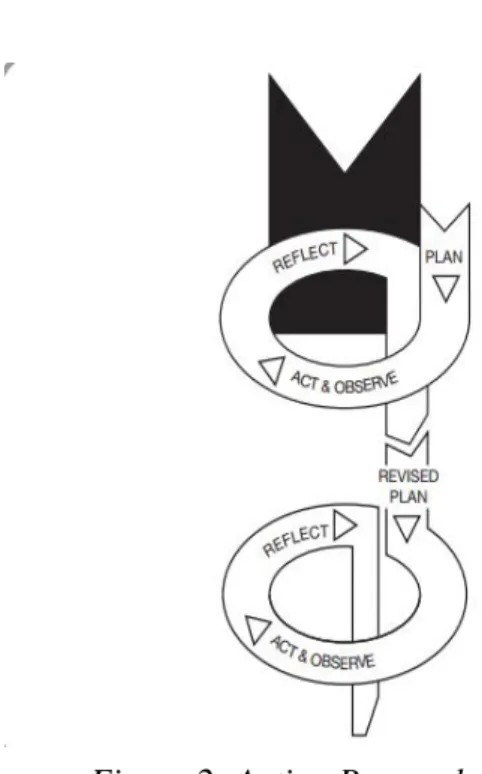
(41) CHAPTER 3: RESEARCH METHODOLOGY. 3.1 Research Approach The present document is an Action Research (AR) study. AR is defined by Burns in Cornwell (1999) as “a self- reflective, systematic and critical approach to enquiry by participants who are part at the same time members of the research community” (Burns A. , 2010, p. 5). It “is related to the ideas of ‘reflective practice’ and ‘the teacher as researcher’. (Burns A. , 2010, pág. 2). According to Burns, one of the main objectives of AR is “to identify a ‘problematic’ situation or issue that the participants… consider worth looking into more deeply and systematically.” (2010, p.2). It is considered a flexible methodology because it needs to adapt to the social and political situation in which is implemented (Somekh, in Burns 2010, p.2). Kemmis and McTaggart (1988 quoted in Burns) propose one of the best known models of AR which includes four broad phases which could be spiral as they should keep repeating until the researcher feels s/he has achieved satisfactory outcome. The four phases are planning, action, observation and reflection. Kemmis and McTaggart (1988 quoted in Burns, p.8) describe the phases as follows: Planning is the phase in which the researcher identifies a problem or issue and designs an action plan in order to address it. Such problem must be related to a specific area of the context. In this phase two questions should be considered “what kind of investigation is possible within the realities and constraints of the teaching situation”. Page. 42. and “what potential improvements are possible”.
(42) In the Action phase the plan is put into action in several intervention over a given period of time and during that praxis the researcher must question the assumptions about the context situation and other possible ways of doing things. During this phase there is also a systematic Observation of the effects of the action. It is a data collection phase where the researcher uses different tools to collect information. Finally, the researcher goes to the Reflection phase where s/he evaluates and describes the effects of the action and may decide to do more cycles or to share his/her findings.. Figure 2: Action Research Phases Koshy (2005) states some of the advantages of action research which make this method very apropriate to apply in the classroom setting, for him “research can be set. Page. 43. within a specific context or situation; researchers can be participants – they don’t have to be distant and detached from the situation; action research involves continuous evaluation and modifications can be made as the project progresses; there are.
(43) opportunities for theory to emerge from the research rather than always follow a previously formulated theory; the study can lead to open-ended outcomes.” (p.21) Action Research has been chosen for this project because of the flexibility to adapt to different educational contexts which is very important in the case of the public schools in Colombia where the teacher has not decision over what population s/he works with. It is also an important method because it allows the constant evaluation of the pedagogical intervention in order to improve methodologies and because it allows the researcher to reflect on ways to make the language teaching more effective.. 3.2 Content Analysis. Content analysis is a method used to analyze qualitative data that is comes in the form of narrative data. it will be used in this project because the main instrument of data collection are the observations that are recorded in the field notes and which Taylor-Powell and Renner (2003) describe as descriptive accounts as a result of watching and listening. They also suggest five basic steps for the analysis which will be briefly described next: 1. Get to know your data: in this step the researcher must consider the quality of the data and explain the limitations and level of analysis depending on the data. 2. Focus the analysis: in this part the researcher "focuses the analysis to look at how individual or groups responded to each question or topic for a given time period". Page. 44. (p.2) 3. Categorize information: in this stage the researcher identifies themes or.
Figure

Documento similar
morronensis and the storksbills that serve as food plants for its larvae were considered in the main objectives of this study, which were: (1) to create
One of the main issues in Me-DLC research is the improvement of the mechanical performance, which depends on the metal used and the way that it incorporates into the film. The
However, the particular axioms or properties through which this principle is included in the modelling (be it, for example, any of the variations on the Weak Axiom of
This means all you need to know to construct an object reference to your notification service is the IP address of the machine and the port number the server process ist listening
In the first question of the questionnaire regarding this phase, it is questioned which soft skills - social and problem-solving skills - and which of the hard skills -
Because there were a number of possible outcomes for this study, as noted earlier, our primary goal was to determine whether there was just a main effect of the intended target
The used instrument was the scale of causes of attrition from sports centres (Nuviala et al. For its design, three different phases were followed: 1) Bibliographical research
For this reason, the main objectives of the second study were to evaluate the combined effects of different irrigation water qualities (Tajo Segura water
