Universidade da Coruña
Department of Physical Education and Sport
Relationship between physical activity and
chronic diseases among European adults from
several countries: A cross sectional and
prospective population-based study
Adilson Passos da Costa Marques
Doctoral thesis / 2018
Miguel Ángel González Valeiro
Resumo
Introdución: As enfermidades crónicas son a principal causa de morbilidade e mortalidade no mundo. Para a prevención de enfermidades crónicas recoméndase a práctica da actividade física. O obxectivo deste estudo foi examinar a relación entre a actividade física e as enfermidades crónicas nos adultos europeos. Métodos xerais:
utilizáronse datos do Survey of Health, Aging, and Retirement in Europe (SHARE), as ondas 4 e 5; e do European Social Survey (ESS), ronda 7. Resultados principais:
Resumen
Introducción: Las enfermedades crónicas son la principal causa de morbilidad y mortalidad en el mundo. Para la prevención de enfermedades crónicas, se recomienda la práctica de actividad física. Este estudio tuvo como objetivo examinar la relación entre la actividad física y las enfermedades crónicas en adultos europeos.
Abstract
Summary
Introduction ... 1
Objective of the study ... 5
General methods ... 7
Article 1 ... 15
Article 2 ... 33
Article 3 ... 57
Article 4 ... 77
Article 5 ... 99
Article 6 ... 121
General conclusion ... 143
References ... 149
Appendixes ... 155 Published articles
Introduction
Chronic diseases are the leading cause of morbidity and mortality, and are considered to be at epidemic levels worldwide (WHO, 2015, 2016, 2017). Chronic diseases affects negatively quality of life due to physical and psychological consequences and in 2015 were responsible for 70% of the world’s deaths (WHO, 2017).
Chronic diseases were associated with older population, nonetheless, because of the lifestyle changes that have been rapidly occurring in recent years, chronic diseases are now becoming more prominently among young adults and adults (WHO, 2017). Out of the 38 million deaths due to chronic diseases in 2012, more than 40% were premature (WHO, 2014). The risk factors for chronic diseases are mainly caused by an unhealthy and sedentary lifestyle (Lee et al., 2012; Rayner, Wickramasinghe, Williams, McColl, & Mendis, 2017). Thus, a worldwide increase in interest in health enhancing physical activity has been observed. Regular practice of physical activity has been recommended (European Union, 2008; USDHHS, 2008; WHO, 2010) because of its effectiveness for primary and secondary prevention of chronic diseases (Alves et al., 2016).
O'Donovan, Lee, Hamer, & Stamatakis, 2017; Wen et al., 2011). Hence, the World Health Organization considers physical activity to be a key determinant to control and prevent chronic diseases (WHO, 2014).
Although the importance of physical activity on chronic diseases, a large proportion of the world’s population (Sallis et al., 2016), and specifically European adults (Loyen et al., 2017; Marques, Sarmento, Martins, & Saboga Nunes, 2015), are not considered physical active. The prevalence of physical inactivity of adults is, therefore, a major public health issue (Lee et al., 2012; WHO, 2016, 2017). The majority of the studies have analysed the relationship between physical activity and a particular chronic disease, not considering that a person can have several diseases (Banks, Lim, Seubsman, Bain, & Sleigh, 2011; Karjalainen et al., 2015; Swift et al., 2013). The use of a more comprehensive approach that evaluates several diseases is needed. Furthermore, other studies only involved men (Chomistek, Cook, Flint, & Rimm, 2012; Lee et al., 2003), and it would be of importance to study men and women (Tambalis et al., 2016).
Although physical activity is of importance in preventing and reducing chronic diseases (Ekelund et al., 2015; Lee et al., 2003; O'Donovan et al., 2017; Wen et al., 2011) there is evidence that vigorous intensity has a protective and preventive effect against chronic diseases among adults (Lee et al., 2003). However, older adults are less likely to engage in vigorous physical activity (Ayabe et al., 2009; Takagi, Nishida, & Fujita, 2015). Therefore, it is important to further collect evidence, and understand the relationship between chronic diseases and physical activity at different levels of intensity among older adults.
most adults spend their awake time in sedentary behaviours (Dumith, Hallal, Reis, & Kohl, 2011), being television viewing time reported as the most prevalent leisure-time sedentary behaviour (Clark et al., 2009; Harvey, Chastin, & Skelton, 2013). Studies have demonstrated that sedentary behaviours, and particularly the time spent watching television, is associated with increased risk for mortality and chronic diseases (Ekelund et al., 2016; Keadle et al., 2015; Pinto Pereira, Ki, & Power, 2012). The deleterious associations of television viewing with mortality and chronic diseases has been investigated independently of physical activity (Wijndaele et al., 2011). Although the negative impact of time watching television has been also observed in active people (Healy et al., 2008), higher levels of physical activity may reduce or even eliminate the risk associated with sedentary behaviours (Ekelund et al., 2016; Rao, Orpana, & Krewski, 2016). For that, studies have addressed the association of television viewing and physical activity with specific chronic diseases (Ekelund et al., 2016; Keadle et al., 2015; Pinto Pereira et al., 2012), but only few studies have investigated this issue with the presence of multimorbidity.
al., 2014; Mavaddat et al., 2014b; Perruccio, Katz, & Losina, 2012) and life satisfaction (Lukkala et al., 2016).
In opposition to multimorbidity, physical activity has been shown to have a significant and positive association with self-rated health and life satisfaction (Maher, Pincus, Ram, & Conroy, 2015; Sodergren, Sundquist, Johansson, & Sundquist, 2008). It is thus expected that, by having a positive effect on self-rated health and life satisfaction, and by having a protective health effect against chronic diseases, physical activity might moderate the relationship between multimorbidity and self-rated health and life satisfaction.
Objective of the study
Considering the problems and concerns presented previously, with this thesis we intend to analyse the relationship between physical activity and chronic diseases. From the main objective of research derive more specific ones, that we intend to analyse through a compilation of several articles of investigation.
Therefore, this project aimed to:
1) Examine the relationship between physical activity (moderate and vigorous), and the number of chronic diseases in European older adults, using a prospective analysis with data from 2011 and 2013.
2) Evaluate whether reporting physical activity is associated with lower odds of self-reported chronic diseases, individually and mutually adjusted, including heart problems, high blood pressure, breathing problems, allergies, type 2 diabetes, cancer and obesity, among nationally representative samples of adults European countries.
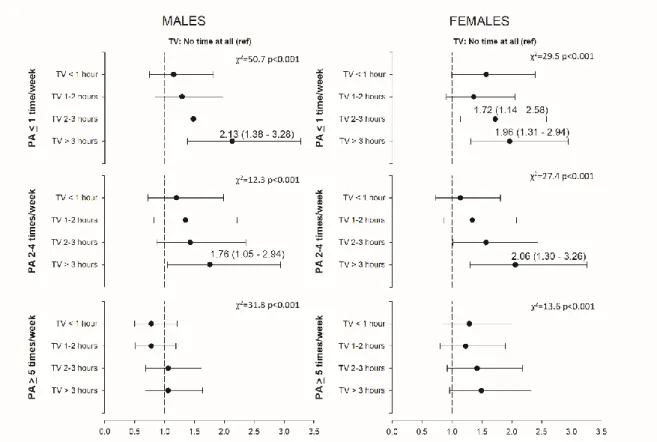
3) Examine the cross-sectional and prospective relationship between physical activity at different levels of intensity (moderate and vigorous), and chronic diseases. 4) Analyse the association of television viewing, physical activity, and chronic diseases; and to understand if physical activity attenuates or eliminates the detrimental association between television viewing and chronic diseases.
General methods
Data source
The present thesis used data from the Survey of Health, Aging, and Retirement in Europe (SHARE) study, wave four and fifth; and from the European Social Survey (ESS) project, round 7.
SHARE is a cross-national panel database of information on a wide range of variables spanning from health behaviour and psychological health to socioeconomic status and social and family networks. The sample in SHARE represents a non-institutionalized population. The fourth wave data was collected in 2011 and the fifth wave in 2013; it included individuals aged 50 and over. The SHARE study is fully described elsewhere (Börsch-Supan et al., 2013; Börsch-Supan & Jürges, 2005).
Measures
Physical activity. From SHARE data physical activity was measured as “frequency of moderate physical activity” (e.g., gardening, cleaning the car, going for a walk) and “frequency of vigorous physical activity” (e.g., sports, heavy housework, a job involving physical labour). The response alternatives both for moderate and vigorous activity were: (1) more than once a week, (2) once a week, (3) up to three times a month, and (4) hardly ever or never. The last two response options were grouped into one category called less than once a week. From ESS information on physical activity was assessed with a single item asking, “on how many of the last 7 days did you walk quickly, do sports, or other physical activity for 30 minutes or longer?”. Using the reported information on physical activity a new variable was computed to classified participants into three groups: 1) practice of physical activity ≤1 time/week; 2) practice of physical activity 2-4 times/week; and 3) practice of physical activity ≥5 times/week. Although physical activity was assessed with a single item, there is evidence in previous studies where physical activity is not the primary focus and more detailed measures are not feasible, that a single question is an acceptable alternative (Wanner et al., 2014).
Chronic diseases. In both databases, chronic diseases were assessed by asking participants to report whether their doctor told them the presence of the several chronic diseases, such as heart attack or other heart problems, hypertension, stroke or cerebral vascular disease, high blood cholesterol, diabetes, chronic lung disease, cancer, stomach or duodenal ulcer, Parkinson disease, hip fracture/femoral fracture, Alzheimer’s disease/dementia.
than 3 hours, using intervals of 30 minutes. Responses were recoded to “no time at all”, “less than 1-hour/day”, “2-3 hours/day”, and “more than 3 hours/day”.
Self-rated health. Self-rated health was assessed with a single-item question about the perception of health in general. The response options were on a 5-point scale: excellent, very good, good, fair, and poor. For data analysis the scale was reversed, and high values thus represent better health perception.
Life satisfaction. Life satisfaction was assessed with the item, “How satisfied are you with your life as a whole nowadays?” Responses were indicated using a scale ranging from 0 “extremely dissatisfied” to 10 “extremely satisfied.” Studies have shown that life satisfaction is associated to mental health outcomes (Nes et al., 2013), can predict mortality (St John, Mackenzie, & Menec, 2015), and that one single item is a robust measure capable of reliably estimating life-satisfaction (Cheung & Lucas, 2014).
Those who indicated that they lived in a big city, or suburbs, or outskirts of a big city were grouped into a new category named urban areas; those who responded that they lived in country village or home in countryside were grouped into rural areas. Household income was determined based on decile. Using this data, 1st to 3rd decil, 4th to 7th decil, and 8th to 10th were grouped to create three groups: low, middle and high, respectively.
Smoking habits and drinking alcohol. Participants were asked about their smoking behaviors. Response options ranged from “I have never smoked” to “I smoke every day”. Because there is no threshold of safety for smoking cigarettes, responses were recoded into current smoker, former smoker, and never smoke. Participants were also asked how often they drink alcohol. Responses were recoded into less than once a month, 2-3 times a month, once a week, several times a week, and every day.
Data analysis
In all articles, descriptive statistics were calculated for all variables (means, standard deviation and percentages) for the entire sample and stratified by sex. The comparison between men and women according to participants’ characteristics will be tested by Chi Square test and Independent sample t-test. When observed an interaction effect between sex and other independent variables, the subsequent analysis will be perform stratified by sex. In cases when interaction effect is not observed the analysis will be perform for the entire sample, but adjusted for sex. All data analysis will performed using IBM SPSS Statistics version 24 (SPSS Inc., an IBM Company, Chicago, Illinois, U.S.A.). For all tests statistical significance will be set at p<0.05.
association between moderate and vigorous physical activity with the number of chronic diseases was assessed using general linear models. Three different models were performed: Model 1 was the crude (unadjusted) analysis between physical activity and the number of chronic diseases. Model 2 was adjusted for age, marital status, educational level, living place and country. Model 3 was adjusted for model 2 and self-rated health. For prospective analysis, a fourth model was added. This fourth model was adjusted for model 3 and additionally for the number of chronic diseases in 2011. To capture changes in physical activity, participants’ physical activity results trajectories were examined. For that, physical activity participation in 2011 and 2013 was recoded into inactive (less than once a week) and active (if the answers were once a week or more than once a week) and then stratified into 4 groups as follows: 1) inactive in 2011 and in 2013 (inactive-inactive), active in 2011 and inactive in 2013 (active-inactive), inactive in 2011 and active in 2013 (inactive-active), and active in both 2011 and 2013 (active-active). The association between the trajectory analysis of physical activity with the number of chronic diseases was also assessed using the four models of general linear models, the same as for prospective analysis
For the third and fourth article bivariate relationship between moderate or vigorous physical activity and the presence of chronic diseases at baseline was tested by Chi-square test. The cross-sectional and prospective association between moderate or vigorous physical activity and the presence of chronic diseases was assessed using binary logistic regression. For cross-sectional and prospective analysis, two different models were performed. Model 1 was adjusted for age, marital status, educational level, living place, smoking, and country. Model 2 was further adjusted for the presence of all other chronic diseases. In all analysis moderate or vigorous physical activity entered as categorical variable and the presence of chronic disease were tested against the practice of physical activity “less than once a week” (reference category). All analyses were stratified by gender, because an interaction effect between gender and some chronic diseases was observed.
Article 1
Cross-sectional and prospective relationship between physical activity and
chronic diseases in European older adults – a study based on SHARE data
Cross-sectional and prospective relationship between physical activity and
chronic diseases in European older adults – a study based on SHARE data
Adilson Marques1,2, Miguel Peralta3, João Martins4, Margarida Gaspar de Matos3,5, Ross C. Brownson6
1 Centro Interdisciplinar de Estudo da Performance Humana, Faculdade de
Motricidade Humana, Universidade de Lisboa, Lisboa, Portugal
2 Centro de Investigação em Saúde Pública, Escola Nacional de Saúde Pública,
Universidade Nova de Lisboa, Lisboa, Portugal
3 Faculdade de Motricidade Humana, Universidade de Lisboa, Lisboa, Portugal 4 Laboratório de Pedagogia, Faculdade de Motricidade Humana e UIDEF,
Instituto de Educação, Universidade de Lisboa, Lisboa, Portugal
5 William James Center for Research, Instituto Superior de Psicologia
Aplicada, Lisboa, Portugal
5 George Warren Brown School of Social Work, Washington University, St.
Louis, United Stated of America
Abstract
Objectives: This study examined the relationship between physical activity (PA), and chronic diseases in European older adults, using a prospective analysis with data from 2011 and 2013. Methods: Participants were 37524 older adults (16204 men) who responded to the fourth (in 2011) and fifth (in 2013) wave of SHARE project, from 13 European countries. Participants answers to interview questions about the presence of chronic condition and PA. The cross-sectional and prospective association between PA and the number of chronic diseases was assessed using general linear models. Results: Among men and women, moderate or vigorous physical activity (MVPA) in 2011 was associated with fewer reported chronic diseases in 2011 and in 2013. In prospective analysis, MVPA in 2011 was inversely associated with the number of chronic diseases in 2013 in the unadjusted model. In the adjusted model MVPA more than once a week remained as a significant predictor of fewer chronic diseases. Conclusions: PA should be prescribed to older adults in order to prevent and reduce the number of chronic diseases, and, when possible, vigorous intensity PA should be recommended.
Introduction
Chronic diseases, including heart diseases, hypertension, obesity, diabetes, respiratory diseases and cancer or malignant tumours, are the leading causes of death and disability worldwide (WHO, 2014). While the annual number of deaths by infectious disease is projected to decline, the prevalence of chronic diseases is accelerating globally, spreading across every region and infusing all socioeconomic classes, and it is projected to increase to 52 million by 2030 (Mathers & Loncar, 2006). The risk factors for chronic diseases are mainly caused by an unhealthy and sedentary lifestyle (Lee et al., 2012). Thus, a worldwide increase in interest in health enhancing physical activity has been observed (European Union, 2008; USDHHS, 2008; WHO, 2010). Physical activity can reduce chronic diseases and the risk of disease progression (Bryan & Katzmarzyk, 2011; Huai et al., 2013; Lee & Paffenbarger, 2001), while improving the functional capacity and quality of life of those suffering with chronic diseases (Kujala et al., 2015). Moreover, physical activity reduces premature mortality and morbidity associated with chronic diseases (Ekelund et al., 2015). Hence, the World Health Organization considers physical activity to be a key determinant to control and prevent chronic diseases (WHO, 2014).
(moderate and vigorous), and the number of chronic diseases in European older adults, using a prospective analysis with data from 2011 and 2013.
Methods
Participants and procedures
The present study used data from the fourth and fifth wave of the Survey of Health, Aging, and Retirement in Europe (SHARE) study. SHARE is a cross-national panel database of information on a wide range of variables spanning from health behaviour and psychological health to socioeconomic status and social and family networks. The sample in SHARE represents a non-institutionalized population. The fourth wave data was collected in 2011 and the fifth wave in 2013; it included individuals aged 50 and over. The SHARE study is fully described elsewhere (Börsch-Supan et al., 2013; Börsch-(Börsch-Supan & Jürges, 2005).
From 58489 participants who responded to the fourth wave in 2011, the 37524 (64.2%) who also responded to the fifth wave were included in the present study analysis. This study sample included 16204 men (43.2%), 21320 women (56.8%), from 13 European countries (Austria, Belgium, Czech Republic, Denmark, Estonia, France, Germany, Italy, Netherlands, Slovenia, Spain, Sweden, Switzerland). The participants were between the ages of 50 and 102 years (66.2±9.7) in 2011, and were between the ages of 52 and 104 years (68.2±9.7) in 2013. The study protocol was approved by the Ethics Committee of the University of Mannheim, and by the Ethics Council of the Max-Planck-Society for the Advancement of Science.
Measures
attack or other heart problems; stroke or cerebral vascular disease, diabetes, chronic lung disease, asthma, arthritis or rheumatism, osteoporosis, cancer or malignant tumour, stomach, duodenal, or peptic ulcer, Parkinson’s disease, cataract, hip or femoral fracture, and other conditions. The total number of chronic diseases was summed to produce a single score, as performed previously (Lindwall, Larsman, & Hagger, 2011).
Physical activity. Physical activity was measured as “frequency of moderate physical activity” (e.g., gardening, cleaning the car, going for a walk) and “frequency of vigorous physical activity” (e.g., sports, heavy housework, a job involving physical labour). The response alternatives both for moderate and vigorous activity were: (1) more than once a week, (2) once a week, (3) up to three times a month, and (4) hardly ever or never. The last two response options were grouped into one category called less than once a week.
general. The response options were on a 5-point scale: excellent, very good, good, fair, and poor. For data analysis the scale was reversed, and high values thus represent better health perception.
Data analysis
same as for prospective analysis. Data analysis was performed using SPSS 22. For all tests statistical significance was set at p<0.05.
Results
Table 1. Participants’ characteristics – Survey of Health, Aging, and Retirement in Europe (SHARE), 2011-2013, Europe.
2011
Abbreviation: M, media; SD, standard deviation; PA, physical activity. a Tested by Chi Square.
b Tested by t test.
Table 2 presents the bivariate analysis of the cross-sectional and prospective relationship between physical activity and the number of chronic diseases. Among men, moderate or vigorous physical activity in 2011 was associated with fewer reported chronic diseases in 2011 [moderate: F(2, 16140)=135,843, p<0.001; vigorous: F(2, 16140)=414,750, p<0.001] and in 2013 [moderate: F(2, 16140)=137,934, p<0.001; vigorous: F(2, 16140)=383,915, p<0.001]. For the women, physical activity in 2011 was also related with a reduced number of chronic diseases in 2011 [moderate: F(2, 21191)=243,550, p<0.001; vigorous: F(2, 21151)=546,141,
Table 2. Cross-sectional and prospective relationship between physical activity and number of chronic diseases – Survey of Health, Aging, and Retirement in Europe (SHARE), 2011-2013, Europe.
Men
Number of chronic diseases (M±SD)
Women
Number of chronic diseases (M±SD)
2011 p 2013 p 2011 p 2013 p
Table 3. Cross-sectional parameters estimates of chronic diseases according to physical activity intensity levels and frequency – Survey of Health, Aging, and Retirement in Europe (SHARE), 2011-2013, Europe.
Men
Parameters estimates of predicting the number of chronic diseases in 2011 Abbreviation: MPA, moderate physical activity; VPA, vigorous physical activity; CI, confidence interval
Model 1: Unadjusted analyses. Model 2: Analyses were adjusted for age, marital status, educational level, living place and country. Model 3: Analyses were adjusted for age, marital status, educational level, living place, country and self-rated health.
*p<0.05, **p<0.01, ***p<0.001.
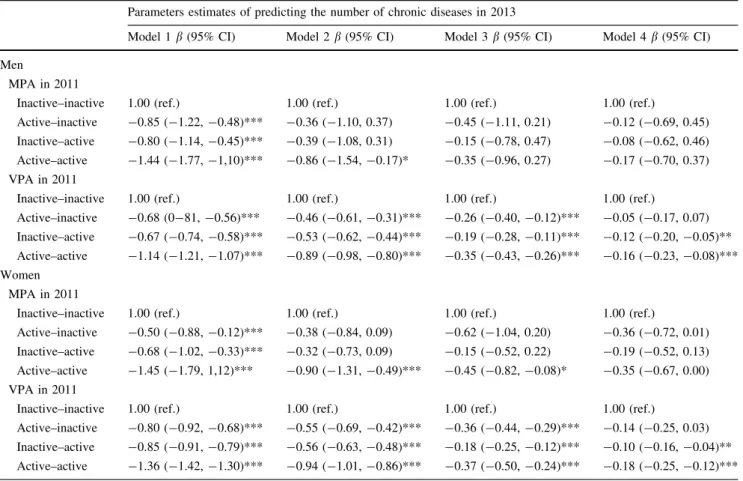
In prospective analysis, moderate or vigorous physical activity in 2011 was inversely associated with the number of chronic diseases in 2013 in the unadjusted model (table 4). Following adjustment for age, marital status, educational level, living place and country (model 2), and further self-rated health (model 3), the relationship was attenuated although statistically significant. In the final model we further adjusted model 3 for the number of chronic diseases in 2011, to examine whether the associations were independent of baseline number of chronic diseases. In this model (model 4) moderate (men: β=-0.12, 95% CI: -0.20 to -0.04, p<0.01; women: β=-0.22,
p<0.001; women: β=-0.14, 95% CI: -0.19 to -0.09, p<0.001) physical activity more than once a week remained as a significant predictor of fewer chronic diseases.
Table 4. Prospective parameters estimates of chronic diseases according to physical activity intensity levels and frequency – Survey of Health, Aging, and Retirement in Europe (SHARE), 2011-2013, Europe.
Men
Parameters estimates of predicting the number of chronic diseases in 2013 Model 1 Abbreviation: MPA, moderate physical activity; VPA, vigorous physical activity; CI, confidence interval
MPA, sedentary time, FMI, TFM, and BFM did not have normally distributed residuals and were therefore log-transformed for analyses.
Model 1: Unadjusted analyses.
Model 2: Analyses were adjusted for age, marital status, educational level, living place and country.
Model 3: Analyses were adjusted for age, marital status, educational level, living place, country and self-rated health.
Model 3: Analyses were adjusted for age, marital status, educational level, living place, country, self-rated health and the number of chronic diseases in 2011.
*p<0.05, **p<0.01, ***p<0.001.
(men inactive-active: β=-0.12, 95% CI: -0.20 to -0.05, p<0.01; men active-active: β=-0.16, 95% CI: -0.23 to -0.08, p<0.001; women inactive-active: β=-0.10, 95% CI: -0.16 to -0.04, p<0.01; women active-active: β=-0.18, 95% CI: -0.25 to -0.12, p<0.001).
Table 5. Association between the trajectory of physical activity and the number of chronic diseases – Survey of Health, Aging, and Retirement in Europe (SHARE), 2011-2013, Europe.
Men
Parameters estimates of predicting the number of chronic diseases in 2013
Model 1. β (95% CI) Model 2. β (95% CI) Model 3. β (95% CI) Model 4. β (95% CI) Abbreviation: I-I, inactive-inactive; A-I, active-inactive; I-A, inactive-active; A-A, active-active; MPA,
moderate physical activity; VPA, vigorous physical activity; CI, confidence interval
MPA, sedentary time, FMI, TFM, and BFM did not have normally distributed residuals and were therefore log-transformed for analyses.
Model 1: Unadjusted analyses. Model 2: Analyses were adjusted for age, marital status, educational level, living place and country. Model 2: Analyses were adjusted for age, marital status, educational level, living place, country and self-rated health. Model 3: Analyses were adjusted for age, marital status, educational level, living place, country, self-rated health and the number of chronic diseases in 2011.
*p<0.05, **p<0.01, ***p<0.001.
Discussion
among those who were less physically active (less than once a week). Engaging in moderate or vigorous physical activity more than once a week is negatively related with the number of chronic diseases.
There is strong evidence that participation in physical activity should be used as a strategy in the prevention and treatment of many chronic diseases (Adami, Negro, Lala, & Martelletti, 2010), and this study’s results suggest the same. Furthermore, recent studies suggest that proper levels of physical activity can reduce the risk of progression of chronic diseases, such as hypertension and type 2 diabetes mellitus (Huai et al., 2013; Lambert & Bull, 2014) and improve the functional capacity and quality of life of that portion of the population with chronic disease (Kujala et al., 2015). Thus, physical activity should be prescribed to older adults in order to prevent and reduce the number of chronic diseases, and, when possible, vigorous intensity physical activity should be recommended.
Despite the benefits of physical activity, its levels among people with chronic diseases are low (Evenson, Butler, & Rosamond, 2014; Lin, Yeh, Chen, & Huang, 2010). Due to a preponderance of health problems, community-dwelling older adults with chronic diseases hardly achieved the recommended levels of physical activity (Lin et al., 2010). Therefore, the implementation of programs that promote continuous participation in moderate physical activity may be considered as a strategy to reduce the number of chronic diseases in the older population.
week, might create a ceiling effect that does not allow for the discernment of different levels of active people. For instance, those who were active two times a week were in the same group as those who were active 5 or more times a week. The current investigation also had its strengths. The SHARE study provides a large and representative sample size of several European countries. Considering the sample size and the heterogeneity of the participants in terms of age, culture, and other socio-demographic variables, the generality of these results should be considered a strength. Prospective analysis allows for the examination of the relationship between physical activity patterns and the number of chronic diseases.
Ethical approval: All procedures performed in studies involving human participants were in accordance with the ethical standards of the and with the 1964 Helsinki declaration and its later amendments or comparable ethical standards.
Funding: None declared.
Conflicts of interests: None to declare.
References
Adami PE, Negro A, Lala N, Martelletti P (2010) The role of physical activity in the prevention and treatment of chronic diseases Clin Ter 161:537-541
Ayabe M, Yahiro T, Yoshioka M, Higuchi H, Higaki Y, Tanaka H (2009) Objectively measured age-related changes in the intensity distribution of daily physical activity in adults J Phys Act Health 6:419-425
Börsch-Supan A et al. (2013) Data resource profile: the Survey of Health, Ageing and Retirement in Europe (SHARE) Int J Epidemiol 42:992-1001 doi:10.1093/ije/dyt088
Börsch-Supan A, Jürges H (2005) The Survey of Health, Aging, and Retirement in Europe – Methodology Mannheim Research Institute for the Economics of Aging, Mannheim
Craig C et al. (2003) International physical activity questionnaire: 12-country reliability and validity Med Sci Sports Exerc 35:1381-1395 doi:10.1249/01.MSS.0000078924.61453.FB
Della Valle E, Grimaldi R, Farinaro E (2008) [Importance of physical activity for prevention of chronic diseases] Ann Ig 20:485-493
Ekelund U et al. (2015) Physical activity and all-cause mortality across levels of overall and abdominal adiposity in European men and women: the European Prospective Investigation into Cancer and Nutrition Study (EPIC) Am J Clin Nutr 101:613-621 doi:10.3945/ajcn.114.100065
European Union (2008) EU physical activity guidelines recommended policy actions in support of health-enhancing physical activity. European Union, Brussels Evenson KR, Butler EN, Rosamond WD (2014) Prevalence of physical activity and
sedentary behavior among adults with cardiovascular disease in the United
States J Cardiopulm Rehabil Prev 34:406-419
doi:10.1097/HCR.0000000000000064
Huai P, Xun H, Reilly KH, Wang Y, Ma W, Xi B (2013) Physical activity and risk of hypertension: a meta-analysis of prospective cohort studies Hypertension 62:1021-1026 doi:10.1161/HYPERTENSIONAHA.113.01965
Kruk J (2007) Physical activity in the prevention of the most frequent chronic diseases: an analysis of the recent evidence Asian Pac J Cancer Prev 8:325-338
Kujala U, Kukkonen-Harjula K, Tikkanen H (2015) [Physical activity in the treatment and rehabilitation of chronic diseases] Duodecim 131:1700-1706
Lambert EV, Bull F (2014) Public health recommendations for physical activity in the prevention of type 2 diabetes mellitus Med Sport Sci 60:130-140 doi:10.1159/000357343
Lee I, Paffenbarger RS, Jr. (2001) Preventing coronary heart disease: the role of physical activity The Physician and sportsmedicine 29:37-52 doi:10.3810/psm.2001.02.366
Lee I, Sesso H, Oguma Y, Paffenbarger R (2003) Relative intensity of physical activity and risk of coronary heart disease Circulation 107:1110-1116
Lee I, Shiroma EJ, Lobelo F, Puska P, Blair SN, Katzmarzyk PT (2012) Effect of physical inactivity on major non-communicable diseases worldwide: an analysis of burden of disease and life expectancy Lancet 380:219-229 doi:10.1016/S0140-6736(12)61031-9
Lin YC, Yeh MC, Chen YM, Huang LH (2010) Physical activity status and gender differences in community-dwelling older adults with chronic diseases The
journal of nursing research : JNR 18:88-97
doi:10.1097/JNR.0b013e3181dda6d8
Lindwall M, Larsman P, Hagger MS (2011) The reciprocal relationship between physical activity and depression in older European adults: a prospective cross-lagged panel design using SHARE data Health Psychol 30:453-462 doi:10.1037/a0023268
Mathers CD, Loncar D (2006) Projections of global mortality and burden of disease from 2002 to 2030 PLoS medicine 3:e442 doi:10.1371/journal.pmed.0030442 Motl RW, McAuley E, DiStefano C (2005) Is social desirability associated with
self-reported physical activity? Prev Med 40:735-739 doi:10.1016/j.ypmed.2004.09.016
Sesso H, Paffenbarger R, Lee I (2000) Physical activity and coronary heart disease in men: The Harvard Alumni Health Study Circulation 102:975-980
Takagi D, Nishida Y, Fujita D (2015) Age-associated changes in the level of physical activity in elderly adults Journal of physical therapy science 27:3685-3687 doi:10.1589/jpts.27.3685
USDHHS (2008) 2008 physical activity guidelines for Americans. Be active, healthy, and happy! USDHHS, Washington DC
WHO (2010) Global recommendations on physical activity for health. World Health Organization, Geneva
Article 2
The association between physical activity and chronic diseases in
European adults
The association between physical activity and chronic diseases in
European adults
Adilson Marques1,2,3, Teresa Santos4,5, João Martins4, Margarida Gaspar de Matos4,5, Miguel González Valeiro1
1 Facultad de Ciencias del Deporte y la Educación Física, Universidad de A
Coruña, A Coruña, España
2 Centro Interdisciplinar de Estudo da Performance Humana, Faculdade de
Motricidade Humana, Universidade de Lisboa, Lisboa, Portugal
3 Centro de Investigação em Saúde Pública, Escola Nacional de Saúde Pública,
Universidade Nova de Lisboa, Lisboa, Portugal
4 Faculdade de Motricidade Humana, Universidade de Lisboa, Lisboa, Portugal 5 William James Center for Research, Instituto Superior de Psicologia
Aplicada, Lisboa, Portugal
Abstract
Chronic diseases are the leading cause of morbidity and mortality and are considered to be at epidemic levels worldwide. This is a cross-sectional multi-country study based on data from the European Social Survey round 7, 2014, comprising 30826 participants (14813 men) with mean age 50.4±18.0. Physical activity and chronic diseases were self-reported. Men and women who practiced physical activity more often had lower odds of having heart problems, breathing problems, type 2 diabetes, and obesity. Engaged in physical activity 2-4 times/week and ≥5 times/week decrease the odds of having heart problems, high blood pressure, breathing problems, type 2 diabetes, and obesity, compared with men and women who engaged in physical activity 1 or less times per week. For the women, the practice of physical activity ≥5 times/week was significantly and negatively associated with having cancer, when compared with women who engaged in physical activity 1 or less times per week. Physical activity is associated with a lower risk of chronic diseases, in particular: heart problems, high blood pressure, breathing problems, allergies, type 2 diabetes, and obesity. Furthermore, even small amounts of weekly physical activity seem to decrease the risk of chronic diseases.
Introduction
Chronic diseases are the leading cause of morbidity and mortality and are considered to be at epidemic levels worldwide (WHO, 2015). Chronic diseases negatively affect quality of life because of their physical and psychological consequences. In 2012, chronic diseases were responsible for 68% of the world’s deaths (GBD Risk Factors Collaborators et al., 2015; WHO, 2014).
Until recently, chronic diseases were associated with the older population. Nonetheless, because of lifestyle changes that have been rapidly occurring in recent years, chronic diseases are now becoming more prominent among young adults and adults (WHO, 2014, 2015). Out of the 38 million deaths due to chronic diseases in 2012, more than 40% were premature (WHO, 2014).
Although the health benefits of physical activity, with respect to chronic diseases, are well established, a large proportion of the world’s population (Sallis et al., 2016), and specifically European adults (Marques et al., 2015), is not considered physically active. The prevalence of physical inactivity of adults is, therefore, a major public health issue (Lee et al., 2012). Many studies have analysed the relationship between physical activity and each individual chronic disease, not considering that a person can have several diseases (Banks et al., 2011; Karjalainen et al., 2015; Kyu et al., 2016; Swift et al., 2013). The use of a more comprehensive approach that evaluates several diseases is needed. Therefore, the purpose of this study was to analyse the relationship between self- reported physical activity and self-reported chronic diseases, individually and mutually adjusted, including heart problems, high blood pressure, breathing problems, allergies, type 2 diabetes, cancer and obesity, among nationally representative samples of adults from 18 European countries. Involving representative samples from several countries and collecting data with the same instrument is important because internationally comparable data is needed to inform public health policies.
Methods
Study design and participants
across Europe since 2001. The survey measures the attitudes, beliefs and behaviour of European people. The European Social Survey uses a multi-stage probability cluster sampling designed to provide national representative samples among several European countries. According to national options, participants are sampled by means of postal code address files, population registers, social security register data, or telephone books. In the sampling procedure, statistical precision was kept the same for all countries. In each country the information was collected using a questionnaire filled-in through an hour-long face-to-face filled-interview that filled-included questions on the use of medicine, immigration, citizenship, socio-demographic and socioeconomic issues, health status, and physical activity. The questionnaire was translated by language experts, into the language of each of the participating countries. Further details about European Social Survey are available elsewhere (Schnaudt et al., 2014). The study protocol of the European Social Survey subscribes the Declaration on Professional Ethics of the International Statistical Institute.
Measures
Socio demographic characteristics. Participants reported their sex and age. The European Social Survey data provides two variables of education attainment: a recoded variable that focuses on achieved levels of education (primary, lower secondary, upper secondary, post-secondary, and tertiary education), according to the International Standard Classification of Education (UNESCO, 2012), and years of full time education. Respondents were asked to describe whether they lived with or without a husband/wife/partner, and their correspondent legal status (e.g. married, civil union, illegally recognized). Response options were dichotomized into live with or without a partner. To determine the living place, participants were asked to report whether they lived in a big city, suburbs or outskirts of a big city, town or small city, country village, or home in countryside. Those who indicated that they lived in a big city, or suburbs, or outskirts of a big city were grouped into a new category named urban areas; those who responded that they lived in country village or home in countryside were grouped into rural areas. Household income was determined based on decile. Using this data, 1st to 3rd decile, 4th to 7th decile, and 8th to 10th were grouped to create three groups:
low, middle and high, respectively.
Chronic diseases. Chronic diseases were assessed by asking participants to indicate whether they currently had, or have has chronic diseases in the last 12 months (yes/no). For obesity, body mass index (BMI) was calculated from self-reported height and weight (kg/m2). Body mass index categories were calculated in accordance with the WHO guidelines (WHO, 2000): normal weight (18.5-24.9 kg/m2), overweight (25-29.9 kg/m2), and obese (≥30 kg/m2).
“more than 3 hours”, in interval lengths of 30 minutes. The response answers were recoded into three groups: 1) no time at all, 2) ≤3 hours per day, and 3) >3 hours per day.
Physical activity. Information on physical activity was assessed with a single item asking, “on how many of the last 7 days did you walk quickly, do sports, or other physical activity for 30 minutes or longer?”. Using the reported information on physical activity, a new variable was computed to classify participants into three groups: 1) practice of physical activity ≤1 time/week; 2) practice of physical activity 2-4 times/week; and 3) practice of physical activity ≥5 times/week.
Data analysis
Results
Table 1. Participants’ characteristics for total sample and stratified by sex.
Chronic diseases (last 12 month) Heart problems
Chronic diseases (number) 0.8±1.1 0.8±1.0 0.9±1.1 <0.001
Time spending watching television
Physical activity (times/week) 3.2±2.6 3.3±2.6 3.1±2.6 <0.001
Physical activity
Abbreviation: M, media; SD, standard deviation
Differences between men and women were tested by Chi Square and Mann-Whitney tests.
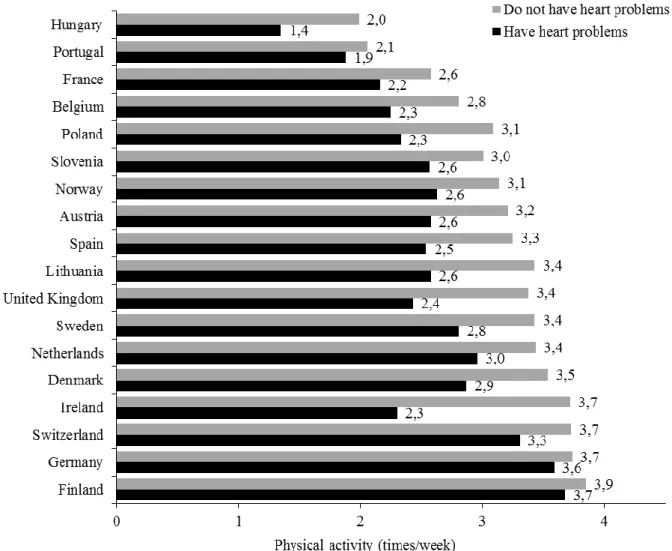
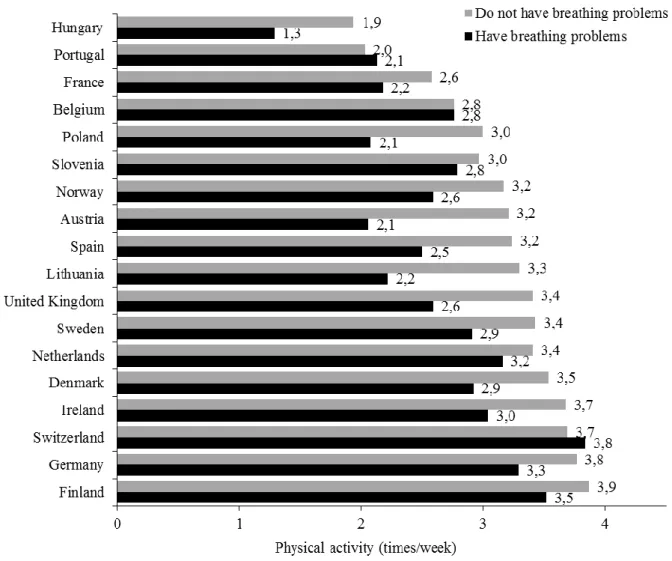
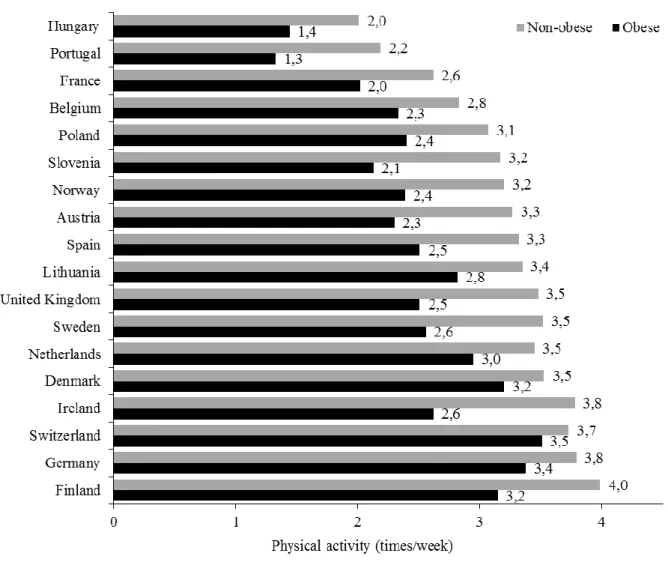
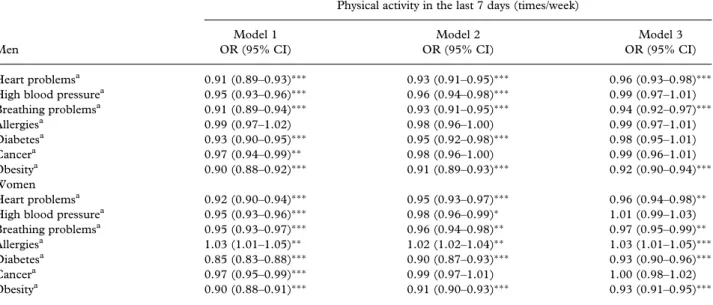
of physical activity remained negatively associated with heart problems, breathing problems, and obesity. For just women, physical activity was significantly and positively related with allergies, and type 2 diabetes, even when the model was fully adjusted.
Table 2. Relationship between physical activity in the last 7 days and having chronic diseases.
Men
Physical activity in the last 7 days (times/week) Model 1
OR (95% CI)
Model 2 OR (95% CI)
Model 3 OR (95% CI) Heart problems1 0.91 (0.89-0.93)*** 0.93 (0.91-0.95)*** 0.96 (0.93-0.98)*** High blood pressure1 0.95 (0.93-0.96)*** 0.96 (0.94-0.98)*** 0.99 (0.97-1.01) Breathing problems1 0.91 (0.89-0.94)*** 0.93 (0.91-0.95)*** 0.94 (0.92-0.97)***
Allergies1 0.99 (0.97-1.02) 0.98 (0.96-1.00) 0.99 (0.97-1.01)
Diabetes1 0.93 (0.90-0.95)*** 0.95 (0.92-0.98)*** 0.98 (0.95-1.01)
Cancer1 0.97 (0.94-0.99)** 0.98 (0.96-1.00) 0.99 (0.96-1.01)
Obesity1 0.90 (0.88-0.92)*** 0.91 (0.89-0.93)*** 0.92 (0.90-0.94)***
Women
Heart problems1 0.92 (0.90-0.94)*** 0.95 (0.93-0.97)*** 0.96 (0.94-0.98)** High blood pressure1 0.95 (0.93-0.96)*** 0.98 (0.96-0.99)* 1.01 (0.99-1.03) Breathing problems1 0.95 (0.93-0.97)*** 0.96 (0.94-0.98)** 0.97 (0.95-0.99)**
Allergies1 1.03 (1.01-1.05)** 1.02 (1.02-1.04)** 1.03 (1.01-1.05)***
Diabetes1 0.85 (0.83-0.88)*** 0.90 (0.87-0.93)*** 0.93 (0.90-0.96)***
Cancer1 0.97 (0.95-0.99)*** 0.99 (0.97-1.01) 1.00 (0.98-1.02)
Obesity1 0.90 (0.88-0.91)*** 0.91 (0.90-0.93)*** 0.93 (0.91-0.95)***
1 The reference category was not having the disease.
Model 1: Unadjusted analyses. Model 2: Analyses were adjusted for educational level, age, marital status, living place, country, and household income. Model 3: Analyses were adjusted for educational level, age, marital status, living place, country, household income, sedentary time watching television, and for all others chronic diseases.
p<0.05, ** p<0.01, *** p<0.001
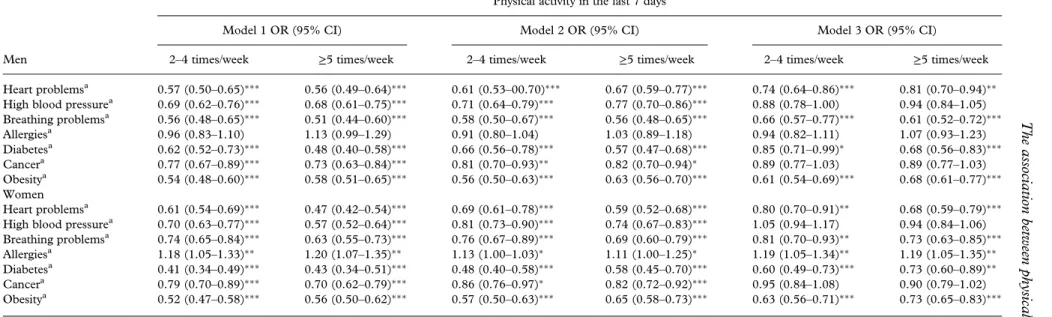
diseases, to be engaged in physical activity 2 to 4 times per week and 5 or more times per week persisted in decreasing the odds of having heart problems, breathing problems, type 2 diabetes, and obesity, compared with men and women who engaged in physical activity 1 or less times per week. Conversely, in all different models, the more active women had higher odds of having allergies when compared with those who were less active.
Table 3. Relationship between physical activity and having chronic diseases.
Chronic diseases
Model 1. OR (95% CI)
Men Women
2-4 times/week ≥ 5 times/week 2-4 times/week ≥ 5 times/week
Heart problems1 0.57 (0.50-0.65)*** 0.56 (0.49-0.64)*** 0.61 (0.54-0.69)*** 0.47 (0.42-0.54)*** High blood pressure1 0.69 (0.62-0.76)*** 0.68 (0.61-0.75)*** 0.70 (0.63-0.77)*** 0.57 (0.52-0.64)*** Breathing problems1 0.56 (0.48-0.65)*** 0.51 (0.44-0.60)*** 0.74 (0.65-0.84)*** 0.63 (0.55-0.73)*** Allergies1 0.96 (0.83-1.10) 1.13 (0.99-1.29) 1.18 (1.05-1.33)** 1.20 (1.07-1.35)** Diabetes1 0.62 (0.52-0.73)*** 0.48 (0.40-0.58)*** 0.41 (0.34-0.49)*** 0.43 (0.34-0.51)*** Cancer1 0.77 (0.67-0.89)*** 0.73 (0.63-0.84)*** 0.79 (0.70-0.89)*** 0.70 (0.62-0.79)*** Obesity1 0.54 (0.48-0.60)*** 0.58 (0.51-0.65)*** 0.52 (0.47-0.58)*** 0.56 (0.50-0.62)***
Model 2. OR (95% CI)
Chronic diseases Men Women
Heart problems1 0.61 (0.53-00.70)***
0.67 (0.59-0.77)*** 0.69 (0.61-0.78)*** 0.59 (0.52-0.68)***
High blood pressure1 0.71 (0.64-0.79)*** 0.77 (0.70-0.86)*** 0.81 (0.73-0.90)*** 0.74 (0.67-0.83)*** Breathing problems1 0.58 (0.50-0.67)*** 0.56 (0.48-0.65)*** 0.76 (0.67-0.89)*** 0.69 (0.60-0.79)*** Allergies1 0.91 (0.80-1.04) 1.03 (0.89-1.18) 1.13 (1.00-1.03)* 1.11 (1.00-1.25)* Diabetes1 0.66 (0.56-0.78)*** 0.57 (0.47-0.68)*** 0.48 (0.40-0.58)*** 0.58 (0.45-0.70)*** Cancer1 0.81 (0.70-0.93)** 0.82 (0.70-0.94)* 0.86 (0.76-0.97)* 0.82 (0.72-0.92)*** Obesity1 0.56 (0.50-0.63)*** 0.63 (0.56-0.70)*** 0.57 (0.50-0.63)*** 0.65 (0.58-0.73)***
Model. OR (95% CI)
Chronic diseases Men Women
Heart problems1 0.74 (0.64-0.86)*** 0.81 (0.70-0.94)** 0.80 (0.70-0.91)** 0.68 (0.59-0.79)*** High blood pressure1 0.88 (0.78-1.00) 0.94 (0.84-1.05) 1.05 (0.94-1.17) 0.94 (0.84-1.06) Breathing problems1 0.66 (0.57-0.77)*** 0.61 (0.52-0.72)*** 0.81 (0.70-0.93)** 0.73 (0.63-0.85)*** Allergies1 0.94 (0.82-1.11) 1.07 (0.93-1.23) 1.19 (1.05-1.34)** 1.19 (1.05-1.35)** Diabetes1 0.85 (0.71-0.99)* 0.68 (0.56-0.83)*** 0.60 (0.49-0.73)*** 0.73 (0.60-0.89)**
Cancer1 0.89 (0.77-1.03) 0.89 (0.77-1.03) 0.95 (0.84-1.08) 0.90 (0.79-1.02)
Obesity1 0.61 (0.54-0.69)*** 0.68 (0.61-0.77)*** 0.63 (0.56-0.71)*** 0.73 (0.65-0.83)*** 1 The reference category was not having the disease.
Figure 1c. Relationship between physical activity participation and obesity.
Discussion
The aim of this study was to analyse the association between physical activity and chronic diseases, including heart problems, high blood pressure, breathing problems, allergies, type 2 diabetes, cancer, and obesity in European adults. The main results highlight that physical activity was inversely related with having heart problems, breathing problems, type 2 diabetes, and obesity among men and women, supporting the idea that physical activity is a healthy behaviour.
chronic diseases (Kaptein & Badley, 2012; Loef, de Hollander, Boot, & Proper, 2016; Marques, Peralta, Martins, de Matos, & Brownson, 2016c). Furthermore, the study results also endorse the fact that even a few episodes of physical activity per week have a positive impact on health, and may contribute to reduce mortality (O'Donovan et al., 2017). This is an important message for public health because adulthood might be a demanding time, with various commitments leading to physical inactivity. Adults have to make trade-offs between necessary (work) activities and physical activity, which could be considered as a discretionary activity.
reverse the increasing prevalence of inactivity and its effects on public health (Lee et al., 2012).
Results showed that physical activity decreases the odds of having breathing problems, even when physical activity was practised more often. In fact, the literature has shown that even light physical activity 3 or more times per week is prospectively associated with less risk ratio of asthma and wheezing, while vigorous physical activity is not associated with any asthma outcomes (Russell et al., 2016). These specific results, and the general present study results, emphasize the idea that increased physical activity does not augment breathing problems or compromise asthma control. On the contrary, it is associated with its improvements (Mancuso et al., 2013).
Although the results present similarities between men and women, there are some differences. For instance, physical activity in the last 7 days was positively related to allergies and negatively related to type 2 diabetes in women but not in men, when the model was fully adjusted. Perhaps the differences are due to the diversities in biology, lifestyle, environment, and socioeconomic status, because these factors impact differences between men and women in predisposition, and development of some chronic diseases. Furthermore, sex hormones have an impact on energy metabolism, which can explain the differences observed between men and women in the relationship between physical activity and some chronic diseases (Kautzky-Willer, Harreiter, & Pacini, 2016; Leynaert et al., 2012).
In the interpretation of this study’s results, several limitations should be noted. First, the cross-sectional design implies that no causal inferences can be made. Thus, the current study cannot answer the question whether the presence of chronic diseases leads to lower physical activity levels, or vice versa. Second, physical activity and television-viewing time were self-reported rather than objectively measured, which could be subject to bias in terms of over- and underestimation (Marques, Martins, Ramos, Yazigi, & Carreiro da Costa, 2014; Otten, Littenberg, & Harvey-Berino, 2010). Moreover, physical activity was measured using a single item. However, there is evidence that assessed physical activity with a single question is an acceptable alternative in epidemiologic studies (Wanner et al., 2014). Third, while chronic diseases were also self-reported, studies have suggested that self-report of chronic diseases is fairly to largely accurate for most chronic diseases (Haapanen, Miilunpalo, Pasanen, Oja, & Vuori, 1997; Hansen et al., 2014).
as several socio-demographic characteristics of the study sample. Furthermore, due to the large sample, there was an adequate statistical power.
Conclusion
In conclusion, this study broadens the scope of research in physical activity and chronic diseases by using a large population-based European survey. Physical activity is associated with a lower risk of cardiovascular diseases, in particular: heart problems, high blood pressure, breathing problems, allergies, type 2 diabetes, and obesity.
References
Ahmad, F. S., Ning, H., Rich, J. D., Yancy, C. W., Lloyd-Jones, D. M., & Wilkins, J. T. (2016). Hypertension, obesity, diabetes, and heart failure-free survival: the Cardiovascular Disease Lifetime Risk Pooling Project. JACC Heart Fail, 4(12), 911-919. doi: 10.1016/j.jchf.2016.08.001
Alves, A. J., Viana, J. L., Cavalcante, S. L., Oliveira, N. L., Duarte, J. A., Mota, J., . . . Ribeiro, F. (2016). Physical activity in primary and secondary prevention of cardiovascular disease: Overview updated. World J Cardiol, 8(10), 575-583. doi: 10.4330/wjc.v8.i10.575
Anzuini, F., Battistella, A., & Izzotti, A. (2011). Physical activity and cancer prevention: a review of current evidence and biological mechanisms. Journal of Preventive Medicine and Hygiene, 52(4), 174-180
Banks, E., Lim, L., Seubsman, S. A., Bain, C., & Sleigh, A. (2011). Relationship of obesity to physical activity, domestic activities, and sedentary behaviours: cross-sectional findings from a national cohort of over 70,000 Thai adults.
BMC Public Health, 11, 762. doi: 10.1186/1471-2458-11-762
Barengo, N., Hu, G., Lakka, T., Pekkarinen, H., Nissinen, A., & Tuomilehto, J. (2004). Low physical activity as a predictor for total and cardiovascular disease mortality in middle-aged men and women in Finland. European heart journal, 25(24), 2204-2211
Friedenreich, C., Neilson, H., & Lynch, B. (2010). State of the epidemiological evidence on physical activity and cancer prevention. European Journal of Cancer, 46(14), 2593-2604. doi: 10.1016/j.ejca.2010.07.028
Fuchs, S. C., Moreira, L. B., Camey, S. A., Moreira, M. B., & Fuchs, F. D. (2008). Clustering of risk factors for cardiovascular disease among women in Southern Brazil: a population-based study. Cad Saude Publica, 24 Suppl 2, S285-293 GBD Risk Factors Collaborators, Forouzanfar, M. H., Alexander, L., Anderson, H. R.,
1990-2013: a systematic analysis for the Global Burden of Disease Study 2013.
Lancet, 386(10010), 2287-2323. doi: 10.1016/S0140-6736(15)00128-2 Haapanen, N., Miilunpalo, S., Pasanen, M., Oja, P., & Vuori, I. (1997). Agreement
between questionnaire data and medical records of chronic diseases in middle-aged and elderly Finnish men and women. Am J Epidemiol, 145(8), 762-769 Hansen, H., Schafer, I., Schon, G., Riedel-Heller, S., Gensichen, J., Weyerer, S., . . .
Scherer, M. (2014). Agreement between self-reported and general practitioner-reported chronic conditions among multimorbid patients in primary care - results of the MultiCare Cohort Study. BMC Fam Pract, 15, 39. doi: 10.1186/1471-2296-15-39
Hardman, A., & Stensel, D. (2009). Physical activity and health. The evidence explained (2nd ed.). Oxon: Routledge.
Hu, G., Lindstrom, J., Valle, T. T., Eriksson, J. G., Jousilahti, P., Silventoinen, K., . . . Tuomilehto, J. (2004). Physical activity, body mass index, and risk of type 2 diabetes in patients with normal or impaired glucose regulation. Arch Intern Med, 164(8), 892-896. doi: 10.1001/archinte.164.8.892
Huai, P., Xun, H., Reilly, K. H., Wang, Y., Ma, W., & Xi, B. (2013). Physical activity and risk of hypertension: a meta-analysis of prospective cohort studies.
Hypertension, 62(6), 1021-1026. doi:
10.1161/HYPERTENSIONAHA.113.01965
Kaptein, S. A., & Badley, E. M. (2012). Sex differences, age, arthritis, and chronic disease: influence on physical activity behaviors. J Phys Act Health, 9(4), 540-548
Karjalainen, J. J., Kiviniemi, A. M., Hautala, A. J., Piira, O. P., Lepojarvi, E. S., Perkiomaki, J. S., . . . Tulppo, M. P. (2015). Effects of physical activity and exercise training on cardiovascular risk in coronary artery disease patients with and without type 2 diabetes. Diabetes Care, 38(4), 706-715. doi: 10.2337/dc14-2216
Kautzky-Willer, A., Harreiter, J., & Pacini, G. (2016). Sex and gender differences in risk, pathophysiology and complications of type 2 diabetes mellitus. Endocr Rev, 37(3), 278-316. doi: 10.1210/er.2015-1137
Kyu, H. H., Bachman, V. F., Alexander, L. T., Mumford, J. E., Afshin, A., Estep, K., . . . Forouzanfar, M. H. (2016). Physical activity and risk of breast cancer, colon cancer, diabetes, ischemic heart disease, and ischemic stroke events: systematic review and dose-response meta-analysis for the Global Burden of Disease Study 2013. BMJ, 354, i3857. doi: 10.1136/bmj.i3857
Lee, I., Sesso, H., Oguma, Y., & Paffenbarger, R. (2003). Relative intensity of physical activity and risk of coronary heart disease. Circulation, 107(8), 1110-1116 Lee, I., Shiroma, E. J., Lobelo, F., Puska, P., Blair, S. N., & Katzmarzyk, P. T. (2012).
Effect of physical inactivity on major non-communicable diseases worldwide: an analysis of burden of disease and life expectancy. Lancet, 380(9838), 219-229. doi: 10.1016/S0140-6736(12)61031-9
Leynaert, B., Sunyer, J., Garcia-Esteban, R., Svanes, C., Jarvis, D., Cerveri, I., . . . Neukirch, F. (2012). Gender differences in prevalence, diagnosis and incidence of allergic and non-allergic asthma: a population-based cohort. Thorax, 67(7), 625-631. doi: 10.1136/thoraxjnl-2011-201249
Mancuso, C. A., Choi, T. N., Westermann, H., Wenderoth, S., Wells, M. T., & Charlson, M. E. (2013). Improvement in asthma quality of life in patients enrolled in a prospective study to increase lifestyle physical activity. J Asthma, 50(1), 103-107. doi: 10.3109/02770903.2012.743150
Marques, A., Martins, J., Ramos, M., Yazigi, F., & Carreiro da Costa, F. (2014). Perception and reality - Portuguese adults' awareness of active lifestyle.
European Journal of Sport Science, 14(5), 468-474. doi:
10.1080/17461391.2013.837512
Marques, A., Peralta, M., Martins, J., de Matos, M. G., & Brownson, R. C. (2016). Cross-sectional and prospective relationship between physical activity and chronic diseases in European older adults. Int J Public Health. doi: 10.1007/s00038-016-0919-4
Marques, A., Sarmento, H., Martins, J., & Saboga Nunes, L. (2015). Prevalence of physical activity in European adults - Compliance with the World Health Organization's physical activity guidelines. Prev Med, 81, 333-338. doi: 10.1016/j.ypmed.2015.09.018
Matsuo, T., Sairenchi, T., Suzuki, K., Tanaka, K., & Muto, T. (2011). Long-term stable obesity increases risk of hypertension. International Journal of Obesity, 35(8), 1056-1062. doi: 10.1038/ijo.2010.226
Murtagh, E. M., Nichols, L., Mohammed, M. A., Holder, R., Nevill, A. M., & Murphy, M. H. (2015). The effect of walking on risk factors for cardiovascular disease: an updated systematic review and meta-analysis of randomised control trials.
Preventive Medicine, 72, 34-43. doi: 10.1016/j.ypmed.2014.12.041
O'Donovan, G., Lee, I. M., Hamer, M., & Stamatakis, E. (2017). Association of "weekend warrior" and other leisure time physical activity patterns with risks for all-cause, cardiovascular disease, and cancer mortality. JAMA Intern Med, 177(3), 335-342. doi: 10.1001/jamainternmed.2016.8014
Otten, J. J., Littenberg, B., & Harvey-Berino, J. R. (2010). Relationship between self-report and an objective measure of television-viewing time in adults. Obesity (Silver Spring), 18(6), 1273-1275. doi: 10.1038/oby.2009.371
Paffenbarger, R., & Hyde, R. (1988). Exercise adherence, coronary heart disease, and longevity. In R. Dishman (Ed.), Exercise adherence. Its impact on public health (pp. 41-73). Champaign, IL: Human Kinetics.
Patel, S. A., Ali, M. K., Alam, D., Yan, L. L., Levitt, N. S., Bernabe-Ortiz, A., . . . Prabhakaran, D. (2016). Obesity and its relation with diabetes and hypertension: a cross-sectional study across 4 geographical regions. Glob Heart, 11(1), 71-79 e74. doi: 10.1016/j.gheart.2016.01.003
Russell, M., Dharmage, S., Real, F., Ane, J., Schlunssen, V., & Svanes, C. (2016). Physical activity and asthma: A longitudinal Respiratory Health in Northern Europe (RHINE) study. European Respiratory Journal, 48, PA1146. doi: 10.1183/13993003.congress-2016.PA1146
Sallis, J. F., Bull, F., Guthold, R., Heath, G. W., Inoue, S., Kelly, P., . . . Lancet Physical Activity Series 2 Executive, C. (2016). Progress in physical activity over the Olympic quadrennium. Lancet, 388(10051), 1325-1336. doi: 10.1016/S0140-6736(16)30581-5
Schnaudt, C., Weinhardt, M., Fitzgerald, R., & Liebig, S. (2014). The European Social Survey: contents, design, and research potential. Schmollers Jahrbuch, 134(4), 487-506. doi: 10.3790/schm.134.4.487
exercise training in primary and secondary coronary prevention. Circ J, 77(2), 281-292
UNESCO. (2012). International Standard Classification of Education ISCED 2011. Montreal: United Nations Educational, Scientific and Cultural Organization. Wanner, M., Probst-Hensch, N., Kriemler, S., Meier, F., Bauman, A., & Martin, B. W.
(2014). What physical activity surveillance needs: validity of a single-item questionnaire. British Journal of Sports Medicine, 48(21), 1570-1576. doi: 10.1136/bjsports-2012-092122
Wen, C. P., Wai, J. P., Tsai, M. K., Yang, Y. C., Cheng, T. Y., Lee, M. C., . . . Wu, X. (2011). Minimum amount of physical activity for reduced mortality and extended life expectancy: a prospective cohort study. Lancet, 378(9798), 1244-1253. doi: 10.1016/S0140-6736(11)60749-6
WHO. (2000). Obesity: preventing and managing the global epidemic. Report of a WHO consultation. Geneva: World Health Organization.
WHO. (2010). Global recommendations on physical activity for health. Geneva: World Health Organization.
WHO. (2014). Global status report on noncommunicable diseases 2014. Geneva: World Health Organization.
Article 3
Associations between vigorous physical activity and chronic diseases in
older adults: a cross-sectional and prospective study in 13 European countries
Associations between vigorous physical activity and chronic diseases in
older adults: a cross-sectional and prospective study in 13 European countries
Adilson Marques1,2,3, Miguel Peralta1, Hugo Sarmento4, João Martins5, Miguel González Valeiro3,7
1 Centro Interdisciplinar de Estudo da Performance Humana, Faculdade de
Motricidade Humana, Universidade de Lisboa, Lisboa, Portugal
2 Centro de Investigação em Saúde Pública, Escola Nacional de Saúde Pública,
Universidade Nova de Lisboa, Lisboa, Portugal
3 Facultad de Ciencias del Deporte y la Educación Física, Universidad de A
Coruña, A Coruña, España
4 Sport and Physical Activity Research Centre, Faculty of Sport Sciences and
Physical Education, University of Coimbra, Coimbra, Portugal
6 Laboratório de Pedagogia, Faculdade de Motricidade Humana e UIDEF,
Instituto de Educação, Universidade de Lisboa, Lisboa, Portugal
7 Grupo de Investigación en Educación, Salud y Actividad Física: Estudios de
Género, Universidad de A Coruña, A Coruña, España
Abstract
Background: This study aimed to assess cross-sectional and prospective relationships between vigorous physical activity (VPA) and the risk of major chronic diseases among European older adults. Methods: Participants were 37524 older adults who responded to the fourth (in 2011) and fifth (in 2013) wave of the SHARE project, from 13 European countries. Participants answered interview questions about the presence of chronic conditions and VPA. The cross-sectional and prospective association between PA and the number of chronic diseases was assessed using logistic regression models. Results: Among men and women, the prevalence of chronic diseases was significantly lower among those who reported VPA once a week or more than once a week. For men, VPA once a week was prospectively related with lower odds of heart attack, chronic lung disease, Parkinson’s disease, and Alzheimer’s disease. VPA more than once a week was prospectively related with lower odds of having all chronic diseases. Women who engaged in VPA once a week presented lower odds of having chronic diseases, except for hypertension, high blood cholesterol, and cancer. For VPA more than once a week, cancer was the only disease not associated with physical activity. Conclusion: VPA is associated with reduced risk of chronic diseases in men and women. Even the practice of VPA once a week seems to be sufficient to reduce risks of chronic diseases.
Introduction
The prevalence of chronic diseases has been growing around the world, mainly among older adults, including: heart diseases, hypertension, diabetes, cancer, obesity, and respiratory diseases (WHO, 2014) As a result, chronic diseases are now the leading cause of morbidity and mortality worldwide (WHO, 2015). The main factor identified as being, in part, responsible for the increasing prevalence of chronic diseases is the prevalence of physical inactivity (Lee et al., 2012).
Physical activity can reduce chronic diseases and the risk of disease progression (Huai et al., 2013; Lee & Paffenbarger, 2001). Thus, regular practice of physical activity has been recommended (WHO, 2010) because of its effectiveness for primary and secondary prevention of chronic diseases (Alves et al., 2016). Even a minimum amount of physical activity has a protective health effect against chronic diseases, and it reduces mortality (Ekelund et al., 2015; Lee et al., 2003; O'Donovan et al., 2017; Wen et al., 2011).