
An Alternative Conceptualization of the Nature of Science for Science and Technology Education
7
0
0
Texto completo
(2) An Alternative Conceptualization of the Nature of Science. Introduction This paper presents an alternative conceptualization of the nature of science (NoS) for science and technology education (ST-Education). Thus, the paper’s central question is what to teach and learn about NoS. The conceptualization presented here is alternative, on the one hand to the so called “consensus view”, and on the other hand, to the recent reconceptualization of NoS for science education by Erduran and Dagher (2014) (EDR hereafter). Specifically, this paper assumes the general criticisms on the consensus view that have been raised along years in the literature, and suggests an alternative model and conceptualization to EDR proposal by choosing a different model-base for developing the conceptualization that does yield more dimensions and categories than EDR did. Further, the paper assumes the integration of the current science and technology in the concept of techno-science, so that the concept of NoS could be extended to encompass also technology (Echeverría, 2010; Tala, 2009). Therefore, NoS will be onward referred to as nature of science and technology (NoS&T), which also allows addressing STEducation in a natural way (scientific and engineering practices). Scientific and Technological Literacy and Nature of Science and Technology NoS&T refers to the history, philosophy, and sociology of scientific and technological knowledge and practices. This general demarcation defines NoS&T as a complex (interdisciplinary realities and contributions), dialectical (change is essential), multifaceted (including multiple perspectives of analysis beyond science), controversial (underscoring its argumentative nature) and contested research territory (scholars disagree on its teaching contents). Further, this complex profile makes its teaching and learning in science and technological education a difficult, multidimensional, and innovative challenge for teachers (Millar, 2006). On the other hand, teaching and learning NoS&T is considered a central component of scientific (and technological) literacy (ST-Literacy) for all citizens (not just for scientists or engineers), with close unanimity of the specialists. Scholars view two main components for ST-Literacy: the traditional understanding "of" science (concepts, laws, models and theories and processes) and the understanding "about" science (NoS&T). Summing up, the STLiteracy is the actual context for teaching NoS&T in ST-Education (Hodson, 2008). The need of teaching NoS&T has been justified for many reasons: socio-economic (S&T foster economic and social development), cultural (S&T is a culture), autonomy (S&T facilitate autonomy), utility (S&T help personal and social decision-. making and quality of life), democratic (S&T impact on public and social interests and participation), and ethical (scientists and technicians are responsible for the management of techno-scientific affairs) (Sjøberg, 1997) The lack of meaning in ST-Education often alienates and disaffects many students from meaningless science and technology, which does not meet their interests, needs, or self-image (i.e. many women are uncomfortable learning science and increasing numbers of students reject S&T in their future careers and jobs). The pedagogy practiced in traditional science classrooms (i.e., memorization to learn laws) oppose to the values of science that the NoS&T tries to advocate (Aikenhead, 2006). The absence of NoS&T in the classroom contributes to those deviations, whereas their active presence provides a global sense of coherence to the STLiteracy, so teaching NoS&T constitute the source of values that justify learning ST-Literacy (Duschl, Maeng, and Sezen, 2011; Erduran and Dagher, 2014). Thus, another essential and relevant educational reason to teach NoS&T in ST-Education stems from the assignation of global sense or meaning making to teaching and learning contents in the context of ST-Literacy for all students: pedagogy and contents must be coherent with NoS&T features (Bennássar, Vázquez, Manassero, and GarcíaCarmona, 2010). Some call functional ST-Literacy the knowledge about S&T as long as it is in the service of citizens (to engage in science or to make practical decisions). Functional ST-Literacy involves understanding of aspects of the development and validation of S&T knowledge and practices: assumptions, gathering and interpreting data, reliability of claims as well as the internal and external relationships between science, technology and society (funding, communication, institutions, policy, priorities, etc.), where environmental and socio-scientific issues are prominent centres of interest. Thus, functional STLiteracy is the context for teaching and learning NoS&T (Allchin, Andersen and Nielsen, 2014). The Contested Consensus View The broad view of NoS&T emerging from the functional ST-Literacy (depicted in the former paragraph) contrasts with the consensus view, which is featured by a close list of aspects of science for teaching NoS arguing that a short agreed list of NoS issues may be enough for ST-Literacy and facilitate their teaching in ST-Education. The Lederman’s seven aspects may be considered a conspicuous representative of the consensus view, and includes the following list of NoS issues: empirical, theoryladen, inferential, creative, tentative, uncertain, and socially embedded (Abd-el-Khalick, 2012; Lederman, 2007). A more extended list of NoS tenets was developed by McComas (2008), whose details are included in the fifth column of the table in the appendix.. Conexão Ci. | Formiga/MG | Vol. 12 | N. esp. 2|p. 18-24 | 2017. 19.
(3) An Alternative Conceptualization of the Nature of Science A different line of research was developed by Osborne, Collins, Ratcliffe, Millar, and Duschl (2003), who empirically elaborated a list through a Delphi study that gathered the opinions of some teachers. The categories of this list depict a new profile for NoS as they are wider than the former proposals (see its details in the fourth column of the table in the appendix). Such short lists of declarative NoS tenets (consensus view) has been criticized as reductionist, and thus invalid for adequately portray the NoS&T. The criticisms address the confusion among the ontological, philosophical, sociological, and ethical features of science, the inaccurate depiction of the heterogeneity of scientific practices, the distortion of the historical descriptions of science, and the ignorance or devaluation of some features, such as the role of technology, and the social, verbal and communicative aspects in the construction of knowledge (Allchin, 2011; Duschl and Grandy, 2008; Matthews, 2012; van Dijk, 2012). Summing up, the critics advocate for an integral and inclusive view of NoS&T, that Allchin calls whole science, where all features related with doing science (cognitive, epistemic, and social practices, as well as material and technological contexts) are candidates to be taught to students in ST-Education. According to this line of criticisms about the consensus view, Matthews (2012) pointed out to change the denomination from NoS to features of science (FOS) and proposed a couple of features that depict an integral and broader image of science (see details in the third column of the table in the appendix). The change from NOS to FOS involves a concern with the processes, institutions and cultural and social contexts where the knowledge is produced, and of course remains focused on the nature of scientific knowledge. Indeed, broadening the field does not mean setting high-level educational aims; rather, modest goals for FOS teaching are proposed through an appropriate pedagogy that allows elaboration, discussion and inquiry about FOS issues, rather than just learn and assess FOS. Acevedo, Vázquez, Manassero and Acevedo (2007) empirically analysed 637 sentences of the Views on science-technology-society (VOSTS) item pool (Aikenhead and Ryan, 1992) searching the agreement of expert judges on those sentences. The criterion for agreement was set up when 2/3 of judges agreed on the sentence classification as adequate or naïve. The results showed an extensive catalogue of sentences that reached the criterion for empirical agreement: 41 sentences to be considered adequate ideas and 93 sentences as naïve ideas. Thus, this empirical analysis shows that experts are able to agree on a much larger set of different statements about NoS&T than a simple and reductionist consensus list. Summing up, it seems also consensual that the consensus view is a reduced depiction of NoS&T. The broader view of NoS&T about authentic (whole). science not only includes and enlarges the lists of the consensus view on tenets, but also involves large amount of naive conceptions to take into account in the pedagogy. Further, the controversy on the consensus view shows that any vision of NoS&T is partial and fragmentary and a structuration of the field is needed not only in order to overcome the typical reductionism of the consensus view, but also to develop classifications that may help researchers and teachers to pinpoint their aims amid the complexity of NoS&T field. Erduran and Dagher’s Reconceptualization (EDR) Assuming the broader view of NoS&T, Erduran and Dagher (2014) apply the Irzik and Nola’s (2014) family resemblance approach model (FRA) develops the idea that the different sciences, like the members of a family, resemble and differentiate one another in some aspects. Further, the different sciences resemble and differentiate one another in some NoS aspects, thus accounting for domain general and domain specific aspects of science. FRA model reconceptualises science in terms of two interactive dimensions that unify the many fragmentary aspects into meaningful wholes: cognitive-epistemic and social-institutional. The cognitive-epistemic dimension includes four categories: scientific practices, aims and values, methods and methodological rules, and scientific knowledge. The social-institutional dimension contains the following categories: professional activities, scientific ethos, social certification, social values, and organizational, political, and financial aspects of science, though just four of them appear later on. Further, the reconceptualization provides holistic views and disciplinary variations through some specific aspects that are assigned to the categories (classification, observation, experimentation, epistemological issues relevant for science education, disciplinary similarities and domain-specificity, etc.), which are modelled trough the science eye and the heuristic rings (table 1). All in all, Erduran and Dagher’s reconceptualization structures the field according to an integrative view of scientific knowledge and practices and other family categories, though the proposal might be improvable and the aim of this communication is to display an alternative reconceptualization of NoS&T assuming the criticisms to the consensus view to go beyond the reductionist lists of NoS&T tenets, and sharing the same integrative background on NoS&T. The Three World Conceptualization Popper’s analogy of the three worlds, which draws on Plato’s philosophy, is assumed as the model base for the 3-World/VOSTS proposal. The physical world of material objects is the first world (W1), while the second world (W2) refers to the world of human thoughts (cognitions and mental states that are the object of the psychology). The. Conexão Ci. | Formiga/MG | Vol. 12 | N. esp. 2|p. 18-24 | 2017. 20.
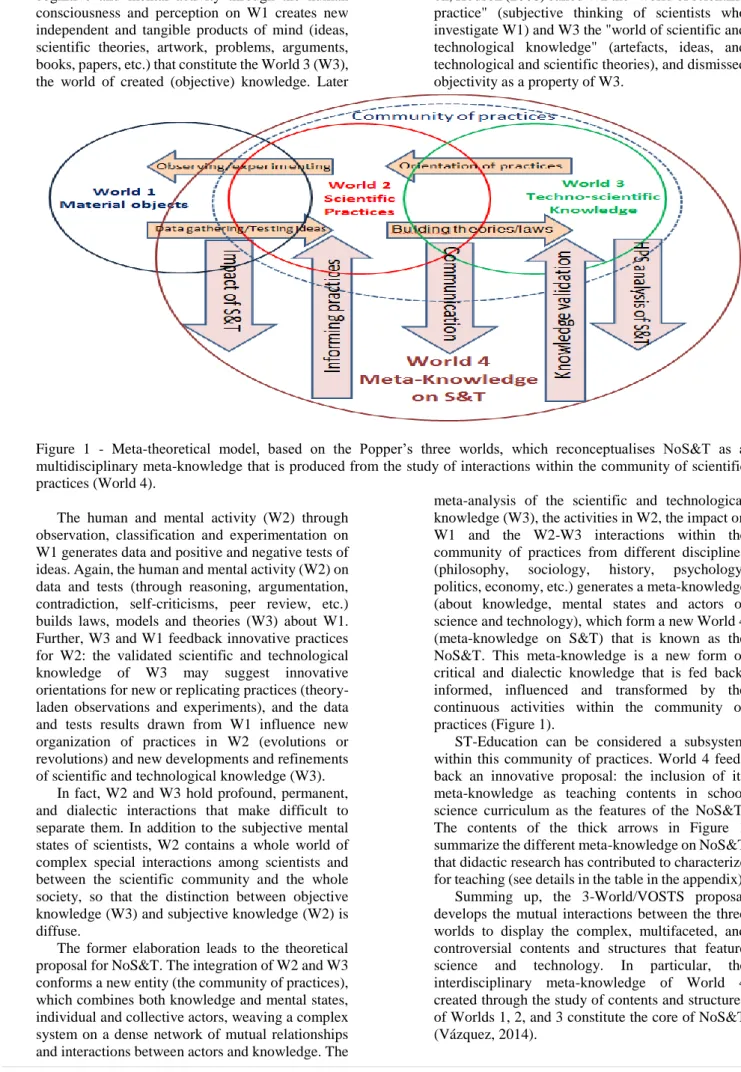
(4) An Alternative Conceptualization of the Nature of Science cognitive and mental activity through the human consciousness and perception on W1 creates new independent and tangible products of mind (ideas, scientific theories, artwork, problems, arguments, books, papers, etc.) that constitute the World 3 (W3), the world of created (objective) knowledge. Later. on, Hodson (2008) called W2 the "world of scientific practice" (subjective thinking of scientists who investigate W1) and W3 the "world of scientific and technological knowledge" (artefacts, ideas, and technological and scientific theories), and dismissed objectivity as a property of W3.. Figure 1 - Meta-theoretical model, based on the Popper’s three worlds, which reconceptualises NoS&T as a multidisciplinary meta-knowledge that is produced from the study of interactions within the community of scientific practices (World 4). meta-analysis of the scientific and technological The human and mental activity (W2) through knowledge (W3), the activities in W2, the impact on observation, classification and experimentation on W1 and the W2-W3 interactions within the W1 generates data and positive and negative tests of community of practices from different disciplines ideas. Again, the human and mental activity (W2) on (philosophy, sociology, history, psychology, data and tests (through reasoning, argumentation, politics, economy, etc.) generates a meta-knowledge contradiction, self-criticisms, peer review, etc.) (about knowledge, mental states and actors of builds laws, models and theories (W3) about W1. science and technology), which form a new World 4 Further, W3 and W1 feedback innovative practices (meta-knowledge on S&T) that is known as the for W2: the validated scientific and technological NoS&T. This meta-knowledge is a new form of knowledge of W3 may suggest innovative critical and dialectic knowledge that is fed back, orientations for new or replicating practices (theoryinformed, influenced and transformed by the laden observations and experiments), and the data continuous activities within the community of and tests results drawn from W1 influence new practices (Figure 1). organization of practices in W2 (evolutions or ST-Education can be considered a subsystem revolutions) and new developments and refinements within this community of practices. World 4 feeds of scientific and technological knowledge (W3). back an innovative proposal: the inclusion of its In fact, W2 and W3 hold profound, permanent, meta-knowledge as teaching contents in school and dialectic interactions that make difficult to science curriculum as the features of the NoS&T. separate them. In addition to the subjective mental The contents of the thick arrows in Figure 1 states of scientists, W2 contains a whole world of summarize the different meta-knowledge on NoS&T complex special interactions among scientists and that didactic research has contributed to characterize between the scientific community and the whole for teaching (see details in the table in the appendix). society, so that the distinction between objective Summing up, the 3-World/VOSTS proposal knowledge (W3) and subjective knowledge (W2) is develops the mutual interactions between the three diffuse. worlds to display the complex, multifaceted, and The former elaboration leads to the theoretical controversial contents and structures that feature proposal for NoS&T. The integration of W2 and W3 science and technology. In particular, the conforms a new entity (the community of practices), interdisciplinary meta-knowledge of World 4 which combines both knowledge and mental states, created through the study of contents and structures individual and collective actors, weaving a complex of Worlds 1, 2, and 3 constitute the core of NoS&T system on a dense network of mutual relationships (Vázquez, 2014). and interactions between actors and knowledge. The. Conexão Ci. | Formiga/MG | Vol. 12 | N. esp. 2|p. 18-24 | 2017. 21.
(5) An Alternative Conceptualization of the Nature of Science The complexities of the meta-knowledge of NoS&T, which are generated in the W4, are summarized using a taxonomic framework elaborated by the authors from the proposal of Aikenhead and Ryan (1992). The taxonomy involves nine topics that are grouped in four strands (Table 1): (I) Definitions (1-Science and technology), (II) External sociology of S&T (encompassing 2Influences of society on S&T, 3-Triadic influences, 4-Influences of S&T on society, 5-Influences of school science on society), (III) Internal sociology of S&T (encompassing 6-Characteristics of scientists, 7-Social construction of scientific knowledge, and 8Social construction of technology), and (IV) Epistemology (9-Nature of scientific knowledge).. The contents of the strands I and IV are epistemic, while the strands II and III gather the many facets of the social relationships of S&T. Further, each topic is flexibly developed in several open categories (see the first column of the appendix), which help the taxonomy to accurately accomplish its function of detailed classification for all NoS&T issues. The proposed conceptualization based on the three-world model and the VOSTS taxonomy allows demonstrating that the dimensions and categories of EDR are a special case of the former.. Table 1. Comparison between the dimensions and categories of EDR and the multi-dimension VOSTS taxonomy proposed here for conceptualizing the features of the NoS&T that show the coincidences and the differences between both proposals. The main coincidence between both proposals is EDR and detailed in 3-world/VOSTS. Further, the the overall integral picture including two big topics EDR system uses different labels refers to values about epistemic and social aspects, whose (aims and values, social values and scientific ethos) correspondence among both systems is fairly and to practices (scientific practices and professional evidenced in table 1. However, the epistemic and practices). This multiplicity of labels seems cognitive dimension of the EDR system is more unnecessary as it may break the integral picture developed than the social-institutional dimension, depicted for NoS in EDR and lead to confusion. and specially the category on scientific practices. The 3-world/VOSTS model provides a powerful This over-development leads to reflect on some representation for conceptualising the NoS&T for issues that might be better social than epistemic. This ST- Education, as the dimensions and categories of might be the case of the development of models, NoS&T arise naturally from the interactions and explanations, critical argumentations, evaluations relationships between the three worlds, as shown in and reflections on practice, and the analysis of dis / Figure 1. Further, the 3-world/VOSTS taxonomy for advantages and risks of scientific and technological classifying the NoS&T features is wide and flexible developments. This reflection may also be extended enough to easily include any issue within its to the EDR system proposal about the consideration framework. In fact, all issues proposed for NoS by of organizational, political, and financial aspects of the authors cited in this paper can be assigned to one science, which is not developed specifically, which of the VOSTS subtopics, and especially the issues may correspond to the many subtopics of the 3put forward by Erduran and Dagher (2014), as the World/VOSTS system within the social topics that table in the appendix shows (and many of them lack lack an equivalent in the EDR system (check first any correspondent issue yet). Further, the 3and second columns of the appendix). world/VOSTS model is detailed enough to facilitate Some minor differences refer to the lack of teachers the explicit plan for teaching any NoS&T consideration in the EDR dimensions of the explicit issue, helping teachers to situate NoS&T issues account for technology, as an important companion within the curriculum, plan them to be taught, of current science, and a reference to the aspects of understand their importance for S&T education and external sociology of science, which is generic in develop heuristics for lessons.. Conexão Ci. | Formiga/MG | Vol. 12 | N. esp. 2|p. 18-24 | 2017. 22.
(6) An Alternative Conceptualization of the Nature of Science. Conclusion This paper presents a conceptualization of the NoS&T for science and technology education (3World model and VOSTS taxonomy), an alternative proposal to the consensus view, and to that presented by Erduran and Dagher (2014). Both conceptualizations stem from the criticisms to the consensus view and propose a wide set of similar specific categories for NoS&T. However, the EDR is based on FRA heuristics while the 3World/VOSTS proposal draws its conceptualization from the Popper’s three world model of science. The NoS&T categories are much straightforward justified through the powerful three world model, while the FRA heuristics does not fully allow making so explicit this justification. Obviously, the EDR taxonomic system goes beyond the consensus lists, yet its configuration raises some questions. On the one hand, EDR appeals to a basic common sense heuristic (Irzik and Nola’s FRA) without much wider prospective scope; on the other hand, some caveats can be pointed out from EDR analysis. For instance, some kind of imbalance might be perceived between the two big dimensions (epistemic and social), as the social and institutional dimension seems to be developed in a lesser extent than the cognitive–epistemic system. Moreover, a category of aims and values in science is attributed to both dimensions (epistemic and social) so that its role is embedded with mystification and controversy between the cognitive–epistemic and social systems, and again the category is less developed in the social system. Further, some categories of the socialinstitutional dimension appear a bit confusing. For instance, the repetition of several categories involving values is not much justified (scientific ethos against social values); and different or new categories (i.e. scientific ethos, organizational, political, and financial aspects of science, scientific critique) appear/disappear in some parts of the proposal; finally, the assignation of some aspects to a specific category is also contentious, due to their apparent overlapping across categories (i.e. peerreview might be assigned to social certification or to professional activities). Beyond caveats, both proposals agree about a holistic account for the representation of science and technology that try to overcome the reductionist visions of the consensus views, through integrating and enlarging contents, methods (teaching, learning, researching…) and the creation of dynamic and interactive developmental tools. The theoretical rationale of the new approach must be developed for empirical validation, and testing for the effectiveness of applied teaching strategies through the work of policy makers, curriculum developers, researchers, science educators, etc. All in all, the prospective of this 3World/VOSTS conceptualization involves testing its effectiveness for developing educational curriculum. and programs, and especially for coping with S&T teacher education as a main target group. Within this prospective, much research (i.e. socio-scientificissues literature and others) is insistently starting to point out that the lack of high-level thinking abilities (critical thinking abilities, critical reflection, argumentation, reasoning, decision-making,…) impedes understanding NoS&T; the detailed 3World/VOSTS may also contribute to the systematical inclusion and development in education of those abilities that may be the “critical” holy grail of NoS&T teaching and learning.. Acknowledgements Project EDU2015-64642-R (MINECO/FEDER) funded by the Spanish Ministry of Economy and Competitiveness and the European Regional Development Fund.. References Abd-El-Khalick, F. (2012). Examining the Sources for our Understandings about Science: Enduring conflations and critical issues in research on nature of science in science education. International Journal of Science Education, 34(3), 353-374. Acevedo, J. A., Vázquez, A., Manassero, M. A. and Acevedo, P. (2007). Consensos sobre la naturaleza de la ciencia: fundamentos de una investigación empírica [Consensuses on the nature of science: basis of an empirical research]. Revista Eureka sobre Enseñanza y Divulgación de las Ciencias, 4(1), 4266. Retrieved from http://www.apaceureka.org/revista/Larevista.htm.. Aikenhead, G. S. (2006). Science education for everyday life: Evidence-based practice. New York, NY: Teachers College, Columbia University. Aikenhead, G. S., and Ryan, A. G. (1992). The development of a new instrument: “Views on science-technology-society” (VOSTS). Science Education, 76(5), 477-491. Allchin, D. (2011). Evaluating knowledge of the nature of (whole) science. Science Education, 95, 518–542. Allchin, D., Andersen, H. M., and Nielsen, K. (2014). Complementary Approaches to Teaching Nature of Science: Integrating Student Inquiry, Historical Cases, and Contemporary Cases in Classroom Practice. Science Education, 98(3), 461486. Bennássar, A., Vázquez, A., Manassero M. A., and García-Carmona, A. (Coor.). (2010). Ciencia, tecnología y sociedad en Iberoamérica: Una evaluación de la comprensión de la naturaleza de ciencia y tecnología. Madrid: OEI. Retrieved from www.oei.es/salactsi/DOCUMENTO5vf.pdf.. Conexão Ci. | Formiga/MG | Vol. 12 | N. esp. 2|p. 18-24 | 2017. 23.
(7) An Alternative Conceptualization of the Nature of Science Duschl, R., and Grandy, R. (Eds.). (2008). Teaching Scientific Inquiry: Recommendations for Research and Implementation. Rotterdam, Netherlands: Sense Publishers. Duschl, R., Maeng, S., and Sezen A. (2011). Learning progressions and teaching sequences: A review and analysis. Studies in Science Education, 47, 123-182. Echeverría, J. (2010). De la filosofía de la ciencia a la filosofía de la tecnociencia. Daímon Revista Internacional de Filosofía, 50, 31-41. Erduran, S., and Dagher, Z. R. (2014). Reconceptualizing the nature of science for science education, scientific knowledge, practices and other family categories. Dordrecht, Holland: Springer. Hodson, D. (2008). Towards scientific literacy: A teachers’ guide to the history, philosophy and sociology of science. Rotterdam: Sense Publishers. Irzik, G., and Nola, R. (2014). New directions for NOS research. In M. Matthews (Ed.), International handbook of research in history, philosophy and science teaching (pp. 999-1022). Dordrecht, Holland: Springer.. International Journal of Science Education, 28(13), 1499-1521. Osborne, J., Collins, S., Ratcliffe, M., Millar, R. and Duschl, R. (2003). What “ideas-about-science” should be taught in school science? A Delphi study of the expert community. Journal of Research in Science Teaching, 40(7), 692-720. Sjøberg, S. (1997). Scientific literacy and school science. Arguments and second thoughts. In S. Sjoberg and E. Kallerud (Eds.), Science, technology and citizenship. The public understanding of science and technology in science education and research policy, (pp. 9-28), Oslo, Norway: NIFU. Tala, S. (2009). Unified View of Science and Technology for Education: Technoscience and Technoscience Education. Science & Education, 18 (3-4), 275-298. doi: 10.1007/s11191-008-9145-7 van Dijk, E.M. (2012). Relevant features of science: Values in conservation biology. Science & Education, 22(9), 2141-2156. Vázquez, A. (2014). Enseñanza, aprendizaje y evaluación en la formación de docentes en educación CTS en el contexto del siglo XXI. Unipluri/versidad Revista 41, 14(2), 37-49.. Lederman, N. G. (2007). Nature of science: past, present, and future. In S. K. Abell and N. G. Lederman (Eds.), Handbook of research on science education (pp. 831-879). Mahwah, NJ: Lawrence Erlbaum Associates. Matthews, M. R. (2012). Changing the focus: From nature of science (NOS) to features of science (FOS). In M. S. Khine (Ed.), Advances in nature of science research. Concepts and methodologies (pp. 3–26). Dordrecht, Holland: Springer. McComas, W. F. (2008). Seeking historical examples to illustrate key aspects of the nature of science. Science & Education, 17, 249-263. Millar, R. (2006). Twenty first century science: Insights from the design and implementation of a scientific literacy approach in school science.. Conexão Ci. | Formiga/MG | Vol. 12 | N. esp. 2|p. 18-24 | 2017. 24.
(8)
Figure
Documento similar
Since forest variables (forest productivity and for- est biomass) and abiotic factors (climate variables, soil texture and nu- trients, and soil topography) were only calculated at
The common policy in the field of science and technology can only be of practical use if there is efficient management of results of research and development. For
the Science Foundation, Ireland; the Istituto Nazionale di Fisica Nucleare, Italy; the Korean Ministry of Education, Science and Technology and the World Class University program
New insights and hypotheses in science represent an opportu- nity for neology and the creation of new conceptualization indices or even new conceptual metaphors (see Vandaele
In addition, this research study has other uses: to use the media to promote equality in the design, production and management of science and technology; to
In parallel, the previous decade has seen the disruption of rapid technological changes impacting the way science is done and shared, which has led to the
A catchment model for river basins and a hydrodynamic model were combined in order to simulate the spreading of the turbidity plume produced by sediment discharges from the
Variation in the coastal area of the GoC (depth of the water column <100 m) of the normalized mean values of pH T (pH T @Tmean) and aragonite saturation state (ΩAr@.. Tmean) at
