
Implementation of a needs analysis for the english for general and academic purposes course level I for biology students [recurso electrónico]
121
0
0
Texto completo
(2) Implementation of a Needs Analysis for the English for General and Academic Purposes Course Level I for Biology Students. Monograph. María Margarita Rodríguez Ortiz Student’s ID: 201329209. Submitted as a partial requirement for the degree in Foreign Languages (English and French). Advisor Andrés Fernando Valencia M., MA. Universidad del Valle Facultad de Humanidades Escuela de Ciencias del Lenguaje Licenciatura en Lenguas Extranjeras Inglés - Francés Santiago de Cali 2018. ii.
(3) iii. Nota de aceptación __________________________ __________________________ __________________________ __________________________. __________________________ Andrés Valencia M. Director de la Monografía. __________________________ Marcela Castellanos O. Jurado Evaluador. __________________________ Eva Tamara Lakatos Jurado Evaluador. Santiago de Cali, Junio de 2018.
(4) iv. Acknowledgments. A Dios, por darme esperanza y guiar mi camino. A mis padres, Guillermo Rodríguez e Irudys Ortiz, por su amor y consejos. A mi hermana, Alejandra Rodríguez. A mis compañeras de estudio y amigas, especialmente a Noemí Torres quien constantemente me brindó su apoyo. A los profesores de la Escuela de Ciencias del Lenguaje. Al profesor Andrés Valencia, director de esta monografía. A los profesores y estudiantes de Biología y de la Escuela de Ciencias del Lenguaje sección de ESP, por su disposición para compartir su tiempo, conocimiento y experiencias para el desarrollo de este trabajo de grado..
(5) v. Abstract. This monograph showcases a multimethod qualitative research aimed at strengthening the processes of EAP material design. This paper analyses to what extent and in which ways the teaching materials in the English course promotes the development of academic English for Biology. The data-gathering process collected multiple sources (students, graduates, language professors and Biology professors) and methods (surveys, interviews, classroom observations). The analysis of the qualitative data involved processes of frequency analysis, coding and categorizing, and triangulation for validity and reliability of the results. The findings condense information on the importance of academic language proficiency, the description of students’ subject-tasks, study skills and academic language usage; finally, suggestions for cooperation, collaboration, and team-teaching to engage the English course with disciplinary content are given. The study confirms the value that academic reading has on the academic and professional performance of students.. Keywords: English for Specific Purposes, English for Academic Purposes, Needs Analysis, Biology, Pilot Program.
(6) vi. Resumen. Esta monografía presenta una investigación cualitativa con un enfoque multimetódico con el objetivo de fortalecer los procesos de diseño de material didáctico para el área de Inglés con Fines Académicos y Específicos. Esta investigación estudió hasta qué punto y en qué forma los materiales didácticos en los cursos de inglés abordan conocimientos disciplinares para enseñar inglés académico. El proceso de recolección de datos reunió varias fuentes (estudiantes, egresados, profesores de lengua y profesores de biología) y administró varios instrumentos (encuestas, entrevistas, registros de observación). El análisis de datos cualitativos tuvo en cuenta procesos de análisis de frecuencias, codificación y categorización de la información y empleó el método de triangulación para asegurar la validez y confiabilidad de los resultados. Los hallazgos sintetizan información relacionada con la importancia del dominio del lenguaje académico en español e inglés para el programa de Biología; la descripción de tareas propias de la carrera, las actividades académicas y el uso del lenguaje académico en inglés de los estudiantes de Biología en primer semestre; finalmente, se presentan algunas sugerencias que involucran cooperación, colaboración y cátedra compartida que podrían unir el curso de inglés con el área de Biología. Este estudio confirma el valor que esta comunidad le da a la lectura académica en inglés en el desempeño académico y profesional de este grupo de estudiantes.. Palabras clave: Inglés con Fines Específicos, Inglés con Propósitos Académicos, Análisis de necesidades, Biología, Programa Piloto.
(7) Preface. vii. The present study summarizes the process and results of the design and implementation of a needs analysis (NA) carried out in 2017 Spring term at Universidad del Valle – Meléndez Campus. The NA described the types of needs of Biology students regarding English for Academic Purposes. The insights may guide the development of task-based teaching material that may work on those academic and language needs. The monograph follows the parameters of several frameworks for needs analysis procedures – such as Brown’s (2009) and the approaches of Needs Analysis (NA) by DudleyEvans and St. John (2011), to name but a few. They highlight the role of NA in the construction of language curriculums, material design, and assessment; also, they emphasize that NA is a tool that should be applied before, during and after any language teaching program –general or specific. Through qualitative data collection and analysis, the present research aims to support the current pedagogical practices in the Pilot Program providing information on students’ academic environment and their motivations to use and learn English as a foreign language; this is, their necessities, lacks and wants for short and long-term language goals. This proposal aims to provide a wide angle that is not easily seen through informal data-gathering in language courses with multidisciplinary groups and which can help to adjust and improve the current development of teaching material for EAP-Biology. This paper describes the three stages that summarize the design of the needs assessment procedure. Each stage has two steps which were carried out simultaneously, most of the time. The first stage contains the identification of the research problem, which emerged from the classroom observations, and the establishment of the objectives of the NA. In the second stage,.
(8) there are steps three and four. On one side, there was the selection of the sources. On. viii. the other, there was the selection and design of the data-gathering methods. A fundamental aspect was the creation of a conceptual framework. The third stage holds the implementation of the data-collection methods and the data analysis methods. The qualitative data gathered demanded several methods for the analysis: these were frequency analysis and data condensation, coding and categories. At last, a discussion chapter presents findings, recommendations, and conclusions..
(9) Table of content. ix. CHAPTER 1. INTRODUCTION .................................................................................... 13 1.1 Research Problem ....................................................................................................... 18 1.2 Research Questions..................................................................................................... 21 1.3 Research Aim ................................................................................................................ 21 1.3.1. Aim .................................................................................................................. 21 1.3.2. Objectives ........................................................................................................ 22 1.4 Research Justification .................................................................................................. 22 CHAPTER 2. THEORETICAL FRAMEWORK .......................................................... 25 2.1 Literature Review ........................................................................................................ 25 2.1.1 Local research background ............................................................................... 25 2.1.2 National research background ........................................................................... 27 2.1.3 International research background .................................................................... 29 2.2. Concepts ..................................................................................................................... 30 2.2.1 English for Specific Purposes ........................................................................... 30 2.2.2 English for Academic Purposes ........................................................................ 35 2.2.3 English for General Academic Purposes and English for Specific Academic Purposes ..................................................................................................................... 37 2.2.4 Academic Language .......................................................................................... 39 2.2.5 Needs Analysis .................................................................................................. 42 CHAPTER 3. METHODOLOGY ................................................................................... 52 3.1. Data Collection ........................................................................................................... 52 3.1.1 Research Setting................................................................................................ 52 3.1.2 Research design and procedure ......................................................................... 58 3.1.3 Methods, participants and sources .................................................................... 61 3.2. Data Analysis.............................................................................................................. 69 CHAPTER 4. FINDINGS ................................................................................................. 73 4.1 Surveys ....................................................................................................................... 73 4.1.1 Students description of needs ............................................................................ 73 4.1.2 Graduates’ description of needs ..................................................................... 79 4.2. Interviews ................................................................................................................... 83.
(10) 4.2.1 Professors’ description of needs ............................................................ 83. x. 4.3. Syllabi and teaching material analysis ....................................................................... 91. 4.4. Triangulation of sources x methods ............................................................................ 95. 4.5. Discussion................................................................................................................... 99. CHAPTER 5. CONCLUSIONS............................................................................................... 107 LIST OF REFERENCES ......................................................................................................... 109 LIST OF APPENDICES .......................................................................................................... 113.
(11) List of Tables. Table 1 Methods and sources to consult during the NA data-collection stage ................. 61 Table 2 Structure of the questionnaire addressed to Biology students. ............................ 63 Table 3 Structure of the questionnaire addressed to Biologists. ....................................... 64 Table 4 Professors’ interview technical details ................................................................ 65 Table 5 Interview to Biology professors (synthesis) ........................................................ 66 Table 6 Interview to Language professors (synthesis) ..................................................... 67 Table 7 Classroom observations records (English course level 1) Spring term 2017 ...... 68 Table 8 Classroom observations records (English course level 1) Fall term 2017 ........... 68 Table 9 Categories (qualitative analysis from interviews) ............................................... 70 Table 10 English outside the classroom. Group A. .......................................................... 76 Table 11 English outside the classroom. Group B. ........................................................... 76 Table 12 Motivation. Top three reasons to learn English. ................................................ 77 Table 13 Motivation. Last three reasons to learn English. ............................................... 77 Table 14 Language skills that are most practical in Biology ............................................ 77 Table 15 Language skills students’ have more confidence in. Group A .......................... 74 Table 16 Language skills students’ have more confidence in. Group B .......................... 75 Table 17 Language skills in which students’ have more confidence in. Both groups ...... 75 Table 18 Language skill perception in Graduates............................................................. 80 Table 19 In what situations do you use English in your job? ........................................... 81 Table 20 Reason to consult academic material as professionals ...................................... 81 Table 21 Practical language skills for Biology first semester........................................... 85 Table 22 Description of the syllabi course and content ................................................... 92 Table 23 Classroom teaching materials description ......................................................... 93 Table 24 Summary of results retrieved from multiple sources and methods. .................. 95. xi.
(12) List of Figures. xii. Figure 1. English Language Teaching Syllabus with Emphasis on Chemistry for 10th Grade. 28 Figure 2 The tree of ELT. ........................................................................................................... 32 Figure 3 Continuum of ELT types. ............................................................................................. 33 Figure 4 Classification of ESP Categories. ................................................................................. 35 Figure 5 The Needs Assessment Cycle. ...................................................................................... 46 Figure 6 Left: Stages in the ESP Process: Theory. Right: Stages in the ESP process: reality. .. 47 Figure 7 Left: A framework for doing NA. Right: Steps to implement a Needs Analysis. ....... 47 Figure 8 What needs analysis establishes. .................................................................................. 48 Figure 9 Scheme for Needs Analysis .......................................................................................... 49 Figure 10 Nueva estructura curricular del área de inglés. ......................................................... 54 Figure 11 Niveles de lengua, Intensidad horaria, créditos y niveles de suficiencia. .................. 57 Figure 12 Interdependency between language and environmental needs. .................................. 60 Figure 13 Interrelation of factors in the Inglés con Fines Generales y Académicos 1 course .... 60 Figure 14 Relación entre habilidades cognitivas y tipología textual .......................................... 71 Figure 15 Visión sociocultural de la enseñanza-aprendizaje ...................................................... 71.
(13) 13 CHAPTER 1. INTRODUCTION. The Pilot Program is the working title of the Proposal for Restructuring the Foreign Language Curriculums in Undergraduate Programs at Universidad del Valle (2015). This name, Pilot Program, conveys the idea that it is an ongoing proposal that still welcomes adjustments. It is a stage where observation and research are necessary to make recommendations to improve the language teaching and learning on our campus. Following this mindset, the present study was carried out during the Spring term, 2017 in one of the Inglés con fines Generales y Académicos courses from the Pilot Program which was suffering the transition period from the previous Lectura de Textos Académicos en Inglés courses. To understand the 2015 proposal, it is useful to review its antecedents in order to grasp and idea of its scope, goals, innovations and limitations. Though established in the sixties, English for Specific Purposes did not reach LatinAmerican countries until the 1970s. In Colombia, according to Diaz (2009), a seminar carried out in Paipa, Boyacá in 1977 confirm, at a national, scale the relevancy and impact of applying ESP in our context. In Diaz’s monograph, there is an example of material design created at the time. He observed that this material –a book series whose focus was on form, vocabulary, discourse analysis, reading strategies, simplified texts and authentic texts– aimed to help students handle realistic study assignments. Examples of the content covered were Biology, Geography, and Social Sciences. (p. 10) All of it aimed to prepare students to face "technical English in textbooks, reports, and journals." In 2003, professor de Escorcia provided a document with a summary of the experiences of the School of Language Sciences and the academic community at Universidad del Valle with.
(14) 14 previous teaching curriculum proposals for foreign languages up until that year. In her recount of events, there were three main moments or stages that led to the transformation of the English courses. The first one was the adoption of ESP as an innovative teaching practice that made sense to the academic context. The second one starts with the introduction of a curricular restructure and all its implications for the development of the English courses. And, a decade later, the third stage appears with the introduction of a policy (Acuerdo 009 of 20001) which, eventually, led to the structure of the Lectura de Textos Académicos courses as they are still known today. All of these stages become the antecedents of the Pilot program. From the first stage, three points can be highlighted. a) The School of Language Sciences worked on an initial proposal for teaching foreign languages (mainly English). The School adopted ESP as a way to engage students in learning English as a Foreign language based on the link between their academic and professional life. b) the ESP courses at Universidad del Valle were designed to achieve specific needs according to the academic demands from each program. De Escorcia explained that, in previous years, the university had figure out that the priority of the English courses was to develop the reading skill to understand academic texts for each discipline. Hence, to suit the results of that first needs analysis, the courses were oriented mainly towards reading comprehension activities and the practice of reading strategies. Becoming what it is known as a skill-center ESP course. c) From the beginning, stimulating students' autonomy when learning a foreign language is a keystone in the program. This document mentioned the use of a student-center pedagogy and the teaching of reading strategies as a way of achieving that autonomy.. 1. This document can be consulted in the following link http://secretariageneral.univalle.edu.co/consejosuperior/acuerdos/2000/Acuerdo-09.pdf (June, 2018).
(15) 15 A second stage would start when Universidad del Valle approved a new curriculum reform in the nineties. One of the measures allowed students to validate the foreign language requirement with language proficiency tests instead of attending English language courses. This policy had several consequences. 1) The birth of the concept of idioma extracurricular (extracurricular language). This means that students are free to choose when they enrolled in the courses and, not necessarily, in continuity. 2) the considerable decrease in demand for ESP courses 3) The dissimilarities in the population who attended the classes. Instead of having students from the same academic program; the ESP courses had students from multiple majors. The implication was the impossibility of teaching the specificity in the language or text typologies from a determined area of knowledge –that is, English for Specific Academic Purposes. Then, the ESP courses transition to an English for General Academic Purposes approach. 4) Some students had their graduation delayed because they missed the foreign language requirement. Also, there was a general lack of motivation to learn English among students. In the year 2000, a new policy approved by the university would mark the start of a third stage. El Acuerdo 009 demanded that each faculty and academic program promoted the importance of learning English in each major. Therefore, the subject teachers had the task of including content and activities using Academic English. As a result, the increase in the demand for English courses encouraged the School of Language Sciences to reframe the language teaching curriculum proposal. Then, the program suffered a reevaluation of its needs, goals, methodology, and training strategies for the professors.
(16) 16 in charge of the Lectura de Textos Académicos courses. Some characteristics of this proposal were: The EAP courses included the development of the four skills aiming to help students to access to academic material, especially written texts. The great number of students (45) made complex the work in detail with all the skills; therefore, the focus on reading skills persisted. The courses had four levels, 5 hours per week. This subject had the equivalent of three credits. Though de Escorcia describe the organization of the content of the four levels, I will include the description of only level I as a reference, given that the present study approach a course for level I as well. In this sense, de Escorcia’s paper explains that in this early level, the courses focused on the development of reading strategies in order to help students approach authentic academic texts of an informative and educational nature. The strategies included interactive ways of reading (such as skimming, scanning, intensive reading, critical reading) as well as strategies for vocabulary recognition (like cognates, word families, compound words, understanding the context, and use of the dictionary). There was also an emphasis on discourse analysis starting with the foundations; for instance, teaching students the identification of cohesion and coherence devices or the use of transition or linking words or the identification of the macro and microstructure of a text. At the same time, the proposal incorporated the listening of academic material as a key component; the listening material would come from the recording of fragments of specialized texts. Naturally, with each course the level of specialization of the text typologies would be higher and the strategies to approach them, more refined..
(17) 17 Another aspect of that proposal was the exploration of alternatives that could support the language learning process outside the language classroom. In other words, to increase the opportunities for exposure and increase students’ awareness. The first idea described in the document was the establishment of a resource center where students from the different programs could consult academic and non-academic material, with authentic and simplified oral and written texts, aiming to improve their receptive skills. The second idea offered suggestions involving the academic programs, and their subject teachers, in the creation of activities that could support their students’ language learning process. In this sense, Professor De Escorcia explained that one way was that subject teachers could plan academic activities with content in English and encourage their students to consult study material in this language as well to stimulate the use of it, making it an active part of their majors. Another way was to organize a projects between language professors and subject teachers from each academic program –That is to carry out projects in collaboration or team-teaching and the creation of resource banks with suggested readings for students in all areas of knowledge, for instance. All of this with the purpose of increase the exposure to the target language and increase students’ opportunities to use Academic English outside the classroom. All in all, this language teaching curriculum proposal from 2003 made evident a few of the limitations that the School of Language Sciences had at the time: the great number of students per class and their heterogeneity in terms of majors, the need of more project-initiatives in conjunction with the academic programs, the need to prepare more language teachers in EAP, the lack of authentic material of an informative nature that could be use with students; the groups of students from different academic program. Though professor De Escorcia did not mention it in.
(18) 18 the document, it is possible that the heavy focus on academic content could have serve to stimulate in the students a more extrinsic rather than an intrinsic motivation for learning English.. 1.1 Research Problem. One complex aspect in the ESP instruction at Universidad del Valle is the selection of teaching material. Materials that can help students acquire English skills to perform in personal as well as in academic domains. Among the textbooks and classroom printed resources reviewed, a particularity is that teaching materials for beginners only cover one of these needs; either General English or Academic English. When it comes to the development of General English skills for beginners, the variety of material and extracurricular activities suggested by the Pilot Program is fair. On the one hand, students count with two textbooks and two software products providing practice for the development of language skills and linguistic competence. On the other hand, students have access to the RedCAAL 2 center where not only they have access to books and magazines in several languages, computers and internet, but also they can request tutorships and participate in a varied offer of cultural activities and clubs –conversation, song and reading clubs and a cinema forum– promoting interaction in the target language. All of this, as part of a well-constructed ensemble to encourage students to practice the foreign language outside the classroom.. 2“. La Red CAAL es una red de espacios destinados al aprendizaje de lenguas extranjeras en modalidad autónoma, virtual y multimodal. Su función esencial es complementar el proceso de enseñanza/aprendizaje de lenguas extranjeras (…).” More information about them can be read in the link: http://humanidades.univalle.edu.co/noticias/item/109-red-de-centros-de-apoyo-al-aprendizaje-de-lenguas.
(19) 19 Although, each of those activities may contribute to the development of Academic English at different degrees –depending on the students’ levels–; most of the specialized textbooks found in the Red CAAL (at the time of this research) were published in the eighties and addressed students who already have a high proficiency level. This implies that, at the moment, students enrolled in the first and second level of Inglés con Fines Generales y Académicos and language teachers would not count with available entry-level material to consult regarding English for Biology or Science for beginners. Language professors from the ESP section are encouraged to design their EAP teaching material. Classroom materials that show awareness of students’ proficiency level and learning needs, content appealing to their disciplines, and the development of study skills proposed in the syllabus. Although the ESP section provides sample materials and manuals to teachers to work with students, the teachers interviewed reveal in their answers that there are not unified guidelines for the design of those entry-level materials utilized to introduce Academic English to students. Each teacher designs their materials following their strategies and criteria. Listening to some EGAP professor sharing their teaching material development process for Biology groups, the recurrent steps were: first, professors draw on experiences, observations, and conversations with students to get ideas. Then, they look for material fitting the learning needs and communicative goals suggested by the syllabus. As it is read in the following passage, I know that some of the readings they’ve got are in English; I don’t know exactly the topics but I ask them sometimes, for example, for the reading part. When we are reading, I ask them to bring some of the readings they have to read now (…) and they show me; so, based on those readings I make some exercises (like skimming, scanning, cognates, type of paragraph, type of texts, etc.). I don’t impose the readings, instead they bring the readings for me, the ones that they use for other subjects. (Excerpt from professors’ interview).
(20) 20 It could be inferred that there is no concrete source of information guiding professors in the research of more suitable content for this specific group of students so, in this case, the professor turns directly to students in order to figure out relevant and updated material for students. Another aspect influencing the teaching material design at the university is the courses’ heterogeneous population. Most courses consist of students from different undergraduate programs; that is why, a syllabus covering General English and General Academic Purposes —to work on common study skills to all university students— makes sense. However, as it was learned during the observation stage and from the results of the students’ survey, most of the surveyors from level I, II and III of the English courses from the Pilot Program belonged to the same academic program, Biology. Consequently, their discipline-specific study skills, background knowledge, interests, and motivations to learn the language were similar. This might allow the creation of discipline-specific lesson plans for Biology groups that could engage students in more active participation. One example of this type of engagement can be read in the following excerpt: Y, en cambio, [con] los estudiantes de tercero de Biología, pues teníamos la unidad de medio ambiente. Entonces, todo era relacionado también con eso; a nosotros, nos cayó como ‘anillo al dedo’ porque son de Biología (…). “con ellos sí podía discutir mucho, además de que sabían del tema, [puesto] que estaba relacionado con sus asignaturas, también tenían el nivel para hablar. (Excerpt from professors’ interview). In this example, the content in this unit of the syllabus overlapped with these students’ discipline knowledge and stimulated the interest and free discussion based on students’ academic knowledge. This correspondence is the result of the work of the Pilot Program of creating a syllabus across all areas of knowledge. Nonetheless, it could be interesting to find out how profitable for Biology courses could be to have a more adjusted syllabus with more units referring to topics in relation to their major. So, figuring out the interests and needs of this generally homogeneous group of students suggests an opportunity to enrich and strengthen the content.
(21) 21 and/or development of their English as a Foreign Language classes. In this case, requesting more field-related topics, content and academic skills closer to those frequently used in their Science field. All in all, the implementation of a Needs Analysis for Biology students in their first year could provide these professors with updated knowledge and better tools to help them in the development of their classes.. 1.2 Research Questions In this sense, the inquiries will revolve around these questions: •. To what extent and in what ways do the materials of the Inglés con Fines Generales y Académicos I course contribute to the development of both, communicative competence in English as a Foreign Language and Academic English for Biology?. •. What are the most required study skills and language skills from freshmen in Biology? Why?. •. What are the subject-tasks in which Biology freshmen require the use of English?. •. What are Biology and Language professors’ views and expectations of Biology freshmen's performance using Academic English? In which aspects, do these perspectives converge?. 1.3 Research Aim 1.3.1. Aim To determine the extent and ways in which the materials of the Inglés con Fines Generales y Académicos I course contribute to the development of both,.
(22) 22 communicative competence in English as a Foreign Language and Academic English for Biology. 1.3.2. Objectives a) To identify study skills and language skills required from freshmen in Biology. b) To identify subject-tasks in which Biology freshmen involve the use of English. c) To identify Biology and Language professors’ expectations regarding the use of Academic English by freshmen and to compare them.. 1.4 Research Justification The idea of learning about teaching material design came about after observing the course Lectura de Textos Académicos II for Economy (Fall 2016) during the final project for the English for Specific Purposes class. In that skill-centered ESP course, students learned the basics of reading comprehension and reading strategies to overcome the language barrier and access academic information. However, the textbook and classroom exercises did not have a direct relation to their field of study. The selected material was “Reading of Academic texts for Engineering, Science and Technology, First level” (Cadavid, 2011). This textbook was designed for teaching to certain multidisciplinary groups, any of them close enough to Economy. Therefore, it was necessary that this manual was seen as a source of ideas to design teaching materials, but the lack of time of the language adjunct professors in the section made that task hard to complete. The inappropriate selection of material might represent a lost opportunity to draw students closer to their working world. The chance of learning from material exploiting, for instance, discipline vocabulary and text genres that are.
(23) 23 prominent in their field captures students' short term interests, which is part of the core of ESP teaching. As Widodo and Pusporini (2010) assert “material design or development is one of the ESP features in practice because teachers are required to design such materials, which best suit particular learners with particular needs in areas of interest within a particular instructional setting” (p. 147) Later, all these inquiries on teaching material and discipline-specific academic skills were shifted towards the Pilot Program. This ongoing English teaching program aims to overcome the limitations in the skill-centered courses aforementioned. The Pilot Program becomes the longawaited answer to the academic community in need of a study plan to achieve an English-Spanish bilingualism. These courses are equipped with an integrated-skill approach as well as Academic English and study skills components aiming to help our students to be more competitive in a globalized world. But, despite of the great advancements made by the Pilot Program towards that goal within its two first years, the lack of discipline-related academic material that can be properly adapted to introduce Academic English to beginner groups remains. As a step forward to overcome this gap, this monograph focuses on the process and results of a Needs Analysis (NA) for the Biology undergraduate program. The interest in carrying out a NA comes from the conception of it as a vital stepping-stone in the constant improvement of language courses, materials, and assessment. As a pre-service teacher, the implementation of a Needs Analysis represents attuning the English as a Foreign Language class to learners’ academic reality by recognizing expectations, motivations and challenges common to this particular academic environment. The Pilot Program will benefit of ongoing researches that can strengthen.
(24) 24 its capacity to be aware and adapt itself to the demands of each faculty and undergraduate programs they address. The purpose of this monograph is to provide ESP professors who are working and will work with Biology students with practical knowledge of students’ Academic English reality in context. Such knowledge may translate into ideas for classwork, suitable instructional material and, proposals for future collaborations with the Biology department promoting an integrated language learning process, as it is suggested in the Propuesta de reestructuración del componente curricular de idiomas extranjeros en programas de pregrado. Although this is not a pioneer project connecting ESP courses with the Biology program in Universidad del Valle, it is the first one to do so since the implementation of the Pilot Program. This is an effort to collect and analyze information that can contribute to the solid growth of it. This Needs Analysis is a small-scale diagnosis to encourage the creation of discipline-specific materials supporting the current teaching practices..
(25) 25 CHAPTER 2. THEORETICAL FRAMEWORK 2.1 Literature Review In the search for publications with a similar line of inquiry, more studies were found in foreign than in local contexts. At the first stage, the quest focused on investigations discussing the process of developing teaching materials for ESP. At a second stage, the attention shifted towards the Needs Analysis processes backing up the development of those materials, or a syllabus design. Hence, the following are the studies that describe in detail their Needs Analysis process and share either similar objectives or target audiences with this monograph.. 2.1.1 Local research background At the local level, Martínez Caballero (2016) presented the results of his monograph called Didactic Sequence Design for the Development of Academic Texts Reading with a Genre-AndContent-Based Approach for Life Sciences Undergraduate Programs of Universidad del Valle. The author conceived three stages. In the first stage, the application of a needs analysis with the purpose of characterizing the target population –mainly students from biology and medicine programs. In the second stage, the designing phase, the collected information met the two conceptual frames –content and genre-based approach–. These theoretical concepts enhanced the nature of the Lectura de Textos Académicos II course; that is, a General Academic English course focused on the development of reading skills through the study of some specific text typologies. In the third stage, the evaluation of the didactic sequence was done by a group of ESP professors specialized in the teaching area. They reviewed the material and answered a survey with their feedback..
(26) 26 A few important aspects of this study are: The rhetorical functions are considered as a “structural analysis tool” for the identification of the “terminological and conceptual characteristics” of genres and contents distinctive to the field of Science. Then, the fragmentation of “discursive frames” guides students in the analysis of them. Lastly, there is a positive influence of the content and genre analysis in the construction of a skill-centered lesson plan; a process where an EAP teacher can have students reflecting about “how specific language is constructed and processed” (p. 129). All in all, the author claims that his work may offer EAP professors a way to approach the scientific discourse that this particular group of students need to understand and master. Martinez Caballero’s work is relevant to our research work given the coincidence of the elements studied. The common elements that will be revisiting in our study too are: 1) the setting where the study takes place; 2) the participants –ESP professors, some Biology freshmen, some professors from the Science field–; 3) the focus on understanding students' academic issues regarding the use of English in their major; 4) the implementation of a Needs Analysis considering sources such as interviews, surveys, curriculum documents and class observations; 5) the analysis of scientific textbooks and materials. This study not only offers a big picture of the previous ESP courses for Science –turning it into a source of information– but also, it is a model for this investigation. Given the changes proposed by the Pilot Program in the current English courses, studies like Martinez Caballero's need to be updated..
(27) 27 2.1.2 National research background. At a national scale, when examining research conducted on Needs Analysis, all of the studies found aimed to design or improve an EFL or ESP syllabus – some studies contexts were high schools with a technological emphasis, undergraduate and postgraduate programs. In 2009, López presented a study titled “An English Syllabus with Emphasis on Chemistry: A Proposal for 10th Graders of a Public School in Colombia.” As the article explains, the author applied “theories on creative thinking and English for specific purposes” in her seven-step process to design this EFL syllabus for a high school in Bogotá. (p. 18) Her students, teenagers between 14 and 16 years old, chose to enroll in a course of Analysis of Chemistry Samples given by the SENA 3 so, this research meant to improve the Language Learning process by complementing and reinforcing those studies. The teacherresearcher carried out a Needs Analysis first using three instruments: 1) Printed surveys 2) Audio-taped interviews to other English teacher in her high school and one Design teacher who studied in an English-speaking country as well as the SENA Chemistry teacher 3) Her teacherresearcher journal. The information gathered from her student’s perceived needs and interests, her colleagues and, her journal were the sources used for the triangulation. Finally, her documentation on Chemistry and the SENA teacher guidance served her to plan this ELT syllabus proposal (Figure 1 displays an excerpt of her syllabus proposal). This content-based syllabus involved EAP principles and a communicative approach to develop students’ four language skills as well as her academic skills in English as a Foreign. 3. SENA is the acronym of Servicio Nacional de Aprendizaje, a Colombian public institution for technical, technological education as well as education for work..
(28) 28 language. On the decision on whether to have an emphasis on one skill over the others or not, the teacher balance the situation by following the educative institution’s mission. In her words: (…) It could be convenient that our students acquire abilities in the English language to be used for getting information on the latest innovations, research, and creations in the chemistry field; and, at the same time, that students understand and do new things with that. It could also be possible that learners develop one language skill more than another, but our duties as teachers are to develop the English learning process that includes the four language skills. (p. 16). Figure 1 English Language Teaching Syllabus with Emphasis on Chemistry for 10th Grade. Source: Profile 11, 2009. p. 25. Lopez research appealed to this monograph based on the Science component of the proposal (Chemistry content) but also, her Needs Analysis implementation and analysis of qualitative data gathered turned out useful as well. Also, it was worth to revise her final product: her content-based syllabus involves the development of the four skills and specific academic skills in a very competent way. Thus, the characteristics mentioned resembled the work observed in the Pilot Program classes with Biology students at Universidad del Valle..
(29) 29 2.1.3 International research background At the international level, the publications chosen to guide this study came from Indonesia. Saragih (2014) presents his article Designing ESP Materials for Nursing Students Based on Needs Analysis. This publication shares one of its objectives with this monograph, though the target group and the context are different. Set in Indonesia, this work explores “the learning needs of 50 nursing students” with the purpose of creating a teaching material proposal based on the results. Nonetheless, the research also concludes that “The data from the students’ questionnaire and interview have illustrated a number of issues which need to be considered as they offer significant implications for introducing curricular change” (p. 68). The article highlights in its theoretical background the relevance of a comprehensive Needs Analysis that inquires about seven dimensions proposed by Lowi (2009) (cited in Saragih, 2014): “Target situation Analysis, Present Situation Analysis, Deficiency Analysis, Strategy Analysis, Constraint Analysis, Pedagogic Need Analysis, and Subjective Need Analysis” (p. 65). Then, the author shows her methodology and procedure summarized as a two-step data collection phase: a) the implementation of 50 questionnaires containing the seven dimensions to nurses between 1926 years old. b) Interview with five ESP Lecturers and two Professional Nurses working in English speaking countries. This research follows a mixed-method research design with the purpose of both, exploring learning-centered materials from several perspectives and using the triangulation method for validity and reliability. Finally, the author asked for an expert evaluation to analyze the final design. Though this research is in many ways very instructive to my research project, its importance relies mainly on three points: the conceptual framework related to the Needs Analysis; its.
(30) 30 procedure and methodology; the clear analysis of the qualitative data and the presentation of the NA findings.. 2.2. Concepts. After some reviews of specialized books and research papers, the link between English for Specific Purposes (ESP) and Needs Analysis (N.A.) became stronger and stronger. That is because, it is the solid awareness of needs what sets the purpose and goals in an ESP program so, the implementation of NA becomes the first step of a process of fulfilling expectations of stakeholders in each context. Therefore, a conceptual framework that unfolds the layers in this relationship will help to understand the scope and the tools available so far. Given the recurrence, the concepts considered to be relevant for this study are: English for Specific Purposes (ESP), English for Academic Purposes (EAP), English for General Academic Purposes (EGAP) and English for Specific Academic Purposes (ESAP), Academic English (for Non-Native Speakers of English, —NNSE) and Needs Analysis.. 2.2.1 English for Specific Purposes. English for Specific Purposes (ESP) is a field that emerges in the 1960s as a response to the commerce-driven world where people needed English to keep up with their job demands. Since then, it has extensively grown around the world; shreds of evidence are the numerous publications about the pedagogical practices and development of ESP courses. [Described in the works of Hutchinson and Waters (1989); Dudley-Evans and St. John (2011); Gonzalez Ramirez (2015)]. Then, it is only natural that a definition of ESP could be anything but fixed; on the contrary, it is constantly revised and updated by the multiple and overlapping research advancements..
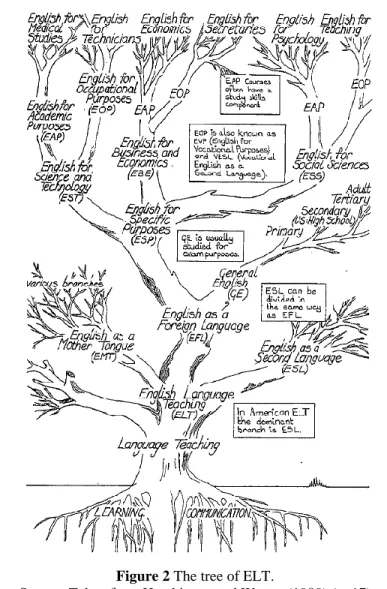
(31) 31 Hutchinson and Waters provided one of the earlier definitions of ESP in their book English for Specific Purposes: A Learning-centred Approach (1989). There they suggested conceiving ESP as "an approach, not a product" (p. 16). At the time, the authors proposed to make a shift from a language-centered ESP, which emphasized register analysis and a skills and strategies approach, towards an ESP focused on students' learning processes. Therefore, they claimed that ESP is "(...) an approach to language teaching in which all decisions as to content and method are based on the learner's reason for learning" (p. 19). Besides this definition, there were three clarifications of what ESP was not (p. 18). As Dudley-Evans and St. Johns (2011) summarizes them: "they [Hutchinson and Waters] mean that ESP does not involve a particular kind of language, teaching material or methodology" (p. 2) Hutchinson and Waters regarded ESP as a subdivision of ELT, as it understood in their "ELT tree illustration" (see Figure 2). The illustration works as an analogy revealing the connections between English Language Teaching (ELT) among the branches. ELT has one subdivision denominated English as a Foreign Language (EFL) which, at the same time, includes several subclasses, ESP is one of them. Beyond any shape that ELT may take, at the roots, Language and Communication are the core of Language Teaching..
(32) 32. Figure 2 The tree of ELT. Source: Taken from Hutchinson and Waters (1989) (p. 17). About such divisions, Barnard and Zemach (2003) suggest that "ESP should not be regarded as a discrete division of ELT, but simply an area (with blurred boundaries) whose courses are usually more focused in their aims and make use of a narrower range of topics." A similar perspective shared by Dudley-Evans and St. Johns (2011) stated that “the use of classification trees creates a number of problems by failing to capture the fluid nature of the various types of ESP teaching and the degree of overlap between ‘common core’ EAP (…) and General English”. Therefore, they suggested “the presentation of the whole of English Language Teaching on a continuum that runs from very clearly definable General English courses through to very specific ESP courses.” (p.8) Figure 3 is the illustration of the continuum proposed..
(33) 33. Figure 3 Continuum of ELT types. Source: Dudley-Evans and St. John (2011, p. 8). Nonetheless, it is important to discern some characteristic particular of this area of ELT. In the book Developments in ESP: A multidisciplinary approach (2011), Dudley-Evans and St. Johns proposed a definition of ESP using absolute and variable characteristics; these are reoccurring features and occasional ones. As for the Absolute characteristics they said: . ESP is designed to meet specific needs of the learner; ESP makes use of the underlying methodology and activities of the disciplines it serves; ESP is centred on the language (grammar, lexis, register), skills, discourse and genres appropriate to these activities. (p. 4). While, for the Variable characteristics: . . ESP may be related to or designed for specific disciplines; ESP may use, in specific teaching situation, a different methodology from that of general English; ESP is likely to be designed for adult learners, either at a tertiary level institution or in a professional work situation. It could, however, be used for learners at secondary school level; ESP is generally designed for intermediate or advanced students. Most ESP courses assume basic knowledge of the language system, but it can be used with beginners. (p. 5). Dudley-Evans and St. Johns differed for Hutchinson and Waters about the concept of methodology in ESP. In fact, their proposal claims that in ESP, the closer to a discipline the classes are, the more the methodology change for a GE course. In their words, ESP.
(34) 34 (...) makes use of a methodology that differs from that uses in General Purpose English teaching. By methodology, here we are referring to the nature of the interaction between the ESP teacher and the learners. In more general ESP classes, the interaction may be similar to that in a General Purpose English class; the more specific the ESP classes, however, the teacher sometimes becomes more like a language consultant enjoying equal status with the learner who have their own expertise in the subject matter (...) (p. 4). In the research paper Key Issues in English for Specific Purposes (ESP) curriculum development, Gatehouse (2001) clarifies that the word "specific" in ESP refers to "the specificity of the purpose or aim of this teaching area, not the special registers or vocabulary entailed (The Meaning of the Word "Special" in ESP, para.3.)"(p. 384). On this, Dudley- Evans and St. John assert that "(...) the specified needs arising from needs analysis relate to activities that students need to carry out (rather than language) (…)" (p. 4) The recent definitions have become more succinct as the time goes by. Barnard and Zemach (2015) believe that ESP is "an umbrella term that refers to the teaching of English to students who are learning the language for a particular work or study-related reason.” (p. 306) For Johns and Price-Machado’s (2008) conceptualization of ESP is "a movement based on the proposition that all language teaching should be tailored to the specific learning and language use needs of identified groups of students –and also sensitive to the sociocultural contexts in which these students will be using English."(p. 43). While, Smoak (2003) in her paper What is English for specific purposes? asserts that "ESP is English instruction based on actual and immediate needs of learners (…) ESP is need-based and task-oriented"(p.27) (as cited in González Ramirez, 2015, p.384). For the purpose of the development of this research project, three conceptualizations will be considered. 1) Dudley-Evans and St. Johns’ idea that ESP is part of a continuum. 2) Johns and Price-Machado’s idea that ESP is a tailored language course sensitive to the context. And 3) Smoak’s belief that ESP is a need-based and task-oriented course too..
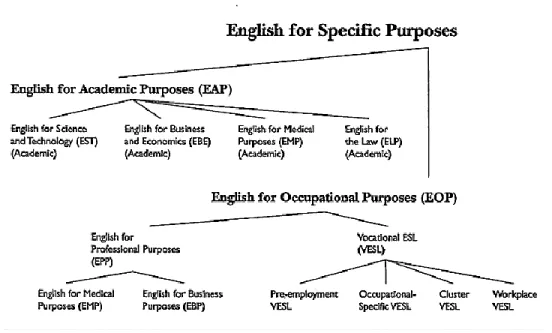
(35) 35 2.2.2 English for Academic Purposes. As the ELT tree shows (Figure 2), ESP branches out towards many disciplines. These branches receive different names according to each academic who defines them. For example, according to Johns and Price-Machado (2001), “the main interests of ESP movement can be categorized in a number of ways” (p.43) therefore, ESP has many categories. So, in their article, they presented the following diagram showing those with the greatest importance at the time. (Figure 4). As it can be observed, EAP and EOP are the two main divisions.. Figure 4 Classification of ESP Categories. Source: Johns and Price-Machado (2001). (p. 44). Instead of categories, Barnard and Zemach (2015) state that ESP has two main areas and proceed to defined them as it follows: . “English for Occupational Purposes (EOP), concerned with enabling a learner to function in English in a particular job or profession.. . English for Academic Purposes (EAP), which provides learners with the appropriate language skills for pursuing a tertiary-level course taught in English, and /or presenting,.
(36) 36 researching, and publishing in academic settings.” (p. 307) It is this area in which this research project will focus on. Dudley-Evans and St. Johns (2011) define English for Academic Purposes as “any English teaching that relates to a study purpose. Students whose first language is not English may need help with both the language of academic disciplines and the specific ‘study skills’ required of them during their academic course” (p. 34). These definitions conceive EAP as setting-bound and that besides the teaching of language skills, there is an awareness of a specific language and study skills. About these two aspects I will refer later. More importantly, Charles (2013) offers a clearer view on the different learners attending an EAP course: (…) Although most often applied to university level contexts and non - native speakers of English (NNSE), the term [EAP] is very broad, covering, for example, both the requirements of native-speaker (NSE) secondary school students who have to read textbooks and write essays, as well as those of academics who need to give conference presentations and write research articles (RA). (p. 137). Based on this portrayal, Charles states that, “English for Academic Purposes (EAP) is concerned with researching and teaching the English needed by those who use the language to perform academic tasks.” This definition adds the word research as another key element of EAP. This author explains that the increase of research publications in English and the job opportunities have encouraged more research entailing a solid growth on this area of language teaching. On this regard, the author elaborates on the three research trends that have influenced the growth of EAP. These are: the uses of corpora, genre analysis and the social context perspective. Moreover, EAP benefits of the trend of merging these approaches to widen its scope. According to the academic environment in which the current study took place, the definition by Dudley-Evans and St. Johns and Charles are going to be the keystone to interpret the context and the results of the needs analysis..
(37) 37 2.2.3 English for General Academic Purposes and English for Specific Academic Purposes. In EAP, there is one more distinction relevant to this research project. That is English for Specific Academic Purposes (ESAP) and English for General Academic Purposes (EGAP). They are not mutually exclusive, on the contrary EGAP and ESAP are like two levels that may overlap depending on the demands of the students and the institutions. Grosso modo, Dudley-Evans, and St. John differentiates them like this: "EGAP refers to the teaching of the skills and language that are common to all disciplines; ESAP refers to the teaching of the features that distinguish one discipline from others." (p. 41) By skills, these authors make reference to study skills (also, study activities) like attending a lecture. To perform that activity, any student will need, at least, a good listening comprehension level and be able of taking notes. An EGAP class works on the development of the language skills frequently required to carry out a determine range of study activities common to any academic environment. While ESAP further develops those skills and language learned by facing students to discipline-related subject tasks. This fundamental transition is what enables students to respond to the requirements of their academic programs. In words of these authors, as in EGAP as in ESAP classes, students are educated to develop language capacities and trained to face frequent academic or (future) professional tasks. (Widowson, (1987); Dudley Evans and St. John (2011). Dudley-Evans and St. John present an interesting idea concerning my present research project: "the common-core EAP work makes more sense and is more relevant if it is supplemented by specific work." (p.42). Such proposal of synergy between the two forms of EAP opposes the perspective of focusing on EGAP in class and letting students learned about.
(38) 38 ESAP through individual tasks. According to them, students will benefit from "a two-pronged attack on their needs and difficulties" (p. 42). (To read more on the challenges of applying ESAP in a EGAP course read Liyanage and John Birch’s (2001) article English for General Academic Purposes: Catering for Discipline Specific Needs) To achieve language class that interconnects with students’ subject tasks, Dudley-Evans and St. John propose three stages. These are in order: (1) Cooperation, (2) Collaboration and, (3) Teamteaching. (p. 42) In brief, the first stage, Cooperation starts with a language teacher that is enthusiastic about students’ discipline. This educator is interested in how to integrate students’ discipline content into the language course. Naturally, this teacher will enter the field of Needs Analysis by learning about Target Situation Analysis and Wants. The second stage, Collaboration, involves two enthusiastic sides: the language teacher and the subject teacher. Outside the classroom, these two educators work together towards the same learning outcome but, their alignment still has some boundaries. (Dudley-Evans and St Johns explains the three types of collaboration, p. 44) Finally, the last stage, Team-teaching describes a session prepared and run by both teachers at the same time. The sessions have two moments: Initially, the language lecturer will focus on teaching language through the understanding of the content while the subject teacher acts as an adviser on the concepts. Later, the roles turn around when the class shifts to learning the subjectspecific content. Although, due to the heterogeneity of the groups, the four levels offered by the Pilot Programs are focused on the development of EGAP, this research has set as objectives to analyze how a synergy of EGAP and ESAP could improve the EAP content for beginners in the Pilot.
(39) 39 Program. By adopting this viewpoint, it is possible to assess how of achieving such interaction of the English course into the Biology program can benefit students’ introduction to Academic English for Biology. 2.2.4 Academic Language. As it can be recalled, one aspect that Dudley-Evans and St. John mentioned is that a EAP course provide help with specific language; this expression could refer to the concept of Academic English. In 1979, Cummins in his seminal paper Cognitive/academic language proficiency, linguistic interdependence, the optimum age question and some other matters coined the terms Basic Interpersonal Communicative Skills (BICS) and Cognitive Academic Language Proficiency (CALP). These terms propose two dimensions of the language proficiency in English Language Learners (ELLs). On the one hand, Basic Interpersonal Communicative Skills refer to the language skills use for interaction in social contexts. Because of the informality and spontaneity of the settings where the interaction occurs, the language is neither very cognitively demanding or specialized. Also, because it is part of student’s everyday interaction, students “usually develop [them] within six months to two years after arrival in the U.S.” (Haynes, 2007). On the other hand, Cognitive Academic Language Proficiency describes a cognitively higher level of language skills needed to participate in formal academic learning. This language is taught in the classroom and “includes listening, speaking, reading, and writing about subject area content material” (Cummins 2003, p.7 as cited by Bowers and Keisler, 2011). Unlike BICS, developing or mastering CALP for Native English Speakers may take around five to seven years and, even a few more years for Non-Native English Speakers who lack strong.
(40) 40 language literacy in their mother tongue (Haynes, 2007). The incidence across languages is explained in Cummins’ theory of a Common Underlying Proficiency (CUP) between two languages. CUP talks about how the academic language proficiency achieved in L1 facilitates the improvement of academic language proficiency in L2. Nowadays, the concept of CALP is associated to Academic English or Academic Language, a more comprehensive term. The characteristics of Academic Language are rooted in the context where it takes place and the style of the interactions expected in it. Consequently, to make sense of the particularities in Academic Language, it is useful to take a look at the elements that compose it. The WIDA consortium 4 conference (2012) (as cited in Gotlieb and Ernst-Slavit, 2014, p. 3) says that: "(...) Academic language operates within a sociocultural context that lends meaning to oral or written communication." Moreover, “(...) academic language learning encompasses the interaction between the student and the learning environment, including the topic or theme of the task or situation, the genre or text type, and the participants’ identities. So, the byproduct of the interaction of all these elements is the definition of Academic language as a register (Gotlieb and Ernst-Slavit, 2014, p.2). In his article Teacher practices and perspectives for developing academic language (2007), Jeff Zwiers highlights the expansion that the conceptualization of Academic Language has come to the point of challenging the "early dichotomous thinking that language is either social or academic. (p. 96) In 2005, Zwiers defined Academic language as "a set of words and phrases" attaining three aims: (1) "to describe content-area knowledge and procedures, (2) to express complex thinking processes and abstract concepts, and (3) to create cohesion and clarity in written and oral discourse." (p. 60). Since these aims are condensed descriptions, I complement them with some points made by other. 4. The WIDA Consortium is a non-profit cooperative group whose purpose is to develop standards and assessments that meet and exceed the goals of No Child Left Behind and promote educational equity for English language learners. WIDA was formerly known as World-Class Instructional Design and Assessment..
(41) 41 authors. 1) to describe content-area knowledge and procedures: Academic language is a register embracing simultaneously general academic words common across all content areas and content-specific words that "pertain to specific subject areas" (like photosynthesis and hypothesize in science (...) (Short, Vogt, and Echavarría, 2011, p.3). The frequency with which some grammar structures and vocabulary appear in Academic Language is the focus of some register analysis studies. Some authors may argue that making visible such frequencies help learners to become familiar with "the specific linguistic features associated with academic disciplines, including discourse features, grammatical constructions, and vocabulary across different language domains or modalities (listening, speaking, reading, writing) and content areas (language arts, mathematics, science, (...)). (Short, Vogt, and Echavarría, 2011, p. 3). Acquiring this knowledge allows students to understand and participate in the academic communication. 2) to express complex thinking processes and abstract concepts: Weideman and Van Dyk (2014) claim that the use of academic language is (…) imbued with cognitive as well as analytical processing.” That is, "require us to do things with language like explain, define, compare, contrast, classify, agree, disagree, illustrate, elaborate, make claims, see implications, infer, exemplify, anticipate, and conclude.” (p. iii) In this sense, Dutro and Moran (2003, as cited in Jeff Zwiers, 2007) say that academic language proficiency is "the ability to interpret and infer meaning from oral and written language, discern precise meaning and information from text, relate ideas and information, recognize the conventions of various genres, and enlist a variety of linguistic strategies on behalf of a wide range of communicative purposes. (p. 95).
(42) 42 3) to create cohesion and clarity in written and oral discourse: As Gottlieb and Ernst-Slavit (2014) explain the fluency in academic language consist in understanding concepts and ideas and to communicate our understanding of them to others. (p.2) All in all, to master academic language is to acquire the ability to understand and use academic discourse to meet the demands of the tertiary education. In this study, academic language will be seen from the perspective of the development of higher cognitive skills that the use of linguistic competence implies.. 2.2.5 Needs Analysis. Many authors suggest that Needs Analysis is a fundamental element in Language Teaching. This is because Needs Analysis is a tool to help language teachers meet students and institutions’ learning goals and adjust their pedagogical practices. To use it, it is important to become familiar with the adaptability of its procedure and the array of research methods and sources available. However, for an overview of its historical evolution, I would suggest reading Hutchinson and Waters (1989) and Dudley-Evans and St. Johns (2011). The concept of Needs To start, let us define the core term on its own: analysis and needs. On the one hand, the Merriam-Webster dictionary defines analysis as “a detailed examination of anything complex in order to understand its nature or to determine its essential features (…)”. On the other hand, a number of classifications are currently available to define needs. Each definition is a by-product of a research approach in Needs Analysis (NA). One of the earlier and most influential definitions are Target and Learning needs by Hutchinson and Waters (1989). Target needs are “what the learner needs to do in the target.
(43) 43 situation” while Learning needs are “what the learner needs to do in order to learn” (p.54 - 55). Both definitions are student-centered but the concept of learning needs reflects on the importance of a metacognitive process. Furthermore, Target needs contains three subcategories. These are: (a) necessities (b) lacks and (c)wants. (a) Necessities are the result of the “demands of the target situation.” This entails “what the learner has to know in order to function effectively” in a specific environment, at a determined moment (p. 55). In words of Nation and Macalister (2010), necessities are "the target tasks" (p. 27) (b) Lacks means the gap between the students' current proficiency in terms of language skills, cultural competence, etc. when compared to the expected proficiency (p. 56). (c) Wants is learners’ perception or awareness of their necessities (p. 56). Represent what they will judge as useful (Nation and Macalister, 2010, p. 29). Their opinion could diverge with other participants or stakeholders -like teachers, course designers, etc.(Hutchinson and Waters, p. 56) Thus, the importance of listening to their expectations. In 2011, Dudley Evans and St. John associate a number of needs classifications showing the similarities and differences among them: • • • • •. Objective and Perceived needs are facts according to outsiders (in this context, fact means "what is known and can be verified") Subjective and Felt needs are opinions from insiders. These opinions correspond to cognitive and affective factors. Product-oriented needs result from the goal or target situation while, Process-oriented needs derived from the learning situation. Lacks derive from the analysis of what learners already know and do not know yet (p. 123). To conclude their revision, these authors show how the classifications fit into four research focus in Needs Analysis..
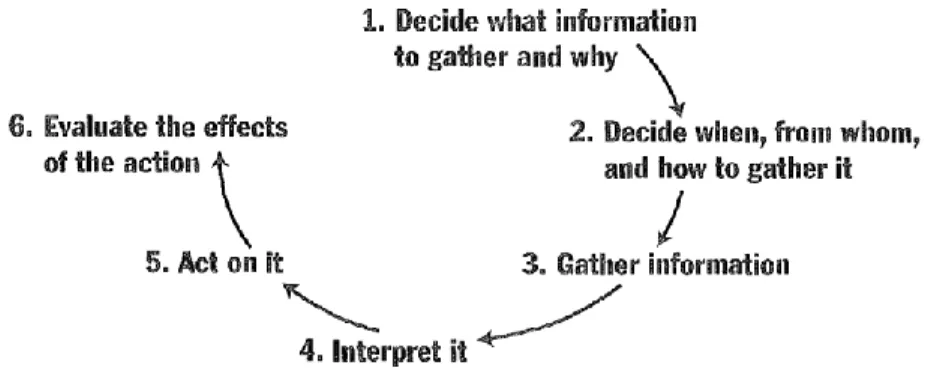
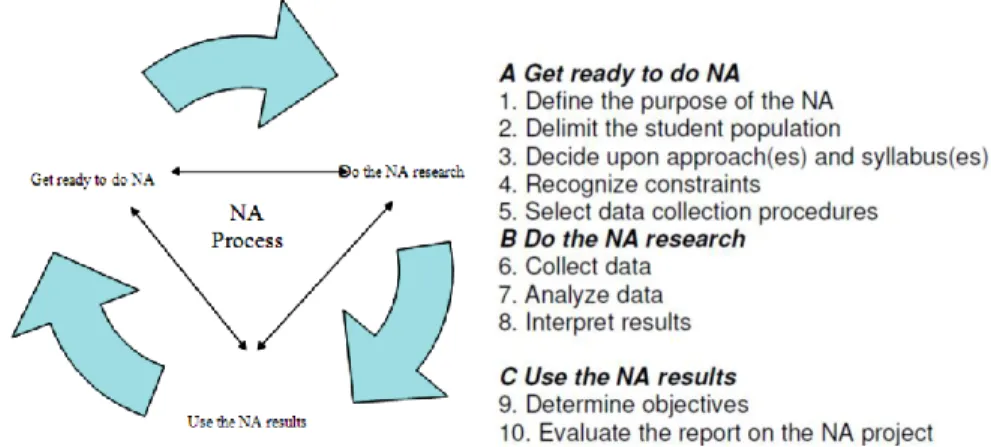
(44) 44 • • • •. Target Situation Analysis (TSA) includes objective, perceived and product-oriented needs; Learning Situation Analysis (LSA) includes subjective, felt and process-oriented needs; Present Situation Analysis (PSA) "estimates strengths and weaknesses in language, skills, learning experiences." Finally, Means Analysis evaluates the environment of the language course. Instead of describing needs, it considers two factors: the classroom culture and, the management infrastructure and culture. (p. 124). One more classification of needs is the dichotomy between immediate needs and delayed needs. Harding (2007) (cited by Özyel et al., 2018, p. 269) proposes several questions to figure out the learning situation before designing a course; one of them is: “(…) Is [the course] meeting immediate needs (learners are working and studying in parallel) or delayed needs (students are pre experienced and will be working on the specialism sometime in the future)?”. The balance between these two types of need is center for the analysis of the results of this needs analysis project. Nonetheless, the eclectic position adopted for the present study will be explained in the methodology chapter (research design and procedure, p. 52). What is Needs Analysis? Overall, Needs Analysis, also known as Needs Assessment (NA), is a process of data collection and analysis; a research tool used in any language program at different stages whose results provide ideas for adjustments. In this sense, the following definitions will expand with various elements and viewpoints this initial conceptualization. Dudley-Evans and St. John provides a precise definition: NA is the “process of establishing the what and the how of a course" (p. 121). In contrast, Graves (2007) elaborates in her conceptualization: NA is “a systematic and ongoing process of gathering information about students' needs and preferences, interpreting the information, and then making course decisions.
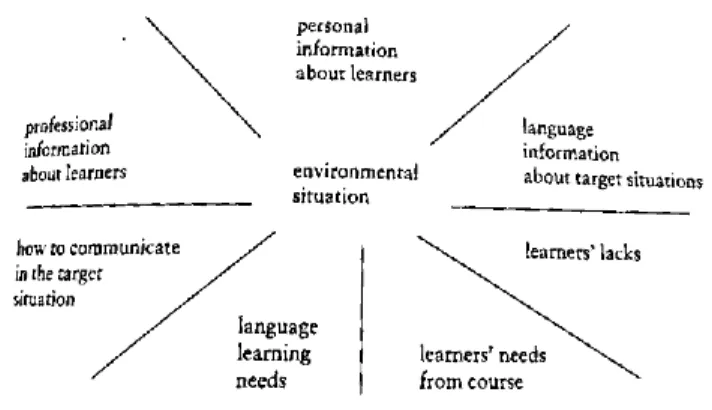
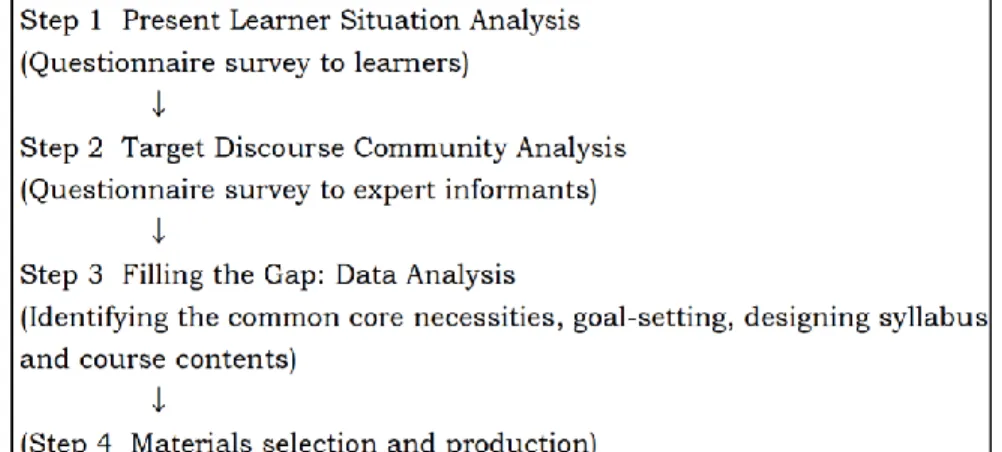
(45) 45 based on the interpretation in order to meet the needs." (p. 98) At a small degree, both definitions coincide in two points: first, they indicate a procedure with several phases; and second, they imply the influence of the results on the content and methodology of a program. Nation and Macalister (2010) highlights that NA is the part of the curriculum design process that "makes sure that the course will contain relevant and useful things to learn.” To figure that information out, they pinpoint that “it is about asking the right questions and finding the answers in the most effective way" (p. 24). On this aspect, Johns and Price Machado say NA is a " practitioners attempt to determine, as closely as possible, what students will need to do ¬and how they will need it– in English language contexts or with English Language literacies". Finally, Graves explains that one of NA purposes is to institute “learning as a dialogue between the teacher and the learners and, among the learners."(p. 98) In other words, a Needs assessment reevaluates the power dynamics between students and teachers. It empowers students to partake in their learning process. She summarizes, "Needs assessment can be as much as about reconciling different views as about finding what the needs are" (p. 100). This study aligns with Graves' perspective. All in all, NA can be: a type of research and/or assessment (Nation and Macalister, 2010); or, an approach to be aware of target and learning needs (Hutchinson and Waters, 1989); or, a systematic collection of data (Brown, 1995 as cited in Saragih, 2014, p. 61); or, an ongoing activity/process (Graves, 2007). But, in any way, it will look for a balance of content and goals that satisfy all the participants of a language learning process. How and when is NA implemented? According to Long (2005), “there is more than one way to conduct an NA, (…) just as there is more than one way to teach a language.” (p. 4) A Needs Analysis is the outcome of a.
Figure


+7

Documento similar