PENINSULA OF SANTA ELENA
STATE UNIVERSITY
FACULTY OF EDUCATION AND LANGUAGES
ENGLISH TEACHING CAREER
“AUGMENTED REALITY TO IMPROVE ENGLISH ORAL
SKILLS TO STUDENTS OF SECOND YEAR BGU AT
COLEGIO MIXTO PARTICULAR “UPSE”, LA LIBERTAD,
PROVINCE OF SANTA ELENA, 2015-2016”
RESEARCH PAPER
As a prerequisite to obtain a:
BACHELOR´S DEGREE IN ENGLISH
AUTHOR: MERCEDES MIREYA GALDEA GONZÁLEZ
ADVISOR: MSC. JORGE CEVALLOS SALAZAR
ii
UNIVERSIDAD ESTATAL PENÍNSULA DE SANTA ELENA
FACULTAD DE CIENCIAS DE LA EDUCACION E IDIOMAS
CARRERA LICENCIATURA EN INGLES.
TEMA
“AUGMENTED REALITY TO IMPROVE ENGLISH ORAL
SKILLS TO STUDENTS OF SECOND YEAR BGU AT
COLEGIO MIXTO PARTICULAR “UPSE”, LA LIBERTAD,
PROVINCE OF SANTA ELENA, 2015-2016”
Trabajo de Titulación para obtener el Grado Académico de
LICENCIADA EN INGLÉS.
AUTOR: MERCEDES MIREYA GALDEA GONZÁLEZ
TUTOR: MSC. JORGE CEVALLOS SALAZAR
iii La Libertad, November 29th 2015
ADVISOR´S
APPROVAL
In my role as Advisor of the research paper under the title “Augmented Reality to improve English Oral skills to students of second year BGU at Colegio Mixto Particular “UPSE”, La Libertad, Province of Santa Elena, 2015-2016” prepared by Mercedes Mireya Galdea González undergraduate student of the English Teaching Career, Faculty of Education and Languages at Península of Santa Elena State University, I declare that after having oriented, studied and reviewed the project, I approve it in its entirety, because it meets the requirements and is sufficient for its submission to the Board of Examiners.
Sincerely
………. MSc. Jorge Cevallos Salazar
iv La Libertad, November 29th 2015
STATEMENT
OF
AUTHORSHIP
I, MERCEDES MIREYA GALDEA GONZÁLEZ with ID number 092726577-7 undergraduate student from the Península of Santa Elena State University, Faculty of Education and Languages, as a prerequisite to obtain a Bachelor´s degree in English, in my role as author of the research paper “AUGMENTED REALITY TO IMPROVE ENGLISH ORAL SKILLS TO STUDENTS OF SECOND YEAR BGU AT COLEGIO MIXTO PARTICULAR “UPSE”, LA LIBERTAD, PROVINCE OF SANTA ELENA, 2015-2016”, certify that this work is of my authorship, except for the quotes and reflections used in this research paper.
_________________________________ Mercedes Mireya Galdea González
v
BOARD
OF
EXAMINERS
________________________________ ______________________________
Dra. Nelly Panchana Rodríguez, MSc.
FACULTY OF EDUCATION DEAN
Lcda. Glenda Pinoargote Parra, M.A. Ed.
ENGLISH TEACHING CAREER DIRECTOR
________________________________ ______________________________ Lcdo. Jorge Cevallos Salazar MSc.
ADVISOR
Lcdo. Kleber Loor Zambrano MSc. SPECIALIST PROFESOR
________________________________ Ab. Joe Espinoza Ayala
vi
DEDICATION
I dedicate this work to my family and a special gratitude to my parents, Ancelmo Galdea and Ana González who were my support during this process.
To my brother, Robert Galdea González, who was my guide for producing this thesis when it seemed difficult to continue, I am grateful for his contribution and assistance giving his time to finish my work.
vii
ACKNOWLEDGMENT
I wish to thank God, who gave me wisdom and strength to follow with my work, to my advisor, who with his knowledge and suggestions guided my research with new ideas and innovation for improving my thesis, to Colegio Mixto Particular “UPSE”, where I learned and grew professionally, to all my professors who taught me to explore and know new aspects about education and for creating new ways in my personal life and my future career.
My thanks and appreciation to the Director of the English Teaching Career MSc. Glenda Pinoargote Parra for her contribution and expertise managing the English Teaching Career. Her dedication is an example of learning and a referent for students, teachers, administrators and authorities.
viii
DECLARATORY
THE CONTENT OF THE FOLLOWING GRADUATION WORK IS MY RESPONSABILITY; THE INTELLECTUAL PROPERTY BELONGS TO PENÍNSULA DE SANTA ELENA STATE UNIVERSITY.
ix
GENERAL
CONTENT
ADVISOR´S APPROVAL ... III STATEMENT OF AUTHORSHIP ... IV BOARD OF EXAMINERS ... V DEDICATION ... VI ACKNOWLEDGMENT ... VII DECLARATORY ... VIII GENERAL CONTENT ... IX PICTURES PAGE ... XIV CHARTS PAGE ... XV GRAPHICS PAGE ... XVII ABSTRACT ... XX
INTRODUCTION ... 1
CHAPTER I ... 4
STATEMENT OF THE PROBLEM ... 4
1.1 TITLE ... 4
1.2 STATEMENT OF THE PROBLEM ... 4
1.2.1. Context ... 4
1.2.2. Critical Analysis ... 6
1.2.3. Formulation of the problem ... 7
1.2.4. Guideline questions ... 7
1.2.5. Delimitation of research object ... 8
1.3. SIGNIFICANCE ... 9
x
1.4.1. General objective ... 9
1.4.2. Specific objectives ... 9
CHAPTER II ... 10
THEORETICAL FRAMEWORK ... 10
2.1. PREVIOUS RESEARCH ... 10
2.1.3. Educational applications of augmented reality ... 12
2.1.4. Uses of augmented reality in different fields ... 12
2.1.5. Augmented reality for teaching english ... 14
2.1.6. Advantages of using of augmented reality in education ... 14
2.5.1. GENERAL HYPOTHESIS ... 21
2.5.2 VARIABLES OF THE STUDY ... 21
CHAPTER III ... 22
METHODOLOGY ... 22
3.1. RESEARCH APPROACH ... 22
3.1.1. Quantitative Method ... 22
3.1.2. Qualitative Method ... 22
3.1.3. Inductive- Deductive Method ... 22
3.1.4. Scientific Method ... 23
3.15.ANALYSIS-SYNTHESIS METHOD ... 23
3.2.1. Field Research ... 23
3.2.2. Bibliographic Research. ... 23
3.2.3. Correlational Research... 24
3.2.4. Applied Research ... 24
3.3. POPULATION AND SAMPLE ... 24
3.3.1. Population ... 24
3.3.2. Sample ... 24
xi 3.5. TECHNIQUES AND INSTRUMENTS FOR DATA COLLECTION 27
3.5.1. Survey ... 27
3.5.2 Interview ... 27
3.6. INSTRUMENTS ... 27
3.6.1. Camera ... 27
3.7. DATA COLLECTION PLAN ... 28
3.8. DATA PROCESSING PLAN ... 29
3.9. ANALYSIS AND INTERPRETATION OF RESULTS ... 30
3.9.1. Survey Directed To English Teachers ... 30
3.9.2. Survey Directed To Students... 40
3.10 CONCLUSIONS AND RECOMMENDATIONS ... 50
3.10.1 Conclusions ... 50
3.10.2 Recommendations ... 50
3.11 ANALYSIS AND INTERPRETATION OF RESULTS ... 52
3.11.1 Interview Directed to the Principal ... 52
3.11.2 Interview Directed to English Teacher From Colegio Mixto Particular “Upse” ... 53
3.11.3 Interview Directed to Specialists ... 54
CHAPTER IV ... 56
PROPOSAL ... 56
4.1. INFORMATIVE DATA ... 56
4.1.1. Title Of Proposal ... 56
4.1.2. Institution ... 56
4.1.3. Beneficiaries ... 56
4.1.4. Location ... 56
4.1.5. Period of Research ... 56
xii
4.2. BACKGROUND OF THE PROPOSAL ... 57
4.4. OBJECTIVES ... 58
4.4.1. General Objective... 58
4.4.2. Specific Objectives ... 58
4.5. DESIGN AND DEVELOPMENT OF THE PROPOSAL ... 59
4.6. DIGITAL TOOL “ZOOBURST” ... 59
4.7. BLOOM´S TAXONOMY ... 66
Activity 1: Regular and Irregular Verbs ... 71
Activity 2: Simple Present ... 74
Activity 3: Simple Present – Adverbs Of Frequency ... 76
Activity 4: Regular/Irregular Verbs ... 78
Activity 5: Simple Past ... 80
Activity 6: Vocabulary ... 82
Activity 7: Like and Dislike Movies ... 84
Activity 8: Words Bank: Movies ... 86
Activity 9: Adjectives ... 88
4.7.1 RUBRIC TO ASSESS ORAL SKILLS IN THE DIAGNOSTIC TEST AND AFTER THE PROPOSAL ... 90
4.8. DIAGNOSTIC TEST ... 91
4.9 TEST USING “ZOOBURST” DIGITAL TOOL ... 94
4.10. CONCLUSIONS AND RECOMMENDATIONS ... 98
4.10.1 Conclusions ... 98
4.19.2 Recommendations ... 98
CHAPTER V ... 99
xiii
5.1 RESOURCES ... 99
5.1.1 Institutional ... 99
5.1.2 Humans ... 99
5.1.3 Materials ... 99
5.1.4 Finantial (Budget) ... 100
xiv PICTURES PAGE
PICTURE1INTERVIEWTOTHEPRINCIPAL ... 109
PICTURE2TEACHERSDOINGASURVEY ... 109
PICTURE3STUDENTSDOINGASURVEY ... 110
PICTURE4INTERVIEWDIRECTEDTOSPECIALIST... 110
PICTURE5INTERVIEWDIRECTEDTOSPECIALISTATUNIVERSITY .. 111
PICTURE6INTERVIEWTOTHEENGLISHTEACHER ... 111
PICTURE7SOCIALIZATIONDIGITALTOOL“ZOOBURST” ... 112
xv CHARTS PAGE
CHART 1: POPULATION OF COLEGIO MIXTO PARTICULAR “UPSE” .... 24
CHART 2: INDEPENDENT VARIABLE ... 25
CHART 3: DEPENDENT VARIABLE ... 26
CHART 4: DATA COLLECTION PLAN ... 28
CHART 5: DATA PROCESSING PLAN ... 29
CHART 6: AUGMENTED REALITY IN ENGLISH EDUCATION ... 30
CHART 7: AUGMENTED REALITY IN THE DEVELOP ORAL SKILLS ... 31
CHART 8: THE USE OF TECHNOLOGY IN CLASSROOM ... 32
CHART 9: TECHNOLOGICAL GAMES TO MOTIVATE STUDENTS ... 33
CHART 10: AUGMENTED REALITY ENGLISH LEARNING ... 34
CHART 11: THE IMPORTANCE OF ORAL FLUENCY ... 35
CHART 12: DIGITAL TOOLS IN THE FIELD ENGLISH EDUCATION ... 36
CHART 13: DIGITAL TOOL TO INCREASE THE ORAL SKILLS ... 37
CHART 14: NEW PROPOSAL FOR TEACHING ENGLISH ... 38
CHART 15: INTENSIFYING THE ATTENTION OF STUDENTS ... 39
CHART 16: AUGMENTED REALITY IN ENGLISH EDUCATION ... 40
CHART 17: THE IMPROVEMENT THE ORAL SKILLS ... 41
CHART 18: THE USE OF TECHNOLOGY INTO THE CLASSROOM ... 42
CHART 19: ACTIVITIES AND GAMES ESTIMULATE ENGLISH ... 43
CHART 20: FEEDBACK WITH AUGMENTED REALITY ... 44
CHART 21: THE IMPORTANCE OF ORAL SKILLS ... 45
CHART 22: DIGITAL TOOLS INCREASE VERBAL FLUENCY ... 46
CHART 23: ADEQUATE ACTIVITIES TO DEVELOP ORAL SKILLS ... 47
CHART 24: INNOVATIVE TECHNOLOGY TO IMPROVE ORAL SKILLS . 48 CHART 25: THE USE POSITIVE OF AUGMENTED REALITY ... 49
CHART 26: DIGITAL LEARNING MATRIX ... 67
CHART 27: RUBRIC TO ASSESS ORAL SKILLS ... 90
xvi
CHART 29: TEST RESULTS AFTER USING ZOOBURST ... 95
CHART 30: DIAGNOSTIC TEST AND FINAL TEST WITH “ZOOBURST” . 96 CHART 31: RESULTS BEFORE AND AFTER THE PROPOSAL ... 97
CHART 32: EQUIPMENT ... 100
CHART 33: FINANCES ... 100
CHART 34: MATERIALS ... 100
CHART 35: BUDGET ... 100
xvii GRAPHICS PAGE
GRAPHIC 1: AUGMENTED REALITY IN ENGLISH EDUCATION ... 30
GRAPHIC 2: AUGMENTED REALITY IN THE DEVELOP ORAL SKILLS . 31 GRAPHIC 3: THE USE OF TECHNOLOGY IN CLASSROOM ... 32
GRAPHIC 4: TECHNOLOGICAL GAMES TO MOTIVATE STUDENTS ... 33
GRAPHIC 5: AUGMENTED REALITY IN ENGLISH LEARNING ... 34
GRAPHIC 6: THE IMPORTANCE OF ORAL FLUENCY ... 35
GRAPHIC 7: DIGITAL TOOLS IN THE FIELD ENGLISH EDUCATION ... 36
GRAPHIC 8: DIGITAL TOOL TO INCREASE THE ORAL SKILLS ... 37
GRAPHIC 9: TEACHING ENGLISH WITH AUGMENTED REALITY ... 38
GRAPHIC 10: INTENSIFYING THE ATTENTION OF STUDENTS ... 39
GRAPHIC 11: AUGMENTED REALITY IN ENGLISH EDUCATION ... 40
GRAPHIC 12: THE IMPROVEMENT THE ORAL SKILLS ... 41
GRAPHIC 13: THE USE OF TECHNOLOGY INTO THE CLASSROOM ... 42
GRAPHIC 14: ACTIVITIES AND GAMES TO ESTIMULATE ENGLISH ... 43
GRAPHIC 15: FEEDBACK WITH AUGMENTED REALITY ... 44
GRAPHIC 16: THE IMPORTANCE OF ORAL SKILLS ... 45
GRAPHIC 17: DIGITAL TOOLS INCREASE VERBAL FLUENCY ... 46
GRAPHIC 18: ADEQUATE ACTIVITIES TO DEVELOP ORAL SKILLS ... 47
GRAPHIC 19: INNOVATIVE TECHNOLOGY TO ORAL SKILLS ... 48
GRAPHIC 20: THE USE POSITIVE OF AUGMENTED REALITY ... 49
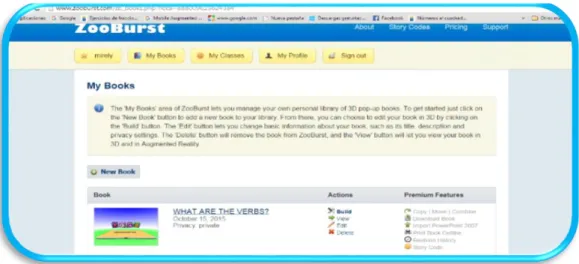
GRAPHIC21:MAINPAGE ... 59
GRAPHIC 22:ACCESSINGTO“ZOOBURST”DIGITALTOOL ... 60
GRAPHIC23:CREATINGANACCOUNTINZOOBURST ... 60
GRAPHIC24:CREATINGACTIVITIESINZOOBURST... 61
GRAPHIC25 :CREATINGANEWBOOK ... 61
GRAPHIC26:WORKINGWITHZOOBURST ... 62
GRAPHIC27:ACCESSINGTOMANUAL(ZBCODE) ... 62
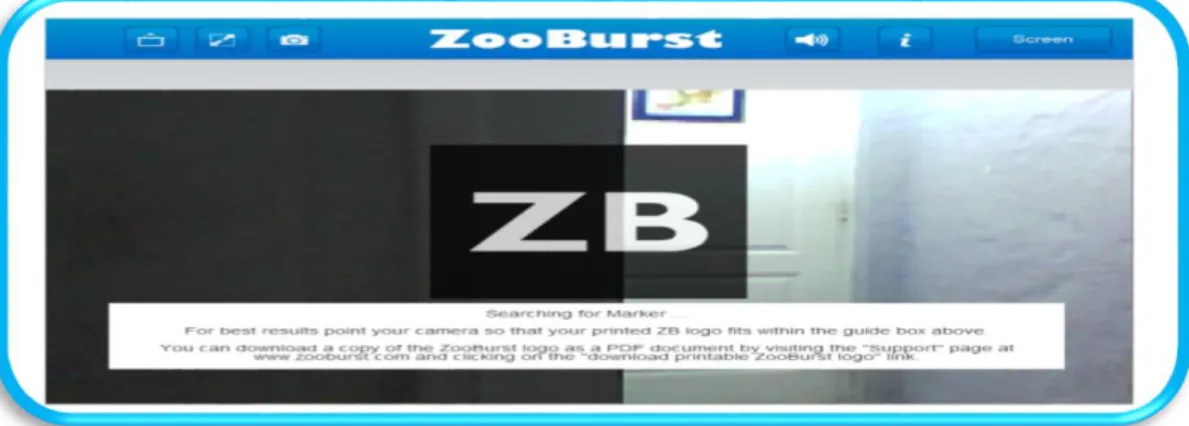
GRAPHIC28:ZBCODE ... 63
xviii
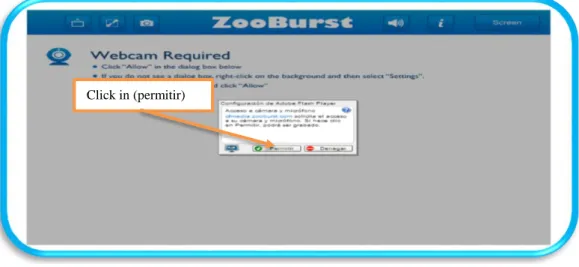
GRAPHIC30:ACTIVATIONWEBCAMONTHECOMPUTER ... 64
GRAPHIC31: WORKINGWITHAUGMENTEDREALITYBOOK ... 64
GRAPHIC32:INTERACTINGTHROUGHSIMPLEGESTURES ... 65
GRAPHIC33:BLOOM´STAXONOMY ... 66
GRAPHIC34:ORALSKILLSACTIVITIESIN3DBOOK ... 70
GRAPHIC35:REGULARANDIRREGULARVERBS ... 71
GRAPHIC36:STUDENTSGUESSUNSCRAMBLEVERB ... 72
GRAPHIC37:TEACHERMODELINGTHEACTIVITY ... 72
GRAPHIC38:STUDENTSUSEIMAGESIN3DBOOK ... 73
GRAPHIC39:ASSESSMENTWITHDIGITALTOOLZOOBURST ... 73
GRAPHIC40:SIMPLEPRESENT ... 74
GRAPHIC41:TEACHERASKSQUESTIONSFORSTUDENTS ... 75
GRAPHIC 42:ASSESSMENTWITHZOOBURST ... 75
GRAPHIC43:ADVERBSOFFREQUENCY ... 76
GRAPHIC44:DESCRIBINGACTIVITIES ... 77
GRAPHIC45:ASSESSMENT ... 77
GRAPHIC46:REGULAR/IRREGULARVERBS ... 78
GRAPHIC47:CHANGINGVERBSINPAST ... 79
GRAPHIC48:TELLINGPASTEXPERIENCE ... 79
GRAPHIC49:SIMPLEPAST ... 80
GRAPHIC50:COMPLETINGTHESTORY ... 81
GRAPHIC51:TELLINGLASTVACATION ... 81
GRAPHIC52:VOCABULARY ... 82
GRAPHIC53:DESCRIBINGHOWPEOPLEFELT ... 83
GRAPHIC54:TEACHERMEASURESVERBALFLUENCY ... 83
GRAPHIC55:LIKEANDDISLIKEMOVIES ... 84
GRAPHIC56:TALKINGABOUTLIKESANDDISLIKES ... 85
GRAPHIC57:TALKINGABOUTFAMOUSMOVIES... 85
GRAPHIC58:WORDSBANK:MOVIES ... 86
GRAPHIC59:DESCRIBINGMOVIES ... 87
xix
GRAPHIC61:ADJECTIVES ... 88
GRAPHIC62:PASTEXPERIENCESUSINGADJECTIVES ... 89
GRAPHIC63:TEACHERASSESINGVERBALFLUENCY ... 89
GRAPHIC64:TEACHERMEASURESLEVELUSINGARUBRIC ... 94
GRAPHIC65:STUDENTSMAKESENTENCESORALLY ... 94
xx
PENINSULA OF SANTA ELENA
STATE UNIVERSITY
FACULTY OF EDUCATION AND LANGUAGES
ENGLISH TEACHING CAREER
“AUGMENTED REALITY TO IMPROVE ENGLISH ORAL SKILLS TO STUDENTS OF SECOND YEAR BGU AT COLEGIO MIXTO PARTICULAR “UPSE”, LA LIBERTAD, PROVINCE OF SANTA ELENA, 2015-2016”.
Author: Mercedes Mireya Galdea González Advisor: Msc. Jorge Cevallos Salazar ABSTRACT
The base of this research is focused in the use of technology for improving English skills. The oral skill is considered one of the most important English skill to develop, for its interactive process of constructing meaning that involves producing, receiving, and processing information, it should be developed with the purpose of understanding and producing messages in another language. Nowadays, the development of English skills demand to use new strategies to teach. One of this, is using Information and Communications Technology (ICT) into the classroom. The use of an educational tool is a good option and a strategy for using technology and work in class. The idea of this research is to innovate the technology learning process with one of the English skill, creating motivating activities and using innovative technology as Augmented Reality with the digital tool ZooBurst. This research is focused on the importance of impoving Oral skills and the use of the digital tool “Zooburst the teacher will find new forms to teach using technology in the classroom. This research will try to optimize teaching strategies in oral skills and the development of activities to generate the practice of oral skills using the digital tool “ZooBurst”in students of second year BGU at Colegio Mixto Particular “UPSE”.
1
INTRODUCTION
Considering the point of view of researchers, technology has dominated society in the educational field, environment, health, culture etc. It has become a dynamic tool because of its innovative applications and social media that allow to connect worldwide. The use of technology especially in education is an essential part during the learning process getting positives results in which it enriches teaching learning into the classroom. In addition, technology has been incorporated in education specifically to personalize the learning and construct new changes. The purpose for experts in education is to follow modern strategies and methodologies including technologies.
The use of innovative technology in English language has played an important role because English teacher update their form to teach using technology. Teacher considers that develop English skills is necessary, it is a continuous training but it also requires the use of good strategies and technology resources. Teacher states all English skills are important but the most difficult one is the oral skill due to its complexity.
Therefore, this research is focused the importance of improving oral skills in students of second year BGU at Colegio Mixto Particular “UPSE” because students have a low level in oral skills and the practice of this skill has not been developed satisfactory.
2 of this digital tool for improving oral skills is “ZooBurst” that allows to work with books in 3D and create activities generating new opportunities to learn in a dynamic form.
This research paper is organized by chapters and each one covers different aspects of this work.
Chapter One describes the statement of the problem, contextualization, critical analysis, formulation of the problem, guideline questions, limitation, research project, significance and objectives of the research (general and specifics). In this chapter a description and definition of augmented reality is presented, it is described as a real-time direct or indirect view of a physical real-world environment that has been augmented by adding virtual computer-generated information to it.
Chapter two is about literature review, it contains previous researches, philosophical basis, fundamental categories, legal basis, hypothesis and variables of the study, followed by relevant information about how augmented reality is used in different fields and how it can help in the improvement of oral skill and contribute with previous information to rich the goal of this research.
Chapter three is based on the methodology, in it you will find the research approach, level or type of the research, population and sample, techniques and instruments, analysis and interpretation of the results and finally conclusions and recommendations. In this chapter the use of multiple methods were presented as survey, interview, and observation to validity the phenomenon of study.
3 create activities in 3D pop-up books in which stories can come to life enriching the practice of oral skills.
4
CHAPTER
I
STATEMENT
OF
THE
PROBLEM
1.1TITLE
“AUGMENTED REALITY TO IMPROVE ENGLISH ORAL SKILLS TO STUDENTS OF SECOND YEAR BGU AT COLEGIO MIXTO PARTICULAR “UPSE”, LA LIBERTAD, PROVINCE OF SANTA ELENA, 2015-2016”
1.2STATEMENTOFTHEPROBLEM 1.2.1. Context
In recent years, English has become the most popular language in the world. It is considered an international and a second language that allows to communicate with another person. English language teaching has focused in the instruction for people who have basic knowledge of English and instruction for the ones who do not. For this reason, English is seen as universal language for business, international communication, entertainment, tourism, trade, technology, and education.
5 Education to include English language learning in public and private high schools. In Ecuador, teaching English Language has become a fundamental part of the curriculum system in some high schools, Ecuadorian teacher have integrated English for developing the four English skills, creating interactive activities and applying effective strategies to make student acquires the languages.
In the Province of Santa Elena the demand to learn English has played an important role for new changes in education. Secondary schools have provided particular attention in teaching English, secondary schools have implemented strategies to teach English because student needs to be competitive.
At Colegio Mixto Particular “UPSE” English has been included as an important subject in secondary classes. Teacher at Colegio Mixto Particular “UPSE” have promoted English and its skills as something but despite teacher has applied strategies student has a low level due to student has a very basic repertoire of words point out them in a scale of level A1, especially in oral skills.
This research paper is focused the low level of oral skills in students of second year BGU at Colegio Mixto Particular “UPSE”. Student has difficulties to speak English, they have difficulties to express ideas, have small conversation, they translate to respond, and do not feel confidence to speak. These factors are the most common problems that affect the development of their oral skills.
6 digital storytelling tool that has books in 3D with enriching stories that can be seen in real life for its capacity to generate Augmented Reality in books.
“ZooBurst” will be used and adapted to create oral skills activities to improve English Oral Skills to Students of Second Year BGU at Colegio Mixto Particular “UPSE”, La Libertad, Province of Santa Elena, 2015-2016”.
1.2.2. Critical Analysis
Oral skills have become one of the most significant skills to develop communication when learning a foreign language. In some cases for high schools student it is a problem, because teacher does not apply the best methods to improve oral skills. The development of oral skills is based in responding short answers, fill questionnaires in a book without a regular monitoring of teachers. Other aspects that affect oral skills are translation, a little interaction with student and focusing only on grammar structure (Davies, 2007).
There are multiple problems that will affect in the future the development of oral skills causing instability in learner when learner needs to speak. Furthermore, learners will make mistakes such as disconnect sentences, pronounce separate words, sentences without transmiting a message involving student in poor meaning production of speaking. The low level in learner can create anxiety with feelings of frustration and rejection making learner have a low level.
7 1.2.3. Formulation of the problem
How will Augmented Reality improve English Oral Skills to students of second year BGU at Colegio Mixto Particular“UPSE”, La Libertad, Province of Santa Elena, 2015-2016?
1.2.4. Guideline questions
What is Augmented Reality?
What are oral skills?
Why is essential to improve oral skills to students of second year BGU at Colegio Mixto Particular “UPSE”?
What is Zooburst?
Advantages of Augmented Reality in education.
Techniques of Augmented Reality to improve speaking skills.
Strategies of Oral Skills.
Activities using Zooburst.
What are the positive effects of the use Augmented Reality?
8 1.2.5. Delimitation of research object
● FIELD: Education.
● AREA: English.
ASPECT: Augmented Reality to improve English oral skills.
● TITLE: “AUGMENTED REALITY TO IMPROVE ENGLISH ORAL SKILLS TO STUDENTS OF SECOND YEAR BGU AT COLEGIO MIXTO PARTICULAR “UPSE”, LA LIBERTAD, PROVINCE OF SANTA ELENA, 2015-2016”.
● PROBLEM: Low level A1 oral skills in students of second year BGU.
● TIME LIMITATION: Academic year 2015-2016.
POPULATION LIMITATION: Students of second year BGU at Colegio Mixto Particular “UPSE”.
● SPACE LIMITATION: Colegio Mixto Particular “UPSE”, La Libertad.
9 1.3.SIGNIFICANCE
This research paper has the purpose to apply approaches and resources that will bring positives outcomes in the improving of oral skills. It is necessary teacher pays especial attention when teaching oral abilities to student and make it a dynamic process. Therefore, it is necessary to use the digital tool “ZooBurst” to improve oral skills to students of second year BGU at Colegio Mixto Particular “UPSE”. This tool will allow to interact with oral skills activities created by the author of this research paper. With the use of this tool student will feel more interested to practice “ZooBurst has 3D books that will generate new experience in student, it will also active participation in class and student will be motivated to speak because it will have pictures and flash cards that will allow student to answer questions, complete stories stimulating their imagination, and make student want to speak.
1.4. OBJECTIVES OF THE RESEARCH
1.4.1. General objective
To analyze the adoption of digital alternative base on Augmented Reality technology to improve oral skills to Students of Second Year BGU at Colegio Mixto Particular “UPSE”, La Libertad, Province of Santa Elena, 2015-2016.
1.4.2. Specific objectives
To diagnose the oral skills level of students.
To determine how augmented reality can improve oral skills.
10
CHAPTER II
THEORETICAL FRAMEWORK
2.1. PREVIOUS RESEARCH
This work is about augmented reality to improve English oral skills to students of second year BGU at Colegio Mixto Particular “UPSE”. Before structuring the theoretical Framework, it is important to understand its definition in order to comprehend this research paper. The following paragraphs give important definitions from several authors. The conceptual framework is described as an abstract of a written document, which “gives details, explaining the most important aspects to be investigated they can be: causes-effects, theories, or variables that affect the issue of study” (Yosef, 2015)
Moreover the theoretical framework is a structure that identifies and describes the major elements, variables, constructs that organize a problem. It is used to hypothesize, understand, and give meaning to the relationships among the elements that influence, affect, or predict the events and outcomes of the work. This research paper will start stating the definitions and concepts related to the variables which are: augmented reality (independent variable) and English oral skills (dependet variable).
The acquisition of oral abilities is considered the most difficult when learners are not native English speakers.
11 alternatives to communicate ; use dialogue to verbalize ideas developing talk and fluency”.
To have interactive communication with another person, the speaker requires some techniques such as free discussion, role plays and simulations, therefore learner can maintain easy dialogues.
(Harmer, 1991) in his book “The Practice of English Language Teaching” states that student react to something that is said, another student joins in and soon the whole class is bubling with life. Such discussions are the most successful. Discussions provide opportunities to develop speaking, learner can exchange opinions and experiences, sustain conversation and generate answers and comments. Others techniques are focused in building particular learning settings, these are role play and simulations. Role play and simulation are forms of experimental learning (Russell, 2015). In role play learners assume varieties of roles experimenting their knowledge in diverse situations creating enjoyable and successful learning. Simulation does not only active participation in class, learner becomes imaginative and critical giving sense to the conversation. It is supported by the author (Chirandon, 2010), who says, “A number of effective teaching techniques are used to stimulate beginners´interest. Using role play in classroom is one of the recommended techniques”. Learner needs to be encouraged and motivated to talk linking interactive techniques that provide effective manage of speech.The other variable of the study in this research paper is Augmented Reality. Before to explain the meaning by the author Johnson, the following paragraphs show the origin and use of Augmented Reality.
2.1.2. Brief background about augmented reality
12 in where users can interact with virtual objects. In 2009, print media integrated augmented reality esquire where readers can scan magazines, book covers, etc and convert them in real live objects. Later Augmented Reality applications appeared with function in computers and mobiles devices.
2.1.3. Educational applications of augmented reality
2.1.3.1. Aurasma: It is an augmented reality appication that allows to create auras, these are augmented reality actions images, videos, 3D animations or games that appear when pointing the mobile device at a real world image or object. Each aura is created by tying together two different pieces of information: the trigger image or object which should cause the aura to appear, for example a poster on a wall, and the overlay that is inserted into the world when viewing the aura, for example a video or animation.
2.1.3.2. Layar: It can scan materials such as books, magazines, pictures, drawings, etc showing them in real time with videos on paper.
2.1.3.3. Google sky map: It is an augmented reality app used for teaching astronomy, it recognizes stars and constellations manipulating a camera on a smartphone.
2.1.3.4. Fetch lunch rush:It is used to teach mathematics with real world settings for solving math problems.
2.1.3.5. Zooburst:Helps learners becoming part of a storytelling.
2.1.4. Uses of augmented reality in different fields
13 paragraphs demonstrate how Augmented Reality is immersed in different fields (Shumaker, 2015) .
2.1.4.1. Medical
The necessity to have medical data of patients that was difficult to visualize within the physical body it generated the use of augmented reality. Another applications were directed to ultrasound imaging allowing pregnant woman to look at the fetus and surgical system directed by hand movements and assisted by augmented reality.
2.1.4.2. Military
It was used by military to show battlefield in real world using augmented reality technique using visualization of an animated field and a helicopter night vision system, it was created to develop pilots´ability in dangerous conditions of navigation.
2.1.4.3. Entertainment and games
Games and entertainment have been chosen in order to create augmented reality games for example: annotating racing cars, snooker balls trajectories and Fox-Trax system used to see hockey puck moving across the ice. Augmented Reality has also been used in publicity to illustrate virtual products.
2.1.4.4. Education
14 can study the anatomy of the body, look at organs and atmosphere in 3D, astronomy; learner can appreciate sun and earth structures in 3D, English learner can improve their skills in writing, speaking, reading and listening with the practice of vocabulary, grammar structure and conversation, etc.
2.1.5. Augmented reality for teaching english
English is considered by teacher and student as one the most difficult language to learn for its background, knowledge, and culture. Learner is not interested in acquiring a new language and it can be disadvantage, but it is essential to learn English because it is called the universal language of communication. For this reason, schools and high schools has implemented technology linking new applications as Augmented Reality for the learning process of the English language.
Teachers use Augmented Reality in English classes for motivating and helping learners to learn English. Teacher has adopted the use of augmented reality games considering the best options for learners to interact in different ways (Zaphiris, 2015).
To conclude learner did not only learn to use a technological tool, learner was motivated to experiment exercises with Augmented Reality for learning a new language.
2.1.6. Advantages of using of augmented reality in education
2.1.6.1 Advantages
Augmented Reality has numerous advantages in teaching and learning.
15
Augmented Reality helps learner to practice topics which learner can´t experience in the real live.
Augmented Reality improves teamwork in student.
It promotes a real learning setting that can be adapted to different learning styles.
Augmented Reality can relate critical and logical thinking incorporating several learning methods, making learning effective. Teaching methods changed because learners can “appreciate” and “listen” the virtual information overlaid in the real world with the advantage of repeating a particular part of the augmentation allowing to have more practice.
The importance to update the English learning with the use of innovate technology has generated the use of Augmented Reality in English classes. “Augmented Reality provides emotive contextual, that allows to adquire learning experiences for its innovative capacity to connect objects and information moving in the real world” (Johnson, 2010). One of this innovative augmented reality to acquire English learning and improve oral skills is digital tool “ZooBurst” which teacher can work with 3D books that can be used with different skills.
16 2.2. PHILOSOPHICAL BASIS
Some authors express their critical thinking about language and the use of technology in the education.
(Patil, 2013) asserted that building up self-ssurance reduces anxiety of making mistakes considered as a precedence that educators should take into consideration, learner can have positive attitude using the English language. Self-confidence and proficiency in speaking could be acquired from the conception of a new syllabus design, interactive process of teaching, and using appropriate resources and practical tasks.
Teachers know that the practice of oral skills is a basic requirement for learning considering as one of the main goals in the field of language learning. Teacher should consider an important challenge in new roles in the use of new materials and activities applying innovations in teaching practices, in this way student can feel confidence in the improvement of their oral skills.
(Stephen, 2008) whose article “The future of online learning: Ten years on” shares his continuing vision of self-directing and self-motivated learner and education as an act of liberty, possible only because collaborative technologies now allow fully participatory worldwide learning communities.
The use of technology in education has generated changes in traditional classrooms, teachers can build new learning with participant, it implies present the material oline creating cooperative work and social interaction.
2.2.1. SOCIOLOGICAL BASIS
17 interaction and socialization within the school and community gains prominence in education sociology (Bhattacharya, 2006).
Curriculum innovation and curriculum reform endeavour to enhance the quality of learning and the implementation of technology education is not an exception to these challenges. For this reason, it is necessary to adapt and learn educational system and technological innovations in the way they work. Education is of vital importance in the knowledge society, as a source of basic skills, as a foundation for development of new knowledge and innovation.
The importance of the development of oral skills is enormous for the learner in education and society. Technology education is emerging as an essential part of the general education of all student, at the development of problem solving and critical thinking skills. Those skills and abilities are recognised as essential in today´s workforce and society.
In conclution, digital technologies are increasingly becoming embedded in societies and being used for a wide range of purposes in educational settings.
2.3. FUNDAMENTAL CATEGORIES
2.3.1. Oral Skills
Oral is an interactive skill, speaker produces and receive information it does not only require to produce the language, but it also is important to comprehend when, where, why and in what ways to produce the language.
2.3.2. Augmented reality
18 2.3.3. ZooBurst
ZooBurst is a digital storytelling tool that has 3D pop-up books producing world in which stories can be seen in real life. Zooburst is used by teacher, student and the educational community for its interactive resources that promote motivation in learners.
2.3.4. Strategic teaching
It is a way of making decisions about a course, an individual class, or even an entire curriculum, beginning with an analysis of key variables in the teaching situation.
2.3.5. Free discussion
Discussion is the process to give ideas about situations or events with the purpose to find solutions and integrate cooperative learning in a classroom.
2.3.6. Role plays
Role plays use interactive activities that allow learner to simulate real situations in which learner proposes the language they want to use.
2.3.7. Simulations
Simulations are activities in which speaker pretends to perform real life situations doing leaning entertaining and successful.
2.3.8. Improve
Act of increasing or making better in relation of quality, value or practicality. This word can be also applied to person becoming better in the performance or development of his/her skills.
2.3.9. Fluency
19 2.3.10. Web 2.0
Web 2.0 include web sites that are used for person to share information it is an interactive and collaborative tool.
2.3.11. English
English is a West Germanic language that was first spoken in early medieval England and now is a global lingua franca.
2.3.12. Skills
Proficiency, facility, or dexterity that is acquired or develop through training or experiences. An art, trade, or ability.
2.4. LEGAL BASIS
This work is based in:
The Constitution of the Republic of Ecuador Chapter One
Good living rights Education
Art. 26.- This article refers to the right of people to receive educational instruction. The government has the responsibility to provide education of quality without distinction of people.
20 Ecuadorian Constitution.
Seveth Code (Good Living)
Art. 343.- The main objective of this article is to develop individual and collective skills in all learners. These abilities are developed through a well-qualified teaching process. This article focuses also in learners to work openly, active, effective to be competent. Futhermore, it integrates all cultural groups promoting an intercultural education.
Organic Law of Education Intercultural
Art. 347. Responsibility of the State:
Section 8.- This article integrates information and communication technology (ICTs) in the learning process and support the teaching process with practical and social activities. This research project will attempt to integrate technology and English learning by combining both variables which are augmented reality and oral skills in order to promote practical and social activities.
Chapter One the Right to Education
Art. 6.- This article ensures digital literacy and the use of information technology and communication in the educational process.
Adolescents and Children Code
21 2.5. HYPOTHESIS
2.5.1. General hypothesis
The application of Augmented Reality will improve English Oral Skills to students of second year BGU at Colegio Mixto Particular “UPSE”, La Libertad, Province of Santa Elena, 2015-2016.
2.5.2 Variables of the study
2.5.2.1 Independent Variable Augmented Reality
22
CHAPTER
III
METHODOLOGY
3.1.RESEARCHAPPROACH
Considering previous studies, oral skills is considered difficult, it implicates difficulties as fluency, interaction problems with communication. The purpose of the current research is to consider learners´ attitudes to the level of difficulty applying innovative methods. Some studies used various methods and techniques. Qualitative and quantitative data to collect and analyze data, applied methodologies are focused to provide diagnostic to demonstrate deficiencies in oral skills. Based on the problem the researcher decided to use different methods. They are:
3.1.1. Quantitative method
This method collects data, it measured variables, verified and generated new hypotheses based on the results of collected data. Example: statistics from the surveys at Colegio Mixto Particular “UPSE”.
3.1.2. Qualitative method
This method analyzed and interpreted data by observing what person does and says. Example: Observations to teachers and student at Colegio Mixto Particular “UPSE”.
3.1.3. Inductive- deductive method
23 Unlike the inductive method the researcher began by investigating and gathering the data from different sources and by using numerous sources of evidence: interviews, direct observation and document analysis in an attempt to make conjecture about the Augmented Reality in students of second year BGU at Colegio Mixto Particular “UPSE”, La Libertad, Province of Santa Elena.
3.1.4. Scientific method
The method determined answers to questions in a logical format providing the real improvement of learning in students of second year BGU at Colegio Mixto Particular “UPSE” using Augmented Reality to improve English speaking skills.
3.1 5.Analysis- Synthesis method
In this research the analysis of knowing the causes of the low level of oral skills from students is relevant because after that the teacher will know and apply the right activities to improve oral skills. And the synthesis is based on the results obtained from survey and interview guided to students and the English teacher.
3.2.LEVELORTYPEOFRESEARCH 3.2.1. Field research
It is a qualitative method of data collection used to obtain updated information about the recent status at Colegio Mixto Particular “UPSE”, particularly in students of second year BGU concerning the implementation of Augmeted Reality for the improvement of English oral skills, it was directed to students of second year at Colegio Mixto Particular “UPSE”.
3.2.2. Bibliographic research.
24 3.2.3. Correlational research
This method was conducted through the nature of the relationship between two variables, the problem to solve (for the improvement English oral skills), and the inclusion of the proposal (implementation of Augmented Reality).
3.2.4. Applied research
This kind of research seeked to solve the problem with the use of Augmented Reality to students of second year BGU at Colegio Mixto Particular “UPSE”, La Libertad, Province of Santa Elena, 2015-2016.
3.3.POPULATIONANDSAMPLE
3.3.1. Population
In this study is important to consider the population who took part in the process of investigation. The whole population of this research was composed by principal, teachers and students.
CHART 1: Population of Colegio Mixto Particular “UPSE”
N° Category Population
01 02 03
Principal at Colegio Mixto Particular “UPSE”
English teachers at Colegio Mixto Particular “UPSE” Students of second year BGU at Colegio Mixto Particular “UPSE”
1 5 40
TOTAL 46
Source: Students of second year BGU at Colegio Mixto Particular “UPSE” Author: Mercedes Mireya Galdea González
3.3.2. Sample
25 3.4.VARIABLESOPERATIONALIZATION
Independent variable: Augmented Reality
CHART 2: INDEPENDENT VARIABLE
CONCEPTUALIZATION DIMENSIONS INDICATORS ITEMS
TECHNIQUES AND INSTRUMENTS
Augmented Reality removes real objects from a perceived environment. It facilitates new forms of face to face and remote collaboration and shares learning
experiences. Augmented Reality activities. Augemented Reality Modality. Digital tool ICTS Internet. Zooburst Facilitate learning Cooperative learning
Use of technology
Learning experiences
Will students improve their oral skills using Zooburst?
Does Augmented Reality facilitate new forms for learning?
Does Augmented Reality create cooperative learning in students? Are the teachers able to use technological resources?
Are the teachers able to create learning experiences using Augmented Reality ?
Interview
Survey
Video-Camera
Source: Students of second year BGU at Colegio Mixto Particular “UPSE”
Author: Mercedes Galdea González
26 Dependent variable: English oral skills
CHART 3: DEPENDENT VARIABLE
Source: Students of second year BGU at Colegio Mixto Particular “UPSE”
Author: Mercedes Galdea González
CONCEPTUALIZATION DIMENSIONS INDICATORS ITEMS
TECHNIQUES AND INSTRUMENTS
English Oral skills to students of second year BGU at Colegio Mixto Particular “UPSE”, La Libertad, Province of Santa
Elena, 2015-2016 Teaching speaking skills Significative Learning Receptive and reproductive ability development (English oral skills) Teaching activities Formative and summative Assessment Motivation
Are students doing interactive activities for the development of oral skills? Does the teacher promote English oral skills in his-her
students?
Will the English oral skills improve verbal fluency to students of second year BGU
at Colegio Mixto Particular “UPSE”, La Libertad, Province of Santa Elena,
2015-2016?
Interview
Survey
27 3.5.TECHNIQUESANDINSTRUMENTS FORDATACOLLECTION This section describes techniques that are implemented in the process of the research: survey and interview.
3.5.1. Survey
It helped to collect data using standardized questionnaires and interview. Getting results that provided positive and negative answers about the use of Augmented Reality to improve oral skills to students of second year at Colegio Mixto Particular “UPSE”.
3.5.2 Interview
The interview was the technique used to gather information from the principal and teachers of Colegio Mixto Particular “UPSE” to know different aspects that affect the learning process and allow to compare the use of Augmented Reality with other tools to get positive or negatives effects of its application.
3.6.INSTRUMENTS
3.6.1. Camera
28 3.7.DATACOLLECTIONPLAN
The data collection plan was completed including data from surveys and interviews.
CHART 4: DATA COLLECTION PLAN
BASIC QUESTIONS EXPLANATION
1. What for? To improve English oral skills. 2. From which people or
objects?
To students second year BGU at Colegio Mixto Particular “UPSE”.
3. About what aspects? Augmented Reality to improve English oral skills.
4. Who? Research: Mercedes Galdea González
5. To whom? Students and teachers
6. When? 2015-2016
7. Where? At Colegio Mixto Particular “UPSE”
8. How many times? Once a year 2015-2016
9. How? Individually and group
10. What data collection
techniques? Interviews, and surveys.
11. With what? Using questionnaires and cameras. Source: Students of second year BGU at Colegio Mixto Particular “UPSE”
29 3.8.DATAPROCESSINGPLAN
CHART 5: DATA PROCESSING PLAN
DETERMINATION OF
A SITUATION DATA SEARCH
DATA COLLECTION AND ANALYSIS DEFINITION AND FORMULATION STATEMENT OF SOLUTIONS Low level of oral skills
and minimal use of technological resources was determined through survey and interview directed to principal, teachers and students of second year BGU at Colegio Mixto Particular “UPSE”. The use of Augmented Reality to improve English speaking skills was justified.
Once the problem was identified, the researcher began looking for similar information at journals, books, and web sites.
Once the problem was confirmed using survey and interview, the researcher gathers and analyzes the information in order to design a proposal to solve the problem at Colegio Mixto Particular “UPSE”.
Using the collected data the researcher perceived oral skills in the use of methodologies to practice speaking.
The Application of Augmented Reality will be an interactive tool allowing the improvement of student´s oral skills.
Source: Students of second year BGU at Colegio Mixto Particular “UPSE”
30 3.9.ANALYSISANDINTERPRETATIONOFRESULTS
3.9.1. Survey directed to English teachers
1. Have you ever heard about Augmented Reality in English education?
CHART 6: AUGMENTED REALITY IN ENGLISH EDUCATION
OPTIONS FREQUENCY PERCENTAGE (%)
Yes 1 20
No 4 80
Total 5 100%
Source: Students of second year BGU at Colegio Mixto Particular “UPSE”
Author: Mercedes Galdea González
GRAPHIC 1: AUGMENTED REALITY IN ENGLISH EDUCATION
Source: Students of second year BGU at Colegio Mixto Particular “UPSE”
Author: Mercedes Galdea González
Analysis: 80% of the teachers have not heard about Augmented Reality and 20% has heard about it, they were interested to know more about this innovative technology.
20%
80%
31
2. Do you consider that Augmented Reality will help students to develop their oral skills?
CHART 7: AUGMENTED REALITY IN THE DEVELOP ORAL SKILLS
OPTIONS FREQUENCY PERCENTAGE (%)
Yes 4 80
No 1 20
Total 5 100%
Source: Students of second year BGU at Colegio Mixto Particular “UPSE”
Author: Mercedes Galdea González
GRAPHIC 2: AUGMENTED REALITY IN THE DEVELOP ORAL SKILLS
Source: Students of second year BGU at Colegio Mixto Particular “UPSE”
Author: Mercedes Galdea González
Analysis: 80% of the teachers consider that Augmented Reality will help students to develop their oral skills, almost 20% answered no. Teachers consider augmented reality can encourage students to participate and explore a new modality to learn.
80% 20%
32 3. Do you use technology in your classroom?
CHART 8: THE USE OF TECHNOLOGY IN CLASSROOM
OPTIONS FREQUENCY PERCENTAGE (%)
Yes 5 100
No 0 0
Total 5 100%
Source: Students of second year BGU at Colegio Mixto Particular “UPSE” Author: Mercedes Galdea González
GRAPHIC 3: THE USE OF TECHNOLOGY IN CLASSROOM
Source: Students of second year BGU at Colegio Mixto Particular “UPSE”
Author: Mercedes Galdea González
Analysis: Most of the teachers expressed that technology in class is an influential resource to promote a good environment to develop the learning process in students. According to the data, 100% of teachers use technology in their classes.
100% 0%
33 4. Do you think technological games may motivate students to improve their oral skills?
CHART 9: TECHNOLOGICAL GAMES TO MOTIVATE STUDENTS
OPTIONS FREQUENCY PERCENTAGE (%)
Yes 5 100
No 0 0
Total 5 100%
Source: Students of second year BGU at Colegio Mixto Particular “UPSE” Author: Mercedes Galdea González
GRAPHIC 4: TECHNOLOGICAL GAMES TO MOTIVATE STUDENTS
Source: Students of second year BGU at Colegio Mixto Particular “UPSE”
Author: Mercedes Galdea González
Analysis: 100% of the teachers think that technological games can help students to have more positive attitudes in their learning, with the application of teaching content and motivational games students can improve their oral skills.
100% 0%
34 5. Do you think Augmented Reality will help the process of English learning?
CHART 10: AUGMENTED REALITY ENGLISH LEARNING
OPTIONS FREQUENCY PERCENTAGE (%)
Yes 5 100
No 0 0
Total 5 100%
Source: Students of second year BGU at Colegio Mixto Particular “UPSE” Author: Mercedes Galdea González
GRAPHIC 5: AUGMENTED REALITY IN ENGLISH LEARNING
Source: Students of second year BGU at Colegio Mixto Particular “UPSE” Author: Mercedes Galdea González
Analysis: All teachers think that Augmented Reality will help the process of English learning, and consider it as an interactive way to promove effective English and create numerous learning activities.
100% 0%
35 6. Do you consider oral fluency an important skill to improve student´s competence?
CHART 11: THE IMPORTANCE OF ORAL FLUENCY
OPTIONS FREQUENCY PERCENTAGE (%)
Yes 5 100
No 0 0
Total 5 100%
Source: Students of second year BGU at Colegio Mixto Particular “UPSE” Author: Mercedes Galdea González
GRAPHIC 6: THE IMPORTANCE OF ORAL FLUENCY
Source: Students of second year BGU at Colegio Mixto Particular “UPSE” Author: Mercedes Galdea González
Analysis: 100% of the teachers consider oral fluency as an important skills because students can have the ability to communicate and express ideas spontaneously.
100% 0%
36 7. Do you think that digital tools should be used in the field English education?
CHART 12: DIGITAL TOOLS IN THE FIELD ENGLISH EDUCATION
OPTIONS FREQUENCY PERCENTAGE (%)
Yes 5 100
No 0 0
Total 5 100%
Source: Students of second year BGU at Colegio Mixto Particular “UPSE” Author: Mercedes Galdea González
GRAPHIC 7: DIGITAL TOOLS IN THE FIELD ENGLISH EDUCATION
Source: Students of second year BGU at Colegio Mixto Particular “UPSE”
Author: Mercedes Galdea González
Analysis: 100% of the teachers consider digital tools are essential in English education because they can include content in which students can access to new material, develop independent work and interact with participants facilitating the learning English process.
100% 0%
37 8. Do you agree that the use of digital tool will help to increase the oral skills of your students?
CHART 13: DIGITAL TOOL TO INCREASE THE ORAL SKILLS
OPTIONS FREQUENCY PERCENTAGE (%)
Yes 5 100
No 0 0
Total 5 100%
Source: Students of second year BGU at Colegio Mixto Particular “UPSE”
Author: Mercedes Galdea González
GRAPHIC 8: DIGITAL TOOL TO INCREASE THE ORAL SKILLS
Source: Students of second year BGU at Colegio Mixto Particular “UPSE” Author: Mercedes Galdea González
Analysis: 100% of the teachers believe that a digital tool will increase the ability of students. They understand that digital tools can be good strategy to acquire verbal fluency because it has sets of applications for free practice.
100% 0%
38 9. Do you think teachers at Colegio Mixto Particular “UPSE” would you like to have a new proposal for teaching English using Augmented Reality?
CHART 14: NEW PROPOSAL FOR TEACHING ENGLISH
OPTIONS FREQUENCY PERCENTAGE (%)
Yes 5 100
No 0 0
Total 5 100%
Source: Students of second year BGU at Colegio Mixto Particular “UPSE”
Auhtor: Mercedes Galdea González
GRAPHIC 9: TEACHING ENGLISH WITH AUGMENTED REALITY
Source: Students of second year BGU at Colegio Mixto Particular “UPSE”
Author: Mercedes Galdea González
Analysis: 100% of the teachers consider a new proposal will be an opportunity to incorporate digital media and include a new model to teach, providing changes in the practice of English teaching with the use of Augmented Reality.
100% 0%
39 10. Do you consider the use of Augmented Reality will intensify the attention of your students?
CHART 15: INTENSIFYING THE ATTENTION OF STUDENTS
OPTIONS FREQUENCY PERCENTAGE (%)
Yes 5 100
No 0 0
Total 5 100%
Source: Students of second year BGU at Colegio Mixto Particular “UPSE”
Author: Mercedes Galdea González
GRAPHIC 10: INTENSIFYING THE ATTENTION OF STUDENTS
Source: Students of second year BGU at Colegio Mixto Particular “UPSE” Author: Mercedes Galdea González
Analysis: 100% of the teachers think that the use of Augmented Reality will intensify the attention of their students, considering it as an innovative application to enrich learning allowing students to use technology getting interactive experience.
100% 0%
40 3.9.2. Survey directed to students
1. Have you ever heard about Augmented Reality in English education?
CHART 16: AUGMENTED REALITY IN ENGLISH EDUCATION
OPTIONS FREQUENCY PERCENTAGE (%)
Yes 25 63
No 15 37
Total 40 100%
Source: Students of second year BGU at Colegio Mixto Particular “UPSE”
Author: Mercedes Galdea González
GRAPHIC 11: AUGMENTED REALITY IN ENGLISH EDUCATION
Source: Students of second year BGU at Colegio Mixto Particular “UPSE” Author: Mercedes Galdea González
Analysis: The mayority of the students have heard about Augmented Reality but they have little knowledge about it. According to the data, 37% of students have not heard about it.
63% 37%
41 2. Do you consider that Augmented Reality will improve your oral skills?
CHART 17: THE IMPROVEMENT THE ORAL SKILLS
OPTIONS FREQUENCY PERCENTAGE (%)
Yes 32 80
No 8 20
Total 40 100%
Source: Students of second year BGU at Colegio Mixto Particular “UPSE”
Author: Mercedes Galdea González
GRAPHIC 12: THE IMPROVEMENT THE ORAL SKILLS
Source: Students of second year BGU at Colegio Mixto Particular “UPSE”
Author: Mercedes Galdea González
Analysi: 80% of the students think that Augmented Reality will improve their oral skills, because they will explore new ways to learn and they can make a combination of technology with the process of learning. Almost 12% considered Augmented Reality will not improve their oral skills.
80% 20%
42 3. Do teachers implement the use of technology into the classroom?
CHART 18: THE USE OF TECHNOLOGY INTO THE CLASSROOM
OPTIONS FREQUENCY PERCENTAGE (%)
Yes 1 2
No 39 98
Total 40 100%
Source: Students of second year BGU at Colegio Mixto Particular “UPSE” Author: Mercedes Galdea González
GRAPHIC 13: THE USE OF TECHNOLOGY INTO THE CLASSROOM
Source: Students of second year BGU at Colegio Mixto Particular “UPSE”
Author: Mercedes Galdea González
Analysis: 2% of the students expressed their teachers use technology, but it is important to point out that more than 98% do not use it, for this reason is important to promote the implementation of technology in the classroom, teachers have the responsibility to integrate this tool and update their knowledge.
2%
98%
43 4. Do teachers use different activities and games to estimulate English learning?
CHART 19: ACTIVITIES AND GAMES ESTIMULATE ENGLISH
OPTIONS FREQUENCY PERCENTAGE (%)
Yes 31 78
No 9 22
Total 40 100%
Source: Students of second year BGU at Colegio Mixto Particular “UPSE”
Author: Mercedes Galdea González
GRAPHIC 14: ACTIVITIES AND GAMES TO ESTIMULATE ENGLISH
Source: Students of second year BGU at Colegio Mixto Particular “UPSE”
Author: Mercedes Galdea González
Analysis: 78% of the students consider activities and games estimulate English learning and using them can develop their thinking, and that will help processing information but 22% said teachers do not use activities and games to promote English learning.
78% 22%
44 5. Do you think the use of Augmented Reality will provide feedback in your English learning?
CHART 20: FEEDBACK WITH AUGMENTED REALITY
OPTIONS FREQUENCY PERCENTAGE (%)
Yes 19 48
No 21 52
Total 40 100%
Source: Students of second year BGU at Colegio Mixto Particular “UPSE”
Author: Mercedes Galdea González
GRAPHIC 15: FEEDBACK WITH AUGMENTED REALITY
Source: Students of second year BGU at Colegio Mixto Particular “UPSE”
Author: Mercedes Galdea González
Analysis: 48% of the students think Augmented Reality will provide feedback in the English learning, they considered it as an interactive tool that can modify the learning process but 52% of students consider Augmented Reality will not help in their learning,
48%
45 6. Do you consider oral skills an important skill to improve your level of competence?
CHART 21: THE IMPORTANCE OF ORAL SKILLS
OPTIONS FREQUENCY PERCENTAGE (%)
Yes 37 92
No 3 8
Total 40 100%
Source: Students of second year BGU at Colegio Mixto Particular “UPSE” Author: Mercedes Galdea González
GRAPHIC 16: THE IMPORTANCE OF ORAL SKILLS
Source: Students of second year BGU at Colegio Mixto Particular “UPSE” Author: Mercedes Galdea González
Analysi: 92% of the students consider oral skills an important skill to improve their level of competence. 8% expressed it is not important.
92% 8%
46 7. Do you agree that the use of digital tools will help increase your verbal fluency?
CHART 22: DIGITAL TOOLS INCREASE VERBAL FLUENCY
OPTIONS FREQUENCY PERCENTAGE (%)
Yes 34 85
No 6 15
Total 40 100%
Source: Students of second year BGU at Colegio Mixto Particular “UPSE” Author: Mercedes Galdea González
GRAPHIC 17: DIGITAL TOOLS INCREASE VERBAL FLUENCY
Source: Students of second year BGU at Colegio Mixto Particular “UPSE
Author: Mercedes Galdea González
Analysis: 85% of the students consider that the use of digital tools will help increase their verbal fluency, accessing virtual learning to practice many activities. 8% of students do not agree with the use of digital tools.
85% 15%
47 8. Do teachers use adequate activities to develop oral skills?
CHART 23: ADEQUATE ACTIVITIES TO DEVELOP ORAL SKILLS
OPTIONS FREQUENCY PERCENTAGE (%)
Yes 34 85
No 6 15
Total 40 100%
Source: Students of second year BGU at Colegio Mixto Particular “UPSE” Author: Mercedes Galdea González
GRAPHIC 18: ADEQUATE ACTIVITIES TO DEVELOP ORAL SKILLS
Source: Students of second year BGU at Colegio Mixto Particular “UPSE” Author: Mercedes Galdea González
Analysis: 85% of the students determined that teachers use adequate activities for improving oral skills, but it is important to point out that 15% of students considered teachers use activities but they do not use innovative technology to develop them.
85% 15%