VOCABULARY ACTIVITIES AS A TOOL TO INCREASE THE INTEREST IN EFL LEARNING PROCESS OF SECOND GRADERS
LINA ESMERALDA VASQUEZ RODRIGUEZ
KATERIN PEREZ DIAZ
UNIVERSIDAD DISTRITAL FRANCISCO JOSÉ DE CALDAS
FACULTAD DE CIENCIAS Y EDUCACIÓN
PROYECTO CURRICULAR LICENCIATURA EN EDUCACIÓN BÁSICA CON ÉNFASIS EN INGLÉS
BOGOTÁ
VOCABULARY ACTIVITIES AS A TOOL TO INCREASE THE INTEREST IN EFL LEARNING PROCESS OF SECOND GRADERS
LINA ESMERALDA VASQUEZ RODRIGUEZ
20081165037
KATERIN PEREZ DIAZ
20081165034
ADVISOR
PROF. RUTH AMIRA CALDERON
UNIVERSIDAD DISTRITAL FRANCISCO JOSÈ DE CALDAS
FACULTAD DE CIENCIAS Y EDUCACIÒN
PROYECTO CURRICULAR LICENCIATURA EN EDUCACIÓN BÁSICA CON ÉNFASIS EN INGLÉS
BOGOTÁ
Nota de aceptación
____________________________ ____________________________ ____________________________ ____________________________
_________________________________ Director
________________________________ Firma de jurado
________________________________ Firma de jurado
“La universidad Francisco José de Caldas no se hace responsable de las ideas, ni el
contenido del presente trabajo, debido a que estas hacen parte única y exclusivamente de sus autores”
Acknowledgement
Special thanks to my parents Sandra Rodríguez and Arturo Vásquez for
their infinite support and comprehension. Also, I want to thank to my lovely son
Thomás Sierra and my sister Yuly Vásquez for their unending and unconditional
love. To my great friend German Huertas, who always showed his constant
interest and encouraged to me, to my partner Katerin Pérez, for her continuous
support, and confidence.
Finally, thanks to my students, who got that I love this profession.
Lina Vásquez
To my father Vicente Pérez who is my inspiration for being successful every day,
to my lovely mother, who never faltered, even when I did. My sister Anyi and
my brother Andrés, because they gave me their hands and pieces of advice to
face and confront many situations; to German, because as a friend he encouraged
me every day. Thanks to Lina Vásquez thanks to her this project is possible and a
reality, Ruth Amira Calderon, who guided this project giving it the right horizon.
TABLE OF CONTENTS
Authors declarations... 4
Acknowledgements ... 5
Table of content ... 6
Abstract ... 9
Introduction ...10
Justification ...12
Chapter One: Problem Statement ...14
1.1 Research Question ...15
1.1.1 Sub question.... 15
1.2 Research Objective...16
Chapter Two: Literature Review...17
2.1 Language Acquisition
2.2 English Foreign Language Learning Process
2.3 Second Graders
2.4 Vocabulary Teaching
2.6 Teaching Principles
2.7 Learning Styles
2.8 Teaching Strategies
2.9 Receptive and Productive Skills
2.10 Didactics
2.11 Classroom Management
Chapter Three: Instructional design ...37
3.1 Introduction...37
3.2 Group Description ...37
3.3 General Instructional Objective ...38
3.4 Specific Instructional Objective...38
3.5 Language Theory ...38
3.6 Theory of Learning according to Ian Tudor...39
3.7 Methodology: Content Based Approach...40
3.8 Content Schedule...42
Chapter Four: Research Design...45
4.2 Type of the Study...45
4.2.1 Content Analysis...46
4.3 Characterization of Participants and Setting...47
4.4 Data Collection Instruments...48
4.4.1 Teaching Journals...48
4.4.2 Artifacts...49
4.4.3 Questionnaires... 49
4.5 Ethics...50
Chapter five: Data Analysis ...52
5.1 Introduction...52
5.2 Category 1: Students prefer to work on simple activities...53
5.3 Category 2: Language used in context ...58
Conclusion...63
Pedagogical Implication...66
Further research ...67
References...68
ABSTRACT
This project was developed to show findings regarding how the vocabulary activities based on students’s preferences influence their interest level towards English
classes and their EFL learning process. The study had as setting a public school in the centre of Bogotá having students from second grade as participants. This project was designed taking into account the theoretical framework of qualitative approach. The main constructs of this study were interest and motivation of second graders in their own EFL learning process, vocabulary activities in the English classes. The instruments to collect data were three questionnaires, six teacher journals, and three artifacts from eight different students. Further, through a qualitative data analysis we could answer the question How do vocabulary activities increase the interest in EFL learning process to second graders?,
providing qualitative results concerning to students prefer to work on simple activities and language used in context. As conclusion, it was possible to see how vocabulary activities help to increase the interest of second graders in their EFL learning process.
KEY WORDS
INTRODUCTION
This project has a specific purpose, which is to analyse how the use of vocabulary activities helps second graders to increase their interest in EFL learning process. These activities were implemented to raise the interest of a population formed by 21 students from a public school to improve their academic performance. Thus we posed the following research question according to certain topics considered important in this study: How do vocabulary activities increase the interest in EFL learning process to second graders?
This is a qualitative case study stated by Yin (1984), focused on eight participants, they were second grade students from a public school in Bogota. Consequently, the first chapter is formed the research question, and the objectives that were proposed at the beginning of the study supported by the problem statement.
In the second chapter, the main constructs are presented, such as the interest to learn a foreign language, the use of vocabulary activities in English classes, EFL learning
The EFL learning process of this population presented kind of difficulties because they were in the age when they were still acquiring their native language. For this reason English classes were based on the teaching of vocabulary and simple expressions closely related to the acquisition of their mother tongue. Kessler (1975) stated that the language acquisition is a complex and dynamic process that depends on student age, exposure to language and mainly the language interaction.
The last construct in which we based the theoretical framework of this study was the description of second graders their learning process. According to Berry (2010), the second graders like the activities that stimulate their memory, their leadership, they enjoy guessing the correct answer and they like to join words with correct meanings.
The third chapter has the instructional design; it was created to follow the
parameters of the curriculum of school. This is the guide of how the pedagogical process was developed in the school. It also shows the evidence of the activities that we selected for the students and all of the tasks that they developed.
The fourth chapter presents the research design showing in detail the setting where the research was developed, the participants who were involved in the study, and
instruments used in the collection of data, which were teacher journals, questionnaires, and student’s artifacts. Those instruments provide enough information about the perceptions of
students, and the evidence that the interest of students increased through the
JUSTIFICATION
First of all it is important to remember that the ability to communicate in a foreign language has been a relevant aspect in the learning of foreign language nowadays.
According to the Common European Framework, it is not necessary to learn a language just for going abroad; it is also remarkable for the mass media giving the opportunity to know about another cultures. Although the English is not the language most spoken in the world, it is considered a ¨lingua franca¨; it means that is the language that two persons use to communicate when they do not share their mother tongue. We as researchers believe that this project was developed to find a useful strategy that allows us to increase interest in EFL learning process of second graders. During our teaching experience we could notice the low interest of students along the development of the English classes and most of the time, this attitude during classes was regarding to the kind of activities used by teacher to develop classes.
In order to develop this project we took into account not only the schools
parameters in P.E.I., which was ¨Responsabilidad, identidad y trasendencia¨. We also had as a guide to carry out the pedagogical intervention, the pedagogical policies proposed by the “Ministerio de Educación Nacional de Colombia” in the “Estándares Básicos de Competencias en Lenguas extrajeras: Inglés, (2006)” which explains the level and the
aims that during their second language learning process students are able to implement the knowledge acquired along classes in the context in which they are involved.
____________________ CHAPTER 1 ____________________
PROBLEM STATEMENT
Based on our experience as pre-service teachers with a group of second graders of a public school, with 21 students who were in an average of age from 7 to 9 years old, we noticed that this population demonstrated low interest during their learning process of English as a foreign language and this attitude was influenced most of the time by the kind of activities that we as teachers implemented to develop the lesson. Through a need
analysis, it was a format that contains two grids with some figures that varied between them (see appendix 1). To solve the test students received simple instructions given by the
teacher. Those instructions included Basic English vocabulary for kids that made they understood easier. With the development of this test we could observe which students were more interested during the class.
The low interest perceived in class made difficult the success of the development of the activities proposed during lessons. It means that the learning process for this population needs a change. But it is necessary to note that the only thing to change cannot be
classroom activities, also teachers must change aspects that are fundamental part of the class such as class management that includes: more aid, support, a different way to give instructions, the creation of a meaningful environment, organization of students in the classroom and the change of the attitude of teachers and students.
As a result of this research project, we expect to provide a strategy that allows teachers to increase the interest of students through the implementation of vocabulary activities in order to get a successful EFL learning process. It aims to identify the vocabulary activities, which should be based on the preferences of students to thereby achieve a successful EFL learning process. So we decided to raise the following question: How do vocabulary activities increase the interest in EFL learning process of second
graders?
1.1 The Research Question
How does the use of vocabulary activities increase interest in EFL learning process
to second graders?
1.1.1 Sub question
What types of activities engage students of second grade in their EFL learning
1.2 The Research Objective
To evidence how vocabulary activities increase the interest in EFL learning process to second graders.
After describing the problem identification, the research question and the research objective we are going to present the literature review that has been chosen to support the development of our study.
____________________ CHAPTER 2 ____________________
LITERATURE REVIEW
There are many important and useful aspects related to our research that is called: How does the use of vocabulary activities increase interest in EFL learning process to
second graders? In this way we have tried to find out pieces of theoretical framework that
can be helpful to solve the problem. Most of these aspects can help us to look for strategies at the moment of enhancing the academic performance for the children who show low interest in the learning English study that is probably our most relevant inquiry.
Dewey (1913) mentions the promoting of interest in students has acquired a great relevance in the influence of students’ learning behaviour and even in the development of cognitive process. But the focus that we want to work on it is the power of interest on motivation and foreign language learning process in second graders.
According to the Colombian standards of a language learning process, it is important to clarify two concepts; the first one, the concept of acquisition which is a process where students are in contact with the language in a non-conscious way. It is the mother learning language process.This mother tongue process is analyzed in deep by Vigotsky (1978) who works so hard in a biological and social perspective of language acquisition.
are linked in a direct way with the things that they see and the first concepts that parents and the rest of people provide. Also, we have taken in consideration the theory of Piaget (2007), he mentions that in ages from 7 to 11 children are in the stage of concrete
operation, in which the reasoning process becomes logic and can be applied to concrete or real problems.
Those previous ideas give us a basis for the comprehension of how pupils acquire a foreign language. We are in agreement with authors like Kessler (1975) who gives us a useful definition of the language acquisition; it is considered like a complex and dynamic process that depends on the student’s age, exposure to language and basically the language interaction.
Actually, Kessler (1975), talks about language acquisition in bilingual students. It is not the population that we are working with, our population is a group of children who are just acquiring their native language, they commit mistakes even using the language that they have to use every day to interact and communicate. Therefore, it is the reason why we decided previously to talk about the definition of the acquisition process of a language to understand what it happens inside our pupils while we give classes in a foreign language.
During the studies about language acquisition authors like Lado (1957) suggests that the mistakes committed in a foreign language learning process and the success in that, has origin in the performance of the first language, also known like mother tongue.
initiator. The mother tongue acquisition is not a barrier in the foreign language learning process. Consequently for students the interference of the L1 is not impairment for learning another language.
The role of the first language is important and necessary in the acquisition of a foreign language, but it does not have to be present in every moment of the process. According to Taylor (1975) the first language influence is an indicator of low acquisition, when that intake is removed or at least it is reduced, the proficiency in a foreign language increase.
Previously we discussed and described how could be possible that our pupils acquire a language. The comprehension of that process allows us to study the possible activities and the curriculum that we have to develop during the teaching and research experience, know the possible internal process that our students carry on to acquire a language. Also it is important to know in deep the characteristics of our pupils because they as second graders are unique, so it is essential to describe the general characteristics of our second graders.
The physical feature is the first step in this description that we supported in the book “Children in the classroom” written by Wood (2007). The first stage is the naming of the
physical features of those children. The first characteristic it is that they are children in average of ages from seven to nine years old. They are more coordinated than children in previous stages; their minds are focused in close objects, so observing objects far away like the board is difficult for them. Wood (2007) blames this aspect to the myopic tendencies and he says that they preferred to concentrate in aspects like color in the visual field. He (2007) claims that second graders do not enjoy plenty of tasks and they enjoy less when those tasks involve too much copying.
Talking about the social aspect, in this age, a child becomes in a completely social human being. Also Wood mentions that children in that average of age are likely to be self-focused. Another finding in Wood’s work, it is that children like to work alone or with his or her best friend, they found the group work overwhelming.
The second graders enjoy making jokes and humor to lighten the tension, the playfulness is their resource to be out of embarrassing situations.One Wood’s advice is to rotate seats frequently in order to encourage children to work and interact with a variety of classmates.
Berry (2010) in her book “What every second grade teacher needs to know”,
The final cognitive aspect what we read is that children like the board games, those stimulate their memory, and the capacity of leadership. They like to guess the correct answer; second graders enjoy matching the word with the right meaning.
In the language feature aspect we take into account the native language
development. Krashen (1981) has some ideas about the language development in native second graders language. For example they show a great progress in listening skills, so to listen songs and to see videos with audio make them to be more interested in the task, remembering words or sounds that they listened previously and they use them in the correct moment.
The children especially in those ages enjoy talking to adult people through those conversations. They can create and imagine the best stories.But probably the most important language aspect is that the second graders show interest in the learning of new words and they are likely to develop vocabulary. This is the emphasis from our thesis, to promote the use of vocabulary activities to increase the interest of students towards English learning. Furthermore, the use vocabulary activities such as flash cards, scrambles,
crosswords allow students to discover new words, create a set of vocabulary related to the several aspects from their real lives and settings.
This stage of the chapter is dedicated to describe some of the goals that students in second grade are supposed to achieve in the learning of a foreign language.
project MEN –British Council para la formulacion de los Estándares Básicos de competencias en Lenguas Extranjeras: Inglés.
This document is created in order to promote the bilingualism. The bilingualism is defined as the domain of an individual to communicate in more than one language and culture. It depends on the context where the person is involved and according to the frequency of people uses that L2.
The paper shows specific standards or characteristics of students acquiring a new language taking into account the four communicative skills: Speaking, listening, writing and reading. Every standard is created according to the course. They split the levels in groups of two or three courses. First, second and third grades are part of the primary school. The students in this basic level are supposed to get the level called (A1).
In our research it is important to take into account those standards, but we would like just to mention the goals that we considered relevant for our pupils to develop in every communicative skill. We have decided to take into account just some of them in the
designing of the curriculum for the English course that we want to develop. Now we are going to show what we want to select.
Listening Skill
The student recognizes when people talk in English
The students understand when people greet them or say good bye. The students understand songs and respond with gestures.
The students can follow a story telling aided by images.
Reading Skill
The students identify words related to topics familiar for them. The students recognize words and short phrases in English books. The students follow simple instructions if they have images.
The students enjoy the reading as an interactive activity that allows them to discover
the world.
Writing Skill
The students are able to copy words that they understand and they use in the classroom. The students can write the name of places and elements if they are in a situation.
Speaking Skill
They can respond to greetings.
The children can respond very simple questions about objects and familiar places. The students are able to participate in games, rounds and rhymes.
Taking in consideration the English level of our students we want to develop our classes based on vocabulary teaching. The reason to do this is because the language learning vocabulary plays an important role during the early age. Thornburry, (2002, p.13) says “without grammar very little can be conveyed, without vocabulary nothing can be conveyed”. He also mentions that “the success in mastering a language is determined by the size of the vocabulary one has learned”.
language. In this way they will be able to communicate ideas or simple expressions. He explains that it is very different when students learn grammar at the beginning of their language learning process, because although they may know grammar, it will be very difficult to express an idea without appropriate vocabulary.
During the language learning process is undoubtedly crucial the issue of collecting items. The more to learn something means the more to remember which it is a memory issue. The role of memory is necessary in any kind of learning process and the vocabulary learning is not an exception according to Schmitt and McCarthy, (1997). So taking into account the previous background we have to take into account that the memory is an important factor during this learning process to understand the way in which they work and how the words are learnt or remembered. It allows us to find vocabulary activities that were more effective at the moment to teach students.
Understanding the importance of teaching foreign language vocabulary at this stage of childhood (without neglecting basic grammar structures) and the influence of teaching material in their learning process, we opt to search and develop activities based on
vocabulary that have as objective to help us to increase and maintain the interest of students during their learning process and achieve a meaningful learning for students. The lesson activities play a significant role, they are an essential factor in the development of classes, because through their implementation, we as teachers expect to increase, or at least maintain the interest of students along their foreign language learning.
someone. Furthermore, according to Schraw et al, (1995), there are two kinds of interest, the intrinsic and the situational. The last mentioned is defined as the immediate affective responses to particular events and/or stimuli in the learning environment. That focuses one's attention on the task. So, we believe that taking into account those concepts in our
pedagogical intervention, we could achieve that students get an immediate affective response to learn for the duration of the same lesson. Also to achieve the goals proposed at the beginning of class while achieving meaningful learning in students.
Dewey (1913) considers that different aspects that make part of people life influence interest. He mentioned that interest is first active or propulsive because as he explained, to be interest in something the person must be actively concern with it. For our classes we want to propose activities all the time which demanding continuous attention and participation of students, to be developed successfully. We want to do this with the goal of making dynamic and interesting classes for children, even managing to maintain the attention of students. When we talk about “dynamics” we return to Dewey, who also says that a simple feeling has to be static or inert, it means, neither increases nor decays, but interest is dynamic. He considers that interest is a feeling or state which will to be influenced by the dynamics that the person has with his environment.
Ellis believes that the instrumental motivation exists when the student feels the desire to learn a second language because they achieve any useful function. For example pass a test, get a job, have a good grade, among others. "In some learning contexts, an instrumental motivation seems to be the major force determining success in L2 learning" by Ellis. The integrative motivation refers to when the student decides or is interested in learning a second language because people and culture represented by the target language. In simple words for some students, according to Ellis, the motivation to learn a second language is nothing more than gets the results of learning. And finally define intrinsic motivation as the action to do something simply because the person is interested or calls attention. Definition consistent with Ryan and Deci (2000), whom say that intrinsic motivation, refers to doing something because it is inherently interesting or enjoyable. Students with intrinsic motivation means that their reasons for L2 learning are derived from their inherent pleasure and interest in the activity; the activity is undertaken because of the impulsive fulfillment that is associated with it according to Noels (2001).
As we mentioned before we wanted to develop dynamic classes that influenced the interest of students so we must find factors of interest that were linked to learning processes in any subject. For that reason, we as researchers had to get external aspects that help us to motivate and catch students’ attention in class, and mainly to increase the interest of
population to achieve meaningful learning.
personal interest. “It signifies a direct concern; recognition of something at stake, something whose outcome is important for the individual”.
Interest is active. For that reason we pretend that the activities which we seek or design for each stage of lesson plan during the class can be developed, in order to catch the interest of students. Also it implicates that students should follow instructions to complete their activity successfully. At the moment to choose the activities we have to know the preferences of students because in that way it would be easier for us to develop interesting activities for learners.
It is mentioned in Motivational Strategies in the language Classroom by Dörnyei (2001), one of the main advices that are given to teachers in literature relate to motivation and interest in the classroom is that for motivating students, we as teachers have to know the goals of the students, and the topics they want to learn about and thus implement to the curriculum.
On the other hand, Dörnyei (2001) also mentioned the importance of knowing the preferences and interests of students, and the easiest methods to achieve this, such as the questionnaires (open questions - closed questions). As you can see in the chapter on Research Design it is one of the instruments used to collect the data, that can help us to carry out part of the investigation. (See appendix 4, 5 and 6)
Tolimson (1998) mentions some principles in his work to create or develop
have is that "material should achieve impact" in others words the topics exposed in the material, or activity in our case should be attractive and also it must vary in each lesson.
Teachers have many different possibilities to create vocabulary activities which help them to make interesting the foreign language learning process and catch the attention of students, at the same time. Language teachers know different ways to present any topic or in this case teach vocabulary, and this advantage is an aspect or factor that is used and give the possibility to implement variety of activities i.e. songs, tales, pictures, match games, crosswords, memory games all of them related to the vocabulary teaching and based on the likes and preferences of students to catch the attention and increase the interest for their foreign language learning process.
To try to avoid monotonous classes that promote low interest in students regarding the development of the class, we as teachers must vary the types of activities used in each stage of lesson and session because we know that each student has a different learning. Dörnyei (2001, p. 72) says that “learning does not necessarily have to be a boring and tedious chore”. He also suggests “that to break the monotony of the classroom concerns rhythms and sequence of events”. He means that the flow must be constantly in change.
For the development of this project we can take into consideration two of the teaching principles given by Brown (2007), the first is so useful to attract the interest from students along the lessons, and the other, to understand how to develop functional lessons for our students.
The first principle that we consider is the anticipation of reward. Authors like Skinner (1976) works so hard in the relationship established between a reward and the desire to develop an activity. This author says that everything we do is inspired by a sense of purpose or goal, he also says that the anticipation of reward is the most powerful factor in ones behavior, so Brown (2007) resumed the anticipation of reward like; ¨ Human beings are driven to act by the anticipation of some sort of reward, It can be tangible or intangible, short or long term that will ensue as the result of the behavior.
Some implications of this principle in the classroom can be the following:
Provide an optimal degree of immediate verbal praise and encouraging them as the
short term reward
In the classes with low motivation the short term reminders of progress may help
students to perceive their development, gold stars, stickers may increase the interest. Display enthusiasm yourself in the classroom, you have to avoid to be bored and
monotonous.
The communicative competence was the second principle. It is consider the most important linguistic principle of learning and teaching according to some studies. This principle is the goal of a language classroom, instructions need to point toward all its components: organizational, pragmatic, strategic and psychomotor. The communicative goals are best achieve by given attention to the language use and not just usage, to authentic language in context and to students needs to apply the foreign language learning to
previously unrehearsed in the real world.
Some of the useful implications of this principle in our project could be:
Some of the pragmatic (functional and social linguistic features of language are very
subtle. And therefore very difficult. Be sure that your classes aim to teach such subtlety.
Try to maintain every technique that you use as authentic as possible: use language
that student will encounter in the real world and provide genuine techniques for the conveyance of information of interest.
Besides, if this theory is well utilized effectively help in the effort to get focused on the student, faster, efficient and accurate. They say there are lots of important distinguishing characteristics between humans which concern standards of behavior, preferences, and capabilities of each individual. These characteristics have a meaningful influence on the teaching-learning.
Being aware that every human being learns differently, it give rise to the challenge for teachers to find appropriate strategies to facilitate learning. According to Woolfolk (1996) we must consider that learning style varies according to what is expected to learn.
Throughout the years have developed different models and theories about learning styles which provide a conceptual framework for understanding the daily behaviors in the classroom, and how these relate to how students are learning and type action that may be more effective.
According to Verlee (1995) it is essential to assess the importance of attention and motivational processes involved in developing the language learning process. The attention controls and directs the conscious activity of the individual, which will always be directed towards a certain goal. And the activation and maintenance of motivational enhancement during the teaching-learning process are essential too.
To achieve this goal, the author says that teacher must constantly changes in the context of the class. Also mentions that the development of an adequate perception of competence is essential because if students have a positive perception, they will show greater interest in learning, they welcome the challenges, and generally do better in their academic
Verlee (1995) lists some intervention strategies which can promote a greater or lesser extent the influence of motivation. In this case, we are going to mention the most useful for our project:
Make learning interesting and meaningful.
Designing varied activities which involve a reasonable challenge and encourage
the involvement of students.
Before proceeding, it is necessary to explain what a “strategy” is. According to Diaz & Hernandez (2010) a strategy is a sequence of activities planned and systematically organized, allowing the construction of knowledge, and articulate with particular communities. Taking this to the educational field, it refers as an intervention that is proposed to improve the traditional learning process of students.
Taking into account the last strategies mentioned by Verlee (1995) the variation of activities is useful when we need to implement activities that allow us and our students to develop the receptive skills (listening and reading) and productive skills (speaking and writing).
According to Summer Institute of Linguistic SIL (1999) the four basic skills are related to each other following two parameters:
The mode of communication: oral or written forms.
The direction of communication: Receiving or producing a message.
We as teachers would try to incorporate all four skills in our planning, considering the goal proposed for students, which are to understand and produce. All this can be possible taking into account the English
level, abilities and knowledge of the population. The classes may focus more on one set of skills, and also they have to be related to the course and leaner objectives Oxford (2001).
When the teachers are planning to present a new item (sound, grammar, or as in our case; Vocabulary) It is important to keep in mind the order of exposure to learners to the item and what they have to produce. It is important to mention that at first students are exposed to these new items as listeners, before to use them in the construction of simple expressions as speakers. According to Laubach (1996) the order of learning a second language is similar to the way as children learn their first language, pupils are able to understand the new item, just a little before they are able to produce it and use it.
It is also important to expose learners to a large amount of material, as in our case vocabulary material, as flash cards, posters, worksheets, all of this using the new item before they are able to employ it in communication.
The concept of didactic has been defined by different authors, as follows:
"The didactic is the field of knowledge of research, theoretical and practical
proposals that focus mainly on the processes of teaching and learning". Zabalza (1990)
Oral
Written
Receptive
Listening Reading
Productive
Speaking Writing
"The didactic is an applicative reflectively discipline which is in charge of
formation processes and personal development in contexts intentionally organized". De la Torre (1992)
"The didactic is the part of pedagogy that studies the procedures to lead the
learner to the progressive acquisition of knowledge, skills, habits and content organization". Villalpando (1970)
Roughly, the didactic is a part of pedagogy that is interested in knowledge; it is dedicated to education in a determined context through the acquisition of theoretical and practical knowledge. It contributes to the learning-teaching processes through the
development of theoretical instruments which are useful for the research, education and improvement of integral students.
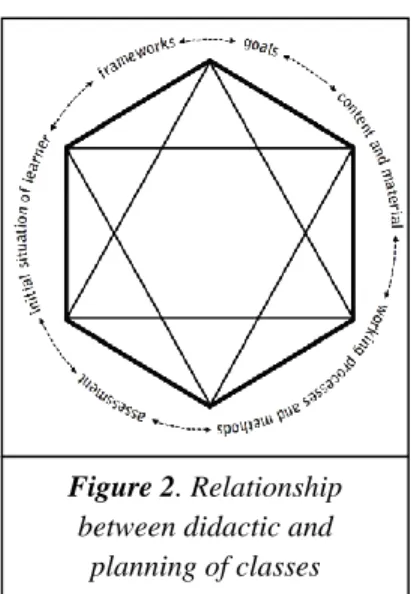
The didactic that is based on a goal of focusing of the most important aspects for planning a class and also it is on the connection between the different factors. All factors are mutually related; the changes in one feature have consequences for the other features as it is presented in the following figure.
To promote a didactic teaching it is important that teachers take into account some competences as:
Ability to develop a suitable curriculum where
learners’ needs correspond to the goals of the class
planning.
Competences have to be connected to different
teaching roles (responding, motivating, coaching)
Figure 2. Relationship between didactic and
Competences related to evaluation and reflection.
According to Hilde & Else (1997) the learners are in very different situations that imply they have to work with a range of different approaches that accommodate their own ways of learning to get optimal results. They have varying needs, demands and goals in relation to teaching and different learners may learn best by using different learning approaches. There are some questions to ask about the initial circumstances of the learner:
What communications skills does the learner have? What collaborative skills does the learner have?
Is the learner motivated to pursue the subject?
How does the learner learn?
They say that it is necessary to think about these questions both in connection to the group of learner as a hole and in connection with each individual learner in the planning of the classes.
Also we have to take into account other constructs that allow to achieve a successful development of the classes, it is the classroom management which is often called classroom discipline and it has been a priority for teachers for a long time according to Rose & Gallup (2006), they said that teachers consider the discipline as one of the serious obstacles for promoting effective teaching.
Another definition given by Evertson and Weinstein (2006) is that classroom
demonstrates that classroom management is a multi-faceted activity. It extends beyond some of the more traditional behavior management techniques frequently recommended to deal with students with disruptive behavior. Specifically, they note that teachers should do the following:
Develop caring, supportive relationships with and among students.
Organize and implement instruction in ways that optimize students’ access to
learning.
Use group management methods that encourage student engagement with academic
tasks.
____________________ CHAPTER 3 ____________________
INSTRUCTIONAL DESIGN
3.1 Introduction
In this chapter the reader will find the general and specific objectives and the three theoretical constructs on which our pedagogical intervention was based, in order to justify why they are considered relevant at the moment of developing this step of the research. Also it is stated the whole schedule containing all the topics worked with the students, the activities implemented, the skills worked (listening, reading, writing and speaking), the language focus that refers to the vocabulary and simple expressions that they learnt, the communicative focus that is related to the use of the language, and finally what we expected each student had to do at the end of each lesson.
3.2 Setting
The population chosen in this research work was a group of twenty one second graders. Girls are the majority. That population ranked an age between 7 to 8 years old. They were attending their primary studies in a public school located in the centre of the city and belonged to a middle social status. These learners had different behaviours towards the class. We worked with this whole population but at the moment to analyse data we only chose eight participants which were chosen randomly.
received classes in Spanish of other subjects, in which they learnt concepts related to the vocabulary taught during the English class.
3.3 General Instructional objective
Identify the type of activities that engage students in their EFL learning process.
3.4 Specific instructional objective
Apply vocabulary activities to engage second graders in their EFL learning process.
3.5 Language theory
This study is going to be framed into the structural conception of language proposed by Saussure (1916), in which language is conceived as a system of correlated elements for the coding of meaning; the fundament of the structural language is a “sign,” which owns two components; a “signified” defined as an idea or concept, and a “signifier” which is a
mean of expressing the signified. This relation between signified and signifier is the one in this intervention aims to stimulate through the representation of vocabulary visually, and the inclusion of language in context as an early literacy strategy within the instructional design; consequently. This reinforcement of the signified obtained through its
representation in images, using the image as a signifier.
this process get completed, the second stage appears and children identify families of objects or generic categories, continuing in this way their cognitive development to form more complex concepts. This learning theory is also known as “schema formation theory” because it follows a pattern of completing schemas before getting the next developmental level.
Vygotsky (1962), in his theory also proposed the called “zone of proximal
development” (ZPD), proposing that children in their learning process need the guidance of
adults or more-skilled children to facilitate their learning. It is explained that, when the concepts that children handle in a disorganized and spontaneous way, are fostered with the instructor's concepts which are more systematic and logic. Children’s learning and their cognitive development can go beyond their actual maturation level according to the ZPD theory. Vygotsky (1962) also holds that language is fundamental to the cognitive growth of children, they are able to communicate and to learn from others through dialogue; and it is for that reason that high quality oral guidance within instruction contributes to children’s
cognitive development.
3.6 Experiential learning (Experience in context) Ian Tudor (2001)
In this part the mainly support is the creation of activities that enhance students to learn in order to use this knowledge in the future.
As we had already mentioned we expected to know the interest, likes, and
be useful for us in order to help students to be more interested in their learning process. That information allows us to design and select the activities necessary and related to students likes. Something that defines the experiential learning is that students are involved in learning content in which they have a personal interest, need, or want, Wurdinger and Carlson (2010).
For that reason, we wanted to maintain and increase the interest of students during class. And based on the likes of students we selected the activities in order to make them involved and interested to each class thematic. Proponents of experiential learning affirm that students will be more motivated to learn when they have a personal stake in the subject rather than being assigned to review a topic or read a textbook chapter.
One of the principles of the experiential learning theory is that experiences are structured to require the student to take initiative, make decisions and be accountable for results. Applying this principle to our practice, we mean, that we structured each of the spaces of the lesson, so that students felt the need and motivation to develop each of the activities, and at the same time to achieve class objectives.
We as teachers had the role as facilitators; the instructor guided rather than directed the learning process where students were naturally interested in learning
3.7 Content based approach Krahnke (1987)
Content based is an approach of second language teaching in which teaching is organized around the content or information that students will acquire.
related each other, for example to know about the members of the family it was supported in sciences where the teacher showed culture and different generations in order to make easier their learning. We thought that they could learn better if they had the capacity to relate contents and aspects that they used in daily life.
In this case they acquired a language beyond of that language itself, they were going to be prepared to convey it, through the experience and the study of any aspects of the contents that we provided class by class. All of this related to themselves and their own living experiences.
According to content based approach the teacher has to be knowledgeable in the subject matter and to elicit that knowledge to their students (Stryker and Leaver 1993:292).
Teachers have to keep context and comprehensibility foremost in their planning and presentations. They are responsible for the selection and adaptation of authentic material and so create a class when the class is learner-centered as Brinton et al. (1989). ¨It’s
necessary to view language from a new way using content as the point of departure finally
with the time and the energy to create content- based language course comes even a great
responsibility for the learner, since the learner needs to become the basis of second
language teaching in classrooms¨ (p.3)
And it would be useful to follow the Content Based Instructions (CBI) skills which Stryker and Leaver gave us to become real Content Based Instructors
To vary the format of classroom instruction. Using group work and team.
In the other hand, there is a the role of student, Striker and Leaver (1993) argued that CBI learners during the process become autonomous, trying to understand their own learning process and taking charge of their process from the early start. Students will be collaborative supporting each other trying to work beyond of independent learning model as we could see.
Learners are going to be interpreters of input, willing to tolerate things along the learning process. Learners also may be sources of content and they have the chance to select the topics and ways to develop activities they like.
Brinton et al. (1989) argued that materials in content based approach may facilitate language learning. Those have to be used with the central concern of authenticity. It implies that materials maybe like the materials used in native language instruction, even
newspapers or magazines non originally for language teaching purposes can be useful, the use of materials from realia such as newspapers, radio and TV broadcasts is suitable for getting attention of students and develop motivational activities for them.
Brinton et al. (1989) says, it is necessary to provide guides and strategies to assist students in the comprehension of the materials.
3.8 Content Schedule
The chart presented below states the tasks and objectives that guided our
___________________ CHAPTER 4 ____________________
RESEARCH DESING
4.1 Introduction
This chapter will present the set of relevant features related to the research study. The first one is the type of study which is a case study that according to Yin (1984) it is an empirical inquiry that investigates a contemporary phenomenon within its real-life context. The second aspect is the context where the research was developed. The third aspect refers to participants involved. And the fourth aspect is the explanation of data collections
instruments used in this research work.
4.2 Type of study
We consider this project, a case study because as it was mentioned by Yin (1984), it is the ideal strategy when “how” or “why” questions are posed, and other characteristic of this study is that our research is focused on a contemporary phenomenon with an impact in the real context. According to Yin there were features in any case study research. One of them was that the researcher focuses on process-tracing; it refers to “the description and explanation of social processes that unfold between people participating during the
process, people with their values, expectation, opinions, perceptions, decision, mutual
relation and behaviours”.
Maykut and Morhouse (1994) considered that qualitative research expects describe and interpret the educative phenomenon as part of the socials phenomenon. Also the
the interest people about it. For that reasons we consider that our research project is a qualitative research besides has characteristics of this kind of study. It is inductive because the conclusions and synthesis will be the result of information specific and general that we as researcher will obtain of different participants that are inside the research. Also it is holistic because we see the population and context since a perspective total, global and unitary. We did not reduce the population in changeable, in change we considered them everything. The study of population was since its past and actual experiences in the same context; in this case it was the school and its characteristics.
As you could see this research project has most or all the characteristics that describe a qualitative project. This study is descriptive because we have the need to describe all the aspects that are around the problem. It is realistic and humanistic because the knowledge will be results of the human activity for that reason the knowledge is produced, it is not discovered. Interactive is this project too because we have to keep a relationship with the population in a natural way.
4.3 Content Analysis
Qualitative content analysis could be perceived such as inductive approach as it was mentioned by Mayring (2003). This inductive approach offers a range of rule-based
procedures for a systematic analysis of the data. This content analysis could be an appropriate analysis and interpretation for the case study research because it is a way to synthesis openness, where the analysis is controlled and the material is analyzed by steps. Qualitative content analysis is related to the holistic and comprehensive approach because through the analysis of data material the complexity of social situations could be covered and examined and also the social data derived from them.
The use of rule-based approach mentioned before offers the opportunity to deal and gradually to reduce the complexity of the social situation. The procedures of summary, explication and the structure step-by-step reduce that complexity and carry out the principle points of the analysis in an interactive process. Consequently, qualitative content analysis fits with the case study research helping us to understand a complex social phenomenon.
4.4 Characterization of Participants and Setting
The population under observation in this research project through a case study method was a group of eight students from a course of 21 belonged to a public school in Bogota. A characteristic of this population is that the participants were in second grade, aging seven to eight years old.
English class in this second grade group took two hours per week on Wednesdays. At the end of the study, children had taken about 4 months of English class totalizing a quantity of 20 classes in which they had acquired some basic vocabulary concepts consisting of nouns, some adjectives, and simple expressions.
Taking into account the setting, this school was a small public primary school located in the city Centre, with reduced space to children mobility, and with limited amount of materials and few technological sources to teach English.
The researchers who developed this project were the second grader's English teachers and researchers at the same time. In every class, the teachers interchanged roles, it means that in a class the person who developed the lesson was not the observer and vice versa. Both students of English language teaching program, at Universidad Distrital, they had had previous experience on teaching English in a second grade group for almost 4 months, and attempting to demonstrate the impact of the inclusion of vocabulary activities as a tool to increase the interest of second graders towards EFL learning process.
4.5 Data Collection Instruments
The instruments used in this study were selected based on the type of study which is a case study. Considering that the research work is a social phenomenon, instruments were chosen to collect the perceptions, opinions and expectations of participants. The
4.5.1Teaching Journals
According to McDonough (1994) teaching journal can function as an instrument of a real insider through which one can obtain a rich source of data.
As a result, practitioners can use such qualitative data for self-evaluation or
qualitative content analysis of recurring themes (p. 87). McDonough’s study implies that by
means of the instrument, pre service teachers can create inquiries and hypotheses about their learning and teaching by themselves to explore their teaching perceptions and practices. The mentioned before is backed by Golombek (2000) who argues that
observation, self-analysis, and self-direction through journaling allow teachers to build the voice and confidence needed to study themselves, and their profession. Consequently, when researcher teachers share journals with one another and some appropriate guidelines are given to them in advance, we can expect them to grow into autonomous teachers.
This instrument was selected to enrich data collection process because this instrument provides qualitative data better than quantitative one.
4.5.2 Artifacts
One of the instruments to collect data from students was the artifacts; Goetz and LeCompte (1985) conceive artifacts as “thing that people make and do” (p. 155). These
Those artifacts belonged to data collection process, because it provided qualitative information. Those artifacts showed all the children's outcomes in terms of vocabulary production.
4.5.3 Questionnaires
Carrasco & Calderero (2000) said that questionnaires consist of a more or less broad set of questions or issues that are considered relevant for the trait, characteristic or variables that are studied in this research. We can use the questionnaires that are similar to the test to assess perceptions of respondents. Additionally the construction and composition of our questionnaires should be simple and carefully explained due to the age of the participants.
It was important to know what kind of data we wanted to collect. According to Munn & Drever (1999) if the purpose of the questionnaire is to find out factual details or to seek responses to firm categories, the 'harder' the data requested. But if the purpose is to facilitate find out new qualitative material, then it is better to have more open and unstructured questions.
4.6 Ethics
Ethics approval in this research from the school, and from participants’ parents was
___________________ CHAPTER 5 ____________________
DATA ANALYSIS
5.1 Introduction
In this chapter we present a description of the procedures of the analysis of data gathered through the three instruments used along the development of our research project which were: Teacher journals, artifacts and questionnaires. In order to elaborate the adequate data analysis it is important to label our data information, it will allow us to answer the main research question: How does the use of vocabulary activities increase interest in EFL learning process to second graders?
Also, the method that we selected to analyse data was the qualitative data analysis perspective in order to verify perceptions, personal appreciations, feelings and preferences of our students respect to the research question of this study.
The procedure that we developed to organize data and to verify results that allowed us to define the categories. We had to apply a triangulation of data along the process using the three instruments mentioned before. It is important to highlight that we decided to use the data analysis technique called as visual markets. It was used with the purpose to recognize and identify common patterns from the categories emerged.
around the similarities of the data content of the artifacts in order to identify common aspect that students tended to do in the activities.
Also we supported the data analysis we the content analysis technique according to Cohen, Manion & Morrison (2007) is a method of text analysis among a group of empirical approaches, Babbie (2001) considers that the content analysis is a kind of study focus on human communications. Actually the basis of this analysis is a coding operation that transforms data in a standard form. This technique allowed us to show the findings of the data emerged from artifacts, teacher journals and questionnaires.
Additionally we based our data analysis on the grounded theory, according to Glasser and Strauss (1967) this theory is a methodology of developing inductive theories that are ground in systematically gathered and analysed data. In this method data collection, analysis and interpretation interacted in order to establish close relationships to one and other. Furthermore, the case study appears as the most appropriate methodology because it was a detail examination of the 8 children selected to participate in the research study.
The research question appeared from the statement of the problem which was: How does the use of vocabulary activities increase interest in EFL learning process to second
graders? Taking into account the question and the information obtained from the
participants emerged two categories that allowed us to answer the main question of this research.
5.2
Students prefer to work on simple activities
about the way student acquire a positive perception towards the development of the classes through the implementation of vocabulary activities which were simple to solve for them. It is important to remember that the kind of activities and the manner as the classes were developed play a meaningful role in a successful EFL learning process.
This idea is supported by Wood (1994) who claims that students do not enjoy activities or tasks which involve too much copying. According to this, student rather simple activities that are not complex at the time to be solved, but it does not mean that they will not put into practice the knowledge acquired previously during the lesson.
In the following excerpt (Fig. 4) it is presented an example of the teacher’s narration in relation to the students’ behavior. In this
excerpt is evidenced the influence of the vocabulary activities in the interest from
students toward class. This excerpt demonstrates that not complex activities, in which students
must follow simple instructions as select, cut and paste, helped them to get a successful development of the task.
In the “Estándares Básicos de Competencias en Lenguas Extranjeras: Inglés, (2006)” is mentioned in the part of reading skill that students prefer simple activities as
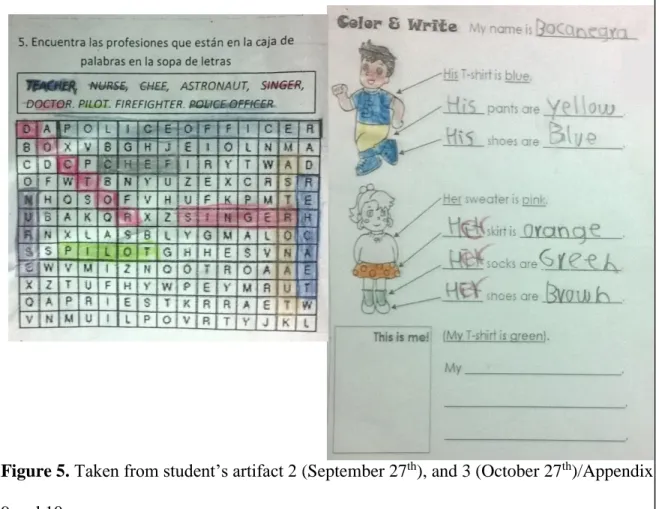
vocabulary scramble, word and picture matching, word search, completing the word. We realized that students learn better and develop tasks showing more interest when activities include pictures and are based on simple instructions. The next excerpt (Fig. 5) shows that
…in the production activity during the creation of a collage they should be very creative. They were so interested because, they had to select, cut and paste different characters that represent their family. That helps us to maintain a high interest and active participation during the development of classes.
student solve in better way activities like word search and they do not get success in activities that involve writing too much.
The activities selected require more capacity to be concentrate but at the same increase the interest and excitement from the students. And the activation and maintenance of motivational enhancement during the teaching-learning process are essential according to Verlee, L. (1995). The next excerpt (Fig. 5) shows that student solve in better way activities like word search and they do not get success in activities that involve writing too much.
Figure 5. Taken from student’s artifact 2 (September 27th), and 3 (October 27th)/Appendix 9 and 10
lesson. In the other one he should to write and complete some sentences according to the picture and using vocabulary learning during the class. It was evidence that he demonstrate more interest at the moment to resolve the word search, the participant did it successfully. And in the writing activity the student could not complete and develop in the most
appropriate way.
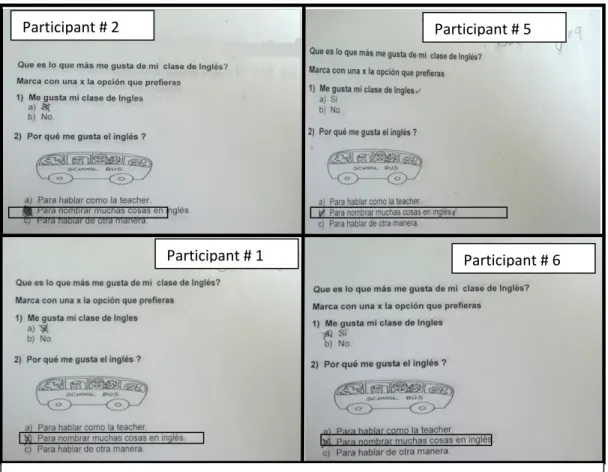
Figure 6. Taken from analysis of questionaire II, September 20th, 2014./Appendix 11
Dörnyei (2001) argued that it is very important to know the interest and preferences of students and the easiest methods to achieve this through the implementation of
an answer student in the third questionnaire; it had open-questions to get the appreciations toward development of the class.
5.3 Language used in context
This second category is answering the sub question: What types of activities engage students of second grade in their EFL learning process with the purpose to build up EFL
motivation? In this sense when students developed the different activities prepare for the
classes. Second graders tended to express great interest when they worked on tasks related to topics based on the context where they were. It was also observed that children rather activities in which images were presented.
Vigotsky (1978) stated that the social context plays an important role in language acquisition, because children receive and imitate many of the things that they see in their daily life. Every aspect of the social context carves the language, the first and simpler words that they produce are linked with the things that they live and the concepts that parents and people around provide. Supporting this idea, Piaget (2007) mentioned that children in ages from 7 – 11 are in the stage of concrete operation in which the thinking process becomes logic and it is applied to concrete o real problems.
The following excerpt (Fig. 8) is the evidence of how student establish a relation between the EFL language acquisition and its application in context.
The pedagogical policies proposed by the “Ministerio de Educacion Nacional de Colombia” in the “Estandares Básicos de Competencias en Lenguas Extranjeras: Inglés (2006)” take into account some standards which are considered relevant for each cycle. In
this case it was the first cycle, and the standards that help to answer the sub question ware:
Students are able to copy words that understand and they use in the
classroom.
Students understand activities related to routines and habits.
Students identify words related to topics familiar for them.
Students enjoy the reading as an interactive activity that allows them to
discover the world.
Students can respond very simple question about objects and familiar places.
After of the pedagogical intervention we could notice that the curriculum that we designed set with the standards proposed by the “Ministerio de Educacion”. It is because the topics in the content schedule were related to aspects that were connecting to students’
context. The following excerpt (Fig. 9) shows one of the most chosen options in the first
At the beginning of the class student had to present their family tree… Always, when students had the possibility to demonstrate
their acquired knowledge at the moment to develop an activity,
made that students be more interested for the class development…
questionnaire (appendix 3) evidence that like to learn English because they want use it in context.
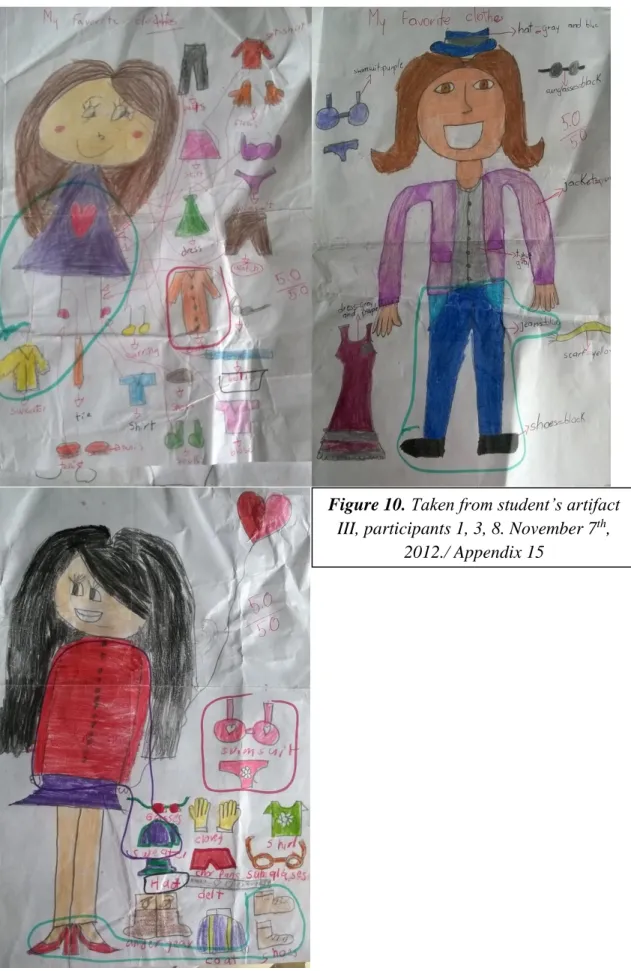
Berry(2010) claims that children in second grade show interest in the learning of new words and they are likely to develop vocabulary. Beyond the use of vocabulary activities allow students to discover new words and create a set of vocabulary related to several aspects from their real lives and settings. In the next excerpt (Fig. 10) the figures circle in colors show how students identify easily the most common things that they see in their daily life.
Participant # 2 Participant # 5
Participant # 1 Participant # 6
Figure 10. Taken from student’s artifact III, participants 1, 3, 8. November 7th,
The table below shows the organization of the categories identified, the samples provided by the learners, the theoretical support and the instruments of the information.
Questions and categories
SAMPLES THEORETICAL SUPPORT INSTRUMENT
Conclusions
This research was focused on answering the question which came from the beginning: How do vocabulary activities increase the interest in EFL learning process to second graders? For doing that, there were analyzed aspects related to the use of activities
in the classroom to increase the interest in EFL learning process of children.
In this project, we chose vocabulary activities as the most important feature for the research project that helped to deal with the low interest in the EFL learning process; we have focused on how vocabulary activities have a good influence in the attitude toward the class of students who are in an EFL learning process.
Through observations we discover how the use of different kinds of activities influences in the student’s behavior towards the class, through this research was also
evidence that we as teachers can increase the interest of students in their EFL learning process when implement activities that are related to the likes and environment around them.
Nowadays, people have different perspectives to develop complete content schedule with the topics and grammar necessary that allow the student to achieve a language level, but not many of them keep on mind the importance of preferences of students in the learning process. However “estándares básicos de competencias en lengua extranjera: inglés” required students to become proficient in the English language, especially when
we have reached the conclusion that the use of activities related to preferences of students is the key factor to increase the students’ interest in their EFL learning process.
The proposal implemented a strategy to increase interest of second graders in their EFL learning process, to achieve this, teachers tried to help them applying
uncomplicated vocabulary activities as scramble, memory game, word search, matching, crosswords, those activities were also linked to preferences and likes of students. Dörnyei (2001), advices that for motivating students in classroom, we as teachers have to know the goals of the students, and the topics they want to learn about and thus implement to the curriculum. Also, he mentioned the importance of knowing the preferences and interests of students
At the beginning it was evident that students showed low interest to develop activities and participate during English class, and was a positive influence for them implement activities which were related to their preferences and context. But while time passed by and it was implemented the vocabulary activities as strategy; the scholar community discovered that children were able to be more interested in their EFL learning process. Most of them always solved activities class successfully and had a different attitude toward the development of each stage of lesson. And the research objective was achieved,describe and understand how vocabulary activities increase the interest in EFL learning process to second graders.
Following the previous idea, the kind of activities use in class is a big issue when we as teachers try to increase the interest of student in their EFL learning process.