
TítuloLatest developments in high efficiency biofiltration
7
0
0
Texto completo
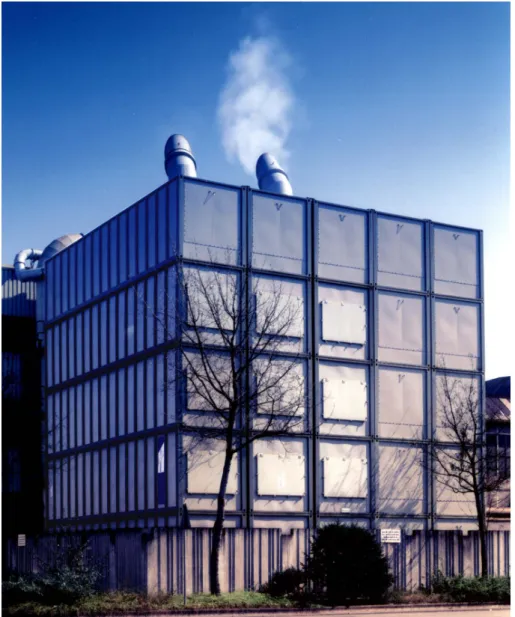
(2) 204. F. SABO, S. PRECHEL AND T. SCHNEIDER. Figure 1. Outdated open type biofilter system.. 2. HIGH PERFORMANCE CONTAINER MODULES The method of biofiltration has proven to be a very economical and environmentally friendly technology to eliminate odours and VOCs in waste gases to a very high degree. As a result of intensive research in the early 90s, increasing numbers of modular biofilters are employed. By capsuling the biofilters no effects from the ambient will affect the conditions within the filter material. For the first time, it is possible to guarantee homogeneous and equalized conditions within the filter material. Other benefits of these modular systems are the possibility to stack up the modules in order to gain floor space and to enlarge the biofilter plant in cases of a increasing production. The next step was the invention of the automatical change of flow direction in connection with the moistening of the filter material. High performance biofilters do not only have to convince by their constructional details, their high reliability and permanent high degrees of effectiveness but primarily by the coherent integration of all units into compact, mobile containers. This offers two decisive advantages: In such a closed system the conditions can be exactly defined and controlled. Also, the containers can be merged for most different configurations and supplemented without problems when required. Fan and scrubber of varying constructions are just as problem-orientedly used as secondary crude gas conditioning techniques such as degreasing, particle elimination or cooling..
(3) LATEST DEVELOPMENTS IN HIGH EFFICIENCY BIOFILTRATION. Figure 2. DaimlerChrysler AG, Airflow 160.000 m3/h.. 205.
(4) 206. F. SABO, S. PRECHEL AND T. SCHNEIDER. Figure 3. Enclosed biofilter system at a starch production plant to treat 45.000 m3/h.. 2.1. Typical applications Breweries Sewage works, dump gas disposal Foundries Coffee & cocoa roasting Purification plants Composting plants Mechanical biological composting plants Plastic recycling plastics processing Food industry Milk processing Mushroom breed Smokehouses, Slaughterhouses Rendering plants. Figure 4. DaimlerChrysler; Multi-Stage Biofilter, Airflow 100.000 m3/h..
(5) 207. LATEST DEVELOPMENTS IN HIGH EFFICIENCY BIOFILTRATION. 3 MULTI STAGED HIGH PERFORMANCE BIOFILTER MODULES Meanwhile, the latest state of technology is presented by dividing the biofilter module into separate chambers. By doubling the velocity of the flow within the filter layer the airflow is transformed from laminar to turbulent. In this case the mass transfer of pollutants from the waste gas into the filter layer is at a much higher level. A limitation of the compound degredation becomes obsolete. The remaining limitation is the degradation velocity of the microorganisms. Apart from this, the operational reliability is increased as well. A break through of waste gas in fact of a malfunction of the scrubbing system is minimized in fact of the two layers of filter material which have to be passed. In very special cases it is possible to triple the biofilter stages. Using a coarse filter material in the first stage, particles like dust or microorganisms can be separated. M. M. Filter-media moisturisation Cleaned gas P. T. T. P. Ventilation unit. Chamber 1. Chamber 2. T. T. Sewage water. P. 1 % slope. L. P. Figure 5. Conceptual drawing of a multi-staged biofilter.. Successes of first industrial applications in the most different ranges like the VOCelimination in the painting and coating industry, the starch production, the foundry industry and the mechanical biological garbage treatment confirm this development. Thus, the degree of elimination efficiency depends substantially on the efficiency of the micro-organism population. Here is, where the optimization potentials of the future are.. Figure 6. Municipal waste treatment; Multi-Stage Biofilter, Airflow 80.000 m3/h..
(6) 208. F. SABO, S. PRECHEL AND T. SCHNEIDER. Spatially separated functional areas are achieved by the division into two or more parts of the biofilters. Many degrading processes run off next to each other. By spatial separation, disassembly processes that could not run next to each other unhindered before, can now be fully completed in different chambers. By the division into two parts the possibility further exists to regulate the respective compartments each on its own. For example, the pH value, amount of moisture within the filter material as well as a special nutrient cocktail can be offerd to different types of micro-organisms. These biofilters already show an obvious increase of reliability and are prone against breakthrough.. Figure 7. BMW AG. Multi-Stage Biofilter, Airflow 6.000 m3/h.. 3.1. Typical applications Chemical industry Paint shops Volatile organic components emitting industry 4. INTELLIGENT CONTROL SYSTEMS The water content of the filter material is the most important parameter for the efficiency of a biofilter and at the same time the most difficult parameter to measure and to control. Both for the absorption of the pollutants and for the vitality of the microorganisms water is the "key element" in biological exhaust air purification. Sufficiently high moisture as well as a homogeneous and even distribution of moistness in the filter media is of highest importance. If some parts of the filter material run dry, tears and channels will form in which the only insufficiently purified exhaust air is passed through. Since the pressure loss in these places is obviously reduced, an increased flow connected with a further break-through and/or short-circuit flow will occur. This dry filter material develops hydrophobic surfaces, which can only be remoistened with great efforts. Changing the filter material is often inevitable and causes considerable costs. Therefore, biofilters are usually very generously dimensioned, usually with an addition of 100% on the calculated surface. If a reliable moisture monitoring and control within the filter material could be guaranteed, biofilters could be dimensioned smaller and would be accordingly more economical in many cases..
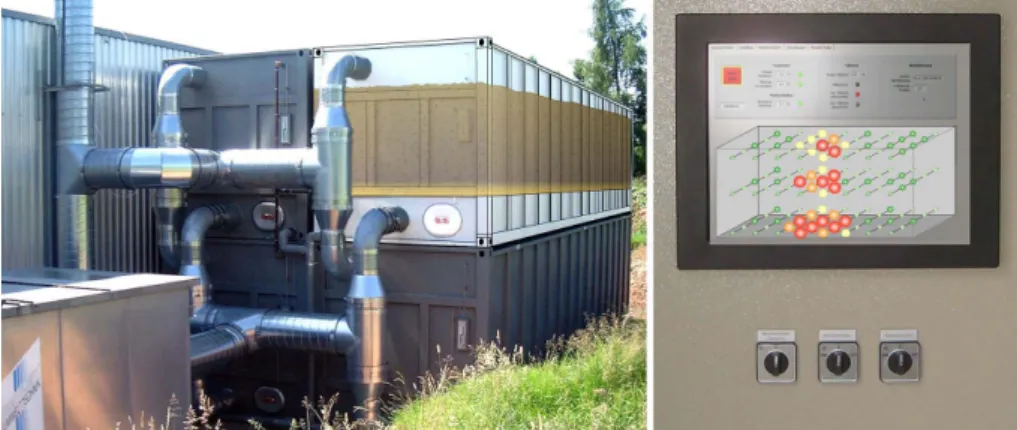
(7) LATEST DEVELOPMENTS IN HIGH EFFICIENCY BIOFILTRATION. 209. An absolute novelty is presented by the modular control system for biological installations. During the operation of biofilters, problems mainly arise if the filter material gets too wet or too dry. Up to now, it had not been possible to permanently determine the humidity of biofilter material with sufficient accuracy. By making use of intelligent control methods, ideal and stable operating conditions and compliance with the highest degrees of efficiency are achieved. For instance, as the moisture within the filter media of biofilters can only be measured by making use of very complex methods, a different approach was developed. For the first time, cost-efficient sensors to measure the humidity distribution and air current allocation within the filter material are deployed. The data of this three-dimensional view is also included into the control system.. Figure 8. Intelligent control systems enable the operator to take a look inside the “black-box” biofilter.. These developments have all in all increased the efficiency of biofiltration at significant dimished space capacity. Meanwhile it is possible to run such a system to the fivefold loading in comparison to a conventional biofilter without any loss of efficiency. It is task of process engineers to ensure optimal living conditions for micro-organisms within biological exhaust air purification plants in order to obtain a high efficiency of removal and to ensure a stable operating mode. However, controlling and an influencing the biological process is not as easily realised in "living" plants as it is in purely technical plants. Rising requirements of the cleaning grade, which can be achieved by biological waste air purification plants, require operational methods with increased reliability and high process stability. To meet these demands, a measuring and a control system has to be developed which particularly integrates the parameter “filter-media moisture” into the control system..
(8)
Figure



+3

Documento similar
Although human skin acts as a biological barrier against pro-oxidative air pollutants, prolonged exposure to their high levels can induce alterations in skin homeostasis and has been
parameters of the binary orbit and the masses of the neutron stars can be measured with very high precision by accurate timing measurements.... The Masses of the Neutron Stars in
By comparing these values with the gas phase values reported in Table 1, it can be observed that at high temperature the matrix effect of KBr affects only the bands at 1173.5 and
To determine the amount of water saved by reducing evaporation and the water saved by reducing f ilter cleaning requirements, the monthly water balance in the covered and uncovered
In addition, it also provides insights of an extra-benefit to the end user that has not been previously studied, the increased energy efficiency at the terminal that can be achieved
The IEEE 802.11aa standard defines different mechanisms for multicast transmission, each of which provides a different behavior in terms of efficiency and reliability. However,
In this case series, we report the functional and radiologic outcomes of 16 complex fractures which healing can- not be achieved with internal fixation: four-part displaced
The development of cost-effective high thermal insulation performance products and systems can contribute to improve the energy efficiency of buildings and thus reducing CO
