Otras secciones de este sitio:
! ! ! !
! Índice de este número !
! ! !
! Más revistas !
! ! !
! Búsqueda
Others sections in this web site:
! ! ! !
! Contents of this number !
! ! !
! More journals !
! ! ! ! Search Artículo:
Survival of Brucella abortus in milk fermented with a yoghurt starter culture
Derechos reservados, Copyright © 2005: Asociación Mexicana de Microbiología, AC
Revista Latinoamericana de Microbiología Número
Number3 - 4
Julio-Diciembre July-December 2 0 0 5 Volumen
Volume 4 7
edigraphic.com
ABSTRACT. In countries such as Mexico, brucellosis is still an
im-portant public health problem due to the consumption of non-pasteu-rized milk and dairy products, contaminated with Brucella spp. The aim of this study was to look into the survival of Brucella abortus during fermentation of milk with a yoghurt starter culture and storage at refrigeration temperature. Sterile skim milk was inoculated with B.
abortus at two concentrations, 105 and 108 CFU/ml simultaneously
with a yoghurt starter culture of lactic acid bacteria (Streptococcus
thermophilus and Lactobacillus delbrueckii subspecie bulgaricus).
Inoculated flasks were incubated at 42ºC, followed by refrigeration at 4ºC. Samples were taken during fermentation and during storage and viable count of B. abortus and lactic acid bacteria and pH were determined. Results showed that after 10 days of storage at 4°C, B.
abortus was recovered in fermented milk at a level of 105 CFU/ml,
despite the low pH below 4.0. Therefore B. abortus is able to survi-ve in fermented milk. This finding may imply that non-pasteurized fermented milk contaminated with Brucella abortus could be a means of transmission of these bacteria.
Key words: Brucella spp, Brucella abortus, fermented milk,
survi-val, yoghurt.
Rev
ista
Lat
inoamer
Survival of Brucella abortus in milk fermented with
a yoghurt starter culture
Armida Zúñiga Estrada,*,** Lydia Mota de la Garza,* Miroslava Sánchez Mendoza,* Eva María Santos López,** Santiago Filardo Kerstupp,** Ahidé López Merino*
* Departamento de Microbiología. Escuela Nacional de Ciencias Biológicas. Institu-to Politécnico Nacional. Apartado Postal 4-870. 06400 México, D.F.
** Centro de Investigaciones Químicas. Universidad Autónoma del Estado de Hidal-go. 42076 Pachuca, Hidalgo, México.
Received April 21, 2005; received in revised form August 24, 2005; accepted October 4, 2005.
RESUMEN. En países como México la brucelosis representa un
im-portante problema de Salud Pública debido principalmente al consu-mo de leche y productos lácteos no pasteurizados contaminados con
Brucella spp. El objetivo de este estudio fue determinar la
sobrevi-vencia de Brucella abortus en leche inoculada con un cultivo inicia-dor para elaborar yogur, fermentada a 42ºC y posteriormente refrige-rada. La leche descremada estéril se inoculó con el cultivo iniciador para elaborar yogur formado por Streptococcus thermophillus y
Lac-tobacillus delbrueckii subespecie bulgaricus, simultáneamente con B. abortus a dos diferentes concentraciones, 105 and 108 UFC/ml.
Se tomaron muestras durante la fermentación y durante el almace-namiento, en las cuales se determinó cuenta viable de B. abortus, así como de S. thermophillus y L. delbrueckii; también se determi-nó el pH. Los resultados mostraron que B. abortus fue capaz de so-brevivir hasta 10 días en leche fermentada y almacenada a 4ºC, a pesar de que el pH fue de alrededor de 4.0. Por tanto, la leche fer-mentada no pasteurizada y contaminada con Brucella abortus pue-de ser vehículo para la transmisión pue-de esta bacteria.
Palabras clave: Brucella spp, Brucella abortus, leche fermentada,
sobrevivencia, yogur.
Vol. 47, No. 3-4 July - September. 2005 October - December. 2005 pp. 88 - 91
INTRODUCTION
Brucellosis is a zoonotic disease of worldwide distribu-tion that mainly affects people in contact with domestic ani-mals and animal products. Although the disease is being controlled in many developed countries, it still remains en-demic in many parts of the world, including Latin America, the Middle East, Spain, Africa, and western Asia.4,5,14,15,22,24
The disease is mainly transmitted to humans through the in-gestion of raw milk or non-pasteurized cheese contaminated with one of the four Brucella species pathogenic to hu-mans.6,19,20 Brucellosis in dairy cattle is very important in
countries such as Mexico, where the incidence has fluctuated between 4-11% during the last years.11-14
Local food habits, like the consumption of unpasteur-ized dairy products, have led to epidemic outbreaks of
hu-man illness.1-3,5,12,16,18,23 In 1997, dairy products accounted
for 84% of the sources of infection of human brucellosis (40% milk, 40% cheese, 4% other dairy products, and 5% were occupational cases in Mexico.11
The survival of Brucella in non fermented dairy pro-ducts has been investigated by some authors, who have demonstrated that Brucella spp. was able to survive for periods as long as 18 months; however there is little information published about the survival of B. abortus in fermented milk food.7,10,21
To understand the role of yoghurt as a vehicle for trans-mitting B. abortus, a research study was carried out on the behavior of this pathogen during sterilized skim milk fer-mentation with a yoghurt starter culture and subsequent storage at refrigeration temperature.
MATERIAL AND METHODS
Strains. B. abortus biovar 1 strain 544 ATCC 23448,
Zúñiga et al Survival of Brucella abortus in milk fermented with a yoghurt starter culture Rev Latinoam Microbiol 2005; 47 (3-4): 88-91
89
edigraphic.com
:rop odarobale FDPVC ed AS, cidemihparG
arap
acidémoiB arutaretiL :cihpargideM
sustraídode-m.e.d.i.g.r.a.p.h.i.c
Starter culture. A lyophilized yoghurt starter culture
obtained in our laboratory from natural fermented dairy products, composed of a 1:1 mix of Streptococcus
saliva-rius subsp. thermophilus and Lactobacillus delbrueckii
subspecie bulgaricus was used. Working lactic cultures were prepared mixing 0.1 g of the starter culture and 10 ml of SSM and incubated 8 hours at 42ºC. Therefore 2% (v/v) inoculum was mixed with 200 ml of SSM and incubated under the same conditions. This procedure was performed twice to obtain the activated working culture.
Microbiological assays. Assays were performed in
du-plicate with concentrations of 1 x 10⁵ or 1 x 10⁸ CFU of B. abortus per ml of milk. One set of five flasks containing
200 ml of SSM was used for each concentration of the pathogen. Three flasks were inoculated with a B. abortus suspension to obtain the desired concentration; two of these flasks were also inoculated with the yoghurt starter culture (106 CFU of lactic acid bacteria/ml of milk); the
one that only contained B. abortus was considered the pathogen control. A fourth flask was inoculated only with the yoghurt starter culture (starter culture control) and the fifth one was not inoculated (negative control).
All flasks were incubated at 42ºC for 8 h; thereafter they were stored at 4ºC. Samples were taken at 2 h inter-vals during fermentation and every 2 days during storage; they were diluted in peptone water (Oxoid) and plated in duplicate on Lactobacillus-Streptococcus Differential agar (LSD) for colony counting of lactic acid bacteria and on Farrell’s agar (Oxoid) for counts of B. abortus. LSD agar is a selective medium which provides good growth and the differentiation of thermophilic lactobacilli and streptococci in yoghurt products; it was prepared according to the formulation of Eloy and Lacrosse.9 All
plates were incubated 48 h at 37ºC under a 6% CO2 atmosphere. Samples were taken until the pathogen was not detected in two consecutive samplings. The pH of the milk samples was measured with a pH meter equipped with a combined electrode.
RESULTS
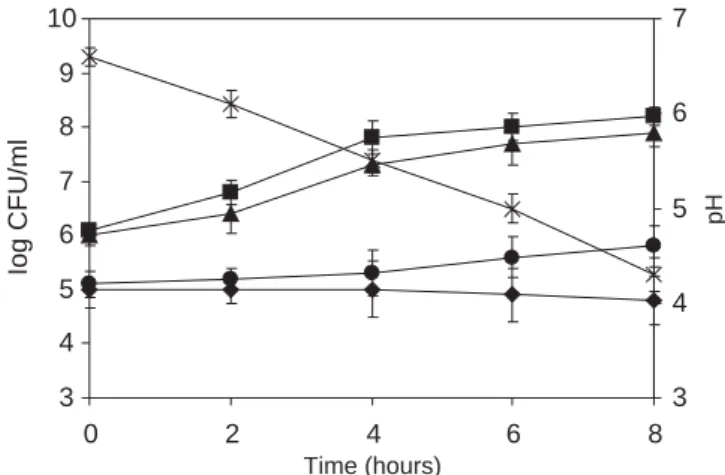
Figure 1 shows the behavior of B. abortus in milk ino-culated with 1 x 10⁵ CFU per ml during fermentation at
42ºC. Growth of the lactic culture was similar in the ab-sence or preab-sence of the pathogen. For this reason, in Fi-gures 1 to 4, only growth of S. salivarius subsp.
thermo-philus and L. delbrueckii subspecie bulgaricus in the
starter culture control flask is shown. After 8 h of incuba-tion, a slight growth of B. abortus close to one logarithm of magnitude, in the pathogen control flask was observed, whereas in the flask containing B. abortus and the starter culture, no growth of the former was observed.
After the fermentation phase, the B. abortus population decreased after the first day of storage at 4°C; and after 10 days no colony on agar plates was observed (Fig. 2). On the other hand, B. abortus population in the pathogen con-trol flask did not show any variation during 12 days. Lactic acid bacteria counts did not change with storage.
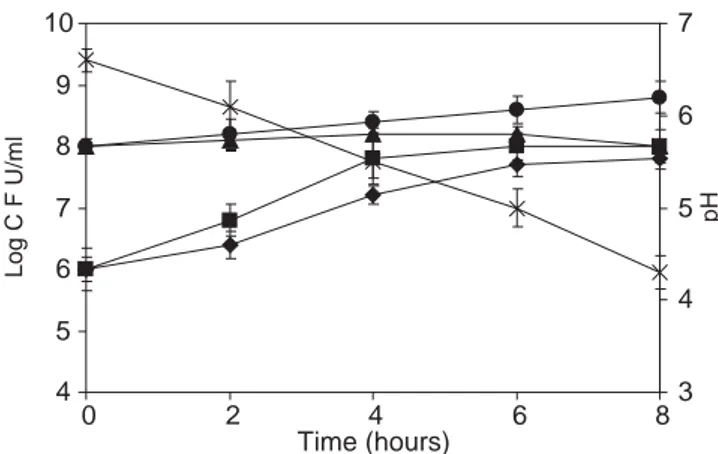
The behavior of B. abortus inoculated at 1 x 10⁸ CFU/
ml of milk during the fermentation phase is shown in Fi-gure 3. When B. abortus was incubated together with the starter culture, its population did not change after 8 hours of incubation; whereas in the absence of the starter culture, a slight increase in B. abortus population was observed.
Figure 1. Counts of S. salivarius subsp. thermophilus ( ), L. delbrueckii
subsp. bulgaricus ( ), B. abortus when incubated with the starter cul-ture ( ), B. abortus in the pathogen control ( ) and pH values ( ) during milk fermentation at 42°C with an initial concentration of B. abortus of 105 CFU/ml.
3 4 5 6 7 8 9 10
0 2 4 6 8
Time (hours)
3 4 5 6 7
pH
Iog CFU/ml
Figure 2. Counts of S. salivarius subsp. thermophilus ( ), L. delbrueckii
subsp. bulgaricus ( ), B. abortus when incubated with the starter culture ( ), B. abortus in the pathogen control ( ) and pH values ( ) during storage at 4°C with an initial concentration of B. abortus of 105 CFU/ml.
0 1 2 3 4 5 6 7 8 9 10
0 2 4 6 8 10 12
Time (days)
.
3 4 5 6 7 8
pH
edigraphic.com
sustraídode-m.e.d.i.g.r.a.p.h.i.c cihpargidemedodabor
B. abortus was able to survive for up to 22 days in the
presence of the starter culture during storage (Fig. 4), in spite of the low pH values (3.8 to 4), but it died after 23 days. In the pathogen control flask, the population of B.
abortus was kept close to 108 CFU/ml throughout 25 days
of storage.
In all flasks the initial pH value of the milk was 6.4, but in the presence of the starter culture it dropped to less than 5 after 8 h, and to less than 4 after 24 h.
DISCUSSION
Lactic acid bacteria are used in the manufacture of fer-mented foods. They contribute to the development of
fla-vour as well as to the preservation of raw milk, mainly due to the presence of lactic acid. In the present study, B.
abor-tus viability was slightly reduced after 8 h in the presence
of the starter culture, at a concentration of 105 CFU of B. abortus per ml. It could be due to a bacteriostatic effect
ob-served by the drastic decrease of pH in the presence of lac-tic acid bacteria and maybe due to the production of other antimicrobial compounds. Reports have been made by other researchers of the influence of some factors, such as bacteriocins, hydrogen peroxide, volatile compounds, and other metabolites produced by lactic acid bacteria, which have proven their efficacy by inhibiting the growth of pathogens such as Staphylococcus aureus and Listeria
monocytogenes, both of which could be present in milk
used in the manufacture of dairy products.17,21
Previous studies have shown that the pH of dairy pro-ducts played a critical role in the survival and growth of
Brucella spp and they have argued as well that the role of
dairy products as a vehicle for transmitting several patho-gens could be predicted by determining the pH values of the products. Davies and Casey7 showed the effect of the
change of pH on the survival of B. abortus in milk and milk products, suggesting a direct correlation between the survival of the microorganism and the pH. According to this study B.
abortus did not survive when the pH was lower than 4.0.
Nevertheless, in this study, we have shown that even at pH 4.0, the starter culture did not inhibit the growth of B.
abortus in associative culture in milk and did not die as
quickly as expected. Rather, the organism was able to sur-vive several days and even weeks in the fermented milk. The survival time of B. abortus in fermented milk observed in this study was longer than the time reported in previous researches.8,10,21 Apparently this was due to differences in
the selected strain of Brucella, size of inoculum, different conditions in experimental assays, inoculation of the patho-gen before or after the fermentation, type and size of the starter culture, etc.
This study demonstrated that B. abortus was able to sur-vive 22 days in milk fermented with a yoghurt starter culture stored at 4ºC when the pH was around 3.8. Certainly, this unexpected survival represents a risk for the health of the consumers. In our country, where traditional hand-made techniques are still used to manufacture dairy products like yoghurt, the consumption of contaminated products could generate isolated cases or outbreaks of human brucellosis.
Finally, it is important to point out that non-pasteurized fermented dairy products, including yoghurt, cannot be considered Brucella-free after a fermentation process and subsequent storage, especially if milk comes from cattle bred in endemic areas. Therefore, milk must be obtained and handled with high standards of hygiene followed by a proper heat treatment to prevent brucellosis.
Figure 3. Counts of S. salivarius subsp. thermophilus ( ), L. delbrueckii
subsp. bulgaricus ( ), B. abortus when incubated with the starter cul-ture ( ), B. abortus in the pathogen control ( ) and pH values ( ) during milk fermentation at 42°C with an initial concentration of B. abortus of 108 CFU/ml.
4 5 6 7 8 9 10
0 2 4 6 8
Time (hours)
3 4 5 6 7
pH
Log C F U/ml
Figure 4. Counts of S. salivarius subsp. thermophilus ( ), L. delbrueckii
subsp. bulgaricus ( ), B. abortus when incubated with the starter culture ( ), B. abortus in the pathogen control ( ) and pH values ( ) during storage at 4°C with an initial concentration of B. abortus of 108 CFU/ml.
0 1 2 3 4 5 6 7 8 9 10
0 5 10 15 20 25
Time (days)
3 4 5 6 7 8
Log C F U/ml
Zúñiga et al Survival of Brucella abortus in milk fermented with a yoghurt starter culture Rev Latinoam Microbiol 2005; 47 (3-4): 88-91
91
edigraphic.com
REFERENCES1. Altekruse, S.F., B.B. Timbo, J.C. Mowbray, N.H. Bean & M. E. Pot-ter. 1998. Cheese-associated outbreaks of human illness in the Unit-ed States, 1973 to 1992: sanitary manufacturing practices protect consumers. J Food Protection 61:1405-1407.
2. Castell M.J., J.V. Rullan, E.F. Peiro-Callizo & A. Nieto-Sandoval. 1996. Epidemic outbreak of 81 cases of brucellosis following the consumption of fresh cheese without pasteurization. Rev. Esp. Salud Pública. 70(3):303-311.
3. Centers for Disease Control and Prevention. 1995. Brucellosis asso-ciated with unpasteurized milk products abroad. Wkly Epidemiol Rec. 70, 308-309.
4. Chomel, B.B., E.E. DeBess, D.M. Mangiamele, K.F. Reilly, R.K. Sun & L.R. Barrett. 1994. Changing trends in the epidemiology of human brucellosis in California from 1973 to 1992: a shift toward food borne transmission. J Infect Dis 170:1216-122.
5 . Cooper, C.W. 1992. Risk factors in transmission of brucellosis from animals to humans in Saudi Arabia. Trans. R. Soc. Trop. Med. Hyg. 86(2):206-209.
6 . Corbel, M.J. 1997. Brucellosis: an overview. Emerg Infect Dis 3:1-21.
7. Davies, G.D. & A. Casey. 1973. The survival of Brucella abortus in milk and milk products. Brit Vet J 129:345-353.
8. El-Daher, N., T. Na´was & S. Al-Qaderi. 1990. The effect of pH of various dairy products on the survival and growth of Brucella
melitensis. Ann Trop Med Parasitol. 84:523-528.
9. Eloy, C. & R. Lacrosse. 1976. Composition d´un milieu de culture destine a effectuer de denombrement des micro-organismes thermo-philes du yoghourt. Bull. Rech. Agron. Gemblou. 11:83-86. 10. Ghoniem, N.A. 1972. The survival period of Brucella organisms in
relation to pH value in Egyptian yoghurt during different storage temperatures. Milchwissenschaft 27:305-310.
11. Lecuona-Olivares, L.A. 1998. La brucelosis como problema de Sa-lud Pública en México. Sistema Nacional de Vigilancia Epidemi-ológica. Secretaría de Salud. 15(31):1-3.
12. López-Merino, A. 1989. Brucellosis in Latin America. In: Brucello-sis: clinical and laboratory aspects ed. Young, E. J. & Corbel, M. J. CRC Press, Inc. Boca Raton, Florida.
13. López-Merino, A., S.R. López, D.A. Ocampo, I. Hernández & F. González. 1991. Brucelosis: Avances y Perspectivas. Publicación Técnica del Instituto Nacional de Diagnóstico y Referencia Ep-idemiológicos. No. 6. Secretaría de Salud. México.
14. Luna-Martínez, J.E. & C. Mejía Terán. 2002. Brucellosis in México: current status and trends. Vet. Microbiol. 90(1-4):19-30.
15. Memish, Z.A. & H.H. Balkhy. 2004. Brucellosis and international travel. J. Travel. Med. 11(1):49-55.
16. Méndez-Martínez, C., A. Páez, M. Cortés, E. Salmoral, E. Mo-hedano, C. Plata, A. Varo & F. Martínez. 2003. Brucellosis outbreak due to unpasteurized raw goat cheese in Andalucía (Spain), January-March 2002. Eurosurveillance 8(7-8):164-168.
17. Ming, X., J.W. Ayres & W.E. Sandine. 1989. Effect of yoghurt bac-teria on enteric pathogens. pp 161-176. In: Live Active Yoghurt: Nutritional and Health Properties ed. Chandan, R.C. Proc. Int. Yo-ghurt Conf. N.Y.
18. Mishal, J., N. Ben-Israel, Y. Levin, S. Sherf, E. Embon & Y. Sherer. 1999. Brucellosis outbreak: analysis of risk factors and serologic screening. Int. J. Mol. Med. 4(6):655-658.
19. Nicoletti, P. 2002. A short history of brucellosis. Vet. Microbiol. 90(1-4):5-9.
20. Nicoletti, P.L. 1989. Relationship between animal and human disease. In: Brucellosis: clinical and laboratory aspects ed. Young, E.J. and Corbel, M.J. CRC Press, Inc. Boca Raton, Florida.
21. Northold, M.D. 1984. Growth and inactivation of pathogenic micro-organisms during manufacture and storage of fermented dairy prod-ucts. A review. Neth. Milk. Dairy J. 38:135-150.
22. Samartino, L.E. 2002. Brucellosis in Argentina. Vet. Microbiol. 90(1-4):71-80.
23. Young, E.J. & U. Suvannoparrat. 1975. Brucellosis outbreak attributed to ingestion of unpasteurized goat cheese. Arch Intern. Med. 135:240-243.
24. Zavala, T.I., A. Nava, J. Guerra & C. Quiroz. 1994. Brucellosis. In-fect. Dis. Clin. N. America. 84:225-241.
Correspondence to:
Dra. Armida Zúñiga Estrada.