FACULTAD de FILOSOFÍA Y LETRAS
Máster de Profesor en Educación Secundaria, Bachillerato,
Formación Profesional y Enseñanza de Idiomas
ERROR ANALYSIS OF SPANISH STUDENTS REGARDING
ADJECTIVES AND SUBJECTS IN ENGLISH
Paula Larisa Szuhai
Tutora: Elena González Cascos
Universidad de Valladolid. Paula Larisa Szuhai
ABSTRACT
Nowadays we live in a multicultural world. We interact with people from different cultures
who speak different languages. We are forced to learn different languages because we used them for traveling, working, personal fulfillment and for studying. For this reason, the attention that linguistics pay to the acquisition of the language has increased in the last decades. Studying a language means making errors, which help us to understand better this process. That is why this work deals with the error analysis of Spanish students concerning the order of adjectives and the omission of subjects as learns of English as the second language.
Keywords: error analysis, acquisition, second language, adjectives, subjects and transfer.
RESUMEN
Hoy en día vivimos en un mundo multicultural. Interactuamos con personas de diferentes culturas que hablan diferentes idiomas. Nos vemos obligados a aprender diferentes idiomas porque los utilizamos para viajar, trabajar, fines personales y para estudiar. Debido a esto, la importancia que ha adquirido el estudio de adquisición del lenguaje ha aumentado en las
últimas décadas. Aprender un nuevo idioma significa cometer errores, lo que nos ayuda a comprender mejor este proceso. Es por eso que este trabajo incluye el análisis de errores de estudiantes españoles de sobre el orden de los adjetivos y la omisión de asignaturas a medida que aprenden inglés como segundo idioma.
Universidad de Valladolid. Paula Larisa Szuhai
INDEX
1.INTRODUCTION 5
2.STATE OF THE ART
6
3.THEORETICAL FRAMEWORK
10
3.1 Language
10
3.2 First Language Acquisition
12
3.3 Second Language Acquisition
13
3.4 Errors
16
3.5 Language Parameters
19
4. ANALYSIS
21
4.1 Test
22
4.2 Contextualization
23
5. ANALYSIS RESULTS
24
5.1 General Table
24
3.2 Adjective Section
26
5.3 Subject Section
30
5.4 Comments
35
Universidad de Valladolid. Paula Larisa Szuhai !
LIST OF FIGURES
Figure 1: Language System
11
Figure 2: UG model of FLA
12
Figure 3:Interlanguage
14
Figure 4:Code-mixing
18
Table 1: Genre Example
20
Table 2: General Table
25
Figure 5: Graph 1
stsentence
26
Figure 6: Graph 2
ndsentence
28
Figure 7: Graph 3
rdsentence
29
Figure 8: Graph 4
thsentence
30
Figure 9: Graph 5
thsentence
31
Figure 10: Graph 6
thsentence
32
Figure 11: Graph 7
thsentence
33
Universidad de Valladolid. Paula Larisa Szuhai "
1
INTRODUCTION
Second language acquisition (SLA) has increased its importance during the last decades. It is considered a current issue nowadays because we use language to communicate, for personal fulfillment and it is considered also the focus on tourism and multiculturalism.
Especially, the English language has become the co-official language of European Union and it is the most spoken in the world after Spanish and Chinese. Linguistics established that when we learn a new language, errors are considered part of the process of
the learning. For this reason, this final dissertation aims to study errors that Spanish natives children of 3rd ESO produce when learning English as a second language regarding two main aspects: (1) order of adjectives and (2) omission of subjects.
Acquisition process seems to be very easy since we are born, and due to the importance of learning languages especially English language, several theories were discovered for its understanding.
Relevant authors such as Pit Corder, Richards, and Rod Ellis studied Error Analysis field providing us information about the topic, and we have based on these theories for our analysis.
For our dissertation, we have based on their works, starting with the comprehension of how the process of acquisition of the first and second language emerged, and also the most common errors produced when learning a second language, such as transfer, overgeneralization, fossilization etc.
Universidad de Valladolid. Paula Larisa Szuhai #
There were several sections included in the dissertation throughout we have achieved the information: in the first section (1) we have included the State of the Art, in the second (2) we have included the methodology section in which we have explained the process of this dissertation, in the third one (3) we have included the analysis of the data with its pertinent comments and finally (4) we have included conclusions about Errors Analysis.
2
STATE OF THE ART
This paper deals with the Error Analysis that belongs to Applied Linguistics field, which has significantly increased its importance during the last years. When we talk about
Applied Linguistics in agreement with Longman (2013) we refer to three different definitions of this field.
1.to the study of language teaching and learning; 2.to the applications of language
study in any area of practical concern; 3. to the applications of the findings of
theoretical linguistics (Longman, 2013, p.6).
Taking into account our dissertation topic the second definition is the one who fit with our dissertation. Applied linguistics is the “application of language study in any area of practical concern” (Longman, 2013, p.6). In other words, we have study how language behaves in a specific context.
Initially, when people learnt a language, the focus was on the teacher while nowadays due to bilingual competence this has changed and the focus now is on the learner (Richards, 1974). This means that we tried to find clues for the improvement of the learner’s skills.
An important characteristic of Error Analysis is that it is linked with the teaching process. According to Corder, some people said, “language teaching is an art” (Corder,
1973, p.9), although he affirmed that is not true because when an individual teaches there are
some kind of ‘values’, which depends on the teacher (knowledge of language, experience)
and the pupils (motivation, level, attitude). For this reason, teaching is cannot be
Universidad de Valladolid. Paula Larisa Szuhai $ Consequently, linguistics was applied to teaching in order to obtain improvements in
teaching bearing in mind theories and strategies (Corder, 1973, p.9).
Another author such as Richards established in the below quotation that the studying of learners ‘errors match between their knowledge (what they have learnt) and the teacher's methods.
Error Analysis has thus important Applied Linguistics justification in that data from the
classroom can both serve as input to theoretical discussion and, after evaluation, feedback to the design of remedial curricula (Richards, 1974, Preface).
He explained that Error analysis data provides us the possibility of learning rules of the language in order to help learners’ interlanguage providing them solutions to their problems of learning a new language; and also provides tips for the teacher to understand better the process that the learners go throw.
Everybody make mistakes when learning a language, even native speakers. As we have seen linguistics such as Corder and Richards established that mistakes are part of the learning process giving us feedback of the learner´s learning, and that is why Error Analysis increased its importance becoming a studied field and an important progress for education.
For this reason, we have tested the level of errors of 3rd ESO Spanish students who are learners of English as second language in order to discover the most common errors or processes in their learning regarding order of adjectives and omission of subjects.
To begin with, dealing with Error Analysis means that we first have to understand how people acquire or learn the language so we can analyze the factor that may lead them to make mistakes.
The acquisition of language is a highly studied field. We have consulted diverse theories of
Universidad de Valladolid. Paula Larisa Szuhai %
From 1960s Noam Chomsky´s Universal Grammar was highly significant for the understanding of the language acquisition to such an extent that several linguistics react pro or against this theory. This means, that after this there were more theories developed which may be used as an aid for understanding.
In 1985, Krashen discovered the Affective Filter Hypothesis, where he has explained that the learners do not have to feel anxious when they learn a language, the importance of the motivation and comprehension of the language.
Also we have applied Clark´s theory of First Language Acquisition (2016) in which she explains different researches that were achieved throughout years regarding the first
language acquisition, being in our paper Spanish language.
Then, after establishing how the language is acquired and we have focused on the main topic of the work and we have consulted several documents related with authors who previously dealt with Error Analysis or Contrastive Analysis.
Pit Corder being very significant for the Error Analysis transmitted knowledge to teachers or those who are becoming teachers through his study in his book Introducing Applied Linguistics (1973). He is considered one of the most important linguistic that dealt with Error analysis due to his explanations about the concept of language, “built-in syllabus”, type errors such as transfer and interlanguage, explaining that the first language may be beneficial four the second learning acquisition. The information provided in his book was used as an aid for the paper.
Richards and Gloria P. Sampson in Error Analysis: Perspectives on Second Language Acquisition (1974) studied how different internal and external factors such as first language importance; transfer, age, etc. influence the language learning process.
Universidad de Valladolid. Paula Larisa Szuhai &
Laura Varela in “Errors Spanish Learners” (2016) has studied error analysis in CEDEL2 according to different type of errors: lexical and semantic errors, morphosyntactic errors and orthographical errors. She has discussed these issues taking all the information from several corpora. It was very helpful for our dissertation and it is also one of the most recent documents.
Milles Turnbull and Jennifer Dailey O´Cain have studied to what extent the first language is used in the second language acquisition. They have established two main points throughout their book. The first one is that the L2 language only influences the acquisition of the L2, while the second point establishes that the first language mostly influences the
second acquisition. In the book First Language Use in Second and Foreign Language they have used different studies about different languages as Hungarian, French and English.
As we have explained before, several factors influence the process of learning of the students. As we have tested Spanish students learning English as second language, we have
to bear I min that each language has its own features and structures. Because of this, we have used). The grammatical structures of English and Spanish: [an analysis of structural differences between the two languages] by Stockwell, Bowen and Martin, in which they explain the differences between English and Spanish language regarding subjects and the
order of the adjectives.
As we have explained before we need data to provide conclusions or clues for the teachers, in this case a future teacher. Understanding the origins of the errors we may improve our teaching methods and syllabus.
Universidad de Valladolid. Paula Larisa Szuhai
3
THEORETICAL FRAMEWORK
This section includes the theoretical and methodological context of the paper. Before starting
the analysis of this dissertation we have to take into account several theories about the language.
This section was divided mainly in five subsections: (1) definitions of language, (2) first language acquisition, (3) second language acquisition, (4) classification of errors and finally
(5) language parameters.
3.1 Language
Although, if we ask someone what is language, everyone knows the answer according to different theories or explanations even if these are not scientific, it may not be completely
analyzed by everyone with just one theory. For this reason, linguistics said that defining what language means is a difficult task (Corder, 1973,p.20).
Throughout his book, Corder encompassed language as different points of view
unified by different opinions of what language means.
As we may hear statements as ‘lose it’, ‘acquire’, ‘use’ for its definition, Corder (1973) explain that language is used as a tool for communication or language is seen as an organism, due to statements as ‘birth’, ‘development’ or ‘decline’, ‘living’ or ‘dead’. This means that defining language is a laborious task because we may not treat it as a whole (p.21).
According to Corder (1973):
Universidad de Valladolid. Paula Larisa Szuhai
Moreover he saw language as (1) phenomenon of the individual, (2) a social phenomenon, and finally, language is seen as a “means of communication” (Corder, 1973, p.32).
Taking the first statement as the point of departure, individuals speak and write. They are not born with all the knowledge about a language; they have to acquire all the communicative skills during their lives (Corder, 1973, p.22).
Concerning language as a social phenomenon, we only can communicate properly each other because there are some general rules that all people should know. That is why, “language is the possession of a social group, an indispensable set of rules which permits its
members to relate each other, to interact with each other, to cooperate with each other: it is a social institution” (Corder, 1973, p.25).
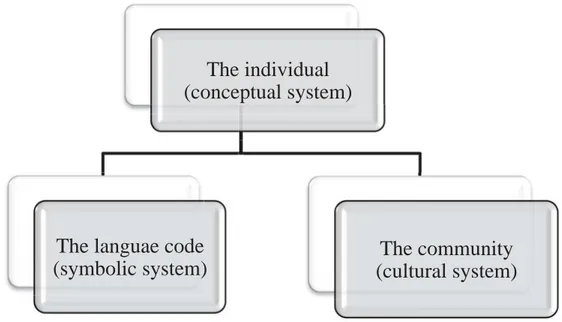
Figure 1: Language System (Corder, 1973, p.71)
Finally, when we refer to the language as “means of communication”, we use language to communicate. He (1973) divided language into linguistic and non-linguistic communication.
The linguistic communication is the one we use a common code, gestures, symbols or conventions characteristics of a language, while the non-linguistic communication is the one where the symbols, gestures or expressions are incomprehensible to the individual.
The individual
(conceptual system)
The languae code
(symbolic system)
Universidad de Valladolid. Paula Larisa Szuhai
Language is a difficult subject to deal with. Although everyone can present diverse theories of what language means, linguists, claim that there is not only a valid definition. In addition, you cannot encompass what the language means in only one statement. Therefore, during the last years, the interest in the language has increased.
3.2 FIRST LANGUAGE ACQUISTION
During the last decades, the acquisition of the language field acquires a significant importance because people communicate throughout the language. Clark Eve (2016) claimed that “using language seems as natural as breathing or walking” (p.1). We learn the language and we learn to communicate since we areborn, but how?
First, depending on the language that an individual learns as his/her mother tongue they will learn rapidly a structure or another, and the process of acquisition will vary.
According to Chomsky there is a “language organ, or `faculty of language´ as we may call it, is a common human possession, varying little across the species as far as we know, apart from very serious pathology” (p.47). He claimed that there is an innate mechanism to acquire a language that only humans possess (Clark, 2016, p.16).
Another important element of Chomsky's theory is the Universal Grammar, UG. There are some “intrinsic set of principle embodied in all languages and in the minds of all human beings” (Cook and Newson, 2007, p. 48), which allow us to acquire a language.
Then, taking into account this property that all human posses to acquire a language is important to state that we also need to be exposed to the input, we need to be exposed to language. Learning a language is “socially marked”, that is the necessity of interaction with other members of the community. For this reason, there are some linguists that affirm that we have to be exposed to the language because in this way we obtain a feedback from the adults (Clark, 2016, p. 24-26).
Input (primary linguistic data)
Universal Grammar
Output (a grammar consisting of principles, parameters and lexicon)
Universidad de Valladolid. Paula Larisa Szuhai
Comprehension seems to be one of the most important components of the acquisition of a language because individuals comprehend before they start to talk (Clark, 2016 p.15).There are several stages of learning since we are born after we can communicate properly.
Newborns children after two months started to produce bubbling words and before two years they can combine some words. After that, they start to produce more coherent structures up to the point of using language as an adult-like. Finally, they acquire complete correct structures, use of vocabulary and different language skills (Clark, 2016, p.15).
1.prelinguistic development – birth to end of the year;
2.single word utterances – from around one year to 1 ½ years of age 3. the first word combinations – from around 1 ½ to 2 years of age
4. simple and complex sentences - the third year of life
(Ingram, 1989, p. 2)
When we are born we cannot speak or communicate. According to Chomsky, all people have an internal mechanism that makes us able to acquire language. For the learning process to be effective, we need to interconnect with the other members of our community. Finally, all the people go through some stages depending on the age that makes us formulate from bubbling to complete and complex structures.
3.3 SECOND LANGUAGE ACQUISITION
As we lived in a multicultural world the acquisition of a second or third language is highly significant because people use it nowadays as means of communication, commerce
and personal occupation. But, what is a multicultural learner?
“Many learners are multilingual in the sense that in addition to their first language they have acquired some competence in more than non-primary language”(Ellis, 1994, p. 11).
Universidad de Valladolid. Paula Larisa Szuhai !
languages are involved in this analysis but also the analysis of their grammars (Richards,1974, p. 4).
Several factors as interlanguage, the environment, motivation, age and the implied difficulties of a language are involved in the process of the second language acquisition.
Authors as Weinreich (qtd.in Richards, 1994, p.310) refer to a “intersystemic interference” (the mixing of the two systems of the languages), that they consider as an inherent feature of the process of learning a second language taking into account that each language has its own system. Other authors as Larry Selinker discovered the the Interlanguage Theory (IT) which was one of the central issue related with the second
language acquisition.
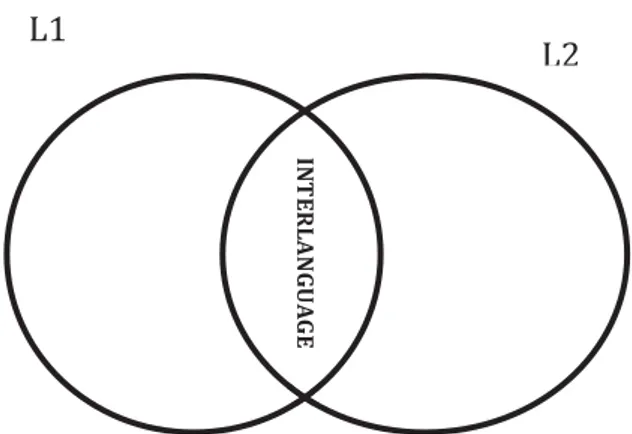
The interlanguage is viewed as a separate linguistic system, clearly different from both the
learner’s ‘native language’ (NL) and the ‘target language’ (TL) being learned, but linked
to both NL and TL by interlingual identifications in the perception of the learner. A central characteristic of any interlanguage is that it fossilizes – that is, it ceases to develop
at some point short of full identity with the target language ( Tarone, 2006, p.747)
As Selinker estbalished, the interlanguage is a kind of mixture between the two language but is considered as independed. Because of this, the adult learners have more difficulties in achieving a proficient level of the second language iif we compared them with
natives speakers.
Figure 3: Interlanguage ( Corder qtd. in Richards, 1974, p.162)
Universidad de Valladolid. Paula Larisa Szuhai "
The second one are the external factors as the environment or the interaction that the learners are exposed to. Ellis (1994) stated that only if the learner access to L2 input, the process of acquisition will take place (p.26). For this reason, he has divided the language acquisition in naturalistic vs. instructed.
A naturalistic acquisition means that the learner acquires the language by himself or herself in social situations, however an instructed acquisition takes place when a teacher “guides” you, as for instance in a classroom context. The effects that instructed learning has are highly different being the instructed superior because the learner “can control very precisely the nature of the input they are exposed to” (Ellis, 1994, p.17).
Motivation varies and the learning too (Ellis, 1994, p.6). The attitude of the learner is very important the same as to understand that each learner´s kowledge is different.
Rebeca Oxford and Jill Sheain (1994) have explained that 218 American students were tested in order to ask about their motivations of studying Japanese. Most of the students have answered that their motivation is future business (instrumental motivational orientation)
while another ones have asnwered that they want to have japanese friends (integrative motivation orientation). Only few of them have answered that they want to study Japanse for cultural knowledge or to know much about their culture.
The same happens with people who go to another country to find a job. They are “forced” to learn the language spokem in this country. Learning the new language means necessity.
As a result of different motivation we may understand that depending on the type of motivation that people have their learning process will be different.That is why some learners acquire fastly and proficiently than others.
Universidad de Valladolid. Paula Larisa Szuhai #
Furthermore, we have to take into account the “Universal hierarchy of difficulty” (Richards, 1974, p.12): there are several inherent features of a language that are difficult not only for foreign learners but for native-speakers too. We have to be aware of this difficulties that sometimes presents a language (Richards, 1974, p.12).
One instance that Richards illustrates is the /v/ and /f/ sounds which are very difficult to be distinguished even for native speakers.
Finally, the first language of the learner has to be taken into account. Languages can be classified in different ways according to their “phonological, syntactic, morphological criteria and so on” (Corder, 1973, p.227).
This classification provides us similarities and differences between languages, and Corder (1973) stated that the languages which present a great amount of similarities will be easier to learn (p.229).
To sum up, when the second language acquisition process takes place we have to bear
in mind different internal factors as the motivation or the interlanguage theory, and external factors as the interaction and the type of instruction that is received because this may provide us clues about the process of the acquisition.
3.4 ERRORS
Learning a new language implies making errors “breaches of rules of our code”
(Corder, 1973, p.258).
We are aware of errors when somebody makes an error concerning our language, but sometimes the attention that we pay to errors make learners feel worried trying to correct them although they can not correct themselves, because they do not know the origin of the errors (Corder, 1973, p.256).
Universidad de Valladolid. Paula Larisa Szuhai $
According to Corder (1973), some people connect different communication skills as poor pronunciation with a poor proficiency of the language. But people who are in contact with foreigners or language learners are aware that these two communication skills have no connection. We can have a poor pronunciation but a good proficiency in English language. So we have to bear in mind the knowledge of language and to know how to deal with errors (Corder, 1973, p.256).
The importance of making mistakes or errors led that learners´ errors may provide feedback for the learner and for the teacher, and this may be helpful for his/her improvement and for the improvement of the method of teaching (Corder, 1973, p. 265).
Corder (1973) stated that:
Erros provide feedback, they tell the teacher something about the efectiveness of his
teaching materials and his teaching techniques, and show him what parts of the syllabus
he has been following have been inadequately learned or taughed and need further attention (p.265).
The information that errors provide is not only feedback to improve our knowledge of a language, it is considered important because after studying the errors of a group of learners we can improve the future syllabus or we may know what parts should we emphasize to achieve a proficient level of the language (Corder, 1973, p.265).
Studying the errors can be considered as a natural implied characteristic of the learning process of a language (Corder, 1973, p.267).
Corder divided mistakes in two groups: errors and lapses. According to him, lapses are the ones that native speakers make when they make slips or confusions of structure. Contrary, he explained that error occurs when unacceptable utterances appear as breaches of a code (Corder, 1973, p.259). Taking into account the interlanguage that a learner of second language has, we are going to focus on those errors that second language learners make.
● “Language transfer”: learners tend to go back to their mother tongue features for the
Universidad de Valladolid. Paula Larisa Szuhai %
Ellis (1994) affirmed that it seems to happens in unmarked structures rather than marked ones, taking into account his definition of markedness as: “a marked linguistic structure is one that can be used with fewer constraints than a related unamerked one” (p.29). We may find mainly to type of transfer: positive transfer and negative transfer or interference.
○ “Positive transfer: “patterns of L1 and L2 are similar” (Ellis,1994, p.29).
○ “Interference” (Richards, 1974, p.6) :“ items produced by the learner which
reflect no the structure of the mother tongue, but generalizations based on partial exoposure to the target language” (Richards, 1974, p.6).
“Code Mixing”
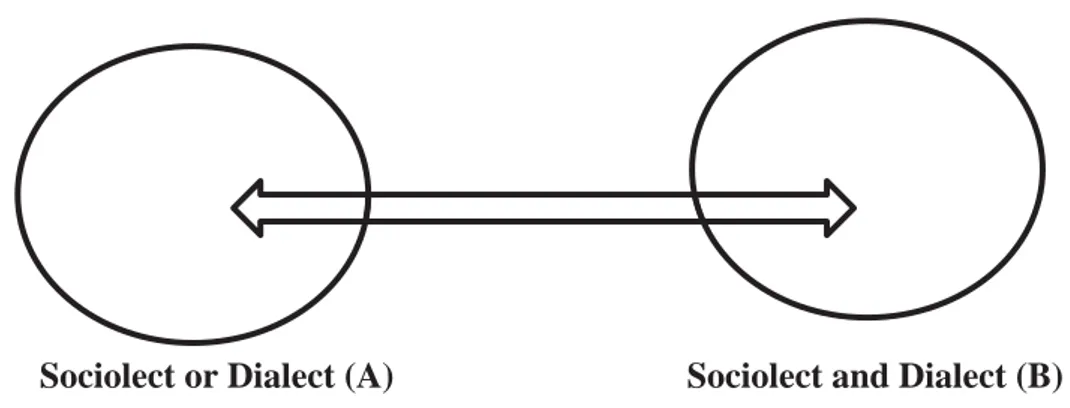
Code mixing is the change of one language to another within the same utterance or in the
same oral/ written text. It is a common phenomenon in societies in which two or more
languages are used. Stud- ies of code mixing enhance our understanding of the nature,
processes and constraints of language (Myers-Scotton, 1993a; Boeschoten, 1998; Azuma,
1998), and of the relationship between language use and individual values,
communicative strategies, language attitudes and functions within particular socio-cultural
contexts (Woon Ye Hoo, 2007)
Figure 4: Code mixing (Corder, 1973, p.56)
● “Code-switching”: the individual switches from one language to another language
(Corder, 1973, p.56).
Universidad de Valladolid. Paula Larisa Szuhai &
● Overgeneralization: “creation of one deviant structure in the place of two target
language structures” (Richards, 1994, p.59).
One example of overgeneralization which is very common is that the learner adds /-ed/ suffix for irregular verbs.
● Fossilization: this process has two main points of view according to different
Selinker in Ellis´s book The Study of Second Language Acquisition. He stated that , on the one hand, learners tend to fossilized due to intern mechanism considered ‘ interlanguage norm’ , especially when they are under presure in the productive
language (Ellis, 1994, p. 353). However, the process of fossilization may be connected with “that process in which the learner’s interlanguage stops developing, apparently permanently” (Tarone, 2006, p.748).
Moreover fossilization process is connected with the Interlanguage Theory. This means that the learners who study a second language , they create a interlanguage in
their mind. This lead them to “fossilizes” ( Tarone, 2006,p. 747).
3.5 LANGUAGE PARAMETERS
As we have explained before, languages show differences and similarities according to different criteria of how they have been classified (syntax, morphology, phonetics etc.) In this dissertation the languages that have been used are English (second language) and
Spanish (mother tongue language) discussed by the syntactic criterion.
Universidad de Valladolid. Paula Larisa Szuhai
Firstly, talking about the subject parameter, the author Permulter writing in Jaeggly y Saffir (1989) stated that there are languages as Spanish, Portuguese and Italian which allow the lack of subject category in a sentence [+NULL SUBJECT LANGUAGE], while languages as French and English are considered [-NULL SUBJECT LANGUAGE] because this type of language do not allow the subject omission in a sentence. Plus null subject languages include empty categories which means that even if the category is hidden in a sentence we may obtain information about it.
[1] Example:
Yo como manzanas todos los días Como manzanas todos los días.
I eat apples every day. Eat* apples every day.
Secondly, before talking about the order of the adjectives in English and Spanish
language, we must know what an adjective is. In agreement with the Oxford English Dictionary an adjective is “A word naming an attribute of a noun, such as sweet, red, or technical.” We can say that adjectives characterize the nouns showing a quality of them.
Although the function of the adjectives is the same in both English and Spanish language,
their formation differ depending on the language.
On the one hand, Spanish adjectives are characterized by their gender and number inflections.
The plural is formed by adding the /-s/ ending after the gender marker or its empty syllable. [2] Example: blanco (singular) → blancos (plural)
According to Stockwell, Bowen and Martin (1965) Spanish adjectives are also marked by genre. They stated that “the normal rule requires alternation between the gender suffixes /-o/ and /-a/ which appear at the end of the steam” (p.47).
Singular Plural
Masculine Feminine Masculine Feminine
blanc-o blanc-a blanc-os blanc-as
Universidad de Valladolid. Paula Larisa Szuhai
On the other hand, English adjectives can not be classified according to their morphological inflections. So they can be classified according to other criteria as it has been said before such us the order they “interact” (Stockwell, Bowen & Martin, 1965, p.49) in a sentence.
[3] Example: “white”
Additionally, another important contrastive feature of adjectives is the order. In English the adjectives go before the noun while in Spanish the adjectives go after the noun that they describe (Durham University). Examples:
[4] Spanish: niña guapa
[5] English: beautiful girl
Finally, Spanish and English languages can be classified according to different criteria representing in this way differences and similarities in their patterns.
As it has been seen, according to the subject parameter English does not allow the omission of the subject in a sentence, while Spanish language provides this features; and according to the order of adjectives we have to bear in mind that in English the adjective goes before the noun.
We have to take into account these features in order to achieve a good level of English.
4
ANALYSIS
Universidad de Valladolid. Paula Larisa Szuhai
4.1 Test
This test aims to develop how far Spanish language parameters influence English language as a second language learning using a test as an instrument.
The instruments are an important part of a study. We have used a test because according to Pit Corder, tests are one of the instruments that help us to “measure” the learner's knowledge. We have focused on a diagnostic test, which is used to “get information about the nature of the learner´s interlanguage” (Corder, 1973, p. 367), in other words, we have tried to focus on what the learner knows.
The test is anonymous and it includes eight sentences that students were asked to translate from Spanish into English and from English into Spanish. The students were asked to translate the sentences because in this way the questions do not provide any clues for the respondents. The length of the test is approximately one page being clear and brief for the students, and it has been completed in class.
For the classification part, no type of identification of students has been used because all the students were from 3rd ESO (same age) with the same English level, no significant differences between them. As we focused on linguistic elements of language no genre identification was needed.
The grammatical issues that have been included in this test are: (1) the order of adjectives and (2) the omission of the subject.
Also, we have focused on what the students have learnt previously in Spanish
language and English language. In this way they were not asked to translate grammar features that they have not learnt yet. It is also important to mention that for the translation of the survey it was used recent vocabulary that students have learnt in the class.
Model of test
1. Ojos negros enfadados (SP→ EN) _________________________ 2. Pelo largo maravilloso (SP→ EN)
Universidad de Valladolid. Paula Larisa Szuhai
_________________________ 4. Old-fashioned small car (EN→ SP)
_________________________
5. Ella es una buena cantante. También toca la guitarra. (SP→ EN) _________________________
6. Llego tarde (SP→ EN)
_________________________ 7. Está lloviendo (SP→ EN)
_________________________
8. Me dijo que no tenía una televisión grande (SP→ EN) _________________________
4.2 Contextualization
The test has been completed in Antonio Tovar college situated in Valladolid, Spain during the Practicum.
It is located in a neighbourhood in Valladolid, near the central are of the city. The neighbourhood is divided basically in three main parts depending on the social status of the families that live there. The first one corresponds to the medium-high class, the second one
to the medium class and the third one to the working class.
Besides, its location has an appropriate connection with the means of transport of the city so for this reason, many students from different areas of Valladolid go to this center.
In this college we may find foreigners and Roma origins, although the percentage is very low. There is a bilingual section for those students who have a higher level of English or fo those who want to participate in this section.
The students that completed the test belong to the same class (3rd ESO) having the same age, as well as the level of English, because none of them had special certification of superior level of English.
Universidad de Valladolid. Paula Larisa Szuhai !
The number of the students was twentyt-three, twenty one were native Spanish speakers being their mother tongue Spanish language while two of them were foreigners learners of Spanish. All of the students were learners of English as L2 language. As they were Spanish natives, the acquisition that they have received is the “instructed” (Ellis,1994, p.12) one.
The instruction given was to complete the test in class because in this way we avoid problems of searching for further information at home.
5
ANALYSIS RESULTS AND COMMENTS
This section includes the results of the analysis after completing the tests. It has been
included several subsections as (1) the description of the general table, (2) results of the order of adjectives, (3) results of subject-omission section and finally (4) a brief conclusion. The results were classified in different graphs discussing the most significant parts and also some examples of the test were included.
Universidad de Valladolid. Paula Larisa Szuhai "
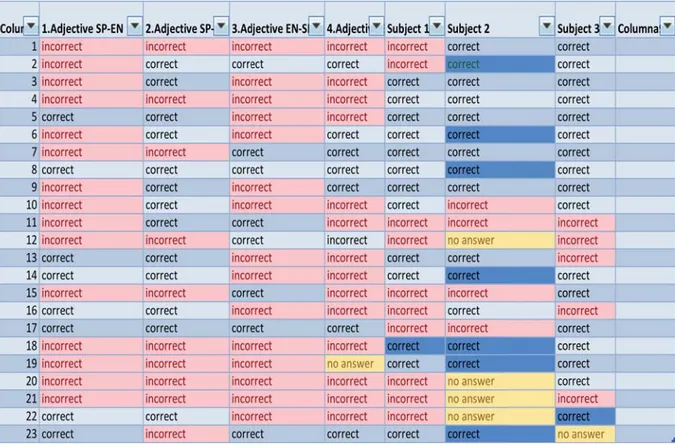
Table 2: General data of each sentence in the test
First, for the collection of the data, it has been created a table in Excell Format, in which the main sentences of the test appeared. Then, we have divided the table into eight sections, being the first four related with the adjective section, and then the next four ones are related with the subject-omission section. Also, for the identification of the result, we have used several colors (red, yellow and blue) as it can be seen in the table.
As we have said before, the test was anonymous so we have numbered the test without following a specific order so as to make it easier to analyze. So, for this reason, the first column corresponds to the number of the participants.
The wrong answers were highlighted in red color and also the word “incorrect” was added throughout the table. They were considered errors according to Corder (1973) who said that error is “branches of the code” (p. 259).
Universidad de Valladolid. Paula Larisa Szuhai #
color corresponds to the subject-omission section in which the participants answer correctly that there was a subject in the sentence although not the accurate one.
Finally, the yellow color was used for those participants who did not know the answer and they did not answer the sentence.
5.2 Adjectives Section
In this section, we have studied how participants have translated the sentences provided in the test taking into account the difference between the order of adjectives in English and Spanish language.
For the analysis of the results, we have to count the incorrect and correct answers and we have identified the most common errors of learning throughout this process. It is important to mention that sometimes the participants did not write the appropriate adjective for the sentence, but this was not relevant to the study. We have focused on how the participant identified the order of adjectives.
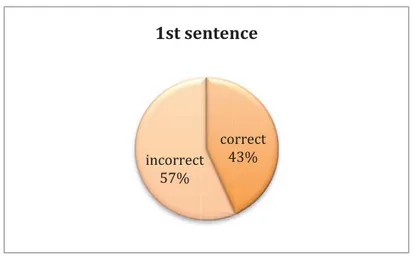
1.Ojos negros enfadados
Figure 5: Graph 1st sentence
As we can see in this first sentence, 57% of the answers of the class were wrong. The main problems were the misunderstanding of the category of the word, the process of
! ' "$'
Universidad de Valladolid. Paula Larisa Szuhai $
overgeneralization and transfer. These problems or errors are a common feature of the process learning of a second language as we have explained in the Error Section (3.3).
Firstly, the participant misunderstands the category of word. He /she has used an adverb instead of an adjective.
Example [6]: black angrily eyes
Secondly, as we can see in the examples above, the participants add /–s/ to the adjectives, and as we have mentioned before the English adjectives have no number inflection. This happens because they overgeneralize the common rule of the number.
Examples:
[7] eyes blacks angrys [8] eyes blacks hungrys [9] black eyes borings
[10] eyes black angrys
Finally, the most common error was the process of transfer. Spanish participants tend to apply Spanish grammatical rules for English language. In this case they translate the
sentence in the same order as the Spanish was provided; being this erroneous because the English adjectives go before the noun. Two instances are:
[11] eyes black angry [12] eyes blacks angry
In general, the participants who show us a transfer process in their learning also made the number mistake of adding the final /- s/ to the English adjectives.
Universidad de Valladolid. Paula Larisa Szuhai %
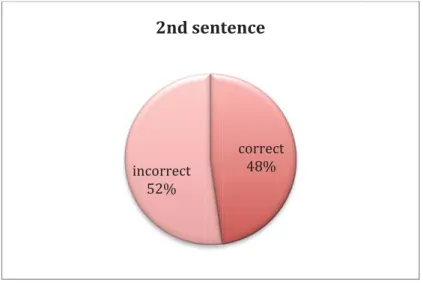
Figure 6: Graph 2nd sentence
In the second sentence that the participants translated, the results show us that 52% of the participants wrote incorrectly the sentence. In this case, their main problem was the process of transfer again. When translating the sentence, they follow the same order of adjectives as in Spanish and once again this is erroneous in English language:
[13] Head large amazing [14] Hair large …
[15] Hair great long
Also, in the example [14] the participant did not add the final adjective for the sentence, although they use sometimes inappropriate adjectives, we have checked them as
correct because we have focused on the order.
3.Big black garage
!%' "'
Universidad de Valladolid. Paula Larisa Szuhai &
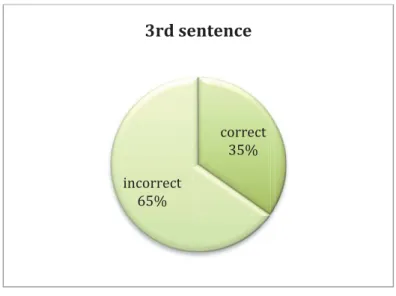
Figure 7: Graph 3rd sentence
In this sentence the percentage of the incorrect answers (65%) exceeds the number of the correct answers (35%). The most relevant issue is that in this case, just one participant
made transfer when translating. Maybe, this may happen because we have changed the target language of the sentence.
Example [16] grande y negro garaje
Other incorrect answers were incorrect because the participants made a “mixing of rules” when translating.
[17] gran garaje negro [18] grande garaje negro [19] negro y negro garaje [20] negro y grande garaje
4.Old-fashioned small car
"'
#"'
Universidad de Valladolid. Paula Larisa Szuhai
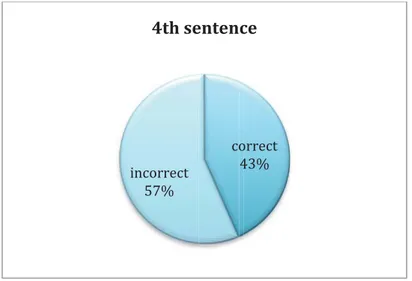
Figure 8: Graph 4th sentence
Dealing with the final sentence of this section, we can see that one again the results show more incorrect (57%) results than correct ones (43%). This happens due to the process of transfer as in the sentences previously seen.
Instances:
[21] viejo pequeño coche
[22] viejo- fascinante pequeño coche [23] toda la moda en pequeño coche
[24] viejo- fashion coche pequeño [25] pequeño coche antiguo
As a general rule the participants translate the sentence as it was written without
paying attention to the correct grammatical rule of English adjectives. Also they produce “mixture of the code” in the example number 25.
5.3 Subject Section
As we have explained before, Spanish language allows the omission of the subject while the English language does not allow it, so we have focused on how this influenced the
participant.
! ' "$'
Universidad de Valladolid. Paula Larisa Szuhai
The subject section results were divided into three main parts for the data collection. The first part was if the participant omits the subject, the second one if she/he did not and the third one was that sometimes he/she used a different subject.
5.Ella es una buena cantante. También toca la guitarra
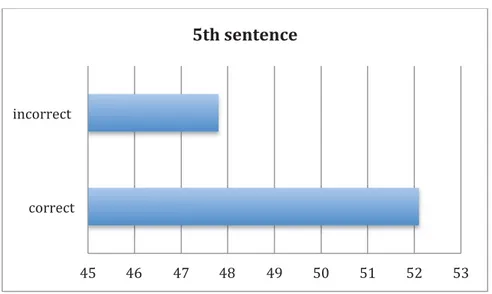
Figure 9: Graph 5th sentence
In this sentence, the participants have obtained more correct answers (52%) than incorrect ones (48 %).
Although the correct exceeds the incorrect ones, the result number is almost similar. This means that 50 % of the class omits the subject, which probably is influenced by the parameters of their language. Moreover, in this case, everybody has answered the sentence.
6.Llego tarde
!" !# !$ !% !& " " " "
Universidad de Valladolid. Paula Larisa Szuhai
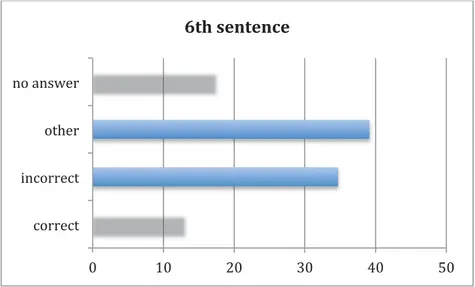
Figure 10: Graph 6th sentence
Sentence number 6 was very interesting to analyze for two main reasons. The first reason is that, this sentence is learnt when beginners learn a language, we can say that is “typical sentence” that everybody knows; and the second reason is that participants have used other subject for the sentence or the number of no answers exceeds the number of the correct answers. (See graph above)
First, as we can read in the graph 35% of the participants omit the subject. Then almost 40% of the participants have used another subject to complete the sentence, as for example:
[26] it is late [27] he came later [28] She´ll came late
7.Está lloviendo
! "
Universidad de Valladolid. Paula Larisa Szuhai
Figure 11: Graph 7th sentence
In this case, the correct answers number (65%) exceeds the number of incorrect answers (21%). The percentage of correctness is the highest in this sentence compared with the other ones in this section.
Some examples of the incorrect answers were:
[29] there is rain the participant uses another subject [30] is raining the participant does not use a subject [31] is rain the participant does not use a subject
&
Figure 12: Graph 8th sentence
! " # $
! " # $
Universidad de Valladolid. Paula Larisa Szuhai !
In this last graph of sentence number eight we can see that the number of correct answers exceeds the number of incorrect ones. The results show us that in this sentence almost 50% of the class does write the subject.
This sentence was one of the most significant for the study because it is considered more difficult for 3rd ESO students, and it obtains better results.
Regarding the correct answers, there were subjects, which were not appropriate for the sentence because students use another person and number. However, they were counted as correct because once again the most important thing for the analysis was that the student might be able to identify the subject in the sentence. Also we do not pay attention to the
grammatical errors of the sentence.
Examples:
[32] it tells me that he haven´t a big television [33] he told me that she didn´t have a big TV
[34] he talk me that he didn’t have a big television
Regarding the incorrect answers we can divide them into: omission of both subjects and omission of one of the subjects (mainly the second one).
It is very curious the fact that the students omit only the second subject in the second set of examples. This may happen because of they probably translate the sentence as it “sounds” in Spanish.
The same happens in the first set of examples where the students omit both subjects. They do not realize that even if in Spanish language sounds strange they have to put a subject for each clause within a sentence. Once again, the process of transfer affects the students.
Universidad de Valladolid. Paula Larisa Szuhai "
Examples of omission of one of the subjects [38] It talk don´t have a big television [39] He say me hasn´t the big television [40] He hasn´t a big television
Even if the 8th sentence has a major complex than the fifth sentence, this sentence obtains better results of 65% of correct answers.
The main difference between the fifth and this last sentence may be the verb. We think that when the sentence includes the verb “to be”, they tend to omit the subject more often than the sentence includes other type of verb.
However, the process of transfer still appears in the tests inhibit in this way the proficiency of the students in English language.
5.4 Comments
After the results of the test, we can summarize that the number of errors dealing with the adjective order section is higher (more than 50% of the class) than the subject-omission section, being both of them studied previously by the students.
On the one hand, in the adjective section, the most common errors of the learners were the process of transfer and the mixing of ideas or rules of a Spanish language with the English language. The process of transfer (features of L1) was almost present in all the analysis, which means that it is very significant when studying English as a second language.
I t is also important to mention that when a participant made an error ordering the adjectives with their noun in English, the same happens in Spanish. In other words, the language of the sentences is not a problem; the problem is that the learners do not have a
clear representation of the rules of each language.
Universidad de Valladolid. Paula Larisa Szuhai #
compared with the adjective section. For this reason, we may discuss that the order of the adjectives seems to be a more complex issue to learn than subject in English language.
However, no connection between the sections was established, which means that there were participants who have done correctly the adjective section or the subject-omission section.
One important thing to highlight is that there was only one participant who has done the entire test correctly. This means that the process of transfer seems to be very influential in the learning of English.
Finally, we have to take into account the results of this analysis to understand the process of learning a second language, in this case, English, being Spanish natives speakers. The results may provide teachers feedback in order to understand better how to face problems of learning.
Universidad de Valladolid. Paula Larisa Szuhai $
6
CONCLUSIONS
Error analysis has increased its importance due to the necessity of learning several
languages in our lives. The process of learning a language seems to be easy to define by everyone but it led us to make errors. According to linguistics, these errors are considered part of the process of acquisition and it attends us as feedback for the learner´s level improvement and also help teachers to improve their teaching methods and syllabus.
This dissertation dealt with the errors produced by Spanish students of 3rd ESO concerning the order of adjectives and the omission of the subject in English language. After the analysis, the data of the tests show us that the mother tongue of the learners has a huge
influence in the process of learning another language.
One the one hand, regarding the order of adjectives we have to say that, even it is a grammatical feature that children learn since they are very small, the results show us that mainly the 50% of the class has problems in this situation.
The higher percentage corresponds to students who make the “transfer process” throughout the test. They have tended to copy the same order as the sentence as the translation provides. Moreover, they have mixed in some cases the order of adjectives of both languages (code-mixing). Both processes were explained in detail in Pir Corder´s book, Introducing Applied Linguistics mentioned before, as a stage in the process of learning languages.
On the other hand, concerning the subject-omission section, the incorrect sentences were due to this omission of the subject. The results show us that almost the 50% of the class omit sometimes the subject of the sentence or they wrote another inappropriate subject. As we have explained in the Theoretical Framework Section (2), Spanish language allows the omission of subjects due to its verbal inflections; however, in the English language we cannot omit the subject of the sentence because it is considered ungrammatical.
Universidad de Valladolid. Paula Larisa Szuhai %
incorrect ones. The last sentence was considered more difficult than the other one ( because it has two subjects), however it obtains better results.
Finally, concerning the two section that we have previously analyzed (order of adjectives and subject-omission sections), we may say that there were a greater amount of errors in the order of adjectives (50%) than in the subject-omission section because students sometimes replace the subject for another one. Only one student completed the test correctly, so this may us highlight the importance of studying the origin of these errors.
The main conclusion that we can draw from this dissertation is that students are highly affected by their mother tongue rules. They tend to mix or to go back to their mother
tongue for studying the new language.
We have considered this conclusion very significant because, in this way, we may understand better the process of acquisition of a second language, we can test the students to know their level of English, and the final and the most important one is that studying this
errors, teachers can elaborate different activities to solve these problems of transferring and improve the syllabus of the students.
Universidad de Valladolid. Paula Larisa Szuhai &
7
REFERENCES
Clark, E. (2016). First Language Acquisition (3rd ed.). Cambridge University Press.
Cook, V., & Newson, M. (2007). Chomsky´s Universal Grammar: An Introduction (3rd ed.). Blackwell.
Corder, S. (1973). Introducing Applied Linguistics. Great Britain :Penguin Education.
Dictionary.com | Meanings and Definitions of Words at Dictionary.com. (n.d.). Retrieved June
3, 2018, from http://www.dictionary.com/
Du, X. (n.d.). The Affective Filter in Second Language Teaching, 5(8). Retrieved from http://www.ccsenet.org/journal/index.php/ass/article/viewFile/3457/3131
Ellis, R. (1994). The study of second language acquisition. Oxford University Press
E., T. (1994). Interlanguage, 4, 1715-1719. Retrieved from
http://socling.genlingnw.ru/files/ya/interlanguage%20Tarone.PDF
Ingram, D. (1989). First Language Acquisition: Method, Description and Explanations (pp. 1-3). Cambrige Universitu Press.
Jaeggli, O. A., & Safir, K. J. (1989). The Null Subject Parameter. Springer Netherlands.
James, C. (n.d.). Errors in language learning and use : exploring error analysis. Retrieved from
https://books.google.es/books?id=DxJEAgAAQBAJ&printsec=frontcover&dq=error+a
nalysis&hl=en&sa=X&ved=0ahUKEwjimfO-z7fbAhWGtRQKHWpiCwoQ6AEIMzAC#v=onepage&q=error analysis&f=false
Johnston Da Cruz, Z. (2015). First Language Acquisition: Is Children´s knowledge of language innate? (B.A). University of Iceland. Retrieved from:
Universidad de Valladolid. Paula Larisa Szuhai !
Longman. (2010). Longman Dictionary of Language Teaching and Applied Linguistics. (J. C. Richards & R. Schmidt, Eds.) (4th ed.). Routledge.
McMillan, B., & Turnbull, M. (2009). First Language Use in Second and Foreign Language Learning. First language use in second and foreign language learning.
Origen e Historia del idioma Inglés |. (n.d.). Retrieved May 9, 2018, from http://www.privateacher.edu.pe/blog/?p=47
Oxford Dictionaries | The World’s Most Trusted Dictionary Provider. (n.d.). Retrieved June 3, 2018, from https://www.oxforddictionaries.com/
Oxford, R., & Sheain, J. (1994). Language Learning Motivation: Expanding the Theoretical
Framework. Modern Language Journal. Retrieved from
https://onlinelibrary.wiley.com/doi/abs/10.1111/j.1540-4781.1994.tb02011.x
Position of adjectives in Spanish. (n.d.). Retrieved May 18, 2018, from https://community.dur.ac.uk/m.p.thompson/adjectives.htm
Private News. (2015). Retrieved from http://www.privateacher.edu.pe/blog/?p=47
Richards, J. (1974). Error Analysis: Perspectives on Second Language Acquisition (6th ed.). England: Longman.
Spangler, D. (2011). Strategies for teaching fractions: Using Error Analysis for Intervention and Asessment. Califonia: Corwin.
Stockwell, R. P., Bowen, J. D., & Martin, J. W. (1965). The grammatical structures of English and Spanish : [an analysis of structural differences between the two languages]. University of Chicago Press.
Universidad de Valladolid. Paula Larisa Szuhai ! Woon Yee Ho, J. (2007). Code-mixing: Linguistic form and socio-cultural meaning. The
International Journal Of Language Society And Culture, (21). Retrieved from