Intravenous immunoglobulin plus corticosteroid to
prevent coronary artery abnormalities in Kawasaki
disease: a meta-analysis
Shaojie Chen,
1Ying Dong,
2Yuehui Yin,
1Mitchell W Krucoff
31Department of Cardiology,
The Second Affiliated Hospital of Chongqing Medical University, Chongqing, China
2Department of Neonatology,
Children’s Hospital of Chongqing Medical University, Ministry of Education Key Laboratory of Child Development and Disorders, Key laboratory of Pediatrics in Chongqing and Chongqing International Science and Technology Cooperation Center for Child Development and Disorders, Chongqing, China
3Duke University Medical
Center, Duke Clinical Research Institute, 508 Fulton Street, Durham, North Carolina, USA
Correspondence to Dr Shaojie Chen, or Yuehui Yin, Department of Cardiology, The Second Affiliated Hospital of Chongqing Medical University, 76 Linjiang Road, Yuzhong District, Chongqing, 400010, China;
[email protected] [email protected]
Received 27 March 2012 Accepted 8 May 2012 Published Online First 6 August 2012
To cite:Chen S, Dong Y, Yin Y,et al.Heart2013, 99, 76–82.
ABSTRACT
Objective To summarise clinical trials that compared the incidence of coronary abnormality between intravenous immune globulin (IVIG) plus corticosteroid therapy and IVIG therapy alone, and to determine the overall efficacy and safety of IVIG plus corticosteroid therapy for the initial treatment of Kawasaki disease.
Background Although use of IVIG as initial therapy has been established in Kawasaki disease, the role of corticosteroids therapy is controversial.
Methods Medline, The Cochrane Library, The Clinical Trials, and Embase Database were searched for published clinical studies up to 31 March 2012. Studies that compare the efficacy of IVIG plus corticosteroid with that of IVIG in treating Kawasaki disease were included. The coronary outcome and adverse events were analysed by meta-analysis.
Results 9 clinical studies with a total of 1011 patients were identified. Meta-analysis of the 9 studies showed that IVIG plus corticosteroid therapy significantly reduced the risk of coronary abnormality (OR: 0.3; 95% CI 0.20 to 0.46). Similar results were observed in subgroup analyses of randomised controlled studies (OR: 0.3; 95% CI 0.18 to 0.5), studies focused on patients with a high risk of IVIG resistance (OR: 0.2; 95% CI 0.1 to 0.36) and studies with blinded-endpoint manner (OR: 0.32; 95% CI 0.19 to 0.55). There was no significant difference in the incidence of severe adverse events between the IVIG plus corticosteroid group, and the IVIG group (OR: 1.24; 95% CI 0.33 to 4.67).
Conclusions Combination of corticosteroid with the conventional regimen of IVIG as an initial treatment strategy could reduce the risk of coronary abnormality.
INTRODUCTION
Kawasaki disease is often complicated by an acute, self-limited vasculitis that occurs predominantly in infants and young children. Coronary artery aneur-ysms, or ectasia, develop in 15%–25% of untreated children with the disease and lead to myocardial infarction, ischaemic heart disease or sudden death. In the USA, Kawasaki disease has surpassed acute rheumatic fever as the leading cause of acquired heart disease in children. Since it wasfirst described in Japan in l967 by Tomisaku Kawasaki, the disease has been known to occur in both endemic and community-wide epidemic forms in the Americas, Europe and Asia, in children of all races.1–4
The treatment with intravenous immunoglobulin plus aspirin has been proved to resolve infl amma-tion, and reduces the occurrence of coronary artery abnormalities.5–7 However, about 20% of patients
have persistent or recurrent fever after completion
of intravenous immunoglobulin, and these patients have a particularly high risk of developing coronary artery abnormalities.8 9Although corticosteroid is a
useful treatment option for various forms of vascu-litis, many physicians hesitate to use them because a report showed a high incidence of coronary artery abnormalities in patients who received a pro-longed course of oral prednisolone.10
Several clinical trials have been performed to investigate the efficacy of corticosteroid in Kawasaki disease11–27; however, the role of a corticosteroid in
the initial treatment of Kawasaki disease has not been established. In 2007, a multicentre, mixed ethnic group, prospective, blinded-endpoint, rando-mised, controlled trial reported that the efficacy of pulsed intravenous methyprednisolone added to conventional therapy did not improve coronary artery outcomes.24Recently, we noted in a Japanese study conducted in a prospective, randomised, blinded-endpoints, controlled design, that primary treatment with IVIG plus prednisolone significantly reduced the risk of coronary abnormality in patients with severe Kawasaki disease.27 Based on the
con-troversial results, in order to further investigate the potential benefit of corticosteroid in an enlarged population, we performed the present study to sys-tematically identify clinical trials that compared the efficacy of IVIG plus corticosteroid therapy, and IVIG therapy, for the initial treatment with respect to the coronary artery outcome.
METHODS
To perform a meta-analysis of clinical trials is still chal-lenging because of different study designs and poten-tial biases. Hence, we conducted this study according to the guideline of PRISMA Statement (The PRISMA statement for reporting systematic reviews and meta-analysis of studies that evaluate healthcare inter-ventions: explanation and elaboration).28
Inclusion criteria
Studies were included if they met the following cri-teria: (1) subjects had a stated diagnosis of Kawasaki disease4 29 30; (2) studies parallelly com-pared the efficacy of IVIG plus corticosteroid and IVIG alone therapy; (3) two-dimensional echocar-diography, or coronary artery catheterisation, was performed to detect the presence of coronary artery abnormality during study follow-up.
Information source and study selection
Two investigators independently performed the data search, employing the search theme, ‘Kawasaki, clinical study’. Searches of published ▸ http://dx.doi.org/10.1136/
studies were performed by Medline, The Cochrane Library, The Clinical Trials and Embase Database up to 31 March 2012. The reports were screened using the titles and abstracts, and articles relevant to our subject were reassessed by reviewing the full text. Disagreement about studies selection was resolved by con-sensus, when necessary. Detailed characteristics of included studies were recorded on our original information table. Primary outcome was incidence of patients with coronary artery abnormality per group during follow-up assessment. The severe adverse events per group during the study period were also estimated.
Quality assessment
The quality of each study was rated by using the following schema31:
1. Were the criteria for the diagnosis of Kawasaki disease stated explicitly? (defined as: (a) a statement that all patients met the diagnostic criteria of the American Heart Association; (b) a statement that all patients met the diagnostic criteria of the Japanese Ministry of Health or (c) fever for 5 days plus any four of the following: conjunctivitis, mucositis of the oral pharynx, peripheral oedema, unilateral lymphadenop-athy, and rash) (score: yes = 1; no = 0).
2. Was an experimental study design used? (score: rando-mised, controlled, prospective study with defined protocol = 2; controlled, defined protocol = 1; none = 0). 3. Was follow-up coronary imaging performed after enrolment?
(score:≥4 weeks = 2; 2≤weeks<4=1; not stated = 0). 4. Was coronary imaging interpreted in a blinded manner?
(score: yes = 1; no or not stated = 0). Each study was scored by the investigators. Conflicts about quality scoring were resolved by consensus.
STATISTICAL ANALYSIS
All the statistical analyses in this meta-analysis were performed on the basis of intention-to-treat principle. The significance between two groups of this meta-analysis was estimated by OR with a two-tailed 95% CIs. Afixed-effects model was employed for consistent outcome variables, and a random-effects model for inconsistent outcome variables. Heterogeneity was assessed by means of a Cochran Q test. Statistic value I2represented the degree of inconsistency with a score of 25%, 50% and 75%, representing low, moderate and high levels of inconsistency, respectively. p Value for the test of heterogeneity less than 0.01 was considered significantly heterogeneous between studies. If heterogeneity was observed between pooled studies, further sen-sitivity analyses were performed to detect potential confounding
variables. Statistical analyses procedures were performed using the Revman software package (Review Manager, Version 5.0, The Cochrane Collaboration, Oxford, UK).
RESULTS Studies selection
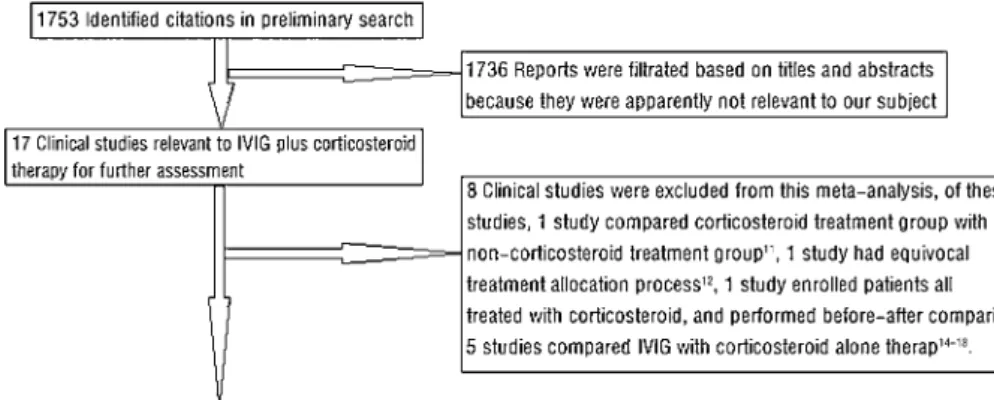
The study selection process is illustrated in figure 1. A total of 1753 items of literature was retrieved in our primary search. After screening titles and abstracts, 1736 were excluded due to irrelevance. The remaining 17 clinical studies relevant to cor-ticosteroid treatment were selected for further assessment. Eight studies were excluded. Of these studies, one study compared a corticosteroid treatment group with a non-corticosteroid treat-ment group,11 one study had equivocal treatment allocation
process,12one study enrolled patients who were all treated with corticosteroid, and performed a before/after comparison,13 five
studies compared IVIG with corticosteroid alone therapy.14–18 Consequently, nine clinical studies were enrolled in this meta-analysis.
Baseline characteristics of included study
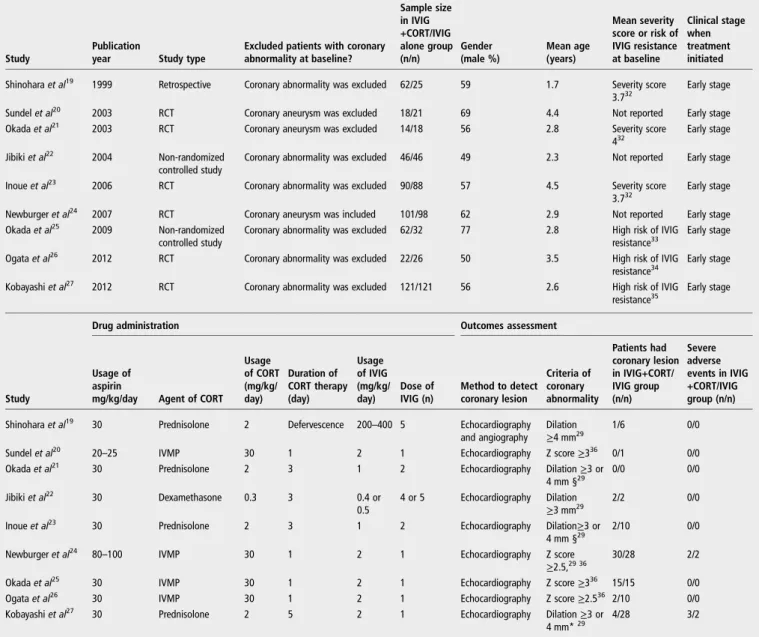
As shown in table 1, seven of the nine studies were conducted in Japan,19 21–23 25–27the other two were in the USA.20 24The time of publication ranged from 1999 to 2012. The overall study population included in this study was 1011; 59% were men, 536 were allocated to the IVIG plus corticosteroid group and 475 to the IVIG group. The mean age ranged from 1.7 years to 4.5 years. The mean severity score32 ranged from 3.7 to 4, whereas, three studies25–27 enrolled a high-resistant risk33–35 of IVIG therapy patients. All studies initiated primary treatment at an early clinical stage (within thefirst 10 days). For the drug administration during study period, all patients enrolled in the included studies received aspirin. The usage of aspirin was 30 mg/kg/day in seven studies19 21–23 25–27 20–
25 mg/kg/day in one study20 and 80–100 mg/kg/day in one study.24 There were four studies using prednisolone 2 mg/kg/ day,19 21 23 27four studies using intravenous methyprednisolone (IVMP) 30 mg/kg/day20 24–26 and one study using dexametha-sone 0.3 mg/kg/day22as corticosteroid agents. Five studies admi-nistrated IVIG 2 mg/kg/day for one dose,20 24–27 two studies 1 mg/kg/day for two doses,21 23 one study 200–400 mg/kg/day forfive doses19and one study 0.4 or 0.5 mg/kg/day for four or
five doses.22 Two-dimensional echocardiogram was used in all studies to detect coronary abnormality during study follow-up.
Quality assessment
The quality assessment of nine studies selected in the meta-analysis is shown in table 2. All the included studies
defined their diagnostic criteria for Kawasaki disease. Of the nine eligible studies, six studies used a prospective, randomised, controlled method,20 21 23 24 26 27 two studies were non-randomized-controlled trials22 25 and one study was a
retrospective report.19 Seven studies had coronary imaging follow-up of 4 weeks or more,19–21 23 24 26 27 whereas, two studies had coronary imaging follow-up less than 4 weeks.22 25 Four studies reviewed the coronary image in a blinded Table 1 The demographic, clinical treatment and outcome characteristics of nine studies included in the meta-analysis
Study
Publication
year Study type
Excluded patients with coronary abnormality at baseline?
Sample size in IVIG +CORT/IVIG alone group (n/n)
Gender (male %)
Mean age (years)
Mean severity score or risk of IVIG resistance at baseline
Clinical stage when treatment initiated
Shinoharaet al19 1999 Retrospective Coronary abnormality was excluded 62/25 59 1.7 Severity score
3.732
Early stage
Sundelet al20 2003 RCT Coronary aneurysm was excluded 18/21 69 4.4 Not reported Early stage
Okadaet al21 2003 RCT Coronary aneurysm was excluded 14/18 56 2.8 Severity score
432
Early stage
Jibikiet al22 2004 Non-randomized
controlled study
Coronary abnormality was excluded 46/46 49 2.3 Not reported Early stage
Inoueet al23 2006 RCT Coronary abnormality was excluded 90/88 57 4.5 Severity score
3.732
Early stage
Newburgeret al24 2007 RCT Coronary aneurysm was included 101/98 62 2.9 Not reported Early stage
Okadaet al25 2009 Non-randomized
controlled study
Coronary abnormality was excluded 62/32 77 2.8 High risk of IVIG resistance33
Early stage
Ogataet al26 2012 RCT Coronary abnormality was excluded 22/26 50 3.5 High risk of IVIG
resistance34
Early stage
Kobayashiet al27 2012 RCT Coronary abnormality was excluded 121/121 56 2.6 High risk of IVIG
resistance35 Early stage
Drug administration Outcomes assessment
Study
Usage of aspirin
mg/kg/day Agent of CORT Usage of CORT (mg/kg/ day)
Duration of CORT therapy (day)
Usage of IVIG (mg/kg/ day)
Dose of IVIG (n)
Method to detect coronary lesion
Criteria of coronary abnormality
Patients had coronary lesion in IVIG+CORT/ IVIG group (n/n)
Severe adverse events in IVIG +CORT/IVIG group (n/n)
Shinoharaet al19 30 Prednisolone 2 Defervescence 200–400 5 Echocardiography
and angiography Dilation
≥4 mm29 1/6 0/0
Sundelet al20 20–25 IVMP 30 1 2 1 Echocardiography Z score≥336 0/1 0/0
Okadaet al21 30 Prednisolone 2 3 1 2 Echocardiography Dilation≥3 or
4 mm §29
0/0 0/0
Jibikiet al22 30 Dexamethasone 0.3 3 0.4 or
0.5
4 or 5 Echocardiography Dilation
≥3 mm29
2/2 0/0
Inoueet al23 30 Prednisolone 2 3 1 2 Echocardiography Dilation≥3 or
4 mm §29
2/10 0/0
Newburgeret al24 80–100 IVMP 30 1 2 1 Echocardiography Z score
≥2.5,29 36
30/28 2/2
Okadaet al25 30 IVMP 30 1 2 1 Echocardiography Z score≥336 15/15 0/0
Ogataet al26 30 IVMP 30 1 2 1 Echocardiography Z score≥2.536 2/10 0/0
Kobayashiet al27 30 Prednisolone 2 5 2 1 Echocardiography Dilation≥3 or
4 mm*29
4/28 3/2
*Dilation≥3 or 4 mm: a coronary artery was defined as abnormal if the internal lumen diameter was >3 mm in a child <5 years, or >4 mm in a child≥5 years according to Japanese Ministry of Health and Welfare.
RCT, randomized controlled trial; IVIG, intravenous immunoglobulin; CORT, corticosteroid; IVMP, intravenous methyprednisolone; IVIG, intravenous immunoglobulin; CORT, corticosteroid;
Table 2 Quality assessment of nine studies included for the meta-analysis
Study Diagnostic criteria Study design Imaging follow-up Blinded outcome Total score
Shinoharaet al199919 1 1 2 0 4
Sundelet al200320 1 2 2 1 6
Okadaet al200321 1 2 2 0 5
Jibikiet al200422 1 1 1 0 3
Inoueet al200623 1 2 2 0 5
Newburgeret al200724 1 2 2 1 6
Okadaet al200925 1 1 1 0 3
Ogataet al201226 1 2 2 1 6
manner,20 24 26 27while no statement about blinded manner of outcome assessment was noted in the remaining studies.
Meta-analysis
When outcome of the nine included studies were combined, sig-nificantly fewer patients who received IVIG plus corticosteroid therapy experienced coronary artery abnormality than those who received IVIG therapy alone (7.6% vs 18.9%; OR: 0.3; 95% CI: 0.20 to 0.46; p<0.001), the test for heterogeneity (I2=51%; p=0.05) (figure 2).
Sensitivity analyses
To explore and control possible confounding variables, we also performed subset analyses. There were six prospective rando-mised controlled studies.20 21 23 24 26 27 When outcomes of
these studies were combined, the IVIG plus corticosteroid group still had significantly fewer coronary artery abnormalities com-pared with the IVIG alone group (6.3% vs 18%; OR: 0.3; 95% CI 0.18 to 0.5; p<0.001), the test for heterogeneity (I2=61%;
p=0.04) (figure 3).
Three studies enrolled patients with a high risk for IVIG resistance.25–27When outcomes of these studies were combined, the benefit of lower incidence of coronary abnormality in the IVIG plus corticosteroid group seemed more significant (10.2% vs 29.6%; OR: 0.2; 95% CI 0.1 to 0.36; p<0.001) with the test for heterogeneity (I2=29%; p=0.25) (figure 3).
Patients in four studies received prednisolone,19 21 23 27while
patients in another four studies received IVMP20 24–26 as cor-ticosteroid agents. To control different corcor-ticosteroids prepar-ation as confounding variable, we included four studies administering prednisolone. Patients in the IVIG plus prednisol-one group experienced significantly lower incidence of coronary artery abnormalities compared with the IVIG alone group (2.4% vs 17.5%; OR: 0.12; 95% CI 0.05 to 0.26; p<0.001) with the test for heterogeneity (I2=0%; p=0.67) (figure 3).
When four studies administrating IVMP were included, patients in the IVIG plus IVMP group still experienced significantly lower incidence of coronary artery abnormalities compared with the IVIG alone group (15.8% vs 24.9%; OR: 0.48; 95% CI 0.28 to 0.81; p=0.006) with the test for heterogeneity (I2=18%; p=0.3) (figure 3).
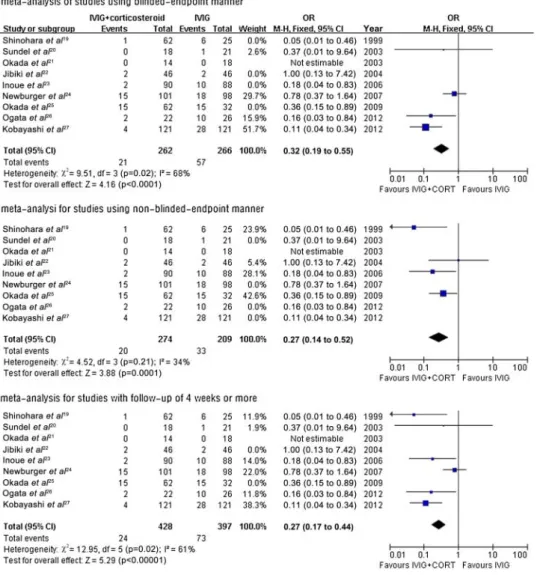
Four studies in this meta-analysis reviewed and analysed the coronary images in a blinded manner,20 24 26 27 while the
remaining studies did not state anything about the blinded manner of coronary outcome assessment. The risk of coronary abnormality was significantly lower in the IVIG plus corticoster-oid group when blinded-endpoint studies were included (8% vs 21.4%; OR: 0.32; 95% CI 0.19 to 0.55; p<0.001) with the test for heterogeneity (I2=68%; p=0.02) (figure 3), and
meta-analysis for non-blinded-endpoint studies (7.3% vs 15.8%;
OR: 0.27; 95% CI 0.14 to 0.52; p<0.001) with the test for heterogeneity (I2=34%, p=0.21) (figure 3).
Seven studies had coronary image follow-up ≥4 weeks.19–21
23 24 26 27When we included only these studies, the patients in
the IVIG plus corticosteroid group still experienced significantly lower incidence of coronary abnormality compared with the IVIG group (5.6% vs 18.4%; OR: 0.27; 95% CI 0.17 to 0.44; p<0.001) with the test for heterogeneity (I2=61%, p=0.02) (figure 3).
Assessment of adverse events
All patients in the included studies were monitored clinically for adverse events daily during administration of the study therapy, and then for the study period. Safety assessments included recording of all severe adverse events, conducting physical exami-nations and laboratory assessments. During the study period,five patients (0.93%) in the IVIG plus corticosteroid group experi-enced severe adverse events (including: one hypotension, one respiratory dysfunction, two high cholesterol, one neutropenia), whereas, four patients (0.84%) in the IVIG group experienced severe adverse events (including: two non-occlusive thrombus in the coronary artery, one anaphylaxis to IVIG, one high choles-terol). No death was reported in the included studies during their study periods. The incidence of severe adverse events in the IVIG plus corticosteroid group and the IVIG group were similar (0.93% vs 0.84%; OR 1.24; 95% CI 0.33 to 4.67; p=0.75) with the test for heterogeneity (I2=0%; p=0.75) (figure 4).
DISCUSSION
The combined data presented in this meta-analysis showed that adding corticosteroid to IVIG therapy as primary management option had the advantage of reducing the risk of coronary artery abnormality when compared with IVIG alone therapy. The overall risk of adverse events was relatively low, and no sig-nificant difference of severe adverse events was observed between the two groups during study follow-up, suggesting that IVIG-combined corticosteroid therapy strategy is safe and effect-ive in the initial treatment for patients with Kawasaki disease.
An acute febrile disorder with systematic vasculitis that pre-dominantly occurs in infancy and early childhood is the charac-teristic of Kawasaki disease, and coronary lesions carry the greatest risk of mortality in notable determinants of its outcome. Later in adulthood, angiographic and postmortem studies demonstrated that coronary sequelae, persisting long after acute Kawasaki vasculitis, result in arteriosclerotic changes, which increase the risk of serious coronary events.37 38Acute and chronic inflammation has been recognised as the patho-physiological basis which is closely associated with coronary artery disease during the course of Kawasaki disease and after-wards.39 Therefore, adding corticosteroid to the standard Figure 2 Meta-analysis of nine
therapy as an initial therapy strategy to reduce the risk of coron-ary sequelae seems reasonable.
Several studies suggest that corticosteroids improved the laboratory findings, shorten the duration of fever, made C-reactive protein and cytokines levels decrease rapidly and reduced the number of patients requiring rescue treatment.16 19–21
23–25 27However, the promising results of corticosteroid noted
that these clinical studies were also challenged by some negative reports. An early Japanese studyfirst showed that corticosteroid therapy exposed a serious detrimental effect on coronary artery in patients with Kawasaki disease, but later on, this study was reported to have potential methodological flaws.10 Recently, a prospective, multicenter, controlled study demonstrated that corticosteroid therapy was useful for the clinical outcome, but it could not reduce the risk of coronary aneurysm when compared
with IVIG therapy.15Moreover, a Canadian retrospective report
revealed that the use of corticosteroid in the acute stage for patients with evolving coronary artery lesions worsened the clin-ical and coronary outcome.11 Although an early meta-analysis including corticosteroid in regimens containing aspirin for primary treatment of Kawasaki disease, reduced the incidence of coronary aneurysm. The results may be overestimated due to small sample size, lack of randomised controlled trials and potential bias.31
In 2007, a multicenter and multi-ethnic group study con-ducted in the USA by Newburger and colleagues prospectively observed no improvement in coronary abnormality when cor-ticosteroid treatment was combined with IVIG therapy.24
Possible reasons might be the patient’s enrolment and time to initiate treatment. The median time until start of treatment was Figure 3 Sensitivity analyses and
relatively late, and the patients who already had coronary artery abnormality at baseline were also considered eligible in their study. A major benefit from early suppression of vasculitis would result if the corticosteroid therapy administrated precedes vascular remoulding,40 41and this explanation may also partially interpret the results shown by Millaret al11and Otagaet al’s15
studies. In a Japanese nation-wide study in 2012, Kabayashi and colleagues demonstrated that prednisolone treatment combined with IVIG therapy at a relatively earlier stage improved coronary and clinical outcomes in patients with severe Kawasaki disease, but their results and score system might be potentially restricted in minority ethnic groups.27 Interestingly, results from their
subset study suggested that primary treatment with IVMP therapy did not improve coronary outcome in patients with high risk for IVIG resistance. Thus, an intriguing concern
whether different corticosteroid preparations had disparate effects on clinical or coronary outcome was raised.
In an effort to obtain a better understanding of IVIG plus cor-ticosteroid therapy among an enlarged population, nine eligible clinical studies werefinally included in this meta-analysis, differ-ent from our previous study. Six of them performed prospective, randomised, controlled design to compare our subjects. The result of the subset analysis that merely included prospective, randomised, controlled trials still showed significant beneficial effect of corticosteroid-combined standard therapy on coronary outcome. During this process, a moderate, but not strong, het-erogeneity was detected by Q test. Further sensitivity analyses revealed that the disparate study design, different patient enrol-ments, drug administration, non-blinded-endpoint manner and different follow-up duration may be potential sources of Figure 3 Continued.
inconsistence, but these factors ultimately did not alter the primary result of the present meta-analysis. Nevertheless, poten-tial bias could not be avoided because of intrinsic differences in study design, a large-scale, multicenter, better-designed, inter-national study may be needed.
Acknowledgements We would like to acknowledge the investigators of the studies that were included in this meta-analysis. This study was partly supported by Program for Innovative Research Team of Chongqing Kuanren Hospital.
Contributors All authors contributed to this paper, and have read and approved this article. No part of this paper has been published or considered for publication elsewhere. Drs Chen S and Dong Y were responsible for literature search, data collection, statistical analysis and manuscript drafting. Profs Yin Y and Krucoff MW directed the study performance and guided the manuscript writing.
Competing interests None.
Provenance and peer reviewNot commissioned; externally peer reviewed.
REFERENCES
1 Nakamura Y, Yanagawa H, Kawasaki T. Mortality among children with Kawasaki disease in Japan.N Engl J Med1992;326:1246–9.
2 Holman RC, Curns AT, Belay ED,et al. Kawasaki syndrome hospitalizations in the United States, 1997 and 2000.Pediatrics2003;112:495–501.
3 Kato H, Sugimura T, Akagi T,et al. Long-term consequences of Kawasaki disease. A 10- to 21-year follow-up study of 594 patients.Circulation1996;94:1379–85. 4 Newburger JW, Takahashi M, Gerber MA,et al. Diagnosis, treatment, and
long-term management of Kawasaki disease.Circulation2004;110:2747–71. 5 Furusho K, Kamiya T, Nakano H,et al. High-dose intravenous gammaglobulin for
Kawasaki disease.Lancet1984;2:1055–8.
6 Murphy DJ Jr, Huhta JC. Treatment of Kawasaki syndrome with intravenous gamma globulin.N Engl J Med1987;316:881.
7 Newburger JW, Takahashi M, Beiser AS,et al. A single intravenous infusion of gamma globulin as compared with four infusions in the treatment of acute Kawasaki syndrome.N Engl J Med1991;324:1633–9.
8 Nakamura Y, Yashiro M, Uehara R,et al. Epidemiologic features of Kawasaki disease inJapan: results ofthe 2007-2008 nationwide survey.J Epidemiol 2010;20:302–7.
9 Uehara R, Belay ED, Maddox RA,et al. Analysis of potential risk factors associated with nonresponse to initial intravenous immunoglobulin treatment among Kawasaki disease patients in Japan.Pediatr Infect Dis J2008;27:155–60.
10 Kato H, Koike S, Yokoyama T. Kawasaki disease: effect of treatment on coronary artery involvement.Pediatrics1979;63:175–9.
11 Millar K, Manlhiot C, Yeung RS,et al. Corticosteroid administration for patients with coronary artery aneurysms after Kawasaki disease may be associated with impaired regression.In J Cardiol2012;154:9–13.
12 Jibiki T, Kato I, Shiohama T,et al. Intravenous immune globulin plus corticosteroids in refractory Kawasaki disease.Pediatr Int2011;53:729–35.
13 Lang BA, Yeung RS, Oen KG,et al. Corticosteroid treatment of refractory Kawasaki disease.J Rheumatol2006;33:803–9.
14 Wright DA, Newburger JW, Baker A,et al. Treatment of immune globulin-resistant Kawasaki disease with pulsed doses of corticosteroids.J Pediatr1996;128:146–9. 15 Ogata S, Bando Y, Kimura S,et al. The strategy of immune globulin resistant
Kawasaki disease: a comparative study of additional immune globulin and steroid pulse therapy.J Cardiol2009;53:15–19.
16 Miura M, Kohno K, Ohki H,et al. Effects of methylprednisolone pulse on cytokine levels in Kawasaki disease patients unresponsive to intravenous immunoglobulin. Eur J Pediatr2008;167:1119–23.
17 Furukawa T, Kishiro M, Akimoto K,et al. Effects of steroid pulse therapy on immunoglobulin-resistant Kawasaki disease.Arch Dis Child2008;93:142–6. 18 Hashino K, Ishii M, Iemura M,et al. Retreatment for immune globulin-resistant
Kawasaki disease: a comparative study of additional immune globulin and steroid pulse therapy.Pediatr Int2001;43:211–17.
19 Shinohara M, Sone K, Tomomasa T,et al. Corticosteroids in the treatment of the acute phase of Kawasaki disease.J Pediatr1999;135:465–9.
20 Sundel RP, Baker AL, Fulton DR,et al. Corticosteroids in the initial treatment of Kawasaki disease: report of a randomized trial.J Pediatr2003;142:611–16. 21 Okada Y, Shinohara M, Kobayashi T,et al. Effect of corticosteroids in addition to
intravenous gamma globulin therapy on serum cytokine levels in the acute phase of Kawasaki disease in children.J Pediatr2003;143:363–7.
22 Jibiki T, Terai M, Kurosaki T,et al. Efficacy of intravenous immune globulin therapy combined with dexamethasone for the initial treatment of acute Kawasaki disease. Eur J Pediatr2004;163:229–33.
23 Inoue Y, Okada Y, Shinohara M,et al. A multicenter prospective randomized trial of corticosteroids in primary therapy for Kawasaki disease: clinical course and coronary artery outcome.J Pediatr2006;149:336–41.
24 Newburger JW, Sleeper LA, McCrindle BW,et al. Randomized trial of pulse corticosteroid therapy for primary treatment of Kawasaki disease.N Engl J Med 2007;356:663–75.
25 Okada K, Hara J, Miki I,et al. Pulse methylprednisolone with gammaglobulin as an initial treatment for acute Kawasaki disease.Eur J Pediatr2009;168:181–5. 26 Ogata S, Ogihara Y, Honda T,et al. Corticosteroid pulse combination therapy for
refractory Kawasaki disease: a randomized trial.Pediatrics2012;129:e17–23. 27 Kobayashi T, Saji T, Otani T,et al. Efficacy of immunoglobulin plus prednisolone for
prevention of coronary artery abnormalities in severe Kawasaki disease (RAISE study): a randomised, open-label, blinded-endpoints trial.Lancet
2012;379:1613–20.
28 Moher D, Libetati A, Tetzlaff J,et al. The PRISMA statement for reporting systematic reviews and meta-analysis of studies that evaluate healthcare interventions: explanation and elaboration.BMJ2009;339:b2700.
29 Research Committee on Kawasaki Disease.Report of Subcommittee on Standardization of Diagnostic Criteria and Reporting of Coronary Artery Lesions in Kawasaki Disease. Tokyo: Ministry of Health and Welfare, 1984.
30 Ayusawa M, Sonobe T, Uemura S,et al. Revision of diagnostic guidelines for Kawasaki disease (the 5th revised edition).Pediatr Int2005;47:232–4. 31 Wooditch AC, Aronoff SC. Effect of initial corticosteroid therapy on coronary artery
aneurysm formation in Kawasaki disease: a meta-analysis of 862 children.Pediatrics 2005;116:989–95.
32 Yanagawa H, Yashiro M, Nakamura Y,et al. Epidemiologic pictures of Kawasaki disease in Japan: from the nationwide incidence survey in 1991 and 1992. Pediatrics1995;95:475–9.
33 Kobayashi T, Inoue Y, Takeuchi K,et al. Prediction of intravenous immunoglobulin unresponsiveness in patients with Kawasaki disease.Circulation
2006;113:2606–12.
34 Egami K, Muta H, Ishii M,et al. Prediction of resistance to intravenous immunoglobulin treatment in patients with Kawasaki disease.J Pediatr 2006;149:237–40.
35 Seki M, Kobayashi T, Kobayashi T,et al. External validation of a risk score to predict intravenous immunoglobulin resistance in patients with kawasaki disease.Pediatr Infect Dis J2011;30:145–7.
36 de Zorzi A, Colan SD, Gauvreau K,et al. Coronary artery dimensions may be misclassified as normal in Kawasaki disease.J Pediatr1998;133:254–8. 37 Suzuki A, Kamiya T, Arakaki Y,et al. Fate of coronary arterial aneurysms in
Kawasaki disease.Am J Cardiol1994;74:822–4.
38 Burns JC, Shike H, Gordon JB,et al. Sequelae of Kawasaki disease in adolescents and young adults.J Am Coll Cardiol1996;28:253–7.
39 Mitani Y, Sawada H, Hayakawa H,et al. Elevated levels of high-sensitivity C-reactive protein and serum amyloid-A late after Kawasaki disease: association between inflammation and late coronary sequelae in Kawasaki disease.Circulation 2005;111:38–43.
40 Brown TJ, Crawford SE, Cornwall ML,et al. CD8 T lymphocytes and macrophages infiltrate coronary artery aneurysms in acute Kawasaki disease.J Infect Dis 2001;184:940–3.