Bilingualism: Language and Cognition
http://journals.cambridge.org/BILAdditional services for Bilingualism: Language and Cognition:
Email alerts: Click here Subscriptions: Click here Commercial reprints: Click here Terms of use : Click here
The effect of language prociency on executive functions in balanced and
unbalanced Spanish–English bilinguals
MÓNICA ROSSELLI, ALFREDO ARDILA, LAXMI N. LALWANI and IDALY VÉLEZ-URIBE
Bilingualism: Language and Cognition / FirstView Article / June 2015, pp 1 - 15 DOI: 10.1017/S1366728915000309, Published online: 15 June 2015
Link to this article: http://journals.cambridge.org/abstract_S1366728915000309
How to cite this article:
MÓNICA ROSSELLI, ALFREDO ARDILA, LAXMI N. LALWANI and IDALY VÉLEZ-URIBE The effect of language prociency on executive functions in balanced and unbalanced Spanish–English bilinguals. Bilingualism: Language and Cognition, Available on CJO 2015 doi:10.1017/S1366728915000309
The effect of language
proficiency on executive
functions in balanced and
unbalanced Spanish–English
bilinguals
∗
M Ó N I C A R O S S E L L I
Florida Atlantic University, Davie, FL, USA
A L F R E D O A R D I L A
Florida International University, Miami, FL, USA
L A X M I N . L A LWA N I
Florida Atlantic University, Davie, FL, USA
I D A LY V É L E Z - U R I B E
Florida Atlantic University, Davie, FL, USA
(Received: October 8, 2014; final revision received: May 7, 2015; accepted: May 11, 2015)
This study analyzed the association between levels of language proficiency and levels of bilingualism and performance on verbal and nonverbal executive functions (working memory, updating, shifting, and inhibition tasks) in young bilinguals. Forty balanced (high and low proficiency), 34 unbalanced bilinguals, and 40 English monolinguals, were selected. The Bilingual Verbal Ability Test was used as a measure of language proficiency; WAIS Block design test was used as a measure of non-verbal intelligence. High proficiency balanced bilinguals performed better than low proficiency balanced bilinguals; unbalanced bilinguals scored in between both balanced groups. High proficiency monolinguals scored higher than low proficiency monolinguals and similar to high proficiency bilinguals. Regression analyses demonstrated that nonverbal intelligence significantly predicted performances on verbal working memory and verbal and nonverbal inhibition tasks. It was concluded that nonverbal intelligence scores are better predictors of executive function performance than bilingualism or language proficiency.
Keywords: Bilingualism, proficiency, balance, executive functions, working memory, Spanish
Introduction
The latest Census Bureau report on language use in the United States shows that bilinguals ages five and older account for over 19.9% of the population of the United States (U.S. Census Bureau; New York. Department of Labor, 2010). Of which over 62% are Spanish– English bilinguals. This population includes bilinguals at the extremes of the proficiency scale, with either very high or very low proficiency levels in English and Spanish (balanced bilinguals) and bilinguals who are more proficient in one language than the other (unbalanced bilinguals). These distinctions in proficiency and balance become especially important when used for or against the argument that bilingualism offers cognitive advantages beyond expansion of the language system (Duncan & DeAvila,1979).
The effect of bilingualism has generated contradictory results: while some studies have found cognitive benefits of bilingualism, such as advantages in conflict resolution (Costa, Hernández & Sebastián Gallés, 2008), suppressing irrelevant information (Bialystok,
∗ Our most sincere gratitude to AmberRose Reale for her editorial support.
Address for correspondence:
Dr. Mónica Rosselli. Department of Psychology, Charles E. Schmidt College of Science, Florida Atlantic University, 3200 College Avenue, Davie, FL 33314, USA.
Craik, Klein & Viswanathan, 2004; Bialystok, Craik & Luk, 2008; Ransdell, Barbier & Niit, 2006), shifting between mental sets (Garbin, Sanjuan, Forn, Bustamante, Rodriguez-Pujadas, Belloch & Avila., 2010; Prior & MacWhinney, 2010), improving control of linguistic processes (Bialystok, 1987), and slowing the decline of executive functions (EF) in aging adults (Bialystok,2007), these results are not consistently replicated (Gathercole, Thomas, Kennedy, Prys, Young, Viñas Guasch, Roberts, Hughes & Jones, L,2014), especially when using verbal tasks. Bilingualism has been associated with detriments on tasks of verbal fluency (Gollan, Montoya & Werner,2002; Rosselli, Ardila, Araujo, Weekes, Caracciolo, Padilla & Ostrosky-Solis, 2000; Sandoval, Gollan, Ferreira & Salmon,2010), longer reaction times for picture naming (Gollan, Montoya, Fennema-Notestine & Morris,2005), and more naming errors (Roberts, Garcia, Desrochers & Hernandez,2002).
2 Bilinguals’ proficiency and executive function
raised here was whether Spanish–English bilinguals who achieved similar proficiency in both languages performed differently on tasks of inhibition, shifting and updating/working memory compared to unequally proficient bilinguals and to high and low English proficient monolinguals.
The American Council of Teaching Foreign Languages (ACTFL) defines proficiency as functional language ability as it pertains to practicality in real-world situations. Differences in bilinguals’ second language functional ability are described as a continuum, which ranges from the highly articulate language user to the user with little to no functional ability (ACTFL,2012). Bialystok (1991) argues that language proficiency is not just a skill, which is mastered, but also something which alters cognition. The definition by the ACTFL was used for the purposes of this study, and proficiency was tested using the Bilingual Verbal Ability Tests (BVAT) (Muñoz-Sandoval, Cummins, Alvarado & Ruef, 1998), which assesses multiple aspects of vocabulary to ensure that bilinguals could properly comprehend and communicate in the languages in which they claimed proficiency.
In earlier studies conducted on bilingual young adults, bilingual advantages on nonverbal tasks were observed when bilingual participants received multiple objective measures to verify language proficiency (Costa et al., 2008). Costa et al. (2008) tested a sample of 200 young adults (100 monolinguals and 100 highly proficient Catalan–Spanish bilinguals) on an attentional network task (ANT). Participants were first tested on reading, writing, comprehension, speaking and pronouncing one or both languages, and were then administered the ANT. It was found that bilinguals were faster at responding on both congruent and incongruent trials. Additionally, bilinguals incurred fewer switching and inhibition costs. It was concluded that high proficiency bilinguals have more efficient executive control networks compared to monolinguals. This study did not include a low proficiency bilingual group therefore we do not know if language proficiency was a relevant variable on the inhibition advantage found in the bilingual group.
Videsott, Della Rosa, Wiater, Franceschini & Abutalebi (2012) analyzed the attentional mechanisms of multilingual children with differential degrees of language competence, using the Attentional Network Test (ANT). The authors found that proficiency levels in early multilingual children may play a significant role in the development and enhancement of the alerting component of the attentional system; they further suggested that the peculiarity of highly competent multilinguals relies on their ability to better recognize, and consequently react faster to, the target stimulus than their less competent multilingual peers.
Kousaie and Phillips (2012a) argued that most previous studies reporting an advantage for bilinguals relative to
monolinguals have used samples that vary in the socioe-conomic status (e.g., immigrant/nonimmigrant) and in the level of proficiency of the second language. After testing for proficiency using an animacy judgment task, they found that when French–English bilinguals and monolin-guals were matched by status of native/second language and socioeconomic variables, the bilingual advantage disappeared on a task examining verbal inhibition (the Stroop task). However, others have found that language proficiency is linked to control over attention, which is handled by executive components, such as inhibition and shifting (Bialystok,1991). Segalowitz and Frenkiel-Fishman (2005) had previously separated an English– French young adult bilingual group using the same animacy judgment task and found that degree of shifting significantly correlated with second language proficiency. Despite the fact that bilinguals show advantages on nonverbal tasks, they are usually outperformed by monolinguals on verbal tasks (Hilchey & Klein,2011). For example, Bialystok et al. (2008) found monolinguals performed significantly better at lexical retrieval tasks than bilinguals, although bilingual proficiency was not tested. This relationship may have been better understood if proficiency had been objectively measured in the sample, since high language proficiency in a bilingual’s first language facilitates higher proficiency in the second language (Mindt, Arentoft, Kubo, Germano, Aquila, Scheiner, Pizzirusso, Sandoval & Gollan,2008).
Bilingual advantages on nonverbal tasks result from the use of executive functions to manage their two languages without interference from language systems (Bialystok, 2009). Although it has been found that manipulation of two languages may cause disadvantages for bilinguals on verbal tasks (Gollan, Montoya, Cera & Sandoval, 2008; Ivanova & Costa,2008; Lehtonen & Laine,2003; Rosselli et al., 2000), the majority of the research in adults has focused on bilingual advantages on nonverbal working memory and executive function task performance in comparison to Monolinguals (Bialystok et al.,2004; Bialystok, Craik & Ryan,2006b; Emmorey, Luk, Pyers & Bialystok, 2008). The following sections will focus on some of the executive functions in which a bilingual advantage has been observed.
Working memory
highlighted (simple condition) and then, in the most difficult condition, asked to click on the blocks by an ordering rule (such as top to bottom along each column). While participants performed equally well in the simple condition, bilinguals outperformed monolinguals on the difficult (backwards) condition, which placed greater executive control demands on working memory. The authors argue these advantages were not due solely to advantages in working memory. Rather, they claim, the tools needed to outperform on such tasks are the result of bilingual advantages in executive functions, such as updating (Hernández, Costa, Fuentes, Vivas & Sebastián-Gallés,2010) and inhibition (Bialystok & Feng,2009).
Updating
This process involves checking and coding the relevance of incoming information for a specific task and correctly revising the items held in working memory by replacing old, no longer relevant information with newer, more relevant information (Morris & Jones, 1990). While updating has not been tested directly (in children or adults), it has been measured concurrently with shifting and inhibition using dual-modality monitoring in young and old bilingual adults (Bialystok, Craik & Ruocco,
2006a). The dual-modality paradigm is believed to
par-allel the actual processes used to manage two languages. Bilinguals use updating, shifting, and inhibition in unison to have constant verification that the language in use is the best choice (updating for surroundings) and to determine if they must switch to the appropriate language (shifting) and inhibit the alternate language. In the dual task paradigm, participants are initially given a classification task in which they organize stimuli as letters or numbers (LN) in one condition and animals and musical instruments (AM) in a second condition. In the dual-task condition, the stimuli can be congruent (both auditory and visual would derive from either LN or AM) or unrelated (one stimulus from the AM and the other from the LN, or vice versa). The unrelated condition is believed to be the more difficult condition, requiring updating to give a response and shifting between rules. Both in the young and old adult samples (consisting of monolinguals, balanced bilinguals, and unbalanced bilinguals) bilinguals performed significantly better than monolinguals in the divided attention tasks when the stimuli presented clashed (requiring additional updating and shifting resources). Results for the unbalanced group did not differ from those seen in the balanced bilingual group.
Shifting
Set shifting or cognitive flexibility refers to the ability to switch rapidly between different response sets (Anderson, 2002). Shifting mental sets for bilinguals involves selecting a situation-appropriate language between two active language systems (Prior & MacWhinney, 2010).
Nonverbal tasks measuring shifting have been measured using the local-global task and tasks similar to the Simon task. Prior and MacWhinney (2010) compared the many ways in which task switching parallels language switching in bilinguals. They hypothesized that bilinguals would perform better on switching tasks which requires two competing responses. To test this, the authors compared 44 bilinguals of mixed languages to 44 monolinguals on a task switching paradigm using cued task switching in which participants had to provide button press responses to either color or shape stimuli. Overall, it was found that bilinguals incurred fewer switching costs than monolinguals (measured by RTs), but did not outperform them on mixed-task blocks. Along with showing bilingual advantages on speed of nonverbal shifting tasks, these results indicate that bilingual advantages in shifting may underlie bilingual inhibition capabilities.
Inhibition
It is the ability to block extraneous information in order to focus on the pertinent rules of interactions or tasks. One of the most common nonverbal inhibition tasks used to assess bilingual advantages is the Simon task (Simon & Rudell, 1967). In this task, participants are given specific response keys, which they are instructed to press in response to visual stimuli presented on either the congruent or incongruent side of the response key. Bilinguals have been shown to provide more rapid responses to congruent and incongruent stimuli in comparison to monolinguals on measures of inhibition (Bialystok et al.,2004; Bialystok et al., 2006b; Costa et al., 2008). Both Bialystok et al., 2004and Salvatierra and Rosselli (2010) found bilingual advantages on the simple condition of the Simon but on different age groups. Bialystok et al., (2004) used samples of monolinguals and Tamil–English bilinguals, both samples divided into young and old adults. Salvatierra and Rosselli (2010) tested a monolingual and Spanish– English bilingual sample, divided in the same way. Both studies found that older bilinguals showed smaller Simon effects on the simple version of this nonverbal task than monolinguals (i.e., were better at responding to incongruent stimuli presented on the opposite side of the response key) but this effect on the younger bilingual group was found only by Bialystok et al. The results for young adults reported by Salvatierra and Rosselli align with Kousaie and Phillips (2012b) who also found no significant differences on performance between young adult monolinguals and highly proficient bilingual young adults on measures of inhibition.
4 Bilinguals’ proficiency and executive function
the bilingual advantage seems to be influenced by the nature of the task: most of the benefits of bilingualism are reported on nonverbal executive function tasks (Bialystok et al.,2004; Bialystok et al.,2006b; Costa et al.,2008). Furthermore, potential confounding variables may have influenced the results of some of the current studies: for example in Bialystok et al. (2004) there were differences in culture background between the monolingual and bilingual participants. Another confounding could be the absence of control of language proficiency in the bilingual and monolingual samples, despite the fact that language proficiency has been shown to influence performance in executive function tasks (Vega & Fernandez, 2011; Rosselli, Ardila, Santisi, Arecco, Salvatierra & Conde, 2002; Zied, Philippe, Pinon, Havet-Thomassin, Ghislaine, Roy & Le Gall,2004). Also, some of the reviewed studies assumed that proficient bilingualism was equivalent to balanced bilingualism: balanced bilinguals can be categorized as high proficient and low proficient (Rosselli et al.,2002). The low proficient bilinguals perform equally low in both languages despite reporting active use of both languages in everyday life. People displaying this type of bilingualism have been called semilinguals by Paradis (1998) and they are quite prevalent in a bicultural society such as South Florida, in which two languages may be required for everyday communication. Thus, at present, more evidence accounting for the aforementioned limitations is needed to unambiguously show that there are differences in performance on executive function tasks of a different nature between bilinguals and monolinguals during early adulthood.
The goal of this study was to evaluate whether balanced high and low Spanish–English proficient bilinguals performed differently on verbal and nonverbal executive function tasks when compared to unbalanced Spanish– English bilinguals and English monolinguals divided into high and low proficiency levels. Specifically, this study analyzed separately the effects of level of proficiency (high vs. low) and the influence of inter language proficiency disparity (balance vs. unbalanced) on five verbal and four nonverbal executive function tasks in a young group of bilingual participants. Five groups of young adults with different language experience were compared; two groups included balanced bilinguals (one group highly proficient in both languages and the other group poorly proficient in both languages), one group was unbalanced bilingual and two groups were monolinguals (one highly proficient in English and the other one poorly proficient in English).
It was predicted that high proficiency in both Spanish and English provided advantages in performance on nonverbal measures of inhibition, updating, shifting and working memory. This advantage was not expected in low proficient bilinguals even though they were equally proficient in both languages (balanced). Highly proficient Spanish–English bilinguals were predicted to
have greater recall on the nonverbal working memory and updating measures, experience a lower shift cost on nonverbal shifting tasks, and experience less inhibition on nonverbal inhibition tasks than the other language groups. Low proficiency bilinguals were predicted to outperform low proficiency monolingual participants only. The low proficient bilingual and monolingual groups were expected to score significantly lower on all verbal and nonverbal tasks compared to the other three groups.
Previous reports on the importance of bilingualism in EF have measured specific aspects of this construct (i.e., inhibition, working memory) but no earlier studies of which we are aware have analyzed the influence of dual language experience in a wide spectrum of executive tasks (i.e., inhibition, shifting, updating, and working memory). Therefore, a final goal of the current study was to explore whether an enhancement in EF scores was significantly associated with the language experience of the groups.
Method
Participants
One hundred and twenty-five undergraduate students between 18 and 45 years of age participated in this study. In order to control for decline in executive function due to aging, participants were excluded if they were above the age of 45. Additionally, participants were excluded if they reported having a history of learning disabilities, fluency in languages other than Spanish or English, and if they did not come in to complete both verbal and nonverbal tasks. Using these exclusion criteria, 114 participants composed the final sample, of which 40 were English monolinguals (35 females), and 74 (62 females) were bilinguals. A demographic and bilingual questionnaire was administered to gauge English and Spanish usage for each participant. Monolingual participants were all native English speakers who reported limited or no proficiency in a second language. Those with limited proficiency reported exposure to a second language in a classroom setting at older ages, and none reported attaining high proficiency.
one score above the median and the other below the median were considered as “Unbalanced bilinguals” (34 participants). Similarly, monolingual participants were divided into two subgroups: (1) High proficiency (total scores in the three subtests of the English version above the median of 1593) (20 participants); and (2) low proficiency (scores in the three subtests below the median) (20 participants).
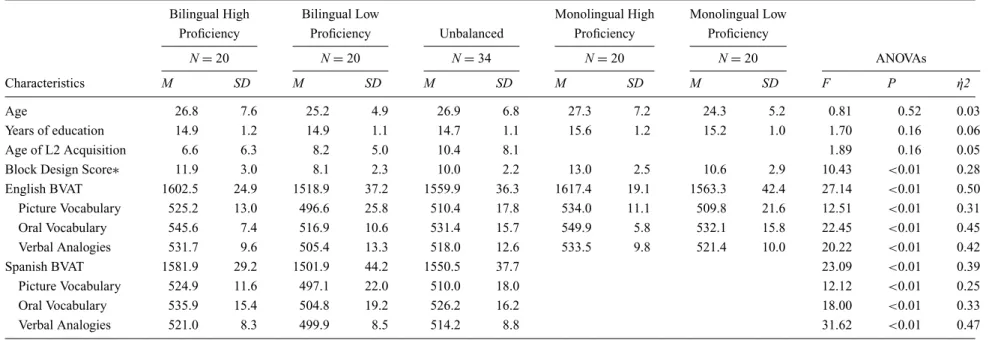
The background variables of all three groups are shown in Table 1. Scaled Block Design scores from the WAIS-III (Wechsler, 1997) were used as a measure of nonverbal intelligence. A one-way ANOVA showed that mean Block Design scores differed significantly between language groups, F (2,113) = 10.44, p<.001. Post hoc comparisons showed that low proficiency balanced bilinguals had significantly lower scores than high proficiency balanced bilinguals, unbalanced bilinguals and monolinguals (p<.05) (SeeTable 1). Block Design scores were significantly higher for high proficiency (M= 11.9) than low proficiency balanced bilinguals (M = 8.1); unbalanced bilinguals scored in between the other bilingual groups (M = 10.0) but significantly lower than the high proficiency balanced bilinguals and the high proficiency monolinguals. Similarly, high proficient monolinguals obtained higher scores (M=13.0) than low proficiency monolinguals (M=10.6). Balanced bilinguals acquired L2 earlier in life (Mage = 7.4 years old) than unbalanced bilinguals (Mage=10.4 years old); and high proficiency learned L2 earlier (Mage=6.6 years old) than low proficiency bilinguals (Mage=8.2 years old).
Tests administered and procedure
Testing was conducted in two sessions. During the first session, participants were given the Block Design task from the Wechsler Adult Intelligence Scale to assess non-verbal intelligence, the Bilingual Verbal Ability Tests in English and Spanish (when applicable), and either a series of verbal or non-verbal computerized executive function tasks. The computerized tasks were used to assess working memory, updating, shifting, and inhibition. The verbal tasks consisted of the forward and backwards Digit Span subtest from the Wechsler Adult Intelligence Scale, the Letter Memory task, the Plus-Minus task, and the Stroop task. The non-verbal tasks consisted of the forward Corsi block task, the Tone Monitoring task, the Local-global task, and the simple version of the Simon task. Administration of the verbal and non-verbal computer tasks occurred on two separate days, and the DirectRT (Version 2006.2.28; Empirisoft Corporation; New York, NY) software randomized task presentation for each section. Order effects were controlled by rotating the session in which participants were administered the BVAT and by rotating presentation of verbal and non-verbal batteries. Participants were given one series of tasks (either verbal or non-verbal) at the end of their first session
and came back for another session to take the second set of computer tasks.
Bilingual Verbal Ability Tests (BVAT) (Muñoz-Sandoval et al.,1998).
The Picture Vocabulary, Oral Vocabulary, and Verbal Analogies BVAT subtests were used to assess participants’ language comprehension and speaking abilities in both English and Spanish (when applicable). Administration of the BVAT took approximately 30 minutes per language. Each subtest began with baseline questions at a designated starting point for college students. The scores for each subtest were calculated and standardized. For the Picture Vocabulary subtest, participants could earn a maximum of 599 points in English and 598 in Spanish (group norm
=526.9 points). For the Oral Vocabulary (synonyms and antonyms) section, participants could earn a maximum of 595 points in English and 610 points in Spanish (group norm=533.8 points). For the Verbal Analogies subtest, participants could earn a maximum of 574 points in English and 565 points in Spanish (group norm=522.4 points). For the bilingual participants the points earned for each subtest in English and Spanish were totaled; the median score was calculated (1566 for English and 1551 for Spanish). For monolinguals, the points earned for each subtest were simply totaled and the median score was calculated (1593). Table 1 shows the BVAT scores, totals and by subtests. To test the performance of the groups in the expression and comprehension BVAT subtests in each language, two MANOVAs were used with the scores in the three BVAT subtests as dependent measures and language group as the factor variable. For English and Spanish the Multivariate Hostelling T was significant, F(12, 317)=10.70, p<.001;ἠ2=28.8, and F(6, 136) = 11.95, p < .001; ἠ2 = 34.5 respectively. Univariate ANOVAs are shown on Table 1. Post-hoc Bonferroni comparisons of group means showed in both analyses and for all subtests that the high proficiency bilinguals performed significantly higher than the other 2 bilingual groups (p<.01). In the BVAT English subtests no differences were found between the high proficiency bilinguals and the high proficiency monolinguals in any of the subtests (p>.01) but significance emerged when this bilingual group was compared with the low proficiency monolinguals (p<.01). The unbalanced group showed significant differences with all other groups in the BVAT English subtests (p <.01) except when this group was compared with the performance of the low proficiency monolinguals (p>.01).
Block Design subtest (Wechsler,1997)
6
Bilinguals’
pr
oficiency
and
executive
function
Table 1. General Characteristics of the Sample
Bilingual High Bilingual Low Monolingual High Monolingual Low
Proficiency Proficiency Unbalanced Proficiency Proficiency
N=20 N=20 N=34 N=20 N=20 ANOVAs
Characteristics M SD M SD M SD M SD M SD F P ἠ2
Age 26.8 7.6 25.2 4.9 26.9 6.8 27.3 7.2 24.3 5.2 0.81 0.52 0.03
Years of education 14.9 1.2 14.9 1.1 14.7 1.1 15.6 1.2 15.2 1.0 1.70 0.16 0.06
Age of L2 Acquisition 6.6 6.3 8.2 5.0 10.4 8.1 1.89 0.16 0.05
Block Design Score∗ 11.9 3.0 8.1 2.3 10.0 2.2 13.0 2.5 10.6 2.9 10.43 <0.01 0.28
English BVAT 1602.5 24.9 1518.9 37.2 1559.9 36.3 1617.4 19.1 1563.3 42.4 27.14 <0.01 0.50
Picture Vocabulary 525.2 13.0 496.6 25.8 510.4 17.8 534.0 11.1 509.8 21.6 12.51 <0.01 0.31
Oral Vocabulary 545.6 7.4 516.9 10.6 531.4 15.7 549.9 5.8 532.1 15.8 22.45 <0.01 0.45
Verbal Analogies 531.7 9.6 505.4 13.3 518.0 12.6 533.5 9.8 521.4 10.0 20.22 <0.01 0.42
Spanish BVAT 1581.9 29.2 1501.9 44.2 1550.5 37.7 23.09 <0.01 0.39
Picture Vocabulary 524.9 11.6 497.1 22.0 510.0 18.0 12.12 <0.01 0.25
Oral Vocabulary 535.9 15.4 504.8 19.2 526.2 16.2 18.00 <0.01 0.33
Verbal Analogies 521.0 8.3 499.9 8.5 514.2 8.8 31.62 <0.01 0.47
(Mercy & Steelman,1982; Salvatierra & Rosselli,2010; Weschler,1997). Participants were given practice trials to familiarize them with instructions and were then scored based on the amount of time used to construct the figures. Standard scores were used.
Executive Function measures
Executive functions (working memory, updating, shifting, and inhibition) were assessed using verbal and non-verbal tasks.
A. Verbal tasks
Four verbal tasks were administered. Working memory was assessed using the Digit span (forward and backward). Updating was assessed using the Letter-memory task. Shifting was assessed using the Plus-minus task. Inhibition was assessed using the Stroop task.
1. Digit Span tasks (forward and backwards)
The digit span task from the WAIS-IV (Wechsler,2008) was transcribed into a computerized version. Numbers were presented at the rate of 2000 ms per number. Participants were presented number lists containing between 2 to 9 numbers. Once all of the numbers of a set were presented, participants were cued to recite numbers into a headset microphone in the direct or inverse order in which they were presented. The dependent measure was the total number of correct digits recalled.
2. Letter Memory
The letter memory task served as a measure of updating. Participants were presented serially with lists of letters of various lengths and were asked to recall the last four letters they were shown. Letters were presented one by one on the computer for 2000 ms per letter. As in the Miyake, Friedman, Emerson, Witzki, Howerter and Wager (2000) article, participants were asked to vocalize the last four letters presented out loud by mentally adding and subtracting letters from the list. For example, on the first example problem, participants should have said, “C . . . CB . . . CBE . . . CBED . . . BEDA” and then recalled “BEDA” at the end of the trial. Following the practice session, participants were given 12 trials (four trials for each length presented in random order) for a total of 48 letters recalled. The score was the number of letters recalled correctly out of 48.
3. Plus-minus task
The plus-minus task was also adapted from Miyake et al. (2000) in order to measure shifting. Participants were given three lists of simple arithmetic problems; the numbers for each list were presented one by one on a computer screen for 1000 ms at a time. Each list consisted
of 30 two-digit numbers. For the first list, participants were told to mentally add 3 to the number presented and give an answer as quickly as possible into a microphone attached to a headset. For the second list, participants were instructed to subtract 3 from the numbers presented. For the third list, participants were to rotate adding 3 to the first number presented followed by subtracting 3 from the second number presented, and to continue rotating adding and subtracting 3 to the numbers presented on the computer screen. Each stimulus was presented for 1000 ms. Reaction times were measured using DirectRT v2006. The numbers of correct responses for each of the three lists were calculated. Accuracy performance rate was 96% for additions, 94% for subtractions and 94% for rotations. Additionally, the processing speeds for each of the three lists were calculated. The shift cost was used as the dependent variable. It was calculated by subtracting the average time used to solve the addition and subtraction lists from the time taken for the rotation list. Only correct responses were included in the analysis.
However, it has to be kept in mind that the plus-minus task is not necessarily a comparable measure of shifting as mental operations; addition and subtraction may be accomplished through partially different cognitive mechanisms (Barrouillet, Mignon & Thevenot, 2008; Thevenot, Fanget & Fayol,2007) which in turn may not totally overlap with mechanisms required with shifting between two available responses, one for each language. As a matter of fact, it is accepted the numbers and numerical operations can be coded in two different ways: verbal and numerical (Ardila & Rosselli,2002).
4. Stroop task
In this inhibition task, participants were shown a series of asterisks in color ink and color words (e.g., blue) in either congruent or incongruent ink. Six color inks were used for the task: orange, green, purple, yellow, red, and blue. Fourteen practice trials were randomized and administered. Participants were given feedback for each of these practice trials. The scored portion of the task consisted of the same stimuli as in Miyake et al. (2000). The DirectRT program randomized presentation of the 72 asterisks, 60 color words shown in different color ink, and 12 color words shown in congruent ink. Stimuli were presented for 2000 ms and participants had 3000 ms to respond. The accurate response rate was 99%. The score was the Stroop effect, calculated by subtracting the average processing speed for responding to all asterisk stimuli from the average processing speed for naming all incongruent stimuli.
B. Non-verbal tasks
8 Bilinguals’ proficiency and executive function
was assessed using the tone monitoring task. Shifting was assessed using the local-global. Inhibition was assessed using the simple version of the Simon task.
1. Forward Corsi blocks task
This task was the computerized version of the task described by Baddeley (2003). This task was used to assess non-verbal working memory. Each trial began with a cross hatch in the center of the screen. Following the crosshatch, nine grey blocks were shown at their relative standard positions on a black background on the computer screen. After 1000 ms, blocks were highlighted in yellow at the rate of 1000 ms per block highlighted, after which participants were once again shown a crosshatch, followed by the screen with nine grey blocks. A 2000 ms gap was kept between each trial. Following the four practice trials, participants were given 24 trials during which sequence lengths varied from 1 through 8 highlighted blocks. Three trials were presented for each sequence length. The dependent measured was the total number of blocks in a sequence that participants got correct.
2. Tone Monitoring Task
Participants were given four blocks of 25 tones (high, medium, and low) presented for 500 ms each with an inter-stimulus interval of 2500 ms. As in Miyake et al. (2000), each block consisted of 8 high-pitched tones, 8 medium-pitched tones, and 8 low-pitched tones and one tone randomly selected from either the high, low, or medium category. Participants were instructed to press a response key every time they heard the fourth tone of each pitch. The dependent measure was the number of correct responses out of a possible 24 responses.
3. Local-global task
This task was originally used by Miyake et al. (2000) to measure shifting. Participants were presented with a geometric, global, figure composed of much smaller, local, figures (i.e., Navon figures) on a computer screen. Depending on the color in which the figure was presented (blue or black), the participants named the number of straight or diagonal lines composing the figure (e.g., 0 for circle, 2 for X, 3 for triangle). An incongruent trial was one in which the smaller figure and the larger figure had a different number of lines, e.g., a square (4 lines) composed of circles (0 lines). A congruent trial was one in which the larger and smaller figures were composed of the same number of lines (e.g., a triangle composed of Hs both had 3 lines). Stimuli were presented for 300 ms, followed by 500 ms response-to-trial intervals. Accuracy response rate was 96%. The dependent variable was the shifting effect, calculated by subtracting the average processing speed for responding when both shapes in the Navon figure had the same number of lines from the processing speed for naming lines when the two figures had an incongruent
number of lines. Only RTs to accurate responses were used in the analysis.
4. Simon task
The simple version of the Simon task (Simon & Rudell, 1967) was used to measure inhibition in bilinguals. Participants were shown either red or green colored squares on either the right or left side of the computer screen and were asked to press either the right shift key for red squares or the left shift key for green squares, regardless of the side of the screen on which the stimulus was presented. Congruent stimuli were presented on the same side as the response key, and incongruent stimuli were presented on the opposite side of the response key. The order of presentation was randomized for all participants by the DirectRT software. Accuracy response rate was 97%. The dependent variable was the Simon effect, calculated by subtracting the processing speeds of accurate responses when stimuli were presented on congruent sides as the response key from the processing speeds for pressing a response button when stimuli were presented on incongruent sides.
Except for the BVAT Spanish version in bilinguals, testing was performed in English.
Statistical Procedure
Data analysis was aimed at answering the three main questions posed by the present study, mainly: a) do Spanish–English bilinguals who are highly proficient in both languages (balanced high) show an advantage in verbal and non-verbal executive function tasks compared to Spanish–English bilinguals who show low proficiency (balanced low) in both languages, and to highly and poorly proficient English monolinguals? b) Do balanced high and low proficient bilinguals combined show different performance on these tasks when compared to unbalanced bilinguals and to monolinguals? C) Is language proficiency a predictor of executive test scores?
with multiple dependent variables (Aron & Aron,2003). Post-hoc group comparisons were performed using Tukey HSD test. To answer the third question, linear regression analyses were performed using as predictor a composite z score for the three BVAT proficiency tests on verbal and non-verbal z-composite scores. Only the verbal and non-verbal tasks that reached significant group effect in the MANOVA were included in these analyses. Given the age range 18 to 45 was wide and significant differences in Block Design scores were found across language groups we included age and Block Design scores into the regression models.
Results
The groups’ performance (means and standard deviations) on each of the verbal and non-verbal tasks are presented
ontables 2and3respectively. However, only the variables
that are indicated with an asterisk on these tables were included in the MANOVAs as EF measures. Also, it is important to remember that the RTs used to calculate the switching costs included in the MANOVAs came from correct responses only, despite the fact that accurate response rates were in general high (accurate rates are reported for each measure in the Method section).
The results of the MANOVA for the 5 verbal tests (digits forward, digits backwards, letter memory, Plus-minus shift cost and Stroop inhibition cost) showed a significant Hotelling’s Trace indicating that there was a significant effect of language groups over all verbal measures,F(20, 414)=2.10,p=.004, partialη2=.09. The results of univariate analyses indicated a significant impact of language proficiency on digits (backwards and forwards) and the Stroop effect (seeTable 2). However, performance on the Plus-minus shift cost and Letter memory tests did not significantly differ between language groups (univariate ANOVAs are reported on Table 2). In the three verbal executive functions tests in which group effects were found, the same pattern of performance was observed: scores were better in the high proficiency bilingual group than in the low proficiency bilingual group (p<.05); scores in the unbalanced subjects were between these two balanced groups but not significantly different. When the bilinguals were compared with the monolinguals, differences emerged only between the monolinguals and the low proficient and unbalanced bilinguals. Although no significant differences were found between the two monolingual groups on any of the verbal executive function tasks.
The results of the MANOVA which tested the effects of language groups on the 4 non-verbal dependent variables (Corsi blocks, Tone monitoring, Simon simple effect, and Global local switching costs) showed a non-significant Hoteling’s Trace coefficient, indicating that there is no Ta
10 Bilinguals’ proficiency and executive function Ta b le 3 . Means and Standar d D ev iations on Non verbal T ests b y Langua g e Gr oups. U nivariate ANO V A s a re pr esented fo r those varia b les inc luded in the M ANO V A Bilingual H igh B ilingual lo w Monolingual h igh M onolingual lo w proficienc y proficienc y Unbalanced proficienc y proficienc y N = 20 N = 20 N = 34 N = 20 N = 20 ANO V A s Non v erbal tasks M S DM S D M S DM S D M S DF P ἠ 2 Corsi b lock span (8) 6.0 1.0 5.6 0 .7 5.7 0.8 5.9 1.0 5.4 0.9 1.20 0.31 0.04 T one monitoring (24) 12.6 3.4 9.6 4 .9 11.2 5.0 12.8 5.1 12.1 5.2 1.49 0.21 0.05 Global L ocal Score (96) 93.0 6.4 90.6 4.7 9 3.8 2.0 91.5 8.2 91.4 5.3 1.55 0.19 0.05 GL shift cost (MS) 41.0 121.5 35.4 165.4 28.1 139.2 27.0 132.9 − 25.0 81.1 1.57 0.19 0.06 Simon simple cor rect (48) 46.2 5.0 46.3 5.5 4 6.4 4.2 46.9 1.4 47.4 1.1 0.32 0.87 0.01 Simon simple cost (ms) 582.0 902.0 1204.0 920.9 865.2 898.6 413.4 773.7 646.3 790.3 2.54 0.04 0.09 Note .m s = milliseconds
effect of language groups overall on non-verbal measures, F(16, 414)=1.60,p=.060, partialη2=.06. Since the p value was so close to significance we decided to look at the results of the univariate test analyses. Language groups differed only on the Simon task (seeTable 3); post-hoc analyses showed that the low proficient bilingual group significantly differed from the high proficient monolingual group (p<.05); no other post-hoc comparisons reached significance.
In order to pinpoint the relationship of the participants’ performance on executive function tests and their type of language experience, we ran two linear regression analyses. In both analyses the predictor variable was a composite z score on the three BVAT subtests, which consisted of Picture Vocabulary, Oral Vocabulary and Verbal Analogies. In one regression analysis the predicted variable was a composite z score of the three verbal tests that reached significance in the MANOVA (see
Table 2): Digits Forward and Backwards and the Stroop
inhibition cost; in the second regression the predicted variable was the Simon simple cost (the only non-verbal test that reached significance in the MANOVA,
seeTable 3). In both regressions Block design and Age
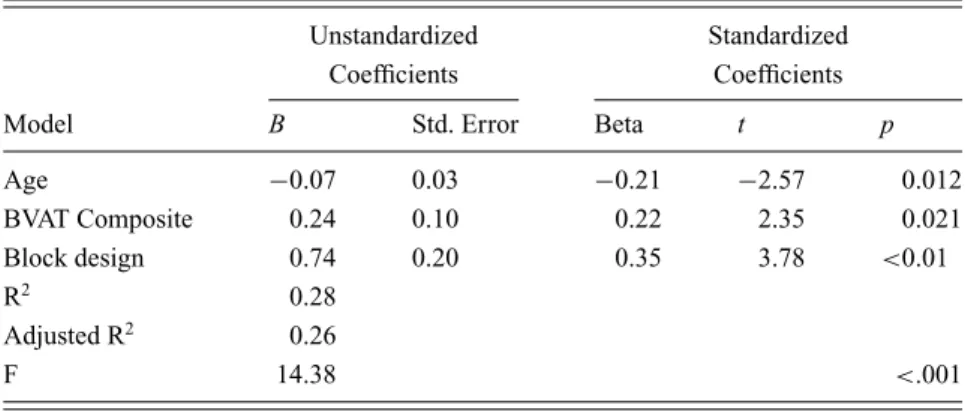
were included as predictors in the model. The results of the first linear regression analysis are presented onTable 4. The coefficient of determination is .28 (adjusted to .26); therefore, about 26% of the variation in the Digits tasks, combined with the Stroop inhibition costs, is explained by the participants’ age in combination to the BVAT proficiency measure and Block design. The regression equation appears to predict well the performance on the executive function tests since the F value is significant at the level of .001. Moreover, all of the variables included in the model are significant predictors; Block Design has however the highest Beta value (.34)
Table 4. Regression of the z score composite BVSAT score on the composite z score on verbal executive function tasks
Unstandardized Standardized
Coefficients Coefficients
Model B Std. Error Beta t p
Age −0.07 0.03 −0.21 −2.57 0.012
BVAT Composite 0.24 0.10 0.22 2.35 0.021
Block design 0.74 0.20 0.35 3.78 <0.01
R2 0.28
Adjusted R2 0.26
F 14.38 <.001
Note.BVAT=Bilingual Verbal Ability Test. Verbal composite score included the scores on the following tests: digits forward, the digits backwards and the Stroop inhibition cost
Table 5. Regression of the proficiency measure (z score composite BVAT) on the non-verbal executive function task (the Simon effect)
Unstandardized Standardized
Coefficients Coefficients
Model B Std. Error Beta t p
Age 0.02 0.01 0.15 1.61 0.110
BVAT Composite −0.08 0.05 −0.15 −1.38 0.169
Block design −0.11 0.10 −0.11 −1.07 0.285
R2 0.07
Adjusted R2 0.04
F 2.73 0.048
Note.BVAT=Bilingual Verbal Ability Test.
The comparison of the adjusted R2 of the two initial regression models suggest that the composite of proficiency used in this study better predicts verbal inhibitory and working memory tasks (Adjusted R2=.26) than non-verbal inhibitory tasks (Adjusted R2=.04).
Discussion
On the basis of previous results (Bialystok et al., 2008; Colzato, Bajo, van der Wildenberg, Paolieri, Nieuwenhuis, La Hei & Hommel, 2008; Costa et al., 2008) this study expected to find young adult bilingual advantages on non-verbal executive function tasks and monolingual advantages on verbal executive function tasks when proficiency was objectively analyzed; for this matter, the Bilingual Verbal Ability Tests on both monolinguals and Spanish–English bilinguals was implemented. Language groups were compared on verbal and non-verbal working memory, updating, shifting, and inhibition tasks.
Results in general were similar in both verbal and non-verbal executive function tests: High proficiency
balanced bilinguals performed better than low proficiency balanced bilinguals; unbalanced bilinguals scored in between both balanced groups. On the other hand, high proficiency monolinguals scored higher than low proficiency monolinguals and similar to high proficiency bilinguals. These results do not support a bilingual advantage in the selected executive functions tests. Only high proficiency balanced bilinguals scored higher than high proficiency monolinguals in a few tests: Letter memory and Corsi block span, but differences were small and non-significant.
Regression analyses were conducted to examine the role of non-verbal intelligence on task performance (measured with the WAIS Block design test). It was found that non-verbal intelligence significantly predicted performances on verbal working memory and verbal and non-verbal inhibition tasks. The data showed that non-verbal intelligence is a better indicator of executive function test performance than language proficiency in young adults for all language groups.
12 Bilinguals’ proficiency and executive function
define proficiency and selected a proficiency measure that was believed to assess bilingualism in a way that fit the ACTFL’s definition, its results cannot be compared to the only previous study that thoroughly analyzed proficiency (Costa et al., 2008), as Costa and colleagues did not test for differences in intelligence between groups. In the study of Costa et al. (2008), high proficiency, young adult bilinguals were shown to perform significantly better on a non-verbal inhibition task than monolinguals. However, the authors did not administer an intelligence measure because they believed that using a large sample (n = 200) should eliminate group differences in intelligence. Additionally, they did not use a low proficiency group while testing for cognitive advantages of bilingualism. The current study tested a relatively large sample and found that non-verbal intelligence was the factor with most significant influence on the outcome.
Other studies comparing young adult bilinguals and monolinguals that have tested for differences in non-verbal intelligence have either not objectively tested for language proficiency, and/or have not divided the bilingual group based on proficiency (Bialystok et al.,2004; Costa, Hernández, Costa-Faidella & Sebastián-Gallés, 2009; Salvatierra & Rosselli,2010; Wodniecka, Craik, Luo & Bialystok,2010) making it difficult to compare previous results with the results of the current study.
Our results are contrary to those observed by Prior and MacWhinney (2010) who found bilinguals demonstrate advantages in shifting as young adults. However, Prior and MacWhinney’s bilingual participants self-reported proficiency and spoke heterogeneous languages (making objective testing of bilingualism a difficult feat). Additionally, participants were only tested on a non-verbal shifting measure, which may have advantaged bilingual participants (Bialystok,2009). Our study tested a group of homogenous (Spanish–English) bilinguals and objectively measured proficiency to divide bilinguals into high and low proficiency groups. Participants were tested on both verbal and non-verbal shifting tasks and it was found that language groups did not differ in shifting performance on either type of task. A possible explanation for the differences observed between studies may be due to the method in which participants responded during shifting tasks. Prior and MacWhinney’s shifting paradigm asked participants to use the keyboard to enter responses, while both shifting measures in the current study asked participants to voice responses into a microphone.
Pursuing this further, Soveri, Rodriguez-Fornells and Laine (2011) also reported non-verbal shifting advantages in bilinguals when participants gave button press responses to stimuli presented. Our shifting, verbal updating, and verbal inhibition measures required bilinguals to respond verbally into a microphone. Word retrieval has been shown to be slower in bilinguals than in monolinguals (Gollan et al., 2005; Ivanova
& Costa, 2008). The button press format may allow bilinguals to respond more rapidly, lowering switching costs, as observed by Soveri et al. (2011). Similarly, Bialystok, Craik and Ryan (2006) analyzed which aspects of control are sensitive to the bilingual experience. Two different studies were carried out; Study 1 used an antisaccade task; no effects of aging or bilingualism were found. Study 2 used the identical visual display but coupled to key press responses. The results showed that bilinguals resolved various types of response conflict faster than monolinguals; this bilingual advantage in general increased with age. It could be suggested that saccadic movements and oral responses are more automatized than are key presses; consequently, they are less vulnerable to minor differences in executive functions. This emphasizes the importance of consistent assessment methods across multiple tasks and exercising caution when comparing results.
Kousaie and Phillips (2012b) tested bilinguals on multiple inhibition tasks and found non-significant differences between monolinguals and bilinguals. The current study tested for and separated the bilingual group by proficiency and separated analyses by task type. These separations of groups and analyses were predicted to show group differences that were not observed by Kousaie and Phillips (2012b) on task type (non-verbal and verbal) and cognitive domains tested. However, neither group of young adult bilinguals in the current study demonstrated any advantages in working memory or executive function tasks over monolinguals. Interestingly, in a developmental population (188 children with differential degrees of language competence, mean age 10.9 years) Videsott et al. (2012) found that linguistic competence rather than competence in other domains plays a crucial role in alerting components.
Our results also align with reports that executive advantages on inhibition tasks are not observed in young adults (Bialystok et al.,2004; Salvatierra and Rosselli, 2010; Bialystok, 2006). However, these results conflict with those of previous studies which measured shifting and inhibition in bilinguals (Bialystok et al., 2006a; Costa et al.,2008; Hernandez et al.,2010). The overall unidirectional lack of advantages on both shifting and inhibition was not surprising considering Meuter and Allport’s (1999) findings that shifting requires inhibition and that advantages tend to go hand-in-hand.
specific skill but benefits would not necessarily be seen in meaningless (irrelevant) tasks. It may be that highly proficient Spanish–English bilinguals do not outperform other groups on verbal or non-verbal tasks because the tasks tested have no relevance to effective communication in Spanish. In other words, the tasks used may be of limited cultural value.
The unbalanced subsample of bilinguals represents an interesting group. Its scores were in most tasks in between the high proficient and low proficient bilinguals; and as a matter of fact, they were highly proficient in one of the languages but showed low proficiency in the other. Consistent with this trend, their scores in the Block design were in between both bilingual groups and similar to the mean scores for monolinguals. They are indeed individuals whose level of bilingualism can be subject to further scrutiny.
An additional point that has to be taken into consideration refers to the idiosyncrasies of the selected sample: young Hispanic bilinguals living in Florida. As a matter of fact, south Florida represents a strongly Spanish–English bilingual area, and frequently both languages are simultaneously used in a single social interaction. Noteworthy, Green and Abutalebi (2013) have suggest that bilinguals will show little or no advantage on tasks tapping language control functions if they operate in a language environment requiring a continuous code-switching, in which “speakers routinely interleave their languages in the course of a single utterance and adapt words from one of their languages in the context of the other” (p. 518). It could be suggested that whether or not the bilingual advantage is found depends on who are the specific participants included in the study.
In conclusion, this study showed young adults’ non-verbal intelligence scores are better predictors of executive function performance than bilingualism or language proficiency. While the advantages of bilingualism have been seen in children and in the elderly (Bialystok, 1999, Bialystok et al., 2004; Bialystok, 2007; Salvatierra & Rosselli,2010), our findings suggest that no statistically significant advantages are found in young adults when controlling for proficiency and balance. These results are in concordance to a recent report by Gathercole et al. (2014) who failed to provide support for the bilingual advantage on three types of EF tasks of different age groups of bilinguals including young adults.
Even though our results highlight the importance of continuing bilingualism investigations while carefully implementing objective measures of proficiency and intelligence, it is important to acknowledge some possible imitations in this research: First of all, the sample was relatively small but similar in size to the samples of previous studies reporting the effects of bilingualism on EF (e.g., Bialystok, 2006; Bialystok et al., 2006a,
2006b). Secondly, only one test of non-verbal intelligence
was used (Block Design) although this subtest is usually regarded as one of the best subtests assessing nonverbal intelligence (Matarazzo, 1972; Brown, 2003). Finally, the participants of the current study belonged to a very particular type of bilinguals: early and young Spanish– English bilinguals, living in a partially bilingual society (south Florida), limiting the generalization of results to bilinguals with these same characteristics.
References
American Council on the Teaching of Foreign Languages (2012).
ACTFL proficiency guidelines for speaking. Hasting-on-Hudson, NY: American Council on the Teaching of Foreign Language.
Anderson, P. (2002). Assessment and development of executive function during childhood.Child Neuropsychology, 8,71– 82.
Ardila, A., & Rosselli, M. (2002). Acalculias and dyscalculias.
Neuropsychology Review, 12,176–232.
Aron, A., & Aron, E.N. (2003).Statistics for Psychology—Third Edition. New Jersey: Pearson Education. Inc.
Baddeley, A. (2003). Working memory: Looking back and looking forward. Nature Reviews Neuroscience, 4, 829– 839.
Barrouillet, P., Mignon, M., & Thevenot, C. (2008). Strategies in subtraction problem solving in children. Journal of Experimental Child Psychology, 99,233–251.
Bialystok, E. (1987). Influences of bilingualism on metalinguistic development.Second Language Research, 3(2), 154–166.
Bialystok, E. (1991).Language processing in bilingual children. New York, NY: Cambridge University Press.
Bialystok, E. (2006). Effect of bilingualism and computer video game experience on the Simon task.Canadian Journal of Experimental Psychology, 60,68–79.
Bialystok, E. (2007). Cognitive effects of bilingualism: How linguistic experience leads to cognitive change.
The International Journal of Bilingual Education and Bilingualism, 10(3), 210–223.
Bialystok, E. (2009). Effects of bilingualism on cognitive and linguistic performance across the lifespan.Streitfall Zweisprachigkeit–The Bilingualism Controversy, 19(1), 53–67.
Bialystok, E., Craik, F. I. M., Klein, R., & Viswanathan, M. (2004). Bilingualism, aging, and cognitive control: Evidence from the Simon task.Psychology & Aging, 19,
290–303.
Bialystok, E., Craik, F.I.M., & Luk, G. (2008). Cognitive control and lexical access in younger and older bilinguals.
Journal of Experimental Psychology: Learning, Memory, and Cognition, 34,859–873.
Bialystok, E., Craik, F. I. M., & Ruocco, A. C. (2006a). Dual-modality monitoring in a classification task: The effects of bilingualism and aging.Quarterly Journal of Experimental Psychology, 59,1968–1983.
14 Bilinguals’ proficiency and executive function
and bilingualism. Journal of Experimental Psychology: Learning, Memory, and Cognition, 32,1341–1354. Bialystok, E., & Feng, X. (2009). Language proficiency and
executive control in proactive interference: Evidence from monolingual and bilingual children and adults.Brain and Language, 109,93–100.
Brown, L. (2003).Handbook of non-verbal assessment. New York: Springer
Colzato, L.S., Bajo, M.J., van der Wildenberg, W., Paolieri, D., Nieuwenhuis, S., La Heij, W., & Hommel, B. (2008). How does bilingualism improve executive control? A comparison of active and reactive inhibition mechanism.
Journal of Experimental Psychology: Learning, Memory, and Cognition, 34 (2), 302–312.
Costa, A., Hernández, M., Costa-Faidella, J., & Sebastián-Gallés, N. (2009). On the bilingual advantage in conflict processing: Now you see it, now you don’t. Cognition, 113(2), 135–149.
Costa, A., Hernández, M., & Sebastián-Gallés, N. (2008). Bilingualism aids conflict resolution: Evidence from the ANT task.Cognition, 106,59–86.
De Groot, A. D. (1978).Thought and choice in chess (Revised translation of De Groot, 1946. The Hague: Mouton Publishers.
Duncan, S. E., & DeAvila, E. A. (1979) Bilingualism and cognition: Some recent findings.NABE Journal, 4(1), 15– 50.
Emmorey, K., Luk, G., Pyers, J., & Bialystok, E. (2008). The source of enhanced cognitive control in bilinguals: Evidence from bimodal bilinguals.Psychological Science, 19,1201–1206.
Feng, X. (2008). Working memory and bilingualism: An investigation of executive control and processing speed. Unpublished doctoral dissertation, York University, Toronto.
Garbin, G., Sanjuan, A., Forn, C., Bustamante, J.C., Rodriguez-Pujadas, A., Belloch, V., & Avila, C. (2010). Bridging language and attention: Brain basis of the impact of bilingualism on cognitive control. NeuroImage, 53(4), 1272–1278.
Gathercole, V.C., Thomas, E.M., Kennedy, I., Prys, C., Young, N.,Viñas Guasch, N., Roberts, E.J., Hughes, E.K., & Jones, L. (2014) Does language dominance affect cognitive performance in bilinguals? Life span evidence from preschoolers through older adults on cardsorting, Simon, and metalinguistic task.Frontiers in Psychology, 5,
1–14.
Gollan, T. H., Montoya, R. I., Cera, C. M. & Sandoval, T. C. (2008). More use almost always means a smaller frequency effect: Aging, bilingualism, and the weaker links hypothesis.Journal of Memory and Language, 58, 787– 814.
Gollan, T. H., Montoya, R. I., Fennema-Notestine, C. & Morris, S. K. (2005). Bilingualism affects picture naming but not picture classification. Memory & Cognition, 33, 1220– 1234.
Gollan, T. H., Montoya, R. I., & Werner, G. (2002). Semantic and letter fluency in Spanish–English bilinguals.
Neuropsychology, 16,562–576.
Green, D. W., & Abutalebi, J. (2013). Language control in bilinguals: The adaptive control hypothesis. Journal of Cognitive Psychology, 25(5), 515–530.
Hernández, M., Costa, A., Fuentes, L.J., Vivas, A.B., Sebastián Gallés, N. (2010). The impact of bilingualism on the executive control and orienting networks of attention.
Bilingualism: Language and Cognition, 13(3), 315– 325.
Hilchey, M. D., & Klein, R. M. (2011). Are there bilingual advantages on nonlinguistic interference tasks? Implications for the plasticity of executive control processes.Psychonomic bulletin & review, 18(4), 625–658. Ivanova, I., & Costa, A. (2008). Does bilingualism hamper lexical access in speech production? Acta Psychologica, 127,277– 288.
Kousaie, S., & Phillips, N.A. (2012a). Ageing and bilingualism: Absence of “bilingual advantage” in Stroop interference in nonimmigrant sample. The Quarterly Journal of Experimental Psychology, 65(2), 356–369.
Kousaie, S., & Phillips, N. A. (2012b). Conflict monitoring and resolution: Are two languages better than one? Evidence from reaction time and event-related brain potentials.Brain research, 1446,71–90.
Lehtonen, M., & Laine, M. (2003). How word frequency affects morphological processing in monolinguals and bilinguals.
Bilingualism: Language and Cognition, 6,213–225. Matarazzo, J. D. (1972).Wechsler’s Measurement and Appraisal
of Adult Intelligence, Oxford University Press, New York. Mercy, J.A., & Steelman, L.C. (1982). Familial influence on the
intellectual attainment of children.American Sociological Review, 47(4), 532–542.
Meuter, R. F. I., & Allport, A. (1999). Bilingual language switching in naming: Asymmetrical costs of language selection.Journal of Memory and Language, 40,25–40. Milner, B. (1971). Interhemispheric differences in the
localization of psychological processes in man. British Medical Bulletin, 27,272–277.
Mindt, M. R., Arentoft, A., Kubo Germano, K., D’Aquila, E., Scheiner, D., Pizzirusso, M., Sandoval, T.C., & Gollan, T. H. (2008). Neuropsychological, cognitive, and theoretical considerations for evaluation of bilingual individuals.Neuropsychology review, 18(3), 255–268. Miyake, A., Friedman, N.P., Emerson, M.J., Witzki, A.H.,
Howerter, A., & Wager, T.D. (2000). The unity and diversity of executive functions and their contributions to complex “frontal lobe” tasks: A latent variable analysis.Cognitive Psychology, 41,49–100.
Morris, N., & Jones, D. M. (1990). Memory updating in working memory: The role of the central executive.British Journal of Psychology, 81,111–121.
Muñoz-Sandoval, A. F., Cummins, J., Alvarado, C. G., & Ruef, M. L. (1998).Bilingual verbal ability tests: Comprehensive manual. Itasca, IL: Riverside Publishing.
Prior, A., & MacWhinney, B. (2010). Beyond inhibition: A bilingual advantage in task switching. Bilingualism: Language and Cognition, 13,253–262.
multilingualism matter?International Journal of Bilingual Education and Bilingualism, 9(6), 728–741.
Roberts, P. M., Garcia, L. J., Desrochers, A., & Hernandez, D. (2002). English performance of proficient bilingual adults on the Boston Naming Test.Aphasiology, 16 (4–6), 635– 645.
Rosselli, M., Ardila, A., Araujo, K., Weekes, V. A., Caracciolo, V., Padilla, M. & Ostrosky-Solis, F. (2000). Verbal fluency and verbal repetition skills in healthy older Spanish– English bilinguals.Applied Neuropsychology, 7,
17–24.
Rosselli, M., Ardila, A., Santisi, M. N., Arecco, M. D. R., Salvatierra, J., & Conde, A. (2002). Stroop effect in Spanish–English bilinguals. Journal of the International Neuropsychological Society, 8(06), 819–827.
Salvatierra, J.L., & Rosselli, M. (2010). The effect of bilingualism and age on inhibitory control.International Journal of Bilingualism, 14(3), 26–37.
Sandoval, T.C., Gollan, T.H., Ferreira, V.S., & Salmon, D.P. (2010). What causes the bilingual disadvantage in verbal fluency? The dual-task analogy. Bilingualism: Language and Cognition, 13,231–252.
Segalowitz, N., and Frenkiel-Fishman, S. (2005). Attention control and ability level in a complex cognitive skill: Attention shifting and second-language proficiency.
Memory and Cognition, 33(4), 644–653.
Simon, J. R., & Rudell, A. P. (1967) Auditory S-R compatibility: The effect of an irrelevant cue on information processing.
Journal of Applied Psychology, 51,300–304.
Soveri, A., Rodriguez-Fornells, A. & Laine, M. (2011) Is there a relationship between language switching and executive
functions in bilingualism? Introducing a within group analysis approach.Frontiers in Cognition, 2(183), 1–8. Thevenot, C., Fanget, M., & Fayol, M. (2007). Retrieval or
non-retrieval strategies in mental arithmetic? An operand-recognition paradigm. Memory & Cognition, 35, 1344– 1352.
U. S. Census Bureau. (2010). Language Use. Re-trieved April 17, 2012, from http://www.census.gov/ hhes/socdemo/language/.
Vega, C., & Fernandez, M. (2011). Errors on the WCST correlate with language proficiency scores in Spanish–English bilingual children.Archives of clinical neuropsychology, 26(2), 158–164.
Videsott, G., Della Rosa, P. A., Wiater, W., Franceschini, R., & Abutalebi, J. (2012). How does linguistic competence enhance cognitive functions in children? A study in multilingual children with different linguistic competences.
Bilingualism: Language and Cognition, 15(04), 884–895. Wechsler, D. (1997).Wechsler Adult Intelligence Scale —Third
Edition. San Antonio, TX: Psychological Corporation. Wechsler, D. (2008).Wechsler Adult Intelligence Scale —Fourth
Edition. San Antonio, TX: Psychological Corporation. Wodniecka, Z., Craik, F.I.M., Luo, L., & Bialystok, E. (2010).
Does bilingualism help memory? Competing effects of verbal ability and executive control.International Journal of Bilingual Education and Bilingualism, 13(5), 575–595. Zied, K.M., Philippe, A., Pinon, K., Havet-Thomassin, V.,