UNIVERSIDAD TÉCNICA PARTICULAR DE LOJA
La Universidad Católica de Loja
TITULACIÓN DE LICENCIADO EN CIENCIAS DE LA EDUCACIÓN
The use of supplementary materials for teaching children in EFL classes Research done in order to achieve the Bachelor’s Degree in Teaching English as a Foreign Language
AUTHOR: MENCIÓN
Rosero Carrillo, Andrea Elizabeth INGLES
ADVISOR:
Paredes Zuñiga, Fabián Marcelo Lic.
QUITO - ECUADOR
iii
CERTIFICATION
Licenciado
Paredes Zuñiga, Fabián Marcelo
DIRECTOR DEL TRABAJO DE FIN DE CARRERA
Certifies that:
This research study has been thoroughly revised by the graduation committee. Therefore, authorizes the presentation of this thesis, which complies with all of the norms and internal requirements of the Universidad Técnica Particular de Loja.
Loja, December 2012
………
iv
CONTRATO DE CESIÓN DE DERECHOS DE TESIS DE GRADO
“Yo, Andrea Elizabeth Rosero Carrillo declaro ser autora del presente trabajo y eximo
expresamente a la Universidad Técnica Particular de Loja y a sus representantes legales de posibles reclamos o acciones legales.
Adicionalmente declaro conocer y aceptar la disposición del Art. 67 del Estatuto Orgánico de la Universidad Técnica Particular de Loja que en su parte pertinente textualmente dice: “formar parte del patrimonio de la Universidad la propiedad
intelectual de investigaciones, trabajos científicos o técnicos y tesis de grado que se realicen a través, o que el apoyo financiero, académico o institucional (operativo) de la Universidad”.
………
Andrea Elizabeth Rosero Carrillo
v
AUTHORSHIP
The thoughts, ideas, opinions and the information obtained through this research are the only responsibility of the author.
Loja, December 2012.
……….
Andrea Elizabeth Rosero Carrillo
vi
DEDICATION
vii CONTENTS
CERTIFICATION………..………..ii
CONTRATO DE CESIÓN DE DERECHOS ……….…………...iii
AUTHORSHIP ………...iv
DEDICATION……….……….v
CONTENTS..………...vi
ABSTRACT ……….………1
INTRODUCTION………2
METHOD ………5
DISCUSSION ………..8
Literature Review………8
Results………...24
Description, Analysis, and Interpretation of Results………29
Conclusions………...84
Recommendations………85
REFERENCES ………..86
1 ABSTRACT
This research analyzes the use of supplementary materials for teaching children in EFL classes. The purpose of this study is to find out if teachers are actually using these materials, and to examine, how pertinent, appropriate, and qualified those materials are. The study was carried out in a private English Institute in Quito. The students who participated were 8, 9 and 10 year-old children. They were studying there in order to reinforce their language knowledge to improve their grades at school.
Both qualitative and quantitative research methodologies were utilized in this study. The qualitative research described how teachers are using each supporting material considering the topic, objectives, content of the class, the students’ needs for their age and level and its quality. The quantitative research described the variety of materials used and the frequency teachers utilized them. The analyzed results showed that, the pertinence, the appropriateness and the quality of several materials are being taken into account, however it is necessary the use of more variety of materials in order to improve the teachers’ consideration of the children learning styles.
2
INTRODUCTION
The teaching of English is a labor of a great complexity and diversity. It has worried many teachers through years. Three basic elements have contributed in this teaching and learning process. Firstly, the socio-cultural component which is taken into account at the moment of making decisions about teaching. The bibliographical
component, that is vital for conducting the students to success. And the methodological component considered the most important because it includes the methods, the
resources and techniques applied which together collaborate in the learning accomplishment.
The teachers count with many aids to achieve this important labor and one of the most important is the use of supplementary material. The use of this tool reports many benefits if the selection of the materials for each class considers the pertinence and the appropriateness of the material in relation to the content of the class and the students needs.
Nowadays, there is available an important quantity of supporting materials that the teachers can use. However, it is believed that this aid is not being correctly used or it is not used at all. For this reason, the theme of the research proposal is: “The use of
supplementary materials for teaching children in Ecuadorian EFL classes”. The purpose of this study is to find out whether or not teachers use supplementary materials, and if they are used, how pertinent, appropriate, and qualified those materials are.
The objectives of this study are: Identify and analyze supporting materials used for teaching children in EFL classes; describe and analyze each one of the
3
It is very important the research on this topic because it will awake teachers’ interest in using supplementary material in their classes and will produce an improvement in the Ecuadorian educational system.
A previous research in this topic conducted by Kelsen, (2009) had as purpose to explore the use of YouTube in an EFL situation by surveying students’ attitudes
towards using YouTube to study English. One of the limitations of this study was that the questionnaires used were only written in English. The self-reported nature of the survey may have led to students overstating their answers as the course teacher administered the questionnaires. There was a relatively small sample size. All the participants came from the same department, so the results cannot be extrapolated to the general student population.
Another related study developed by Shin (2007) had the purpose of identifying how many teachers agreed with the need for Internet literacy training and how many of them would like to use Internet-based materials and activities in their classrooms as much as possible. The limitation of this study was that the questionnaires were
distributed online and off-line among 150 Korean secondary school EFL teachers. But through the open-ended questions in the questionnaire, the teachers indicated they couldn’t express their feeling the way they wanted.
4
As it is evident, these previous researches do not address how to choose the best supplementary materials, neither when is better to use them, nor what impact would provoke in learners, especially on children, for this reason this study will benefit teachers and students, who need to know how they can teach and learn appropriately with these materials.
The first limitation of the study is that the size of the sample was very small, the selected institute had as characteristic to give personalized classes, consequently the maximum number of students in a class is ten (some of them were absent of the classes), it was difficult to give a general interpretation of the effect of these materials on children. Another shortcoming is the period of time in which the research was developed. As the students were at the end of the school year, they were not so focused in their English classes and some of them missed their classes. Finally, the limited number of observations did not allow the investigator to have a real knowledge of the teacher use and handling of the supplementary materials. As the teachers of the institute knew somebody was observing them for only ten classes they tried to use as many supporting materials as they can with the purpose of giving a good impression.
5
METHODOLOGY
Setting and Participants
This research was carried out in a private English Institute located in Quito, Ecuador. This institute teaches children and adults from an introduction level to an upper-advanced level. The teachers are Ecuadorians who have studied the language in a foreign country. This institute counts with a great variety of supporting materials, and basic bibliography.
The students who study in this institute come from different schools of Quito. Most of these students enjoy learning English and others need to improve their grades at school, subsequently they all have a great motivation to learn English. The students who participated in this study were 8, 9 and 10 year-old children distributed in three groups according their age and level. The 8-year-old group or beginner level, counted with four girls and two boys; they were hyperactive and intelligent children who liked to learn and play. The second group formed by the 9-year-old students belonged to the intermediate level, there were five girls and three boys, and they were attentive and cooperative. The third group of the 10-year-old children had five girls and five boys; they were more mature and less considerate. These groups attended to the English classes three times a week, during the afternoon. All the students had their own basic material and a good attitude through the language.
Procedures
6
support on five previous studies about the use of supporting material in the EFL
classrooms was also investigated. The purposes, the methods and the conclusions of the studies were principally analyzed. These studies were found in trustworthy journals and books from the internet. The studies were developed in many places in the world such as Colombia, United States and Korea, consequently we can appreciate a wide vision.
The methods applied in order to develop this research were Qualitative and Quantitative. The qualitative method analyzed the pertinence, the appropriateness and the quality of the supplementary materials used in the observed classes. While
observing the classes, a description of each used material and its impact in the children learning-process was being developed. The quantitative method explored what materials were being used in each class and how often each material was used. It described a statistical analysis with the report of trends, comparisons of results and relationships among variables.
The process of collecting the data was done subsequent to elaborating the literature review. After selecting the institute, the permission from the owners and directors was solicited, in order to collect information to conduct a research. Three groups of students were selected and ten classes were observed. The main aspects of each class were registered such as the supporting materials used in the classes, their description, the students’ attitudes andthe teachers’ ability of using these materials
properly.
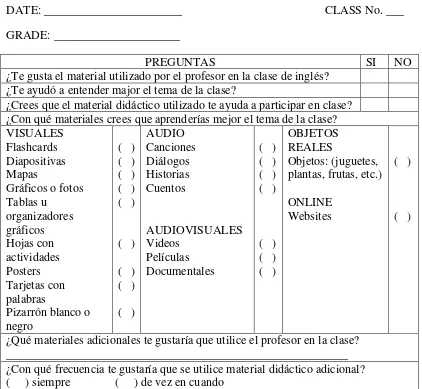
Through the observation and the application of surveys the data was collected in four charts: an observation sheet and a material description sheet filled by the
investigator, a student’s survey applied to two students in each observed class and a teacher’ survey applied to all the teachers of the classes. The investigator used data
7
collect the data for the research; and the techniques applied were reading, note-taking, observation and surveys.
The data was tabulated in five different charts. The chart one showed the type of supplementary material used to teach children, all the observation sheets of the three groups were considered to complete the results in this chart. The chart two presented the pertinence and appropriateness of the supplementary material used to teach the 8-year-old children, the description of the used material sheets of this group were examined to complete this chart. The chart three indicated the pertinence and appropriateness of the supplementary material used to teach the 9-year-old children, the results were taken from the description of material sheets of this group. The chart four illustrated the pertinence and appropriateness of the supplementary material used to teach the 10-year-old children, the data was taken from the description sheets of this group. The chart five served to explain a quantitative tabulation, the frequency of use of each material was presented in order to complete the results on this chart, all the observation sheets were analyzed and transformed in numbers.
The data was analyzed firstly in qualitative and quantitative manners. Having as basis theories, principles and concepts in the literature review, the results from de charts were described, analyzed and interpreted. In the qualitative analysis, the pertinence, appropriateness and quality of each material utilized in each class were explained, as well as the teachers’ consideration of the children learning styles. The quantitative
8
DISCUSSION Literature Review
English is being the most studied language as the worldwide communication bridge in modern times. It is estimated that over 1 billion people are currently learning English worldwide. According to the British council, as of the year 2000 there were 750 million English as foreign language speakers. And, there were 375 million English as Second Language speakers (Beare, 2009). Taking into account that in a globalized world, the number of English learners around the world is only expected to further grow, it has always being analyzed the techniques, methods and all the learning process that a teacher must use in order to help his students to acquire their new language better and faster. In this text, the use of the supplementary material in the EFL classroom is going to be principally investigated due to the great aid that it could represent; it will show especial attention in teaching children with this support.
This study is significant because the supplementary material could help the students to improve and reinforce their skills, and it could make learning fun. In past years, a wealth of studies showed that the use of supplementary materials is relevant because they append and incorporate the original material and entertain or inform independently of the original material (Spratt, 2004).The motivation of this study is that even though the benefits associated with supplementary materials seem to be
understood, educators still know little about how to use them in a practical and
9
Teaching a Foreign Language
Jenkins (2002) claimed that English is no longer spoken only by its native speakers in the UK, North America, Australia and New Zealand. It is also learned among non-native speakers within countries like India, the Philippines and Singapore and internationally among non-native speakers from a wide range of countries/first languages throughout the world. This last use of English is the largest group of English speakers, numbering around 1.5 billion. For this reason, Teaching English as a foreign language (TEFL) is a worldwide activity developed by a great quantity of educators. TEFL means to teach English to students whose first language is not English. It happens in the student's own country, either within the state school system, or privately.
Vez (2002) said that “the development of further education for adults in
practically all the European countries has considerably increased the number of possible students and at the same time has greatly modified the conditions of learning”. Taking
into account this reality, the concept that teaching a foreign language only consists of the utilizations of textbooks and teaching methods wherein there is no organization of subject matter of any kind in the teaching of the words of the language, has to
experiment a transformation.
10
rate. Teaching writing, teachers should assign writing assignments, the more vocabulary a student possesses the better they will write.
Learners
Adults, adolescents and children have their own characteristics; the teacher should know all of them with the purpose of helping each group with the appropriate system. According to Piaget’s theory of cognitive development stages, children learn
languages normally through sensory experience, and intelligence develops in the form of motor actions, young learners receive more concrete input. Consequently, their instruction should preferably involve concrete references in the language being taught and dynamically engaging tasks (Piaget, 1990).
Urham (1996) claims that for adolescents, language teaching should be concerned with the learners’ level by using interactive methods that involve students and present
challenges. At this stage of life, students are starting to take responsibilities in their life and they avoid and fear to make mistakes in everything, including language errors. The risk-aversion tendency will impede active experimentation with language use. Hong & Morgan (2004, p. 10) state:
The processes that adults use to acquire language give them a good start, but ultimately limit their final level of mastery. According to the biological hypothesis, adults who become language learners have less possibility of achieving native mastery. When one cannot be distinguished from a native speaker by another native speaker, then one has mastered the language.
11
are less rigid in understanding new learning tasks. However, adults have advantages too, for example they have a much bigger L1 vocabulary and, therefore, do not have to obtain thousands of new concepts in the L2 as children do. Additionally, adults’ ability
to make mindful grammatical generalizations and apply them to suitable exemplars is an advantage rather than an inhibiting factor (Hong & Morgan, 2004).
There is also evidence that gender differences could affect in TEFL. It seems that men take advantage of the conversation in a way that allows them to promote their performance/production ability, whereas women utilize the conversation to promote their comprehension ability. Consequently, ESL/EFL teacher, should be able to engineer situations that create equal opportunities for both males and females in all aspects of classroom interaction (Shehadeh, 1999).
Motivation in education has numerous effects on how students learn and behave, for example: it can direct behavior toward particular goals, lead to increased effort and energy, increase initiation of activities, enhance cognitive processing and lead to improved performance (Martin, 1986). Referring to the learners’ motivation, Lepper (1995) explains that there are two kinds of motivation: Intrinsic motivation happens when people are internally motivated to do something because it either brings them pleasure, or they feel that what they are learning is significant. Extrinsic motivation occurs when a student is compelled to act a certain way because of external factors.
Learning styles
According to Spratt (2005, p. 52), learning styles “are related to the physical sense we prefer to use to learn, our ways of interacting with other people and our style of thinking.” Based on this, learning styles can be classified in: visual style which concerns
12
discussions, music, etc. Kinesthetic style involves the use of the body; these learners prefer their learning to be connected with reality. Group style refers to working with others. Individual style involves working alone. Reflective style concerns considering choices and impulsive style that engage an immediate respond.
Collins (1995) explained that the simplest and most common way of identifying different learning styles is based on the senses. Commonly called the VAK model, this framework describes learners as visual, auditory, or kinesthetic. Visual learners most effectively process visual information; auditory learners understand best through hearing; and kinesthetic/tactile learners learn through touch and movement. A study conducted by Specific Diagnostic Studies found that 29 percent of all students in elementary and secondary schools are visual learners, 34 percent learn through auditory means, and 37 percent learn best through kinesthetic/tactile modes (Miller, 2001).
Teaching techniques
Ruddell (1995) explained that one useful technique for teaching reading is Read Aloud/Think Aloud: When reading aloud or presenting a video, let them see what
effective readers do inside their heads. For example, when the fox says, "Look at that beautiful bird!" Ask them “Who is the fox talking to?”“Is the crow beautiful?” “Why would the fox say that?” etc. These questions show the students how a reader reflects on the story, words, pictures, or language. Comprehension Questions is another technique to develop students’ understanding which consists of asking the children open-ended
questions that start with Why and How, as well as Who, What, Where, and
13
employing other strategies. Story Grammar Knowing is another technique whose principle is that common structures of stories can help students remember the details of a story.
Upadhyay (2010) described some techniques for teaching vocabulary. Build Word Knowledge is a technique in which the students need to recognize a word in print, need to learn the multiple meanings of the word, need to clarify and enrich the meaning of a known word, and finally need to use that word expressively. Teach Words
Conceptually refers to include the essential features of the word, as well as examples and demonstrations of the word in appropriate contexts. Classroom Visual Aids Technique has to do with the use of a graphical organizer that can be very helpful in making abstract concepts more concrete. The use of charts and posters is also important for the students in order to provide them additional ways to expose their topics.
14
Different contexts for teaching
Group discussions could be done in two ways. A small sub-group of a large lecture class, which meets regularly as a complement to the weekly lectures. A small group formed online to work collaboratively either as part of an online course or as an activity that supports a course taught in the classroom. Laboratory classes allow English students to increase their listening skills and to obtain many other advantages such as: improve their comprehension and pronunciation. The teacher needs to coordinate the material and to guide the students through the lab (Cohen, 2006).
Large groups is the most difficult teaching situation, they require the most academic and mental preparation. This context will be better managed using supporting materials. In small groups students are easier to access; this context provides the
teachers ample opportunity to interact with students and materials. Hybrid courses are often composed of an online component, and an on-campus component. Hybrid courses require the teachers to be able to manage both the online and the face-to-face contents of the course, and create a workable timeline (Cohen, 2010).
There are different types of ESL environments that can enhance learning.
Elementary setting is a context where the student is pulled out of the regular classroom for special instruction in ESL. Students from different first-language backgrounds may be separated into groups for instruction. Middle school setting is a context where
15
Supplementary material
Supplementary material is significant additional work which is incorporated into or related to the original material but which has some function or faculty to entertain or inform autonomously, physically separate from the basic bibliographic unit and
habitually in a different medium. (Spratt, 2004) This material is also considered as a part of a work, physically disconnected from the basic bibliographic unit and frequently in a different medium (Hall, 1987).
The supplementary material is important because it teaches the students to learn by attractive activities, they provide ideas and tricks for instruction and learning. As a great quantity of the teachers feel that the textbook is an external syllabus that has been “imposed on students without any regard for their individual needs” (Yien, 1996) the
supplementary materials are vital because they are suitable for students' needs, they give the students motivation, enthusiasm and everything a basic text cannot provide. For this reason, the teacher must realize that the textbook is not the only tool in the classroom; it may be the major tool, but there are other materials that may be used (Biemer, 1992). Materials that include video and audio tapes, computer software, visual aids and technology, have the role of persuading the students and clarifying the content and the procedures of learning. They help the students to develop their speaking, listening, reading and writing skills. The choice of deductive or inductive learning, the function of memorization, the use of creativity and problem solving, production and reception, are characteristics influenced by these materials (Brody, 2006).
Teachers should employ visual displays in the lessons and assignments to support the oral or written message. Language teachers frequently use audio such as: music and chants in their classes to work on students’ listening and pronunciation ability. These
16
content area concepts. Audiovisual tools are useful for improving a language art lesson. They also assist in illustrating ideas, re-teaching a concept, or infusing content area concepts from other disciplines. It is always clever to preview the audiovisual materials before showing them to a class, screening them for possible language difficulties, misleading cultural information or controversial content. Bringing realia (authentic objects from a culture), to the classroom helps teachers in providing comprehensible input in a second language. Students should be allowed to touch, smell, and taste, if possible, prior to being exposed to the lesson, for most favorable comprehensible input. Online: The use of the internet is a great supplementary material because it provides a great diversity of pages to learn, practice and improve languages skills (Siders, 2000). Previous researches on the use of supporting material in EFL classrooms have focused on gauging students’ perceptions of using YouTube as a supplement to regular
class materials, on assessing the influence of video materials upon the student attitudes and motivation, on responding the need for more CALL (computer-assisted language learning), on how effective is the training on materials use for our students’
performance in the practicum and in how adopting constant pleasure reading of authentic materials, instead of EFL textbooks, in the classes could afforded students a near-native intuition. The past research does not address how to choose the best supplementary materials, neither when it is better to use them, nor what impact would they provoke in learners, especially on children. And from observing English learning processes, the need further exists to better capacitate teachers to use supplementary materials properly.
The first study written by Kelsen, (2009) has as purpose to explore the use of YouTube in an EFL situation by surveying students’ attitudes towards using YouTube
17
to regular class materials for making classes more interesting, being relevant to course materials and to language learning, motivating students to learn in class and outside of class.
This study gathered 69 students and made them to watch YouTube video clips during regular class time and also they were engaged in a number of activities such as: completing worksheets, split viewing, watch and tell the story and spark discussions. Throughout the semester material from the YouTube website was used to supplement the textbook. Before and after viewing, students were made aware of all web addresses through them being posted on the class portal and encouraged to review the clips at home. The students were tested at the end of the semester.
The conclusion of this study shows that teachers and students can be involved in creative ways to incorporate YouTube in a variety of classroom activities to enhance learning outcomes and provide a positive classroom environment. However, using YouTube in class to motivate students to use this website as a medium to study English outside of class and develop some degree of learner autonomy remains less clear. While teacher guidance is recommended, it is important to allow students freedom to explore on their own and take the first steps toward a journey of learning English through YouTube.
The second study developed by Shin (2007) reported the need for more CALL (computer-assisted language learning) research in the Korean context through an investigation of Korean secondary school EFL teachers’ perceptions and perspectives
18
The study used a questionnaire to document Korean secondary school EFL teachers’ perceptions and perspectives on the use of the Internet for English language
teaching purposes. The questionnaire consisted of three sections: a demographic section to get respondents’ background information, a multiple-choice section to find their perceptions and perspectives on the use of the Internet, and an open-ended question section to elicit their general opinions or comments on the use of the Internet for teaching purposes in the classroom. It was distributed on-line and off-line among 150 Korean secondary school EFL teachers in Kyungki and Chungnam provinces in Korea. A total of 101 completed questionnaires had been returned within two-month time. The results of the questionnaire indicate that a majority of the EFL teachers actually used the Internet for their teaching purposes, a large number of the teachers (84.1%) agreed with the need for Internet literacy training and most teachers (89.2%) indicated that they would like to use Internet-based materials and activities in their classrooms as much as possible.
The study has demonstrated that teachers have positive views on the use of the Internet for teaching EFL while they have difficulties in finding appropriate teaching materials and in integrating Internet resources into their curriculum. When teachers use the Internet in the classroom, they need carefully selected Internet resources. To reduce the difficulties, teachers are required to develop Internet literacy and integration skills for themselves. If all EFL teachers undertake well-planned training courses to gain and improve their Internet skills, EFL instruction using Internet resources could be
19
González (2006) conducted a case study to explain how effective is the training on materials use for the students’ performance in the practicum and what elements
educators should take account of to improve that training in the Universidad de Antioquia. The participants were five students who were doing their TEFL practicum, practicum supervisors and eighteen public school EFL teachers who shared their insights. The students, the practicum supervisors and the EFL teachers informed González about the effectiveness of the students’ training on their needs regarding
materials. It was done a documentary analysis of versions of the three programs. The interviews and the focus group sessions were transcribed using standard orthography. González read the texts looking for common patterns and identifying meaningful units. Then the units were labeled and grouped to construct categories. She constructed the categories taking into account what the participants reported. Data were validated through participant triangulation and data triangulation, contrasting the opinions of the students, cooperating teachers and EFL teachers. The data analyzed reported some contradictory issues. Students seem to believe that they know enough about using materials; however, once they become teachers in real classrooms, they report it as one of their main professional needs. In the other hand, from the eighteen EFL teachers interviewed, eleven reported the need for more materials as one of their main professional needs.
The following ideas are the main ones concerning materials use: To solve the lack of materials problem, students try to make their own material but this involves time, money and effort and this material hardly ever gets to be used again. There is a limited access to existing resources, some schools may have the resources suggested in the literature, but it is not possible for teachers to use them. Labs seem a “sanctuary”.
20
become part of the school’s decoration. There is a lack of awareness of their limitations
in materials use. Most students tend to consider their training as something not really necessary when it has to do with non-technical material. Due to the limitation of resources at the Universidad de Antioquia, students are trained to use some “standard” resources or unrealistic settings such as the Internet, videos, tapes, etc. The use of specialized software for language learning is not its program’s strength. The author
highlighted the following issues: EFL Teachers see materials as a very important component in effective teaching. Students require longer and deeper training in the use of technical and non-technical materials. Practicum supervisors need to expose students to real school contexts in which students face the limitations in the use of materials experienced in regular EFL classrooms. Additionally, they need to train future teachers in the use of applications of multimedia in teaching and learning foreign languages. The fourth study made by Hwang, (2005) focused on analyzing and proving how effective EFL education can be realized once students are hooked on authentic
21
stored in receptive memory and thus transform knowledge into skills. They were also asked to take in texts by chunks for the purpose of boosting their collocational
competence.
After a few years of exposure and activation as such, the students feel empowered by seeing "the woods" rather than "the trees" as well as by being able to communicate in English on a greater variety of topics. Copious authentic usages come with the great potential to break students' habit of producing Chinese English. Better students even ask for more materials of the same nature. It was relevant that a student, out of a total of approximately 180 students, gave extensive and reflective answers to the open-ended essay questions on his examinations. His smooth and in-depth writing stood out among his classmates' incomprehensible English-words-in-Chinese-structure/expression sentences. This "miracle student" followed the same route of traditional Taiwan's English education and had never studied in an English-speaking country. But for many years he had read English magazines on popular music out of interest. Apparently, the elusive "English Language Environment" is comfortably attainable to learners with this common-sensical idea for language learning. This student has demonstrated that
constant pleasure reading of current authentic materials in English afforded him a near-native intuition.
22
education makes a foray into the dynamism of popular authentic materials will it experience the power of being energized and see the effect of genuine communicative competence.
The last study investigated by Williams and Lutes, (2006) assesses the impact of video materials upon the student attitudes and specifically how it pertains to motivation. The authors firstly conducted a quantitative study where two groups were established, a control group and a test group. The test group used a video component in eight classes. The video materials used were the Grapevine Video 1, which consists of eight comedic sketches covering basic grammar patterns and functions. Both groups had the same instructor and followed the same curriculum, with the exception of the supplemental video component, and the same evaluation through tests and assignments. A
questionnaire was distributed to the 120 students at the end of the term. The questionnaires were identical. The results showed that the control and test group generally had positive attitudes about their English classes. However, the test group indicated less neutral attitudes and more positive ones. Moreover, a higher number of students in the test group indicated that they looked forward to class, were more likely to prepare for class and would like to take a similar class. These responses would lend support to the contention that the video was an intrinsic motivating factor, which not only served to motivate students in the class, but also influenced student behavior outside the classroom.
A qualitative study was also investigated; it evaluated student interest and motivation toward using video in the classroom. During the course of one semester, University students attended class once a week for 15 weeks. The entire lesson time was focused on watching a video and activities related to that video. At the end of the
23
lessons compared with the regular lessons. The results showed that student interest in the video lessons was significantly higher when compared to the standard lessons, utilizing only the standard course book. Besides, students not only looked forward to the lessons, but also felt disappointed if they had to miss one of the lessons.
An examination of the principles of learning theory validates the idea that video can be a powerful tool as an engaging delivery system, especially when used as part of an active learning approach. Video can also be an extremely effective intrinsic
24 Results
Qualitative Tabulation
Chart One: Type of supplementary material used to teach children.
Variable Indicators Yes No
Visual flash cards X
power point presentations X
Maps X
Pictures X
Charts X
Handouts X
Posters X
word cards X
white/black board X
Audio Songs X
Dialogues X
Stories X
Tales X
Audiovisual Videos X
Movies X
Documentaries X
Realia objects (toys, plants, fruits) X
Online Websites X
25
Chart Two: Pertinence and Appropriateness of the supplementary material used to teach children.
Va
ria
ble Indicators 1
st c
lass
2
nd c
lass
3
rd c
lass
4
th c
lass
5
th c
lass
6
th c
lass
7
th c
lass
8
th c
lass
9
th c
lass
10
th c
lass Per t. Ap pr op . Per t. Ap pr op . Per t. Ap pr op . Per t. Ap pr op . Per t. Ap pr op . Per t. Ap pr op . Per t. Ap pr op . Per t. Ap pr op . Per t. Ap pr op . Per t. Ap pr op . Visua l Flashcard
s X X X X X
Power point presentati ons Maps Pictures Charts Handouts Posters Word cards white/bla
ck board X X X X X X X
Audio
Songs X X
Dialogues X
Stories
Tales
Audiovis
Videos X X X X X X X X X
Movies X
Documen
taries
R
ea
li
a Objects (toys, plants, fruits)
X X
Online
Websites
26
Chart Three: Pertinence and Appropriateness of the supplementary material used to teach children.
Va
ria
ble Indicators 1
st c
lass
2
nd c
lass
3
rd c
lass
4
th c
lass
5
th c
lass
6
th c
lass
7
th c
lass
8
th c
lass
9
th c
lass
10
th c
lass Per t. Ap pr op . Per t. Ap pr op . Per t. Ap pr op . Per t. Ap pr op . Per t. Ap pr op . Per t. Ap pr op . Per t. Ap pr op . Per t. Ap pr op . Per t. Ap pr op . Per t. Ap pr op . Visua l Flashcard s
X X
Power point presentati ons Maps Pictures Charts Handouts Posters Word cards white/bla ck board
X X X X X X X X X X
Audio
Songs X
Dialogues X X
Stories
Tales
Audiovis
Videos X X X X X X
Movies X
Documen taries R ea li a Objects (toys, plants, fruits)
X X X X X
Online
Websites
27
Chart Four: Pertinence and Appropriateness of the supplementary material used to teach children.
Va
ria
ble Indicators 1
st c
lass
2
nd c
lass
3
rd c
lass
4
th c
lass
5
th c
lass
6
th c
lass
7
th c
lass
8
th c
lass
9
th c
lass
10
th c
lass Per t. Ap pr op . Per t. Ap pr op . Per t. Ap pr op . Per t. Ap pr op . Per t. Ap pr op . Per t. Ap pr op . Per t. Ap pr op . Per t. Ap pr op . Per t. Ap pr op . Per t. Ap pr op . Visua l Flashcard
s X X
Power point presentati ons Maps
Pictures X
Charts Handouts Posters Word cards white/bla ck board
X X X X X X X
Audio
Songs X
Dialogues X X X X X
Stories X
Tales
Audiovis
Videos X X X X X X X
Movies X
Documen
taries
R
ea
li
a Objects (toys, plants, fruits)
Online
Websites X
28
Quantitative Tabulation
Chart five: Frequency of use of supplementary material.
Variable Indicators 8years old approx.
9 years old approx
10 years old approx
Total Percentag e
f f f t %
Visual
Flashcards 5 2 2 9 11.25
Power point presentations Maps
Pictures 1 1 1.25
Charts Handouts Posters Word cards white/black board
7 10 7 24 30
Audio Songs 2 1 1 4 5
Dialogues 1 2 5 8 10
Stories 1 1 1.25
Tales
Audiovisu al
Videos 9 6 7 22 27.5
Movies 1 1 1 3 3.75
Documentari es
Realia Objects (toys, plants, fruits)
2 5 7 8.75
Online Websites 1 1 1.25
TOTAL 27 27 26 80 100
29
Description, Analysis, and Interpretation of Results
During the development of the research, there was a high-quality instruction provided by the educators, the observed classes used supplementary materials and the students obtained a great benefit from them.
Consequently, this section analyzes the results exposed in the charts above. The charts number: two, three and four are the basis of the Qualitative Analysis, where each supporting material is described considering its pertinence, appropriateness and quality. The charts number: one and five are described and analyzed in the Quantitative
Analysis section, the frequency of the use of these materials is explained in this part.
Qualitative Analysis
8 Years old
Flash cards
The use of flashcards as supporting material was pertinent in the first class
observed. The topic of this introduction class was: “Detectives”. The students could see what a detective does, what his tools are and how to talk about personal information. The class had as objective to make the students familiarize with the new vocabulary that would help them to understand the following classes. The employment of flashcards permitted the students to make a relation between the pictures and the professions which helped them to memorize easier and faster.
30
The quality of the flashcards was good. They were colorful, clean and laminated. They were designed with popular cartoons that represented each different profession; there were clear situations in each card that corresponded to diverse verbs and there were big and multicolored pictures of tools.
The flashcards employment in the second class was pertinent. The topic of the class was: “The Case of the Missing Husband”. Its objective was to learn how to ask
and answer using the verb TO BE. The flashcards were useful to teach the students the conjugations between the Subject Pronouns and the verb TO BE. They were also important because the students could formulate questions, answer in a positive and negative way only changing the order of the flashcards.
This material was proper in relation to the students’ age and level. As they were 8 years old average, they had recently learned how to write; consequently they were able to understand the written words on the flashcards. As these words were easy, the students could read and subsequently copy in their notebooks, as a result they were according to the learners’ level.
The flashcards were elaborated by the teacher, the words were clear and legible. The students could easily handle them.
The pertinence of the use of the flashcards in the fifth class was reflected when the students showed they needed to learn more verbs and its forms in Past Tense, differentiating regular and irregular verbs. This class had as topic: “The Detectives caught the Criminals” and its objective was to teach the students Simple Past. It was
indispensable to teach the verbs to the children; the flashcards were the best tool the teacher could use.
The children needed attractive aids to memorize the irregular verbs and
31
writing, the more vocabulary a student possesses the better they will write. The use of the flashcards was appropriate because the children could learn many verbs by playing; consequently they were more suitable to write a paragraph. These materials were used considering their age and level.
The quality of the flashcards was good, as they were elaborated taking into account the students needs, they provided comprehensible pictures with their respective verbs in Present and Past Tense.
It was important to use flashcards in this seventh class for the reason that the students needed to memorize the participle forms of the verbs in order to understand the topic: “The Treasure was found by Jack”, and to accomplish the objective that is, to use
the passive voice in their speaking. As the students required knowing these verbs to form the passive voice, the utilization of the flashcards was relevant.
The flashcards helped the children to make a relation between the pictures and the verbs facilitating the memorization, for this reason the use of them were appropriate considering the students’ age and level.
The flashcards had comprehensible images and big words, they were laminated and they had an appropriate size for the children.
The topic of this tenth class was: “The Mystery Solved”; it had as objective to teach the children the Past Perfect. The flashcards served to remind the children the past participle forms of the verbs in order to avoid mistakes in the moment of utilizing this tense.
It was appropriate the use of the flashcards due the children needed to remember most of the verbs. The use of flashcards is a magnificent way of learning for the
32
use of them was suitable in this class in order to form correct structures in the Past Perfect Tense.
The flashcards were of a high quality, each student had a different flashcard and the teacher asked them to memorize the verb of each child and to use it instead of his name, consequently, when somebody wanted to talk with any classmate he should call him using the verb of the flashcard. Gonzales (2006) stated, “EFL Teachers see materials as a very important component in effective teaching. For making his explanations effective the teacher of this class elaborated these flashcards, and used them properly”.
White/black board
The use of the white board in the first class was not so pertinent. It was hard to achieve the objective because the students needed to memorize many new words related to “Detectives” (the topic of the class) and the teacher drew messy pictures not clearly
related to the topic. The drawings were about occupations. Even though these words were practical, they were not useful for the class.
The teacher used the whiteboard according to the students’ level and age because as they were children with a low English level, she simply drew some objects.
The whiteboard was in good conditions, it was situated on a strategic place for the teacher and for the students, the drawings were not so faultless but they were big and clear. It had a good quality.
The whiteboard was correctly used. The third class topic was: “Mrs. Peabody’s Personal Information”. Its principal objective was to make the students introduce themselves. The whiteboard was useful for the reason that the teacher drew an
33
The children in this class were in the first level, consequently the teacher wrote clear and big words on the whiteboard. The use of the whiteboard was appropriate because the children could read the example of the information card that the teacher drew and after that they could easily complete their own information card. The quality of the use of the whiteboard was good. The teacher drew a full-size information card; the whole class could appreciate it. The writing was understandable; as a result, the students could read it and copy it.
The students were reviewing the topic: “Looking for the Photograph” and the objective of this fourth class was to handle the present continuous and use it in questions and answers, the whiteboard was pertinent to explain the structures of this tense to the children, they learned how to formulate questions, how to give positive and negative answers and when it is necessary to use this tense. The whiteboard was a great aid in order to make the students handle this tense.
The use of the whiteboard was appropriate. The teacher considered the students’ age and level writing easy examples on the whiteboard that helped them to memorize the structures faster.
In this class, the use of the whiteboard had a high quality. The teacher wrote clearly many verbs with the ING termination; it helped the students to take into account the structures of the Present Progressive Tense.
The topic of the class was: “The Detectives caught the Criminals”. The use of the whiteboard in the fifth class was very important because the teacher explained how to ask questions and how to give positive or negative answers, achieving in this way the objective of the class: Simple Past structures.
34
past, it was helpful because as they were 8-year-old children they needed to see examples on the whiteboard in order to create their own ones.
The whiteboard use was good. The teacher first wrote the structures of the Simple Past and immediately created easy examples and put them below the structures. The sentences were comprehensible for the students.
It was important to use the whiteboard in this sixth class in order to develop the topic: “The Island Adventure” and to reach the objectives such as: to explain the
students the Past Progressive structures and to indicate the difference between this tense and the Simple Past. The correct use of the whiteboard allowed the students to
comprehend how to create sentences in past progressive.
The children needed a plain explanation about the structures for questions, for negative answers and for positive sentences in the Past Progressive Tense. The use of the whiteboard in teaching Past Tenses was appropriate because the students were in a level in which they were able to understand all these structures.
The use of the whiteboard was accurate; all the students could appreciate the hand-writing on the whiteboard. The teacher used this tool in a correct way and gave the students enough time to copy the examples.
The importance of this material was seen in the eighth class when the teacher used it to explain the students the structures of the Present Perfect Tense and when the teacher wrote some questions and asked the students to answer them on the whiteboard. The topic of the class was: “The Mystery of the Mummy” and the objective was to
35
In this class the use of the whiteboard was appropriate in relation to the age because the teacher created a game for the children where the students had to pass to the whiteboard and answered some questions using this tense.
The use of the whiteboard was correct, the teachers’ writing was comprehensible, coherent and it was located in the center of the board. The teacher wrote structures, examples and questions on the whiteboard, allowing this way an understandable teaching.
The whiteboard was an excellent instrument for the teacher in this ninth class, as the students were reviewing the modal verbs, the teacher explained them the use of Can, Should, May, etc. He made a chart and also wrote some examples. The topic was: “Looking for clues”. It was pertinent to use the board in order to explain the uses of
each modal and to indicate the difference between them.
It was appropriate for the children to see examples on the whiteboard and the chart drawn on it, helped them to differentiate each modal. These children were in intermediate level, the explanation on the whiteboard was comprehensible for them. The use of the whiteboard this time was practical; the teacher elaborated a simple chart which had a brief explanation and an easy example of each modal. The chart was big and comprehensible for the children.
Songs
The use of this song in the third class was pertinent because as Siders (2000) explained, the audio activities are encouraging for students and support in reinforcing and revisiting content area concepts. The topic was: “Mrs. Peabody’s Personal
36
This song was appropriate for the children because it let them to listen to the pronunciation, consequently they could correctly repeat it and memorize the personal information. It was adequate for the students’ level.
The quality of this song was excellent for the reason that it was elaborated considering the children requirements. It had as characteristics clarity in voices, choirs, repetitions, etc.
The song in the ninth class helped the students to keep in mind when and how it is proper to use each modal. The topic was: “Looking for clues”. It was pertinent the use
of this song for the reason that the children were repeating and repeating the lyrics as a result of this the objective of the class was being reached.
It was appropriate for the students’ age and level because the children loved this song and learned the correct use of each modal. They learned how to ask a favor, how to give an advice and how to ask for permission. It was also adequate to use this song for working in the children’s pronunciation as Siders (2000) stated, “teachers frequently use
audio such as: music and chants in their classes to work on students’ listening and pronunciation ability”.
This song was designed to teach children the modals in a practical way; it was a song with a good choir and many repetitions.
Dialogues
Once the students had in mind the structure of the Present Continuous, they needed to know how to pronounce it. Considering this in the fourth class whose topic was: “Looking for the Photograph” the teacher used a dialogue in order to make the
37
teacher talk to more complex listening material until the teacher used supporting
materials as dialogues in order to familiarize the students with different pronunciations. This dialogue was not so appropriate; the students couldn’t understand the
conversation well. The teacher helped them to comprehend. The dialogue contained some new words that impeded the understanding of the students. Consequently, the dialogue was not so adequate for the students’ level.
The quality of this dialogue was good enough, the voices were clear but the characters had a British accent, it obstructed the comprehension of the students, for the reason that they had listened to American accent only.
Videos
In thesecond class, the video sketch was pertinent because it was related to the topic: “The Case of the Missing Husband”. The characters were introducing themselves
and they were having a clear conversation using questions with the verb TO BE. I think the use of this video supported the objective of the class because the students
understood how the characters formulated questions and they started to repeat them. The video was appropriate because the teacher analyzed the structures used by the actors and created real examples using them. After that, he asked the students
structures learned in the video. The students were also asked to create their own questions. The teacher used the Comprehension Questions technique proposed by Ruddel which consists of asking the children open-ended questions that start with Why and How, as well as Who, What, Where. And it also refers to encouraging the children to ask their own questions, using a variety of question forms (Ruddel, 1995). The students were motivated because the video was according to their level.
38
students to understand what the characters were saying because the situations, expressions and circumstances let the students catch the ideas fast and easily.
It was pertinent the use of this video in the third class since the topic was: “Mrs. Peabody’s Personal Information”. The actors introduced themselves. The students listened to the actors’ personal information lines and sentence by sentence they repeat
them. The teacher checked their comprehension and explained the words they didn’t
know. Therefore, the class accomplished its goal.
The appropriateness of this video was noticeable, the children liked to watch the cartoons in English, so it was easier for them to listen and repeat. The age and the students’ level were not an impediment for their understanding.
This video had an excellent quality, it was designed for kids, it was funny and enjoyable and furthermore it facilitated the students to remember how to introduce themselves.
The use of a video in the fourth class was pertinent because it was related to the topic: “Looking for the Photograph” because all the characters were doing different
actions in order to find the photograph and the students had to tell the teacher what the actors were doing using the Present Continuous Tense. The teacher asked the learners many questions about the video using this tense and they easily answered and
formulated more questions between them. It was important the use of this video for the reason that the students could understand the circumstances and the manner they could use this tense.
The 8-year-old children were able to comprehend the video. It was appropriate related to the students’ level. This video had the same English structures the students
39
This video was designed for teaching the use of Present Continuous. It had clear images of the situations and a clear pronunciation of the characters.
The use of this video in the fifth class was pertinent because it helped the students to understand better the topic: “The Detectives caught the Criminals”. It also let them
notice the way of pronouncing the regular and irregular verbs in past, which helped to reach the objective.
Even though the video was appropriate for the students’ age and level, there was not a total comprehension; it happened because this class was the first time the students reviewed this tense.
This video had an excellent quality; it was designed to help the students to
comprehend the past tense. The pronunciation was clear and the characters spoke slowly in easy conversations.
In the sixth class, the use of this video was pertinent because it was related to the topic: “The Island Adventure” and it helped the students to learn the use of the Past
Progressive Tense. The characters were doing different activities and the teacher asked the students what they were doing. The children had the opportunity to practice asking questions and talking about this video using this tense.
This video was appropriate for the students’ age, the children enjoyed to see the scenes, the characters and the story, they understood when it is proper to use the Past Progressive, and it was suitable for the children’s level.
This video had an outstanding quality for the reason that it was designed to teach the children the Past Progressive; the characters were using this tense in their
40
In this seventh class the topic was: “The Treasure was found by Jack” and the video was related to the topic because it showed a story about how a detective found a treasure. The video was related in Passive Voice, permitting the children to notice its use and to learn this structure.
The use of this video was appropriate in relation to the students’ age and level for the reason that in the last classes the children were learning all about Past Tenses, and they needed to reinforce grammar, consequently as Siders (2000) said this audiovisual aid was useful in “re-teaching concepts”. As result, the children were able to understand
all the tenses in past.
This video was designed with the purpose of teaching the students the Passive Voice, the actors had conversations using this structure many times, the situations and the pronunciation were comprehensible.
The utilization of a video in this eighth class was an efficient strategy of the teacher, for the reason that it was related to the topic: “The Mystery of the Mummy”
and it facilitated the children to recognize when it is appropriate to use the Present Perfect Tense. The children could also improve their pronunciation, fluency and listening while they were examining this film.
41
The video used in this class was designed to accomplish two aims: the first one was to catch the children attention and make them get fun and the second one was to make the students understand this tense using simple sentences.
It was a pertinent decision to use a video as a supplementary material in this ninth class because it helped the children to understand better the topic: “Looking for clues” and to see practical ways to use the modals. Furthermore, it enhanced how important it is to use the modals in daily conversations.
This video was adequate for the children since they could learn when it is suitable to use a model, how they could ask permissions, favors, etc. As the children needed to learn the politeness, this video taught them it, showing its appropriateness for their age. This video was designed to teach the children to be polite. In the conversations the characters used many modal verbs. The video also taught the way it is common to give an advice and to express possibilities.
The video was pertinent according to the topic: “The Mystery Solved” and to the objective of the tenth class because it was related in Past Perfect and there was a detective who was investigating a mystery he asked the characters the activities they had done before the crime happened. The students achieved the objective since they learned the Past Perfect.
The video was appropriate for the students’ age and level for the reason that they loved the detective’s story and after they saw it they played to be detectives using Past
Perfect Tense structures.
42
Movies
The presentation of this movie was very important to reinforce the students’ knowledge and also to keep the attention in this first class. The use of this
supplementary material really worked for the reason that it supported the objective achievement letting the students listen and observe the new vocabulary for a second time which strengthen students’ memory. This movie was totally related to the topic,
“Detectives” and it was presented in the adequate time, before the students started to get
distracted.
This movie showed many characters playing different professions, each of them were doing a different activity and using a different tool. It was appropriate for the students’ age and level because they could understand the vocabulary, repeat it and
memorize it.
The quality of this movie was excellent; it contained easy and well pronounced words and showed attractive images. The teacher made the students watch and listen to the video, pronounce and identify each new word and memorize them.
Objects
The objects that the teacher brought to the first class, gave the students the opportunity to see them, touch them and use them. The topic of this introduction class was: “Detectives”. The use of the objects in the class was pertinent because the learners could practice the words in the real life with real material. The teacher made the
students, repeat the name of each object for several times which allowed them to retain the vocabulary, achieving the objective of the class.
43
taste, if possible, prior to being exposed to the lesson, for most favorable
comprehensible input. Even though the exercise with the objects was not practiced at the beginning of the class, it had a good effect because it was according to the students’ level.
The quality of the tools were satisfactory, they were neither sharp nor heavy. The students could easily pass them to their classmates.
The topic of the tenth class was: “The Mystery Solved”. The use of objects in this
class was interesting for the students because after they saw the video, a group of children were asked to prepare a list of questions in Past Perfect in order to solve a mystery and the other group held some guns and mysterious objects, so the first group had also to asked questions about those instruments in order to solve the mystery. The objects made the game more real and the children acted seriously.
The objects were appropriate for the children’s age because they were toys and made the class funnier. Even though the toys entertained the children they were not so proper to learn the Past Perfect, they were adequate only to entertain.
The toys were designed for didactic activities, they were simple objects the children could use to play.
Learning Styles
The 8-year-old children who formed the observed classes were students that had different learning styles. According to Spratt (2005), learning styles “are related to the physical sense we prefer to use to learn, our ways of interacting with other people and our style of thinking.” It was evident that the majority of the children preferred to use
44
some of them got distracted because of the toy and started to play, that is why the
teachers in these classes did not use toys as supporting materials very often. Some of the children had visual learning style which concerns seeing, they were interested in
drawings, pictures, videos. The teacher used flashcards, videos, the whiteboard and a movie as a result the whole class was benefitted. The children also showed they had a group learning style because they liked to work with others, for this reason the teachers made them work in pairs or in groups. In conclusion, most of the observed classes counted with a vast diversity of supplementary materials, it allowed all the students to learn the way they prefer because their different learning styles were taken into account.
9 Years old
Flash cards
The teacher decided to use flashcards in this fifth class for the reason that he saw it was pertinent to teach adverbs to the students in order to facilitate them to understand the topic of the class: “Did you get the information yet?” and to differentiate between
adverbs, such as: still, already and yet. This exercise using the flashcards was essential to proceed with the explanation of the use of these words on the whiteboard.
The flashcards use was appropriate for the level of the students because they firstly needed to know the meanings of the adverbs and after that, the students could comprehend how to use them in a question or sentence. Upadhyay (2010) named this technique as Teach Words Conceptually technique and explained that when teaching words it is crucial to include the essential features of the word, as well as examples; and demonstrations of the word in appropriate contexts. During the class the features of the adverbs and their examples were explained. For the children, it was correct the