Recent Advances in Animal Nutrition in Australia, Volume 15 (2005)
Summary
With many broiler diets, particularly wheat–based diets, rate of passage of digesta limits intake and growth. In many trials, the relationship between feed intake and apparent metabolizable energy (AME) was negative or insignificant. In some trials, the limitation to voluntary intake was so severe that negative relationships existed between it and FCR. This is a consequence of the diversion of a large proportion of nutrients to maintenance rather than to growth. When feed intake is increased, a greater proportion of nutrients is used for growth and FCR is improved. Although intake was increased by supplementation with enzymes and by pelleting, variation between samples was not. Furthermore, rankings of various grains for feed intake and growth were affected by processing and enzymes. It is proposed that limitations to digesta passage rate are partly related to differences in the time required to hydrate the diet, a function of particle size and physicochemical properties.
Keywords: Feed intake, growth rate, FCR, broilers, wheat, digesta passage rate
Introduction
Recent improvements in growth rate and feed conversion efficiency of broiler chickens are remarkable. Havenstein et al. (2003) compared growth and feed conversion ratio (FCR) of genetically selected broiler lines with lines that had not been subject to selection since 1957 and used diets similar to those fed in 2003 and in 1957. They reported that there had been a three– fold decrease in the age at which a market weight of 1.8 kg was attained and a three–fold improvement in feed efficiency between 1957 and 2003. It was estimated that 85–90% of the improvement in growth rate and feed efficiency was due to genetic selection and 10–15% to improved nutrition. Leeson (1989) and Pym (2005) demonstrated that improvements in feed efficiency are not due to changes in efficiency of muscle deposition, but to a reduction in the time taken to reach
market weight and decreased maintenance costs. Growth rate and efficiency are linked to the ability to consume, digest, absorb and metabolize dietary nutrients. A delay of one day in the time taken to achieve a specific market weight could increase feed used for maintenance by almost three percent, equivalent to an increase in FCR of 0.06.
The focus of this communication is on variation in feed intake, how this affects growth rate, and why maximum growth rate is necessary to minimize feed conversion ratio. Curtis (1987) reported that feed intake capacity of pigs limits growth rate, feed conversion and carcass quality—that is, if pigs could consume more, they would grow faster! Curtis (1987) observed a 40% increase in growth of pigs when feed intake was increased by 20% (clearly indicating an improvement in feed efficiency) with no significant change in carcass composition. I am convinced that similar intake capacity limitations exist with some diets that are fed to broilers.
Regulation of feed intake
There have been a number of reviews on regulation of feed intake of broiler chickens (Nitsan 1995; Ferket 2002; Scott 2002, 2004a, 2004b; Ferket and Gernat 2003; Forbes 2005). All of these authors agree that voluntary feed intake is linked to growth rate. Morel et al. (2001) indicated that it may be possible to increase nutrient intake by adjusting nutrient density, but the aforementioned authors suggested that factors other than nutrient density are responsible for limitations to nutrient intake capacity. Ferket and Gernat (2003) state that it may not be possible to increase feed intake as broilers have reached the upper limit of their capacity.
Ferket and Gernat (2003) indicated that when growth rate is limited by feed intake, this is usually because of factors other than dietary energy content such as environmental temperature, stocking density, feeder space and water availability. They did acknowledge that even when no environmental limitations can be identified, there is often less than perfect homeostatic
Variation in feed intake of broiler chickens
T.A. Scott
control of feed intake. Although there are several physiological mechanisms that regulate feed intake (glucostatic, lipostatic and thermostatic mechanisms, distension of the gastrointestinal tract and levels of circulating amino acids), Ferket and Gernat (2003) and Forbes (2005) consider gut distension and digesta motility to be the most important for intake of broilers. Ferket and Gernat (2003) remarked on the paucity of information about dietary or physiological factors that affect gut distension and rate of passage. Bokkers and Koene (2003) compared satiety and hunger triggers in broilers and laying hens. They concluded that a lower set point does not exist in broilers and that intake is regulated by the physical capacity of the gut, but did not discuss factors affecting this.
Water intake is directly linked to feed intake (Marks 1981, 1985; Houpt 1987; Schoorlemmer and Evered 2002). Carre (2000) indicated that particle size may affect the water content of digesta and that this may influence digestion, rate of digesta passage and feed intake. Hoerr (2001) indicates that under moderate environmental conditions, the mass of water consumed by broilers is approximately twice that of feed consumed, and two grams of water per gram feed consumed are added to digesta in the form of mucus and electrolyte–buffer secretions. A significant proportion of water is reabsorbed from the lower gut. Although we accept that water is necessary to facilitate digestion, I do not think that we really understand all the complexities of diet hydration and its impact on digestion, digesta passage and feed intake.
Washburn (1991) suggested that dietary manipulation to slow down rate of passage would facilitate better feed–efficiency by increasing the time available for nutrient digestion, absorption and growth of gut microflora. Sacranie et al. (2005) indicated that digesta reflux may be important for delaying digesta passage and facilitating higher absorption of nutrients. Variation in reflux may be a consequence of variation in feed intake and gut fill. However, in my opinion, it may be more advantageous for broiler growth, and in some cases, for feed efficiency, to increase intake by inducing a higher rate of passage, albeit at the cost of slightly lower nutrient absorption. With increased growth, there is a decrease in market age and a substantial decrease in maintenance requirements that would offset losses associated with slightly lower nutrient absorption. This may of course be taken to the extreme, in which event high amounts of undigested nutrients will be excreted because the broiler is capable of increasing rate of passage substantially while only minimally increasing growth rate (Scott 2002).
Nielsen (2004) felt that the ongoing discussion on limitations to feed intake and growth had ignored the bird’s behaviour. For example, in situations of reduced feed intake, nutrients may be conserved by a decrease in activity, making more nutrients available for growth. With regard to limitations in feed intake, Nielsen (2004) asks a very important question: ‘Is intake limitation due
to the limitation of the size of the gut or is it related to the composition of the feed that somehow constrains feed intake?’
Broilers were able to increase intake during the finisher period by as much as 50% when diets were diluted with either sand or oat hulls (Leeson et al. 1996). Although part of this response was achieved by an increase in gut dimensions, the majority of the increase was simply due to a higher rate of passage. Thus, it would appear that gut dimensions are not a major factor with respect to feed intake. Nitsan (1995) observed that growth rate in very young broilers is limited by gut volume and absorption capacity (e.g., immature villi and limited enzyme hydrolysis). Pym (2005) reported that feed consumption of lines selected for increased feed intake was greater than that of lines selected for increased body weight but there was little difference in gut volume or growth rate, thereby implicating changes in rate of passage as the causative factor. This resulted in significant decreases in feed efficiency and higher fat deposition.
Watkins et al. (2004) compared post hatch growth of domestic and wild ducks and concluded that the growth achieved through selection is not associated with any significant change in the size of the digestive tract. On the contrary, the absolute mass of the small intestine of domestic ducks at five weeks of age was 38% lower than that of unselected birds. Although the authors did not make this conclusion, it seems obvious that the fast growth rate of domestic ducks is related to a capacity for a high throughput of feed. This ability appears to relate to dietary intake strategies: wild birds maximize digestion of scarce ingredients and possibly only eat when it is safe to do so or when hunger overrides this instinct; domestic birds maximise intake to support growth and do not necessarily maximize digestion.
Recent advances in our
understanding of variation in
feed intake
Feed intake (g/d)
Body weight at 17 d of age (g)
Feed conversion ratio
AME (MJ/kg) Study Grain Enzyme n M e a n S D Min. M a x . % Diff. M e a n S D Min. M a x . % Diff. Mean S D Min. M a x . % D if f. M e a n S D Min. M a x . % Diff. UGG–2003 Pellet + 2 5 44.8 1.92 39.6 48.1 21.5 478 20.6 412 506 22.8 1.45 0.031 1.38 1.53 10.9 13.8 0.53 12.9 15.1 16.5 UGG–2003 Mash + 2 5 40.5 1.18 38.0 42.8 12.6 4 3 6 1 1.0 4 1 2 4 5 6 10.7 1.46 0.045 1.38 1.57 13.8 13.4 0.91 10.3 14.9 44.3 95–wheat Wheat + 5 4 39.3 1.72 35.4 42.6 20.3 448 14.0 406 485 19.5 1.40 0.037 1.35 1.50 1 1.1 13.9 0.40 12.8 14.6 14.1 UGG–2000 Wheat + 1 4 38.6 2.14 35.1 41.6 18.5 390 16.6 370 424 14.6 1.54 0.045 1.50 1.66 10.7 12.1 0.67 1 1.0 13.1 18.7 UGG–2000 Hulless + 1 0 39.1 2.06 35.0 41.4 18.3 4 1 6 24.6 3 6 5 4 4 8 22.7 1.45 0.042 1.40 1.51 7.9 12.4 0.52 1 1.5 13.5 17.1 97–barley Barley + 2 4 40.6 1.40 38.0 43.8 15.3 472 21.8 425 513 20.7 1.35 0.042 1.27 1.44 13.4 13.1 0.66 1 1 .8 14.3 20.9 UGG–2000 Barley + 1 6 40.1 3.39 35.6 45.8 28.7 413 10.6 398 443 1 1 .3 1.53 0.033 1.47 1.59 8.2 1 1 .6 0.51 10.8 12.8 19.0 Pig Diets Barley + 3 6 39.2 2.05 35.8 45.0 25.7 419 23.0 379 468 23.5 1.50 0.044 1.42 1.62 14.1 1 1 .5 0.54 10.0 12.4 23.8 UGG–2003 Pellet – 2 5 42.2 1.56 39.6 45.3 14.4 431 17.8 402 466 15.9 1.55 0.049 1.49 1.64 10.1 13.0 0.77 1 1.0 14.3 29.7 UGG–2003 Mash – 2 5 39.1 1.99 35.8 42.6 19.0 4 1 3 20.4 3 8 2 4 5 4 18.8 1.52 0.044 1.46 1.63 1 1.6 12.8 0.84 10.8 14.5 33.6 95–wheat Wheat – 5 4 38.6 1.60 35.0 41.8 19.4 433 18.2 385 465 20.8 1.44 0.046 1.36 1.56 14.7 13.4 0.46 12.1 14.3 18.8 UGG–2000 Wheat – 1 4 38.4 2.73 31.7 41.9 32.2 369 25.6 318 417 31.1 1.66 0.075 1.56 1.80 15.4 1 1.0 0.75 9.8 12.1 23.9 UGG–2000 Hulless – 1 0 31.7 5.52 23.3 38.7 66.1 3 0 9 75.2 1 9 3 3 8 8 101.0 1.78 0.313 1.45 2.37 63.4 10.7 1.10 9.0 12.0 32.9 97–barley Barley – 2 4 33.1 2.78 26.3 36.6 39.2 330 39.9 241 395 63.9 1.77 0.192 1.48 2.20 48.6 10.3 0.69 8.6 1 1 .6 34.5 UGG–2000 Barley – 1 6 29.8 5.44 22.4 34.9 55.8 350 45.9 256 4 1 1 60.5 1.67 0.153 1.52 2.01 32.2 10.9 0.80 9.5 12.0 26.0 Pig Diets Barley – 3 9 36.7 3.03 29.2 42.1 44.2 383 34.6 291 438 50.5 1.59 0.076 1.48 1.77 19.6 10.9 0.54 9.3 12.1 30.6 T able 1 A
summary of the variability in broiler bioassay measurement
s t
aken from
ad libitum
fed male broilers from 4–17 d of age. S
tudies dif
fered in source of cereal grain (80% inclusion in bioassay diet
s),
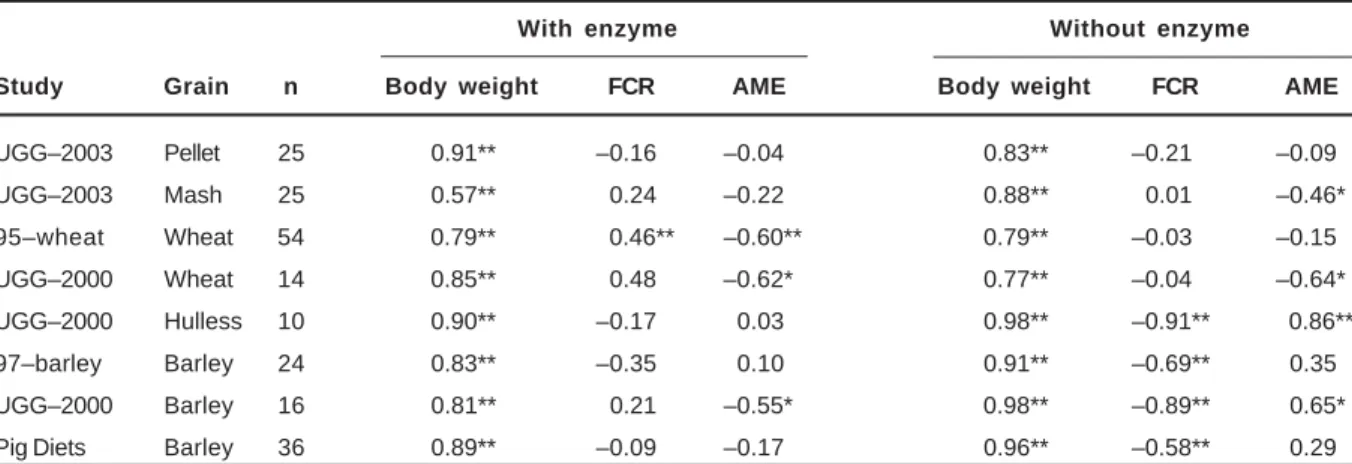
or hydrothermal processing). The relationships (Pearson correlations) between feed intake and body weight, FCR or AME for diets with or without enzyme supplements are presented in Table 2.
The data in Table 1 were obtained from a broiler chick bioassay developed to measure variability in nutrient availability between sources of wheat and barley and responses to enzyme supplementation. The bioassay has been described Scott et al. (1998). Briefly, it is based on a diet containing 80% test cereal (balanced with a basal diet containing soybean isolates, corn gluten, minerals, vitamins and 1% acid–insoluble ash marker). A portion of the test diet was supplemented with an appropriate NSPase (enzyme supplied by Finnfeeds International, now Danisco Animal Nutrition). Each mash diet was provided ad libitum to four pens of six male broilers each from 4–17 d of age, and feed intake, growth and FCR were determined. On d 16, an excreta sample was collected from each pen and used to determine AME.
UGG–2003 wheat samples represent 25 sources of wheat from the 2002 harvest (one of the driest growing seasons on record) collected by United Grain Grower Feed Mills in western Canada. After the samples had been ground, one portion was pelleted, reground and then mixed as described previously, yielding four diets for each wheat source (pelleted and unpelleted, with or without enzyme). The 100 test diets were fed to groups of six male broilers in each of four separate bioassays conducted over a 12–week period.
The 1995 wheat samples (n = 54) represent nine seed–grade cultivars from three classes of wheat (Hard Red Spring, Durum and Canadian Prairie Spring) grown in duplicate at three locations in western Canada during1995. Using the same samples, Classen et al. (1995) and Scott et al. (1998) showed that the relationship between physiochemical characteristics of the diet and AME was only moderate (ranging from insignificant to 0.50) and that there was no relationship between dietary characteristics and broiler performance.
UGG–2000 represents a series of grain samples that were harvested in 1999. Fourteen wheat samples,
16 samples of hulled barley and 10 samples of hulless barley were collected from feed mills across western Canada.
The 1997 barley samples represent 12 cultivars of hulled barley that were grown at two regional seed– testing plots by cereal geneticists at the University of Saskatchewan. The samples were of seed–grade quality and were harvested in 1997.
The pig diets represent 39 diets in which different sources of barley were included at a level of 95% of basal diets used for determining DE in pigs (R. Zijlstra, Prairie Swine Centre, University of Saskatchewan). The DE diets tested in the pig trials were fed as described for the broiler bioassay (i.e., 80% inclusion in a basal diet). The effect of enzyme addition was evaluated with 36 of the sources. DE values determined using the pig bioassay bore no significant relationship with broiler AME values when the broiler diet contained no enzyme; however, a significant relationship (r2 = 0.60) was
observed when diets were supplemented with enzymes. Feed intake of wheat–based diets varied by approximately 20% (Scott 2004a, 2004b, 2005). Although there were positive effects of enzyme supplementation and processing (pelleting) on feed intake, variation in feed intake was high with the pelleted and/or enzyme supplemented diets. There was no agreement between feed intake rankings for diets with or without enzyme supplementation or processing. Growth varied to an extent similar to that of feed intake; lower variability was observed for feed conversion ratio and higher variability for AME.
Consistently high correlations between feed intake and body weight were observed in all studies (Table 2). If an animal successfully adjusts its intake according to the changing energy requirements for growth and maintenance, one would expect a stronger relationship between feed intake and FCR than between feed intake and growth rate. With wheat–based diets, a positive relationship between feed intake and FCR was observed in only one study (1995–wheat with enzyme supplementation); in several other cases, low negative correlations were observed. In contrast, there was a
With enzyme Without enzyme
Study Grain n Body weight FCR AME Body weight FCR AME
UGG–2003 Pellet 25 0.91** –0.16 –0.04 0.83** –0.21 –0.09
UGG–2003 Mash 25 0.57** 0.24 –0.22 0.88** 0.01 –0.46*
95–wheat Wheat 54 0.79** 0.46** –0.60** 0.79** –0.03 –0.15
UGG–2000 Wheat 14 0.85** 0.48 –0.62* 0.77** –0.04 –0.64*
UGG–2000 Hulless 10 0.90** –0.17 0.03 0.98** –0.91** 0.86**
97–barley Barley 24 0.83** –0.35 0.10 0.91** –0.69** 0.35
UGG–2000 Barley 16 0.81** 0.21 –0.55* 0.98** –0.89** 0.65*
Pig Diets Barley 36 0.89** –0.09 –0.17 0.96** –0.58** 0.29
highly significant negative correlation between feed intake and FCR for barley–based diets without enzyme. This unexpected relationship is due to the association between feed intake and growth rate. The growth rate of broilers fed barley–based diets without enzyme was low and a considerable proportion of the feed consumed would have been used for maintenance. This resulted in a high FCR for the unsupplemented diets. This negative relationship between feed intake and FCR was not detected when the diet was supplemented with enzyme because both feed intake and growth rate were increased by enzyme supplementation.
A negative relationship between feed intake and AME would be expected for wheat and barley diets if feed intake were not limited. This was only observed in three of the eight studies, and these three instances were for diets with enzymes. In contrast, intake of unsupplemented diets, particularly barley diets, was positively and significantly related to AME. The higher feed intake of some barley samples may be due to low levels of soluble non–starch polysaccharides (NSP). This would result in fewer digestive upsets, higher starch digestion and, consequently, higher AME. However, this was not sufficient to maximize growth rate.
The limited intake of feed intake by broilers fed wheat and barley diets was confirmed by recent studies conducted by the Premium Grains for Livestock Programme (PGLP; Black et al. 2005), which also collected data on sorghum, triticale, oats and rice. The PGLP is a seven–year initiative to identify variation in the nutritive value of various feed grains for domestic livestock in Australia. The bioassay employed by the PGLP involved total excreta collection from five–week– old broiler chicks fed diets in which the primary source of protein was casein. All diets were cold–pelleted and were fed without enzymes to four groups of six male broilers each. Feed intake, body weight gain and AME for 22 wheat–based diets are presented in Figure 1. Feed intake varied by 28% and growth rate by more than 50%. There was a significant positive relationship between intake and growth rate (r = 0.75), and between feed intake and AME (r = 0.33), as was the case with Canadian barley–based diets without enzymes.
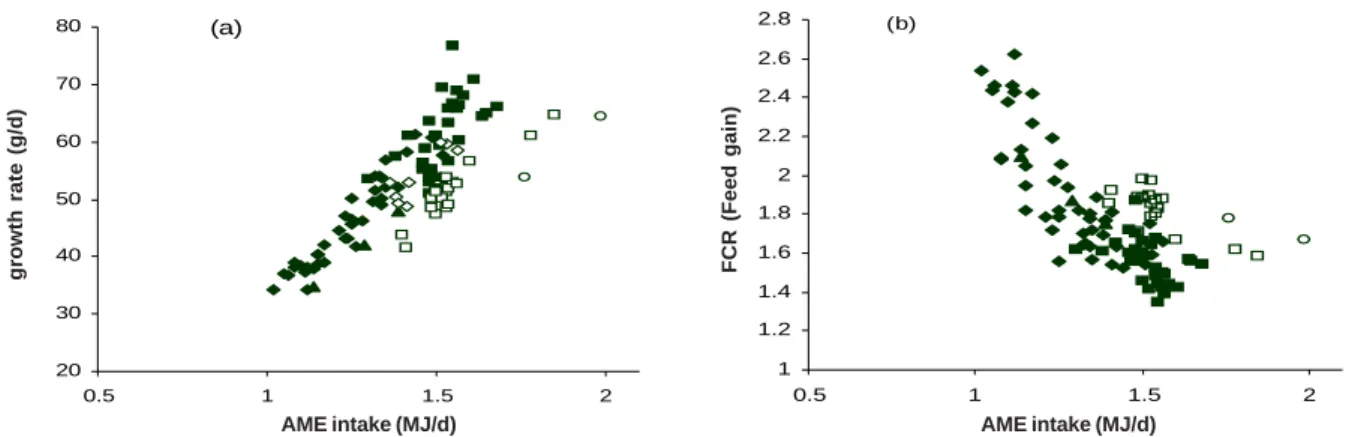
Figures 2a and b show that AME intake is positively related to growth and negatively related to FCR for many grains. It is important to note that almost all the variability in AME intake was associated with variation in feed intake, not AME.
Figure 2 Relationship between AME intake and growth rate (a) or feed conversion ratio (FCR) (b) of broiler chickens fed wheat (), barley (), oats (S), triticale (), sorghum ( ), or rice ({) (Black et al. 2005).
20 30 40 50 60 70 80
0.5 1 1.5 2
(a)
AME intake (MJ/d)
growth rate (g/d)
1 1.2 1.4 1.6 1.8 2 2.2 2.4 2.6 2.8
0.5 1 1.5 2
(b)
AME intake (MJ/d)
FCR (Feed gain)
Figure 1Variation in feed intake, liveweight gain and AME in broilers fed 22 Australian wheat samples (Black et al. 2005).
40 60 80 100 120
1 6 11 16 21
Sample number
F
e
e
d
I
n
ta
k
e
(
g
/d
)
Liv
e
w
e
ig
ht
ga
in
(g
/d
)
10 12 14 16 18
AME (MJ/
kg
)
Possible explanations for variation
in feed intake
Scott (2002, 2004a, 2004b) suggested that variation in feed intake is related to the rate of hydration of the grain component of the diet because digestion cannot begin until grains are hydrated. These authors showed that feed intakes of wheat–based diets were increased by pre–soaking. However, it was also shown that this resulted in an excessively high intake with some types of wheat. In these instances, it appears that increased intakes and growth rates were achieved by maximizing throughput rather than digestion. These broilers consumed 40% more wet diet than dry diet (on a dry matter basis) and, although they grew faster (16%), FCR was increased and AME was decreased. In subsequent studies, Scott and Silversides (2003) showed that a modest level of feed restriction or a lower dietary water content slowed digesta passage rate sufficiently to increase digestion.
Forbes (2003) reviewed the effects of feeding wet diets to poultry and showed that feed intake was consistently increased. However, effects on FCR were inconsistent. This may be related to the source of the grain (Scott 2002). The addition of water also activated enzymes, which were derived from the grains and possibly from microbial growth. Although fermentation of wet diets occurs within 24 h of preparation, Scott (2002) could not demonstrate an advantage in reducing microbial growth by supplementing wet diets with propionic acid. Whitehead and Scott (2005) ensiled broiler diets using a commercial silage inoculant containing high levels of Lactobacillus plantarum and
Enterococcus faecium. pH decreased from 6.6 and stabilised at 4.2 within 24 h. Feed intakes and growth rates of broilers fed fermented diets were higher than those fed wet diets and growth rates were 19% greater those fed a dry diet.
A wide range of research studies have been published on the use of physicochemical measures of cereal grains for predicting food and malting quality. Water hydration rate and/or capacity play a key role. Hydration rate can vary considerably between sources of wheat because of differences in cultivars and growing conditions (Grant 1998; Metho et al. 1999). This variation in hydration rate for food applications can be reduced to a large extent by processing or, as described by Daniels (1975), by ‘starch and protein damage’. Buffo et al. (1998) observed that the water absorption rate of sorghum decreased as starch content increased. With some sorghum flours, it took up to two hours to achieve 50% water saturation and eight hours to achieve full saturation. Water saturation time would, however, be altered by processes in the digestive tract of poultry.
Digestion and digesta flow
Lentle (2004, 2005) formulated a new hypothesis on regulation of digesta and nutrient flow in the gut. The
premise of his hypothesis is that digesta behaves like a semi–solid plug in the gut. The rheology (deformation and flow of matter) of digesta is influenced by viscosity, particle size and interactions between chemical components. This, in turn, influences the penetration of digestive fluids to the core of the plug and movement of digested nutrients to the intestinal mucosa. There is much speculation about the effect of digesta rheology on microflora in the core of the plug. Lentle’s concept of digesta flow is very different to the conventional reflux–of–digesta model or, as Lentle describes it, ‘the chemical reactor theory’.
Sacranie et al. (2005) reviewed the importance of reflux for nutrient digestion and bird health and indicated that rate of passage can be reduced by some feed ingredients, causing ‘ileal braking’, slow gastric emptying and reduced intake. However, the principal effect of reflux would be to promote movement of undigested material to environments that promote macromolecule breakdown (gizzard) and nutrient absorption (upper small intestine). Many of the studies on reflux were conducted under conditions where access to feed was restricted. Under these conditions, reflux would increase digestion and retention time. Is there significant ‘back–flow’ of digesta in a broiler that is eating to maximum capacity? Would undigested feed minimise reflux and force digesta in an anterograde direction? If this is the case, we need to understand the contribution of feed ingredients, processing, and feeding and drinking patterns to digesta flow and to understand how this limits intake.
Lentle (2005) explained that the digesta core behaves likes a squeegee: contractions of the intestinal tract force fluids and dissolved nutrients from the core of the plug, and resurgence of fluid back into the plug occurs during the relaxation phase. The degree of compaction of the plug is related to chemical composition of the diet (e.g., starch profile and presence of gluten proteins). This, together with particle size determines the movement of digesta fluid through the core of the plug. Lentle (2004) theorised that the time the digesta plug remains in the gut (i.e., rate of passage) would be independently regulated by the degree of viscosity of the fluid layer separating the plug from the intestinal wall (i.e., degree of lubrication) and not necessarily by the rate of digestion of the core. A better understanding of this concept may help to maximize nutrient absorption through optimum intake, particle size and moisture content or by using surfactants.
I am still grappling with the question of measures needed to optimise rate of gut transit, intake and absorption of nutrients necessary to support the broiler’s genetic potential for growth. Since particle size and physicochemistry is profoundly influenced by processing, we need to know why this has beneficial effects with some sources of grain and adverse effects with others. Likewise, it is necessary to know why intake rankings for various sources of grain change with enzyme supplementation. Feed intake will become increasingly important in determining the broiler’s ability to attain its genetic potential for growth.
Acknowledgements
The author gratefully acknowledges collaborating industry partners (Agricore United, Finnfeeds International), researchers (University of Saskatchewan) and the skilled technical support of the poultry research unit at the Pacific Agri–Food Research Station (Agriculture and Agri–Food Canada).
References
Black, J.L., Hughes, R.J., Nielsen, S.G., Tredrea, A.M., MacAlpine, R. and van Barneveld, R.J. (2005). The energy value of cereal grains, particularly wheat and sorghum, for poultry. Australian Poultry Science Symposium 17, 21–29.
Bokkers, E.A.M. and Koene, P. (2003). Eating behaviour, and preprandial and postprandial correlations in male broilers and layer chickens. British Poultry Science 44, 538–44.
Buffo, R.A., Weller, C.L. and Parkhurst, A.M. (1998). Relationships among grain sorghum quality factors. Cereal Chemistry 75, 100–04.
Carre, B. (2000). Effects of particle size on the digestive processes in domestic birds. Production Animales 13, 131–36.
Classen, H. L., Scott, T.A., Irish, G.G., Hucl, P., Swift, M.L. and Bedford, M.R. (1995). The relationship of chemical and physical measurements to the apparent metabolizable energy (AME) of wheat when fed to broiler chickens with and without a wheat enzyme source. In: World’s Poultry Science Association Proceedings, 10th European Symposium on Poultry Nutrition, pp. 65–71.
Curtis, S.E. (1987). Environmental and behavioural influences on feed intake by pigs. In: Proceedings of the 8th Western Nutrition Conference, pp. 21–24.
Daniels, N.W.R. (1975). Some effects of water in wheat flour doughs. In: Water Relations of Foods — Food Science and Technology, a Series of Monographs, pp. 573–86 (ed. R.B Duckworth). Academic Press, London.
Ferket, P.R. (2002). Factors that affect feed intake of meat birds. In: Proceedings 63rd Minnesota Nutrition Conference, pp. 17–18.
Ferket, P.R. and Gernat, A.G. (2003). Feed intake A–Z. Watt Poultry USA, August 2003, pp. 14, 16, 18, 20, 22, 24, 26, 28, 29.
Forbes, J.F. (2003). Wet foods for poultry. Avian and Poultry Biology Reviews 14, 175–194.
Forbes, J.M. (2005). Why did the chicken choose the food? Australian Poultry Science Symposium 17, 145–152.
Grant, L.A. (1998). Effects of starch isolation, drying and grinding techniques on its gelatinisation and
retrogradation properties. Cereal Chemistry 75, 590–94.
Havenstein, G.B., Ferket, P.R. and Qureshi, M.A. (2003). Growth, liveability, and feed conversion of 1957 versus 2001 broilers when fed representative 1957 and 2001 broiler diets. Poultry Science 82, 1500–08.
Hetland, H., Svihus, B. and Krogdahl, A. (2003). Effects of oat hulls and wood shavings on digestion in broilers and layers fed diets based on whole or ground wheat. BritishPoultry Science 44, 275–282.
Hoerr, F.J. (2001). Intestinal integrity and the impact of losing it. World Poultry — Elsevier 17 (7), 16–18.
Houpt, T.R. (1987). Influences of water on feed intake. In: Proceedings of the 8th Western Nutrition Conference, Edmonton, Alberta, pp. 63–65.
Leeson, S. (1989). Feeding meat–birds for reduced maintenance cost. In: Maryland Nutrition Conference, pp. 113–9.
Leeson, S., Caston, L. and Summers, J.D. (1996). Broiler response to energy or energy and protein dilution in the finisher diet. Poultry Science 75, 522–28.
Lentle, R. (2004). Physical properties of digesta that may influence feed conversion efficiency. Proceedings of New Zealand Poultry Industry Conference 7, 10–19.
Lentle, R.G. (2005). The macrobiophysics of digestion: Implications for the poultry industry. Australian Poultry Science Symposium 17, 163–170.
Marks, H.L. (1981). Role of water in regulating feed intake and feed efficiency of broilers. Poultry Science 60, 698–707.
Marks, H.L. (1985). Sexual dimorphism in early feed and water intake of broilers. Poultry Science 64, 425–28.
Metho, L.A., Taylor, J.R.N., Hammes, P.S. and Randall, P.G. (1999). Effects of cultivar and soil fertility on grain protein yield, grain protein content, flour yield and breadmaking quality of wheat. Journal of the Science of Food and Agriculture 79, 1823–31.
Morel, P.C.H., Timmers, J.A., DeWit, T.A.T.H., Wood, G.R., Sheriff, R., Camden, B.J., Thomas, D.V. and Ravindran, V. (2001). Prediction of feed intake in modern broilers. Australian Poultry Science Symposium 13, pp. 152–55.
Nielsen, B.L. (2004). Behavioural aspects of feeding constraints: do broilers follow their gut feelings? Applied Animal Behaviour Science 86, 251–60.
Poultry Science Association, 10th European Symposium on Poultry Nutrition, pp. 21–28.
Rogel, A.M., Balnave, D., Bryden, W.L. and Annison, E.F. (1987). Improvement of raw potato starch digestion in chickens by feeding oat hulls and other fibrous feedstuffs. Australian Journal of Agricultural Research 38, 629–37.
Pym, R.A.E. (2005). Genetic aspects of food intake and food utilisation efficiency for growth in chickens. Australian Poultry Science Symposium 17, 153–62.
Sacranie, A., Iji, P.A. and Choct, M. (2005). Reflux of digesta and its implications for nutrient digestion and bird health. Australian Poultry Science Symposium 17, 171–75.
Schoorlemmer, G.H.M. and Evered, M.D. (2002). Reduced feeding during water deprivation depends on hydration of the gut. American Journal of Physiology. Regulatory, Integrative and Comparative Physiology 283,
R1061–69.
Scott, T.A. (2000). Observations on variability of
voluntary feed intake of wheat– and barley–based diets by broiler chickens. In: XXI World’s Poultry Congress [Abstracts on CD–Rom].
Scott, T.A. (2002). Impact of wet feeding wheat–based diets with or without enzyme on broiler chick performance. Canadian Journal of Animal Science 82, 409–17.
Scott, T.A. (2004a). A possible explanation for limited feed intake of wheat–based diets by broilers. In:
Proceedings of the Australian Poultry Science Association 16, 9–16.
Scott, T.A. (2004b). Wheat–based broiler diets — limits to intake. Proceedings of the New Zealand Poultry Industry Conference 7, 1–9.
Scott, T.A. (2005). The impact of pelleting and enzyme supplementation on feed value of twenty–five Canadian wheat samples. Australian Poultry Science Symposium 17, 138–44.
Scott, T.A. and Silversides, F.G. (2003). Defining the effects of wheat type, water inclusion level, and wet– diet restriction on variability in performance of broilers fed wheat–based dits with added water. Canadian Journal of Animal Science 83, 265–72.
Scott, T.A., Silversides, F.G., Classen, H.L., Swift, M.L. and Bedford, M.R. (1998). Effect of cultivar and environment on the feeding value of western Canadian wheat and barley samples with and without enzyme supplementation. Canadian Journal of Animal Science 78, 649–56.
Watkins, E.J., Butler, P.J. and Kenyon, B.P. (2004). Posthatch growth of the digestive system in wild and domesticated ducks. British Poultry Science 45, 331–41.
Washburn, K.W. (1991). Efficiency of feed utilization and rate of feed passage through the digestive system. Poultry Science 70, 447–52.