Is Spillover Relevant for Hydrogen Adsorption
and Storage in Porous Carbons Doped with
Palladium Nanoparticles?
Mar´ıa Blanco-Rey,
∗,†,‡J. I˜
naki Juaristi,
†,¶,‡Maite Alducin,
¶,‡Mar´ıa J. L´
opez,
§and Julio A. Alonso
∗,§,‡† Departamento de F´ısica de Materiales, Facultad de Qu´ımicas UPV/EHU, Apartado 1072, 20080 Donostia-San Sebasti´an, Spain
‡ Donostia International Physics Center (DIPC), Paseo Manuel de Lardizabal 4, 20018 Donostia-San Sebasti´an, Spain
¶ Centro de F´ısica de Materiales CFM/MPC (CSIC-UPV/EHU), Paseo Manuel de Lardizabal 5, 20018 Donostia-San Sebasti´an, Spain
§ Departamento de F´ısica Te´orica, At´omica y ´Optica, Universidad de Valladolid, 47011 Valladolid, Spain
E-mail: [email protected]; [email protected]
Abstract
Experiments have shown that the efficiency of nanoporous carbons to store hydrogen
becomes enhanced by doping the material with metallic nanoparticles. In particular,
doping with palladium has been used with success. The hypothesis to justify the
enhancement has been that the Pd nanoparticles dissociate the hydrogen molecules
and then the hydrogen atoms spill over the carbon substrate, where the hydrogen
is retained. To test this hypothesis we have performed ab initio molecular dynamics
simulations of the deposition of molecular hydrogen on Pd nanoparticles (Pd6and Pd13)
supported on graphene, which is a good model for the wall of a carbon nanopore. Three
channels have been identified in the simulations: bouncing off the molecule, molecular
adsorption, and dissociation of the molecule in two H atoms. The relative percentage
of those channels is sensitive to the size of the Pd particle. Dissociation occurs more
frequently on Pd13and it generally takes place on the lateral regions of the Pd particles.
However, in our simulations we have not found a single case of H atoms or H2 molecules
spilling over the carbon substrate. We have also tested the situation when several H
atoms are preadsorbed on the Pd6 and Pd13 particles and found that not a single
dissociation event occurs on these H-saturated nanoparticles. These results lead us
to cast strong doubts on the validity of the spillover mechanism for explaining the
enhancement of hydrogen adsorption on porous carbons doped with transition metal
1
Introduction
The technology of hydrogen fuel cells is well developed.1 However, the main difficulty pre-venting a widespread use of hydrogen as an alternative fuel in cars is the efficient storage of hydrogen on board.2 The only method available at present consists in storing hydrogen gas at high pressure (about 700 atm.) in a metallic container. This is an important advance, but the opinion of many scientists and engineers is that it is not the ultimate solution. For this reason, other storage technologies are being investigated and one that is receiving much attention is the storage in porous materials. Several families of porous materials have been studied for this purpose: porous carbons,3,4 metal organic frameworks,5 zeolites,6 clathrate hydrates,7 and microporous organic polymers.8 Targets to be achieved in the short term (year 2020) are 5.5 per cent of hydrogen in weight and a volumetric capacity of 40 grams of hydrogen per liter at room temperature and moderate pressures, with ultimate targets of 7.5 per cent in weight and 70 grams per liter.9
Focusing on the porous carbons, there is experimental10–12and theoretical evidence4,13–17 that hydrogen storage on clean porous carbon materials does not fulfill the recommended targets. However, a number of experiments indicate that doping porous carbon materials (nanotubes, nanofibers, nanoporous carbons) with metallic clusters or nanoparticles could provide a strategy to increase the hydrogen uptake.18–26 The metals mostly used in those in-vestigations are alkali metals18,19 and some transition metals like vanadium, palladium, and platinum.22–27 To explain the observed enhancement of the hydrogen adsorption, a mecha-nism of spillover28,29 has generally been assumed.22–27,30,31 In that mechanism, the hydrogen molecules are first adsorbed and dissociated on the surface of the metallic nanoparticles, and are next transported onto the surface of the substrate carbon material. However, in our opinion, the validity of that spillover idea has not been scrutinized critically.
theory (DFT). The graphene layer is a good model for the wall of the pores in nanoporous carbons.32 The molecules are dropped from a certain distance above the cluster with a given kinetic energy and their classical dynamical evolution is followed as they interact with the substrate. In a fraction of the studied simulations the deposited H2 molecules experience catalytic dissociation in two hydrogen atoms, and by comparing the results for two different Pd clusters, Pd6 and Pd13, insight is gained on the influence of cluster size. We also find that H atoms preadsorbed in the clusters, which have been proposed in the literature as spillover promoters,33 hinder dissociation. Both the H2 molecules and the H atoms wander around on the surface of the Pd cluster, but mass transfer to the carbon substrate was not observed in any of the studied cases. The number of simulations performed is sufficiently large to let us conclude that the idea of a mechanism of spillover to explain the enhancement in hydro-gen adsorption in graphene doped with palladium nanoparticles should be taken with care. In other words, spillover should not be taken for granted when modelling hydrogen uptake in porous carbon doped with transition metal nanoparticles, and we suggest that specific experiments testing the mechanism in depth should be performed.
The paper is organized as follows. In section 2 we explain the calculation details. The results for clean Pd nanoparticles and for Pd nanoparticles with preadsorbed H are, respec-tively, shown and discussed in sections 3.1 and 3.2. Finally, in section 4 we summarize the main results and give the conclusions of this work.
2
Computational details
The AIMD calculations are performed with the “Vienna ab initio simulation program” (vasp),34,35 which is based on DFT. The exchange–correlation energy is calculated within
performed with a Γ–centered 2×2×1 Monkhorst-Pack grid of special k-points.38 The en-ergy cut-off used in the plane-wave basis set is 400 eV. Fractional occupancies are determined through the Methfessel-Paxton broadening scheme of first order using a width of 0.1 eV.39 The convergence criterion for total energy self-consistency in each ionic step is 10−5 eV. The calculations have been performed with periodic boundary conditions using appropriate su-percell sizes. In the case of the Pd6 nanoparticle, the supercell consists in a hexagonal 5×5 graphene layer in the lateral directions, which corresponds to a supercell lattice parameter of 12.33 ˚A. In the direction normal to the graphene layer the height of the supercell is 14 ˚A. The most stable structure of isolated Pd6 is an octahedron, and this structure is preserved for Pd6 supported on graphene, with a triangular face of the octahedron lying on the graphene layer.40In that structure, the supported Pd
6 cluster can be viewed as formed by two parallel triangular layers, being the lower one in contact with the graphene surface. The magnetic moment, 2 µB, of the free Pd6 cluster is preserved upon deposition on the graphene layer. However the dissociative adsorption of hydrogen quenches the moment of the cluster down to zero.40–42 In the case of the Pd13 nanoparticle, the supercell consists in a hexagonal 6×6 graphene layer in the lateral directions, which corresponds to a supercell lattice parameter of 14.80 ˚A. The length of the supercell in the direction normal to the graphene layer is again 14 ˚A. The ground state structure of both the free and the supported Pd13 nanoparticles consists in two (111) f cc planes with seven and six atoms, respectively. For the deposited particle, the face with seven atoms rests on the graphene layer. The magnetic moment, 6µB, of the free Pd13 cluster is reduced to 4µB upon deposition on the graphene layer. The
dissociative adsorption of one hydrogen molecule quenches further the moment of the cluster down to 2µB and finally additional adsorption of hydrogen cancels the moment. To better
which is a DFT code that uses Vanderbilt ultrasoft pseudopotentials44 to describe the in-teraction between the valence electrons and the ionic cores. A basis set of plane waves is used to expand the electronic wave functions and density, with cutoff values of 500 eV and 1000 eV, respectively. We have used the same (PW91) exchange correlation functional as in the AIMD calculations. Similar equilibrium configurations and adsorption energies are obtained from VASP and Dacapo calculations. The small differences in the relaxed atomic positions and energies can be quantified with the following representative test on the sup-ported clean Pd13 nanoparticle: we find full agreement between the geometries optimized with Dacapo and VASP, with differences in the atomic positions smaller than 0.10 ˚A. The energy difference between those structures, calculated with VASP, is 0.056 eV. Moreover, the hydrogen dissociation energies on the supported Pd13 calculated with the two codes agree within 50 meV.
12 meV in all cases except for a few dissociated trajectories in Pd6 for which ∆E <30 meV. Sixty different trajectories are simulated for each nanoparticle, the different trajectories cor-responding to different initial positions and orientations of the H2 molecule. As outcome of the trajectory simulations we distinguish the following events: (i) dissociation of the H2 molecule, (ii) non-dissociative molecular adsorption, and (iii) reflection (non-reactive scat-tering). A dissociation event is considered when the internuclear distance between the two atoms of the H2 molecule is larger than 1.6 ˚A. The molecular adsorption channel corresponds to those molecules that at the end of the simulation, after 1 ps, remain non-dissociated and moving around the Pd nanoparticles at distances from their center not larger than 4.5 ˚A for Pd6 and 5.5 ˚A for Pd13. Two different kinds of trajectories are included in the reflection channel. On the one hand, we consider as reflected molecules those that, after being scattered off the nanoparticle, reach the heightZ = 8.5 ˚A with a positiveZ-component of the velocity. On the other hand, there exist some trajectories in which the molecules are scattered off the Pd nanoparticle with a small normal velocity. These molecules arrive at the boundaries of the simulation cell and interact with a periodic image of the initial nanoparticle, as a result of using periodic boundary conditions. In our analysis we have considered these trajectories as reflected. Finally, only in a few cases pathological trajectories exist that have an unclear outcome and thus they are excluded from the analysis.
3
Results and Discussion
3.1
H
2incident on clean Pd nanoparticles supported on a graphene
layer
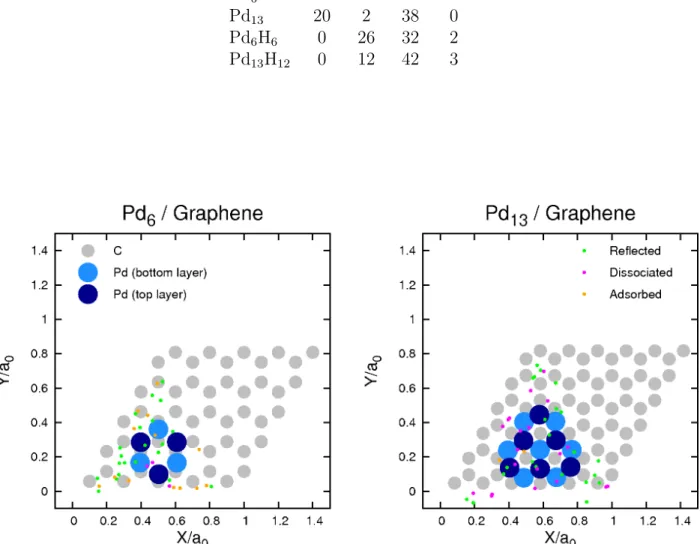
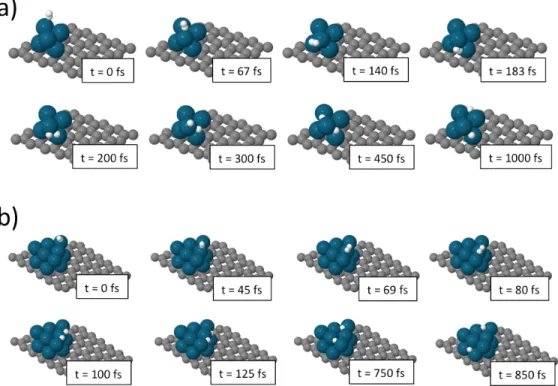
proportion of adsorbed and dissociated molecules is very different. In the case of Pd13 most of the molecules that are adsorbed dissociate, whereas dissociation is much reduced on Pd6. We note that the molecule initial position within the triangular sampling area does not seem to dictate the outcome of the trajectory. This can be observed in Fig. 1, where the initial positions are identified attending to the different outcomes. A detailed inspection of the trajectories shows that most of the dissociation events occurring on both nanoparticles are direct and fast. Figure 2 shows the snapshots of two representative trajectories leading to dissociation on the Pd6 and Pd13 nanoparticles. As shown in this figure, the H2 molecule, once it interacts with the nanoparticle, first orients itself with the molecular axis lying on a Pd atom of the top layer, leaning then towards the lateral side of the nanoparticle where it rapidly dissociates. The resulting H atoms wander around the external walls of the nanoparticle and occasionally penetrate inside the nanoparticle and then move again to the surface. Finally, though the Pd atoms are displaced from their equilibrium positions upon interaction with the impinging molecule, we observe that the subsequent deformation of the Pd nanoparticles is minor and that they basically keep their original structure intact.
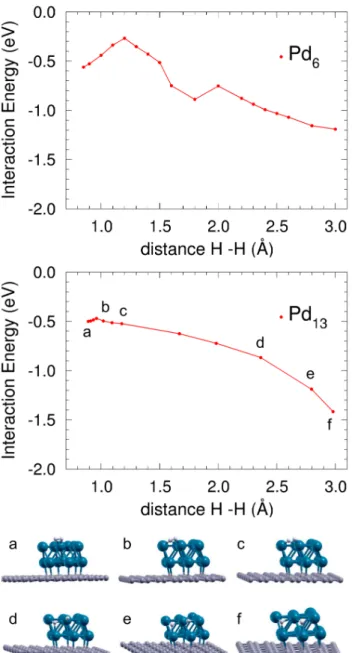
non-adjacent lateral faces of Pd13. The H-H distance d(H-H) is taken as the reaction coordi-nate and the configurations along the path are obtained through constrained minimizations of structures intermediate between those of the extreme points. Constrained minimization means that the positions of the H and Pd atoms are relaxed, keeping fixed the d(H-H) value. Figure 3 shows the energies and some structures along the MEP. Starting with the hydrogen molecule adsorbed onto a Pd atom of the upper layer (a), the molecule leans towards one Pd-Pd bond (b). One of the H atoms, the first, attaches to that bond, weakening the H-H bond, and the other H atom, the second, separates from the first one (c). The first H moves towards a lateral face (d) and the second H attaches to a Pd-Pd bond (e). Then, the two H atoms move towards their respective final configurations adsorbed above two non-adjacent lateral faces of the Pd cluster (f). The energy barrier for dissociation along this path is of 29 meV. This sets an upper limit for the dissociation barrier on Pd13.
The dissociation barriers of H2 on supported Pd4, Pd5, Pd6 and Pd13 are 0.46, 0.26, 0.30 and 0.03 eV, respectively (the dissociation barrier for Pd6 is also shown in Fig. 3). A tendency for the height of the dissociation barrier to decrease as the size of the Pd cluster increases is evident. In fact, the barrier for dissociation on Pd13 is quite small, and this low value is the reason for H2 dissociation to be more favorable on this cluster. Notice also that, measured with respect to the molecule in the gas phase, there is no barrier to dissociation (the same happens for Pd6). However, the dynamical simulations show that the absence of energy barriers does not mean that all the molecules dissociate. As a matter of fact, the probabilities for dissociation amount to just about 33% in the Pd13 nanoparticle and only to 5% in Pd6. The reason is that a large amount of the molecules do not find the most favorable path to dissociation and are either reflected or molecularly adsorbed.
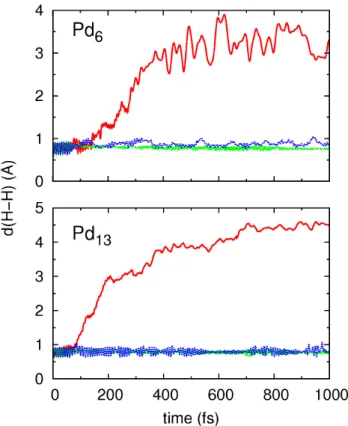
and Pd13 nanoparticles. In the case of the trajectories in which the hydrogen molecule reaches the cell boundary, included in the reflection channel, the simulations are stopped when the distance between the molecule and the center of the images is 5.5 ˚A for Pd13 and 4.5 ˚A for Pd6, i.e., before the interactions with the adjacent nanoparticles are effective. The figure clearly demonstrates the validity of the criterion that we have chosen to define H2 dissociation: while the d(H-H) values rapidly increase above 1 ˚A for the dissociated H2, they remain around the equilibrium bondlength in the other two channels. Additionally, the figure allows us to establish the typical time needed for the direct dissociation, which is around 100 fs for Pd13 and around 200 fs for Pd6. Only in the case of Pd13 we find one trajectory in which dissociation takes place after being molecularly adsorbed for nearly 1 ps. The average displacements of the Pd atoms in the Pd6 and Pd13 particles upon their interaction with the incoming molecule are shown as a function of time in Fig. 5 for the different outcome channels. For both nanoparticles, those displacements are relatively large in the case of the dissociating molecules. The reason for this is the great exothermicity of the process, similar in both cases (the released dissociation energy on Pd6 and Pd13 is of 1.2 and 1.4 eV, respectively), which requires that the energy liberated in the dissociation is transferred to the substrate atoms. Clear differences between the two nanoparticles are observed for the molecular adsorption events. While the Pd displacements are small in Pd13, and similar to those occurring in the case of H2 reflection, the displacements caused by the molecular adsorption mechanism in Pd6 are large and comparable to those observed for dissociation. These results show that, indeed, the larger particle is more rigid. Furthermore, we have observed that in four trajectories of the molecular adsorption channel on Pd6 the nanoparticle rotates over itself and ends up sitting on an edge over the graphene layer instead of lying on a face. The contribution to the averaged displacements from those trajectories is relatively large (see Fig. 5).
This conclusion does not depend on the size of the Pd cluster since it is obtained for both supported Pd6 and Pd13. This is neither the result of the incidence conditions imposed to the molecules in the simulations We have also performed additional simulations with an incident energy of 0.250 eV for the Pd13 nanoparticle that show, not only a total absence of H transfer to the graphene layer, but also that the adsorption probability in the nanoparticle is reduced from 37 % to 23 %. Since H2 dissociation takes place very fast (during the first 100-200 fs), it looks extremely unlikely that the hydrogen atoms may travel to the graphene layer at times longer than the simulation times of 1 ps. Although variations of either the molecule orientation or the incidence angle can vary the adsorption probabilities for a given incident energy, the memory of the initial conditions is lost soon after collision with the nanoparticle, which rules them out, too, as relevant factors in spillover. Eventual mechanisms may exist that, being characterized by reaction paths involving very reduced regions of the configurational space, would require longer times. Nonetheless, energy dissipation effects also active at longer times would make spillover very improbable. A similar outcome occurs for the simulations leading to molecular adsorption. Also the molecules stay adsorbed on the Pd nanoparticles with no sign of spilling over the carbon substrate.
3.2
H
2incident on H-covered Pd nanoparticles supported on a
graphene layer
equilibrium adsorption sites in the lateral walls of the nanoparticle (see Fig. 6(a)). In this way, only one adsorption site is left vacant at the top of the nanoparticle. In the case of the Pd13, we find that up to seven H2 molecules can be dissociatively adsorbed in the cluster. Therefore, in order to have free adsorption sites for the incoming H2, we have performed simulations on Pd13 covered with 12 preadsorbed H atoms. In the most stable structure with this stoichiometry the H atoms are adsorbed in the hollow sites leaving nonadjacent vacancies (see Fig. 6(b)). By choosing these structures as the starting condition for our AIMD simulations, we maximize the coverage in each case and, in principle, the chances for spillover. The results of the AIMD simulations for these nanoparticles are also sum-marized in Table 1. The number of reflection events is similar to the numbers obtained in the clean Pd6 and Pd13 nanoparticles. However, in contrast to them, no dissociation events occur on the Pd6H6 and the Pd13H12 nanoparticles since all the adsorbed molecules remain non-dissociated. Definitely, the presence of preadsorbed atomic hydrogen on the metallic nanoparticle complicates the dissociation of molecular hydrogen impinging on the nanopar-ticle. Also in contrast to the Pd6 and Pd13 cases, we find that the H-covered nanoclusters can be significantly altered upon interaction with the incoming H2. As shown in Fig. 5, the Pd atoms are subject to much larger displacements. In particular, the structure of the Pd6H6 gets sometimes appreciably distorted due to the breaking of some Pd-Pd and Pd-C bonds (see Fig. 6(c)). In the Pd13H12 nanoparticle, the Pd-C bonds are also softened upon interaction with the incoming H2. However, in this case, instead of inducing deformation of the nanoparticle, this softening of the bonds leads to a displacement of the nanoparticle over the graphene layer of around 0.6 ˚A(see Fig. 6(d)). As a final remark, note that in spite of all these differences between the results obtained for the clean and covered nanoparticles, no transfer of hydrogen (neither molecular nor atomic) towards the graphene layer is observed in any of the cases under study.
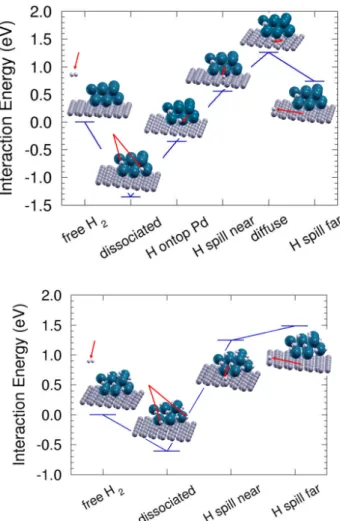
saturation of the Pd nanoparticle. Moreover, one should notice that the energy level of the configuration with one H atom spilt onto the graphene support is well above the energy level for desorption of one hydrogen molecule, labelled as “free H2” in Fig. 7 for both cases. Therefore, increasing the temperature of the system would lead to hydrogen desorption rather than to facilitate H spillover onto the graphene support. In conclusion, both static and dynamical calculations show clear evidence that the spillover of hydrogen does not take place under the conditions investigated in this manuscript and suggest that a critical evaluation of the spillover mechanism under more general conditions is also needed.
4
Conclusions
carbons promoted by the presence of dopant Pd nanoparticles has to be revised.
Acknowledgement
M. B. R., J. I. J. and M. A. acknowledge support by Basque Departamento de Educaci´on, Universidades e Investigaci´on, the University of the Basque Country UPV/EHU (Grant No. IT-756-13) and the Spanish Ministerio de Econom´ıa y Competitividad (Grant No. FIS2013-48286-C2-2-P). J. A. A. and M. J. L. acknowledge support by MINECO (Grant No. MAT2014-54378-R) and Junta de Castilla y Le´on (Grant No. VA050U14). The authors thankfully acknowledge the computer resources provided by the DIPC computing center.
References
(1) Fuel Cell Handbook, 7th ed.; EG&G Technical Services, Inc., US DOE: Morgantown, West Virginia, 2004.
(2) Jena, P. Materials for Hydrogen Storage: Past, Present, and Future. J. Phys. Chem. Lett. 2011, 2, 206–211.
(3) Cabria, I.; L´opez, M. J.; Alonso, J. A. InHandbook of Nanophysics, Vol. 5 (Functional Materials); Sattler, K., Ed.; CRC Press: Boca Rat´on, FL, 2010; p 41.1.
(4) Alonso, J. A.; Cabria, I.; L´opez, M. J. Simulation of hydrogen storage in porous carbons.
J. Mater. Res. 2013, 28, 589–604.
(5) Wong-Foy, A. G.; Matzger, A. J.; Yaghi, O. M. Exceptional H2 Saturation Uptake in Microporous Metal-Organic Frameworks. J. Am. Chem. Soc. 2006, 128, 3494–3495.
International Symposium on Metal-Hydrogen Systems, Fundamentals and Applications (MH2002).
(7) Mao, W. L.; Mao, H.-k.; Goncharov, A. F.; Struzhkin, V. V.; Guo, Q.; Hu, J.; Shu, J.; Hemley, R. J.; Somayazulu, M.; Zhao, Y. Hydrogen Clusters in Clathrate Hydrate.
Science 2002, 297, 2247–2249.
(8) McKeown, N. B.; Budd, P. M.; Book, D. Microporous Polymers as Potential Hydrogen Storage Materials. Macromol. Rapid Commun. 2007, 28, 995–1002.
(9) Targets for Onboard Hydrogen Storage Systems for Light-duty Vehicles (US DOE, 2009). http://energy.gov/sites/prod/files/2015/01/f19/fcto_myrdd_
table_onboard_h2_storage_systems_doe_targets_ldv.pdf.
(10) Z¨uttel, A. Materials for hydrogen storage.Mater. Today 2003,6, 24 – 33.
(11) Yushin, G.; Dash, R.; Jagiello, J.; Fischer, J.; Gogotsi, Y. Carbide-Derived Carbons: Effect of Pore Size on Hydrogen Uptake and Heat of Adsorption. Adv. Funct. Mater.
2006, 16, 2288–2293.
(12) Jord´a-Beneyto, M.; Su´arez-Garc´ıa, F.; Lozano-Castell´o, D.; Cazorla-Amor´os, D.; Linares-Solano, A. Hydrogen storage on chemically activated carbons and carbon nano-materials at high pressures. Carbon 2007, 45, 293 – 303.
(13) Patchkovskii, S.; Tse, J. S.; Yurchenko, S. N.; Zhechkov, L.; Heine, T.; Seifert, G. Graphene nanostructures as tunable storage media for molecular hydrogen. Proc. Natl. Acad. Sci. USA 2005, 102, 10439–10444.
(15) Cabria, I.; L´opez, M.; Alonso, J. Simulation of the hydrogen storage in nanoporous carbons with different pore shapes. Int. J. Hydrogen Energy 2011, 36, 10748 – 10759.
(16) Mart´ınez-Mesa, A.; Yurchenko, S. N.; Patchkovskii, S.; Heine, T.; Seifert, G. Influence of quantum effects on the physisorption of molecular hydrogen in model carbon foams.
J. Chem. Phys. 2011,135, 214701.
(17) Peng, L. J.; Morris, J. R. Structure and hydrogen adsorption properties of low density nanoporous carbons from simulations. Carbon 2012, 50, 1394 – 1406.
(18) Chen, P.; Wu, X.; Lin, J.; Tan, K. L. High H2 Uptake by Alkali-Doped Carbon Nan-otubes Under Ambient Pressure and Moderate Temperatures. Science 1999, 285, 91– 93.
(19) Yang, R. T. Hydrogen storage by alkali-doped carbon nanotubes-evisited.Carbon 2000,
38, 623 – 626.
(20) Bhat, V. V.; Contescu, C. I.; Gallego, N. C.; Baker, F. S. Atypical hydrogen uptake on chemically-activated, ultramicroporous carbon.Carbon 2010, 48, 1331 – 1340.
(21) Contescu, C. I.; van Benthem, K.; Li, S.; Bonifacio, C. S.; Pennycook, S. J.; Jena, P.; Gallego, N. C. Single Pd atoms in activated carbon fibers and their contribution to hydrogen storage. Carbon 2011, 49, 4050 – 4058.
(22) Lueking, A. D.; Yang, R. T. Hydrogen spillover to enhance hydrogen storage-study of the effect of carbon physicochemical properties. Appl. Catal. A-Gen 2004, 265, 259 – 268.
(24) Zacharia, R.; Kim, K. Y.; Kibria, A. F.; Nahm, K. S. Enhancement of hydrogen storage capacity of carbon nanotubes via spill-over from vanadium and palladium nanoparticles.
Chem. Phys. Lett. 2005, 412, 369 – 375.
(25) Anthony J. Lachawiec, J.; Qi, G.; Yang, R. T. Hydrogen Storage in Nanostructured Car-bons by Spillover: Bridge-Building Enhancement. Langmuir 2005, 21, 11418–11424, PMID: 16285820.
(26) Kim, B.-J.; Lee, Y.-S.; Park, S.-J. Preparation of platinum-decorated porous graphite nanofibers, and their hydrogen storage behaviors.J. Colloid Interf. Sci.2008,318, 530 – 533.
(27) Parambhath, V. B.; Nagar, R.; Ramaprabhu, S. Effect of Nitrogen Doping on Hydrogen Storage Capacity of Palladium Decorated Graphene. Langmuir 2012, 28, 7826–7833, PMID: 22548388.
(28) Conner, W. C.; Falconer, J. L. Spillover in Heterogeneous Catalysis. Chem Rev. 1995,
95, 759–788.
(29) Cheng, H.; Chen, L.; Cooper, A. C.; Sha, X.; Pez, G. P. Hydrogen spillover in the context of hydrogen storage using solid-state materials. Energy Environ. Sci. 2008, 1, 338–354.
(30) Chen, L.; Cooper, A. C.; Pez, G. P.; Cheng, H. Mechanistic study on hydrogen spillover onto graphitic carbon materials. J. Phys. Chem. C 2007, 111, 18995–19000.
(31) Singh, A. K.; Ribas, M. A.; Yakobson, B. I. H-Spillover through the Catalyst Saturation: An Ab Initio Thermodynamics Study.ACS Nano2009,3, 1657–1662, PMID: 19534542.
(33) Parambhath, V. B.; Nagar, R.; Sethupathi, K.; Ramaprabhu, S. Investigation of Spillover Mechanism in Palladium Decorated Hydrogen Exfoliated Functionalized Graphene. J. Phys. Chem. C 2011, 115, 15679–15685.
(34) Kresse, G.; Furthm¨uller, J. Efficiency of ab-initio total energy calculations for metals and semiconductors using a plane-wave basis set. Comput. Mater. Sci. 1996, 6, 15 – 50.
(35) Kresse, G.; Hafner, J. Ab initio molecular dynamics for liquid metals. Phys. Rev. B
1993, 47, 558–561.
(36) Perdew, J. P.; Chevary, J. A.; Vosko, S. H.; Jackson, K. A.; Pederson, M. R.; Singh, D. J.; Fiolhais, C. Atoms, molecules, solids, and surfaces: Applications of the generalized gradient approximation for exchange and correlation. Phys. Rev. B 1992,
46, 6671–6687.
(37) Kresse, G.; Joubert, D. From ultrasoft pseudopotentials to the projector augmented-wave method. Phys. Rev. B 1999, 59, 1758–1775.
(38) Monkhorst, H. J.; Pack, J. D. Special points for Brillouin-zone integrations.Phys. Rev. B 1976, 13, 5188–5192.
(39) Methfessel, M.; Paxton, A. T. High-precision sampling for Brillouin-zone integration in metals. Phys. Rev. B 1989, 40, 3616–3621.
(40) Cabria, I.; L´opez, M. J.; Fraile, S.; Alonso, J. A. Adsorption and Dissociation of Molec-ular Hydrogen on Palladium Clusters Supported on Graphene.J. Phys. Chem. C 2012,
116, 21179–21189.
(42) Barone, G.; Duca, D.; Ferrante, F.; Manna, G. L. CASSCF/CASPT2 Analysis of the Fragmentation of H2 on a Pd4 Cluster.Int. J. Quantum Chem. 2010, 110, 558–562.
(43) Dacapo, See https://wiki.fysik.dtu.dk/dacapo for a description of the total energy code, based on the density functional theory. 2009.
(44) Vanderbilt, D. Soft Self-Consistent Pseudopotentials in a Generalized Eigenvalue For-malism.Phys. Rev. B 1990,41, R7892.
(45) Mushrif, S. H.; Rey, A. D.; Peslherbe, G. H. Energetics and dynamics of hydrogen ad-sorption, desorption and migration on a carbon-supported palladium clluster.J. Mater. Chem. 2010,30, 10503–10510.
(46) Yang, R. T.; Wang, Y. Catalyzed Hydrogen Spillover for Hydrogen Storage. J. Am. Chem. Soc. 2009, 131, 4224–4226.
(47) Chen, H.; Wang, L.; Yang, J.; Yang, R. T. Investigation on Hydrogenation of Met-alOrganic Frameworks HKUST-1, MIL-53, and ZIF8 by Hydrogen Spillover. J. Phys. Chem. C 2013, 117, 7565–7576.
(48) Wang, L.; Lachawiec Jr., A. J.; Yang, R. T. Nanostructured adsorbents for hydrogen storage at ambient temperature: high-pressure measurements and factors influencing hydrogen spillover. RSC Adv. 2013, 3, 23935.
Table 1: Number of trajectories that lead to dissociation (ND), non-dissociative molecular adsorption (NA) and reflection (NR) for H2 molecules incident on
different Pd nanoparticles. The number of simulations for each nanoparticle is 60. NP is the number of pathological trajectories (see text).
Particle ND NA NR NP
Pd6 3 13 43 1
Pd13 20 2 38 0
Pd6H6 0 26 32 2 Pd13H12 0 12 42 3