Orientación y Sociedad – 2006 – Vol. 6 1
T E X T C O M P R E H E N S I O N A N D R O D U C T I O N I N
U N I V E R S I T Y S T U D E N T S : T E X T R E F O R M U L A T I O N
T e l m a P i a c e n t e * - A n a M a r í a T i t t a r e l l i * *
* Full Professor and Researcher, Secretary of Science and Technics, National University of La Plata, School of Psychology (Argentina).
piacente @isis.unlp.edu.ar
** Associate Professor and Researcher, Secretary of Science and Technics, National University of La Plata, School of Psychology (Argentina).
Abstract
This paper sets out to report on findings about features of task-specific reformulation observed in university students in the middle stretch of the Psychology degree course (N=58) and in a reference group of students from the degree courses in Modern Languages, Spanish and Library Studies (N=33) from the National University of La Plata (Argentina). Three types of reformulation were modeled: summary reformulation, comprehensive and productive reformulation.The study was based on a corpus of 621 reformulations rendered from different kinds of text. The versions obtained were categorised according to the following criteria: presence or absence of normative, morphosyntactic and semantic difficulties. Findings show that problems arise particularly with paraphrase and summary writing. Observation showed difficulties concerning punctuation, text cohesion and coherence, and semantic distortion or omission as regards extracting and/or substituting gist, with limited lexical resources and confusion as to suitability of style/register in writing. The findings in this study match those of earlier, more comprehensive research on the issue and report on problems experienced by a significant number of university students when interacting with both academic texts and others of a general nature. Moreover, they led to questions, on the one hand, as to the nature of such difficulties, which appear to be production-related problems and indirectly account for inadequate text comprehension, and on the other hand, as to the features of university tuition when it comes to text handling.
Key Words: reading comprehension; summary reformulation; comprehensive reformulation; productive reformulation; text production.
Introduction
This study is part of some broader-scale, exploratory-descriptive work on text comprehension in Psychology university students. It involves a range of comprehension activities, which become apparent through replies to literal and inferential questions and through reformulation tasks. It seeks to explore and describe features observed in the handling of various text types, contentrelated to the discipline and otherwise (Piacente & Granato, 2005).
Orientación y Sociedad – 2006 – Vol. 6 2
arises, firstly, from considering the difficulties detected by tutors at higher education level in that respect. Secondly, it draws upon specialized bibliographic review, which has repeatedly pointed out the problems shown by a significant number of students in connection with the handling of complex texts, (Arnoux, Di Stéfano & Pereyra, 2002, Carlino, 2002 2005, McCardle & Chhabra, 2004). Regarding text handling, it can be speculated that students are not adequately trained during their schooling prior to admission to higher education. Hence, it is common for newly admitted university undergraduates to present difficulties in connection with a plurality of domains (McMahon & Mc-Cormack, 1998): inappropriate general information, misconceptions, inadequate treatment of complext texts and lack of knowledge of general and specific terms (Anderson & Freebody, 1981, Hynd, 1998).
Such state of affairs has led us to acknowledge the need to enquire into the features of academic text comprehension and production in university students. From then on, we have tried to establish whether difficulties arise in connection with either formality of text structure or text content, and whether they are more frequent when it comes to written production. The interest in a study of this kind lies in the importance of text handling for developing strategies that should ensure full comprehension of a text and enable production. Indeed, these are skills directly related with performance levels in undergraduate studies.
Both text comprehension and text production require that information be constructed into a coherent mental representation. To that end, it is necessary for the individual the words and phrases inside the text to be processed along with the way such words and phrases relate to one another, not only with regard to the text itself but also to the reader´s wider, prior knowledge (general knowledge of the world, specific domain knowledge and linguistic knowledge)
Kintsch (1988, 1994) and van Dijk & Kintsch (1983) have posisted a model on different comprehension levels, which prove recurrent rather than subsequent on according to depth of comprehension. A surface level, referential in nature, is first called up, which refers to word and sentence meaning. Information on this level is stored up in the short-term memory until meaning is grasped by constructing propositions. A secord level, the text-base level, allows mapping into micro-and macrostructures by moving on from linguistic units to conceptual units. Finally, the third level, called situation model, constitutes deep-level text comprehension, is inferential in nature and constructs text input integrating it with the reader´s knowledge.
Orientación y Sociedad – 2006 – Vol. 6 3
relate to the fact that academic texts are for the most part authorial texts geared to the scientific community and not toward teaching and learning. Their organization and information distribution therefore tends to be complex, and students will have hardly any previous experience dealing with them. For the last two decades, it has been claimed that “text structure and reader expertise to recognize such structures have a direct bearing on the amount of information students recall” (McGee & Richgels, 1985, p. 739).
Assessing Reading Comprehension
Reading comprehension has traditionally been tested through responses to literal and inferential questions, that is by assessing interpretation of overt input and that which must be retrieved, either because it is implicit or not sufficiently explicit (Harp, 2006; Parodi Sweis, 2003). As for the present study, we were also concerned with examining specific features in different reformulation tasks, aware that they allow examining not only text production but also, indirecty, comprenhension.
In fact, reformulation is a specific skill in a discourse area or text type. It can be defined as an activity in which a text producer recalls all of or part of text content in the form of a subsequent text, which implies carrying out operations on the lexical, syntactic or textual planes. When reformulations exclude access to the source text, they depend solely on the representations resulting from comprehension work, with greater demands on memory operations.When reformulations are done with the source text in sight, demands on memory operations decrease, although in both cases the requirements for verbal and conceptual abilities are similar (Silvestri, 1998, 2002).
For that reason, the questions guiding this study were formulated in terms of students’
greater or lesser ability to extract and recall information and to show their reformulation
capacity by reference to various kinds of text, be it for their rhetorical organization or for
their content. In the latter case, we dealt with three types of reformulation: summary
reformulation, comprehensive, reformuation and productive reformulation. The first one involves deriving the text macrostructure by deleting input to allow selection of relevant information. The second involves replacing part of a statement with another one, among different options. The third is concerned with rendering a text segment in one’s own words.
Considering the above, the following objectives and method were selected.
General Aims
Orientación y Sociedad – 2006 – Vol. 6 4
of La Plata) according to different text types (narrative and expository), discipline-related and generalist in nature.
• Determining whether the features identified still hold in degree courses including in their curricula courses especially geared towards training in text handling.
Specific Aims
• Identifying the presence / absence of difficulties in reading processes. • Characterizing students’ difficulties as text-type related or content related. • Identifying whether particular difficulties arise in the case of text production. • Comparing text production between Psychology students and those enrolled on
other degree courses.
Method
Design.
This is a non-experimental, exploratory descriptive transsectional study (Hernández Sampieri, Fernández Collado y Baptista Lucio, 1991).
Subjects and Materials. A single probabilistic sample (N=60) was taken by
systematic sampling of sample elements from the universe of thrird-year students from both sexes enroled on the Psychology degree course at the Nacional University of La Plata during the 2002(1)academic term. A control group of same-level students from other degree courses (N=33) was also cosen, whose disciplinary contents are closely linked to text comprehension and production training (Modern Languages, Spanish and Library Studies).
The corpus analyzed covers 522 written productions out of three texts (Texts 1, 2 and 3) by Psychology students and 99 productions out of a single text (Text 1) by students from other degree courses.
Tools. Three texts, two generalist texts (one narrative and one expository) and
a disciplinary (expository) one were selected, 300 to 500 words in length each (see Appendix).
Procedure.
Orientación y Sociedad – 2006 – Vol. 6 5
After reading the texts individually, students were requested to answer a list of literal and inferential questions and perform a number of tasks as follows:
1. Provide a title that summarizes the content.
2. Make a summary (summary reformulation) up to 30 words long.
3. Do a multiple-choice exercise including five questions involving recall of inferential elements and two questions involving recall of literal elements.
4. Perform two comprehensive reformulations of sentence elements singled out from the source texts (multiple-choice questionnaire).
5. Perform a productive reformulation of two paragraphs singled out from the source texts (paragraph paraphrase) (See Appendix).
b) Data treatment and analysis. The corpus obtained was classified and analyzed in the light of different criteria, descriptive of readers’ characteristics, and in the dimensions examined, namely, adjustment to the number of words requested for summary writing, presence of normative, morphosyntactic and semantic difficulties, appropriacy of response to task type, according to the following specifications:
b1. Literal and inferential questions:
• Appropriacy of response, measured from correct retrieval of overt or covert elements in source texts.
b2. Summary reformulation:
• Adequacy of title provided, which shows evidence of capacity to extract the macroproposition of the text read.
• Adequacy of summary requested, regarding length guidelines and inclusion of
relevant elements.
b3. Comprehensive reformulation:
• Adequacy of text productions, in terms of right choice among four options. b4. Productive reformulation:
• Adequacy of text productions, demonstrated through correct paraphrase of two segments from the source text.
Reformulations involve varying complexity levels as regards normative, morphosyntactic and semantic aspects. Different evaluation grids were modeled and designed for data analysis, on the basis of which those responses permitting a quantitative and qualitative treatment of findings were qualified. These should thus allow intra- and inter-group observation of presence /absence of difficulties in the dimensions selected.
Orientación y Sociedad – 2006 – Vol. 6 6
headings: normative difficulties, morphosyntactic difficulties and semantic difficulties. As regards the first grouping, distinctions were made among accentuation errors, spelling, punctuation and capitalization. Discrimination between spelling and accentuation sought to compare the presence of accentuation errors by reference to other types of spelling error. Among the second group, the greater o smaller degree of adjustment to text parametres was taken into account. When For the group of semantic difficulties it proved relevant to record the presence of distortions, of omissions or of both types of error. This decision was made on the understanding that distortion errors are more closely connected with text or paragraph comprehension, considering that omissions miss out information while in distortions information is twisted or misleading. For a quantitative comparison of findings in reformulation tasks, the criterion adopted for recording the errors detected was as follows: the presence of at least one type of error in each subject’s individual response was entered for every category included, notwithstanding several same-type errors found in many individual responses.
Findings
The findings reported in this paper account for the difficulties observed in university students from the Psychology degree course when interacting with different types of text, both expositive and narrative, generalist in content and discipline-related. Broadly, findings showed difficulties in all categories under evaluation for a significant group of students, though of varying extents. Similar findings were recorded for students from other degree courses, though some of the dimensions examined resulted in lower error percentages.
Responses to literal and inferential questions
1. Literal questions. Even for literal questions, difficulties occurred when choosing the right option from all three source texts, though ranking in different ranges (approximately 70% right answers) and dropping to a lower percentage when contrasted with inferential questions.
2. Inferential questions. Between 30% and 70% of students were able to furnish right options for generalist texts. Greater difficulties arose in relation to disciplinary texts. Right answers ranged between 30% and 50%.
Title appropriateness and response adjustment to rubric regarding summary
reformulation tasks
Orientación y Sociedad – 2006 – Vol. 6 7
recorded in 50% of students when text content was not overt. This was mainly observed in relation to Text 2, as the titles chosen for Text 1 and Text 3 were mostly appropriate. The following features were recorded in relation to error analysis.
1. Syntactic distortion: grammar changes (singular for plural).
2. Inadequacy: phrases chosen by students do not represent the
macroproposition of the text, but render other issues such as secondary subjects or emotional states.
3. Expression of wrong concepts: concepts or ideas in the text are not addressed.
4. Lexical distortion: significant deviations occur as regards text lexis.
As for response adjustment to rubric, the task assigned being to summarize the source
text in up to 30 words, findings revealed that the task was not adequately fulfilled in
slightly less than half the cases. There was a wide range of variability in the number of
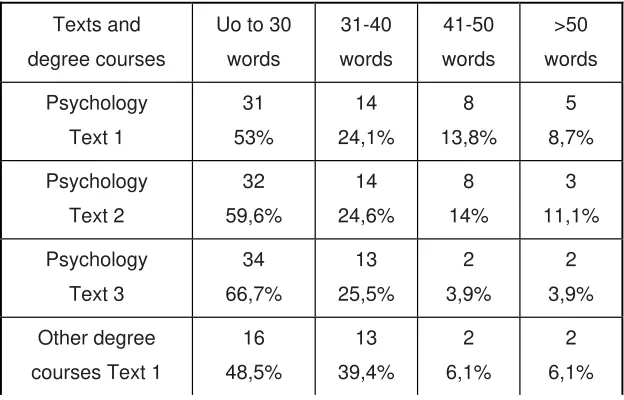
words for all three texts. Word-count distribution was grouped as follows (Tables 1 and
2).
Table 1.Summary reformulation. Amplitude and range of response adjustment to rubric
Texts and degree courses Amplitude Range
Psychology Text 1 11-61 55 Psychology Text 2 12-59 47 Psychology Text 3 12-87 45 Other degree courses Text 1 22-67 45
Table 2.Summary reformulation. Word-count distribution
Texts and degree courses
Uo to 30 words 31-40 words 41-50 words >50 words Psychology Text 1 31 53% 14 24,1% 8 13,8% 5 8,7% Psychology Text 2 32 59,6% 14 24,6% 8 14% 3 11,1% Psychology Text 3 34 66,7% 13 25,5% 2 3,9% 2 3,9% Other degree courses Text 1
16 48,5% 13 39,4% 2 6,1% 2 6,1%
It is particularly interesting to note the written productions by a number of respondents
[image:7.595.122.434.506.706.2]Orientación y Sociedad – 2006 – Vol. 6 8 contrasting Psychology undergraduates’ productions to those of students from other
degree courses (Text 1), a lower percentage of response adjustment was observed for
the former, as in the latter group only 12% produced answers of 41 words or over.
These findings relate to certain degree course peculiarities, possibly associated with
the type of activity formally required in the different degree courses.
Nonetheless, it is worth mentioning that higher word counts did not necessarily result in
better summaries, in terms of including text gist. In many cases, written productions
featured repetitive information, or else contained information of little or no relevance.
Performance on comprehension reformulations
As for comprehension reformulations, few difficulties were observed (30% of error).
Those that arose did so from wrong choices, mainly owing to lack of lexical knowledge.
(For example, when the underlined syntagm in the following passage was supposed to
be recast: Se han considerado muchas teorías, algunas rayanas en lo fantástico
(Several theories have been considered, some verging on the fantastic, where
ignorance of “rayanas” (“verging on”) led to a wrong choice).
Performance on summary and productive reformulations
Productive reformulations (replacing the source text by a similar one), as well as
summary reformulations (summary of content)) were the tasks posing greater
difficulties.
As mentioned before, for task-specific reformulation errors were categorised into
normative, morpho-syntactic and semantic. On analysing the percentage of students
having made at least one error in each of the categories under consideration for the
summary reformulation task, the following distribution appears. In decreasing order, the
percentage of Psychology students is higher when it comes to semantic errors, as is
the case with students from other degree courses, followed by normative errors and
finally by syntactic errors. Even though these percentages are higher among students
from the Psychology degree course, figures are still high among students from other
degree courses.This situation proves striking, considering that in the latter case
[image:8.595.139.495.690.751.2]students receive specific training in text handling (Tables 3 and 4).
Table 3. Summary reformulation. Percentage of Psychology students making errors
Categories Text 1 (N=58) Text 2 (N=57) Text 3 (N=51)
Normative 48
82,7%
45 78,9%
Orientación y Sociedad – 2006 – Vol. 6 9 Morphosyntactic 34
58,6%
24 42,1%
18 35,3%
Semantic 53
91,4%
54 94,7%
[image:9.595.137.500.70.141.2]50 98%
Table 4. Summary reformulation. Percentage of students making errores. Other degree courses
Categories Text 1 (N=33)
Normative 16
48,5%
Morphosyntactic 9 27,3%
Semantic 26
78,8%
As for productive reformulation, which, as said before, involved replacing part of the
text with one’s own words (paragraphs 1 and 2 in each text), the percentage of
students making errors roughly follows the same pattern. However, in some cases, a
higher percentage appears of normative errors among students from Psychology and
[image:9.595.114.475.451.619.2]from other courses (Tables 5 and 6).
Table 5. Productive reformulation. Percentage of Psychology students making errors
Text 1 Text 2 Text 3 Categories Par. 1
(N=58) Par. 2 (N=56) Par. 1 (N=57) Par. 2 (N=56) Par. 1 (N=53) Par. 2 (N=51)
Normative 49 84,5% 36 64,9% 46 80,7% 34 60,7% 32 60,4% 39 76,5%
Morphosyntactic 27 46,5% 25 44,6% 14 24,6% 11 19,6% 20 37,7% 12 23,5%
Semantic 45 77,6% 36 64,3% 46 80,7% 46 82,1% 47 88,7% 41 80,4%
A thorough analysis on the total error figures, in turn, revealed a relatively
homogeneous distribution in the percentage of normative and
morphosyntactic-semantic errors as far as summary and comprehension reformulation tasks were
concerned (Tables 7 and 8).
Orientación y Sociedad – 2006 – Vol. 6 10 Text 1
Categories
Par. 1 (N=33) Par.2 (N=33)
Normative 28
78,8%
9 27,3%
Morphosyntactic 8 24,2%
11 33,3%
Semantic 20
60,6%
[image:10.595.123.408.71.230.2]23 69,7%
Table 7. Summary reformulation. Errors by category
Categories Psychology Other degree
Normative 84
49,1%
24 40,7%
Morphosyntactic y Semantic 87 50,8%
35 59,3%
Total 171
100%
[image:10.595.126.441.265.395.2]59 100%
Table 8.Productive reformulation. Errors by category
Categories Psychology Other degree courses
Normative 143
51,8%
43 40,9%
Morphosyntactic and Semantic 133 48,2%
62 59%
Total 276
100%
105 100%
The analysis on the type of difficulties arising from each of the categories included is
laid out as follows.
1. Normative Difficulties
The normative difficulties experienced by students were similar in both reformulation
taks regardless of the nature of the text (expositive/ narrative, generalist/ disciplinary).
As for the type of normative difficulty observed, punctuation problems showed a higher
occurrence in comparison to those resulting from spelling, accentuation and
capitalization. Difficulties of this type are remarkable, as they are closely related to text
Orientación y Sociedad – 2006 – Vol. 6 11 Even though the percentage of spelling errors is relatively high in Text 3, by
comparison with the other two texts, it must be pointed out that it so results from
inappropriate inclusion of figures, letters or abbreviated syllables in place of words, or
else use of abbreviations. (Note that test instructions clearly warned that full words
should be used).
On the one hand, wrong capitalization in Text 1 is striking, since the syntagm
“Triángulo de las Bermudas” [= “Bermuda Triangle”)], was more often than not
transcribed using small letters (despite having the source text in sight). As for Text 2,
instead, the only compulsory capitals corresponded to proper names, a convention that
appears to be more straightforward with students. The few errors observed in Text 3,
requiring only sentence-initial capitalization, were due to the wrong inclusion of
mid-sentence capitals. Normative difficulties proved similar among students from other
[image:11.595.170.416.365.568.2]degree courses (Tables 9, 10, 11 and 12).
Table 9.Summary reformulation by Psychology students. Normative-type errors in all three texts
Types Text 1 Text 2 Text 3
Accentuation 28 33,3%
25 31,2%
13 23,2%
Spelling 4 4,8%
14 17,5%
21 37,5%
Punctuation 32 38,1%
37 46,25%
20 35,7%
Capitalization 21 25%
4 5%
2 3,6%
Total 84
100%
80 100%
56 100%
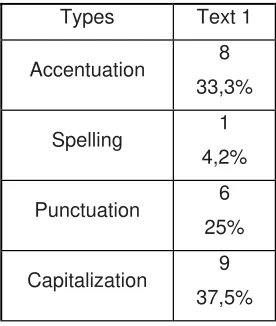
Table 10. Summary reformulation. Normative-type errors in students from other degree courses
Types Text 1
Accentuation 8 33,3%
Spelling 1 4,2%
Punctuation 6 25%
[image:11.595.182.320.601.764.2]Orientación y Sociedad – 2006 – Vol. 6 12
Total 24
[image:12.595.124.465.158.377.2] [image:12.595.167.376.427.642.2]100%
Table 11. Productive reformulation by Psychology students. Normative-type errors in all three texts
Text 1 Text 2 Text 3
Types
Par. 1 Par. 2 Par. 1 Par. 2 Par. 1 Par. 2
Accentuation 28 30,4% 19 37,2% 27 35,5% 9 20,4% 12 40% 23 46%
Spelling 3 3,3% 4 7,8% 18 26,7% 13 29,5% 10 33,3% 8 16%
Punctuation 34 36,9% 24 47,1% 28 36,8% 18 40,9% 18 60% 16 32%
Capitalization 27
29,3% 4 7,8% 3 3,9% 4 9,1% 1 3,3% 3 6%
Total 92 100% 51 100% 76 100% 44 100% 30 100% 50 100%
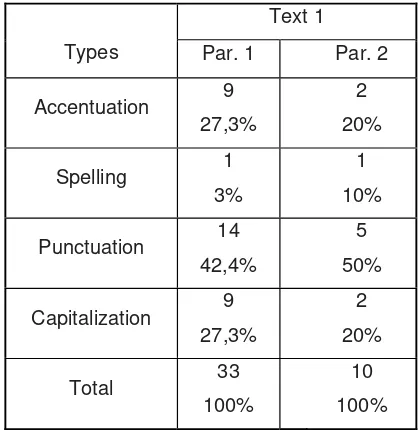
Table 12. Productive reformulation by students from other courses. Normative-type errors in all three texts
Text 1
Types Par. 1 Par. 2
Accentuation 9 27,3%
2 20%
Spelling 1 3%
1 10%
Punctuation 14 42,4%
5 50%
Capitalization 9 27,3%
2 20%
Total 33
100%
10 100%
2. Morphosyntactic and semantic difficulties
Morphosyntactic and semantic difficulties, which account for about half the errors
recorded at least once from subjects’ productions, can be attributed to different causes.
From the morphosyntactic point of view, either lexical errors or inadequacies in textual
cohesion were observed. The former can be due to a narrow range of vocabulary,
Orientación y Sociedad – 2006 – Vol. 6 13 limited command of text parameters, necessary for any satisfactory writing task. Such
difficulties registered a relatively homogeneous distribution for each reformulation task.
Once again, a variable number of errors of this type were observed in students’
individual written productions.
Semantic difficulties, as stated before, were classified according to the type of difficulty
revealed by the written productions, namely, information distortion, omission of relevant
aspects, or both. On evaluation, these difficulties acquired particular significance. In
fact, reformulation tasks seem to open up a much more thorough option for assessing
text comprehension. It must be borne in mind that they require putting source text
content into one’s own words. By contrast, the other tasks demanded assess different
capabilities, presumably with less cognitive cost, such as choosing the right answers to
literal and inferential questions and selecting the replacement section for a given part of
a paragraph, among four different alternatives.
On comparing the written productions by Psychology students on the different types of
reformulation task (summary writing and production), a similar error percentage is
observed, out of the total error figures recorded for these categories (Tables 13 and
[image:13.595.162.428.423.556.2] [image:13.595.162.429.590.723.2]14).
Table 13. Summary reformulation. Percentage by error type
Types de errores Psychology Other degree
Morphosyntactic 34 39,1%
13 37,1%
Semantic 53 60,9%
22 62,8%
Total 87
100%
35 100%
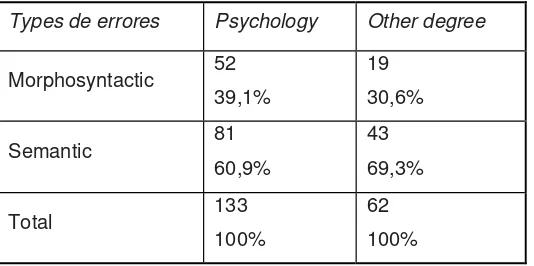
Table 14. Productive reformulation. Percentage by error type
Types de errores Psychology Other degree
Morphosyntactic 52 39,1%
19 30,6%
Semantic 81 60,9%
43 69,3%
Total 133
100%
62 100%
Orientación y Sociedad – 2006 – Vol. 6 14 tasks in relation to the different texts, varying percentages are observed which, though
revealing similar difficulties for all texts, suggest a higher percentage of semantic errors
for disciplinary texts. This occurrence is striking in two different senses. On the one
hand, it confirms the intrinsic complexity of academic texts; on the other hand, it draws
attention to the fact that students’ assumed specific background knowledge (given the
time of year by reference to course content) was either not well consolidated or proved
insufficient (Tables 15 and 16).
[image:14.595.172.415.240.372.2] [image:14.595.169.417.422.557.2]
Table 15.Summary reformulation by Psychology students. Error percentages in all three texts
Types Text 1 Text 2 Text 3
Morphosyntactic 34 39,1%
24 30,8%
18 26,5%
Semantic 53 60,9%
54 69,2%
50 73,5%
Total 87
100%
78 100%
68 100%
Table 16.Productive reformulation by Psychology students. Error percentages in all three texts
Types Text 1 Text 2 Text 3
Morphosyntactic 52 39,1%
25 21,4%
32 26,6%
Semantic 81 60,9%
82 70,1%
88 73,3%
Total 133
100%
117 100%
120 100%
Of perhaps greater interest is the kind of semantic difficulty reported. In the case of
summary reformulation, the range of errors varied according to text type and to text
content. Distortions were greater in Text 2, omissions in Text 1 and both distortions and
omissions in Text 3.
In Text 1, shows evidence of difficulty in providing a gist-based summary, subjects
resorting for the most part to replacements with irrelevant information or else to
omissions. In Text 2, instead, distortions were frequent due to inability to arrive at the
text macrostructure permitting an adequate summary. It must be pointed out that the
type of account, a detective story, which can trigger various interpretations, was not
Orientación y Sociedad – 2006 – Vol. 6 15 distortions and omissions, possibly owing to the complexity alluded.
Moreover, the limited knowledge of summary rhetorical organization was noteworthy,
the task often being taken for a mere comment or a free interpretation of text content.
The latter must not be attributed to enhancement through inferential information
(expansive reformulation, in the case of written productions bearing a greater number
of words than requested), but rather to inadequate comprehension of text gist and
partial knowledge of the text parameters which should lead to summary writing (Table
[image:15.595.179.408.251.416.2]17).
Table 17. Summary reformulation. Error percentages
Types Text 1 Text 2 Text 3
Distorsions 21 39,6%
34 62,9%
1 2%
Omissions 27 50,9%
20 37%
5 10%
Both 5
9,4%
– 44 88%
Total 53 100%
54 100%
50 100%
On contrasting the written productions by Psychology students to those from other
degree courses, based on a single text (Text 1), the findings reported were quite
[image:15.595.151.433.519.682.2]similar, with a similar percentage of distortion or omission errors (Table 18).
Table 18. Summary reformulation. Percentage of semantic-type errors
Types Psychology Other degree courses
Distorsions 21 39,6%
11 42,3%
Semantic 27 50,9%
12 46,1% Both 5
9,4%
3 11,5%
Total 53
100%
26 100%
In relation to productive reformulations, when jointly contrasting text productions on
paragraphs 1 and 2 from both texts, a remarkable prevalence of the figures for
Orientación y Sociedad – 2006 – Vol. 6 16 Psychology degree course. In said this case, difficulty in replacing one text by a similar
one can partly be attributed to a narrow range of vocabulary. Still, it can also be put
down to inadequate comprehension of intended meaning of the paragraph to be
[image:16.595.179.407.178.345.2]replaced (Table 19).
Table 19. Productive reformulation. Percentage of semantic-type errors
Types Text 1 Text 2 Text 3
Distorsions 60 74,1%
64 69,6%
72 81,8%
Omissions 16 19,7%
25 27,2%
10 1,1% Both 5
6,2%
3 3,3%
6 6,8%
Total 81 100%
92 100%
88 100%
A higher error percentage of both types, distortions and omissions, was observed in
relation to summary reformulations for Tex 3 (disciplinary), in terms of the difficulty
involved in writing an adequate summary.
Comparison of Psychology students’ written productions to those of students from
other degree courses, renders higher distortion percentages among the former.
Conversely, students from other degree courses registered higher omission
percentages. It is worth pointing out that distortion errors are more worrying, in that
they misconstrue information, still admitting that, in varying degrees, omission also
entails defective comprehension of the information furnished by the source text (Table
20).
Table 20. Productive reformulation by students from other courses. Percentage of
semantic-type errors
Types Text 1
Distorsions 29 67,4%
Omissions 13 30,2%
Both 1 25%
[image:16.595.204.332.603.762.2]Orientación y Sociedad – 2006 – Vol. 6 17 Qualitative analysis of certain written productions
There now follow some examples of analyses carried out on summary and productive
reformulations (transcriptions are literal).These will allow closer inspection of the
features of the written productions obtained and of the difficulties reported for the
categories selected.
Summary reformulation of Source Text 1 (see appendix)
Reformulated text
“Se trata de un lugar entre Bermuda y La Florida donde han desaparecido, sin
encontrar nunca mas resto, gran nº de aviones, barcos y personas. No se han
descubierto las causas de estos sucesos. Se dice que puede ser causa de actividades
extraterrestres, energía no descubierta o por ser un lugar aun desconocido por el
hombre”
Observations: lack of adjustment to rubric, with a word count of 56 words instead of
30, as requested. Still, excess words do not enhance the written production but rather
detract from its standar; poor in coherence.
Difficulties arise on different levels. Normative difficulties feature omission of full stop,
omission of diacritic on “mas” [= “more”] and “aun” [= “still”], and inappropriate use of
the abbreviation for “number”. As for morphosyntactic difficulties, it resorts to a poorly
formulated hyperbaton, which obscures the meaning of the first sentence: “sin
encontrar nunca mas resto” [= “with remains never found”]. Passive voice should be
used instead (adding the pronominal “se”). Besides, double negative, which would
make it meaningful, is omitted: nunca mas resto alguno [= “no remains ever found”].
The expression “Se dice que puede ser causa de” [= “It is said it can be due to”]
reveals referential ambiguity, lack of agreement (“puede”-“causa”), and semantic
problems, since the cause relation is transformed into a consequence relation.There
are omissions obscuring meaning, (fuente de [= “source of”]) “energía no descubierta”
[= “energy not yet discovered”]. On the semantic level, the text meaning is altered, on
replacing “por ser un lugar aun desconocido por el hombre” [=“because it is a place
unknown to man”] instead of “o por alguna dimensión de tiempo y espacio no conocida
por el hombre” [= “due to some time or space dimension unknown to man”].
Productive Reformulation Text 1, paragraph 2
Source Text
Si esta luz tiene alguna conexión con las desapariciones misteriosas se desconoce –
Orientación y Sociedad – 2006 – Vol. 6 18
Reformulated Text
Una de las posibles causas de las desapariciones puede ser lo existencia de una luz
que se observo en el mar. Sin embargo, todavía no ha podido ser explicado.
Observations: the connector “sin embargo” [= “however”] is used inappropriately,
expressing an adversative relation that does not appear in the source paragraph.
Reformulation is well achieved, by replacing “esta luz” [= “this light”] by “una luz que se
observo en el mar” [= “a light spotted at sea”]. Finally, it misinterprets the first
statement in the paragraph by taking it to be an assertion that the existence of the light
mentioned constitutes a possible cause for disappearance. Even though the second
statement adequately reformulates its source, it is not consistent with the first
statement in the reformulation (the subject of “no ha podido” [= “could not be”] is
ambiguous).
Productive Reformulation Text 3, paragraph 1
Source Text
Un test es una prueba estrictamente definida en cuanto a sus condiciones de
aplicación y su modo de notación, que permite situar a un sujeto con respecto a una
población, estando esta última bien definida.
Reforumated Text
Un test esta bien hecho cuando su aplicación y modo de anotación fueron realizadas
bien
Observations: This reformulation is not consistent with the register of the source text,
using expressions such as “está bien hecho” [= “is well made”], “fueron realizadas
bien” [= “were well made”] (semantic distortion).
The adverb “bien” [=“well”] is repeated, without expanding its scope (semantic
distortion). The thematic information in the source text focuses on the definition of test
and the specification of its primary function. The reformulated text has partly elided the
essential information, as it does not refer to test function (semantic distortion).
Furthermore, it focuses exclusively on grounds for test correction, and it does so in
ambiguous and relatively vague terms. In fact, the source text does not state that “Un
test esta bien hecho cuando su aplicación y modo de anotación fueron realizadas bien”
[= “A test is well made when its application and record-keeping system were well
made”]. Rather, it says that what should be clearly defined for a test to be effective is
“las condiciones de aplicación del test” [= “test application conditions”] –not just “su
aplicación” [= “its application”]- and “su modo de notación” [= “its notation system”]
(semantic distortion). The phrase “su aplicación y modo de anotación fueron realizadas
Orientación y Sociedad – 2006 – Vol. 6 19 agreement for the past participle, which should be “realizados” [= “made”], since the
compound subject bears a feminine nucleus and the nucleus it refers to is masculine
(morpho-syntactic distortion).The omission of the possessive adjective “su” [= “its”]
being an attribute of “modo” [= “system”] causes “su aplicación y modo de anotación”
[= “its application and notation system”] to be perceived as a sense continuum in which
each nucleus lacks autonomy, instead of projecting the independence of each entity
(morpho-syntactic and semantic distortion). The full stop is omitted (normative
difficulty).
To sum up, these quantitative and qualitative analyses report on difficulties in text
handling seen in most university students, regardless of the degree courses they are
enroled in.
Conclusions
About the issue of text comprehension and production, which was the specific subject
matter of this study, findings point to the fact that even though difficulties arise in any of
the tasks requested such problems increase when it comes to text production,
regarding reformulation tasks in this case. In fact, these posed significant difficulties for
a considerable number of students, who made different types of error. However, it is
striking to observe normative punctuation difficulties, morphosyntactic difficulties and
semantic distortions and omissions. They all showed evidence of problems in the
handling of text parametres and of inadequate text comprehension.
Comparison of written productions by Psychology students with those by students from
other degree courses, in which somewhat smaller percentages were observed, reflects
often-similar production patterns. Notwithstanding the specific training in text handling
common to students from other degree courses, these, too, display difficulties, though
a better command of text parametres is observed.
As for the group in the Psychology degree course, although errors occurred in all texts,
they were more numerous in the case of Text 3, disciplinary in nature, particularly in
the summary writing task. As pointed out above, this occurrence reports on the
intrinsec complexity of academic texts and on inadequate or limited consolidation of
domain-specific background knowledge, which should assist the task.
Besides error percentages, it is striking to observe students’ ignorance of the rhetorical
organization of a summary or of the importance of text-segment recasting. This raises
questions as to the way they make their own summaries when they deal with academic
texts and how they study from them, that is to say, extract knowledge from texts.
From the findings recorded, it is possible to draw some inferences about the difficulties
Orientación y Sociedad – 2006 – Vol. 6 20 of newly-admitted undergraduates accounts for student outcomes, all that happens
within university in terms of teaching and learning processes should be taken into
consideration. A number of students do not present problems. Still, those cases in
which difficulties do arise explain the need for planned action that should raise
students’ awareness of their own reading and writing processes, so that they can
achieve better comprehenion and production levels by means of direct, systematic
training.
Naturally, the knowledge and skills involved are not guaranteed by mere content
transmission, significant as this may be. It would be necessary to complement it with
that which is register-specific for written academic texts in each particular discipline. In
fact, text production is an indirect measure of comprehension, since it requires putting
clearly and distinctly into writing what is understood from the text, by means of
reformulations such as summary writing and text segment paraphrase. In that respect,
some of the differences found according to degree course prove the value of specific
reading and writing training in the handling of academic texts.
In the case of Psychology students, one wonders, on the one hand, about the rare
demand for written productions, inkeeping with the style norms governing the academic
community, due, among other reasons, to the large turnout of students for these
courses. On the other hand, about the insufficient training as regards the rhetorical
organization demanded by various types of text production, summary reformulation, in
this case, or some other reformulation type. Some local research (Carlino, 2002, 2005)
refers to three types of representation echoing this lack of or inadequacy in training: in
the first place, “Writing is thought of solely as a channel for communicating knowledge
rather than as a tool for analysis which requires thinking over knowledge. Besides, and
as a result of the latter, writing is believed to be an instant action: by knowing what one
wants to say, it is just a matter of putting it into writing. Finally, writing is assumed to be
a basic technique which, once acquired, is good for putting on paper any disciplinary
knowledge”.
Although there are certainly various reasons for inadequate text handling, a possible
approximation to the issue consists in taking different approaches to examine what has
been called “academic literacy”. By this, we mean the university’s mission to teach how
to understand and produce complex texts, particularly academic texts. As pointed out
above, it is for the most part about dealing with authorial texts, not directed to students
but to the scientific community, all of which therefore poses intrinsic difficulties.
Adequate handling of these texts is a goal rather than an aim. In that sense, text
handling should be mediated by careful text selection, particularly in the inicial
Orientación y Sociedad – 2006 – Vol. 6 21 instruction on text interaction processes and procedures. Among them, writing stands
out as a valuable practice, not only for its usefulness in improving students’
performance but also for its epistemic value (Miras, 2000), in as much as it enables the
development of the situation model formulated by van Dijk and Kintsch (1983).
Finally, we would like to call attention to the fact that our presentation of findings and
the reflexions they have encouraged do not intend to stigmatize students’
performances but, rather, to question education systems, which should seek to
substantially improve students’ skills for comprehension and production of academic
texts by including issues such as cross-sectional contents in every degree course.
See source texts in the spanish version appendice.
Notes
1. N=500
References
1. Anderson, R. C. & Freebody, P. (1981). Vocabulary knowledge. In J. T. Guthrie (Ed.) Comprensión and teaching research reviews (pp.77-117). Newark, DE: International Reading Association.
2. Arnoux, E., Di Stéfano M. & Pereira C. (2002). La lectura y la escritura en la universidad, Buenos Aires, Eudeba.
3. Carlino, P. (2002).Evaluación y corrección de los escritos académicos. Ponencia presentada al IX Congreso de la Sociedad Argentina de Lingüística-SAL 2000.
4. Carlino, P. (2005). Escribir, leer y aprender en la universidad. Una introducción a la alfabetización académica. Buenos Aires: Fondo de Cultura Económica.
5. Harp, B. (2006). The Handbook of Literacy Assessment and Evaluation. Norwood, Massachusetts: Christopher Gordon Publisher Hernández Sampieri, M., Fernández 6. Collado, C. & Baptista Lucio, P. (1998) Metodología de la investigación. México-Buenos Aires: McGraw Hill.
7. Hynd, C. R. (1998). Learning from text across conceptual domains. Mahawah, New Jersey: Laurence Erlbaum.
8. Kintsch, W.(1988).The use of knowledge in discourse processing:A construction integration model. Psychological Review, 95, 163-182.
9. Kintsch, W. (1994). Text Comprehension, Memory, and Learning. American Psychologist, vol.49, Nº 4, 294-303.
10. McCardle, P. & Chhabra, V. (2004). The Voice of Evidence in Reading Research. Baltimore: Paul Brookes Publishing.
11. McGee, L. M. & Richgels, D. J. (1985). Teaching Expository Text Structure to Elementary Students. The Reading Teacher, vol. 38, 739-748.
Orientación y Sociedad – 2006 – Vol. 6 22 Disciplinary Knowledge. In Learning from Text Across Conceptual Domains. Mahwah, New Jersey; London; Lawrence Erlbaum Assocites, Publishers.
13. Molinari Marotto, C. (1998), Introducción a los modelos cognitivos de la comprensión del lenguaje. Buenos Aires: EUDEBA.
14. Miras, M. (2000). La escritura reflexiva. Aprender a escribir y aprender acerca de lo que se escribe. Infancia y Aprendizaje, 89, 65-80
15. Parodi Sweis, G. (2000). Relaciones entre la lectura y escritura: una perspectiva cognitiva discursiva. Santiago de Chile: Ediciones universitarias de Valparaíso.
16. Piacente, T. & Granato, L. (2005). Procesos lectores y tipos textuales en alumnos universitarios de Psicología en la UNLP, Proyecto de investigación. Secretaría de Secretaría de Ciencias y Técnica de la UNLP
17. Piccolo, J. (1987). Expository text structure: Teaching and learning strategies. The Reading Teacher, Mayo 1987, 838-847.
18. Silvestri, A. (2001). La adquisición discursivo-cognitiva en la escuela secundaria. Habilidades de reformulación y estrategias de memoria. Tesis doctoral (inédita). Facultad de Filosofía y Letras de la UBA.
19. Silvestri, A. (1998), En otras palabras. Las habilidades de reformulación en el texto escrito. Buenos Aires: Cántaro Editores.
20. van Dijk, T. A. & Kintsch, W. (1983). Strategies of discourse comprehension. San Diego, California: Academic Press.
21. Van Dijk, T. A. (1992). La ciencia del texto. Buenos Aires: Paidos.
Received: April 2006