learning Activities in Educating
business: a Pilot with a Process-Oriented
e-learning Environment
Henk Plessius1 and Pascal Ravesteyn1
1 University of Applied Science Utrecht, Faculty of Science and Engineering, Nijenoord 1, 3552 AS Utrecht, The Netherlands
{henk.plessius, pascal.ravesteijn}@hu.nl, WWW home page: http://www.hu.nl
Abstract. Current e-learning tools offer a multitude of possibilities for the exchange of various types of documents and for communication between students as well as between students and teacher(s). But education is intrinsically process-oriented – and current technology in the field of e-learning offers no support for the activities which form the core of e-learning. In this paper the possibilities and limits of current technology as used in an extensive program (a minor) on e-business, are demonstrated. Furthermore, a first impression of a new, activity-based tool is given, which has been used in one of the courses of the program.
1 Introduction
The introduction of the Bachelor/Master structure in the field of higher education in the Netherlands has led to a rethinking of the various educational programmes. The focus in this paper is on e-learning in a minor program (a minor being a self-contained and coherent unit of study) with e-business as its theme. The main objective of this paper is to present the use of e-learning tools in an extensive program (half a year of study) and to show what can be done with current technology and (more important) what not. In our experience a different paradigm is needed for e-learning: activity-based instead of content-based.
Quite recently we were able to experiment with a beta-release of Educator, a new e-learning tool developed on the Cordys6
platform. Finally we will end this paper with our first impressions of this tool.
1.1 Transformations in higher education: towards more flexibility
Since September 2002 the Netherlands has implemented the Bachelor/Master structure in the field of higher education, in line with the intention made in Bologna [1], to create “an open and transparent European Higher Education Area”.
The University of Applied Science in Utrecht (see www.hu.nl for more information on the university), has seized this opportunity to reform its curricula. One of the changes is the implementation of minors, a minor being defined as a coherent program of 30 ECTS (30 ECTS in the European Credit Transfer System being equivalent to 840 hours or half a year of study for a full-time student) which supplements the student’s main course (which by contrast is called the major). Students with a major in Software Engineering can in this way broaden their scope with a minor in Human Computer Interaction, Business Informatics, e-learning or even Russian. The only restriction on their choice is the existence of a program, which conforms to the quality standards of the higher educational curricula.
By introducing minors, the University of Applied Science in Utrecht now has a very flexible system in which the students may to a great extent follow their own interests in their professional education. Other elements in which students may choose their own specialization are traineeships and the thesis. Contrary to the minor, these elements are restricted by the topic of the chosen major.
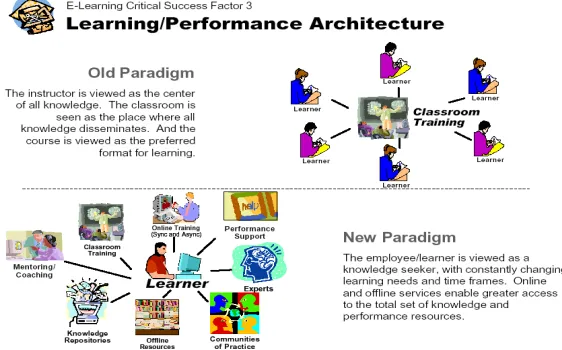
Another way in which the university reaches for more flexibility is in the use of e-learning. Contrary to countries such as Australia where distance learning is necessary for people living in the interior, in the Netherlands the distances to a university are small (typically less than 50 kilometres). The need for e-learning tools comes from the increasingly dominant role of ICT, especially the use of the Internet, in our society. Furthermore a paradigm shift has taken place in the field of education, from knowledge transfer to competence-based training, where the quest for information and knowledge is now the responsibility of the student with the professional in the role of tutor (see Figure 1).
For this paradigm to be effective, the student needs access to various knowledge sources for solving problems – e-learning tools provide a way in which all the different sources of knowledge can be structured.
During the last decade a lot of different projects have been undertaken by Dutch educational institutes in the field of e-learning. We have seen universities implementing learning in entire educational programmes, trying to outsource e-learning technology or even content development (with the help of publishers and/or companies). Only a couple of these first initiatives have been successful because of technological problems (e.g. bandwidth) or cultural problems: a lot of lecturers have
6
had a hard time adapting to new ways of teaching. Today universities mostly use a blended learning concept in which e-learning has a supportive role, in this way securing the motivation and engagement of students via the ‘live’ contact with the professional – their role-model.
Under the influence of the developments mentioned before, the essence in managing educational institutes is shifting from managing curricula towards managing the process of learning. Electronic learning environments like Blackboard or LearnExact offer educational institutes the possibility to develop flexible and transparent learning paths.
2 Experiences with e-learning tools in educating e-business
As stated before, in this paper we will focus on e-learning in a minor e-business, a program developed for ICT-students from 3 different faculties by staff from these faculties.
When starting with the program (the first course was given in the fall of 2003) it was apparent that we had to deal with different educational cultures and different views on the subject. After ample discussions an agreement was reached on the following conditions:
• An e-business application for a real organization should be the end-result of the minor.
• To provide a common language and understanding, a mandatory framework of
courses would be necessary.
• Students should be able to tune the minor to their personal interests by choosing additional courses.
• The organization should provide a professional working environment, to
[image:3.612.164.445.142.317.2]Based on these conditions a program was developed which currently (after minor revisions for 2004 and 2005) consists of the following subjects:
1. Developing an e-business application for a real organization (12 ECTS). This process must result in an application that is tailored to the organization and is implemented at the organization, using the existing infrastructure and hardware.
2. Mandatory courses (12 ECTS):
- Strategy, Change and Vision (3 ECTS).
This course consists of weekly guest lectures by renowned speakers in the field. Students have to write individually a paper on a topic in e-business.
- E-commerce (3 ECTS).
During the course the students must apply the theory on the organization for which they are developing the application.
- E-procurement & Supply Chain Management (3 ECTS).
Traditional course with examination.
- Organization and Business Processes (3 ECTS).
Theory and practice on process modeling in order to adapt the back-end processes (using software from Cordys and Bizzdesign).
3. Optional courses (6 ECTS); examples are (students have to choose 2 courses):
- Portfolio Management (3 ECTS)
- Project Management (3 ECTS)
- Knowledge Management (3 ECTS)
- XML (3 ECTS)
- Customer Relationship Management (3 ECTS)
From the start of the minor in 2003, we decided to support the resulting program, with its focus on multidisciplinary learning, with an electronic environment that should meet with various demands. On the one hand it should be possible to create a virtual office in which students could work on the e-business application, but also on cases and questions. Furthermore, the environment should help in the exchange of ideas and documents on various topics (student-student and lecturer-student(s)). Finally, the environment should provide a platform for discussion and assessments. For these goals we found the electronic environment of Teletop (www.teletop.nl) – an environment developed in the Netherlands – very easy to use. But other tools (e.g. Lotus Notes, Blackboard, It’s learning, LearnExact etc.) offer more or less the same functionality.
Teletop as the only way to provide students with documents: syllabi, sheets, articles, cases, etc. and to give feedback on students via Teletop.
Apart from the exchange of documents, Teletop is used as the only tool for the communication between administration, students and lecturers. Examples are: schedules, announcements of guest lectures and results. As a rule the students know that news for the next day can be added until 18.00 hours.
Any other use of Teletop (e.g. the electronic office) is optional, not required. Looking back, the chosen policy has proved sensible:
• Students were informed in time on changes in the schedule – even
last-minute changes: a lot of students made it their habit to look on Teletop before going to the Institute.
• We accumulated a lot of useful material on the topic of e-business that
can be re-used in the next courses.
• By monitoring the student discussions the staff was well informed on
relevant student-themes. A good example is the discussion on the use of software tools for creating the e-business application in which the students proved very creative in finding free tools (e.g. shareware, open source software).
• The workspace provided by Teletop as virtual office was intensively
used by all but one group. Most groups planned 2 to 3 physical meetings a week and did a lot of work at home while being in contact with other team members via Teletop.
Finally the use of Teletop as an instrument in assessments was unintentional but proved quite important. Students were asked to match their competences in the field of e-business before and after the program (a questionnaire on the various competences we aimed for was developed for this purpose). This provided us with a valuable insight in the added value of the various elements of the program, which proved in some ways quite different than we expected before starting. As an example we learned that students distributed tasks not on competences to be learned, but on the urgency of the task, thereby not always aiming on profit in educational terms but instead on rewards in the short term (which is probably a quite familiar pattern for anyone who works with students).
3
The next step: from e-learning to e-learning activities
enable students in their learning process. This didactical approach is quite natural to teachers, but is often not articulated to the outside world.
Here are some examples of processes we cannot (or not sufficiently) model in the current electronic environments. We refer back to our experiences with the minor:
• Students have to develop an e-business application. In accordance with good
software engineering practice [3,4], students are asked to model the business process, model the application, build the software and test the application. But where every organization is different, and the nature of the business processes may vary quite a lot in different organizations, the steps which have to be taken and the timing thereof are different for the various student-groups. While for one group the best approach is a linear process, for another group a more iterative approach is demanded. Prototyping may be needed to get a feeling for the technology, but in other cases, it may not be necessary. So one of the first things students have to deliver is a phase model, explaining what is to be done and when. These phase models may differ and students should be able to implement their planning in the learning environment. And perhaps even more important, they should be able to change this plan if a better approach is feasible (after all: students are not professionals – yet). In this way the learning environment can act not only as a communicating device between students and between students and their tutors, but also as a dynamic planning tool. This is quite different from the current practice to make Word documents and post these. We want the tool to actively guard milestones etc.
• For the course Vision, Strategy and Change, students have to write a paper on a
topic in e-business. Current learning environments offer no support at all for a process like this; they can only support students by providing content.
• The course Organization and Business Processes has a large practical assignment
in the use of modeling software and methods. Dependent on learning style and former experience, it should be possible to take different, not pre-defined routes through this course. That is, the learning environment should provide a lot of flexibility, as is also described in [5,6,7]
• For the course e-Commerce students have to apply the marketing concepts to the
organization they are building an application for. Support in the form of sample cases like in the 4C/ID- design method [8,9] and peer review would come in handy.
All in all, we want support from e-learning tools for learning activities and the coordination thereof, while with most of the current tools the only support is in “mere consumption of content by individual learners” [10,11]. This paradigm shift (in software engineering terms: from data-driven to event-driven) has its consequences for the construction of content. No longer is the start a break-down in learning objects, but instead, the first step to be taken is modeling different “use-cases”, each describing a different way of how the content is used and which learning activities are expected. Learning objects in this way become nuggets of content, to be discovered by students while actively engaged in learning.
4 Experiences with Educator
As mentioned before the Cordys Company, with their business process management system, offers software for modeling and orchestrating (business) processes, integrating different information systems and business intelligence. Recently a spin-off company developed a special release for educational purposes: Educator. In the course of the last minor, we had a chance to work with a beta release of Educator.
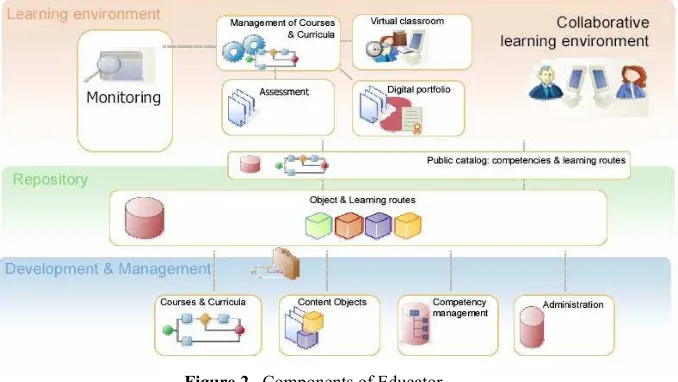
Educator (see Figure 2) is a next generation e-learning environment, based on the activity-centered approach in order to design a student’s learning experience. It uses both business standards in modeling [12] and the latest in educational standards [13].
In September and October of 2005 a project group of 4 students, two teachers and one representative from the Educator company reviewed a beta version of Educator and suggested improvements in order to be able to use it in a pilot setting during the period November 2005 – January 2006. The most important goal during this period was to try out the process-modeling environment. In the pilot itself a group of about nine students used the Educator environment to follow a course on Customer Relationship Management. The learning activities were modeled beforehand and all resources were connected to the different activities in the learning process (see Figure 3). During the pilot the modeling environment has been used only by teachers/course developers and not by the students.
[image:7.612.143.482.203.394.2]After login students will typically see the ‘regular’ functionality of an e-learning environment (e.g., news, forum, courses, virtual classroom etc.). The main difference, however, is the way in which courses are represented. Instead of presenting all course content, a student starts a workflow by enrolling in a course. The workflow in turn starts activities that are sent to the student’s task list. Depending on the type of task (e.g., preparing a lecture, (portfolio) assignment, writing a paper, etc.), different sorts of content and functionality become available.
To model learning processes Educator offers several elements. The most basic element is the “activity”. This element can be used by the course modeler to describe tasks like “read an article” or “make exercise 12 on page 24” or “write a paper on …”. It is possible to link resources that the students need to the activity and it is also possible to add a time limit (e.g., when this task is activated, completion should follow within five days). A second element that we have used frequently in the learning process that was modeled for the pilot is the “portfolio assignment”. Whenever a student gets a portfolio assignment it means that the work that the student has done must be uploaded after which the teacher has to provide feedback, both of which are then automatically placed in the student’s digital portfolio. It is also possible to give other students access to the digital portfolio to enable peer review exercises.
Elements that we have not used during the pilot but can be used to model learning processes are amongst others “360 degree feedback”, “assessment”, “(digital) classroom meeting”, “forum”, “chat”, “approval” and “decision”. One of the most important is the “decision” element which can be used to coordinate students along different learning processes based on the outcomes of earlier elements, for instance assessments. This is a very important difference when comparing Educator to most of the current e-learning environments.
[image:8.612.140.483.218.427.2]Our current experience with this next generation e-learning environment is that it can simplify the work of the teacher by taking away a lot of the communication and coordination needed during the student’s individual learning process. By making use of workflow technology it is possible to give each student just-in-time information and activities. However the task of modeling the learning process of a course is a
daunting one. All the different activities, both standard and specific (for students needing more attention, extra assignments etc.), and the routes through the process should be thought out before developing the course model. Even if this is done it is still necessary to have the flexibility to change a student’s learning process on the fly when that is needed. Currently Educator is not capable of doing this.
Another very important lesson that we learned is that students who start asking questions via means other than the e-learning environment should be guided back as quickly as possible. It is very tempting to quickly answer an e-mail of one student, but if the answer is already provided somewhere in the modeled learning process the student should get it from there. Even if the answer is not provided, it should still be encouraged to use the forum, chat or frequently asked questions functionality of the e-learning environment instead of phoning or mailing the teacher (of course this is important in a traditional e-learning environment as well).
Finally we would like to mention that some students during the pilot got the impression that there were only a few activities that had to be completed for this course due to the fact that a student could see the content of only one activity at each time. Although Educator does offer a high-level view of all activities that belong to one process, beforehand it is not possible to see the specific tasks and it is not clear which route the student will follow through the process.
During the pilot we didn’t use time constraints on activities, causing several students to start too late with their tasks. Halfway during the pilot, functionality was added to the environment that enabled the teacher to track the progress of individual students and thus making it possible to intervene when students were not performing according to the course schedule and process.
After evaluation of the pilot it will be decided if we will use Educator in a larger setting and start using more of the elements available to model learning processes. Specifically the use of pre-assessments, to determine which activities and routes an individual student should take through a learning process, may be implemented.
5 Conclusions
In the last couple of years we have gathered quite a lot of practical experience with e-learning tools. While these tools are very handy as a repository for all kinds of documents and offer communication between students as well as between student and teacher, they are essentially static. In this paper we have expressed our need for more dynamic tools, supporting not only learning objects (content), but also learning activities and the coordinating processes. This shift is necessary to support the competence-based curricula most professional universities are trying to implement.
For now Educator is promising but it currently is lacking in flexibility: making changes on the fly in the process is not possible once a student has started with the process.
Finally, for students this way of looking at learning activities makes e-learning much more social and also more effective in reaching the competences that students are working on. E-learning becomes natural when it is activity based and process oriented.
References
1. European Union, Bologna (June 19, 1999); Available from:
http://europa.eu.int/comm/education/policies/educ/bologna/bologna.pdf 2. R. Oliver, B. Harper, J. Hedberg, S. Willis, Information and Communication
Technologies and their role in Flexible learning, AUTC project report; Available from: http://www.learningdesigns.uow.edu.au.
3. Sommerville, Software Engineering, 7th
edition (Pearson Education Ltd, Harlow, 2004). 4. I. Jacobson, G. Booch and J. Rumbaugh, the Unified Software Development Process
(Addison Wesley, Reading, Massachusetts, 1999).
5. O. Marjanovic, M. Orlowska, Making the flexible learning more flexible, paper presented at the IEEE International Workshop on advanced Learning technologies, December 4-6, Palmerston North, New Zealand.
6. O. Marjanovic, Towards IS supported Coordination in Emergent Business Processes, Business Process Management Journal. 11(6), 624-627 (2005).
7. S. Carlsen, H. Jorgensen, Emergent Workflows: The AIS Workware Demonstrator, paper presented at the CSCW-98 Workshop on Towards Adaptive Workflow Systems, November 14, Seattle, USA.
8. J. Noordman, M.B. Ameike, J.G. van Merriënboer, Innovatief Onderwijs Ontwerpen (Wolters-Noordhoff bv., Groningen, 2002).
9. J.G. van Merriënboer, Training Complex Cognitive Skills (Educational Technology Publications, Inc., New Jersey, 1997).
10. H.G.K. Hummel, J.M. Manderveld, C. Tattersall, E.J.R. Koper, Educational Modelling Language: new challenges for instructional re-usability and personalized learning. International Journal of Learning Technology. 1(1), 110-111 (2004).
11. H.G.K. Hummel, E.J.R. Koper, From a Learning Object centric view towards a Learning Activity perspective (to be published in Journal of Technology, Instruction, Cognition, and Learning).
12. A. Arkin, Business process modelling language - BPML 1.0, 2002; Available from: http://www.bpmi.org.
13. ADL (2004a) SCORM, 2nd Edition Overview; Available from: