Ninth graders’ social experiences to promote critical literacy in EFL with project-based learning
Claudia Paola Ruiz Sarmiento 20132062011
Universidad Distrital Francisco José de Caldas School of Sciences and Education
Masters in Applied Linguistics to TEFL Bogotá, Colombia.
Ninth graders’ social experiences to promote critical literacy in EFL with project-based learning
Claudia Paola Ruiz Sarmiento
Thesis director: Deyanira Sindy Moya Chaves
“A thesis submitted as a requirement to obtaining the degree of M. A. in Applied Linguistics to the Teaching of English”
Universidad Distrital Francisco José de Caldas School of Science and Education
Note of acceptance
Thesis Director ____________________________________________ Name Deyanira Sindy Moya Chaves. M.A.
Jury ____________________________________________ Name Diego Fernando Ubaque Casallas. M.A.
Acuerdo 19 de 1988 del Consejo Superior Universitario
Abstract
The present qualitative action research study aims at describing and analyzing the promotion of critical literacy (CL) in an EFL class through high school students’ social experiences. Project-based learning was selected to create the instructional design, which presents the implementation of three-cycled project with ninth graders. This project combines students’ interests and needs identified from a needs analysis conducted based on Pineda’s (2000) three step model and on curricular objectives of EFL from a public school in Bogotá, Colombia. The results show it is possible to include students’ experiences in foreign language classes and by reflecting on them in class, in English, it is possible to promote critical literacy, especially when students are agents and active participants into shaping of their own learning. The project concludes with the idea that teachers are presented with the opportunity of changing the traditional methods of learning a language and also that it is necessary to use the immediate knowledge of young students because it is what they are more interested about and where their knowledge of the world comes from.
Table of contents
Abstract ... 6
Chapter I. Statement of the Problem ... 14
Statement ... 21
Research Question ... 23
Research Objectives ... 23
General Objective ... 23
Specific Objectives ... 23
Rationale ... 24
Chapter II. Literature Review ... 26
Students’ social experience and its role in EFL learning ... 30
Critical Literacy in EFL ... 33
Interaction, context and culture in CL. ... 37
Students’ thinking and perception of the world ... 40
Language policies for EFL ... 42
Chapter III. Research Design ... 44
Type of Study ... 44
Setting or context of the study ... 48
Participants ... 49
Sampling ... 50
Researcher’s role ... 51
Instruments and Procedures ... 52
Journals ... 53
Interviews ... 54
Students’ Artifacts ... 55
Ethical Issues ... 57
Chapter IV. Instructional Design ... 59
Curricular Platform ... 60
Vision of curriculum ... 60
Vision of language... 61
Vision of English classroom ... 63
Pedagogical Intervention ... 64
Objectives of the pedagogical intervention ... 64
Methodology ... 65
Learner’s role ... 66
Teacher’s role ... 66
Instructional Unit ... 67
Chapter V. Data Analysis ... 71
Super family Analysis ... 74
SF: Critical Literacy in an EFL Classroom... 74
Families Analysis ... 76
CF: Selfness as a Language Learner ... 76
CF: The Learning Process ... 78
CF: Opportunities to Learn ... 80
Categories’ Analysis ... 82
Personal Standpoints ... 83
Interaction ... 84
Learning Awareness: How To ... 85
Language Awareness: What To ... 87
Initiative ... 88
Subcategories’ Analysis ... 89
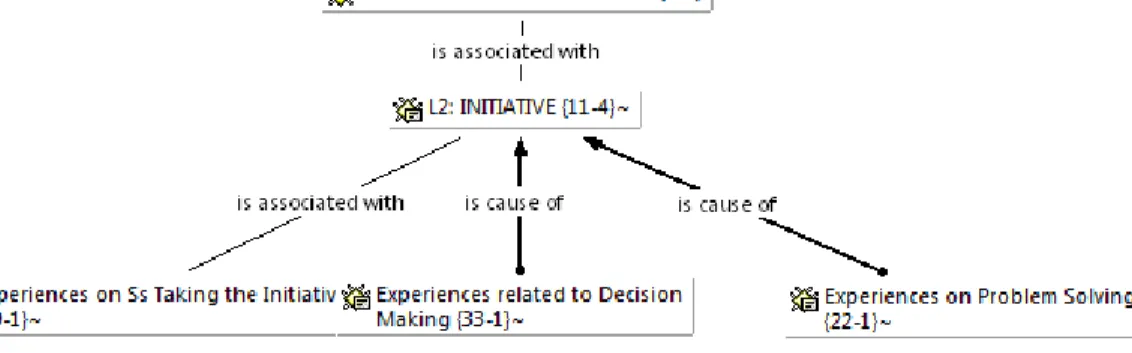
Experiences related to Feelings ... 90
Experiences related toSelf-recognition ... 92
Experiences related to Issues ... 94
Experiences related toActors ... 96
Experiences related toPlaces ... 99
Experiences related to Opportunities ... 101
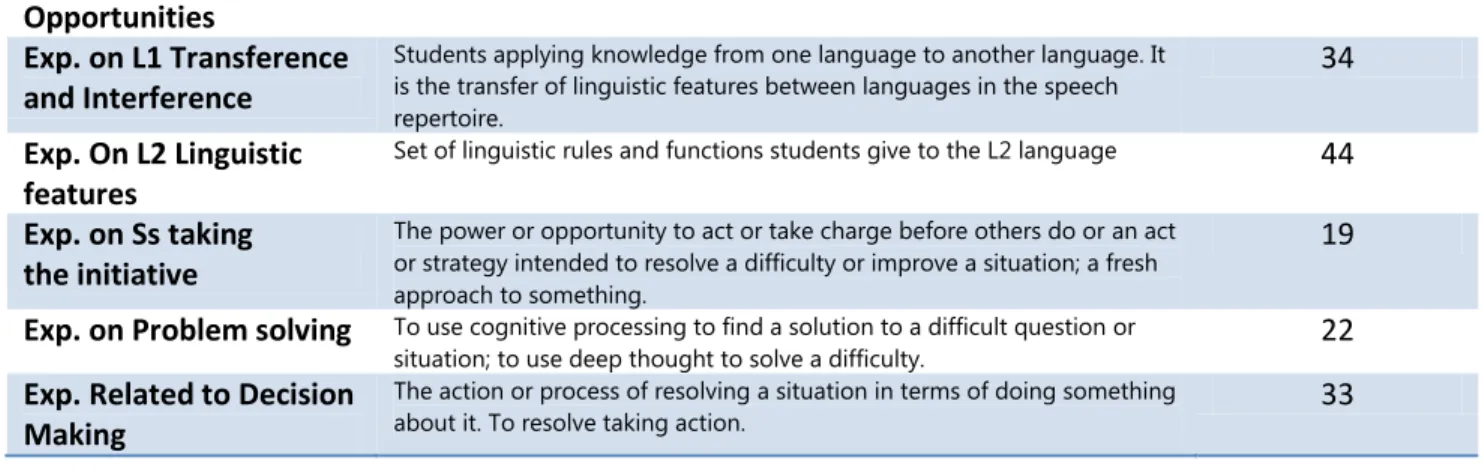
Experiences on L1 Transference and Interference ... 103
Experiences on L2 Linguistic Features ... 105
Experiences on Ss taking the Initiative ... 107
Chapter VI. Conclusions and Pedagogical Implications ... 115
Discussion ... 115
Conclusions ... 119
Limitations and Recommendations for further research ... 122
References ... 124
Appendices ... 135
Appendix A. Needs Analysis, Teachers’ Survey ... 135
Appendix B. Results, Needs Analysis Teachers Survey ... 137
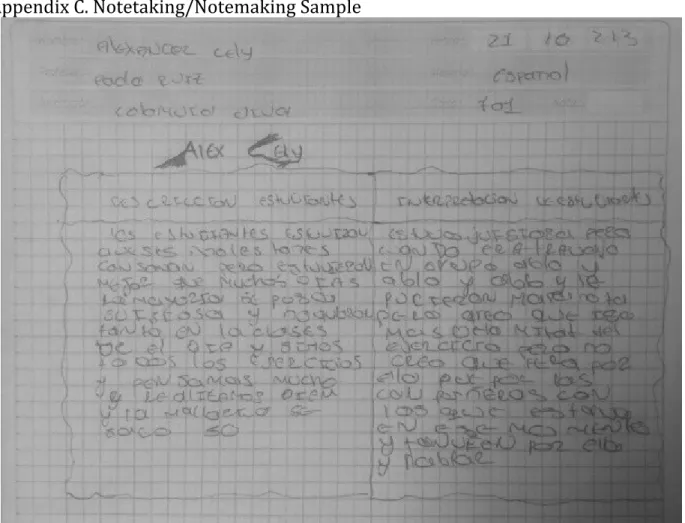
Appendix C. Notetaking/Notemaking Sample... 138
Appendix D. Students’ Journal Sample... 139
Appendix E. Teacher Researcher Sample ... 140
Appendix F. First Interview ... 142
Appendix G. Final Interview ... 143
Appendix H. Parents consent form ... 144
Appendix I. Student Participant Consent Form ... 146
Appendix J. Instructional Unit Sample ... 147
List of Tables
Table 1. Teachers survey question two ………19
Table 2. Sampling selection criteria ………53
Table 3. First interview constructs ………57
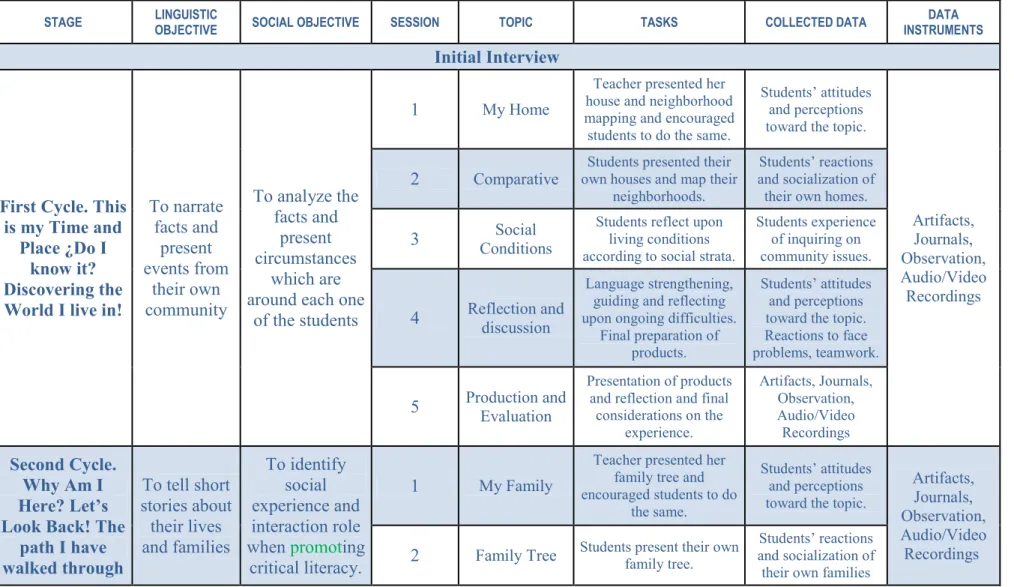
Table 4. Research Design Summary ………59
Table 5. Implementation Objectives ………67
Table 6. Instructional Unit Model ………70
Table 7. Free Codes Groundedness ………74
Table 8. Categories (focus codes) ………84
Table 9. Open Coding: Subcategories ………91
Table 10. Quotes for code Issues ………97
Table 11. Coherence in Students’ artifacts ………108
Table 12. Open Code: Students taking the initiative ………110
List of Figures
Figure 1. Community Mapping – Sports...……….………. 17
Figure 2. Community Mapping – Sports...……….………. 17
Figure 3. Community Mapping – Sports...……….………. 17
Figure 4. Community Mapping – Housing……….………. 18
Figure 5. Community Mapping – Housing……….………. 18
Figure 6. Community Mapping – Housing……….………. 18
Figure 7. Students’ preparation on ethnography basics……… 20
Figure 8. Extract from a student’s note taking…..…….……… 21
Figure 9. Extract from a student’s note taking..………….……… 22
Figure 10. Griffee’s (2012) AR six phases’ model……….. 49
Figure 11. Critical Literacy Super Family……….……. 76
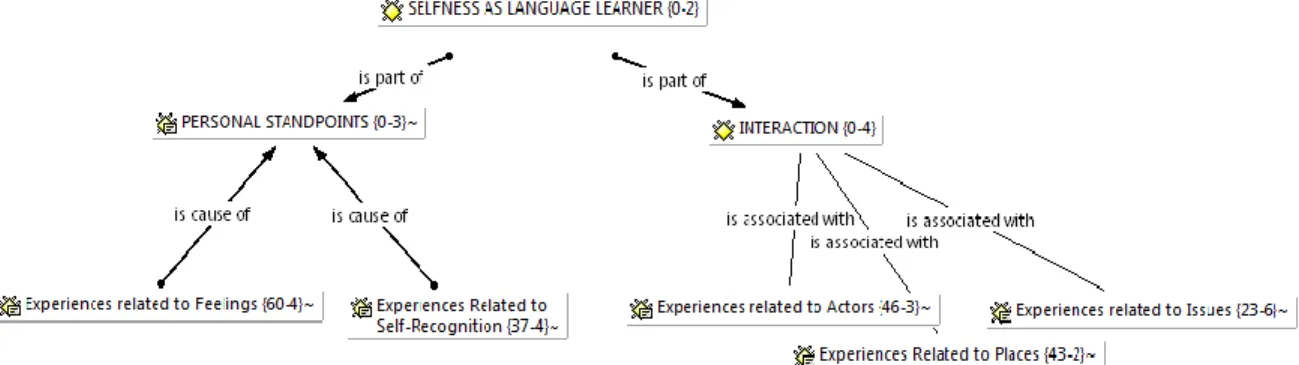
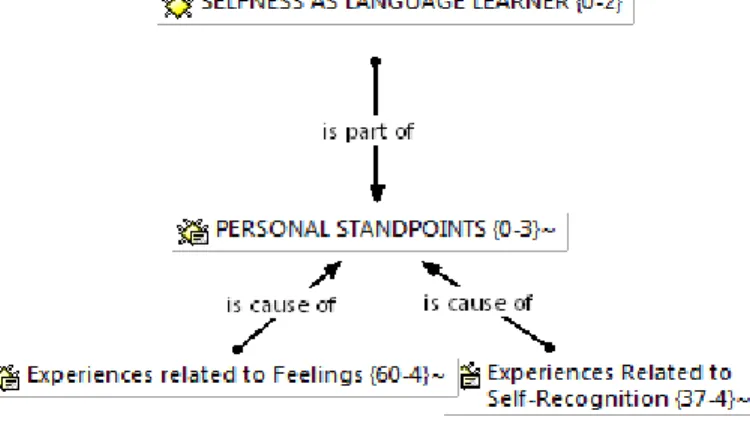
Figure 12. CF: Selfness as a language learner network………. 79
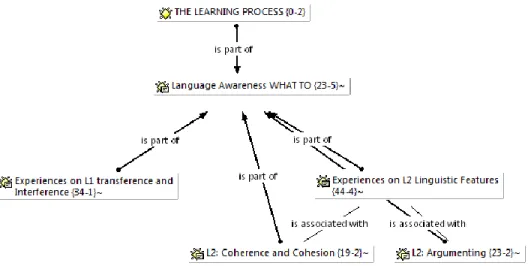
Figure 13. CF: The Learning Process network.……….. 80
Figure 14.CF: Opportunities to learn network….……….. 82
Figure 15. Category: Personal Standpoints (focus code)……..………. 85
Figure 16.Category: Interaction (focus code)………..………... 86
Figure 17. Category: Learning Awareness (focus code)……… 87
Figure 18.Category: Language Awareness (Focus code)……..………. 89
Figure 19.Category: Initiative (focus code) ……… 90
Figure 20. Open Code: Feelings Network..………. 92
Figure 21. Open Code: Self-Recognition Network………. 94
Figure 23. Open Code: Issues Network………... 96
Figure 24. Open Code: Actors network………... 98
Figure 25. C2-Artifacts1-2-Let's Look Back-Real Life Stories. S02OP-903AT…….. 101
Figure 26.Open Code: Places Network……… 102
Figure 27. C1-Artifact2-Mapping Activity-S02OP-903AT……… 103
Figure 28. Open Code Opportunities Network …….………. 103
Figure 29. C1-Artifact1-Introduction-S06HB-901AT……… 104
Figure 30. Open Code Transference and Interference Network……….. 105
Figure 31. Open Code: L2 Linguistic features……… 107
Figure 32. Open Codes: Ss taking the initiative network, Decision Making and Problem Solving Network………. 109
Figure. 33. 3rd Cycle Artifact-S01MC-903AT………. 111
Presentation
This research is created as part of an agreement with Secretaría de Educación de Bogotá
to support the postgraduate education of teachers from public sector and thus, improving the
quality of education students are receiving. The present study looks into highlighting students’
experiences in order to improve their language learning and in doing so, promoting a critical
stance through the process or as mentioned by Murrell (2001), understanding that the setting
of the language learning is a fabric for human relationships; In that sense, school becomes a
relevant factor to address aspects related to equality and seizing opportunities for students to
improve their life.
The paper is organized in six different sections that show the stages of a study done
between 2013 and 2015. The first chapter is devoted to describe the problem, the research
question, and the research objectives. The second part deals with the constructs’ descriptions
and a presentation of a reviewed literature used to support the theoretical framework. The
third section is the research design where I present and justify the methodological decisions
made in regards to the type of research selected for this study.
The fourth part presents the instructional design where the pedagogical framework used
to implement the project is described; this part also shows the model of classroom used during
the intervention. The fifth part addresses the analysis of the data gathered through the
implementation; it presents the creation of subcategories, categories, families, and super
families that help me to solve the question and achieve the objectives. And finally, on the sixth
chapter, I present the conclusions of the research as well as the pedagogical implications it has
Chapter I. Statement of the Problem
When teaching and learning English in Colombia, most English teachers consider that there are several difficulties and problems that converge and affect the good intentions and purposes they might have for their praxis. One of those common issues most English teachers might find when working in public sector schools is incorporating students’ experiences and knowledge, not only the one they acquire at school, but the one they have from their own
neighborhood or, as mentioned by Murrell (2001), by realizing that the context in which learning occurs is relevant to the value and impact of the learning experience in the promotion of critical literacy in EFL classroom and this can also be applied in a public school in Bogotá, Colombia.
It is important to clarify that for this research, problem is not going to have the
connotation of something to fix but a challenge to explore opportunities and potentialities of this community in order to make it aware of its strengths and also to show what students can achieve with the understanding of their own experiences. This paper is the narrative of an action research study that was carried out from 2013 to 2015 with seventh, eighth and ninth graders from one of the branches of “Colegio Colombia Viva IED” in the afternoon shift in Bogotá, Colombia.
In order to identify the problem addressed in this research, it is necessary to know deeply the people and the context in which the researcher is implementing. The issues mentioned in this section are the steps taken to recognize what problems were relevant to solve for this community. The problem is identified by the help of the following activities: a mapping, a teachers’ survey and four students’ interview.
community has, and it is used as a referential and contextual framework. Then, it also deals with the descriptions of the main results of critical needs analysis implemented in order to find out what is needed. Its objective is to identify the relevant aspects to make all the members of this community participative and active in the EFL process.
First, an ethnographic exercise was carried out for understanding the context and
identifying the problem. Thanks to the implementation of a community mapping, it was possible to identify some important key aspects that support the idea for this study to be focused on recognizing students’ experiences in the promotion of critical literacy in the EFL classroom through the use of project-based learning methodology. The community mapping was done during the third week of September 2013 and it included the participation of some students who volunteered to carry out the task. This students’ escort was necessary because of the security problems surrounding the school’s neighborhood: Bochica Sur, Molinos Segundo Sector, Diana Turbay and Ayacucho. Nevertheless, there was a great disposition from some of the students to be participants in this “adventure”. Students’ offering to assist the research and their
collaboration thorough the whole process is, by itself, an important finding in this community mapping and it is also evidence that there is a need for the students to be acknowledged and taken into account. There were five different findings from this community mapping that describe this community’s identity and the issues which might be considered in the problem addressed in this chapter (i) youth; (ii) entertainment; (iii) food; (iv) history, and (v) housing.
It is shown by the number of parks that surround the A and B branches of the school. There is an ethic code to protect these public places because it is possible to see that despite the differences and invisible lines which might subsist in relation to race, beliefs and social trends, these places are well kept and preserved; they do not show signs of vandalism. During the mapping it was possible to observe that many students of the aforementioned school like to go and spend their free time in these places.
Also, there was a possibility to notice a social contrast: some invisible lines inside the neighborhood due to the fact that there is a big difference of realities just blocks away. The school is divided into three different neighborhoods: Bochica Sur, Diana Turbay and Ayacucho. Life quality and social strata differences are evident among those sectors as it is shown in images 4, 5 and 6.
These findings presented critical issues that can be addressed during the implementation of the project and let the researcher into comprehending that as much richness as can be found in this community there is a major problem that might be emerging. There are problematic issues in relation to the fact that most of the students do not recognize the relevance of the context they inhabit and the importance of it inside the school processes in order to get better comprehension of their social conditions as a first step into transformation of their realities. All this information can be summarized in the fact that there is diversity within the community and so many assets in particular in this neighborhood that can be included inside the school making students aware of their culture potential. According to Kretzmann (1992) “We can no longer regard city
neighborhoods, even the most devastated, as simply hopeless collections of needs, problems and deficiencies” (p.2) but, on the contrary, it is necessary to find the strengths and potentiate them in order to overcome the daily difficulties.
According to what was found in the neighborhood, the outside part, the next logical step was to analyze the inside part, by recognizing the school deficiencies, potentialities and strengths. And it was done by Pineda’s (2000) three steps needs analysis: Necesidades, Carencias y
Expectativas Personales. The population involved group 701 (39 students, 2013) from the A
branch of the School Colombia Viva IED in the afternoon shift. They were the selected participants.
A survey for the EFL Teachers (Appendix A) was the first instrument. It was possible to count with a total of five teachers. The survey was designed to identify, from a wider perspective, this school EFL curriculum in theory and practice and, because of that, it was necessary to
include teachers from different shifts and branches. The survey was constructed with ten open questions about the teaching process. According to the findings (see Appendix B), the main objective in the EFL teaching process is to make students reach the basic level of competence stated in the national standards.
Table 1. Teachers survey question two.
Pregunta #2 Competencia Respuestas Docentes
¿Qué necesitan saber, hacer y ser los estudiantes para aprobar la asignatura de inglés?
Saber
Contenidos básicos
Demostrar el conocimiento Estructuras gramaticales Pronunciación
Traducir
Saber Vocabulario
Hacer
Aplicar en situaciones concretas
Desempeñarse en las habilidades comunicativas Poner en práctica lo aprendido
Hacer ejercicios
Ser Ser personas responsables Demostrar Interés
Students’ perception of the learning process was vital for the identification of the problem and it was necessary to do a systematized observation by means of an ethnographic tool:
Notemaking/Notetaking, (Frank, 1999). In order to try to determine students' disposition and ability to work from a critical perspective, they also worked on analyzing the English class from their own perspective. In Spanish classes they were prepared on some foundations of
Ethnography, as shown in Figure 7.
Students were prepared to examine their own role in the EFL class but also to analyze one of their classmates’ reactions to the English class (see appendix C) and specially to understand if their experience is being considered when learning English. For the students it was a novelty to be able to reflect upon the actions they do almost unconsciously and to comprehend why they behave in certain way when learning English. This idea reinforces the emerging problem in which it seems that teachers are not considering students as capable people to assume critically their educational process and to take leading role in it.
The most relevant aspects extracted from these instruments, show that the students’ perception about their own classmates’ attitude toward the class is that they do not demonstrate interest as it is shown in an excerpt of one student’s report. For example, the following excerpt
evidenced that for most students learning English is not useful or is not relevant. In another part, it is possible to evidence how students are not attracted by traditional methodologies. That makes unappealing the learning process for some students.
Other important data gathered from this exercise was the distinction students made about the class’ focus. They realized the most important issue in the class was the topic and not
themselves as it is show in the following excerpt: “El profesor entró y saludó y empezó a dar clase como todos los días que nos toca con él y empezó a hablar del tema y de There is, There are y como cambiamos las formas negativas a afirmativas.” (K.P. 701at). Even more, some of the students resort to violence and other unusual behaviors that interrupt the learning process of the majority. It is possible to notice a starting point to awareness and improving the teaching and learning conditions.
Figure 9. Extract from a student’s note taking.
“The student started to fight with the student Romero”
Figure 8. Extract from a student’s note taking.
When the student started interpreting the data they collected (note making), there was an agreement that aggression is a very recurrent topic in some classes. They were able to realize that it occurs, specially, when the teacher is absent (he leaves the class) or he is giving his back to the students. They gain awareness of a challenge they have, some of the causes and how they can improve it. This was a key aspect in this process of identifying potentialities because it shows that students might be prepared to work on analyzing those cultural, economic, political and social aspects that need to be considered in order to become critical about their role in the society they live and the first steps to change and transform it.
Statement
The research problem for this project is presented in three specific situations which affect the dynamics in the EFL class and that need to be addressed efficiently to make the English language learning an enjoyable experience.
The second key aspect is that teachers, most of the times, do not present our students opportunities to explore their mental potentialities by focusing English classes only on the linguistics aspects (Li Li, 2011; Dantas-Whitney, 2002). Students may have more positive reactions in class when they are challenged into thinking beyond the boundaries of the school, making connections with their experiences in their community and when it is expected more from them in terms of socio, cultural, and cognitive aspects. Critical literacy might play a relevant role in the EFL classroom by enabling students to transform the traditional ways in which they are supposed to learn English and make a difference in their community at the same time (Yaghoubi, 2013) and their lived experiences can be a trigger for reflection that might help them achieve small scale transformation.
Lastly, it is the issue related to the problem of putting into practice the local, national and international policies of Teaching English as a Foreign Language (TEFL), for some teachers this is a very delicate issue to address in terms of making it explicit in the class dynamics.
All in all, this research is facing the challenge of addressing two issues. First, it seems to be a lack of challenging opportunities for students to promote Critical Literacy (CL) within the EFL classroom, especially with young students. Prapai Jantrasakul (2012) mentions that “English as a Foreign Language (EFL) teaching and classrooms should make spaces for students to
supported by the teachers’ interviews done within the EFL classroom at Colegio Colombia Viva IED and the classroom observation instrument.
Because of the evidence gathered through the mapping, the teachers’ survey, students’ interviews and the class observation, it is possible to state that the problem is that most of the important decisions of the English learning process are made by the teacher without connecting:
Students’ social and interactional experiences within their communities Students’ personal needs for empowerment and critical stances, and The academic objectives of the English class.
One key aspect for this research is the possibility to change the traditional paradigm of classes which is usually focused on the teacher and the standardized contents. As seen in the needs analysis, most of grammar topics are not contextualized neither connected with the student’s lives outside the classroom. The different instruments revealed, there is a general request from the actors of the teaching and learning process to transform the practices within the EFL classroom in order to make it more dynamic and meaningful, more communicative.
Research Question
How can critical literacy be promoted when students’ reflect on their own social experiences in an EFL classroom?
Research Objectives General Objective
To describe and analyze how ninth graders’ reflection on their social experiences can promote critical literacy in an EFL classroom.
1. To observe and understand the role of interaction, context and culture when reflecting on social experiences.
2. To identify the relationship between students’ reflection on their social experiences and critical literacy in an English as a Foreign Language classroom.
3. To indicate if students thinking and perception of the world becomes more critical by reflecting upon their social experiences.
Rationale
The objective of this study is to gain an understanding of the role students’ experience plays when learning English and how this role contributes to the promotion of critical literacy. I selected this particular topic because, as an English teacher from a school in the public sector, I’m deeply concerned with the apparently lack of interest and enthusiasm to learn English due to the fact that many students do not see this subject as part of their future lives plan.
This project is aimed to any English teacher who wants to transform the passive role most students play when learning English throughout the world and any teacher who understands the educational process can be enriched from the students’ experiences. In relation to this, Norton and Toohey (2011) argue that “some contexts and practices may limit or constrain opportunities for learners to listen, speak, read, or write, other contexts and practices may offer enhanced sets of possibilities for social interaction and human agency” (p.6). It means that it is important to understand the importance of the specific context and its people in order to make the learning relevant and successful, as well as to understand and take advantage of the several opportunities the context offers to learn, to take into account students’ lives and desires.
and historical factors which impact their community and whom are willing to transform those difficulties they face in their daily life.
In order to gain a more profound understanding of their reality, there is a need to work collaboratively among themselves, respecting each other’s opinions and beliefs that is why it includes the process of doing a project which involves students’ experiences through the
discovery of the many reasons which have brought them into the same place, Colegio Colombia Viva IED in Bogotá, Colombia. The project they did was the excuse by which the researcher analyzed the key aspects they found out in terms of the socio-cultural implications their lives have and the way they can prepare themselves to be literated from a critical stance thanks to the involvement of the students in their English classes in the aforementioned school.
This project is innovative because it introduces the topic of promoting English at the same time that critical literacy in teenagers which is not frequently worked in a foreign language environment. Thus, there are some implications which are needed to be taken into account that cannot be measured in terms of quantitative research but they suit better from a qualitative stance. This makes it essential as a descriptive-interpretive action research study which may open the path to other researchers with similar concerns in relation to their daily praxis. It is expected that student participants, at long-term, will be able to continue proving they have empowered
themselves through this experience and be able to understand they can play an active role in the society they live in, or as stated by Lin (1999): “Understanding existing classroom practices and their socio cultural and institutional situatedness is a first step towards exploring the possibility of alternative creative, discursive practices that might contribute to the transformation of the
Chapter II. Literature Review
The Colombian educational system, as several in Latin America, requires of many opportunities and innovation in order to improve and to help its protagonists: demoralized and tired teachers, students which are underestimated and bored of not being noticed. Most of the social problems in a culture like ours are blamed on the school and its actors. In the specific case of English, not have native speaker teachers, the daily praxis is limited by several factors such as salary, work over load, low self-esteem and a poor recognition of their value from the society in general (Pineda, 2010). In the particular context of the present research study, the needs analysis (see chapter one for more information) shows a current requirement to change the traditional methods of teaching English in order to fulfill the students’, families’, and school’s expectations and also, to involve the participants in a more meaningful teaching and learning process that can make the transformation or improvement of their local reality possible.
For the development of this research study, it is important to clarify and limit some key constructs that are considered as strands that will weave the necessary connections for the
pedagogical intervention to work out: students’ social experiences, critical literacy improvement, interaction, context, and culture, students thinking and perception. These terms are developed accordingly to understand better the problem in relation to what the academic community has discovered so far about the problem and the possibilities to approach it.
which deals with describing and analyzing how critical literacy can be promoted when students reflect on their own social experiences in an EFL classroom.
Most language teachers consider that promoting critical literacy (CL) in an EFL
classroom is a very difficult thing to do, if not impossible, due to the fact that some researchers considered CL as part of high order thinking ones (Harrigan & Vincenti, 2004). For this reason, there is an assumption of working them only with adults (Reza Hashemi & Ghanizadeh, 2012; Li Li, 2011; Manalo, Kusumi, Koyasu, Michita, Tanaka, 2013). For the present study, CL is
considered as the intrinsic opportunity any student has to reflect upon their own existence and the ability they show to transform what they are not content with. In that sense, CL is not frame in limitations of age. In fact, some studies demonstrate it is possible to work CL with young learners, even small children, as Ruiz Niño (2013) presented it in her study with third graders. She concludes that “the structure and nature of project work allowed students to start using their emerging critical thinking skills in the EFL classroom because it encouraged the students’ interest and motivation toward the topic selected during their research process” (Ruiz, 2013:218) and that “students learned and improved their writing through participation, interest, motivation, and experiences” (Ruiz, 2013:218). This study showed that it is possible to promote critical literacy with young learners as long as the teacher takes into account their mental abilities and their interests to engage them in the learning process.
learners live. Most EFL studies are from countries where English is conceived as a key element in educational systems. For instance, Yaghoubi (2013) mentions that CL is a determining factor in language learning and teaching. This stresses its significance but also, that language scholars should consider that learning-oriented learners can be better at critical thinking and thus, promoting critical literacy. In the same line of thought, Pally (1997) declares that focusing on goals and context content rather than on linguistic features can be beneficial for the learning of a second language. She states that “As ESL classes are often filled by students with wide-ranging goals, teachers who wish to pursue sustained content need to devise curricula that sustain the interest of a wide range of students” (Pally, 1997:300).
Some of these studies with related strands (critical literacy and language education) have fundamental differences which make the results somehow different and could be implemented in the Colombian context obtaining diverse outcomes. For example, from other parts of the world, the Saudi author Alhasan Allamnakhrah (2013) was asking for education reforms to incorporate critical thinking in English education programs. Also, Safaa, and Halim (2011) found out that there is a problem concerning weaknesses in critical reading and translation skills. Other
research, in fact most of it, are focused on analyzing the impact of CT in the EFL but with adults or young adults at university level (Grosser & Lombard, 2008; Harrigan & Vincenti, 2004; Bakhtiar, Okechukwu-Lawrence, 2013; Alhasan Allamnakhrah, 2013 and Safaa Halim, 2011).
Research, on the specific topic of literacy from a critical stance, which has been carried out by authors such as Alhasan Allamnakhrah. (2013) states that CL “is about becoming a better thinker in every aspect of your life: in your career, and as a consumer, citizen, friend, parent, and lover. Discover the core skills of effective thinking” (Alhasan, 2013:201). For this author,
experience in order to become literate from a critical perspective is necessary. Nasser Rashidi and Faeze Safari (2011) understand that standardized learning materials can also carry a message of inequality and denial of one’s culture and experiences and they explained that an important part of the learning process is to form critical approaches that try to increase learners’ critical
awareness and encourage them to take action against the inequalities of the world around them. Prapai Jantrasakul (2012) research study on an EFL classroom in Thailand showed that there can be some benefits such as, to a certain extent, facilitating and empowering students’ language learning. In addition, CL enables the students to rethink about their cultural standpoints: it serves as a space for contextualized language practice within a cultural context, where the students were provided with opportunities to share their opinions.
In terms of social experience, most of the research related to CL deals with highlighting students’ experiences and making them explicit inside the language class as main source of knowledge. In this regard, Mollaei and Rahnama (2012), state that language learning is a social situation in which students’ perception of the world is mediated and reflected on the process constantly. They confirm that “Experience perse is, therefore, only the first step in the learning process, and for learning to be drawn from it, the experience must be followed by the vital step of reflection. The ability to reflect on an experience, and on initial reactions to the experience, is the "missing link" that defines the relationship between experience and learning” (p, 269).
framing students’ experience, are relevant to comprehend and understand a foreign language, and that teachers should find ways to help students to retain new information in foreign language by connecting it with their lived experiences in diverse and difficult contexts.
All in all, these studies present very broadly the efforts from teachers - researchers all around the world when trying to reflect on students’ language learning experiences to promote critical literacy. Also, it is important to highlight that these studies show that critical literacy is a means that can be achieved in the EFL classroom to make students see the possibilities they have for improving, not just the learning process but also, their life conditions and as Saylag, (2014) states “in the field of pedagogy, it has long been recognized that there is a need for flexible and negotiable learning objectives; the addressing of lack of background knowledge; and the inclusion of students’ experiences as resources for learning” (p, 535).
The theoretical framework, in which this project is centered, shows the organization of some key terms that are the essence and foundations which support the following phases of the study and specially the criteria that is going to establish if this methodology for teaching EFL can be successful in the public sector in Bogotá, Colombia. There are five main concerns that are going to be dealt when implementing the intervention (See chapter four) and that are going to be considered as conducting lines in the data analysis and the discussion of the findings (See chapter five): (i) students’ social experiences, (ii) critical literacy, (iii) interaction, context and culture, (iv) students thinking and perception, and (v) language proficiency and critical literacy as a broad term which includes critical thinking skills (CTS).
Students’ social experience and its role in EFL learning
the intention of transforming the teaching practices to make language learning more engaging and interesting for the students. In first place, the notion of experience is going to be constructed from Dewey’s (1938) and Kolb’s (1984) perspective as shown in the following excerpt:
To imposition from above is opposed expression and cultivation of individuality; to external discipline is opposed free activity; to learning from texts and teachers, learning through experience; to acquisition of isolated skills and techniques by drill, is opposed acquisition of them as means of attaining ends which make direct vital appeal; to preparation for a more or less remote future is opposed making the most of the opportunities of present life” (Dewey, 1938:6).
This means that experience is something one cannot deny in the classroom and it is a crucial part of the students’ learning process because of the assimilation of new knowledge and its integration to the prior one “if an experience arouses curiosity, strengthens initiative, and sets up desires and purposes that are sufficiently intense to carry a person over dead places in the future, continuity works in a very different way. Every experience is a moving force. Its value can be judged only on the ground of what it moves toward and into” (Dewey, 1938:14). Nevertheless, it is also important to mention that not all the experiences can be relevant for an academic process, as Dewey explains that we need to discriminate between experiences that are worthwhile educationally and those that are not. So, this is a very essential idea for this research topic because the students are the ones who need to learn how to differentiate the kind of
others with wider experience and judgment. This cycle is vital to understand that all the meaningful experience should be based on the relationships created with others.
The second key author for this project in relation to experience is David Kolb (1984), who explains several characteristics experiential learning must have. In first place it is focused on the process rather than the outcomes, and then it must be considered that in experiential theories, learning is believed intrinsically as part of experience and it requires resolution of conflicts in order to be able to adapt new knowledge to the world by reflecting processes and thus producing learning. Experience is, therefore, started as an individual process of the human being and then, through interaction and reflection, it is transformed into long term knowledge.
This understanding of experience implies that learning is a holistic process of adaptation to the world (Kolb, 1984:31) or as he states, “it provides conceptual bridges across life situations such as school and work, portraying learning as continuous, lifelong process” (p.33). This
statement supports the idea that it is necessary to make connections between the classroom and students’ real-life experiences so learning can happen. Finally, Kolb clarifies the terms
performance (short-term adaptations to immediate circumstances), learning (longer term mastery of genetic classes of situations) and development (lifelong adaptations) which are core to the study and specially the conception of promoting critical literacy through language learning. Experiences are considered a cycle in which the experience becomes learning and the latter becomes transformative knowledge as steps of critical literacy.
during the learning process. In this regard, it is essential to highlight that experience in the language classroom allows students center role in the educational process because their life experiences are considered, at the same time, motivators and reason for learning. Ellis (1989) names this model a humanistic classroom and explains that “[it] is not one where certain rather special kinds of activities take place, but one where learners are valued and nurtured as
individuals.” (p.91) and also that “human beings are individuals; they differ with regard to
gender, age, motivation, personality, learning style, self-esteem etc. Each person has her own way of going about things with the result that there is immense diversity in both the way learners learn and in what they achieve.” (p.74) By comprehending that each student is a human being and that their subjectivity is transformed thought interaction with others but it is also shaped by their internal processes of individual and collective interpretations of the reality and so, they become knowing subjects (Weedon, 2004) that “use language to express meaning. They acquire the knowledge that they convey in language from their socialization, education and experience of life” (p,8). Thus, social experiences would serve students to identify themselves and the world that surround them, it would help them address issues they face daily and understand their own perception of their reality, and teachers all over the world are called to start reflecting upon the ways languages are being taught and learnt through the sharing of experiences.
Critical Literacy in EFL
(2011), CLA “discovers the relationship between language and social perspective. In critical language awareness the focus is on the ways in which language represents the world and reflects the social construction” (Shamim Ali, 2011:30). This author mentions that CLA presents the opportunity to transform the teaching community. Also “critical language awareness approaches can be strengthened by requiring students to develop skills used in sociolinguistic and
ethnographic research in order to become proficient at observing, analyzing and evaluating language use in the world around them” (Egan-Robertson & Bloome 1998).
The second critical applied linguistics domain is critical pedagogy and second language education. According to Norton and Toohey (2004), “Advocates of critical approaches to second language teaching are interested in relationships between language learning and social change” (p, 1). This means that learning a foreign language must be included in the life project of the students and, in that way, they are going to be able to transform the society they belong to from a local viewpoint, or as explained by Norton and Toohey (2004:1), “From this perspective,
language is not simply a means of expression or communication; rather, it is a practice that constructs, and is constructed by, the ways language learners understand themselves, their social surroundings, their histories, and their possibilities for the future.” (p.1)
For the present study, the word critical means a person’s ability to argue and to judge whatever information is given by the means of contact to the world and other people. It involves the notion of being critical just by being in the world and it might not have to deal necessarily with
emancipation situations but with small scale transformations and empowerment of students’ lives and context.
There are different assumptions in relation to promoting critical literacy in an EFL classroom. According to Luke (2004) the term literacy refers, traditionally, to the reading and writing of text but nowadays it can be conceived “as a social practice that is integrally linked with ideology, culture, knowledge and power” (Rassool, 2004:7). It should be also perceived as
natural, due to the fact that “it is seen as a cultural activity that involves people in conscious and reflexive action within a variety of situations in everyday life” (p.7). It is mentioned that literacy “takes account of the different forms and functions of written and spoken language within a variety of social and cultural contexts” (p. 13). Hence, as this conception it goes beyond the technical aspects of the language and the skills themselves, literacy is presented more in a communicative perspective within a specific context in which language is purposeful and alive.
This is the background where literacy starts to mean something different from the actions of reading and writing: In Freire and Macedo’s words (1987) “critical literacy views readers as active participants in the reading process and invites them to move beyond passively accepting the text’s message to question, examine, or dispute the power relations that exist between readers and authors. It focuses on issues of power and promotes reflection, transformation, and action” (pg, 14). This means that critical literacy involves imagining multiple perspectives and
possibilities and using the basic skills and the language learnt for carrying out a social change. Or as Luke (2004) states, “the focus would be on naming and renaming, narrating and understanding learners’ life worlds, with the aim of framing and solving real problems. Reading and writing are about substantive lives and material realities, and they are goal and problem-directed” (p.3).
Critical literacy, according to Atkinson (2012) goes beyond thinking techniques. It is students’ voice and its relationship with texts and the world and history of each person. This understanding of CL is a way to relate knowledge with the world in terms of acquiring a political stand. Halpern (2003) also defines it as “thinking that is purposeful, reasoned, and goal oriented” (p.1).
Critical literacy in EFL in Colombian context has also been promoted through
learning. These economic, politic and social implications affect the way students and teachers, the main participants, feel about the learning process. It is concluded that “the MEN (Ministry of National Education) places English as the magic formula that will solve our economic, social, cultural, and political problems; speaking English grants us “access” to the wide range of advantages associated to this language” (p.305), and that in “a complex, competitive, rich, plurilingual, pluricultural world like the one we live in, it is very narcissist and egocentric to think that speaking an important language like English is the key to solve all our problems” (p, 306). Colombian context needs a social transformation and the public school and its actors are called to start it, which is the relevance of critical perspectives in teaching and specifically in language learning.
Pineda (2004) is also interested in understanding critical thinking in the EFL classroom. She mentions that “Individuals’ critical perspectives and their engagement in economic, social, political, and cultural spheres contribute to the development of nations around the world. In light of the need to provide opportunities for our learners to participate in different environments, it becomes essential to focus on the teaching of English, as it is the language most commonly associated with global processes” (p.47). She found out that “competence and criticality are on-going, never-ending processes. However, teachers can refine them through thought-provoking, stimulating materials” (p, 3).
Interaction, context and culture in CL.
This strand presents the idea that the EFL student is a human being that no matter the age or growth stage he is in, he has a valuable and rich background or previous knowledge that is vital in order to create the connections in the learning process. This route of interaction,
and the one around themselves: the context, can be difficult sometimes due to the fact that not everybody learns in the same way, and that kind of uniqueness makes it hard for the teacher to find learning patterns that can be significant for all the students. From this perspective, Li Li’s (2011) study presents some findings that suggest that interactions can facilitate or obstruct opportunities for improving thinking skills through participation, meaning negotiation and co-construction in EFL classrooms. EFL classroom can promote student communication,
negotiation, meaning co-construction and participation all of the former are requirements of an interactional theory. This is the main reason why the focus on interaction in EFL classes can help, somehow, to facilitate learning processes as suggested in Harrigan & Vincenti’s (2004) study.
Interaction importance when learning a language is conceived from Vygotsky’s (1978) activity theory of social cognition for a conception of social knowledge that conceives learning as a transaction between the person and the social environment. Interaction is also relevant in order to improve students’ critical literacy. Also it is conceived from Ochs’ (2000) perspective on real interactions constructed by society and culture which might help and “conjoin less and more experienced persons in the structuring of knowledge, emotion, and social action” (p.230). This means that interaction, recognized as dialogue, creation, and sharing of knowledge can be the first step into immersing students in critical practices and, at long term, in creating
transformations and social changes which are needed to start in the school but also be extended to the close community, because interaction and “ordinary conversation is an informal resource for transforming self and society” (p, 231). This is only possible when communication occurs and language becomes meaningful because the focus is on the person and the message.
internalized cognitive system to actively construct meaning. The process of making sense implies interpreting our reality from a subjective perspective, which is shaped by our history and through interaction with others. For example, in Paulo Freire’s work, it is possible to understand that the only way to comprehend and “Read the World” (Freire, 1974) is by exchanging the own
experience with others to enrich it and make it more familiar with the reality in order to transform it. In relation to this, Kolb mentions that the “process of naming the world is accomplished
through dialogue among equals” (Kolb, 1984, p.29), which is exactly what this study is proposing, that is to say students might achieve better academic results and improve their
language learning by the mere fact of sharing, discussing and reflecting upon their own reality, by connecting their daily experiences with the target language.
In that sense, Renkema (2009) mentions culture should be consider “as the deposit of knowledge, beliefs, values and attitudes a group of people share” (p.280). This is what needs to be understood and analyzed in the present study in order to frame the interaction role, which is conceived as dialogue among equals and interchange of experiences because through the scrutiny of the learning process students may understand that there is a possibility to empower themselves creating what Renkema called social action and equality in terms of what they can achieve and how to get it. Grundy (1987) also supports the idea of action through reflection by stating that “action follows from theoretical as well as practical reflection. It is the real, and hence uncertain world of human interaction which is the site for such action, not an idealized or objectified world” (p.135). This definitely highlights the importance of recognizing the term of culture as something considered only from a specific location or setting.
critical perspective; for instance, Starkey (2002) declares that “Whilst language learning by itself does not necessarily reduce or remove prejudices, when accompanied by other well-conceived educational experiences it can be a powerful contributor to a culture of human rights and equity” (p.12). This quote emphasizes the role language learning may have to empower students in complex settings such as the one presented in the public sector in Bogotá Colombia, where the least advantage people study, and it also would help learn a more meaningful process by bonding the foreigner and exogenous part, English, to the closest experiences students have lived on their own communities or, as stated by Ochs (2000), who asserts that interaction is a two-way street, in which the involved people learn from each other by using, in a imaginative way, their linguistic resources to “navigate and construct the human condition” (p.232).
Students’ thinking and perception of the world
This research highlights the role of students and the relevance of being taken into account by deciding vital aspects of a class in the EFL classroom. There have been several researchers dealing with the importance of students’ beliefs and perceptions on the outgoing of the learning process (Eslami-Rasekh & Valizadeh, 2004; Murphey, Falout, Elwood & Hood, 2009) and through it, students’ involvement in the learning process and decision making has been
experience. These authors state that when learning is planned, it must “include all that individuals understand about themselves as learners and thinkers, including their goals and needs” (p.2).
For this study, students’ thinking and perception of the world is considered from a contextual approach, it means that while the particularities of students are taken into account, there is also a need to interpret them from their significance in the specific context the students participants inhabit and in that sense, there might be more possibilities to make the language learning process more successful, understanding that “learners hold both facilitative and inhibitive beliefs about language learning,” (Bernat & Gvozdenko, 2005:8), and the way these factors allow the teacher “to discover what students believe or know about their learning and provide activities that would allow students to examine these beliefs and their possible impact on how they approach learning” (Bernat & Gvozdenko, 2005:8). In order to make them more self-sufficient learners, capable of interpreting the world on their own account, and empowering them into leading their lives and expectations.
As a teacher researcher, it is important to notice the relevance “of our students’
perceptions and beliefs about language learning in order to facilitate desired learning outcomes in the classroom” (Eslami-Rasekh, 2004), these include the vision of society (or world) they possess and how they perceived it might be transformed to be benefited according to the context
Language policies for EFL
As this research project is framed in action research, it is important to clarify that all the implementation happens in an EFL classroom and the focus of attention, academically speaking, is the description and possible improvement of students learning of English as a foreign
language. In this sense, the instructional units are framed within two of the most relevant normative in a national and international framework: the Colombian Basic Standards for Competence in Foreign Language: English (Ministerio de Educación Nacional, 2006) and The Common European Framework (Council of Europe, 2002) which is the one that oriented the standard creation in the first place.
Colombian Basic Standards for Competence in Foreign Language: English were created by the Ministry of Education in order to contribute to prepare Colombian students to face a globalized world by developing communicative competences in another language (Ministerio de Educación Nacional, 2006:3). This educational organization supports these standards creation on the following stance on the third page:
Tener un buen nivel de inglés facilita el acceso a oportunidades laborales y educativas que ayudan a mejorar la calidad de vida. Ser competente en otra lengua es esencial en el mundo globalizado, el cual exige poderse comunicar mejor, abrir fronteras, comprender otros contextos, apropiar saberes y hacerlos circular, entender y hacerse entender, enriquecerse y jugar un papel decisivo en el desarrollo del país. Ser bilingüe amplía las oportunidades para ser más competentes y competitivos. (p.3)
experiences in order to get better national results. The ninth grade indicators, provided by the standards guideline, were used to attune the linguistic objectives in the instructional design.
The second language policy taken into account was the Common European Framework (Council of Europe, 2002). This international framework for the learning of English as a foreign language was created in order to help teachers to design and elaborate language Syllabi. At first, it was created to be implemented in Europe but it has spread throughout the world as one of the reference points to teaching of English as a foreign language. The council of Europe explains that this document can help teachers to understand “what language learners have to learn to do in order to use a language for communication and what knowledge and skills they have to develop so as to be able to act effectively” (p.10), explaining specifically the importance of “the cultural context in which language is set” (p.10). This is a very relevant detail which implies the stance that knowledge is not universal, and that it is relevant to keep focus on the particularities of the different contexts in which a language might be learned.
Chapter III. Research Design
Making explicit the research design led me to select objectively, the instruments that helped me into describing the way critical literacy is promoted while students interacted, shared, and reflected on their social experiences. This section includes the research paradigm, the research approach, and the type of research. It also describes the setting and the participants and the researcher’s role. Lastly, it describes the data collection instruments that are used during the pedagogical intervention.
Type of Study
This research project is framed within the socially constructed knowledge claims (Creswell, 2003) because he states it present researcher and participants the idea of
comprehending the world that surround them. According to this, it is claimed that students “develop subjective meanings of their experiences-meanings directed toward certain objects or things. These meanings are varied and multiple, leading the researcher to look for the complexity of views” (pg, 8). This is the main reason why this paradigm suits the essence of the present study because it helps to highlight the relevance of research participants by “rely[ing] as much as possible on the participants' views of the situation being studied” (p.8) and letting them construct the meaning from their own knowledge and experiences which is constructed through interaction with others. Another relevant characteristic is the fact that it tends to focus on the specific
contexts in which the research is being carried out and most important of all is that it “acknowledge[s] how interpretation flows from their own personal, cultural, and historical experiences” (pg, 9).
from teachers but, through this project, ninth graders from this school are assuming central role in their English classes. It is possible for participants to discuss and actively participate in decision making in relation to methodological aspects for the project and also to include their life
experiences from outside the school and incorporate them in the political, economic, social, cultural and historical events of their specific context which will have an impact on their lives.
This study is an inductive qualitative action research focused on the researcher’s and participants’ subjective perspective and understanding of the language learning situation
according to the particularities of the context where it has been carried out. In agreement with this approach, Creswell (2003) mentions that in a qualitative study “the researcher seeks to establish the meaning of a phenomenon from the views of participants” (p.21). In the case of this study, it is important to understand the way EFL learning can become a means in the process and not the target, and how students’ lives and experience is a relevant element to promote critical literacy in English.
or issue”. Lastly Creswell’s idea reinforces the need to highlight students’ critical participation into the study throughout active participation in the whole procedure. This participation should make it possible for students to become agents of change in their own communities by giving a positive meaning to all experiences they have had.
Action research (AR) is an important research methodology that helps teacher practitioners to face difficulties in educational settings to transform their praxis in order to address the challenges each particular school presents every day. This research type makes it possible to affect and transform problematic conditions mentioned in chapter one of this study because there seems to be no connection among students’ experiences, the class objectives and the funds of knowledge of their community. For Stenhouse (1983), action research is about emancipation and intellectual, moral and spiritual autonomy that should be “undertaken with rigour and understanding so as to constantly refine practice” (Koshy, 2005: 1). This idea of transforming the classroom dynamics to make it more interactional and participative is coherent with the paradigm that guides the study and it will help to promote the critical perspective through the project in which students will have the opportunity to face their daily difficulties and understand that they have the power to change them or at least to use them into personal growth.
This model is really pertinent to this study because this research methodology allows incorporating the implementation of the pedagogical platform [for more information see chapter four], which is project based learning into the cycles or phases within the AR project. It is also significant because it involves students’ participants in the decision making process when doing the project. The initial awareness and exploration phases are conducted by the researcher in terms of understanding the context and identifying the problematic situation that is needed to
considered [see chapter one for more information].This initial awareness is achieved by
collecting information with a needs analysis and community mapping, the phase three which is the initial response is designed by the researcher in the first decisions made and the theoretical review of the topics related to the problem.
The following phases are constructed with the contribution of the participant students on the first steps into the implementation, the created plan consists on selection the project objective for each phase and also the order of the topics in relation to the three phases as well as deciding which the product is for each cycle. The implementation itself (see chapter four) is the fifth and
sixth phase which is repeated during the three cycles and the last phase, report, is conducted by the researcher when the process of implementing finishes.
Action research design is the selected type of research because this study complies with the three characteristics Griffee (2012) states: first, it is teacher oriented in terms of how “the research questions come from the teacher’s immediate concerns and problems” (p.112) and this is observable in the way I am guiding students in the process of learning English as a foreign
language; second, it is focused on problem solving and for Griffee, it could be that “teachers identify a specific classroom problem to address rather than problems derived from applied research theory” (p.112). This last aspect may have some implications on the way the research is carried out and perceived by the fellow researchers. The final characteristic for this action
research project is that it has a structured reflection according to the aforementioned six phases of the project. It is important to highlight that despite being structured, there is also a flexible
component that will allow the researcher to go back, if necessary, to any phase and redesign the actions that are needed to change.
Setting or context of the study
Colegio Colombia Viva IED is a public school located in the south of Bogotá, Colombia in the Rafael Uribe Uribe locality. This school is formed from four branches and three shifts (morning, afternoon and weekends). It has a population of nearly 4.000 students. Its institutional educative project (PEI) “Seres humanos comprometidos con su desarrollo personal y con
proyección social” is under construction since 2013 and is intended to shape leadership and autonomy in the students. In this regard, the present study contributes into the school's
LEO (lectura, escritura y oralidad) and PRAE (proyecto ambiental escolar) have been promoting a deep understanding of social problems from their field perspectives and they are very good examples of teachers implementing literacy and critical thinking in students native language. In that sense, students might be more than willing to apply this knowledge they have discussed in their native language so they can improve their English level and transform their reality. Lastly, in relation with the English learning processes, the school has not had any relevant project which aims to improve students communicative competences and also to make English a meaningful experience, there had been several activities such as English day and songs festivals but they are usually not continued or incorporated to the curriculum.
Participants
The participants of this study are 80 ninth graders from a public sector school in the south of Bogotá and they are divided into three groups. There are a total of 38 girls and 42 boys aging between 13 to 19 years old. They are characterized for being a homogeneous group in terms of ages, living characteristics and socioeconomical strata but also, there are several students who have an advanced level in high order thinking skill due to the fact that six of them belong to the school's debating club and it had helped them to improve them. The three groups 901, 902 and 903 which are going to be the population group, are composed of really outgoing students and most of them are not afraid of speaking in public and participating in class. Nevertheless,
specifically in the English class, most of them have a tendency to participate less when speaking is concerned because they feel they do not have a good pronunciation level.
with one of the parents (be it mother or father) and some of them live with other relatives and this family diversity represents the predominant situation in this school. There are several cases of students which have been displaced or demobilized and ten students come from different parts of Colombia. There are two African-American students and four others with aborigine ascendance. All of this data is very useful when implementing the project because it shows that there is diversity, inquiry possibilities and desire for knowledge about themselves and the experiences they had had.
Sampling
Participants were selected in a purposive sample (Dawson, K. 2002) because of the possibility they have to bring important characteristics needed for the research process. It is purposive because the selected students are a heterogeneous group in terms their thinking and arguing skills which are determinant to promote literacy, but at the same time, they present interest at improving their English knowledge and level of English. And this is relevant to the project because according to Yin (2012) they are the participants that most likely “will yield the most relevant and plentiful data, given your topic of study” (p.88). On the other hand, this group has some homogeneous characteristics in terms of their age, physical and cognitive development, and the grade they are taking at this moment. So, all these aspects make the population a diverse group which I consider very suitable in order to identify the way their different experiences may converge into getting a critical understanding of the society they live in order to transform the aspects they are not comfortable with and also the improvement of their English level.
relation to their level of English and also their willingness to participate into the study. Some of their key characteristics are presented in the following table.
Table 2. Sampling selection criteria
# Group Description Special Features
901 4 students
S05TC (GIRL 15 YEARS OLD) S06HB (BOY 14 YEARS OLD) S07CB (BOY 15 YEARS OLD) S08EL (BOY 14 YEARS OLD)
Two of them belong to clubs (Debate club and PRAE). Three are usually top of the class students and one with socialization
difficulties but very good at English.
902 4 students
S03KM (GIRL 15 YEARS OLD) S04YR (BOY 14 YEARS OLD) S09WM (BOY 13 YEARS OLD)
S10EV (BOY 16 YEARS OLD)
One top of the class student. Two sociable students with no very good English level but hard workers and one with good level but not apparent interest in the class and disciplinary problems. They all belong to different extracurricular activities (debate team, PRAE
and soccer club)
903 4 students
S01MC (GIRL 15 YEARS OLD) S02OP (BOY 16 YEARS OLD) S11PP (GIRL 16 YEARS OLD) S12VV (GIRL 16 YEARS OLD)
One boy, three girls. Most of them are new in the group. The four present good English level. One top of the class student, one student with academic difficulties. One student is homosexual.
Researcher’s role
The researcher’s role in this study is going to be participant observer (Guest, Namey and Mitchell, 2013) because I am a teacher in the school where the project is carried out and it means that I know deeply the context and the participants. According to Guest el al. (2013), this is important in the research process for the reason that “doing participant observation means being embedded in the action and context of a social setting” (p.76)