Copyright 2001 Psychonomic Society, Inc. 354 Responding to a stimulus that predicts an outcome can be weakened if other stimuli are presented in compound with this stimulus during training. Accounting for such stim-ulus competition has been central to the development of most contemporary theories of learning (e.g., Dickinson & Burke, 1996; Mackintosh, 1975; Miller & Matzel, 1988; Pearce & Hall, 1980; Rescorla & Wagner, 1972; Van Hamme & Wasserman, 1994; Wagner, 1981). A frequently cited ex-ample of stimulus competition is the so-called blocking ef-fect. Kamin (1968) showed that conditioned responding to a conditioned stimulus (CS) was diminished (blocked) if this CS (hereafter identified as X) was presented during training in compound with another CS (hereafter identi-fied as A) that had already been established as a good
pre-dictor of the occurrence of the unconditioned stimulus (US; i.e., A–US pairings followed by AX–US pairings). The capacity to explain blocking and other stimulus competi-tion effects separated modern formulacompeti-tions of the mecha-nisms of Pavlovian learning (e.g., Rescorla & Wagner) from previous formulations (e.g., Atkinson & Estes, 1963; Bush & Mosteller, 1951; Konorski, 1948; Pavlov, 1927).
The better-known modern theories of associative learn-ing (e.g., Mackintosh, 1975; Pearce, 1987; Pearce & Hall, 1980; Rescorla & Wagner, 1972; Wagner, 1981; hereafter identified as traditional associative theories) all assume that blocking occurs because the initial learning that a CS (A) predicts the US prevents the formation of an association be-tween the added CS (X) and the US. That is, these theories assume that the blocking effect is a deficit in the acquisi-tionof an association between the added CS and the US. Moreover, these theories assume that, following blocking treatment, only the actual pairings of the blocked CS with the US can counteract the blocking deficit (in theoretical terms, increase the strength of the X–US association). Other stimulus competition effects (e.g., overshadowing [Pavlov, 1927] and the relative stimulus validity effect [Wagner, Logan, Haberlandt, & Price, 1968]) are explained in a similar way by traditional associative theories. That is, they all assume that stimulus competition occurs dur-ing acquisition and that the competdur-ing CS impedes the de-velopment of an association between the added CS (X) and the US.
Contrary to the assumptions of traditional associative theories, several recently developed theories suggest that stimulus competition effects can be reversed by posttrain-ing extinction of the competposttrain-ing stimulus (i.e., conditioned responding to the added CS [X] can be increased if the competing CS [A] is extinguished). There are two major
The experimental preparation and Experiments 1 and 2 were part of a dissertation submitted by F. A. to the University of Deusto in partial fulfillment of the doctoral degree. Support for this research was pro-vided by Grants PI96/006 from Departamento de Educación, Universi-dades, e Investigación (Basque Government), and PB95-0440 from Di-rección General de Enseñanza Superior (Spanish Ministry of Education) and by NIH Grant 33881. F. A. was supported by Fellowship BFI97.013 from Programa de Formación de Investigadores del Departamento de Educación, Universidades, e Investigación (Basque Government). We thank Mirko Gerolin, Jennifer Kelschenabch, Kerstin Kindling, Oscar Landeta, Nuria Ortega, Oskar Pineño, and Sonia Vegas for their assis-tance in data collection. We also thank Ralph R. Miller for enlightening discussions and for his encouragement and insightful comments on an early version of the manuscript. We are especially grateful to Ana Martínez-Pampliega for her help in recruiting participants. Finally, F. A. thanks his dissertation committee members, Imanol Amayra, Victoria Chamizo, Antonio Maldonado, Ana Martínez-Pampliega, and Ricardo Pellón, for their insights and advice relating to this project. F. A. and M. E. are now at the State University of New York at Binghamton. Correspondenc e concerning this article should be addressed to F. Arcediano, Psychology Department, Binghamton University, Binghamton, NY 13902-6000 (e-mail: [email protected]) .
Reversal from blocking in humans
as a result of posttraining extinction
of the blocking stimulus
FRANCISCO ARCEDIANO, MARTHA ESCOBAR, and HELENA MATUTE Universidad de Deusto, Bilbao, Spain
families of models that predict this effect. On the one hand, there are models based on a response rule (e.g., Den-niston, Savastano, & Miller, 2001; Gallistel & Gibbon, 2000; Miller & Matzel, 1988), and on the other hand, there are models based on new learning about absent stimuli during posttraining extinction of CS (A) (e.g., Dickinson & Burke, 1996; Markman, 1989; Tassoni, 1995; Van Hamme & Wasserman, 1994). Both families of theories predict that, if the blocking stimulus is extinguished following blocking treatment, conditioned responding to the blocked stimulus will be increased.
Models based on a response rule differentiate between the process of acquisition and the production of a response. For example, Miller and Matzel (1988) assume that CS– US associations are learned through a pure contiguity mechanism and that at (each) opportunity to respond (i.e., presentation of CS X), A–US and X–US associations compete with each other to determine whether CS X will elicit a conditioned response. In general terms, these mod-els assume that conditioned responding to a CS depends on recurring comparisons between the strength of the CS–US association and the associative strength to the US of other stimuli (discrete or contextual) that were present during training with the CS. For example, in a blocking procedure, the previously trained stimulus (A) blocks con-ditioned responding to the added CS (X) because A has a stronger association to the US than does X. However, if the association between A and the US is weakened (e.g., via extinction of A), the conditioned response to X should be enhanced, thereby revealing an otherwise latent associa-tion between X and the US.
Models based on new learning about absent stimuli (e.g., Dickinson & Burke, 1996; Markman, 1989; Tassoni, 1995; Van Hamme & Wasserman, 1994) were derived from traditional associative models (specifically, Rescorla & Wag-ner, 1972, and WagWag-ner, 1981) and share with their prede-cessors the general assumption that competition between stimuli reflects a failure to acquire an association between the added stimulus (X) and the US. That is, stimulus com-petition is regarded as an acquisition deficit. These new models differ from the traditional models in that they posit that the associative strength of an absent stimulus may be modified if a stimulus that was previously trained in com-pound with the absent stimulus is subsequently presented on a learning trial. Specifically, the associative strength of a CS will increase not only when it is paired with the US, but also when both the CS and the US are expected to occur and neither of them is actually presented. Accord-ing to these models, followAccord-ing blockAccord-ing treatment, the blocked stimulus will have a weak association with the US. Subsequent extinction of the blocking CS should re-sult in an increase in the strength of the blocked CS–US association, because both the blocked stimulus and the US are expected when the blocking CS is presented during the extinction trials (because both have previously been paired with the blocking CS) but the two of them are absent.
In summary, both the models based on a response rule and the models based on the acquisition of new learning
about absent stimuli, contrary to traditional associative the-ories, predict that extinction of the blocking stimulus fol-lowing blocking treatment should produce an increment in conditioned responding to a previously blocked stimulus. However, there have been problems in experimentally con-firming this prediction, which contrasts with the success-ful demonstrations of increases in conditioned responding after extinction of the competing stimulus in overshadowing (Kaufman & Bolles, 1981; Larkin, Aitken, & Dickinson, 1998; Matzel, Schachtman, & Miller, 1985; Matzel, Shus-ter, & Miller, 1987; Wasserman & Berglan, 1998) and the relative stimulus validity effect (Cole, Barnet, & Miller, 1995). Only recently has reversal from blocking been re-ported in an animal study (Blaisdell, Gunther, & Miller, 1999). The primary purpose of the present paper was to as-sess the generality of this effect and, specifically, to deter-mine whether it could be obtained with human participants. The main difficulty in investigating reversal from block-ing with human participants is that the blockblock-ing effect it-self has proven to be quite elusive with humans (e.g., Davey & Singh, 1988; Lovibond, Siddle, & Bond, 1988; Pellón, García, & Sánchez, 1995), and the seemingly successful blocking studies have generally lacked adequate control groups, thereby being open to alternative interpretations (see Arcediano, Matute, & Miller, 1997, for a review). For example, we previously developed a behavioral preparation that proved effective in obtaining simple Pavlovian condi-tioning in humans (Arcediano, Ortega, & Matute, 1996), which seemingly yielded blocking (Arcediano et al., 1997), but in subsequent unpublished research with that prepara-tion we had problems in obtaining blocking relative to a control condition in which participants were trained with a stimulus different from the blocking stimulus during the first phase of the blocking treatment (i.e., C–US trials fol-lowed by AX–US trials, with X being the target CS). Arce-diano et al. (1997) used a control condition in which the
Most other studies previously reporting blocking in hu-mans used either a control group in which the blocking CS was presented alone (i.e., without US presentations) during Phase 1 (e.g., Chapman, 1991; Chapman & Robbins, 1990) or a control group in which neither the CS nor the US was presented during Phase 1 (e.g., Pellón et al., 1995; Shanks, 1985). Both of these control groups raise problems for an ambiguous demonstration of blocking. In the former case (i.e., A-alone trials in Phase 1), the possibility exists that during Phase 2 the target CS becomes superconditioned in the control group (if some inhibition developed to A be-cause, on the basis of the instructions to the participants, the US is expected but does not occur in the presence of A). In the latter case (no CSs or USs in Phase 1), the weak responding to the target CS observed in the blocking group could reflect habituation to the US (e.g., Pellón et al., 1995) in this group, as compared with the control group, owing to its more numerous exposures to the US. In the present series of experiments, we examined block-ing in human participants relative to a control group that received C–US pairings in Phase 1, in order to minimize the aforementioned possible confounds in the present re-search. This treatment is generally considered a more ad-equate control condition for blocking than is no treatment or uncorrelated treatment in Phase 1. Most important, we tried to determine whether extinction of the blocking stim-ulus after completion of the blocking treatment could re-sult in an increment in conditioned responding to the pre-viously blocked stimulus. Experiment 1 demonstrated behavioral blocking in humans with our preparation, with control participants receiving C–US treatment in Phase 1. Experiment 2 provided evidence of increases in condi-tioned responding to a previously blocked stimulus as a result of posttraining extinction of its blocking stimulus. Finally, Experiment 3 demonstrated that reversal from blocking is specific to extinction of the blocking stimulus, as opposed to extinction of any other conditioned excitor.
EXPERIMENT 1
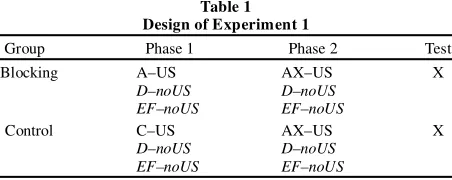
Experiment 1 was performed to investigate whether it was possible to obtain behavioral blocking in humans, using a control condition in which a stimulus different from the blocking stimulus is reinforced in Phase 1 (see Table 1). We consider this task behavioralbecause, although there were verbal instructions explaining the task and the US was given motivational value through instructions, our depen-dent variable was suppression of an ongoing nonverbal be-havior (i.e., barpresses on a computer’s keyboard).
Method Participants
Twenty-three undergraduate students from Deusto University (Spain) volunteered for the study. The participants were randomly assigned to either group blocking (n =11) or group control (n =12).
Apparatus
All the participants performed the experiment simultaneously, using personal computers, in a large room with many computers
pres-ent. The participants were at least 1.5 m apart from each other, and the participants at adjacent computers received different group and stimuli assignments. Owing to the number of participants and the size of the room, three experimenters were present.
The task was a computer video game and had many features in common with the behavioral preparation described by Arcediano et al. (1996). Associative learning was evidenced in the suppressio n ratio of ongoing behavior (playing of a video game, during which the stimuli of a Pavlovian procedure were presented). Instead of the US’s being inherently fear inducing (as with a footshock US), the US was given negative motivational value through instructions.1
A graphic representation of the task is displayed in Figure 1. On the computer screen, the participants saw a jail room with two walls, an Exitdoor composed of vertical bars, a refuge, a circular figure(with a face and arms), which the participants could make move with the cursor (arrow) keys on the computer’s keyboard, and a square-shape d responsepanel. The direction of the figure’s movement, which was controlled by the arrow keys, was rotated 45º from perpendicular to the participant ’s visual axis in order to permit the room to be shown in perspective; for this reason, a drawing showing the four cursor keys and the direction in which each key made the figure move were shown in the lower left corner of the screen at all moments. The only exit from the room was a door, initially closed, composed of 15 ver-tical bars. A message indicating whether the Exit door was closed or opened was displayed on the upper right corner of the screen. The goal of the participants was to escape from the room through the Exit door as many times as they could within the experimental ses-sion. They gained one point each time they escaped from the room, and the total number of points they had gained was displayed at all times during the game on the upper left and lower right corners of the screen. In order to escape from the room, the participants had to completely open the Exit door, which could be done only by making the figure press the response panel. To press the response panel, the participants had to move the figure with the cursor keys until it touched the response panel, and then the participants had to press the space bar on the keyboard to make the arms of the figure go down, thereby pressing the response panel on the monitor screen. This made the vertical bars that closed the door go up, one at a time. The door was “opened” when all 15 bars were lifted. Then, the figure could go through the door and escape from the room. Upon so doing, they earned one point and the figure was again returned to the jail room.
[image:3.527.270.496.570.660.2]The Pavlovian CSs were colors displayed in two light panels that were placed on one of the walls of the jail room. When only one CS was presented, only one of the panels (which was randomly selected for each trial) displayed this CS, and the other light panel remained white. When a compound of two stimuli was presented, each panel (randomly selected on each trial) displayed a different color. All CSs were 6 sec in duration. The US consisted of the floor of the room flashing in black and white (except for the area corresponding to the refuge) cycling two times in a second. The flashing continued for
Table 1 Design of Experiment 1
Group Phase 1 Phase 2 Test
Blocking A–US AX–US X
D–noUS D–noUS
EF–noUS EF–noUS
Control C–US AX–US X
D–noUS D–noUS
EF–noUS EF–noUS
2 sec on each occasion. If the flashing light occurred and the figure was out of the refuge, the figure was shown flashing in black and white simultaneously with the floor, and all the vertical bars that had been lifted prior to that moment came down, one by one, closing the Exit door completely. Thus, the participants had to start lifting the vertical bars all over again when the flashing stopped. The partici-pants could avoid this presumably aversive consequence by going into the refuge before the flashing light occurred; that is, they could avoid the closing of the partially open door if they learned to antic-ipate when the flashing floor (surrogate US) would occur. Thus, we expected that the participants would learn to stop pressing the space bar and go to the refuge in the presence of an effective CS (i.e., one that predicted the US). We also assumed that the participants would continue pressing the space bar in the presence of an ineffective CS (i.e., one that did not predict the US). Thereby, the suppression of the participants ’ pressing the space bar in order to go to the refuge was viewed as an avoidance response, which was incompatible with the ongoing response of lifting bars by making the figure press the re-sponse panel.
In our procedure, the intertrial interval was variable because it de-pended, in part, on the participants ’ behavior. A trial began only im-mediately after the participant pressed the space bar continuously for at least 1 sec. Then the computer recorded barpress responses during the subsequent 6 sec, with these 6 sec constituting the base-line preCS interval to be used in calculating suppression ratios. Im-mediately after the preCS interval had elapsed and the number of barpresses during these 6 sec had been recorded, the CSs were dis-played on the light panels, and the number of barpresses during the 6 sec of CS presentation was recorded. The first second was in-cluded to increase the likelihood that the participants were pressing the space bar consistently during the 6 sec previous to the CS pre-sentation. A further restriction was imposed on initiating trials, so that, if the participants had already opened 10 of the 15 bars consti-tuting the Exit door, no CSs were displayed until the participant had escaped from the room and started a new round with the Exit com-pletely closed. The reason for this restriction was that if only 5 bars remained down, the door could be opened in less than 12 sec (the sum of a preCS period and a CS period), and the participants could have stopped pressing the space bar (i.e., the response panel) during CS presentation to escape from the room, which would result in an apparent suppression of barpressing in the presence of the CS that was unrelated to the experimental design.
We used as our dependent variable a suppression ratio, which is a conventional measure in animal conditioned suppression studies (Annau & Kamin, 1961; Estes & Skinner, 1941). It was computed as a/(a + b), where awas the number of barpresses during the 6 sec of CS presentation and bwas the number of barpresses recorded dur-ing the immediately prior 6-sec preCS interval. A suppression ratio of zero indicates that response suppression to the CS was complete. If the CS presentation does not affect the ongoing behavior, the num-ber of responses during the CS and during the period of time imme-diately preceding the CS will be similar, and therefore, the resultant suppression ratio will approach .5.
Design
Table 1 summarizes the design of Experiment 1. The participant s were exposed to two phases of treatment. During Phase 1, CS A pre-dicted the occurrence of the US in Group Blocking, whereas CS C predicted the occurrence of the US in Group Control. During Phase 2, the AX compound predicted the occurrence of the US for both groups. Finally, CS X was presented alone as a test. During Phases 1 and 2 of treatment, the participants in both groups were also pre-sented with the nonreinforced filler Stimuli D and EF. The presen-tation of these filler stimuli in addition to the critical stimuli under study is a common practice in human research because, with human participants, some nonreinforced stimuli need to be included in order to prevent indiscriminate suppression to all the stimuli
pre-sented on the screen. The addition of these filler stimuli trials for both groups did not affect the relevant prediction of a between-groups difference indicative of blocking.
Procedure
Instructions. The instructions of the video game were displayed in four successive screens. An approximate Spanish-to-English translation of these instructions reads as follows:
Screen 1:
In this experiment, you will control a person that is locked inside a room. Inside that room, you will see an Exit door composed of verti-cal bars, a refuge, and a response panel that you can use to lift the bars of the Exit door. You will begin the game with 0 points. Each time you get out of the room by going through the Exit door, your score will increase by one point. Your goal is to obtain as many points as you can. Screen 2:
In order to go out through the Exit door, you must raise all the bars in the door. To do this, you have to move the person until it is in contact with the response panel and press it with the figure’s arms. To make the figure press the response panel with the arms, you have to press the space bar on your computer’s keyboard. To move the figure around the room, you have to use the four cursor (arrow) keys on the key-board. The direction of motion for each key will always be shown on the screen. If you hold down the space bar, the figure’s arms will press the response panel constantly, and the bars will go up faster than if you intermittently press and release the space bar. You will not be able to go through the Exit door unless all the bars are up and the message over the door “Exit door closed” has changed to “Exit door open.” Screen 3:
If you feel threatened at any moment, you should go to the refuge, which is the only safe place in the room. A message displayed on the screen will inform you how many points you have. Before you begin with the experiment, you will have one practice round, so that you can become comfortable with using the keyboard to move the figure around the room. After you complete this practice round, the experi-ment will begin.
Screen 4:
If you have problems or questions, please do not hesitate to ask one of the experimenters. Try to get as many points as you can. Good luck! Press the space bar when you are ready to start.
Once all the participants had read the instructions on their screens, one of the experimenters emphasized the most important instruc-tions aloud in order to make sure that they were understood. At the same time, one of the experimenters performed the pretraining phase on a large screen that could be seen by all the participants. Next, the participants performed the pretraining phase on their screens.
Pretraining phase. The participants were presented with a screen displaying the room and the figure inside the refuge. They had to move the figure around the room with the arrow keys, press down the response panel to lift the bars and open the Exit door, and escape from the room. During this phase, the light panels were not present, and no CSs or USs were displayed. Once the participants es-caped from the room, a message on the screen informed them that the experiment was about to begin. To ensure that all the participant s began the treatment phases at the same time, the participants could not advance to the next screen until the experimenters asked them to type a “password.” During this waiting time, all questions asked by the participants were answered aloud by one of the experimenters , so that all the participants received the same information. The main purpose of the pretraining phase was to familiarize the participant s with the experimental environment and teach them the basic skills required for a good performance in the video game.
tri-als was A–US, A–US, D–noUS, A–US, EF–noUS, A–US, A–US, A–US, A–US, D–noUS, A–US, EF–noUS, A–US, A–US, AX–US, EF–noUS, AX–US, D–noUS, and AX–US for Group Experimental. The same sequence applied to Group Control, except that the A–US trials were replaced by C–US trials. CS duration and intertrial inter-vals were as described above. CSs A and C were blue, brown, or pink, counterbalanced. (Three colors were counterbalanced because, in the subsequent experiments of the series, counterbalancing of three CSs was required.) CSs D, E, and F were red, light blue, and purple, respectively. CS X was green. Testing consisted of one presentation of CS X. The training and the testing phases occurred without in-terruption.
We normally use a data selection criterion in order to ensure that participants have understood the instructions and are paying atten-tion to the experiment. According to this criterion, the data from par-ticipants who do not discriminate between reinforced and nonrein-forced stimuli are eliminated from the analyses. This criterion was used in Experiments 2 and 3. However, because in the present ex-periment we gave only two nonreinforced D–noUS filler trials (as against the 10 A–US or C–US presentations), it seemed inappropri -ate to take into account the data from the D–noUS trials. Thus, in this experiment, we just made sure that a good suppression of ongoing behavior was taking place when CSs A or C were presented at the end of Phase 1 (note that if the blocking CS did not produce strong conditioned suppression at the end of Phase 1, we would not expect that this CS would later block conditioning to the target CS, X). Thus, the data of participants whose suppression ratio on the last re-inforced trial of Phase 1 (i.e., the last A–US trial for Group Block-ing or the last C–US trial for Group Control) was greater than .3 were eliminated. Data from 2 participants of Group Blocking were eliminated following this criterion.
Results and Discussion
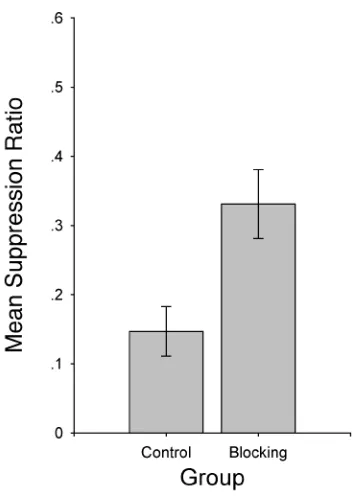
Figure 2 shows the suppression ratio for the target CS (X) recorded during testing. As can be seen in this figure,
when CS X was presented at test, the participants in Group Blocking suppressed their barpressing behavior less than did the participants in Group Control [t(19) = 2.59, p< .05]. That is, conditioned responding to CS X was blocked in Group Blocking.
An analysis of the number of responses recorded dur-ing the 6 sec prior to the presentation of the target CS (preCS scores) revealed no differences between Groups Blocking and Control [t(19) = 0.60, p > .1]. Thus, the observed dif-ference between groups in suppression to CS X was due to differences in suppression to CS X, rather than to their baseline responding. In addition, there were no differences in suppression ratios on the last trial of the AX compound in Phase 2 [t(19) = 0.73, p> .1]. Thus, Phase 1 treatment ap-pears to have been the major source of the observed dif-ference in conditioned responding to CS X at testing.
As was previously stated, we used a data selection cri-terion with human participants because it allowed us to elim-inate data from participants that failed to exhibit suppres-sion to a consistently reinforced stimulus for reasons unrelated to the experimental training (e.g., they did not understand the instructions, were color-blind, or did not take the experiment seriously). This criterion gave greater sensitivity to our measures, although it did not change significantly the results. Without the elimination criterion, the average suppression ratios were .14 and .33 for the con-trol and blocking groups, respectively, a difference that still reflects the blocking deficit [t(21) = 2.75, p <.05]. The results of Experiment 1 replicated the behavioral blocking effect in humans previously reported by Arcedi-ano et al. (1997), but with a different task and with a con-trol group trained during Phase 1 with pairings of a stimu-lus different from the blocking stimustimu-lus and the US (i.e., C–US), instead of presentations of the blocking CS (A) uncorrelated with the US. The control group used in this experiment avoids many of the interpretative problems of the other control conditions mentioned in the introduction.
EXPERIMENT 2
Both the models that focus on a response rule and the models that focus on new learning about absent stimuli pre-dict that conditioned responding to a blocked stimulus can be increased by posttraining extinction of its blocking stimulus. Thus, the prior difficulty in obtaining this effect is problematic for both families of models.
Method
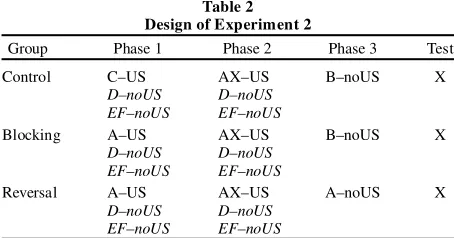
[image:6.527.55.234.50.298.2]In Experiment 2, two groups of participants received conventiona l blocking treatment, similar to that in Experiment 1. Then one of these groups received posttraining extinction of the blocking CS (Group Reversal), whereas the other group received nonreinforce d presentations of a novel stimulus (Group Blocking, see Table 2). A third group of participants did not receive blocking treatment (Group Control). Blocking would be evident if conditioned responding to the target CS was greater in Group Control than in Group Blocking. Reversal from blocking would be evident if conditioned respondin g to the target CS was greater in the group that received extinction treatment of the blocking CS after blocking treatment (i.e., Group
Reversal) than in the blocking group that did not receive the extinc-tion treatment (i.e., Group Blocking).
In this experiment, we introduced some modifications into the task and the procedure, relative to Experiment 1, in an attempt to in-crease its sensitivity. These changes were introduced because previ-ous attempts to reverse blocking, using the same preparation as that described in Experiment 1, had proven unreliable (we were able to find reversal from blocking, but we failed to replicate the result with-out these changes; see Arcediano, 1998). Our expectation was that an increase in task sensitivity would yield consistent, replicable re-sults, which would speak to whether reversal of behavioral blocking can be obtained with human participants. There were three major changes made on the basis of several pilot studies (Arcediano , 1998). First, the number of filler trials was increased. In Experi-ment 1, the participants were exposed to 13 reinforced trials (i.e., 10 A[or C]–US trials in Phase 1 and 3 AX–US trials in Phase 2) and only 6 nonreinforced filler trials (i.e., D–noUS and EF–noUS [4 tri-als in Phase 1 and 2 tritri-als in Phase 2]). Thus, it is possible that there was a great amount of generalized suppression toward all the pre-sented stimuli. In order to reduce this possibility, the participants in Experiments 2 were exposed, during Phases 1 and 2, to 11 reinforced trials (8 trials in Phase 1 and 3 trials in Phase 2) and 14 nonrein-forced filler trials (12 trials in Phase 1 and 2 trials in Phase 2).
The second change consisted in “punishing ” all movements of the figure around the room that were not directly related to escaping from the room. Thus, unless the Exit door was completely open, any movement of the figure around the room would make the vertical bars go down slowly one at a time. In previous experiments, it was not unusual that, perhaps by excessive prudence or “fear,” some par-ticipants went to the refuge when any stimulus was displayed, al-though some stimuli (i.e., D and EF) consistently predicted the ab-sence of the US. We expected that, as a result of this “punishment,” the participants would be more selective in deciding when to go to the refuge, enhancing the discrimination between reinforced and nonreinforced stimuli.
The third change consisted in giving the participants more explicit instructions. The participants were instructed that (1) they would see, during the task, two light panels on the walls of the room, (2) some colored lights would be displayed in these light panels on some oc-casions, (3) these colored lights might or might not provide infor-mation about the occurrence of a possible threat, and (4) if this threat occurred and the figure was out of the refuge, all the vertical bars that they had already lifted to open the Exit door would go down and they would lose all the effort they made toward opening the door on that round. These last changes in the instructions were expected to
facilitate the participants ’ discrimination of the stimuli. Arcediano et al. (1996) reported that participants who received explicit in-structions about the presence of stimuli that might predict the oc-currence of the US during a video-game-like operant task showed faster and better discrimination of the stimuli than did participant s who did not receive explicit instructions.
Participants
Sixty-four students from Deusto University (Spain) volunteere d for the study. The participants were randomly assigned to Group Con-trol (n =20), Group Blocking (n =19), or Group Reversal (n =25). Variability in group size was due to the vicissitudes of scheduling .
Apparatus
The computers were identical to those used in Experiment 1, ex-cept that the computers were located in a small room, with the con-sequence that a small, rather than a large, number of participant s performed the experiment at the same time. The experimental prepa-ration was identical to that described in Experiment 1, except for the three changes described above. Furthermore, the two light panels on which the stimuli were displayed were smaller and located on dif-ferent walls of the room and at difdif-ferent heights, with the purpose of discouraging configural learning of compound stimuli. In addition, the probability of any scheduled stimulus’s being displayed during treatment on the left (or right) light panel was 50%, and the order of the location of each stimulus on each light panel was identical for all the participants.
Procedure
The experimental task, instructions, and pretraining phase were similar to those in Experiment 1. However, we presented the addi-tional new instructions when the task was explained aloud to all the participants. Once the experimenter explained the task, the partici-pants were informed that they would see, during the game, two light panels in which, sometimes, color lights were going to be displayed . Some of these colors indicated the occurrence, close in time, of an aversive event. Moreover, if this event occurred and the figure was out of the refuge, all the verticals bars lifted until that moment would go down, one bar at a time, closing the Exit door completely. The ex-perimenter emphasized that the refuge was the only safe place in the room when this aversive event occurred and that, if the participan t thought this event was going to occur, the best decision was to move the figure toward the refuge to be safe. In addition, the experimente r showed on a computer screen (which could be seen by all the par-ticipants) that unless the Exit door was completely opened, any movement of the figure around the room would make the vertical bars go down. The speed at which these bars went down while the figure was moving around the room was half of the speed at which they were lifted when the figure pressed the response panel with its arms.
[image:7.527.29.256.60.179.2]Phases 1 and 2 were identical to Experiment 1, with the exception of the number of trials. In Phase 1, the participants in Groups Block-ing and Reversal were presented with eight A–US pairBlock-ings, eight D–noUS, and four EF–noUS presentations. The sequence of trials was D–noUS, A–US, D–noUS, A–US, EF–noUS, D–noUS, A–US, D–noUS, EF–noUS, D–noUS, A–US, D–noUS, A–US, EF–noUS, D–noUS, A–US, EF–noUS, A–US, D–noUS, and A–US. The se-quence of trials was identical for Group Control, except that the A–US trials were replaced by C–US trials. In Phase 2, all the par-ticipants were presented with three AX–US, one D–noUS, and one EF–noUS trials. The sequence of trials was AX–US, D–noUS, AX–US, EF–noUS, and AX–US. In Phase 3, the participants in Group Reversal received five A–noUS presentations, whereas the participants in Groups Blocking and Control received five B–noUS presentations. Testing occurred as described in Experiment 1. Stim-uli A, B, and C were blue, brown, and yellow, counterbalance d within groups. Stimuli D, E, and F were pink, light blue, and orange, respectively. The target stimulus (X) was green.
Table 2 Design of Experiment 2
Group Phase 1 Phase 2 Phase 3 Test
Control C–US AX–US B–noUS X
D–noUS D–noUS
EF–noUS EF–noUS
Blocking A–US AX–US B–noUS X
D–noUS D–noUS
EF–noUS EF–noUS
Reversal A–US AX–US A–noUS X
D–noUS D–noUS
EF–noUS EF–noUS
In Experiment 2, because we presented, during Phase 1, the same number of trials of a stimulus that predicted the occurrence of the US (A–US in the two blocking groups and C–US in the control group) and of a filler stimulus that did not predict the occurrence of the US (D–noUS), we were able to use the discrimination between these stimuli (one consistently reinforced and one consistently nonrein-forced) as a participant selection criterion. The data from those par-ticipants that had less than a 1.1 difference between the suppression ratio to the last filler trial of Phase 1 (eighth D–noUS trial) and the suppression ratio to the last reinforced trial of this Phase (eighth A–US or C–US trial) were eliminated from the analysis. We as-sumed that participants who did not selectively suppress their bar-pressing behavior to a stimulus that predicted the US, relative to a stimulus that did not predict the US, after eight trials of training with each stimulus probably did not understand the video game, did not pay sufficient attention to the experimental preparation, or had prob-lems in discriminating between colors. A discrimination criterion appeared inappropriate in Experiment 1 because of the different number of reinforced and nonreinforced Phase 1 trials. The criterion used in Experiment 1 accepted data from all participants whose sup-pression ratios to the last reinforced trial of the first Phase (A–US in Group Blocking or C–US in Group Control) was less than .3; how-ever, this criterion did not allow us to determine whether the partic-ipants suppressed their behavior selectively to stimuli that predicted the occurrence of the US or to all stimuli indiscriminatel y. In con-trast, the criterion of Experiment 2 allowed us to eliminate data from participants who did not discriminate appropriately by the end of Phase 1. With this criterion, the data from 2 participants from Group Control, 1 from Group Blocking, and 7 from Group Reversal were not included in the analyses of Experiment 2.
Results and Discussion
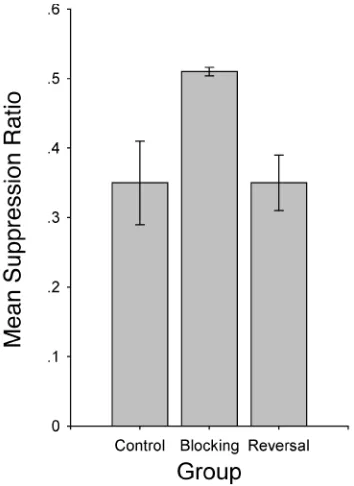
The participants in Group Blocking suppressed their barpressing responses during the presentation at test of the
target stimulus (X) less than did participants in Groups Control and Reversal. Therefore, the results of this exper-iment replicated the behavioral blocking reported in Ex-periment 1 and showed that conditioned responding to a previously blocked stimulus could be incremented when the blocking stimulus was extinguished following block-ing treatment. Figure 3 shows the suppression ratio for the target CS (X) recorded during testing.
A one-way analysis of variance (ANOVA) performed on the suppression ratios recorded during the presentation at test of the target CS, X, yielded a main effect of group [F(2,51) = 4.47, MSe= 0.03, p <.05]. Planned
compar-isons using the error term from this ANOVA revealed that Groups Blocking and Control differed [F(1,51) = 7.82, p< .01]. That is, conditioned suppression to CS (X) was blocked in Group Blocking. Further planned comparisons revealed that Groups Blocking and Reversal differed [F(1,51) = 5.35, p< .05]. That is, conditioned responding to the target CS (X), which had been subjected to identi-cal blocking treatment in these two groups, was increased owing to posttraining extinction of the blocking CS (A). Moreover, there was no difference between Groups Re-versal and Control [F(1,51) < 1]. That is, there was no dif-ference between suppression to the target stimulus after blocking treatment plus posttraining extinction of the blocking stimulus (Group Reversal) and suppression to the target stimulus when it did not undergo blocking treatment (Group Control). Indeed, as Figure 3 shows, the mean suppression ratios to the target stimulus at test in both groups were very similar.
To test whether the differences among groups were due exclusively to the association between the target CS and the US, and not to nonassociative factors, such as differ-ential base rate behavior, we performed a one-way ANOVA on the responses recorded during the 6 sec previous to the presentation of the target stimulus at test; this ANOVA re-vealed no effect of group [F(2,51) < 1]. Therefore, the differ-ences between groups apparently were not due to different response rates immediately prior to presentations of the target stimulus at test. In addition, a similar ANOVA re-vealed no differences in the suppression ratios on the last trial of the compound AX in Phase 2 [F(2,51) < 1]. Thus, the differential treatments during Phase 1 appear to be the only plausible source of the observed difference in re-sponding to CS X at test between Groups Blocking and Control. Similarly, extinction of the blocking stimulus during Phase 3 seemed to be the only plausible source of the observed difference between Groups Blocking and Reversal.
The data from all the participants (i.e., without apply-ing the data selection criterion) were analyzed to determine whether the results reported above were an artifact of data selection. Without the use of a data selection criterion, the mean suppression ratios at test were .32, .45, and .33 for the Control, Blocking, and Reversal groups, respectively. Responding in Group Control differed significantly from that in Group Blocking [F(1,61) = 5.59, MSe= 0.03, p< .05], and responding in Group Blocking differed
[image:8.527.49.226.56.299.2]cantly from that in Group Reversal [F(1,61) = 5.29, MSe= 0.03, p < .05]. In addition, we analyzed the number of points earned by participants during the experiment, which can be considered an index of stimulus discrimina-tion and performance during the experiment. The mean number of points by participants that were and were not eliminated from the analyses were 3.80 and 6.51, respec-tively. This difference was statistically significant [t(62) = 4.47, p< .001].
EXPERIMENT 3
Experiment 2 demonstrated that posttraining extinction of the blocking stimulus results in an increase in condi-tioned responding to the previously blocked stimulus. However, one could argue that Groups Control and Block-ing were exposed durBlock-ing Phase 3 to a neutral, novel stim-ulus (i.e., a stimstim-ulus without a previous history of rein-forcement), whereas Group Reversal received extinction treatment with a previously reinforced stimulus. Thus, it is possible to argue that responding to the blocked stimu-lus (X) would be increased if a previously reinforced stim-ulus was presented without reinforcement in Phase 3, but not if a novel neutral stimulus was presented during Phase 3. That is, extinction of any excitor (not necessarily the blocking stimulus) might result in increased respond-ing to X. In Experiment 3, we assessed the stimulus speci-ficity of the reversal effect observed in Experiment 2, and we did so by extinguishing, during Phase 3, a previously reinforced, blocking stimulus in all the groups.
Method
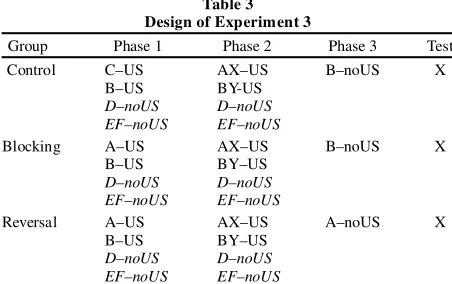
In Experiment 3, two stimuli, A and B, were established as block-ing stimuli for two targets, X and Y. After completion of blockblock-ing treatment, either A or B was extinguished, and responding to X was
assessed. If the reversal effect observed in Experiment 2 is a spe-cific result of extinguishing X’s blocking stimulus, responding to X should be increased only in the group in which A was extinguished, whereas blocking should be evident in the group in which B was ex-tinguished. If, in contrast, the reversal effect reported in Experi-ment 2 was the result of extinguishing any excitor after completion of the blocking treatment, blocking of X should be equally attenu-ated in both the group receiving extinction of A and the group re-ceiving extinction of B (see Table 3).
Participants and Apparatus
Fifty-nine students from State University of New York, Bing-hamton, volunteered for the study. The participants were randomly assigned to Group Control (n =24), Group Blocking (n =17), or Group Reversal (n =18). The computers were similar to those used in Experiments 1 and 2, and they were located in small rooms, with one or two computers per room.
Procedure
The experimental task and the instructions were similar to those in Experiment 2. However, we introduced several changes. All text was in English, all instructions were presented on successive screens on the computer (i.e., no oral instructions were given), the pretrain-ing phase was eliminated, and the preCS interval was reduced from 6 to 3 sec. Because the number of trials was increased from 31 trials in Experiment 2 to 49 trials in Experiment 3, we decided to reduce the preCS interval in order to avoid significantly increasing the du-ration of the experiment. In addition, CSs were presented only if the participants were constantly pressing the space bar during the full preCS interval. Consequently, there were necessarily no difference s in responding between groups (or individual participants) during the preCS interval, and all the participants were pressing the space bar when the CSs were presented. Suppression ratio was computed as a/(a + 2b), where awas the number of barpresses during the 6 secof CS presentation and bwas the number of barpresses recorded during the immediately prior 3-sec preCS interval.
In Phase 1, the sequence of eight A–US, eight B–US, eight D–noUS, and eight EF–noUS trials was D–noUS, A–US, EF–noUS, B–US, EF–noUS, D–noUS, EF–noUS, A–US, EF–noUS, B–US, D–noUS, A–US, EF–noUS, B–US, D–noUS, D–noUS, AUS, A–US, EF–noUS, B–US, D–noUS, A–US, EF–noUS, B–US, B–US, D–noUS, A–US, B–US, D–noUS, EF–noUS, B–US, and A–US for Groups Blocking and Reversal. The sequence of trials was identical for Group Control, except that the A–US trials were re-placed by C–US trials. In Phase 2, the sequence of three AX–US, three BY–US, two D–noUS, and two EF–noUS trials was AX–US, BY–US, D–noUS, EF–noUS, AX–US, EF–noUS, BY–US, D–noUS, BY–US, and AX–US for all groups. In Phase 3, the participants in Group Reversal received five A–noUS presentations, whereas the participants in Groups Blocking and Control received five B-noUS presentations. Testing on X occurred as described in Experiment 1. Stimuli A, B, and C were blue, brown, and yellow, counterbalance d within groups. Stimuli D, E, and F were pink, light blue, and gray, respectively. Stimuli X and Y were green and orange, counterbal -anced within groups.
[image:9.527.29.255.61.203.2]As in Experiment 2, we used the discrimination between consis-tently nonreinforced stimuli and consisconsis-tently reinforced stimuli at the end of Phase 1 as a criterion for retaining participants. Because there were now two consistently nonreinforced stimuli (D and the compound EF) and two consistently reinforced stimuli (A or C and B), with an identical number of trials during Phase 1, our criterion was adapted accordingly. That is, data from those participants that had less than a +.1 difference between the average suppression ratio to the two last filler trials of Phase 1 ([eighth D–noUS trial + eighth EF–noUS trial] / 2) and the average suppression ratio to the last re-inforced trials of this phase ([eighth A–US (or C–US) trial + eighth
Table 3 Design of Experiment 3
Group Phase 1 Phase 2 Phase 3 Test
Control C–US AX–US B–noUS X
B–US BY-US
D–noUS D–noUS
EF–noUS EF–noUS
Blocking A–US AX–US B–noUS X
B–US BY–US
D–noUS D–noUS
EF–noUS EF–noUS
Reversal A–US AX–US A–noUS X
B–US BY–US
D–noUS D–noUS
EF–noUS EF–noUS
B–US trial] / 2) were eliminated from the analysis. The data from 12 participants from Group Control, 5 participants from Group Block-ing, and 6 participants from Group Reversal were excluded from the analyses of Experiment 3.
Results and Discussion
Figure 4 depicts the suppression ratio for the target CS, X, recorded during testing. As can be seen, Experiment 3 replicated the results reported in Experiments 1 (block-ing) and 2 (reversal from block(block-ing). A one-way ANOVA performed on the suppression ratios recorded during the test presentation of the target stimulus (X) yielded a main effect of group [F(2,33) = 8.15, MSe= 0.02, p <.01].
Planned comparisons using the error term from this ANOVA revealed that the blocking treatment was effec-tive, as evidenced by the difference in responding to X be-tween Groups Control and Blocking [F(1,33) = 13.75, p< .001]. In addition, there was a difference in suppression to CS X between Groups Blocking and Reversal [F(1,33) = 10.47, p< .01]. That is, conditioned suppression to the target stimulus (X) which had received a blocking treat-ment in both groups, was increased when the blocking stimulus (A) but not when another excitor (B) was extin-guished. Finally, there was no difference between Groups Reversal and Control [F(1,33) < 1]. That is, there was no significant difference between the conditioned response elicited by CS X after blocking treatment plus posttrain-ing extinction of the blockposttrain-ing stimulus (Group Reversal) and CS X when it had not been subject to blocking treat-ment (Group Control). Indeed, as Figure 4 shows, the
mean suppression ratios to the target stimulus at test in both groups were very similar.
Statistical analysis on the number of responses recorded during the 3 sec prior to the presentation of X were not performed because they were necessarily identical be-tween groups owing to the experimental preparation (i.e., CSs were presented only if the participants were continu-ously pressing the space bar during preCS interval). In ad-dition, there were no differences in suppression on the last trial of the compound AX in Phase 2 [F(2,33) < 1]. Thus, the blocking effect (i.e., differences between Groups Block-ing and Control) could plausibly be attributed only to the differential treatment in Phase 1, and the increment on the conditioned response to the previously blocked stimulus once the blocking stimulus was extinguished (i.e., differ-ences between Groups Reversal and Blocking) could plau-sibly be attributed only to extinction of the blocking stim-ulus in Phase 3.
As in the previous experiments, the data from all the par-ticipants (i.e., without applying the data selection criterion) were also analyzed. The mean suppression ratios without application of a criterion of elimination were .22, .34, and .23 for the Control, Blocking, and Reversal groups, re-spectively. Responding in Group Control differed signifi-cantly from that in Group Blocking [F(1,56) = 6.11, MSe= 0.02, p< .05], and responding in Group Blocking differed significantly from that in Group Reversal [F(1,56) = 4.63,
MSe= 0.02, p< .05]. In addition, as in Experiment 2, we
analyzed the average number of points obtained by those participants whose data were and were not eliminated from the analysis. The average number of points obtained was 3.43 and 6.08, respectively. The comparison was sta-tistically significant [t(57) = 4.27, p< .001].
In conclusion, Experiment 3 replicated the behavioral blocking observed in Experiments 1 and 2, as well as the reversal from blocking observed in Experiment 2. More-over, Experiment 3 showed that increased responding to the previously blocked stimulus was specific to posttrain-ing extinction of the blockposttrain-ing stimulus; this reversal of blocking was not observed when an excitor different from the blocking stimulus was subject to extinction treatment.
GENERAL DISCUSSION
The present series of experiments was intended to in-vestigate whether conditioned responding to a previously blocked stimulus can be increased after posttraining ex-tinction of the blocking CS when human participants were used in a novel behavioral task. Traditional associative theories (e.g., Mackintosh, 1975; Pearce, 1987; Pearce & Hall, 1980; Rescorla & Wagner, 1972; Wagner, 1981) argue that stimulus competition is the result of a deficit in ac-quiring an association between the target CS and the US. Moreover, these theories posit that this deficit can be re-versed only if the target CS is paired with the US in the ab-sence of the competing CS. However, in recent years, new associative theories of acquired behavior have been
[image:10.527.56.235.48.296.2]veloped to explain some stimulus competition effects that cannot be explained by traditional theories. One of the major predictions of these new theories is that conditioned responding to a stimulus subject to competition (e.g., over-shadowing [Pavlov, 1927], relative stimulus validity [Wag-ner et al., 1968], or blocking [Kamin, 1968]) may be in-creased even if it does not receive further pairings with the US. Two families of models make this prediction. On the one hand, there are models that emphasize a response rule, and on the other hand, there are models that emphasize ac-quisition processes, including learning about absent stimuli.
Models based on a response rule (e.g., Denniston, et al., 2001; Gallistel & Gibbon, 2000; Miller & Matzel, 1988) assume that the relationships between the CSs and the US are learned through a contiguity mechanism. In general, according to these models, blocking can be reversed be-cause there is an association between X and the US that re-mains latent and does not elicit responding because the A–US association is stronger than the X–US association (owing to the Phase 1 training). Thus, if the association between A and the US is weakened (as a result of post-training extinction of A), conditioned responding to X will be observed. Models based on new learning about ab-sent stimuli (e.g., Dickinson & Burke, 1996; Markman, 1989; Tassoni, 1995; Van Hamme & Wasserman, 1994) assume, as do traditional associative models (e.g., Mack-intosh, 1975; Pearce, 1987; Pearce & Hall, 1980; Rescorla & Wagner, 1972; Wagner, 1981), that competition be-tween stimuli reflects a failure to acquire an association between the target stimulus and the US. However, they as-sume that the strength of a CS–US association will in-crease not only when the CS is followed by the occurrence of the US, but also when both the CS and the US are ex-pected but not presented on a trial. Thus, during extinction of A the strength of the X–US association is assumed to increase, and responding to X should be observed.
These two groups of theories have been successful in explaining increases in conditioned responding to stimuli under competition after posttraining extinction of the competing stimulus in paradigms such as overshadowing (Kaufman & Bolles, 1981; Larkin et al., 1998; Matzel et al., 1985; Matzel et al., 1987; Wasserman & Berglan, 1998) and the relative stimulus validity effect (Cole et al., 1995). However, their prediction of reversal of conditioned re-sponding to a previously blocked stimulus has proven dif-ficult to confirm. Only recently did Blaisdell et al. (1999) report this effect under select conditions, using rats as sub-jects. In order to provide a human analogue of this elusive effect, we developed a new behavioral procedure to mea-sure learning of associations between stimuli, using con-ditioned suppression of ongoing behavior as dependent variable. Our experimental preparation shared many basic ideas with the behavioral preparation developed by Arce-diano et al. (1996) but attempted to provide greater ex-perimental sensitivity, which seemed necessary to detect relatively small changes in responding that may testify to the reversal of stimulus competition. Indeed, the blocking
effect itself has been quite elusive in human research (see the introduction), and it seemed quite clear that only by developing a more sensitive preparation could we investi-gate both blocking and reversal from blocking in humans. In Experiment 1, we replicated the blocking first reported with a nonverbal behavioral measure in humans by Arce-diano et al. (1997), but here we used an improved control condition for blocking (i.e., C–US followed by AX–US). In Experiment 2, some aspects of the behavioral preparation were modified to provide greater task sensitivity, in order to observe the impact on blocking of posttraining manipu-lations of the blocking stimulus. Experiment 2 replicated the blocking effect obtained in Experiment 1 and reversed (i.e., increased) conditioned responding to a previously blocked stimulus as a result of posttraining extinction of its blocking stimulus. Finally, Experiment 3 demonstrated that the reversal effect observed in Experiment 2 was spe-cific to extinction of its blocking stimulus; extinction of another previously reinforced stimulus had no effect on responding to the blocked target stimulus.
human research. We can speculate that more extinction trials are required in a preparation that uses a biologically significant US than in a preparation in which the US is of low biological significance, because reversal of stimulus competition is observed only if both responding and bio-logical significance are extinguished to the competing stimulus.2
The present data support the view that posttraining ma-nipulations of the competing stimulus (in the present case, the blocking stimulus) can result in reversal of stimulus competition phenomena. Whether such reversal reflects expression of a previously latent association (as is sup-ported by models that emphasize a response rule) or a new-learning effect (as is suggested by theories that allow new learning about absent stimuli) is still unclear. Further experiments will have to be performed in order to deter-mine which one of these families of models is more accu-rate and to illuminate the true nature of stimulus compe-tition.
REFERENCES
Annau, Z., & Kamin, L. J. (1961). The conditioned emotional response as a function of intensity of the US. Journal of Comparative & Phys-iological Psychology, 54, 428-432.
Arcediano, F. (1998). Recuperación de la respuesta a un estímulo blo-queado extinguiendo el estímulo bloblo-queador [Recovery of responding to a blocked stimulus following extinction of the blocking stimulus]. Unpublished doctoral dissertation. Bilbao, Spain: Universidad de Deusto.
Arcediano, F., Matute, H., & Miller, R. R.(1997). Blocking of Pavlovian conditioning in humans. Learning & Motivation, 28, 188-199.
Arcediano, F., Ortega, N., & Matute, H.(1996). A behavioura l preparation for the study of human Pavlovian conditioning. Quarterly Journal of Experimental Psycholog y, 49B, 270-283.
Atkinson, R. C., & Estes, W. K. (1963). Stimulus sampling theory. In R. D. Luce, R. B. Bush, & E. Galanter (Eds.), Handbook of mathe-matical psychology (Vol. 3, pp. 121-268). New York: Wiley. Baker, A. G.(1977). Conditioned inhibition arising from a
between-sessions negative correlation. Journal of Experimental Psychology: Animal Behavior Processes, 3, 144-155.
Blaisdell, A. P., Gunther, L. M., & Miller, R. R. (1999). Recovery from blocking achieved by extinguishing the blocking CS. Animal Learning & Behavior, 27, 63-76.
Bush, R. R., & Mosteller, F. (1951). A mathematical model for sim-ple learning. Psychological Review, 58, 313-323.
Chapman, G. B. (1991). Trial order affects cue interaction in contin-gency judgment. Journal of Experimental Psychology: Learning, Memory, & Cognition, 17, 837-854.
Chapman, G. B., & Robbins, S. J. (1990). Cue interaction in human contingency judgment. Memory & Cognition, 18, 537-545. Cole, R. P., Barnet, R. C., & Miller, R. R. (1995). Effect of relative
stimulus validity: Learning or performance deficit? Journal of Ex-perimental Psychology: Animal Behavior Processes, 21, 293-303. Davey, G. C. L., & Singh, J. (1988). The Kamin “blocking” effect and electrodermal conditioning in humans. Journal of Psychophysiolog y,
2, 17-25.
Denniston, J. C., Miller, R. R., & Matute, H. (1996). Biological sig-nificance as a determinant of cue competition. Psychological Science,
7, 325-331.
Denniston, J. C., Savastano, H. I., & Miller, R. R. (2001). The ex-tended comparator hypothesis: Learning by contiguity, responding by relative strength. In R. R. Mowrer & S. B. Klein (Eds.), Handbook of contemporary learning(pp. 65-117). Mahwah, NJ: Erlbaum. Dickinson, A., & Burke, J.(1996). Within-compound associations
me-diate the retrospective revaluation of causality judgments. Quarterly Journal of Experimental Psycholog y, 49B, 60-80.
Droungas, A., & Lolordo, V. M. (1994). Evidence for simultaneous excitatory and inhibitory associations in the explicitly unpaired pro-cedure. Learning & Motivation, 25, 1-25.
Durlach, P. J. (1986). Explicitly unpaired procedure as a response elim-ination technique in autoshaping. Journal of Experimental Psychol-ogy: Animal Behavior Processes, 12, 172-185.
Estes, W. K., & Skinner, B. F. (1941). Some quantitative properties of anxiety. Journal of Experimental Psychology, 29, 390-400. Gallistel, C. R., & Gibbon, J. (2000). Time, rate, and conditioning.
Psychological Review, 107, 289-344.
Hearst, E., & Franklin, S. R. (1977). Positive and negative relations between a signal and food: Approach–withdrawal behavior to the sig-nal. Journal of Experimental Psychology: Animal Behavior Processes,
3, 37-52.
Kamin, L. J. (1968). “Attention-like” processes in classical conditioning. In M. R. Jones (Ed.), Miami Symposium on the Prediction of Behav-ior: Aversive stimulation (pp. 9-31). Miami: University of Miami Press.
Kaplan, P.(1984). The importance of relative temporal parameters in trace autoshaping: From excitation to inhibition. Journal of Experi-mental Psychology: Animal Behavior Processes, 10, 113-126. Kaufman, M. A., & Bolles, R. C. (1981). A nonassociative aspect of
overshadowing. Bulletin of the Psychonomic Society, 18, 318-320. Konorski, J. (1948). Conditioned reflexes and neuron organization.
Cambridge: Cambridge University Press.
Larkin, M. J. W., Aitken, M. R. F., & Dickinson, A. (1998). Retro-spective revaluation of causal judgments under positive and negative contingencies. Journal of Experimental Psychology: Learning, Mem-ory, & Cognition, 24, 1331-1352.
Lovibond, P. F., Siddle, D. A. T., & Bond, N. (1988). Insensitivity to stimulus validity in human Pavlovian conditioning. Quarterly Jour-nal of Experimental Psychology, 40B, 377-410.
Mackintosh, N. J. (1975). A theory of attention: Variations in the as-sociability of stimuli with reinforcement. Psychological Review, 82, 276-298.
Markman, A. B. (1989). LMS rules and the inverse base-rate effect: Comment on Gluck and Bower (1988). Journal of Experimental Psy-chology: General, 118, 417-421.
Matzel, L. D., Gladstein, L., & Miller, R. R. (1988). Conditioned excitation and conditioned inhibition are not mutually exclusive. Learning & Motivation, 19, 99-121.
Matzel, L. D., Schachtman, T. R., & Miller, R. R. (1985). Recov-ery of an overshadowed association achieved by extinction of the over-shadowing stimulus. Learning & Motivation, 16, 398-412.
Matzel, L. D., Shuster, K., & Miller, R. R. (1987). Covariation in conditioned response strength between stimuli trained in compound . Animal Learning & Behavior, 15, 439-447.
Miller, R. R., & Matute, H. (1996). Biological significance in for-ward and backfor-ward blocking: Resolution of a discrepancy between animal conditioning and human causal judgment. Journal of Experi-mental Psychology: General, 125, 370-386.
Miller, R. R., & Matzel, L. D. (1988). The comparator hypothesis: A response rule for the expression of associations. In G. H. Bower (Ed.), The psychology of learning and motivation(Vol. 22, pp. 51-92). San Diego: Academic Press.
Miller, R. R., Schachtman, T. R., & Matzel, L. D. (1987). [Failure to attenuate blocking by posttraining extinction of a blocking stimu-lus]. Unpublished raw data.
Pavlov, I. (1927). Conditioned reflexes (G.V. Anrep, Trans.). London: Oxford University Press.
Pearce, J. M.(1987). A model of stimulus generalization for Pavlovian conditioning. Psychological Review, 94, 61-73.
Pearce, J. M., & Hall, G. (1980). A model for Pavlovian learning: Variations in the effectiveness of conditioned but not unconditione d stimuli. Psychological Review, 87, 532-552.
and nonreinforcement following prior inhibitory conditioning. Learn-ing & Motivation, 2, 113-123.
Rescorla, R. A., & LoLordo, V. M. (1965). Inhibition of avoidance behavior. Journal of Comparative & Physiological Psychology, 59, 406-412.
Rescorla, R. A., & Wagner, A. R. (1972). A theory of Pavlovian con-ditioning: Variations in the effectiveness of reinforcement and non-reinforcement. In A. H. Black & W. F. Prokasy (Eds.), Classical con-ditioning II: Current research and theory (pp. 64-99). New York: Appleton-Century-Crofts.
Shanks, D. R. (1985). Forward and backward blocking in human con-tingency judgment. Quarterly Journal of Experimental Psycholog y,
37B, 1-21.
Suiter, R. D., & LoLordo, V. M. (1971). Blocking of inhibitory Pavlov-ian conditioning in the conditional emotional response procedure. Journal of Comparative & Physiological Psychology, 76, 137-144. Tassoni, C. J. (1995). The least mean squares network with information coding: A model of cue learning. Journal of Experimental Psychol-ogy: Learning, Memory, & Cognition, 21, 193-204.
Van Hamme, L. J., & Wasserman, E. A. (1994). Cue competition in causality judgments: The role of nonpresentation of compound stim-ulus elements. Learning & Motivation, 25, 127-151.
Wagner, A. R. (1981). SOP: A model of automatic memory processing in animal behavior. In E. Spear & R. R. Miller (Eds.), Information pro-cessing in animals: Memory mechanisms (pp. 5-47). Hillsdale, NJ: Erlbaum.
Wagner, A. R., Logan, F. A., Haberlandt, K., & Price, T. (1968). Stimulus selection and a “modified continuity theory.” Journal of Ex-perimental Psychology, 76, 171-180.
Wasserman, E. A., & Berglan, L. R. (1998). Backward blocking and recovery from overshadowing in human causal judgment: The role of within-compound associations. Quarterly Journal of Experimental Psychology, 51B, 121-138.
Weisman, R. G., & Litner, J. S. (1969). The course of Pavlovian exci-tation and inhibition of fear in rats. Journal of Comparative & Physi-ological Psychology, 69, 667-672.
Williams, D. A. (1986). On extinction of inhibition: Do explicitly
un-paired conditioned inhibitors extinguish? American Journal of Psy-chology, 99, 515-525.
Williams, D. A., Dyck, D. G., & Tait, R. W. (1986). Excitatory back-ward conditioning in conditioned punishment and conditioned sup-pression in rats. American Journal of Psycholog y, 99, 367-384. Williams, D. A., & Overmier, J. B. (1988). Some types of conditioned
inhibitors carry collateral excitatory associations. Learning & Moti-vation, 19, 345-368.
NOTES
1. A demonstration version of this program can be downloaded from http://sirio.deusto.es/matute/software.html.
2. The concept of biological significance could also account for the greater difficulty in demonstrating reversal of blocking in animals, rela-tive to reversal of overshadowing and the relarela-tive stimulus validity effect. In the latter paradigms, the target stimulus (i.e., the stimulus under com-petition) is presented with the competing stimulus during the first phase of conditioning and paired with a US that is normally food or foot-shock (i.e., stimuli of high biological significance); therefore, the target stimulus could acquire greater biological significance (i.e., behavioral control) than if the target stimulus is paired with the US only in a second phase of conditioning, when the competing stimulus has already ac-quired strong behavioral control (e.g., blocking). In the case of blocking, the competing (blocking) stimulus should be maximally effective in pre-venting the target (blocked) stimulus from acquiring biological signifi-cance. In supportive of this assumption, Blaisdell et al. (1999) required more posttraining extinction trials to observe reversal of blocking fol-lowing a two-phase blocking procedure than folfol-lowing a single-phase blocking procedure (800 extinction trials and 200 extinction trials, respectively). Apparently, if the competing (i.e., blocking) stimulus has not already acquired complete behavioral control when the target (i.e., blocked) stimulus is first paired with the US, fewer extinction trials with the blocking CS are needed to reverse the blocking deficit.