current as of April 2, 2010. Online article and related content
http://jama.ama-assn.org/cgi/content/full/289/22/2983
. 2003;289(22):2983-2991 (doi:10.1001/jama.289.22.2983)
JAMA
E. Wesley Ely; Brenda Truman; Ayumi Shintani; et al.
Agitation-Sedation Scale (RASS)
Reliability and Validity of the Richmond
Monitoring Sedation Status Over Time in ICU Patients:
Correction Contact me if this article is corrected.
Citations
Contact me when this article is cited. This article has been cited 145 times.
Topic collections
Contact me when new articles are published in these topic areas.
Critical Care/ Intensive Care Medicine; Adult Critical Care; Anesthesia
http://pubs.ama-assn.org/misc/permissions.dtl [email protected]
Permissions
http://jama.com/subscribe Subscribe
CRITICALLY ILL PATIENT
Monitoring Sedation Status Over Time
in ICU Patients
Reliability and Validity of the Richmond Agitation-Sedation
Scale (RASS)
E. Wesley Ely, MD, MPH Brenda Truman, RN, MSN Ayumi Shintani, PhD, MPH Jason W. W. Thomason, MD Arthur P. Wheeler, MD Sharon Gordon, PsyD Joseph Francis, MD, MPH Theodore Speroff, PhD Shiva Gautam, PhD Richard Margolin, MD Curtis N. Sessler, MD Robert S. Dittus, MD, MPH Gordon R. Bernard, MD
I
NCREASED SCRUTINY HAS RECENTLYbeen placed on appropriate titra-tion of sedative and analgesic medi-cations in critically ill patients, es-pecially those being treated with mechanical ventilation.1-5Patient com-fort should be a primary goal in the in-tensive care unit (ICU), including ad-equate pain control,6,7anxiolysis, and prevention and treatment of de-lirium.8However, achieving an appro-priate balance of sedation and analge-sia is challenging.9-11Without rational and agreed on target levels of seda-tion, different members of the health care team will have disparate treat-ment goals,12-14increasing the chance for iatrogenic complications and po-tentially impeding recovery.
The clinical practice guidelines of the Society of Critical Care Medicine em-phasize the need for goal-directed de-livery of psychoactive medications.8,15
Al-Author Affiliationsare listed at the end of this article.
Corresponding Author and Reprints:E. Wesley Ely, MD, MPH, Department of Medicine, Division of Al-lergy, Pulmonary, and Critical Care Medicine, Center for Health Services Research of Vanderbilt Univer-sity, Tennessee Valley Veteran’s Affairs Healthcare Sys-tem, Geriatric Research Education and Clinical
Center (GRECC), Nashville, TN 37232 (e-mail: wes [email protected]).
Caring for the Critically Ill Patient Section Editor: Debo-rah J. Cook, MD, Consulting Editor,JAMA.
Advisory Board: David Bihari, MD; Christian Brun-Buisson, MD; Timothy Evans, MD; John Heffner, MD; Norman Paradis, MD; Adrienne Randolph, MD.
Context Goal-directed delivery of sedative and analgesic medications is recom-mended as standard care in intensive care units (ICUs) because of the impact these medications have on ventilator weaning and ICU length of stay, but few of the avail-able sedation scales have been appropriately tested for reliability and validity.
Objective To test the reliability and validity of the Richmond Agitation-Sedation Scale (RASS).
Design Prospective cohort study.
Setting Adult medical and coronary ICUs of a university-based medical center.
Participants Thirty-eight medical ICU patients enrolled for reliability testing (46% receiving mechanical ventilation) from July 21, 1999, to September 7, 1999, and an independent cohort of 275 patients receiving mechanical ventilation were enrolled for validity testing from February 1, 2000, to May 3, 2001.
Main Outcome Measures Interrater reliability of the RASS, Glasgow Coma Scale (GCS), and Ramsay Scale (RS); validity of the RASS correlated with reference standard ratings, assessments of content of consciousness, GCS scores, doses of sedatives and analgesics, and bispectral electroencephalography.
Results In 290-paired observations by nurses, results of both the RASS and RS dem-onstrated excellent interrater reliability (weighted, 0.91 and 0.94, respectively), which were both superior to the GCS (weighted, 0.64;P⬍.001 for both comparisons). Cri-terion validity was tested in 411-paired observations in the first 96 patients of the vali-dation cohort, in whom the RASS showed significant differences between levels of con-sciousness (P⬍.001 for all) and correctly identified fluctuations within patients over time (P⬍.001). In addition, 5 methods were used to test the construct validity of the RASS, including correlation with an attention screening examination (r=0.78,P⬍.001), GCS scores (r=0.91,P⬍.001), quantity of different psychoactive medication dosages 8 hours prior to assessment (eg, lorazepam:r=−0.31,P⬍.001), successful extubation (P=.07), and bispectral electroencephalography (r=0.63,P⬍.001). Face validity was demon-strated via a survey of 26 critical care nurses, which the results showed that 92% agreed or strongly agreed with the RASS scoring scheme, and 81% agreed or strongly agreed that the instrument provided a consensus for goal-directed delivery of medications.
Conclusions The RASS demonstrated excellent interrater reliability and criterion, con-struct, and face validity. This is the first sedation scale to be validated for its ability to detect changes in sedation status over consecutive days of ICU care, against con-structs of level of consciousness and delirium, and correlated with the administered dose of sedative and analgesic medications.
though the Ramsay Scale (RS)16was not originally intended for use as a clinical monitoring tool, it has been used for de-cades in both clinical practice and re-search. Still, most patients are not moni-tored with any scale to guide delivery of sedative medications. Objective, goal-directed sedation therapy is now the recommended standard to avoid overse-dation and to promote earlier extuba-tion.2,8,14,17-19 As pointed out by oth-ers,1,20-22 very few of the available sedation scales have been appropri-ately tested for reliability and validity. Even among available instruments that have been tested for reliability and va-lidity,23-26none discretely separates ver-bal from physical stimulation (ie, the po-tency of the stimulus) in generating scores at pivotal levels of sedation. Two recent systematic reviews concluded that goal-directed sedative and analgesic ad-ministration would be enhanced if such instruments were shown to detect varia-tions in level of consciousness over time and according to delivery of psychoac-tive drugs.1,26Other investigators ob-served cardiac surgery patients over time, yet the duration of monitoring was only 6 hours, the sample size was small (only 14 patients followed up to extubation), and correlations with drug doses were not published.27
The Richmond Agitation-Sedation Scale (RASS)28,29was developed by a mul-tidisciplinary team at Virginia Common-wealth University in Richmond. It is a 10-point scale that can be rated briefly using 3 clearly defined steps and that has dis-crete criteria for levels of sedation and agitation. A unique feature of the RASS is that it uses the duration of eye con-tact following verbal stimulation as the principal means of titrating sedation. Hence, this scale’s validation could be linked to both arousal and content of thought—the 2 components of con-sciousness.30We determined that the du-ration of eye contact could be easily mea-sured with minimal training, allowing reproducibility and increased acceptabil-ity of the instrument by bedside physi-cians, nurses, and researchers alike. The RASS has been demonstrated to have ex-cellent interrater reliability in a broad
range of adult medical and surgical ICU patients and to have excellent validity when compared with a visual analogue scale and selected sedation scales.29
The current investigation was de-signed to extend the reliability and va-lidity testing of the RASS in novel ways to include assessment of sedation over time, correlation of the RASS with in-dependent neuropsychiatric experts’ measures of level of consciousness and formally measured content of conscious-ness (ie, inattention and delirium), doses of sedative and analgesic medications, and objective measurement of brain function using bispectral array electro-encephalography.
METHODS
This investigation was conducted in the adult medical and coronary ICUs at Vanderbilt University Medical Center, a 641-bed tertiary-care, academic medi-cal center. The institutional review board approved the study, and written in-formed consent was obtained from the patients or proxies. Reliability and va-lidity testing was performed in 2 phases. We enrolled patients into the reliabil-ity testing cohort from July 21, 1999, to September 7, 1999, and into the valid-ity testing cohort from February 1, 2000, to May 3, 2001.
While none of the data in this re-port have been previously published, other data from this cohort of patients have been published as would be ex-pected from prospective cohort inves-tigations that have the capacity to ad-dress different issues. Specifically, the 38 patients from the RASS reliability testing cohort were those reported in the first Confusion Assessment Method for the Intensive Care Unit (CAM-ICU) study,31 and 96 of the patients from this RASS validity testing were those reported in the second CAM-ICU study cohort.32
Patients receiving and not receiving mechanical ventilation were screened during reliability testing to ensure reli-ability in verbal and nonverbal patients. Any adult admitted to the ICU who did not meet the following a priori exclu-sion criteria was eligible for
enroll-ment: a history of severe dementia, psy-chosis, or neurologic disease (n = 12); patient or family refusal to participate (n=8); and admission to the ICU after the predefined cap of 10 study patients per day (because of research staffing limi-tations) had been reached (n=18). Con-secutive patients receiving mechanical ventilation were enrolled into the valid-ity testing cohort (and followed up un-til ICU discharge), because the primary challenge and use for sedation scales in the ICU are for patients who are non-verbal and are intubated. Patients were excluded if they had a history of psycho-sis or neurologic disease (n=16), were non–English-speaking or deaf (n = 5), were extubated or had died before nurses’ screen (n = 15), were previously en-rolled in reliability cohort (n=5), or be-cause of patient or family refusal to par-ticipate (n=9).
Psychoactive Medications
During this investigation, no protocol to guide analgesia, sedation, or neuromus-cular blockade existed in our ICU, and no objective target levels of sedation were routinely identified according to dis-ease state or ventilator settings. All doses of narcotics, benzodiazepines, propo-fol, and neuromuscular blocking agents were recorded prospectively in 8-hour intervals throughout the investigation. Administered narcotics were either mor-phine or fentanyl. Administered benzo-diazepines were either lorazepam or mid-azolam (the midmid-azolam dose was converted to lorazepam equivalents by dividing by 3 to achieve equipotent dose33). If neuromuscular blocking agents had been given within 8 hours of RASS assessment, patient observations were excluded from our pharmacologi-cal analyses.
Performing the RASS
Prior to this investigation, raters had no experience with the RASS. Sessler et al29 from the Virginia Commonwealth Uni-versity provided a 1-page handout with the RASS description and the Proce-dure for RASS assessment (TABLE1) to the investigators. No other formal train-ing was received or required. All raters
performed the RASS using the same se-quence of 3 steps as outlined in Table 1. If the patients were alert or agitated prior to stimulation, they were scored 0 to+4 accordingly. If patients were not spon-taneously alert, they were then called by name to look at the rater, with the du-ration of eye contact measured, at which time a positive response was scored ac-cordingly as −1 to −3. If the patients did not respond to verbal stimulation, they were then physically stimulated (ie, shoulder shake and/or sternal rub) and scored according to their response as –4 or –5. If calm and not alert prior to ver-bal and physical stimulation, patients were then rated as −1 to −5 (as standard-ized in Table 1) even if they became agi-tated on stimulation. Assessments re-quired less than 20 seconds.
Structure of Reliability Study Procedures
Two critical care study nurses, an in-tensivist, and a neuropsychiatric ex-pert performed daily, independent RASS ratings during each patient’s ICU stay. Interrater reliability assessments were conducted in the afternoon, and none of the raters had access to the others’ scores at any time. The study nurses per-formed simultaneous ratings (one in-teracted with and rated the patient while the other observed and rated the same patient), while the intensivists and neu-ropsychiatric experts performed their in-dependent RASS ratings within 4 hours of the nurses’ ratings. In addition, both nurses performed independent RS16 rat-ings and Glasgow Coma Scale (GCS)34 ratings for each patient.
Structure of the Validation Study Procedures
Validity, the extent to which the instru-ment measured what it was intended to measure, was tested in 3 ways accord-ing to standard definitions.35,36 Crite-rion validity, the extent to which a mea-sure relates to a set of externally derived criteria, was tested on the first 96 pa-tients of the validation cohort by com-paring patients’ RASS levels against ref-erence standard evaluations performed by neuropsychiatric experts (ie, a
geri-atric psychiatrist and a gerigeri-atric neuro-psychologist) who rated patients’ levels of consciousness as normal, delirious, stuporous, or comatose using standard-ized definitions that did not incorpo-rate the RASS in any way.31,32,37The neu-ropsychiatric experts were blinded to the study nurses’ RASS ratings and the 2 rat-ings were performed within 4 hours of one another. To address 2 areas of seda-tion monitoring that have not been stud-ied adequately to date,21,26we analyzed data for patients who were and were not receiving mechanical ventilation and the ability of the RASS to identify changes in level of consciousness over time (as rated by the neuropsychiatric expert).
Construct validity, the extent to which a measure relates to the other mea-sures that would theoretically support the concept (or construct) being mea-sured, also should be measured when-ever no universally accepted criterion ex-ists.35,38,39Thus, construct validity was tested 5 ways in patients with normal and abnormal consciousness: (1) RASS scores were compared with
abnormali-ties in the “content of consciousness” as rated by the nurse using a screening ex-amination for attention,31which served as a measure of content of conscious-ness since this is the pivotal feature of delirium32; (2) comparisons were made against ratings of the GCS, a standard instrument widely used in neurologic monitoring throughout the world; (3) RASS scores were correlated with the quantity of sedative and analgesic drugs administered to patients in the 8- and 24-hour periods prior to their assess-ments; (4) outcomes of planned extu-bation were compared with concur-rent RASS scores; and (5) bispectral-XP electroencephalography (BIS-XP EEG) (Aspect Medical Systems Inc, Newton, Mass) was measured and correlated with RASS scores as described below. Both the GCS and BIS-XP EEG measurements were recorded at the same time as the RASS ratings, while the ratings by the neuropsychiatric experts occurred within 4 hours of the study nurses’ rat-ings. The decision to extubate was made by the attending physician according to Table 1.The Richmond Agitation-Sedation Scale (RASS)
Score Term Description
+4 Combative Overtly combative, violent, immediate danger to staff +3 Very agitated Pulls or removes tube(s) or catheter(s); aggressive +2 Agitated Frequent nonpurposeful movement, fights ventilator +1 Restless Anxious but movements not aggressive or vigorous
0 Alert and calm
−1 Drowsy Not fully alert, but has sustained awakening (eye opening/eye contact) to voice (⬎10 seconds) −2 Light sedation Briefly awakens with eye contact to voice
(⬍10 seconds)
Verbal stimulation −3 Moderate
sedation
Movement or eye opening to voice (but no eye contact)
−4 Deep sedation No response to voice, but movement or eye opening
to physical stimulation Physical stimulation −5 Unarousable No response to voice or physical stimulation
Procedure for RASS Assessment 1. Observe patient
• Patient is alert, restless, or agitated. Score 0 to +4 2. If not alert, state patient’s name and say to open eyes and look
at speaker.
• Patient awakens with sustained eye opening and eye con-tact.
Score −1
• Patient awakens with eye opening and eye contact, but not sustained.
Score −2
• Patient has any movement in response to voice but no eye contact.
Score −3
3. When no response to verbal stimulation, physically stimulate patient by shaking shoulder and/or rubbing sternum.
• Patient has any movement to physical stimulation. Score −4 • Patient has no response to any stimulation. Score −5
the results of spontaneous breathing trials with no knowledge of the RASS scores and without a predetermined neu-orologic status. Extubations were con-sidered successful if the patient re-mained extubated and did not receive mechanical ventilation for 48 hours. De-tailed reasons for unsuccessful extuba-tion were not recorded.
Face validity, the extent to which an instrument appears to measure what it is intended to measure, was tested by surveying critical care nurses about whether or not the RASS was an appro-priate and clinically useful measure of agitation and sedation. The survey in-cluded 4 relevant questions each worded 2 different ways and embedded within other questions regarding patient man-agement. The survey asked nurses to rate the following 4 statements using a 5-point Likert scale (1 [strongly dis-agree] to 5 [strongly dis-agree]): (1) RASS levels for agitation (+1 to+4) are clini-cally relevant and easy to score; (2) it makes sense clinically that the RASS as-sessment begins with verbal stimula-tion (−1 to−3) and then moves to physi-cal stimulation (−4 to−5); (3) use of the RASS improves communication among the health care team; and (4) use of the RASS provides a team consensus for tar-get-level sedation.
BIS-XP EEG
Bispectral index uses a nonlinear sig-nal processor to measure brain wave ac-tivity in the form of raw electroencepha-lography (EEG) and to create a score ranging from 100 (awake) to 0 (no cor-tical activity). Both raw EEG and BIS-XP EEG data were recorded using a fronto-temporal montage with disposable sen-sors that were connected to a portable EEG monitor (A1050, Aspect Medical Systems Inc).40,41As opposed to earlier versions of the BIS-XP EEG used in other investigations designed for the anesthe-tized surgical patients in the operating room,42this version has been specifi-cally designed for use in ICU patients who are sedated and receiving mechani-cal ventilation to reduce electromyo-graphic interference.43,44Electrode im-pedance values were acceptable if they
were no greater than 5 k⍀and if the threshold for acceptable signal quality index was greater than 80%. Raw EEG data was sampled at 128 samples per sec-ond and recorded continuously in real time; processed variables were down-loaded and recorded every 5 seconds. The data sampling rate was 256 times per second with filter settings of 70 Hz for the high frequency (70 Hz) and 2 Hz for the low frequency. The study nurses were blinded to both the raw EEG and the BIS-XP EEG data. The continuous EEG recording was later reviewed by a separate investigator blinded to the clini-cal assessment ratings to identify the re-ported baseline value (ie, a stable por-tion of the tracing that the EEG would return to after the sensor was attached).
Statistical Analysis
Patients’ baseline characteristics were presented using means and SDs for con-tinuous variables, and frequencies and proportions for dichotomous variables. Interrater reliability was determined for the RASS, RS, and GCS by comparing rat-ings between raters using weighted in-dices and 95% confidence intervals. For criterion validity, RASS scores were com-pared with the neuropsychiatric expert rating using Wilcoxon rank sum tests. As part of criterion validity, and to ac-count for dependency among observa-tions within an individual patient, pro-portional odds regression analysis with generalized estimating equations was performed to assess the neuropsychiat-ric expert ratings vs RASS ratings, and odds ratios were presented. Similar analy-sis using Wilcoxon rank sum tests as-sessed the difference between observa-tions within a level of consciousness of patients receiving and not receiving me-chanical ventilation. For construct va-lidity testing, the Spearman correlation coefficient (r) was calculated for the as-sociations between RASS scores and on-set of inattention, GCS score, daily dos-age of sedative drugs, and BIS-XP EEG results. Wilcoxon rank sum tests were used to assess significant differences in GCS scores according to RASS levels, and proportional odds models were used with the generalized estimating equations to
analyze the relationship over time among the RASS score, GCS score, and daily dos-age of sedative drugs. Statistical analy-ses were performed using SAS version 8.02 (SAS Institute Inc, Cary NC) and STATA version 7.0 (STATA Corp, Col-lege Station, Tex).
RESULTS
Patient Characteristics
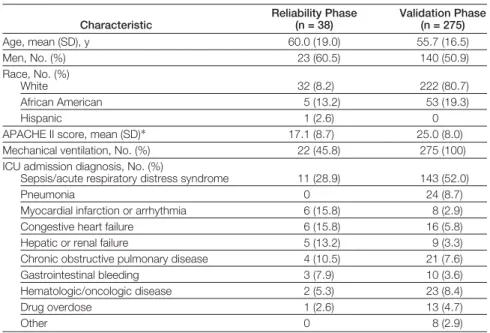
Eighty-six patients were admitted to the medical and coronary ICUs during the reliability testing phase, of whom 38 (44%) were enrolled. During the valid-ity testing phase, 325 consecutive pa-tients receiving mechanical ventilation were admitted to the ICU, of whom 275 (84.6%) were enrolled. Baseline char-acteristics from all 313 patients are pre-sented inTABLE2. At the time of en-rollment, 22 (46%) of the reliability cohort received mechanical ventila-tion, while all 275 of the validation co-hort received mechanical ventilation. The 2 cohorts had a high baseline se-verity of illness as measured by Acute Physiology and Chronic Health Evalu-ation II (APACHE II) scores (mean [SD], 17.1 [8.7] and 25.0 [8.0]), and had a wide variety of medical diagnoses.
RASS Interrater Reliability Testing Patients were evaluated on multiple oc-casions during their ICU stay. The mean (SD) RASS scores for each rater were as follows: nurse 1, −1.60 (2.16); nurse 2, −1.88 (2.20); intensivist, −1.61 (2.17); and neuropsychiatric expert, −1.50 (2.25). In 290 paired observations by nurses, both the RASS and the RS dem-onstrated excellent interrater
reliabil-ity (weighted , 0.91 and 0.94,
respectively), which were superior to GCS (weighted, 0.64;P⬍.001 for both comparisons). Using only the first ob-servation for each patient (n=38), the weightedvalues for the RASS, RS, and GCS were unchanged at 0.95, 0.95, and 0.65, respectively. The interrater reli-ability of the RASS was very high across nurses, intensivists, and neuropsychi-atric experts (TABLE3). Because reli-ability testing was expected to be most challenging for patients receiving me-chanical ventilation, we conducted
other analysis of interrater reliability re-stricted to the 22 patients who were intubated. The weightedfor the RASS between the 2 nurse ratings for pa-tients who were intubated was 0.88 (95% confidence interval, 0.78-0.97).
RASS Criterion, Construct, and Face Validity Testing
The relative frequency that the valida-tion cohort spent in each major arousal category for 1833 observations in 275 patients indicated that the patients who received mechanical ventilation spent about one third of their time either unarousable or in a deeply sedated state (RASS score, −5 or −4; n = 548 observations), one third in a moderate to light sedation state (RASS score, −3 to −1; n = 625 observations), and one third in an alert and calm state (RASS score, 0; n=619 observations). Sponta-neous agitation (RASS score,+1 to+4; n = 41 observations), which was rated prior to stimulation, was an uncom-mon state (⬍5%) found by the study nurses.
Criterion validity was tested in 411 paired observations in the validation cohort for the first 96 patients with a median of 3 observations per patient. The results of the RASS showed excellent dis-crimination between levels of conscious-ness as rated using the neuropsychiatric expert reference standard (P⬍.001 for all) (FIGURE1). Furthermore, as the neuro-psychiatric expert raters and RASS rat-ers independently tracked level of con-sciousness within patients over successive days of ICU care, RASS scores contin-ued to correlate with expert raters’ evalu-ations despite fluctuevalu-ations in conscious-ness (P⬍.001 for all) (TABLE4). When comparing patients over the course of their ICU stay, the reference standard rat-ings of abnormal levels of conscious-ness (ie, delirium, stupor, and coma) compared similarly with RASS ratings regardless of intubation status: delirium (−2 median RASS score if intubated vs –2 median RASS score if extubated, P=.18), stupor (−3 vs –3,P=.92), or coma (−5 vs –5,P=.62) (Figure 1).
Five methods were used to test con-struct validity: (1) RASS was correlated
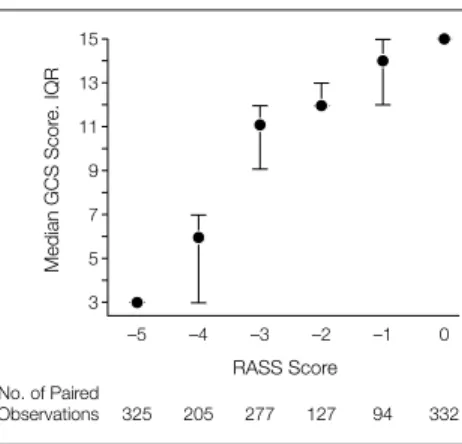
with onset of inattention using an atten-tion-screening examination, the piv-otal criterion for delirium (r= 0.78, P⬍.001). (2) To compare the RASS to the GCS, 1360 paired observations (among 275 patients with a median of 3 observations per patient) showed excellent correlation and discrimina-tion (r=0.91,P⬍.001) (FIGURE2). The RASS also correlated with the GCS over time (P⬍.001), and the odds ratio of hav-ing higher RASS scores with greater GCS scores was 1.39 (P⬍.001). (3) We com-pared RASS scores with the cumulative lorazepam, propofol, fentanyl, and mor-phine dose over the 8-hour and 24-hour periods prior to RASS assessments (TABLE5). As described in the “Meth-ods” section, midazolam dose was con-verted into lorazepam equivalents for the purposes of these analyses. As an example of the dose-response
relation-Figure 1.Criterion Validity: Richmond Agitation-Sedation Scale (RASS) Scores vs Reference Standard Evaluations Performed by a Neuropsychiatric Expert
0
–1
–2
–3
–4
–5
No. of Paired Observations
Neuropsychiatric Expert Rating
Median RASS Scor
e, IQR
Coma
127
Stupor
93
Delirium
80
Normal
111
Neuropsychiatric experts (ie, a geriatric psychiatrist or a geriatric neuropsychologist) rated patients’ levels of consciousness as normal, delirium, stuporous, or coma-tose. Data (median [interquartile range][IQR]) are from 411 paired observations in the first 96 patients in the validation cohort and demonstrated significant discrimi-nation between each level of consciousness (allP⬍.001). Table 3.Interrater Reliability of the Richmond Agitation-Sedation Scale
Rater
No. of Paired Observations
Weighted (95% Confidence Interval) Nurse 1 vs nurse 2 290 0.91 (0.86-0.95) Nurse 1 vs intensivist 127 0.79 (0.61-0.88) Nurse 1 vs neuropsychiatric expert 150 0.82 (0.67-0.90) Nurse 2 vs intensivist 128 0.88 (0.76-0.94) Nurse 2 vs neuropsychiatric expert 151 0.84 (0.71-0.92) Neuropsychiatric expert vs intensivist 129 0.91 (0.82-0.96)
Table 2.Patient Characteristics at Enrollment
Characteristic
Reliability Phase (n = 38)
Validation Phase (n = 275) Age, mean (SD), y 60.0 (19.0) 55.7 (16.5) Men, No. (%) 23 (60.5) 140 (50.9) Race, No. (%)
White 32 (8.2) 222 (80.7)
African American 5 (13.2) 53 (19.3)
Hispanic 1 (2.6) 0
APACHE II score, mean (SD)* 17.1 (8.7) 25.0 (8.0) Mechanical ventilation, No. (%) 22 (45.8) 275 (100) ICU admission diagnosis, No. (%)
Sepsis/acute respiratory distress syndrome 11 (28.9) 143 (52.0)
Pneumonia 0 24 (8.7)
Myocardial infarction or arrhythmia 6 (15.8) 8 (2.9) Congestive heart failure 6 (15.8) 16 (5.8) Hepatic or renal failure 5 (13.2) 9 (3.3) Chronic obstructive pulmonary disease 4 (10.5) 21 (7.6) Gastrointestinal bleeding 3 (7.9) 10 (3.6) Hematologic/oncologic disease 2 (5.3) 23 (8.4) Drug overdose 1 (2.6) 13 (4.7)
Other 0 8 (2.9)
Abbreviations: APACHE II, Acute Physiology and Chronic Health Evaluation II; ICU, intensive care unit.
ship between psychoactive medication and RASS scores, correlative data for lor-azepam equivalents over 8 hours prior to RASS assessment are shown in
FIGURE3. In contrast to the benzodiaz-epines, correlations between RASS and fentanyl and morphine were per-formed and presented as separate analy-ses because of significantly different results for these 2 agents (Table 5). (4) Of 185 planned extubations in the 275 validation cohort patients, 19 (10.3%) patients required reintubation within 48 hours. Of these planned extubations, 137 had RASS scores available during the shift prior to extubation, of which 13 (9.5%) were unsuccessful. The median (inter-quartile range) RASS score for
success-ful extubation was−2 (−3 to 0) and for unsuccessful extubation was − 3 (−3 to−2) (P=.07). (5) From the validation cohort, a random sampling of 124 patients was monitored over 321 days in the ICU with the BIS-XP EEG. The RASS scores correlated with the BIS-XP EEG results over the range of levels of consciousness (r=0.64,P⬍.001 for all) (FIGURE4). For patients in 3 different, clinically relevant states (ie, spontane-ously awake and alert [RASS score, 0], arousable with verbal stimulation [RASS score, –1 to –3], and arousable only with physical stimulation or not at all [RASS score, –4 or –5]), the median (inter-quartile range) EEG values were 96.8 (90.0-97.6), 69.0 (57.6-87.6), and 57.4 (46.4-66.3), respectively.
Face validity was demonstrated via a survey of 26 bedside critical care nurses. According to the results of the survey, 77% of the nurses agreed or strongly agreed that the RASS levels for agita-tion were clinically relevant and easy to score. Regarding the construct of the se-dation assessment, 92% agreed or strongly agreed with the “verbal fol-lowed by physical stimulation” scoring scheme, 69% agreed or strongly agreed that the RASS improved communica-tion among the managing team, and 81% agreed or strongly agreed this instru-ment provided a consensus target for goal-directed delivery of sedative and an-algesic medications.
COMMENT
This investigation was designed to test a very brief yet structured approach to assessment of patient sedation in the ICU for reliability and validity, using a new,
broader, and more rigorous set of vali-dation procedures than those previ-ously studied. The RASS demonstrated strong interrater reliability and crite-rion, construct, and face validity. In pre-vious work, Sessler et al29 demon-strated strong interrater reliability of RASS between 5 nurse, pharmacist, and physician investigators in 192 consecu-tive patients who did or did not receive mechanical ventilation in surgical, neu-roscience, and medical ICUs. The au-thors further documented strong reli-ability between a nurse educator and 27 bedside nurses in more than 100 pa-tient observations. Building on these data, the present study included the use of neuropsychiatric experts as reference standard raters of patients’ levels of con-sciousness to demonstrate criterion va-lidity, 5 methods of confirming con-struct validity, and incorporating views of bedside critical care nurses for face va-lidity.
In keeping with the stated priorities of recent critical appraisals of seda-tion scales,1,20-22,26the present report shows the RASS to be valid over suc-cessive days in individual patients, to correlate with the administered dose of sedative and analgesic drugs as well as brain wave activity, and confirms that it is a reliable and valid measurement for patients who were and were not re-ceiving mechanical ventilation.
This report and that by Sessler et al29 are complementary and constitute an evaluation of the RASS in more than 600 patients, both having avoided selec-tion bias present in other investiga-tions by enrolling consecutive pa-tients. The large sizes of these 2 investigations, combined with the strong reliability of the instrument and the scope of our validity testing, lend strong credibility for the use of the RASS in patient management.
Strengths of the RASS
The RASS itself has several important strengths that warrant comment. Un-like other recently validated instru-ments,23,25the RASS separates verbal from physical stimulation so that the pa-tient’s level of arousal may be graded ac-Figure 2.Construct Validity: Richmond
Agitation-Sedation Scale (RASS) Scores vs Glasgow Coma Scale (GCS) Scores
15
7 9 11 13
5
3
No. of Paired Observations
RASS Score
Median GCS Scor
e. IQR
–1
94 –2
127 –3
277 –4
205 –5
325
0
332
Data (median [interquartile range] [IQR]) are from a total of 1360 observations and demonstrate excel-lent correlation (r=0.91,P⬍.001) and discrimination (all pairs withP⬍.001). Median GCS for RASS+1 to+4 (n=27) was 13 (IQR 10-14) (data not shown). Gen-eralized estimating equations analysis was used to in-dependently evaluate association within patients over successive days of intensive care and yielded a similar result (odds ratio, 2.3;P⬍.001).
Table 4.Neuropsychiatric Expert Rating vs Richmond Agitation-Sedation Scale (RASS) Rating: Tracking Level of Consciousness Over Time Within Patients*
Reference Standard Neuropsychiatric Rating
Odds Ratios of Higher RASS Score
Over Time at Given Level of Consciousness PValue
Normal ⬎100 ⬍.001
Delirium 36 ⬍.001
Stupor 9 ⬍.001
Coma 1 (reference) . . .
*To understand correlations between repeated observations over time, this generalized estimating equations analysis would be interpreted as follows: using coma as a reference point (ie, odds ratio of 1), patients rated by the neuropsy-chiatric experts as stuporous, delirious, or normal were 9, 36, and⬎100 times more likely, respectively, to have higher RASS scores across time compared with patients whose ratings remained comatose (eg, comparing 2 initially tose patients with RASS scores of −5, one of whom transitioned to delirium on day 2 while the other remained coma-tose, the odds of the delirious patient having a higher RASS score would be 36 times greater).
cording to the potency of the stimu-lus.28It has been common to consider sedation scales valid as long as they de-lineate levels of arousal (considered a sur-rogate of consciousness).20,23-25,49 Con-sciousness, however, is classically defined as the combination of a person’s level of arousal plus the content of conscious-ness (eg, delirium).30Only recently has the ICU community begun to focus on delirium as an essential element of pa-tient comfort and outcome.8,50,51 Impor-tantly, a key feature of delirium is the presence or absence of inattention, which can be measured in part by the ability of a person to maintain eye contact. In-deed, this study demonstrated that RASS scores correlated with the onset of inat-tention and delirium. These 2 main strengths of the RASS assessment pro-cedure (ie, completely distinguishing ver-bal from physical stimulation, and rely-ing heavily on duration of eye contact) complement the recently developed de-lirium monitoring instrument, the CAM-ICU.31,32Using such a combined neuro-logic monitoring schema for patients receiving mechanical ventilation in fu-ture trials may offer a significant ad-vance in our ability to measure short- and long-term cognitive outcomes of goal-directed delivery of sedative and anal-gesic medications or newer pharmaco-logical agents with procognitive advantages over traditionally used agents in treating delirium.8,52,53
Thevalues between nurses’ and be-tween physicians’ paired assessments were both 0.91, and the values be-tween any nurse and physician pair
ranged from 0.79 to 0.88. While all very high, the subtle differences in these val-ues likely reflect that time elapsed be-tween the nurse and physician assess-ments. The fact that the correlations were high despite elapsed time between the nurses’ and physicians’ assessments makes the data even more compelling.
Study Limitations and Areas for Future Research
We correlated RASS scores with quan-tity (ie, dose) of sedative and analgesic medications and found highly signifi-cant yet moderately to low correlation coefficients. Considering the broad dis-tribution of drug dose variables and the numerous other covariates affecting con-sciousness (eg, underlying illness, elec-trolytes, hypoxemia, and other pharma-cological agents), it would be unrealistic to expect RASS correlation with actual dose to be any higher. Similar to other reports on risk factors for delirium,47,54 we found disparate correlation coeffi-cients between RASS levels and differ-ent drugs. For example, the highly sig-nificant correlations between RASS levels vs lorazepam or fentanyl (bothP⬍.001) contrast sharply with that of morphine (P=.10). Future investigations should at-tempt to determine the relative impor-tance of other covariates contributing to level of consciousness, such as pa-tients’ age, sex, race, disease state, body mass index, the duration and cumula-tive drug levels of narcotics and analge-sics over days of ICU care, and pharma-cological interindividual variability based on drug metabolism and transport.
Most available evidence regarding sedatives and analgesics in ICU pa-tients indicates that it may be less im-portant which drugs are delivered than their proper titration using goal-directed delivery to optimize patient comfort while avoiding complications, such as prolonged mechanical ventila-tion or reintubaventila-tion.1,3,8,55For example, recent data showed that deeper levels of sedation at the time of extubation, mea-sured using the RASS, were associated with a higher likelihood of reintuba-tion.56Future investigations should evaluate the usefulness of this tool in single or multicenter clinical trials, lo-Figure 3.Richmond Agitation-Sedation Scale (RASS) Scores vs Cumulative Lorazepam Equivalent Dose
14
12
10
8
6
4
2
0
No. of Paired Observations
RASS Score
Lorazepam Equivalents, mg
(Median, IQR)
–1
14 –2
30 –3
64 –4
69 –5
85
0
27
Benzodiazepine doses administered to patients over the 8-hour period prior to RASS assessment are shown (r=−0.31, P⬍.001). Benzodiazepines are expressed in lorazepam equivalents. Data on individual correla-tions between RASS vs lorazepam, propofol, fen-tanyl, and morphine for both 8-hour and 24-hour pe-riods are shown in Table 5. Data on RASS scores greater than 0 were not shown because of insufficient sample size (n=5 for RASS⬎0).
Table 5.Correlation Coefficients Between RASS Scores and Sedative and Analgesic Drug Equivalents*
Sedative or Analgesic Equivalents
8 Hours Prior to RASS 24 Hours Prior to RASS
No. of Observations
Median Dose (IQR), mg
RASS vs Drug Dose
No. of Observations
Median Dose (IQR), mg
RASS vs Drug Dose
Spearmanr P
Value Spearmanr
P
Value Lorazepam administration 294 4 (2-8) −0.31 ⬍.001 494 5 (2-12) −0.25 ⬍.001 Propofol administration 29 1269 (675-1896) −0.32 .09 36 3315 (556-5814) −0.40 .01 Fentanyl administration 247 1.6 (0.75-2.4)† −0.25 ⬍.001 295 3 (0.9-6.5)† −0.22 ⬍.001 Morphine administration 160 12 (0.75-2.4) −0.13 .10 229 14 (0.9-6.5) −0.12 .08
Abbreviations: IQR, interquartile range; RASS, Richmond Agitation-Sedation Scale.
*Data are from the validation phase cohort. See Figure 3 for a detailed example of the dose-response relationship between RASS and 1 class of these agents (using lorazepam). Similar
Pvalues were observed using generalized estimating equations to adjust nonindependent observations within patients.
†Fentanyl is commonly reported to be 100 times more potent than morphine.33Therefore, the median morphine equivalent dose given to these patients (as fentanyl) would equate to
cal or national quality-improvement col-laboratives,57and different manage-ment strategies based on goal-directed delivery.
Some patients are sedated but subse-quently demonstrate agitation follow-ing stimulation,5,20which represents an-other limitation of this investigation. Since we only recorded a single RASS score per patient assessment, we do not know the number of times patients were initially sedated and assigned negative RASS scores, only to become agitated minutes later. It may be surprising to some that so few patients in this inves-tigation and that by Sessler et al29were found in the vigilant or agitated state, which we believe reflects a recurring theme of oversedation in critical care.2,10,17On the other hand, underse-dation and inadequate relief of symp-toms could lead to problems such as un-addressed pain or anxiety,7,58 and ultimately posttraumatic stress disor-der.59-62The fact that the RASS has an expanded set of clinically relevant scores for tracking both agitation and seda-tion makes it well suited for future in-vestigators to help better understand the clinical implications of such crossover states.
While the RASS demonstrated excel-lent face validity among our nurses, re-ports of ongoing large-scale implemen-tation projects using the RASS will aid in our understanding of how to effect sustained change in the practice pat-terns of ICU nurses, therapists, phar-macists, and physicians using such in-struments. Preliminary work in this area has already been reported from aca-demic settings,63but should be forth-coming from community settings as well.
Lastly, as a barometer of brain wave activity, we used BIS-XP EEG monitor-ing in a method comparable with that used by other investigators.27,42,44The BIS-XP used in this investigation was an advance over that of earlier versions of BIS42because of improved screening of an electromyographic artifact.43,64 How-ever, the overlapping BIS values at dif-ferent RASS levels (Figure 4) may be the result of the broad distribution of psy-choactive drugs administered to this co-hort and their interindividual effects on brain wave activity or merely a limita-tion in this emerging EEG technology.
Conclusion
The RASS, which takes less than 20 sec-onds to perform and requires minimal training,29has been shown to be highly reliable among multiple types of health care professionals. The RASS has an ex-panded set of scores at pivotal levels of sedation that are determined by pa-tients’ response to verbal vs physical stimulation, which will help the clini-cian in titrating medications. This ex-tensive body of new data, with a vari-ety of unique approaches to assess an agitation-sedation scale, expands the usefulness of such instruments for pa-tient care. In accordance with recent rec-ommendations, health care profession-als should use valid and reliable instruments such as the RASS to imple-ment sedative and analgesic drug deliv-ery protocols for patients receiving me-chanical ventilation. The driving unmet need for goal-directed sedation prac-tice has been met—now an instrument has been shown to detect variations in level of consciousness over time. Taken
together, advances in neurologic assess-ment provided by the RASS and the CAM-ICU should lead to better charac-terization of acute brain dysfunction as an organ failure, reductions in the ran-dom variation with which patients’ seda-tives are currently managed, and appro-priate interventions aimed at prevention or reversal of acute brain dysfunction.
Author Affiliations:Department of Medicine, Divi-sion of Allergy, Pulmonary, and Critical Care Medi-cine (Drs Ely, Thomason, Wheeler, and Bernard, and Ms Truman), and Geriatric Psychiatry and Neurosci-ence (Drs Gordon and Margolin), Center for Health Services Research (Drs Ely, Shintani, Dittus, Gordon, Speroff, and Ms Truman) of Vanderbilt University School of Medicine, Nashville, Tenn; Geriatric Re-search Education and Clinical Center of the Veterans Administration Tennessee Valley Healthcare System, Nashville (Drs Ely, Gordon, Speroff, and Dittus); De-partment of Preventive Medicine, Division of Biosta-tistics (Dr Gautam), Division of Quality and Data Man-agement (Dr Francis), St Vincent Hospital Health System, Indianapolis, Ind; Department of Internal Medi-cine, Virginia Commonwealth University, Richmond (Dr Sessler).
Author Contributions: Study concept and design:Ely, Truman, Wheeler, Gordon, Francis, Margolin, Sessler, Dittus, Bernard.
Acquisition of data:Ely, Truman, Wheeler, Gordon, Francis, Margolin, Bernard.
Analysis and interpretation of data:Ely, Truman, Shintani, Thomason, Wheeler, Speroff, Gautam, Margolin, Sessler, Dittus, Bernard.
Drafting of the manuscript:Ely, Truman, Shintani, Thomason.
Critical revision of the manuscript for important intel-lectual content:Ely, Truman, Shintani, Thomason, Wheeler, Gordon, Francis, Speroff, Gautam, Margolin, Sessler, Dittus, Bernard.
Statistical expertise:Ely, Shintani, Speroff, Gautam. Obtained funding: Ely, Dittus, Bernard.
Administrative, technical, or material support:Ely, Truman, Thomason, Wheeler, Gordon, Francis, Margolin, Dittus, Bernard.
Study supervision: Ely, Wheeler, Dittus, Bernard.
Funding/Support: Dr Ely is a recipient of the AFAR Phar-macology in Aging Grant and the Paul Beeson Faculty Scholar Award from the Alliance for Aging Research, a recipient of a K23 from the National Institutes of Health (AG01023-01A1) and the Geriatric Research Educa-tion and Clinical Center (GRECC). Aspect Medical Sys-tems Inc provided the necessary equipment and finan-cial support to obtain the electroencephalographic measurements, but was not involved with patient as-sessments, data collection. Aspect did have access to and helped in analysis of the data for the BIS-XP-EEG figure.
Acknowledgment: We thank the tireless and de-voted nursing staff and respiratory care practitioners in our ICU, who constantly strive to improve the delivery of care for our critically ill patients.
REFERENCES
1. Ostermann ME, Keenan SP, Seiferling RA, Sib-bald W. Sedation in the intensive care unit: a system-atic review.JAMA. 2000;283:1451-1459.
2.Kress JP, Pohlman AS, O’Connor MF, Hall JB. Daily interruption of sedative infusions in critically ill pa-tients undergoing mechanical ventilation.N Engl J Med. 2000;342:1471-1477.
3.Young C, Knudsen N, Hilton A, Reves JG. Seda-Figure 4.Richmond Agitation-Sedation
Scale (RASS) Scores vs Bispectral-XP Electroencephalography (BIS-XP EEG)
100
80
60
40
20
0
No. of Paired Observations
RASS Score
Median BIS-XP EEG
Scor
e, IQR
–1
31 –2
47 –3
92 –4
64 –5
91
0
57
The algorithm for BIS-XP EEG was used to measure brain wave activity in the fronto-temporal leads of 124 patients who received mechanical ventilation over 382 days. The RASS scores correlated with the electroen-cephalography (EEG) scores (r=0.64) over a range of levels of arousal from awake and alert to coma (P⬍.001). The (median [interquartile range] [IQR]) EEG values from 12 RASS evaluations of 9 agitated pa-tients was 88.1 (79.5-97.3;P⬍.001 for all).
tion in the intensive care unit.Crit Care Med. 2000; 28:854-866.
4.Shapiro BA, Warren J, Egol A, et al, Society of Criti-cal Care Medicine. Practice parameters for intrave-nous analgesia and sedation for adult patients in the intensive care unit: an executive summary.Crit Care Med. 1995;23:1596-1600.
5.Fraser G, Prato BS, Riker R, Berthiaume D, Wilkins ML. Frequency, severity, and treatment of agitation in young versus elderly patients in the ICU. Pharmaco-therapy. 2000;20:75-82.
6.Joint Commission on Accreditation of Healthcare Or-ganizations ( JCAHO).Comprehensive Accreditation Manual for Hospitals: The Official Handbook. Oak-brook Terrace, Ill: JCAHO; 2003.
7.Payne JP, Bru O, Bosson JL, et al. Assessing pain in critically ill sedated patients by using a behavioral pain scale.Crit Care Med. 2001;29:2258-2263.
8.Jacobi J, Fraser GL, Coursin DB, et al. Clinical prac-tice guidelines for the sustained use of sedatives and analgesics in the critically ill adult.Crit Care Med. 2002; 30:119-141.
9.Park G, Coursin D, Ely EW, et al. Balancing seda-tion and analgesia in the critically ill.Crit Care Clin. 2001; 17:1015-1027.
10.Kollef MH, Levy NT, Ahrens T, et al. The use of continuous IV sedation is associated with prolonga-tion of mechanical ventilaprolonga-tion.Chest. 1999;114:541-548.
11.Wheeler AP. Sedation, analgesia, and paralysis in the intensive care unit.Chest. 1993;104:566-577.
12.Bair N, Bobek MB, Hoffman-Hogg L, et al. Intro-duction of sedative, analgesic, and neuromuscular block-ing agent guidelines in a medical intensive care unit: physician and nurse adherence.Crit Care Med. 2000; 28:707-713.
13.Slomka J, Hoffman-Hogg L, Mion LC, et al. Influ-ence of clinicians’ values and perceptions on use of clini-cal practice guidelines for sedation and neuromuscu-lar blockade in patients receiving mechanical ventilation. Am J Crit Care. 2000;9:412-418.
14.Mascia MF, Koch M, Medicis JJ. Pharmacoeco-nomic impact of rational use guidelines on the provi-sion of analgesia, sedation, and neuromuscular block-ade in critical care.Crit Care Med. 2000;28:2300-2306.
15.Nasraway SA, Jacobi J, Murray MJ, Lumb PD. Se-dation, analgesia, and neuromuscular blockade of the critically ill adult: revised clinical practice guidelines.Crit Care Med. 2002;30:117-118.
16.Ramsay M, Savege TM, Simpson ER, Goodwin R. Controlled sedation with aphaxalone-alphadolone.BMJ. 1974;2:656-659.
17.Brook AD, Ahrens TS, Schaiff R, et al. Effect of a nursing implemented sedation protocol on the dura-tion of mechanical ventiladura-tion.Crit Care Med. 1999; 27:2609-2615.
18.MacIntyre NR, Cook DJ, Ely EW, et al. Evidence-based guidelines for weaning and discontinuing ven-tilatory support.Chest. 2001;120(suppl 6):375S-395S.
19.Ely EW, Meade M, Haponik EF, et al. Mechanical ventilator weaning protocols driven by non-physician health care professionals: evidence-based clinical prac-tice guidelines.Chest. 2001;120(suppl):454S-463S.
20.Hansen-Flaschen J, Cowen J, Poloman RC. Be-yond the Ramsay scale: need for a validated measure of sedating drug efficacy in the intensive care unit.Crit Care Med. 1994;22:732-733.
21.Lieberman J, Trember KK. Sedation: if you don’t know where you are going, any road will get you there. Crit Care Med. 1999;27:1395-1396.
22.Wittbrodt ET. The ideal sedation assessment tool:
an elusive instrument.Crit Care Med. 1999;27:1384-1385.
23.Devlin JW, Boleski G, Mlynarek M, et al. Motor activity assessment scale: a valid and reliable seda-tion scale for use with mechanically ventilated pa-tients in an adult surgical intensive care unit.Crit Care Med. 1999;27:1271.
24.Ambuel B, Hamlett KW, Marx CM, Blumer JL. As-sessing distress in pediatric intensive care environ-ments: the COMFORT scale.J Pediatr Psychol. 1992; 17:95-109.
25.Riker R, Picard JT, Fraser G. Prospective evalua-tion of the sedaevalua-tion-agitaevalua-tion scale for adult critically ill patients.Crit Care Med. 1999;27:1325-1329.
26.De Jonghe B, Cook D, Appere-De-Vecchi C, Guy-att G, Meade M, Outin H. Using and understanding sedation scoring systems: a systematic review. Inten-sive Care Med. 2000;26:275-285.
27.Riker RR, Fraser GL, Simmons LE, Wilkins ML. Vali-dating the sedation-agitation scale with the bispec-tral index and visual analog scale in adult ICU pa-tients after cardiac surgery.Intensive Care Med. 2001; 27:853-858.
28.Sessler CN, Grap MJ, Brophy GM. Multidisci-plinary management of sedation and analgesia in criti-cal care.Semin Respir Crit Care Med. 2001;22:211-225.
29.Sessler CN, Gosnell M, Grap MJ, et al. The Rich-mond Agitation-Sedation Scale: validity and reliability in adult intensive care patients.Am J Respir Crit Care Med. 2002;166:1338-1344.
30.Plum F, Posner J.The Diagnosis of Stupor and Coma. 3rd ed. Philadelphia, Pa: FA Davis Co; 1980.
31.Ely EW, Margolin R, Francis J, et al. Evaluation of delirium in critically ill patients: validation of the Con-fusion Assessment Method for the Intensive Care Unit (CAM-ICU).Crit Care Med. 2001;29:1370-1379.
32.Ely EW, Inouye SK, Bernard GR, et al. Delirium in mechanically ventilated patients: validity and reliability of the Confusion Assessment Method for the Intensive Care Unit (CAM-ICU).JAMA. 2001;286:2703-2710.
33.Cammarano WB, Drasner K, Katz J. Pain control, sedation, and use of muscle relaxants. In: Hall JB, Schmidt GA, Wood LD, eds.Principles of Critical Care Medicine. New York, NY: McGraw Hill Publishers; 1998:90-97.
34.Teasdale G, Jennett B. Assessment of coma and im-paired consciousness: a practical scale.Lancet. 1974; 1:81-84.
35.Carmines EG, Zeller RA.Reliability and Validity. Newberry Park, Calif: Sage Publications; 1979.
36. Fleiss JL.Statistical Methods for Rates and Pro-portions. 2nd ed. New York, NY: Wiley & Sons; 1981.
37.American Psychiatric Association.Diagnostic and Statistical Manual of Mental Disorders, Fourth Edi-tion.Washington, DC: American Psychiatric Associa-tion; 1994.
38.Sacket DL, Haynes RB, Guyatt GH, et al.Clinical Epidemiology: A Basic Science for Clinical Medicine. 2nd ed. Boston, Mass: Little Brown & Co; 1991.
39.Parone SV, Tsuang MT. Measuring diagnostic ac-curacy in the absence of a “gold standard.”Am J Psy-chiatry. 2002;151:650-657.
40.Rosow C, Manberg PJ. Bispectral index monitor-ing.Anesthesiol Clin North Am. 2001;19:947-966.
41.Johansen JW, Sebel PS. Development and clinical application of electroencephalographic bispectrum moni-toring.Anesthesiology. 2002;2000:1336-1344.
42.Nasraway SA, Wu EC, Kelleher RM, Yasuda CM, Donnelly AM. How reliable is the Bispectral Index in critically ill patients? a prospective, comparative, single-blinded observer study.Crit Care Med. 2002;30:1483-1487.
43. Ely EW, Truman B, May L, et al. Validating the bispectral EEG for ventilated ICU patients.Am J Respir Crit Care Med. 2001;163:A899.
44.Frenzel D, Greim CA, Sommer C, Bauerle K, Roewer N. Is the bispectral index appropriate for monitoring the sedation level of mechanically ventilated surgical ICU patients?Intensive Care Med. 2002;28:178-183.
45. Knaus WA, Draper EA, Wagner DP, Zimmerman JE. APACHE II: a severity of disease classification sys-tem.Crit Care Med. 1985;13:818-829.
46. Trujillo KA, Akil H. Opiate tolerance and depen-dence: recent findings and synthesis.New Biol. 1991; 3:915-923.
47.Vinik HR, Kissin I. Rapid development of toler-ance to analgesia during remifentanil infusion in hu-mans.Anesth Analg. 1998;86:1307-1311.
48. Eilers H, Philip LA, Bickler PE, McKay WR, Sch-umacher MA. The reversal of fentanyl-induced toler-ance by administration of “small dose” ketamine.Anesth Analg. 2001;93:213-214.
49. Eappen T, Wittbrodt E, Fuchs B, et al. Reliability of four sedation assessment scales.Crit Care Med. 1999; 27:A135.
50. Bergeron N, Dubois MJ, Dumont M, Dial S, Skro-bik Y. Intensive Care Delirium Screening Checklist: evalu-ation of a new screening tool.Intensive Care Med. 2001; 27:859-864.
51. Dubois MJ, Bergeron N, Dumont M, Dial S, Skro-bik Y. Delirium in an intensive care unit: a study of risk factors.Intensive Care Med. 2001;27:1297-1304.
52. Ely EW, Stephens RK, Jackson JC, et al. Current opinions regarding delirium in the ICU: a survey of 915 healthcare professionals.Crit Care Med. In press.
53. Carnes M, Howell T, Rosenberg M, et al. Physi-cians vary in approaches to the clinical management of delirium.J Am Geriatr Soc. 2003;51:234-239.
54.Marcantonio ER, Juarez G, Goldman L, et al. The relationship of postoperative delirium with psychoac-tive medications.JAMA. 1994;272:1518-1522.
55. Hall RI, Sandham D, Cardinal P, et al. Propofol vs midazolam for ICU sedation: a Canadian multicenter randomized trial.Chest. 2001;119:1151-1159.
56. Coller Z, Shintani A, Truman B, et al. The impact of delirium in the ICU on outcomes of mechanical ven-tilation.Am J Respir Crit Care Med. 2003;167:A970.
57. Brattebo G, Hofoss D, Flaatten H, et al. Effect of a scoring system and protocol for sedation on duration of patients’ need for ventilator support in a surgical in-tensive care unit.BMJ. 2002;324:1386-1389.
58. Hall-Lord ML, Larsson G, Steen B, Sweden K. Pain and distress among elderly intensive care unit pa-tients: comparison of patients’ experiences and nurses’ assessments.Heart Lung. 1998;27:123-132.
59. Schelling G, Stoll C, Haller M, et al. Health-related quality of life and posttraumatic stress disorder in survivors of the acute respiratory distress syndrome. Crit Care Med. 1998;26:651-659.
60. Michaels AJ, Michaels CE, Smith JS, et al. PTSD in critical care.J Trauma. 2000;48:841-850.
61. Rotondi AJ, Chelluri L, Sirio C, et al. Patients rec-ollections of stressful experiences while receiving pro-longed mechanical ventilation in an intensive care unit. Crit Care Med. 2002;30:746-752.
62. Scragg P, Jones A, Fauvel N. Psychological prob-lems following ICU treatment.Anaesthesia. 2001;56: 9-14.
63. Truman B, Shintani A, Jackson J, et al. Implemen-tation of the SCCM guidelines for sedation and de-lirium monitoring in the ICU.Am J Respir Crit Care Med. 2003;167: A969.