UNIVERSIDAD
TÉCNICA
PARTICULAR
DE
LOJA
La Universidad Católica de Loja
ESCUELA DE CIENCIAS DE LA EDUCACION MENCIÓN INGLÉS
MODALIDAD ABIERTA Y A DISTANCIA
A DESCRIPTIVE ANALYSIS OF ANGLICISMS
USED IN ECUADORIAN MAGAZINES
Research done in order to achieve the Bachelor’s Degree in Teaching English as a Foreign Language AUTHOR:
Calva Abad Ana María
ADVISOR:
Mgs. Luz Castillo Cuesta
CENTRO UNIVERSITARIO VILLAFLORA QUITO
Certification
Mgs. Luz Castillo Cuesta
CERTIFIES THAT:
This research work has been thoroughly revised by the graduation
committee. Therefore, authorizes the presentation of this thesis
which complies with all the norms and internal requirements of the
Universidad Técnica Particular de Loja.
Loja, March 2011
………..
Mgs. Luz Castillo Cuesta
Contrato de cesión de derechos de tesis de grado
“Yo, Ana María Calva Abad declaro ser autora del presente trabajo y
eximo expresamente a la Universidad Técnica Particular de Loja y
a sus representantes legales de posibles reclamos o acciones
legales.
Adicionalmente declaro conocer y aceptar la disposición del art. 67
del Estatuto Orgánico de la Universidad Técnica Particular de Loja
que en su parte pertinente textualmente dice: “formar parte del
patrimonio de la Universidad la propiedad intelectual de
investigaciones, trabajos científicos o técnicos y tesis de grado que
se realicen a través, o que el apoyo financiero, académico o
institucional (operativo) de la universidad”
………
Ana María Calva A.
AUTHORSHIP
The thoughts, ideas opinions and the information obtained through
this research are the only responsibility of the author.
Date: March, 2011
……….………….
Ana Maria Calva Abad
Dedication
I would like to dedicate this thesis with all my love
to GOD that gave me the opportunity of living to have a beautiful
family.
With all my love and respect to my husband, who was always
supporting me in everything, I am sure that without his
encouragement and patience, I would have never achieved this.
To my children, who were supportive and gave me their time and
patience without complaining when I was sitting down studying for
a long time.
To my mother that even though she is far from me, I know she is
always praying to God for me in order to get a lot of blessing.
Finally, I want to thank very much to my director, Mgs. Luz
Castillo, who had a lot of patience and was always willing to help
Contents
Certification ii
Contrato de cesión de derechos de tesis de grado iii
Authorship iv
Dedication v
Abstract 1
Introduction 2
Methodology 6
Discussion Literature Review 8
Results 24
Description, Analysis, and Interpretation of Results 45
Conclusions 73
References 75
Annexes 80
Abstract
The theme of this current research is A Descriptive Analysis of
Anglicisms in Ecuadorian Magazines, which pretends to analyze the
use of anglicisms in Spanish written language in Ecuador.
This study was based on three variables: cultural magazines,
scholarly magazines, and general interest magazine. It was carried out
in Quito Ecuador.
The methods used in this research were Qualitative and
Quantitative.
Once the variables were selected, it was mandatory to read
through them to find the anglicisms. Then, all the words selected had
to be verified in a dictionary to know whether they were anglicisms or
not. The dictionaries used to verify the anglicisms were
Merriam-Webster, and Diccionario de la Real Academia de la Lengua (DRAE).
Finally, I developed a linguistic and comparative analysis of
each anglicism regarding morphological, syntactic and semantic
aspects.
As a result of this study, I could figure out that the language is
constantly changing around the world; so, new words appear, and they
are used as proper, but in fact, they have another origin, as in the case
‐ ‐
Introduction
This research is focused on “A Descriptive Analysis of Anglicisms
in Ecuadorian Magazines”. Because of a great use of foreign words in
the Spanish written language in our country, it is worth making a deep
investigation to know how English is influencing our language in terms
of anglicisms.
Having as a fact the use of anglicisms in written language in
Ecuador, the general objective of this work is to research on the
linguistic phenomenon of anglicisms used in Ecuadorian magazines.
Because of the phenomenon of the use of anglicisms in written
language in our country, it is worth to investigate how the anglicisms
are formed to fit in Spanish language. Taking into account that
English is the most common language around the world and this
permits the communication among people from different cultures and
places, it is important to know the changes a word suffers regarding
syntactic, semantic and morphological aspects of the language to
become an anglicism.
The variables proposed for this study were cultural magazines,
scholarly magazines and general interest magazines, which were
written and used in Ecuador.
Once the words were chosen from the magazines, the next step
use of dictionaries was mandatory. So, the dictionaries used were:
Webster dictionary and RAE dictionary. The dictionaries were a rich
source of information required to do the descriptive analysis of the
anglicisms.
Another resource that helped me to do a comparative analysis of
anglicisms was the use of a table, which contains the name of the
magazine where they were found, the anglicisms, the context in which
they are used, the lexical category, the number of repetitions for each
anglicism, the heading of the article, as well as the page in which the
Anglicism was found.
In addition, before doing this study it was necessary to research
previous studies about anglicisms. So, the studies that supported this
current research belong to the authors: Rabago, and Romero (2008),
Pratt, (1980: 229), Rodriguez and Lillo, 1997 among others. These
studies gave me the clues to understand the way in which anglicisms
are formed and used into our language.
Since all of these words are well accepted by the society without
any problem, it is easy to demonstrate that a language is really
transformed when new words are used in written media.
The beneficiaries of this study will be the Universidad Técnica
Particular de Loja whose interest in carrying out linguistics
‐ ‐
programs and its distance students who require a research study in
order to complete their program and obtain their Bachelor degree as
teachers of English as a Foreign Language. Also, future professionals
as translators and marketing experts will get advantage of this study
about anglicisms.
One thing that is important to mention is the difficulty to find
a cultural magazine which contains enough words to be analyzed as
anglicism. I think it was the greatest limitation found in this study.
Finally, regarding the specific objectives of this study, I can
say that they were achieved in a ninety nine percent as it is shown
above.
The first objective is to identify the syntactic and lexical
anglicisms more used in Ecuadorian magazines. From my point of
view, this objective was achieved in a 95%, because I chose the
anglicisms from the magazines, then, according to the context where
they were found, I decided which category they had as for instance as
a noun, adjective, verb, adverb etc.
The second objective is to make a deep analysis of the anglicisms
found in Ecuadorian magazines regarding syntactic, semantic and
morphological aspects. In a similar way, I think this objective was also
gotten in a 95%. It was carried out through a descriptive and linguistic
the dictionaries above mentioned; where all the anglicisms were
analyzed to determine the syntactic, semantic and morphological
aspects.
The third objective is to establish which variable (cultural,
scholarly, and general interest magazine) contains the highest number
of anglicicms. In order to accomplish this objective, it was necessary to
do a comparative analysis between variables. As a result, I claim that
the variable which contains the highest number of anglicisms is the
general interest magazines.
The last objective is to determine which anglicisms are mostly
used. This objective was achieved by taking as a base the repetition
number of the anglicisms found in all the variables, whose information
‐ ‐
Methodology
First of all, I had to make a bibliographic investigation about
linguistic topics, as well as in previous studies on anglicisms. This
research was carried out on different bibliographical sources such as
books, magazines, journals and in Internet.
The information was classified in index cards which permitted
me to organize, summarize, and classify the most relevant information
related to the theme in order to complete the literature review part.
Then, I had to choose six Ecuadorian magazines, two for each
variable; and they were classified under three different variables:
cultural, scholarly and general interest. Then, I had to read the whole
magazines to get the possible anglicisms.
This research was carried out in Quito, Ecuador, and the general
approaches of this study were Qualitative and Quantitative; it means
that the collected data had to be analyzed, described, and compared.
The most important characteristics about the magazines were
that they had to be published by Ecuadorian people; also, the cultural
magazines had to be published by Casa de la Cultura Ecuatoriana of
my city or province, and the scholarly magazines could be about
science, technology, economics, and business among others.
This study used the methods of description, analysis and
anglicisms. The techniques and instruments used to collect data were:
skimming, scanning, and note taking; Data collection format, cards,
and tables were also used.
The results obtained from this process were classified in two
tables which gave a clear statistic among them; their frequency and
common use were considered here.
Furthermore, it was necessary to develop a descriptive and
linguistic analysis of thirty anglicisms, regarding their syntactic,
semantic and morphological aspects.
Finally, there was a comparative analysis among the variables,
having as a result that general interest magazines contain the greatest
number of anglicisms.
‐ ‐
DISCUSSION
Literature Review
As it was previously mentioned, the study of anglicisms is a
worth topic to be carried out, because of its great use in our country.
Therefore, in order to carry out this section, it was necessary to
research and organized scientific contents in a coherent and
sequential way. That is why the literature review included general
concepts about topics related to the language.
First of all, Olivares (2003) claims that “English is a language
known and spoken by millions of people around the world”. That is
why when we read any kind of written media it’s acceptable to find
the internationalization of topics such as fashion, music, film,
tourism, etc. and of course within these topics we can find a lot of
words borrowed from the English language and fit into our daily life
as own. But sometimes we just read and interpret them without
knowing exactly how those words got there and how they are formed.
However, if we find out a little more we can discover that all those
“estrange” words have explanation and even name; these words are
called anglicisms.
Furthermore, in order to understand in a better way how
language is made up and how and why it can change to turn into new
make a brief reference about the scientific aspects which are taken as
a basis to help us analyze how the language is formed.
Linguistics: Radford (2003), mentions that “linguistics is the
study of natural language that specifies how to combine words to
form phrases and sentences”. So it means that in order to form
phrases and sentences we have to follow some rules related to
language.
In addition, taking into account that linguistics is the study of
natural language, we can claim that it implies a broader study of
language; it means for instance linguistics enclosed a speaker’s
actual use of language in real situations. What the speaker actually
says, including grammatical errors, pitch of the voice that serves to
distinguish words in tonal languages, and other non-linguistic
features contrasting with linguistic competence, or in a general way.
Nevertheless, it is important to go in a deeply study of the
language, so linguistics has branches which help to reach this
purpose because they have a close relation among them in such a
way they appear.
Morphology: Evans (2007) suggests that morphology is the
study of the structure of the words. It studies the patterns or word
formation that formulates rules that model the knowledge of the
‐ ‐
Also if we look for meaning in a dictionary about morphology it
is clear that morphology is the study of morphemes of a language and
how are they combined to make words. But what is a morpheme,
according to Oxford ESL dictionary; morpheme is the smallest
meaningful part into which a word can be divided. It means that word
forms are analyzed as arrangements of morphemes, for instance in a
word like unfriendly we say that the morphemes are un-, friend-, and
ly; friend is the root and the other morphemes are, in this case,
derivational affixes. In fact, morphology shows how a word is changed
to form a new one and it indicates which morphemes were added and
its role in the new word.
Semantics: refers to the study regarding how the meaning is
constructed, interpreted, clarified, obscured, illustrated, simplified,
negotiated, contradicted, and paraphrased.
In addition, it is important to mention the Devize’s (2007)
concept; “it is the study of meaning of words, and the relation of signs
to the objects to which the signs are applicable. In formal studies,
semantics is provided for a formal language when
an interpretation or model is specified”.
Pragmatics: Kasper (1997) claims that pragmatics studies the
relation of signs that deals with the aspects of semiosis. It has two
knowledge about the social distance, social status between the
speakers involved, and the knowledge such as: politeness and
linguistic knowledge explicit and implicit.
Also, an article found in Wikipedia, the free encyclopedia, about
pragmatics states:
It is a subfield of linguistics which studies the
ways in which context contributes to meaning.
Pragmatics encompasses act theory,
conversational implicative, interaction; and
other approaches to language behavior
in philosophy, sociology, and linguistics. It
studies how the transmission of meaning
depends not only on the linguistic knowledge
(e.g. grammar, lexicon etc.) of the speaker and
listener, but also on the context of the
utterance, knowledge about the status of those
involved, the inferred intent of the speaker,
and so on.
It implies that pragmatics helps us to know what kind of
speech we must use depending on the place, person or social group,
for instance how to address to the boss and how to address to the
‐ ‐
Phonology, according to Loos (2004), says that it is the study of
how sounds are organized and it includes an inventory of sounds and
their features, following rules which specify how sounds interact with
each other.
In other words, phonology is the study of how sounds are
organized and used in natural language. It is just one of several
aspects of language. It is related to other aspects such as phonetics,
morphology, syntax, and pragmatics. Besides, phonology is the basis
for further work in morphology, syntax, discourse, and orthography
design, it analyzes the sounds patterns of a particular language by
determining which phonetic sounds are significant, and explaining
how these sounds are interpreted by the native speaker.
Also, it can be added that phonology is the study of the sound
system of a given language and the analysis and classification of its
phonemes.
Syntax: Larry Page and Sergey Brin (2004), argue that syntax is
the arrangement of words in sentences, clauses, and phrases, and
the study of the formation of sentences and the relationship of their
component parts.
Besides, in English, the main device for showing this
relationship is word order; for example, "The boy loves his dog"
follows standard subject-verb-object that is a word order, and
switching the order of such a sentence, it would change the meaning
we can claim that syntax is also the study of the rules for forming
admissible sentences; it means that it is a type of grammar that
describes syntax in terms of a set of logical rules that generate all
and only the infinite number of grammatical sentences in a language
and assigns them all the correct structural admissible sentences. It
means that the word order in grammar is important in the study of
syntax.
Syntax: Lexical categories (parts of speech): according to Brett
(2009) it is made up lexical items that include nouns, verbs, and
others. Some argue that the formal distinctions between parts of
speech must be made within the framework of a specific language or
language family, and should not be carried over to other languages or
language families.
Also, it is important to add the point of view of Bibmann; (2002,
750f.), who claims that in grammar, a lexical category (also a word
class, a lexical class, or in traditional grammar, a part of speech) is a
linguistic category of words (or more precisely lexical items), which is
generally defined by the syntactic or morphological behavior of the
lexical item in question.
Language contact: Aby (2006) says, it is created through the
contact of more than one existing languages. It occurs when a
language of one group becomes in a language used for wider
‐ ‐
grammars. Language contact is an indispensable prerequisite for the
development of contact languages. The place where language contact
begins is in the mind of the individual.
The contribution to the colloquial cover the simultaneous and
successive acquisition, obviously involving several languages. The
investigation of language contact and contact languages is at its best
when it comes to discovering patterns of unlimited language contact
phenomena.
Apart from this, according to Bibmann, (2002), parts of speech
emerge from a process of classification, which take into account
formal and functional features of the words to be classified as parts of
speech. Arts and Hoemann point out that these parts of speech of
words classes can be viewed as “(…) abstractions over sets of words
displaying some common property or properties”
Language Vice: Durán Candia, (2003) claims that language vice
often belongs to children and adolescents, who most of the time make
up languages of their own and some belong to secret societies. A
phenomenon common between children and adolescents is that of
the “private” make up language. So the language vice is present in a
common conversation, including slang and barbarism. The barbarism
occurs when there is lack of knowledge of a language.
Gerber Theresa, (2004) says that the vices of language are
of speaking such us the slang and barbarism, the unnecessary
repetition o words, the over correction.
Barbarism: According to an article published in Wikipedia, the
free encyclopedia, (2010) states the word barbarism originally was
related to incorrect use of the language, but now, it is used more
generally to refer to ignorance or crudity in matters of taste, including
verbal expression.
In addition, we can say that barbarism refers to a word that is
not in the language; however, it breaks the standards not only as a
word but also as an expression or pronunciation in the language.
Anglicisms: Wikipedia The Free Encyclopedia (2008) states,
an Anglicism, as most often defined, “as a word borrowed
from English into another language”. "Anglicism" also describes
English syntax, grammar, meaning, and structure used in another
language with varying degrees of corruption.
Anglicisms are pervasive in most languages all over the world,
and Spanish, of course, is no exception. Pratt, (1980: 229)
demonstrates in his pioneering study, the influence of English on
contemporary Spanish by affecting all the levels of the system:
orthographic, lexical, semantic, syntactic, and morphological.
However, it is probably at the level of lexis that this influence is
greater and most noticeable. Indeed, more and more English
‐ ‐
form, the so-called ‘patent’ Anglicism (Rodriguez and Lillo, 1997) such
as airbag, byte, lifting. Together with these, there are also semantic or
content Anglicism, less common and far less noticeable. They occur
when Spanish borrows from English not a word but part of the
meaning or a sense of a paronymous form in that language, thus
having its denotational range extended very often.
Borrowing and loans: Collins (2010) claims that
a loanword (or loan word) is a “word borrowed from one language and
incorporated into another”.
Certain classes of words are more commonly borrowed than
others, usually words for exotic concepts or ideas. What is
"exotic" varies from language to language. Thus, English names for
creatures not native to Great Britain are almost always loanwords,
and most of the technical vocabulary referring. Loanwords according
to Gorlanch (2004, pag. 15) suggests that loanwords usually have a
reduced semantic range compared to that in their original language
and tend to take on different meanings”
Magazines (definition, language used, and audience): well it is
needed to point that magazines do not take part in the study of
anglicisms, but are magazines where we find examples about it, that
is why it is important to know something else about them.
So according to Wikipedia, the free encyclopedia (2010), it is a
illustrated, that is produced at regular intervals.
Magazines, periodicals, glossies or serials are publications, generally
published on a regular schedule, containing a variety of articles,
generally financed by advertising, by a purchase price, by pre-paid
magazine subscriptions, or all three.
The various elements that contribute to the production of
magazines vary widely. Core elements such as publishing schedules,
formats and target audiences are seemingly infinitely variable.
Typically, magazines which focus primarily on current events, such
as Newsweek or Entertainment Weekly, are published weekly or
biweekly. The audiences for magazines depend on the kind of
information published in it, for instance there are magazines of
technical, scientific and sports fields etc.
In order to go on with this research it has to be based on
previous studies about Anglicism which help us in a better way to
understand how they are formed.
The first one is made by Statu Pirkkalainen (2002) who claims
that many different definitions for anglicisms can be found. According
to Filipovic (1995) “anglicisms are all the lexical items with
recognizably English origin”. So as it is said Anglicisms are all words
which have English origin and after they are changes to fit in another
language suffering changes somewhat in syntax, morphology,
‐ ‐
With reference to Olivares (2009), English is a language
known and spoken by millions of people around the
world, to be exact, is the second or third most spoken
language in the world. In Spain increasingly requiring
children to learn this second language at a younger
age, thus to ensure the success of its acquisition and
that English is the language most widely spoken of all
Western followed by Spanish. On the other hand, we
find the internationalization of topics such as fashion,
music, film, tourism, etc. to which should be added to
the progressive development of telecommunications,
which has been bringing together people of diverse
backgrounds and therefore speakers of different
languages.
All these factors are extralinguistic must add many
more such as the development of information and the
international scientific community but in this study I
will pay special attention to one factor, which in my
view, has been one of the most has influenced the
spread of English around the world at youth level. I
am referring to the music industry which has always
been dominated worldwide by the groups and singers
According to the study carried out by Onysko (2003, pag. 90)
who made his study between German and English language and he
says that “an Anglicism is any instance of an English lexical,
structural, and phonological element German that can be formally
related to English”. This means that the term Anglicism includes
borrowings, code switches, and the productive use of English forms
in German or in any language in which can occur this phenomenon.
Apart from that, anglicisms also refer to instances of interferences of
borrowings in another language.
On the other hand, Alexieva (2004) made a comparison of
anglicisms in French and Italian and something relevant for my
research is that the comparison between the extended meanings and
those of the English etymons reveals discrepancies which are rooted
in the nature of lexical borrowing, different types of social,
psychological and semantic motivation underlie the varying
divergence between anglicisms and their English etymons in the
creation of new meanings.
Another useful study is the one of Gorlanch (2002, pag. 46)
who wrote about a bibliography of European anglicisms and he
points out on a study of variants in the Dictionary of Anglicisms in
Croatian and Servian. He says “Morphological variants of anglicisms
in Croatian are found in borrowed nouns and verbs. In nouns the
‐ ‐
formed on the basis of the English plural form and the ending – a
denoting gender”.
Gorlanch (2002) also claims that the kind
of anglicisms and their number are not the same
in various European languages. They depend on
the human activities of various nations and their
contact with the English culture and civilization.
The more linked they are, the bigger number and
versatile the fields of contact are. The result of
English influence is that the receiving languages
of Europe borrow English loans, adopt them as
anglicisms and subsequently integrate them into
their vocabulary.
Furthermore, the study of De Beaugrand, and Grossman,
Seidlhofer (1998), is based on anglicisms in contemporary Slovene
and their lexicographic treatment, which is based on Professor Rudolf
Filipuviè of Zageb University. Their theory is developed specially for
the treatment of anglicisms in Croatian and also in Servian.
De Beaugrand, Grossman, and Seidlhofer (1998), claim that
this theory addresses the interactions in wherein a receptor language
acquires items or patterns from a donor language. Such interactions
can resolve problems of perceived lexical gaps just by borrowing the
adaptations of existing words, and neologisms. Usually, borrowed
words are gradually adapted to the structure of the receptor
language, as is the case for language contact between English and
Slovene.
The English word is first a model when taken over by another
language, and is gradually adapted into a replica. When the
adaptation of the model is complete, the replica has fully integrated
into the system of the receptor language.
Begoña (2003) tends to analyze the use of anglicisms in
technical magazines. So, Begoña claims that against of
informalization, in certain scientific genres, such us research articles,
language is used more formally. Scientific language is used in
research papers and in the expositions of hypothesis and theories. It
is often described as very formal in style and tends towards
abstractness. Scientific English can be approached from different
angles taking into account its specific vocabulary and the framework
of the syntactic structures most commonly used.
To go on with the previous studies research, it is time for
Guzman (2002) who states that it should be noted that the increase
in the knowledge of English in Spain has increased very much and
seems to have imposed a brake on the phonological and
‐ ‐
It seems to be that loanwords with similar phonic structures
are more easily adopted into the borrowing language as for instance
detective and deteKtive. While less similar words like traveling and
Technicolor have long been accepted by the DRAE in the forms
travelìn and tecnicolor, thus, showing minor adaptations in spelling
as well as, in the case of travelín, of pronunciation.
Nevertheless, they very frequently appear with their English
spellings, often italicized or placed between quotation marks, and the
same applies to other officially sanctioned Spanish words, as the
above mentioned detective or gangster. This surely means that were
these words to be read aloud, the corresponding pronunciations
would in all probability be closer to English than to any Spanish
adaptation.
The next study embraces a topic pretty similar to this research
proposal; because it refers to that there are some apocalyptic voices
that raise a clamour against the deterioration of Spanish by the
hordes of unnecessary anglicisms entering the language. They tend to
overlook the difference between isolated usages, temporary fashions,
and permanent additions, but as a rule such people are not linguists,
who generally have a more detached perception of what is going on.
Rollason (2006) in his study claims that the relationship
between the language of Europe and American English is not an
power of the U.S. A. So, it is believed that while the onrush of
anglicisms does not abolish the status of other European language as
separate systems, it is disturbingly likely to occlude that status and
gender its perception by problematic users. This variable is one of the
most important to be considered in the research proposal since it has
to deal with different borrowing of language.
In the Rabago, and Romero (2008) it is said that today
languages suffer a transformation when cultures accept and use new
words with its regardless of regulations. Because of the nearest of
two towns it is more frequently the use of anglicisms and they are
adopted without any problem. This study’s main point is to
demonstrate that a language is really transformed when new words
‐ ‐ Results
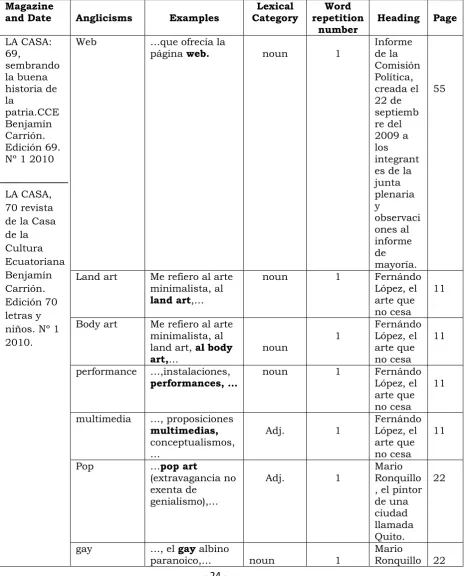
Table One
Variable: Cultural magazine
Magazine
and Date Anglicisms Examples
Lexical Category
Word repetition
number
Heading Page
LA CASA: 69, sembrando la buena historia de la patria.CCE Benjamín Carrión. Edición 69. Nº 1 2010
LA CASA, 70 revista de la Casa de la Cultura Ecuatoriana Benjamín Carrión. Edición 70 letras y niños. Nº 1 2010.
Web
…que ofrecía la página web. noun 1
Informe de la Comisión Política, creada el 22 de septiemb re del 2009 a los integrant es de la junta plenaria y observaci ones al informe de mayoría. 55
Land art Me refiero al arte minimalista, al
land art,…
noun 1 Fernándo
López, el arte que no cesa
11
Body art Me refiero al arte minimalista, al land art, al body art,… noun 1 Fernándo López, el arte que no cesa 11 performance …,instalaciones, performances, …
noun 1 Fernándo
López, el arte que no cesa
11
multimedia …, proposiciones
multimedias,
conceptualismos, …
Adj. 1
Fernándo López, el arte que no cesa
11
Pop …pop art
(extravagancia no exenta de
genialismo),…
Adj. 1
Mario Ronquillo , el pintor de una ciudad llamada Quito.
22
gay …, el gay albino
paranoico,… noun 1
Mario
, el pintor de una ciudad llamada Quito. rock …el punk y el
rock de la nueva ola…
…el lugar del
rock, por ejemplo…
Noun
noun
2 Mario Ronquillo , el pintor de una ciudad llamada Quito. --- Edwin Ulloa y sus memoria s de agua y fuego.
22
25
top …podría ser como esa top model…
Adj. 1 Edwin
Ulloa y sus memoria s de agua de fuego.
24
links …pueden servir
de links entre…
noun 1 Edwin
Ulloa y sus memoria s de agua de fuego.
28
Internet …;el Internet es uno de ellos…. --- El Internet
permite…
Noun
--- noun
2 Poetry & Facebook : Poesía en red. 34 web Podemos encontrar
páginas web…
noun 1 Poetry &
Facebook : Poesía en red.
34
New-age …, indigenismo milenarista,
regodeos new-age,…
adjective 1 Poetry & Facebook
: Poesía en red.
34
fax …al tiempo / en la celda de un fax
/ y…
noun 1 Tierra
adentro. Poemas para sacarlos a pasear 49
cómic En marzo del 2006 Francisco Viñachi creó un
cómic, …
noun 1 Parece
que fue ayer…
66
bond …por lo que se volvió al
noun 1 Parece
que fue
‐ ‐
tradicional bond. ayer…
Author: Ana María Calva
Table Two
Variable: Scholarly magazines
Magazine
and Date Anglicisms Examples
Lexical Category
Word repetition
number
Heading Page
PCWORLD SECRETOS DE SOFTWARE Agosto 2010
Internet …conexiones a
Internet y una…
--- …acceso a
Internet con… --- Conecciones de banda ancha de Internet.
...
…la diferencia entre la
Internet y… ---
…visibles en el
Internet. ---
Gira en torno a la Internet ---
…de la
tecnología y el
Internet… ---
…existencia de la Internet
con… --- …su plataforma-Internet APPS… --- …los contenidos de Internet… --- …su experiencia en la internet… --- Noun --- Noun --- Noun --- Noun --- Noun --- Noun --- Noun --- Noun --- noun --- Noun
…por ende en la Internet. --- …indican que usar la Internet degrada… perspectiv as
Web …acceso a
Internet con botón web. --- …una computadora con cámara web. --- ...una página
web con un… --- …cargar la páginas de la
web ricas… --- …impresoras, cámara web,… ……….
Internet con el navegador web
completo --- …desde la web
con el solo toque…
--- …de las
páginas web en una nueva… --- Directamente de la web, … --- …bonito servicio de la
web que lleva… --- …sus sitios favoritos de la
web.
---
…de una página de la
web.
---
…de una página entera de la web.
‐ ‐ ---
…sitio de la
web de Picasa… --- …, un sitio de la web o… --- …contra sitios de la web. ---
Sitios de phishing en la
web.
---
…para
expresarse en la web. ---
El periodismo de la web. ---
…aplicaciones, o en las
páginas de la
web.
---
…una página de la web
totalmente… ………. …la misma página de la
web … ---
…fusionar la
web con los… --- Una fusión de la web con la TV…
--- …contenido de la web y la TV. --- …la televisión regular y la
web; si escoge… --- …es el video de la web pero google…. --- …el contenido de la web,
software ...sistema integrado de
software y… --- …bajo licencia de software
apache.
--- …empresas de hardware y
software y… ---
Software y telecomunicaci ones…
--- Computadoras y software
especializado… --- …desarrollo de software bancario… --- …especializarse en software
para … --- …con algún error de software. --- …súper secretos de software. --- …sugerencia de software cuando…. --- …sin necesidad de un software
adicional. Puede descargar el software desde… --- …de Sprint y el
‐ ‐
…instalado el
software fue… --- Incluye también el software “Anywhere Print”. --- …incluyen el software unique… --- …que instalar
software en su PC.
--- Dependiendo del software de administración …
--- …por usuario o por el
software… --- …eso significa usar software
antivirus.. --- …una
detección de virus, que, si su software
esta al…
--- …sobre si el
software que utiliza… --- …ejecutar el
software de Windows. --- …para más tarde es su
software antivirus. --- …ambicioso de integrar el software Androide… Noun --- Noun --- Noun --- Noun --- Noun --- Noun --- Noun --- Noun --- Noun --- Noun --- Noun --- noun multinacio nales --- Portátiles y netbooks --- Mejores cámaras megazoom de bolsillo --- Los secretos de sincroni- zar, transmitir y organizar --- Centro empresari al --- El gigante de la búsqueda pronto estará en suTV. 33 52 53 54 55 61 63 69 hardware …sistema integrado de software y
Noun 6 Solución
de data center de
hardware… --- …una de las 48 empresas de
hardware,
software… --- …use el icono de Quitar
hardware con seguridad… --- …, y está basada en
hardware,
capaz… ---
El hardware es capaz de descifrar… --- Noun --- Noun --- Noun --- noun furukawa --- Androide llegó al Ecuador con Movistar y Huawei. --- Súper secretos del software --- El gigante de la búsqueda pronto estará en suTV. --- Tarjeta de gráficos de 3D para escritorios 7 48 49 69 70
Laptop …además las
laptops y… --- …móviles y a
laptos. Noun --- 2 Toshiba dispone de políticas de eficiencia energética --- LA FERIA visitante y exportador es. 7 9 display …tecnología
display LED…
Adj. 1 Toshiba
dispone de políticas de eficiencia energética 7
scanner …scanner, monitores,…
noun 1 cronología
s
11
Word
…mientras que se abra Word,
qizás… --- …PDF al formato de
‐ ‐
un documento de Word
Excel…
--- …alta
resolución en los documentos de Word y …
Noun --- Noun software --- Cómo hacerlo 63
Excel …qizás Excel y un…
noun 1 Los
peligros de la asistencia técnica amateur 13 Flash …desarrollada sobre flash, …
---
…tiene un
flash del LED… --- El flash
emergente… --- …puede abrir y serrar dicho
flash
manualmente. --- El flash se habre… --- …una unidad de disco flash
para USB… --- …con
capacidad de
flash a finales…
…5 mega píxeles con un
flash de LED… --- …con capacidad de flash, confirmó… --- La aplicación obvia para el
manejar flash.
marketing …para el tema de marketing
viral…
noun 1 Evolucion
amos camino a la compu
15
Link …con un link
para…
noun 1 Evolucion
amos camino a la compu
15
Clear …descargas de
clear, y…
noun 2 Los
dispositivo s de 4G despegan
16 17
megabits …3,2 megabits
por segundo…
noun Los
dispositivo s de 4G despegan
18
Pop `…y en la
cultura pop,
para…
Adj. 1 Cámaras
digitales y teléfonos digitales
23
Fax …y gestión de
faxes, … --- …permite enviar un fax
directamente… --- …copia,
escaneo y fax.
Noun
--- Noun
--- noun
3 Impresora s láser y multifunci onales
25
Audio …para el audio
y video… --- …formatos de audio,… --- …baja su calidad de audio. …decodificador es de audio y…
Noun --- Noun --- Noun noun 5 Proyecto- res --- ¡Apunte, dispare, acción! PCWords Labs pone a prueba las habilidade s de video de la megazoom de bolsillo. --- Trucos de Windows 26 33 52 multimedia …experiencia multimedia en…
noun 1 Proyecto-
res.
27
notebook …las
notebook, por
Noun 4 Portátiles
‐ ‐ su… --- …las notebooks integran… --- …cuando las notebooks están… --- …de escritorio
notebooks , consola… --- Noun --- Noun --- noun netbooks --- Centro Empresari al 27 55
Dial …por medio de un dial de… --- …en el dial de modo… Noun --- noun 2 Sony cyber- shot DSC-HX5V 31 34
Chip …decidirse por
un chip para… --- …a cada chip
su velocidad… --- …frente a los
chips rivales… --- …real de un
chip.
---
…desempeño en los chips
aparentemente …
--- …el juego de
chips X58… --- …significa que un chip Core… --- …a menos que el chip tenga… ---
…contenido de los chips de seis…
--- …una serie de
chips nueva;… --- …energía del
chip.
---
…de gráficos el chip que…
--- …así que el
chip no puede…
--- Los chips están agrupados… --- …familia de chips Lynnfield… --- …desempeño de este chip … --- …dos canales del chip (que…) --- …si opta por un chip de… --- …ya que
ningún chip de este…
--- …con los chips
Opteron… --- …algunos de los chips que… ... …fabricantes de chips se… --- …generaciones previas del
chip será… ………. …que usan estos chips, permitiendo… ……… …a la par de los chips
pequeños… ……….. …que los chips
para… --- Noun --- Noun --- Noun --- Noun --- Noun --- Noun --- Noun --- Noun --- Noun ………… Noun --- Noun ………… Noun ……….. Noun --- --- Cuando compra una PC nueva --- Los mejores procesado res de Intel y AMD --- Cuando compra una PC nueva --- CHIPS DE servidor --- Nuevos procesado res debutan en Computex 41 42 42 70 70
Store …en el menú
de store…
noun 1 Súper
secretos de software
52
Mouse …que me
enseña es la categoría de
noun 1 Consejos
de Rick Broida
‐ ‐ mouse. TRANS- PORTE ACELE- RANDO AÑO 5 Nº 20 JUNIO-JULIO 2010 ECUADOR
líder …el líder tiene que… ………. …formándo líderes. Noun ………… Noun 2 Bonifaz ratificando en la FENATEI 10 11
fútbol …mundial de
fútbol tiene… ……….. …para el fútbol. ... …mundial de fútbol. Noun ………… Noun ………… noun 3 El mundial de las curiosidad es 20
clubes …a los clubes
que seden…
………
…el club de…
Noun ………… noun 2 El mundial de las curiosidad es ……… ………. El día del chofer no debe ser olvidado
21
32
marketing …comercial y
marketing
de…
noun 1 Paccar en
Ecuador
35
récord …tiempo
récord se actualizaron…
noun 1
Mercedes-Benz, un camión con historia
40
software …un software
desarrollado…
noun 1 Control de
gestión desde la oficina o casa
41
web …acceder a la
web con…
noun 1 Control de
gestión desde la oficina o casa
41
full …la versión full
viene…
noun 3 Todos van
en la Hyundai H1
43
airbag …mejorado,
airbag para…
noun 1 Todos van
en la Hyundai H1
43
Call center …a su call center,
automóviles…
noun 1 Fedetaxis
ciudadaní a
Author: Ana María Calva
Table: Three
Variable: General Interest magazine
Magazine
and Date Anglicisms Examples
Lexical Category
Word repetition
number
Heading Page
Hogar May 2009
Clóset …conviene ordenar el
closet
para que la ropa….
Noun 1 A
ordenar el armario
38
rol Ser madre es un rol
que se cumple….
Noun 1 Miedos
de mamá 56
sexy Considera da como la mamá más sexy… ……… La eligió como la princesa más sexi
deSuecia Adj. --- Adj. 2 Mamá ante todo Realmen te bellas 72, 132
futbolista …junto a su esposo el
futbolista …
Noun 1
Mamá ante todo
72
cocktail …vestido
cocktail
color….
Noun 1 Fashion
& Style
72
look …para
quienes prefieren un look
suave… Noun 1 Algo más sobre YSL 93
‐ ‐ minidress
…
chic
mix Vestido strapples que posee un mix
de…
Noun 1 Arriba el
hippie chic
98
Boom …que se ha vuelto un boom
dentro…
Noun 1 Té para
adelgaza r.
108
Máster La máster
en nutrición …
Noun 1 Los tés
milagros os
109
Trendy …se inclina por un estilo súper
trendy
Adj. 1 Realmen
te Bellas
133
Aeróbicos …siempre en forma están los deportes
aeróbicos,
como…
Noun 1 Realmen
te Bellas
134
Rock …asistir a un
concierto de rock, una mesera…
Noun 1
Ranking real
138
Streaptease …que una bailarina de
striptease
podría ser…
Noun 1 Ranking
real
138
webs …promoci onales para
webs…
Noun 1 Videos
promocio nales apuesta segura.
165
displays Displays
con videos para puntos de
Noun 1 Videos
promocio nales apuesta
ventana segura.
pop Su música puede considerar se como pop,… …es la sensación de la música pop. Noun noun 2 Entre la música y mil amores Miley Cyrus: Teen Queen 179 182
filme …con su primer
filme …
Noun 1 Miley
Cyrus: Teen Queen
180
rating Con un
rating de 25 puntos
Noun 1 Miley
Cyrus: Teen Queen
182
fans …al ser considera da un posible mal ejemplo para sus fans.
Noun 1 Miley
Cyrus: Teen Queen
183
Films …Los puentes de Madison, entre otros
films.
Noun 1 Meryl
Streep, la diosa del cine
186
Internet …comprar en
internet u organizar … ………….. …que utiliza Internet en el… ………… …un rápido vistazo a Internet para… Noun ………….. Noun ……… Noun 3 Sí al Internet 188
‐ ‐ millones en software para evitar… Internet
look …con un
look de los…
Noun 1 Vuelve el
sexo y la ciudad
14
flashbacks …incorpor an
flashback s de la…
Noun 1 Vuelve el
sexo y la ciudad
14
light …a los
light, puedes…
Adj. 1 Adelgaza
sin riesgos
s/p
rol …de su
rol y que… ……… …a sus roles habituales … Noun ……… Noun
2 45 años
Hogar ………… ………. Sabia lección 20 161 ivory …color ivory.
Adj. 3 Dieron el
sí.
34, 58, 59
cóctel …en el
cóctel, los invitados …
Noun 1 45 años
de sueños
77
fitness …para el
fitness
consiste…
Noun 1 Pole
dancing
106
récord …un tiempo
récord de poco…
Apos. 1 La
poesía plástica de Jaime Villa
109
fans …fans que sonríen…
Noun 1 Kenny G:
Músico de milagros
110
jazz …y jazz
de la vieja guardia…
Noun 1 Kenny G:
Músico de milagros 110 Internet …la Internet … ya no… ……… …tanto en Internet como… ……… …directo, Internet Noun ……… Noun --- Noun
3 Kenny G:
inalámbric o,… viaje de relajació n, alegría y autodesc ubrimien to show …famoso
show de Ed
Sullivan… ……… …estoy en un show y veo… ……… …un show
para… ……… …fila del show estuvo… Noun ……… Noun ……… Noun 4 Sigue siendo Rafael ………… José Luis Perales ………… Adolfo Domíngu ez y la moda 112 114, 115 163 hits …verdader os hits: …
Noun 1 Sigue
siendo Rafael 112 chequeos …remedie s, chequeos periódicos … ……… …se la hace chequear con… Noun ……… verb 1 ……… 1 Ejemplos de valor ………… Una lucha integral por la mujer 148 150
shock Tras el
shock
inicial…
Noun 1 Ejemplos
de valor 149 tips …ofrece alunos tips para…
Noun 1 Siempre
bella
154
blush …sombras
blush y labiales
Noun 1 Siempre
bella
154
test Test de sangre…
Noun 1 Después
del tramient o
156
relax …tiempo de relax.
Noun 1 Síndrom
e post vacacion al 161 estrés …disminu yendo el
Noun 6 Hidroter
apia
‐ ‐ estrés
que…
……… …el sol, el
estrés y… ……… …padecen de estrés,
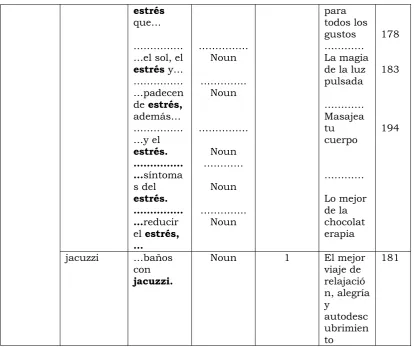
además… ……… …y el estrés. ……… …síntoma s del estrés. ……… …reducir el estrés, … ……… Noun ………….. Noun ……… Noun ………… Noun ………….. Noun para todos los gustos ………… La magia de la luz pulsada ………… Masajea tu cuerpo ………… Lo mejor de la chocolat erapia 178 183 194 jacuzzi …baños con jacuzzi.
Noun 1 El mejor
viaje de relajació n, alegría y autodesc ubrimien to 181
[image:49.595.102.517.81.428.2]Author: Ana María Calva
Table Four
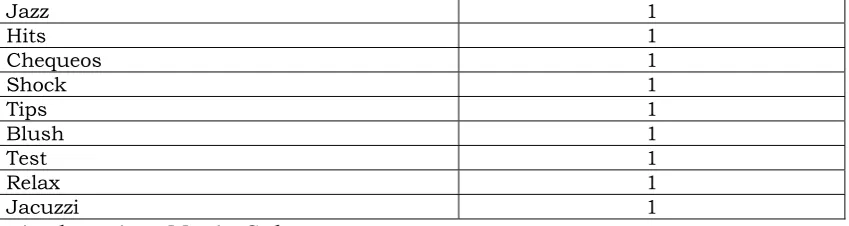
The Most Frequent Anglicisms (in all variables)
Anglicisms Word repetición number
chip 32 web 32 software 28 Internet 21
hardware 19
Laptop 2 Links 2 Clear 2 Dial 2 Líder 2 Clubes 2 Sexy 2 Rol 2
Land art 1
Body art 1
multimedia 1 Rock 1 Gay 1 Top 1 New-age 1 Fax 1 Cómic 1 Bond 1 Display 1 scanner 1 Excel 1 Marketing 1 Megabits 1 multimedia 1 Store 1 Mouse 1 Marketing 1 Récord 1 Airbag 1
Call center 1
Clóset 1 Rol 1 Futbolista 1
‐ ‐
Jazz 1 Hits 1 Chequeos 1 Shock 1 Tips 1 Blush 1 Test 1 Relax 1 Jacuzzi 1
[image:51.595.105.530.86.199.2]Author: Ana María Calva
Table Five
Comparison between variables
Anglicisms
Variable f %
Cultural magazines 15 17.90% Scholarly magazines 33 34.73% General Interest magazines 44 47.37%
Total 92 100%
Description, Analysis and Interpretation of Results
This research regards the use of anglicisms in Ecuadorian
magazines. As it is known every day it is more and more common to
find words taken from English language and somehow they become
into Spanish words and we use them as ours.
After a thorough research in previous studies about anglicisms,
in this section I include an analysis of thirty anglicisms, taking into
consideration the syntactic, morphological and, semantic aspects. The
anglicisms presented here are the ones which are more frequently
used in Ecuadorian magazines, collected from three different variables.
Therefore, this section will show the linguistic as well as the
comparative analysis, which will help future researchers to
understand how the anglicisms are formed in a better way.
GAY
“Gay” is a word found in a cultural magazine. It was found in the
following context “…, el gay albino paranoico…”. This example refers to someone who imposes something interesting in the 70s. So, the
function here is as an noun.
The meaning of “gay” according to RAE dictionary is
“Perteneciente o relativo a la homosexualidad”. And in Webster
‐ ‐
The function of this word in English is as a noun or as an
adjective. This anglicism is accepted by the RAE dictionary. It has
replaced to the Spanish word “maricón”. Also, this term maintains the
same morphological aspects as the original one.
From my point of view, the term “gay” enriches spanish
language, because nowadays it is becoming in a very common term,
so, I think it is less rude than the Spanish word.
TOP
Top is the next word to be analyzed; in fact, it appeared just
once. However, it is very used among people in any environment. The
function of this word in English is as a noun, as a verb, and as an
adjective.
One thing that is relevant about this term is the meaning given
in both DRAE and Merryam Webster Dictionary. In the first one, the
meaning is “Prenda de vestir femenina, generalmente ajustada, que
cubre el pecho y llega como mucho hasta la cintura”. And in the
second one the meaning is “the highest point, level, or part of
something”.
Commonly, in our environment, this term is used with the word
“model”, for instance “top model” as it appeared in the example found
adjective. However, it is also used to refer to a kind of cloth which is
worn by women.
Even though the term “top” has a different meaning in Spanish
and in English, the use of this word tends to be closer to the adjective
meaning in English. This term has its equivalence in Spanish as
“cumbre”. Also, it is important to mention that this term has not
replaced any word in Spanish. This term is accepted by the RAE
dictionary. Regarding morphological aspect, this term does not present
any change.
In this case, I would say that this term is not relevant in Spanish
language, because it is just used by a small group of people, especially
to talk about spectacles.
INTERNET
This term was found thirteen times in a scholarly magazine.
One of the examples in which it was used is “Conecciones de banda
ancha de Internet”, functioning as a noun.
The meaning in English according to Webster dictionary is “an
electronic communications network that connects computer networks
and organizational computer facilities around the world”. And in the
RAE dictionary its meaning is “red informática mundial,
descentralizada, formada por la conexión directa entre computadoras
‐ ‐
The term keeps the morphological aspects as the original one;
and it does not have an equivalent in Spanish. Its function is as a
noun in both, English and Spanish language. This term is accepted as
a new term in the RAE dictionary.
Of course this term has enriched Spanish language in the sense
it is used around the world in the same way.
WEB
The term “web” was found a lot of times in a scholarly
magazine. The examples that I selected to show how this term is used
in the context found are: “…una computadora con cámara web” whose function is as an adjective, since web is describing a thing. The
second example is “…desde la web con el solo toque…”; here, its function is as a noun.
One thing that is relevant about this term is the fact about
meaning, because in English it is different from the real meaning that
we use in Spanish.
So, according to the Merriam Webster Dictionary, it means “a
network of silken thread spun especially by the larvae of various
insects (as a tent caterpillar) and usually serving as a nest or shelter”.
However, in the RAE dictionary its meaning is “Red informática” that
This term is accepted by RAE dictionary. Morphologically
speaking, it does not have any changes; also, it has not replaced any
Spanish word. Therefore, its equivalent in Spanish is “red informática”.
In the same way like Internet, the term “web” enriches Spanish
language because it is an international term used by all of us.
LAPTOPS
“Laptops” is another word used among people around the
world. This word is also associated to computational fields, and it has
gotten here through English.
The example in which this term appears is “Además las laptops y netbooks de Toshiva cuentan…” in this context this word is
functioning as a plural noun because the morpheme “s” is added to
the end that is needed according to the Spanish pluralitation rules.
It is not accepted by the DRAE, but it is still used among people.
According to Webster Dictionary, its function is as an adjective or as a
noun. And its meaning here is, “a portable microcomputer having its
main components (as processor, keyboard, and display screen)
integrated into a single unit capable of battery-powered operation”
Its equivalence in Spanish is “ordenador portátil”. Its function is
just as a noun in Spanish. It does not present changes regarding the
‐ ‐
I believe that this term has an important role in Spanish
language, because it is a new term used around the world. So, we
cannot be the exception in this modern world.
DISPLAY
Display is another example also associated to informatics. But
this word is frequently used in other fields too; for instance, in
commercial environments like in the markets, this term is used to
refer to a package of something that is sometimes on sale or just in
stock.
The context in which this term was found is “…tecnología
display LED…”, its function here is as an adjective. According to Webster Dictionary, this word can be used as a noun and as a verb,
but in Spanish dictionary the function appears just as a noun.
The term is included in RAE Dictionary, but it is also proposed
to be deleted. The meaning in this dictionary is “despliegue” or
“exhibición”. And the meaning in Webster dictionary is “a setting or
presentation of something in open view”. This term maintains its
original English morphology.
As far as I understand, I think this term is not relevant in
Spanish language, because it is a word used in a less frequent way, so
LINKS
Although, it is not accepted by the RAE dictionary, it is still used
in informatics fields too; as it is shown in the example found
“…pueden servir de links entre…”, the function of this term is as a noun. Besides, it is in plural form because an “s” is added at the end
according to Spanish rules for plurazitation of nouns; it regards
something that is used to connect things, words etc.
The meaning of this term according to Webster dictionary is “a
connecting structure”, this dictionary indicates that this term can be
used as a verb and as a noun. Its equivalent in Spanish is “conectores”
but it is not completely replaced. Morphologically speaking, in Spanish
this term keeps the same written form as in English.
On the other hand, the term link is increasing its use, especially
as a sophisticated word because of its use in computational fields; so, I
think that in a very short time maybe everyone will be using it.
However, right now this word is not very important in Spanish
language.
MARKETING
Marketing is a term that has more acceptances nowadays. Thus,
‐ ‐
This term is accepted by RAE dictionary. The meaning of this
word according to this dictionary is “mercadotecnia”. The function of
this term is as a noun in both dictionaries, Webster and DRAE.
According to Webster Dictionary, this term means “the process
or technique of promoting, selling, and distributing a product or
service.
The function of this term in the example found is as a noun
“…para el tema de marketing viral…” Morphologically speaking, marketing is derived from market because as it is seen above in the
meaning action of selling or promoting something is related to the
activities made in a market. So, in order to become in a noun it is
necessary to add –ing form to the original word market. Finally, this
term has replaced the Spanish word “mercadotecnia”.
Of course this term has enriched the Spanish language, taking
into account that this word has replaced the original Spanish term
“mercadotecnia” and marketing has become a term used by everyone.
POP
This term, like the others shown before, is very used in our
environment. However, the use given is different from its original
The functions of this term found in Webster dictionary are as a
noun, as an adjective and as an adverb. And the RAE dictionary shows
that it can be used as an adjective.
The function used in the example is as an adjective because it is
referring to a way of life or culture, in this way “…y en la cultura pop, para…” The meaning found in Webster dictionary is “to push, put, or
thrust suddenly and often deftly <pops a grape into her mouth.
<Popped in a CD>.
On the other hand, in RAE Dictionary it is defined as “Se dice de
un cierto tipo de música ligera y popular derivado de estilos musicales
negros y de la música folclórica británica”. Of course, this meaning is
closer to the use in the Spanish environment.
The term is accepted by the DRAE, and it has not replaced to
any word in Spanish. Regarding morphological aspects, it maintains
the original written form.
I think this term does not enrich the Spanish language, because
it is a word without any relevance to be used.
FLASH
This term was found sixteen times. One of the examples is: