Identifying the main actors and their positions on international forest
policy issues in Argentina
Identiicación de los principales actores y sus posiciones sobre asuntos internacionales
de política forestal en Argentina
Sarah L Burns a,b*, Lukas Giessen a
*Corresponding author: a University of Göttingen, Chair of Forest and Nature Conservation Policy, Germany, [email protected]
b Universidad Nacional de La Plata, Facultad de Ciencias Agrarias y Forestales, Laboratorio de Investigación de Sistemas Ecológicos y Ambientales, La Plata, Argentina.
SUMMARY
Since the Earth Summit in Rio in 1992, forest management and conservation have become important issues in international forest-related politics and policies. As a result, different international initiatives have dealt with the subject directly or indirectly, building up a fragmented international forest regime complex made of international laws and agreements about forests. The diverse elements of this regime complex are differently made relevant by various actors in different countries. The aim of this study was to identify the most relevant forest issue elements in Argentina as well as the main involved actors and their positions towards these elements as a result of their interests. To identify the issues, content analysis of documents was employed on public sources (newspapers, websites) as well as expert sources (personal interviews and professional journals) from 2008 - 2012. The most relevant actors were identiied and categorized. The positions of the different actors were obtained analyzing the different sources. The forest issue elements found to be relevant in Argentina are: climate change and forests, forest biodiversity, regional forest-related policy initiatives, competing forest certiication schemes, desertiication, bilateral forest related disputes and forest-related support by international organizations. The various actors identiied showed different positions regarding a diversity of issues, being climate change and forests the most conlictive concern among actors, especially among environmental NGOs and forestry associations and the Secretariat of Environment and Sustainable Development and the Ministry of Agriculture, Livestock and Fisheries.
Key words: forest policy, international forest regime complex, relevance, implementation.
RESUMEN
Desde la Cumbre de la Tierra, en 1992, el manejo y conservación de los bosques se han convertido en temas importantes en la política forestal internacional. Como resultado, distintas iniciativas internacionales abordaron el tema de manera directa o indirecta, conformándose un cuerpo normativo de leyes y acuerdos fragmentado sobre los bosques de alcance internacional. Los temas que conforman este régimen normativo se convierten en relevantes de distinta manera por medio de varios actores en diferentes países. El objetivo del presente trabajo fue identiicar los principales temas de política forestal internacional relevantes en Argentina así como los principales actores involucrados y sus posiciones frente a los mismos como resultado de sus intereses. Para la identiicación de estos temas se consultaron fuentes públicas (diarios nacionales, páginas web) así como expertas (entrevistas y publicaciones profesionales) entre el 2008 - 2012. Los actores más importantes fueron identiicados y categorizados. Las posiciones de los distintos actores se obtuvieron mediante el análisis de las fuentes. Los temas de política forestal internacional identiicados en la Argentina fueron: cambio climático y bosques, biodiversidad en sistemas forestales, iniciativas de políticas forestales regionales, competencia de sistemas de certiicación forestal, desertiicación,disputas bilaterales referentes a bosques y inanciamiento de organismos internacionales en temas forestales. Los diferentes actores identiicados presentaron posiciones encontradas con respecto a los temas, detectándose el cambio climático y bosques como el más conlictivo entre actores, principalmente entre ONG ambientalistas y asociaciones forestales y la Secretaría de Ambiente y Desarrollo Sustantable y el Ministerio de Agricultura, Ganadería y Pesca.
Palabras clave: política forestal, complejo de régimen forestal internacional, relevancia, implementación.
INTRODUCTION
After the Rio Summit in 1992, a growing number of international policies and regimes addressing forests have evolved into what can be described as an international
fo-rest regime complex (IFR-C) (Humphreys 2006, Rayner
et al. 2010, Giessen 2013). This regime complex attempts
is-BOSQUE 35(2): 163-173, 2014
International forest policy issues in Argentina
164
sue needs to be put on the agenda (Howlett and Ramesh 1995). Conlicting interests about the substance, then, make the issue visible empirically as a political conlict. In the politics surrounding the issue, a number of actors concerned will then take positions based on their interests (Krott 2005, Wibowo and Giessen 2012).
The formulation of the IFR-C has already been analy-zed to a large degree (Humphreys 2006, Rayner et al. 2010, McDermott 2014); yet the implementation in speciic na-tional settings is largely unresearched with few exceptions (McDermott et al. 2010). Implementation studies are called
for to research the link between IFR-C and policy chan-ges at the domestic level (Bernstein and Cashore 2012, Wibowo and Giessen 2012). In addition, only few studies have analyzed forest policy issues in Argentina (Rosenberg 2008, Gartland 2012, Romero 2012), but no research has been done on the implementation of the IFR-C in the cou-ntry, with the exception of few studies analyzing particular issues of the regime (Espach 2006, Cubbage et al. 2010). Hence, the objective of this article is to identify the most relevant international forest-related policy issues in Argen-tina as well as the main actors and their positions towards these issues. Due to the large North-South extension and resulting ecological variations within Argentina, special at-tention shall be given to potential differences between the northern and southern parts of Argentina regarding the re-levant issues. Consequently, our hypothesis is that elements of the IFR-C are made relevant in Argentinean policy by speciic actors formulating their related positions in public and/or expert deliberations. Hence, the different interests of the most relevant actors will determine which forest issue elements become relevant at the domestic level. In addition, ecological and political differences at subnational levels lead to further differentiations in which forest issue ele-ments become relevant in different regions of the country.
METHODS
Theoretical underpinnings. An international regime can be
deined as a “set of implicit or explicit principles, norms, rules and procedures around which actors´ expectations converge in a given area of international relations” (Kras-ner 1982). International forest-related negotiations conti-nuously take place in multiple processes resulting in a body of international forest-related policy, which is referred to as an international forest regime-complex (Rayner et al. 2010, Giessen 2013, Giessen et al. 2014, McDermott 2014).This
regime complex is composed by a set of elements which are directly or indirectly relevant for forests as an issue in global politics (Humphreys 1999, Giessen 2013). Thus, the IFR-C consists of different elements from a number of international regimes referred to as Forest Issue Elements (FIE). Analytically the IFR-C is a program consisting of goals, measures, assumed impacts and implementing actors (Krott 2005). Likewise each FIE consists of goals, measu-res, assumed impacts and implementing actors (Giessen
2013). Which and how each of these FIE are implemented or not at national level is different in each country and de-pends on problem structure, actors and the institutional set-ting (Bernstein and Cashore 2012). The relevance of the di-fferent FIE at a domestic level is inluenced by the interests of the relevant domestic actors, be they state or non-state.
Interests of actors determine the actions they take, which is the reason why they constitute one of the most important factors in political processes (Krott 2005). In-terests are not openly displayed based on different tactics (Krott 2005). Positions can be deined as the publically sta-ted preferences towards speciic policy or policy options. The different positions are based on the actors´ interests (Wibowo and Giessen 2012).
When the various actors and their different forest-re-lated interests are brought together, issues arise and beco-me visible (Krott 2005). Such issues are then addressed in more or less public arenas, whereas low degree of publi-city in general results in clearer articulation of positions.
Study area. Argentina has a continental area of 2,791,810
km2, with a length from north to south of 3,700 km between 22° and 55° of Latitude South. This extension determines a wide climatic variation, from subtropical conditions in the north with mean annual temperatures above 20 °C to temperate conditions in the south with mean annual temperatures below 10 °C (SAyDS 2010a).
There are around 31.4 million hectares of natural fo-rests divided in six ecological regions (SAyDS 2005). Mo-reover, there are 1.2 million hectares of cultivated forests, 80 % of which are located in the north–east of the country, in the Mesopotamian region (MAGyP 2013). At natio-nal level the Secretariat of Environment and Sustainable Development is responsible for natural forests, while the Ministry of Agriculture, Livestock and Fisheries is res-ponsible for forest plantations. Argentina adopted a fede-ral republican representative form of government. Except for national parks, which are under the jurisdiction of the national government, forests toile within the political res-ponsibility of the provinces and are subject to provincial laws under the umbrella of national laws (Article 124 of the National Constitution 1994).
forests, between 23 – 26 % of deforestation and only 8 % of protected forests (Brown et al. 2006). Furthermore,
this province held, until the year 2002, almost 35 % of the plantation forests in the country contributing with 29 % of the country´s forest exports (Braier 2004). On the op-posite side, the “Bosques Andino Patagónicos” ecoregion has 34 % of protected forests being the most conserved ecoregion in the country (Brown et al. 2006). This
ecore-gion held, until the year 2002, around 6 % of the plantation forests in the country (Braier 2004). From this ecoregion, the province of Río Negro was chosen –because of its long history in conservation having the oldest national park of the country– with the aim of comparing a highly forestry productive oriented province like Misiones with a highly conservation oriented province.
Empirical methods. Qualitative content analysis is a
lexi-ble method for analyzing text data (Neuman 2005). This method focuses on the language as a means of commu-nicating with attention to the content of a text (Neuman 2005). It is the most appropriate method for objectively revealing the most signiicant text, word or symbol from a large volume of text (Neuman 2005, Sadath et al. 2013). This method has been widely used in political sciences to analyze documents and interviews (Neuman 2005).
In order to identify the most relevant international forest issues in Argentina, a qualitative content analysis was used in a two stage approach, distinguishing between public and expert sources in both stages. The distinction between these two types of sources lies on the degree of publicity. Public sources were deined as all material ac-cessible to the whole population including newspapers and websites. Expert sources were deined as all material focu-sed on a selected audience from the forest sector.
For the public sources, the irst stage consisted of an open search in a broadly distributed national newspaper (La Nación) that was selected for eliciting the relevant issues. The terms “international”, “forest” and “forestry” were searched with the search engine of the newspaper
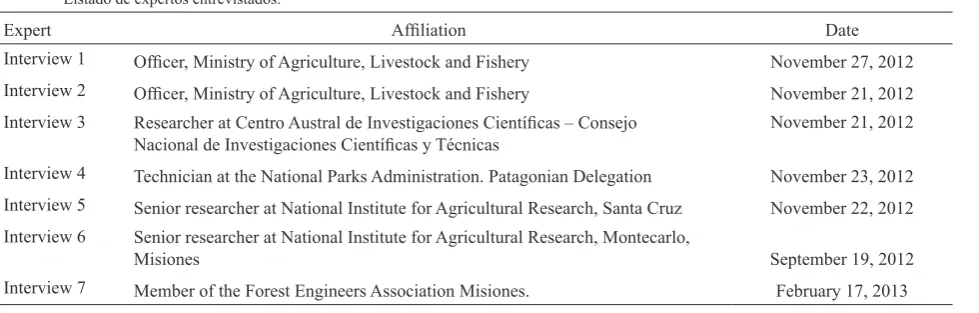
between the years 2008 - 2012. For the expert sources, an open search on professional journals in the ield of fores-try (Argentina Forestal, Producción Forestal) was done. This irst stage was done in order to detect the most re-levant international forest issues in Argentina as well as the most relevant actors. The second stage, after main ac-tors and issues were identiied, included a more focused search. For public sources, websites and position papers of the different actors towards the identiied issues were searched. For expert sources, interviews to people with broad knowledge of the forest sector in Argentina through personal correspondence were made (table 1). To each one of them a question was made: Which international forest policy issues were relevant in Argentina between the years 2008 – 2012? Interviews were used as an additional source to verify the data from other sources (Wibowo and Gies-sen 2012). The selection of the interviewees was based on their knowledge of the forest sector as well as on ease of ield access.
In the analysis, forest-relevant actors were classiied according to Krott (2005) into forest users (forest owners, forest workers and employees, general population), asso-ciations and parties (forestry assoasso-ciations, environmental NGOs) and government and administration bureaucracies.
For the North – South comparison, the two stage search was also applied in the two selected provinces. For the irst stage in public sources, provincial newspapers widely distributed throughout the studied provinces were chosen (Misiones online for Misiones and Río Negro for Río Ne-gro). For expert sources, the same professional journals used for the national level were used for both provinces but only articles of provincial relevance were selected at this level.
RESULTS
[image:3.609.76.566.578.734.2]After analyzing all the sources found, seven Forest Is-sue Elements (FIE) were identiied as relevant in Argentina. These FIEs were made relevant by different actors (table 2).
Table 1. List of experts interviewed. Listado de expertos entrevistados.
Expert Afiliation Date
Interview 1 Oficer, Ministry of Agriculture, Livestock and Fishery November 27, 2012 Interview 2 Oficer, Ministry of Agriculture, Livestock and Fishery November 21, 2012 Interview 3 Researcher at Centro Austral de Investigaciones Cientíicas – Consejo
Nacional de Investigaciones Cientíicas y Técnicas November 21, 2012 Interview 4 Technician at the National Parks Administration. Patagonian Delegation November 23, 2012 Interview 5 Senior researcher at National Institute for Agricultural Research, Santa Cruz November 22, 2012 Interview 6 Senior researcher at National Institute for Agricultural Research, Montecarlo,
Misiones September 19, 2012
BOSQUE 35(2): 163-173, 2014 International forest policy issues in
Ar
gentina
[image:4.609.66.734.156.500.2]166
Table 2. Main actors, classiied following Krott (2005), and their positions on each forest issue element relevant in Argentina. (0): no position detected; (+) position detected either in favor or against the issue.
Principales actores, clasiicados según Krott (2005), y sus posiciones sobre cada elemento relevante del tema forestal en Argentina. (0): sin posición detectada; (+) posición detectada ni a favor ni en contra del tema.
Actors CC and
forests biodiversityForest initiativesRegional Certiication Desertiication and forests Bilateral disputes Support by international organizations
Forest users
Forest owners
APN 0 + 0 0 0 0 +
INTA + + + + 0 0 0
Forest workers and employees
UATRE 0 0 0 0 0 0 0
General population 0 0 0 0 0 + 0
Association and parties
Forestry Associations
AFoA 0 0 0 + 0 0 0
FAIMA + 0 0 + 0 0 0
AFCP 0 0 0 + 0 + 0
Environmental NGOs
Greenpeace + + 0 + 0 + 0
FVSA + + 0 + 0 + 0
FARN + + 0 0 0 0 0
Government and administration bureaucracies
SAyDS + + + 0 + + +
MAGyP + + + + + 0 +
Climate change and forests. Since 1992, when countries
joined the United Nations Framework Convention on Climate Change (UNFCCC), climate change has been an important issue in the international forest regime (Hum-phreys 2006). As a result of this convention, the Kyoto Protocol was adopted in 1997 entering into force in 2005. Argentina approved the UNFCCC and the Kyoto Pro-tocol by national law establishing the Secretariat of En-vironment and Sustainable Development as the applica-tion authority (Law 24295, Decree 2213/02). In 2005 the Argentinean Carbon Fund was created with the objective of facilitating and promoting Clean Development Mecha-nisms (CDM) projects in Argentina. The Ministry of Agri-culture, Livestock and Fisheries supports the use of fast growing plantations as very eficient carbon sinks that can contribute to ight climate change (MAGyP 2013). Howe-ver, environmental NGOs argue against the use of forest plantations as CDM projects (Greenpeace 2000). And i-nally, a national REDD strategy is at the moment under development (Colombres 2009) and discussed by different actors (FVSA 2010a, Greenpeace 2012).
Forest biodiversity. The Convention on Biological Diver-sity (CBD) addresses forests directly through the expan-ded program of work on forest biological diversity (annex to decision VI/22), adopted in 2002 (CBD 2013).
Argentina approved the CBD by national law and es-tablished a committee to follow up the convention, de-veloping a national strategy about biological diversity (Law 24375, Decree 1347/97). At the moment the Nagoya Protocol on access to genetic resources and the fair and equitable sharing of beneits arising from their utilization, after being translated to the languages of the main ethnic groups from the country (SAyDS 2012a), is in the process of being ratiied by the government (table 1: Interview 1). However, Argentina is not a party of the Cartagena Pro-tocol on Biosafety. Argentina ranked 12th in the export of commodities in 2002 due to the export of soybean cake and in the year 2006 was the second world producer of genetically modiied organisms (ASA 2006). Therefore, most private sectors opposed the ratiication of this Proto-col (De las Carreras 2004).
Regional policy initiatives. After the irst UNCED Rio
Summit (1992), some regional initiatives towards deining and implementing sustainable forest management were initiated. Part of these initiatives which are relevant to Argentina include the Montreal Process on the deinition of criteria and indicators for sustainable management of temperate forests, the Latin American and Caribbean Fo-restry Commission that works as a forum for Latin Ameri-can countries to analyze important regional forestry issues and to exchange knowledge and expertise (FAO 2013) and the International Model Forest Network that has the goal of sustainable management of forest-based landscapes through the Model Forest approach (IMFN 2013).
Argentina has been very active in the last decade in the execution of different technical cooperation projects in terms of information systems, forest sanity and forest management as part of the activities in the Latin American and Caribbean Forestry Commission (table 1: Interview 2). In 2002 the national working group for the Montreal Process was created by the Secretariat of Environment and Sustainable Development, also involving the Ministry of Agriculture, Livestock and Fisheries, the National Insti-tute on Agricultural Technology (INTA) and the National Park Administration. The criteria and indicators formu-lated under the Montreal Process were then used in the forests associated to the IMFN. There are currently six forests associated to the IMFN adding up to 6,798,000 ha (Programa Nacional de Bosques Modelo 2013).
Competing forest certiication schemes. Forest manage-ment certiication was introduced as a market based instru-ment mainly promoted by environinstru-mental NGOs which rea-lized about the need for a tool -stronger than international conventions- to stop deforestation and promote sustaina-ble forest management. Moreover, to stop timber illegality, legality certiication schemes have lately been developed.
In January 2013 there were 305,137 ha of forests in Ar-gentina certiied by FSC (FSC 2013), mainly forest planta-tions with only two companies certifying the management of natural forests. In 2010 a national certiication scheme was lunched, after ive years of development, following international requirements in order to be a part of PEFC (Testa 2010). A forest trade network based on the Global Forest and Trade Network is currently being promoted both by environmental NGOs as well as by forestry asso-ciations to deal with illegally harvested timber, which is estimated to be around 30 % of the total volume commer-cialized from the country (FAIMA 2012a, FVSA 2013).
Desertiication and forests. Similar to climate change and biodiversity loss, desertiication was identiied as an im-portant issue at the 1992 Rio Earth Summit, and the United Nations Convention to Combat Desertiication (UNCCD) was established in 1994 (UNCCD 2013).
In Argentina there are 60 million hectares suffering from erosion. The area is expanding at a rate of 650,000 hectares per year by degradation and desertiication of land (SAyDS 2013) with 75 % of the land cover under some process of degradation (SAyDS 1997). In 1996, Argentina ratiied the UNCCD by national law and proposed a National Action Program as well as Sub-Regional Programs (SAyDS 1997). Forest plantations are seen as a solution to stop desertii-cation and subsidies, such as the exemption of taxes, have been granted by the Ministry of Agriculture, Livestock and Fisheries, to promote them with the intention of protecting the soil from desertiication processes (MAGyP 2013).
Bilateral forest related disputes. Over the years several
impor-BOSQUE 35(2): 163-173, 2014
International forest policy issues in Argentina
168
tant inter-national issues between Argentina and speciic neighbor countries such as Uruguay and Chile. In the last years, an important conlict between Argentina and Uru-guay over the installation of a pulp mill over the margins of the Uruguay River, boundary between both countries, has developed. The conlict started with demonstrations in the Argentinean town of Gualeguaychu where the general population organized under an assembly (Asamblea Ciu-dadana Ambiental Gualeguaychu) claiming that the pulp
mill had negative impacts on the environment and that its installation violated the Statute of the Uruguay River from 1975 (Sarlo 2010). The conlict later rose to the level of the foreign ministries of both countries1. A committee of the government of Argentina, led by the Ministry of In-ternational Affairs and Cult, then brought the issue to the International Court of Justice (table 1: Interview 3) who established that the Statute of the Uruguay River had not been violated by Uruguay and the pulp mill could operate2. Another bilateral dispute took place between Chile and Argentina regarding the management of exotic invasive species like the beaver in the south of both countries. In 2001, both countries started working in order to make an agreement to control the invasion of the beaver from the island of Tierra del Fuego into the continent. This work was done under the umbrella of the Argentina – Chile En-vironment Subcommittee (table 1: Interviews 3 and 4). In 2008, an agreement to stop the invasion of the beaver and to restore areas affected by this species was signed by both. In addition under the umbrella of the Environmental Treaty between Argentina and Chile from 1991, binational plans for forest ire prevention and control were developed (table 1: Interview 4).
Support by international organizations. There are several
forest-related inancing initiatives associated with Interna-tional Organizations. The most relevant of these initiatives identiied in Argentina are the Global Environment Faci-lity (GEF) and the World Bank through the International Bank for Reconstruction and Development. So far, there have been 28 environmental projects inanced by GEF in Argentina, two of which are entirely about forests (GEF 2013).
Forest owners. Argentinean forest plantations are owned
mainly by private owners (99.7 %) and only 0.3 % is ow-ned by state organizations (FAO 2010). The natural forests are owned by the National Parks Administration (3.5 %), the different provinces (approximately 2.9 %) as well as some research and environment protection institutions as National Universities and INTA (0.1 %) and private ow-ners (93.5 %) (SIFAP 2013).
1 Gutiérrez O, C Céspedes-Payret, D Panario. Was the implementation of an Industrial Forestry Complex in Uruguay the result of a State Policy or Policy Transfer? Unpublished.
2 Idem.
The National Parks Administration depends on the Ministry of Tourism and has the objective to protect and conserve the different ecosystems. One of their main goals is the conservation of biodiversity and the promotion of sustainable activities (SAyDS 2010a) and hence they are involved in the national strategy for biodiversity; howe-ver they are not involved in other international forest is-sues and have not taken any position. INTA is an autar-chic organism dependent of the Ministry of Agriculture, Livestock and Fisheries. As a national institution they are concerned about many international forest issues. They have been working on the adaptation of forests to climate change and participating in international meetings about it (Surraco 2012) as well as in the formulation of the natio-nal strategy for biodiversity (SAyDS 2010a). They parti-cipated in the Montreal Process working on indicators of sustainable forest management (table 1: Interview 5). They claim the use of criteria and indicators is a useful tool for a country to evaluate how sustainable the management of the forests at a national level is. On the other hand, they stress the use of these criteria and indicators will impro-ve the income of the forest, beneitting the forest industry by allowing access to new markets (table 1: Interview 5). They are working on the development of a certiication scheme for natural forests that guarantees legality of the products as well as sustainable management of the forests (FAIMA 2012). Their aim is to have a certiication sche-me more accessible for forest owners, especially for small land owners, farm workers and aborigines’ communities.
Forest workers and employees are represented by the same union as all rural workers, the Argentinean Union of Rural Workers and Stowers (UATRE), their rights and beneits are then looked after by this Union. Although they represent all forest workers in the country, they have not posed any position on issues of international forest policy. Although the general population could not be identi-ied as actors on international forest policy issues, they played an important role in the pulp mill conlict with Uru-guay (Sarlo 2010). An assembly was formed against the installation of a pulp mill in Uruguay, making big demons-trations (Sarlo 2010).
Associations and parties. At a national level there are three
Regar-ding international forest issues, they support certiication processes, both FSC and PEFC, also as means of entering foreign markets (FAIMA 2013b). Moreover, they claim a forest trade network in Argentina to stop timber illegality is needed, such as the one proposed by Fundación Vida Silvestre Argentina (FVSA) (FAIMA 2012a). They work
towards the use of wood for construction claiming it is a mechanism to store CO2 helping to reduce emissions to stop climate change (FAIMA 2012b). The Association of Producers of Cellulose and Paper (AFCP) has grouped the main producers of pulp and paper in the country since 1932 (AFCP 2014). As well as the other forestry associa-tions, their main interest is in forest certiication, both FSC and PEFC, seeing it as a means of entering foreign markets (AFCP 2009). They are also interested in the bilateral dis-pute with Uruguay about the pulp mill (AFCP 2010).
There are several environmental NGOs involved in in-ternational forest issues. Although their main goal is con-servation, they have different views of what this means and different approaches to achieve their goals. Among the most popular Environmental NGOs at a national level are FVSA, Greenpeace and Fundación Ambiente y Recursos Naturales (FARN).
Regarding climate change and forests, they all consider REDD+ as a valuable and positive tool to stop deforestation though they all emphasize it is very important to guaran-tee environmental and social safeguards in order to avoid negative effects due to this mechanism (Sibielau 2011, Greenpeace 2012). Both Greenpeace and FVSA support a legally binding document for climate change not only to reduce emissions (including emissions from deforestation) but also to include the inance of developed countries for adaptability measures in developing countries. They call for developed countries to have the responsibility to mi-tigate emissions and inance solutions (FVSA 2009, Gre-enpeace 2011). FARN claims that the GRULAC (group of countries from Latin America and the Caribbean) was not a protagonist in the climate change negotiations, except Brazil that was always closer to the EU and the USA than to Latin-American countries, and did not have uniied and strong opinions as a group (FARN 2011a).
Regarding CBD, FVSA considers it is very important to protect areas in order to preserve biodiversity and works towards the creation of new protected areas as well as more control in the existing ones (FVSA 2010b). Green-peace claims there is a lack of commitment to include pro-duction criteria to stop tropical forests destruction to make way to plantations as raw material for biofuel. This way, European Union countries keep using biofuels produced in non-sustainable ways and producer countries keep using agriculture practices that destroy the environment (Green-peace 2008). FARN, on the other hand, argues towards the inance of the ambitious biodiversity goals of Aichi and the Nagoya Protocol (FARN 2011b).
FVSA points out forest certiication as an important is-sue, they are a member of the environmental chair of FSC
international and between 2002 and 2006 were the contact organization for FSC in Argentina (FVSA 2012). As well, they work towards the creation of a forest trade network in Argentina based on the Global Forest and Trade Net-work to stop timber illegality (FVSA 2013). Greenpeace supports forest certiication arguing that, in Argentina, it is the only means of assuring that companies are using envi-ronmental and social standards, providing the basis for an appropriate environmental management.
Both Greenpeace and FVSA strongly opposed the pulp mill in Uruguay (Greenpeace 2006a, FVSA 2006). Greenpeace joined the assembly in Gualeguaychu during demonstrations (Greenpeace 2006b). They argue against the construction of pulp mills, both in Argentina and in Uruguay, using old technologies and high environmental impacts and push for a binational plan of clean production (Greenpeace 2006a). FVSA claim that the conlict showed the need for more articulation between Argentina and Uruguay as well as the need of companies to adopt social responsibilities. They consider the pulp mill should have been located in a more appropriate location. They call for treatment systems as well as continuous monitoring to en-sure the minimum environmental damage (FVSA 2006).
Government and administration bureaucracies. There are
mainly three bureaucracies involved in international forest issues at national level.
• Natural forests are under the jurisdiction of the Secreta-riat of Environment and Sustainable Development. As part of their goals, they are responsible for evaluating CDM projects as well as making the REDD+ national strategy (SAyDS 2010b). About REDD+, they claim that this mechanism will require a level of capacities that most developing countries currently lack. There-fore, they highlight the need for timely and suficient support from Annex I countries for capacity building activities. Further inancing is requested including up-front inancing. Concerning CDM, they claim baseli-nes need to be updated periodically. In this regard, past efforts made by developing countries to improve per-formance in different economic sectors and subsectors of their economies should be recognized and incorpo-rated into the baselines; hence, those developing coun-tries could be in a position to sustain and deepen their mitigation efforts (SAyDS 2008). In relation to the pulp mill conlict with Uruguay, they were part of the committee in charge of presenting the issue in the In-ternational Court of Justice together with the Ministry of International Affairs and Cult, as well as developing an Environmental Monitoring Plan (SAyDS 2012b).
BOSQUE 35(2): 163-173, 2014
International forest policy issues in Argentina
170
to climate change. They stress that fast growing planta-tions are very eficient carbon sinks and may contribute to ight climate change. Since studies showed that old growth forests stop ixing CO2, productive plantations are an environmental opportunity (MAGyP 2013). Re-garding UNCCD, they believe forest plantations may help rehabilitate degraded lands and ight desertiica-tion. Reforestation can help recover degraded land by acting as wind barriers; thus helping absorb water and ixate soil plus being CO2 sinks ighting climate change (MAGyP 2013).
• The Ministry of International Affairs and Cult is also involved in international forest related issues, mainly by leading negotiations at the different conventions. They argue towards the differentiated obligations and responsibilities, calling for developed countries to stop transferring their responsibilities to developing coun-tries and pushing them to provide public and genuine funds --to help mitigation and adaptation to climate change in developing countries-- as well as technolo-gic transfer. They ask to participate in the elaboration of new technologies from the beginning. They argue against developed countries taking unilateral measu-res, based on climate change arguments, which block exports from developing countries (Taiana 2009). Con-cerning the bilateral conlict with Uruguay about the pulp mills, they were in charge of presenting the issue in the International Court of Justice against the cons-truction of the pulp mill (SAyDS 2012b) claiming Uru-guay violated the international treaty of the UruUru-guay River (Taiana 2006). They do not take active positions on the other international forest issues.
North - South discrepancies. When comparisons between
a province from the north, Misiones, and a province from the south, Río Negro, were made, in order to investiga-te poinvestiga-tential discrepancies due to ecological differences, a number of issues were observed as relevant. While in the south, forest certiication processes are not a main issue, in the north, consulted experts see certiication as the most relevant international issue (table 1: Interviews 6 and 7), with the main consequence of improving working condi-tions for forest workers (table 1: Interview 6, Cubbage et al. 2010). The north east region of Argentina holds 80 %
of the forest plantations of the country mainly owned by big irms which are concerned about access to internatio-nal markets and which can afford forest certiication pro-cesses, while in the south, forests are owned mainly by smallholders who cannot afford these processes.
Although both, in the north and in the south, climate change is an issue, in the south the main topic is adaptation to climate change while in the north there is an interest in mitigation with CDM projects as well as many expecta-tions around REDD. INTA has been researching the im-pact of climate change both on native as well as cultivated forests in the south of the country (Varela et al. 2013). On
the other hand, the Ministry of Ecology of Misiones re-presented Argentina in meetings both in UN-REDD and FCPF, showing the collaboration between the national and provincial level. In these meetings they highlighted the im-portance of federalism in the country, and how this should be respected when applying REDD+ mechanisms. The north of the country is more production-oriented and mi-tigation practices are used to justify more production. On the other hand, the south is more conservation-oriented, hence the adaptation measures.
Moreover, in the south one of the most relevant inter-national forest related issues is the bilateral disputes with Chile about the invasion of exotic species, as the beaver, and the control of forest ires. Although the beaver is not currently a problem in the province of Río Negro, joint efforts with Chile have been made to stop the beaver from moving from the island of Tierra del Fuego into the con-tinent. This effort is being done by all provinces from the “Bosques Andino Patagonicos” ecoregion (Table 1: Inter-views 3 and 4). However, this is not an issue in the north.
DISCUSSION
The most relevant international forest policy issues of the past ive years in Argentina were identiied using qualitative content analyses of documents and interviews. According to our indings seven issues from the IFR-C were made relevant in Argentina by contrasting positions of different actors. The issues detected were not the same as the relevant subjects found in a similar study conducted in Indonesia (Wibowo and Giessen 2012), although cli-mate change and forest certiication were relevant in both countries. Previous studies in Argentina only focused on forest certiication and its impact on forest sustainability (Cubbage et al. 2010). However, no analysis of the
IFR-C or other issues was done before. Studies on the imple-mentation of the IFR-C are very important to understand the inluence and effects of the different issues at national level (Lindstad and Solberg 2010, Bernstein and Cashore 2012); though, not much is known. Many attempts have been made to measure the effectiveness of the IFR-C (Hovi et al. 2003, Young 2003, Sprinz 2005). However,
due to the fragmented nature of the IFR-C (Giessen 2013) in order to understand the effects of the IFR-C, a shift to inluence-oriented studies is needed (Bernstein and Casho-re 2012), which should be built on a theory-based, yet em-pirically applicable, understanding of the relevant actors’ power resources (Krott et al. 2013).
within national bureaucracies but also with subnational bureaucracies. Our results support this, with national bu-reaucracies, as the Ministry of Agriculture, Livestock and Fisheries and the Secretariat of Environment and Sustaina-ble Development, having different positions towards some of the different issues. However, regarding some issues they seem to work together. This may be surprising since according to the bureaucratic politics theory only a sin-gle actor has a dominant role in a particular sector (Peters 2010). Similar results were found in Indonesia (Wibowo and Giessen 2012). Our analyses focused on public posi-tions. Different results might be observed when analyzing ongoing politics. Based on the amount of issues, each actor had a public position; the most active actors were the envi-ronmental NGOs, which had public positions about most of the issues. However, the Secretariat of Environment and Sustainable Development was the most relevant actor, considering it is involved in the implementation of all the issues detected. This result shows the signiicance of main bureaucracies in dealing with international forest issues in Argentina as suggested by the bureaucratic politics theory (Peters 2010).
When analyzing the subnational level in two provinces with different ecological conditions, discrepancies were detected especially regarding forest certiication. Surprisin-gly, no discrepancy between the north and the south was detected regarding desertiication. Considering the climatic conditions of the south and the long term impacts predicted to this area due to climate change, we expected desertiica-tion to be a main issue for this area. However, no differen-ces were observed concerning this issue. The results of the subnational levels show that it is politically worthwhile to account for ecological variations in policy analyses becau-se they lead to different incentives and production patterns. Our methodology did not detect deforestation or soy bean expansion as an international forest related issue des-pite being a central question in the country (Pengue 2005, Leguizamón 2014). The selection of broadly distributed newspapers, both at the national and provincial level, as a irst stage in the search of public sources can cause poten-tial biases by two selection processes. Firstly, the selection of the sources by the authors may lead to a bias. Secondly, media selection processes can inluence forest discourses (Sadath et al.2013). The same limitations apply to our
se-lection of the professional journals. The scope of the cho-sen media and the expected interest of the audience could explain the issues they discuss (Sadath et al. 2013).
Howe-ver the issues discussed in the public sources were only used as a irst step in the analyses. The use of other sources allowed the minimization of this bias. Our methodology focused on the position of the different actors on the diver-se issues relevant in Argentina. However, the issues which are not made relevant and the reason why they are not made relevant cannot be detected by our methodology. Fu-ture analyses focusing on this should be carried out to fur-ther explain the implementation of the IFR-C in Argentina.
CONCLUSIONS
The different actors identiied in this study showed opposing positions towards the different forest issue ele-ments from the forest regime complex. The major diffe-rences in positions were observed between environmental NGOs and the Secretariat of Environment and Sustainable Development and the Ministry of Agriculture, Livestock and Fisheries. These differences in the interests of the main actors determined which forest issue elements are actively made relevant in Argentina. Climate change and forests was detected as the issue that presented the most opposing positions. At subnational level, a number of fo-rest issues were observed as relevant, most likely due to ecological and political differences.
ACKNOWLEDGEMENTS
This research was supported by funding from the Eva Mayr-Stihl Foundation, the German Research Foundation (DFG PAK 813) and Erasmus Mundus Action 2 EURO-PLATA partnerships.
REFERENCES
Bernstein S, B Cashore. 2012. Complex Global Governance and Domestic Policies: Four Pathways of Inluence. Internatio-nal Affairs 88(3):585–604.
Braier G. 2004. Tendencias y Perspectivas del Sector Forestal al año 2020. Informe Nacional Nº 1. Secretaría de Ambiente y Desarrollo Sustentable. SAGPyA. Rome, Italy. FAO. 71 p. Brown A,U Martinez Ortiz, M Acerbi, J Corcuera. eds. 2006. La
Situación Ambiental Argentina 2005. Buenos Aires, Argen -tina. Fundación Vida Silvestre. 587 p.
Cubbage F, D Diaz, P Yapura, F Dube. 2010. Impacts of forest management certiication in Argentina and Chile. Forest Policy and Economics 12(7): 497-504.
Espach R. 2006. When is Sustainable Forestry Sustainable? The Forest Stewardship Council in Argentina and Brazil. Global Environmental Politics 6 (2): 55-84. doi:10.1162/ glep.2006.6.2.55
Gartland HM. 2012. Politica y legislacion forestales. Buenos Ai -res, Argentina. Hemisferio Sur.419 p.
Giessen L. 2013. Reviewing the Main Characteristics of the International Foret Regime Complex and Partial Explana -tion for its Fragmenta-tion. International Forestry Review 15(1):60-70.
Giessen L, M Krott, T Möllmann. 2014. Increasing representa -tion of states by utilitarian as compared to environmental bureaucracies in international forest and forest-environ -mental policy negotiations. Forest Policy and Economics 38: 97–104.
Hofmann F. 2002. Globale Waldpolitik in Deutschland – Eine Untersuchung über die Wirkung internationaler Regime in föderalen Strukturen. PhD Thesis. Albert-Ludwigs-Univer -sität Freiburg. 311 p.
BOSQUE 35(2): 163-173, 2014
International forest policy issues in Argentina
172
Howlett M, M Ramesh. 1995. Studying Public Policy: Policy Cycles and Policy Subsystems. 2nd edition. Toronto, Cana -da. Oxford University Press. 239 p
Humphreys D. 1999. The evolving forests regime. Global Envi-ronmental Change 9(3): 251–254.
Humphreys D. 2006.Logjam: Deforestation and the Crisis of Global Governance. London, UK. Earthscan. 139 p. Krasner SD. 1982. Structural Causes and Regime Consequences:
Regimes as Intervening Variables. International Organiza-tion 36(2):185–205.
Krott M. 2005. Forest policy analysis. Dordrecht, The Nether -lands. Kluwer Academic Publishers. 334p.
Krott M, A Bader, C Schusser, RRDevkota, A Maryudi, L Gies -sen, H Aurenhammer. 2013. Actor-centred power: The driving force in decentralised community based forest governance. Forest Policy and Economics. In press. doi. org/10.1016/j.forpol.2013.04.012
Leguizamón A. 2014. Modifying Argentina: GM soy and socio-environmental change. Geoforum 53: 149-160.
Lindstad BH, B Solberg. 2010. Challenges in Determining Na -tional Effects of Interna-tional Policy Processes: Forest Pro -tection in Norway as a Case.Forest Policy and Economics 12(7): 489-496.
McDermott CL. 2014. REDDuced: From sustainability to legali
-ty to units of carbon—The search for common interests in
international forest governance. Environmental Science &
Policy 35: 12-19.
McDermott CL, B Cashore, P Kanowski. 2010. Global Environ
-mental Forest Policies: An International Comparison. Lon
-don, UK. Earthscan. 392 p.
Neuman WL. 2005. Social research methods. Quantitative and qualitative approaches. 6th ed. London, UK Allyn and Ba -con. 600 p.
Pengue WA. 2005. Transgenic crops in Argentina: the ecological and social debt. Bulletin of Science, Technology & Society 25: 314–322.
Peters BG. 2010. The Politics of Bureaucracy-An Introduction to Comparative Public Administration. 6th edition. Oxford, UK. Routledge. 380 p.
Rayner J, A Buck, P Katila. Eds. 2010. Embracing Complexity: Meeting the Challenges of International forest Governance. A Global Assessment Report. Prepared by the Global Fo -rest Expert Panel on the International Fo-rest Regime. Vien -na, Austria. IUFRO World Series Volume 28. 172 p. Romero JE. 2012. Forest conservation in Argentina: Early analy
-sis of the forest law implementation in the chaco ecoregion. Master Thesis. British Columbia, USA. University British Columbia. 123 p.
Rosenberg G. 2008. El concepto de bosque en la legislación ar -gentina y en la normativa internacional. Recordip 1: 1-6 Sadath N, D Kleinschmit, L Giessen. 2013. Framing the tiger —
A biodiversity concern in national and international media reporting. Forest Policy and Economics 36: 37-41. Sprinz D.2005. Regime effectiveness: The next wave of research.
Conference on the Human Dimensions of Global Environ -mental Change. Berlin, Germany.Volkswagen Found. 18 p. Wibowo A, L Giessen. 2012. Identifying International Forest-Related Issues in Indonesia Based on Actors’ Statements in Public and Expert Deliberations. International Journal of Social Forestry 5: 1-30.
Young OR. 2003. Determining Regime Effectiveness: A Com
-mentary on the Oslo-Potsdam Solution. Global Environ-mental Politics 3: 97-104.
EMPIRICAL REFERENCES
AFCP (Asociación de Fabricantes de Celulosa y Papel, AR). 2009. La Asociación Civil FSC Argentina dio sus primeros pasos en la AFCP: reunió a empresas, sindicatos y ONG. AFCP Noticias N°46.
AFCP (Asociación de Fabricantes de Celulosa y Papel, AR). 2010. Fallo de la Corte de La Haya sobre el diferendo entre la Argentina y Uruguay. AFCP Noticias N°61.
AFCP (Asociación de Fabricantes de Celulosa y Papel, AR). 2014. Consulted 10 Apr 2014. Available in http://www. afcparg.org.ar/
AFoA (Asociación forestal argentina, AR). 2012. Consulted 27 Nov 2012. Available in http://www.afoa.org.ar/
ASA (Asociación Semilleros Argentinos, AR). 2006. Posición de ASA con respecto a la ratiicación del Protocolo de Carta -gena sobre Bioseguridad.
CBD (Convention on Biological Diversity, CA). 2013. Consulted 6 Feb 2013. Available in http://www.cbd.int/
Colombres M. 2009. El bosque, al rescate del planeta. La Nación, Buenos Aires, AR, oct. 24.
de las Carreras A. 2004. Bioseguridad, acuerdos y dudas. Buenos Aires, Argentina. La Nación, jan.12
FAIMA (Federación Argentina de Industria Maderera y Aines, AR). 2012a. Buenos Aires - Una empresa certiicada. Con -sulted 27 Nov 2012. Available in http://www.faima.org.ar/ content/view/2949/1/
FAIMA (Federación Argentina de Industria Maderera y Aines, AR). 2012b. Misiones - La madera con fuerte aporte para combatir el cambio climático. Consulted 27 Nov 2012. Available in http://www.faima.org.ar/content/view/2725/1/ FAIMA (Federación Argentina de Industria Maderera y Aines,
AR). 2013a. Consulted 18 Jan 2013. Available in http:// www.faima.org.ar/
FAIMA (Federación Argentina de Industria Maderera y Aines, AR). 2013b. Empresas forestales del NEA obtendrían el se -llo internacional PEFC. Consulted 27 Nov 2012. Available in http://www.faima.org.ar/content/view/3096/1/
FAO (Food and Agriculture Organization of the United Nations, IT). 2010. Evaluación de los recursos forestales mundiales 2010. Informe Nacional. Argentina. Roma, Italia. FAO. 66 p FAO (Food and Agriculture Organization, IT). 2013. Oicina re
-gional de la FAO para America Latina y el Caribe. Consul -ted 19 Jan 2013. Available in http://www.rlc.fao.org FARN (Fundación Ambiente y Recursos Naturales, AR). 2011a.
COP 17 Durban: Conclusiones y prespectivas. Buenos Ai -res, Argentina. 10 p.
FARN (Fundación Ambiente y Recursos Naturales, AR). 2011b. Reporte sobre la 11° Conferencia de las Partes Convenio sobre diversidad biológica. Buenos Aires, Argentina. 20 p. FSC (Forest Stewardship Council, DE). 2013. Global FSC cer
-tiicates: type and distribution. January 2013. Bonn, Ger -many. 18 p.
FVSA (Fundación Vida Silvestre Argentina, AR). 2006. Botnia y la situación de la industria de pulpa y papel en Argentina. Documento de posición. Buenos Aires, Argentina. 1 p. FVSA (Fundación Vida Silvestre Argentina, AR). 2009. Finan
Copenhague. Buenos Aires, Argentina, dec. 14.
FVSA (Fundación Vida Silvestre Argentina, AR). 2010a. Una nueva oportunidad para hacerle frente al cambio climático. Buenos Aires, AR, nov. 30.
FVSA (Fundación Vida Silvestre Argentina, AR). 2010b. Hoy comienza el mayor encuentro internacional en el que los países deinirán metas y políticas para conservar el medio ambiente global para los próximos 10 años. Buenos Aires, Argentina, oct. 18
FVSA (Fundación Vida Silvestre Argentina, AR). 2012. Consejo de Manejo Forestal. Consulted 25 Nov 2012. Available in http://www.vidasilvestre.org.ar/que_hacemos/nuestra_so -lucion/cambiar_forma_vivimos/conducta_responsable/ bosques/_cual_es_la_solucion_/fsc/
FVSA (Fundación Vida Silvestre Argentina, AR). 2013. Red de Comercio Forestal Argentina. Consulted 25 Mar 2013. Available in http://www.vidasilvestre.org.ar/que_hacemos/ nuestra_solucion/cambiar_forma_vivimos/conducta_res -ponsable/bosques/_cual_es_la_solucion_/red_de_comer -cio_forestal_argentina/
GEF (Global Envirnonment Facility, US). 2013. Consulted 25 Mar 2013. Available in http://www.thegef.org/gef
Greenpeace. 2000. ¿Deberían incluirse los Bosques y otras Acti -vidades de Cambio en el Uso del Suelo en el MDL? Buenos Aires, Argentina. 27 p.
Greenpeace. 2006a. Greenpeace: “el gobierno argentino debe abandonar su política hipócrita en materia de plantas de ce -lulosa”. Buenos Aires, Argentina, jan. 13.
Greenpeace. 2006b. Greenpeace mantiene paralizada construc -ción de la papelera. Buenos Aires, Argentina, jan. 17. Greenpeace. 2008. Documento de Greenpeace acerca de la De
-claración de la Conferencia Mundial sobre Seguridad Ali -mentaria, Cambio Climático y Bioenergía de la FAO. Bue -nos Aires, Argentina, jun. 06.
Greenpeace. 2011. Documento posición de Greenpeace frente a la COP 17. Buenos Aires, Argentina, nov. 7 p.
Greenpeace. 2012. Los bosques y la gente primero: La necesidad de salvaguardas universales para REDD+. Amsterdam, NE. 24 p.
IMFN (International Model Forest Network, CA). 2013. Consul -ted 15 Feb 2013. Available in http://www.imfn.net
MAGyP (Ministerio de agricultura, ganadería y pesca, AR). 2013. Área ambiental. Consulted 3 Feb 2013. Available in http://64.76.123.202/new/0-0/forestacion/tecnica%20 e%20informacion/08_Area%20Ambiental/04_Acuer -dos%20Ambientales/index.php
Programa Nacional de Bosques Modelo, Argentina. 2013.Inicia -tiva de la red nacional de bosques modelo sobre criterios e indicadores de manejo forestal sustentable. Buenos Aires, AR. 52 p.
Sarlo B. 2010. Cronica de una derrota anunciada. La Nación, Buenos Aires, Argentina, apr. 25.
SAyDS (Secretaría de ambiente y desarrollo sustentable, AR). 1997. Programa de acción nacional de lucha contra la de -sertiicación. República Argentina. Documento de base. Buenos Aires, AR. 55 p.
SAyDS (Secretaría de ambiente y desarrollo sustentable, AR). 2005. Primer inventario nacional de bosques nativos. Pro -yecto bosques nativos y áreas protegidas BIRF 4085-AR 1998-2005, Argentina. 126 p.
SAyDS (Secretaría de ambiente y desarrollo sustentable, AR). 2008. Republic of Argentina. Scope and content of the se -cond review of the Kyoto Protocol pursuant to its Article 9. Buenos Aires, Argentina.
SAyDS (Secretaría de ambiente y desarrollo sustentable, AR). 2010a. Cuarto informe nacional, Republica Argentina. Convención sobre diversidad biológica. Buenos Aires, Ar -gentina. 112 p.
SAyDS (Secretaría de ambiente y desarrollo sustentable, AR). 2010b. Argentina REDD. Readiness Plan Proposal. Buenos Aires, Argentina. 104 p.
SAyDS (Secretaría de ambiente y desarrollo sustentable, AR). 2012a. Ambiente reconoce los conocimientos ancestrales de los pueblos originarios para la preservación de la biodi -versidad. Consulted 12 Dec 2012. Available in http://www. ambiente.gov.ar/?idarticulo=10913
SAyDS (Secretaría de ambiente y desarrollo sustentable, AR). 2012b. Historia de la demanda ante la Corte Internacional de Justicia. Consulted 12 Dec 2012. Available in http:// www.ambiente.gov.ar/?idarticulo=8989
SAyDS (Secretaría de ambiente y desarrollo sustentable, AR). 2013a. Programa de Acción Nacional de Lucha contra la Desertiicación. Consulted 3 Feb 2013. Available in http:// www.ambiente.gob.ar/?idarticulo=463
Sibielau, A. 2011. El mecanismo REDD+: Informe ambiental anual 2011. FARN, Buenos Aires, Argentina. 467-489 p. SIFAP (Sistema Federal de Áreas Protegidas, AR). 2013. Consul
-ted 24 Jun 2013. Available inhttp://www2.medioambiente. gov.ar/sifap/default.asp
Surraco, C. 2012. Un representante del INTA participo del IV curso internacional “Adaptacion al cambio climatico”. INTA Noticias, sep. 25.
Taiana J. 2006. Speech from the Chancellor J Taiana at the As -sembly in Gualeguaychú. July 2006
Taiana J. 2009. Speech from the Chancellor J Taiana at the Cli -mate Change Convention 2009, Copenhague, Dinamarca. Testa A. 2010. Sello propio de certiicacion forestal. Buenos Ai
-res, Argentina. La Nación, jul. 24.
UNCCD (United Nations Convention to Combat Desertiica -tion). 2013. Consulted 24 Jun 2013. Available in http:// www.unccd.int
Varela S, M Weigandt, J Villacide, J Corley, ML Suárez, M Amo -roso. 2013. Desafíos que plantea el cambio climático en la Patagonia. Río Negro, Viedma, Argentina. may. 11.