doi: 10.17711/SM.0185-3325.2019.035
Family conflict, stress, and coping
as predictors of violence
AndrésGómez-Acosta,1John AlexanderCastro Muñoz1
1 Grupo de Investigación “Psycholo-gy and Health Sanitas”, Fundación Universitaria Sanitas, Bogotá, D. C, Colombia.
Correspondence: Andrés Gómez-Acosta
Grupo de Investigación “Psychology and Health Sanitas” Fundación Universitaria Sanitas,
Carrera 7 # 173-64, Bogotá, D.C, Colombia. Phone: 57 30 1712--6635 Email: [email protected] Received: 18 January 2019 Accepted: 24 October 2019 Citation:
Gómez-Acosta, A., & Castro Muñoz, J. A. (2019). Family conflict, stress and coping as predictors of violence.
Salud Mental, 42(6), 269-274.
DOI: 10.17711/SM.0185-3325.2019.035
ABSTRACT
Introduction. Violence research has prioritized stress as a consequence, even though it would be suggested that it could be considered as a trigger for violent behavior; additionally, there are no models in Colombia from an empirical-analytical perspective that demonstrate which are the psychosocial factors that allow pre-dicting interpersonal violence. Objective. To determine from the structural-equations model (SEM) the extent to which variables such as family conflict, in association with the perception of stress and coping strategies, predict the presence of violent behavior. Method. Cross-sectional descriptive-correlational investigation, with multivariate analysis. Results. The SEM obtained reports that the average of expressions of violence in the family, family conflict, perceived stress, and coping strategies explain the variance of violence by 68%, with optimal adjustment goodness of fit indicators. Discussion and conclusion. The situations of family conflict and the expression of manifestations of violence of any kind in the family scenario, added to stress of people can seem to trigger, if there are no adequate coping resources, the intention to inflict harm on people or things that are immersed in such contexts. However, it is necessary to develop new studies, in order to consolidate the explanatory potential of the formulated model.
Keywords: Stress, coping strategies, interpersonal violence, family conflict, young adults.
RESUMEN
Introducción. La investigación en violencia ha priorizado el estrés como una consecuencia, aun cuando se podría considerar como factor desencadenante de las conductas violentas; adicionalmente, no existen modelos en Colombia desde una mirada empírico-analítica que evidencien cuáles son los factores psicoso-ciales que, aunados a la dinámica familiar, permitan predecir la violencia. Objetivo. Determinar a partir de un modelo de ecuaciones estructurales (MEE) en qué medida variables como la conflictividad familiar, el estrés y las estrategias de afrontamiento predicen el comportamiento violento. Método. Investigación descriptivo-co-rrelacional, transversal, con análisis multivariado. Resultados. El MEE obtenido reporta que la sumatoria de expresiones de violencia en la familia, la percepción de conflicto familiar, el estrés y algunas estrategias de afrontamiento explican la varianza de la violencia en un 68%, con indicadores de bondad de ajuste óptimos. Discusión y conclusión. El conflicto familiar y las manifestaciones expresas de violencia de cualquier tipo en el escenario familiar, sumadas al estrés de las personas, pueden desencadenar, si no se cuenta con los recursos de afrontamiento adecuados, la intención de infligir daño hacia las personas o cosas inmersas en dichos contextos. Sin embargo, es preciso el desarrollo de nuevos estudios para consolidar el potencial ex-plicativo del modelo formulado.
INTRODUCTION
The role of daily social environment, added to stressful life events, would have the capacity to destabilize an individual, connoting physiological, emotional, cognitive, and behav-ioral demands against which violent behavior is assumed as one of the multiple sets of possible answers (Faasse & Petrie, 2015). The crisis of the family as a formative institu-tion of positive values and support for the various problems that people have (Baskerville, 2009), added to some beliefs related to masculinity, the status in a group and the manage-ment of power have led to the population as a whole to nat-uralize violent responses to multiple stressors (Nascimento, Gomes, & Rebello, 2009).
Even though in Colombia agreements related to what has been called “the post-conflict,” have been implemented in this country an average of 18 victims are recorded every hour with multiple injuries, caused mostly in public roads (Instituto Nacional de Medicina Legal y Ciencias Forenses [INMLCF], 2018). Likewise, it should be considered that situations of violence frequently occur in homes, educa-tional institutions, and neighborhood environments that are not documented due to their cultural legitimization (Lee, Becker, & Ousey, 2014).
The vast majority of these records are due to interper-sonal violence defined as the deliberated use of human force related to the level of self-perceived thread characterized by the use of such force against oneself, other person, group of people, or community, with a high probability to cause injuries, death, psychological damages, developmental dis-orders, or deprivations (Krug, Dahlberg, Mercy, Zwi, & Lozano, 2003), which is presented to the extent that the sub-jects value a situation as stressful and are probably inclined by a hostile attitude to deal with it (Suldo, Shaunnessy, & Hardesty, 2008), or by an aggressive reactive or proactive response when experiencing or witnessing stressful situa-tions (Brown, Fite, DiPierro, & Bortolato, 2017); leading to the performance of aggressive behaviors associated with violent behavior models with which subjects are identified (Potocnjak, Berger, & Tomicic, 2011), the lack of impulse control (Thompson & Auslander, 2011), the social support received in the moment of confrontation, and a pessimistic feeling in which other resolution alternatives (Seiffge-Kren -ke, Aunola, & Nurmi, 2009).
In addition, violent behavior can effectively contribute in certain social contexts to dissuade a stressful situation, and therefore, give the aggressor a feeling of well-being and satisfaction (Gómez-Acosta & Londoño-Pérez, 2013). Likewise, when people live in highly unstable or stress-ful family nuclei, a greater impact can be expected from the effects of the mistreatment received on their physical and mental health (Topitzes, Mersky, Dezen, & Reynolds, 2013) as well as a greater predisposition to react violently (Mendelson, Turner, & Tandon, 2010).
Although there are studies that link psychological fac-tors associated both with the explanation of interpersonal violence (Botelho & Gonçalvez, 2016), the vast majority continue to focus on the identification of risk factors such as poverty, exclusion, and marginality (Pridemore, 2008), in factors related to psychopathy’s (American Psychiatric Asso-ciation, 2013), or in elements associated with biological pre-disposition (Raine, 2013), and so they are attributed the role of causal agents of violence. On the other hand, research has focused more on identifying stress, understood as a particu-lar kind of individual-environmental relationship, where the subject evaluates the stressful situations as “overflowing” in relation to the perception of his own coping abilities ( Cam-po-Arias, Bustos-Leyton, & Romero-Chaparro, 2009), seen as a consequence of violent acts, than stress and inadequate coping defined as the less effective process used by people in order to manage specific stressful situations (Londoño et al., 2006), as a possible trigger for violent behavior.
In response to the previous considerations, it is pro-posed to investigate to what extent the family conflict and the presence of stress and inadequate coping strategies pre-dict the occurrence of violent behavior.
METHOD
Design of the study
Empirical-analytical cross-sectional descriptive-correla-tional research, with multivariate analysis.
Subjects
Through a snowball sampling, 291 persons (68% women) from the middle socioeconomic strata from Bogotá City were obtained. The inclusions criteria required that all par-ticipants should be legal adults (age over 18) at the mo-ment of the application test, with literacy skills. All of them had signed the informed consent. It was a heterogeneous sample in relation to some inclusion criteria like academic formation, occupation, or religious beliefs. As for exclusion criteria, those who declined to continue in the middle of the research test application process were excluded.
Measurements
Aggression Questionnaire (Adaptation for Colombia by Chahin-Pinzón, Lorenzo-Seva, & Vigil-Colet, 2012). It consists of 29 items that evaluate the instrumental dimen-sions of aggression (physical and verbal), as well as the cognitive component (hostility) and anger (Alpha = .83).
Perceived Stress Scale (PSS-14). Adapted for Colom-bia by Campo-Arias et al. (2009) to review its psychometric properties. It is configured by 14 items that measure the de-gree to which life situations are weighted as unpredictable and uncontrollable overloads (Alpha = .86).
Modified Coping Strategies Scale (MCS-S) - Adapted for the Colombian context by Londoño, (2006), it consists of 69 questions that inquire about 12 typical coping strat-egies used by people faced with different stressing chal-lenges: problem solving, seeking social support, waiting, religion, emotional avoidance, seeking professional sup-port, aggressive reaction, cognitive avoidance, positive re-appraisal, expression of the difficulty in coping, denial, and autonomy (Alpha = .84).
Procedures
Participants were workers that came from general labor, health labor, and superior educational labor sector who were invit-ed to participate voluntarily, and subsequently signinvit-ed an in-formed consent form. Once they accepted to participate, they were conducted to empty and isolated places, separated to the presence of any possible distractors. After, they completed the psychometric test about the sociodemographic and psychoso-cial variables described. The information was systematized using the SPSS 24 software and the AMOS application.
Statistical analysis
We applied the descriptive statistics provided for sociode-mographic characteristics perceptions of interpersonal vio-lence factors. To determine if parametric or non-parametric statistics should be used, we previously used the Kolmog-orov–Smirnov statistic test, which indicated that all of the subscales had a parametric distribution. Furthermore, as adjustment parameters for the acceptance of the SEM, a
p-value less than or equal to .05 has been indicated (Hair, Black, Babin, & Anderson, 2010), a comparative index of Tucker-Lewis (TLI) greater than or equal to .95, a ratio of chi-squared/degrees of freedom between 2 and 3, a root mean square error of approximation (RMSEA) greater than .05, and a normalized factor impact (NFI) greater than .90 (Escobedo, Hernández, Estebané, & Martínez, 2016).
Ethical considerations
The institutional ethics committee approved the proposal and the procedures of this study. The participants had the opportunity to learn about the study and participate
accord-ing to the ethical considerations for research with humans in force in Colombia.
RESULTS
Regarding the personal assessment of the relationships with their relatives, and the given relationships among their rela-tives, between 16.8-21.6% of the sample rated these items with six points or less, on a zero to ten scale. More than 40% of the participants of the sample described having at least one violent participant in their family, and the participants report-ed that in their families there were important percentages in the types of violent behavior like extramarital problems, in-sults, yelling, indifference, and negligence (Table 1).
A significant percentage of people related that in their family there was at least one participant who behaved in a violent manner in their daily lives, an aspect that may be associated with the fact of social legitimacy that has been given to violence as an appropriate way to solve conflicts (Nascimento et al., 2009; Lee et al., 2014).
On the other hand, the sample was heterogeneous in terms of the scores obtained in the dimensions that make up the violence questionnaire, so there were extreme scores. These scores indicated that the sample there were people without any reference of aggressive reactions, but there were also others that showed high levels to be classified as aggressive ones. Also, there were people from the sample with extremely high and extremely low levels of stress. An analogous situation is documented for the stress scale. Like-wise, it was found that the most recurrent coping strategies are based on problem solving, social support, emotional avoidance, cognitive avoidance, positive reappraisal and autonomy, while the least used are waiting, religion, profes-sional support, and aggressive reaction (Table 2).
Additionally, the level of aggressiveness was grouped or classified into three different levels (high, medium, and low) considering as a criterion the standard deviation, and accord-ing to this an analysis of variance (ANOVA) was applied, de-termining differences in the averages of the evaluations to the
Table 1
Violence situations - family reported by the participants of the sample
Violence expressions among the family
(in the last year) f %
Extramarital problems 62 21.31
Violent relatives 118 40.55
Beating in the family 36 12.37
Family insults 84 28.87
Family yelling 110 37.80
Family indifference 69 23.71
violence expressions among the family, family conflict, total stress, waiting, emotional avoidance, cognitive reappraisal, and expression of coping difficulties (Table 3).
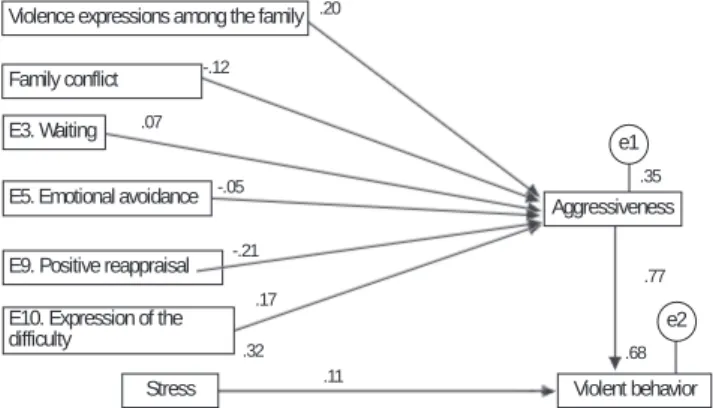
According to the mean differences, it was decided to perform the SEM procedure with the total scores obtained from every single implemented measure, running 24 differ-ent SEM possibilities, and reporting the one that explained the greatest amount of variance possible in the occurrence of violence (Figure 1).
According to the exposed model, the variables “average of expressions of intrafamily violence”, “family conflict”, “stress” and coping strategies “waiting”, “emotional avoid-ance”, “lack of positive reappraisal”, and “difficulty expres-sions” explain the variance of violence by 68%; the adjust-ment indicators (p = .05, NFI > .95, CFI > .95, RMSEA < .08, and ratio of chi square/degrees of freedom it is between 2.0 - 3.0) are optimal, except for the TLI index which was a little bit under the required score (.934), but could be considered as a well-adjusted level based on the degrees of freedom, with-out overparameterization of the model.
DISCUSSION AND CONCLUSION
A significant percentage of people reported that in their family there was at least one participant who behaved in a
violent manner, an aspect that may be associated with the fact of the social legitimacy that has been given to promote violence as an appropriate way to solve conflicts (
Nasci-Table 2
Descriptions related with the measured psychological properties, family relationships assessment and age of the participants
Min Max Mean CI (95%) SD
Age 18 38 22.24 21.55 – 22.48 3.34
Family relationships assessment (conflict) 1 10 7.69 7.48 – 7.90 1.82 Violence expressions among the family 0 20 1.91 1.65 – 2.18 2.30 Aggression Questionnaire Score
Physical aggressiveness 7 30 17.12 16.72 – 17.74 5.44
Hostility 9 32 21.42 20.77 – 22.06 5.88
Anger 7 28 20.12 19.53 – 20.71 4.56
Verbal aggressiveness 5 25 13.07 12.65 – 13.48 3.88 Stress Score 9 63 39.39 37.93 – 40.85 12.58 Coping Strategies Score
E1. Problem Solving 1 6 3.68 3.58 – 3.77 .81 E2. Social Support 1 6 3.26 3.13 – 3.38 1.10
E3. Waiting 1 6 2.52 2.42 – 2.61 .81
E4. Religion 1 6 2.62 2.50 – 2.73 .99
E5. Emotional Avoidance 1 6 3.13 3.10 – 3.23 .93 E6. Professional Support 1 6 2.32 2.18 – 2.45 1.15 E7. Aggressive Reaction 1 6 2.49 2.38 – 2.59 .91 E8. Cognitive Avoidance 1 6 3.31 3.19 – 3.42 .99 E9. Positive Reappraisal 1 6 3.51 3.39 – 3.63 1.03 E10. Expression of difficulty 1 5 2.85 2.74 – 2.94 .87
E11. Denial 1 6 3.02 2.91 – 3.12 .93
E12. Autonomy 1 6 3.26 3.13 – 3.38 1.09
Table 3
Average differences of the sample
Items
Compared groups (1 = less violent,
2 = normalized, 3 = more violent)
Difference of averages Sig. Violence expressions among
the family 1 3 - .00
2 3 - .04
Family conflict 1 3 - .00
Total stress 1 3 + .04
2 3 + .04
E3. Waiting 1 3 + .02
E5. Emotional avoidance 1 3 + .00
2 3 + .00
E7. Aggressive reaction 1 2 + .00
1 3 + .00
2 3 + .00
E9. Positive reappraisal 1 3 - .00 E10. Expression of the difficulty 1 2 + .01
mento et al., 2009; Lee et al., 2014). Further, the sample was inclined towards coping strategies focused on the caus-es and consequenccaus-es of the specific problem, requcaus-esting for close social support and appealing to autonomy when they consider it is necessary; however, when they feel that the demands of the environment overflow their own capa-bilities, they tend to emotionally and cognitively avoid the adverse event.
There are higher scores in the violence related to the in-crease of stress factors, the violence expressions among the family, and the waiting, emotional avoidance, aggressive reaction, and expression of the coping strategies; in that order, the use of strategies who result to be usefulness for the subject to stressful conditions is not effective, and also predisposes the violent reaction (Faasse & Petrie, 2015). On the other hand, the violence averages diminish when the use of coping strategies aimed at the positive reappraisal increase. It could be stated that this population prefers to eliminate the thoughts that are considered negative in rela-tion to the challenging situarela-tions.
The adjusted goodness-of-fit parameters of the model support the working hypothesis in which family factors, stress, and undesirable forms of coping explain the violent behavior of the population approached. In effect, situations of conflict and express manifestations of physical or emo-tional violence of any kind in the environment in which people have grown and developed (Jung, Herrenkohl, Lee, Klika, & Skinner, 2015), including the family scenario and as a couple (Price, Bell, & Lilly, 2014), added to oth-er stressful situations in the hoth-ere and now for people can trigger, if adequate coping resources are not present, neg-ative attitudes and beliefs accompanied by the intention to inflict harm towards the people or things that are immersed in these contexts (Botelho & Gonçalves, 2016); if these at-titudes are not effectively overcome, it is possible that the presence of a new stressful event facilitates the appearance of physiological and behavioral responses to violence itself,
which is consistent with the proposal of Palmero, Gómez, Guerrero, Carpi, Diez, and Diago (2007).
The incorporation of strategies such as waiting and the expression of difficulty in coping perhaps indicate sit-uations in which the subject does not have sufficient skills to overcome critical situations, and ends in turn generating hostile feelings, and additionally, it is illustrated as factors as a well-managed emotional avoidance linked with a posi-tive reappraisal of the different events can contribute to the reduction of hostility, and in this way, to a lesser expression of violent behavior.
However, it must be borne in mind that the factors in-volved in the model are not universal, because by definition they are ambiguous and very relative both to the relation-ship established between the subjects and the situations where they interact (Ward & Fortune, 2016) and to the symbolic load that said violence represents in the cultural environment where it is developed (Lee, 2016). Likewise, these outcomes must be made with caution, considering that reference is made to not necessarily usual strategies of cop-ing in the people of the sample.
On the other hand, although ethical precepts are ap-plied to ensure the confidentiality and anonymity of people, in self-report tests such as those applied, it is possible that some answers are biased due to the assumption of social desirability and because they appeal to memories and ex-periences that occasionally are inaccurate, so it is pertinent to contrast the model with information that is less subject to manipulation.
It is suggested that future research based on what has been discussed up to this point inquiries about the config-uration of personal protective characteristics (static as per-sonality or intelligence, and dynamic such as self-control, interpersonal relationships, and coping strategies) as well as of their reciprocal interaction with family, environmental, and situational factors (Ward & Fortune, 2016) to reduce the risk of interpersonal violence.
Also, it is recommended that clinical intervention mod-els should have protocols that allow addressing the predic-tive factors investigated, including the participation of the family or the reference group, to reduce risk factors of vio-lent behavior, emphasizing the formation of adaptive coping resources (Gagné & Melancon, 2013), following techniques of cognitive restructuring, relaxation, positive reappraisal and problem solving, strengthening of social skills, flexi-bility in emotional regulation and increase in moral reason-ing, among others, that are considered ethical, relevant and cost-effective (Fortune & Ward, 2017), and its real effect on
the reduction of such forms of behavior (Klepfisz, Daffern,
& Day, 2017).
To conclude, the SEM developed in this study allow to demonstrate some variables that can be predictors of in-terpersonal violence, but it is necessary to carry out new investigations, particularly longitudinal ones, to consolidate Aggressiveness
Violent behavior Stress
E10. Expression of the difficulty
E9. Positive reappraisal E5. Emotional avoidance E3. Waiting Family conflict
Violence expressions among the family
e1
e2 .20
-.12
.07
-.05
-.21
.17
.32 .11
.35
.77
.68
the explanatory potential exposed and that account for both the acquisition and maintenance of prosocial beliefs and practices, as well as the evolution of the different associated psychosocial factors.
Funding
This study was funded by Fundación Universitaria Sanitas.
Conflicts of interests
The authors declare they have no conflicts of interests.
Acknowledgements
We thank the people who participated in this study.
REFERENCES
American Psychiatric Association (2013). Diagnostic and statistical manual of mental disorders. (5th ed.). Washington D.C.: American Psychiatric Publishing. Baskerville, S. (2009). Freedom and the family: The family crisis and the future of
western civilization. Humanitas, 22(1), 168-184.
Botelho, M., & Gonçalves, R. A. (2016). Why do people kill? A critical review of the literature on factors associated with homicide. Aggression and Violent Behavior, 26, 9-15. doi: 10.1016/j.avb.2015.11.001
Brown, S., Fite, P. J., DiPierro, M., & Bortolato, M. (2017). Links Between Stressful Life Events and Proactive and Reactive Functions of Aggression. Journal of Aggression, Maltreatment & Trauma, 26(6), 691-699. doi: 10.1080/10926771.2017.1322658
Campo-Arias, A., Bustos-Leyton, G., & Romero-Chaparro, A. (2009). Consistencia interna y dimensionalidad de la Escala de Estrés Percibido (10 y EEP-14) en una muestra de Universitarias de Bogotá, Colombia. Aquichan, 9(3), 271-280.
Chahin-Pinzón, N., Lorenzo-Seva, U., & Vigil-Colet, A. (2012). Características psicométricas de la adaptación colombiana del Cuestionario de Agresividad de Buss y Perry a una muestra de preadolescentes y adolescentes de Bucaramanga. Universitas Psychologica, 11(3), 979-988. ISSN: 1657-9267
Escobedo, M., Hernández, J., Estebané, V., & Martínez, G. (2016). Modelos de ecuaciones estructurales: características, fases, construcción, aplicación y resultados. Ciencia & Trabajo, 19(55), 16-22. doi: 10.4067/S0718-24492016000100004
Faasse, K., & Petrie, K. J. (2015). Stress, coping and health. In International Encyclopedia of Social and Behavioral Science, 23, 551-555. doi: 10.1016/
B978-0-08-097086-8.14133-9
Fortune, C. A., & Ward, T. (2017). Problems in protective factor research and practice. Aggression and Violent Behavior, 32, 1-3. doi: 10.1016/j.avb.2016.12.008 Gagné, M. H., & Melancon, C. (2013). Parental psychological violence and adolescent
behavioral adjustment: The role of coping and social support. Journal of Interpersonal Violence, 28(1), 176-200. doi: 10.1177/0886260512448842 Gómez-Acosta, C. A., & Londoño-Pérez, C. (2013). Modelo predictor del consumo
responsable de alcohol y del comportamiento no violento en adolescentes. Salud y Drogas,13(1), 23-34.
Hair, J. F., Black, W. C., Babin, B. J., & Anderson, R. E. (2010) Multivariate Data Analysis: A global perspective. (7th ed.). New Jersey: Pearson.
Instituto Nacional de Medicina Legal y Ciencias Forenses INMLCF. (2018). Informe Forensis: Datos para la vida. Bogotá: Imprenta Nacional. Available at: https:// acotaph.org › assets › forensis-2018
Jung, H., Herrenkohl, T. I., Lee, J. O., Klika, J. B., & Skinner, M. L. (2015). Effects of
physical and emotional child abuse and its chronicity on crime into adulthood. Violence and Victims, 30(6), 1004-1018. doi: 10.1891/0886-6708.VV-D-14-00071
Klepfisz, G., Daffern, M., & Day, A. (2017). Understanding protective factors for violent reoffending in adults. Aggression and Violent Behavior, 32, 80-87. doi: 10.1016/j.avb.2016.12.001
Krug, E. G., Dahlberg, L. L., Mercy, J. A., Zwi, A. B., & Lozano, R. (2003) La violencia, un problema mundial de salud pública. Informe mundial sobre violencia y salud (pág. 1-23). Washington, D.C.: OPS. Retrieved from: http:// iris.paho.org/xmlui/bitstream/handle/123456789/725/9275315884.pdf Lee, B. X. (2016). Causes and cures IV: The symbolism of violence. Aggression and
Violent Behavior, 27, 152-157. doi: 10.1016/j.avb.2016.03.002
Lee, M. R., Becker, S., & Ousey, G. C. (2014). The transformation of pro-violence norms: An integrative review of the literature. Aggression and Violent Behavior, 19(4), 340-345. doi: 10.1016/j.avb.2014.05.003
Londoño, N. H., Henao López, G. C., Puerta, I. C., Posada, S., Arango, D., & Aguirre-Acevedo, D. C. (2006). Propiedades psicométricas y validación de la escala
de estrategias de coping modificada (EEC-M) en una muestra colombiana.
Universitas Psychologica, 5(2), 327-350.
Mendelson, T., Turner, A. K., & Tandon, S. D. (2010). Violence exposure and depressive symptoms among adolescents and young adults disconnected from school and work. Journal of Community Psychology, 38(5), 607-621. doi: 10.1002/jcop.20384
Nascimento, E. F. D., Gomes, R., & Rebello, L. E. F. D. S. (2009). Is violence man’s
thing? the “naturalization” of the violence for young men. Ciência &Saúde Coletiva, 14(4), 1151-1157. doi: 10.1590/S1413-81232009000400021 Palmero, F., Gómez, C., Guerrero, C., Carpi, A., Diez, J. L., & Diago, J. L. (2007).
Hostilidad, psicofisiología y salud cardiovascular. Avances en Psicología Latinoamericana, 25(1), 22-43. ISSN 2145-4515
Potocnjak, M., Berger, C., & Tomicic, T. (2011). Una aproximación relacional a la violencia escolar entre pares en adolescentes chilenos: Perspectiva adolescente de los factores intervinientes. Psykhé, 20(2), 39-52.
Price, R. K., Bell, K. M., & Lilly, M. (2014). The interactive effects of PTSD, emotion
regulation, and anger management strategies on female-perpetrated IPV. Violence and Victims, 29(6), 907-926. doi: 10.1891/0886-6708.VV-D-12-00123 Pridemore, W. A. (2008). A methodological addition to cross-national empirical
literature on social structure and homicide: A first test of poverty-homicide
thesis. Criminology, 46(1), 133-154. doi: 10.1111/j.1745-9125.2008.00106.x Raine, A. (2013). The anatomy of violence: The biological roots of crime. New York,
NY, US: Pantheon/Random House.
Seiffge-Krenke, I., Aunola, K., & Nurmi, J. E. (2009). Changes in stress perception
and coping during adolescence: The role of situational and personal factors. Child Development, 80(1), 259-279. doi: 10.1111/j.1467-8624.2008.01258.x Suldo, S. M., Shaunnessy, E., & Hardesty, R. (2008). Relationship among stress,
coping and mental health in high-achieving high school students. Psychology in the Schools, 45(4), 273-290. doi: 10.1002/pits.20300
Thompson, Jr. R. G., & Auslander, W. F. (2011). Substance use and mental health problems as predictors of HIV sexual risk behaviors among adolescents in foster care. Health & Social Work, 36(1), 33-43. doi: 10.1093/hsw/36.1.33
Topitzes, J., Mersky, J. P., Dezen, K. A., & Reynolds, A. J. (2013). Adult resilience
among maltreated children: A prospective investigation of main effect and
mediating models. Children and Youth Services Review, 35(6), 937-949. doi: 10.1016/j.childyouth.2013.03.004
Ward, T., & Fortune, C. A., (2016). The role of dynamic risk factors in the explanation