Effect of Proton Pump Inhibitors on Mortality in
Patients with Cirrhosis and
Spontaneous Bacterial Peritonitis
Tsung-Hsing Hung,*,** Chih-Wei Tseng,*,** Hsing-Feng Lee,*,** Chih-Chun Tsai,*** Chen-Chi Tsai**
* Division of Gastroenterology. Department of Medicine, Dalin Tzu Chi Hospital, Buddhist Tzu Chi Medical Foundation, Chiayi, Taiwan. ** School of Medicine, Tzu Chi University, Hualien, Taiwan. *** Department of Mathematics, Tamkang University, Tamsui, Taiwan.
November-December, Vol. 17 No. 6, 2018: 933-939
INTRODUCTION
Cirrhosis is a hepatic disorder characterized by hepatic cell death, inflammation, and fibrotic conversion of the liver, thus increasing susceptibility to bacterial infection.1
If patients with cirrhosis have bacterial infections, they
have a four-fold increase in mortality.2 Spontaneous
bacte-rial peritonitis (SBP) is a specific life-threatening infec-tion in patients with cirrhosis.1-5 It is caused by invasive
procedures or bacterial translocation from the intestine because of bowel bacterial overgrowth, increased intesti-nal permeability, and impaired immunity in patients with cirrhosis.1-10
A proton pump inhibitor (PPI) is a kind of potent acid suppressant used for gastroesophageal reflux disease and
peptic ulcers.11 In patients with cirrhosis, PPIs can reduce
the size of postbanding ulcers after endoscopic variceal
li-gation.12 Some reports have indicated that 46%-78% of
pa-tients with cirrhosis use PPIs.13,14 However, recent reports
have indicated that PPIs can facilitate intestinal bacterial overgrowth and increase bacterial translocation of the in-testine, which increases the occurrence of SBP in patients
with cirrhosis.15-19 Studies in mice have also demonstrated
a high colonization rate with vancomycin-resistant
Entero-coccus faecium or drug-resistant Klebsiella pneumoniae in those
administered PPIs.20 In some studies, PPIs increased the
mortality of patients with cirrhosis.14,21
However, patients with cirrhosis using PPIs often have active gastrointestinal bleeding or recently had gastroin-testinal bleeding and are prone to higher mortality. It is
The Official Journal of the Mexican Association of Hepatology, the Latin-American Association for Study of the Liver and
the Canadian Association for the Study of the Liver
Manuscript received: Manuscript received:Manuscript received:
Manuscript received:Manuscript received: September 08, 2017. Manuscript accepted:Manuscript accepted:Manuscript accepted: November 08, 2017.Manuscript accepted:Manuscript accepted:
DOI:10.5604/01.3001.0012.2114 A B S T R A C T A B S T R A C T A B S T R A C T A B S T R A C T A B S T R A C T
Introduction and aim. Introduction and aim. Introduction and aim. Introduction and aim.
Introduction and aim. Spontaneous bacterial peritonitis (SBP) is a life-threatening infection in patients with cirrhosis. However, it is unknown whether patients with SBP and cirrhosis who do not have active gastrointestinal bleeding have a poorer prognosis if treated with proton pump inhibitors (PPI). Material and methods.Material and methods.Material and methods.Material and methods.Material and methods. We used the Taiwan National Health Insurance Database to identify 858 patients with SBP and cirrhosis who were administered PPIs and hospitalized between January 1, 2010, and December 31, 2013. One-to-two propensity score matching was performed to select a comparison group based on age, gender, and comorbidities. All patients obtained follow-up for 1 year. Results: Results: Results: Results: Results: The overall 30-day, 90-day, and 1-year mortality was 27.9%, 49.0%, and 73.7%, respectively, in the PPI group and 25.6%, 43.8%, and 67.2%, respectively, in the non-PPI group. After adjusting the Cox regression model for age, gender, and comorbidities, the hazard ratios for PPIs regarding 30-day, 30- to 90-day, and 90-day to 1-year mortality were 1.074 (95% CI 0.917-1.257, P = 0.377), 1.390 (95% CI 1.154-1.673, P = 0.001), and 1.297 (95% CI 1.099-1.531, P = 0.002), respectively. Conclusions: Conclusions: Conclusions: Conclusions: Conclusions: PPIs did not increase the short-term mortality of patients with SBP and cirrhosis who did not have active gastrointestinal bleeding, but PPIs increased the long-term mortality risk. For these patients, physicians should discontinue PPIs as early as possible.
Key words. Ascites. Key words. Ascites. Key words. Ascites. Key words. Ascites.
unknown if the increased mortality risk is attributable to PPIs or gastrointestinal bleeding. To eliminate this bias in the present study, we enrolled only patients with SBP and cirrhosis who did not have active gastrointestinal bleeding. Using the Taiwan National Health Insurance Research Database, we enrolled a large population of patients with SBP and cirrhosis who did not have active gastrointesti-nal bleeding and identified the effect of PPIs on their mortality.
MATERIAL AND METHODS
Database and ethical statement
The Taiwanese government started the National Health Insurance program in 1995. Currently, the National Health Insurance Bureau covers more than 98% of the Taiwanese population. All contracted medical institutions must pro-vide medical records to the National Health Insurance Bureau for medical payment. The National Health Insur-ance Bureau and National Health Research Institute used these medical records to establish a database called the National Health Insurance Research Database. Investiga-tors can use a dataset from the National Health Insurance Research Database in their studies, but the study protocols must be evaluated and approved by the National Health Research Institute.
This study used a dataset from the National Health In-surance Research Database that contained all International Classification of Diseases, 9th Revision, Clinical Modifi-cation (ICD-9-CM) codes for hospitalized patients in Taiwan. The agreement number was 104359. This study also obtained the approval of the institutional review board of the Buddhist Dalin Tzu Chi Hospital (IRB B10403026). The review board waived the requirement for written informed consent from all patients because all identifying personal information in the dataset was re-moved before analysis.
Study sample
We screened for patients who were discharged with a primary or an accessory diagnosis of cirrhosis (ICD-9-CM code 571.5, or 571.2) between January 1, 2010, and De-cember 31, 2013. SBP was defined as patients with ICD-9-CM codes 567.2, 567.8, or 567.9. Patients were not included if they had another diagnostic code for secondary peritonitis such as appendicitis, hollow organ, or biliary tract perforation; ischemic bowel disease; or peritoneal dialysis catheter-related peritonitis; or had an additional
procedure code for abdominal surgery.3,4,22 If patients had
multiple hospitalizations for SBP, only the first SBP epi-sode was selected for analysis. To exclude patients with
cirrhosis who had active gastrointestinal bleeding, patients were excluded if they had diagnostic codes for upper gas-trointestinal tract bleeding (ICD-9-CM code 531.0, 531.2, 531.4, 531.6, 532.0, 532.2, 532.4, 532.6, 533.0, 533.2, 533.4, and 533.6) or esophageal variceal bleeding (ICD-9-CM code 456.0 or 456.0). In addition, those undergoing panen-doscopy or administered an intravenous PPI during hos-pitalization were also excluded. Because high-dose oral PPIs might be used to treat recent peptic ulcer bleeding, we also excluded those using PPIs at higher than standard doses (standard doses: omeprazole 20 mg, rabeprazole 20 mg, lansoprazole 30 mg, pantoprazole 40 mg, and esome-prazole 40 mg).
As for the enrolled patients, those who were adminis-tered oral PPIs including esomeprazole, lansoprazole, omeprazole, pantoprazole, and rabeprazole were consid-ered the study group (PPI group). To avoid interference from any of the measured confounding factors, one-to-two propensity score matching was performed to select the control group (non-PPI group) according to comorbidi-ties, including age, gender, alcoholism (ICD-9-CM codes 291, 303, 305.00-305.03, and 571.0-571.3), hepatocellular carcinoma (ICD-9-CM code 155.0), hepatic encephalopa-thy (ICD-9-CM code 572.2), and renal function impair-ment (ICD-9-CM code 584, 585, 586, and 572.4, as well as any other procedural codes related to renal failure).
Statistical analyses
We used the SPSS statistical package (SPSS System for Windows, version 22.0) to perform the analyses in this study. A χ2 test or Fisher's exact test was used to compare
categorical variables. A Student's t-test was used to com-pare continuous variables. To identify risk factors for mortality in patients with SBP and cirrhosis, a Cox regres-sion model (proportional hazards model) was used to control the effects of confounding factors. Hazard ratios (HR) are presented along with a 95% CI using a signifi-cance level of 0.05.
RESULTS
group consisted of 1,716 patients with SBP and cirrhosis who were not administered oral PPIs and were consid-ered the non-PPI group. In the PPI group, the mean age was 60.9 ± 13.8 years, and 616 (71.8%) patients were males (Table 1).
The overall 30-day mortality for the PPI group and non-PPI group was 27.9% and 25.6%, respectively. After adjusting the Cox regression model for age, gender, and other comorbidities, the HR for oral PPIs regarding the 30-day mortality for patients with SBP and cirrhosis who did not have an active gastrointestinal bleed was 1.074 (95% CI 0.917-1.257, P = 0.377), as compared with the non-PPI group. The other significantly different prognos-tic factors were as follows: hepatocellular carcinoma (HR 1.993, 95% CI 1.698-2.339, P < 0.001), hepatic encephalop-athy (HR 1.511, 95% CI 1.271-1.796, P < 0.001), renal func-tion impairment (HR 2.603, 95% CI 2.203-3.075, P < 0.001), and age (HR 1.015, 95% CI 1.008-1.021, P < 0.001) (Table 2).
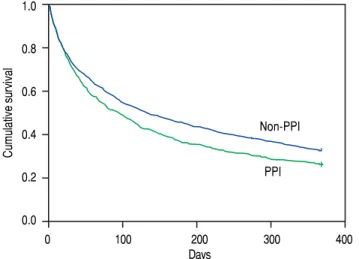
To evaluate mortality occurring at a later time, we cal-culated the 90-day mortality for the patients who survived more than 30 days and the 1-year mortality for the patients who survived more than 90 days. The 90-day and 1-year mortality was 49.0%, and 73.7%, respectively, in the PPI group, and 43.8%, and 67.2%, respectively, in the non-PPI group (Figure 1). After the Cox regression model was ad-justed for age, gender, and other comorbidities, the HRs for oral PPIs regarding the 30- to 90-day and 90-day to
1-year mortality were 1.390 (95% CI 1.154-1.673, P = 0.001) and 1.297 (95% CI 1.099-1.531, P = 0.002), respectively (Table 3).
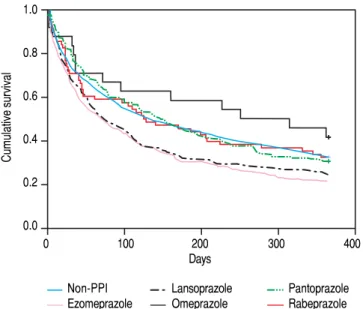
Each of the oral PPIs was compared with the non-PPI group to evaluate the effect of each oral PPI on the mortal-ity of patients with SBP and cirrhosis, but without active gastrointestinal bleeding. Patients receiving only one kind of oral PPI during their hospitalization were enrolled. Oral pantoprazole (HR 0.671, 95% Cl 0.483-0.931, P = 0.017) showed a beneficial effect on the 30-day mortality of patients with SBP and cirrhosis who did not have an ac-tive gastrointestinal bleed. However, other oral PPIs had no effect on the 30-day mortality. Oral esomeprazole (HR 1.568, 95% Cl 1.198-2.053, P = 0.001) and lansoprazole (HR 1.474, 95% CI 1.082-2.008, P = 0.014) had a higher 30-to 90-day mortality risk. Oral esomeprazole (HR 1.447, 95% CI 1.119-1.872, P = 0.005) had a higher 90-day to 1-year mortality risk, but the other PPIs had no effect (Table 3; Figure 2).
DISCUSSION
This was a nationwide population-based study con-ducted to identify the effect of oral PPIs on the outcomes of patients with SBP and cirrhosis who had no active gas-trointestinal bleeding. Using the national population-based database to enroll a large population of patients with SBP and cirrhosis, our study provides reliable
informa-Table 1. Demographic characteristics of patients with SBP and cirrhosis who did or did not concomitantly use oral PPIs.
Characteristics PPI group (n = 858) Non-PPI group (n = 1,716) P value
Male, n (%) 616 (71.8) 1,244 (72.5) 0.709
Age, years 60.9 ± 13.8 60.9 ± 13.6 0.952
Hepatocellular carcinoma, n (%) 333 (38.8) 666 (38.8) 1.000
Hepatic encephalopathy, n (%) 193 (22.5) 389 (22.7) 0.920
Renal function impairment, n (%) 149 (17.4) 289 (16.8) 0.739
Alcoholism, n (%) 182 (21.2) 366 (21.3) 0.946
PPI: proton pump inhibitor.
Table 2. Adjusted HRs for risk factors regarding the 30-day mortality of patients with SBP and cirrhosis and without active gastroin-testinal bleeding.
Variable HR 95% CI P value
Age 1.015 1.008 - 1.021 < 0.001
Male 1.043 0.875 - 1.243 0.640
Alcoholism 1.125 0.895 - 1.415 0.313
Hepatic encephalopathy 1.511 1.271 - 1.796 < 0.001
Hepatocellular carcinoma 1.993 1.698 - 2.339 < 0.001
Renal function impairment 2.603 2.203 - 3.075 < 0.001
Oral PPI use 1.074 0.917 - 1.257 0.377
Figure 1. Figure 1. Figure 1. Figure 1.
Figure 1. Cumulative survival plot for spontaneous bacterial peritonitis cir-rhotic patients with and without oral proton pump inhibitors.
Table 3. Adjusted HRs for different PPIs regarding the 30-day, 30- to 90-day, and 90-day to 1-year mortality of patients with SBP and cirrhosis and without active gastrointestinal bleeding
PPIs 30-day mortality 30- to 90-day mortality 90-dday to 1-year mortality
Case/control HR (95% CI) Case/Control HR (95% CI) Case/Control HR (95% CI)
PPIs 858 / 1716 1.074 (0.917-1.257) 619 / 1276 1.390 (1.154-1.673) 438 / 981 1.297 (1.099-1.531)
Esomeprazole 286 / 1716 1.226 (0.978-1.537) 195 / 1276 1.568 (1.198-2.053) 130 / 981 1.447 (1.119-1.872)
Lansoprazole 235 / 1716 1.248 (0.979-1.591) 158 / 1276 1.474 (1.082-2.008) 111 / 981 1.328 (0.996-1.770)
Omeprazole 24 / 1716 0.486 (0.156-1.513) 21 / 1276 1.225 (0.505-2.973) 16 / 981 0.767 (0.341-1.723)
Pantoprazole 211 / 1716 0.671 (0.483-0.931) 172 / 1276 1.226 (0.898-1.674) 126 / 981 1.255 (0.958-1.643)
Rabeprazole 68 / 1716 1.330 (0.848-2.085) 48 / 1276 0.798 (0.395-1.613) 40 / 981 1.191 (0.743-1.912)
CI: confidence interval. HR: hazard ratio. PPI: proton pump inhibitor.
tion and reflects the actual mortality in clinical practice. Our study showed SBP contributed to a poor prognosis in patients with cirrhosis. The 30-day mortality was over 20%, and the 1-year mortality was over 60%. This result is comparable to a previous study involving patients with SBP and cirrhosis.2-4,10,21-24
Patients with cirrhosis commonly have gastrointestinal bleeding including esophageal variceal bleeding, peptic ul-cer bleeding, portal hypertensive gastropathy, and gastric vascular ectasia syndrome. In such patients, PPIs are used for the treatment or prevention of bleeding after
endo-scopic hemostasis.12,25 However, recent studies showed
that PPIs could increase the occurrence of SBP in patients
with cirrhosis.15-19 In a retrospective case-control study,
there were 25 patients with SBP and cirrhosis who were administered PPIs and 26 patients who were not adminis-tered PPIs. Patients with and without PPI use responded
equally well to antibiotics (84% vs. 81%, respectively, P =
0.8) and experienced no significant difference in mortality
(84% vs. 73%, respectively, P = 0.3).26 In another
retro-spective study, there were 82 patients with SBP and cir-rhosis who were administered PPIs and 451 who were not administered PPIs. The result showed that the use of PPIs was a predictor of 30-day mortality (HR 1.960, 95% CI 1.190-3.227, P = 0.008).25 The former study was limited by a small case number. The latter study had a larger study population, but the PPI group had more patients with hepatocellular carcinoma and esophageal variceal bleed-ing. We could not know if a patient was administered PPIs continuously or had active gastrointestinal bleeding during hospitalization. Patients with cirrhosis who had a history of esophageal variceal bleeding are more prone to receiving PPIs continuously and having esophageal variceal bleeding
during hospitalization for SBP.27 The higher mortality risk
may be attributed to active gastrointestinal bleeding during hospitalization for SBP, but not to the PPI.
To eliminate this confounding factor, we excluded pa-tients with SBP and cirrhosis who had active gastrointesti-nal bleeding during hospitalization. We used a 1:2 propensity score match to select a comparison group to control for other comorbidities. We found that concomi-tant oral PPI did not increase 30-day mortality risk in pa-tients with SBP and cirrhosis who did not have active gastrointestinal bleeding. A recent study showed that PPIs could inhibit the production of proinflammatory cy-tokines by monocytes and protect against lipopolysaccha-ride-induced mortality in a murine model of lethal
endotoxic shock.28 However, the present study did not
demonstrate that PPIs had this benefit in patients with SBP and cirrhosis.
In our study, PPI users had a higher 30- to 90-day and 90-day to 1-year mortality than non-PPI users. This may be attributed to the increased occurrence of SBP in pa-tients with cirrhosis who used PPIs. We suggest that oral PPIs should be discontinued in patients with SBP and cir-rhosis who do not have active gastrointestinal bleeding as soon as possible. However, patients with cirrhosis who have peptic ulcer diseases still need to take oral PPIs to prevent recurrent bleeding and promote ulcer healing. A
0 100 200 300 400
Days 1.0
0.8
0.6
0.4
0.2
0.0
Cumulative survival
Non-PPI
question still remains as to how long oral PPIs should be used in patients with cirrhosis who have peptic ulcer dis-ease for the greatest survival benefit.
The present study showed that pantoprazole had a ben-eficial effect on 30-day mortality but that esomeprazole had a harmful impact on 30- to 90-day and 90-day to 1-year mortality in patients with SBP and cirrhosis, but without active gastrointestinal bleeding. Esomeprazole was more effective for the relief of acid reflux symptoms in patients with reflux esophagitis than other PPIs.29,30 Based on
phar-macokinetic studies, acid inhibition is faster and superior with esomeprazole than pantoprazole, and esomeprazole is more effective for controlling gastric acid at a steady state than other PPIs.31,32 According to the present study, the PPI
with more effective gastric acid control seems to carry a higher mortality risk in patients with SBP and cirrhosis and without active gastrointestinal bleeding. However, further study is necessitated to demonstrate this observation.
There were several limitations in our study. First, we could not evaluate the severity of cirrhosis through the Mayo Clinic model for end-stage liver disease score or Child-Pugh score. This is because the dataset that was used in this study did not include laboratory data such as bilirubin levels, albumin levels, or prothrombin time. Second, the exact etiology of non-alcoholic cirrhosis could not be identified. This is because the cause of cir-rhosis was not always coded in patients’ hospitalizations. However, previous studies have established that the etiol-ogy of non-alcohol-related cirrhosis in Taiwan is
primari-ly associated with the hepatitis B virus.33 Third, the
duration of PPI exposure was not available before admis-sion for SBP. However, it has been demonstrated that PPI
use 48 h after the initial dose induces a sustained increase
in gastric acid suppression.34 Fourth, we could not know
exactly how long the patient received PPIs after discharge. Therefore, we could not identify the effect of the duration of oral PPIs on the mortality of patients with cirrhosis. Fi-nally, this was a retrospective study with selection bias. However, we used propensity score matching and a Cox regression model to reduce this bias as much as possible. Despite these limitations, this study still provided some useful clinical information for clinical practice. In conclusion, this nationwide population-based study showed that concomitant oral PPI use did not increase the 30-day mortality of patients with SBP and cirrhosis who did not have active gastrointestinal bleeding. H o w ever, PPI users had a higher 30- to 90-day and 90-day to 1-year mortality than non-PPI users. We recommend that physicians discontinue PPIs as soon as possible in patients with SBP and cirrhosis who do not have active gastrointestinal bleeding.
ABBREVIATIONS
• HR: hazard ratio.
• ICD-9-CM: International Classification of Diseases, 9th Revision, Clinical Modification.
• PPI: proton pump inhibitor.
• SBP: spontaneous bacterial peritonitis.
CONFLICT OF INTEREST STATEMENT
The authors declares that there is no conflict of interest regarding the publication of this article.
ACKNOWLEDGMENTS
This study was based in part on data from the National Health Insurance Research Database provided by the Bu-reau of National Health Insurance, Department of Health, and managed by the National Health Research Institutes (Registered number: 104359). The interpretation and con-clusions contained herein do not represent those of the Bureau of National Health Insurance, Department of Health or National Health Research Institutes.
COMPLIANCE WITH ETHICAL REQUIREMENTS
For studies with human subjects, this study was initiat-ed after approval by the institutional review board of the Buddhist Dalin Tzu Chi General Hospital Taiwan (B10403026). As all identifying personal information was stripped from the secondary files before analysis, the re-view board waived the requirement for written informed consent from the patients involved.
Non-PPI Ezomeprazole
Lansoprazole Omeprazole
Pantoprazole Rabeprazole
Figure 2. Figure 2. Figure 2.
Figure 2. Figure 2. Cumulative survival plot for spontaneous bacterial peritonitis cirrhotic patients taking different oral proton pump inhibitor .
0 100 200 300 400
Days 1.0
0.8
0.6
0.4
0.2
0.0
REFERENCES
1. Wiest R, Krag A, Gerbes A. Spontaneous bacterial peritoni-tis: recent guidelines and beyond. Gut 2012; 61: 297-310. 2. Arvaniti V, D'Amico G, Fede G, Manousou P, Tsochatzis E,
Pleguezuelo M, Burroughs AK. Infections in patients with cir-rhosis increase mortality four-fold and should be used in de-termining prognosis. Gastroenterology 2010; 139: 1246-56. 3. Hung TH, Tsai CC, Hsieh YH, Tsai CC, Tseng CW, Tsai JJ.
Ef-fect of renal impairment on mortality of patients with cirrho-sis and spontaneous bacterial peritonitis. Clin Gastroenterol
Hepatol 2012; 10: 677-81.
4. Hung TH, Tsai CC, Hsieh YH, Tsai CC, Tseng CW, Tseng KC. The Effect of the First Spontaneous Bacterial Peritonitis Event on the Mortality of Cirrhotic Patients with Ascites: A Nationwide Population-Based Study in Taiwan. Gut Liver 2016; 10: 803-7.
5. Wiest R, Garcia-Tsao G. Bacterial translocation (BT) in cir-rhosis. Hepatology 2005; 41: 422-33.
6. Bauer TM, Steinbrückner B, Brinkmann FE, Ditzen AK, Schwacha H, Aponte JJ, Pelz K, et al. Small intestinal bacte-rial overgrowth in patients with cirrhosis: prevalence and re-lation with spontaneous bacterial peritonitis. Am J
Gastroenterol 2001; 96: 2962-7.
7. Guarner C, Runyon BA, Young S, Heck M, Sheikh MY. Intes-tinal bacterial overgrowth and bacterial translocation in cir-rhotic rats with ascites. J Hepatol 1997; 26: 1372-8. 8. Pardo A, Bartolí R, Lorenzo-Zúñiga V, Planas R, Viñado B,
Riba J, Cabré E, et al. Effect of cisapride on intestinal bacte-rial overgrowth and bactebacte-rial translocation in cirrhosis.
Hepatology 2000; 31: 858-63.
9. Ramachandran A, Prabhu R, Thomas S, Reddy JB, Pulimood A, Balasubramanian KA. Intestinal mucosal alterations in ex-perimental cirrhosis in the rat: role of oxygen free radicals.
Hepatology 2002; 35: 622-9.
10. Obstein KL, Campbell MS, Reddy KR, Yang YX. Associa-tion between model for end-stage liver disease and spon-taneous bacterial peritonitis. Am J Gastroenterol 2007; 102: 2732-6.
11. Targownik LE, Metge C, Roos L, Leung S. The prevalence of and the clinical and demographic characteristics associated with high-intensity proton pump inhibitor use. Am J
Gastro-enterol 2007; 102: 942-50.
12. Shaheen NJ, Stuart E, Schmitz SM, Mitchell KL, Fried MW, Zacks S, Russo MW, et al. Pantoprazole reduces the size of postbanding ulcers after variceal band ligation: a rand-omized, controlled trial. Hepatology 2005; 41: 588-94. 13. Chavez-Tapia NC, Tellez-Avila FI, Garcia-Leiva J,
Val-dovinos MA. Use and overuse of proton pump inhibitors in cirrhotic patients. Med Sci Monit 2008; 14: CR468-72. 14. Dultz G, Piiper A, Zeuzem S, Kronenberger B, Waidmann O.
Proton pump inhibitor treatment is associated with the sever-ity of liver disease and increased mortalsever-ity in patients with cirrhosis. Aliment Pharmacol Ther 2015; 41: 459-66. 15. Lewis SJ, Franco S, Young G, O'Keefe SJ. Altered bowel
function and duodenal bacterial overgrowth in patients treat-ed with omeprazole. Aliment Pharmacol Ther 1996; 10: 557-61.
16. Bajaj JS, Zadvornova Y, Heuman DM, Hafeezullah M, Hoff-mann RG, Sanyal AJ, Saeian K. Association of proton pump inhibitor therapy with spontaneous bacterial peritonitis in cir-rhotic patients with ascites. Am J Gastroenterol 2009; 104: 1130-4.
17. Trikudanathan G, Israel J, Cappa J, O'Sullivan DM. Associa-tion between proton pump inhibitors and spontaneous
bacte-rial peritonitis in cirrhotic patients - a systematic review and meta-analysis. Int J Clin Pract 2011; 65: 674-8.
18. Min YW, Lim KS, Min BH, Gwak GY, Paik YH, Choi MS, Lee JH, et al. Proton pump inhibitor use significantly increases the risk of spontaneous bacterial peritonitis in 1965 patients with cirrhosis and ascites: a propensity score matched co-hort study. Aliment Pharmacol Ther 2014; 40: 695-704. 19. Dam G, Vilstrup H, Watson H, Jepsen P. Proton pump
inhibi-tors as a risk factor for hepatic encephalopathy and sponta-neous bacterial peritonitis in patients with cirrhosis with ascites. Hepatology 2016; 64: 1265-72.
20. Stiefel U, Rao A, Pultz MJ, Jump RL, Aron DC, Donskey CJ. Suppression of gastric acid production by proton pump in-hibitor treatment facilitates colonization of the large intestine by vancomycin-resistant Enterococcus spp. and Klebsiella pneumoniae in clindamycin-treated mice. Antimicrob Agents
Chemother 2006; 50: 3905-7.
21. Kwon JH, Koh SJ, Kim W, Jung YJ, Kim JW, Kim BG, Lee KL, et al. Mortality associated with proton pump inhibitors in cir-rhotic patients with spontaneous bacterial peritonitis. J
Gas-troenterol Hepatol 2014; 29: 775-81.
22. Thuluvath PJ, Morss S, Thompson R. Spontaneous bacterial peritonitis--in-hospital mortality, predictors of survival, and health care costs from 1988 to 1998. Am J Gastroenterol 2001; 96: 1232-6.
23. Rimola A, García-Tsao G, Navasa M, Piddock LJ, Planas R, Bernard B, Inadomi JM. Diagnosis, treatment and prophylaxis of spontaneous bacterial peritonitis: a consensus document. International Ascites Club. J Hepatol 2000; 32: 142-53. 24. Tandon P, Garcia-Tsao G. Bacterial infections, sepsis, and
mul-tiorgan failure in cirrhosis. Semin Liver Dis 2008; 28: 26-42. 25. Lodato F, Azzaroli F, Di Girolamo M, Feletti V, Cecinato P,
Li-sotti A, Festi D, et al. Proton pump inhibitors in cirrhosis: tra-dition or evidence based practice? World J Gastroenterol 2008; 14: 2980-5.
26. de Vos M, De Vroey B, Garcia BG, Roy C, Kidd F, Henrion J, Deltenre P. Role of proton pump inhibitors in the occurrence and the prognosis of spontaneous bacterial peritonitis in cir-rhotic patients with ascites. Liver Int 2013; 33: 1316-23. 27. Hung TH, Tseng CW, Tsai CC, Lay CJ, Tsai CC. A fourfold
in-crease of oesophageal variceal bleeding in cirrhotic patients with a history of oesophageal variceal bleeding. Singapore
Med J 2016; 57: 511-3.
28. Balza E, Piccioli P, Carta S, Lavieri R, Gattorno M, Semino C, Castellani P, et al. Proton pump inhibitors protect mice from acute systemic inflammation and induce long-term cross-tol-erance. Cell Death Dis 2016; 7: e2304.
29. Wang X, Fang JY, Lu R, Sun DF. A meta-analysis: compari-son of esomeprazole and other proton pump inhibitors in eradicating Helicobacter pylori. Digestion 2006; 73: 178-86. 30. Zheng RN. Comparative study of omeprazole, lansoprazole,
pantoprazole and esomeprazole for symptom relief in pa-tients with reflux esophagitis. World J Gastroenterol 2009; 15: 990-5.
31. Hunfeld NG, Touw DJ, Mathot RA, Mulder PG, VAN Schaik RH, Kuipers EJ, Kooiman JC, et al. A comparison of the acid-inhibitory effects of esomeprazole and pantoprazole in rela-tion to pharmacokinetics and CYP2C19 polymorphism.
Aliment Pharmacol Ther 2010; 31: 150-9.
32. Miner P Jr, Katz PO, Chen Y, Sostek M. Gastric acid control with esomeprazole, lansoprazole, omeprazole, pantopra-zole, and rabeprazole: a five-way crossover study. Am J
Gastroenterol 2003; 98: 2616-20.
to types and localization of HBsAg in the tumor cells. Cancer 1983; 52: 1825-32.
34. Miner PB Jr, Allgood LD, Grender JM. Comparison of gastric pH with omeprazole magnesium 20.6 mg (Prilosec OTC) o.m. famotidine 10 mg (Pepcid AC) b.d. and famotidine 20 mg b.d. over 14 days of treatment. Aliment Pharmacol Ther 2007; 25: 103-9.
Correspondence and reprint request: Chen-Chi Tsai, M.D.
Division of Infectious Diseases, Department of Medicine, Dalin Tzu Chi Hospital, Buddhist Tzu Chi Medical Foundation,
No. 2, Minsheng Rd., Dalin Township, Chiayi County 62247, Taiwan. Tel.: + 886-5-2648000, Fax: + 886-5-2648999.