Lieveld FI, et al. , 2016; 15 (5): 696-704
696
Resistance-associated polymorphisms in Dutch hepatitis
C genotype 1a patients with and without HIV infection
Faydra I. Lieveld,†,‡ Niels Swaans,* Astrid M. Newsum,§,|| Cynthia K.Y. Ho,§ Janke Schinkel,§ Richard Molenkamp,§ Jan T.M. van der Meer,¶ Joop E. Arends,‡ Andy I.M. Hoepelman,‡ Anne M.J. Wensing,* Peter D. Siersema,†,** Karel J. van Erpecum,† Greet J. Boland*
* Department of Medical Microbiology, † Department of Gastroenterology and Hepatology, ‡ Department of Internal Medicine and Infectious Diseases,
University Medical Center Utrecht, Utrecht, the Netherlands.
§ Department of Medical Microbiology, ¶ Department of Internal Medicine and Infectious Diseases, Academic Medical Center, Amsterdam, The Netherlands. || Department of Infectious Diseases Research and Prevention, Public Health Service of Amsterdam, Amsterdam, The Netherlands.
** Department of Gastroenterology and Hepatology, Radboud University Medical Center, Nijmegen, the Netherlands. September-October, Vol. 15 No. 5, 2016: 696-704
ORIGINAL ARTICLE
INTRODUCTION
With the introduction of interferon-free direct-acting antivirals (DAAs), sustained virologic response (SVR) rates increased substantially for hepatitis C virus (HCV) infected patients.1 As approximately 30% of patients with
human immunodeficiency virus (HIV) are infected with HCV,2 coinfected patients form a significant proportion
of patients eligible for treatment with DAAs. Neverthe-less, only limited data are available on HCV genetic poly-morphisms in HIV/HCV coinfected patients (summarized in table 1). The emergence of NS3 resistance-associated variants (RAVs) such as Q80K has been described in HCV patients, especially in those with genotype 1a.1 Successful
therapy could be complicated by the high genetic diversi-ty of HCV and its rapid mutation rate.3 Notably,
occur-rence rates of RAVs vary in different parts of the world, with a higher frequency of Q80K in North America than Europe, and a high variation in reported prevalence of Q80K (ranging from 0% to 18%) between individual Euro-pean countries.4 This may be related to the high
preva-lence of genotype 1a in North America compared to Europe, where genotype 1b is more frequent.5 Moreover,
within genotype 1a, two distinct clades (clade I and clade II) are distinguished, and Q80K presence appears to be re-stricted to clade I.6,7 Several studies reported reduced
sus-ceptibility to NS3/4A protease inhibitors in the presence of RAVs.8-10 Q80K exhibited a 10.9 fold reduced susceptibility The Official Journal of the Mexican Association of Hepatology,
the Latin-American Association for Study of the Liver and the Canadian Association for the Study of the Liver
Manuscript received: Manuscript received: Manuscript received: Manuscript received:
Manuscript received: November 20, 2015. Manuscript accepted:Manuscript accepted:Manuscript accepted:Manuscript accepted:Manuscript accepted: February 21, 2016.
DOI:10.5604/16652681.1212426.
A B S T R A C T A B S T R A C T A B S T R A C T A B S T R A C T A B S T R A C T
Background and aim. Background and aim.Background and aim. Background and aim.
Background and aim. Resistance-associated variants (RAVs) on the NS3 region of the hepatitis C virus (HCV) may be relevant for antiviral therapy, but data in human immunodeficiency virus (HIV) coinfected patients are scarce. We assessed frequencies of NS3 RAVs in patients infected with HCV genotype 1a with or without HIV coinfection. Material and methods.Material and methods.Material and methods.Material and methods.Material and methods. HCV NS3 amino acids 1-181 were sequenced by the Sanger method and analyzed for RAVs. RAVs and their distribution between HCV genotype 1a clade I and II viruses were compared between HIV-infected versus HIV-uninfected patients. Results.Results.Results.Results.Results. 148 samples were available (n = 68 HIV and n = 80 non-HIV). Relative frequency of clade I and clade II was significantly different between HIV (85% and 15%) and non-HIV groups (49% and 51%). Overall, HIV infected patients exhibited significantly lower prevalence of RAVs than HIV-unin-fected patients (62% vs. 79%, p = 0.03). However, Q80K prevalence was significantly higher in HIV-inHIV-unin-fected subjects (50% vs. 24%, p = 0.001), whereas prevalence of S122D/G/N/S (2% vs. 16%, p = 0.002) and N174G/N/S (10% vs. 55%, p < 0.0001) poly-morphisms were significantly lower. Q80K was found exclusively in clade I viruses. S122 (3% vs. 22%, p=0.001) and N174 (13% vs. 75%, p<0.0001) polymorphisms had significantly lower prevalence in clade I than clade II viruses. Conclusions.Conclusions.Conclusions.Conclusions.Conclusions. In the Nether-lands, prevalence of clade I viruses and Q80K was significantly higher in HCV genotype 1a infected patients with HIV coinfection than in those without HIV coinfection. Prevalence of N174 and S122 polymorphisms was significantly higher in clade II than clade I viruses.
Key words. Key words.Key words. Key words.
697
, 2016; 15 (5): 696-704
Studya Study specifics Sample Patient Previous Q80K Other RAVs No. of RAVs
year characteristics treatment HIV vs. non-HIV HIV vs. non-HIV
Vicenti, et al.15 Archived samples; 2007-2011 n = 50 HIV Naïve to PIs 6/50 (12%) vs. V36L: 2/50 (4%) At least one RAV:
2012, Italy genotype 1a and 1b;b n = 17 non-HIV 5/19 (29%), vs. 2/17 (12%); 10/50 (20%) vs.
whole NS3 genome p = NA T54S: 1/50 (2%) 7/17 (41%), p = NA
vs. 1/17 (6%); V55A: 1/50 (2%)
vs. 0/17 (0%)
Ehret, et al.14 CS; all genotype 1a; All 2014 n = 23 HIV NA 8/19 (42%) vs. NA NA
2014, Germany NS3 amino acids 1-181 n = 19 non-HIV 9/23 (39%), p = NS
Jabara, et al.23 Archived samples; 2000-2011 n = 20 HIV Naïve to all 6/20 (30%) vs. V36ALM 38% vs.; Overall non-Q80K RAV
2014, USA all genotype 1a; n = 20 non-HIV anti-HCV 11/20 (55%), 64% Q41R 24% vs. cumulative frequency:
NS3 amino acids therapy p = NA 4%; T54AS 24% 0.53% vs. 0.37%, p = NS
36-173 vs. 29%; V55AI 16% vs.
29%V107I 80% vs. 58%; A156SVD 22% vs. 16%;
V/I170T 44% vs. 31%
Lin, et al.24 Archived samples; 1998-2010 n = 26 HIV Naïve to PIs NA NA V36L, Q80K and R155K:
2014, USA genotype 1a, 1b, 2, 4;b n = 39 non-HIV 11/26 (42%) vs. 16/39
10 NS3 sites covering (41%), p = NA
V36-V170,
Beloukas, et al.25 Archived samples, 2006-2014 n = 61 HIV Naïve to all 7/61 (12%) vs. V36LM, T54S, V55A, NA
2015, UK genotype 1a, n = 107 non-HIVd anti-HCV 18/107 (17%), Q80KL, D168E, V/I170AT
NS3 amino acids 1-181 therapy p = 0.379 and N174S: 169/238d (63%)
Applegate, et al.26 Archived samples of a 2004-2008 n = 24 HIV Naïve to PIs 2/24 (8%) vs. V36M: 1/24 (4%) Median no. Of
2015, Australia PS, genotype 1a, 11 NS3 n = 26 non-HIV 0/26 (0%), p = NA vs. 0/26 (0%); RAVs/subject: 6; sites covering V36-V170, V55A: 0/24 (0%) Proportion subjects
NS5A, NS5Bc vs. 2/26 (8%) with 6 or more RAVs:
42% vs. 52%, p = 0.49
McCormick, et al.27 CS, genotype 1a, 1b, 3 Unknown n = 57 HIV 27/57 HIV group 5/57 (9%) vs. T54ST: 0/57 (0%) At least one RAV:
2015, UK and 4,b NS3 amino acids n = 23 non-HIV Experienced 8/23 (35%), vs. 2/23 (9%); 5/57 (9%) vs.
1-181, NS5A. NS5Bc with PEG-IFN/RBV p = NA V36L: 0/57 (0%) 11/23 (48%),
Unknown vs. 1/23 (4%); p < 0.0001 for non-HIV R155K: 0/57 (0%)
vs. 1/23 (4%);
a Abstracts or full articles from original studies found through a systematic search of the literature in the electronic database PubMed, conducted on August 4, 2015, with the following search terms
used: “HIV” and synonyms combined with “hepatitis C” and synonyms combined with “NS3” and synonyms. Studies without genotype 1a NS3 RAV data in HIV vs. non-HIV infected subjects were ex-cluded. b Only genotype 1a data is given in the table. c Only NS3 data is given in the table. d Specific data only given in subgroup of 168 patients, with total study population consisting of 238 subjects.
Lieveld FI, et al. , 2016; 15 (5): 696-704
698
to simeprevir in vitro8 and is reported to jeopardize
achievement of SVR in the combination of the NS3/4A protease inhibitor simeprevir with pegylated-interferon and ribavirin.1 In “all oral” DAA regimens with NS3A,
NS5A and/or NS5B inhibitors, effects of Q80K seem to be minor or non-existent.11,12In vitro, for S122R, the
sensi-tivity to simeprevir appears to be reduced by up to 20 fold.10 In addition, the N174 polymorphisms are reported
to lead to 3.3-5.9 fold susceptibility reduction to telaprevir and boceprevir in vitro.9
RAVs may form a high burden within the HIV-infected population because HCV subtype 1a is more prevalent in coinfected patients5 and more prone to NS3 drug
resist-ance than other subtypes.7 Nevertheless, it remains to be
determined to what extent NS3 RAVs impact treatment results in HCV patients with and without HIV infection, during treatment with interferon-free DAA regimens. While several studies have focused on RAVs in HIV-unin-fected HCV patients, few studies assessed frequencies of NS3 RAVs in HIV/HCV coinfected patients with conflict-ing results.13-15
In the current study we analyze the frequencies of NS3 RAVs in HCV genotype 1a patients with and without HIV. In addition, we assess the distribution of NS3 RAVs be-tween clade I and II viruses.
MATERIAL AND METHODS
Patients and samples
A total of 148 samples from HCV genotype 1a patients were available from the University Medical Center Utrecht (UMCU) and the Academic Medical Center (AMC) in the Netherlands. Samples consisted of pretreatment archived samples from the CIRA study16 (all HIV
unin-fected) and samples from patients (previously) in regular care. Patients treated with NS3/4A protease inhibitors, NS5A or NS5B polymerase inhibitors, or patients treated with experimental therapy prior to sampling have been excluded. In addition, demographic and clinical data were collected.
Sequencing procedure
HCV RNA was isolated using the MagNA Pure 96 sys-tem (Roche Applied Sciences). A reverse transcription PCR was then performed using either the Superscript III One-Step Platinum Taq kit (Life Technologies, Inc., Gaithersburg, MD) with HCV genotype 1-specific prim-ers (UMCU) or Supprim-erscript II (Life Technologies) with random hexamer primers (AMC). Subsequently, cDNA was amplified by nested PCR using either the Expand High Fidelity PCR System Kit (Roche Diagnostic)
(UMCU) or Faststart Taq polymerase (Roche Applied Science) (AMC). Product length was confirmed on an aga-rose gel. When required, the product was purified using a QIAquick PCR purification kit (Qiagen Inc.). A cycle se-quence reaction was run using the BigDye Terminator v3.1 sequencing kit (Technologies, Inc., Gaithersburg, MD) to prepare the samples for sequencing. After cycle sequence reactions, samples were sequenced using the 3730xl DNA analyzer (Applied Biosystems), covering NS3 amino acids 1-181. Both reverse transcriptase PCR proto-cols and nested PCR procedures were compared in 14 ran-dom samples and yielded similar results. The following amino acid positions were selected for RAV analyses (se-lected a-priori according to previous literature17) by using
geno2pheno [hcv] 0.92 with a fold change cutoff value of 1.2: V36, Q41, F43, T54, V55, Q80, V107, R109, S122, V132, R155, A156, V158, D168, V/I170, N174 and L/M175.
Statistical analyses
Presence of RAVs were compared between HIV-in-fected and HIV-uninHIV-in-fected groups, clade I and clade II vi-ruses and samples taken before and after 2010. Additional sensitivity analyses were performed for RAV prevalences in samples taken before and after 2008, 2009 and 2011. Data were compared using non-parametric χ², Fisher’s exact or Mann-Whitney U tests as appropriate. Qualitative data were summarized by numbers with percentages and quan-titative data by medians with ranges. Statistical analyses were performed using SPSS statistics version 21.0.0 (IBM SPSS Statistics, Chicago, IL) and graphics were created using GraphPad Prism version 6.0 (GraphPad Software Inc., CA, USA). A two sided p-value of < 0.05 was consid-ered statistically significant.
RESULTS
Study population
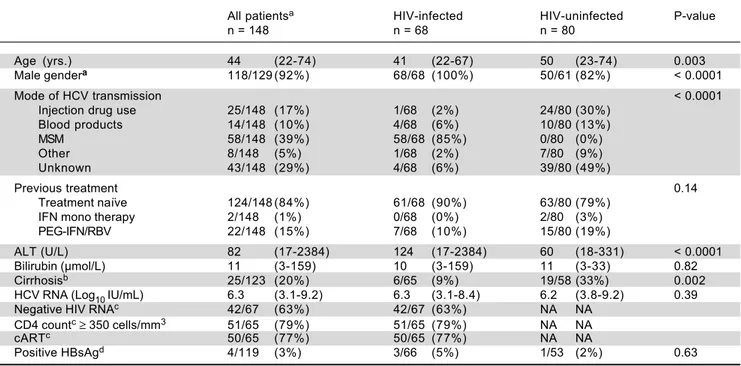
frequently cirrhosis at baseline (diagnosis by FibroScan®, liver bi-opsy or imaging modalities). Of the 50 HIV-infected subjects treated with combined antiretroviral therapy, 41 (82%) had un-detectable HIV RNA (< 50 copies/mL).
RAVs in the study population
Polymorphisms at positions F43, R109, V132, S138, R155, V158, D168 and L/M175 were not observed. While samples from HIV-infected were more frequent-ly of recent dates than those from HIV-uninfected pa-tients, presence of at least one RAV did not differ between samples taken before or after 2010, neither in the HIV-infected group (62% vs. 62%, p = 1.0), nor in the HIV-uninfected group (78% vs. 80%, p = 1.0), nor in the whole group (72% vs. 70%, p = 1.0). In addition, prevalence of V36, Q41, T54, V55, Q80K, V107, S122, A156, V/I170 and N174 polymorphisms were not signif-icantly different between samples taken before and after 2010. In sensitivity analyses, no differences were seen in samples taken before and after 2008, 2009 and 2011. As a proxy of duration of HCV infection, presence of RAVs between patients with and without cirrhosis was as-sessed, with no significant differences found in those with HIV (67% vs. 63%, p = 1.0), those without HIV (74% vs. 80%, p = 0.74) or in the whole group (72% vs.
69%, p = 1.0).
RAVs in HIV infected vs. HIV uninfected groups
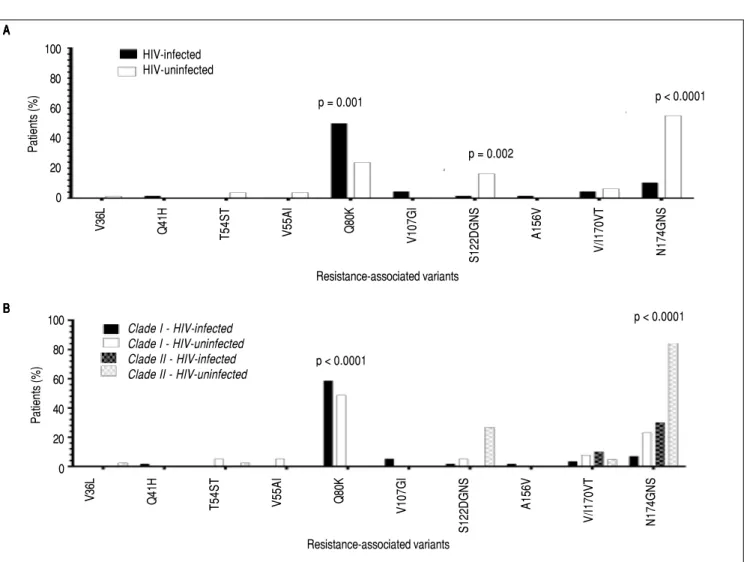
Overall, HIV-infected patients had lower RAV fre-quencies than HIV-uninfected patients, with 42 (62%) exhibiting at least one RAV vs. 63 patients (79%, p = 0.03) in the HIV-uninfected group (Figure 1). In addition, total number of RAVs per subject was significantly lower in the HIV-infected group (Figure 2). Prevalence of Q80K was higher in HIV-infected patients (50% vs. 24%, p = 0.001), whereas S122D/G/N/S polymorphisms (2% vs. 16%, p = 0.002) and N174G/N/S polymorphisms (10% vs. 55%, p < 0.0001) had lower prevalences (Table 3). Within the HIV-infected group, CD4 cell count ≥ 350 or treatment with combined antiretroviral therapy did not affect preva-lence of the RAVs.
RAVs distribution among HCV transmission modes
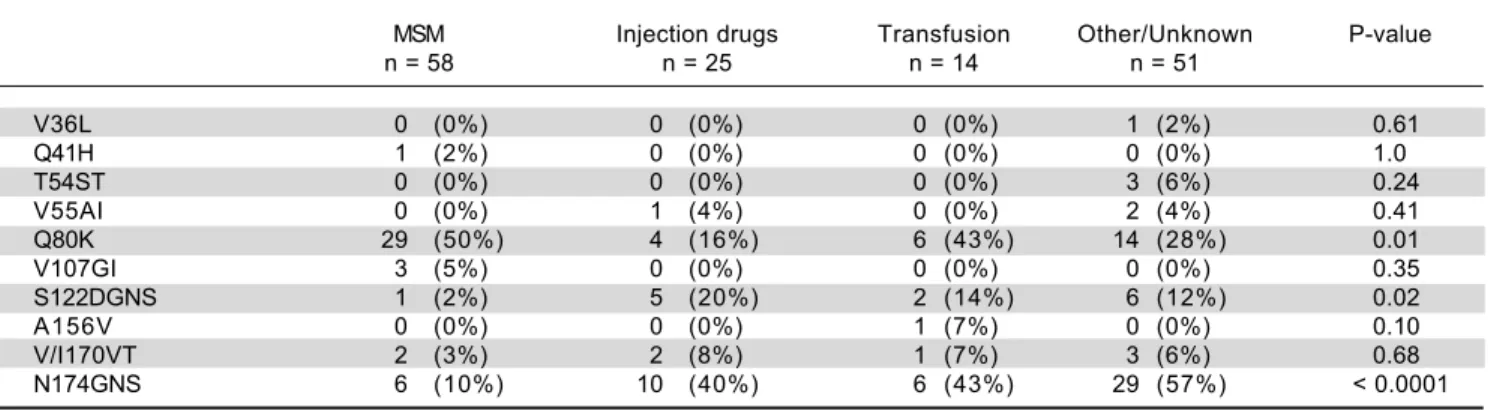
Distribution of RAVs among the various modes of HCV acquisition in the total study population are given in table 4. Significantly higher rates of Q80K were observed in HCV transmission by MSM vs. other modes of trans-mission (29/58 (50%) vs. 24/90 (27%), p = 0.005). Lower frequencies of Q80K were observed among injection drug users vs. other modes of HCV transmission (4/25 (16%) vs.
Table 2. Baseline characteristics of hepatitis C genotype 1a patients infected with and without HIV.
All patientsa HIV-infected HIV-uninfected P-value
n = 148 n = 68 n = 80
Age (yrs.) 44 (22-74) 41 (22-67) 50 (23-74) 0.003
Male gendera 118/129 (92%) 68/68 (100%) 50/61 (82%) < 0.0001
Mode of HCV transmission < 0.0001
Injection drug use 25/148 (17%) 1/68 (2%) 24/80 (30%) Blood products 14/148 (10%) 4/68 (6%) 10/80 (13%)
MSM 58/148 (39%) 58/68 (85%) 0/80 (0%)
Other 8/148 (5%) 1/68 (2%) 7/80 (9%)
Unknown 43/148 (29%) 4/68 (6%) 39/80 (49%)
Previous treatment 0.14
Treatment naïve 124/148 (84%) 61/68 (90%) 63/80 (79%) IFN mono therapy 2/148 (1%) 0/68 (0%) 2/80 (3%) PEG-IFN/RBV 22/148 (15%) 7/68 (10%) 15/80 (19%)
ALT (U/L) 82 (17-2384) 124 (17-2384) 60 (18-331) < 0.0001 Bilirubin (μmol/L) 11 (3-159) 10 (3-159) 11 (3-33) 0.82
Cirrhosisb 25/123 (20%) 6/65 (9%) 19/58 (33%) 0.002
HCV RNA (Log10 IU/mL) 6.3 (3.1-9.2) 6.3 (3.1-8.4) 6.2 (3.8-9.2) 0.39 Negative HIV RNAc 42/67 (63%) 42/67 (63%) NA NA
CD4 countc≥ 350 cells/mm3 51/65 (79%) 51/65 (79%) NA NA
cARTc 50/65 (77%) 50/65 (77%) NA NA
Positive HBsAgd 4/119 (3%) 3/66 (5%) 1/53 (2%) 0.63
Data are presented as median (range) or n (%). a Data incomplete in 19 patients. b Data known in 123 patients. bHIV RNA < 50 copies/mL. c Data unknown in 1
respectively 3 patients. d Data unknown in 29 patients. ALT: alanine aminotransferase. cART: combined antiretroviral treatment. HBsAg: hepatitis b surface
Lieveld FI, et al. , 2016; 15 (5): 696-704
700
49/123 (40%), p = 0.024). S122 and N174 polymorphisms displayed lower frequencies in MSM than in other modes of transmission (For S122 1/58 (2%) vs. 13/90 (14%) with p = 0.009, and for N174 45/90 (50%) vs. 6/58 (10%) with p < 0.0001). For all other polymorphisms, no differ-ences in mode of HCV transmission were observed.
RAVs in clade I vs. clade II viruses
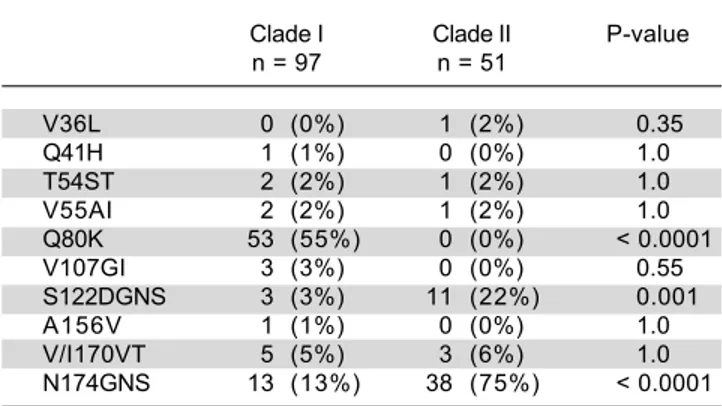
In HIV-infected patients, clade I viruses were signifi-cantly more prevalent than clade II viruses (85% vs. 15%), whereas distribution of clade I and clade II viruses was equal in HIV-uninfected subjects (49% vs. 51%, p<0.0001). Q80K was exclusively seen in clade I viruses, whereas S122 polymorphisms (3% vs. 22%, p = 0.001) and N174
polymorphisms (13% vs. 75%, p < 0.0001) had significantly lower relative frequencies in clade I viruses than in clade II viruses (Table 5). No significant differences in preva-lence of at least one RAV or CD4 cell count were ob-served between clade I and clade II viruses.
DISCUSSION
In the current study, significant higher frequencies of Q80K and lower frequencies of polymorphisms on the S122 and N174 loci were observed in NS3/4A protease in-hibitor treatment-naïve HIV-infected patients than in HIV-uninfected patients with HCV genotype 1a. These re-sults may be explained by differences in HCV acquisition between the groups, as a subset of HCV genotype 1a strains may circulate among the MSM community,18 whereas a
A A A A A
V36L Q41H
T54ST V55AI Q80K V107GI
S122DGNS
A156V
V/I170VT N174GNS
Resistance-associated variants
V36L Q41H
T54ST V55AI Q80K V107GI
S122DGNS
A156V
V/I170VT N174GNS
Resistance-associated variants B
B B B B
100
80
60
40
20
0
Patients (%)
p = 0.001
p = 0.002
p < 0.0001
100
80
60
40
20
0
Patients (%)
p < 0.0001
p < 0.0001 Clade I - HIV-infected
Clade I - HIV-uninfected Clade II - HIV-infected Clade II - HIV-uninfected
HIV-infected HIV-uninfected
Figure 1. A. Figure 1. A. Figure 1. A. Figure 1. A.
Figure 2. Figure 2.Figure 2.
Figure 2.Figure 2. Number of NS3 resistance-associated variants in the HIV-infec-ted and HIV-uninfecHIV-infec-ted study population. Number of RAVs per subject with interquartile range: 1 (0-1) for HIV-infected vs.1 (1-2) for HIV-uninfected. Black dots represent HIV-infected and open dots represent HIV-uninfected subjects. HIV: human immunodeficiency virus. no: number. RAVs: resistan-ce-associated variants.
Table 3. Distribution of resistance-associated variants in 148 NS3/4A protease inhibitor treatment-naïve patients with and without HIV
infection.
All patients HIV-infected HIV-uninfected P-value
n = 148 n = 68 n = 80
V36L 1 (1%) 0 (0%) 1 (1%) 1.0
Q41H 1 (1%) 1 (2%) 0 (0%) 0.46
T54ST 3 (2%) 0 (0%) 3 (4%) 0.25
V55AI 3 (2%) 0 (0%) 3 (4%) 0.25
Q80K 53 (36%) 34 (50%) 19 (24%) 0.001
V107GI 3 (2%) 3 (4%) 0 (0%) 0.10
S122DGNS 14 (10%) 1 (2%) 13 (16%) 0.002
A156V 1 (1%) 1 (2%) 0 (0%) 0.46
V/I170VT 8 (5%) 3 (4%) 5 (6%) 0.73
N174GNS 51 (35%) 7 (10%) 44 (55%) < 0.0001
Data are presented as n (%). Data on F43, R109, V132, S138, R155, A156, V158, D168 and L/M175 polymorphisms prevalence are not given as they did not occur in the study population.
Table 4. Distribution of resistance-associated variants in 148 NS3/4A protease inhibitor treatment-naïve patients according to modes
of HCV transmission.
MSM Injection drugs Transfusion Other/Unknown P-value
n = 58 n = 25 n = 14 n = 51
V36L 0 (0%) 0 (0%) 0 (0%) 1 (2%) 0.61
Q41H 1 (2%) 0 (0%) 0 (0%) 0 (0%) 1.0
T54ST 0 (0%) 0 (0%) 0 (0%) 3 (6%) 0.24
V55AI 0 (0%) 1 (4%) 0 (0%) 2 (4%) 0.41
Q80K 29 (50%) 4 (16%) 6 (43%) 14 (28%) 0.01
V107GI 3 (5%) 0 (0%) 0 (0%) 0 (0%) 0.35
S122DGNS 1 (2%) 5 (20%) 2 (14%) 6 (12%) 0.02
A156V 0 (0%) 0 (0%) 1 (7%) 0 (0%) 0.10
V/I170VT 2 (3%) 2 (8%) 1 (7%) 3 (6%) 0.68
N174GNS 6 (10%) 10 (40%) 6 (43%) 29 (57%) < 0.0001
Data are presented as n (%). Data on F43, R109, V132, S138, R155, A156, V158, D168 and L/M175 polymorphisms prevalence are not given as they did not occur in the study population. MSM: men who have sex with men.
broad variety in strains may be acquired through other transmission routes. Indeed, several studies among HIV-positive MSM in European studies, including the Neth-erlands, revealed the existence of MSM-specific HCV transmission networks in which HCV co-circulating strains were identified.19,20 This may have been exhibited
in the current study by higher Q80K frequencies in the MSM group whereas the other RAVs displayed a more even distribution among the other transmission modes. Another explanation may be the high prevalence of geno-type 1a clade I viruses in HIV-infected patients, which may lead to subsequent higher Q80K rates.7 In line with
our observations, a recent study on NS3 RAVs in HIV-in-fected patients (n = 40 HCV genotype 1a and n = 19 geno-type 1b) observed 10/23 vs. 4/17 RAVs in genotype 1a clade I respectively clade II, of which 8 out of 10 RAVs in clade I were Q80K.21
Q80K reduces susceptibility to simeprevir in vitro, with lower SVR rates especially in pegylated-interferon con-HIV-infected HIV-uninfected
RAVs per subject (n)
p = 0.004 5
4
3
2
1
Lieveld FI, et al. , 2016; 15 (5): 696-704
702
taining combinations,1,22 and some studies indicate that
Q80K may also reduce SVR rates in “all oral” regimens containing simeprevir.11 However, guidelines state that
combination of simeprevir with other DAAs may mitigate the effects of Q80K,22 and as the impact of Q80K seems
ab-sent in treatment with newer NS3/4A protease inhibi-tors,12 the relevance of this polymorphism remains
controversial. While S122 polymorphisms are associated with reduced efficacy of simeprevir,1 telaprevir and
asuna-previr17 and N174 polymorphisms with reduced efficacy
of simeprevir,1 reports suggest that they only have a minor
impact on SVR.23
Several studies with smaller sample sizes have evaluat-ed Q80K and other NS3 RAVs in patients with and with-out HIV14,15,24-28 (Table 1). To our knowledge the current
study is the largest, and the first to unequivocally describe higher frequencies of Q80K in HIV-infected patients with HCV genotype 1a. The discrepancies in results with the other studies may be attributed to differences in demo-graphic and geodemo-graphic characteristics, as well as the small-er sample sizes in othsmall-er studies. Nonetheless, one study also found higher frequencies of Q80K in coinfected pa-tients.13 However, that study examined a small group (n =
21) consisting of both HCV genotype 1a and genotype 1b infected subjects.
Currently, a large number of HCV-infected patients have been treated with interferon-free DAA regimens with high success rates, reaching up to 90% and above depend-ing on the regimen.29 While baseline RAV testing may not
be relevant in the majority of patients it may still have an important role in individual cases as cross-resistance exists between first- and second-generation NS3/4A protease in-hibitors,17,30 or when other negative treatment predictors
such as cirrhosis are present.31
In our study we observed lower number of RAVs per subject in the HIV-infected population, which is in line with another study on this subject.28 Another instructive
observation from our study is higher prevalence of clade I than clade II viruses in HIV-infected with an equal distri-bution of clade I and clade II viruses in HIV-uninfected subjects. This is contrary to the findings of another study7
that found HIV-infected subjects to have a trend towards higher prevalence rates of clade II viruses. In this latter study however, both HIV-infected and HIV-uninfected subjects were most frequently infected by HCV through intravenous drug use or by unknown means as opposed to homosexual contact in our HIV-infected study popula-tion. In line with other reports, Q80K was exclusively seen in clade I viruses in our study.6,7 However, we are the
first to describe higher prevalence of S122 and N174 poly-morphisms in clade II viruses.
Our study has several limitations, including the retro-spective design and availability of limited clinical data in some patients. Second, we assessed RAVs by population-based sequencing and do not have deep sequencing data (i.e. mutations expressed in ≥ 20% of the HCV quasispe-cies population).32 However, a previous study on NS5A
RAVs investigating several sequencing cut off values from 1-20%, described a reduction in SVR only in high level re-sistant polymorphisms.31 Thus, the widely used
popula-tion-based sequencing method is highly likely to be sufficient in detecting clinically relevant RAVs. The strengths of this study are that we analyzed a relatively large subset of NS3 RAVs throughout 15 years of time in both HIV-infected and HIV-uninfected patients and the relatively large sample size compared to the available liter-ature.
In conclusion, the current study demonstrated in-creased prevalence of Q80K and reduced prevalence of S122 and N174 polymorphisms in HIV-infected patients compared to HIV-uninfected patients with HCV genotype 1a. Although testing for RAVs prior to treatment with NS3/4A protease inhibitors does not constitute standard of care with currently available DAA regimens, it could be useful in the near future when treating DAA-failures or difficult-to-treat patients.
ABBREVIATIONS
• AMC: Academic Medical Center. • DAA: direct-acting antiviral. • HCV: hepatitis C virus.
• HIV: human immunodeficiency virus. • MSM: men who have sex with men. • RAV: resistance-associated variant. • SVR: sustained virologic response.
• UMCU: University Medical Center Utrecht.
Table 5. Distribution of resistance-associated variants in 148
NS3/4A protease inhibitor treatment-naïve patients with hepatitis C genotype 1a clade I and clade II viruses.
Clade I Clade II P-value n = 97 n = 51
V36L 0 (0%) 1 (2%) 0.35
Q41H 1 (1%) 0 (0%) 1.0
T54ST 2 (2%) 1 (2%) 1.0
V55AI 2 (2%) 1 (2%) 1.0
Q80K 53 (55%) 0 (0%) < 0.0001 V107GI 3 (3%) 0 (0%) 0.55 S122DGNS 3 (3%) 11 (22%) 0.001
A156V 1 (1%) 0 (0%) 1.0
V/I170VT 5 (5%) 3 (6%) 1.0 N174GNS 13 (13%) 38 (75%) < 0.0001
CONFLICT OF INTEREST
A.M. Newsum was financially supported by the “Aids Fonds” Netherlands (grant number 2013.037). C.K.Y. Ho was financially supported by the Virgo consortium, funded by the Dutch government project number FES0908, and by the Netherlands Genomics Initiative (NGI) project number 050-060-452. J.E. Arends served as an advisory board member or a speaker for Viiv, Janssen, Gilead, MSD, Abbvie and Bristol-Myers Squibb. A.I.M. Hoepel-man served as an advisory board member for Gilead, Jans-sen, ViiV and MSD. A.M.J. Wensing has received an unrestricted grant from Janssen for this work. A.M.J. Wensing also received consultancy fees, travel and/or re-search grants from Bristol-Myers Squibb, Gilead, Janssen, MSD, Viiv Healthcare and Virology Education, all paid to her institution: these were not related to this work. K.J. van Erpecum has served as an advisory board member or lecturer for Abbvie, Bristol-Myers Squibb, Gilead Sci-ences and Janssen-Cilag (all paid to the institution). He also received grants from Janssen-Cilag and Gilead for pa-tient support during “all oral” HCV therapy. G.J. Boland has received consultancy fees from AbbVie, paid to the in-stitution. All other authors declare no conflict of interests.
FINANCIAL SUPPORT
Determination of resistance-associated polymor-phisms in the University Medical Center Utrecht and the Academic Medical Center was made possible by financial support from Janssen Pharmaceuticals, Inc.
REFERENCES
1. Lenz O, Verbinnen T, Fevery B, Tambuyzer L, Vijgen L, Peeters M, Buelens A, et al. Virology analyses of HCV iso-lates from genotype 1-infected patients treated with simeprevir plus peginterferon/ribavirin in phase IIb/III studies. J Hepatol 2014; 62: 1008-14.
2. Sulkowski M, Benhamou Y. Therapeutic issues in HIV/HCV-coinfected patients. J Viral Hepat 2007; 14: 371-86. 3. Soriano V, Perelson AS, Zoulim F. Why are there different
dy-namics in the selection of drug resistance in HIV and hepatitis B and C viruses? J Antimicrob Chemother 2008; 62: 1-4. 4. Sarrazin C, Lathouwers E, Peeters M, Daems B, Buelens A,
Witek J, Wyckmans Y, et al. Prevalence of the hepatitis C vi-rus NS3 polymorphism Q80K in genotype 1 patients in the european region. Antiviral Res 2015; 116: 10-6.
5. Messina JP, Humphreys I, Flaxman A, Brown A, Cooke GS, Pybus OG, Barnes E. Global distribution and prevalence of hepatitis C virus genotypes. Hepatology 2015; 61: 77-87. 6. Pickett BE, Striker R, Lefkowitz EJ. Evidence for separation
of HCV subtype 1a into two distinct clades. J Viral Hepat 2011; 18: 608-18.
7. De Luca A, Di Giambenedetto S, Presti AL, Sierra S, Pros-peri M, Cella E, Giovanetti M, et al. Two distinct hepatitis C virus genotype 1a clades have different geographical dis-tribution and association with natural resistance to NS3
protease inhibitors 2015. Open Forum Infect Dis 2015; 2: ofv043.
8. Bae A, Sun SC, Qi X, Chen X, Ku K, Worth A, Wong KA, et al. Susceptibility of treatment-naive hepatitis C virus (HCV) clinical isolates to HCV protease inhibitors. Antimicrob Agents Chemother 2010; 54: 5288-97.
9. Susser S, Schelhorn S, Lange C, Welsch C, Vermehren J, Perner D, Füller C, et al. Ultratiefe pyrosequenz-analyse (UDPS) von neu beschriebenen seltenen resistenzvarianten der hepatitis C virus NS3 protease bei patienten, die mit tel-aprevir oder boceprevir behandelt wurden. Z Gastroenterol 2012; 50 - K052.
10. Kieffer TL, George S. Resistance to hepatitis C virus pro-tease inhibitors. Current opinion in virology 2014; 8: 16-21. 11. Lawitz E, Sulkowski MS, Ghalib R, Rodriguez-Torres M,
You-nossi ZM, Corregidor A, DeJesus E, et al. Simeprevir plus sofosbuvir, with or without ribavirin, to treat chronic infec-tion with hepatitis C virus genotype 1 in non-responders to pegylated interferon and ribavirin and treatment-naive pa-tients: The COSMOS randomised study. The Lancet 2014; 384: 1756-65.
12. Forns X, Gordon SC, Zuckerman E, Lawitz E, Calleja JL, Hof-er H, GilbHof-ert C, et al. Grazoprevir/elbasvir plus ribavirin for chronic HCV genotype-1 infection after failure of combina-tion therapy containing a direct-acting antiviral agent. J Hepatol 2015; 63: 564-72.
13. Ogishi M, Yotsuyanagi H, Tsutsumi T, Gatanaga H, Ode H, Sugiura W, Moriya K, et al. Deconvoluting the composition of low-frequency hepatitis C viral quasispecies: Comparison of genotypes and NS3 resistance-associated variants be-tween HCV/HIV coinfected hemophiliacs and HCV monoin-fected patients in japan. PLoS One 2015; 10: e0119145. 14. Ehret R, Neifer S, Walter H, Baumgarten A, Obermeier M.
Ap-pearance of NS3 Q80K mutation in HCV genotype 1a mono-or HIV/HCV co-infected patients in a berlin labmono-oratmono-ory. J Int AIDS Soc 2014; 17(4, Suppl. 3): 19741.
15. Vicenti I, Rosi A, Saladini F, Meini G, Pippi F, Rossetti B, Sidella L, et al. Naturally occurring hepatitis C virus (HCV) NS3/4A protease inhibitor resistance-related mutations in HCV genotype 1-infected subjects in italy. J Antimicrob Chemother 2012; 67: 984-7.
16. van Soest H, van der Schaar PJ, Koek GH, de Vries RA, van Ooteghem NA, van Hoek B, Drenth JP, et al. No beneficial ef-fects of amantadine in treatment of chronic hepatitis C pa-tients. Dig Liver Dis 2010; 42: 496-502.
17. Poveda E, Wyles DL, Mena Á, Pedreira JD, Castro-Iglesias Á, Cachay E. Update on hepatitis C virus resistance to direct-acting antiviral agents. Antiviral Res 2014; 108: 181-91. 18. Nevot M, Boesecke C, Parera M, Andrés C, Franco S, Revollo
B, Ingiliz P, et al. Hepatitis C virus NS3/4A quasispecies di-versity in acute hepatitis C infection in HIV-1 co-infected pa-tients. J Viral Hepat 2014; 21: e19-e28.
19. van de Laar T, Pybus O, Bruisten S, Brown D, Nelson M, Bhagani S, Vogel M, et al. Evidence of a large, international network of HCV transmission in HIV-positive men who have sex with men. Gastroenterology 2009; 136: 1609-17. 20. van de Laar TJ, van der Bij AK, Prins M, Bruisten SM,
Brink-man K, Ruys TA, van der Meer JT, et al. Increase in HCV incidence among men who have sex with men in amsterdam most likely caused by sexual transmission. J Infect Dis 2007; 196: 230-8.
Lieveld FI, et al. , 2016; 15 (5): 696-704
704
22. European Association for the Study of the Liver. Electronic address: [email protected]. EASL recommendations on treatment of hepatitis C 2015. J Hepatol 2015.
23. Shepherd SJ, Abdelrahman T, MacLean AR, Thomson EC, Aitken C, Gunson RN. Prevalence of HCV NS3 pre-treatment resistance associated amino acid variants within a scottish cohort. J Clin Virol 2015; 65: 50-3.
24. Jabara CB, Hu F, Mollan KR, Williford SE, Menezes P, Yang Y, Eron JJ, et al. Hepatitis C virus (HCV) NS3 sequence di-versity and antiviral resistance-associated variant frequen-cy in HCV/HIV coinfection. Antimicrob Agents Chemother 2014; 58: 6079-92.
25. Lin M, Charlton A, Rouster S, Zamor P, Sherman K. Hepatitis C virus NS3 mutations in haemophiliacs. Haemophilia 2014; 20: 659-65.
26. Beloukas A, King S, Childs K, Papadimitropoulos A, Hopkins M, Atkins M, Agarwal K, et al. Detection of the NS3 Q80K polymorphism by sanger and deep sequencing in hepatitis C virus (HCV) genotype 1a strains in the united kingdom. Clini-cal Microbiology and Infection 2015; pii: S1198-743X(15)00734-X.
27. Applegate TL, Gaudieri S, Plauzolles A, Chopra A, Grebely J, Lucas M, Hellard M, et al. Naturally occurring dominant drug resistance mutations occur infrequently in the setting of re-cently acquired hepatitis C. Antivir Ther 2015; 20: 199-208. 28. McCormick AL, Moynihan L, Macartney MJ, Garcia-Diaz A,
Smith C, Johnson MA, Rodger AJ, et al. Baseline drug
resist-ance mutations are detectable in HCV genes NS3 and NS5A but not NS5B in acute and chronic HIV-coinfected patients. Antivir Ther 2015; 20: 361-3.
29. Zoulim F, Liang TJ, Gerbes AL, Aghemo A, Deuffic-Burban S, Dusheiko G, Fried MW, et al. Hepatitis C virus treatment in the real world: Optimising treatment and access to therapies. Gut 2015; 64: 1824-33.
30. American Association for the Study of Liver Diseases, In-fectious Diseases Society of America. Recommendations for testing, managing, and treating hepatitis C 2015.
31. Dietz J, Susser S, Berkowski C, Perner D, Zeuzem S, Sar-razin C. Consideration of viral resistance for optimization of direct antiviral therapy of hepatitis C virus genotype 1-in-fected patients. PloS one 2015; 10: e0134395.
32. Tan S, He Y. Hepatitis C: Antiviral drug discovery and devel-opment. Horizon Scientific Press; 2011.
Correspondence and reprint request:
G.J. Boland, Ph.D.
Department of Medical Microbiology. University Medical Center Utrecht. PO BOX 85500, 3508 GA Utrecht, The Netherlands.