06
Healthy wetlands, healthy people
A review of wetlands and human health
interactions
Reports
Healthy wetlands, healthy people
A review of wetlands and human health interactions
Coordinating authors: Pierre Horwitz, C. Max Finlayson,
Philip Weinstein
Despite the production of more food and extraction of more water globally, wetlands continue to decline and public health and living standards for many do not improve. Why is this – and what needs to change to improve the situation? If we manage wetlands better, can we improve the health and well-being of people? Indeed, why
is this important? This report seeks to address these questions.
Ramsar Convention Secretariat
Rue Mauverney 28
1196 Gland, Switzerland
World Health Organization
Avenue Appia 20
1211 Geneva 27, Switzerland
ii
Published jointly by the Secretariat of the Ramsar Convention on Wetlands (Ramsar, Iran, 1971) and
the World Health Organization
© Ramsar Convention Secretariat 2012. ISBN 2-940073-32-5.
This report should be cited as: Horwitz, P., Finlayson, M. and Weinstein, P. 2012. Healthy wetlands, healthy peo-ple: a review of wetlands and human health interactions. Ramsar Technical Report No. 6. Secretariat of the Ramsar Convention on Wetlands, Gland, Switzerland, & The World Health Organization, Geneva, Switzerland.
Coordinating Authors: Pierre Horwitz, C. Max Finlayson, Philip Weinstein. Section Lead Authors: Martin
Birley, Robert Bos, Nick Davidson, Rebecca D’Cruz, Ritesh Kumar, Christine Prietto, Chris Skelly. Contributing
Authors: Priyanie Amerasinghe, Malcolm Beveridge, Ruth Cromie, Anthony Cunningham, Edgar Kaeslin,
Rebecca Lee, Heather Mackay, Dave Pritchard, Jack Rieley, David Stroud. Contact details can be found at the end of this report.
Design & layout: Dwight Peck (Ramsar Convention Secretariat). Cover photo: Avian influenza surveillance activities in Kenya (Ruth Cromie, WWT)
Ramsar Technical Reports. Series editors: Heather MacKay (Chair of Ramsar Scientific & Technical Review
Panel), Max Finlayson (former Chair of Ramsar Scientific & Technical Review Panel), and Nick Davidson (Deputy Secretary General, Ramsar Convention Secretariat).
Ramsar Technical Reports are designed to publish, chiefly through electronic media, technical notes, reviews and reports on wetland ecology, conservation, wise use and management, as an information support service to Contracting Parties and the wider wetland community in support of implementation of the Ramsar Convention. All Ramsar Technical Reports are peer-reviewed by the members and observers of the STRP and independent experts.
Ramsar Technical Reports are published in English in electronic (PDF) format. When resources permit, they are also published in French and Spanish, the other official languages of the Ramsar Convention.
The views and designations expressed in this publication are those of its authors and do not necessarily repre-sent officially-adopted views of the Ramsar Convention or its Secretariat or of The World Health Organization. All reasonable precautions have been taken by the Ramsar Convention to verify the information contained in this publication. However, the published material is being distributed without warranty of any kind, either expressed or implied. The responsibility for the interpretation and use of the material lies with the reader. In no event shall the Ramsar Convention or the World Health Organization be liable for damages arising from its use. All authors of this report have confirmed that they do not have any conflict of interest in respect to its contents. Reproduction of material from this publication for educational and other non-commercial purposes is author-ized without prior permission from the Ramsar Secretariat, providing full acknowledgement is given.
Ramsar Technical Report No. 6
iii
Contents
Preface
Acknowledgements
Executive summary
1. The Wetland/Health Nexus
1.1 On the global drivers of wetland change
1.2 A persistent problem remains
1.3 The response of wetland management
1.4 A new central theme for wetland management?
1.5 A role for public health?
1.6 Principles of public health
1.7 The determinants of health
1.8 The wetlands and public health relationship – the early days
1.9 The choices we make: tradeoffs and economic approaches
1.10 The aim of this report
2. From ecological character to ecosystem health: the Ramsar Convention, and wetland
ecosystems as settings for human health
2.1 Introduction
2.2 Ecological character
2.3 Ecosystem services provided by wetlands
2.4 Wetland ecosystem services and human well-being
2.5 Public health and health promotion: recognizing ecosystems
2.6 Patterns of health: epidemiological transitions, poverty and inequality
2.7 Bringing them together: health issues and health determinants in wetland settings
2.8 Drivers of change
2.9 From healthy people to ecosystem health
2.10 Conclusion
3. Wetland ecosystem services and benefits for the health of human populations
3.1 Introduction
3.2 Health benefits and values of wetland ecosystem services
3.3 Conclusions
4. Wetland ecosystem settings: core requirements for humans, their livelihoods and
lifestyles
4.1 Introduction
4.2 Sufficient and safe water
4.3 Nutrition
4.4 Social determinants of health
4.5 Conclusions
5. Wetland ecosystems and human exposures to health risks: the role of disruption to
ecosystem services
5.1 Introduction
5.2 Exposure to pollution
5.3 Infection
5.4 Mental health and psycho-social well-being
5.5 Exposure to physical hazards
5.6 Conclusion
6. Interventions required to enhance human well-being by addressing the erosion of
ecosystem services in wetlands
6.1 Introduction
6.2 Thinking big – changing attitudes and perspectives
6.3 Enabling responses and interventions – the policy level
6.4 Wetland-based interventions ‒ the role of the wetland managers
6.5 Conclusions
7. Conclusions and Recommendations
References
Authors’ details
iv iv 1 7 7 8 8 8 9 9 10 11 12 14 15
15 16 16 18 19 21 23 23 25 27 27 27 29 37 39
39 40 43 47 51 52
52 52 56 65 69 72 73
iv
Preface
At the 9th meeting of the Conference of the Contracting Parties to the Ramsar Convention, in Resolution IX.2 (Ramsar 2005b) the Parties instructed the Scientific and Technical Review Panel (STRP) to undertake a review of the issues and interactions between wetlands and human health, in recognition of the fact that these matters had not previously received significant attention under the Convention. This topic subsequently attained further significance with the adoption of the theme for the next COP as “Healthy Wetlands, Healthy People”.
The Panel established an expert Working Group to progress this task, under the initial leadership of the STRP Chair and the Deputy Secretary General. The Panel established a scope, approach and outline contents for this review report, and it invited a number of additional human health and wetlands experts to contribute to the drafting. The report drafting team has been led by Professors Pierre Horwitz, Max Finlayson, and Philip Weinstein, and the report preparation has received significant input from Drs Robert Bos and Martin Birley from the World Health Organization (WHO), Professor Chris Skelly, and a number of other invited experts, STRP members (notably Rebecca D’Cruz and Ritesh Kumar) and observers as contributing authors.
The STRP determined that its initial report should focus on providing advice to wetland managers and deci-sion-makers on the range of often complex issues concerning wetlands and human health interactions, but it also recognized that this report should be the first stage in the exploration of the issues and recommended to the 10th meeting of the Conference of the Contracting Parties (COP10) that the Panel should be asked to under-take further work on a number of aspects of the issues that have emerged as gaps (see Resolutions X.10 and X.23). Amongst these the Panel recognized a need, especially in relation to the COP10 theme, to provide a bet-ter understanding of what is meant by “wetland ecosystem health”, including in relation to the commitments under the Convention concerning the maintenance of the ecological character of wetlands.
Acknowledgements
The Ramsar STRP and Secretariat are very grateful for financial support for this work from the governments of the Republic of Korea and Sweden, which enabled members of the report drafting team to meet in three writing workshops to progress its work: in Changwon, Republic of Korea (November 2007), Perth, Australia (January 2008), and Kuala Lumpur, Malaysia (April 2008). A fourth writing workshop was held in Perth, Australia (August 2009).
1
Executive Summary
Managing Wetlands and Fostering Human
Health
W
etland ecosystems, including rivers, lakes,marshes, rice fields, and coastal areas, pro-vide a well-defined set of ecosystem services that contribute to human well-being and poverty alle-viation. While it is impossible to imagine human life without water, the importance of the relation-ship between wetlands and water is less well recog-nized, and this relationship has changed over time.
Technology, engineering and medicine have inter-vened in the way we manage water and wetlands to successfully improve aspects of and foster human health. Over the same period, increasing human populations and increasing rates of consumption by humans, alterations to land use and land cover and the practices of irrigation, all associated with agri-culture, urban expansion, and global environmental change, have collectively and substantially adversely modified wetland systems, in terms of both water quality and water quantity.
Reconceiving this relationship will be central for wetland management: developing strategies that support the maintenance of both wetland ecological character and human health concurrently through the implementation of the Ramsar Convention on Wetlands (Ramsar, Iran, 1971) and other processes. Wetlands are often seen only as the source of vec-tor- or water-borne diseases, and a widespread misinterpretation of wetlands as ‘the problem’ for human health requires careful treatment and atten-tion. Better land and water management is required, including a richer sense of the roles of biodiversity in parasite regulation, to emphasize the benefits that humans derive from wetlands. Understanding these and other benefits provide the basis for foster-ing human health and well-befoster-ing while managfoster-ing wetlands. Wetland managers must have information that will allow them to articulate, and respond pro-fessionally to, these claims.
Some groups of people, particularly those living near wetlands, are often highly dependent on wetland ecosystem services and are directly harmed by their degradation; in other instances wetlands are the basis of economic structures and are embedded in cul-tural expressions. These benefits can also determine human health, directly and indirectly, by contribut-ing to other forms of well-becontribut-ing (like providcontribut-ing secu-rity and basic materials for a good life and fostering good social relations).
If wetlands are more than a source of disease, if they play an important role in sustaining human health and well-being, and if they continue to be lost and degraded more rapidly than other ecosystems, then more effective treatment of the tradeoffs between dif-ferent forms of benefits will be required.
Wetlands as settings for public health
E
cosystems are implicitly recognized inconsid-erations of public health in virtually all of its endeavours, yet the management of ecosystems is generally given a low priority against the
medi-cal imperatives of attending to curing disease. The
Millennium Ecosystem Assessment sought to re-emphasise that ecosystem services are indispensable to the well-being and health of people everywhere, and in stating this case the Assessment involved environmental health practitioners, epidemiologists and others in the process.
Ecosystem services, ecosystems and ecological thought, and their application for health policy, is best expressed in the discipline of health promotion and its agreed charters, for instance, the 1986 Ottawa Charter for Health Promotion (Geneva: World Health Organization), and can be located in the ‘healthy set-tings’ agenda. To public health practitioners, then, wetland ecosystems can be usefully articulated as set-tings for people’s health, where the influences of cul-tural, economic and political factors are also located. Wetland ecosystems are settings that determine
human health and well-being through a number of characteristic influences, such as:
• a source of hydration and safe water; • a source of nutrition;
• sites of exposure to pollution or toxicants; • sites of exposure to infectious diseases; • sites of physical hazards;
• settings for mental health and psycho-social well-being;
• places from which people derive their livelihood; • places that enrich people’s lives, enable them to
cope and to help others; and
• sites from which medicinal products can be derived
inter-2
ventions for wetlands must also seek to address these inequities.
Seen in this way, problems in which the environment is considered to have been implicated in health out-comes cannot be solved by medical approaches to health alone. Rather, broader approaches are needed, drawing on a wider scientific base, including ecologi-cal and social sciences. This presumes that humans are not separable from the natural environment, and that socio-economic factors mediate human health.
Healthy wetlands, healthy people, and other
relationships
D
espite the Ramsar Convention’s text andlan-guage that centers around wise use and eco-logical character, the phraseology of ‘healthy wet-lands’ (and healthy rivers, healthy ecosystems, healthy parks, healthy landscapes, and so on) per-sists in common and professional use.
If used in a way that acknowledges that humans are an intrinsic part of ecosystems, the phrase “healthy ecosystem” can be justified: humans are implicated in activities that degrade ecosystems, yet humans can also be agents for the maintenance or restora-tion of ecosystems. And the health of humans is in some way a measure of the health of the ecosystem in which they live and depend, and vice versa. ‘Health’ is also powerful metaphor for the condition of an eco-system, and ecosystem approaches to human health make critical contributions to public health.
A claim to ‘healthy ecosystems’ comes from judg-ments about the desirability of a certain ecological character. It is also explicit about the health of com-ponents of the ecosystem (including humans) and whether organizations responsible for managing ecosystems are adaptive and responsive to changes in those ecosystems.
There are at least four ways of perceiving the rela-tionship ‘healthy wetlands, healthy people’. Human health outcomes can be either adverse or improved, depending upon whether or not ecosystem services are either degraded or maintained/enhanced. One view is that it is possible to demonstrate that a wet-land ecosystem can provide a range of ecosystem services in which you find people with improved health (the so-called ‘double dividend’). The oppo-site of this is where people with adverse health out-comes are found in degraded ecosystems (the classic ‘unhealthy wetland’).
However, two paradoxes exist. First, degraded eco-system services can provide benefits to people in such a way that there are positive health outcomes.
Secondly, maintained or enhanced ecosystem serv-ices can have problematic consequences for human well-being.
These paradoxes exist because human interactions in wetland ecosystems are complex and involve choices: tradeoffs between benefits that will occur when wetlands are developed or in which some services are promoted or favoured over others. This introduces a need to assess carefully the direct ben-efits and potential direct and indirect losses when managing wetlands and, in some instances, to reach compromises and agreed tradeoffs between services and beneficiaries.
Benefits of wetland ecosystems for human
health
T
he benefits of wetland ecosystems for humanhealth can be approached in at least three inter-related ways: by recognizing the human needs that are met by water in its setting; by recognizing the health products that come from wetland ecosys-tems; and by recognizing the economic value of wetlands in a full sense, in a way that allows indi-viduals within wetland ecosystems to sustainably improve their socio-economic conditions.
Human needs: Health benefits will accrue when
human social and cultural needs are satisfied by access to wetlands. Health relates most easily to the direct survival requirements (a full spectrum of which includes water for food, water for drinking, cooking and eating, washing, cleaning, health and healthcare, and for waste removal and assimilation). Water is needed to generate income and material well-being, and access to it generates prestige and social identity, contributes to social cohesion, allows for recreation while providing an aesthetic opportunity, all embed-ded within moral, cultural and spiritual needs.
Health products: Health benefits will accrue to
soci-eties in general and individuals in particular when products of wetlands can be used for pharmaceuti-cal or other medicinal purposes. Wetland-associated animals, fungi, bacteria, and lower plants (algae), some of them living in extreme conditions, provide the most productive sources of new natural products. The medicinal qualities of these are a good example of the continued value of traditional knowledge to health care today. Links between wetland biodiver-sity and human health should focus less exclusively on the obvious (such as birds, large mammals, or plants) and more on the “hidden biodiversity” (such as fungi and bacteria).
Economic value: As a general rule, as
3
outcomes improve as well. Wetland ecosystemserv-ices contribute to the material well-being (and socio-economic status) of individuals and populations, and they can be valued in economic terms. Valuation studies in general highlight the significant contribu-tion of wetlands to local, nacontribu-tional, regional and glo-bal economies. Several of these studies also indicate that when both the marketed and non-marketed eco-nomic benefits are included, the total ecoeco-nomic value of an unconverted wetland is frequently greater than that of a converted wetland.
Wetland management for water and sanitation
W
etland ecosystems provide a sophisticatedwater treatment service involving depo-sitional environments, aerobic water columns, anaerobic sediments, microbial suites, and wetland vegetation all contributing to the assimilation and extraction of pollutants and pathogens. Wetland landforms are also adjusted hydrologically to hold increased volumes of water.
Adverse health outcomes of insufficient water are direct in terms of human water requirements for survival, and indirect in terms of lack of access to drinkable water and water suitable for sanitation and hygiene. Poor quality water (as unsafe water), inadequate sanitation, and insufficient hygiene are the major risk factors for diarrheal disease, which is the second leading contributor to the global burden of disease. An important share of the total burden of disease worldwide – around 10% – could be pre-vented by improvements related to drinking water, sanitation, hygiene, and water resource management. Large inequalities exist globally, regionally, and locally in access to safe drinking water and adequate sanitation, and these trends need to be considered in wetland management processes. Lack of access to safe drinking water and poor sanitation usually affects the poorest sectors of society, with follow-on affects for food security. Rural populations are often disadvantaged compared to urban ones, and this situation is significant in most developing countries where women often shoulder the largest burden for collecting drinking water. Recognizing and manag-ing for ecosystem services that provide quality water will improve human health in these circumstances.
Wetland management for food security
W
etlands, through the services they provide,contribute to human health through the pro-vision of food security: ensuring food availability, buying power or social capital to access food with cash or through barter, sufficient nutrients from the
available food, and a resource of genetic material contained within wetland organisms.
The world’s major food items, core requirements for human health, come from wetland ecosystems. Rice, a staple food item for almost half the world’s popu-lation, is grown in a wide range of environments, mostly wetland ecosystems. Rice receives 35–45% of the world’s irrigation water and some 24–30% of developed freshwater resources. Inland fisheries and aquaculture contribute about 25% of the world’s production of fish; both can be critical to local food security with an irreplaceable value to human nutri-tion and local and regional incomes, often with high levels of participation in catching, farming, process-ing and marketprocess-ing.
Wetland ecosystems, managed appropriately for their resources, have a prominent role in maintain-ing dietary diversity, contributmaintain-ing to a multi-dimen-sional agenda focused on nutritional and health status, socio-cultural traditions, income generation, and biodiversity conservation. This attention helps to address both a trend towards increasing dietary focus on starch and oils and another trend in which the variety of foods are diminished, resulting in deficiencies in micronutrients and attendant health consequences.
A major tradeoff must be acknowledged, and possi-bly renegotiated, in the context of food security. It is often the act of trying to increase food production, both within and outside wetlands, that results in degradation of wetlands and causes the loss of other ecosystem services.
Wetland management for livelihoods and
lifestyles
A
ddressing wetland management as if people’slives, and their livelihoods, depended upon it will undoubtedly contribute to human health. A wetland manager and a health service provider should seek to sustain community livelihood in the context of the wetland, first by understanding the community situations by listening to their stories, hopes and wishes, and then by acting in accordance with them, within a context of local and traditional knowledge, government requirements, and market forces.
4
to disease-causing risks. Lifestyle factors are related to the ecosystem services, particularly leisure, recrea-tion, sporting activities, educarecrea-tion, and cultural herit-age (frequently including a spiritual significance of water), and they provide for both physical and men-tal health given human affinities for wetlands and watercourses.
Wetland management for reducing the risks of
exposures to disease
H
umans can be exposed to health risks inwet-land ecosystems: toxic materials, water-borne or vector borne diseases. While steps can be taken to ameliorate these risks, the risks can increase (sometimes dramatically) if disruption occurs to ecosystems and the services they provide.
Human health can be affected by acute or chronic exposure to toxicants, through the media of water, wet-land sediments, or even air when sediments become dessicated and airborne or burnt. The nature of these exposures is exacerbated by human behaviours and activities and they can result whenever ecosystem services have been eroded – especially when the hydrological services that maintain biological, geo-logical and chemical processes have been distorted by human activities of over extraction of water. Drainage and diversions of water are the two activi-ties responsible for the majority of such changes. Wetlands are often the loci for communicable disease, where microorganisms (the pathogens) are transmit-ted through water, people, animals, surfaces, foods, sediments or air, any or all of which can be associated with wetlands. Infectious diseases associated with wetlands have profoundly influenced the discipline of public health, and this is probably the source of the erroneous oversimplification that wetlands are bad for human health.
For water-borne or vector-borne diseases, numerous examples now exist to demonstrate that significant interactions occur between the host, agent, and aquatic environment factors, and these must broaden the traditional perspectives of public health and their epidemiological approaches into one more closely aligned with the science of ecology. This is an area where wetland managers have a significant contribu-tion to make.
While wetlands can be associated with an increased incidence of globally significant and locally impor-tant infectious diseases (such as cholera, malaria and schistosomiasis), the removal of wetlands or altera-tion of their water regimes is not generally the only disease management option that should be consid-ered. The incidence of many of these diseases can
instead be reduced through an integrated approach ensuring provision of clean water, improved sanita-tion, modified behaviours to reduce exposures, and – most importantly – good management of wetlands. The incidence of a range of infectious diseases is increasing in recent times. Emerging infectious dis-eases occur when there is a changed vector or para-site distribution, or a change to host susceptibilities. Usually these mechanisms have in turn been driven by human activities that have led to ecosystem disruptions, so that the ecosystem service of dis-ease control is diminished. A special case is when human and animal pathogens that have in the past been controlled successfully become resistant in the water environment and to most disinfectants and/ or antibiotics. This resistance has been mediated by discharge from sewage systems and discharge from animal production areas. Both result in drug residues and the presence of antibiotic resistant isolates in the receiving environment.
Wetlands management for psycho-social
health, and the effects of disasters
W
etlands, in their myriad forms, becomeembedded in the human psyche in formula-tions of “sense of place”. Changes to wetlands, to their products, to their ability to deliver a liveli-hood, or their becoming a source of toxic exposure or disease, can influence a person’s mental health by becoming a source of psychological stress. These potentialities are increasingly recognized as being part of the wetland manager’s and pub-lic health practitioner’s spheres of prevention and intervention.
5
Wetland management: changes in
perspec-tives required
A
ttitudinal shifts and reorientation ofperspec-tives within and outside the field of wetland management will ensure that human health and wetland ecosystems are managed to benefit one another.
Using systems thinking, wetland managers realize that there are consequences of their actions, and they undertake those actions knowing about them, not-withstanding the fact that we live in a complex and uncertain world. Where tradeoffs are being made, they need to be considered and valued according to principles of sustainability and equity rather than ignored or dealt with exclusively in financial terms. The wetland manager is responsible for biodiversity and its conservation, including parasites and par-asite-host relationships and the ways they contrib-ute to ecological functions. Too often these aspects of ecological character are ignored or diminished in emphasis, but they are a critical component of dis-ease regulation.
It is not acceptable to reason that we can manage wetlands for biodiversity alone; in fact, to do so will be counterproductive. A people-centred approach in wetland management, which does not diminish the importance of biodiversity, will help realize the co-benefits of sustainable ecosystem management and, for instance, achievement of the Millennium Development Goals.
Resolving matters of tradeoffs across levels of human involvement, from the personal to the global, can be achieved through dialogue, using a deliberative rather than hierarchical approach, to ensure that the local interests of people are not marginalized by more powerful forces.
Identifying principal partners and responsible stake-holder groups, often across disciplines and between sectors where barriers and boundaries exist, requires a particular form of engagement that wetland managers need to develop as part of their skill set: patience, tolerance of these ‘others’, and a willing-ness to reciprocate.
Wetland management: higher levels of policy
development
T
o embrace the breadth and richness of therelationship between wetland ecosystems and human health and well-being will require policy interventions promoted by, but extending well
beyond, the wetland sector. Policy interventions
are proposed to be non-specific and non-targeted.
Promoting cross-sectoral governance, institutional structures, and action-oriented teams will maximize the likelihood of wetland ecosystems and human health co-benefits.
Rationalized incentive structures need to exist for the wetland ecosystem services that currently sit outside of markets. Payments for ecosystem services, development of water markets and water-pricing, improved allocation of rights to freshwater resources to align incentives with conservation needs, and elimination of subsidies that promote excessive use of ecosystem services, are some of the policy approaches that can be taken.
Capacity building, improving communication, and empowerment of groups particularly dependent on ecosystem services or affected by their degradation, including women, indigenous people, and young people, will improve the likelihood of better man-agement of the ecosystems that provide ecosystem services.
Societal understandings of wetland and water management are not just technical issues, but also social and political ones as well. Policies must aim at measures to reduce consumption, raise aware-ness, develop curricula, empower communities, and promote participation in issues where the wetland / human health nexus exists.
Policies will need to be aimed at dramatically improv-ing irrigation efficiencies and promotimprov-ing other tech-nologies capable of productivity gains in agriculture without concomitant upscaling of water, ecosystem and energy costs. Similarly, the strategic develop-ment of appropriate mechanisms to enable health costs to be satisfactorily included in wetland man-agement is also an essential ingredient of the needed policy development.
Claims and counter-claims of ownership (for instance, local people’s claim to knowledge of medic-inal properties when scientific development also claims discoveries, with ensuing disputes over patent rights and payment benefits) can also have impor-tant policy implications. In light of the Convention on Biological Diversity’s recent Nagoya Protocol on Access and Benefit Sharing, the Ramsar Convention can be used to protect cultural knowledge and biodi-versity where traditional medicines and new product potentials both exist in wetlands.
Wetland management: new instruments and
approaches
I
nstruments and approaches likely to be used by6
the health outcomes of disruptions to ecosystem services should be understood and employed by
wetland managers. These will include the
monitor-ing and surveillance of disease causmonitor-ing agents and interventions aimed at prevention, burden-of-disease assessments, health impact assessments, community health assessments, risk assessments, and commu-nity and stakeholder engagement.Working with the World Health Organization and other health pro-fessionals, the Ramsar Convention can adapt these instruments for their use in wetland settings.
This report
The purpose of this review report is to provide an accessible source of information to help improve understanding of the often complex inter-relation-ships between wetland ecosystems and human health and well being. The primary audience for this report is intended to be wetland conservation and wise use practitioners, from wetland managers at the site level to decision makers at national and interna-tional levels. The information in the report should help in facilitating dialogue between wetlands and human health professionals in their respective efforts to maintain and improve wetland ecological charac-ter and people’s health.
Wetlands as settings for health and well-being. An example from Halong Bay, Vietnam, where food and water are derived by house boat inhabitants, the context in which exposures to diseases, toxicants and natural disasters might
7
1. The Wetland/Health Nexus
1.1 On the global drivers of wetland
change
A
n increasing and increasingly consumptive human population lies at the basis of wetland change. Population expansion in rural and urban environments in both developed and developing countries creates a significant demand for the pro-vision of food. It also creates a demand for potable water which is not insignificant, provided usually by reservoirs and groundwater abstraction. Urban expansion itself requires land use change (mainly through land clearing or deforestation, drainage and wetland infilling, often in that sequence). The urban demand for potable water and wetland conversion therefore also drives altered water regimes. Together these trends have caused substantial changes to river flow patterns, downstream coastal ecosystems and wetlands (Finlayson et al. 2005; Agardy & Alder 2005; Vorosmarty et al. 2005; Vorosmarty et al. 2010) and have led to river depletion affecting more than half of the large rivers around the world (Falkenmark & Lannerstad 2005; Nilsson et al. 2005).Increases in agriculture over the past century have led to substantial improvements in global food secu-rity through higher and more stable food production. Increased agricultural production has also contrib-uted to economic growth in many countries and pro-vided for ever-expanding urban areas. Agriculture, including rangelands, now covers roughly 40% of the world’s terrestrial surface (Foley et al. 2005), with croplands covering more than 50% of the land area in many river basins in Europe and India and more than 30% in the Americas and Asia (Millennium Ecosystem Assessment 2005). Through these trends in land use, agriculture has become a main contrib-utor to global environmental change (Foley et al. 2005).1
Changes in land use, land cover, drainage and irri-gation have thereby substantially modified the glo-bal hydrological cycle in terms of both water qual-ity and water quantqual-ity. For example, irrigation now comprises 66% of all water withdrawals (Scanlon et al. 2007) and accounts, by far, for the largest share of consumptive water use (Falkenmark & Lannerstad 2005). Agriculture has also led to a redistribution of the spatial patterns of evapotranspiration globally,
1 These first few paragraphs have been adapted from Gordon et al. 2010.
decreasing it in areas of large-scale deforestation and increasing it in many irrigated areas (Gordon et al. 2005), with impacts on climate and ecosystems in some regions (Gordon et al. 2008). Agriculture has further contributed to a doubling of nitrogen fixation (Galloway et al. 2004), and a tripling of phosphorus use (Bennett et al. 2001) at the global scale over the last century. Increased nutrient loading has caused widespread eutrophication and hypoxic zones (Diaz 2001) in aquatic systems.
Used water, such as wastewater and stormwater, car-ries effluent from industrial, agricultural and urban activities. Such effluent can include a very broad range of organic and inorganic chemicals, from heavy metals to pesticides, antibiotics and hormones, as well as nutrients. These create exposure issues for human health and changes to aquatic ecosystems, often demanding energy-intensive treatment options and more appropriate reuse. Land and water use changes can also result in acidification, salinisation, waterlogging and desertification, and these too pro-duce water quality responses.
Individually or collectively the ecosystem effects of these impacts include decline in downstream ies, affecting subsistence as well as industrial fisher-ies; decline in water quality with a potential impact on the safety of drinking-water and recreational waters; and increase in water scarcity resulting in a loss of wetlands and coastal ecosystems that can be important, for example, in nutrient retention and local livelihoods (Millennium Ecosystem Assessment 2005). Some of the changes have negative feedback on the food and fiber production in agricultural sys-tems themselves, for example through reductions in pollinators (Kremen et al. 2002) and degradation of land (Bossio et al. 2007). These adverse changes have varied in intensity and some are seemingly irrevers-ible, or at least difficult or expensive to reverse, such as the extensive dead zones in the Gulf of Mexico and the Baltic Sea (Dybas 2005).
8
systems likely to experience large and early impacts. These impacts will in turn affect the relationships between wetlands and human well-being and health.
1.2 A persistent problem remains
A
top priority for most governments is food secu-rity for their own people, and thus economic development and land-use change has a higher pri-ority in many societies than does ecosystem mainte-nance. In fact, there is a lack of recognition by other sectors that the success of their business and their continued use of water depends heavily on wetlands and their services (Ramsar Convention 2008a). This lack of attention to ecosystem maintenance would seem to stem from the perception of the supposed limitless resilience of nature. To wetland managers this lack of recognition is also perhaps an internal issue: a failure to communicate interests and a view of the world in a way that is meaningful for these other sectors.1.3 The response of wetland management
U
nderstandings of these ecosystem changes arebecoming deeper, almost daily, but descrip-tions of the variety and severity of changes have been repeatedly stated for decades now (and indeed were a key driver for the development of the Ramsar Convention in the late 1960s), yet the alarming trends continue. An evaluation of messages and directions in wetland management is therefore timely.
Wetland management traditionally derives its knowl-edge base from the fields of aquatic chemistry and biology, and hydrology, amongst others. However, this disciplinary training does not equip wetland managers for the challenge of addressing the drivers of ecosystem change as described above – the societal processes that produce the need for more food and more water and land use change.
Similarly, a focus for wetland management has come from a perception of the centrality of the conserva-tion of biological diversity. This attenconserva-tion to the wel-fare of other species, while perfectly appropriate and morally reasonable in its own right, requires wetland management to articulate concerns in these terms, rather than in terms more familiar to those sec-tors who deal directly with the drivers of ecosystem change – those sectors dealing with human welfare. The biodiversity messages are readily over-ridden by louder, more dominant humanitarian ones.
In texts and policy documents, the language of wet-land management is one of a separation between humans and their surroundings, even a dominion
over their surroundings, where the simplest interpre-tation of our surroundings – to use the environment immediately – is the preferred approach.
Finally, the command and control approach of con-ventional natural resource management, most com-monly observed in the developed world, where the ‘environment’ is compartmentalised and exploited for efficiency of constant yields, places wetland man-agement at the wrong end of the decision-making chain, where it must deal reactively with the conse-quences of this approach.
Together the core messages and directions of wetland management will ameliorate the effects of ecosystem change at best; at worst, they might even be per-ceived as being part of the problem, thus reinforcing the drivers of frequently adverse ecosystem change.
1.4 A new central theme for wetland
management?
I
f anything, the evidence points to an increasing disconnect in any meaningful relationship between the well-being of people and the quality of their sur-roundings, in this case the health of wetland ecosys-tems. There is a case to be made that this relationship should be central for wetland management.The first United Nations World Water Development Report noted that a healthy and unpolluted natural environment is essential for human well-being and sustainable development, and further stressed that wetland (aquatic) ecosystems and their dependent species provide a valuable and irreplaceable resource base that helps to meet a multitude of human and ecosystem needs which are essential for poverty alle-viation and socio-economic development (United Nations & World Water Assessment Programme 2003). The report also noted that human health pro-vides one of the most striking features of the link between water and poverty.
Finlayson et al. (2005) and others have emphasised that failure to tackle the loss and degradation of wetland ecosystems and their species, such as that caused by the development of agriculture and water resources, could undermine progress toward achiev-ing the human health and poverty components of the Millennium Development Goals.
main-9
taining the ecological components and processes thatunderpinned their ecological character (Molden et al. 2007). The consequences of such approaches include the loss of fisheries, loss of storm protection and nutrient retention, with negative feedback on food and fibre production. Human health has also suf-fered, for example, directly through increased preva-lence of insect-borne disease or through changes in diet and nutrition or the loss of ecosystem properties that control erosion and ameliorate floods (Corvalan et al. 2005 a, b). Poor people in rural areas who use ecosystems directly for their livelihoods are likely to be the most vulnerable to such changes in ecosystems (Millennium Ecosystem Assessment 2005).
The adverse consequences of increased interac-tions between people and wetland ecosystems have received more attention in recent years, with Finlayson et al. (2005) in particular emphasising the strength of the fundamental relationship between ecosystems and human health and poverty, and therefore the importance of developing environ-mental management strategies that support the maintenance of both wetland ecological character and human health concurrently. Almost in parallel it has become apparent that many problems where the environment is determined to have impacts on human health cannot be solved by ‘traditional’ health approaches alone. Rather, broader approaches are needed to analyse interactions between humans and the surrounding environment (Corvalan et al. 2005 a, b), often drawing on a wider scientific base, including ecological and social sciences, and accept-ing that humans are not separable from the natural environment.
1.5 A role for public health?
A
fundamental and underlying part of this com-plexity is the paradox that wetlands can provide for people directly or indirectly, yet are also associ-ated with a number of adverse health factors. In many parts of the world they support the propaga-tion of disease vectors. They pose a challenge to safe disposal of human excreta. Access to health services may be more difficult for wetland human popula-tions (see Corvalan et al. 2005b). The complexity of such relationships is shown by the historical links between malaria and humans in parts of Europe (Box 1.1). Another telling example concerns the cor-relations between climate change and human health (Box 1.2).If wetland ecological character and human health are treated as being inextricably linked, it should be no surprise that the incidence of many diseases varies
with short- and long-term trends in that relationship. By extension, for a variety of vector-borne, water-borne and other ‘environmental’ diseases, appropri-ate, scientifically based public health interventions can only be devised with an understanding of the relationship between wetland ecological character and human health – i.e., the ecology of the vectors, pathogens and diseases themselves. The complex interactions and reciprocity of those interactions between people and wetlands is also illustrated by the debilitating effect of HIV/AIDS, which reduces the capacity of groups of people to support their wider well-being through fishing and other basic activities, or indeed where the changing nature of the biophysical environment may condition sexual rela-sexual rela-tionships and sexual mixing patterns in a community and consequently heighten their HIV risk (Mojola 2009).
Obvious health issues for wetland ecosystems include water associated illnesses, such as malaria and the other vector-borne diseases whose transmis-sion depends on vector species that are inextricably linked to the aquatic environment. The link between safe drinking water and wetland ecosystem services is also easily perceived. Less obvious is the role that wetland-specific social determinants of health may play in the transmission of HIV/AIDS, but, on the other hand, as just indicated, it is clear that commu-nities associated with wetland ecosystems and bur-dened by HIV/AIDS, malaria, tuberculosis or a range of water-borne diseases will have less capacity to contribute to wetland management.
There is an imperative to consider at all times a recip-rocal relationship between humans and ecosystems. Less clear for non-health professionals may be spe-cific links between wetland condition and maternal/ child health and the burden of childhood illness. These will be closely associated with institutional health determinants like the capacity of the health services to reach members of the communities asso-ciated with wetland ecosystems (and of individuals to access health services), and the difficulty of con-structing adequate sanitation facilities in wetland areas. Constraints and opportunities in this connec-tion require locaconnec-tion-specific analysis during the dif-ferent seasons of the year.
1.6 Principles of public health
10
the founding Member States of the World Health Organization as part of the WHO Constitution. It emphasizes the public health principles and concepts that evolved during the second half of the 19th and the first half of the 20th century: Health is a complete state
of physical, mental and social well-being and not merely the absence of disease and infirmity. This definition has not only stood the test of time, but it has proved its universal value over and again when new health par-adigms appeared against the backdrop of changing geo-political or socio-economic landscapes. In some parts of the world, a spiritual well-being dimension has been added, but this is not a globally accepted feature.
There are three generally accepted principles of pub-lic health. First, the highest duty of public health is to protect populations from risks and dangers to
health. This duty belongs to government. It includes
the performance of basic public health functions, such as ensuring the quality of medicines and the safety of food, water, and blood supplies. It also includes a responsibility to ensure that populations have the information and the means to protect their health. Obviously, it also includes regulatory functions and requires the investment of public funds. Second, the
highest ethical principle of public health is equity.
This can be expressed in simple terms. People should not be denied access to life-saving or health-promot-ing interventions for unfair reasons, includhealth-promot-ing those with economic or social causes. Third, the greatest
power of public health is prevention. Medicine
focuses on the patient, but public health seeks to address the causes of ill health in ways that provide population-wide protection.
An explanation of current thinking on public health principles cannot be understood without placing the concepts in a historic perspective. Reviewing the 60 years between 1948 and 2008 it becomes clear, however, that the issues addressed by public health have not changed. The first World Health Assembly in 1948 established as the four priority areas for the Organization’s Programme of Work the control of malaria and tuberculosis, the improvement of mother and child care, the reduction of child mortality due to vaccine preventable diseases, and the management of health risks through environmental sanitation. The eight Millennium Development Goals that emerged from the 2000 Millennium Declaration include four goals with specific public health targets, shown in bold in this list of MDGs:
Goal 1: Eradicate extreme poverty and hunger Goal 2: Achieve universal primary education
Goal 3: Promote gender equality and empower women
Goal 4: Reduce child mortality Goal 5: Improve maternal health
Goal 6: Combat HIV/AIDS, malaria and other diseases
Goal 7: Ensure environmental sustainability
Goal 8: Develop a Global Partnership for Development
Apart from the new arrival of HIV/AIDS (target 7), the associated MDG targets to be achieved by 2015 could be applied with ease to the priority areas set in 1948:
Target 5: reduce by two thirds the mortality rate among children under five
Target 6: reduce by three quarters the maternal mor-tality ratio
Target 7: halt and begin to reverse the spread of HIV/ AIDS
Target 8: halt and begin to reverse the incidence of malaria and other major diseases
Target 9: reduce by half the proportion of people without sustainable access to safe drinking water and to adequate sanitation.
In other words, in spite of the dramatic changes the world has witnessed over the past 60 years, the pub-lic health priorities have remained remarkably con-stant. That is another way of saying that at the prior-That is another way of saying that at the prior-ity public health issues recognized over 60 years ago have yet to be resolved.
Moving beyond the above priority areas, goals and targets, but staying within the scope of this report on wetlands, it is useful to distinguish the following categories of health outcomes (Table 1.1). These cat-egories can be used to structure the analysis of the association between wetlands and health, and the relevance of these health outcomes to wetland eco-system services will be explored in Sections 3-5 of this report.
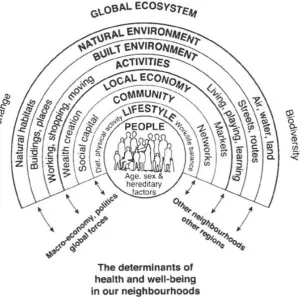
1.7 The determinants of health
11
can change in both positive and negative directions.In doing so, they can enhance or diminish the health outcomes experienced by the community. Some of the health determinants can be managed so as to enhance community health, for example the qual-ity of water supplies. Others, such as age, cannot be managed.
1.8 The wetlands and public health
relationship – the early days
I
n considering the historic perspectives of the wet-lands-health nexus, itis important to go back further than the 60 years of WHO history. Malaria features predominantly in this earlier story, even before the nature and transmission pathway of the disease had both been unveiled in 1898. In 16th -century Spain, for exam-ple, strict laws were made prohibiting the siting of irrigated rice produc-tion systems within cer-tain boundaries around towns, based on the observed association with the incidence of fevers (Najera 1988).
Once the nature of this association had become known (i.e., some mos-quito species of the genus
Anopheles, which breed in clean freshwater, and exceptionally brackish
[image:17.595.213.516.435.732.2]water systems, serving as the vector), the step to environmental management measures to reduce vector populations and interrupt transmission was a logical and easy one to take. Such “source reduc-tion” strategies included mainly water management measures, among which the drainage of wetlands featured prominently. This contributed substantially to the reduction of malaria transmission in a number of settings, including in Southeast Asia, the Indian subcontinent, and Central and South America. The best-known example from Europe is the drainage of the Pontine marshes near Rome (Box 1.1).
Table 1.1: Examples of the main categories of health outcomes
Main categories of health
outcomes Examples
Nutritional problems Protein-energy and micro-nutrient deficiencies and excesses; food safety
Communicable diseases Malaria and other vector-borne diseases, diarrheal diseases, sexually trans-mitted infections / HIV/AIDS, respiratory infections.
Non-communicable
diseases Acute and chronic poisoning from hazardous chemicals and minerals, can-cers, cardiovascular diseases, dust-induced lung disease Injuries Drowning, traffic-associated accidents, accidents related to the use of
machin-ery in agriculture and construction Psychosocial disorders
and well-being Suicide, depression, (communal) violence, substance abuse, stress, fear of dis-asters; happiness, fulfilment, social integration
12
Two important lessons can to be learned from this era prior to the establishment of the WHO. One is that from our present-day perspective there may be con-flicts of interest between biodiversity conservation and public health. The massive drainage of wetlands is obviously no longer a viable option in malaria control programmes, but there may be more subtle instances where drainage is deemed to be an impor-tant part of such efforts. This means that the profes-sionals managing wetlands and those managing public health programmes must develop the skills to enter into a productive dialogue to find optimal solu-tions in such situasolu-tions.
The second is that wetland policy makers and man-agers will have to gain insight into the epidemiol-ogy of water-associated diseases. In communicable diseases, transmission pathways may be complex. In non-communicable diseases, confounding factors may obscure the attribution of specific determinants to long-term health effects. For both of these, differ-ent options for health intervdiffer-entions may yield results different from those expected based on conventional wisdom. The cost-effectiveness of different interven-tions, in particular when considering environmental management options versus medical interventions, may be substantially different if externalities in terms of costs and effects are taken into account.
1.9 The choices we make: tradeoffs and
economic approaches
I
n decision-making for wetland management, issues of potential relevance or importance span a remarkable spectrum. They include the management of flora and fauna, access to harvestable items like timber, fish or edible plants, and the nature of sedi-ment, water quantity and quality. Beyond these fun-damentals are the presence of waterborne pollutants, human sanitation, water-related diseases, disease emergence related to small and large dams, catch-ment land use, livelihoods in or around wetlands, property prices, patterns of human movement and transport, human nutrition and wetlands, and wet-lands as sources of beneficial drugs. Some of these issues occur in the short term, others long term, some local, others regional or global. Compounding fac-tors occur, like the implications of climate change for human health issues associated with wetlands (Box 1.2). Inevitably choices need to be made in decision-making where conflicting outcomes might be reason-ably predicted, requiring a tradeoff: ‘the opportunity cost of selecting one alternative over the other’.If wetlands play an important role in sustaining human health and well-being, and if wetlands con-tinue to be lost and degraded at rates more rapid than other ecosystems (Finlayson et al. 2005), it is possible that something is wrong with the way we negotiate these tradeoffs. This is largely attributed to
Box 1.1: A Historical case study: Rome, Wetlands and Malaria
P
erhaps the most telling interaction among deforestation, wetlands, and human health arises in the so-called Pontine territory, a broad, flat, well-watered plain to the south of Rome. In early times, it was an abundantly fertile region and, Roman historian Livy reported, once supported numerous settle-ments (Rackham 1947). Its early capacity to support crops and animal husbandry made it a key target of Roman acquisitiveness into the fourth century BCE. In the following centuries, the nature of the Pontine region altered radically, although the changes are traceable only through later incidental references and anecdotes (Koot 1991). What is clear is that, by the first century BCE and perhaps even earlier, the area had become dominated by stagnant swamps and marshes – a change that may perhaps be reflected in a redesignation by the Romans of the ager Pomptinus, or Pontine field, as the Pomptinae paludes, or Pontine marshes (Traina 1988). Deforestation was probably a major factor in this change, although there may have been other contributors. Sallares (2002) points to the possible adverse impact on the area’s natural drain-age pattern of the construction of a road (the Via Appia) across the Pontine plain in the late fourth century BCE. Subsequent Roman attempts to drain the marshes – such as that by Marcus Cornelius Cethegus in 160 BCE – were unsuccessful because the flatness of the land impeded the effective removal of water, and may even have exacerbated rather than alleviated the problem as further areas of standing water were created. The Pontine marshes became, it seems, both too marshy and too pestilential to farm, for a pro-nounced infestation of malaria accompanied this ecological change. Literary and archaeological evidence indicate that the population of the region collapsed. Not until Mussolini’s public works projects in the 20th century could the Pontine marshes once more become widely inhabited and cultivated.13
Box 1.2: Wetlands, climate change and human health
T
he global burden of disease attributable to anthropogenic climate change up to the year 2000 was reviewed by the World Health Organization in 2002. Taking into account the uncertainty with climate change models and making conservative assumptions about climate-health relationships, the review indicated that climatic changes that had occurred since the mid-1970s could already have caused over 150,000 deaths and about 5 million ‘disa-bility-adjusted life years’ (DALYs) through increased incidence of diseases such as diarrhea, malaria, and malnu-trition that occur mainly in developing countries. Further, it was estimated that climate-change-induced excess risk of various health outcomes could double by 2030 (McMichael et al. 2004). Large increases were predicted for the relative risk of flooding, with more modest increases in diseases such as malaria and malnutrition. However, as malaria already kills over 1,600 per million people in Sub-Saharan Africa, small changes may still indicate a substantial disease burden.Specific data for malaria risk in Africa have also been used to predict increased risk in exposures of 16-28%, but such analyses do not account adequately for non-climatic confounding factors (socio-economic issues, immunity patterns, and drug resistance) or the variation of specific climate-disease relations among locations. Patz et al. (2005) emphasise the weakness of using statistical models for such extrapolations and recommend combining such approaches with process-based models that capture the ecological relationships of the malarial vector. They also point to the influence of changes in land use and land cover on ecologically-mediated infectious diseases and recommend that, to assess future climate-change impacts on health, future projections of land-use change must also be considered. Ethical questions about climate change and human health are also being raised; for exam-ple, Africa with an estimated 90% of malaria has generally low per capita emissions of greenhouse gases that cause global climate change. Further, the ecological condition and health of many African wetlands is unknown, with many of them unmapped or adequately described (Taylor et al. 1995; Finlayson et al. 1999). The absence of basic ecological knowledge on many wetlands could hinder efforts to incorporate ecological relationships into the proc-ess models being recommended as a basis for extrapolations about future risks of water-borne diseases. Further information on the basic ecology of wetlands and their species, and the often complex interactions that will affect human health, will be needed to inform decision making. Specific regional assessments of the impacts of climate change on human health will allow the relationships with wetland ecosystems to be highlighted. For example, McMichael (2009) produced the following summary of the main health risks from climate change for Australia:
1. Increased illness events and deaths from more frequent and severe heatwaves, especially in urban environments.
2. Increased injury, death and post-traumatic stress disorders from increases in other extreme weather events, especially floods, storms, cyclones (moving further south), and more extreme bushfires.
3. Increased risks of infectious food-poisoning (gastroenteritis) from salmonella, campylobacter, various temperature-sensitive vibrios, and others.
4. Changes in the range and seasonality of outbreaks of mosquito-borne infections – dengue fever in northern Australia (likely to spread south, down both eastern and western coasts), Ross River virus disease, Barmah Forest virus disease, and others.
5. Freshwater shortages in remote (especially indigenous) communities, with consequences for hygiene and sanitation.
6. Regional increases in the production of various plant-derived aeroallergens (pollens, spores) that cause or exacerbate asthma.
7. A potentially serious range of adverse health impacts of more severe droughts and long-term drying con-ditions on rural communities. These include adverse impacts on mental health (depression and suicides); child emotional and developmental experiences; exposures to extremes of heat, dust, smoke; freshwater shortages and hygiene; local food availability; changes in health-related behaviors (e.g., alcohol, smoking, self-medication).
14
policy decisions that fail to internalize and factor in the values of wetland ecosystem services in a man-ner that supports their retention or rehabilitation. In many cases the tangible and financial benefits aris-ing through wetland degradation or conversion are taken into account when making such decisions, whilst the substantial value arising from wetland ecosystem services which are not traded into formal markets, and thereby do not generate cash flows, are not. Incomplete knowledge of the value of these services can lead to perverse incentive systems which favour degradation and conversion of wetlands without considering the consequent loss of human welfare and impacts on human health and overall well-being. Quantifying and valuation of wetland ecosystem services in a way that makes them compa-rable with the returns derived from alternative uses can facilitate improved policy and decision making (Turner et al. 2000).
1.10 The aim of this report
I
n response to many of the issues outlined above, the Ramsar Convention on Wetlands has devoted increasing attention to developing the scientific con-cepts behind the theme ‘healthy wetlands, healthy people’ and sought greater understanding of how people and wetlands interact, for example, through analyses of the interactions between agriculture and wetlands (Wood & van Halsema 2008), fisheries and wetlands (Ramsar Convention 2005c), forestry and wetlands (Blumenfeld et al. 2009), and, in this instance, the interactions between human health and wetlands.The slogan ‘Healthy wetlands, healthy people’, which was also the theme of the 10th meeting of the Conference of the Contracting Parties (COP10) in 2008, implies an interaction between wetland ecol-ogy and management and the health of people, with consequent social and cultural interactions between people and wetlands. This is seen as an extension of the multi-disciplinary approaches adopted through the Millennium Ecosystem Assessment (2005) and subsequent global assessments that have addressed human well-being and ecosystem services.
The interactions between human health and wet-lands are expanded in this report through an exami-nation of the linkages between human health and ecosystem services obtained from wetlands, with an emphasis on human health as a component of human well-being that is linked inextricably with wetland ecological character.
With this background, the purpose of this review report is to provide an accessible source of
infor-mation to help improve understanding of the often complex inter-relationships between wetland ecosys-tems and human health and well-being. The primary audience for this report is intended to be wetland conservation and wise use practitioners, from wet-land managers at the site level to decision-makers at national and international levels. The informa-tion in the report should help in facilitating dialogue between wetlands and human health professionals in their respective efforts to maintain and improve wet-land ecological character and people’s health.
The depth and detail of coverage in the report have benefited by the accessibility of information in recent global overviews such as the Millennium Ecosystem Assessment (2005), the World Water Development Report (UN WWDR 2006), the Comprehensive Assessment of Water Management in Agriculture (Molden 2007), and the UNEP Global Environment Outlook 4 (2007). These surveys represent both a global consensus by scientists on key issues affect-ing wetland ecosystems, water and people and up-to-date widely reviewed compilations of science-based evidence. These are particularly important when considering the implications of efforts to achieve the Millennium Development Goals, with their emphasis on biodiversity in virtual isolation of wider ecosystem issues, if they run counter to efforts to achieve wetland conservation. The Millennium Ecosystem Assessment in particular has emphasised the strength of the fundamental relationship between wetland ecosystems and their services and human health, and therefore the importance of developing environmental management strategies that support the maintenance of both wetland ecological charac-ter and human health concurrently (Finlayson et al. 2005). It is contended that at a metaphorical level these linkages are being established – further scien-tific evidence is needed to support these and enable
Key questions: our problem statements
How can we manage wetlands better?
If we manage wetlands better, can we improve the health and well-being of people?
Why is this question important? Despite pro-ducing more food globally and extracting more water globally, wetlands continue to decline and for many people public health and living standards do not improve.