HCV antiviral therapy in injection drug users:
difficult to treat or easy to cure?
Marcello Persico,* Nicola Coppola,† Valerio Rosato,‡ Ludovico Abenavoli,§ Mario Masarone,* Antonio De Luna||
* Internal Medicine and Hepatology Unit, University of Salerno. Baronissi, Italy.
† Department of Mental Health, Section of Infectious Disease, Second University of Naples. Naples, Italy. ‡ Internal Medicine and Hepatology Department, Second University of Naples. Naples, Italy.
§ Department of Health Sciences, University Magna Graecia. Catanzaro, Italy. || UOC Dipendenza ASL-SA/DS65. Battipaglia, Italy.
ABSTRACT
Background and rationale of the study. Hepatitis C infection is very common among injection drug users(IDUs). In clinical practice there is reluctance to treat IDUs, because considered difficult-to-treat. Aim of this study was to evaluate the response to antiviral treatment in IDUs compared to non-IDUs. Main results. In this observational retrospective study, 204 non cirrhotic patients(112 IDUs, 92 non-IDUs) with chronic hepatitis C, treated with PEG-IFN and ribavirin in a tertiary centre for IDUs of Southern Italy from 2008 to 2011 were analyzed. Age, sex, genotype, steatosis, response to previous therapy, rapid(RVR), early(EVR), end-of-treatment(ETR), sustained(SVR) virological response were evaluated. IDUs were mainly young and males, with prevalence of genotype 3. A higher SVR rate in IDUs group compared to non-IDUs only in PerProtocol(PP) analysis (90% vs. 78,9% ;p = 0.04). On the contrary, in IntentionToTreat(ITT) analy-sis, no significant difference was relieved. A higher SVR rate at ITT analyses in naïve non-IDUs patients was found (76,13% vs. 90%, p = 0.021), but at PP analysis wasn’t confirmed. Treatment was well tolerated; a higher dropout rate was reported in IDUs (24 patients) compared to non-IDUs (2 patients). In order to exclude the effect of viral genotypes on SVR a genotype matched statistical analysis was done and no difference was found. Conclusions. IDUs naïve patients, due to young age and high prevalence of genotype 3, appear good candidates to dual antiviral therapy with high SVR rates. Dropout is the main non-response cause among these subjects, but through an optimal monitoring program with a multidisciplinary setting, their “difficult to treat” characteristics can be overcome.
Key words. Chronic hepatitis C. Antiviral treatment. Injection drug users. Sustained virological response.
Correspondence and reprint request: Prof. Marcello Persico.
Chair of Internal Medicine, University of Salerno, Via Allende, 84081 Baronissi (SA), Italy.
Tel.: +393383338695. E-mail: [email protected]
Manuscript received: August 21, 2014. Manuscript accepted: October 27, 2014. INTRODUCTION
Hepatitis C virus (HCV) infection is a major healthcare problem and the leading cause of chronic liver disease worldwide. According to recent World Health Organization (WHO) data, approximately 170-200 million people throughout the world are in-fected with HCV.1
The primary objective of anti-HCV therapy is the complete elimination of the virus, which is termed a sustained virological response (SVR). SVR, defined
as undetectable serum HCV RNA at least 6 months after completion of antiviral therapy, has become the best indication of successful therapy for HCV infec-tion.2
Therapy-induced SVR is a clinically meaningful end point and a durable marker of viral eradication.3
Once achieved, an SVR is considered to be a cure of HCV infection, because the rate of late relapse (de-fined as reappearance of serum HCV RNA) is ex-tremely low (< 1%). Achievement of SVR has been associated with improvement in liver histology (re-duced inflammation and fibrosis) and health-related quality of life, as well as reduced risk of hepatocellu-lar carcinoma (HCC) and liver-related morbidity and mortality.2-4 The survival of patients who achieved
SVR was reported to be comparable to that of gener-al population, matched for age and sex.4
combi-nation of pegylated interferon-α (PegIFN) and riba-virin (RBV).5 This regimen achieves SVR rates of
40% to 50% in patients with genotype 1, and up to about 80% in those with genotype 2, 3, 5 and 6.2,6,7
In 2011 first-generation direct-antivirals (DAAs), namely boceprevir (BOC) and telaprevir (TVR), were licensed for use in HCV genotype 1 in com-bination with PegIFN/RBV(PR). These triple drug regimen, administered on response-guided based therapy, have proven to be effective for pre-viously untreated (naïve) and for treatment-expe-rienced patients achieving SVR rates of 65-80%8
or other genotype PR is still represented by dual therapy combination of PegIFN/RBV. New agents will be soon available for interferon free regi-mens that should provide a response rate as high as 100%.9,10 At present, injection drug users
(IDUs) constitute the largest proportion of HCV patients in industrial countries.1 In Italy, the
IDU population is estimated to range from 200,000 to 300,000 individuals and HCV infection prevalence among this population ranges between 42.4% and 89.7%.1
Although international guidelines no longer re-gard ongoing illicit drug use as a contraindication to antiviral therapy for chronic hepatitis C (CHC), in routine clinical practice there is a continuing re-luctance to treat IDUs: they are considered difficult to treat, because of the poor treatment adherence, the high dropout rate, the increased likelihood of re-infection, the high rates of concomitant alcohol abuse or mental health issues, all potentially im-pacting treatment compliance and effectiveness;11,12
therefore, HCV infection is a complex and challeng-ing medical condition in this population of pa-tients.13 A debated issue concerns the health costs of
drug-related HCV, which is accounting for nearly 40% of expenses in IDUs between hepatitis B and HIV.14 These patients are considered at low priority
for the high risk of dropout and relapse. Neverthe-less they are often young and naïve patients in whom treatment would be appropriate to avoid he-patic and extrahehe-patic HCV related complications. Furthermore, in approaching the era of high cost in-terferon-free antiviral therapy, the previous cheaper standard of care with PR might still be considered a real strategic option.
The aim of this retrospective observational study was to evaluate the response to dual antiviral thera-py in IDUs, the largest subpopulation infected with HCV, compared to non-IDUs patients in order to better understand how to select patients who can be treated successfully for hepatitis C.
MATERIAL AND METHODS
Study design
This was an observational, retrospective, single-centre study performed in an outpatients service for IDUs care in a tertiary structure of Southern Italy.
Patients
All consecutive non-cirrhotic adult patients with chronic hepatitis C treated with PEG-IFN alpha-2a and ribavirin in a tertiary centre for IDUs of South-ern Italy from 2008 to 2011 were analyzed. The se-lection criteria for the treatment included a multidisciplinary program of initial observation of patients (hepatological and psychiatric counselling). The IDUs stabilized on methadone or buprenorphine substitution treatment were subjected to tox screen every 15 days and carbohydrate-deficient transferrin (CDT) assay every 20 days. Cirrhosis, active chron-ic hepatitis B, HIV infection, drug and alcohol abuse during the last six months and higher score than 18 at the evaluation Hamilton depression scale were considered exclusion criteria to be enrolled to antivi-ral therapy. Based on that, 36% (62 out 174 IDUs: 16% cirrhotic, 15% with mental problems, 5% who were using drugs during the last six months) and 45% (74 out 166 of non-IDUs: 40% cirrhotic and 5% with mental problem) of the patients were excluded from the study.
Therefore, 204 patients were enrolled: 112 IDUs (54.9%) and, as a control group, 92 non-IDUs (45.1%), coming from an outpatients Hepatology service of the same structure.
patients with genotype 2 and 3. Treatment dura-tions and dosage were chosen on the basis of cur-rent treatment schedules approved in our country. During the treatment helpline was available seven days a week. Monthly patient’s multidisciplinary evaluation and biweekly tox screen to IDUs was performed. Also carbohydrate deficient transferrin (CDT) assay in patients with alcohol abuse was exe-cuted every 20 days.
The study was performed in accordance with Good Clinical Practice and complying with the prin-ciples laid down in the Declaration of Helsinki.15
The study was approved by the appropriate Ethi-cal Committee of the centre and all patients gave their written informed consent before enrollment.
Assessments and endpoints
Of every patient enrolled in the study were evalu-ated: age, sex, genotype, clinical parameters (pres-ence of hepatic steatosis, assessed clinically and by ultrasound; the ultrasound evaluation was always made by the same operator and with the same equip-ment, Aloka SSD500 - Aloka Co., Ltd, Tokyo, Ja-pan-), response to previous therapy (naïve or relapsers patients).
The following treatment outcomes were also ana-lyzed: rapid virological response (RVR: undetectable HCV RNA at week 4 of therapy), early virological response (EVR: ≥ 2 log10 decrease in HCV RNA at week 12 compared with baseline), end-of-treatment response (ETR: undetectable HCV RNA at the end of treatment) and sustained virological response (SVR: undetectable HCV RNA at least 6 months following the end of treatment).
For safety evaluation, the incidence of adverse events and the dropout rate were assessed in both groups.
Methods
• RNA Preparation and Quantitative
Real-Time PCR Analysis. A real-time nucleic acid
amplification assay (RT-PCR), was used for quan-titative detection of HCV RNA. Sera were rapidly frozen at -80°C within 2 h of blood drawing. HCV RNA was isolated from 0,85 ml aliquots of con-trols and clinical specimens using the automated COBAS Ampliprep instrument (Roche Diagnos-tics, Meylan, France). HCV quantification stand-ard was added to the sample in order to achieve full process control. Amplification and detection were performed according to the manufacturer’s
instructions. After COBAS Ampliprep-based ex-traction of nucleic acids, samples and controls were processed for amplification and detection by an automated RT-PCR using the COBAS Taq-Man 48 Analyzer (Roche Diagnostics, Meylan, France) according to the instructions of the manufacturer.16 The lower limit of detection is 15
IU/mL, with ≥ 95% probability, using 1 mL of se-rum. Carryover PCR contamination was avoided by the application of the measures suggested by Kwok and Higuchi.17
• HCV Genotyping. To classify the HCV
geno-types, serum polymerase chain reaction (PCR) products were hybridized to type-specific and sub-type-specific probes 1a, 1b, 2a, 2b and 3a. The probes had to fulfill two main criteria: there could be no more than 2 mismatches in compari-son with the corresponding published sequences of the same subtype, and they had to differ by 3 or more mismatches in comparison with pub-lished sequences of other types and subtypes. The only exception was probe 2b, which had only 2 mismatches in comparison with the correspond-ing sequence of type 3a.18
• Statistical analysis. Chi-Square test with
YAT-ES correction or Fisher-exact test was used to compare categorical variables (sex, presence of steatosis and cirrhosis, response to previous therapy [naïve, relapsers and non-responders], genotype, viral load at the start of treatment and duration of infection). Response to current thera-py, as a categorical variable, even among pa-tients matched for genotype, was evaluated by Chi-Square Test with yates correction. A binary logistic regression was performed to evaluate the independent factors associated with SVR. All sta-tistical analyzes were performed with Stasta-tistical Program for Social Sciences (SPSS®) ver.20.0 for
Macintosh® (SPSS Inc., Chicago, Ill.). P-value <
0.05 was considered significant. An Intention-To-Treat (ITT) and a Per-Protocol (PP) analysis were performed.
RESULTS
Characteristics of the patients
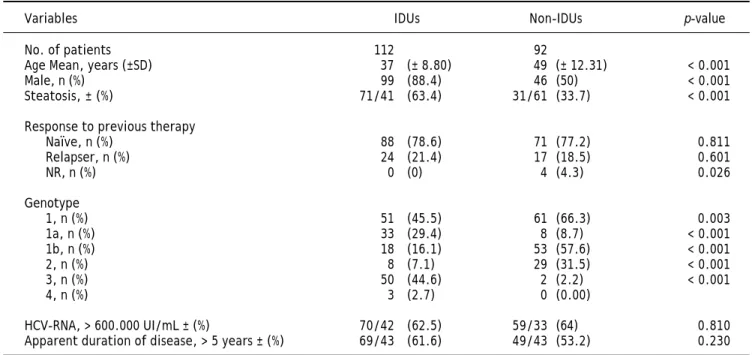
(63.4% vs. 33.7%; p < 0.001) compared to non-IDUs. However, in both groups, most patients were naïve(88 [78.6%] IDUs vs. 71 [77.2%] non-IDUs), than relapsers (24 [21.4%] IDUs vs. 17 [18.5%] non-IDUs), without significant differences.
Genotype 3 was significantly higher in the IDUs group compared to controls (44,6% vs. 2,22%; p<0.001), while genotype 1 and 2 was higher in non-IDUs group. Genotype 1 was found in 45,5% of IDUs and 66.3% (p = 0.003) of non-IDUs, genotype 2 was found in 7.1% of IDUs and 31.5% of non-IDUs (p < 0.001).
There were no significant differences in the other parameters evaluated (basal viral load and apparent duration of infection).
Efficacy
The prevalence of virological response was evalu-ated by means of ITT and PP analysis. ITT analysis included 204 patients (112 IDUs and 92 non-IDUs), while PP analysis included 180 patients (90 IDUs and 90 non-IDUs).
Results show a higher SVR rate in IDUs group compared to non-IDUs group only in PP analysis: 90% vs. 78.9%; p = 0.04. Higher EVR (100% vs.
87.7%; p = 0.001) and EOT (98.9% vs. 91.9; p = 0.012) rate was found in IDUs group as well, while in ITT analysis, no significant difference was re-lieved (Figure 1).
The prevalence of SVR at both ITT and PP analy-ses was evaluated in different subgroups of the pop-ulation: naïve and relapser patients. A SVR higher
Figure 1. Prevalence of virological response (%) at both ITT and PP analysis. Twenty-four dropouts in IDUs group and 2 in non-IDUs group were reported. Higher EVR, EOT and SVR rate in IDUs group was confirmed only at PP analysis.
Table 1. Patient demographic and baseline characteristics.
Variables IDUs Non-IDUs p-value
No. of patients 112 92
Age Mean, years (±SD) 37 (± 8.80) 49 (± 12.31) < 0.001
Male, n (%) 99 (88.4) 46 (50) < 0.001
Steatosis, ± (%) 71/41 (63.4) 31/61 (33.7) < 0.001
Response to previous therapy
Naïve, n (%) 88 (78.6) 71 (77.2) 0.811
Relapser, n (%) 24 (21.4) 17 (18.5) 0.601
NR, n (%) 0 (0) 4 (4.3) 0.026
Genotype
1, n (%) 51 (45.5) 61 (66.3) 0.003
1a, n (%) 33 (29.4) 8 (8.7) < 0.001
1b, n (%) 18 (16.1) 53 (57.6) < 0.001
2, n (%) 8 (7.1) 29 (31.5) < 0.001
3, n (%) 50 (44.6) 2 (2.2) < 0.001
4, n (%) 3 (2.7) 0 (0.00)
HCV-RNA, > 600.000 UI/mL ± (%) 70/42 (62.5) 59/33 (64) 0.810 Apparent duration of disease, > 5 years ± (%) 69/43 (61.6) 49/43 (53.2) 0.230
IDUs: injection drug users. NR: non-responder. HCV: hepatitis C virus.
Percentage of patients (%)
100 90 80 70 60 50 40 30 20 10 0
64.3 61.9
92.9 8 7
79.5 89.1
72.3 77.2
RVR EVR EOT SVR
Percentage of patients (%)
120 100 80
60 40
20 0
6 3 61.1
100 87.8
98.9
91.1 9 0 78.9
RVR EVR EOT SVR
p = 0.001 p = 0.012 p = 0.04 IDUs
Non IDUs
ITT
rate at ITT analyses in naïve non-IDUs patients was found (76,13 vs. 90%, p = 0.021) that was not con-firmed at PP analysis (Figure 2). In order to ex-clude the effect of virus genotype variable on SVR a genotype matched statistical analysis was done and no difference was found among the HCV genotypes (Figure 3).
A multiple logistic-regression model was used to ex-plore the effects of various demographic and virologi-cal characteristics at baseline and on treatment on the probability of an SVR (Table 2). Factors considered in this analysis were: sex, age (considered as a continu-ous variable), HCV genotype (assessed by comparing the frequency between IDUs and non-IDUs group for each genotype), RVR and drug abuse. In the multiple
Figure 3. Prevalence of SVR at both ITT and PP analyses matched by genotype. No difference at genotype matched sta-tistical analysis was found among the HCV genotypes. Figure 2. Prevalence of SVR at both ITT and PP analyses in
different subgroups of the population. Higher SVR rate in naïve non-IDUs group was found at ITT analysis, that was not confirmed at PP analysis.
Table 2. Multiple logistic-regression model for successful HCV therapy. The only independent factor of sustained virological
response was RVR.
Variables OR 95.0% CI p-value
Sex 0.797 0.312 - 2.038 0.636
Age 1.041 1.000 - 1.084 0.052
Genotype 1.201 0.771 - 1.871 0.418
RVR 7.488 3.320 - 16.892 < 0.001
Drug Abuse 0.923 0.418 - 1.563 0.865
HCV: hepatitis C virus. OR: odds ratio. CI: confidence interval. RVR: rapid virological response.
logistic-regression model, all these factors were includ-ed simultaneously. The results demonstratinclud-ed that the only independent factor associated with SVR for suc-cessful HCV therapy was RVR (O.R.: 7.488, C.I.95%: 3.32-16.982, p < 0.001): a higher RVR independently and significantly increased the odds ratio of a SVR.
Safety
Treatment was well tolerated and no unexpected side effects were seen. The adverse events reported in the two groups were typical of those previously reported with this standard therapy: drug addiction relapse following discontinuation of therapy was found in 12 (13.4%) of IDUs, depression was reported
Percentage of patients (%)
100 90 80 70 60 50 40 30 20 10 0
72.3 77.2 76.1
90.1
58.3
41.2
All patients Naïve patients Relapser patients
Percentage of patients (%)
100 90 80 70 60 50 40 30 20 10 0
9 0 7 9
9 6 9 3
7 0
4 1
All patients Naïve patients Relapser patients
Percentage of patients (%)
100 90 80 70 60 50 40 30 20 10
60.8 68.9
87.5 93.1 8 2
100 82.7
93.5
genotype 1 genotype 2 genotype 3 genotype 4
Percentage of patients (%)
100 90 80 70 60 50 40 30 20 10
81.6
7 0
100 96.4
97.6 100
97.9 96.6
genotype 1 genotype 2 genotype 3 genotype 4 IDUs
Non IDUs
IDUs Non IDUs
p = 0.04
p = 0.021 ITT
PP
ITT
in 16 (17.92%) of IDUs and 8 (7.3%) of non-IDUs, anemia in 10 (11.2%) of IDUs and 7 (6.44%) of non-IDUs, asthenia in 8 (8.69%) of IDUs and 5 (5.4%) of non-IDUs, psoriasis occurred in none of IDUs and in 3.9% of non-IDUs. Excluding drug addiction re-lapse, there were not significative difference.
On the contrary, dropout rate was significantly higher in the IDUs group: 22 (19.6%) dropouts were reported among IDUs patients and only one (1%) among non-IDUs patients. The reasons for prema-ture termination were the following: in IDUs group, 4 patients dropped out for depression, 6 patients for their own decision to stop treatment earlier, 12 pa-tients for drug addiction relapse; in non-IDUs group, there was only one patient dropped out for depression.
DISCUSSION
Globally, about ninety per cent of new hepatitis C infections are contracted through injection drug use and the majority of infections, particularly in devel-oped countries, are attributed to injection drug use.11 Because HCV transmission occurs primarily
through direct percutaneous exposure to infected blood from various sources, injection drug use is at greatest risk of acquiring HCV infection, and is now responsible for the majority of new and existing cas-es of hepatitis C. Blood-to-blood contact transmits HCV from person to person very efficiently; thus, people can acquire it through sharing not only nee-dles and syringes, but also other injection equip-ment, including cottons, cookers and rinse water.
A growing body of data suggests that drug users, even those with multiple potential barriers, can at-tain successful treatment outcomes in hepatitis C therapy, showing no relevant direct influence of in-travenous drugs on the efficiency of anti-HCV thera-py among adherent patients.19,20
Based on data from 16 prospective clinical studies of CHC treatment in IDUs published in the past 10 years, findings on effectiveness and tolerability are comparable to those in the general population.21
A retrospective study performed in Greece in a large cohort of former IDUs (with prevalent geno-type 3) followed-up from 1994 to 2008 showed that IDUs patients had SVR rates similar to those with-out drug-dependence.22
Interestingly, some evidence suggests that hepati-tis C may follow a more benign course when con-tracted via injection drug use, despite the potential risks of ongoing injecting behaviours and alcohol consumption.23
A review by Hellard, et al. identified 22 studies re-porting on SVR attainment by IDUs with chronic hepatitis C: of the 22 studies included, 10 enrolled a control group of non-IDUs and the remaining 12 studies recruited IDUs only (former or current). The available evidence suggests that IDUs can be suc-cessfully treated for hepatitis C: there is evidence that a sizeable proportion of IDUs who begin hepati-tis C treatment achieve a SVR. There was a consid-erable variation in SVR rates among IDUs in different trials, ranging from 15.8% to 94.1% for chronic hepatitis C. The median SVR rate among IDUs (40.6%) suggests that a substantial propor-tion of treated IDUs achieved a SVR. These data suggest that injection drug use should not preclude treatment. On the same ground, different studies have demonstrated that properly selected HCV-in-fected IDUs can achieve SVR rates comparable to those of non-IDU populations. In studies in which IDUs were compared with non-IDUs, the SVR among IDUs was often similar to and, at times, higher than among non-IDUs. None of the studies that included non-IDU comparison groups reported a statistically significant difference between the rate of SVR among IDUs and that among non-IDUs.11
Several factors predicting non-response to inter-feron therapy have been investigated since it became available. There is large evidence in the literature that HCV genotype 2 and 3 are associated with higher SVR rates in respect to the others (i.e. geno-type 1).24 Moreover, in many studies, a proportion >
50% of unselected IDUs patients has been reported to be infected with HCV genotype 3.1 Also patients
related non response predictive factors were largely demonstrated and they are generally divided into two main subgroups: non-modifiable factors (age, gender, ethnicity, degree of liver disease and disease duration) and modifiable (diabetes and insulin re-sistance, obesity and steatosis, alcohol consumption and drug abuse).24 Based on that and to avoid
con-founding results, among the exclusion criteria we identified liver cirrhosis that might significantly weight on SVR. Nonetheless, some epidemiological and viral non response predictive factors (i.e. age, genotype, etc.) were still significantly different be-tween the two groups and despite that, the SVR rate was still comparable between the IDUs and non-IDU and also comparable to that reported into reg-istered trials.2,6,7 Moreover, SVR rates of both study
geno-type 1 infected patients, who might account for a worst response to therapy, were more prevalent among non-IDU patients, the easy-to-treat subjects being homogeneously distributed between the two groups (genotype 3 patients higher in IDUs and genotype 2 higher in non IDUs) might balance the overall response and be responsible for no SVR rates difference between IDUs and non-IDUs.
The SVR rates both in naïve and relapser and IDU and non-IDU patients, both at ITT and PP analyses seem higher than that reported in the liter-ature. In our mind, this might be related to the high clinical surveillance applied to our patients during therapy. Therefore such care and surveillance seem of great significance and to be recommended to pur-sue as high a response rate as possible. Moreover, at the ITT analysis a higher rate of SVR was relieved in naïve non-IDU patients whereas in PP analysis no difference was shown between groups and no dif-ferences were found while considering all patients. Looking at the PP analysis a higher SVR rate was shown in IDUs group in the overall population. Try-ing to explain this apparent discrepancy, we realize that it might be accounted for the higher number of dropout subjects in the group of IDUs. In fact, IDUs patients prematurely terminated treatment more fre-quently than the control group (22 dropouts in IDUs group and only one in non-IDUs group), con-firming a higher dropout rate among IDUs also re-ported in other studies.25 A lower dropout rate
(19.6%) was found at our center compared to those reported by other structures.26,27 A possible
explana-tion accounting for this discrepancy might be that in our center was performed a close monitoring of the IDUs patients by a multidisciplinary approach, including psychiatric and hepatologic counselling, treatment helpline ever available and strict check-ing of drug addiction relapse by tox screen and CDT assay. Thus IDUs patients with appropriate adher-ence and compliance have very good chances to reach the SVR and, through an optimal monitoring program with multidisciplinary setting, their “diffi-cult to treat” characteristics can be overcome. Our study demonstrates that in our geographical area, there may be no differences in SVR rates between IDUs and non-IDU patients. This finding is even more significant if we compare it with other litera-ture’s reports, because of the nature of our study that was based on a single-center, and therefore less prone to biases arising from patients selection and characteristics. Moreover, the higher genotype 3 prevalence among IDUs here demonstrated in agree-ment with other studies, suggests that, despite new
therapies, for these patients the dual therapy re-mains a real option and considering physical and physiological fragility of drug addicts together with the excellent SVR rates obtained in this study, we believe that dual antiviral therapy may still be con-sidered a first choice option also for genotype 1 pa-tients. In fact, the known poor compliance for antiviral therapy together with the high number of drop-outs among IDUs might suggest that it might be still worse for triple therapy with DAAs, which are in general less tolerated than the dual therapy.5
CONCLUSION
There is no scientific or clinical reason to exclude IDUs from antiviral therapy for CHC. Although no international treatment guidelines are available for management of HCV infection among IDUs, the re-sults of our observational study show that IDUs naïve patients, appear to be good candidates and very good responders to a standard antiviral combi-nation of ribavirin and pegylated inferferon alpha with high prevalence of SVR. This finding suggests that the proportion of IDUs who start treatment for HCV infection should be increased and dual therapy might still be considered a real strategic option for them.
AKNOWLEDGEMENTS
The present study did not receive any financial support to be declared.
CONFLICT OF INTEREST DISCLOSURE
All authors: no conflict.
ABBREVIATIONS
BOC: boceprevir.
CDT: carbohydrate-deficient transferrin.
CHC: chronic hepatitis C.
DAAs: direct-antiviral agents.
ETR: end of treatment response.
EVR: early virological response.
HCC: hepatocellular carcinoma.
HCV: hepatitis C virus.
IDUs: injection drug users.
ITT: intention to treat.
IV: intravenous.
OR: Odds Ratio.
PCR: polymerase chain reaction.
PP: per protocol.
PR: PegIFN/Ribavirin.
RBV: ribavirin.
RT-PCR: real time-polymerase chain reaction.
RVR: rapid virological response.
SOC: standard of care.
SVR: sustained virological response.
TVR: telaprevir.
WHO: World Health Organization.
REFERENCES
1. Zanini B, Lanzini A. Antiviral treatment for chronic hepati-tis C in illicit drug users: a systematic review. Antivir Ther 2009; 14: 467-79.
2. Ghany MG, Strader DB, Thomas DL, Seeff LB. Diagnosis, management, and treatment of hepatitis C: an update. Hepatology 2009; 49: 1335-74.
3. Pearlman BL, Traub N. Sustained virologic response to antiviral therapy for chronic hepatitis C virus infec-tion: a cure and so much more. Clin Infect Dis 2011; 52: 889-900.
4. Swain MG, Lai MY, Shiffman ML, Cooksley WG, Zeuzem S, Dieterich DT, Abergel A, et al. A sustained virologic re-sponse is durable in patients with chronic hepatitis C with peginterferon alfa-2a and ribavirin. Gastroenterol 2010; 139: 1593-601.
5. Coppola N, Pisaturo M, Tonziello G, Sagnelli C, Sagnelli E, Angelillo IF. Efficacy of pegylated interferon alpha-2a and alpha-2b in patients with genotype 1 chronic Hepatitis C: a meta-analysis. BMC Infect Dis 2012; 12: 357.
6. de Bruijne J, Buster EHCJ, Gelderblom HC, Brouwer JT, de Knegt RJ, van Erpecum KJ, Schalm SW, et al. Treatment of chronic hepatitis C virus infection – Dutch national guide-lines. Netherlands J Med 2008; 66: 311-22.
7. McCaughan GW. Asian Pacific Association for the Study of the Liver consensus statements on the diagnosis, man-agement and treatment of hepatitis C virus infection. J Gastroenterol Hepatol 2007; 22: 615-63.
8. Coppola N, Pisaturo M, Sagnelli C, Sagnelli E, Angelillo IF. Peg-interferon plus ribavirin with or without boceprevir or telaprevir for HCV genotype 1: a meta-analysis on the role of response predictors. PlosOne 2014. In Press. 9. Lawitz, E, Mangia A, Wyles D, Rodriquez-Torres M,
Hassa-nein T, Gordon SC, Schultz M, et al. Sofosbuvir for previ-ously untreated chronic hepatitis C infection. N Engl J Med 2013; 368: 1878-87.
10. Jacobson IM, Gordon SC, Kowdley KV, Yoshida EM, Rod-riguez-Torres M, Sulkowski MS, Shiffman ML, et al. Sofos-buvir for hepatitis C genotype 2 or 3 in patients without treatment options. N Engl J Med 2013; 368: 1867-77. 11. Hellard M, Sacks-Davis R, Gold J. Hepatitis C treatment for
injection drug users: a review of the available evidence. Clin Infect Dis 2009; 49: 561-73.
12. Cooper CL, Mills EJ. Therapeutic challenges in hepatitis C-infected injection drug using patients. Harm Reduction J 2006; 3: 31.
13. Edlin BR, Kresina TF, Raymond DB, Carden MR, Gourevitch MN, Rich JD, Cheever LW, et al. Overcoming barriers to prevention, care and treatment of hepatitis C in illicit drug users. Clin Infect Dis 2005; 40: S276-S285.
14. Postma MJ, Wiessing LG, Jager JC. Pharmaco-economics of drug addiction: estimating the costs of hepatitis C vi-rus, hepatitis B vivi-rus, and human immunodeficiency virus infection among injecting drug users in Member States of the European Union. United Nations Bulletin of Narcotics 2001; 53: 79-89.
15. World Medical Association Declaration of Helsinki: ethical principles for medical research involving human subjects. JAMA 2000; 284: 3043-5.
16. Germer JJ, Harmsen WS, Mandrekar JN, Mitchell PS, Yao JD. Evaluation of the COBAS TaqMan HCV test with auto-mated sample processing using the MagNA pure LC instru-ment. J Clin Microbiol 2005; 43: 293-8.
17. Kwok S, Higuchi R. Avoiding false positives with PCR. Na-ture 1989; 339: 237-8.
18. Viazov S, Zibert A, Ramakrishnan K, Widell A, Cavicchini A, Sch-reier E, Roggendorf M. Typing of hepatitis C virus isolates by DNA enzyme immunoassay. J Virol Methods 1994; 48: 81-92. 19. Bruggmann P, Falcato L, Dober S, Helbling B, Keiser O,
Ne-gro F, Meili D, et al. Active intravenous drug use during chronic hepatitis C therapy does not reduce sustained vi-rological response rates in adherent patients. J Viral Hepat 2008; 15: 747-52.
20. Dore GJ, Hellard M, Matthews G, Grebely J, Haber PS, Petoumenos K, Yeung B, et al. Effective treatment of in-jecting drug users with recently acquired hepatitis C vi-rus infection. Gastroenterology 2010; 138: 123.
21. Zanini B, Covolo L, Donato F, Lanzini A. Effectiveness and tolerability of combination treatment of chronic hepatitis C in illicit drug users: meta-analysis of prospective stud-ies. Clin Ther 2010; 32: 2139-59.
22. Gigi E, Sinakos E, Sykia A, Androulakis G, Tanis C, Stayri-dou V, Tsirogianni E, et al. Epidemiology, clinical data, and treatment of viral hepatitis in a large cohort of intrave-nous drug users. J Addict Med 2013; 7: 52-7
23. Wilson LE, Torbenson M, Astemborski J, Faruki H, Spoler C, Rai R, Mehta S, et al. Progression of liver fibrosis among injection drug users with chronic hepatitis C. Hepatol 2006; 43: 788-95.
24. Masarone M, Persico M. Antiviral therapy: why does it fail in HCV-related chronic hepatitis? Expert Rev Anti Infect Ther 2011; 9: 535-43.
25. Gazdag G, Horvath G, Szabo O, Ungvari GS. Difficulties with interferon treatment in former intravenous drug us-ers. Braz J Infect Dis 2011; 15: 163-6.
26. Seal KH, Currie SL, Shen H, Anand BS, Bini EJ, Brau N, Jef-fers L, et al. Hepatitis C treatment candidacy and out-comes among 4318 US veterans with chronic hepatitis C virus infection: does a history of injection drog us mat-ter? J Clin Gastroenterol 2007; 41: 199-205.