The function of MicroRNA in
hepatitis B virus-related liver diseases: from Dim to Bright
Kangkang Yu, Guangfeng Shi, Ning LiDepartment of Infectious Diseases, Huashan Hospital, Fudan University, Shanghai, China.
ABSTRACT
MicroRNAs represent a class of non-coding RNA molecules that negatively regulate gene expression either by repressing translation or by inducing degradation of messenger RNA. Studies have shown that, as regula-tors of gene expression, microRNAs are widely involved in various human diseases, including hepatitis B vi-rus-related liver diseases. By modulating hepatitis B virus replication, regulating extracellular matrix formation, as well as silencing tumor suppressor genes, these small molecules are implicated in the devel-opment of chronic hepatitis, liver fibrosis/cirrhosis, and hepatocellular carcinoma caused by hepatitis B vi-rus infection. In addition, current researches indicated a potential role of microRNA as diagnostic markers and therapeutic targets. In conclusion, microRNAs are promising tools in the diagnosis and treatment of hepatitis B virus -related liver diseases.
Key words. Small RNA. Chronic Hepatitis B. Hepatocellular carcinoma.
Correspondence and reprint request: Ning Li, M.D., Ph.D
Room 508, Department of Infectious Diseases, Huashan Hospital, Fudan University, 12 Middle Urumqi Road, Shanghai 200040, China
Tel:+86-21-52887965. Fax: +86-21-62480170 E-mail: [email protected]
Manuscript received: September 10, 2014. Manuscript accepted: December 10, 2014.
INTRODUCTION
Almost 40 years have passed since effective anti-hepatitis B virus(HBV) therapy was firstly introduced to clinical practice.1 Despite significant progress in anti-viral treatment, HBV infection still causes more than 1 million deaths of liver failure, cirrhosis, and hepatocellular carcinoma(HCC) annually.2
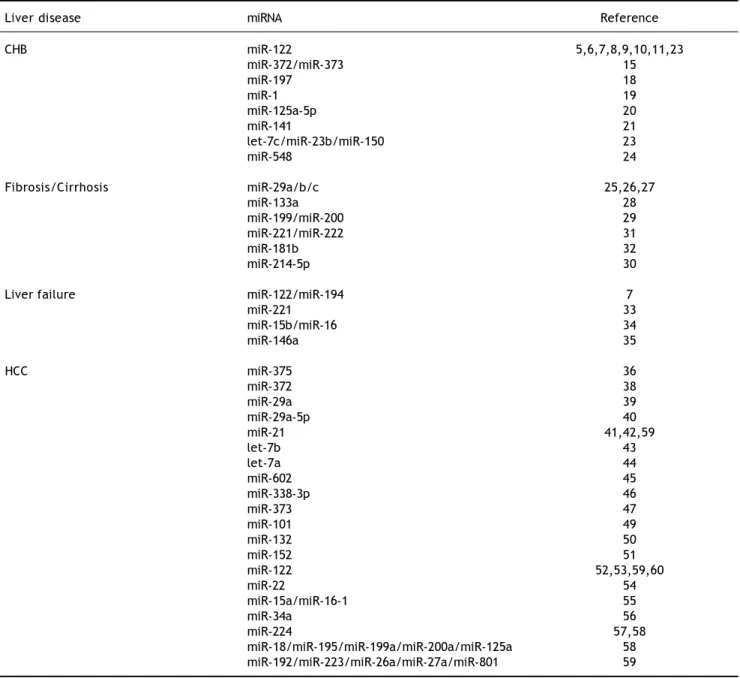
MicroRNAs(miRNA, miR) represent a class of non-coding RNA molecules that negatively regulate gene expression post-transcriptionally by interacting with the mRNA of target genes.3,4 Current studies have revealed the contribution of miRNAs to the pathogenesis of various human diseases, including HBV-related liver diseases (summarized in Table 1). A large number of studies have demonstrated al-tered miRNA expression profiles in chronic hepatitis B (CHB), cirrhosis, or HCC, which provide us new insight into the molecular mechanisms involved in the progression of HBV-related liver diseases. Given these findings, it is probable for aberrantly
ex-pressed miRNAs to serve as diagnostic tools, as well as promising therapeutic targets.
CHRONIC HEPATITIS B
Patients who developed chronic liver diseases, such as CHB, after infection of HBV are at in-creased risk for developing cirrhosis and primary HCC. Therefore, the suppression of HBV replication, and ideally the eradication of HBV cccDNA are of great importance for antiviral therapies.
with P53 blocked the specific binding of P53 to HBV enhancer elements, which led to the inhibition of HBV transcription. Another research 10 found that treatment of IFN-α contributed to a marked de-crease of miR-122 expression in hepatocytes by in-ducing upregulation of NT5C3 (an IFN-stimulated gene), which was identified as a target of miR-122, but could in turn suppress miR-122 by binding and sequestering its mRNA 3’-UTR, thus promoting HBV expression and replication.10 This may help to explain the poor responses to IFN-α in CHB pa-tients, if the results could be further confirmed in clinical samples. These exciting findings indicated a
promising anti-HBV treatment based on miR-122. More interestingly, a research found that serum miR-122 levels may serve as an indicator for viral translation and a potential marker for risk stratifi-cation in patients infected with HBV.11
In addition to miR-122, many other miRNAs were also correlated with HBV infection, and even the de-gree of liver injury.12-17 MiR-372/373 were positively associated with the hepatic HBV DNA levels in vivo.15 Nuclear factor I/B (NFIB) was identified as a direct target of miR-372/373 and cell experiment con-firmed the suppression of HBV expression by NFIB.15 The study demonstrated that miR-372/373
Table 1. MiRNAs in HBV-related liver diseases.
Liver disease miRNA Reference
CHB miR-122 5,6,7,8,9,10,11,23
miR-372/miR-373 15
miR-197 18
miR-1 19
miR-125a-5p 20
miR-141 21
let-7c/miR-23b/miR-150 23
miR-548 24
Fibrosis/Cirrhosis miR-29a/b/c 25,26,27
miR-133a 28
miR-199/miR-200 29
miR-221/miR-222 31
miR-181b 32
miR-214-5p 30
Liver failure miR-122/miR-194 7
miR-221 33
miR-15b/miR-16 34
miR-146a 35
HCC miR-375 36
miR-372 38
miR-29a 39
miR-29a-5p 40
miR-21 41,42,59
let-7b 43
let-7a 44
miR-602 45
miR-338-3p 46
miR-373 47
miR-101 49
miR-132 50
miR-152 51
miR-122 52,53,59,60
miR-22 54
miR-15a/miR-16-1 55
miR-34a 56
miR-224 57,58
miR-18/miR-195/miR-199a/miR-200a/miR-125a 58
promoted HBV expression through a pathway in-volving the transcription factor NFIB.15 Besides, by targeting IL-18, miR-197 might reactivate liver in-flammation.18 MiR-1 was found capable of enhanc-ing the HBV core promoter transcription activity by increasing expression of farnesoid X receptor α.19 MiR-125a-5p interacted with viral mRNA of HBV and interfered with viral translation, down-regulat-ing the expression of surface antigen.20 MiR-141 was reported to be able to target peroxisome proliferator-activated receptor alpha (PPARA), which regulates HBV gene expression through interaction with HBV promoter regulatory elements, thus repressing HBV replication.21 HBXIP, an inhibitor of HBV replica-tion, was a potential target of miR-501.22 Moreover, Chen, et al.23 identified a panel of serum miRNAs (let-7c, miR-23b, miR-122, and miR-150) with ex-tremely high sensitivity (99.9%) and specificity (99.8%) in diagnosing occult hepatitis B virus infec-tion. Investigators also found miR-548 family mem-bers, especially miR-548c5p, which involved in type I IFN signaling, up-regulated significantly in patients with CHB compared to normal controls, which indi-cated a close relationship between miR-548 family and disorder of type I IFN secretion.24 On the whole, these data demonstrated the roles of miRNAs in the modulation of HBV replication, including the epigenetic regulation of HBV cccDNA function (re-viewed elsewhere25). However, the application of our current knowledge to clinical practice is a huge chal-lenge. Although trails on antiviral treatment based on miR-122 have been launched,26,27 it is still far from bench to beside.
LIVER FIBROSIS/CIRRHOSIS
Liver fibrosis develops through a complex net-work of signaling pathways regulating the deposi-tion of extracellular matrix and collagens. The principal cells responsible for the accumulation of extracellular matrix proteins during hepatic fibro-genesis are activated hepatic stellate cells (HSC).
MiR-29 family members (miR-29a/b/c) were well documented fibrosis relevant miRNAs.28-31 It was re-ported that members of the miR-29 family were strikingly down-regulated in mouse models of liver fibrosis and in human fibrotic livers.28 Further-more, the decreased expression of miR-29b in ani-mals was significantly correlated with the degree of liver fibrosis.28 More recently, serum miR-29 levels were found negatively correlated with liver fibrotic stages and necroinflammation grades in patients chronically infected with HBV.29 Investigators
con-firmed that overexpression of miR-29b significantly decreased the expression of extracellular matrix genes in HSC.28 And the process might be a part of signaling network involving TGF-β and NF-κB.28 In addition, miR-29b was capable of suppressing HSC activation as well as production of type I colla-gen.30,31 All these data suggest that miR-29b prevent liver fibrosis. MiR-133a was another identified miR-NA during fibrogenesis but down-regulated in HSC specifically.32 Researchers found that miR-133a sup-pressed collagen synthesis through a TGF-β -depend-ent way.32 In addition, overexpression of miR-199 and -200 families were tightly related to the grade of liver fibrosis.33 Other investigations have associated overexpression of several miRNA (miR-221/222, miR-181b, and miR-214-5p) with activation of HSC as well as progression of liver fibrosis.34-36
LIVER FAILURE
Liver failure is a life-threatening condition in which there is a severe deterioration of liver func-tion, and miRNAs seem to be involved in this patho-genesis.
HEPATOCELLULAR CARCINOMA
MiRNA expression profiling studies in patients with hepatocellular carcinoma (HCC) or hepatoma cell lines have shown some unique miRNA signa-tures, which provided us novel insights into the pathogenesis and development of HCC.
By targeting yes-associated protein (YAP, a tran-scriptional co-activator involved in downstream of Hippo signaling pathway), miR-375 was found to be able to suppress proliferation and invasion of HCC cells.40 HULC (highly up-regulated in liver cancer), as a long non-coding RNA (lncRNA), plays an im-portant role in the initiation of hepatocellular carci-noma.41 Studies42 demonstrated that cAMP-response element binding protein (CREB) up-regulated HULC expression level by interacting with miR-372. Inter-estingly, HULC reversely inhibited miR-372 and led to up-regulation of its target gene, PRKACB, which in turn induced phosphorylation of CREB.42 The auto-regulatory loop of HULC promoted its own ex-pression in liver cancer. Meng, et al.43 performed a systematic miRNA expression profiling study using cell lines disposed with arsenic trioxide and found the expression of miR-29a was up-regulated. They confirmed that PPM1D is the target of miR-29a, whereby the effect of inhibiting cell growth and in-ducing cell apoptosis in liver cancer cells were exert-ed. In addition, miRNA-29a-5p was identified has the potential to serve as biomarker for early relapse of HBV-related HCC post resection.44
Tumor suppressor Sprouty1 is the target of miR-21, investigators found that in liver cancer cells, Sprouty1 expression was inversely correlated with Pokemon levels, and miR-21 was up-regulated by Pokemon.45 By overexpression and silence, investigators confirmed that Pokemon repressed Sprouty1 expression via miR-21 at both mRNA and protein levels, promoted the growth and prolifera-tion of liver cancer cells.45 PTEN activates phos-phatidylinositol 3-kinase signaling to AKT, and studies46 indicated that up-regulation of miR-21 acti-vated PTEN, and led to progression of HCC.
The oncogenic HMGA2 (High Mobility Group AT-2 hook), a nuclear non-histone transcriptional co-factor, was found down-regulated in human hepatocellular carcinoma models by panobinostat through an anti-oncomir- hsa-let-7b-dependent way.47 In addition, down-regulation of let-7a by HBx increased STAT3 expression, promoted cell prolifera-tion and caused tumorigenesis.48 Studies49 also re-vealed that miR-602 was up-regulated in HCC and targeted tumor suppressive gene RASSF1A
(Ras-as-sociated domain family member 1A). Inhibition of miR-602 promoted hepatoma cell apoptosis and in-hibited cell proliferation.49 Oncogene HBV X was found to be able to promote the expression of Cy-clinD1 by suppressing miR-338-3p, which led to cell proliferation.50 This might contribute to the HBx-mediated hepatocarcinogenesis. Study51 also found by down-regulation of miR-373, HBx decreased E-cadherin expression, which contributed to the me-tastasis of HBV-related HCC.
Gene inactivation caused by CpG hypermethyla-tion is now recognized as an important mechanism in tumor initiation and progression.52 A research from Wei, et al.53 confirmed that hepatitis B virus x protein increased the expression of DNMT3A (DNA methyltransferase 3A, a target of miR-101) by down-regulating miR-101 and enhanced DNA methylation of tumor-suppressor genes. In addition, investiga-tors revealed that proliferation and colony forma-tion of HCC cells could be repressed by miR-132-mediated inhibition of the Akt-signaling pathway, while DNA methylation induced by HBx suppressed miR-132 expression.54 Besides, research-ers found that the frequent down-regulation of miR-152 deregulated DNMT1, caused subsequent aberrant DNA methylation in HBV-related HCC.55
Studies also manifested that inhibition of miR-122 by HBV mRNA up-regulated PTTG1 (pituitary tumor-transforming gene 1) binding protein, and promoted HCC tumor growth and cell invasion.56 By binding to peroxisome proliferator activated re-ceptor-gamma (PPARγ), HBx, rather than hepatitis C viral particles, suppressed the transcription of miRNA-122 in hepatoma cells.57 Interestingly, in male patients with HBV-related HCC, miR-22 over-expressed in tumor adjacent tissues, which was re-lated to decreased expression of ERa, indicating a possible effect of weakened protective function of estrogen in HBV-related carcinogenesis in male patients.58
Other studies suggested that, in hepatocytes, HBV RNA led to HCC progression by inhibiting miR-15a/miR-16-1, the noted anti-oncomirs.59 De-creased tumor expression of miR-34a and inDe-creased tumor expression of CCL22 caused by HBV predis-posed HCC patients to portal vein tumor throm-bus.60 Recently, a research demonstrated that, by suppressing miR-224, autophagy inhibited carcino-genesis of HBV-related HCC.61
the prediction accuracy of HCC based on the miRNA panel reached as high as 97.8%.62 Besides, a plasma microRNA panel (122, 192, 21, miR-223, miR-26a, miR-27a, and miR-801) was confirmed with satisfactory diagnostic accuracy of HCC re-gardless of the Barcelona Clinic Liver Cancer stages and was able to differentiate HCC from healthy, chronic hepatitis B, and cirrhosis.63 Still, miR-122 proved itself with the potential to serve as a biomar-ker for screening HCC.64
FUTURE DIRECTIONS
Profiling studies concerning miRNAs in chronic liver diseases caused by HBV infection have demon-strated the important function of miRNAs in the progression of CHB, fibrosis/cirrhosis, liver failure, and HCC. These findings improved our understand-ing of the mechanisms implicated in HBV-related liv-er diseases.
Due to the stable presence in circulation, miR-NAs are favorable biomarkers. Further studies are needed to identify specific circulating miRNA signa-tures that have the potential to differentiate differ-ent liver diseases. To date, cccDNA eradication is the major challenge of anti-HBV therapies. Notably, many miRNAs can modulate HBV replication and cccDNA function directly or by epigenetic mecha-nisms. Elucidating the complicate nexus between miRNAs and HBV will certainly contribute to sup-pression and cccDNA elimination of HBV. In addi-tion, decoding the complex molecular mechanisms of miRNAs involved in the development and metastasis of HCC is crucial for the establishment of effective therapeutic strategies. We believe that, in the next decade, application of treatments based on miRNAs will greatly benefit patients.
ACKNOLEDGEMENTS
The work was supported by Natural Science Foundation of China (81101240) to NL and Natural Science Foundation of China (81371821) to GS.
We thank Chong Huang (Department of Infec-tious Diseases, Huashan Hospital, Fudan Universi-ty) for his critical comments on this manuscript.
ABBREVIATIONS
• ACLF-HBV: acute-on-chronic hepatitis B liver failure.
• CHB: chronic hepatitis B.
• CREB: cAMP-response element binding protein.
• DNMT: DNA methyltransferase. • HBV: hepatitis B virus.
• HBXIP: hepatitis B X interacting protein. • HCC: hepatocellular carcinoma.
• HMGA2: High Mobility Group AT-2 hook. • HSC: hepatic stellate cell.
• HULC: highly up-regulated in liver cancer. • IFN: interferon.
• IL: interlukin.
• lncRNA: long non-coding RNA. • miRNA: microRNA.
• NFIB: nuclear factor I/B. • NF-κB: nuclear factor kappa B.
• PPARA: peroxisome proliferator-activated re-ceptor alpha.
• PPARγγ: peroxisome proliferator activated recep-tor-gamma.
• PTEN: phosphatase and tensin homolog deleted on chromosome ten.
• PTTG1: pituitary tumor-transforming gene 1. • RASSF1A: Ras-associated domain family
mem-ber 1A.
• SNP: single nucleotide polymorphism.
• STAT3: signal transducer and activator of tran-scription 3.
• TGF-β: transforming growth factor-β. • TNF: tumor necrosis factor.
• YAP: yes-associated protein.
GRANTS SUPPORT
Natural Science Foundation of China (81101240) to Ning Li and Natural Science Foundation of Chi-na (81371821) to Guangfeng Shi.
CONFLICTS OF INTEREST
There were no financial disclosures from any au-thors.
REFERENCES
1. Greenberg HB, Pollard RB, Lutwick LI, Gregory PB, Robin-son WS, Merigan TC. Effect of human leukocyte interferon on hepatitis B virus infection in patients with chronic ac-tive hepatitis. N Engl J Med 1976; 295: 517-22.
2. Dienstag JL. Hepatitis B virus infection. N Engl J Med 2008; 359: 1486-500.
3. Bartel DP. MicroRNAs: target recognition and regulatory functions. Cell 2009; 136: 215-33.
4. Selbach M, Schwanhausser B, Thierfelder N, Fang Z, Khanin R, Rajewsky N. Widespread changes in protein synthesis induced by microRNAs. Nature 2008; 455: 58-63.
injury in patients with chronic hepatitis B. J Med Virol 2013; 85: 789-98.
6. Zhang Y, Jia Y, Zheng R, Guo Y, Wang Y, Guo H, Fei M, et al. Plasma microRNA-122 as a biomarker for viral-, alcohol-, and chemical-related hepatic diseases. Clin Chem 2010; 56: 1830-8.
7. Ji F, Yang B, Peng X, Ding H, You H, Tien P. Circulating mi-croRNAs in hepatitis B virus-infected patients. J Viral
Hepat 2011; 18: e242-51.
8. Chen Y, Shen A, Rider PJ, Yu Y, Wu K, Mu Y, Hao Q, et al. A liver-specific microRNA binds to a highly conserved RNA sequence of hepatitis B virus and negatively regulates vi-ral gene expression and replication. FASEB J 2011; 25: 4511-21.
9. Wang S, Qiu L, Yan X, Jin W, Wang Y, Chen L, Wu E, et al. Loss of microRNA 122 expression in patients with hepati-tis B enhances hepatihepati-tis B virus replication through cyclin G(1) -modulated P53 activity. Hepatology 2012; 55: 730-41.
10. Hao J, Jin W, Li X, Wang S, Zhang X, Fan H, Li C, et al. In-hibition of alpha interferon (IFN-alpha)-induced microRNA-122 negatively affects the anti-hepatitis B virus efficiency of IFN-alpha. J Virol 2013; 87: 137-47.
11. Waidmann O, Bihrer V, Pleli T, Farnik H, Berger A, Zeuzem S, Kronenberger B, et al. Serum microRNA-122 levels in dif-ferent groups of patients with chronic hepatitis B virus infection. J Viral Hepat 2012; 19: e58-65.
12. Murakami Y, Toyoda H, Tanahashi T, Tanaka J, Kumada T, Yoshioka Y, Kosaka N, et al. Comprehensive miRNA ex-pression analysis in peripheral blood can diagnose liver dis-ease. PLoS One 2012; 7: e48366.
13. Ura S, Honda M, Yamashita T, Ueda T, Takatori H, Nishino R, Sunakozaka H, et al. Differential microRNA expression between hepatitis B and hepatitis C leading disease pro-gression to hepatocellular carcinoma. Hepatology 2009; 49: 1098-112.
14. Winther TN, Bang-Berthelsen CH, Heiberg IL, Pociot F, Hogh B. Differential plasma microRNA profiles in HBeAg positive and HBeAg negative children with chronic hepati-tis B. PLoS One 2013; 8: e58236.
15. Guo H, Liu H, Mitchelson K, Rao H, Luo M, Xie L, Sun Y, et al. MicroRNAs-372/373 promote the expression of hepati-tis B virus through the targeting of nuclear factor I/B.
Hepatology 2011; 54: 808-19.
16. Zhang H, Li QY, Guo ZZ, Guan Y, Du J, Lu YY, Hu YY, et al. Serum levels of microRNAs can specifically predict liver in-jury of chronic hepatitis B. World J Gastroenterol 2012; 18: 5188-96.
17. Li LM, Hu ZB, Zhou ZX, Chen X, Liu FY, Zhang JF, Shen HB, et al. Serum microRNA profiles serve as novel biomarkers for HBV infection and diagnosis of HBV-positive hepato-carcinoma. Cancer Res 2010; 70: 9798-807.
18. Chen L, Li C, Peng Z, Zhao J, Gong G, Tan D. miR-197 Ex-pression in Peripheral Blood Mononuclear Cells from Hepa-titis B Virus-Infected Patients. Gut Liver 2013; 7: 335-42. 19. Zhang X, Zhang E, Ma Z, Pei R, Jiang M, Schlaak JF,
Roggendorf M, et al. Modulation of hepatitis B virus repli-cation and hepatocyte differentiation by MicroRNA-1.
Hepatology 2011; 53: 1476-85.
20. Potenza N, Papa U, Mosca N, Zerbini F, Nobile V, Russo A. Human microRNA hsa-miR-125a-5p interferes with expres-sion of hepatitis B virus surface antigen. Nucleic Acids Res 2011; 39: 5157-63.
21. Hu W, Wang X, Ding X, Li Y, Zhang X, Xie P, Yang J, et al. MicroRNA-141 represses HBV replication by targeting PPA-RA. PLoS One 2012; 7: e34165.
22. Jin J, Tang S, Xia L, Du R, Xie H, Song J, Fan R, et al. Mi-croRNA-501 promotes HBV replication by targeting HBXIP.
Biochem Biophys Res Commun 2013; 430: 1228-33.
23. Chen Y, Li L, Zhou Z, Wang N, Zhang CY, Zen K. A pilot study of serum microRNA signatures as a novel biomarker for occult hepatitis B virus infection. Med Microbiol
Im-munol 2012; 201: 389-95.
24. Gilli P, Stabellini N, Storari A, Gualandi G, Guerra G, Ghinelli F. Effect of human leukocyte alpha interferon on cry-oglobulinaemic membranoproliferative glomerulonephritis associated with hepatitis C virus infection. Nephrol Dial
Transplant 1996; 11: 526-8.
25. Zhang X, Hou J, Lu M. Regulation of hepatitis B virus repli-cation by epigenetic mechanisms and microRNAs. Front
Genet 2013; 4: 202.
26. Elmen J, Lindow M, Schutz S, Lawrence M, Petri A, Obad S, Lindholm M, et al. LNA-mediated microRNA silencing in non-human primates. Nature 2008; 452: 896-9.
27. Lanford RE, Hildebrandt-Eriksen ES, Petri A, Persson R, Lindow M, Munk ME, Kauppinen S, et al. Therapeutic silenc-ing of microRNA-122 in primates with chronic hepatitis C virus infection. Science 2010; 327: 198-201.
28. Roderburg C, Urban GW, Bettermann K, Vucur M, Zimmer-mann H, Schmidt S, Janssen J, et al. Micro-RNA profiling re-veals a role for miR-29 in human and murine liver fibrosis.
Hepatology 2011; 53: 209-18.
29. Huang C, Zheng JM, Cheng Q, Yu KK, Ling QX, Chen MQ, Li N. Serum microRNA-29 levels correlate with disease pro-gression in patients with chronic hepatitis B virus infec-tion. J Dig Dis 2014; 15: 614-21.
30. Ogawa T, Iizuka M, Sekiya Y, Yoshizato K, Ikeda K, Kawa-da N. Suppression of type I collagen production by microR-NA-29b in cultured human stellate cells. Biochem Biophys
Res Commun 2010; 391: 316-21.
31. Sekiya Y, Ogawa T, Yoshizato K, Ikeda K, Kawada N. Sup-pression of hepatic stellate cell activation by microRNA-29b. Biochem Biophys Res Commun 2011; 412: 74-9. 32. Roderburg C, Luedde M, Vargas CD, Vucur M, Mollnow T,
Zimmermann HW, Koch A, et al. miR-133a mediates TGF-beta-dependent derepression of collagen synthesis in he-patic stellate cells during liver fibrosis. J Hepatol 2013; 58: 736-42.
33. Murakami Y, Toyoda H, Tanaka M, Kuroda M, Harada Y, Matsuda F, Tajima A, et al. The progression of liver fibrosis is related with overexpression of the miR-199 and 200 families. PLoS One 2011; 6: e16081.
34. Iizuka M, Ogawa T, Enomoto M, Motoyama H, Yoshizato K, Ikeda K, Kawada N. Induction of microRNA-214-5p in hu-man and rodent liver fibrosis. Fibrogenesis Tissue Repair 2012; 5: 12.
35. Ogawa T, Enomoto M, Fujii H, Sekiya Y, Yoshizato K, Ike-da K, KawaIke-da N. MicroRNA-221/222 upregulation indicates the activation of stellate cells and the progression of liver fibrosis. Gut 2012; 61: 1600-9.
36. Wang B, Li W, Guo K, Xiao Y, Wang Y, Fan J. miR-181b pro-motes hepatic stellate cells proliferation by targeting p27 and is elevated in the serum of cirrhosis patients. Biochem
Biophys Res Commun 2012; 421: 4-8.
37. Sharma AD, Narain N, Handel EM, Iken M, Singhal N, Cathomen T, Manns MP, et al. MicroRNA-221 regulates FAS-induced fulminant liver failure. Hepatology 2011; 53: 1651-61.
39. Jiang H, He X, Li J, Xie Q, Lin J, Chang Y. Association of a single-nucleotide polymorphism within the miR-146a gene with susceptibility for acute-on-chronic hepatitis B liver failure. Immunogenetics 2013; 65: 257-63.
40. Liu AM, Poon RT, Luk JM. MicroRNA-375 targets Hippo-signaling effector YAP in liver cancer and inhibits tumor properties. Biochem Biophys Res Commun 2010; 394: 623-7.
41. Panzitt K, Tschernatsch MM, Guelly C, Moustafa T, Stradn-er M, StrohmaiStradn-er HM, Buck CR, et al. CharactStradn-erization of HULC, a novel gene with striking up-regulation in hepato-cellular carcinoma, as noncoding RNA. Gastroenterology 2007; 132: 330-42.
42. Wang J, Liu X, Wu H, Ni P, Gu Z, Qiao Y, Chen N, et al. CREB up-regulates long non-coding RNA, HULC expression through interaction with microRNA-372 in liver cancer.
Nucleic Acids Res 2010; 38: 5366-83.
43. Meng XZ, Zheng TS, Chen X, Wang JB, Zhang WH, Pan SH, Jiang HC, et al. microRNA expression alteration after ar-senic trioxide treatment in HepG-2 cells. J Gastroenterol
Hepatol 2011; 26: 186-93.
44. Zhu HT, Dong QZ, Sheng YY, Wei JW, Wang G, Zhou HJ, Ren N, et al. MicroRNA-29a-5p is a novel predictor for ear-ly recurrence of hepatitis B virus-related hepatocellular carcinoma after surgical resection. PLoS One 2012; 7: e52393.
45. Jin XL, Sun QS, Liu F, Yang HW, Liu M, Liu HX, Xu W, et al. microRNA 21-mediated suppression of Sprouty1 by Poke-mon affects liver cancer cell growth and proliferation. J
Cell Biochem 2013; 114: 1625-33.
46. Meng F, Henson R, Wehbe-Janek H, Ghoshal K, Jacob ST, Patel T. MicroRNA-21 regulates expression of the PTEN tu-mor suppressor gene in human hepatocellular cancer.
Gas-troenterology 2007; 133: 647-58.
47. Di Fazio P, Montalbano R, Neureiter D, Alinger B, Schmidt A, Merkel AL, Quint K, et al. Downregulation of HMGA2 by the pan-deacetylase inhibitor panobinostat is dependent on hsa-let-7b expression in liver cancer cell lines. Exp Cell
Res 2012; 318: 1832-43.
48. Wang Y, Lu Y, Toh ST, Sung WK, Tan P, Chow P, Chung AY, et al. Lethal-7 is down-regulated by the hepatitis B virus x protein and targets signal transducer and activator of transcription 3. J Hepatol 2010; 53: 57-66.
49. Yang L, Ma Z, Wang D, Zhao W, Chen L, Wang G. Micro-RNA-602 regulating tumor suppressive gene RASSF1A is overexpressed in hepatitis B virus-infected liver and hepatocellular carcinoma. Cancer Biol Ther 2010; 9: 803-8.
50. Fu X, Tan D, Hou Z, Hu Z, Liu G. miR-338-3p Is Down-Regu-lated by Hepatitis B Virus X and Inhibits Cell Proliferation by Targeting the 3'-UTR Region of CyclinD1. Int J Mol Sci 2012; 13: 8514-39.
51. Arzumanyan A, Friedman T, Kotei E, Ng IO, Lian Z, Feitel-son MA. Epigenetic repression of E-cadherin expression by
hepatitis B virus x antigen in liver cancer. Oncogene 2012; 31: 563-72.
52. Chen M, Zhang J, Li N, Qian Z, Zhu M, Li Q, Zheng J, et al. Promoter hypermethylation mediated downregulation of FBP1 in human hepatocellular carcinoma and colon cancer.
PLoS One 2011; 6: e25564.
53. Wei X, Xiang T, Ren G, Tan C, Liu R, Xu X, Wu Z. miR-101 is down-regulated by the hepatitis B virus x protein and in-duces aberrant DNA methylation by targeting DNA methyl-transferase 3A. Cell Signal 2013; 25: 439-46.
54. Wei X, Tan C, Tang C, Ren G, Xiang T, Qiu Z, Liu R, et al. Epigenetic repression of miR-132 expression by the hepa-titis B virus x protein in hepahepa-titis B virus-related hepato-cellular carcinoma. Cell Signal 2013; 25: 1037-43. 55. Huang J, Wang Y, Guo Y, Sun S. Down-regulated
microRNA-152 induces aberrant DNA methylation in hepatitis B vi-rus-related hepatocellular carcinoma by targeting DNA methyltransferase 1. Hepatology 2010; 52: 60-70. 56. Li C, Wang Y, Wang S, Wu B, Hao J, Fan H, Ju Y, et al.
Hepatitis B virus mRNA-mediated miR-122 inhibition upreg-ulates PTTG1-binding protein, which promotes hepatocel-lular carcinoma tumor growth and cell invasion. J Virol 2013; 87: 2193-205.
57. Song K, Han C, Zhang J, Lu D, Dash S, Feitelson M, Lim K, et al. Epigenetic regulation of MicroRNA-122 by peroxi-some proliferator activated receptor-gamma and hepati-tis b virus X protein in hepatocellular carcinoma cells.
Hepatology 2013; 58: 1681-92.
58. Jiang R, Deng L, Zhao L, Li X, Zhang F, Xia Y, Gao Y, et al. miR-22 promotes HBV-related hepatocellular carcinoma de-velopment in males. Clin Cancer Res 2011; 17: 5593-603. 59. Wang Y, Jiang L, Ji X, Yang B, Zhang Y, Fu XD. Hepatitis B
viral RNA directly mediates down-regulation of the tumor suppressor microRNA miR-15a/miR-16-1 in hepatocytes. J
Biol Chem 2013; 288: 18484-93.
60. Yang P, Li QJ, Feng Y, Zhang Y, Markowitz GJ, Ning S, Deng Y, et al. TGF-beta-miR-34a-CCL22 signaling-induced Treg cell recruitment promotes venous metastases of HBV-positive hepatocellular carcinoma. Cancer Cell 2012; 22: 291-303.
61. Lan SH, Wu SY, Zuchini R, Lin XZ, Su IJ, Tsai TF, Lin YJ, et al. Autophagy suppresses tumorigenesis of hepatitis B vi-rus-associated hepatocellular carcinoma through degra-dation of microRNA-224. Hepatology 2014; 59: 505-17. 62. Murakami Y, Yasuda T, Saigo K, Urashima T, Toyoda H,
Okanoue T, Shimotohno K. Comprehensive analysis of mi-croRNA expression patterns in hepatocellular carcinoma and non-tumorous tissues. Oncogene 2006; 25: 2537-45. 63. Zhou J, Yu L, Gao X, Hu J, Wang J, Dai Z, Wang JF, et al.
Plasma microRNA panel to diagnose hepatitis B virus-related hepatocellular carcinoma. J Clin Oncol 2011; 29: 4781-8. 64. Qi P, Cheng SQ, Wang H, Li N, Chen YF, Gao CF. Serum
mi-croRNAs as biomarkers for hepatocellular carcinoma in Chinese patients with chronic hepatitis B virus infection.