BRIEF COMMUNICATION
Neuropsychological test performance in Aruaco Indians:
An exploratory study
ALFREDO ARDILA1andSONIA MORENO2
1Instituto Colombiano de Neuropsicología, Bogotá, Colombia 2University of Antioquia, Medellín, Colombia
(ReceivedJanuary 18, 2000;AcceptedMarch 13, 2000)
Abstract
A sample of 20 right-handed Aruaco Indians (12 male, 8 female; age 8–30 years) from the Sierra Nevada de Santa Marta (Colombia) participated in this study. A brief neuropsychological test battery (visuoconstructive and visuoperceptual abilities, memory, ideomotor praxis, verbal fluency, spatial abilities, concept formation) was individually administered. In addition, a handedness questionnaire was included. In some neuropsychological tests performance was virtually perfect (Recognition of Overlapped Figures and Ideomotor Praxis Ability test), whereas performance in other tests was impossible (e.g., Block Design using a time limit). It was proposed that two types of variables were significantly affecting performance: (1) educational level; and (2) cultural relevance. Some tests appeared significant and meaningful whereas others were meaningless and even impossible to understand. The appropriateness of current neuropsychological instruments for cross-cultural assessment is discussed.
(JINS, 2001, 7, 510–515.)
Keywords: Neuropsychological testing, Cross-cultural neuropsychology, American Indians, Illiteracy
INTRODUCTION
Cognitive abilities measured by neuropsychological tests represent, at least in their contents, culturally learned abil-ities. Basic cognitive processes are universal and cultural differences in cognition reside more in the situations to which particular cognitive processes are applied than in the existence of the process in one cultural group and the ab-sence in the other (Altarriba, 1993; Ardila, 1995; Berry, 1971, 1979). Culture prescribes what should be learned and at what age (Ferguson, 1954; Irvine & Berry, 1988). The evaluation of an alien cultural group using our current neuro-psychological instruments, procedures and norms, results in conceptual errors in assessment.
In neuropsychology, cognitive disturbances associated with brain pathology of a very limited subsample of the human species—contemporary Western, and most often, urban middle-class, and literate brain-damaged individuals— have been relatively well analyzed. Our understanding about the brain’s organization of cognitive abilities, and their
dis-turbances in cases of brain pathology, is therefore not only partial but, undoubtedly, culturally biased. Cultural and lin-guistic diversity is an enormous, but frequently, overlooked moderating variable (Irvine & Berry, 1988).
Neuropsychological instruments have been rarely admin-istered to indigenous people in the Americas. Pontius (1989) selected 19 adult nomadic Auca Indians of the Ecuatorian basin. A four-colored Kohs Block Design test was admin-istered. Deficits in block design particularly related to rep-resentations and construction of certain intrapattern spatial relations and graphic representational skills were found. Pontius (1995) hypothesized that this strategy is also ob-served in other hunting societies. Hunter–gatherer’s sur-vival depends on prompt assessment of the salient shape of prey and attackers. Excepting Pontius’ study, the literature yields no further research in this area.
The purpose of this research was to analyze test perfor-mance in a sample of Amerindians. A brief and simple neuro-psychological test battery was developed, and administered to a small sample of Aruaco Indians in Colombia. Tests were selected or constructed according to the following criteria: (1) short and easy to administer; (2) to be adapted to the Indian living conditions; and (3) sampling a large
Correspondence: Alfredo Ardila, Ph.D., ABPN, 12230 NW 8 Street, Miami, FL 33182. E-mail: [email protected]
range of cognitive abilities (language, memory, spatial, con-structive, perceptual, praxis, and conceptual abilities).
METHODS
Geographical Location and
Cultural Background
Located about 150 km away SSE from Santa Marta City (Colombia) is the Sierra Nevada de Santa Marta. Four In-dian groups live in this area: Kogis, Aruacos (Ijka), Kankua-mos, and Sanha (Arsarios). The two major groups are the Aruacos (28,000 people) and the Kogis (22,000 people). The Aruaco language is known as Ijka. Aruacos are mainly agricultural, but they also hunt, fish, and have some domes-tic animals. They live in small communities of about 2,000 to 3,000 inhabitants.
Each Indian group speaks a different language. Many people, however, speak two or more languages. Bilingual schools (local Indian language and Spanish) are found in the different Indian villages. Colombian school programs are used in these Indian schools. As a result, younger peo-ple can speak Spanish, but older peopeo-ple usually only speak Indian languages.
Aruaco Indians have their own political administration. A General Council takes responsibility for most important social and administrative decisions. So-called Mamos (lead-ers) participate in this General Council. Mamos are leaders or experts in different areas. There are different kinds of Mamos: health Mamos, spiritual Mamos, agriculture Ma-mos, etc. There is also a Major Mamo. The Major Mamo has a broader knowledge and authority in different do-mains: It is accepted that he knows how to control diseases, is knowledgable about the rain season, agriculture, etc. Ma-mos are only male and do not attend formal school.
Aruacos live in predominantly nuclear families, but also frequently other family members are present in the house-hold. Houses are typically 836, 834 or 434 m. Inside the houses virtually nothing is found except a fireplace that is maintained all the time. In the houses there is also a sleeping area for all the family, but no beds or hammocks are found. They sleep on the floor.
Aruaco people use a long dress, sandals, a hat or cap, and carry two sidebags, one for diverse objects, and the other for the poporo (a kind of wood bottle). In the poporo they keep crushed coca leaves and a powder obtained from seashells.
In 1916 a missionary group (Capuchins) settled in the Sierra Nevada de Santa Marta. Capuchins remained there until mid-1970s, when they had to leave by direct Indian request. During this time they introduced the Catholic reli-gion and different Western elements. Currently, a mixture of traditional and Catholic religion is found. During the last decades, many non-Indian people have moved to the Sierra Nevada de Santa Marta looking for farming land. Nonindig-enous people also introduced diverse Western cultural ele-ments (agricultural tools, radios, etc.) in the area.
The Aruaco village that was examined in this study is known as Nabusimake or San Sebastian de Rabago.
Research Participants
Twenty individuals ranging in age from 8 to 30 years were selected. Twelve males and 8 females were included in the sample. Educational level ranged from zero to 6 years of school. All the participants 15 years of age and younger were students. Older people were devoted to agriculture and to household activities. All were healthy, according to the medical report. For some analyses, participants were divided in two age ranges: 8 to 14, and 15 to 30 years.
Instruments
A brief and simple neuropsychological test battery was used, included the following:
1. Copying a Cube: A 4-point scoring system was used. One point was given when tridimentionality was used. One point was given when the front side of the cube was correctly oriented; 1 point when the internal lines were correctly oriented; and 1 point when the opposite sides were drawn in a parallel way. Total score ranged from zero to 4.
2. Rey-Osterrieth Complex Figure Copy (ROCF;
Osterri-eth, 1944): There was no time limit but time was
re-corded. Both the copy and the memory designs were scored considering 18 units separately (Lezak, 1995; Taylor, 1959) . Maximum score was 36.
3. ROCF–Immediate Memory: Maximum score was 36.
4. Block Design from the WISC–R, Spanish version
(Wech-sler, 1993): The first three designs were used. As the
time required by all participants to complete the task was extremely long (usually several minutes), it was simply scored as 2 if the design was correct regardless of the time limit. The total score ranged from zero to 6.
5. Recognition of Overlapped Figures: Three cards each one containing four overlapped figures (tree, fish, eye, spoon, Indian bag, Indian cap, poporo, canoe, tree leaves, flower, and an Indian pot) were presented. Participants were required to name the drawings. Total score ranged from zero to 12.
6. Recognition of Figures–multiple choice: If the partici-pant failed in recognizing the overlapped figures, a multiple-choice trial was given. Participants were required to point to the four figures out of eight possibilities.
8. Draw-a-Map Test: Using a sheet of paper, participants were told that the paper represented the house space. It was explained, “We are now at this point, and here is located that wall. Now, point on the paper where the fireplace and the sleeping area would be located?” To-tal score ranged from zero to 2.
9. Spatial Memory: Nine everyday elements with approx-imately the same size were used (bean, two different pebbles, corn, small piece of wood, two different seeds, piece of coal, and chickpea). They were distributed in a 333 arrangement, three columns with three rows. The participant was instructed to carefully watch them for 10 s. The examiner then mixed the elements and the participant was asked to place them in their original positions. Each element placed in the correct position was scored 1. Total score ranged from zero to 9.
10. Verbal Fluency: Participants were required to say aloud as many fruits and animals as possible. One minute was used in each condition. Total score was the addi-tion of correct responses for fruits and animals.
11. Modified Wisconsin Card Sorting Test (WCST; Nelson,
1976): Only 48 cards are used. Correct Responses,
Er-rors, Categories, and Perseverative Responses were recorded.
12. Handedness Questionnaire: A brief handedness ques-tionnaire was used including three questions (to paint oneself, to throw a stone, and to strike a match).
Procedure
Frequently the Colombian Ministry of Health organizes health brigades in Indian communities. During brigade
visits, immunization is provided to children, and medical and dental consultation is given to people requiring them. A professional neuropsychologist participating in a health bri-gade collected the information used in this study. Partici-pants were individually tested inside the Indian houses. Testing was performed in Spanish, excepting in the three older participants because they only spoke Indian lan-guages. For testing these three individuals, an Indian inter-preter was used.
Ethical Considerations
Following the Indian tradition, the purpose of this study was initially explained to the Major Mamo of the commu-nity and permission was obtained to test each person. Each participated voluntarily. No special reward was given to the participants.
RESULTS
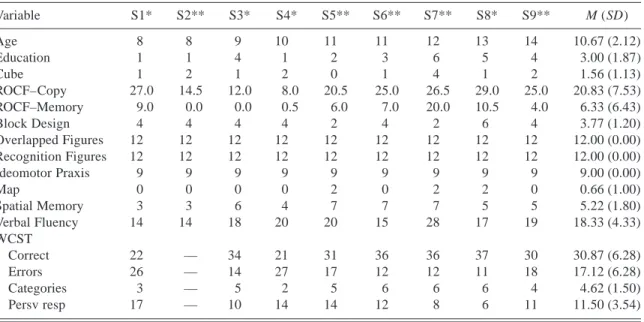
Table 1 and Table 2 present the general results in the two age groups. In some tests, performance was virtually per-fect in all participants. In most of the tests, performance was higher in the younger than in the older group. One younger and two older participants were unable to under-stand the WCST and administration was impossible. Most failed in the Drawing-a-Map test. In several tests, perfor-mance was similar in both age groups. Interesting to note, all were right-handed, and all answered “with the right” to the three questions included in the handedness questionnaire. Correlations between test scores and age and education were calculated. All correlations between age and test performance—excepting WCST Perseverative Responses—
Table 1. Distribution of the younger sample (4M, 5F) and raw scores in the neuropsychological tests
Variable S1* S2** S3* S4* S5** S6** S7** S8* S9** M (SD)
Age 8 8 9 10 11 11 12 13 14 10.67 (2.12) Education 1 1 4 1 2 3 6 5 4 3.00 (1.87)
Cube 1 2 1 2 0 1 4 1 2 1.56 (1.13)
ROCF–Copy 27.0 14.5 12.0 8.0 20.5 25.0 26.5 29.0 25.0 20.83 (7.53) ROCF–Memory 9.0 0.0 0.0 0.5 6.0 7.0 20.0 10.5 4.0 6.33 (6.43) Block Design 4 4 4 4 2 4 2 6 4 3.77 (1.20) Overlapped Figures 12 12 12 12 12 12 12 12 12 12.00 (0.00) Recognition Figures 12 12 12 12 12 12 12 12 12 12.00 (0.00) Ideomotor Praxis 9 9 9 9 9 9 9 9 9 9.00 (0.00)
Map 0 0 0 0 2 0 2 2 0 0.66 (1.00)
Spatial Memory 3 3 6 4 7 7 7 5 5 5.22 (1.80) Verbal Fluency 14 14 18 20 20 15 28 17 19 18.33 (4.33) WCST
Correct 22 — 34 21 31 36 36 37 30 30.87 (6.28) Errors 26 — 14 27 17 12 12 11 18 17.12 (6.28) Categories 3 — 5 2 5 6 6 6 4 4.62 (1.50) Persv resp 17 — 10 14 14 12 8 6 11 11.50 (3.54)
were negative. Correlations between age and test perfor-mance were significant in the following tests: ROCF–Copy (r5 2.572, p , .011), Block Design (r5 2.676, p , .001), Overlapped Figures (r5 2.533, p,.019), and WCST Perseverative Responses (r5.532, p,.033). All correla-tions between education and test performance—excepting WCST Perseverative Responses—were positive. Correla-tion between educaCorrela-tion and tests performance was statisti-cally significant in the following tests: Cube (r5.527, p, .020), ROCF–Memory (r5.509, p , .020), WCST Cat-egories (r5.500, p,.049) and Perseverative Responses (r5 2.568, p,0.021).
DISCUSSION
This study has two significant limitations: a small and het-erogeneous sample, and limited testing. Furthermore, a very narrow age band was used. As a result of the heterogeneity, it is extremely difficult to draw conclusions for the whole sample. However, current results allow exploring neuropsy-chological test performance in a sample of previously un-studied people—the Aruaco Indians. Our participants were Westernized to variable degrees, and conclusions can be only tentative. Children had exposure to Western cultural elements not only through direct contact, but also through the school. Older people were more traditional and much less exposed to Western cultural influence.
The last 3 participants (S18, S19, and S20) are relatively homogenous (age 26–30 years; zero years of school; they only speak Ijka, suggesting a very low level of Western acculturation); 2 were female and 1 was male. All 3 partici-pants were virtually unable to draw a cube or to copy the ROCF. As a matter of fact, they had never used a pencil
before, nor had they engaged in drawing or copying any-thing before. Block Design was zero in these 3 participants, even though no time limit was used. Nonetheless, Recog-nition of Overlapped Figures and performance in the Ideo-motor Praxis test was virtually perfect. They completely failed in representing spatial relationships on paper (Draw-a-Map test), and performance in the Spatial Memory test was very low (they were able to correctly locate an average of 3.609 everyday elements). Verbal Fluency for the two semantic categories was, on average, 18.6, equivalent to the rest of the sample. Two out of the 3 participants could not even understand what was requested with the WCST, and the other was able to get only two categories, well below the group average. Summing up, only three tests (Recogni-tion of Overlapped Figures, Ideomotor Praxis Test, and Verbal Fluency) appeared appropriate, meaningful, and un-derstandable for these 3 Indian adults. The rest of the tests were extremely confusing, unusual, or simply impossible to comprehend for these individuals.
A significant correlation was observed between neuro-psychological test performance and years of school. This correlation supports the assumption that abilities tapped in neuropsychological test are to a significant extent school-trained abilities (Ardila, 1995, 1999; Ostrosky et al., 1998, 1999). Correlations were particularly high for Copy-a-Cube, copying the ROCF, and WCST Perseverative Responses.
It can be hypothesized that bilingualism represented a confounding variable in the correlations that were found between age and education, and test performance. In Aru-aco Indians, the ability to communicate in Spanish is sig-nificantly associated with age and schooling. Furthermore, in 3 older participants an interpreter was required to
admin-Table 2. Distribution of the older sample and raw scores in the neuropsychological tests
Variable S10* S11* S12* S13* S14* S15* S16* S17** S18** S19** S20* M (SD)
Age 15 15 18 20 20 21 23 24 26 28 30 21.82 (4.94) Education 5 5 5 5 5 5 (†) 2 0 0 0 3.20 (2.39)
Cube 3 1 2 2 3 0 4 0 1 0 0 1.45 (1.44)
ROCF–Copy 19.0 10.0 12.0 11.0 17.5 15.5 32.5 10.5 6.5 10.5 6.5 13.77 (7.39) ROCF–Memory 3.5 7.0 6.5 3.5 9.5 6.0 24.5 4.5 4.0 4.5 0.0 6.68 (6.38) Block Design 0 2 2 0 4 4 2 0 0 0 0 1.27 (1.61) Overlapped Fig 12 12 12 12 12 9 10 12 10 9 12 11.09 (1.30) Recognition Fig 12 12 12 12 12 12 12 12 12 12 12 12.00 (0.00) Ideomotor Praxis 9 9 9 9 9 9 9 9 9 9 9 9.00 (0.00)
Map 0 0 0 0 2 0 2 0 0 0 0 0.36 (0.80)
Spatial Memory 3 6 5 5 9 4 7 6 4 4 3 5.09 (1.61) Verbal Fluency 21 16 17 21 22 17 19 20 17 22 17 19.00 (2.28) WCST
Correct 15 18 26 24 34 28 31 18 — 12 — 22.88 (7.54) Errors 33 30 22 24 14 20 17 30 — 36 — 25.11 (7.54)
Categ 2 3 4 4 5 4 4 2 — 2 — 3.33 (1.11)
Persv 17 20 11 17 11 12 12 21 — 25 — 16.22 (5.01)
*male. **female.
ister the testing, introducing an uncontrolled bias. Usually younger and schooled people can speak Spanish better than older and illiterate people. Negative correlations between age and test performance, and positive correlations be-tween school and test performance may have been inflated as a consequence of a confounding variable.
The Block Design test deserves special consideration. As no participant was able to reproduce the three designs within the time limit, time limit was not considered. Slowness in performance was evident in other tests. For instance, to copy the ROCF took on average 8 min, 12 s. As time re-strictions do not make any sense in the Aruaco culture, all activities are performed in an extremely slow pace accord-ing to Western standards. Understandaccord-ing a culture requires knowledge of its orientation to time. Aruaco people in gen-eral do not use any rigid timetable. They frequently refer to “later” as a kind of indefinite future. “Later” can be 2 hr, 10 hr, or 5 days later. However, as any people devoted to agriculture, they distinguish years and separate seasons of the year.
Of note, contrary to expectations, nonverbal measures were the least appropriate tests for cross-cultural use in relation to verbal measures. Performance was particularly low in the WISC–R Block Design subtest, and Draw-a-Map Test, whereas Verbal Fluency Test performance was notoriously higher. This finding emphasizes that nonverbal tests are not necessarily more appropriate for cross-cultural testing than verbal tests. Some time ago, it was supposed that the effect of culture could be controlled if verbal items were eliminated, and only nonverbal, performance items were used. However, this assumption turned out to be wrong. Researchers using a wide variety of cultural groups in many countries, have sometimes observed even larger group dif-ferences in performance and other nonverbal tests than in verbal tests (Anastasi, 1988; Vernon, 1969). Therefore, not only verbal, but also nonverbal tests may be culturally bi-ased. The use of pictorial representations itself may be un-suitable in cultures unaccustomed to representative drawings, and marked differences in the perception of pictures by individuals of different cultures have been reported (Miller, 1973). Furthermore, nonverbal tests often require specific strategies and cognitive styles characteristic of middle-class Western cultures (Cohen, 1969).
In summary, it can be proposed that three types of vari-ables impacted the performance of our sample in neuropsy-chological tests:
1. Formal educational level: A significant correlation be-tween test scores and educational level was observed in several tests.
2. Cultural relevance: Some tests appeared significant and meaningful whereas others were meaningless and even impossible to understand. Figure Recognition, Ideo-motor Praxis and Verbal Fluency using well-known se-mantic categories appeared as good neuropsychological instruments for Aruaco Indians. Copying a complex
fig-ure, drawing a map, and Block Design appeared as frankly inappropriate tests. Spatial Memory and the WCST are somewhere in between. Tests using time restrictions ap-pear as evidently inappropriate when testing Aruaco individuals.
3. Age: A significant association between test performance and age was found.
It is difficult to know how well these conclusions gener-alize to other Amerindian groups. Nonetheless, some gen-eral principles can be valid; for example, drawing tests are inappropriate to use with illiterates. Tests tapping abilities related to the everyday life (meaningful functional move-ments used in the everyday life, naming of animals, etc.) seems to be valid for every human group.
ACKNOWLEDGMENTS
Our sincere gratitude to Dr. Keving Keating for his valuable sug-gestions and editorial support.
REFERENCES
Altarriba, J. (1993). The influence of culture on cognitive pro-cesses. In J. Altarriba (Ed.), Cognition and culture (pp. 361– 376). Amsterdam: North-Holland.
Anastasi, A. (1988). Psychological testing. New York: Macmillan. Ardila, A. (1995). Directions of research in cross-cultural neuro-psychology. Journal of Clinical and Experimental
Neuropsy-chology, 17, 143–150.
Ardila, A. (1999). A neuropsychological approach to intelligence.
Neuropsychology Review, 3, 117–136
Berry, J.W. (1971). Ecological and cultural factors in spatial per-ceptual development. Canadian Journal of Behavioral
Sci-ences, 3, 324–336.
Berry, J.W. (1979). Culture and cognition style. In A. Mrsella, R.G. Tharp, & T.J. Ciborowski (Eds.), Perspectives in
cross-cultural psychology (pp. 117–135). New York: Academic Press.
Cohen, R.A. (1969). Conceptual styles, culture conflict, and non-verbal tests. American Anthropologist, 71, 828–856.
Ferguson, G.A. (1954). On learning and human ability. Canadian
Journal of Psychology, 8, 95–112.
Irvine, S.H. & Berry, J.W. (Eds.). (1988). Human abilities in
cul-tural context. New York: Cambridge University Press.
Lezak, M.D. (1995). Neuropsychological assessment (3rd ed.). New York: Oxford University Press.
Miller, R.J. (1973). Cross-cultural research in the perception of pictorial materials. Psychological Bulletin, 80, 135–150. Nelson, H.E. (1976). A modified card sorting test sensitive to
frontal damage. Cortex, 12, 313–324.
Osterrieth, P.A. (1944). Le test de copie d’une figure complexe [Test of copying a complex figure]. Archives de Psychologie,
30, 206–356.
Ostrosky, F., Ardila, A., Rosselli, M. López-Arango, G., & Uriel-Mendoza, V. (1998). Neuropsychological test performance in illiterates. Archives of Clinical Neuropsychology, 13, 645– 660. Ostrosky, F., Ardila, A. & Rosselli, M. (1999). “Neuropsi”: A brief neuropsychological test battery. Journal of the International
Pontius, A.A. (1989). Color and spatial errors in Block Design in stone-age Auca Indians: Ecological underuse of occipital pari-etal system in men and of frontal lobes in women. Brain and
Language, 10, 54–71.
Pontius, A.A. (1995). In similarity judgements hunter-gatherers prefer shapes over spatial relations in contrast to literate groups.
Perceptual and Motor Skills, 81, 1027–1041.
Taylor, E.M. (1959). The appraisal of children with cerebral
def-icits. Cambridge, MA: Harvard University Press.
Vernon, P.E. (1969). Intelligence and cultural environment. Lon-don: Methuen.
Wechsler, D. (1993). Escala de Inteligencia de Wechsler para
Niños Revisada [Wechsler Intelligence Scale for Children–