UNIVERSIDAD TÉCNICA PARTICULAR DE LOJA
La Universidad Católica de Loja
ESCUELA DE CIENCIAS DE LA EDUCACIÓN
MENCIÓN INGLÉS
DISTANCE SYSTEM
THE USE OF SUPPLEMENTARY MATERIALS IN EFL CLASSES: A COMPARATIVE ANALYSIS OF PUBLIC AND PRIVATE HIGH SCHOOLS
Research done in order to achieve the Bachelor’s Degree in Teaching
English as a Foreign Language
AUTHOR:
LÓPEZ TERÁN ALEXANDRA CAROLINA
ADVISOR:
MGS. NESTERENKO NINA
UNIVERSITY CENTER QUITO
ii
CERTIFICATION
Mgs. Nina Nesterenko
CERTIFIES THAT:
This research study has been thoroughly revised by the
graduation committee. Therefore, authorizes the presentation of this
thesis, which complies with all the norms and internal requirements
of the Universidad Técnica Particular de Loja.
Loja, September 2011
………..
MGS. NINA NESTERENKO
iii
CONTRATO DE CESIÓN DE DERECHOS DE TESIS DE GRADO
“Yo, Alexandra Carolina López Terán declaro ser autora del presente
trabajo y eximo expresamente a la Universidad Técnica Particular de
Loja y a sus representantes legales de posibles reclamos o acciones
legales.
Adicionalmente declaro conocer y aceptar la disposición del Art.67 del
Estatuto Orgánico de la Universidad Técnica Particular de Loja que
en su parte pertinente textualmente dice: “formar parte del
patrimonio de la Universidad la propiedad intelectual de
investigaciones, trabajos científicos o técnicos y tesis de grado que se
realicen a través, o que el apoyo financiero, académico o institucional
(operativo) de la Universidad”.
………..
Alexandra Carolina López Terán
iv
AUTHORSHIP
The thoughts, ideas, opinions and the information obtained through
this research are the only responsibility of the author.
September 2011
………..
Alexandra Carolina López Terán
v
DEDICATION
I want to dedicate the present work to my husband Pablo, for his
constant support and understanding, to my daughter Elisie and to
vi
ACKNOWLEGEMENTS
I would like to express my appreciation mainly to my God, to my
family and friends who helped me in the development of this work, to
my mother Ana María, because thanks to the effort that they made to
give me the opportunity to attend the school, after married I could
continue with my superior studies.
I am also very grateful for the continuing support and friendship of
vii
CONTENTS
CERTIFICATION………..………ii
CONTRATO DE CESIÓN DE DERECHOS ……….……iii
AUTHORSHIP ………..iv
DEDICATION ……….…v
ACKNOWLEDGMENT……….………...vi
CONTENTS………vii
ABSTRACT…...……….………..………..1
INTRODUCTION ………..2
METHODOLOGY………..5
DISCUSSION………..9
Literature Review………..9
Results……….30
Description, Analysis, and Interpretation of Results………..…42
Conclusions……….114
Recommendations………...….116
REFERENCES………....117
Abstract
This study has researched the use of supplementary material
in EFL classes: a comparative analysis of public and private
high schools, and its main purposes are to determine the type of
supporting materials used in EFL public and private high
schools, and to compare the supporting materials used in them.
So, I have selected a place located at the north of Quito city, in
the “Marianas” neighborhood, which belongs to Calderon parish.
The samples analyzed for this job were taken from 8th, 9th and
10th grades in “Joseph Louise of Lagrange” private high School,
and “Nicolas Jimenez” public high school, fifteen classes were
observed in each school.
In order to conduct this research, it was necessary to use
the qualitative and quantitative methods which were used for the
analysis and interpretation of data gathered in the thirty observed
classes in the different grades, in both high schools. Also some
instruments were used as data collection formats, observation
formats and tables. This research evidences that the use of
supplementary material in EFL classes is very important, due to the
fact that the students in the private high school were more interest to
learn the EFL, because their teacher used a wider variety of materials
than in the public high school.
2
Introduction
Since a lot of time ago, EFL teachers have been worried in the
teaching-learning process of the language in a nonnative country due
to the fact that this activity is very complex and diverse. Regarding
some of the components that they have considered the most
important to take into account in this situation are the “socio
-cultural”, which is considered decisive when somebody wants to
teach, “the success of the teaching-learning process” that depends on
the selection of the bibliographical component, and the last is the
“methodological” which is considered as the most important because
it uses methods, resources, and techniques that support the teaching
of English in the best way.
For those teachers, the most important result in the
educational field is to reach their purposes successfully, which is not
an easy task. That is why they believe that all teachers should use
appropriate tools that help to make the work easier to them. So, in
relation to their experience, it has been suggested that one of the
most important aids could be the use of supplementary materials,
which are very helpful to develop pleasant and motivated classes.
Nevertheless, the adequate selection of those materials is also a very
important job, which requires teachers’ responsibility because they
must choose their aids in terms of pertinence (topic, objectives, and
3
The most common supplementary materials are visual, audio,
audio-visual, realia, websites, etc. Some EFL teachers and
researchers believe that teachers usually do not use materials
appropriately or do not use them at all. Due to that doubt those
teachers and researchers want to know if this situation is true or no,
and that is why they have proposed to do this research study with
the topic “The use of supplementary materials in EFL classes: a
comparative analysis of public and private high schools” and its
specific objectives are to identify and analyze supporting materials
used in EFL public and private high schools, describe and analyze
each one of supplementary materials used in EFL classroom in terms
of pertinence (content), appropriateness (students’ needs), and
quality, and determine the frequency and variety of the
supplementary material used in the observed public and private high
schools. So, the main goals are determine the type of supporting
materials used in EFL public and private high schools, and compare
the supporting materials used in public and private high schools.
Previous studies about this topic have already been done
around the world. Thus, some of them have been taken into account
in this research to support the information and know their results.
For instance, one of the authors, Kelsen, B. (2009) had the purpose of
exploring the use of You Tube in an EFL situation by surveying the
student’s attitudes towards the use of this material. He stated that
4
motivational tool. He also identified some limitations; it was that
questionnaires were only written in English. The self-reported nature
of the survey may have led to students to overstate their answers.
The relatively small sample size and the fact that all of the
participants came from the same department means that the results
cannot be extrapolated to the general student population. Other
authors, such as Chen, Y. Chen, P. (2009) had the purpose of
exploring whether the use of English popular songs can enhance
elementary school students motivation and learning performance.
They also stated that overall class motivation had significantly
increased after creative teaching. And their limitations were that
female students agreed that the songs were easier, while male
student’s responses were approaching “agree”. Those researches and
other ones have been the greatest motivation to carry out this
investigation in high schools in my city.
On the other hand, the results of this research will benefit
mainly teachers and students because if teachers will want to have
taken into consideration this study to use adequate supplementary
materials, and motivate the students to develop interest in EFL
classes, it would also contribute to improvement the educational
system. Besides, researchers interested in similar topics could use
this material to know other opinions and results and to support their
5
Regarding the limitations of this study, it could be mentioned
that in the public high school there was difficulty to obtain the
authorization to carry out the observation classes. It was because the
secretary asked me a written request which was refused two times.
Then, I awaited the authorization for three days and finally started
the activity, but there was also other obstacle because during two
days, I could not do my job because teachers were attending
meetings. Second, the observed teacher was not kind enough because
he asked me a lot of information about my job; but he did not answer
all my questions. Finally, I realized that students were very tense and
very attentive in the class during the first and second day. Then, they
got a little bit more relaxed; nevertheless, it was difficult to know if all
the students were really attentive at every moment.
As a recommendation for future researches, it will be important
to develop the observation process during more days to know better
the students and the teacher.
Methodology
As this research is aimed at analysis of the use of
supplementary material in public and private high schools; therefore
a qualitative and quantitative approaches were used.
First of all, a wide review of literature on the topic was carried
out using different sources such as internet, journals, books, and
previous investigations. All the selected information was condensed
6
The field research was accomplished through the cooperation of
a public, and a private high school that authorized the observation of
fifteen classes in each one, but in total, the observed classes were
thirty. Thus, I started my research during a week in the public high
school where three grades were selected to observe five classes in
each one; they were 8th, 9th and 10th of basic. The supplementary
material used to teach each lesson was kept in check in an
observation sheet and in the end of each class the teacher and a
student filled a survey each one to get more information about the
use of supplementary materials. On the next week, I followed the
same process in the private high school. Then, for the tabulation
process all the information obtained was registered in tables.
The most important students’ characteristics in both high
schools were that the students’ age, in 8th grades fluctuated between
11-13, in 9th 12-14 and in 10th grade 13-15 years. In conclusion,
almost all the students were teenagers. On the other hand, regarding
the gender, the public high school had 13 males and 31 females in
8th, 15 males and 24 females in 9th, and 12 males and 22 females in
10th grade, and the private high school had 5 males and 12 females
in 8th, 6 males and 9 females in 9th, 7 males and 8 females in 10th
grade.
In addition, this research was carried out in a private, and a
public high schools at the north of Quito, in the “Marianas”
7
Bibliographic, analytic and descriptive methods were used in
this research project. Bibliographic methods for gathering the
scientific material which were necessary to do the literature review
and the analytic and descriptive methods in all other stages, in order
to do the descriptive and statistical analysis, as well as the
interpretation of the data gathered through the field research.
As part of my research, I had to collect information through
several techniques such as reading, note-taking, surveys and
interviews. Moreover, I also used some instruments such as data
collection formats, observation formats, and tables. Other resources
were books, internet and the didactic guide.
The collected information was carefully analyzed and classified
into qualitative and quantitative tables, according to the variables
such as visual, audio, audiovisual, realia, and On-line sources and
the indicators such as flash cards, power point presentations, maps,
pictures, charts, handouts, posters, word cards, the white/black
board, songs, dialogues, stories, tales, videos, movies, documentaries,
objects, and websites. The chart one and two were a referent to
determine the use of supplementary material in the EFL classes in a
public and a private high school. Charts 3-8 showed if each
supplementary material was used in terms of pertinence,
appropriateness and quality. Charts 9-12 determined the frequency
of use of the supplementary material used in both high schools
8
Subsequently, I could analyze and compare the variables and
indicators to know the type of supporting materials used in the public
and private high schools and to compare the supporting materials
used in public and private high schools. In conclusion, this study has
9
DISCUSSION
This section is composed of five essential parts: literature
review, results, description, analysis, and interpretation of results,
conclusions, and recommendations. The literature review refers to the
conceptions of several authors who provided us a very wide knowledge
about the use of supplementary material in EFL classes.
In the last part of the Literature Review are five researches made
some time ago. They have been also a very important support to
demonstrate the importance of the use of supporting material in other
countries.
Literature Review
Regarding to supplementary materials, it is indispensable to
know that the use of them in EFL classes is very important and
interesting in many ways. So they should be frequently used by
teachers in the teaching-learning process. When supplementary
materials are used in a proper way, teachers can usually reach their
aims successfully because the students will be motivated in the best
way. As a result, they will get more interested in learning the new
language.
Obviously, there are some theoretical information and previous
studies about this topic that all teachers should know before using
supplementary materials in their classes, and which will be
10 Teaching a foreign language
Teaching a foreign language is a complex activity which
requires a lot of teachers’ creativity and interest, it is mainly because
students are not usually interested in enhancing their knowledge of a
foreign language. For this reason, it is very important that teachers
use tools which may help them to introduce and develop the EFL
classes in an attractive way which is not an easy job. According to
Brown (2000, p. 23), “…good language teachers should develop
intuition. Moreover they need to be mindful about how learners
respond to learning situations and how they should be motivated,
their learning preferences and styles or why they fail to master L2
and so on”.
In the same way, Binis (2008) states that teachers must
explicitly realize, how the process teaching-learning occurs. It could
be done mainly by researching how people learn a foreign language
and which factors benefit and affect this job.
In addition, Marschollek (2003, p. 5) states: “Foreign- language
teaching is faced with the task of making language learning an
unforgettable experience by allowing learners to develop wide range
competencies”.
Learners
A series of theoretical and practical educational studies has
suggested that even if learners need assistance of the teacher to
11
resource in the classroom is learners because they are considered as
the core part in this process. However, it is important to take into
account that there are some important differences among them.
For instance, concerning age, there are three groups of foreign
learners such as young ages (children), older children (adolescents)
and adults who require that teachers apply different methods for
each. According to Apec (2006) many teachers consider that
language learning is easier for younger children because they are
more proficient at FL acquisition. However, older children and adults
who study for longer time and practice the language frequently are
considered as proficient as younger students, and their only
disadvantage is their poor pronunciation.
Likewise, Hong & Morgan (2007, p. 6) state: “children,
adolescents and adults have neurological, cognitive and psychological
differences in L2A. Children are generally observed to be intrinsically
better learners, while adolescents and adults have developed
cognitive skills and self-discipline”.
Lastly, Stern (1987 p. 362) states: “...although children are
probably superior than adults in acquiring an acceptable accent in a
new language, they have a slower progress in other aspects of foreign
language learning……”.
Nevertheless, it is important to mention that each learner does
not have only differences in age; they also have other differences
12
(1995) students differ in intelligence, socioeconomic status, culture
and gender which influence learning. In the same way Hall expands
a brief explanation of each factor: “Intelligence” is the ability to think
and reason abstractly, in order to solve problems, and to acquire new
knowledge. “Socioeconomic status” includes parents’ occupation, and
level of education. “Culture helps” determining the abilities, values,
customs, and behavior patterns a child brings to school. “Gender” is
related with different treatment of boys and girls.
Likewise, Woolfolk (2007) states that our development as
human beings is similar in many ways; however, every learner is a
distinctive collection of talents, abilities, and limitations. They can
have some differences such as, economic and social, ethnic and
racial, girls and boys, and language differences.
On the other hand, it is very important to emphasize that most
learners need their teachers to inspire, challenge, and encourage
them. So, the best influence that teachers can apply on learners
during the process of acquiring a foreign language is motivation which
must be obviously positive. According to Binis (2008, p. 7),
“motivation is the key factor which refers one’s success in learning a
language. This means the thoughts and feelings we have which make
us want to do something is the way, to find many factors that
influence our motivation to learn a language”.
In addition to this, Woolfolk (2007, p. 395) states: “Most
13
teaching. Motivation to learn involves more than wanting or intending
to learn”.
Furthermore, Nunan (1999, p. 232) says: “Motivation refers to
the combination of effort plus desire to achieve the goal learning the
language plus favorable attitudes toward learning the language.
Motivation to learn a second language is seen as referring to the
extent to which the individual works or strives to learn the language
because of a desire to do so and the satisfaction experienced in this
activity”.
Learning styles
An only definition of learning styles does not exist, but there
are many authors that give their proper definition of the term. The
different ways that the students use to learn during the process of
teaching and learningare called learning styles which should be
taken into account by teachers ever they prepare their plans.
Pashler, Rohrer & Bjork (2008) say that learning styles are different
ways of instruction or studying that learners consider the most
effective for them. Therefore, learning styles have an important
influence within the education field.
Likewise, Giles (2003) states that learning styles are the ways
how each learner receives and processes the new information through
their senses. Many people use more than one style which is
14
In the same way, Woolkfolk (2007, p. 124) states: “The way as a
person approaches learning and studying is his or her learning style,
which is determined by his/her preferences for particular learning
environments. For instance: where, when, with whom, or with what
lighting, food or music they like to study”.
Additionally, Keefe (1994, p. 8) defines learning styles as:
“cognitive characteristics, affective and physiological behaviors that
serve as indicators of how learners perceive, interact with, and
respond to the learning environment”. Keefe also state that the
cognitive characteristics are the ways the students structure the
contents, make and use concepts, interpret the information, resolve
problems, select the representation way (visual, audio, kinesthic), etc.
The affective behaviors are the motivations and expectations that
influence in learning.
Finally, Curry (2006, p. 14) states that according to the Onion
Model, there are many factors that affect the students learning as the
following:
Ambient: environment illumination, sound and temperature; class
distribution, etc.
Emotional: regarding to motivation, responsibility, etc.
Social factors: they are the ways the students prefer to work in
classroom, for example, in groups, in pairs or individual way.
Physiologic: perception way (audio, visual, kinesthic), time (class
15
Physicologic: regarding to the age, gender, etc.
Teaching techniques
In the same way that learning styles are preferences that
students have for learning; teaching techniques are preferences that
teachers should carry out in his/her classes, taking into account the
different characteristics of the context where he/she works. So, at
this point the focus is on teaching adolescents who are usually
considered as the most difficult group to teach in a general way.
Picolo (2010) states:
Teenagers are considerably more difficult to
motivate and manage than any other age group.
They look for meaning and significance in relation
to their own lives in what they are taught. A
clever teacher will capitalize on this and
personalize their lessons in regard to what is
going on in the lives of his/her students at the
moment. Prior to learning, teenagers need to know
why they are doing something, how it can help
them and how it relates to their lives. Everyone
prefers interesting lessons, but it is impossible to
make all lessons fun. A teacher should use six
resources when teaching teenagers such as
music, role-playing and acting, class knowledge, a
16
understands the characteristics of a teenage
learner, effective teaching methods and the
resources to put those methods into practice is a
teacher who will motivate and challenge a teenage
class to learn with interest.
In the same way Budden (2009, p. 9) says: “teens are often the
hardest age group for teachers to cope with, and there are six things
to bear in mind: the natural information-gap, they´re still young,
parents can be your allies, students have lives outside your
classroom, knowing as much as you can about each and every
student you teach, and using their technological knowledge to your
benefit”.
Moreover, Rhinehart (2010, p. 10) states: “Keeping teenagers
engaged can be one of the most challenging experiences a teacher will
encounter. However, with a little imagination, reasonable boundaries
and careful planning, ESL lessons for teenage students can become
the highlight of the student’s academic life”.
Different teaching contexts
The contexts where the teachers develop their classes are often
very complex, but the most common ones are related with
organization, students, time schedule, and background.
Bacon (1999) states that:
The context of teaching includes anything in the
17
institutional and personal that influences
teaching and learning. Physical environment
includes the classroom where teaching/learning
occurs. Social environment includes the
relationship between teacher and students and
the cultural norms. These cultural norms, this is
what is expected of a teacher and a student; have
to be considered as well. They include norms and
attitudes regarding gender, age, class and ethnic
roles. The Institutional norms play a similar role
as well as cultural norms, but perhaps they affect
more strongly what behaviors the teacher and
students see as acceptable, and the personal
context each instructor (and every student) brings
to the classroom…
In addition, Schneider (1995) states that building a good
teaching context means taking into account both the psychologist
and the instructional perspectives.
Lastly, Barth (2002) states that:
……the increasing diversity in schools results in
significant problems for teachers who must pay
particular attention to each student´s sense of
personal identity, and must value students,
18
must gain an understanding of cultures and offer
instruction that is relevant to the various
cultures. Teachers must use different teaching
techniques that address individual learning styles
and provide students with opportunities to
interact with and respect their peers.
Supplementary material
At this part, it is important to mention that there is a very
important way in which teachers can make the learning experience
more interesting and memorable for learners and it is precisely using
supplementary material in their classes.
There are some important definitions about this topic, for
instance, Spratt (2005, p. 16) states: “Supplementary materials can
be defined as “books and other materials used in addition to the
course book” which complements the teacher´s work. These
resources provide information concerned with the language and
teaching process and cover these lacks that course books cannot”.
Another important definition about this topic is given by Sae
(2005, p. 3) who states: “teaching aids are things used in the
classroom to aid teaching and training. They fall into two main
categories: visual aids such as overheads; and interactive tools such
as a video programme or resource pack. It is good to bear in mind
that too much material and too many different themes can serve to
19
Similarly, Klaus (2010, p. 4) states: “Teaching aids are tools
that classroom teachers use to help their students learn quickly and
thoroughly. A teaching aid can be as simple as a chalkboard or as
complex as a computer program. Klaus also declares “Because every
individual learns in a different way, teachers rely on these tools to
explain concepts to students with a wide variety of learning needs”.
On the other hand, even if during many years ago the
importance of using supplementary materials have not been
considered by teachers in their lessons because textbooks frequently
have determined the control of all their classes, nowadays this aspect
is changing in special in private institutions where the teachers are
more worry in to improve the education level. Regarding this some
points of view will be mentioned below.
According to Roberson (2010, p. 43), “many benefits of teaching
aids include helping learners improve reading comprehension skills,
illustrating or reinforcing a skill or concept, differentiating instruction
and relieving anxiety or boredom by presenting information in a new
and exciting way”. Furthermore, Roberson adds that teaching aids
also engage students' other senses since there are no limits as to
what aids could be used when supplementing a lesson”.
In addition, Smith (2004, p. 3) declares: “Supplementary
materials can enhance meaning, create context, and clarify confusing
concepts making lessons more relevant. This is especially important
20
and/or who have language learning difficulties. Smith also says
“Using a variety of supplementary materials can also support
different learning styles, when students can see, hear, feel, perform,
create, and participate while making connections and constructing
personal, relevant meanings”.
Further, Allwright (1990) states that teaching aids are
important teaching tools for teachers to accomplish their purpose in
teaching. The classroom teaching aids provide materials, books and
equipment for teaching. The variety of teaching aids is specially made
and designed by teachers.
It is also very important to explain the role of supplementary
materials during the EFL classes because they function as stimulus
to promote learning, increase the learners’ knowledge and diminish
the level of difficulty.
According to Araya (2007, p. 11), “one of the main general
ideas about the role that materials play in the language teaching and
learning process is related to input and to stimuli. However, far from
considering materials necessary because they are instruments to
access the target language, they are one of the most powerful ways
through which ideological attitudes and values can be developed in
the classroom”.
Finally, a brief summary about each one of the different kinds
of supplementary materials used by second language teachers in EFL
21 Visual
The most common group of visual aids for teachers are:
flash cards, power point presentations, maps, pictures, charts,
handouts, posters, word cards and the white/black board. On this
respect Echevarria (2010, p. 11) says: “Visual aids can include
overhead transparencies, models, graphs, charts, timelines, maps,
props, and bulletin board displays. Students with diverse abilities
often have difficulty processing an inordinate amount of auditory
information and are aided with visual clues”.
In the same way, Moreira (1998, p. 21) states: “Visual Aids are
pictures, the teachers themselves, the blackboard, real objects,
flashcards and charts. Showing visuals focuses the attention on
meaning, and helps to make the language used in the class more real
and alive. Having something to look at keeps the students’ attention,
and makes the class more interesting. Good visual aids are not just
used once, but again and again, and can be shared by different
teachers”.
According to Sae (2005, p. 7), “Visual aids are presentations in
the form of text, cartoons, graphs, illustrations, photographs. These
can be OHP transparencies, handouts, flipcharts, posters, objects etc.
They help to break up the monotony, providing a visual stimulant to
reinforce what the learners are hearing. Nowadays the most high-tech
version is the use of a data projector, a computer and presentation
22 Audio
The most common audio aids for teachers are songs, dialogues,
stories and tales. Sarango (1997) states that audio stories, dialogues,
poems, speeches, dictation, oral comprehension and/or song
exercises are invaluable aids in the process of learning-teaching a
foreign language. And these materials are usually the mostly used by
teachers in their classes. Sarango also says the advantages of those
tools are that learners can hear the class again; they can listen the
real pronunciation and also memorize in a good way the content of
the class.
In addition, Maniruzzaman (2007) states:
The appropriate use of audio aids can be
substantially helpful. On this respect since such
learning aids and teaching machines stimulate,
motivate and arrest the learner’s attention during
the instructional process. Audio-aids can be
defined as models and devices that can be heard
and give an image of something, somebody and
some situations. They include recorded materials,
radios, cassette players, cassettes. Teachers with
a little training can use them in the L2 class in
order to make the teaching methods, techniques
23
interesting, and to help the learner getting a
maximum benefit.
Audiovisual
In the group of audiovisual aids for teachers the most common
materials are: videos, movies and documentaries. Echevarria (2010)
states that audiovisual materials are available to enhance teaching
and learning. These range from simple tape recordings to videos,
DVDs, interactive CD-ROMs, and an increasing number of resources
available on the Web.
In the same way, Sae (2005, p. 11) states: “Videos, DVDs and
audio tapes can be useful ways of reinforcing, introducing or filling in
detail on the second language being taught. These can be shown to
the class as a substitute for a lecture or presentation. Or they can be
used in conjunction with a work sheet which requires the class to fill
in details from the visual/aural experience time and it is allowed for
discussion before and/or after the showing”.
Additionally Sarango (1997, p. 32) states: “Today audiovisual is
an important device for introducing a new language. It is because it
combines pictures with movement, color and sound. It enlarges our
horizons, provides new experiences, builds curiosity and it is fun.
This aid is also motivating and dynamic because it also presents real
language, and it gives learners practice in dealing with the
24 Realia
The most common aids in this group are: objects such as toys,
plants, fruits, etc. Echevarria (2010, p. 19) says: “These are real-life
objects that enable students to make connections to their own
lives...”.
Further, Moreira (1998, p. 22) states: “Real Objects are in many
ways the easiest kind of visual aid to use in class, as they need no
special preparation or materials. Simple objects can be used not only
for teaching vocabulary but also as prompts to practice structures
and to develop situations”.
Another important point of view is given by Budden (2008, p.
14) who states: “Realia in EFL terms refers to any real objects we use
in the classroom to bring life to the class. The main advantage of
using real objects into the classroom is that it makes the learning
experience more memorable for the learner”.
Online
In this group of on-line aids are websites.According to Holden
(2000, p. 2), “A massive number of websites that help English
learners has emerged. Google comes up with 85 million results for
the phrase “learn English”.
Likewise, Malaya (2001, p. 5) states: “There are numerous web
sites on the World Wide Web that have been created specifically for
ESL/EFL learners. Many of these web sites can help your students to
25
Wide Web is that it is available 24 hours a day and if students have
access to the internet outside the classroom, they can access the web
sites at their own time”.
Lastly, Shuenn (2009, p. 426) says: “since 1998, more and
more foreign educators have applied this friendly technology to
classroom instruction and language learning. However, it seems that
relatively few English teachers have ever used blogs in an EFL writing
class which have formidable potentials as a useful tool for the
teaching of EFL writing class”.
Regarding the previous studies about the use of supplementary
materials in EFL or ESL classrooms, a short summary of some
important researchers will be mentioned below.
From his point of view, Kelsen (2009) sought to gauge student’s
attitudes and perceptions by using supplementary materials in the
EFL classes. The purpose was making classes more interesting, being
relevant to course materials, being beneficiate language learning,
motivating students to learn in class, and motivating students to use
this material to learn English outside of class.
During a semester some materials from You Tube website were
selected as for example: clips related to topics selected from the
textbook, clips connected to current events and music videos. Each
clip was chosen due to its relevance for material covered in class, and
appropriate vocabulary was taught prior to viewing all this material.
26
review the clips at home. Furthermore, students were invited to
suggest video clips to be used in class.
As a result from this study, students found the experience of
using You Tube interesting, relevant, beneficial and somewhat
motivating in class; however, although they were motivated to use
these websites as a medium to study English outside the class, it was
found that considerably fewer students revisited the websites in their
own time.
On the other hand, Kelly, Kelly, Offner, and Vorland (2002)
researched how authentic materials can be effectively used in the
ESL classroom. In the first place, the researchers had an extensive
collection of materials that included menus, maps, newspapers,
inserts, store advertisements, travel brochures, catalogs, phone
books, real estate pamphlets, and various pamphlets of sightseeing
and tourist information. These materials were organized in sets which
looked for an immersion the student in a multidimensional English
experience. After, the researchers started handing out authentic
materials to each student and had them work individually. Finally,
students worked together with a partner to extract pertinent
information that is necessary to answer questions. Besides, they were
helped by researchers.
Consequently, it was found that when teachers use effective,
authentic materials, it helps bringing the real world into the
27
it exposes the students to deeper understanding of and interest in the
topic. On the one hand, the students develop their ability, and on the
other hand, they learn how to disregard what is not relevant.
In addition, Rammal (2006) created effective teaching materials
to be implemented in EFL classroom. So, he got acquainted with the
video equipment for some time until he got used to it. After, he
videotaped short segments that can be viewed and reviewed in order
to allow longer time for student’s classroom activities and
participation. He focused on the language, content, and production.
Finally, he also asked the characters to maintain pauses in the
course of the dialogue. This gave students enough time to
comprehend the language patterns that they are expected to use in
classroom activities.
As for the content, he tried to choose situations whose content
is of great value and interest to students.
In conclusion, he found that video material can be a very useful
source and asset for the language teaching-learning process because
it combines both fun and pedagogic instructions in an authentic
material that reflect real interaction.
Meanwhile, Chen and Chen (2009) explored whether the use of
English popular songs can enhance elementary school students’
motivation for learning English. It was also an attempt to investigate
the relationships between learning motivation and learning
28
To create a more enjoyable learning environment for young
students to learn English, a total of four English popular songs were
presented in the CD player. In addition, the teacher also provided
students with parts of the films to introduce the main plots of the two
last songs. These English songs also provided a context to help
students review sight vocabulary.
To understand the improvement of student’s abilities through
English song learning, a questionnaire was designed by the
researcher. The questionnaire was subdivided into two categories.
One was related to the variable “learning motivation” and the other
was “learning performance”. To sum up, there was a total of six hours
instructional time within 12 weeks.
The results of this study showed that the majority of students
were interested in learning English popular songs and their learning
motivation also increased after engaging in this creative teaching
activity.
The most important recommendation was that English popular
songs could be used to practice the four skills – listening, speaking,
reading and writing – together.
Finally, Orr (2008) researched on learner perceptions of
interactive whiteboard (IBM) use in English in a foreign language
class.
Student’s perceptions were investigated in two ways. First, 26
29
to answer the question, “What’s it like learning English in class with
an IWB?”. They gave their answer orally and it was recorded,
transcribed, segmented and codified according to the features
appearing in data. Second, written responses to the question, “What
do you like/dislike about learning with an IWB?” were segmented and
codified as was done with the oral data. This second source of data
came from an open question at the end of a questionnaire given out
in several British Council teaching centers.
The results showed a general appreciation of the introduction of
new technology but suggested there is little in the way of an improved
pedagogy being implemented that might immediately justify the
investment. On the other hand, it would appear that the promise of
interactive whiteboards have not been unfulfilled yet, except perhaps
30
Results
Qualitative Tabulation
Chart One: Type of supplementary material used in public high school.
Author: Alexandra López
Source: 8th, 9th, and 10th grades
Variable Indicators Yes No
Visual
Flash cards
Power point presentations
Maps
Pictures
Charts
Handouts
Posters
Word cards
White/black board
Audio
Songs
Dialogues
Stoties
Tales
Audiovisual
Videos
Movies
Documentaries
Realia Objects (toys, plants, fruits)
31
Chart two : Type of supplementary material used in private high school
Author: Alexandra López
Source: 8th, 9th, and 10th grades
Variable Indicators Yes No
Visual
Flash cards
Power point presentations
Maps
Pictures
Charts
Handouts
Posters
Word cards
White/black board
Audio
Songs
Dialogues
Stoties
Tales
Audiovisual
Videos
Movies
Documentaries
Realia Objects (toys, plants, fruits)
32
Chart three : Pertinence and Appropriateness of the supplementarty material used in public high schools.
Author: Alexandra López
Source: 8th grade
Variable Indicators 1st class 2nd class 3rd class 4th class 5th class
Pert. App. Pert. App. Pert. App. Pert. App. Pert. App.
Visual
Flash cards
Power point
presentations
Maps
Pictures
Charts
Handouts
Posters
Word cards
White/black
board
Audio
Songs
Dialogues
Stories
Tales
Audio- visual
Videos
Movies
Documentari.
Realia Objects (toys,
Plants, fruits)
33
Chart four : Pertinence and Appropriateness of the supplementarty material used in public high schools.
Author: Alexandra López
Source: 9th grade
Variable Indicators 1st class 2nd class 3rd class 4th class 5th class
Pert. App. Pert. App. Pert. App. Pert. App. Pert. App.
Visual
Flash cards
Power point
presentations
Maps
Pictures
Charts
Handouts
Posters
Word cards
White/black
board
Audio
Songs
Dialogues
Stories
Tales
Audio-
visual
Videos
Movies
Documentari.
Realia Objects (toys,
Plants, fruits)
34
Chart five : Pertinence and Appropriateness of the supplementarty material used in public high schools.
Author: Alexandra López
Source: 10th grade
Variable Indicators 1st class 2nd class 3rd class 4th class 5th class
Pert. App. Pert. App. Pert. App. Pert. App. Pert. App.
Visual
Flash cards
Power point
presentations
Maps
Pictures
Charts
Handouts
Posters
Word cards
White/black
board
Audio
Songs
Dialogues
Stories
Tales
Audio-
visual
Videos
Movies
Documentari.
Realia Objects (toys,
Plants, fruits)
35
Chart six : Pertinence and Appropriateness of the supplementarty material used in private high schools.
Author: Alexandra López
Source: 8th grade
Variable Indicators 1st class 2nd class 3rd class 4th class 5th class
Pert. App. Pert. App. Pert. App. Pert. App. Pert. App.
Visual
Flash cards
Power point
presentations
Maps
Pictures
Charts
Handouts
Posters
Word cards
White/black
board
Audio
Songs
Dialogues
Stories
Tales
Audio-
visual
Videos
Movies
Documentari.
Realia Objects (toys,
Plants, fruits)
36
Chart seven : Pertinence and Appropriateness of the supplementarty material used in private high schools.
Author: Alexandra López
Source: 9th grade
Variable Indicators 1st class 2nd class 3rd class 4th class 5th class
Pert. App. Pert. App. Pert. App. Pert. App. Pert. App.
Visual
Flash cards
Power point
presentations
Maps
Pictures
Charts
Handouts X
Posters
Word cards
White/black
board
Audio
Songs
Dialogues
Stories
Tales
Audio-
visual
Videos
Movies
Documentari.
Realia Objects (toys,
Plants, fruits)
37
Chart eight : Pertinence and Appropriateness of the supplementarty material used in private high schools.
Author: Alexandra López
Source: 10th grade
Variable Indicators 1st class 2nd class 3rd class 4th class 5th class
Pert. App. Pert. App. Pert. App. Pert. App. Pert. App.
Visual
Flash cards
Power point
presentations
Maps
Pictures
Charts
Handouts
Posters
Word cards
White/black
board
Audio
Songs
Dialogues
Stories
Tales
Audio- visual
Videos
Movies
Documentari.
Realia Objects (toys,
Plants, fruits)
38
Quantitative Tabulation
Chart nine : Frequency of use of supplementary material in 8th grade
Author: Alexandra López
Variable Indicators Public Private
Visual
f % f %
Flash cards 0 0 0 0
Power point presentations 0 0 0 0
Maps 0 0 0 0
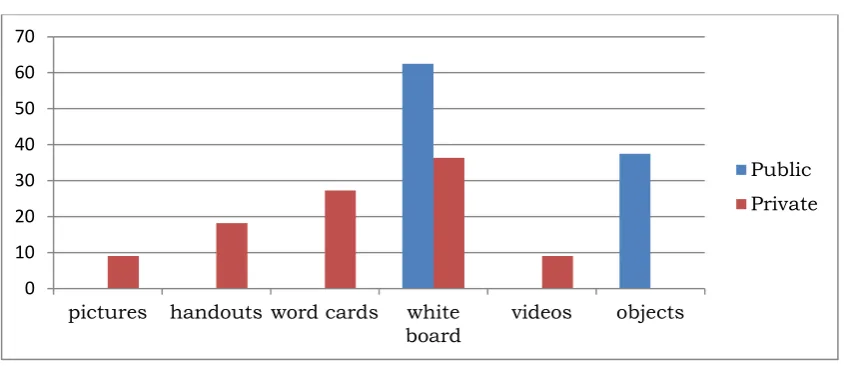
Pictures 0 0 1 9,09
Charts 0 0 0 0
Handouts 0 0 2 18,18
Posters 0 0 0 0
Word cards 0 0 3 27.2
White/black board 5 62,5 4 36,36
Audio
Songs 0 0 0 0
Dialogues 0 0 0 0
Stories 0 0 0 0
Tales 0 0 0 0
Audiovisual
Videos 0 0 1 9.09
Movies 0 0 0 0
Documentaries 0 0 0 0
Realia Objects (toys, plants, fruits) 3 37,5 0 0
Online websites 0 0 0 0
39
Chart ten : Frequency of use of supplementary material in 9th grade
Author: Alexandra López
Variable Indicators Public Private
Visual
f % f %
Flash cards 0 0 0 0
Power point presentations 0 0 0 0
Maps 0 0 0 0
Pictures 0 0 0 0
Charts 0 0 0 0
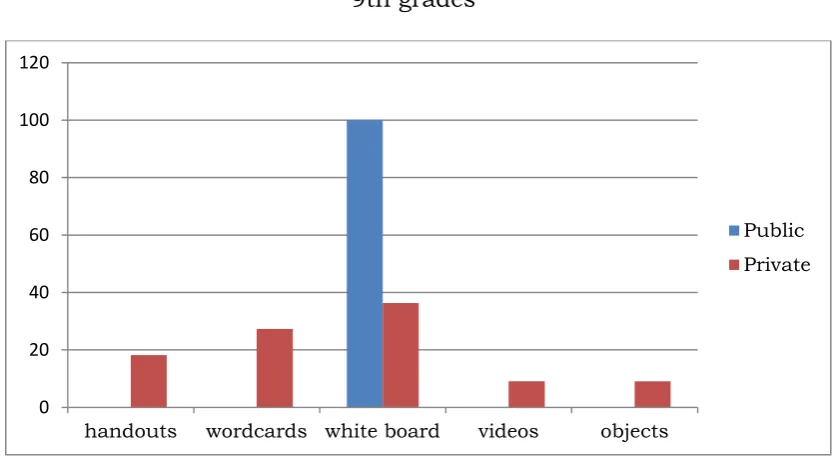
Handouts 0 0 2 18.18
Posters 0 0 0 0
Word cards 0 0 3 27,27
White/black board 4 100 4 36,36
Audio
Songs 0 0 0 0
Dialogues 0 0 0 0
Stoties 0 0 0 0
Tales 0 0 0 0
Audiovisual
Videos 0 0 1 9,09
Movies 0 0 0 0
Documentaries 0 0 0 0
Realia Objects (toys, plants, fruits) 0 0 1 9,09
Online websites 0 0 0 0
40
Chart eleven : Frequency of use of supplementary material in 10th grade
Author: Alexandra López
Variable Indicators Public Private
Visual
f % f %
Flash cards 0 0 0 0
Power point presentations 0 0 0 0
Maps 0 0 0 0
Pictures 0 0 0 0
Charts 0 0 0 0
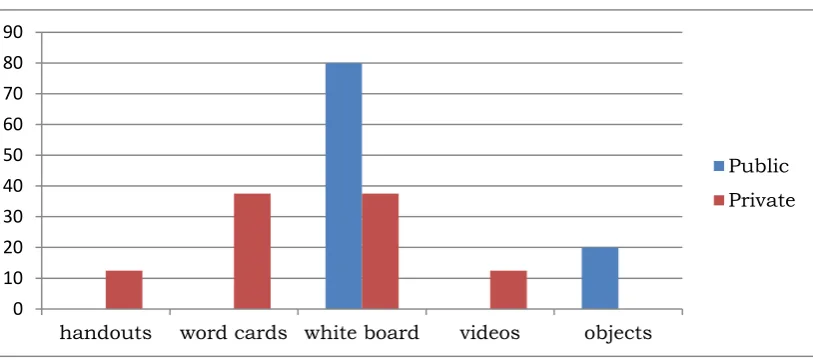
Handouts 0 0 1 12,50
Posters 0 0 0 0
Word cards 0 0 3 37,5
White/black board 4 80,00 3 37,5
Audio
Songs 0 0 0 0
Dialogues 0 0 0 0
Stoties 0 0 0 0
Tales 0 0 0 0
Audiovisual
Videos 0 0 1 12,50
Movies 0 0 0 0
Documentaries 0 0 0 0
Realia Objects (toys, plants, fruits) 1 20,00 0 0
Online websites 0 0 0 0
41
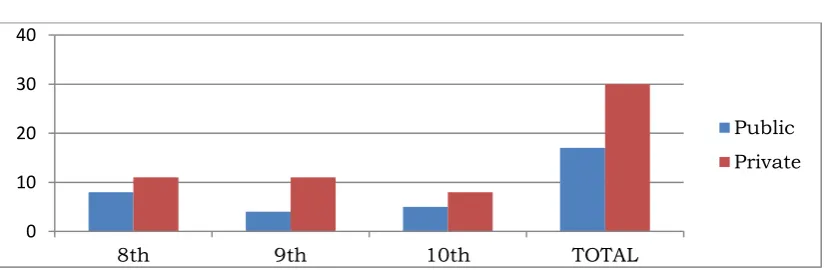
Chart twelve :
Grades Public (f) Private (f)
8th 8 11
9th 4 11
10th 5 8
TOTAL 17 30
42
Description, Analysis, and Interpretation of Results
At this point, the results from the research made on each
supplementary material used by teachers in the thirty classes
observed in the public and private High Schools are described,
analysed, and interpreted in a deep way. First of all, a descriptive or
qualitative analysis of a public High School is developed. This study
points out specific supplementary materials used at the fifteen
lessons observed in that High School and it was made by using the
information showed on the chart one of the results section. Then, I
describe each supplementary material used for each grade (8th, 9th,
10th) taking into account three parameters: pertinence,
appropriateness and quality, by means of charts “three”, “four”, and
“five”. Next, at the end of the analysis of each level, a criterion about
the learning styles is stated. Afterwards, the private high school is
analysed in the same way as the public high school by using the
charts “six”, “seven”, and “eight”. Finally, a comparative analysis is
done by using the statistics of the charts “nine”, “ten”, “eleven”, and
“twelve”, which have been illustrated in bar graphs to explain the
results got between 8th, 9th, and 10th grades of the two high
schools.
Descriptive Analysis
Public High School
It is important to mention that the teacher who was observed
43
grades in this public High School. Besides, he used only the
whiteboard, and objects.
8th Grade
While the classes were being observed in this grade, the teacher
used the whiteboard in all of them and objects in the first, second
and third classes. The way these supplementary materials were used
is described in the next paragraphs.
White/black board
In the first class the whiteboard was used to review the topic
“My Classroom”. The purpose of this lesson was to listen and practice
the pronunciation of new vocabulary. This activity was important
mainly for the students with difficulties in listening skill, because
even if they listened a Cd twice and filled in the blanks in a
paragraph from the student’s book, they were not sure about their
own answers because each one had different answers in the
classroom. That is why the teacher asked six students to write a
whole paragraph on the board in order to correct each sentence. In
conclusion, some students were happy because their answers were
right and the other ones could clarify their confusion and correct
their wrong answers.
Moreover, the activity developed on the whiteboard was related
and selected according to the general student characteristics,
because the vocabulary used in this lesson by the teacher had easy
44
these elementary words are basically used to teach beginners
students. Regarding the listening part, it was necessary that the
students write the words listened before, on the the whiteboard at the
same time while they listened the Cd again whose activity was
necessary to understand and clear their doubts.
In addition, it is important to say that the content written on
the whiteboard was checked by the teacher in that class, because it
was made by six students who followed the instructions of the
teacher and the format of the book. In sum, the quality was good
because the paragraph had the perfect size; the writing was very clear
and without mistakes and the words checked were underlined.
In the second class the whiteboard was used to focus on the
topic “Classroom Objects and Positions” whose objective was to teach
the way the students should give and ask for information about the
location of the classroom objects. I believe that the explanation
written on the whiteboard was important, basically because some
models were built in order to point to the structure, for example, the
use of “where”, and the prepositions “near” and “on”, was very helpful
to understand the questions and answers of the objective.
On the other hand, the use of the whiteboard was related and
selected according to the general student characteristics, because the
questions and answers built on the whiteboard consisted of simple
words such as the prepositions “on” and “near” which are very easy
45
location of the objects which are very easy to use, the new vocabulary
introduced in the last class, that was “My classroom”, and the article
“the” which the students have already studied before. In conclusion,
the answers and the question learned were just for beginner
teenagers.
In addition, it’s important to emphasize that the content of the
whiteboard was planned and checked by the teacher in order to reach
a better level of comprehension of each student. And the quality of
the class was almost perfect, because the structure and the
chronologic order were acceptable, but a limitation was that the
marker used in the class was only black. Consequently the material
content became a little boring. So we always have to remember what
Brown (2000) said “…good language teachers should develop
intuition. Moreover they need to be mindful about how learners
respond to learning situations and how they should be motivated,
their learning preferences and styles or why they fail to master L2
and so on”. In sum, these words encourage us to follow a correct
procedure when we’re teaching this Second Language.
Following with the third class the whiteboard was used to deal
with the topic “School Things”. The purpose of this lesson was to
teach vocabulary related to it. I think that using the whiteboard to
introduce this new vocabulary was a useful activity, mainly for
46
to practice the pronunciation and to copy those new words in the
students’ notebooks.
Furthermore, in this class the use of this supplementary
material was an activity related and selected according to the general
student characteristics of those teenagers, because the new
vocabulary introduced to them was very easy and simple for example:
table, chair, map, etc., besides the white/black board is a
supplementary material very important in the classroom which can
be used for all age.
Likewise, the supplementary material used in this class was
checked by the teacher, the one who also wrote the content with a
clear handwriting and in order; however, the quality was a little poor
because it was made without creativity, it was using only a marker,
which diminished the students’ motivation because the writing was
not interesting. In this part, it would be important for teachers to
take into account Araya’s statement (2007) who said that one of the
main general ideas about the role that materials play in the language
teaching and learning process is related to input and to stimuli for
students’ interest in the EFL classes.
In the fourth class the whiteboard was used to draw a chart for
the topic “Timetables” whose objective was to teach new vocabulary
related to it. In my opinion, using the whiteboard in this class was
basic, because it was an important way to correct the class work of
47
of the correction of their task in the schedule drawn on the
whiteboard, check their answers and at the same time they were
practicing their writing again, and the use of new vocabulary.
Moreover, the activity developed on the whiteboard was closely
related and selected according to the general student characteristics.
First they made their own class schedule in their notebooks using the
new vocabulary about subjects introduced by the teacher before,
which were simple words. Then, this task was done and checked by
the teacher and the students on the board, which is not necessary for
the students with a better English level.
In the same way, it is important to mention that although the
students were the ones who drew and filled the chart on the
whiteboard, the teacher was the one who gave all the instructions for
designing and elaborating the format, which finally was a good
quality job because the size of the chart was suitable, the
handwriting was clear, and even if some students made mistakes,
others ones were interested in correcting them. In conclusion the
activity captured all the student’s attention and interest.
For the fifth class the whiteboard was used to develop the topic
“School Timetables” whose objective was to teach the way in which
the students must give and ask for information about school
timetables. My opinion is that the examples written on the board
were essential and easy to understand the structure of questions and
48
“What time”, “How long” and “How many” were used for the
questions, and vocabulary known by the students was used for the
answers such as days of the week, numbers, times and subjects. In
conclusion, the objective was reached with success because then the
students could practice the questions and the answers in an oral way
without mistakes.
On the other hand, the use of the whiteboard was related and
selected according to the general student characteristics, because
they only learned four question words which were connected to
known vocabulary to build simple question models that are usually
used for teaching beginner learners. In addition the information for
answering the questions was taken of a page of the student’s book,
and the information was about the school timetables from two
teenagers who study in different countries.
Finally, the content written on the whiteboard was checked by
the teacher, and its quality was good because the size was right, clear
and free of mistakes. Besides, the examples were developed in order
and the quantity of them was enough; however, in this class the
teacher also used only a black marker, which was not a creative and
interesting design to motivate learners.
Objects
As I had said, the first class was about “My Classroom” whose
objective was to listen and practice the pronunciation of a new
49
the chair, desk, whiteboard, cupboard, etc. was a good opportunity
on the one hand, to create a novelty and interesting class which
could attract students’ attention and, on the other hand, to illustrate
the new vocabulary introduced in a written way on the board, which
made it possible for the students to learn in an easier way. To
support this explanation, it is important to remember the point of
view given by Budden (2008) who stated “Realia in EFL terms refers
to any real objects we use in the classroom to bring life to the class.
The main advantage of using real objects into the classroom is that it
makes the learning experience more memorable for the learner”.
Moreover, this supplementary material was used appropriately
because it was selected taking into account the initial or elementary
level of the students and their ages. It was because the new
vocabulary was very basic, simple, and easy to understand.
Likewise, it is important to mention that the quality of the
supplementary materials used in this class was good and very
important because they were colourful, real, tangible and therefore
easier to memorize and to develop motivation in the students.
In the second class this supplementary material was used to
focus on the topic “Classroom Objects and Positions”. The purpose of
this lesson was to teach the way the students should give and ask for
information about the location of the classroom objects. I think that
the use of those supplementary materials in this class, such as, the
50
examples to understand easily the use of the prepositions “on” and
“near”. Besides, this activity motivated the students because this let
them to participate actively and voluntarily.
On the other hand, this supplementary material was related
and selected according to the general student characteristics. It was
because they learned only two prepositions of place, and the way as
“on” and “near” must be used, which was very easy to understand.
In addition, the quality of the supplementary materials used in
the class were checked by the teacher, because he was the one who
used those real objects to introduce the new vocabulary in the class,
which were visual stimulus very important for the students because
they could capture the students’ interest to participate with their own
examples in the class, which was also an excellent result for the
teacher’s objective.
In the third class this supplementary material was used to
illustrate the topic “School Things” whose objective was to teach
vocabulary related to it. In my opinion, in this class the use of those
real objects like an eraser, a pencil case, a ruler, a school bag, etc.
was a good technique to stimulate and motivate the students’ interest
because they showed to assimilate easily the new vocabulary all the
time, because their oral exercises were always right.
Regarding the general students characteristics the
51
teenager students and do not have enough knowledge about the
English language because they are in an elementary level.
Finally, it is important to mention that the supplementary
materials used in this class was checked by the teacher; because, he
used those school items, which helped to develop a creative and
interesting class. On the other hand, it is important to mention that
those objects are very common, colourful, and easy to touch. Besides,
it was proved that the use of this material was very useful to
memorize the new vocabulary in an easy way. Echevarria (2010)
states on this respect: “Students with diverse abilities often have
difficulty processing an inordinate amount of auditory information
and are aided with visual clues”.
Learning styles
During the classes observed for this grade, there were some
important factors which were useful to develop a good process of
learning. For example according to the class’ environment, it had
good illumination; the temperature and the distribution of the
student desks were always adequate because all the students could
integrate without problems in all the classes. Regarding to the
emotional, physiologic and physicologic aspects the teacher only
selected the audio and visual perception in all his classes by using
the student’s book to read, write, and look at pictures and the
whiteboard to practice the pronunciation of the new vocabularies and
52
real objects of the classroom, such as, pencils, erasers, sharpeners,
etc. However, the preferences of the students were not taken into
account, due to the fact that a student wrote in his survey that he
would like to learn English using sometimes flash cards, pictures,
charts, posters, songs from their favorite singers, stories, movies or
magazines.
At this part, it is important to remember the word of Curry (2006)
who stated according to the Onion Model, there are many factors that
affect the students learning as the following:
Ambient: environment light, sound and temperature; class
distribution, etc.
Emotional: regarding to motivation, responsibility, etc.
Social factors: they are the ways as the students prefer to work in
classroom, for example: in groups, in pairs or individual way.
Physiologic: perception way (audio, visual, kinesthic), time (class
duration, schedule).
Physicologic: regarding to the age, gender, etc.
Consequently, it’s very important to know that the use of some
learning styles are not enough, teachers also must listen to the
students’ wishes in order to develop a better understanding and