Homology Stability for Spaces of Surfaces
Federico Cantero Morán
Aquesta tesi doctoral està subjecta a la llicència Reconeixement 3.0. Espanya de Creative Commons.
Esta tesis doctoral está sujeta a la licencia Reconocimiento 3.0. España de Creative
Commons.
Homology Stability for Spaces of Surfaces
Homology Stability for Spaces of Surfaces
Memòria presentada per Federico Cantero Morán per aspirar al grau
de Doctor en Matemàtiques
dirigida per
Dr. Carles Casacuberta Vergés Dr. Oscar Randal-Williams
Departament d’Àlgebra i Geometria Facultat de Matemàtiques
Universitat de Barcelona
Contents
Contents v
Introduction 1
Background . . . 1
Homology stability for spaces of embedded surfaces . . . 8
Applications and related results . . . 13
1 Preliminaries 17 1.1 Manifolds and submanifolds . . . 17
1.2 Spaces of embeddings and spaces of submanifolds . . . 21
1.3 Haefliger’s approximation for embeddings . . . 23
1.4 Tubular neighbourhoods . . . 24
1.5 Local retractibility . . . 26
1.6 Homotopical resolutions . . . 32
1.7 A criterion for homological stability . . . 34
2 Homology Stability 37 2.1 Stabilisation maps . . . 37
2.2 Resolutions of pairs of pants and their fibrations . . . 39
2.3 Proof of homology stability forαandβmaps . . . 45
2.4 Resolutions of complements of arcs and their fibrations . . . 49
2.5 Triviality . . . 57
2.6 Closing the last boundary . . . 67
3 Stable Homology 73 3.1 Group completion . . . 73
3.2 Surgery on semi-simplicial spaces . . . 83
3.3 Manifolds without boundary . . . 94
4.2 Rational stability for spaces of surfaces in closed manifolds . . . . 115 4.3 Distances on spaces of submanifolds . . . 118
Introduction
The main subject of this thesis is the homology of the space of embedded com-pact, connected, oriented surfaces in a manifoldM. We first show that, under some conditions, the homology groups of this space become stable with respect to the surface genus. Then we show that a natural map from the space of em-bedded surfaces to a space of sections overMis a homology equivalence in the stable range. The methods used follow recent advances on cobordism theory and the homology of diffeomorphism groups of surfaces, which we review in the following sections.
Background
Cobordism and mapping spaces
It was Pontryagin who first realized a crucial relationship between spaces of embedded submanifolds and spaces of maps into spheres. In 1938, he found that the set of normally framed closed submanifolds of dimensionkof a given manifold Mof dimensionnup to normally framed cobordism is in bijection with the set of homotopy classes of compactly supported maps fromMto the sphereSn−kof dimensionn−k:
{normally framed closedk-submanifolds ofM}/cobordism
←→π0mapc(M, S n−k).
Anormally framed submanifoldofMof dimension kis a pair(W, `), whereW
is a submanifold ofMwhose normal bundle is trivial and`is a collection of
n−klinearly independent vector fields on the normal bundle ofW. Anormally framed cobordismbetween two such framed closed submanifolds(W, `),(W0, `0) is a normally framed submanifold with boundary (B, l)in M×Isuch that
∂B = B∩(M×∂I) and such that∂B = W×{0}∪W0 ×{1}and l restricts to`and`0on its boundary.
If M = Rn, then the resulting set of homotopy classes is the homotopy
groupπn(Sn−k), which is one of the main objects of research in algebraic topol-ogy. According to [Pon50], the motivation of Pontryagin was the possibility to use the above equivalence to compute homotopy groups of spheres, in the be-lief that the space of normally framed cobordisms was easier to deal with.
Shortly after, Thom [Tho54] found that the set of cobordism classes of closed normally orientedk-submanifolds of a manifoldMof dimensionnis in bijec-tion with the set of homotopy classes of compactly supported maps fromMto the Thom space Th(γn−k). Hereγn−kis the tautological(n−k)-plane bundle over the Grassmannian Gr+n−k(R∞)of oriented(n−k)-planes in the infinite unionR∞ = Sn≥0R
n, and Th(γ
n−k)is the result of collapsing all vectors of length≥1inγn−kto a point:
{closed normally orientedk-submanifolds ofM}/cobordism
←→[M,Th(γn−k)]c. The identification is given by the Pontryagin–Thom map, described as follows. IfWis a submanifold, we first choose a tubular neighbourhoodUofW, that is, an embeddingeof the normal bundleπ:NW→WintoMthat restricts to the identity onW. ThenWis sent to a mapfthat is constant with value the point at infinity outsideU, and is defined asf(p) = (Nπ(v)W, v)ife(v) =p.
IfM = Rn, then [M,Th(γ
n−k)]c is preciselyπn(Th(γn−k)). In this case
Mitself is canonically oriented, so a normal orientation of a submanifold is equivalent to a tangential orientation. The canonical inclusions Rn ⊂ Rn+1
define compatible inclusions
{closed orientedk-submanifolds ofRn}/cob.oo //
πn(Th(γn−k))
closed orientedk-submanifolds ofRn+1 /cob.oo //πn+1(Th(γn+1−k)).
Lettingngo to infinity, the space of embeddings of a manifold intoRnbecomes
more and more connected, so the space of embeddings intoR∞is weakly
con-tractible. On the other hand, if we denote by the trivial line bundle over Grn−k(R∞), then the pullback ofγn−k+1along the inclusion Grn−k(R∞) ⊂
Grn−k+1(R∞)is isomorphic toγn−k⊕. Therefore, there are maps
ΣTh(γn−k)=∼ Th(γn−k⊕)−→Th(γn−k+1),
3
the colimit one obtains
{closed orientedk-manifolds}/cobordism←→πk(MSO). (0.0.1) This theory led to an enormous amount of results in algebraic topology that we skip to go directly to the application that concerns this thesis. The following is the main theorem of [GMTW09]. Its discovery was a consequence of several advances on the homology of mapping class groups that we will review in the next section.
Let us consider the categoryCkwhose objects are pairs(W, a)consisting of a closed oriented(k−1)-submanifoldWofR∞and a numbera∈R, and whose
morphisms between(W, a)and(W0, a0)are oriented cobordisms inR∞×[a, a0]
between them. The set of objects and morphisms is topologised suitably. The connected components of the classifying space of this category are in bijection with the set of closed oriented(k−1)-manifolds up to cobordism. The main theorem of [GMTW09] establishes a homotopy equivalence
BCk
'
−→Ω−1Ω∞MTSO(k) (0.0.2)
with the following spectrum MTSO(k). Let Gr+k(Rn) be the Grassmannian of oriented k-planes in Rn and let γ⊥k,n denote the complement of the tau-tological bundle γk,n over Gr+k(Rn), seen as a subbundle of the trivial vec-tor bundle Gr+k(Rn)×Rn. Ifdenotes the trivial line bundle over Gr
+ k(Rn), then the pullback ofγ⊥
k,n+1along the inclusion Gr +
k(Rn)⊂Gr +
k(Rn+1)is iso-morphic to γ⊥k,n⊕. Hence, as before, we consider the spectrum MTSO(k) whosenth space is Th(γ⊥
k,n), and whose structural maps are the composites
Σ(Th(γ⊥k,n))=∼ Th(γ⊥k,n⊕)→Th(γ⊥k,n+1). In the following, we recall how the equivalence (0.0.2) relates to Thom’s bijection (0.0.1).
There is an inclusion Gr+k(Rn)⊂Gr +
k+1(Rn+1)that sends an oriented plane
Pto the sumP⊕Rwith the last factor inRn+1. This yields a map of spectra
MTSO(k)→ΣMTSO(k+1)(here(ΣX)n :=Xn+1). On the other hand, notice that Gr+k(Rn)is canonically homeomorphic to Gr
+
n−k(Rn)by sending a plane to its orthogonal complement. Composing this homeomorphism with the in-clusion into the infinite Grassmannian gives a map
Gr+k(R
n) =∼ //
Gr+n−k(R
n) //Gr+
n−k(R∞),
where the second map isk-connected. Moreover, the pullback of the tautologi-cal bundleγn−k,nisγ⊥k,n. We have therefore induced maps from thenth space ofMTSO(k)to the(n−k)th space ofMSO:
where the second map isn-connected. These maps commute with the struc-tural maps ofΣkMTSO(k)andMSO(k), yielding ak-connected map of spectra
ΣkMTSO(k)→MSO. By construction, the latter map factors as
ΣkMTSO(k)−→Σk+1MTSO(k+1)−→· · · −→MSO,
hence the spectra ΣkMTSO(k)give a filtration of the spectrum MSO. As a consequence,πi(MTSO(k))=∼ πi+k(MSO)in degreesi+k < k, that is,i < 0. Fori= −1, we recover Thom’s bijection (0.0.1) from the equivalence (0.0.2):
π0BCk−→π0(ΣMTSO(k))=∼ π−1(MTSO(k))=∼ πk−1(MSO).
Stable homology of diffeomorphism groups
The moduli spaceMgof connected, proper, smooth algebraic curves of genus
goverCis rationally homotopy equivalent to the classifying spaceBDiff+(Σg) of the orientation-preserving diffeomorphism group of a surface of genusgfor
g ≥ 2. In turn, the topological group Diff+(Σg)has contractible components [EE69] wheng≥2, hence it is homotopy equivalent to its group of components
Γ(Σg), called themapping class groupofΣg:
Mg'QBDiff+(Σg)'BΓ(Σg), g≥2.
Harer [Har85] found that the homology groups ofBΓ(Σg)were indepen-dent ofgin the range≤ 1
3(g−1)(thestable range). In order to state his result more precisely, let us writeΣg,bfor a generic compact connected oriented sur-face of genusgwithbboundary components. The mapping class group of a surface with boundary is the group of connected components of the space of orientation-preserving diffeomorphisms of the surface that restrict to the iden-tity on the boundary. IfSandS0are oriented surfaces with boundary, andSis the union ofΣg,bandS0, then the inclusionΣg,b ⊂Sinduces a map from the mapping class group ofΣg,bto the mapping class group ofSby extending dif-feomorphisms with the identity. Harer’s theorem states that these maps induce isomorphisms in homology groups in degrees≤ 1
3(g−1). His estimation of the stable range was improved by Ivanov [Iva93] and later by Boldsen [Bol09] and Randal-Williams [RW10]. The improved range is known to be essentially optimal. IfS0is a torus with two boundary components, then it induces a map
Σg,1→Σg+1,1, which we callstabilisation map. We writeBΓ∞for the colimit of
BΓ(Σg,1)with respect to the maps induced by the stabilisation maps. It is the recipient of the stable homology of the mapping class groups.
5
κi∈H2i(Mg)and conjectured that the stable rational cohomology ring would be a polynomial algebra on these classes. The classesκican be defined in the rational cohomology ofBDiff+(Σg)as follows: Letπ:E → BDiff
+
(Σg)be the universal oriented surface bundle, and letTvertEbe the vertical tangent bundle
ofE(that is, the bundle of pairs(p, TpW), wherep∈ EandW = π−1(π(p))). Lete ∈ H2(E)be the Euler class ofTvertE. Then the classκ
iis defined as the pushforwardπ!(ei+1)∈H2i(BDiff+(Σg)).
Using Harer’s stability theorem, Miller [Mil86] and Morita [Mor87] proved independently that the map
Q[κ1, κ2, . . .]−→H∗(BDiff+(Σg);Q)
was injective in the stable range. As part of his proof, Miller constructed a prod-uct in the disjoint union`g≥0BDiff(Σg,1), and the group completion with re-spect to this product has a double loop space structure. This group completion is homotopy equivalent toZ×BΓ∞+, where+denotes the plus construction.
In-spired by this later result, Tillmann [Til97] proved that the spaceZ×BΓ∞+ has
an infinite loop space structure. In [MT01], Madsen and Tillmann conjectured that certain map
α∞:Z×BΓ∞+ −→Ω∞MTSO(2)
was a homotopy equivalence. The rational cohomology ofΩ∞MTSO(2)is a polynomial algebra with one generator in each even degree; therefore this new conjecture implied Mumford’s conjecture. In addition, it gave a description of the integral stable homology. They also showed thatα∞was a map of infinite loop spaces. Finally, in [MW07], Madsen and Weiss proved that α∞ was a homotopy equivalence, which in particular solved Mumford’s conjecture.
The mapα∞is defined as follows. The space of embedded oriented surfaces diffeomorphic toΣginR∞is a model forBDiff+(Σg), as it is the quotient of the space of embeddings ofΣgintoR∞, which is contractible, by the free action of
Diff+(Σg). More generally, the space of cobordisms diffeomorphic to Σg,b in
R∞×[0, 1]that restrict to a fixed closed submanifold in the boundary ofR∞×
[0, 1]is a model forBDiff+(Σg,b). Recall that ifWis a compact oriented surface inRn, then the Pontryagin–Thom collapse map is a compactly supported map
Rn−→Th(γn−2,n)
that restricts onW to the classifying map of the normal bundle ofW inRn.
Instead we construct a Pontryagin–Thom collapse map
that restricts on Wto the classifying map of the tangent bundle ofW inRn.
Alternatively, it is the composite of the mapRn−→Th(γn−2,n)and the diffeo-morphism Th(γn−2,n) =∼ Th(γ⊥2,n). This construction assigns to each surface
WinRna point inΩnTh(γ⊥2,n). Lettingngo to infinity we obtain a map
BDiff+(Σg)−→colim
n Ω
n
Th(γ⊥2,n) =Ω∞MTSO(2).
Similarly, there is a mapBDiff+(Σg,1)→Ω∞MTSO(2)that is compatible with the stabilisation maps, which defines a map
BΓ∞−→colim
n Ω
n
Th(γ⊥2,n) =Ω∞MTSO(2)
that factors through the plus construction ofBΓ∞.
At this point we may give a hint on the construction of the map (0.0.2). The space of morphisms between two objectsAandA0of the cobordism category
Ck is the space of embedded surfaces with prescribed boundary. As already observed, this space of embedded surfaces is a model for the disjoint union
`
gBDiff +
(Σg,b), whereb is the number of components of the union of the submanifoldsAandA0. Therefore we obtain a map
Ck(A, A0)−→Ω∞MTSO(2) that induces the map (0.0.2).
Stable homology of configuration spaces of points
The Harer stability theorem applies to diffeomorphism groups of surfaces; more specifically, of compact connected oriented smooth manifolds of dimension2. An analogous result for diffeomorphism groups of compact manifolds of di-mension0, that is, symmetric groups, is due to Nakaoka [Nak60], who proved that the homology of the symmetric group onrletters is independent ofrin de-grees belowr/2. A precedent of the Madsen–Weiss theorem in this setting was discovered earlier by Barratt and Priddy [BP72]. If we writeBΣ∞for the col-imit ofBΣrandS∞for the sphere spectrum, then the Barratt–Priddy theorem states that there is a homology equivalence
BΣ∞−→Ω∞0(S∞),
7
Barratt and Priddy make no use of Nakaoka’s theorem. We remark that a proof of the Madsen–Weiss theorem independent of Harer’s theorem was found in [GRW10].
The symmetric group acts on the space of embeddings Emb([r], M)of a dis-crete space withrpoints into a manifoldM. The quotient is the configuration spaceCr(M). It was proved by McDuff [McD75] that, if the dimension ofMis at least2andMhas boundary, then the homology groups ofCr(M)are inde-pendent ofrin low degrees with respect tor. Later, Segal [Seg79] showed that they are independent ofrin degrees belowr/2(thestable range). In addition, McDuff constructed a map
S0:Cr(M)−→Γc(Thfib(TM)→M)r
to the space of degree r compactly supported sections of the fibrewise one-point compactification of the tangent bundle ofM. Such a section is said to be
compactly supportedif it sends each pointpin the complement of some compact subset to the point at infinity on the fibre ofp. McDuff’s main theorem states that the map S0 is a homology equivalence in the stable range when Mhas dimension≥2(but may have empty boundary).
The main result of this thesis is joint work with Oscar Randal-Williams [CRW13] that generalizes the theorem of McDuff to configurations of connected surfaces in a manifold, stabilising with respect to the genus of the surface (in-stead of the number of connected components), as in Harer’s theorem:
Nakaoka
Barratt–Priddy //
McDuff
Harer
Madsen–Weiss //this thesis.
One may also generalize McDuff’s theorem by stabilising with respect to the number of components of the surfaces (instead of their genus). This has been done by Palmer in his main theorem of Chapter 5 in [Pal12]. A particular case of it states the following: Let Mbe a manifold of dimension n and let
WandPbe (possibly non-connected)k-manifolds. LetEP
r(W, M)be the space ofk-submanifolds diffeomorphic to the disjoint union ofWand`ri=1Psuch that each factorPis isotopic to some fixed embeddingP⊂∂M. Then the ho-mology ofEP
r(W, M)is independent ofrin degrees< r/2provided thatMis path connected andn≥2k+3. In the particular case of surfaces one may take
Homology stability for spaces of embedded surfaces
LetMbe a smooth manifold, not necessarily compact and possibly with boun-dary. Our object of study will be certain spaces of oriented surfaces inM, which we define as follows. LetΣgdenote a connected closed oriented smooth surface of genus g, and let Emb(Σg, M)denote the space of all smooth embeddings of this surface into the interior of M, equipped with the C∞ topology. The topological group Diff+(Σg)acts continuously on Emb(Σg, M), and we define
E(Σg, M) =Emb(Σg, M)/Diff +
(Σg)
to be the quotient space. As a set, E(Σg, M)is in bijection with the set of all subsets ofMwhich are smooth manifolds diffeomorphic toΣg, which is why we refer toE(Σg, M)as themoduli space of genusgsurfaces inM.
We will study the spaceE(Σg, M)using a technique calledscanning, which compares this space of surfaces inMwith a certain space of “formal surfaces inM”.
For an inner product space(V,h−,−i), define
S(V) =Th(γ⊥2 →Gr + 2(V)).
That is, we take the Grassmannian Gr+2(V)of oriented2-planes inV, consider the tautological2-plane bundleγ2⊂V×Gr
+
2(V), and take its orthogonal com-plement using the inner product onV. Then we take the Thom space of this vector bundle. We will denote the point at infinity by∞∈ S(V).
IfV→Bis a vector bundle with metric, we letS(V)→Bbe the fibre bundle obtained by performing this construction fibrewise toV. The constant section with value∞in each fibre gives a canonical section of this bundle.
We fix a Riemannian metricgon M. The space of formal surfacesin Mis defined to be
Γc(S(TM)→M;∞),
the space of sections ofS(TM)→Mwhich are compactly supported, i.e., agree with the canonical section∞outside of a compact set and on∂M. Every such section chooses for each pointx ∈ Meither an oriented affine 2-dimensional subset ofTxMor the empty subset. The scanning construction associates to each oriented surfaceΣ⊂Msuch a section by —loosely speaking— assigning to eachx∈Mthe best approximation toΣby an affine subset ofTxM.
To make this precise, we letEν(Σ
9
of length< . We then define a mapM× Eν(Σ
g, M)→S(TM)by (p, , Σ)7−→
∅ ∈ S(TpM) ifp6∈exp(ν(Σ)),
(D(exp|TwM))(TwΣ, v)⊂TpM ifp=exp(v)forv∈ν(Σ)w,
where we consider the oriented 2-plane TwΣand the vectorvas lying inside
Tv(TwM)using the canonical isomorphismTv(TwM) =∼ TwM, and then apply the linear isomorphismD(exp|TwM) :Tv(TwM) → TpM. The adjoint to this
map,
Sg: Eν(Σg, M)−→Γc(S(TM)→M;∞), is thescanning map. As the forgetful mapEν(Σ
g, M) → E(Σg, M)is a weak homotopy equivalence, we often considerSgas a map fromE(Σg, M).
In Section 3.3 we construct a functionχ:Γc(S(TM)→M;∞)→Zsuch that χ◦Sg takes constant value2−2g; we think ofχas sending a formal surface to its Euler characteristic, and writeΓc(S(TM)→ M;∞)g = χ−1(2−2g). The simplest form of our theorem is then as follows.
Theorem A. IfMis simply connected and of dimension at least5, then the scanning map Sg: E(Σg, M) → Γc(S(TM) → M;∞)g induces an isomorphism in integral
homology in degrees smaller than or equal to 13(2g−2).
Theorem A follows from two rather more technical results. First, a homol-ogy stability theorem analogous to Harer stability [Har85]. To make sense of such a result it is essential to discuss surfaces with boundary, and we will shortly define spaces of surfaces with boundary inside a manifoldMwith non-empty boundary. A large part of our work is devoted to proving this homology stability theorem, which requires new techniques. The second technical result is analogous to the Madsen–Weiss theorem [MW07], and identifies the stable homology of these spaces of surfaces. To describe these results we must intro-duce more terminology.
Surfaces with boundary
Now we suppose thatMhas non-empty boundary∂Mand that we are given
a collarC: ∂M×[0, 1),→M. For0 < < 1, we writeCfor the restriction of
Cto∂M×[0, ). LetΣg,bbe a fixed smooth oriented surface of genusgwithb boundary components, and letc:∂Σg,b×[0, 1),→Σg,bbe a collar. We writec for the restricted collar. We also fix an embeddingδ:∂Σg,b ,→∂M, which we call aboundary condition.
Let Emb(Σg,b, M;δ)be the set of-collared embeddings, that is, embed-dingsesuch thate◦c=C◦(Id[0,)×δ). We topologise Emb
theC∞topology as before. Let Diff+(Σg,b)be the topological group of diffeo-morphismsϕofΣg,bsuch thatϕ◦c=c. This group acts on Emb(Σg,b, M), and we define
E(Σg,b, M;δ) =Emb(Σg,b, M;δ)/Diff + (Σg,b).
If < 0, then there is a continuous mapE0(Σg,b, M;δ),→E(Σg,b, M;δ), and we writeE(Σg,b, M;δ)for the colimit taken over all.
Let Q: ∂M N be a cobordism which is collared at both boundaries.
Then we can glueMandQ along∂Mto obtain a new manifoldM◦Q
(us-ing the collars to obtain a smooth structure). Similarly, if e: Σb+b0 ,→ Q is an embedding of a surface with bboundary components in∂Mandb0 in N
(which we call theincomingandoutgoingboundaries∂in,∂outrespectively) such
that every component of the surface intersects the incoming boundary, and if
e(∂inΣb+b0) =Im(δ), we obtain agluing map
E(Σg,b, M;δ)−→E(Σh,b0, M◦Q;e|∂outΣ
b+b0) (W⊂M)7−→(W∪e(Σb+b0)⊂M◦Q)
where the value ofhdepends on the combinatorics of the topology ofΣb+b0 (note that, asΣg,bis connected and every component ofΣb+b0 intersects the incoming boundary,Σg,b∪Σb+b0 is connected).
In particular, if we letQ=∂M×[0, 1]and choose a diffeomorphismM◦Q=∼ M(for example by reparametrising the collar in M), we obtain gluing maps
E(Σg,b, M;δ)→E(Σh,b0, M;δ0).
Homological stability
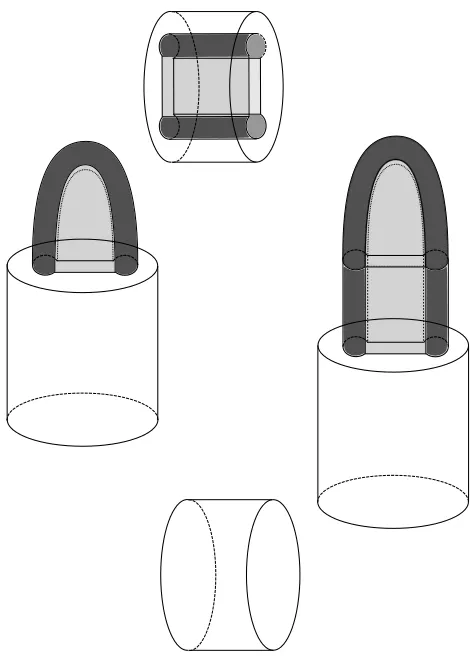
There are three basic types of gluing maps which generate all general gluing maps under composition. These occur whenΣb+b0 is
(i) the disjoint union of a pair of pants with the legs as incoming boundary and a collection of cylinders;
(ii) the disjoint union of a pair of pants with the waist as incoming boundary and a collection of cylinders;
11
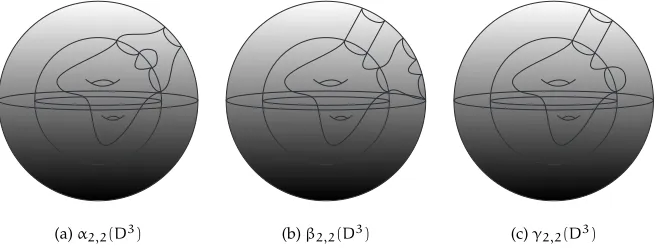
When these surfaces are embedded in ∂M×[0, 1], we call them stabilisation maps, and we denote them by
αg,b=αg,b(M;δ, δ0) :E(Σg,b, M;δ) −→ E(Σg+1,b−1, M;δ0)
βg,b=βg,b(M;δ, δ0) :E(Σg,b, M;δ) −→ E(Σg,b+1, M;δ0)
γg,b=γg,b(M;δ, δ0) :E(Σg,b, M;δ) −→ E(Σg,b−1, M;δ0).
As a warning to the reader, we remark thatthe notation does not determine the map: we will often write, for example,βg,b to denoteanygluing map of this type. There are many because there can be many non-isotopic embeddings of
Σb+b0into∂M×[0, 1].
[image:18.499.93.421.256.381.2](a)α2,2(D3) (b)β2,2(D3) (c)γ2,2(D3)
Figure 1: The three basic types of stabilisation maps acting on a surface in the spaceE(Σ2,2, D3;δ)of surfaces in the disc of dimension3.
The following is our main result concerning homological stability.
Theorem B. LetMbe a simply connected manifold of dimension at least5. If the dimension ofMis5, we assume that all the pairs of pants defining stabilisation maps are contractible in∂M×[0, 1].
(i) Every mapαg,binduces an isomorphism in homology in degrees less than or
equal to1
3(2g−2), and an epimorphism in the next degree.
(ii) Every mapβg,binduces an isomorphism in homology in degrees less than or
equal to1
3(2g−3), and an epimorphism in the next degree. If one of the newly
created boundaries of the pair of pants is contractible in∂M, then the mapβg,b
is also a monomorphism in all degrees.
(iii) Every mapγg,b(M;δ, δ0)induces an isomorphism in homology in degrees less
than or equal to 2
3g, and an epimorphism in the next degree. Ifb≥2, then it is
Note that we donotrequire that∂Mbe simply connected, but only thatM
be. Thus there can be many non-isotopic boundary conditions.
The proof of this theorem follows the proof of the main result of [RW10], where it is proven that the moduli space of surfaces with tangential structures satisfies homological stability. It is important to observe that embeddings are not determined by a local condition, hence they do not arise as a tangential structure. The detailed survey [Wah12] has been of great aid too.
The space of embeddings of a compact surface into R∞ = Sn≥0R n is
weakly contractible by the Whitney embedding theorem. On the other hand, the action of Diff+(Σg,b)on this space of embeddings is free, hence the space
E(Σg,b,R∞×[0, 1];δ)is a model for the classifying spaceBDiff+(Σg,b)(note that the space of boundary conditions is contractible, so the embeddingδ:∂Sg,b→
∂(R∞×[0, 1])is irrelevant). The statement of Theorem B in this setting is
pre-cisely the content of the Harer stability theorem.
These stability ranges are known to be essentially optimal for Harer’s theo-rem (cf. [Bol09]), hence they are also optimal in this general setting.
Stable homology
To identify the stable homology groups resulting from Theorem B, we require a version of the scanning map for surfaces with boundary. We will not describe it in full detail here, but just say that it is a map
Sg,b:E(Σg,b, M;δ)−→Γc(S(TM)→M;δ¯)g
to the space of sections of the bundleS(TM)→ Mwhich are compactly sup-ported and which in addition are equal to a fixed section ¯δ:∂M→S(TM)|∂M on the boundary.
Theorem C. IfMis simply connected and of dimension at least5, then the map
Sg,b:E(Σg,b, M;δ)−→Γc(S(TM)→M;δ¯)g
induces an isomorphism in integral homology in degrees≤ 1
3(2g−2).
This theorem will be proven during the first two sections of Chapter 3 for manifoldsMwith non-empty boundary. An additional argument in the third section establishes this theorem in full generality. Theorem A follows as the particular case whenb=0.
13
Applications and related results
During this section we assume that the surfacesΣhave non-empty boundary for simplicity. IfXis a paracompact space, then the set of homotopy classes of maps[X,E(Σ, M)]are in one-to-one correspondence with the set of subsurface bundles ofX×Mup to concordance, that is, surface bundles that are fibrewise included in the trivial bundleX×Mup to concordances that are included in the trivial bundle(X×I)×M:
{subsurface bundles ofX×M}concordance←→[X,E(Σ, M)].
As a consequence, the cohomology ring ofE(Σ, M)is the ring ofcharacteristic classes of subsurface bundles ofX×M.
Characteristic classes of fibre bundle pairs and diffeomorphism
groups of manifolds
The topological group Diff∂(M)acts on the spaceE(Σ, M;δ), and ifO2(M) de-notes the set of orbits of this action, then the orbit map
a
[W]∈O2(M)
Diff∂(M)×{W}−→E(Σ, M;δ)
is a fibration whose fibre over a surfaceW is the group Diff∂(M;W)of those diffeomorphisms of Mthat are the identity on the boundary and restrict to an orientation-preserving diffeomorphism ofW. Taking classifying spaces we obtain
a
O2(M)
E(Σ, M;δ)−→ a
O2(M)
BDiff∂(M;W)−→BDiff∂(M).
The stabilisation maps−∪Pof our Theorem B give stabilisation maps
`
O2(M)E(Σ, M;δ) //
BDiff∂(M;W)
,
,
BDiff∂(M1)
`
O2(M1)E(Σ∪P, M1;δ) //BDiff∂(M1;W∪P)
2
2
whereM1:=M∪(∂M×I). Hence it follows that the relative homology groups of the map in the fibre are zero in the range∗ ≤ 2
between total spaces are also zero in those degrees. There are maps of fibrations
`
O2(M)E(Σ, M;δ) //
BDiff∂(M;W)
BDiff∂(M1;W∪P),
Γc(S(TM)→M;δ¯)g //Γc(S(TM)→M;δ¯)g//Diff∂(M)
1
1
(0.0.3) where //denotes the homotopy quotient. A direct consequence of the main theorem is
Corollary D. If Mis simply connected and of dimension at least5, then the map between total spaces in(0.0.3)
BDiff∂(M;W)−→Γc(S(TM)→M;δ¯)g//Diff∂(M)
is a homology equivalence in degrees≤2
3(g−1). IfMhas non-empty boundary, then
the space on the right is independent of the genus of the surfaceW.
IfΣis an oriented surface, letΦ(M, Σ) :=π0E(Σ, M)/Diff∂(M). The set of homotopy classes of maps from a paracompact spaceXto
a
[W]∈Φ(M,Σ)
BDiff∂(M;W)
is in bijection with the set of pairs of fibre bundles with fibresMandΣoverX
up to concordance. Each such pair consists of a triple(E ⊂E0, p), whereEis a subspace of the spaceE0 andp: E0 → Xis a smooth fibre bundle with fibre
Msuch that the restrictionp|Eis an oriented surface bundle with fibreΣ. Two such pairs are concordant if there is a pair overX×Ithat restricts to the given pairs overX×{0, 1}. Therefore, the cohomology ring ofBDiff∂(M;W)is the ring of characteristic classes of pairs of fibre bundles as above.
Moduli spaces of surfaces in
R
nand rational homotopy theory
In Section 4.1 we compute the rational stable cohomology of the space of sub-surfaces inRn. If we denote byγ⊥2,nthe complement of the tautological bundle over Gr+2(Rn), then the main theorem in this case gives a rational homology isomorphism in the stable range
E(Σg,Rn)−→Ωn0Th(γ⊥2,n).
We compute the rational cohomology of the space on the right in Theorem 4.1.5. We also describe the homomorphism induced in cohomology by the classifying mapE(Σg, M)−→BDiff
+
15
As part of these computations, we prove that the spaces Th(γ⊥2,n)are in-trinsically formal and give explicit Sullivan and Lie minimal models, which is a first step in the calculation of the stable rational homology of other spaces of surfaces with different background manifolds [Hae82, BS97, BFM09].
In addition, in Section 4.2 we apply these calculations in the spirit of [BM12] to deduce that
Theorem E. IfMis a closed parallelizable manifold, then the rational homology of E(Σg, M)is independent ofgin degrees≤23(g−1).
A metric for the space of submanifolds of Galatius and
Randal–Williams
One of the tools of the present work is the space Ψk(Rn)of submanifolds of
dimensionkofRn that are closed as subsets (but may be noncompact). This
space was introduced by Galatius and Randal-Williams in [GRW10] and its main use is homotopical, through the following theorem:
Proposition. The spaceΨk(Rn)is homotopy equivalent to the Thom spaceTh(γ⊥k,n).
In [BM11] Bökstedt and Madsen proved that a C1 version of Ψ
k(Rn) is
metrizable as a step in their proof of the main theorem of that article. Their proof is not constructive, but shows that the space is regular and second count-able. In Section 4.3 we give an actual metric for thisC1version, which, loosely speaking, is given by the Hausdorff distance in the one-point compactification of the Grassmannian of k-planes of the tangent bundle of Rn, plus a
correc-tion term that measures the volume of the submanifolds in compact subsets. We also give an interpretation of the topology given by the plain Hausdorff distance.
Acknowledgments
I would like to thank first my advisors Carles Casacuberta and Oscar Randal-Williams for their constant dedication, encouragement and support.
I am indebted to Jeffrey Giansiracusa and Ignasi Mundet for their careful reading of this manuscript and valuable remarks.
I have taken a great profit from the topology community in Barcelona. In particular, I want to acknowledge the support of Javier Gutiérrez, Fernando Muro, Oriol Raventós, Urtzi Buijs (from whom I learnt the rudiments of rational homotopy theory that I have used in the last chapter), Imma Gálvez and Andy Tonks. Additionally, the Junior Seminar organized by Wolfgang Pitsch, the Bott–Tu Seminar organized by Joana Cirici, Andratx Bellmunt and Abdó Roig (Section 4.3 has benefited from conversations with Abdó), and the Triangulated Seminar where I met Alberto Fernández and Joan Pons, were helpful.
I also thank George Raptis for his collaboration on an earlier paper on finite topological spaces; Martin Palmer for sharing Chapter 5 of his thesis with me; Joachim Kock for his interest and encouragement in an earlier project on the interplay between categories and topology; and Tom Leinster for offering me the opportunity of working with him in Glasgow.
Finally, I thank the Department of Algebra and Geometry of the University of Barcelona for offering me a place to work and providing facilities during the process of doing this thesis. This work has been funded by the Ministry of Science and Innovation through an FPI grant associated to the research project MTM2007-63277.
I take to this section my friends, in particular Alex, Gabriel and Miki, who had always the right word and concern. I also want to mention my early men-tor D. José Manuel Couce.
Chapter 1
Preliminaries
This chapter is a recollection of terminology and results that are used in the proofs of the main theorems. We do not claim any originality in the presenta-tion, except for several lemmas about local retractibility in Section 1.5.
1.1
Manifolds and submanifolds
Anm-dimensional topological manifoldis a Hausdorff second countable topologi-cal space lotopologi-cally modeled onRmand its homeomorphisms. Atopological
embed-dingf: M→Nis a continuous map that induces a homeomorphism between
Mand its image.
Anm-dimensional smooth manifoldMis anm-dimensional topological man-ifold locally modeled onRmand its diffeomorphisms. Smooth maps between
smooth manifolds are required to preserve the local structure; in particular they induce maps between tangent bundles. A smooth mapf:M→ Nis asmooth embedding if it is a topological embedding and the fibrewise linear maps in-duced between tangent bundles are injective.
A subsetW⊂Mis asmooth submanifoldif there is a smooth manifoldΣand
an embeddingf: Σ→ Mwhose image isW. The homeomorphism ofΣonto
its image endowsWwith a smooth structure, which does not depend on the embedding [Hir94].
An orientation on a manifold M is a compatible choice of orientations in the tangent spaces ofM. A manifold is orientableif it admits an orientation, in which case there are exactly two possible orientations for each connected component ofM. An orientable submanifold ofMis not naturally oriented, even ifMitself is oriented.
IfΣis an oriented manifold andMis a manifold, then there is a map
p:Emb(Σ, M)−→E(Σ, M)
from the space of embeddings ofΣ into M(with the Whitney C∞ topology [Hir94]) to the set of oriented submanifolds ofMthat are diffeomorphic toΣ
through an orientation-preserving diffeomorphism, given by sending each em-bedding to its image, with the orientation induced by the emem-bedding. The in-verse imagep−1(W)of a submanifoldWhas a free action of the group Diff+(Σ) of orientation-preserving diffeomorphisms ofΣ, given by precomposition. As the smooth structure on a submanifoldWdoes not depend on the embedding, iff, g:Σ→Mare two embeddings whose image isW, the compositefg−1is a diffeomorphism ofΣ. Therefore this action is also transitive.
Hence, there is a bijection between the quotient of the space of embeddings ofΣby the action of Diff+(Σ)and the set of oriented submanifolds ofMthat are diffeomorphic toΣ. This bijection endowsE(Σ, M)with a topology.
During the proof of Theorem B we will need to consider embedded surfaces with boundary. We will also need to consider spaces of embedded surfaces in the complement of some submanifold ofM. Such a complement in general will not be a manifold, but will be amanifold with corners. We start by recalling their definition in this section, and in Section 1.2 we will define spaces of embedded surfaces in a manifold with corners.
Manifolds with corners
Although the main theorems of this thesis can be formulated in the realm of smooth manifolds as defined above, at certain places of the proof it is unavoid-able the use of manifolds with boundary, and, what is more, manifolds with corners, which we next define.
LetA⊂Rn,B⊂Rm, and letf:A→Bbe a continuous map. We say thatf
issmoothif it extends to a smooth map from an open neighbourhood ofAtoRm.
Iffis a homeomorphism, we say that it is adiffeomorphismif it is smooth and has a smooth inverse. In particular, this defines the notion of diffeomorphism between subsets ofRm+ := [0,∞)m.
Amanifold with cornersMof dimensionmis a Hausdorff, second countable topological space locally modeled on the spaceRm+ and its diffeomorphisms [Cer61, Lau00].
In detail, asmooth atlas ofMis a family of topological embeddings (called
charts){ϕi: Ui → [0,∞)m}i∈I, where each Ui is an open subset of Mand if
1.1. Manifolds and submanifolds 19
ϕj(Ui∩Uj). Asmooth structureon a Hausdorff, second countable topological space is a smooth atlas which is maximal with respect to inclusion.
Ak-submanifoldof a manifold with corners is a subsetW⊂Msuch that for each pointp ∈Wthere is a chart(U, ϕ)ofMwithp ∈Usuch thatW∩U= ϕ−1(v+
Rk+), wherev ∈Rm+ (see [Cer61, Definition 1.3.1]). Anembeddingis a smooth map whose image is a submanifold and that induces a diffeomorphism onto its image.
Thetangent spaceTpRm+ at a pointp ∈ Rm+ is defined to beTpRm. Since
diffeomorphisms ofRm+ induce isomorphisms between tangent spaces ofRm+, we can define the tangent bundle of a manifold with corners following the usual procedure. A smooth map f: N → Minduces a fibrewise linear map
Df:TN→TMbetween tangent bundles.
If(U, ϕ)is a chart andp∈ U, then the numberc(p)of zero coordinates in
ϕ(p)is independent of the chart. The boundary ofMis the subspace
∂M={p∈M|c(p)> 0}.
Aconnectedk-faceofMis the closure of a component of the subspace
{p∈M|c(p) =k}.
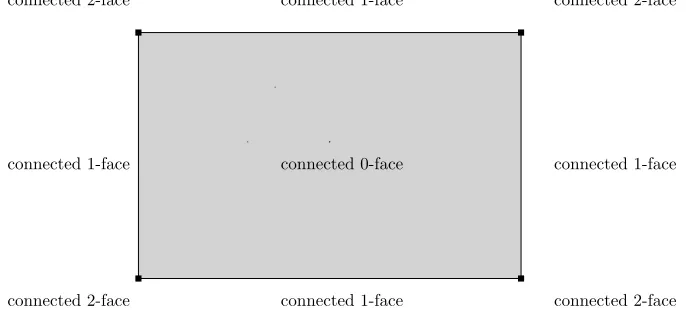
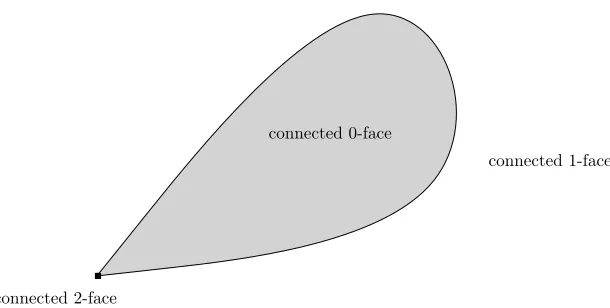
A manifold with cornersMis amanifold with faces if eachp ∈ Mbelongs to
c(p)connected1-faces. Afaceis a (possibly empty) union of pairwise disjoint connectedk-faces, for somek, and is itself a manifold with faces. Observe that the boundary of ak-face is a union of(k−1)-faces.
connected 1-face
connected 1-face
connected 1-face connected 1-face
connected 2-face connected 2-face
connected 2-face connected 2-face
[image:26.499.85.428.447.602.2]connected 0-face
connected 1-face
connected 2-face
[image:27.499.94.399.72.226.2]connected 0-face
Figure 1.2: A drop is not a manifold with faces.
Notation 1.1.1. During Chapters1and2, the word manifold will be used sy-nonymously with manifold with faces. In Chapter3we will turn back to the usual definition of a manifold.
Definition 1.1.2. IfMis a manifold and∂0Mis a1-face inM, acollarof∂0Mis an embeddingcof the manifold∂0M×[0, 1)intoMsuch thatc(x, 0) =xand such thatc|(F∩∂0M)×[0,1) is a collar of∂0M∩F inFfor any other1-faceF. A manifold iscollaredif a1-face∂0Mand a collar of∂0Mare given.
IfBandMare manifolds, andcand Care collars of∂0Band∂0M, then an embeddinge:B → Mis said to be-collaredif ec(x, t) = C(e(x), t)for all
t < . In particular,e(∂0B)⊂∂0M. An embeddingeis said to becollaredif it is
-collared for some > 0.
A smooth mapf:B→Mbetween manifolds istransverseto a submanifold
W ⊂ Mif for eachp ∈ Bsuch thatf(p) ∈ W we haveDf(TpB) +Tf(p)W =
Tf(p)M. A smooth mapf: B →Mto a manifoldMistransverse to∂Mif it is transverse to any connected face. Aneatembeddingfis an embedding that is transverse to the boundary and that is collared ifBis collared. A neat subma-nifold is the image of a neat embedding.
1.2. Spaces of embeddings and spaces of submanifolds 21
1.2
Spaces of embeddings and spaces of
submanifolds
In this section we define carefully the spaces of embeddings of manifolds with corners and the spaces of embedded surfaces with corners.
Boundary conditions for spaces of embeddings
We say that a pair of embeddingsf, g:B→Mhave the sameincidence relation
iff(x)andg(x)belong to the interior of the same connected face ofMfor every
x ∈ B. To each embeddingf:B → Mwe can associate a function[f]fromB
to the set of faces ofMthat sends a pointxto the minimal face to whichf(x) belongs. Thenfandghave the same incidence relation if and only if[f] = [g]. We denote by
Emb(B, M; [f])
the space of neat embeddingsgofBinMsuch that[g] = [f], endowed with the WhitneyC∞topology, as in [Cer61]. Iff: (B, A)→(M, W)is an embedding of a pair, we denote by
Emb((B, A),(M, W); [f])⊂Emb(B, M; [f])
the subspace of neat embeddings of the pair (B, A)into the pair (M, W)that have the same incidence relation asf.
Aboundary conditionfor Emb(B, M; [f])is a functionqthat assigns to each point ofBa neat submanifold of[f](x)and is constant on each connected face. We denote by
Emb(B, M;q)⊂Emb(B, M; [f])
the subspace of those embeddings gsuch that g(x) ∈ q(x). If A ⊂ B and
W⊂M, then we denote by
Emb((B, A),(M, W);q)⊂Emb(B, M;q)
the subspace of embeddings of the pair(B, A)into the pair(M, W). We say that a boundary condition isconstantifq(x)is diffeomorphic to the connected face that containsx.
We denote by Diff(M)⊂Emb(M, M; [Id])the space of diffeomorphisms of
Mthat restrict to diffeomorphisms of each connected face. IfWis a submani-fold, we denote by
the subspace of those diffeomorphisms ofMthat restrict to a diffeomorphism ofW, which is orientation-preserving ifWis oriented. We denote by Diff∂(M) the space of diffeomorphisms ofMthat restrict to the identity on the boundary. Iff, g:B → Mare neat embeddings, we say thatfandghave the same jet along∂Miff−1(∂M) =g−1(∂M)and all the partial derivatives offandgat all points inf−1(∂M)agree. This defines an equivalence relation, and we define the set of jetsJ∂(B, M)to be the quotient of the set of all neat embeddings ofB intoMby the relation of having the same jet. Ifd∈J∂(B, M), we denote by
Emb(B, M;d)
the space of all neat embeddings ofBintoMwhose jet isdendowed with the WhitneyC∞topology.
Boundary conditions for spaces of submanifolds
As sketched in the Introduction, we will join the surfaces inMwith cobordisms defined in a collar ofM. This operation is not defined in the space of all em-bedded surfaces, so we need to define the space of all surfacesWthat glue well with a given cobordism P. Since we are in the realm of smooth manifolds, it is not enough to take all submanifolds that intersect the boundary ofMin the same submanifold as the cobordism does: We need to impose that the partial derivatives ofWandPat their common boundaries agree.
Let us denote byTkMthek-fold tangent space ofM, which is recursively defined asTkM:=T Tk−1M. LetT∞(M)be the inverse limit of the projections
. . .−→TkM−→Tk−1M−→. . .−→TM−→M,
and write T∂∞M := T∞M|∂M. If e ∈ Emb(B, M;d) is an embedding with
e(∂B) ⊂ ∂M, then it induces a map T∞e: T∂∞B → T∂∞M. By construction, the image of this map only depends ond, and this defines a map
jB:J∂(B, M)−→P(T∞M)
to the power set ofT∞M. We define the space of boundary conditions∆(B, M) as the image ofjB. Let∆n(M)be the union of the images ofjB, whereBruns along diffeomorphism classes ofn-dimensional manifolds. Ifδ ∈∆(B, M), we denote byE(B, M;δ)the set of submanifoldsWinMdiffeomorphic toBsuch that T∂∞W = δ. IfjB(d) = δ, we endow E(B, M;δ) with a topology via the bijection
1.3. Haefliger’s approximation for embeddings 23
that sends a class of an embeddingeto its image. IfWis orientable, we write
∆+(B, M)for the space of pairs(δ, θ)whereδ∈∆(B, M)andθis an orientation ofδ. Ifδ∈∆+(B, M), we writeE+(B, M;δ)for the set of oriented submanifolds
WofMdiffeomorphic toBsuch thatT∂∞W=δ, and we topologize it using the bijection
Emb(B, M;d)/Diff+∂(B)−→E
+(B, M;δ).
IfB= Σis a collared compact connected oriented surface, this topology does not depend on the chosend, because ifj(d) =j(d0)then there exists a diffeo-morphismh(that does not need to fix the boundary) ofΣsuch that the map Emb(Σ, M;d) → Emb(Σ, M;d0) given by composing withh is a homeomor-phism. Similarly, a diffeomorphism h: Σ → Σ0 induces a homeomorphism Emb(Σ, M;d)→Emb(Σ0, M;d◦h−1), which is equivariant with respect to the induced homeomorphism Diff+(Σ) → Diff+(Σ0). Therefore, this space is de-termined by the genus ofΣand the boundary conditionδ(which describes the boundary ofΣ).
Notation 1.2.1. If Σ has genus gand b boundary components, we use the shorter notationE+
g,b(M;δ) :=E+(Σ, M;δ), although specifyingbis redundant, as it is already given byδ. We writeδ0:=δ∩∂0M, and observe thatδ0is deter-mined by its underlying submanifold (hence, ifMis a manifold with boundary, i.e.,∂M=∂0M, then∆
2(M)is the set of compact submanifolds of dimension1 in∂M). We denote by Diff(M;δ)the space of those diffeomorphisms that fixδ.
1.3
Haefliger’s approximation for embeddings
In the proof of Theorem B we will need to computeπ0Emb(B, M;q)several times. Our approach to this problem has been through the following theorem of Haefliger, which we state in its relative version. Thus, homotopies and iso-topies are relative to the boundary ofB.
Theorem 1.3.1([Hae61]). LetBbe a compact connected manifold of dimensionnand letMbe a manifold of dimensionm. Letg:∂B→Mbe a smooth embedding and let f: B→Mbe a(k+1)-connected map withf|∂B=g. Then
(i) fis homotopic to an embedding if and only if m ≥ 2n−kandn > 2k+2 (alternatively,m≥2n−kand2m≥3(n+1));
Corollary 1.3.2. IfBis a connected surface,qis a constant boundary condition for embeddings ofBintoMand eitherm > 5orm= 5andπ1(M)is trivial, then the
inclusionEmb(B, M;q) → map(B, M;q)induces a bijection on connected compo-nents. Ifπ1(M)is not trivial, then it induces a surjection on connected components.
An alternative approach to this problem is through the Goodwillie–Weiss calculus of embeddings [GKW01]. Roughly speaking, their theory constructs a sequence of spacesTkEmb(B, M)and maps Emb(B, M) → TkEmb(B, M)that are(3−dim(M) +k(dim(M) −dim(B) −2))-connected. One might ask whether this approach gives a better approximation ofπ0Emb(B, M). A first remark in this direction is that this approximation only works if dim(M) −dim(B) ≥3, so the only improvement we could expect would be the removal of the as-sumption thatMis simply connected. By the above theorem, as the dimen-sion of Mgrows, the existence of homology stability for embedded surfaces is equivalent to the existence of homology stability with respect to genus for surfaces with maps to a background space, that is, the homotopy quotient map(Σ, M)//Diff+(Σ)(i.e., the Borel construction [Hus94]). WhenMis simply connected, homology stability for this quotient was established by Cohen and Madsen [CM09, CM10] and later improved by Randal-Williams [RW10]. On the other hand, ifMis not simply connected, then the problem of homology stability for the quotient is still open.
If we letB be a surface with non-empty boundary andMbe non-simply connected, then the cardinality ofπ0map(B, M;q)will in general grow to infin-ity with the genus ofB, and so will the cardinality ofπ0Emb(B, M;q). We point out that a higher version of the results of this thesis, that is, a study of homol-ogy stability properties of the space of embedded high-dimensional manifolds would find better approximations via the Goodwillie–Weiss theory.
1.4
Tubular neighbourhoods
LetV⊂Mbe a neat submanifold and denote by NMV=TM|V/TVthe normal bundle ofVinM. Atubular neighbourhoodofVinMis a neat embedding
f: NMV−→M
such that the restrictionf|V is the inclusionV⊂Mand the composition
TV⊕NMV−→T(NMV)|V Df
−→TM|V
proj.
−→NMV
1.4. Tubular neighbourhoods 25
we define atubular neighbourhood ofVin the pair(M, W)as a tubular neighbour-hoodfofVinMsuch thatf∩Wis a tubular neighbourhood ofV∩W.
We may compactify NMV fibrewise by adding a sphere at infinity to each fibre, obtaining theclosed normal bundleNMVofVinM. We denote by
S(NMV)⊂NMV
the subbundle of spheres at infinity. We define aclosed tubular neighbourhoodof a collared submanifoldVto be an embedding of NMVintoMwhose restriction to NMVis a tubular neighbourhood.
Note thatVdetermines an incidence relationffor NMVinM, by assigning to each vector(x, v)the minimal face to whichxbelongs. We denote by
Tub(V, M)⊂Emb((NMV, V),(M, V);f)
the subspace of tubular neighbourhoods. A boundary conditionqNfor a tubu-lar neighbourhood of V is a boundary condition for V inM, and we denote by
Tub(V, M;qN)⊂Tub(V, M)
the subspace of those tubular neighbourhoodstsuch thatt(x, v)⊂qN(x). We denote by
Tub(V,(M, W);qN)⊂Tub(V, M;qN)
the subspace of tubular neighbourhoods of V in the pair(M, W). Finally, if
q⊂qNis a pair of boundary conditions, we denote by
Tub(V, M; (qN, q))
the space of tubular neighbourhoods ofVinMsuch that the restriction to each faceFis a tubular neighbourhood in the pair(qN(x), q(x)), wherexis any point inF.
The following lemma follows from the proof of [God07, Proposition 31], where it is stated for the space of all tubular neighbourhoods of compact sub-manifolds.
Lemma 1.4.1. IfV andW are compact submanifolds ofMand qN is a boundary
condition forVinMsuch thatqN(x)is a neighbourhood ofxin the face[V⊂M](x),
then the spacesTub(V, M;qN)andTub(V,(M, W);qN)are contractible.
H of Tub(V, M;qN) is constructed into the subspace Tf of all tubular neigh-bourhoods whose image is contained in Imf. The second step provides a con-traction of Tf to the point {f}. It is easy to see that iff is a closed, collared tubular neighbourhood of a pair, then both homotopies define homotopies for Tub(V,(M, W);qN), and the argument there applies verbatim.
1.5
Local retractibility
During the proof of Theorem B, we will need to prove that certain restriction maps onto spaces of embeddings or spaces of embedded surfaces are Serre fi-brations. We approach this problem in this section, following Palais and Cerf, through Lemma 1.5.3, wich says that ifEandXare spaces with an action of a groupG, then an equivariant mapf:E→Xbetween them is a locally trivial fi-bration (in particular a Serre fifi-bration) provided thatXis “G-locally retractile”. We point out that the role of the groupGhere is merely auxiliar to prove that a map is a fibration. The rest of the section is devoted to verify that the spaces of embeddings and embedded surfaces that will concern us areG-locally retractile whenGis the diffeomorphism group ofM.
Definition 1.5.1. ([Cer61, Pal60]) LetG be a topological group. AG-spaceX
isG-locally retractileif for anyx ∈ X there is a neighbourhoodUofx and a continuous mapξ:U→G(called theG-local retraction aroundx) such thaty= ξ(y)·xfor ally∈U.
Lemma 1.5.2. IfXis aG-locally retractile locally connected space andG0⊂Gdenotes
the connected component of the identity, thenXis alsoG0-locally retractile.
Proof. Ifξ: U → G is a local retraction around x ∈ X, and x ∈ U0 ⊂ Uis a connected neighbourhood of x, then, since ξ(x) = Id, we deduce thatξ|U factors throughG0and defines aG0-local retraction aroundx.
Lemma 1.5.3([Cer61]). AG-equivariant mapf:E →Xonto aG-locally retractile space is a locally trivial fibration.
Proof. For eachx∈Xthere is a neighbourhoodUand aG-local retractionξthat gives a homeomorphism
f−1(x)×U−→f−1(U) (z, y)7−→ξ(y)·z.
1.5. Local retractibility 27
Proof. The composite of a local section forfand aG-local retraction forXgives aG-local retraction forY.
LetP→Bbe a principalG-bundle and letFbe a leftG-space. The space of compactly supported sectionsΓc(P→B)does not act on the space of compactly supported sections of the associated bundleΓc(P×GF→B). On the other hand, the space of compactly supported sections of the adjoint bundleP×adjGG→B —classified by the compositionB→G→Aut(G)of the classifying map of the principal bundle and the adjoint representation— does act onΓc(P×GF→B). Recall that a spaceF is locally-equiconnected if the inclusion of the diagonal intoF×Fis a cofibration. This condition is satisfied by CW-complexes.
Lemma 1.5.5. IfBis compact and locally compact, andFis a locally equiconnectedG -space that is alsoG-locally retractile, thenmap(B, F)ismap(B, G)-locally retractile. For a fibre bundleP×GF→B, the space of sectionsΓ(E→B)isΓ(P×adjGG→B)
-locally retractile.
Proof. Here is a proof of the first part. A proof of the second part is similar to this one, working with spaces overB.
LetΦ: G×F→F×Fbe defined asΦ(x, g) = (x, g·x). If we prove that there is a neighbourhood V of the diagonalD = f(B)×f(B) ⊂ F×Fand a global section ϕ of the restrictionΦ|V: Φ−1(V) → V, then we obtain a map(B, G) -local retractionψaround any pointf0∈map(B, F)as the composition
A={f|(f0×f)(B)⊂V} f7→f0×f
−→ map(B, V)ϕ−◦→−map(B, G×F)→π map(B, G),
where the last map is induced by the projection onto the second factor. To see that this is a local retraction, we first notice thatAis an open neighbourhood off0becauseBis compact and locally compact. Second, writeΨ:map(B, G)×
{f0}→map(B, F), and
(Ψψ(f))(x) = (Ψπϕ(f0×f))(x) =Ψπϕ(f0(x), f(x))
= (πϕ(f0(x), f(x)))·f0(x) =f(x).
So we only need to findV andϕ. Let us denoteGx,y ={g∈G |gx =y}. Let
x0∈Fand letξ:Ux0 →G×{x0}be a local retraction aroundx0. Then there is
a homeomorphism
Ux0×Ux0×Φ
−1(x
0, x0)=∼ Ux0×Ux0×Gx0,x0
that sends a triple(x, y, g)to the triple(x, y, ξ(y)−1gξ(x)). DefineV0 to be the
open setS
As we have assumed thatFis locally equiconnected, we may take a neigh-bourhood deformation retractVofD ⊂F×F, and, sincef(B)is compact, we may also impose thatV ⊂V0. Then in the following pullback square of fibre bundles
Φ−1(D) //
Φ−1(V)
D //V
the bottom map is a homotopy equivalence and the left vertical map has a global section that sends a pair (x, x) to the pair (x, e), where e ∈ G is the identity element. Hence the right vertical map has a global sectionφtoo.
Ifp:E→Bis a ranknvector bundle over a manifoldB, we denote by Vectk(E) :=Γ(Grk(E)→B)
the space of rankkvector subbundles ofE. IfP→Bis the associated principal bundle, let
GL(E) :=Γ(P×adj(GLn(R))GLn(R)→B).
be the space of sections of its adjoint bundle. IfZ⊂∂Bis a submanifold and
L∂ ∈Vectk(E|Z)is a vector subbundle, we denote by Vectk(E;L∂) ⊂ Vectk(E) the subspace of those vector bundles whose restriction toZisL∂. Similarly, we denote by GLZ(E)the group of bundle automorphisms ofEthat restrict to the identity overZ. The Grassmannian Grk(Rn)is compact, locally equiconnected
and GL(n)-locally retractile. As a consequence,
Corollary 1.5.6. If B is compact andE is a vector bundle over B, then the space
Vectk(E)isGL(E)-locally retractile and the spaceVectk(E;L∂)isGLZ(E)-locally
re-tractile.
The following lemma and its corollary are a consequence of a more gen-eral theorem proved by Cerf [Cer61, 2.2.1 Théorème 5, 2.4.1 Théorème 5’] in full generality for manifolds with faces. Palais [Pal60] proved it for manifolds without corners and Lima [Lim63] gave later a shorter proof.
Proposition 1.5.7([Cer61]). Iff:B→Mis an embedding of a compact manifoldB into a manifoldM, thenEmb(B, M; [f])isDiff(M)-locally retractile. Ifdis a jet of an embedding ofBintoM, thenEmb(B, M;d)isDiff∂(M)-locally retractile.
1.5. Local retractibility 29
Corollary 1.5.8([Cer61]). IfA⊂Bis a compact submanifold andf:B→Mis an embedding, then the restriction map
Emb(B, M; [f])−→Emb(A, M; [f|A])
is a locally trivial fibration.
We will need local retractibility for the space of surfaces in a manifold:
Proposition 1.5.9([BF81, Mic80]). IfBandMare manifolds,dis a jet ofBinM andδ=j(d), then the quotient map
Emb(B, M;d)−→Emb(B, M;d)/Diff∂(B) :=E(B, M;δ) is a fibre bundle.Diff∂(B)may be replaced byDiff+∂(B)ifBis oriented.
From Lemmas 1.5.4 and 1.5.9 we deduce that
Corollary 1.5.10. The spaceE+
g,b(M;δ)isDiff∂(M)-locally retractile.
We will also need local retractibility for two more spaces.
Proposition 1.5.11. Let W ⊂ Mbe a submanifold, letA ⊂ Bbe manifolds, and let f: (B, A) → (M, W) be an embedding. Then the space of embeddings of pairs
Emb((B, A),(M, W); [f])isDiff(M;W)-locally retractile.
Proof. Lete0be one such embedding, and consider the diagram
Diff(M;W)×{e0} //
x
x
Diff(M)×{e0}
w
w
Diff(W)×{e0|A} //
Emb(W, M; [W⊂M])
◦e0|A
X
x
x
/
/Emb(B, M; [f])
w
w
Emb(A, W; [f|A]) //Emb(A, M; [f|A])
where the spaceX⊂Emb(B, M; [f])is the subspace of those embeddingsesuch thate(A)⊂W. Hence the bottom square is a pullback square and has a natural action of Diff(M;W,[f]). The space Emb((B, A),(M, W); [f])is a subspace ofX
hence is also a locally trivial fibration, so it has local sections. As the subspace Emb((B, A),(M, W); [f]) ⊂Xis Diff(M;W)-invariant, any Diff(M;W)-local re-traction around e0 in Xgives, by restriction, a local retraction around e0 in Emb((B, A),(M, W); [f]).
Corollary 1.5.12. The spaceEmb(B, M;q)isDiff(M;q)-locally retractile and the spaceEmb((B, A),(M, W);q)isDiff(M;W, q)-locally retractile.
Proof. Both results are obtained by applying Lemma 1.5.11 recursively to the submanifolds in the image ofq.
LetBandMbe manifolds and letC ⊂Bbe a submanifold. LetqandqN be boundary conditions forBinM. The set TEmbk,C(B, M;q, qN)is defined as the set of triples(e, t, L), where
(i) e∈Emb(B, M;q)is an embedding;
(ii) t∈Tub(e(B), M; (qN, q));
(iii) L∈Γ(Grk(NMe(C))→e(C));Nq(∂0C)e(∂0C)).
If k = 0, the subsetCis irrelevant and we will write TEmb(B, W;q, qN)for TEmb0,C(B, M;q, qN). Note that, if∂0C 6= ∅, then the last condition forces
k=dimq(∂0C) −dim∂0C.
The set TEmbk,C(B, M;q, qN)has a natural action of the discretization of Diff(M;q, qN)given as follows: Ifgis a diffeomorphism ofMandtis a tubular neighbourhood as above, then ginduces isomorphisms TM|e(B) → TM|ge(B) and Te(B) → Tge(B), hence an isomorphismg∗: NMe(B) → NMge(B). We
defineg(t)as the composite
NMge(B) g −1
∗ //
NMe(B) t //M g //M.
We defineg(L)asg∗(L).
Endow the set TEmbk,C(B, M;q, qN)with the following topology: For a point(e0, t0, L0), pick a Diff(M;q, qN)-local retractionξ:U0→Diff(M;q, qN) arounde0using Lemma 1.5.7 and write
Ue0 ={(e, t, L)∈TEmbk,C(B, M;q, qN)|e∈U0}.
There is an injective map
1.5. Local retractibility 31
given by j(e, t, L) = (ξ(e), t ◦ξ(NMe(B)), ξ(NMe(C))(L)) and we give Ue0
the subspace topology. The Ue’s cover TEmbk,C(B, M;q, qN), so they define a topology.
This discussion applies to the subspace TEmbk,C((B, A),(M, W);q, qN)of tubular neighbourhoods of embeddings of a pair(B, A)in a pair(M, W), and this latter space has a natural action of Diff(M;W, q, qN).
Proposition 1.5.13. The spaceTEmbk,C(B, M;q, qN)isDiff(M;q, qN)-locally
re-tractile.
Proof. Let(e0, t0, L0)∈TEmbk,C(B, M;q, qN). Let
ξe0:Ue0 −→Diff(M;q, qN)
be a local retraction arounde0in Emb(B, M;q). Let
ξt0:Ut0 −→Diff(M;q, qN)
be a local retraction aroundt0in Tub(e0(B), M; (qN, q)). Let
ξL00:UL0 −→GL∂0C(NMe(C))
be a local retraction aroundL0 in Vectk(NMe0(C);Nq(∂0C)e0(∂0C)). There is a canonical embedding GL∂0C(NMe0(C))→Diff(t0(NMe(C));q, qN)induced by the diffeomorphismt0, and using a bump function we may construct a non-canonical embedding Diff(t0(NMe0(C));q, qN) → Diff(M;q, qN). We denote by
ξL0:UL0−→Diff(M;q, qN)
the composite ofξL0
0 and these embeddings. Note thatξt0(t)(e0) = e0, that ξL0(L)(e0) =e0, and thatξL0(L)(t0) = t0, by the definition of tubular
neigh-bourhood and the definition of the action of Diff(M;q, qN)on the space of tubular neighbourhoods. LetU⊂TEmbk,C(B, M;q, qN)be the intersection of the inverse images ofUe0,Ut0andUL0under the projection maps. For a point (e, t, L)inU, let us denotet1= ξe0(e)
−1(t)andL
1 =ξt0(t1)
−1◦ξ e0(e)
−1(L),
and define a map
ξ:U−→Diff(M;q, qN) given byξ(e, t, L) =ξe0(e)◦ξt0(t1)◦ξL0(L1).
Using the proof of Lemma 1.5.11, and the previous lemma we obtain
Corollary 1.5.14. The spacesTEmbk,C((B, A),(M, W);q, qN)areDiff(M;q, qN)
1.6
Homotopical resolutions
Asemi-simplicial space, also called∆-space, is a contravariant functor
X•:∆opinj−→Top
from the category∆injwhose objects are non-empty finite ordinals and whose
morphisms are injective order-preserving inclusions to the category Top of topological spaces. The image of the ordinalnis writtenXnand we denote by
∂j:Xn+1→Xnthe image of the inclusionn={0, 1, . . . , n−1},→{0, 1, . . . , n}=
n+1that misses the elementj ∈ {0, 1, . . . , n}. These are calledface mapsand the whole structure ofX•is determined by specifying the spacesXnfor eachn together with the face maps in each level.
Asemi-simplicial space augmented over a topological spaceXis a semi-simplicial space X• together with a continuous map : X0 → X (the augmentation or
0-augmentation) such that ∂0 = ∂1: X1 → X. Alternatively, an augmented
semi-simplicial spaceis a contravariant functor
X•: ∆opinj,0−→Top
from the category∆inj,0whose objects are (possibly empty) ordinals and whose morphisms are injective order-preserving inclusions to the category Top. As above, we denote by∂j:Xn → Xn+1the image of the inclusion that missesj and we denote by the image of the unique inclusion∅ → 0. We denote by
i:Xi→Xthe unique composition of face maps and the augmentation map. Asemi-simplicial mapbetween (augmented) semi-simplicial spaces is a nat-ural transformation of functors. If•:X• →Xand•0:Y•→Y are augmented
semi-simplicial spaces, a semi-simplicial mapf•is equivalent to a sequence of
mapsfn:Xn→Ynsuch thatdi◦fn=fn−1◦difor alliand alln, together with a mapf:X→Ysuch that0◦f
0=f◦. There is a realization functor [Seg74]
| · |:Semi-simplicial spaces−→Top
and we say that an augmented semi-simplicial space X• over a space Xis a
resolutionofXif the map induced by the augmentation
|•|:|X•|−→X
is a weak homotopy equivalence. It is an n-resolutionif the map induced by the augmentation isn-connected (i.e., the relative homotopy groupsπi(X,|X•|)
1.6. Homotopical resolutions 33
We will use the spectral sequences given by the skeletal filtration associated with augmented semi-simplicial spaces as they appear in [RW10]. For each augmented semi-simplicial space•: X• → Xthere is a spectral sequence
de-fined fort≥0ands≥−1:
E1s,t=Ht(Xs)=⇒Hs+t+1(X,|X•|),
and for each map between augmented semi-simplicial spacesf•:X•→Y•there
is a spectral sequence defined fort≥0ands≥−1:
E1s,t=Ht(Ys, Xs)=⇒Hs+t+1((|Y•|),(|X•|)),
where, for a continuous mapf:A→B, we denote byMfthe mapping cylinder offand by(f)the pair(Mf, A).
The following criteria will be widely used throughout the paper.
Criterion 1.6.1 ([RW10, Lemma 2.1]). Let •: X• → Xbe an augmented
semi-simplicial space. If eachiis a fibration andFibx(i)denotes its fibre atx, then the
realization of the semi-simplicial spaceFibx(•)is weakly homotopy equivalent to the
homotopy fibre of|•|atx.
Anaugmented topological flag complexis an augmented semi-simplicial space
•:X•→Xsuch that
(i) the product mapXi→X0×X· · · ×XX0is an open embedding;
(ii) a tuple(x0, . . . , xi)is inXiif and only if for each0 ≤j < k≤ithe pair (xj, xk)∈X0×XX0is inX1.
Criterion 1.6.2([GRW12, Theorem 6.2]). Let•:X• →Xbe an augmented
topo-logical flag complex. Suppose that
(i) X0 → Xhas local sections, that is,is surjective and for eachx0 ∈ X0such
that(x0) =xthere is a neighbourhoodUofxand a maps: U→X0such that
(s(y)) =yands(x) =x0;
(ii) given any finite collection{x1, . . . , xn} ⊂ X0 in a single fibre ofover some
x∈X, there is anx∞in that fibre such that each(xi, x∞)is a1-simplex.
Then|•|:|X•|→Xis a weak homotopy equivalence.
Resolutions of a single surface
In the proof of [RW10, Proposition 4.1] the following semi-simplicial space was introduced: IfWis a compact connected oriented surface with non-empty boundary, andk0, k1are embedded intervals in∂W, the semi-simplicial space
O(W;k0, k1)•is defined as follows: Ani-simplex is a tuple(a0, . . . , ai)of
pair-wise disjoint embeddings of the interval[0, 1]inWsuch that
(i) aj(0)∈k0andaj(1)∈k1;
(ii) the complement ofa0∪. . .∪aiinWis connected;
(iii) the ordering at the endpoints of the arcs is (a0(0), . . . , ai(0))in k0 and (ai(1), . . . , a0(1)) in k1, where k0 and k1 are ordered according to the
orientation ofδ.
Thejth face map forgets thejth arc. In order to simplify the notation we will write[i]for{0, . . . , i}. The set ofi-simplices is topologized as a union of compo-nents of the space Emb(I×[i], W;q)withq(x) =kjifx∈{j}×[i]andq(x) =M otherwise.
Proposition 1.6.4 ([RW10, Proposition 4.1]). The realization |O(W;k0, k1)•| is
(g−2)-connected, wheregis the genus ofW.
This proposition is the hardest step in the proof of homological stability for diffeomorphism groups of surfaces, and the change in the definition of this complex of curves yielded various improvements [Iva93, Bol09, RW10] of the original complex of Harer [Har85]. A detailed proof of the above proposition may be found in [Wah12].
1.7
A criterion for homological stability
Criterion 1.7.1. Letf•:X•→Y•be a map of augmented semi-simplicial spaces such
that|X•|:|X•|→Xis(l−1)-connected and|Y•|:|Y•|→Y isl-connected. Suppose
there is a sequence of path connected based spaces(Bi, bi)and mapspi: Yi→Bi, and
form the map
gi:hofibbi(pi◦fi)−→hofibbi(pi)
induced by composition withfi. Suppose that there is ak≤l+1such that