Essays on Information and Competition in
Banking and Service Industries
Autor: Silvio Petriconi
TESI DOCTORAL UPF / ANY 2014
DIRECTORS DE LA TESI
Prof. Jaume Ventura
Prof. Vasco Carvalho
Acknowledgments
It is a pleasure to thank the many people who have supported my research in many different ways.
First and foremost, I am deeply indebted to my two advisors, Jaume Ventura and Vasco Carvalho. Not all doctoral students are in the fortunate position to con-tinuously receive valuable comments, feedback and guidance from their advisor. In this aspect, I always thought of myself as blessed twice: I have had the rare luck to have not only one but even two wonderful advisors for the entire time of my dissertation work. Their continued feedback and support has been crucial for me. I wish to extend my sincere gratitude to both of them.
For the banking-related part of my research, I have enjoyed many interesting conversations with Xavier Freixas. I thank him for his continued interest in my work, for his guidance and for many valuable suggestions. Many thanks also go to Doh-Shin Jeon with whom I have co-authored the paper which forms the last chapter of this thesis. He has taught me many important things about research in general and about the theory of Industrial Organization in particular, for which I am deeply grateful.
Further important feedback has emerged from many conversations with other faculty members, visitors and students at Universitat Pompeu Fabra and CREI. I especially wish to thank Giovanni Dell’Arriccia, Joan de Mart´ı, Robert Marquez, Alberto Martin, Kristoffer Nimark and the participants of the CREI International Lunch Seminar for many helpful comments.
In all the administrative tasks ranging from thesis registration and scholarship renewals to the mailing of my job market materials, the GPEFM secretaries Marta Araque and Laura Augusti have been nothing short of magicians. Their competent and efficient handling of all those urgent matters has allowed me to keep my mind focused on my research while they fought bureaucratic monsters on my behalf. I thank them for their tremendous support.
I am grateful for the funding sources that enabled me to finance my graduate school studies and to cover my expenses when presenting at conferences: the Studienstiftung-H¨olderlin scholarship, the Generalitat de Catalunya FI grant, and the EBES travel grant of Universitat Pompeu Fabra.
Abstract
This thesis investigates the relation between information and competition in two particular settings. In the first chapter, I ask which screening and lending choices banks make if their loan offers can be observed by uninformed competitors. I show that banks grant excessive credit and underinvest in screening in order to de-ter borrower poaching; more competition exacerbates this problem. In a dynamic setting, the model reproduces many stylized facts of lending booms.
The second chapter (jointly with Doh-Shin Jeon) investigates the incentives behind commercial open source software. We find that the production of open source software by profit-maximizing firms can be understood as a form of op-timal information sharing: by releasing source code, service firms create their own competition which mitigates customer concerns about hold-up problems. We show that the resulting increases in customer investment and collaboration can yield higher profits for the service firm.
Resum
Aquesta tesi investiga la relaci´o entre la informaci´o i la compet`encia en dues situ-acions. En el primer cap´ıtol, s’analitzen les opcions de cribratge i de pr´estecs que els bancs fan si les seves ofertes de pr´estecs poden ser observats pels competidors desinformats. Mostro que els bancs concedeixen pr´estecs excessius i inverteixen poc en el cribratge per tal de dissuadir la cac¸a furtiva prestatari; m´es compet`encia exacerba aquest problema. En un entorn din`amic, el model reprodueix molts fets estilitzats dels auges de cr`edit.
Foreword
This thesis comprises of two essays which study the strategic role of information for competition in banking and knowledge-based service industries.
In the first essay, I ask how banks make their loan approval decisions and se-lect their screening activity if their loan offers can be observed by uninformed rival lenders. I find that the impact of such an informational imperfection on screening incentives and lending standards can be rather dramatic: in order to prevent unin-formed outsiders from poaching their customers, inunin-formed banks will intention-ally make “more erratic” lending decisions and will include too many borrowers of poor quality in their loan portfolio. Moreover, they will intentionally under-invest in screening and accept that their screening decisions remain quite noisy. Both effects aggravate the adverse selection problem that an uninformed outsider faces which helps informed banks to protect themselves from competition. Most interestingly, these distortions in credit are not constant in time but vary substan-tially as the expected cash flows of projects change: I find that especially in times of low interest rates and high collateral values banks are likely to lend too much and to screen too little. I argue that the predictions of the model are well in line with many known stylized facts about credit booms. Finally, I explore a dynamic version of the model in which banks’ choices of screening precision exhibit some sort of rigidity. This extended model generates boom-bust cycles in credit that are increasing in the amount of bank competition: it features both excessive credit in boom times and inefficiently severe lending contractions in recessions.
Contents
1 BANK COMPETITION, INFORMATION CHOICE AND
INEFFI-CIENT LENDING BOOMS 1
1.1 Introduction . . . 1
1.2 Model . . . 4
1.2.1 Setup . . . 4
1.2.2 Competition . . . 6
1.2.3 Timing . . . 7
1.3 The Social Planner’s Solution . . . 7
1.3.1 Constrained Optimal Portfolio Choice . . . 7
1.3.2 Constrained Optimal Screening Precision . . . 9
1.4 Competitive Equilibrium . . . 12
1.4.1 Monopoly . . . 12
1.4.2 Portfolio Allocations under Competition . . . 13
1.4.3 Information Choice under Competition . . . 18
1.4.4 Excessive Lending . . . 19
1.5 Discussion . . . 22
1.5.1 The nature of bank competition in the model . . . 22
1.5.2 Improving Screening Precision: A Word of Caution . . . . 24
1.5.3 Specialization and Industry Structure . . . 24
1.5.4 Robustness and Generalizations . . . 25
1.5.5 A Dynamic Model of Credit Cycles . . . 27
1.5.6 Predictions and Empirical Findings . . . 30
1.5.7 Policy Implications . . . 32
1.6 Conclusions . . . 35
1.A Appendix . . . 36
1.A.1 Derivation of Posterior Beliefs after Screening . . . 36
1.A.2 Proofs . . . 36
2 GEEKS BEARING GIFTS: COMPETITION AND INFORMATION
SHARING IN KNOWLEDGE-BASED SERVICE INDUSTRY 45
2.1 Introduction . . . 45
2.2 A Model of Knowledge-Based Service Industry . . . 48
2.2.1 Service Transactions and Service Value . . . 48
2.2.2 Knowledge Stocks and Knowledge Accumulation . . . 51
2.2.3 General Model of Knowledge-Based Service Transactions 52 2.3 Knowledge Sharing and Ex-ante Investment . . . 53
2.3.1 Benchmark: Planner’s Solution . . . 56
2.3.2 GameΓC: Closed Source . . . 56
2.3.3 GameΓO: Open Source (without commitment) . . . 57
2.3.4 GameΓR: Reciprocal Open Source . . . 63
2.3.5 Comparison: Determinants of Open v.s. Closed Source . . 65
2.4 Knowledge Sharing and Ex-post Collaboration . . . 67
2.4.1 Benchmark: Planner’s Solution . . . 68
2.4.2 GameΓ˜C: Closed Source . . . 69
2.4.3 GameΓ˜O: Open Source (without commitment) . . . 70
2.4.4 GameΓ˜R: Reciprocal Open Source . . . 73
2.4.5 Comparison of the three Licenses . . . 74
2.5 Extensions . . . 75
2.5.1 Endogenous Choice of Shared Knowledge Stock . . . 75
2.5.2 Forking, and Competition by Openness . . . 76
2.6 Concluding remarks . . . 78
2.A Appendix . . . 79
2.A.1 Comparing Second Period Customer Surplus . . . 79
2.A.2 Proof of proposition 2: . . . 79
2.A.3 Full results for the gameΓR: . . . 80
2.A.4 Proof of proposition 7: . . . 82
2.A.5 Proof of proposition 8: . . . 83
Chapter 1
BANK COMPETITION,
INFORMATION CHOICE AND
INEFFICIENT LENDING BOOMS
1.1
Introduction
Over the past two decades, many countries worldwide have undertaken a pro-cess of deregulation1 of their financial sectors that has turned tightly regulated
oligopolistic banking landscapes into much more competitive industries. It is widely believed that these reforms have provided credit-constrained firms and self-employed workers with better access to bank credit. However, the increas-ing occurrence of credit-driven boom-bust cycles2raises the question whether this
increase in competition may have come at a cost: anecdotal evidence suggests that in episodes of strong economic outlook, credit may actually have becometoo easyto obtain. In good times, so the narrative goes, competitive pressure drives banks to reduce their screening effort and lower their lending standards, resulting in the build-up of large positions of poorly screened assets in their balance sheets that lay the foundations for the next financial crisis.
In this chapter, I develop a theory of excessive lending that is driven by bank-ing competition. In a model of borrower screenbank-ing, I obtain two main results: first, more competition can incentivate informed incumbent banks to knowingly
1e.g. in the U.S. the 1994 Riegle-Neal Act eliminated previous interstate baadvisornking and
branching restrictions, and the 1999 Gramm-Leach-Bliley Act repealed the separation between investment and commercial banking. For information on banking liberalization across countries, see Abiad et al. (2010).
2For stylized facts and more discussion of credit-driven boom-bust cycles, see Borio and Lowe
take bad projects into their loan portfolio. This is optimal because it protects them against the entry of uninformed lenders who could poach their customers. Instead of raising welfare by reducing markups, more bank competition exerts detrimen-tal downward pressure on lending standards. Since in equilibrium banks offer credit to some borrowers despite of a negative screening evaluation, they also fail to make best use of their information which leads to my second main result: if banks choose their screening precision endogenously, I find that competition re-duces borrower screening to inefficiently low levels. The combination of these two results provides me with a powerful theory of the credit cycle.
The key to my findings is to acknowledge that just like all other information centric industries, banks may face difficulties in protecting their private informa-tion when assessing credit. Specifically, I assume in my model that the lending decisions of privately informed banks can be observed by uninformed competi-tors. This could for example be the case if banks are legally required to present their loan offers in writing. Loan-approved borrowers could then use the written offer to credibly signal their positive evaluation to an uninformed outside lender in the attempt to receive a better offer.
When actions are observable by competitors, an informed incumbent bank must strike a careful balance between optimizing her portfolio quality and pro-tecting herself from competition: the more wisely she chooses her loan portfolio, the more positive information will be conveyed by every loan approval, and the more profitable it becomes for uninformed outside lenders to enter the incum-bent’s market and poach loan-approved customers. If the informed incumbent “poisons the well” by making less prudent choices for her own loan portfolio, she will clearly suffer from more defaulting loans but may be rewarded with the successful deterrence of entry.
in-formation leaves many poor projects in the portfolio that is financed. In line with empirical evidence, my model predicts that the worst loans are made right at the peak of the boom, and that low policy rates can exacerbate inefficient lending. Once the boom goes bust, the situation reverses. If screening precision requires time to build, the bust phase will be characterized by a credit crunch and a flight to quality: as screening remains impaired from the effects of competition during the preceding boom phase, only exceptionally good borrowers succeed in generating a sufficiently positive signal to receive credit.
Finally, my model also emphasizes the important role of project liquidation values for the lending cycle. In recessions, expected liquidation values are low. This makes banks hesitant to lend because the option of repossessing defaulted projects offers them little protection against risk. The opposite is true when liqui-dation values are high: not only will those high values reduce banks’ incentives to screen thoroughly (Manove et al., 2001), but in the presence of competition they can also exacerbate the inefficiencies in bank lending: this is because diminish-ing risk encourages uninformed outside banks to compete more aggressively, and incumbents respond to this threat of competition by making more bad loans.
My work is related to several strands of literature. First, it contributes to the literature on credit screening. Imperfect credit-worthiness testing in compet-itive markets has been analyzed, among others, by Broecker (1990) and Riordan (1993). However, they focus on externalities between banks that arise from credit rejection decisions which exacerbate adverse selection within the applicant pool. In sharp contrast, I analyze here a setting of contestable markets where banks’ lending decisions have no impact on the composition of competitors’ applicant pools, but where informational spillovers limit the ability of lenders to fully ap-propriate the returns to costly private information gathering. Lending standards are softened in this type of competition as a result of cross-subsidization between supra- and submarginal projects, which is somewhat similar to de Meza and Webb (1987). Ruckes (2004) and Direr (2008) analyze credit screening models based on Broecker (1990) in which the choice of information is endogenous, just as it is here. The scope of their analysis, however, is different from mine: they are interested in the screening activity of banks in theabsenceof any informational spillovers whereas I study the very consequences of such an imperfection.
decisions of equally informed transactional lenders that are confined to financ-ing only at most one sfinanc-ingle customer each. This assumption precludes the use of cross-subsidization strategies to deter entry from informational free-riders, an idea that lies at the heart of this paper. Thus, he finds that increasing competition reduces the credit risk taken by every individual bank, which is the opposite of my conclusions.
The idea that adverse selection can constitute an effective barrier to bank en-try goes back to Dell’Ariccia et al. (1999). They show that the rejection decisions from Bertrand competition between two informed lenders can deteriorate the ap-plicant pool for a third entrant so much that entry is blockaded.
This paper is also related to the literature on the impact of bank competition on information and lending standards. Dell’Ariccia and Marquez (2006) present a model of a credit boom driven by increases in competition, but their booms, whilst possibly increasing financial fragility, are surplus-increasing and thus sug-gest substantially different policy than the inefficient booms which I discuss here. Both Marquez (2002) and Hauswald and Marquez (2006) address information in a banking system under increasing levels of competition, where the latter present the idea that increases in competition reduce returns to information; however, in their model information acquisition nevertheless remains socially excessive, which is not the case here.
Finally, my model also adds to the literature that explores the economic mech-anisms behind lending booms. Rajan (1994) develops the idea that in the pres-ence of thriving competitor banks, short-horizon reputational concerns of bank managers can promote inefficiently lax lending standards. In Lorenzoni (2008), lenders’ failure to internalize the general equilibrium price impact of their liq-uidation of collateral gives rise to excessive lending. Both of these theories are complimentary to the idea of informational problems that I pursue here.
1.2
Model
1.2.1
Setup
The economy in my model comprises of two islands, with a unit mass of en-trepreneurs and a financial intermediary on each of these islands.
Every entrepreneur i ∈ [0,1] is endowed with a risky project. The project requires one unit of investment, and may either succeed and yield a perfectly verifiable payoff ofR >1, or fail and yield its liquidation value,r <1:
Xi =
R with probabilitypi
r with probability1−pi
The quality of projects is heterogeneous in the sense that some projects are more likely to succeed than others: the success probabilitypi of entrepreneuri’s project is drawn independently from a uniform probability distribution with mean
¯ p:
pi ∼U
¯ p− ε
2,p¯+ ε 2
(1.2) I assume that this distribution is the same for both islands and is publicly known whereas an individual project’s success probability pi is only known to the en-trepreneur. Entrepreneurs have zero initial wealth, so they need to borrow an amount of1against the state-contingent promise of repayment of(Di, di)from a bank in order to develop their project. I assume that all entrepreneurs apply for a loan irrespective of their type3, and that they do not have any signaling devices such as collateralization or self-financing at their disposal. Banks are risk-neutral and can access an unlimited amount of financing through the interbank market at a cost of ρ. I will interpret ρ directly as the monetary policy rate, and assume thatr < ρ < R. Before coming to a decision on a loan, banks can screen every
domesticproject (i.e. every project on the same island) by using all soft and hard information available to them to generate an informative but imperfect private signal about its idiosyncratic probability of success.
To this end, they resort to an imperfect credit-worthiness test. The precision of this test depends on a parameterλ ∈ [0,1]which captures the extent to which the lender’s institutional setup and business strategies are well-aligned with the purpose of generating reliable credit-relevant information and channeling it to the decision-making loan officers. In the case λ = 0 the test does not generate any useful information at all, whereas for λ → 1 the test reveals every borrower’s type perfectly. By making its choice ofλ, a bank endogenously selects its optimal degree of exposure to asymmetric information problems in its lending activities. The cost associated with holding a given levelλof precision in credit testing are primarily fixed cost which are independent of the number of screened customers and are described by a strictly convex cost function c(λ) that satisfies c0 > 0,
c00 > 0, limλ→0c(λ) = 0and limλ→1c(λ) = ∞; I assume that once these fixed cost are paid, the screening of an individual domestic applicant is costless and yields an imperfect signal of his true typepi. I refer to the signal’s random variable asσi, and denote its realization assi. Active screening only works with domestic entrepreneurs; I assume that the screening of an entrepreneur from a different island always results in a completely uninformative signal.
Whilst the key results in this paper generalize to a wide class of screening technologies I postulate for now that the following specific test technology is in
3This could, for example, be ensured by postulating that entrepreneurs derive an additional
place: with probabilityλ, the credit-worthiness test generates a signal realization
si = pi that is identical to the project’s true success probability whereas with probability1−λit yields a totally uninformative valuesithat is randomly drawn frompi’s prior distribution (1.2). In sharp contrast to the signal structure analyzed by Ruckes (2004), the bank does not know whether a given signal realization represents a “real” or an uninformative draw. I show in the appendix that Bayesian updating of beliefs given the observation of a signal realization ofsi results in a posterior expectation of
E[pi|σi =si] =λsi+ (1−λ)¯p (1.3)
Note that the posterior expected value ofpi is simply a convex combination of the observed signal realization and the prior meanp¯whereby the test’s precision determines the relative weight given to each of them. A more precise test will therefore move beliefs aboutpifurther away from the prior mean and create more dispersion in posterior expectations. As we shall see later, this is the first key ingredient for understanding the central properties of the model.
1.2.2
Competition
The second key ingredient to the model is competition between asymmetrically informed lenders where an imperfection of the market gives rise to informational spillovers. Specifically, I assume that legislation prohibits charging fees to a loan applicant for the review of a loan application before actually closing the loan4and that any loan offer must be made in writing. Entrepreneurs with a favorable loan evaluation by their domestic bank can then use the written offer to credibly signal their positive domestic evaluation to the uninformed outside lender on the other island. In this way, the uninformed bank on the other island can attempt to poach customers which the domestic bank considers credit-worthy. However, a cost disadvantage limits the ability of the outside bank to compete for customers that do not reside on its island: I assume that for every loan made to an off-shore customer, the lender incurs a cost ofγ >0. Whilst there are several possible interpretations5
to this charge, I prefer to think of it as the extra cost from monitoring the execution of a project that does not reside on the same island. In my analysis, I use γ
to parametrize changes in the strength of competition: γ → ∞ will result in monopoly, whereasγ →0generates the highest possible level of competition.
4For example, this is the case under the German law.
1.2.3
Timing
I now let the two banks compete with each other. In particular, I assume the following structure and timing of the game:
1. every bankj ∈ {1,2} chooses its publicly observable level of screening effort λj, pays screening cost c(λj)and obtains private signals σ
i,λ for all domestic projectsi∈[0,1].
2. both banks then make their domestic loan offers: they choose a domestic
loan portfolio comprising of a set Pj of projects to be offered a loan, and agreed repayment terms(Di, di)for every projecti∈ Pj in case of success or failure, respectively.
3. each bank observes the domestic loan offers made on the other islandj0 6=j
and decides whether and under which state-contingent repayment terms
(Oij0, oj0i ) it offers outside credit to the other islands’ loan-approved en-trepreneurs.6
4. entrepreneurs choose the loan offer with the lowest expected repayment terms; when two offers leave them indifferent, they stay with their domestic bank.
I solve the game by backward induction. Before doing so, I will however make a quick detour and analyze the information precision and credit allocation that a social planner who is constrained to using the same screening technology would choose.
1.3
The Social Planner’s Solution
1.3.1
Constrained Optimal Portfolio Choice
Since I solve backwards, I first take λ as exogenously given. The constrained optimal portfolio is easily found by observing that the expected surplusπi from a single project is monotonically increasing in its expected probability of success and reads
E[πi|σi,λ =si] =E[pi|si]R+ (1−E[pi|si])r−ρ (1.4)
6Note that only domestically loan-approved entrepreneurs have incentive to apply for a loan
Equating this expression to zero yields that a project with an expected success probability of
q ≡ ρ−r
R−r (1.5)
will contribute exactly zero surplus, and every project with a higher expected suc-cess probability will generate positive surplus. The constrained optimal portfolio must therefore include all projects that have an expected success probability above the cut-off thresholdq, and deny financing to all those projects that fall below it. As we shall see, all important expressions in the paper can be written in terms of this cut-off thresholdq, so it deserves a brief discussion at this point: holdingR
andr constant, it is obvious thatq lies between0and 1when the interbank rate
ρ moves within its assumed boundaries,r < ρ < R. Taking R and ρ constant and varying r it is also easy to see that higher liquidation values r decrease the probability of successqthat is required to break even.
With the cut-off thresholdqat hand, it is straightforward to calculate the vol-ume and average success probability of the constrained optimal portfolio. It is useful to first derive the cumulative distribution function ofE[pi|σi,λ],
Eλ(q) ≡ Prob (E[pi|σi,λ]≤q) (1.6) which can be obtained using equation (1.3):
Eλ(q) = Prob
σi,λ ≤
q−(1−λ)¯p λ =
0 ifq≤p¯− λε 2 q−p¯
λε + 1
2 ifp¯− λε
2 < q <p¯+ λε
2
1 ifq≥p¯+λε2
(1.7)
The constrained efficient portfolio’s mass of credit is then simplymSB
λ = 1 − Eλ(q), whilst the portfolio’s average success probability can be calculated as
ASBλ =
R1
q pdEλ(p)
R1
q dEλ(p)
(1.8)
The results are conveniently summarized in the following proposition:
Proposition 1. The constrained efficient portfolio contains all projects with ex-pected success probability above the cut-offq = R−rρ−r and none below. The opti-mally financed mass of projects reads
mSBλ =
1 ifq≤p¯− λε 2 1
2 − q−p¯
λε ifp¯− λε
2 < q <p¯+ λε
2
0 ifq≥p¯+λε2
and the projects in the portfolio attain an average success probability of
ASB
λ = ¯p+
λε(1−mSB λ )
2 (1.10)
Proof. see appendix.
Remembering that the limit λ→1 yields the perfect information case, we can now directly compare the second-best choice with imperfect testing precision
λ <1to the outcomes of a (clearly unattainable) first-best world in which project types are perfectly observable:
Corollary 1.1. The second-best allocation when project types are noisily observed compares to the allocation when types are perfectly known as follows:
• Ifp < q¯ , strictly less projects are developed than in the first-best with per-fect information. Moreover, the size of the constrained efficient portfolio is increasing inλ.
• Ifp > q¯ , the amount of projects that are developed exceeds the perfect in-formation case. The size of the constrained efficient portfolio is decreasing inλ.
In other words, imprecise information drives a wedge between the second-and the first-best amounts of financing whereby the sign of the wedge depends on whether the average project is credit-worthy: in exceptionally good times (i.e. q < ¯
p), noisy information results in the financing ofmoreprojects than under perfect observability of types, whilst in normal times (i.e.p < q¯ ), noisy information leads tolessinvestment.
1.3.2
Constrained Optimal Screening Precision
Having determined the planner’s optimal project portfolio decision, the next step is to ask how much screening precision λ the social planner would optimally choose to acquire. For this purpose I first calculate the gross surplus as a function ofqandλ:
ΠSBλ =
Z 1
q
pR+ (1−p)r−ρdEλ(p)
= (R−r)
Z 1
q
p−R−rρ−r
dEλ(p)
= mSBλ (R−r) ASB λ −q
Note the very intuitive structure of this expression: for every financed project, the planner obtains a surplus that is equal to the risky partR−rof the project’s pay-offs multiplied by the margin by which the portfolio’s average success probability exceeds the zero-surplus cut-offq. Substituting previous results leads to
ΠSBλ =
(R−r)(¯p−q) ifq≤p¯− λε 2
(R−r)(2 ¯p−82qλε+λε)2 ifp¯−λε
2 < q <p¯+ λε
2
0 ifq≥p¯+λε2
(1.12)
The three regions in this equation are the same as for the constrained-efficient project mass in equation (1.9): the first region of the equation describes the case in which projects are so good and information is so imprecise that the size of the constrained optimal portfolio is 1. Region two stands for the intermediate case in which 0 < mSB
λ < 1; finally, the third region is relevant whenever screening precision is so low and average projects are so bad that it is impossible to identify any project with positive gross surplus at all.
The constrained efficient information choice λ∗SB maximizes surplus net of information cost:
max
λ Π
SB
λ −c(λ)
s.t. λ ≥0 (1.13)
Although the exact shape of the solution to this problem depends on the specific functional form ofc(λ) about which I have not made any assumption so far, its main properties are independent of this choice:
Proposition 2. If the planner’s information choice attains a nonzero level of in-formationλ∗SB,
• λ∗SBis strictly increasing in the risky partR−rof the projects’ payoffs, and
lim
r→Rλ ∗ SB = 0.
• λ∗SB as a function ofqfollows an inverse-U shape. It reaches its maximum when the cut-off quality q coincides with the average quality of the pool:
q= ¯p.
Proof. see appendix.
screening will change investment decisions only for a very small percentage of the project portfolio.
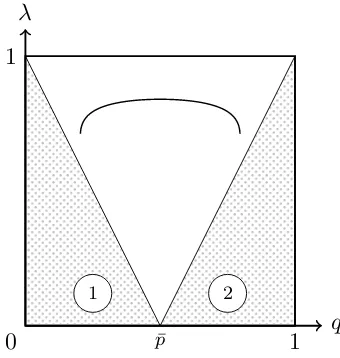
I provide a graphical representation of the results in this section in Figure 1.1. Let me go over this figure in detail because it not only illustrates the planner’s solution but also paves the way for the subsequent discussion of the competitive equilibrium. We have found that when the average borrower is credit-worthy and information is relatively imprecise (i.e.,p¯−q≥ λε
2 ), the volume of lending grows until every project is financed. Let me draw the set of all(q, λ)pairs for which this applies in the diagram and label it as area 1 . Since within this parameter region every entrepreneur receives a loan, screening is useless there. We can therefore conclude that the curve of optimal information choice λ∗SB(q) will either remain outside this region or drop to zero wherever it overlaps with it. The same holds for the opposite case where information is relatively imprecise and the average project makes an expected loss: no projects will be financed, the mass of credit is0and there are no returns to information acquisition within this region either. I mark the corresponding area as 2 .
q λ
0 1
1
¯
p
[image:23.595.175.345.374.553.2]1 2
Figure 1.1: The planner’s constrained optimal information choice.
The parameters of the plot areε= 1,p¯= 21,r= 34,R = 2andc(λ) =c01−λλ withc0 = 2501 .
Areas 1 and 2 which are shown in gray shading correspond to the cases handled in the first and third line of equation (1.9), respectively, where screening has no value because everybody, or nobody, is financed.
choice in order to draw a graph. I use here the specificationc(λ) = c01−λλ which yields closed-form solutions7 for both the planner’s choice and the competitive
case.8
Looking at the graph of λ∗(q) we can see that for the chosen parameters the interior solution indeed covers a wide range of q, but as q moves further away from p¯, the payoff to screening diminishes so much that it eventually becomes unprofitable to screen.
1.4
Competitive Equilibrium
1.4.1
Monopoly
Before discussing the full equilibrium under competition, it is instructive to look at the special case of monopoly. We can model this case within the existing setup by assuming that the remote monitoring costγ are sufficiently high that no bank can ever profitably offer outside credit to projects outside its own island. This is the case for all possible values ofqwheneverγ >(R−r)ε/2.
It is easy to see that a profit-maximizing monopolistic lender will replicate the planner’s choices perfectly: monopoly power enables the bank to extract the full surplus from all entrepreneurs by lending to them against a state-contingent repayment of(R, r). In order to maximize profits, the monopolist will choose the surplus-maximizing levelλ∗SB of testing precision and (assuming that the lender observes the same signal realizations as the planner) give loans to exactly the same set of projects that the planner would choose to develop. Despite the fact that all surplus is given to the monopolistic lender, the allocation is therefore constrained Pareto optimal. It is noteworthy that this optimality result depends crucially on the monopolist’s ability to extract all project surplus. The assumed exogenous nature of project size plays here an important role because it enables the monopolistic lender to perfectly know each entrepreneur’s individual ability of repayment. If entrepreneurs would instead choose the size of their projects endogenously while facing decreasing returns to scale, monopolistic pricing would result in ineffi-ciently small projects that are no longer constrained efficient. Similarly, if a reg-ulator were to limit the monopolist’s surplus extraction by curbing the maximum
7See the appendix for details.
8Note that this specific cost function implies that marginal cost of information acquisition are
strictly positive everywhere, even forλ→0:c0(0) =c0. Thus, ifc0is sufficiently large, holding
any positive amount of information will be suboptimal and the surplus maximization problem (1.13) yields the corner solutionλ∗
SB = 0for all values ofq. I avoid this situation by assuming
that c0 sufficiently low, i.e. c0 < ε8, that there exists an interior solutionλ∗SB > 0 for some
repayment on each unit of funds to some valueDmax < R, the resulting portfo-lio of financed projects would remain inefficiently small since the corresponding cut-offqˆ= Dmaxρ−r−r up to which the monopolist provides funding would lie higher thanq.
1.4.2
Portfolio Allocations under Competition
I now study the optimal portfolio choices of the two lenders when they compete against each other. Under competition, lenders must be careful in how they use the private information that they have obtained in the screening process because their decisions will become known to their uninformed competitor. If their loan approval conveys sufficiently good news about the quality of a borrower, the unin-formed rival bank can enter the market as an outside lender, undercut the incum-bent’s loan offer and poach some or all of its loan-approved customers. However, the outside lender’s cost disadvantage ofγwhen lending to the other island puts a limit to this poaching activity: entry is not profitable if a poached borrower earns the outside lender in expectation less than this extra cost γ. This motivates the following definition:
Definition Denote with Π[P] the gross profit that accrues to a domestic lender in the absence of competition from holding a given domestic loan portfolio P, and denote the volume of loans in the portfolio as|P|. Then, a loan portfolio P shall be called noncontestable if its gross surplus per loan is less or equal to γ:
Π[P]≤γ|P|.
In equilibrium, every bank will choose a noncontestable portfolio: otherwise, the competing bank could profitably poach the entire set of customers by undercut-ting the domestic bank’s offer for every domestically loan-approved entrepreneur by a smallδ > 0: (Oij, oji) = (Di −δ, di). The domestic lender’s profits would drop to zero and be strictly lower than if it had chosen some noncontestable port-folio which yields lower but positive gross profits.9 It must be pointed out that noncontestability is a necessary, but not a sufficient condition to guarantee that a loan portfolio does not attract entry: it only secures that an entrant financing the
entireloan portfolio will suffer losses. If the variation in repayment terms(Di, di) of individual borrowers carries any information on borrower quality, the entrant might still be able to profitably target a subset of projects that are identified as more lucrative than others. Such scenario is no concern if the incumbent’s portfo-lio is by chance not only noncontestable but alsosymmetric, i.e. every loan offer in the portfolio has the same repayment terms(Di, di) = (D, d). Then there exists no profitable possibility of entry, and the incumbent wins the full surplus of the
portfolio. As the following lemma shows, choosing a symmetric portfolio does not need to be inferior to choosing a non-symmetric one:
Lemma 3. LetP be a (not necessarily symmetric) noncontestable loan portfolio. Then there always exists a symmetric noncontestable portfolio Q for which the incumbent’s payoff in the competition game is at least as high as when choosing
P.
Proof. see appendix.
A direct consequence of the lemma is that if we manage to find within the class of all symmetric noncontestable portfolios some portfolioQ∗
that is profit-maximizing in the sense that no other symmetric noncontestable portfolio gener-ates higher surplus, it must be an equilibrium of the game: to see this, observe that if any arbitrary portfolio R could generate a strictly higher payoff for the incumbent, such portfolio would be noncontestable for sure (otherwise, as we know, payoff would be zero). But then the lemma assures us that a symmetric noncontestable portfolio that generates at least the same payoff asRexists, thus generating an immediate contradiction to the maximality ofQ∗. Therefore,Rcan not have existed in first place, and we have
Corollary 3.1. Any symmetric portfolioQ∗ that maximizes gross surplus subject
to the constraint of noncontestability,
max
Q=(S,(D,d)) Π[Q]
s.t. Π[Q] ≤γ|Q| (1.14)
is an equilibrium allocation of credit under competition.
The maximality of Π[Q∗] also makes it clear that even though the equilib-rium portfolioQ∗ is not necessarily unique, the equilibrium payoffs are always uniquely determined. The same is true for credit mass and average success proba-bilities: those two quantities are uniquely pinned down by the constraint whenever it is binding, whereas any possible indeterminacy that can arise if the constraint does not bind are eliminated by the previously made assumption that no project with zero expected surplus receives funding.
As a solution to the maximization problem for symmetric portfolios I find the following equilibrium allocations:
• If the monopolistic portfolio is noncontestable, it is an equilibrium. This is the case if information is sufficiently imprecise, λ ≤ 2(q−εp¯) + ε(R−r4γ ), and the thresholdq is sufficiently high thatF is noncontestable,q > p¯− R−rγ . The bank then acts as a monopolist and reproduces the constrained optimal allocation by lending to entrepreneurs whose expected success probability exceedsq= R−rρ−r against state-contingent repayment of(R, r).
• If information is sufficiently precise that a monopolistic portfolio choice would attract competition, i.e. λ > 2(q−εp¯) + ε(R−r4γ ), but the full portfolio
F remains noncontestable,q >p¯− R−rγ , it is an equilibrium to finance all positive net present value (NPV) projects and some projects with negative NPV by offering credit at terms (R, r) to projects whose expected success probability lies aboveqˆ= ¯p−λε
2 + 2 q−p¯+ γ R−r
, wherebyq < qˆ .
• If both the monopolistic portfolio and the full portfolioF are contestable, i.e. q ≤ p¯− R−rγ , it is an equilibrium to offer credit to every domestic entrepreneur against a state-contingent repayment of (D, r), with D =
γ+ρ−r(1−p¯) ¯
p .
Proof. see appendix.
This important result deserves several comments:
First, the surprising finding is that more competition has virtually zero impact on the cost of borrowing until every available project receives a loan. Before this point, an increase in competition (i.e. fall inγ) only lowers banks’ lending stan-dards and prompts them to take projects with negative net present value into their loan portfolios. The central force behind this result is that it is more profitable for the bank to deter entry by reinforcing the entrant’s adverse selection problem than to do so by lowering its terms of repayment: imagine for a moment that the bank had instead reduced its repayment terms for its massmof borrowers to some
(D, r)withD < R but had not lowered its lending standards. Its portfolio must then satisfy the noncontestability constraint with equality which bounds profits to γ|m|. This is no equilibrium because the bank can do better: it can extract the full surplus (R, r) of those m projects and use the proceeds to finance ex-actly as many additional negative NPV projectsnas to restore noncontestability,
richer model in which careless lenders incur higher refinancing cost, banks might choose an optimal mix of more aggressive pricing and lower lending standards in order to defend themselves against the entry of competitors.
Another important observation is that the game’s competitive equilibrium is essentially a contestable market: the incumbent’s informational advantage and the cost disadvantage of the entrant make it impossible for the entrant to actually ever poach any customers from the incumbent. It is the mere threat of entry that drives all the changes in allocations although in equilibrium entry never occurs.
Finally, the fact that the game has an equilibrium in pure strategies stands in sharp contrast to most credit screening games in the literature for which the nonexistence of pure strategy equilibria has been established (see e.g. Broecker, 1990; von Thadden, 2004). This is, however, not really unexpected given my substantially different setup: the sequential nature of bidding together with the observability of actions ensure that the entrant can correctly infer the incumbent’s true valuation for the pool of loan-approved borrowers and hence does not face any winner’s curse problem when submitting a bid on this pool.
I now proceed to discuss the equilibrium credit volume which can be calcu-lated from the results of proposition 4:
Corollary 4.1. In equilibrium, the volume of credit is the following:
mEλ(q, γ) =
1 if0≤λ≤ 2( ¯p−qε ) andp¯−R−rγ < q <p¯ 0 if0≤λ≤ 2(q−εp¯)
1 2 −
q−p¯
λε if
2|q−p|¯
ε < λ≤ 2(q−p¯)
ε +
4γ ε(R−r)
1−2(q−p¯+
γ R−r)
λε if
2(q−p¯)
ε +
4γ
ε(R−r) < λ <1andq >p¯− γ R−r
1 for allλ∈[0,1)ifq ≤p¯−R−rγ
(1.15)
Whilst this expression looks rather complex at first glance, it is actually quite easy to understand. The first three lines represent the absence of competition: they are practically the same expressions that we had found for the planner’s bench-mark and the monopolistic case. The only difference is that the domain where the monopolistic case applies has shrunken, and there is a new domain of(q, λ) val-ues where threat of entry is relevant. The new area is represented by the ultimate two lines: line four describes the case in which the bank cross-subsidizes some negative NPV loans in order to deter entry. Line five finally stands for the case in which the bank cross-subsidizes all negative NPV projects and additionally reduces repayments in order to attain a noncontestable portfolio.
q λ
0 1
1
¯
p
¯
p−Rγ−r 5
4
3
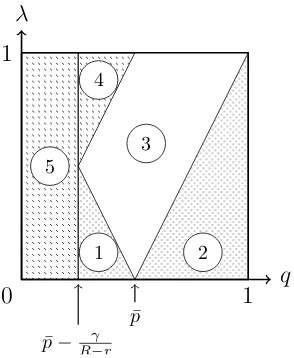
[image:29.595.203.350.124.303.2]1 2
Figure 1.2: Competitive and monopolistic domains of lending.
Figure 1.1. We can see that threat of entry (as indicated by the dark shaded ar-eas 4 and 5 ) affects banks that have very precise information and / or operate under very favorable conditions such that the cut-off q is very low. As one can see from the expressions in lines4and 5of equation (1.15), these areas grow as competition becomes stronger: in the limiting caseγ →0, they cover almost the entire(q, λ)plane with the exception of area 2 .
How do the comparative statics of credit allocations under threat of entry dif-fer from those in the monopolistic regime? The following proposition holds the answer:
Proposition 5. Letqbe such that in contestable market equilibrium some but not all projects receive credit, i.e.p¯−R−rγ < q <p¯+λε2 , and let competition be strong enough to potentially impact lenders within this regime, i.e. R−rγ < λε2 . Then,
• the lower the chosen levelλ of information acquisition, the more sensitive is the volume of lendingmE(q, γ)to changes in both monetary policy rate
ρand project values(R, r).
• holding constant the level of λ, the sensitivity ∂mE
∂q of credit volume to
changes in monetary policy rate and project values is twice as high under threat of competition than if the domestic bank can act as a monopolistic lender.
• the average default rateDλ = 1− Aλ in a lender’s portfolio increases as
monetary policy rate falls and expected liquidation values rise. The sensi-tivity ∂Dλ
∂q to such changes is independent of λ, but is twice as high under
Proof. see appendix.
In other words, the presence of competition makes credit more volatile. An improvement in economic conditions will lead to both faster credit growth and faster deterioration of portfolio quality.
1.4.3
Information Choice under Competition
As the final step in solving the competition game backwards, I now find the equi-librium choices of screening precision that maximize total profits in a competitive environment. The gross profit function ΠEλ(q, γ) that is needed for this purpose follows immediately from the results in the last section: for all those(q, λ) com-binations for which there is no threat of entry, gross profits are exactly the same as under monopoly. In the remaining parameter ranges, the threat of competition limits equilibrium gross profits toγ·mE.
The equilibrium screening intensityλ∗E then solves the problem
max
λ Π
E
λ −c(λ) (1.16)
s.t. λ≥0
Even without a specific cost function, one can infer the impact of competition on screening directly from an inspection of marginal returns:
Proposition 6. The equilibrium screening intensityλ∗E
• is equal to the constrained efficient screening intensityλ∗SB whenever the monopolistic portfolio at this screening level does not attract competition, i.e. for allq >p¯− γ
R−r for whichλ ∗
SB(q)≤ 2(q−p¯)
ε +
4γ ε(R−r).
• falls below the constrained efficient level when competition is sufficiently strong to pose a threat of entry, i.e. q > p¯− R−rγ andλSB∗ (q) > 2(q−εp¯) +
4γ ε(R−r).
• is zero if competitive threats result in the financing of all projects regardless of their type, i.e. for allq ≤p¯− R−rγ .
Proof. see appendix.
apparent in the extreme case in which qis so low that banks finance all projects regardless of their type: under such conditions, screening is entirely useless.
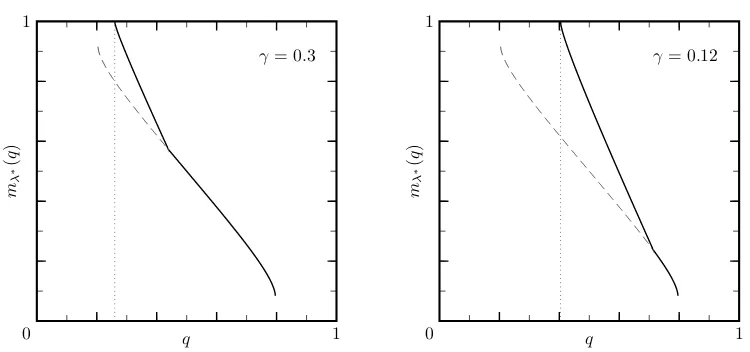
I illustrate the result graphically in Figure 1.3 with a plot of λ∗E over q for two different levels of competition. The cost function is the same as in the plan-ner’s case, c = c01−λλ . In the graph on the left-hand side, competition is weak and generates little impact. Borrower poaching is only profitable under the best possible economic conditions, i.e. when the cut-offq is exceptionally low. Only in such exceptionally good economic states, the equilibrium choice of screening precision (shown as the solid line) will fall below the constrained-optimal level (dashed line). In all other times, the screening and lending choices of the bank and the social planner coincide. As the graph on the right-hand side of Figure 1.3 shows, the advent of more competition changes the situation dramatically: screen-ing incentives are eroded over a wide range of economic statesq, and for nearly all except the worst states of the economy, banks will choose a screening precision far below the constrained efficient level.
1.4.4
Excessive Lending
What are the consequences of inefficiently low screening for the total amount of lending? To answer this question, I evaluate the credit mass mEλ(q, γ) at the equilibrium levelλ∗E(q)of screening precision. Let me move the discussion im-mediately to the most interesting case:
Imagine that average project characteristics are good enough as to render the average project of the pool credit-worthy, i.e. p¯− R−rγ < q < p¯. Then, as we have seen in corollary 1.1, the second-best amount of investment already exceeds the first-best benchmark of perfect information. Moreover, banks that hold less
precise information than the planner will lend evenmorebecause their signal is too imprecise to actually push many bad projects below the zero expected surplus cut-off q. To make things worse, this is not even where lending under competition10
actually ends! The equilibrium financing cut-off lies belowqbecause (as shown in proposition 4) banks add additional loans of negative net present value to their portfolio in order to protect themselves against poaching of their clients. The overall amount of credit in this situation is therefore excessive relative to both second-best and first-best levels and indeed deserves to be called an “inefficient lending boom”:
mEλ∗
E(q, γ)> m
SB λ∗
E(q)> m
SB λ∗
SB(q)> m
F B
λ=1(q) (1.17)
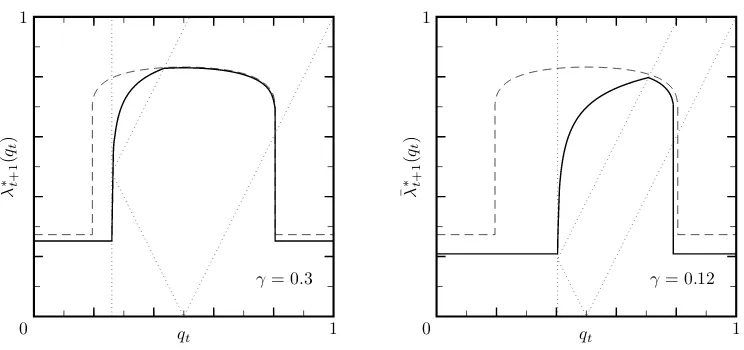
Figure 1.4 illustrates the equilibrium credit mass as a function of the economic conditionsqusing the same equilibrium screening levels that were already shown
10i.e. forγ < R−r 2
¯
p−q+ελ
∗
SB(q)
in Figure 1.3. We can see in the left-hand side picture that for a moderate amount of competition, credit becomes excessive only when economic conditions are par-ticularly strong, i.e.qis very low. The right-hand side graph displays the behavior of credit as a function ofq when there is more banking competition. We can ob-serve that credit is excessive over a much wider range of economic conditionsq. The lending boom is most pronounced for very low values ofq, which are attained whenever the monetary policy rateρ is low and the liquidation valuer of failed projects is high.
But the most important factor that determines the extent of an inefficient boom is the amount of banking competition. In fact, it is possible to show that inde-pendently of the chosen screening cost function, the size of the lending boom is always greater when there is more competition:
Proposition 7. Let the average project be credit-worthy, i.e. q ∈ (¯p− γ R−r,p)¯,
and let competition be strong enough to pose threat of entry if monopolistic was
applied, i.e. γ < R−r2 p¯−q+ ελ∗SB(q)
2
. Then, the size mE
λ∗E of the inefficient
lending boom is increasing in the level of bank competition:
d dγm
E
λ∗E(q, γ)<0. (1.18)
γ= 0.3
0 1
1
λ
∗(
q
)
q
γ= 0.12
0 1
1
λ
∗(
q
)
[image:33.595.89.467.160.333.2]q
Figure 1.3: Screening precision λ∗E as a function of q for two different levels of competition. The constrained efficient choice is indicated as a dashed line.
γ= 0.3
0 1
1
mλ
∗(
q
)
q
γ= 0.12
0 1
1
mλ
∗(
q
)
q
Figure 1.4: Credit massmE
λ∗ as a function of economic state q for two different
[image:33.595.90.465.451.627.2]1.5
Discussion
With all central results in place, it is now time to discuss these findings in more detail and to analyze to which extent the key predictions of the model are robust to changes to my initial assumptions.
1.5.1
The nature of bank competition in the model
The first point that deserves to be given more detailed consideration is the nature of bank competition in my model, which is captured by the “extra monitoring cost” parameterγ. I think ofγas a parameter that has a lot of economic meaning because it captures several distinct effects:
First, γ can indeed reflect the additional cost of monitoring a borrower who is more difficult to observe for the bank. For example, this could be the case if the bank has no further service relationship with this customer (e.g. checking ser-vices) that could generate relevant information for monitoring the borrower’s ac-tions.11 A reduction inγ could thus reflect improvements in the ability of lenders
to access information about remote customers, for example by exploiting advances in information technology (Hauswald and Marquez, 2003).
In an alternative interpretation of the model,γ can be considered a switching cost: in fact, one can think of my model as the second stage of a two-period game where in the first period, banks build customer relationships by providing banking services. Banks might initially compete for extending a loan to the customer, or for handling the customer’s main checking and payroll account. The exact nature of this first-period service competition remains irrelevant as long as it gives the chosen “inside” bank the exclusive opportunity to collect additional private infor-mation about the customer that can be used in the second period. In period two, the “inside” bank then competes with outside lenders for winning the customer as a borrower. In this interpretation of the model, it is more natural to think ofγ
as a switching cost (due to the loss of the original bank relationship, or the cost of initiating a new business relationship with another lender) that any customer incurs who chooses to obtain his second period loan from a different lender. The existence of such switching cost are empirically well documented (e.g. Barone et al., 2011). An increase in competition in the model would be equivalent to a reduction in switching cost, which could for example occur due to changes in the regulatory environment.
Another important dimension of competition between banks is comparative advantage due to specialization. One could think of an extension of the model
11Mester et al. (2007) provide evidence that transaction account data help banks monitor
in which one of the two banks (which I will refer to as the money center bank
orM) has a comparative advantage relative to the other (which I will call the lo-cal bankorL) because of its specialization as a large transnational lender which gives it cheaper access to wholesale funding, i.e. ρM < ρL. On the other hand, the
local bank might benefit from its geographic specialization in the form of lower marginal cost of screening, i.e. c0L(λ) < c0M(λ). What would the corresponding equilibrium allocations under competition be? Without having to solve the model all over again, it is possible to see the answer directly by careful inspection of the symmetric model. Since I will discuss differentials in screening cost at a later point, let me for now analyze a world in which both banks have identical cost of screening but the money center bank has access to cheaper wholesale funding,
ρM = ρL−∆ρ. This cost advantage enables the money center bank to compete more aggressively for customers of the local lender: it could earn a strictly pos-itive profit by poaching any loan portfolio on which the local lender earns more thanγ−∆ρper loan. The local bank will anticipate this and respond to the threat of poaching by taking on more excessive credit and reducing its screening pre-cision λ∗L. In fact, it is easy to see that the local bank will act exactly as if in a symmetric model the value ofγ had decreased toγ −∆ρ. The money center bank, on the other hand, will act in the opposite way: first of all, the lower refi-nancing cost translate into a lower required probability of success for a project to break even: qM =qL− R−r∆ρ. Thus, the bank is able to extend its lending to more risky borrowers. To the extent that the resulting portfolio remains noncontestable, this expansion of credit will also be efficient. But more interestingly, the new loan portfolio is also more easily kept noncontestable since the local lender incurs higher cost on every loan-approved customer that it poaches from the money cen-ter bank: the local lender can only engage in profitable poaching of customers if the money center bank’s profits per loan exceedsγ+ ∆ρ. The comparative advan-tage of lower refinancing cost therefore translates into lower competitive pressure: in equilibrium, the money center bank will behave exactly as if it was playing the symmetric game whereq =qL− R−r∆ρ and the “extra monitoring cost” parameter
γ was increased toγ+ ∆ρ.
Finally, we may ask what happens in the limit of perfect competition, which should be somehow related to the model’s equilibrium in the limiting caseγ →0. Unfortunately, in the limit γ → 0 the fact that each bank earns zero profit also implies that there will be zero information collection. Lending would be all-or-nothing, depending only on how q stands relative to p¯. More meaningful con-clusions about the perfect competition limit can only be attained if we keep λ
into additional negative NPV loans.
1.5.2
Improving Screening Precision: A Word of Caution
Given that the model predicts socially suboptimal levels of screening in equi-librium, we may want to think about what would happen if a regulator who is unaware of the actual origin of the problem would attempt to increase banks’ screening levels by means of some intervention (for example, via a subsidy to screening, or by some minimum due diligence requirements).
By looking at the mechanics of the model, it is easy to see that such regu-latory action could yield an unpleasant surprise: assume that in the competitive regime (where the monopolistic portfolio would attract outside competition and thus screening in equilibrium is inefficiently low) the screening level of banks was forced to some higher level λRG by means of regulatory intervention such that λ∗SB(q) ≥ λRG > λ∗E(q, γ). The elevated screening precision will enable banks to make more profitable portfolio choices than if they had retained the less precise level of screening of the competitive equilibrium. But for this very same reason banks will also need to take more aggressive countermeasures against out-side lenders who could poach their customers. They do so by adding further negative NPV clients to their borrower pool: an inspection of the fourth line in equation (1.15) reveals immediately that whenever banks operate in the compet-itive regime, more information precision will translate into larger credit mass. Thus, as long as regulatory intervention fails to reduce the informational asym-metries between lenders and instead only restores information acquisition at the
individualbank, the outcome will be just a further expansion in credit which will be associated with further welfare losses.
1.5.3
Specialization and Industry Structure
If we compare the fate of the local lender to the fate of the money center bank it becomes clear that in a world in which the efficient use of information is constrained, the business model of the money center bank is the more promising one. Hence, as barriers to competition are reduced we would expect to witness a change in the structure of the banking industry: local lenders will either choose to transform themselves (via mergers) into big money center banks or exit the market.
1.5.4
Robustness and Generalizations
How robust are my results to changes in the assumptions of the model? Indeed, there are a few key assumptions that are indispensable:
The most important assumption in my model is the existence of a differential in private information between theinsidelender and otheroutsidebanks: without this difference in information, there would be little scope for informational free-riding. The second fundamental assumption in my model is the order in which the loan negotiation process takes place: it is of fundamental importance that the uninformed lender moves last. In a game in which there is only one round of ne-gotiations, this is not a very strong assumption because forq > p¯the uninformed lender would anyways never approve any loan without further information. But we can see the importance of this assumption if we were to add a second round of negotiation and would allow the informed bank to submit the last bid. Then, the superior knowledge of the informed bank would enable it to poach the best positive-NPV borrowers back from the outside lender, which would leave the out-side lender with a loss-bringing portfolio of negative-NPV loans. In anticipation of this problem, the outside lender would thus refrain from bidding in first place, and the monopolistic outcome would be attained. This problem would not occur if the outside lender could submit its bidafterthe informed lender: since the second bid of the informed lender is final, it must contain information about the prof-itability of the selected customers that can be used by the outside lender. Thus, I would expect that the second period equilibrium in a two round game in which the uninformed bank bids after the informed bank will exhibit most of the features of the single round model that I have analyzed here.
Another important question regarding the robustness of my findings is to which extent the main result of the model – i.e. the optimality of cross-subsidized lend-ing under competition – depends on the chosen screenlend-ing technology. The good news is that in fact there is very little dependence on the chosen screening tech-nology, as I shall show: the driving force behind most results is the fact that credit-worthiness testing creates dispersion in posterior expectations – the more precise the test, the more of it (see Ganuza and Penalva, 2010).
given level of test precision λ, the test comprises of a family of cumulative dis-tribution functions{Sλ(s|pi)}pi∈[0,1] which indicate for every possible realization
of a project’s true typepi the probability of obtaining a signal less or equal tos. Together with the prior distribution B(p), this induces a joint distribution from which one can calculate by Bayes’ Law the posterior distribution ofpconditional on observing a signal realizationσi,λ = si. From this posterior distribution, one can then finally calculate the expected probability conditional on the observed signal, E[pi|si]. Just as before, I denote the cumulative density function of the random variableE[pi|σi]under test precisionλasEλ(p).
For any test specification that satisfies the following single-crossing assump-tion regardingEλ(p), the model yields similar qualitative results:
Assumption 1. Let λ ∈ [0,1) and µ ∈ [0,1) with λ > µ. Then, a credit-worthiness test with higher precision λ disperses posterior expectations further away from the priorp¯than a test with lower precisionµin the sense that
Eλ(p) > Eµ(p)for allp∈(0,p)¯ , and
Eλ(p) < Eµ(p)for allp∈(¯p,1). (1.19) The results of the second-best benchmark as in proposition 1 then follow triv-ially frommSB
λ (q) = 1− Eλ(q): for exogenousλ, the constrained optimal amount of lending is higher than under perfect information if q < p¯, and is lower than under perfect information ifq >p¯.
With a minor twist in order to accommodate discrete posterior distributions I can also solve for the optimal portfolio under competition: remember that we de-fined the average success probability of the set of all projects that lie above some cut-off z as Aλ(z) =
1 R
z
pdEλ(p)/
1 R
z
dEλ(p). This definition can cause problems when the posterior distribution is discrete since Aλ(z) would become a discon-tinuous function. By a change of variables, this problem is easily circumvented: I simply rewrite the average success probability as a function of credit mass12 m
rather than cut-off probabilityz via the transformationm=Eλ(p)and define it as
ˆ
Aλ(m) =
1 m
1 Z
1−m E−1
λ (µ) dµ (1.20)
which makes it a continuous and decreasing function inm. Lemma 3 and corollary 3.1 continue to hold for this more general case, and one obtains an equilibrium portfolio under competition that bears much resemblance in its structure to what we have found before:
12It is understood thatmstands for a mass ofmprojects selected in the order from best towards
• If Aˆλ(mSBλ ) ≤ q + γ
R−r, the earnings per loan do not exceed γ and the monopolistic portfolio is noncontestable. In this case, the allocation will reproduce the second-best, and a state-contingent repayment terms for loans are(R, r).
• Under threat of entry Aˆλ(mSBλ ) > q+ γ
R−r, not every project will be fi-nanced as long as the full portfolio remains noncontestable, i.e.q >p¯− γ
R−r. The financed mass of projects in this regime will be
mEλ(q) = ˆA−1 λ
q+ γ R−r
(1.21)
where Aˆ−λ1(a) ≡ sup{m ∈ [0,1] : ˆAλ(m) = a}. Due to financing of negative-NPV projects, credit mass is excessive in this range, mE
λ(q) >
mSB
λ (q). Equilibrium repayment terms remain at(R, r), and gross profits amount toγ·mEλ(q).
• Finally, for q ≤ p¯− R−rγ , every project is financed at reduced repayment terms such that total gross profit equalsγ.
In other words, the equilibrium with cross-subsidized loans and excessive lending is also attained under a generalized screening technology.
1.5.5
A Dynamic Model of Credit Cycles
I now extend the model to a simple dynamic setting. This extension to serves the purpose of capturing an additional aspect regarding information choice that was missing in the static model: typically, a banks’ information choice exhibits some sort of rigidity. The baseline model does not capture any of this; λ is simply a function of the underlying microeconomic stateqwhich is precisely known at the time when the bank makes its information choice. In reality, however, banks face large fixed cost for changing their internal organizational structure, which makes a frequent and perfect adjustment of the bank’s screening precision to the ex-post realized macroeconomic state prohibitively costly. It is therefore more in line with anecdotal evidence to assume that banks make their organizational choice based on their ex-ante expectations regarding the medium-term macroeconomic outlook and are unable to quickly adjust it when the ex-post realized state turns out to require substantially different levels of screening precision.
1. initially, the state ofqis unknown, but it is known that it will be drawn from a cumulative distribution functionU(q).
2. the rest of the setup follows exactly the baseline model: two islands, two banks; without knowing the actual realization ofq, every bank chooses its screening precisionλ¯ and pays a cost of c(¯λ)that becomes sunk immedi-ately
3. afterλhas been chosen, the actual level of the cut-offqis realized
4. banks choose their domestic portfolios, observe each other’s domestic lend-ing choices and attempt to poach customers as in the baseline model Since the last steps of the game have remained untouched, the model’s findings on portfolio choice for a given ¯λ are unaffected by the modification; the new setup merely changes equation (1.16) which determines the optimal level λ¯∗E of screening under competition. The new optimization problem then reads
max
¯ λ
Z
ΠEλ¯(q, γ)−c(¯λ) dU(q) (1.22) s.t. λ¯ ≥0
The bank takes all possible realizations ofqweighted by their probability of oc-currence into account when optimizing its expected net profits. This creates two different effects: on the one hand, bank competition reduces in a now already fa-miliar way the benefits of bank screening for a possibly large range of low-qstates of nature. As long as the distributionU(q)assigns nonzero probability weight to those states of nature, the resulting ex-ante profit-maximizing level of screening
¯
λ∗E will fall short of the amount that would be attained without competition. On the other hand, a new effect arises from the impossibility to condition information choice on the actual realization ofq: The bank may ex-post encounter both situa-tions in which its actual screening abilitiesexceedthe level that would have been chosen ifq had been known ex-ante, and situations in which the contrary is true and screening precision ends up beingtoo lowfor the ex-post realization ofq. We shall see in a bit that this has important consequences.