11
thMeeting of the Conference of the Parties to the
Convention on Wetlands (Ramsar, Iran, 1971)
“Wetlands: home and destination”
Bucharest, Romania, 6-13 July 2012
Resolution XI.13
An Integrated Framework for linking wetland conservation and
wise use with poverty eradication
1. RECALLING that the Changwon Declaration on human well-being and wetlands (Resolution X.3, 2008) affirmed that wise use, management, and restoration of wetlands should help to build opportunities for improving people‟s livelihoods, particularly for wetland-dependent, marginalised and vulnerable people;
2. ALSO RECALLING that Resolution X.28 (2008) on Wetlands and poverty eradication encouraged Contracting Parties to identify ways and means of further implementing the initial framework for action on wetlands and poverty reduction adopted in Resolution IX.14 (2005), and in paragraph 11 it requested the Scientific and Technical Review Panel (STRP) to develop specific guidance for Contracting Parties to support the
implementation of those Resolutions;
3. RECOGNIZING that poverty has been defined as the pronounced deprivation of well-being, is complex and multidimensional, and a reality that still affects a large percentage of the world‟s people and nations, and is indeed one of the greatest challenges for wetland management in developing countries;
4. RECALLING the recognition by the Rio +20 Conference (Brazil, 2012) that “Eradicating poverty is the greatest global challenge facing the world today and indispensable
requirement for sustainable development” and that this equally may apply to the goal of wetland wise use;
5. ALSO RECALLING that, at the Ramsar 5th Pan-American preparatory regional meeting,
the Kingston Declaration underscored commitment to an integrated framework for wetland conservation and poverty eradication;
7. FURTHER RECOGNIZING that the implementation of the wise use provisions of the Ramsar Convention can contribute to poverty eradication and hence the achievement of the Millennium Development Goals (MDGs) 1 and 7on eradicating extreme poverty and hunger and ensuring environmental sustainability, AND WELCOMING the process regarding development of the Sustainable Development Goals as set by Rio +20 Conference;
8. EMPHASIZING that livelihood strategies based on wetlands need to be sustainable in order to contribute meaningfully to poverty eradication;
9. NOTING that Decision X.6 (2010) of the Convention on Biological Diversity, on “Integration of biodiversity into poverty eradication and development”, called for active involvement and commitment of development cooperation bodies and implementing agencies in supporting the mainstreaming of biodiversity and ecosystem services into poverty eradication and development processes; and
10. EXPRESSING APPRECIATION to the STRP for its work in preparing the advice and guidance annexed to this Resolution, and ALSO THANKING the government of the United Kingdom, Wetlands International, and the International Water Management Institute (IWMI)for their support to the development of this guidance;
THE CONFERENCE OF THE CONTRACTING PARTIES
11. WELCOMES the „Integrated Framework for linking wetland conservation and wise use with poverty eradication‟, annexed to this Resolution, as a tool for governments, wetland management authorities and stakeholders to assess wetland ecosystem services and livelihoods interlinkages at multiple scales;
12. URGES Contracting Parties to make use of the Framework, in their assessments of the interlinkages between poverty and the wise use of wetlands, and to include such
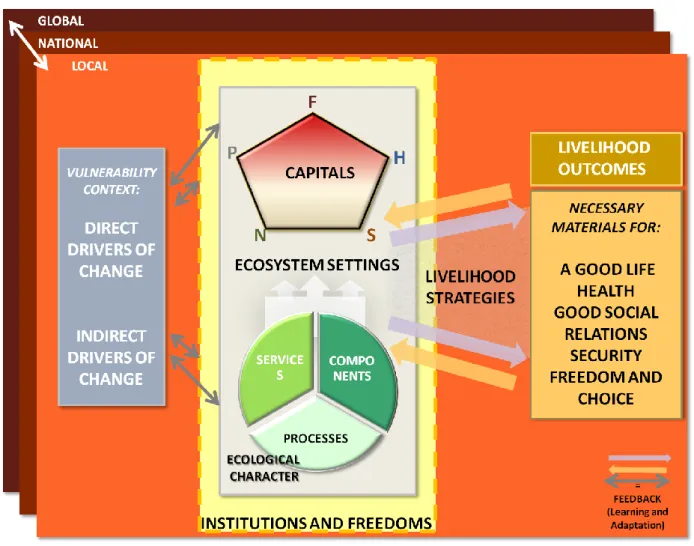
assessments in the development of site-based management planning to promote wise use and maintenance of the ecological character of wetlands;
13. ALSO URGES Contracting Parties to draw the Framework to the attention of all relevant stakeholders, including inter alia government ministries, departments and agencies, non-governmental organizations, and civil society, and FURTHER URGES Parties to use this Framework, together with the Ramsar Handbooks for the Wise Use of Wetlands (4th edition,
2010), as a means of furthering cooperation and collaboration with development agencies to address poverty issues within wetlands in their decision-making and their activities that relate to the delivery of the wise use of wetlands;
14. FURTHER URGES Contracting Parties, when drawing the Framework to the attention of all relevant stakeholders, to make use of the advice provided in Resolution XI.12 Annex 1, on „Wetlands and health‟, concerning the relevance of implementing the Ramsar
Convention for addressing the Millennium Development Goals (MDGs), and especially MDG1 (Eradicate extreme poverty and hunger);
indigenous peoples and local communities, public action support, and project funding and to include wetland conservation as a key component of official development assistance;
16. REQUESTS the Ramsar Secretariat, resources permitting, to identify means and ways of assisting Contracting Parties in assessing contributions made towards achieving the MDGs through implementation of the Ramsar Convention while conducting national evaluations for the global assessment of the MDGs in 2015, including by making use of the annexed Framework in accordance with paragraph 9 of this Resolution, and to report this matter to the 12th meeting of Conference of the Parties;
17. FURTHER REQUESTS the Secretariat to engage in the process and development of the Sustainable Development Goals being coordinated by the UN Secretary General;
18. REQUESTS the Scientific and Technical Review Panel, working with Contracting Parties, the International Organization Partners, and other interested organizations and networks, in particular the CBD‟s Biodiversity for Development Initiative and subject to available resourcing and agreed priorities in Resolution XI.17 to build upon this Framework by including in its future work plan the development of:
i) advice on mainstreaming the “Integrated Framework for linking wetland conservation and wise use with poverty eradication” into national policies and programmes that may have a bearing on poverty eradication;
ii) advice to include Communication, Education, Participation and Awareness (CEPA) as a mechanism that contributes significantly to reduce the risks that can create or deepen poverty; and
iii) case studies and best practices on the application of the Framework for assessing poverty in wetlands; and
Annex
An Integrated Framework for linking wetland conservation and wise use
with poverty eradication
I. Introduction
1. In 2005, Ramsar Contracting Parties adopted Resolution IX.14 on Wetlands and poverty reduction, which recognized the relevance of wetland conservation and wise use (and thereby of the Ramsar Convention as an instrument) as an important element for achieving internationally agreed development strategies, including the Millennium Development Goals (MDGs). In the subsequent Resolution X.28 (2008) on Wetlands and poverty eradication, the Parties requested the Scientific and Technical Review Panel (STRP) to develop an integrated framework for linking wetland conservation and wise use with poverty eradication and to identify the most appropriate scale at which each type of poverty eradication action should take place.
2. Within this framework, poverty is recognized as a multi-dimensional, value-laden, context-specific, and dynamic phenomenon. This is consistent with current thinking on the concept and measurement of poverty, which over the past four decades has evolved from an emphasis on access to physical commodities to an approach which includes capabilities, or the ability to achieve human well-being.
3. Some of the dimensions used to describe poverty include “inability to satisfy basic needs, lack of control over resources, lack of education and skills, poor health, malnutrition, lack of shelter, poor access to water and sanitation, vulnerability to shocks, violence and crime, lack of political freedom and voice”1. Poverty has also been expressed as “pronounced
deprivation of well-being”2. The Millennium Ecosystem Assessment3 identified poverty
and well-being as two extremes of a multi-dimensional continuum. Poverty is also considered to be a dynamic phenomenon, with some people remaining in a state of
chronic poverty over time whilst others experience a more transient state and may move in and out of poverty.
4. Whilst absolute poverty in terms of the more conventional, financial dimensions of poverty measurements of income/consumption levels can be compared in relation to a poverty line, other dimensions of poverty are context-specific, and what is perceived as poverty can vary between different individuals, sites, regions and countries, and may also vary over time.
1 World Bank (2001) Poverty Trends and Voices of the Poor. 4th Edition. The World Bank, Washington DC, USA.
2 World Development Report (2001) Attacking Poverty: Opportunity, Empowerment and Security, World Bank, Washington DC, USA.
5. Ramsar Resolution IX.14 (2005) refers to poverty reduction, which implies lifting people beyond a defined poverty line and transforming them from poor to non-poor, while the subsequent Resolution X.28 (2008) talks about poverty eradication, which usually refers to moving people who are in extreme poverty (below a US$1.25 per day poverty line) to above this line.
II. Wetland-poverty interlinkages
6. Wetland management seeks to ensure “wise use” of wetlands, which in Ramsar‟s definition of wise use means “the maintenance of ecological character, achieved through the
implementation of ecosystem approaches, within the context of sustainable development”(Resolution IX.1 Annex A, 2005).
7. An explicit recognition of ecological character as a relatively value-based, cultural and normative social construct forms the basis of wetland-poverty interlinkages. Human societies are fundamentally linked to wetlands, from the core human requirements for water, food and livelihoods, through the choices and tradeoffs they make and the
governance systems that influence their behaviour in and around wetlands. The existence of poverty in its various forms may therefore influence, and be influenced by, wetland ecological character and associated cultural values.
8. Wetland ecosystem services (the benefits people derive from wetlands) form an integral part of the livelihood strategy of wetland-dependent communities. Their livelihood systems often involve adapting to the overall ecological character of the wetland so as to optimize livelihood outcomes. The ways in which ecosystem services integrate with other livelihood capitals, particularly the social, economic and political contexts under which ecosystem services accrue to the livelihoods of dependent communities, become important variables in influencing the sustainability of livelihood strategies as well as poverty within wetland communities.
9. Conversely, livelihood strategies of communities living in and around wetlands may also influence a wetland‟s ecological character. Failure to follow wise use principles can exacerbate the problem by pushing people into poverty (transforming the non-poor into the poor), by maintaining the status quo for those who are already in poverty, and by pushing already poor people further into poverty.
10. The relationship between wise use and poverty eradication can be direct (e.g., wise use of resources that support livelihoods) and indirect (e.g., wise use of wetlands contributes to climate change mitigation and thus can improve human well-being). Similarly, degradation of ecological character can have direct relationships with poverty (e.g., resource depletion that negatively impacts on livelihoods of local wetland-dependent communities) or be indirect (e.g., pollution that impacts on the livelihoods of downstream communities through the deterioration of water quality and/or increasing costs of water treatment).
12. As well as wetland loss and degradation impacting upon human well-being, poverty can often result in interventions that impact upon wetlands. These impacts can be both direct (over-exploitation of a natural resource that reduces livelihood options; absence of sanitation, which forces people to use wetlands for waste disposal) and indirect (destructive agricultural practices in the catchment leading to changes in wetland sedimentation). Such interventions can also take place at a range of geographical scales, from local ( e.g., poverty of local wetland dependent communities resulting in
unsustainable exploitation) and national (e.g., national government efforts to reduce poverty may result in unwise use of wetlands) to global (e.g., focusing on MDG goals on hunger, poverty, and water may result in the failure to achieve targets for wetland
ecosystem services).
13. Where poverty exists, it is possible for a vicious circle to develop, whereby poverty impacts upon ecological character to the extent that the potential for wetlands to deliver their ecosystem services is degraded or even lost.
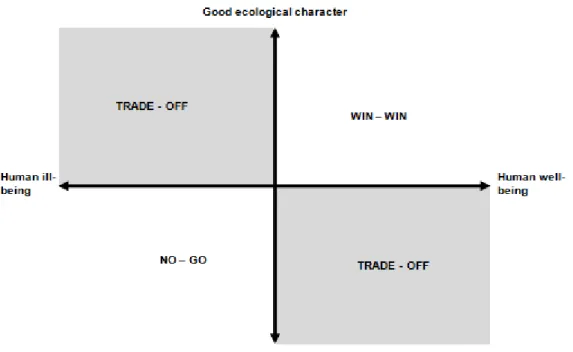
14. The impact of conservation/development interventions on wise use (maintaining ecological character) and poverty eradication have a number of potential outcomes. The range of potential scenarios is dependent on the starting point on the poverty/well-being and ecological character axes, as shown in Figure 1. The nature of any intervention will depend on the relevant institutional, social, economic, and ecological factors at play.
15. It is clear that policy changes that bring the communities into the domain of well-being (lifting people out of poverty) and maintain good ecological character provide a win-win situation. Conversely, a policy change that triggers deterioration in ecological character beyond the limit of acceptable change and pushes communities into poverty lies in the “no-go” zone.
16. Between these two options there is a range of scenarios which deliver one of the two objectives at the cost of the other, thereby indicating that tradeoffs have to be made. It is in these zones that a systematic assessment of wetland-poverty interlinkages becomes highly relevant, as too does developing policy options that ensure optimal achievement of both objectives, poverty eradication and maintenance of ecological character.
17. For further description of the interactions between wetland ecological character and the human health aspects of poverty eradication and human well-being, see Ramsar Technical Report No. 6 (2012)4.
4 Horwitz, P., Finlayson, C.M. & Weinstein, P. (coordinating authors) 2012. Healthy wetlands, healthy
people: a review of wetlands and human health interactions. Ramsar Technical ReportNo. 6/World Health
Figure 1. The range of potential scenarios of changes in wetland ecological character and poverty due to policy interventions
III. A general framework for integrated assessment of wetland-poverty interlinkages
18. This general framework for assessing wetland-poverty interlinkages builds upon
recognizing the tradeoffs involved in the transition from a state of ill-being to a state of well-being, with an underlying change in ecological character. The framework builds on the concepts of justice, equity, sustainability, livelihoods, capability, and ecosystem
stewardship, along with the Ramsar definitions of ecological character and wise use of wetlands.
19. The framework is based on a set of design principles derived from a review of existing frameworks on poverty-environment linkages. The review reinforces the idea that a two-way interaction between livelihoods and environment is essential.
20. The framework progresses from understanding poverty as an expression of vulnerabilities to exposure to environmental change, to more meaningful expressions of well-being and ecosystem services and how a systems approach can reveal interventions which can alleviate poverty.
21. The five general principles underlying the framework are:
wetland ecosystem services. Sustainable management of wetlands should be seen as a part of a number of broad-scale strategies for addressing poverty.
ii) Wetland management as a process to promote and encourage participation of the poor. Existing evidence on the relationship between biodiversity and poverty indicates that in general the poor carry an unequal burden from the impact of wetland degradation. Exclusion or inclusion, at multiple levels and forms, in natural resources management constitutes one of the key determinants of poverty. At the same time, owing to their relative location and relationship with resources, the poor also provide opportunities for promoting stewardship and contributing traditional knowledge to support conventional understanding of ecosystem functioning. One of the key purposes of wetland management planning is to provide a voice and a mechanism for the poor to participate in decision making. Ramsar guidance promotes full local community participation in wetland management planning (see Ramsar Wise Use Handbook 7, 4th edition, 2010).
iii) Sustainability of livelihoods as an important precondition to achieving wise use of wetlands. Several components of ecological character are manifestations of livelihood systems with direct or indirect linkages to wetlands. Poverty is influenced by, and also influences, wetland ecological character. Livelihoods need to be
sustainable, in social as well as ecological terms, to achieve the wise use of wetland ecosystems.
iv) The interconnectedness of ecosystems services and livelihood capitals – the dynamic nature of wetland ecosystem services as a livelihood capital base for the poor. People obtain livelihoods using various capitals. Capabilities help define access to various forms of capitals. Wetlands form a dynamic capital base that contributes to all forms of capitals. Institutions and levels of freedoms available to a community play an important role in defining access, allocation and overall resource management.
v) The inherent relationships amongst livelihood systems across various socio-political, spatial and ecological scales. It is apparent that livelihood-related issues where the environment is implicated cannot be solved exclusively by approaches in a „traditional‟ development domain which focus on people and their assets. Rather, broader approaches are needed, drawing on ecological and social sciences, accepting that humans are not separable from their natural environment and that socio-economic factors mediate human health and well-being. The drivers and pressures on livelihood systems act at multiple scales and through several direct as well as indirect pathways. An important consequence for wetland management is therefore to be able to recognize these pathways and develop appropriate response strategies as a part of management processes.
22. The framework for integrated assessment of wetland-poverty interlinkages comprises five elements:
a) wetlands as settings for livelihood-ecological character interactions; b) linkages with external environment-vulnerability contexts;
d) institutions and freedoms; and e) human well-being outcomes.
23. The framework is presented in Figure 2. Description of each of the framework elements follows.
Figure 2. The framework for integrated assessment of wetlands-livelihoods interlinkages (derived from the Millennium Ecosystem Assessment’s conceptual framework for ecosystems and human
well-being)
A. Wetlands as settings for livelihood-ecological character interactions
25. The livelihood systems can be seen as based on a set of capitals5, broadly categorized into:
i) Natural Capital, representing capital stocks derived from nature from which resource flows and services useful for livelihoods are derived;
ii) Human Capital,representing the skills, knowledge, ability to labour, and good health that together enable people to pursue different livelihood strategies and achieve livelihood objectives;
iii) Social Capital, comprising the social resources upon which people may draw in pursuit of livelihood objectives (such as opportunities for participation);
iv) Physical Capital, comprising the basic infrastructure and producer goods needed to support livelihoods; and
v) Financial Capital, comprising the financial resources that people use to achieve livelihood objectives.
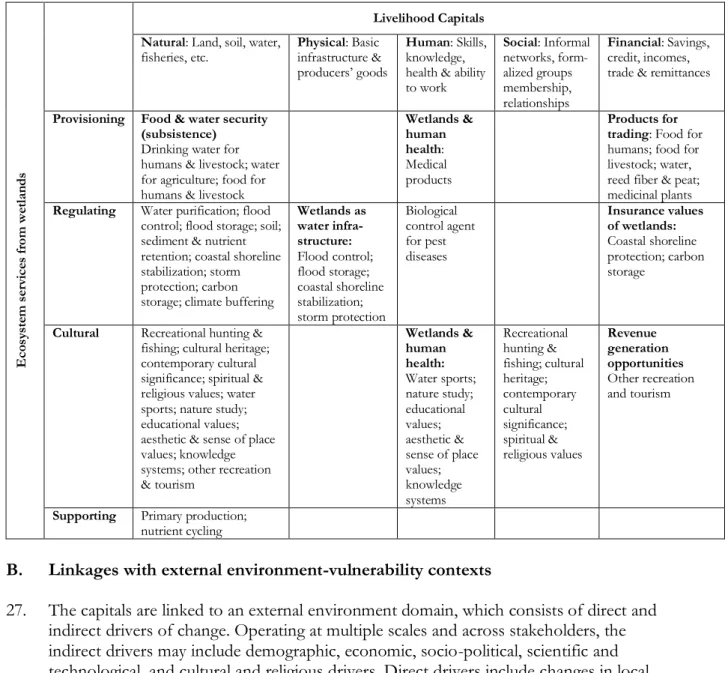
26. Ecosystem services from wetlands are flows parallel to those from other livelihood capitals. While forming a part of the natural capital, these services, through transforming structures and processes, contribute to all other forms of capital. An understanding of these interactions helps to conceptualize the extent to which wetlands can contribute to poverty reduction for a given livelihood system. Maintenance of ecological character forms the basis of the continued provision of these ecosystem services to people. A mapping of wetland ecosystem services and livelihood capitals is provided in Table 1.
5 These are further described in DFID (UK Department for International Development) (2001)
Sustainable Livelihoods guidance sheets. Downloadable from www.eldis.org/index.cfm?objectid=
Table 1. Linking wetland ecosystem services to livelihood capitals Ec os ys te m se rv ic es fr om w etl an ds Livelihood Capitals Natural: Land, soil, water,
fisheries, etc.
Physical: Basic infrastructure & producers‟ goods
Human: Skills, knowledge, health & ability to work
Social: Informal networks, form-alized groups membership, relationships
Financial: Savings, credit, incomes, trade & remittances
Provisioning Food & water security (subsistence)
Drinking water for humans & livestock; water for agriculture; food for humans & livestock
Wetlands & human health: Medical products Products for trading: Food for humans; food for livestock; water, reed fiber & peat; medicinal plants
Regulating Water purification; flood control; flood storage; soil; sediment & nutrient retention; coastal shoreline stabilization; storm protection; carbon storage; climate buffering
Wetlands as water infra-structure: Flood control; flood storage; coastal shoreline stabilization; storm protection Biological control agent for pest diseases Insurance values of wetlands: Coastal shoreline protection; carbon storage
Cultural Recreational hunting & fishing; cultural heritage; contemporary cultural significance; spiritual & religious values; water sports; nature study; educational values; aesthetic & sense of place values; knowledge systems; other recreation & tourism Wetlands & human health: Water sports; nature study; educational values; aesthetic & sense of place values; knowledge systems Recreational hunting & fishing; cultural heritage; contemporary cultural significance; spiritual & religious values Revenue generation opportunities Other recreation and tourism
Supporting Primary production; nutrient cycling
B. Linkages with external environment-vulnerability contexts
27. The capitals are linked to an external environment domain, which consists of direct and indirect drivers of change. Operating at multiple scales and across stakeholders, the indirect drivers may include demographic, economic, socio-political, scientific and technological, and cultural and religious drivers. Direct drivers include changes in local land use and cover, species introduction or removal, technology adaptation and use, external inputs, harvest and resource consumption, climate change, and other natural, physical, and biological drivers.
C. Livelihood strategies
D. Institutions and freedoms
29. The capability to access livelihood capitals is influenced by institutional arrangements, formal and informal (referred to in DFID 2001as transforming structures and processes). Inequality in access to resources, often attributed to scarcity, as well as opportunities of value addition, create incentives for powerful groups to gain privileged access by influencing political, economic and social institutions that govern their access,
management, and use. The ability to create, revise, and/or modify institutions is linked to the degrees of freedoms in the community. These freedoms play an important role in providing space for the poor to define their rights and create institutions that will ensure and fulfil fair distribution of rights, finally leading to an ability to make their own choices for self-determination.
30. Six broad categories of freedoms6 have been articulated as:
i) participative freedom which allows people to be involved in an active manner without intimidation or fear in deciding issues related to their well-being;
ii) economic facilities, enabling people to convert ecosystem services for production and exchange;
iii) social opportunities such as arrangements societies make for education, health and other related sectors in order to allow people to live better lives and be productive members of society, with specific reference being made to gender equality;
iv) transparency guarantees, encouraging openness and trust;
v) protective security, creating safety nets against adverse events that make individuals helpless; and
vi. ecological security, the minimum levels of ecosystem services required to sustain livelihoods.
E. Human well-being outcomes
31. The livelihood strategies finally lead to a livelihood outcome, or change in well-being status. A strategy can therefore be leading to a certain change in poverty status depending upon the changes induced in the five broad elements of human well-being, i.e., the necessary material for good life, health, good social relations, security, and freedoms and choice.
32. The sustainability of the wetland-livelihoods interlinkages can be assessed for a livelihood system in terms of achieving at least three preconditions:
6 For a detailed discussion, refer to UNEP-IISD (2004). Exploring the Links: Human Well-Being, Poverty
i) Internal sustainability, when there is the ability to cope and recover from stresses and shocks and maintain or enhance capabilities and assets both now and in future;
ii) Social sustainability, when the livelihood of others are enhanced, or not diminished; and
iii) Ecological sustainability, when there is no depletion or disruption of ecosystem services to the prejudice of livelihoods and the well-being of others, now or in future. Inherent in this definition is that livelihood systems are enabling maintenance or enhancement of wetland ecological character.
IV. Response strategies
33. The framework for integrated assessment of wetland-livelihoods interlinkages can be used to develop response strategies for addressing unsustainable wetland-livelihood
interlinkages by identifying causative factors at the levels of framework elements.
34. A suitable problem analysis tool – for example, the
Driver-Pressure-State-Impact-Response (DPSIR) framework – can be employed to identify the causal links between the human well-being outcomes and various framework elements.
35. Although any specific intervention will vary depending on the characteristics of the site-level interaction, it is understood that a multiscalar response strategy will be required that involves multiple stakeholders. The wetland management planning processes and the enabling institutional arrangements would need to ensure that sufficient linkages are maintained to be able to initiate and implement these response strategies to achieve desired wetland management and poverty eradication outcomes.
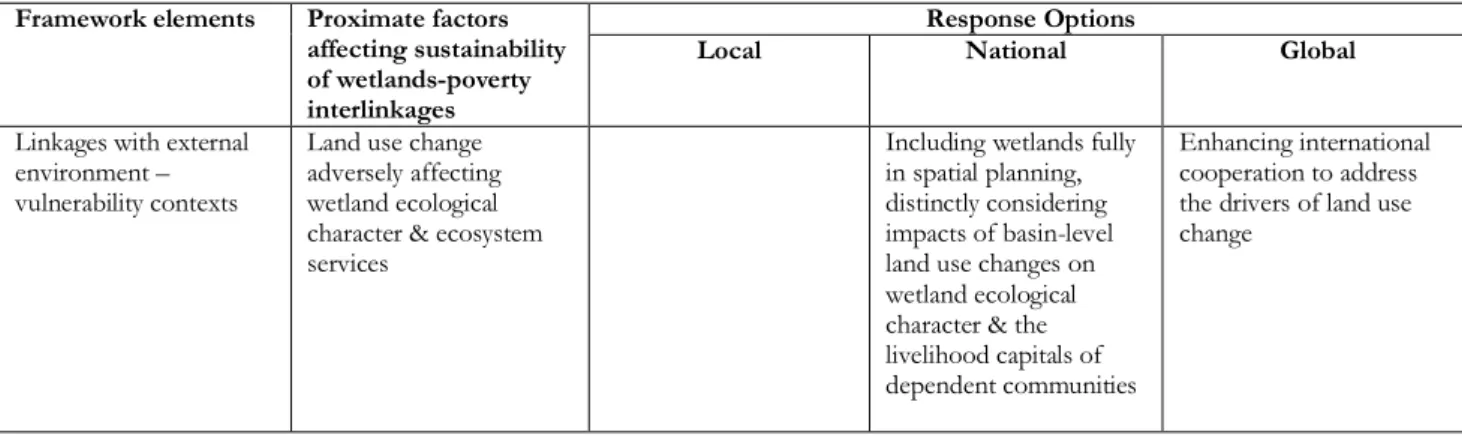
36. A generic response framework for addressing wetland-poverty interlinkages based on the framework elements is provided in Table 2. The response options can form the basis of development of a set of indicators for assessing the sustainability of wetland-livelihoods interlinkages for poverty eradication.
Table 2. A generic response framework for addressing wetland-poverty interlinkages based on the framework elements
Framework elements Proximate factors affecting sustainability of wetlands-poverty interlinkages
Response Options
Local National Global
Linkages with external environment – vulnerability contexts
Land use change adversely affecting wetland ecological character & ecosystem services
Including wetlands fully in spatial planning, distinctly considering impacts of basin-level land use changes on wetland ecological character & the livelihood capitals of dependent communities
Livelihoods-wetland ecological character interactions
Degradation of wetlands leading to negative impacts on livelihood capital base
Resource use practices negatively impact wetland ecological character
Improving measures to access & develop capacity of communities to sustainably use wetland resources based on wise use principles
Rationalizing incentive systems to promote wetland ecosystem stewardship
Ensuring that wetland management planning processes provide opportunities for sustainable livelihoods for wetland communities Integrating the conservation & wise use of water & wetlands into national poverty reduction strategy papers Creating partnerships between wetland managers, indigenous peoples, local
communities & national level policy planners to ensure that local perspectives & existing sustainability strategies are respected
Establishing financial mechanisms that improve wetland management as well as contribute to tangible poverty reduction
Ensuring that gender equality & sensitivity are taken into account in sustainable wetland management strategies
Developing new financial mechanisms for wetland management as a means of addressing poverty alleviation / reduction / eradication
Livelihood strategies Lack of capacity of
wetland communities to access livelihood capitals, including wetland ecosystem service flows